




Abstract
A tourist’s cultural construction of nature can shape their nature sports experience. It can also impact how they perceive the destinations where they engage in nature sports. This ethnography identifies how international tourists on a surfing trip in Australia draw on their cultural knowledge of nature to assign meaning to their experiences and surroundings. The nature sports experience is influenced by three types of cultural knowledge applied to nature: declarative, evaluative, and procedural. Interaction with nature activates that knowledge. Theoretical contributions include offering a comprehensive explanation for how cultural knowledge of nature can transform the nature sports experience and providing a more complete picture of how cultural knowledge impacts the tourist’s interpretation of a destination. Applied implications involve drawing on different types of cultural knowledge to create compelling nature sports and destination promotion campaigns.
Introduction
While the natural world and natural landscapes (noted herein as “nature”) are often thought of as part of physical space, they are also socially and culturally constructed (Macnaghten & Urry, 1998; Ponting & McDonald, 2013). Interestingly, extant research has yet to examine how a tourist’s culturally informed understanding of nature can shape their nature sports experience. This ethnography examines how international tourists on a surfing trip in Australia draw on their cultural knowledge of nature to interpret the surroundings. The research identifies how nature sports tourists deploy declarative, evaluative, and procedural cultural knowledge when interpreting nature and associated entities (such as people and place) and how this impacts their experiences. The primary goal of the work is to theorize how culture permeates the nature sports experience and add depth to our knowledge of how tourists understand destinations.
Nature sports form a subset of the sports tourist experience where the experience of nature is central to the activity (Weed & Bull, 2009). Sports such as surfing, cycling, free diving, snowboarding, hang gliding, kayaking, sailing, and mountain and rock climbing involve dynamic interaction between participants and various elements of nature such as rivers, waves, oceans, mountains, forests, snowfields, rock faces, and associated forces and conditions such as gravity, swell, thermal currents, wind, rain, and sun (Melo & Gomes, 2017). Nature sports experiences involve significant challenges, tensions, dangers, unpredictability, thrills, and excitement (Beverland et al., 2010).
Critically, these experiences are also unique because the interpretation of nature is influenced by cultural knowledge held by the subcultures that form around these sports, including the shared values, beliefs, ideas, rituals, traditions, and language of these subcultures (Canniford & Shankar, 2013). However, despite recognizing that this knowledge is pervasive, and that nature is fundamental to the experience (Ford & Brown, 2006; Melo & Gomes, 2017; Rickly-Boyd, 2012a), the application of cultural knowledge to nature is yet to be examined in the nature sports context. We developed a two-part research question: How do nature sports participants deploy their cultural knowledge of nature, and how does activating this knowledge shape the nature sports experience?
The paper is organized as follows. We examine the sociological perspective of cultural knowledge, consider its relevance to the broader tourism literature in relation to destinations, and review the literature on nature sports to establish our current understanding of cultural knowledge in this context, including how it may impact the tourist experience. We follow this with an explanation of the ethnographic method, the research findings, and a discussion of our contributions to the literature.
Literature Review
The Sociological View of Cultural Knowledge
The sociological view of cultural knowledge considers how culture influences meaning-making and social interaction based on how it is stored and deployed (Lizardo, 2017; Patterson, 2014; Swidler, 1986). Knowledge is cultural in that it is externally represented and shared, dynamically reproduced yet stable, consists of information about the world that is informative and meaningful, and enables people to make sense of things and each other (Patterson, 2014). Cultural knowledge is rooted in objects, language, metaphors, and various signs used in communication (Lizardo, 2017), and frames meaning in social contexts. It may be general or extensive and must be understood in context to establish how it is assigned to experiences (Lizardo, 2017).
Cultural knowledge also relates to knowledge of culture in an anthropological sense. This includes knowledge of entities like nature and place that are inscribed with values, beliefs, ideas, and meanings and associated with symbolic practices, traditions, and rituals steeped in cultural significance (Arnould & Thompson, 2005; Patterson, 2014). With this in mind, we use the terms “culture” and “cultural” as they relate to shared knowledge and knowledge of culture from the anthropological perspective.
The sociological view recognizes various cultural knowledge structures, such as declarative, procedural, and evaluative knowledge. Declarative cultural knowledge pertains to shared facts and events (Patterson, 2014), is held internally, and is expressed through language and discourse. It also manifests externally in the case of institutions, artifacts, and natural phenomena and forms part of lay or folk knowledge as a shared understanding of the “what.” In the context of the research reported here, this may include “waves,” “beaches,” or “coastline,” and related entities such as the “Australian surfer.” Although declarative cultural knowledge is based on shared facts about real-world entities or events, these “facts,” entities, and events can be culturally and personally significant, for example, in the case of information relating to a beach, or ritual performances, like checking the surf before going into the sea. Hence, related knowledge and ideas will often be subjective (Canniford & Shankar, 2013).
Evaluative knowledge relates to values and norms that valorize propositions about the world (Swidler, 2013). Values are shared principles that orient judgment and choice and drive action and emotion, while norms are rules and expectations that prescribe and prohibit (in)appropriate ideas and actions. Procedural knowledge relates to processes or skills that enable the completion of actions or tasks (Patterson, 2014). Where declarative knowledge relates to what defines a mountain slope, procedural knowledge explains how to ski that slope and related ideas about the experience.
The Cultural Knowledge of Destinations
Cultural knowledge has been considered primarily in quantitative research examining destination knowledge and destination image. Destination knowledge relates to cultural knowledge as it incorporates shared beliefs, ideas, information, and imagery generated by the tourism industry, popular culture, mainstream and travel media, and word-of-mouth communication (Caton & Santos, 2008). Research has examined the impact of this knowledge on various destination decisions and experience elements (Huang et al., 2016; Yamashita & Takata, 2020).
In the case of destination image, particularly where it relates to prior knowledge of a destination held by those yet to visit (Gartner, 1993; Phelps, 1986), the notion of image and how it is measured closely resembles cultural knowledge in that it is made up of general beliefs, ideas, and impressions of a destination (Crompton, 1979; Kock et al., 2016). Researchers have examined destination image as a type of knowledge, such as visual knowledge (MacKay & Fesenmaier, 1997), and measured a wide range of destination perceptions, motivations, and decision elements such as willingness to visit (Chaudhary, 2000; C. F. Chen & Tsai, 2007; Kock et al., 2016; Michaelidou et al., 2013).
While this research offers valuable insight into how destination knowledge can impact perceptions and behaviors, it does not account for the fact that cultural knowledge can take different structures and form part of a shared identity, two key elements that influence how it is deployed (Patterson, 2014). It is also particularly limited in explaining how tourists assign meaning to a destination when drawing on that knowledge or how this permeates their experiences.
Cultural Knowledge of Nature and the Nature Sports Experience
We consider nature sports holistically and include not just the physical act but the broader set of social interactions and associated experiences (Melo & Gomes, 2017). Research dealing with the experience of nature in nature sports has focused on motives and embodied experiences such as adventure (Folch-Serra, 1990), sensation-seeking (Pizam et al., 2002), risk-taking (Fave et al., 2003; Stranger, 1999), transcendence (Watson, 2007), thrill (R. Buckley, 2012), euphoria (Houge Mackenzie & Brymer, 2020), flow (Arstila, 2012; R. C. Buckley, 2018), and benefits such as existential authenticity (Rickly-Boyd, 2012b).
This work offers insight into how nature is experienced at a sensory level and related benefits. However, embodied experiences of nature can produce active meaning-making (Brymer & Gray, 2010; Hanna et al., 2019; Trauer, 2006), and in this regard, cultural knowledge can have a significant impact (Gebauer, 1993; Tuan, 1993). Two broad themes emerge from the literature regarding the cultural knowledge of nature. The first involves how the tourism industry, media, and tourists infuse nature with values and myths. The second concerns how knowledge of nature can shape the nature sports experience.
The agency of the tourism sector to create worlds within the natural environment is a feature of the nature sports context. The tourism industry, sports and travel media, and popular culture draw heavily on the romantic view of nature (Canniford & Shankar, 2013) to imbue it with cultural values and codes such as the “sublime,” remote,” “wild,” “transcendent,” and “authentic” (Bell & Lyall, 2002; Ford & Brown, 2006). Infusing nature with values is used to evoke ideas of escape, thrill, pleasure, and self-fulfillment (Frost, 2021; Laing & Crouch, 2009).
A common way the tourism industry appropriates nature in the nature sports context is to draw on notions of masculinity (Pitches, 2020; Wheaton, 2003). Sometimes labeled the anthropocentric perspective, this includes depicting nature as a force to be conquered (Shoham et al., 2000). Whether rock climbing, base jumping, skydiving, surfing, sailing, or mountain biking, nature’s power or unboundedness is emphasized to impart ideas about physical and mental strength, courage, endeavor, challenge, commitment, risk-taking, and triumph (Frison-Roche & Jouty, 1996; Palmer, 2002). The names given to places of renown also help to embed cultural values, such as mountains known as the “edge” or big-wave surfing at “mavericks,” “gladiators,” or “shipwrecks” (Ford & Brown, 2006).
Framing nature as a sacred environment is another way the media and tourism industry produces cultural knowledge. For example, the mountains that host the Tour de France are sacralized based on the professional cycling events held there and the fact that these mountains have been the subject of powerful myths and imagery for over a century (Lamont, 2014). Tourism agencies also generate cultural knowledge by promoting iconic natural environments as places that offer extraordinary sports experiences (Brookes, 2001; Pitches, 2020).
It has been suggested that experiences filtered through culture may be lesser than sensorial, embodied experiences because nature embedded with cultural meaning by the tourism industry can render it passive, inert, or inauthentic (Booth, 2019; Ponting, 2017). This is also consistent with the idea that the tourism industry reproduces essentialized versions of nature (Bell & Lyall, 2002; Ponting & McDonald, 2013), and further highlights the value of better understanding the role of cultural knowledge in the lived experience of nature.
Two areas where the influence of cultural knowledge is dealt with relate to specialist knowledge and technological advancements. Participants in nature sports subcultures share specialist knowledge about nature’s power, surfaces, form, and conditions, which can alter how they interpret experiences (Melo & Gomes, 2017; Wheaton, 2003). The use of technology also frames how nature is understood. For example, advancements in climbing apparatus and the grading of mountains (or routes) by climbers and the media have shifted the status of certain places; influenced where participants go and what they pay most attention to during and after the experience; and forged ideas about what constitutes challenging peaks and authentic experiences. It has also impacted how skills and competencies are understood and how climbers rate performance (Bonington & Salkeld, 1994; Rickly-Boyd, 2012a). In the surfing context, the introduction of jet skis for surfing giant waves and wave pools has sparked questions about what defines surf, waves, and wave riding (Johnston & Edwards, 1994; Ponting, 2020).
There is limited research that directly examines how cultural knowledge of nature impacts the nature sports experience. Ponting (2009) analyzes the power of surf media to create idealized surfing spaces containing waves, uncrowded conditions, adventure, and an exotic, pristine environment. This work describes how surfer tourists are influenced by cultural knowledge to the extent they expect quality waves in pristine environments and focus on taking photos of idyllic conditions. In an extension of this research, Ponting and McDonald (2013) study how the tourism industry, surf tour providers, and surfers construct the surf-tour space by co-producing myths associated with “nirvana.” While they offer some explanation of how cultural knowledge is created, they do little to examine how tourists assign it to their experiences. This and other research that considers the construction of nature in the nature sports context (Pitches, 2020; Preston-Whyte, 2002; Rickly-Boyd, 2012a) fails to explore culture-in-action (Swidler, 1986) in terms of how the tourist’s cultural knowledge of nature can bring meaning to the experience.
Method
An ethnographic approach was adopted to understand how cultural knowledge could structure the meaning of nature as part of the nature sports experience. This involved paying attention to (sub)cultural elements, including values, traditions, rituals, language, and meaning when it came to nature and how it was experienced, and incorporating in-depth interviews, observation, and informal conversations with international tourists for whom surfing formed an integral part of their travels in Australia.
The research occurred primarily in Victoria, Australia, although two interviews and a shorter observation period occurred in Sydney. The study formed part of a large grant involving a major international surf brand. This provided an opportunity to conduct four interviews in California with tourists who had traveled to Australia to surf. Interview participants were sourced by an agency attached to the international surf brand, through interactions at social events, and as part of snowball sampling. Before discussing data collection and analysis, a brief background of the surf culture and the relevance of surfing and nature to Australia is provided to highlight the relevance of the context.
The surf culture has a unique understanding of nature, including the coast, beach, and waves, and how the surfer and the act of surfing connect with nature. This extends to a sense of freedom, a casual demeanor, a love of adventure and the coast, beach, and waves, and distinct motives for surfing (Kampion, 2003). Related ideas and associations have been reproduced through movies (Endless Summer, Point Break, Blue Crush), magazines (Surfer, Tracks, Surfing Life), novels (Mark Twain’s Roughing It, Jack London’s The Kanaka Surf, Tim Winton’s Breath), music (Beach Boys, Jan and Dean), places (Waimea, Uluwatu, Bells, Pipeline), fashion (Hawaiian shirts, board shorts, baggies, bikinis), dance (The Stomp), language (“dude,” “stoked,” “far out,” “wipeout,” “hang loose”), and brands (Billabong, Quiksilver, Rip Curl).
Australia is presented in surf and travel media as a priority destination because of its rich surfing history, vast coastline, and abundance of quality waves (Booth, 2001). The surf culture also carries cultural meanings that are consistent with tourism industry discourse about Australia’s natural world. For example, associations are drawn between Australia’s beaches, an outdoor lifestyle, and the idea of Australians possessing a relaxed disposition (Waitt, 1997). More broadly, the tourism industry has focused on Australia’s natural assets, such as its coastline, “bush,” outback, and wildlife, to market the destination. Consistent with the idea of Australia as a land of wide-open spaces, Australians are stereotyped as being surrounded by nature, and at home in nature, whether the bush, beach, or outback; and Australia’s coast and beaches are promoted as being clean, blue, pristine, rugged, vast, mysterious, and dangerous in terms of powerful waves, undertows, and sharks (Ellison & Hawkes, 2016).
Data Collection
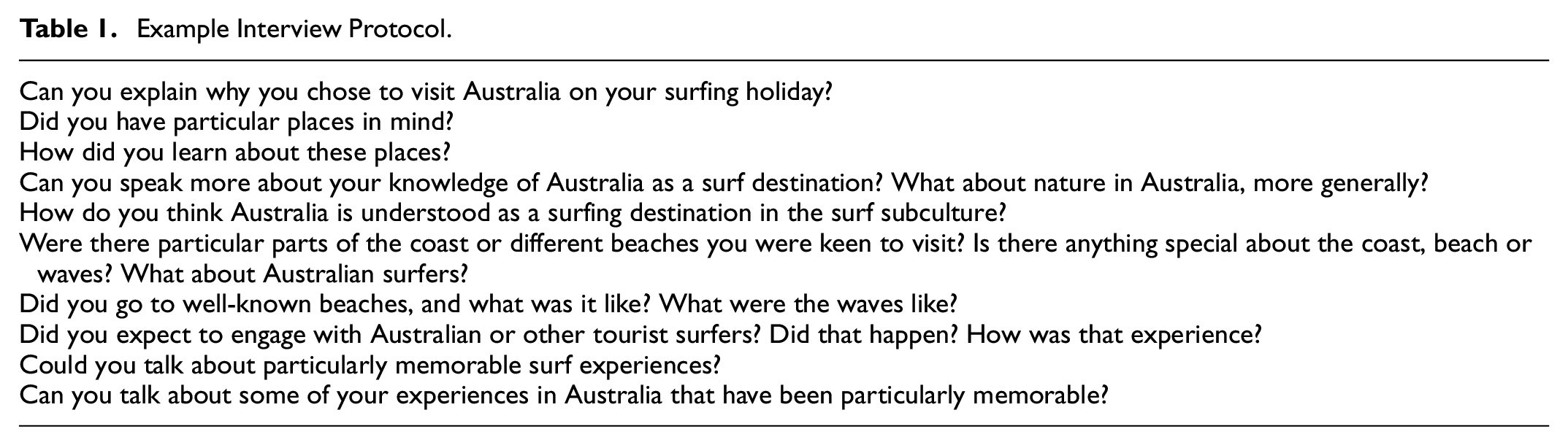
We collected our data primarily through interviews and observations. We conducted 27 in-depth interviews lasting between 30 and 90 min. Sixteen of these interviews were with tourists who had been or were on a surfing trip to Australia. They were aged between 16 and 48, and came from the USA, the UK, France, Japan, and New Zealand. The interviews utilized a mix of grand tour questions and floating prompts (McCracken, 1988). They commenced with broad questions, such as the motivation for going on a surfing trip to Australia, to enable informants to engage with the conversation before focusing on specifics such as their thoughts about the surf, surf places, their surfing experiences, and surfing-related social experiences in Australia (refer to Table 1 for additional interview questions). One of the authors has been a surfer for over 20 years and this helped to understand the context and gain rapport. The notion of cultural knowledge was used as a sensitizing concept (Blumer, 1956) when it became apparent that informants were deploying distinct types of shared knowledge. To provide added perspective to the views expressed by the international surfer tourists, we also interviewed six local surfers and five managers of a major surf brand (these are not referenced due to space constraints).
Example Interview Protocol.
Our second key source of primary data was derived from field observations in three surf regions of Victoria, Australia carried out over 5 years (Victoria is known for plentiful surf, famous surf breaks, world-class waves, and surf competitions). The observations formed a vital part of the research in four ways. First, the research involves gleaning nature-related knowledge, meanings, interactions, and experiences from an insider perspective. This required being in the field for a prolonged period (Schouten & McAlexander, 1995). Second, the subject matter was observable within a setting (coast, beach, surf, etc.) that was not created or manipulated by the researcher (Jorgensen, 1989). Third, the researcher could access the setting, which was “frontstage” in the way it projected meaning (Goffman, 1959). Fourth, as discussed below, studying cultural knowledge applied to nature benefited from data gathered through observation and interaction with informants in the focal setting, combined with in-depth interviews. The observation component of the research enabled thick descriptions of nature in the physical sense and how it features in stories, ideas, actions, events, incidents, and explanations.
We documented over 45 hours of observation at beaches and coastal spaces and at international and State surf competitions, surf club events, parties, barbecues, and backpacker hostels where international surfer tourists were staying; and held many informal discussions with international tourists, local surfers, and individuals responsible for holding surf events. We employed three modes of observation: participant, unstructured and structured (Merriam, 1998). Participant observation took place at surf events, surf shops, parties, and barbecues and observing surfers while in the surf. We included unstructured observation to capture data in an open and holistic way, especially the physical setting, people, conversations, interactions, and relationships. Structured observation enabled us to focus on critical aspects of the research and to make the process more effective and efficient (Angrosino, 2007). This included observing incidents or interactions where tourists were discussing people, places, or the focal act in relation to the natural environment. The structured observations were aided by a template (Spradley, 1980) which included setting, nature type or attributes, actors, activities, interactions, knowledge, explanations, and emotions.
We supplemented the interview and observation data with secondary data, including advertising campaigns, commercial research reports, stories in the media, and surf magazine articles that discussed surfing in Australia, including in Surfer, Tracks, and Surfing World magazine.
Data Analysis
Ethnography entails observing and analyzing behavior in naturally occurring conditions (Belk et al., 1988), and grounded theory performs best with data generated in natural settings (Charmaz, 2014; Robrecht, 1995). Due to this methodological fit, we followed grounded theory principles to analyze our ethnographic data (Burton, 1997; Charmaz & Bryant, 2010).
Following Charmaz (2014), we carried out open and focused coding of the observation and interview data. This method of coding is highly regarded for allowing deep and grounded analysis of the data without relying on multiple analytical steps in the move to higher-order themes that may impose unnecessary structure and potentially distance the codes from informant meaning and action. In total, interview data, and data from observation, informal discussion, and other sources, amounted to over 450 single-spaced pages of data. As part of the analysis, we combined thick descriptions of observations with informant ideas from the interviews. This was important in the constant comparison between passages and preliminary codes from the observations (which revealed the ontology of the international surfer) and the interviews (which added depth to the content of that reality). For example, we compared the meaning of and emotional responses to the iconic “beach” gathered through observation with inferences about Australian surf conditions or Australian surfers identified in the interview data. This also allowed us to compare the natural unfolding of an experience with sensemaking evident in the interview data to examine cultural knowledge. The approach was particularly valuable given the lack of empirical research into types of cultural knowledge and the need to develop the content, meaning, and conceptual relevance of these constructs (Charmaz & Bryant, 2010).
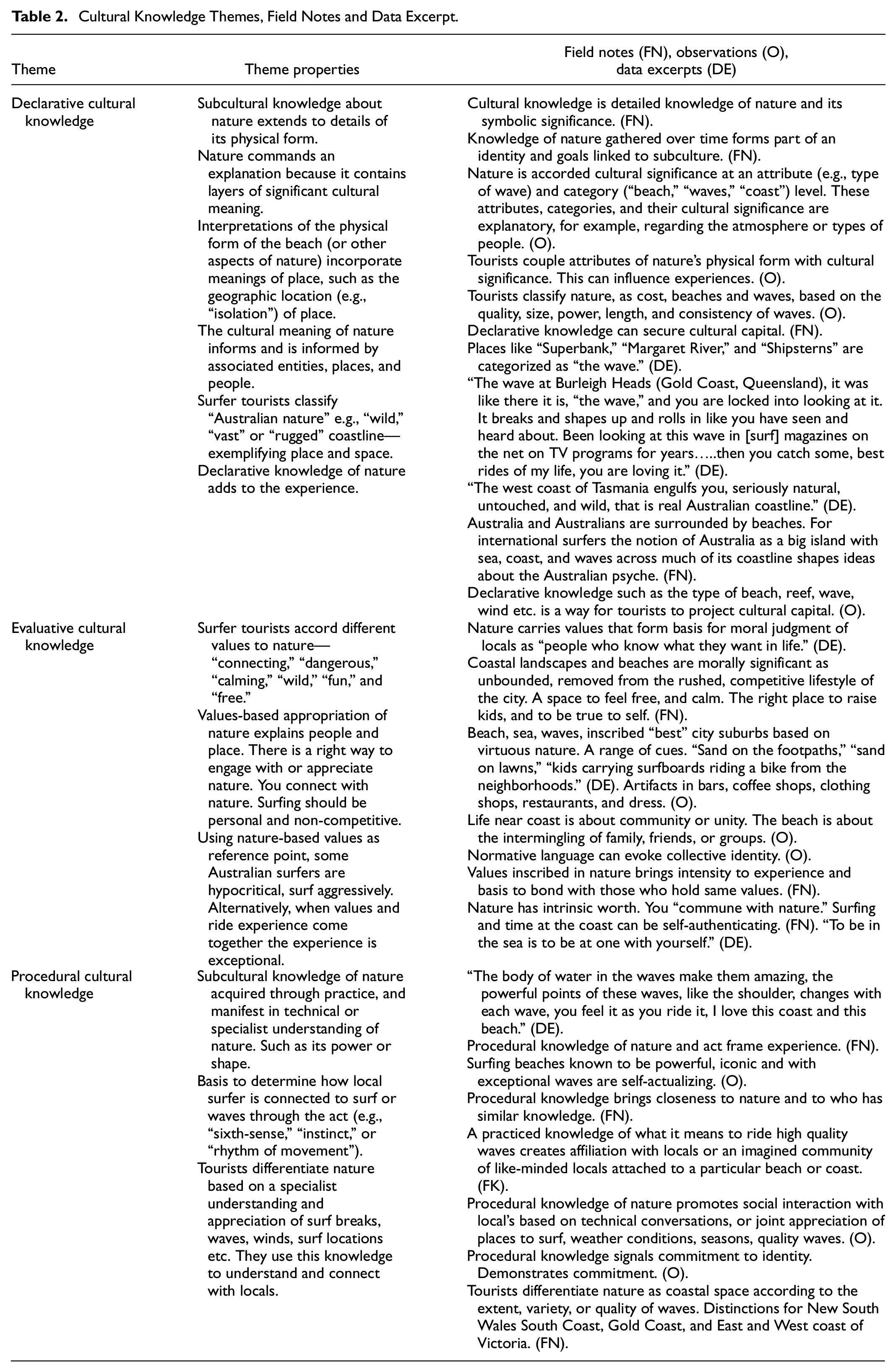
We moved between data, preliminary codes, and the literature as part of an ongoing iterative process and cycled back and forth between the development of the theory and data analysis. We reached saturation when it was clear that information emerging from informant stories did not contribute further theoretical insights. Excerpts of data, field notes including observations, and related ideas supporting themes, are provided in Table 2.
Cultural Knowledge Themes, Field Notes and Data Excerpt.
Issues of research trustworthiness were addressed through standard criteria: credibility, transferability, dependability, confirmability, fit, and reflexivity (Lincoln & Guba, 1985). The period in the field ensured adequate time to develop a comprehensive picture of the context, build trust with informants, gather rich data, and test interpretations and ideas. We traced our field notes at different points of the research to examine the fit between our interpretations and informant sentiments (Charmaz & Bryant, 2010). Three informants were provided with interpretations of the data to examine if they were an accurate reflection of what was discussed.
The researchers held regular meetings during the analysis. They coded independently and compared labels, interpretations, and emerging codes. Descriptions from the field were compared with findings in the literature to consider further the truthfulness of data capture and interpretation based on its potential relevance in other nature sports contexts. Triangulation of the data was carried out to improve analytic rigor and the validity of the insights and themes based on a search for convergence among the different sources of information (Charmaz, 2014). This also included assessing divergent accounts of informant assessments present in the data.
Findings
Specific types of cultural knowledge drawn from the surf culture underscored tourist accounts of nature and related experiences, identities, and places. This includes nature as declarative cultural knowledge; evaluative, values-based cultural knowledge; and procedural knowledge. The data presented focuses on rich interpretations of informant passages to explain how cultural knowledge of nature is represented and experienced at the emic level.
“The Beach”: Nature as Declarative Cultural Knowledge
Declarative cultural knowledge framed how surfer tourists interpreted nature in Australia in terms of what constituted and differentiated the “beach,” “waves,” “sand,” “coast,” and other attributes of nature. This was important not just for understanding what nature contains and explains, but because delineating nature in this way significantly impacted the tourist experience.
Declarative cultural knowledge was most evident in the case of iconic nature, as related knowledge was loaded with detail and significance. Accessing declarative knowledge activated intense meaning-making and amplified the emotional impact of the experience. Samantha (USA) offered a personal account of visiting Bells Beach. Located in Western Victoria, “Bells” is an iconic beach for surfers because of the quality, shape, and power of its waves and because it has been the location of an annual international surfing championship event for almost 50 years (Doherty, 2016).
Over the years, the stories, videos, pictures, magazines and stuff….so we park the car, walk up to it, and “bang”! Seeing it, looking down [over the beach], the rock ledge, the sea, and the waves. That first experience, taking in the whole beach, the [surf] break, the rides, the history, it is like this is “the beach.” There were good waves that morning, long waves sweeping in, and how the guys could surf, and the people were buzzing. This is Bells. I wanted to come here for so long… and when you do get some great waves, everything multiplies the feeling, [it] is just so special.
Iconic nature is a potent example of how declarative cultural knowledge could influence how nature is understood and experienced. The tourist’s detailed knowledge played a significant role in what they were attentive to and why they were compelled by nature’s physical form and cultural significance. Icons are objects that stand as a quintessential representation of a category based on their material attributes and cultural importance (Farrelly et al., 2019), which Samantha encapsulates as “the beach.”
Inductive analysis building on definitive categorizations such as “the beach,” “the coast,” “the wave,” and “the reef” revealed that tourists were particularly moved when experiencing iconic nature for the first time as they simultaneously engaged with its compelling physical form and surf-culture-infused knowledge of that form (also refer to Table 2). In this case, declarative knowledge is reflected in the focus given to key attributes of the beach, waves, and surfing (noted herein as “the focal act”) and the symbolic elements, most notably the history and status of the beach. Samantha’s feelings of awe and excitement were also due to experiencing these aspects of the beach while having her expectations affirmed.
Declarative knowledge also shaped the experience in the way Samantha determined that the good waves created the atmosphere (“buzzing”) and how social status was understood in the context of nature and the focal act (“long waves sweeping in,” “great surfers,” and “serious rides”). As a member of the surf subculture, validating the symbolic meanings attached to nature, including what she had been exposed to through stories, videos, pictures, and magazines “over the years,” also reinforced her sense of self, especially as visiting this beach had been a long-standing identity goal. Cultural knowledge of nature also influenced how informants like Samantha interpreted Australia and Australian culture. Another reason Samantha is so moved is that she draws on her knowledge of the beach as a powerful representation of the Australian way of life. This representation is influenced partly by the tourism industry, which has repeatedly used narratives and imagery of the beach to capture the desirability of Australia and Australian identity (Booth, 2019).
The findings also highlighted how declarative cultural knowledge of nature extended to place. Surfer tourists would categorize nature according to its “Australianness.” As noted in Table 2, nature could be “wild,” “remote,” “vast,” and “heavy” (powerful), consistent with what exemplified the “Australian” coastline, beaches, or waves.
Moralizing Nature, Local People, Place, and the Focal Act: Nature as Values
The tourist’s cultural knowledge extended to the values they inscribed in nature and how this informed moral judgments about the focal act, people, and place. A common judgment involved the idea that the demeanor of residents, and the relaxed atmosphere of a place, could be attributed to growing up close to the beach, or beaches near the city.
Living in parts of the city like Coogee, Cronulla, and Avalon is a better life. They have surf beaches close to the heart [of the city]. Children learn to swim and surf at the beach, handle surf at a young age, spend so much time hanging [at the beach], and then surf clubs and local pubs when they are older. There is that coast feel. It is the whole place. If you are in Avalon, or other places in Sydney or Perth, the city is there, the beach is right there, and just the trees and sand and nature like that, your life is amongst that, so the people are happier and content. (Dominic, France)
Echoing the romantic view of nature as peaceful, pure, and authentic (Canniford & Shankar, 2013), tourists like Dominic held the view that the beach and coast shaped lifestyles, mindsets, and the atmosphere of the place. While people lived in a city, the fact that they spent so much time at and near the beach and coast explained why they were friendly, at ease, open, and had an attractive lifestyle (refer to Table 2).
Since its inception in the 1950s, the surf culture has also adopted core values of freedom and being “laid-back” or “chilled,” consistent with what it means to experience nature as a calming, spiritual and authenticating force (Kampion, 2003). Such values also came to the fore when tourists like Michael (UK) processed the beach, surfing, local surfers, and Australians.
Australians and the beach and outdoors, the relaxed vibe, you see that in the surf, right? No. It is a myth. Aussie surfers are fired up in the water. I did not expect it to be easy, but the jostling for waves. One time I was sure there would be a fight in the water; it was like, “Really, out here”? I go with the soul idea of surfing, just feeling good in the water, surf hard, sure, but enjoy the waves, don’t hassle….my other experiences and the same for whom I came with, when you are in Australia surfing these amazing beaches and [waves] and with the warm weather and Aussies who love the environment, and are chilled, it is bliss.
The two contrasting experiences emphasized in this passage were not uncommon. Subcultural values equating nature with freedom and being laid-back and related ideas about connecting to the beach, sea, and surf as a place to relax and escape the pace of the city (Ford & Brown, 2006) framed tourist expectations of the act, Australian surfers, and Australians (also refer to Table 2). In this case, they sharpened the ill feeling toward Australian surfers based on inappropriate behavior in the surf, such as “smashing out as many waves as possible” in a session, being aggressive, engaging in “snaking” (cutting in front of someone as they paddle for a wave), or “dropping in” (not giving way to the person who is about to take off or who has taken off closest to where the wave is breaking). These behaviors were considered to be particularly inappropriate because they were at odds with how Australian surfers should act, given their connection to nature. This discrepancy could also lead to frustration and disappointment as tourists felt they could not connect socially with Australian surfers because of how they behaved in the surf.
Michael’s mention of being “soul” expresses a values-based cultural knowledge of nature and helps to explain how this knowledge is linked to identity goals and why such experiences could be intense. The idea of the soul surfer identity originates from the “aloha” spirit and the sense of unity, freedom, community, and identity native Hawaiians draw from their deep connection with the sea and waves as a spiritual source (Kampion, 2003). Tourists who adopted this frame of reference emphasized the beach and surf as a “sanctuary,” “connection with the water,” surfing for pure thrill and enjoyment, and how important surfing was for their sense of self. When Michael’s value-inscribed view of beaches, surfing, Australia, and Australian surfers came together positively, the experience could be extraordinary.
“Knowing”: Procedural Knowledge of Nature
Procedural knowledge of the focal act, waves, and swell framed tourist experiences at surf events and in the surf, and ideas about local surfers and places. It also enabled bonding between tourists and locals. Hiro [Japan] spoke of attending a professional surf tournament at Bells Beach.
It was great on the beach at the Bells Pro [World Surf League Championship], sitting on the sand. There is this knowing, as these are seriously good waves and surfers, so everyone is just into it, yelling out as if there is a great ride or big wipeout. Because they get what these professional guys [are doing]. People know how good that wave is or to get that wave, or to ride it like that. There is a real buzz.
Celsi et al. (1993) speak of communitas among nature sports groups being rooted in the flow state of the core action experience. In this research, procedural knowledge, or “knowing,” enabled a sense of communitas on a larger scale. The fact tourists like Hiro could attribute the atmosphere at surf events to a real and imagined community (B. Anderson, 2006) of people with intimate knowledge of quality or powerful waves, what it takes to surf those waves, and the thrill of riding such waves made the event experience decidedly more engaging and affirming. Procedural knowledge could also impact experiences in the surf.
I was paddling out behind an Aussie who had just caught a heavy wave. It was bowling up right where he took off, and I thought you are reading this. I could tell by his movement [in the water] and placement at the spot [take-off section of the wave]. This guy could read how many waves were in a set and where bigger and smaller ones would break. These were tricky waves, moving around, and he had these waves sorted. And the rides he was getting. I managed to get onto a few [waves], and they were seriously good waves… the experience…. like wow. (Paul, New Zealand)
Ingold (2000) notes that people acquire procedural knowledge slowly through repeated practice, encoding, habituation and skill development in the field. This was most relevant to this research in the way the tourist’s approached nature, and how that filtered their understanding of the focal act, the other, and place (also refer to Table 2).
For Paul, categorizing dynamic attributes of swell and waves (“tricky,” “shifting,” “heavy,” “bowling up”) gave rise to ideas about knowledge, skill, technique, and bodily practice, as evident in the way he appreciated the capacity of the other to “read” the waves. Reading swell as it moves in from the horizon is an important skill. Reading the swell early means one can begin paddling before others, make it out beyond the breaking surf without getting held back or battered by incoming waves, and get to the right take-off spot first, which allows a better chance of catching the wave and gives the right of way. However, it is a challenging skill to master because the swell and where and when waves break change due to wind, currents, and tides.
Procedural knowledge of the surf informed notions of the right wave, surfing well, and the thrill of riding good waves. It also added meaning to flow experiences (Csikszentmihalyi, 1990) when coupled with ideas about Australian surf conditions and informed perceptions of how others reacted to the surf and performed the act. More broadly, procedural knowledge of nature, because it led to a purposeful approach to the act, could be emotionally charged because it carried over to people’s attachment or commitment to the act.
Nature as Layers of Cultural Knowledge and Dynamic Interpretation
Critically, the three modes of cultural knowledge of nature interact, as was apparent in the story conveyed by Max (UK):
I was surfing outside Port Campbell, on the west coast [Victoria], and it was big [waves], and I have been in quite big surf, but this place gets heavy waves, and the surf spot is away, like even from the small town. Australia’s Southern Ocean is wild and so away from everything, and the ocean is big, and the waves break a long way out at this place, and the shore is like just rocks and cliffs. The weather got darker, stormy, the water was dark, the waves were getting bigger, and I was going further out [to get over the waves before they break]. I was thinking, “this is scary.” I start thinking of sharks too. There were some Aussie surfers, and they would probably help. But these are hardcore surfers out here, so it is like, “Okay, it is up to me.”
Narratives like this one highlighted how the three forms of cultural knowledge could saturate an experience. In Max’s case, declarative culture is evident in the detailed way the material form of the ocean, sea, and waves present themselves, how their cultural properties are categorized, and how this heightens the intensity of the experience. Most notably in terms of the remote beach.
The idea of the remote sea and coastline as dangerous and foreboding has been captured widely in children’s and adult literature, popular media, folklore, and surf media for many years (Ford & Brown, 2006). For Max, the fear of large, powerful waves, dark water, and rocky coastline is exacerbated by the meaning he attaches to the remote place. Especially in the way he processes the surf break and coastline as being in a regional part of Victoria, part of the rough and vast Southern Ocean, and part of a country that is geographically removed from much of the world. Also significant is the fact that he was paddling further out to sea, which echoes the idea that the sea has zones and deeper water signifies a shift into the wild and into danger (Fiske, 1989). Compounding his fear is his values-based entangling of rugged nature and Australian surfer masculinity, suggesting he must rely on himself to manage the situation. Furthermore, procedural knowledge means he is acutely aware of the danger of big, powerful waves and what it could mean to get caught in surging water near rocky cliffs.
Adding to the impact of these interacting layers of meaning is that the cultural knowledge of nature is applied dynamically because of nature’s changing form. The sea, climate, and surrounding natural world are alive, immense, all-consuming, and shifting. As the waves get bigger and the weather becomes bleaker, various cultural meanings, including the ocean’s power, remoteness, harsh landscape, distance from shore, and what might be lurking beneath the water, take on greater significance and intensify Max’s fear and sense of isolation.
Discussion
We contribute to tourism literature by theorizing how cultural knowledge of nature impacts the nature sports experience and by developing our understanding of cultural knowledge more generally. In this discussion we elaborate on these contributions and link them to extant research.
The literature recognizes that different nature sports subcultures bring a unique cultural view to nature (Beverland et al., 2010; Ponting & McDonald, 2013; Rickly-Boyd, 2012a), though how this informs the tourist’s lived experience is not well understood. This research identifies how three forms of cultural knowledge applied to nature can transform the experience based on the form of knowledge, how it was acquired, and how the tourist’s interaction with nature activates that knowledge. Cultural knowledge had a marked influence on the commonly discussed qualities of the nature sports experience (Houge Mackenzie & Brymer, 2020; Melo & Gomes, 2017; Melo et al., 2020; Rickly-Boyd, 2012a). It shaped how international tourists gave meaning to their interaction with nature and how they experienced the focal act, including feelings of flow, fear, excitement, and transcendence. It also catalyzed ideas and experiences meaningful for the self, influenced social interaction and feelings of belonging, and how tourists evaluated people and places.
In terms of the types of knowledge, declarative cultural knowledge was significant in delineating the material and symbolic qualities of nature most relevant to the participant, the focal act, and the subculture. This was most apparent when surfer tourists visited iconic nature such as Bells Beach and processed the attributes of the beach, its symbolic meanings, and its importance to identity. Research dealing with iconic nature indicates a similar reaction, such as when tourists make a pilgrimage to the French Alps to ride on the same mountain roads as cyclists competing in the Tour de France (Lamont, 2014). Their interpretation of certain mountains and mountainous routes, the physical challenge, and the experience are influenced by how they understand the French Alps as a culturally significant landscape.
Evaluative cultural knowledge framed the nature experience through a moral lens. Drawing from the romantic view of nature (Canniford & Shankar, 2013), the tourist’s interpretation of people, place, and the experience of riding a wave, was influenced by the values they inscribed in nature. This extended to appropriate ways to engage in the focal act. It also carried over to people and places, such as the masculinity of Australian surfers and the rugged coastline as a quintessential expression of Australian nature. This reflects how the sea, outback, and bush have been linked with Australian individualism over time (Ellison & Hawkes, 2016; Waitt, 1997). Such connections have also been made regarding the historical association between large waves and masculinity in Hawaii and how this continues to place expectations on Hawaiian surfers (Ford & Brown, 2006), and in terms of long-standing myths about men braving large waves (Kampion, 2003
In the case of procedural knowledge, because it is acquired slowly and experientially in the surf, it provides tourists with a unique understanding and appreciation of the field of play, including coast, beach, swell, waves, conditions, and the act, and forms a basis for evaluating experiences. When international surfers linked their technical knowledge of the act, waves, and swell with their understanding of Australian surf conditions or well-known surf breaks, it could create a more immersive experience in the surf. It could also augment flow experiences (Csikszentmihalyi, 1990) when the meaning of having surfed a high-quality wave was linked to Australian beaches known for powerful or exceptional waves.
By drawing on their procedural knowledge of nature, tourists also connected with fellow surfers and places. Writers on nature sports discuss the communitas that comes with being in the company of others who possess intimate knowledge or appreciation of nature because they engage with the core activity (Celsi et al., 1993; Janowski et al., 2021). This was the case here, particularly in the way a procedural knowledge of nature and the act enabled international tourists to connect with locals based on shared understanding and appreciation of one’s commitments, capabilities, and surfing experiences.
Another crucial feature of cultural knowledge is the link to identity. Whether processing the physical attributes of nature or how it represents values, lifestyle, or capabilities, cultural knowledge constructed nature as a powerful marker of identity. Tourists utilized knowledge of nature’s physical form (locations, beaches, waves, sand banks, reef, coast, weather conditions), symbolic and normative significance, and the valued experiences it affords, to project and affirm the self. How the knowledge was acquired also shaped the link to identity and impacted the experience. For example, the application of declarative knowledge carried great weight because the significance of a particular beach or wave has been reinforced over time through exposure to surf media and the subculture. Applying procedural knowledge added emotional intensity to an experience because it was attained through many hours in the surf and speaks to commitment and progression. Knowledge of nature could also promote the sharing of stories between tourists and locals because that knowledge formed part of a shared identity.
The connection between cultural knowledge, identity, and place has been considered in the literature. McCabe and Stokoe (2004) investigate how tourists construct the meaning of a national park to make distinctions between member-identity categories; for example, “tourist,” “walker,” and “serious hiker”; and consider in general terms how this can connect place and identity. However, this research gives limited attention to cultural knowledge (beyond broad identity categories) and, like other research dealing with connections between place, identity, and experience (Campelo et al., 2014; Selänniemi, 2001), does not investigate how cultural knowledge permeates lived experiences.
The present research also contributes to our understanding of the cultural knowledge of destinations. Cultural knowledge relating to the image of a destination is typically considered in terms of the general beliefs, ideas and impressions tourists have of a destination (Gartner, 1993; Kock et al., 2016; Phelps, 1986). We establish that cultural knowledge of a destination is more complex than how it is represented in the literature. It can encompass broad knowledge of a destination circulated through popular culture, tourism, and word-of-mouth communication. However, it can also manifest as distinct knowledge structures that influence the understanding of a destination and the experience in different ways and for different reasons. We also draw attention to how cultural knowledge of a destination may be deeply held and have a marked impact on meaning-making and the experience because it is significant to the self and part of a shared identity. We also show that it can form the basis for engagement between tourists and locals. This complexity highlights the value of delineating cultural knowledge to reveal a richer view of the destination experience.
Managerial Implications
A key implication of this research for tourism bodies is to recognize how an in-depth appreciation of the tourist’s cultural knowledge of nature can produce new ideas about marketing a destination to nature sports enthusiasts. This includes how that knowledge informs ideas about people, places, and desired experiences and the creative possibilities this can present for promoting a nature sports destination. This could be particularly important given that the typical approach is to project ideal images of the sport in its natural setting, such as idyllic weather, surf conditions, and uncrowded waves (Ellison & Hawkes, 2016; Kampion, 2003), and because this narrow focus can create a sameness of destination images (Ford & Brown, 2006).
From a declarative cultural knowledge perspective, there is potential to weave together the symbolic aspects of iconic surf locations with explanation and evocative imagery of the attributes that define the beach and wave. A deeper appreciation of declarative cultural knowledge could also reveal how the coast, beach, or waves can be used as a metaphor for place, people, social interaction, and atmosphere. Understanding each knowledge structure can provide a window into the worldview of the nature sports participant, including unique values and attitudes that can support marketing communication.
Another reason for understanding cultural knowledge of nature is to differentiate the nature sports destination beyond the focal act. While that is important, it may not be sustainable in the case of surfing, given the crowding of waves across the world makes it difficult to make distinctions based purely on the wave riding experience (Kampion, 2003). To develop a more effective communication strategy, agencies could also benefit from focused ethnographic research regarding how nature, people, place, and the focal act are understood at the subcultural level. This could help develop insights into how nature sports subcultures understand themselves and how the same subcultures vary between countries (Akaka et al., 2022). This could help with segmentation and communication on a country-by-country basis and reveal insider language to communicate what is desirable about a destination. Significantly, major international brands across industries increasingly turn to ethnography to unpack the meaning of consumption at a cultural level to support product development, marketing communication, and branding (K. Anderson et al., 2017).
Limitations and Future Research
It is important to note the limitations of this study and opportunities for future research. Our qualitative findings cannot claim to be representative of the wider population. That said, it is probable that participants of nature sports subcultures traveling overseas to pursue their passions will possess extensive cultural knowledge of nature, including declarative, evaluative, and procedural knowledge, and that this is likely to have a significant bearing on the experience.
On the issue of future research, several ideas warrant further attention. National cultures regard nature differently and have unique perspectives of the natural world in other countries (Tuan, 1993). There is merit in exploring how the tourist’s cultural knowledge drawn from the home culture may influence how they understand nature in the destination and how this may shape the experience. This research was carried out before the Covid-19 pandemic, and in the case of nature sports tourists, the cultural knowledge of nature may have shifted. It has been noted that the meaning of place might have changed for adventure tourists, especially in places far removed from congested cities (Pop et al., 2022). Phenomenological research examining how this change may have intensified the significance of values ascribed to nature, such as remoteness, could reveal rich insights.
There is also potential to explore cultural knowledge in special interest tourism, such as eco (Wurzinger & Johansson, 2006), cultural (G. Chen & Huang, 2018), gastronomic (Richards, 2015), or spiritual tourism (Willson et al., 2013). Different types of cultural knowledge are likely to feature in these contexts and be applied to parts of place culture. In addition, the fact that cultural knowledge may form part of a shared identity and be activated to achieve identity goals could alter how tourists assign meaning to associated experiences and reveal meaningful insights.
Conclusions
There is a limited understanding of how cultural knowledge of nature can impact the nature sports experience. This research focuses on the experiences of international surfer tourists in Australia by examining how they assign cultural knowledge to nature and related entities, ideas, and experiences.
Cultural knowledge takes three dominant forms of knowledge that impact the tourist experience in different ways, including how they interpret nature, the focal act, social interaction, people, place, and how experiences are important for the self. Because cultural knowledge of nature can be complex, nuanced, and personal, it can add to the intensity, pleasure, and meaningfulness of experiences, including interactions with nature that affirm the self (Wang, 1999). Far from suggesting a more superficial encounter (Booth, 2020; Demeritt, 2002; Waitt et al., 2003), the coming together of culture and nature can significantly enhance the tourist experience.
These findings also contribute to the tourism literature beyond the nature sports context. The tourism industry, the media, and popular culture actively produce general knowledge of destinations, which can influence the tourist experience. However, this represents one facet of cultural knowledge and fails to account for the fact that it takes distinct forms and can carry personal and collective significance. This research develops our understanding of cultural knowledge and how it can transform the tourist experience.
Footnotes
Acknowledgements
We want to acknowledge Dr Pinar Cankurtaran, whose editing and insights helped to improve the manuscript considerably.
Declaration of Conflicting Interests
The author(s) declared no potential conflicts of interest with respect to the research, authorship, and/or publication of this article.
Funding
The author(s) received no financial support for the research, authorship, and/or publication of this article.
