




Abstract
This work extends Rosa’s theory of social acceleration drawing on empirical findings from a qualitative study of online dating. Due to an involuntary deceleration in the pace of life during the COVID-19 crisis, online dating platforms moved from being accelerated love markets where competitive consumers made short-term exchanges, to supportive networks that helped them establish long-term relationships. This transformation occurred because consumers experienced contingent social synchronization—a process of temporal realignment after an unexpected desynchronization in pace of life, technological change, and social change. In contingent social synchronization, online daters modified their interactions and unexpectedly formed stronger bonds within these accelerated markets, transforming their patterns of time investment and their temporal perception of love. The implications of contingent social synchronization are discussed for the functioning of love markets, therapeutic confessions, and consumption during crises.
Keywords
Introduction
In late modernity, consumers struggle to establish enduring relationships based on principles of altruism and cooperation because their interactions are usually embedded in accelerated and transactional dynamics in which bonds rapidly form and break (Bauman, 2003; Illouz, 2019; Rosa, 2013). In addition, the establishment of relationships is often influenced by the instrumental logic typical of economic exchanges as exemplified in courtship rituals of gift-giving (Belk and Coon, 1993; Bergström, 2021; Illouz, 1997; Tabet, 2004). The concurrence of these temporal and exchange factors, along with the time constraints of contemporary life, has created the perfect context for the emergence of technology-enabled love markets like online dating platforms (Hobbs et al. 2017; Morozov, 2013; Slater, 2013).
Although prior research has examined the diverse social and economic exchanges that occur in the formation of human relationships, particularly romantic ones (Bauman, 2003; Belk and Coon, 1993; Illouz, 1997, 2019; Minina et al., 2022; Patterson and Hodgson, 2006), little research explores how the formation of these bonds in accelerated love markets could be affected by a crisis that disrupts notions of temporality. Consequently, we formulate the following research question: how does a disruption to social exchanges in the dating market—due to a crisis—affect the temporal perception of love?
We examine online dating platforms as a type of accelerated love market where consumers interact competitively facing time restrictions (Degen and Kleeberg-Niepage, 2022; Patterson and Hodgson, 2006; Stoicescu, 2022). Our findings explain how exchanges in these platforms transformed during the COVID-19 crisis due an involuntary deceleration in the pace of life and a subsequent desynchronization with technological and social change (Rosa, 2013; Rosa et al., 2017; Rosa and Scheuerman, 2009). Importantly, this study reveals that the economic rationality that dominates online dating, and the early stages of relationship formation, can be subverted by a temporal disruption that helps consumers slow down and devote time to nascent relationships forged during a crisis.
This new approach is possible due to alterations in the key temporal factors structuring human love, such as tempo, sequence, and duration (Lauer, 1981; Yeo and Fung, 2018; Zerubavel, 1981). First, we demonstrate how online daters, who experienced temporal deceleration and market restrictions, developed emergent relationships guided by an altruistic time investment process; this atypical shift in the early stages of romantic exchanges occurs due to contingent social synchronization. Second, we show how these interactions in accelerated love markets ceased to be strictly transactional and became therapeutic, even when consumers were in the early stages of their relationship formation process.
Literature review
Love is a matter of time: Consumers’ interactions in accelerated love markets
Time structures the experience of human love, indicating what kind of actions and approaches are legitimate at each stage of relationship formation based on dimensions like tempo, sequence, and duration (Lauer, 1981; Yeo and Fung, 2018; Zerubavel, 1981). Tempo refers to the number of episodes of action per unit of time; sequence is the order that those actions must follow to be socially acceptable; duration is the amount of time that these interactions last (Birdwhistell, 1970; Iorio, 2020; Sorokin, 2007). In late modernity, however, consumers find it difficult to establish long-lasting relationships, given that tempo, sequence, and duration are socially accelerated (Bauman, 2003; Rosa, 2013).
Consequently, consumers turn to online dating platforms in the hope of forging enduring bonds while minimizing their time investments (Bandinelli and Gandini, 2022; Hobbs et al., 2017; Licoppe, 2020). Concomitantly, online dating allows consumers to meet and discard candidates with the velocity of other contemporary consumption experiences (Illouz, 2019; Sales, 2015; Yeo and Fung, 2018). As a result, these platforms act as non-cooperative love markets that enable exchanges among competitive users who independently seek to maximize their utility (Bever and Rowlett, 2013; De Vries, 2023).
Interactions in online dating platforms are often dominated by a transactional logic (Hobbs et al., 2017; Illouz, 2019; Yeo and Fung, 2018) that is contrary to principles that are fundamental for lasting relationships, such as altruism and selflessness (Illouz, 1997; Minina et al., 2022). Thus, consumers interact as in a zero-sum game, seeking the most favorable outcome from their romantic and sexual interactions, even if this occurs to the detriment of the interests of others (Narr, 2021; Stoll, 2019). This pattern results in online daters presenting themselves and seeing others as commodities, following the market metaphor of love as an economic exchange and partners as products (Ahuvia and Adelman, 1993; Baxter, 1992; Coupland, 1996; Stoll, 2019).
Although relationships may eventually evolve into an agapic stage dominated by altruistic and selfless acts, an economic exchange mentality tends to prevail in romantic and courtship dynamics (Bauman, 2003; Belk and Coon, 1993; Patterson and Hodgson, 2006). Since these love markets operate under conditions of time compression, utility maximization, and fierce competition, the theory of social acceleration could explain their functioning and possible anomalies when facing a temporal disruption caused by a crisis (Rosa, 2013).
Accelerated love markets and the theory of social acceleration
The simultaneous increase of speed in the pace of life, technological change, and social change creates a time compressed reality that is transversal to political, economic, and cultural relationships (Rosa, 2013; Rosa et al., 2017; Staudacher, 2023; Virilio, 1998). This phenomenon, defined as social acceleration, both functions at the level of subjective experiences and social structures (Aho, 2007; Rosa, 2013; Rosa and Scheuerman, 2009; Torres, 2021). Such acceleration is evident in the ever-increasing speed of transportation, communication, production, and consumption cycles, resulting in the need for individuals and institutions to adapt (Berman, 1988; Harvey, 1989; Rosa, 2013).
The theory of social acceleration also accounts for the temporal factors defining romantic relationships, like tempo, sequence, and duration (Degen and Kleeberg-Niepage, 2022; Iorio, 2020; Stoicescu, 2022; Yeo and Fung, 2018). First, acceleration of the pace of life occurs as the tempo at which consumers juggle potential partners increases (Ansari and Klinenberg, 2015; Lauer, 1981; Stoll, 2019). Second, technological acceleration, in the form of the implementation of new functionalities to optimize romantic explorations, defines the sequence of romantic events from browsing, to chatting, to meeting (Hobbs et al., 2017; Ward, 2017; Yeo and Fung, 2018). Third, acceleration of social change occurs by contracting the time needed to meet and discard romantic partners, affecting the duration of romantic relationships (Bandinelli and Gandini, 2022; Iorio, 2020; Meenagh, 2015; Minina et al., 2022).
Online daters were unexpectedly challenged by the COVID-19 pandemic, which generated an involuntary deceleration in the pace of life due to social and economic restrictions. Consequently, we formulate our research question: how does a disruption to social exchanges in the dating market—due to a crisis—affect the temporal perception of love?
Deceleration, desynchronization, and boredom during crises
Individuals can respond to the hecticness of contemporary life through deliberate deceleration efforts (Canniford and Shankar, 2013; Higgins and Hamilton, 2019; Husemann and Eckhardt, 2019). Deceleration can also be involuntary and caused by unforeseen events like crises (Rosa and Scheuerman, 2009), causing a temporal misalignment defined as desynchronization (Lundström, 2022; Rosa, 2013).
Prior research argues that temporal desynchronization is disorienting for individuals and detrimental to the coordination of markets and social systems (Giddens, 1987; Lübbe, 2009; Robinson et al., 2022). Thus, consumers may experience temporal misalignments when the pace of their lives is incongruent with the tempo of these structures (Lauer, 1981; Rosa, 2013; Simmel, 2009). Such is the case of boredom, a state of listlessness in which consumers struggle to find meaning in their present actions due to a sense of dislocation of space and time (Heidegger, 1995; Lefebvre, 2004; Murphy et al., 2022; Nash and Lyon, 2023; Paasonen, 2022).
During crises, temporal desynchronization also compromises consumers’ notion of the future, making them feel incapable of projecting what lies ahead (Giddens, 1987; Koselleck 2000, 2004; Koselleck and Richter, 2006; Lübbe, 2009; Rosa, 2013) and leading to feelings of paralysis (Nash and Lyon, 2023; Robinson and Veresiu, 2021; Torres, 2021; Zecher, 2020). Consequently, consumers are forced to form contingent responses to situate themselves in the uncertain present and allow the reconstruction of a possible future (Koselleck and Richter, 2006; Kosselleck, 2002).
Crises could be particularly disruptive for consumers interacting in love markets. Consider the case of daters trying to establish and maintain a relationship in the middle of a war (Méheut et al., 2024; Usborne, 2017). Although the search for love could appear secondary for individuals in these situations, prior research shows that the company and support of a friend, lover, or partner help individuals cope better with potentially traumatic events (Knobloch et al., 2023; Krystalli and Schulz, 2022; Mangold, 2024).
Bonding, synchronization, and solidarity during crises
As crises trigger feelings of uncertainty, individuals strive to understand their situation and regain stability by expressing thoughts and feelings with others facing similar struggles (Dervin, 2003; Muhren et al., 2008; Smith et al., 2012; Stein, 2004). Consequently, they may create, activate, and strengthen online support networks to respond collectively to adverse events, relying on virtual communities both as a source of knowledge and emotional support (Aldrich and Page-Tan, 2017; Heverin and Zach, 2012; Page-Tan, 2020, 2021; Veer et al., 2016; Vieweg et al., 2008; Xu, 2018).
Moreover, crises have a homogenizing effect on notions of temporality held by individuals and collectives, leading to a synchronization process in which heterogeneous paces of life become uniform (Jordheim, 2014; Jordheim and Wigen, 2018; Lundström, 2022). Prior research also examines the creation of exchange-based collectives that are inspired by common principles, such as cooperation and solidarity (Chatzidakis et al., 2021; Fuschillo and D’Antone, 2023; Scaraboto, 2015). For example, Fuschillo and D’Antone (2023) showed how different stakeholders synchronize their actions within cooperative marketplaces to achieve a common objective, in their case, to support vulnerable communities during the COVID-19 pandemic.
By examining the case of online dating platforms, we shed light on the possible transformations happening in online dating platforms where consumers traditionally interact as in a zero-sum game. This study contrasts with prior research that focuses on markets driven by social cohesion.
Methods
Research context and data collection
During the COVID-19 pandemic, Melbourne (Australia) enforced 262 days of lockdown, one of the longest and strictest in the world (Cassidy, 2021; Hope, 2021; Shepherd, 2021; Wahlquist, 2021). The personal, social, and economic costs of this policy were high. The city lost an average of 71 million AUD a day in August and September of 2020, reflected in an average daily loss of 1200 jobs, and a 30% increase in the demand for mental health services (Gross et al., 2020).
Data were collected from April to December of 2020, following university ethics approval. We conducted in-depth interviews with 20 online daters in Melbourne (Australia), observing differences in terms of age, gender, and sexual orientation. The interviews had an average duration of 80 min. All interviews took place online, following safety measures in accordance with governmental restrictions. In-depth interviews were suitable for exploring how consumers attribute meaning to their dating experiences, offering insights into the participants’ systems of beliefs and values (Brinkmann, 2014; Kvale, 2007; McCracken, 1988).
Interview questions focused on participants’ online dating practices before and during the COVID-19 pandemic, exploring four domains: (1) perspectives on technology and love markets, (2) dating platform interactions before the COVID-19 crisis, and (3) dating platform interactions during the COVID-19 crisis. Finally, our interview protocol asked participants if changes arose in their dating and socializing practices due to the COVID-19 crisis, inviting them to make comparisons of their online dating interactions before and during the pandemic.
Data analysis
All interviews were transcribed. We first conducted an individual case analysis to explore how participants’ separate dating patterns influenced their platform usage before and during the pandemic (Spiggle, 1994; Thompson, 1997). A set of pattern criteria was considered when coding: similarity, difference, frequency, sequence, and correspondence (Saldaña, 2015). Following the constant comparison principle, we refined codes and grouped them according to their theoretical proximity (Silverman et al., 2011; Spiggle, 1994). Data incidents were identified, classified, and then compared iteratively, in a cycle that went from the first to the last interview (Fischer and Otnes, 2006). The process extended until categories emerging from the data collection and analysis stabilized. This state of completeness was achieved both within and across participants (Goulding, 2002; Miles et al., 2014).
We adopted the extended case method (ECM) to extrapolate from the patterns of social exchange of online daters (i.e., ways of communicating, intensity and frequency of contact, and time investments) to the macro-structures involved in the functioning of love markets under conditions of involuntary deceleration and desynchronization (Burawoy, 1991, 1998, 2009). Importantly, the ECM allowed us to appreciate the modifications in the temporal perceptions of love for each one of the cases analyzed, extending these transformations to the theories that inform the intersection between the social dimensions of love and time. As a result, we identified how possible connections between transformed dating practices and the deceleration of pace of life could lead to a better explanation of the role of temporality in love markets’ functioning and consumer exchanges, while contributing to social acceleration theory.
Findings
Desynchronization: Decelerated pace of life meets with accelerated technological change
Online dating originally emerged as an alternative to establishing romantic relationships within the time constraints of a hectic pace of life (Hobbs et al., 2017). Louis (event manager, 27) explains: Since I got a job and started working full time, I don’t necessarily have the time to go out and meet people. So… dating apps is a way to connect with people I wouldn’t meet otherwise. People have busy lives and they do not have the time to go out and test the scene socially—connect with someone, set a date, stay a couple of hours, and meet them face to face. That’s probably my general perspective… I think they are useful.
Before lockdown, participants used online dating platforms to interact with new people when facing time constraints, calling them a “human catalogue” (Charles, photographer, 32), a “human shopping mall” (Anne, event manager, 36), or a “meat market” (Jennifer, retail assistant, 31).
However, restrictions during the pandemic led to a significant decrease in the episodes of action experienced by participants, decelerating abruptly the rhythm of their everyday lives. Desynchronization occurs when the pace of life slows down, but technological usage accelerates (see Figure 1—green represents acceleration and red represents deceleration patterns). Lisa (social worker, 26) discusses her motivations to use dating platforms during this period: I was using the dating app as a band-aid because I feel bored, or I feel lonely, or whatever it is. I just want to have fun. That’s why I downloaded it again last night because I was feeling bored. I think now we are using dating apps more because the regular avenues to meet people aren't there anymore, and because a lot of people lost their jobs, so what else are we going to do? Cycle of desynchronization, techno-social synchronization, and resynchronization.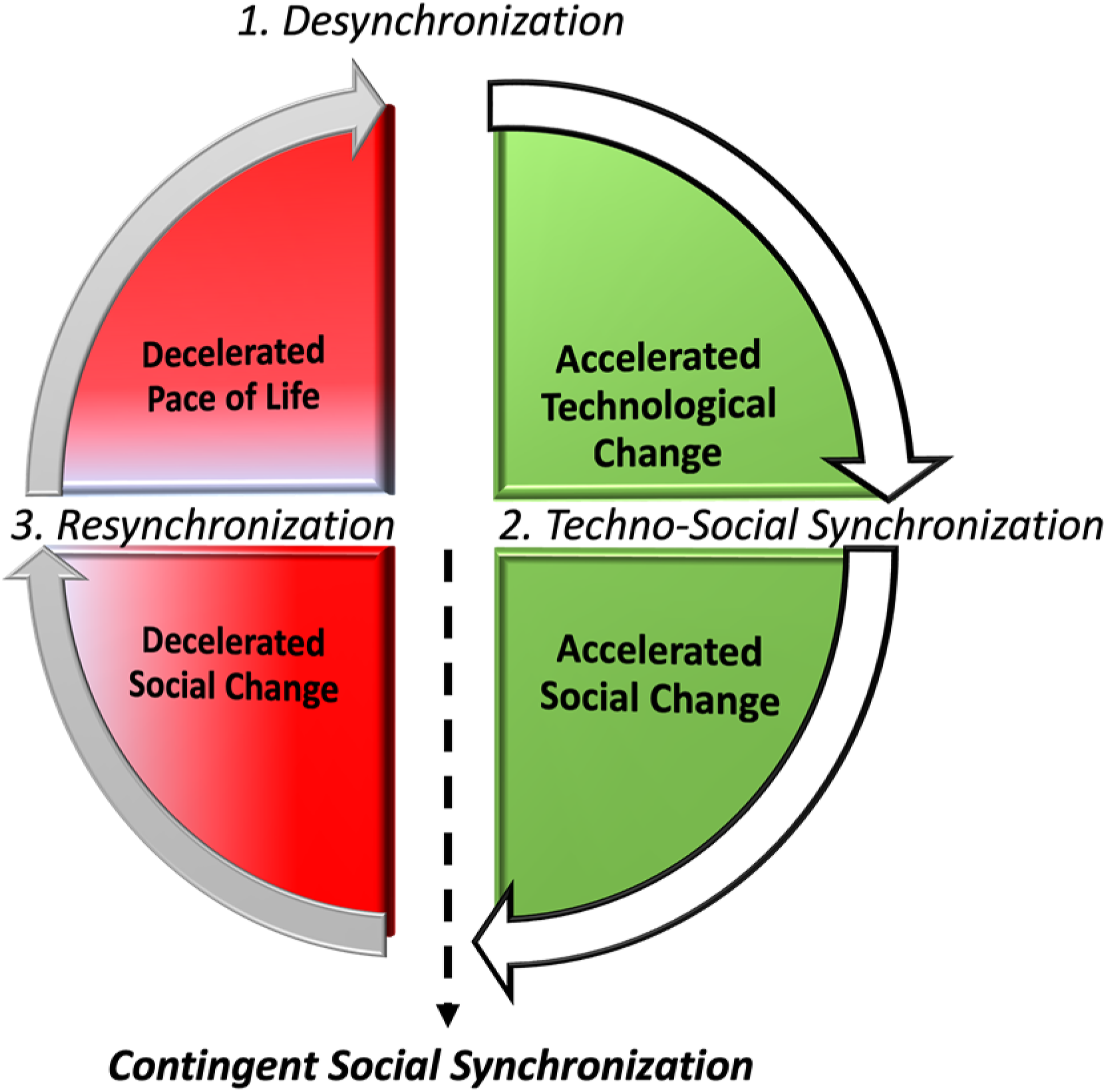
For Lisa and other participants, this situation was unexpected and was experienced as a problem of too much time with too few activities—leading to a state of slowness. As John (design manager, 33) illustrates: “There’s not much going on, so you have a lot more of time on your hands.” Participants rejected this elongation of time, feeling that each day was identical to the previous one, in a never-ending loop of repetitiveness that caused boredom. Many participants described this as a “Groundhog Day,” referring to the movie by the same name in which the lead character relived the same day again and again.
As the pace of life dramatically slowed due to social and economic restrictions, consumers recurred to online dating platforms to “have a distraction” (John, design manager, 33), or “look for some action” (Robert, hospitality worker, 25). George (postgraduate student, 27) reflects on his platform usage: It is also a way of fighting boredom, just swiping on people… You have a lot of time on your hands when you are staying for so long at your place… Before I was going to Uni[versity] every day, I didn’t have much time to be interacting with my mobile phone… During lockdown, you are at your place the whole day. You have your mobile phone beside you. So, it’s a good way to kill time, just to see what’s happening in the apps… That’s one of my other motivations… to entertain myself.
Thus, participants increasingly used online dating platforms to accelerate their pace of life during this time of forced slowness. As a result, the tempo of their romantic interactions also rose, given that they were engaging with an increasing number of profiles simultaneously. Also, participants became motivated to create new connections with more diverse profiles, broadening the range of their interactions. Gabrielle (financial manager, 32) illustrates: It’s just impossible during the restrictions to meet anyone. I would prefer to meet people at a bar. I do miss that ability to go to a party or a bar and meet someone naturally, having this freedom is more valuable to me than most things… So, I started using the passport version of dating apps. I was curious about how do guys look like in other countries, or what they’re doing during lockdown? That’s been like the fun part, having different conversations with people overseas that you wouldn’t normally meet under these conditions.
Participants mitigated the effects of boredom through dating app usage, with the help of other consumers experiencing similar struggles. Consequently, online dating platforms were accelerating devices that offered consumers relief from their disrupted temporality.
Techno-social synchronization: Accelerated technological change meets with accelerated social change
Participants acknowledged that before the pandemic they were using online dating platforms primarily as a tool to access others for an “immediate transaction” (George) that allowed them to “find someone, something fun…” (Georgia, education manager, 34). As participants’ technological use intensified during the COVID-19 crisis, their socializing patterns changed concomitantly. Thus, the time needed to form new relationships contracted, since participants were interacting in these platforms more frequently and with greater intensity. Joanne (postgraduate student, 30) reflects on the rapid development of her current relationship due to the intensification of her platform usage: When I met with my current partner, the connection grew really quickly because, mmm, I don’t know, dating apps did that during lockdown. They make relationships grow very quickly... I introduced him to my friends, he came to a virtual party with my friends, so that was really nice… He met my mom in other video call, so that was quick…
Hence, an increase in the frequency and intensity of dating platform usage altered the sequence of romantic events for our participants. As a result, activities like meeting the other person’s friends and family, which are typical of advanced stages of the relationship, happened within weeks of having first established contact. This pattern of interaction was new and differed from the accelerated and non-cooperative exchanges that characterized online dating platforms in pre-pandemic times. Bryan (lawyer, 38) explains: Since the pandemic, I sort of gravitated more to long-term relationships, more trusting, because I just feel that the pandemic made me feel more carefully about the future, in terms of finding someone, a real person, rather than someone that you just find attractive that moment in the picture. For example, with this woman I am texting right now, maybe in the future I could say, “I met my wife through dating apps”…That would be great.
Thus, participants had deeper conversations and formed stronger bonds because they had more time to dedicate to one another. Accordingly, they started using online dating platforms to form richer social connections that were not limited to short-term goals. Estelle (social worker, 37) explains: Before, people were using dating apps with an objective—they wanted to hook up, they wanted validation. But I think that during the pandemic people were really vulnerable. People have lost their jobs. People are worried about their families. So, like, even with the complete stranger that you just met in the app, you could spend your time connecting, really genuinely, having deep conversations about life and stuff. It was easy to go into those genuine conversations and see the person really, humanly. It wasn’t so easy before. Because it was always about the goal, you know, to hook up. I think that during the pandemic there was a need for human connection that was being fulfilled through dating apps.
Prior to the pandemic, participants primarily used them to arrange casual sexual encounters, believing it was “pathetic” (Charles, 32, photographer) to have deep conversations with other online daters. During the crisis, however, they were open to share their feelings of loneliness, depression, or anxiety in online dating platforms, hence establishing meaningful relations with other users: Now I feel that I can talk to people more…I feel that conversations are longer than before. One guy invited me to stay at his place and told me a lot of personal stuff…He told me he was struggling a lot during the pandemic and that he was suffering from depression… Next day he had even made breakfast for me, something that is very unusual. That date was very cool because we talked a lot, about a lot of things… (Charles, 32, photographer)
This transformation was enabled by contingent social synchronization, a process of temporal realignment after an unexpected desynchronization in pace of life, technological change, and social change. Thanks to contingent social synchronization, competitive consumers modified their patterns of non-cooperative interaction within accelerated markets. Contingent social synchronization supposed a rupture in the transactional logic of online dating platforms. This rupture is illustrated in Figure 1. Contingent social synchronization (represented as a dashed arrow) decelerates the temporal dimension of social change, impeding the rapid obsolescence of the newly formed bonds and enabling deeper and more consistent interactions. As the temporal dimension of social change slows its pace, consumers form and consolidate long-term relationships. Consequently, during a crisis when notions of time were disrupted, consumers adapted to the elongation of the present and the obstruction of their imagined future by modifying the ethos of their competitive and accelerated exchanges due to contingent social synchronization.
Thanks to contingent social synchronization, our participants reevaluated their patterns of time investment and engagement with online dating. For example, they frequently mentioned that they were taking more time to interact and get to know better their connections, “making the effort of asking more questions… there’s a superficiality when things kind of rush” (Claire, social worker, 27). This newfound synchronization manifested in novel ways of interacting with fellow daters, including alternative forms of moving, communicating, and consuming. Steven (casual worker, 31) explains: I have been trying different things, like recently I had a first date with a person, we met and went walking to this abandoned silo in the west of Melbourne, sat on the roof, talked for hours, took some pictures…It was lovely, and easy and we communicated pretty well.
Due to contingent social synchronization, the traditional order of events that usually takes place during the courtship process was changed by the rupture of the transactional logic that dominates online dating interactions. Thus, consumers modified the sequence of romantic acts that are observed in the formation of a romantic relationship. Georgia (education manager, 34) reported: I proposed to this woman a couple of activities that implied that she needed to stay at my place, because of the curfew and all that… That clearly made things faster between us and was also like speeding the magic of those first moments of a romantic approach, and all the elements that come before an invitation to stay at each other’s place.
Resynchronization: Decelerated social change meets with decelerated pace of life
The process of contingent social synchronization increased the duration of platonic and romantic relationships forged in love markets during the crisis. This modification in the lifecycle of connections established though online dating platforms was evident in the consolidation of deeper and longer-lasting bonds among consumers. We call this resynchronization because the stability of these relations—whether romantic or platonic—aligns with the slower pace of the decelerated life experienced during the lockdown. Andrea (researcher, 40) explains how her use of online dating platforms transitioned from transactional short-term connections to more caring long-term relationships: People are showing that they want to take the time to get to know me, and actually that shows me that they’re taking more care… and [that] has helped me shift my thinking about what I need and what I want as well.
Our participants affirmed that the previously hectic pace of swiping and interacting online diminished to the point that they focused on fewer people or even a single person. Anne (event manager, 36) explains: This COVID thing is consistent with me slowing down… This way of dating is definitely more authentic… Before I was wearing makeup every day, doing my hair, my nails… I think it’s been positive because we have focused on getting to know each other, you are hanging out together, it’s not focusing on drinking and eating, you are kind of just watching movies, going for walks, it’s quite nice. You are getting to know someone.
Furthermore, participants argued that before the pandemic, consumption concerns (e.g., what to buy, where to drink, and how to look) dominated their dating patterns. During the pandemic, however, marketplace restrictions led them to focus on their nascent relationships instead. Thus, the opportunity to socialize without the distractions of market exchanges contributed to the creation of deeper and stronger bonds. In addition, online daters began appreciating public places as settings for social gatherings. Robert (hospitality worker, 25) illustrates: I like to be in the public space, more than before. Invite someone from a dating app to a picnic or drinks at the park. It’s a good idea, really… I now see public space more as a place for social interaction. So, these spaces are actually good to develop relationships: there, it’s a lot easier to share that burden we have, we are carrying, and see that probably all of us are feeling similar things, because we are going through the same.
Participants contended that dating in non-commercial environments led to more authentic interactions. Certainly, the lack of consumption choices forced them to rediscover public and natural spaces as settings for more relaxed and spontaneous encounters that encouraged the formation of stronger social bonds.
Discussion
A new time for love: Contingent social synchronization in accelerated and non-cooperative love markets
As illustrated in Figure 1, the COVID-19 crisis triggered a process of contingent social synchronization that caused a rupture in the transactional logic of love markets, impeding the rapid decline of newly formed bonds and enabling deeper and more consistent interactions. By decreasing the pace of social change, contingent social synchronization enabled an alignment that allowed decelerated consumers to form stronger relationships in online dating platforms. Instead of following the pattern of economic exchanges that is prevalent in the early stages of courtship (Belk and Coon, 1993; Bergström, 2021; Illouz, 1997; Tabet, 2004), online daters generously devoted their time to interact with strangers on these platforms, forming altruistic relationships that were unlikely under accelerated and competitive conditions.
These new patterns of interaction in accelerated and non-cooperative love markets challenge the perspective on the stages of dating and the evolution of relationships described by Belk and Coon (1993). In their seminal study, they contend that dating dynamics tend to evolve in a single direction, from economic exchange to social exchange to romantic love. However, their work does not consider that misalignments in the temporal dimensions of social life can significantly modify the linear transition from utilitarian exchanges to selfless and altruistic acts. Our work explains how modifications in the tempo, sequence, and duration of online dating interactions lead to early manifestations of agapic love in new relationships.
First, as the pace of daily life decelerated due to pandemic restrictions, consumers accumulated a time surplus. Consequently, they increased their usage of online dating platforms, thus accelerating the tempo of their online romantic interactions. When consumers experienced an increased number of romantic episodes of action per unit of time, they regained some of the agency and social capabilities lost during the crisis. Second, the acceleration of their technological usage also altered the sequence of their platonic and romantic interactions, “making things happen faster” than in pre-pandemic times. Third, as their new bonds became deeper due to constant interactions and an acceleration of romantic gestures, consumers were less inclined to see other online daters as disposable products in a “human catalogue” and prioritized establishing stronger relationships, hence elongating the duration of these new social bonds.
Contingent social synchronization also allowed consumers to imagine another future even amid the uncertainty of the crisis. This alignment is fundamentally different from other synchronization processes previously described in the literature (Fuschillo and D’Antone, 2023; Jordheim, 2014; Jordheim and Wigen, 2018; Lundström, 2022). For example, the work of Fuschillo and D'Antone (2023) describes how dispersed entities synchronize to achieve common goals during a crisis. However, collectives that promote social cohesion function under principles of cooperation. This is not the case of non-cooperative and accelerated markets such as online dating platforms, where consumers traditionally try to maximize their outcomes, even to the detriment of other users’ interests.
Thus, our findings suggest that in periods of crisis, contingent social synchronization contributes to the modification of non-cooperative interactions within accelerated love markets. This transformation occurs due to fundamental changes in the temporal structures that define these marketplaces.
Fast-love in online dating platforms: Reevaluating the effects of technological acceleration
When temporal acceleration was suddenly disrupted, consumers reported a repetitive elongation of the present and were unable to project a future due to the sudden unpredictability caused by the pandemic (Koselleck and Richter, 2006; Murphy et al., 2022; Nash and Lyon, 2023). Restrictions implemented further disrupted spatial and temporal aspects of consumption, limiting opportunities to socialize and access marketplaces (Chatzidakis et al., 2012; Lefebvre, 1991). For our participants, deceleration in the pace of life was accompanied by repetitiveness and spatial restrictions (Chatzidakis et al., 2018; Gardiner, 2012; Lefebvre and Elliot, 2005) that ultimately led to profound boredom (Heidegger, 1995; Lefebvre, 1985; Murphy et al., 2022).
As a result, consumers accelerated their technological usage, seeking the interactions and sociality lost due to the pandemic restrictions. Our findings suggest that technological acceleration was not merely an act of hedonic escapism, as contended by Murphy et al. (2022), but was a precursor to fundamental changes in interaction patterns within accelerated love markets. Thus, individuals used technology to establish the relationships they found lacking during this crisis and generated alternative futures with their newfound connections, demonstrating the transformative potential of boredom (Gardiner, 2012, 2014; Lefebvre, 1995).
Once these new relations were established, consumers worked to cultivate and nourish them, increasing their ability to imagine possible futures during the crisis. Importantly, technological acceleration manifested not only in the intensification in the usage of online dating platforms, but also in the development and evolution of these platforms’ capabilities, allowing consumers to enjoy novel functionalities (e.g., voice messages and video calls) (Duguay et al., 2024).
Learning to be vulnerable: Therapeutic confessions in accelerated love markets
Prior research examines how certain sociospatial settings can promote a therapeutic feeling of connectedness and emotional bonding among consumers (Higgins and Hamilton, 2019; Moisio and Beruchashvili, 2010). Literature in consumer research also explores how dispersed entities (i.e., consumers, institutions, and objects) create emergent networks of solidarity during crises when sociality is suspended (Fuschillo and D’Antone, 2023). However, little research identifies the mechanism by which competitive consumers bond and engage in therapeutic confessions within accelerated marketplaces. Our work shows that contingent social synchronization may be key for creating these therapeutic experiences.
First, therapeutic servicescapes expose consumers to ideological homogeneity and restorative scripts (Higgins and Hamilton, 2019; Fuschillo and D’Antone, 2023). However, in accelerated love markets, patterns of usage and exchange differ among consumers, since the objectives of participants in online dating platforms are varied and dynamic. Second, in self-help groups, a synergy exists between therapeutic and spiritual systems that encourage consumers to confess, be absolved, and surrender to the surveillance power of the group (Moisio and Beruchashvili, 2010). For online dating, contrarily, consumers adopt self-promotion strategies to portray themselves as ideal romantic and sexual candidates, in a self-commodification process that is often at odds with reality (Ellison et al., 2006; Hobbs et al., 2017; Marwick, 2013). Finally, online dating is an accelerated market where consumers compete fiercely with the objective of maximizing their payoff, even to the detriment of other users, emulating the non-cooperative dynamics of a zero-sum game (Bever and Rowlett, 2013; De Vries, 2023; Narr, 2021; Stoll, 2019).
Nevertheless, online daters experiencing contingent social synchronization aligned their interests by privileging social interactions toward the consolidation of long-term relationships, as opposed to the transactional and competitive exchanges observed during pre-pandemic times. At the same time, this contingent social synchronization encouraged consumers to confess and seek absolution, resembling the spiritual model of well-being described in past literature (Moisio and Beruchashvili, 2010). During contingent social synchronization, non-cooperative consumers interacted differently in accelerated love markets, dedicating more time to develop and nourish the connections made during a crisis. This new pattern allowed them to form long-term relationships in markets that were previously characterized by their fast-paced and transactional exchanges.
Consequently, our work suggests that under conditions of temporal deceleration, social isolation, and boredom, contingent social synchronization facilitates altruistic and selfless interactions that resemble those of therapeutic marketplaces.
Contingent social synchronization and the reevaluation of acts of love
Although consumption long plays a central role in courtship (Belk and Coon, 1993; Illouz, 1997, 2007, 2019; Patterson and Hodgson, 2006), this study suggests that online daters were less interested in romance-related consumption during contingent social synchronization. Past research shows how attenuated consumption contributes to processes of reflexivity and deceleration (Husemann and Eckhardt, 2019). During these experiences, individuals choose deprivation as a way of escaping the hecticness of marketplace interactions. Upon returning to their accelerated pace of life, by choice or obligation, they typically resume their normal consumption practices.
In our case, however, deceleration was imposed upon consumers, causing a process of temporal desynchronization that impacted consumption practices and markets. Consequently, individuals experienced consumption deprivation not as a conscious choice, but as an external restriction. Surprisingly, this lack of consumption options was well received by online daters. Although in pre-pandemic times consumers preferred romantic marketplace offerings, during lockdown, commercial outlets were restricted. This simplification in how they socialized and mated allowed them to get to know one another better, experiencing relief with a courtship process that was partially detached from romantic consumption. Hence, lack of marketplace activity paired with contingent social synchronization led to a temporary separation of the consumption and romantic realms, contributing to the formation of deeper social relations.
In the absence of the economic and social activities that structure the linear trajectory of love—from economic exchange to social exchange to romantic love—(Belk and Coon, 1993), online daters had to invent new ways of employing their time romantically. For example, when our participants could not access marketplaces, they creatively expressed their platonic or romantic interest by sending detailed texts and letters, recording audio messages, making video calls and remote film sessions, organizing virtual parties, or simply spending hours companionably on the phone. In pre-crisis times, these gestures might be considered unnecessary, or even “pathetic” in the words of one our participants. However, when there was no way to access the marketplace for traditional gift-giving rituals proper of courtship, online daters opted for investing their time surplus on these nascent relationships, following principles of altruism and selflessness. Thus, giving time generously was the act of love par excellence during the crisis.
In sum, our research examines the effects of involuntary deceleration and desynchronization in accelerated and non-cooperative love markets during a crisis. Accordingly, we explain how temporal misalignments caused transformations in the patterns of interaction within these markets, through a process of contingent social synchronization. By examining how temporal disruptions affect accelerated markets and competitive consumers, we extend the literature on consumption, temporality, and crisis beyond the discussions on deliberate consumer deceleration (Husemann and Eckhardt, 2019) and cooperative marketplaces (Fuschillo and D’Antone, 2023).
We contend that as consumers strived to adapt to the desynchronization triggered by the pandemic, they temporarily reshaped the functioning of online dating platforms through contingent social synchronization. As a result, they adopted novel socializing patterns that resulted in positive experiences within these formerly competitive and accelerated markets. We do not know if these patterns continued following the lockdown. However, factors that led online daters to experience contingent social synchronization showed that online dating platforms appear to promote the formation of stronger bonds under conditions of decelerated pace of life. We conjecture that contingent social synchronization facilitates a deeper and less transactional approach to interactions within these markets. Our findings suggest that dating during deceleration might be appropriate for the formation of long-term relationships, both romantic and non-romantic. In these cases, online dating platforms could propose slow dating scenarios to encourage contingent social synchronization, suggesting to consumers decelerated events and experiences aimed at building social and communal ties.
Contemporary life offers a gamut of continuing crises (e.g., war, global warming, and resource scarcity). These events might alter notions of temporality and provoke contingent social strategies to deal with their disruptive effects. We would conjecture that emergent patterns of communication, social interactions, and consumption might be adopted to restore stability and purpose when uncertainty hits. Certainly, the concept of contingent social synchronization could arise in other contexts in which adverse events disrupt the experiences of temporality, impeding the possibility of projecting a future due to a repetitive elongation of the present. Future research might explore if this process extends to other social calamities, such as war and recession, or to individual crises, like incarceration and chronic illness.
Footnotes
Author note
The first author would like to thank María Lucía Osorno-Martínez for her valuable support during the data collection process.
Declaration of conflicting interests
The authors declared no potential conflicts of interest with respect to the research, authorship, and/or publication of this article.
Funding
The authors received no financial support for the research, authorship, and/or publication of this article.
