




Abstract
The aim of this article is to provide a systematic review of peer-reviewed literature on the effectiveness of crisis communication efforts by the tourism and hospitality sector. A total of 70 peer-reviewed articles from Web of Science met our criteria. Insights from these articles allowed us to identify, generalize and synthesize best practices that can encourage the industry and governments to invest more in necessary communication policies during crises, thereby benefiting vulnerable tourists as much as possible. While a significant number of articles emphasize image restoration after a crisis, we also acknowledge important insights for other aspects of crisis management, including the pre-crisis phase and communication during a crisis or disaster. Based on the findings, we conclude that governments are best positioned to provide tourist-related information on general risks during the orientation phase and to update tourists on the latest safety measures upon arrival. The tourism sector, on the other hand, is well-suited to inform tourists about specific risks, particularly those associated with adventurous activities that require tailored guidelines and heightened attention from visitors.
Introduction
On December 9, 2019, the White Island volcano in New Zealand erupted, resulting in 21 fatalities and numerous severe injuries. Among those who perished, 19 were tourists from an Australian cruise that had marketed the excursion to the volcanic island with the allure of bringing visitors “close to the drama.” Prior to the catastrophe, the alert level had been elevated to its highest, signaling imminent eruption risks. Despite this, the cruise company and the local tour operator failed to inform the tourists about the increased alert status or the inherent dangers of volcanic activity (ABC News, 2020). In his verdict, Judge Evangelo Thomas determined that Whakaari Management violated legislation mandating the protection of visitors from hazards at the active volcano. The decision also raised questions about the responsibilities of landowners in managing and disclosing natural hazard risks and the potential need for a system to categorize and convey these risks (The New York Times, 2023).
Incidents like the one at White Island are not isolated cases of tourists being unaware of the risks they face. Globally, tourists have repeatedly become victims in overseas disasters. Despite the ability to research and assess potential natural hazards online, tourists might overlook risk information that local residents receive, making them more vulnerable due to their lack of familiarity with local dangers, available resources for mitigation, and their reliance on local experts for safety guidance (Cahyanto and Pennington-Gray, 2014; Carneiro and Crompton, 2009).
According to Brown et al. (2017), fatalities among tourists can be reduced through education, warnings, and restricting access to vulnerable areas. These are all aspects of crisis and risk communication. However, there is no clear overview of what might be considered best educational -, warning - or restriction practices in enhancing tourist’s safety abroad. In terms of education, it might be more challenging to reach people to warn or educate them while having a single visit to a high-risk environment compared to educational programs for residents in, for example, an earthquake-prone or hurricane-prone area (Yusuf et al., 2022). Warnings might create practical difficulties, as cell broadcasting may not be available to tourists from abroad, and language barriers could hinder the understanding of clear warning messages distributed by local governments. Regarding the suggestion to restrict access, some authors believe that this aspect is particularly challenging in some countries, as tourists are often drawn to high-risk exotic landscapes (Bird and Gisladottir, 2020; Brown et al., 2017; Drabek, 1995; Murphy and Bayley, 1989), and the risk itself is part of the holiday experience.
Liu-Lastres (2022) reviewed crisis communication research in hospitality and tourism previously, finding that most studies focus on crisis response and post-crisis recovery, while the pre-crisis stage remains largely overlooked. From this perspective, the greatest value in the development of crisis communication seems to lie in proactively considering where interventions in crisis communication can be made to better protect tourists during future crises. It bridges the existing gap between practice and theory and might enable practitioners to receive clear guidance in the literature on how to effectively manage tourists during crises or how to inform them about potential risks at their destination beforehand. It is already difficult for authorities to deliver precise and timely warnings about hazards to known at-risk populations, and this challenge is intensified when trying to convey the same information to tourists, who represent a transient demographic (Bird and Gísladóttir, 2020). Moreover, it is important to note that governments typically prioritize communicating local risks to their own communities (Liu et al., 2019). Given the unique characteristics of tourists as a group, it is crucial to identify existing knowledge on how to communicate with them both in preparation for and during crises, and to have additional indications on what best practices could be used to keep them equally informed compared to local residents and nearby businesses. While there is considerable literature on audience segmentation in risk and crisis communication, the main focus tends to be on citizens, customers, businesses and the like. A specific focus on tourists as a distinct audience segment in risk and crisis communication seems less common.
The aim of identifying best practices for communicating risks and crises to tourists is grounded in their usefulness for packaging learned principles (Seeger, 2006) and their common application in crisis communication research (Diers-Lawson, 2017). Because tourists are an underrepresented group, it is worthwhile to explore the literature for examples where crisis communication was either effectively or ineffectively used for this target audience. The search for examples and best practices sets this study apart from the literature review by Liu-Lastres (2022), which primarily focused on theoretical developments in crisis communication and its intersections with research in the tourism and hospitality domain. The best practices and insights derived from crisis-related studies within the tourism and hospitality sector contribute to the development of a comprehensive framework for key actions that can be implemented during the pre-crisis stage. These actions aim to enhance the industry’s preparedness for future crises and optimize the effectiveness of crisis communication directed toward tourists. Therefore, the purpose of this research is as follows:
According to peer-reviewed research, what risk and crisis communication strategies can currently considered best practices in enabling tourists to prepare for risks or assist themselves during crises?
Crises include potential life-threatening circumstances during forest fires, hurricanes, and floods. As our focus is broader than natural hazards as such, we broaden the scope of crises to encompass any circumstances that negatively impact the potential health and well-being of tourists and require the involvement of public authorities. Our focus is on groups of tourists as an audience who experience a crisis, thereby excluding tourists who experience a situation as a personal crisis, such as the discontinuation of their holidays due to unforeseen circumstances or the unplanned cancellation of a trip. In conducting this review, we expect to generate a helpful overview of best practices in the domain of public safety, based on academic insights. To categorize findings, we will approach crises within the domain of tourism and hospitality in a linear manner, starting with the pre-crisis phase, the crisis phase, and the post-crisis phase.
Initially, it is challenging to determine which insights from the literature can be deemed best practices. The designation of a best practice often hinges on the authors’ interpretation of a situation. Thus, our review begins with a broad scope, focusing on how risk and crisis communication is utilized in tourism. By examining examples and recurring themes across multiple articles, we aim to identify existing best practices or, alternatively, make recommendations to establish best practices in the future.
Methods
Database and search strategy
Search strategy and keywords.

The dataset included literature up to and including the year 2023, to capture the full range of articles on crisis communication up to that point, yielding 85 articles. After reviewing the full texts, 32 studies were eliminated. Excluded were all articles focusing on the impact of the COVID-19 outbreak on tourism and hospitality, as they did not specifically address tourists’ needs in distinct environments. Given the global scale of the COVID-19 pandemic, such articles often generalized about health and sanitation standards. Other excluded studies examined topics like the effects of tourism on the well-being and quality of life in Hong Kong (Fu et al., 2020) or the brand image of destinations like Jamaica (Johnson, 2014). Additionally, articles on medical tourism (e.g., Maguire et al., 2016; Mason et al., 2019), the practice of traveling abroad to obtain medical treatment, were excluded as it is beyond the scope of our research. Additional sources were identified using the snowball method, which leverages key documents from the initial findings to uncover further literature.
Figure 1 gives an overview of the final set of articles. Flowchart selection of articles.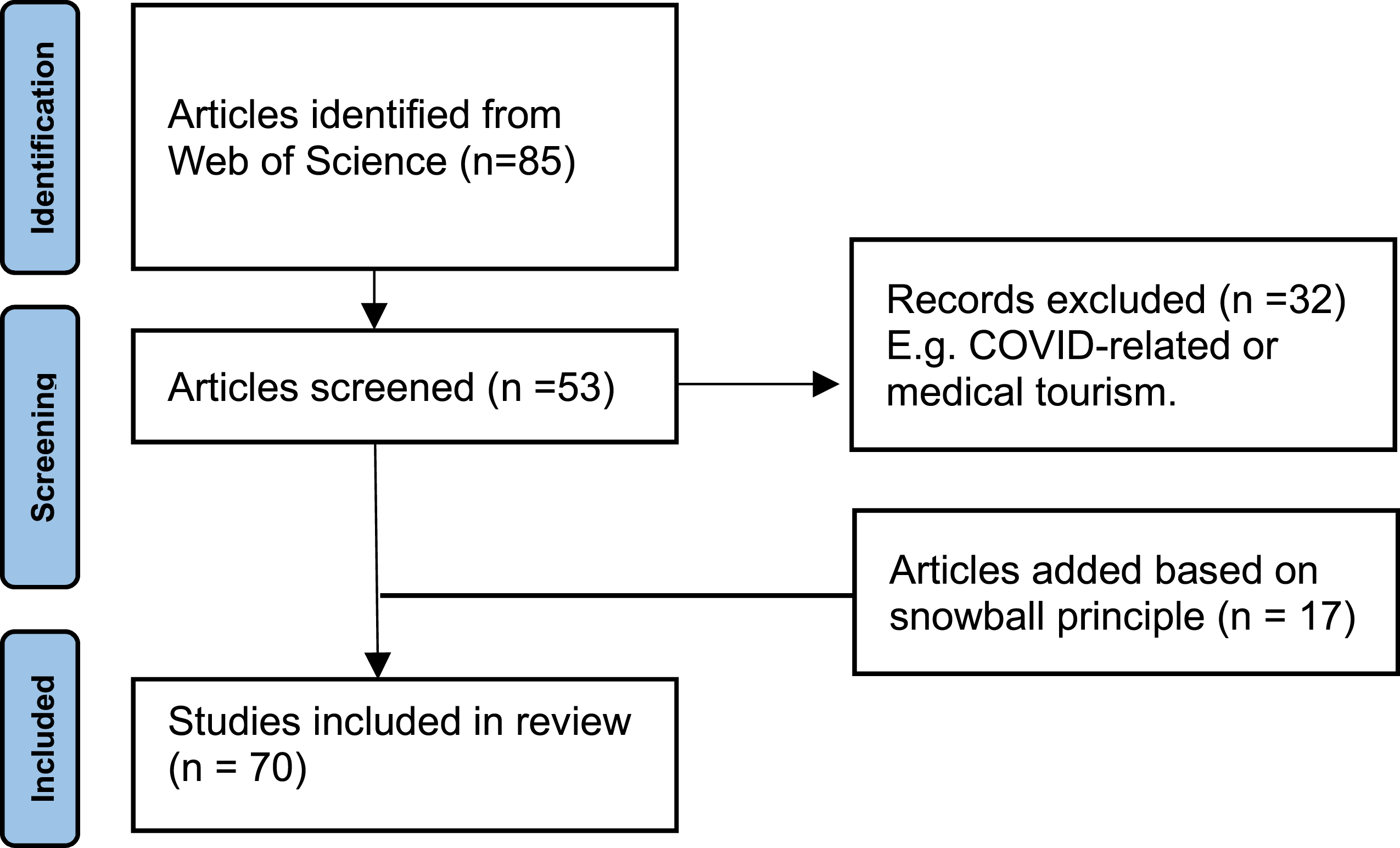
Data extraction
For each selected publication, criteria were identified that aid in evaluating effective communication strategies for preparing tourists for potential risks at their destinations. These criteria were organized into five categories to differentiate between various facets of risk and crisis communication. These include the educational programs in the pre-crisis phase, the warnings and other means of communication during a crises and access restriction during and in the aftermath of a crisis. This aligns with Coombs’ (2021) three-phase model of pre-crisis, during a crisis, and post-crisis. To tailor it further to the domain of tourism and hospitality, we divided the pre-crisis phase into two sub-phases: before arrival and at the destination but prior to a potential incident. Additionally, we maintained the crisis phase and the post-crisis phase. As a residual category, we included a separate classification for findings that do not align explicitly with any of the defined phases. This results in five categories, that work as a heuristic framework to systematically highlight the different elements of crisis communication throughout a tourist’s journey in an organized and structured way: a. Communication with or to tourists before their arrival at the destination, such as information gathered during the planning phase or when booking their trip. b. Risk communication on-site, aimed at informing tourists about potential dangers near their accommodation or the places they intend to visit. c. Crisis communication directed at tourists experiencing an actual crisis while traveling. d. Post-crisis communication or other related forms of communication following a crisis at the destination. e. Any other pertinent topics identified in the literature not encompassed by the categories above.
The categories serve as a practical heuristic to systematically describe the various aspects of communication with tourists. Whenever articles touched upon different categories in separate sections, two or more categories could be applied to a single article.
Results
Ultimately, 70 journal articles were included in the review, with 53 articles derived from the initial search in Web of Science and an additional 17 articles added through snowballing. The findings of the review are detailed in (online) Appendix I, where articles obtained through snowballing are clearly marked with an asterisk.
Description of included studies
Category A. Communication prior to arrival
In the prior to arrival section, the articles from our review highlight two intertwined phenomena. One prominent topic is the question of who is responsible for communicating certain risks at the destination. The other topic is who can be held accountable for taking action. While the first topic primarily focuses on the stakeholders at the tourist hotspot, the second topic can be broadened to include the tourists themselves, stakeholders involved in the booking process, and stakeholders at the destination.
Huan et al. (2004) suggest a need to distinguish between so-called escapable and inescapable disasters in terms of the information that needs to be shared before arriving to their destination. They (Huan et al., 2004) observe that destinations are reluctant to share risk information beforehand or share post-disaster images, fearing it might create a negative perception. Looking back at the Tunisian terrorist attack on a tourist resort, Agarwal et al. (2021) share that tourists should have had more information before coming to Tunisia in order to be better prepared for the crisis situation.
Regarding the responsibility to be prepared upon arrival at the destination, authors argue that tourists should be informed about the risks at their destination (Jeuring and Becken, 2013). When taking the point of view of arriving tourists themselves, Jeuring and Becken (2013) observe that visitors have varied views on who should bear the responsibility for preparing tourists for potential risks; some feel it is their own duty, while others think it falls to the government to inform them about the dangers. Moreover, the fact that they should be aware does not automatically mean they will be, as it is largely influenced by their willingness and personal motivation to prepare (Wan, 2008). In describing the responsibilities, authors also distinguish between escapable and non-escapable disasters. Escapable disasters are situations where it is possible to inform locals and tourists, such as an approaching hurricane (Daye, 2014), while non-escapable disasters take people by surprise and make it harder to assign responsibilities to.
From the perspective of arriving tourists, Jeuring and Becken (2013) observe that visitors have varied views on who should bear the responsibility for preparing tourists for potential risks; some feel it is their own duty, while others think it falls to the government to inform them about the dangers. Overall, researchers are hesitant to completely depend on tourists for their own safety preparations. This is because it’s uncertain how willing or able tourists are to evaluate risks in unfamiliar environments, whether they can adequately prepare themselves, and the fact that not all tourists prepare in the same manner. Tourists more familiar with local media, possibly because they are visiting places within their own state, tend to be more aware about potential risks and are more likely to change their travel plans when faced with threats (Cahyanto and Liu-Lastres, 2020). This is in contrast to tourists coming from farther away, who might be less acquainted with the specific conditions of the destination and are largely left to themselves in determining whether the potential risks are acceptable to them. In this context, residents can serve as a valuable channel for delivering risk communication, particularly repeat visitors who tend to rely on this source more than others (Liu-Lastres and Cahyanto, 2020).
Category B. Risk communication at location prior to crisis
Once at their destination, tourists might face risks that are more dangerous to them than to local residents, who are generally more aware of and accustomed to potential dangers (Brown et al., 2017; Cahyanto and Pennington-Gray, 2014). This is because tourists are often in unfamiliar places where it is hard for them to assess. In a visitor survey conducted in Australian national parks, some visitors even suggested that they should be prevented from accessing the most dangerous areas (Gstaettner et al., 2020). While these visitors recognized their own responsibility for their safety, they also believed that park management agencies should share in this responsibility, as visitors may not fully understand the consequences or grasp the extent of the risks involved. Nagai et al. (2021) highlight not only the vulnerabilities of tourists but also those of foreign workers within the tourism industry. These workers often lack training on how to respond to natural disasters in the workplace and have limited knowledge of the local risks themselves (Nagai et al., 2021).
The challenge for communicating agencies is that no two tourists are alike. Some are fully equipped for a national park adventure, while others may arrive in high heels (Rickard et al., 2011), highlighting the need for a better understanding of the mental models of both communicators and tourists (Aliperti and Cruz, 2018). Another issue, as Bird and Gísladóttir (2020) point out, is that tourists are generally not risk-averse. They have already invested significant effort to reach their destination and plan their visit.
Typically, tourists are reluctant to actively seek out information on potential hazards or emergency procedures, even when such information is readily available, for example, on signs and in brochures. Quilliam et al. (2019) note that, even when signage about water quality is present, visitors often remain unaware of or unfamiliar with the EU’s standardized indicators for bathing water quality, and tend to overlook information boards and digital displays that provide daily water quality forecasts. However, a study on Chinese tourists by Aliperti and Cruz (2019) suggests that they are more inclined to seek risk information compared to American counterparts. At the same time, failing to use consistent risk communication and evacuation procedures for all international tourists may result in confusion (Aliperti et al., 2020). Yet, a study on the adventure tourism business indicates that Chinese mass adventure tourists often do not prioritize safety and may not fully understand the risks involved in adventure activities (Wang et al., 2019). This suggests that even tourists who seek out risk-related information might not always find it, as tour operators may be reluctant to share such information, fearing it could deter tourists (Wang et al., 2019). This underscores the need for tailored risk communication strategies that consider the behavioral differences of international travelers (Aliperti and Cruz, 2019) and the importance of making risk information available to those who wish to prepare. According to a study by Aliperti et al. (2020), tourism suppliers identify hotel check-ins as the ideal moment to deliver risk information and emergency procedures, while government agencies and academics suggest that public Wi-Fi access points and specific airport operations, such as baggage claim, could also serve as effective opportunities for this purpose.
Surveys among tourists indicate that sirens, alarms, announcements, and mobile apps are considered the most important means of communication, more so than social cues (Arce et al., 2017), such as people running, moving or screaming. Media can also disseminate warnings, though tourists vary in their level of attention to these alerts (Cahyanto and Pennington-Gray, 2014). During Hurricane Irma in Florida, many tourists turned to social media to monitor the situation (Park et al., 2019). In the context of tsunami risks, Arce et al. (2017) note that areas are often unprepared to communicate in multiple languages or to use universally recognized signs. This also applies to foreign workers in tourist areas (Nagai et al., 2021), who may have limited knowledge about local risks. Regarding terrorism threats, Gilboa et al. (2022) emphasize the importance of enhancing actual safety measures, such as ensuring the availability of emergency exits, arranging seating locations thoughtfully, which in turn signals to customers how easy it will be to employ protective actions.
Category C. Crisis communication during crisis at location
During actual crises, it is equally significant to take cultural variances into account when targeting diverse audiences (Aliperti and Cruz, 2019). These cultural differences influence not only tourist behavior in various situations but also governmental communication, including the accessibility of information (Avraham, 2017). Cultural variances can even exist within a single tourist hotspot; Liu-Lastres et al. (2019) found that during a norovirus outbreak on cruise ships, some groups were indifferent, while others interpreted messages differently and applied the practical instructions for their own protection.
Building on this, Hasegawa et al. (2005) highlight the need for visual aids and multilingual disaster-related information in areas with high tourist traffic, a sentiment echoed by Mistilis and Sheldon (2006). The complexity of guiding tourists in multiple languages during crises (Mistilis and Sheldon, 2006), combined with the fact that tourists frequently visit large outdoor locations more susceptible to natural disasters (Psaroudakis et al., 2021), underscores the importance of using visual pictograms and other visual aids as an effective way to inform them. Tourists, unfamiliar with the local environment, require more and different information than locals, underscoring the need for effective communication in accessible languages (Daye, 2014; Sakurai and Adu-Gyamfi, 2020). However, this does not necessarily mean that tourists underestimate risk. Hoagland et al. (2020) note that tourists may perceive the risks of ongoing crises as even greater than they are, leading to misunderstandings of the hazard.
In large-scale incidents, such as terrorist attacks, communication will not only help in ensuring tourists’ safety, but will also assist the destination in recovering faster because the visitors will feel that the destination is making their safety a priority (Barbe et al., 2018). For smaller-scale incidents, such as those within hotels, it is important to monitoring in order to understand guest behavior during a crisis and inform them effectively (Liu et al., 2015; Liu et al., 2016). Despite this, Möller et al. (2018) found in their study of hotel responses during a hurricane in Fiji that tourists expected more from their hotels during the disaster than what was provided. When surveyed, hotels in the Orlando area revealed a reluctance to communicate about crises for which they are not entirely responsible, such as infectious disease outbreaks (Barbe and Pennington-Gray, 2018).
Research indicates the importance of informing tourists in hazard-prone areas, but studies also highlight the limited involvement of the tourism sector in local emergency organizations’ risk mitigation strategies (Becken and Hughey, 2013; Blackman et al., 2011; Hystad and Keller, 2008), making it difficult to live up to the expectations during the crisis. This emphasizes the need for collaboration with tourist boards and stakeholders to effectively reach tourists (Aliperti and Cruz, 2020) and to speak with one voice (Orchiston and Higham, 2016). Hystad and Keller (2008) suggest enhancing the collaboration between tourism offices and emergency response agencies, especially in regions known for specific hazards, such as forest fires in Canada. Despite potential hesitancy from the tourism industry to communicate during disasters, fearing reputational damage, especially when not at fault, it’s crucial to effectively communicate about the risks involved. This hesitancy was evident in Hong Kong, where the tourism and hospitality industry suffered due to a travel boycott following tensions between China and Hong Kong (Luo and Zhai, 2017).
When focusing on communication methods, X (formerly known as Twitter) and Facebook are widely adopted during crises, yet its effectiveness seems limited (Ketter, 2016; Park et al., 2019; Ćurlin et al., 2019) and largely depends on the opinion leaders and influencers to be effective (Park et al., 2019). In a Spanish study by Huertas and Oliveira (2019) on the Twitter-platform’s use following a bomb attack in Barcelona, the most beneficial information spread through social media pertained to practicalities, such as closed underground stations and areas. However, this information was primarily sent by individuals rather than official tourism boards. Similarly, in an analysis of bed bug incidents in hotels by Liu-Lastres et al. (2019), guests anticipated practical advisories. Yet, hotel management often hesitates to communicate crisply about such crises, fearing negative impacts on their reputation.
Category D. Aftermath
In the aftermath, a lot of attention goes to stakeholder management and restoring the image and reputation of the location (Chan et al., 2020). Recovery marketing initiatives can also aim to mitigate indirect tourism losses beyond the immediate disaster zone (Orchiston and Higham, 2016). This is an important task, as even after recovery, media reports, online reviews, or other sources might echo, giving the impression that a crisis is still not over (Liu et al., 2015; Roozen and Raedts, 2022), requiring intense monitoring and webcare to be effective in restoring the image (Roozen and Raedts, 2022; Su et al., 2019; Zhai et al., 2019, 2020). Based on tweets sent by tourism boards in Barcelona in the aftermath of a terrorist attack, empathetic tweets helped to restore the image (Oliveira and Huertas, 2019). Especially in situations of political instability, which have long-term effects (Farajat et al., 2017), there is an overall need to establish campaigns aimed at tourists contemplating a holiday in a resort recovering from a disaster (Khazai et al., 2018; Martín-Critikián et al., 2021). Hence, understanding crisis communication and public relations plays a crucial role in rebuilding trust in a tourism location affected by a crisis or disaster, with tourist boards leveraging their messaging strategies during the recovery phase (Barbe et al., 2018; Blackman et al., 2011). Although tourism agencies can help regain tourists’ trust, they are not seen as the most credible sources for journalists following a crisis (Daye, 2014), suggesting that additional parties like local authorities may need to contribute to the efforts to shape the public perception.
Enhancing a location’s reputation involves more than effective crisis communication; it requires tangible improvements in safety to truly alter its perceived image, moving past cosmetic repair (Avraham & Ketter, 2008, 2013). And the image depends on the target audience; a feature of a place that might be negative for one target could be considered positive by a different audience (Avraham, 2013).
Category E. Other
The integration of crisis preparedness within the tourism industry remains insufficient, evidenced by the reluctance of many executives to recognize its importance or to grasp the associated dangers (Cioccio and Michael, 2007; Xu and Grunewald, 2009). Despite the critical roles of proactive preparation, engagement with stakeholders, and vigilant monitoring of developments (Liu and Pennington-Gray, 2015; Pappas, 2019; Pennington-Gray et al., 2011; Wut et al., 2021), there remains a notable gap in risk awareness among tourist operators (Orchiston, 2012), which is needed for effective risk communication. The challenge is further compounded by the diverse perceptions of various target audiences regarding ongoing events and associated risks, thereby complicating the formulation of effective marketing and communication strategies for destinations (Avraham, 2015; Hull-Jackson and Adesiyun, 2018; Kellens et al., 2012).
To mitigate misinformation and support coordinated response efforts, the establishment of a centralized information source as part of a media communication strategy is vital (Faulkner, 2001). However, the complexity of tourism communication is underscored by instances like the Hong Kong protests, where research efforts are often impeded by censorship (Tolkach, 2018; Zhai and Luo, 2018).
Discussion
This review of 70 journal articles highlights a significant issue related to crisis management in tourism. The review confirms that a critical aspect—how to inform tourists who are unfamiliar with their surroundings—has only been minimally explored so far. Tourists are vulnerable as they lack local knowledge and often visit touristic hotspots despite the risks involved, such as mountainous areas and volcanoes. Yet, we find hardly any best practices for informing them before or during their stay. This raises the question of whether an approach mentioned in only a single study can be considered a best practice. However, it does suggest that certain approaches may be more broadly acknowledged by multiple authors as effective practices. For instance, whether tourists are alerted via cell broadcast messages, text messages, or WhatsApp signals, the overarching insight emphasizes the critical importance of establishing reliable communication structures to maintain contact with tourists in high-risk situations.
The hard lesson is that the challenge to engage with tourists through risk or crisis communication is not a lack of knowledge in the field. Many tourism operators have expressed resistance to communicating risks to potential customers, fearing it might deter them from staying or purchasing their services. For example, some accommodation providers in Iceland have requested that emergency guideline brochures not be distributed in the region, believing that “the brochure would scare tourists from booking overnight stays” (Bird and Gisladottir, 2020: 5). This attitude may also explain why Royal Caribbean cruise line, which took its tourists to New Zealand’s White Island, failed to communicate the risks associated with the active volcano to its passengers.
This raises the question: “Who is responsible for providing the information?” Many papers in the fields of risk communication and tourism assert that information should be provided but fail to specify who is responsible or how it should be done. This ambiguity is reflected in some strategies, where there is no consensus among scholars on who should participate in and be responsible for the proposed measures. In the articles, we found roles for tour guides, drivers, hut wardens, hotel staff, travel agents, tourism-related businesses and national park staff, who all should be better educated on how to inform tourists on possible risks and how to lead if the disaster is actually about to happen. Perhaps, a guide for future crisis communication can be the study by Sano and Sano (2019). They found that if the perceived risk was low, tourists saw communication channels of peers and businesses as credible as official crisis communication media. However, if tourists perceived the risk as high, they saw communication by businesses as significantly more credible than communication by peers.
To establish a set of best practices that enhance crisis and risk communication efforts, we reviewed 70 papers, enabling us to generalize, synthesize, and focus on the various stages discussed. Given the lack of consistent lessons from the tourism industry and governments responsible for disaster management policies in tourism hotspots, it might not be useful to develop such best practices from their perspective. Instead, following Jeuring and Becken’s (2013) approach, we better adopt the tourist’s perspective who wants to be informed about crises in the pre-crisis, crisis and post-crisis stage. Therefore, it is essential to identify the necessary actions during the preparation phase, when crisis manuals are developed, and exercises are conducted. By thinking ahead and clearly defining the crisis communication responsibilities of each party (government, hotel owners, tourism boards, tourists) for informing tourists during future incidents, we can ensure an effective crisis response when a crisis occurs.
The following section provides a detailed exploration of the question, “Who is responsible for providing crisis and risk communication at each stage of a crisis?” Addressing the question “Who is responsible?” provides a framework that we propose as a set of best practices, which are illustrated with examples. Similar to Seeger (2006), we characterize the best practices approach as a form of grounded theory for process improvement, which offers a promising pathway for improving the effectiveness of crisis communication.
To address this, we analyzed the most likely roles and responsibilities of the government and the tourism sector. This approach enabled us to identify seven best practices that can encourage both the industry and governments to prioritize and invest in essential communication policies during crises. By doing so, we aim to apply insights from the literature to effectively support and protect vulnerable tourists.
Communication prior to arrival
Best practice 1: Government best suited for tourist related information in orientation phase
The review demonstrates that the tourism sector is reluctant to communicate about potential risks, fearing that tourists might change their plans and choose another destination. We believe that the government is best suited to communicate about potential risks, in a manner similar to how it informs its own citizens. This implies that information should be accessible and available in multiple languages. Studies highlight brochures and websites as effective methods for communicating certain risks, although they have also proven to not always capture tourists’ attention. Reasons identified in the literature review for this include brochures and websites being visually unattractive, difficult to spot, providing irrelevant information, or being hard to read due to their location, size, material, or language.
Risk communication at location prior to crisis
Best practice 2: Government updates tourists with latest safety measures at arrival
Since safety measures for general risks apply to both citizens and tourists, we believe the government is best suited to update arriving tourists on the latest situation. For example, this includes informing tourists about what it means to visit a Caribbean country during hurricane season, driving to volcanic areas in Iceland or visiting a country that’s under a terrorism threat. This means tourists can be instructed on how to receive future updates, considering the diverse backgrounds of visitors from different countries. As Bird and Gisladóttir (2020) propose, a long-term and ongoing commitment is needed to regularly distribute consistent hazard, risk, and response information through all available channels so that when a warning is issued, it does not come as a surprise. Although providing information is not a guarantee for safety, it enables the government to establish a baseline of what it expects from its visitors and what visitors can expect from the government in the country they are visiting.
Best practice 3: Tourism sector informs tourists on specific risks prior to crises
While the government is best suited to inform visitors about general risks, the tourism and hospitality industry should take its responsibility for communicating concrete risks. National park management agencies, in particular, can and should take responsibility for informing tourists about what to expect and how to prepare in unfamiliar areas. Even those who arrive in flip-flops or high heels are not risk-averse and dedicated to completing their trip, making it the duty of tourism hotspots to provide information in ways and languages that are most appropriate and aligned with visitors’ media usage. Even though many articles refer to the use of X (formerly known as Twitter) during crises, this might not be appropriate anymore, given the fast changing social media usage patterns among different audiences.
Best practice 4: Tourism sector communicates in languages of most regular visiting audiences
We echo Aliperti and Cruz (2019), who emphasized the necessity for customized risk communication strategies that consider the behavioral differences of international travelers. Nowadays, online tools can easily provide multilingual information for the most frequent visiting audiences. It is also important to be aware that visitors often communicate with each other directly or through platforms such as TripAdvisor, the largest and one of the most influential online travel communities in the world (Sano and Sano, 2019). This likely further promotes the spread of information on specific risks in the area among tourists and reaching other tourists who are not speaking the local language.
Crisis communication during crisis at location
Best practice 5: Government informs about escapable and inescapable disasters that affect both tourists and communities
We believe the government is best suited to inform tourists, much like it informs citizens, about ongoing crises that affect both tourists and communities. This means tourists should be included in governmental disaster planning and management programs. While doing so, governments should recognize, as Faulkner (2001) notes, that tourists are more vulnerable than locals due to their unfamiliarity with local hazards and resources and their lower level of independence. As observed, the tourism sector’s involvement in local emergency organizations’ risk mitigation strategies is limited (Becken and Hughey, 2013; Blackman et al., 2011; Hystad and Keller, 2008) and needs to be enhanced to address tourists’ interests. Therefore, as Hystad and Keller (2008) and Aliperti and Cruz (2020) suggested, tourism-marketing agencies should intensify their relationships with emergency planning authorities to ensure the safety of tourists and staff.
Best practice 6: Tourism sector has duty to take care of tourists as an affected group, and address additional needs on their behalf
While the government is best suited for crisis communication, it is overly simplistic to assume that the tourism and hospitality sector can entirely relinquish its role in times of crises. The sector has the best knowledge of the practical and emotional needs of tourists and is in the best position to care for the most vulnerable among them. Additionally, within the tourist group, the sector must address the diverse interests of various sub-groups. Hull-Jackson and Adesiyun (2018) highlight that elderly tourists have specific concerns, while other authors (Avraham, 2017; Liu-Lastres et al., 2019) point out cultural differences that result in varied responses to crisis communication efforts.
Aftermath
Best practice 7: Restoring the image as a joint effort of tourism sector and government
Much of the focus in our literature review is on image restoration in the aftermath of crises to draw tourists back to areas affected by floods, hurricanes, or wildfires. As Daye (2014) notes, a collaborative effort is required to regain tourists’ trust, as tourism agencies are not perceived as the most credible sources by journalists following a crisis. Moreover, the government also has a vested interest in restoring its image after a crisis. In many regions, tourism hotspots are vital economic drivers. For instance, Small Island States such as the Caribbean islands often experience a sharp decline in visitors arriving by cruise ship or plane following a crisis (Carballo Chanfón et al., 2021). This creates a trade-off between the interests of the tourism industry and the government’s priorities for its own population. Damage repair is crucial to reviving tourism. But from a more psychosocial point of view, the return of tourists might boost the local population’s morale. Returning tourists after the devastating hurricane Irma at the Caribbean island of Sint Maarten signaled that the disaster phase was over and the situation was returning to normal for all people involved (Vora, 2018).
Conclusion
This study aimed to provide an overview of best practices. The outlined best practices serve as general guidelines to help the tourism and hospitality sector enhance their crisis communication efforts. Additionally, the study supports the sector by clarifying, based on the 70 articles reviewed, whether the government, the tourism sector, or both are the most appropriate sources to communicate messages in times of crises. While a significant number of articles emphasize image restoration after a crisis, we also acknowledge important insights for other aspects of crisis management, including the pre-crisis phase and communication during a crisis or disaster.
We are aware, however, that the seven best practices we present, have a somewhat generic starting point. Nonetheless, these steps are essential for translating academic insights into practical actions and offering guidelines to help practitioners adopt effective crisis communication strategies as Liu-Lastres (2022) proposed. Once responsibilities for crisis communication are clearly defined among stakeholders in the pre-crisis, crisis, and post-crisis phases, a foundation is established for targeted and effective strategies.
The distinction from the third best practice between specific risks, such as those associated with visiting hazardous locations like volcanoes or deserts as part of a trip, and more general risks, such as terrorism threats or the danger of forest fires, could be particularly valuable in enhancing the effectiveness of risk and crisis communication for tourists. The impact can be further amplified by clarifying which party—government, the tourism sector, or both—is primarily responsible for communicating these risks, as well as addressing how the communication needs of tourists differ from those of local citizens. Such audience segmentation can then be applied to develop detailed crisis communication approaches tailored to effectively reach all groups involved. As we observed, tourists are far from a homogeneous group and can be differentiated by factors such as gender, age, past experience with natural disasters, and place of residence, to name just a few. It could be argued that by tailoring risk communication at an even deeper level, more significant social and behavioral changes can be achieved. However, reaching these specific audiences might be even more challenging for stakeholders, given the existing difficulties in tailoring messages to such a diverse group. Future research could explore whether this is indeed the case and what implications it would have for the proposed strategies.
A key limitation of this study is the exclusion of COVID-19-related articles, as the overwhelming volume of such studies would have shifted the focus away from the specific contexts and situations of regular tourist visits to destinations around the world. While this decision ensures a more targeted exploration of risk and crisis communication strategies relevant to distinct risks and locations, it may have led to the omission of additional valuable insights contained in those studies.
Supplemental Material
Supplemental Material - Enhancing tourists’ safety abroad. A literature review on best practices to support risk and crisis communication in tourism and hospitality
Supplemental Material for Enhancing tourists’ safety abroad. A literature review on best practices to support risk and crisis communication in tourism and hospitality by Wouter Jong and Hanne Goossen in Tourism and Hospitality Research.
Footnotes
Author contributions
Wouter Jong: Writing – original draft, methodology, conceptualization. Hanne Goossen: brought up original idea, writing partial review, validation final draft.
Declaration of conflicting interests
The author(s) declared no potential conflicts of interest with respect to the research, authorship, and/or publication of this article.
Funding
The author(s) received no financial support for the research, authorship, and/or publication of this article.

Supplemental Material
Supplemental material for this article is available online.
Author Biographies
References
Supplementary Material
Please find the following supplemental material available below.
For Open Access articles published under a Creative Commons License, all supplemental material carries the same license as the article it is associated with.
For non-Open Access articles published, all supplemental material carries a non-exclusive license, and permission requests for re-use of supplemental material or any part of supplemental material shall be sent directly to the copyright owner as specified in the copyright notice associated with the article.
