




Abstract
In this paper, we explore how platformisation facilitates potentially harmful consumption practices of sports betting. Our research draws on ideas from the platformisation and social practice theory literature and features a netnographic study of a sports betting community of practice hosted on the English-language platform Reddit. We consider how platformisation shapes sports betting consumption practices, and the implications for consumers. Our findings demonstrate how platformisation facilitates harmful sports betting consumption practices by causing: (1) intrusion of these practices into work, time, and the consumption of sport; and (2) competitive intensification among and between consumers, against the gambling industry, and against consumers themselves. We discuss the implications from our research findings for platformisation theory, the platformisation of consumption practices, and sociocultural perspectives on gambling. Further, we offer suggestions for how policy and practice can ameliorate gambling harms that are facilitated through platformisation, and identify opportunities for further research.
Keywords
This paper aims to examine how platformisation facilitates potentially harmful consumption practices by employing a netnography of a gambling community of practice hosted on the Reddit platform. Platformisation refers to the form, function, and penetration of digital platforms and their associated technical, governmental, organisational, and economic frameworks, which have restructured everyday life (Poell et al., 2019). Digital platforms constituted by platformisation include mobile apps and online forums (Canavan, 2021; Ross and Nieborg, 2021). People (and machines) now create, purchase, and evaluate goods, services, and brands wherever digital platforms exist (Kozinets et al., 2021; Wichmann et al., 2022). Against this backdrop, studies have pointed to how platformisation via digital platforms can benefit consumers by providing greater opportunity for social interaction and consumer choice (Kozinets et al., 2021; Tomasena, 2019).
Yet platformisation has political and economic consequences, including the reconfiguration of markets, labour, democratic processes, and consumption practices (Gandini, 2020; Wichmann et al., 2022). Platformisation is enabled by technical frameworks, such as application programming interfaces (APIs) that connect apps and websites, enabling consumers to navigate multiple platforms instantly (Helmond, 2015). Platformisation has also reconfigured the generation, collection, and utilisation of data (Helmond, 2015; Kozinets et al., 2021). However, platformisation accentuates asymmetric power relations between consumers and firms, because corporates and governments are able to harness the technical, governmental, organisational, and economic frameworks of digital platforms for commercial purposes (Duffy et al., 2019; Kozinets et al., 2021).
There is an emerging focus on the darker side of platformisation. Scholarship examines how the capitalist political economy of platformisation can be oppressive, and considers how platform design features may relate to harmful consumption (Ross and Nieborg, 2021; Zanescu et al., 2021a, 2021b). The proliferation of free-to-download apps that are underpinned by consumer data and ad-based revenue models demonstrate the operational and commercial success of platformisation (Ross and Nieborg, 2021). Prior research suggests that game platformisation rewards consumer engagement while collecting consumer data for platform companies and third parties (Zanescu et al., 2021b). This data informs corporate strategies and tactics to predict and structure consumption (Whitson and French, 2021). However, research suggests that game platformisation is potentially normalising risk, and stimulating pathology and addiction (Ross and Nieborg, 2021; Zanescu et al., 2021b). There are now calls for consumer experience–focused research on how platformisation shapes harmful consumption (Ross and Nieborg, 2021; Zanescu et al., 2021a).
Recently, attention has turned to digital platforms and gambling (Gordon and Reith, 2019; Lopez-Gonzalez et al., 2021). With an estimated global market value of USD747.9 billion in 2022 (Global Industry Analysts, 2024), gambling is a growth area for dynamic technology platforms. For example, sports betting smartphone apps make it easier to gamble anywhere, any time, and across numerous contexts (Hing et al., 2022; Houghton et al., 2019). Research suggests that gambling platforms may profile and segment consumers enabling the target marketing of gambling opportunities which may stimulate harmful consumption (French et al., 2021). However, more research is required on consumer experiences with platformised harmful gambling consumption (Ross and Nieborg, 2021; Zanescu et al., 2021a, 2021b). This is important given the significant health, social, and economic harms of gambling (Langham et al., 2015; Parke and Parke, 2019). We address these calls with a netnography of a sports betting community of practice (Hartmann et al., 2015; Wenger 1998) hosted on the Reddit platform. Accordingly, we consider the following research question: How may platformisation facilitate harmful consumption practices of sports betting?
To help investigate this, we draw on social practice theory as an enabling theory (Dolbec et al., 2021) to consider how platformisation as a broader level force manifests in relation to different elements of sports betting consumption practices. These elements include bodies, minds, things, knowledge, discourse and language, spaces and places, structures, processes, and agents (Gordon and Reith, 2019; Reckwitz, 2002). Social practice theories examine everyday-embodied habits and routines like cooking, eating, or gambling to understand how these practices may be shaped (Hakala et al., 2017; Molander and Hartmann, 2018; Westberg et al., 2017). Research focusing on potentially harmful consumption practices, such as smoking cigarettes or gambling, has also enriched our understanding beyond individual psychology, behaviour, and addiction, by drawing attention to how social norms, economic status, or familial relationships influence practices (Blue et al., 2016; Westberg et al., 2017).
As social practice theory points us to how harmful consumption practices can be shaped by an interplay of forces and agencies, this lens attunes us to how platformisation involves a ‘recursivity between institutions and cultural practices’ (Duffy et al., 2019: 2). In this research, we are interested in conceptualising how platformisation shapes potentially harmful sports betting consumption practices. Social practice theory helps us to advance understanding of the platformisation of consumption because we can consider conceptual associations between everyday practices and platformisation, and analyse how platformisation as a broader level force may facilitate harmful consumption practices of sports betting. Our research focuses on how platformisation incorporates the form, function, and penetration of digital platforms, moves between regulatory frameworks and economic imperatives, connects with consumers, and helps shape consumption practices. Rather than solely a scalar entity, here platformisation can be revealed in the materiality of digital platforms, the discursiveness of consumer exchange, and the emotional and embodied experiences of consumers.
The remainder of our paper is structured as follows. First, we review literature on platformisation, consumers, and harmful consumption. Second, we present social practice theory to interpret platformisation and harmful consumption practices. Third, we summarise our research context of a sports betting community of practice hosted on the Reddit platform, and our netnographic methodology. Fourth, we present the research findings regarding how platformisation facilitates harmful sports betting consumption practices through (1) intrusion and (2) competitive intensification. Intrusion refers to the way that platformisation shapes sports betting consumption practices and intrudes these practices on work, time, and the consumption of sport. Competitive intensification reflects how platformisation shapes sports betting consumption practices in ways that facilitate more intensive between consumers, against the gambling industry, and for consumers against themselves. Fifth, we discuss the conceptual, practical, and research contributions and implications of our research for platformisation theory, the platformisation of consumption, and sociocultural perspectives on gambling. Primarily, this paper uses social practice theory to illustrate how platformisation manifests in relation to sports betting consumption practices, through bodies, minds, discourse and language, things, processes, and agencies, and how these are negotiated in a community of practice. Intrusion and competitive intensification are revealed to be conceptual associations between sports betting consumption practices, various practice elements, and platformisation. Thus, platformisation can be evidenced to have a powerful impact on shaping everyday consumption practices including of sports betting, and this can lead to harm. This suggests practical interventions at the level of digital platforms, and gambling practices, may be needed. We provide an area for further research using social practice theory to investigate associations between consumption practices and platformisation given the increasing prominence of digital platforms in everyday life.
Platformisation, consumers, and harmful consumption
Platformisation is attracting increasing attention in marketing theory due to shifts in brand–consumer relationships, and the new possibilities for brand- and consumption-related harms (Wichmann et al., 2022). Dominant technological perspectives on these interactions highlight how platformisation connects internet architectures and online networks into a platform ecosystem (Van Dijck, 2021), while facilitating a convergence of consumers, producers, advertisers, and practices (Hartmann et al., 2018; Hughes et al., 2019). Research suggests that platformisation influences consumer choice and purchasing practices through data collection, gamification, and in-app advertising (Batra and Keller, 2016; Ross and Nieborg, 2021). The emerging insight on platformisation and harmful consumption is informed by analysis of the political economy and design of digital platforms, and there are now calls for consumer experience perspectives to help understand platformisation and harmful consumption (Ross and Nieborg, 2021; Zanescu et al., 2021a).
A significant concern is how platformisation creates an ‘always on’ culture (Nieborg and Poell, 2018; Risi and Pronzato, 2021). This is exemplified by how platformisation has proliferated the use of digital devices in the workplace, facilitated the digital monitoring of work, and expanded the gig economy. The outcome is that platformisation has transformed labour practices, leading to increasing work hours and reductions in pay (Duffy et al., 2019; Gandini, 2020). The impacts of platformisation on workers and producers can include physical and emotional stress (Gandini 2021; Kim and Yu, 2019). Yet platformisation affects not only labour practices. Research has shown that the technical frameworks of platformisation, including algorithms and consumer analytics, facilitate personalised consumption experiences (Kozinets et al., 2017; Puntoni et al., 2021). However, platformisation extends managerial and organisational control by enabling segmentation and target marketing (Wood and Ball, 2013).
Yet consumers are often unaware of or oblivious as to how digital platforms can shape consumption practices, including purchasing (Smith et al., 2021). Research also suggests that on social media platforms, brands and influencers can stimulate psychological and emotional dependence among consumers for commercial gain, by playing on addictive desires for interaction and affirmation (Hoang et al., 2022). By attending to digital platforms as vehicles for platformisation (see Poell et al., 2019), this work on consumer experience, digital platforms, and potential harm may be enriched.
One nascent area of enquiry is platformisation and harmful game consumption (Ross and Nieborg, 2021; Whitson and French, 2021). Design features of platformised games include leaderboards and rewards, which can influence consumer engagement and shape harmful consumption (Harwood and Garry, 2015; Ross and Nieborg). Research suggests that social casino apps and console video games encourage consumers to make real-money purchases for in-game items, creating a loop where money and time go in, but do not come back out (Ross and Nieborg, 2021; Zanescu et al., 2021a, 2021b). Psychology perspectives on fantasy sport platforms suggest that companies like DraftKings take advantage of liberalising regulations, platform technology, and consumer personality traits to associate games and sports fandom with gambling (Houghton et al., 2019). There are now calls for consumer experience–focused research on gamblified platformisation to understand the implications for harmful consumption (Ross and Nieborg 2021; Zanescu et al., 2021b).
Gambling on sports via digital platforms like mobile apps is an area of concern (Gordon and Reith, 2019; Reith and Wardle, 2022). Mobile apps have transformed sports betting into a 24-h, seven-day-a-week consumption practice (Hing et al., 2022). The ubiquity of digital devices has helped sports betting firms to embed gambling consumption practices in everyday life, including in social networks, which can influence more frequent gambling (Gordon et al., 2015; James et al., 2019). Gambling consumption practices are also supported by economic liberalisation, state reliance on gambling tax revenues, online forums, and digital marketing (Gordon and Reith, 2019; Markham and Young, 2015; O’Leary, 2020). Yet sports betting is associated with interconnected health, social, and economic harms (Downes et al., 2014; Yani-de-Soriano et al., 2012). However, perceptions of gambling harm may be mediated by non-monetary benefits of wagering, including social interaction (Waitt et al., 2022), and improved self-perception (Siemens and Kopp, 2011). Scholars have identified a need for research on platformisation and gambling that considers consumer experiences (Ross and Nieborg 2021; Zanescu et al., 2021a, 2021b), including regarding sports betting consumption practices (Gordon and Reith, 2019).
Interpreting platformisation and harmful consumption with social practice theory
Theorisations of platformisation are largely framed through perspectives from political economy, which foreground the effects of economic (capitalist), governmental and organisational, and technical (APIs, algorithms, and data analytics) frameworks of digital platforms on cultural industries and practices (Nieborg and Poell, 2018). Wichmann et al. (2022) conceptualised platformisation through assemblage theory to draw attention to how digital platforms bring together markets, smartphones, objects, and consumers to help businesses sell goods and services. Recently, Duffy et al. (2019) suggested that the institutional structures of platformisation may mutually articulate with cultural practices performed by consumers, acknowledging bias in platformisation theory toward platformisation as a scalar entity only. We identify opportunities to enrich current conceptualisations about platformisation through social practice theory, by revealing material, discursive, emotional, and embodied consequences of platformisation for consumers.
Following from this, we draw on social practice theory as an enabling theory (see Dolbec et al., 2021) to help interpret how platformisation may shape harmful consumption practices of sports betting. Social practice theory is a dialectic and relational framework that encourages scholars to consider how everyday life is influenced by the dynamics of structure and agency (Hakala et al., 2017; Hartmann et al., 2015; Robinson and Arnould, 2020). Here, social practices are the key unit of analysis (Reckwitz, 2002; Schatzki, 2002). These social practices are recognised to be comprised of various different elements that include bodies, minds, things, knowledge, discourse and language, structure and process, and the agent or consumer (Reckwitz, 2002). The relations among these elements, and the resulting social practices and associated outcomes for consumers and societies, can be examined using social practice theory to understand how they may be shaped by broader level forces (Hakala et al., 2017; Reckwitz, 2002; Woermann and Rokka, 2015), such as platformisation. As Gordon and Reith (2019) articulate, various elements that are material, embodied, spatial, social, cognitive, and emotional formulate gambling practices.
We are interested in how platformisation works to shape sports betting consumption practices, the implications for consumers, and how this may facilitate harm. This can include considering how bodies are engaged in the performance of gambling consumption practices in ways that interface with platformisation through material smartphones, and apps. For example, arms and hands are used to hold material devices, scroll through sports betting platforms, and place bets, while eyes and mental activities are deployed to read, interpret, and act on information on these platforms. Moreover, discourse, language, and emotional resonances are shared in online communities of practice, while the conditions of promotional offerings are transmitted through digital marketing. Social practice theory enables us to foreground how platformisation manifests in relation to these different elements of practice, and facilitates consideration of how sports betting consumption practices may be shaped by platformisation.
Marketing and consumer research utilising social practice theory helps us to understand how consumption practices are shaped through an interplay of contexts, structures, and actors (Hakala et al., 2017; Hartmann et al., 2015; Woermann and Rokka, 2015). Scholarship has shown that structuring forces including discourses, technology, and social norms shape the consumption practices that give form to everyday life (Hakala et al., 2017; Robinson and Arnould, 2020). Furthermore, a social practice theory perspective can help reveal how forces beyond the individual may shape harmful consumption practices. For example, Blue et al. (2016) found that tobacco consumption practices, and the associated health harms, are structured by social relations of class and ethnicity. Likewise, Westberg et al. (2017) identified that initiation into harmful gambling consumption practices is shaped by social norms, including acceptance of wagering among families.
The utility of social practice theory in the study of platformisation and potentially harmful sports betting consumption practices resides in the capacity to analyse a nexus of practice elements, the practices these elements co-constitute, and how these practices in turn are shaped by the economic, technical, managerial, and organisational frameworks of digital platforms. Our research considers how platformisation with its ties to capitalism, technical apparatuses, corporates, and governments, and the form, function, and penetration of digital platforms, such as smartphones, apps, and online forums, shapes harmful sports betting consumption practices. Social practice theory enables the interpretation and theorisation of platformisation as a broader level force, and the conceptual associations between platformisation and social practices, to understand how harmful sports betting consumption practices may be facilitated. In this study, we seek to address the following research question: How may platformisation facilitate harmful consumption practices of sports betting? This is important given the increasing prominence of digital platforms in everyday life, the need to better understand platformisation and harmful consumption, particularly gamblified platformisation (Ross and Nieborg, 2021; Zanescu et al., 2021a, 2021b), and the significant health, social, and economic harms of gambling (Langham et al., 2015).
Research context and methodology
We conducted a netnography of a gambling community of practice hosted on the English-language platform Reddit. The community that was the focus of this study comprised members of various sports betting subreddits 1 but does not include consideration of personal sports betting websites or apps. The community of practice is configured by platformisation, and involves consumer discussion that can be interpreted to help illustrate how platformisation shapes everyday social practices, including consumption practices of sports betting that can lead to harm. We obtained ethical approval from the university Human Research Ethics Committee before data collection commenced.
Netnography is a qualitative approach to data collection, analysis, and interpretation of internet material (Kozinets, 2019). The netnography featured lurking, overt commenting, web scraping, and direct messaging to investigate how consumers discussed sports betting practices. Statistically, Reddit users are more likely to be male, aged 18–29 years, and reside in North America, the United Kingdom, Australia, and Germany (Statista, 2022). The prevalence of young male consumers on Reddit was important because younger males are most likely to participate in sports betting consumption practices (Gordon et al., 2015). Furthermore, online forums including Reddit are increasingly used by consumers to discuss these practices (Griffiths, 2010; Van der Maas et al., 2022). Reddit also affords consumer privacy protections and prohibits the posting of personal information (Reddit Content Association, 2023), which were important ethical considerations.
To identify subreddits for the netnography, we conducted a key word search in Reddit using the search terms ‘sports betting’, ‘sports gambling’, and ‘sports wagering’, which generated 12 relevant subreddits. The first author then commenced an entrée (Kozinets, 2019) by lurking on these subreddits daily for 1 month in November 2021 to develop an understanding of the content, rules, and dynamics. Lurking allowed identification of subreddits that focused on casinos, financial stocks, or other gambling practices not related to sports, or were not active (no new posts and comments during the entrée). These subreddits were excluded as irrelevant or outside project scope. As a result, five subreddits were selected: r/sportsbook (325,000 members); r/sportsbetting (195,000 members); r/soccerbetting (83,000 members); r/sportsgambling (8000 members); and r/sportsbettingandDFS (1600 members). During the entrée, researcher presence was revealed via a standardised comment on posts whenever discussion aligned with the research aim, to invite consumers to engage with the study or to reply with a comment to have their data (i.e. comments) excluded. As a result, we excluded the data of one consumer.
Our systematic approach to data collection used an automated web scraping tool called Parsehub to extract posts from the subreddits at weekly intervals, from November 2021 to May 2022 (see Buzova et al., 2020). Data were exported by Microsoft Excel worksheet to allow management and analysis of the 6597 relevant posts, plus associated comments. The 6-month duration accounted for seasonal changes to sports, and included a broad representation of sports betting consumption practices. A research diary included screen captures, direct message exchanges, and research field notes (see Gurrieri and Cherrier, 2013). The extracted data were manually inspected, moving between web scraped posts and the live subreddits. As a result, third-party advertising embedded as posts, single posts with no comments, and posts with no relation to sports betting practices were identified and excluded. The final corpus of data consisted of 856 posts and 6034 associated comments that contained consumer discussions specific to sports betting practices.
Microsoft Excel worksheet and screen capture data were then imported into qualitative data analysis software QSR Nvivo10. We conducted a thematic analysis of the posts and comments (Braun and Clarke, 2006), beginning with initial open coding to identify patterns and themes (Spiggle, 1994) using a combination of inductive and deductive reasoning (see Onwuegbuzie and Leech, 2005). Data were grouped by umbrella themes, sub-nodes, and further segmented by drawing on insights from the data, the elements of practices, and the frameworks of platformisation (see Figure 1). The research team engaged in reflexive and collaborative dialogue, and toggled between web scraped posts, live subreddits, the research diary, literature, and theory to come to a consensus of meaning. Finally, we used the Reddit direct message function to conduct message based member-checks on our emergent thematic analysis with a sub-sample of six subreddit members to facilitate interpretation of meaning (Fisher and Smith, 2011; Langer and Beckman, 2005). In the findings, we present pseudonymised data as screen captures (Canavan, 2021; Hakala et al., 2017). A limitation of our methodology is that data collection was confined to Reddit. We were unable to recruit consumers for qualitative interviews despite commenting on posts and using Reddit’s direct message function; however, this enabled the message based member-checks. Recruitment challenges may have been due to the reticence of consumers to identify themselves for interview research. As such, no insights are available on the social and demographic characteristics of consumers beyond Reddit usage statistics and direct message exchanges. Coding diagram for the thematic analysis.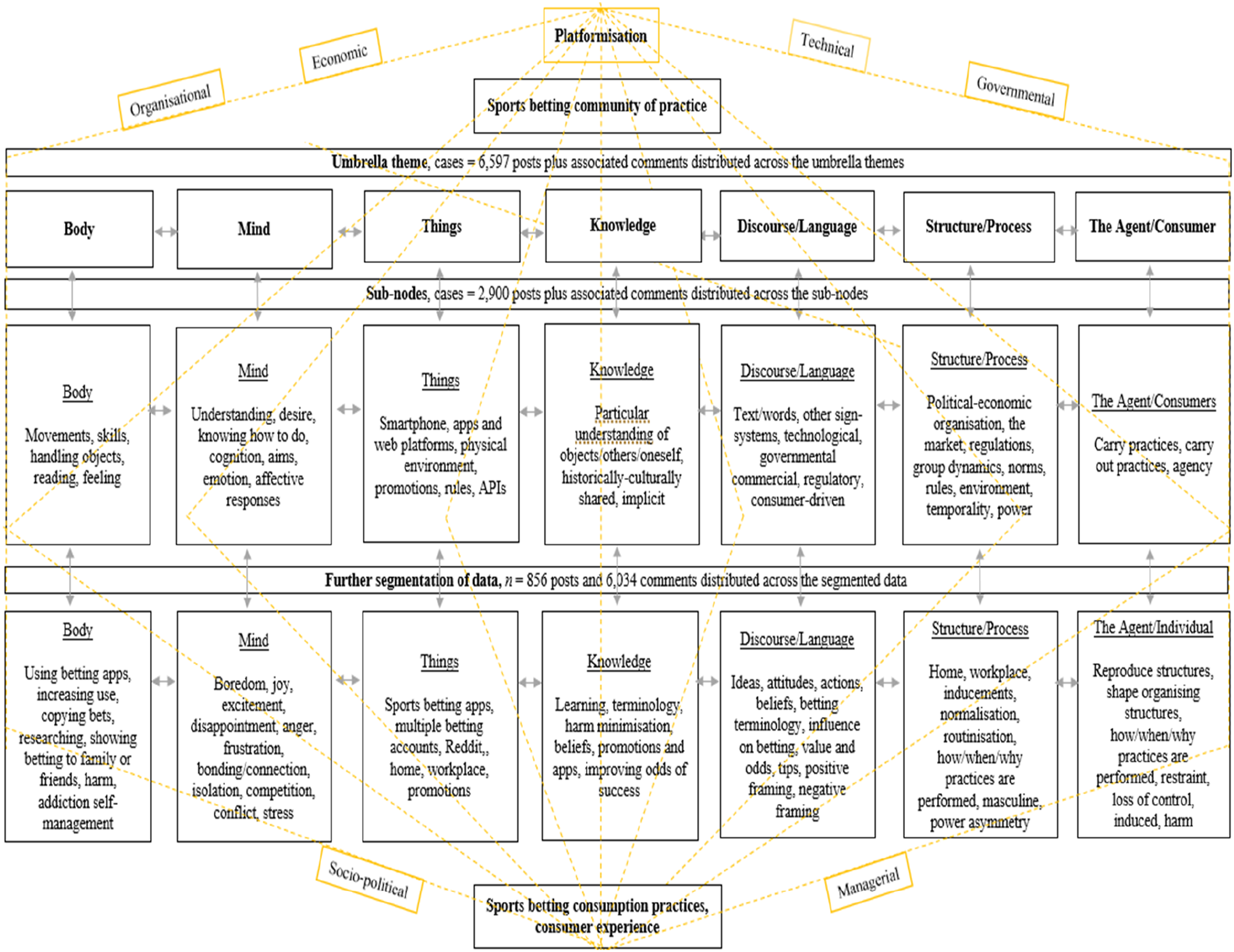
Findings
In this section, we present empirical examples that address the research question: How may platformisation facilitate harmful sports betting consumption practices? The key findings of the research demonstrate that platformisation has a powerful impact on shaping sports betting consumption practices. This includes the introduction of new sports betting consumption practice elements (smartphone apps, online communities, etc.) that result in changing configurations of everyday social practices. For example, sports betting, work, experiences of time, and the consumption of sport are altered by platformisation in ways that cause intrusion and competitive intensification of sports betting consumption practices, and this can lead to harm. Figure 2 provides a conceptual diagram for how the findings themes are discussed. Conceptual diagram of how platformisation facilitates potentially harmful sports betting consumption practices.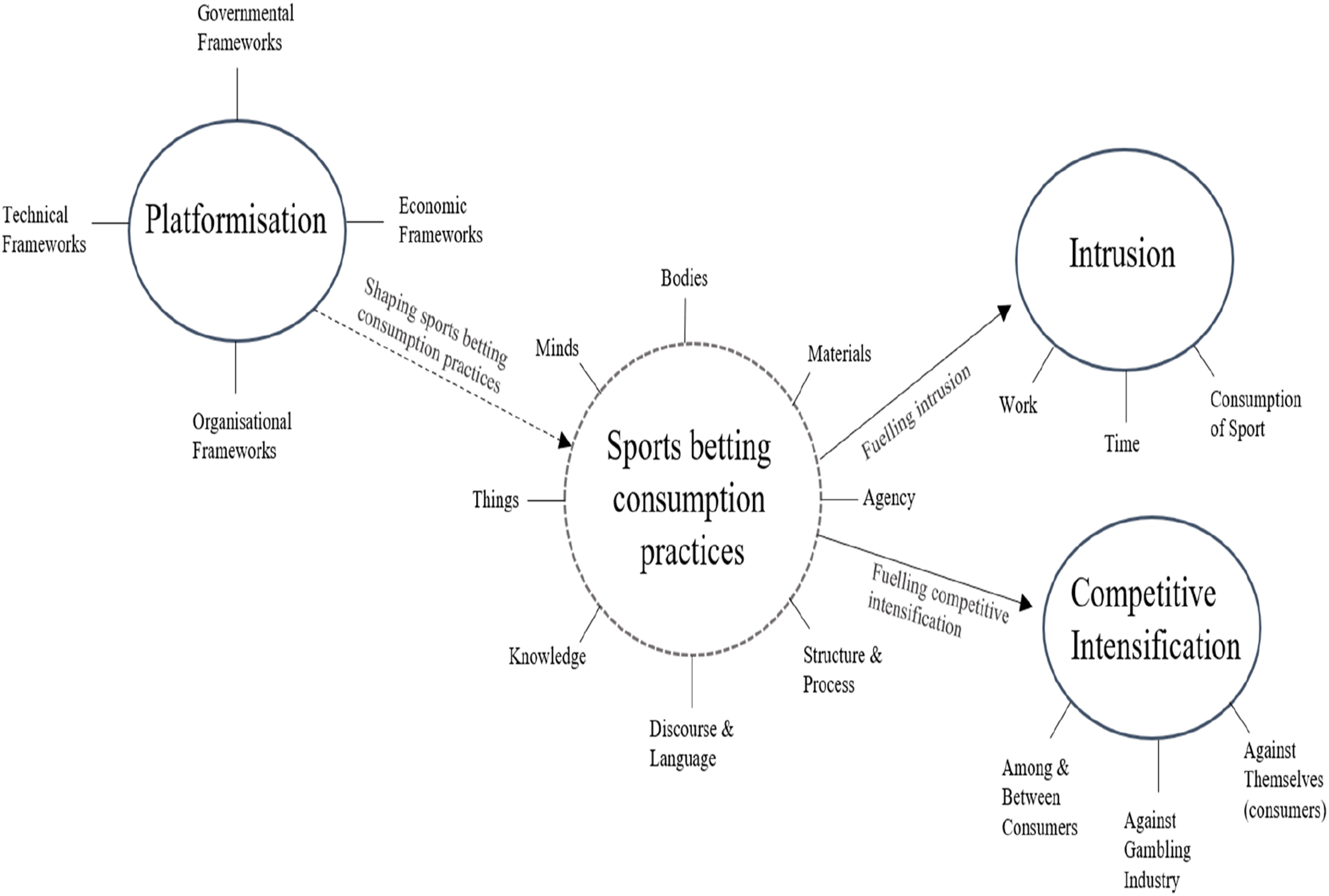
Intrusion
Our analysis identified that platformisation intrudes sports betting consumption practices during work, on time, and the consumption of sport. As illustrated in Figure 3, platformisation facilitates the intrusion of sports betting consumption practices into consumers’ work. Figure 3. The Intrusion of Sports Betting Consumption Practices Into Work.
In Figure 3, members of the sports betting community of practice are discussing workday sports betting consumption practices. Here, practice elements like material devices, knowledge of odds and sports, physical workplaces, embodied boredom, and agency come together to constitute sports betting practices (Downes et al., 2014; Gordon and Reith, 2019) during work. Indeed, prior research by Lopez-Gonzalez et al. (2021) has drawn attention to the emerging phenomenon of sports betting at work using mobile apps, and called for further research in this area. As discussed by the community members, sports betting consumption practices during work offers a way to alleviate boredom (Gordon et al., 2015). Here, platformisation shapes sports betting practices including finding odds, and discussing gambling on Reddit in the workplace and during work hours, causing an intrusion of sports betting practices into work that erodes boundaries between labour and leisure, winning and losing, and stigma and normativity. This intrusion of leisure practices of sports betting into work builds on recent insights illustrating that platformisation accelerated the convergence of leisure practices and work during the COVID-19 pandemic (Risi and Pronzato, 2021). Our findings supplement prior insights on how platformisation has enabled leisure practices to be colonised by work practices through gig economy platforms and company messaging apps (Gandini, 2021; Kim and Yu, 2019). Indeed, this demonstrates how platformisation mediates the relationship between leisure and work in both directions.
As the community members in this thread illustrate, potentially harmful consumption practices like sharing and copying bets that could lead to financial losses during work hours are actively performed. This is a concern, as studies have shown that digital gambling environments can influence more frequent betting with larger amounts, exacerbating personal, social, and economic harms (Siemens and Kopp, 2011). Additionally, the privacy affordances of digital platforms may overcome material workplace constraints to sports betting, like the potential for surveillance by co-workers (Lopez-Gonzalez et al., 2021), which can subvert negative emotional experiences from gambling stigma (Hing et al., 2022). By shaping sports betting practices and facilitating an increased intrusion of these practices into work, platformisation may also reduce productivity and exacerbate personal harm (Langham et al., 2015; Yani-de-Soriano et al., 2012).
Figure 4 illustrates how the intrusion of sports betting consumption practices into work causes some consumers to perform gambling practices as work. Rather than an outcome of material availability of gambling apps alone (Lopez-Gonzalez et al., 2021), platformisation aligns consumer experience with legitimate work, and shapes some consumer perceptions that gambling can provide a lucrative source of income. The intrusion of sports betting consumption practices as work.
In this post, a community member we know as Jace reflects on how they ‘love every second’ of sports betting practices because they provide enough income to be the equivalent of a full-time job, and help with recovery from job loss in white-collar banking due to COVID-19 related budget cuts. In this example, practice elements including bodies and minds of consumers, the materiality of shared winnings, convenience of gambling platforms, and emotions including joy and love form sports betting practices (Reckwitz, 2002; Westberg et al., 2017). Here, we move beyond discourses on gambling while working to gambling as work. Platformisation is connecting consumers and apps through technical infrastructures including APIs and software development kits, enabling consumers to have relationships with like-minded sports bettors who gamble as work, even when experiencing conflict with loved ones. Thus, in effect, we can see that platformisation is transforming labour practices (Gandini, 2021) through intrusion, and structuring the legitimacy of sports betting consumption practices, and consumer experiences of harm, as work. The increased intrusion of sports betting consumption practices as work may mask harms like stress, conflict in relationships, and lost opportunity costs (Langham et al., 2015). This example also illustrates the tensions and trade-offs for consumers between the positive and harmful aspects of how platformisation facilitates consumption practices in the context of online gambling platforms.
Figure 4 also illustrates Jace and another community member named Paul discussing how the intrusion of sports betting consumption practices as work can cause harm to close personal relationships. Gambling literature suggests that sports betting can be viewed as a legitimate leisure practice (Reith and Wardle, 2022) or, contrastingly, as an immoral and deviant practice (Raymen and Smith, 2020). Here, platformisation, through facilitating the increasing intrusion of sports betting consumption practices into everyday life so that it becomes work, influences understandings and relationship norms that help partners and families come to accept or cease to question gambling practices as legitimate work (Downes et al., 2014). Thus, platformisation can pull consumers and close significant others into sports betting consumption practices, implicating families in gambling harm, including interpersonal stress (Latvala et al., 2019). However, acceptance by family members is contingent on sociocultural narratives of being ‘good enough’, and practices of sustained and consistent winning, providing monetary kickbacks to loved ones, and avoiding the ‘big losing streak’. Here, the capitalist economic frameworks of platformisation shape ideas that skill, knowledge, and practices of sharing money with family members make gambling as work acceptable, and that a dedicated workspace is not required.
Platformisation also facilitates an intrusion of sports betting consumption practices on time. Figure 5 illustrates consumers in a sports betting community of practice discussing gambling platforms like DraftKings that afford constant access to wagering on domestic and international sports, including during the night (Parke and Parke, 2019). Here, platformisation provides the structure for consumers to connect around, and perform the practice of, gambling between 12a.m. and 4a.m., representing another form of intrusion on their everyday lives. The intrusion of sports betting consumption practices on time.
Figure 5 conveys narratives from community members we know as Mikey, Jamal, and Orlando about sports betting consumption practices performed during the night. Here, practice elements including the bodies and minds of consumers, material gambling platforms, things such as sports broadcasts, knowledges that betting can provide an escape from shift work, and the agency of consumers, come together to influence temporal experiences of sports betting practices. These insights join existing conversations about how consumption practices shape consumers’ temporality (Woermann and Rokka, 2015). Platformisation also shapes gambling practices such as betting on televised sport to make viewing more exciting, and potentially harmful practices including chasing losses, causing an intrusion on time Yet these consumers associate such potentially harmful practices with ‘degening 2 it up’, referring to a cultural understanding that gambling is a degenerate practice (Reith, 2007). Thus, for some sports bettors, ‘degen’ is a badge of honour, suggesting that gambling stigma takes on new positive meaning. Additionally, the intrusion of sports betting practices on time affords an embodied sense of excitement, and a means to mentally and emotionally escape the material confines of shift work. Digital platforms enable consumers to overcome the social isolation associated with being awake between 12 a.m. and 4 a.m. by enabling them to bet, while also facilitating practice elements like discourses of mateship and togetherness (Waitt et al., 2022). Here, the intrusion of sports betting consumption practices on time shapes positive affective intensities, including camaraderie, that are a recognised element of sports betting practices (Gordon et al., 2015).
However, sports betting at times like 12 a.m. to 4 a.m. is associated with greater risk of problem gambling, including compulsively wagering on random sports (Parke and Parke, 2019). As Figure 5 illustrates, the ‘always on’ intrusion of sports betting consumption practices that is facilitated by platformisation enables consumers to gamble through the night and into the early morning. For the community member Mikey, this is experienced as gambling to ‘lose my winnings or chase my losses on the day’. Yet elements such as physical spaces of overnight work shifts, the minds and bodies of consumers, and things like smartphones and this community of practice form sports betting practices that consumers experience socially when most people are sleeping, which changes how consumers experience time (see Woermann and Rokka, 2015), namely, 12 a.m. to 4 a.m. Here, how platformisation shapes sports betting consumption practices to cause an intrusion on time that is experienced socially by consumers may mediate the link between chasing losses and pathological gambling (see Blaszczynski and Nower, 2002), and help mask the power asymmetries that are associated with online platforms and which favour the gambling industry (see Ross and Nieborg, 2021; Zanescu et al., 2021a). Moreover, consumer desires for knowledges and things (‘insights and picks’) reproduce normative understanding that sports betting consumption practices involve elements of skill which can be acquired to subvert the long odds of winning (Gordon et al., 2015). Yet consumers can also experience gambling harms associated with betting during unsociable times, including chasing losses and reduced productivity (Parke and Parke, 2019).
Figure 6 indicates that sports betting consumption practices that are being shaped by platformisation are also intruding into the consumption, and potentially the enjoyment, of sport (Hing et al., 2017). The intrusion of sports betting consumption practices in the consumption of sport.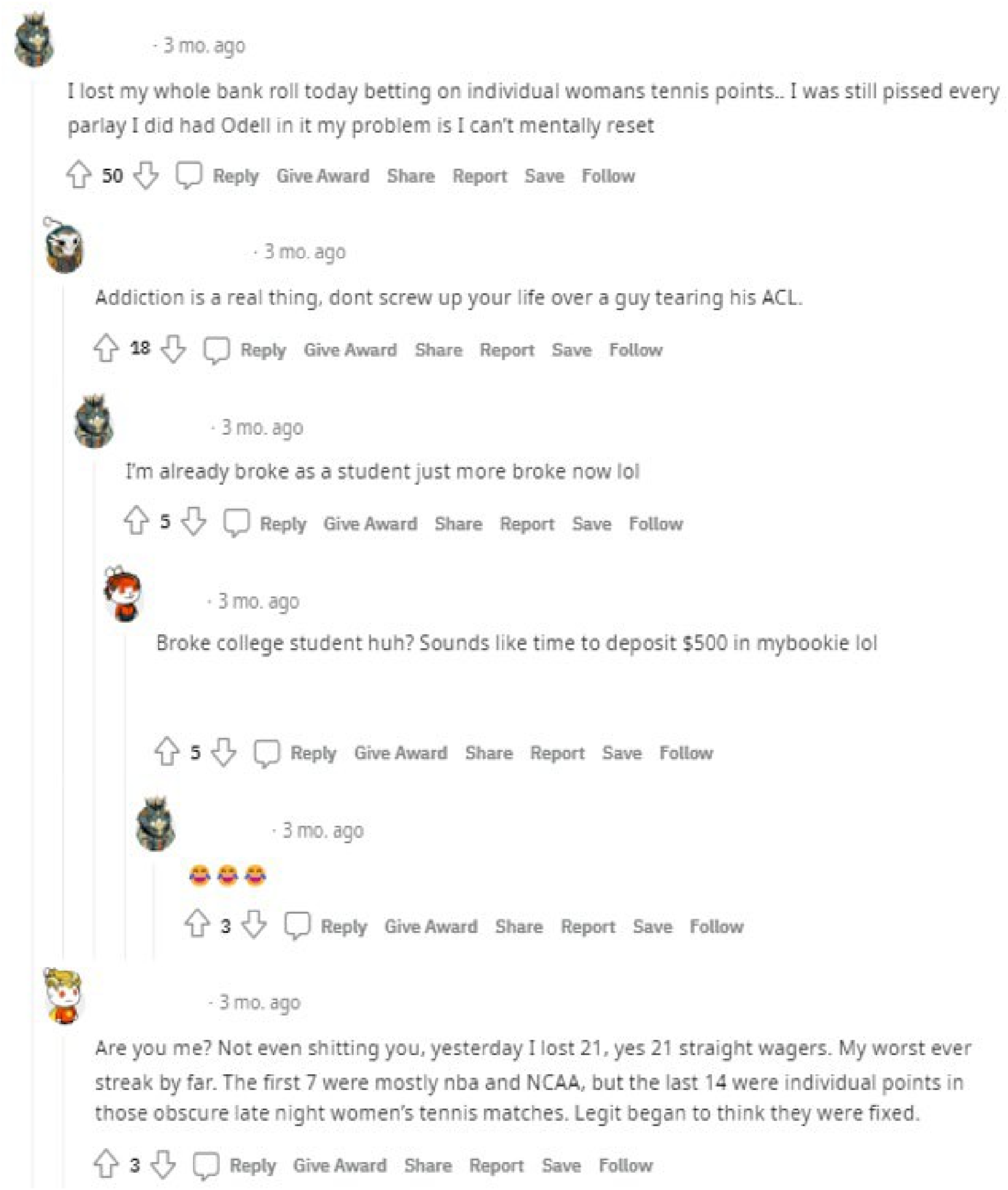
As Figure 6 illustrates, the material, embodied, and social affordances of platformisation associated with sports betting apps and Reddit facilitate the increased intrusion of harmful sports betting practices into the consumption of sport. Here, community members discuss practices like wagering on individual points within sports matches, and hint at the financial and mental health harms this may cause (Russell et al., 2019). One member we know as Jai identifies as a student, which is a market segment more susceptible to these gambling harms (James et al., 2019). Another community member draws comparisons between addiction and discussed practices of betting more frequently, spending all discretionary funds, and placing multiple bet types simultaneously. Yet Jai and the other consumers look the other way by questioning the legitimacy of sports matches, suggesting that they may be ‘fixed’. Here, platformisation is implicated in supporting an atmosphere where the intrusion of betting practices into the consumption of sport is normalised and legitimised by online community discourses (Hakala et al., 2017).
In Figure 6, a community member we know as King shares how an outcome of the intrusion of sports betting consumption practices into the consumption of sport is a struggle to ‘mentally reset’, Here, mobile apps, dynamic markets and odds, new bet types, and the bodies of consumers are elements that constitute ‘always on’ sports betting consumption practices. The material availability of sports betting via digital platforms is implicated in increasing gambling harm (Hing et al., 2022). However, digital platforms are also agentic and relational with consumption practices (Robinson and Arnould, 2020), and structured by political economies and extractive design features (Zanescu et al., 2021a, 2021b). Hence, the discourse of this community of practice suggests that platformisation is shaping when and how sports betting consumption practices are performed, which is intruding gambling into the consumption of sport. Here, platformisation brings to bear economic, managerial, and organisational frameworks of digital platforms that increase the pressure on consumers to place bets when consuming sports. Yet the banter and jokes common to sports betting consumption practices performed by young men (Raymen and Smith, 2020; Waitt et al., 2022), help to offset consumers’ experiences of gambling harm, including poor mental health and financial hardship (Russell et al., 2019). Therefore, more frequent sports betting to try and overcome financial hardship, rather than abstention, becomes a more viable practice for some consumers.
In summary, this section demonstrates that platformisation is shaping sports betting practices and facilitating an intrusion of these practices into work, on time, and into the consumption of sport. This intrusion of sports betting practices is contributing to consumer experiences of gambling harms, including poor mental health, interpersonal stress, and reduced productivity, and eroding boundaries between work and leisure, winning and losing, and stigma and normativity.
Competitive intensification
Our analysis builds on prior research that identifies that competition is a key driver for consumer engagement with sports betting practices (Gordon et al., 2015; Waitt et al., 2022). We identify that platformisation is also shaping sports betting consumption practices in ways that facilitate competitive intensification among and between consumers, against the gambling industry, and for consumers against themselves.
Consumers can acquire knowledge through affordances of platformisation, including online communities (Kozinets et al., 2021; Wichmann et al., 2022). As Figure 7 suggests, the competitive intensification of sports betting consumption practices among and between consumers is supported by knowledge acquisition in this sports betting community of practice. Competitive intensification among and between consumers.
In this example, the original poster we know as Tony encourages other consumers we know as Randall and Milo to join a new competitive gambling community of practice that they established on the Reddit platform. To participate, consumers must place bets using gambling platforms and then add additional money to a digital pot that is won by the most successful gambler of that week. In Figure 7, elements including material gambling platforms and Reddit, things such as money, discourses and sociocultural narratives of competition and of ‘the best’ gambler, and embodied and mental desires of consumers form sports betting consumption practices (Gordon and Reith, 2019). Here, competitive intensification among and between consumers shapes ideas and motivations to formalise a new community of practice to be exploited by the best gamblers. Moreover, platformisation and affordances for consumer learning (Kozinets et al., 2021; Wichmann et al., 2022) shape knowledges that this competitive gambling is a new opportunity to earn money from old sports betting practices. The discussion also provides community reinforcement of normative ideals marketed by the gambling industry, including sports betting practices as social, fun, masculine, and an exciting source of responsible thrill (Gurrieri et al., 2022). Here, competitive intensification among and between consumers illustrates how consumer agency can operate in platformised contexts to influence potentially harmful consumption practices (see Ross and Nieborg, 2021).
As illustrated by Figure 7, platformisation facilitates competitive intensification by acting on the bodies of consumers and stimulating natural human instincts for competition. Consumers enacting competitive intensification by gambling among themselves can experience discourses of praise, mental and embodied effects of status, and, potentially, material increases in income, which are important elements of sports betting consumption practices (Gordon and Reith, 2019). As a result, consumers’ bodies and minds are diverted away from self-disclosed experiences of gambling harm, including mental stress (Langham et al., 2015), keeping them gambling. For example, social connection, and beating other consumers, may offset losses to gambling companies and moderate consumer experiences of anxiety, relationship problems, and addiction. Thus, platformisation helps to shape a normalisation of consumption practices beyond online community discourses or explicit marketer efforts (Hakala et al., 2017; Keller and Halkier, 2014). Additionally, this competitive intensification means that consumers already losing to gambling platforms may incur additional financial losses to other consumers. Again, we can see contradictions and trade-offs for consumers between the positive and harmful manifestations of how platformisation facilitates sports betting consumption practices.
In Figure 8, competitive intensification among and between consumers facilitates issues around controlling sports betting consumption practices, namely, the frequency of checking betting apps, and the regularity of gambling on sports. Therefore, gambling harm can be considered beyond individual personality traits and rational action (Reith, 2007). Competitive intensification among and between consumers, the associated practices, and harms.
Here, two community members we know as Leo and Harvey discuss the mental, financial, and relationship harms from competitive intensification among and between consumers, as well as concerns regarding gambling addiction. Bodies, minds, knowledge, emotions, and agencies of consumers are elements that align in this context of platformised harmful sports betting consumption practices (Gordon and Reith, 2019) to stimulate adrenalin, risk-taking, and competitive instincts among young men. However, the language employed points to how platformisation shapes sports betting consumption practices as acts of aggression that are necessary for survival. In doing so, platformisation reifies the asymmetric relationship between platform operators and consumers (see Zanescu et al., 2021a, b), shaping potentially harmful consumption practices like using multiple gambling platforms and betting larger amounts of money. Here, competitive intensification results in uncontrollable gambling practices and consumer experiences of mental and relationship harms. By discussing shared experiences of gambling harm on Reddit, Leo and Harvey contribute to the social atmosphere that platformisation helps attach to sports betting consumption practices, which aids social normalisation (Hakala et al., 2017). In this example, consumer experiences of homosociality sustain sports betting consumption practices (Waitt et al., 2022) and provide a counterbalance to harm.
In Figure 8, Leo and Harvey discuss experiencing a drug-like ‘rush’ or ‘high’, and ‘feeling sick’, that influences negative emotions and impacts personal relationships, and wellbeing. Material smartphones, things such as promotions interpreted as ‘free bets’, the bodies and minds of gambling platform users and their significant others, and the physical venue of a date, constitute sports betting consumption practices. By focusing and embroiling consumers in competitive intensification among themselves, platformisation facilitates potentially harmful practices of placing high-intensity random bets and overspending on risky parlay products. While prior gambling practices research has found that gambling can help ‘make families’ (Westberg et al., 2017), our findings highlight that the competitive intensification of sports betting by platformisation may provide a source of relationship harms through a lack of attention (Langham et al., 2015). This signals how platformisation is shaping harmful sports betting consumption practices and causing competitive intensification among and between consumers. Yet Figure 8 shows that the effects of responsible gambling practices that are championed by government regulators and the gambling industry, including taking breaks and setting limits (Yani-de-Soriano et al., 2012), have limited positive impact on consumer experiences of harm.
Our analysis also indicates that, by connecting consumers to each other and to material sports betting digital platforms that serve the capital extraction objectives of the gambling industry, platformisation is shaping sports betting consumption practices of high-intensity betting with no prior knowledge of the sport, and enabling real-time consumer discussions about the associated experiences of harm. Figure 9 illustrates how platformisation is causing a competitive intensification against the gambling industry. Competitive intensification against the gambling industry.
Figure 9 shows consumers engaged in tribal practices of tailing 3 each other’s bets. Here, the agency, bodies, and minds of consumers unite with material gambling platforms, including smartphone betting apps and this sports betting community of practice, to support discourses, knowledge, and socialities that together form potentially harmful consumption practices (Blue et al., 2016). Here, platformisation shapes the consumption practice of tailing which supports competitive intensification against the gambling industry, while the discourse of the online community helps to normalise the tailing practice (see Hakala et al., 2017). In effect, platformisation is helping to facilitate a perception that collective sports betting consumption practices impart a greater financial impact on sports betting operators, thus ‘#bleedthebooks’. Here, technical architectures of platformisation, including APIs and software development kits (Helmond, 2015), connect consumers regardless of spatial proximity, enabling collective action with minimal physical effort. In effect, platformisation shapes tailing practices as united consumer action to extract financial resources from sports betting platforms, causing competitive intensification against the gambling industry. Yet potentially harmful practices, including gambling with no prior knowledge of the sport, are normalised. While practice elements such as emotions can structure and guide consumption practices (Molander and Hartmann, 2018), this example points to how platformisation shapes sports betting consumption practices, causing competitive intensification against the gambling industry, which influences the emotional and embodied elements of the consumption practice of sports betting. As a result, practices aligned with minimising gambling risks, such as conducting research (Gordon et al., 2015), disappear.
Figure 9 also illustrates how platformisation can afford consumers emotional and practical support (Tomasena, 2019). Here, embodied and mental experiences of losing and winning co-constitute with other practice elements including knowledges that collective betting helps to compete against the gambling industry, stimulating sociality through camaraderie and teamwork. Yet as platformisation shapes sports betting consumption practices like tailing, or sustained betting despite a series of failures and experiencing a loss of hope, competitive intensification against the gambling industry also brings positive affective intensities that sustain these practices. Platformisation creates an atmosphere that rewards consumer experiences of harm as progress in the competition against the gambling industry. Here, the asymmetric power relations of platformisation that favour corporate entities (Duffy et al., 2019) pervade material betting apps and Reddit, and the bodies, minds, knowledges, and agency of consumers, structuring a zero-sum game of competitive intensification against the gambling industry. While community members like Travis can experience fleeting reprieve from the pressure of competition through an unexpected winning bet, gambling platforms collect revenue from consumer losses, as well as consumer data (French et al., 2021), while potentially harmful gambling consumption practices are reconfigured by platformisation as the only response to competitive intensification.
The platformisation of sports betting consumption practices is also stimulating competitive intensification for consumers against themselves, leading some consumers to battle with urges to compulsively gamble until they experience financial and emotional harm (see Figure 10). Competitive intensification for consumers against themselves.
In this example, consumers use the sports betting community of practice as a confessional space regarding harmful sports betting consumption practices and impacts to wellbeing. Here, platformisation aligns consumer experiences of harm to progress in the competitive intensification against themselves. In Figure 10, practice elements including bodies and minds, material smartphones and apps, things like high-risk product types and bank accounts, discourses of the ‘true’ gambler, and emotional support among betting consumers constitute various sports betting practices (Gordon and Reith, 2019; Westberg et al., 2017). We see that platformisation shapes potentially harmful sports betting consumption practices including overdrawing bank accounts to gamble, and trying to self-manage gambling addiction to continue sports betting, as more viable alternatives to gambling harm reduction than stopping gambling. Yet platformisation is connecting the community members who we know as Dwight, Harlem, Tony, Dane, and Tom to economic, technical, and organisational frameworks of gambling platforms that extend the control of corporate entities seeking ever-increasing profits (Nieborg and Poell, 2018). This results in consumers self-organising to help each other to compete against themselves in the pursuit of winning money back, and controlling urges to gamble. Here, platformisation shapes continued gambling despite experiencing financial hardship and mental health harms (Russell et al., 2019). All the while, gambling harm becomes cachet for some consumers by signalling progress toward becoming a ‘true gambler’ who is more equipped for competition against themselves.
Consumers practice self-discipline to try and manage potential risk and harm when gambling (Latvala et al., 2019). As Figure 10 illustrates, consumers may experience greater perceived knowledge and mental capacity for self-control after taking a break, which can lead to more intense gambling when they recommence using betting apps. While platformisation shapes practices of self-discipline for Dwight, platformisation also makes it easier for consumers like Harlem to gamble at all times, to perform practices like overdrawing bank accounts, and it imbues material sports betting apps with an intensity that is experienced in the bodies and minds of some consumers as the ‘itch’ that is synonymous with addiction (see Zanescu et al., 2021b). Here, competitive intensification against consumers renders practices like taking breaks ineffective for ameliorating gambling harm. Thus, ‘responsible’ practices may further implicate consumers in a cycle of harmful consumption, and competitive intensification against themselves. Additionally, the interplay of the Reddit platform, the sports betting community of practice, ‘always on’ platformised gambling consumption, and the discourse and language of consumers helps to reconfigure financial and mental harms of gambling practices as fodder for sustained competition against themselves. However, the technical, economic, and organisational frameworks of digital platforms further entangle consumers with potentially harmful sports betting consumption practices, and the competitive intensification against themselves, serving the capital extraction objectives of the gambling industry (Markham and Young, 2015). Here, platformisation provides an alternative view on how consumption practices are shaped in online communities beyond community discourse and explicit marketer practices (see Hakala et al., 2017).
In summary, we have presented empirical examples that demonstrate how platformisation facilitates competitive intensification among and between consumers, against the gambling industry, and for consumers against themselves. Here, platformisation shapes harmful sports betting consumption practices, including more frequent gambling with larger amounts of money, and consumer experiences of mental, financial, and relationship harms, which competitive intensification helps to reframe as normal.
Discussion
Theoretical implications and contributions
In this study, we seek to address the research question ‘How may platformisation facilitate potentially harmful consumption practices of sports betting’? In addressing this research question, we find that platformisation shapes sports betting consumption practices and facilitates an intrusion of potentially harmful practices into consumers’ work, time, and the consumption of sport (Figures 3–6). In addressing this research question, we also find that platformisation shapes sports betting consumption practices and facilitates a competitive intensification among and between consumers, against the gambling industry, and for consumers against themselves (Figures 7–10). While intrusion and competitive intensification produce some positive aspects for certain consumers, they can result in others experiencing mental, financial, and relationship harms, and reduced productivity. Here, our research enriches conceptualisations of the implications of platformisation for consumers and practices (e.g. Duffy et al., 2019; Kozinets et al., 2021), and expands conversation on the darker side of platformisation focusing on political economy and platform design features (Ross and Nieborg, 2021; Zanescu et al., 2021a).
Our findings also illustrate the contradictions and trade-offs for some consumers between potential positive aspects of online betting platforms, such as providing an income in case of job loss, and connecting like-minded consumers, and the potential financial, relationship, mental health, and work productivity harms that these platforms are also implicated in. This enriches the insights from prior research that also considers both the positive and negative effects of platformisation (Kozinets et al., 2017; Ross and Nieborg, 2021; Zanescu et al., 2021b). For example, we find that platformisation of sports betting consumption practices enables consumers to earn an income akin to a job, yet the financial risks associated with gambling as work are significant (Downes et al., 2014). Furthermore, platformisation of gambling consumption elicits affective intensities of a drug-like ‘rush’ or ‘high’, yet also results in consumers ‘feeling sick’ due to a wagering loss (Gordon et al., 2015; Waitt et al., 2022).
As with prior research (Gordon and Reith, 2019; Westberg et al., 2017), our findings reveal that various elements form different sports betting consumption practices. These elements include bodies, minds, things, knowledge, materials, agency, discourse and language, and structure and process. Here, we add new insights to practice theory of consumption research about how practice elements can change over time (Molander and Hartmann 2018; Schatzki, 2002). For example, platformisation has a powerful impact on shaping everyday consumption practices as digital platforms are integrated as key material elements of sports betting practices, so consumers no longer need to make time to physically visit gambling venues, which enables an intrusion of gambling into work, time, and the consumption of sport (Gordon and Reith, 2019; Lopez-Gonzalez et al., 2021). These findings add to conversations on the temporal dimensions of consumption practices and the impacts for consumer experience (Woermann and Rokka, 2015), and enrich insights into how consumption practices can be shaped in online communities (Hakala et al., 2017) and by digital elements (Robinson and Arnould, 2020).
Our findings also illustrate how platformisation acts as a broader level force that shapes sports betting consumption practices. Here, we enrich scholarship on the role of structuring forces on consumption practices, highlighting how technical, economic, governmental, and organisational frameworks of digital platforms work to shape sports betting practices in various ways, and this can lead to harm. This builds on existing scholarship that highlighted how technological objects, emotions, or online community discourses structure social practices of consumption (Hakala et al., 2017; Hartmann et al., 2015; Robinson and Arnould, 2020). Indeed, our findings suggest that the quartet of interrelated tensions arising from the platformisation of consumer culture – datafication and liquification, standardisation and ephemerality, interaction and mediation, and immateriality and materiality (Caliandro et al., 2024) – can have implications for harm.
Finally, our research enriches sociocultural perspectives on gambling. Our findings add to conceptualisations of the capital extractive function of the gambling industry from political economy (Markham and Young, 2015) by showing how platformisation through digital platforms and their various frameworks reinforce power asymmetries that cause financial losses for consumers, which boosts gambling industry revenue. Furthermore, our findings contrast with prior research that suggested that gambling practices can ‘make’ families (Westberg et al., 2017), by showing that platformisation can shape sports betting consumption practices leading to relationship conflict and interpersonal stress. For example, by facilitating intrusion and competitive intensification. Moreover, our findings illustrate that platformisation is a broader level force largely beyond the control of consumers that shapes sports betting practices during work, expanding conversations on gambling and work (Downes et al., 2014) that largely focus on cause (e.g. greater availability via material apps) and affect (e.g. increased gambling at work) (e.g. Lopez-Gonzalez et al., 2021).
Practical contributions and implications
We offer the following implications for policy and practice emerging from our study. Government regulators and public policy-makers need to acknowledge and pay attention to the role that platformisation plays in stimulating potentially harmful consumption practices. Given ongoing policy concerns regarding platforms, online betting, and gambling harms (Parliament of Australia, 2023), there must be serious consideration about whether the co-regulatory model that emphasises industry self-regulation in countries such as the United Kingdom and Australia is adequate for protecting consumers and mitigating gambling harm in the age of platformised consumption (Reith and Wardle, 2022). A shift toward tighter governmental controls over platforms and statutory regulation of online gambling may be required (Gordon and Moodie, 2009; Houghton et al., 2019). For example, bans for price promotions that induce sports betting practices late at night, early in the morning, and within individual sports matches (Gordon and Reith, 2019; Hing et al., 2022). Likewise, the emerging group betting products marketed by gambling companies that may further capitalise on competitive intensification, as well as intrusive digital marketing, could be prohibited.
On a practical level, marketers should pay more attention to how the platformisation of consumption can potentially lead to harm for consumers. Given that our findings show links between digital platforms such as sports betting apps and Reddit, and potentially harmful gambling consumption practices, there may be a need to refine marketing codes of ethics to ensure ‘do no harm’ to consumers is upheld (see American Marketing Association, 2021). We argue that there is also a need for a greater level of social responsibility from the gambling industry and marketers concerning how they harness platformisation and use mobile apps to stimulate gambling. Our findings suggest that platforms encourage consumers to bet late at night, at work, or more intensively, and this does not align with industry and marketer claims to focus on ‘responsible gambling’.
Practical actions for platforms like Reddit may include adjusting existing moderation practices to remove content that stimulates, or represents, risky and harmful gambling consumption. Links to gambling support services could also be provided in gambling communities of practice hosted on the Reddit platform. There may be potential for social marketing programs to harness platformisation to facilitate positive behaviour change among gambling consumers, for example, through using digital platforms that encourage engagement in alternative leisure practices to support health and wellbeing (e.g. Hello Sunday Morning). Finally, gambling support service providers, including psychologists and financial counsellors, should be aware of the powerful role that platformisation can play in facilitating harmful gambling consumption practices and may need to consider how they can appropriately support consumers to disengage from platforms such as sports betting apps and online communities of practice.
Research contributions and implications, and suggestions for future research
There are some limitations to our research that we acknowledge. First, we were unable to recruit consumers from Reddit for interview research despite inviting potential participants using direct messages and comments on posts. This may be due to the anonymity afforded to consumers on Reddit and a reluctance to reveal their identity through interview research. Additionally, because the netnography focused on how consumers discuss sports betting consumption practices, the platform owner’s perspective is missing. Future research could feature interviews with gambling platform owners and developers to more deeply understand how the technical, capitalist economic, and managerial and organisational frameworks of online gambling platforms shape consumption practices, and how this can lead to harm. Future social practice theory research could also further investigate associations between social practices and platformisation, especially given the increasing prominence of digital platforms in everyday life.
Research could also consider how platformisation intrudes into other aspects of consumers’ everyday lives, such as at home, or their roles and responsibilities as a partner or parent. Studies could also expand our focus on competitive intensification to investigate how the platform-mediated social interaction among consumers may be a product of industry and marketer tactics. Further studies could also undertake ethnographic and visual ethnographic research (see Gordon and Reith, 2019) to reveal additional mechanisms beyond intrusion and competitive intensification through which platformisation, or other macro forces, shape consumption practices and the associated outcomes for consumers. Finally, future research that considers the regulation of platforms and the policy environment that sustains gambling consumption practices is necessary. This research would benefit by considering the platformisation literature and recent shifts toward statutory regulation (Poell et al., 2019).
Footnotes
Declaration of conflicting interests
The author(s) declared no potential conflicts of interest with respect to the research, authorship, and/or publication of this article.
Funding
Responsible Gambling Fund, Australian Research Council (DP190101405) and Business School, Queensland University of Technology.
Notes
