




Abstract
With care being increasingly present and offered for sale on markets consumers are more often asked to consider ethical questions. However, ethical consumption literature has not paid close attention to how the selling of different care offerings contributes to the ethicalisation of consumption. To illustrate and conceptualise this phenomenon, the present paper builds on an object-focused study of care products and services from both online and offline Swedish clothing retail settings. The Callonian notion of qualification, which refers to the attachment of different characteristics in the making of exchangeable goods, is drawn on theoretically to study how care offerings, such as repair kits and laundry tools, are offered for sale. The findings suggest that the qualifications propose a shift from care-less consumption, where the care offerings are made central to the performance of caring consumption through everyday mundane activities. Thus, the paper shows that the way care products and services are offered for sale wants to intervene and shape how caring consumption is made possible through markets and how it should be performed through ethicalised mundane chores.
Introduction
Care is now appearing on markets in various products and services, as well as part of corporate social activities (Chatzidakis and Littler, 2022); in other words, care is ‘packaged for sale in the marketplace’ (Chatzidakis and Maclaran, 2022: 161). When care is materialised as a product for sale, it promises to deliver care for the self or more distant others (Chatzidakis and Littler, 2022). Caring through consumption is often performed with the purchase of ethically produced and sourced products (Newholm and Shaw, 2007; Szmigin et al., 2009) or the purchase being attached to a donation (Eckhardt and Dobscha, 2019; Kipp and Hawkins, 2019). The delivering and demonstration of that care through consumption can be understood as ‘attentive interest, concern, as well as actions arising as a result of such attention’ (Shaw et al., 2017: 416). However, with the marketisation of care (Chatzidakis et al., 2024) also comes the increasing appearance of care products and services that have a different relation to the delivery of care. These care products and services ask consumers to give care, not simply through the purchase of the more ethical products, but through asking consumers to take care of their belongings also at home with the help of these products and services.
Clothing retail markets are examples of retailers offering – occasionally in a complimentary manner – such care products and services for sale. These are offerings that help consumers to conduct garment care as part of their everyday lives, such as washing guides, self-repair kits, and iron-on patches as well as to deliver care through the help of professional repair and personalisation services. Although these care offerings advocate for a slower approach to consuming clothing, mainstream fast fashion retailing is characterised by a high amount of clothing sold and shortened product lifetimes (Niinimäki et al., 2020). The care offerings problematise this issue and fast-paced clothing consumption, often decoupled from retailers’ key activities of selling more clothes (Stål and Corvellec, 2018). Thus, creating ethically complex environments for consumers to manoeuvre, where the care offerings might be used by retailers to legitimise problematic corporate practices as a form of carewashing (Chatzidakis and Littler, 2022). While, Chatzidakis and Littler (2022) demonstrate how care is used in corporate branding, and marketing of self-care and community care resources as a form of carewashing, the care products and services in clothing retail settings call consumers to perform caring in mundane everyday routines.
These care offerings ask consumers to think about the consequences of their own actions as part of their everyday routines for the sector’s sustainability transition. Previous studies show that consumers are individualised to act ethically with consideration for different global challenges through markets and policy-making (Carrington et al., 2016; Caruana and Chatzidakis, 2014; Chatzidakis, 2015; Giesler and Veresiu, 2014). This is similar to what Fuentes and Sörum (2019) call the ethicalisation of consumption, where different ‘things’ on markets, such as ethical consumption-supporting apps, foreground the ethics embedded in consumption by problematising mundane consumption activities and reframing them as arenas for ethical action. On markets, an ‘illusion of choice’ and the possibility of being an ethical consumer is maintained for consumers (Carrington et al., 2016: 27), often through the purchase of different forms of ethical products and services (Eckhardt and Dobscha, 2019; Kipp and Hawkins, 2019; Newholm and Shaw, 2007). However, care offerings differ from selling fair-trade products or connecting a purchase to a donation as a form of ethical consumption. Through these care offerings, care-giving and ethical consumption are not performed simply through the purchase, consumers are asked to do the caring also at home after the purchase decisions have been made.
While previous research explored how ethical choice on markets is maintained for consumers through selling different ethical products and services (Eckhardt and Dobscha, 2019; Kipp and Hawkins, 2019), as well as how carewashing is part of corporate branding and customer care (Chatzidakis and Littler, 2022), these new offerings raise different questions about the relation of care on markets and ethical consumption. It is widely acknowledged that different professionals, such as marketing managers and product developers, organise markets so that consumers are increasingly asked to choose ethically (Giesler and Veresiu, 2014; Kipp and Hawkins, 2019). However, less is known about how products and services offered for sale attempt to ethicalise consumption throughout the consumption process and especially in the use and disposition phases. As these offerings are increasingly present in retail settings, that is, the places of ‘where and when retailing takes place’ (Hagberg et al., 2016: 694), such as stores, webstores as well as social media accounts, what they do to ethical consumption requires further research. Thus, there is a need to understand the concrete ways in which these care products and services are offered for sale to fully grasp how they problematise and shape mundane everyday activities as ethical. Accordingly, the present study aims to address the following research question: How does the socio-material enactment of care offerings in retail settings contribute to the ethicalisation of consumption?
With this focus, the paper offers an empirically grounded account of how the selling of care offerings shapes, that is, defines, enables and constrains, the way ethical consumption should be performed beyond purchasing ethical products as part of everyday lives. To study this, the paper theoretically draws on the notion of qualification (Callon et al., 2002), which explains the process of how products and services are offered for sale by being attached with different characteristics that prepare them for exchange. The present paper is based on an object-focused study (Bruni, 2005; Carrington, 2012) of garment care offerings introduced in Swedish clothing retail settings. Three Swedish retailers’ care offerings and their surrounding marketing material were collected as part of the study. This set of materials was analysed to identify what qualities are attached to the care products and services offered for sale and prepared for exchange, and how these qualities problematise and question everyday mundane activities. The three identified qualities of ‘sustainability proxy’, ‘technique enabler’ and ‘emotional durability tool’ presented in the analysis illustrate what form of ethical consumption these care products and services favour and want to enable in everyday lives, as well as what actions they problematise. Based on this socio-materially oriented analysis, the paper illustrates how the selling of care offerings contributes to the ethicalisation of consumption through intervening in everyday mundane activities.
The paper commences by introducing the theoretical framework of studying the shaping of ethical consumption through ethicalisation and qualification, followed by the methodological choices through which three Swedish clothing retailers’ care offerings were studied. Next, the three identified qualities of ‘sustainability proxy’, ‘technique enabler’ and ‘emotional durability tool’ are presented and analysed to show how they ethicalise consumption. The discussion and conclusion sections illustrate how these findings contribute to knowledge on ethical consumption and care offerings appearing on markets.
Ethicalisation of consumption and qualifications of care offerings
The ethical consumption literature has started to explore how markets and policies shape ethical consumption. Initially, ethical consumption research focused on how different attitudes and barriers facilitate or impede ethical choice (Carrington et al., 2010, 2014), and the potential guilt (Chatzidakis, 2015; Shaw et al., 2016) or dissonance and flexibility associated with the consumer experience of this gap (Szmigin et al., 2009). However, more recently, research has started to focus on how the landscape in which consumption is embedded shapes, that is, defines and enables or constrains ethical consumption. Carrington et al. (2020) in their interdisciplinary review of ethical consumption research describe this shift as increasing interest in the question of constructing ethical consumption-related agencies and responsibilities. In the present study, the knowledge developments arising from this shift combined with the qualification approach serve as the theoretical framework.
As part of the above-presented shift, previous studies have identified that multiple actors on different levels (e.g., communities, governments and corporations), through varying actions (e.g., boycotts, protests, policies, CSR initiatives), advance the role of consumers in bringing about more ethical practices (Caruana and Chatzidakis, 2014). Additionally, another previous study shows how non-governmental organisations construct ethical consumer subjectivities by allocating responsibilities to consumers and different market-bounded capacities (Giesler and Veresiu, 2014). These market-bounded capacities might be positioned as solutions to showing care for environmental and social issues, such as in the case of buying a pair of TOMS shoes with the promise that the company will also give a pair to someone in need (Kipp and Hawkins, 2019). Through such offerings, product developers, marketing managers and corporate strategists present a pre-designed variety of options, labelled ethical, for consumers to choose from. This pre-construction of ethical choice aims to convey to consumers that being ethical while consuming is possible (Carrington et al., 2016; Coffin and Egan-Wyer, 2022). Thus, these studies argue that marketing professionals and product designers define what is understood as an ethical choice on markets. Yet a more socio-materially oriented approach is necessary to provide an explanation for how the selling of care offerings attempts to intervene in consumers’ everyday lives.
Practice-oriented and constructivist theorising of markets and consumption started to closely observe and conceptualise the role of different socio-material entities in shaping ethical choices on markets (Barnett et al., 2005; Hawkins, 2021; Pecoraro et al., 2021). For instance, a previous study on Finnish retail settings shows how care is ‘built into’ the servicescape as an ethical retail ideology, alongside nostalgia and aesthetics, to ‘nurture ethical consumption possibilities’ (Pecoraro et al., 2021: 538). Here the shaping of ethical choice is achieved through the design of the store as well as the materials involved. In a similar vein, but starting to pay closer attention to specific ‘things’ in configuring consumption-related ethics, Hawkins (2021) shows that plastic packaging is made into a political actant that invites consumers to demonstrate care by detaching from the use of such material in grocery retail settings. Thus, the package-free retail store is a socio-material landscape that asks and allows consumers to demonstrate their care for the environment, by giving up on the problematised use of plastic packaging. Plastic packaging invites others, through the material arrangement of the store, to ponder over care-related questions and voluntarily avoid the use of plastic as a form of care. Here, Hawkins asks how consumers end up detaching themselves from plastic packaging as an act of care and expression of ‘ethically infused consumer agency’ (Hawkins, 2021: 415). Continuing on the question of how consumers start caring through different ‘things’ in retail settings and how that problematises certain everyday activities while favouring others, the present paper draws on the ethicalisation of consumption as discussed by Fuentes and Sörum (2019).
Furthering the understanding of how socio-material entities shape ethical consumption, Fuentes and Sörum (2019), through the ethicalisation of consumption, show the role of ethical consumption-focused smartphone apps in problematising previously mundane everyday activities and reformulating them as ethical. More specifically, the ethicalisation of consumption illustrates how ethical questions around consumption are brought to the fore through different market devices (Fuentes and Sörum, 2019). These ‘things’ on markets focus on problematising and repositioning mundane consumption activities into arenas for ethical action, while not necessarily succeeding in making consumers who carry out these prescribed actions more ethical (Fuentes and Sörum, 2019). Such changes are often challenging to achieve in actual terms (Carrington et al., 2016; Szmigin et al., 2009). As other previous studies have shown, consumers may resist being assigned responsibilities for wider causes or being enrolled in sustainability initiatives (Eckhardt and Dobscha, 2019; Gonzalez-Arcos et al., 2021). Thus, the ethicalisation of consumption rather points to how the previously mundane, hidden and routinised domestic chores such as laundry, cleaning and food shopping, are made into ‘sites for ethical consumption’ through different ‘things’ on markets (Fuentes and Sörum, 2019: 144). While ethicalisation has been used to explain how ethics in consumption are foregrounded through different smartphone apps, it has not been discussed how different offerings in retail settings may also problematise mundane everyday activities.
This is where qualification as an analytical tool is employed. Qualification allows one to investigate the socio-material work involved in offering products and services for sale (Callon et al., 2002; Kjellberg and Helgesson, 2007). This concept sheds light on how products and services are made into tradable goods (e.g., Dubuisson-Quellier, 2010; Fuentes and Fuentes, 2017; Reijonen and Tryggestad, 2012). By definition, qualification refers to the ongoing process where product developers and marketeers attach a ‘constellation of characteristics’ or qualities to their products and services to prepare them for exchange (Callon et al., 2002: 199). Thus, combining the insights from the ethicalisation of consumption with the qualification approach allows for studying how the different characteristics attached to products and services speak about consumption. More specifically, it enables an examination of the forms of consumption the qualities problematise and what actions they attempt to enable or impede. In the following sections, the analytical aspects of the qualification process that assist in studying the care offerings and their role in the ethicalisation of consumption are discussed.
Previous empirical studies furthered the understanding of the complexities of qualifications when new products or services are offered for sale on markets, for instance, showing how provenance is created and used in the qualification of wine (Smith Maguire, 2013) or the creation of alternativeness through multiple qualifications to make different markets for dairy alternatives (Fuentes and Fuentes, 2017). Outside the context of food and beverage, qualifications were studied around PVC-free and environmentally friendly urinary drainage bags (Reijonen and Tryggestad, 2012), and rider airbags in the safety equipment market (Reimer and Pinch, 2020). Lastly, the qualification of a specific service, namely, garment take-back systems in clothing retail settings, has also been explored (Corvellec and Stål, 2019). These studies, through showing the multiple qualifications produced by marketers to prepare the offerings for exchange, highlight the complex socio-material work behind offering products and services for sale. Furthermore, they demonstrate the intensive qualifications involved with products and services offering environmental benefits, as well as the complex qualifications connected to abstract notions such as safety, provenance, and alternativeness. Thus, studying the specific qualities attached to the care offerings that prepare them for exchange can foreground how ethical consumption is envisioned and problematised as the care products and services are offered for sale.
The above studies also show that qualifications, despite being designed during product development, are possible to identify and trace based on how the products and services are offered for sale on retail markets. This traceability of qualifications is demonstrated by Reimer and Pinch (2020) as they show how retail stores are used for the qualification of rider airbags. To reiterate the distinction between the different scenes of qualifications, Reijonen and Tryggestad (2012) point out the difference between ‘in vitro’ qualification experiments that take place before products are launched and ‘in vivo’ qualifications that are present in already launched products and services. These latter qualifications are the ones that Callon et al. (2002) describe as temporarily stabilised and embedded in offerings to prepare them for exchange as they are offered for sale. The present paper is concerned with identifying and studying these ‘in vivo’ qualifications in retail settings to see how the selling of the care offerings shapes and ethicalises consumption.
Lastly, qualifications of products and services in retail settings are not limited to the qualities directly attached to the very products and services waiting to be exchanged. Furthering the understanding regarding ‘in vivo’ qualifications, some argue that the different qualities are not only embedded in the different products and services, as marketeers also offer suggested qualities to consumers through the socio-material construction of the surrounding retail settings (Cochoy, 2007), including packaging, labels and both physical and digital promotion materials (Callon and Muniesa, 2005; Fuentes and Fuentes, 2017; Muniesa et al., 2007). Fuentes and Fuentes (2017) demonstrate this through their work on alternative dairy market-making, as they study the product qualifications conducted by digital marketing material, product packaging, and the arrangement of the store. Therefore, when studying the qualifications involved with care products and services ‘in vivo’, attention should be paid to both the qualifications that are embedded in the products or services and the surrounding retail settings.
Against these insights, the present study analytically approaches the care offerings on retail markets as they are offered for sale to identify the different ‘in vivo’ qualities that are attached to them in the preparation of exchange. Furthermore, by connecting the ethicalisation of consumption (Fuentes and Sörum, 2019) with the qualification approach (Callon et al., 2002), the study also asks what form of consumption these qualities problematise, how they question mundane and routinised everyday activities, and which ones they attempt to enable or impede. With this analytical approach, the study illustrates and conceptualises how different care offerings offered for sale on retail settings contribute to the ethicalisation of consumption. The following section presents the methodological choices made to study the ‘in vivo’ qualifications around the care offerings.
Methodology
The present paper draws on a wider multi-sited (Marcus, 1995) and object-focused study (Bruni, 2005; Carrington, 2012; Fuentes and Fuentes, 2017) conducted in Swedish clothing retail settings. This approach of starting from artefacts (Carrington, 2012) to understand socio-material realities, constructed through human and non-human interactions, is inspired by Science and Technology Studies (e.g., Bruni, 2005). A perspective that is also connected to the qualification framework that the present study draws upon. Following things on markets, such as shopping bags (Hagberg, 2016); plastic packaging (Hawkins, 2021); marketing devices or ‘market-things’ such as shelves or labels in supermarkets (Cochoy, 2007; Fuentes and Fuentes, 2017) have been deemed useful for understanding how different activities and forms of consumption are enabled or constrained through markets. Building on this research approach allowed for ‘following’ and collecting the instances when care products or services are offered for sale in retail settings.
To capture these offerings, the 25 largest fashion companies registered in Sweden were sampled through the Orbis database in April 2020, where 12 fulfilled the chosen criteria of interacting with consumers directly and having their headquarters in Sweden. Furthermore, two smaller companies, Acne Studios as a ‘luxury brand’ and Nudie Jeans as a denim retailer offering free repairs, were added to the sample to include more examples besides the already included fast fashion retailers. The sustainability webpages and reports of these 14 companies were screened for garment care offerings. After this screening, companies that did not address garment care were excluded. Out of this sampling and screening, H&M, Filippa K and Nudie Jeans were chosen as research sites for following care offerings based on the principle of including diverse examples of clothing retailers, who engaged with garment care extensively, offering different products and services. H&M was chosen as it is the largest fashion company in Sweden with the most elaborate garment care offering amongst the fast fashion retailers, while Filippa K is a higher price point retailer that bases its branding on long-lasting products. Lastly, the denim-focused Nudie Jeans was also included as it stands out by offering free repairs through different channels for all sold jeans.
Material was collected from these three retailers by following different mentions of their care offerings guided by the principle of looking at what the ‘shoppers’, the primary recipients of the qualifications, see when encountering the retail settings (Cochoy, 2007). This approach, applied in October-November 2020, led the research process through the retailers’ different retail settings, understood broadly as different physical and digital locations of ‘where and when retailing takes place’ (Hagberg et al., 2016: 694). Thus, the material was collected from stores, websites, webstores and social media accounts (Facebook and Instagram) as well as sustainability reports. The digital material was captured by using screenshots and by downloading website sections as documents, while photographs were taken of the physical retail settings.
Summary of Collected Material.
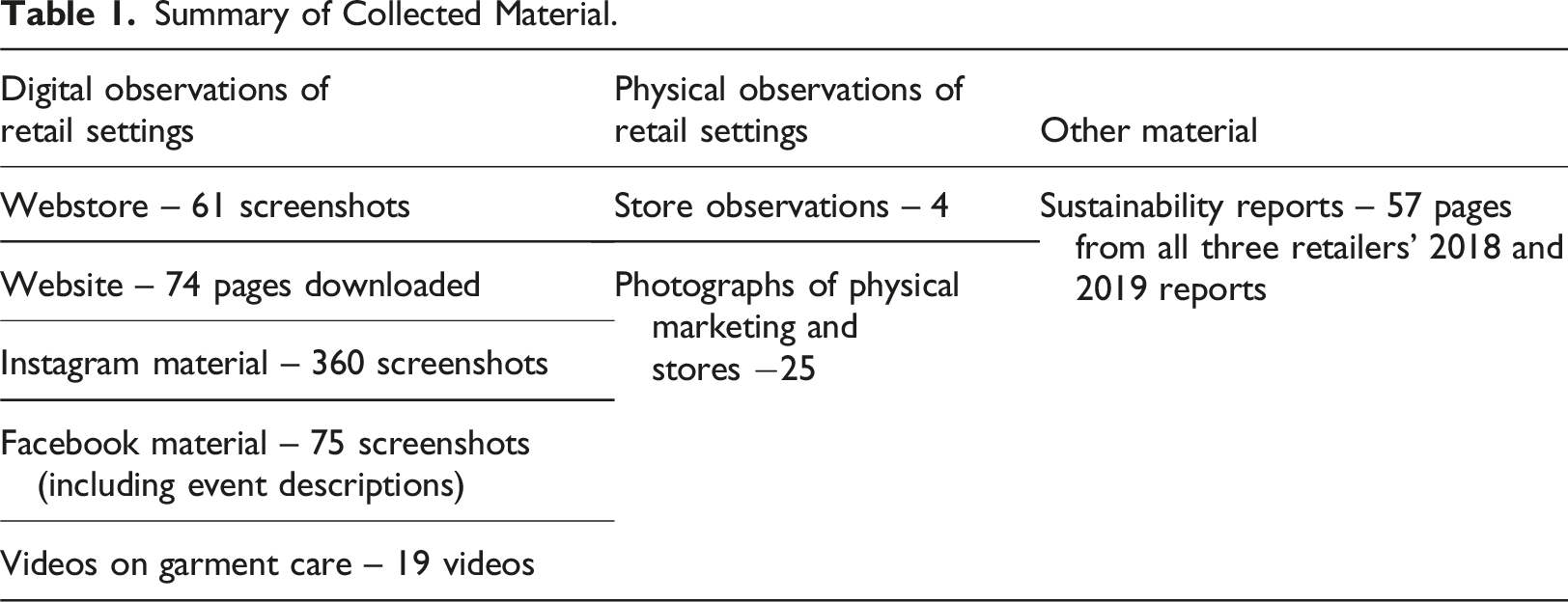
All of these data files were uploaded to NVivo, and sorted according to the three retailers, allowing for line coding of all the material. Even though the collected material spans different formats (video, social media images and posts, event descriptions, product descriptions, and store observations), the data mainly involve textual material, as written observations were produced on imagery and store visits, videos were transcribed, and social media posts comprised elaborate post descriptions. The data files were studied one by one, and different codes, emerging from the material, were assigned to them using NVivo’s node function (some data files received more than one node), generating a wide range of nodes (n.180) such as ‘care advice’, ‘bond with clothes’, ‘memory of clothes’, ‘ageing of garments’. Once all material was coded, the nodes that connect to how the care offerings are offered for sale on retail settings were assigned to a separate set.
After this organisation of the material, the analysis commenced by building on the above-outlined theoretical framework based on the qualification approach (Callon et al., 2002) and ethicalisation of consumption (Fuentes and Sörum, 2019). To understand the selling of care, each of the nodes and its contributing data files were studied one by one under this set to build an understanding of the in vivo qualification work involving the temporarily stabilised qualities that aim to prepare the care offerings for exchange.
The following section presents the identified qualities that are attached to care products and services to prepare them for exchange and how they contribute to the ethicalisation of consumption.
Analysing ethicalisation in the qualifications of care offerings
Taking the above analytical approach led to the identification of three qualities in the selling of care offerings: sustainability proxy, technique enabler, and emotional durability tool, all of which aim to prepare the care offerings for exchange across different retail settings. Furthermore, it was also observed that these qualities not only speak of the care offerings but also address consumers’ own belongings, that is, their garments that would receive the care through the use of the care offerings. These qualities contribute to the ethicalisation of consumption by foregrounding the issues with care-less consumption while advocating for caring garment consumption with the purchase of the offerings. The qualifications prepare the care offerings for exchange by opposing and aiming to tackle the different reasons that impede care-giving. The following sections illustrate the three qualities attached to care offerings, how they address garments and how this contributes to the ethicalisation of consumption.
Sustainability proxy
Sustainability proxy, as the first discussed quality in the qualifications of the care offerings, builds on connecting consumers performing garment care with the goal of extending product lifetimes, and the implication of such behaviour for environmental sustainability. This aspect of the qualifications, where caring, product lifetimes and environmental sustainability are connected, is visible in the following quote from Nudie Jeans (captured by the author during Autumn 2020, posted by Nudie Jeans on 8/2/2020 https://www.instagram.com/nudiejeans/): Wear them hard, wash them seldom, repair when necessary. Prolonging the life of your clothes saves resources and in turn, helps save our planet.
In the above quote, caring for garments (including wearing, laundry and repair) is linked to caring for the planet, as consumers are encouraged to demonstrate a conscious attitude towards the environment by prolonging garment lifetimes through care (see also in Figure 1). This argument is at the core of how the sustainability proxy quality aims to prepare the care offerings for exchange. This quality needs to establish that through the use of the care offerings, clothing consumption can be made more sustainable. It shows that with the use of the care offerings, longer product lifetimes are ensured, contributing to the reduction and avoidance of textile waste (Niinimäki et al., 2020), associated with the opposing care-less garment consumption. Hence, this quality prepares the care offerings for exchange by promising an environmental benefit stemming from the adoption of these offerings, while also problematising the lack of caring for garments. Filippa K’s care label (photo taken by the author in autumn 2020).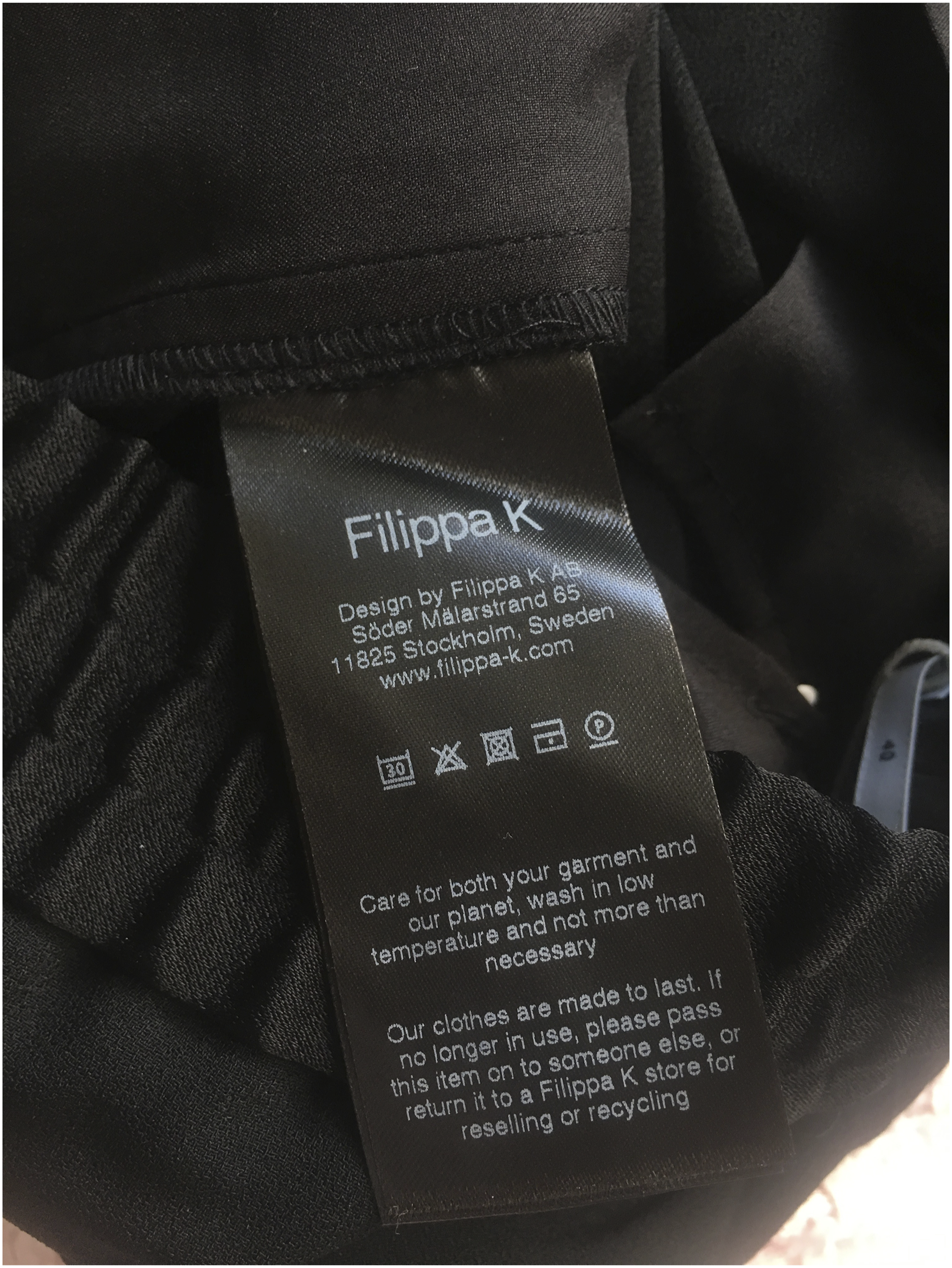
One example of the use of the sustainability proxy quality can be observed in the product description of washing bags on H&M’s webstore and the presentation of the ‘Cleaner Sea’ care guide on the Take Care Hub, involving the use of Guppy bags (No 6/81 Take Care SE). The sustainability proxy quality is attached to the washing bag by problematising the issue of microplastic shedding from synthetic garments during washing, but it also shows that even the use of the regular mesh washing bags can at least protect the garments from damage during wash. Here, the washing bag is attached with the sustainability proxy quality by not only showing its ability to prolong the lifetime of the garment but also contributing towards keeping microplastics away from the sea. The sustainability proxy quality attached to these wash bags implies that the non-use of this tool is a form of care-lessness since it involves not paying attention to microplastics and the need to protect clothing during washing despite the availability of tools and information.
The attachment of the sustainability proxy quality to a care service can be observed on Filippa K’s care label, sown into garments sold by the brand (see Figure 1) when the care label is understood as a complementary service exchanged through the purchase of Filippa K garments. The sustainability proxy quality appears in the text on the label, as it positions caring for garments as caring towards the planet and recommends washing at low temperatures and only when necessary. Thus, the qualification shapes the understanding of how garment care should be conducted by highlighting the environmental impact of potentially doing laundry too often or at too high a temperature. Foregrounding the issues with the routinised task of laundry and proposing to care for garments with respect to the environment contributes to the ethicalisation of consumption, as laundry is made into a site for ethical action (Fuentes and Sörum, 2019).
Further highlighting the importance of caring for garments from an environmental perspective, the sustainability proxy quality also addresses garments as investment pieces. This is a necessary shift in the qualifications of the offerings, as the care-lessness of the competing qualification, where garments are viewed as throwaway pieces (Cooper, 2008), commonly used in fast fashion, needs to be tackled (Fletcher, 2010). Furthermore, by seeing garments as investment pieces, the time, energy and money invested into caring for them is made more worthwhile. Thus, the sustainability proxy quality shows that it is worth investing caring into garments, and while transferring the different wardrobe management activities into ethicalised spheres (Fuentes and Sörum, 2019), it also draws out arguments regarding how consumers should value and use their garments.
In the material, this qualification aspect was mostly identified in the case of Filippa K. This retailer, through different qualifications, talks about mindful consumption and invites consumers to buy less and good quality clothing with the intention of keeping them for longer. With caring, as the qualification points out, a prolonged lifetime can be expected from these garments, which justifies their higher price. Thus, in this example, the sustainability proxy quality further prepares the care offerings for exchange by speaking of garments as investment pieces that are worthy of care, not only because of the initially higher investment but also since, with the care offerings, a prolonged lifetime can be expected from them. The following quote, from Filippa K’s 2018 sustainability report (p. 49), provides an example of how the retailer explains the importance of care offerings in relation to maintaining the quality of garments: With Filippa K Care products, our customers can give their garments a luxury treatment. Each is uniquely designed to help keep your timeless styles in pristine condition, and looking new season after season.
As the sustainability proxy quality gets attached to care offerings, the everyday handling of clothing becomes understood as a doing with the end goal of prolonged product lifetime, where garments receive care as consumers utilise these products and services. This way of consuming clothing is counter-positioned to the problematised care-less way, where garments are not viewed as investment pieces and caring for them is not considered worthwhile. This proposed shift towards caring consumption foregrounds the problems involved with, for instance, laundering clothing in a care-less way, that is, without the use of washing bags, or with too high a frequency or temperature. This way of selling the care offerings adds ethical questions to handling and maintaining garments, by pointing out the problems with how it is currently done as opposed to how it should be conducted, that is, in a more environmentally friendly way with the help of the care offerings.
However, this promise embedded in the sustainability proxy quality on its own is not always enough to ‘succeed’ and prepare the offerings for exchange and successfully advocate for the shift towards more caring garment consumption. In some cases, the act of care-giving requires different levels of skills from consumers, which may alienate some from purchasing these care offerings. Thus, while the lack of attention and care for clothing is problematised for environmental reasons, further qualifications are required in the selling of care offerings to prepare them for exchange. The following quality addresses the challenge of consumers’ potential lack of know-how regarding garment care (Dissanayake and Weerasinghe, 2022), which further supports the qualifications of care offerings, while also contributing to the ethicalisation of consumption.
Technique enabler
To further prepare the care products and services for exchange, they are also attached with the technique enabler quality, which makes caring skills accessible for consumers. This quality ensures that the configuration of exchange is not hindered due to consumers’ potential lack of know-how about garment care. The key qualification work here is to shift the concept of garment care as an activity that requires expert knowledge to be viewed as an attainable skillset with the help of the offerings. Thus, this quality makes care offerings needed, not only for sustainability reasons as did the previous quality, but also for the performance of care-giving. This quality contributes to the ethicalisation of consumption as it lowers the access to repairing and caring skills, and shows that anyone is capable of doing their part through the garment care solutions offered by the retailers. This positions the lack of knowledge, or alternatively the lack of willingness, to learn about garment care as a form of care-lessness.
As garment care entails different activities that vary in complexity, the technique enabler quality needs to answer to different levels of skillsets to win consumers over, prepare the offerings for exchange and enable caring consumption. On the one hand, this quality positions care practices as easy and accessible despite consumers’ skillsets and presents the care products and services as simple step-by-step guides that help consumers conduct care practices, such as the five-step guide on ironing a shirt without damaging it (No 16/81 on H&M Sweden’s Take Care Hub captured in Autumn 2020). Furthermore, the technique enabler quality not only ‘markets’ these freely accessible guides, it is also used to prepare different care products for exchange. For instance, the garment tag attached to a Filippa K jumper suggests using a sweater stone to remove piling from the material, which at the time was also available for sale (see Figure 2). This garment tag carries the technique enabler quality by transferring material knowledge about cashmere and suggesting a tool through which consumers can provide care for the garment. The garment tag attached with the technique enabler quality prepares the sweater stone for exchange, as it connects the purchase of the sweater stone to the purchase of the knitwear by showing that this care product is required for owning a cashmere jumper. The tag also points out that the garments’ aesthetic improvement with age is conditional to the care provided by consumers. This implies that a garment’s less appealing look is the result of consumers’ care-lessness. Care guide for a cashmere jumper (photo taken by the author in autumn 2020).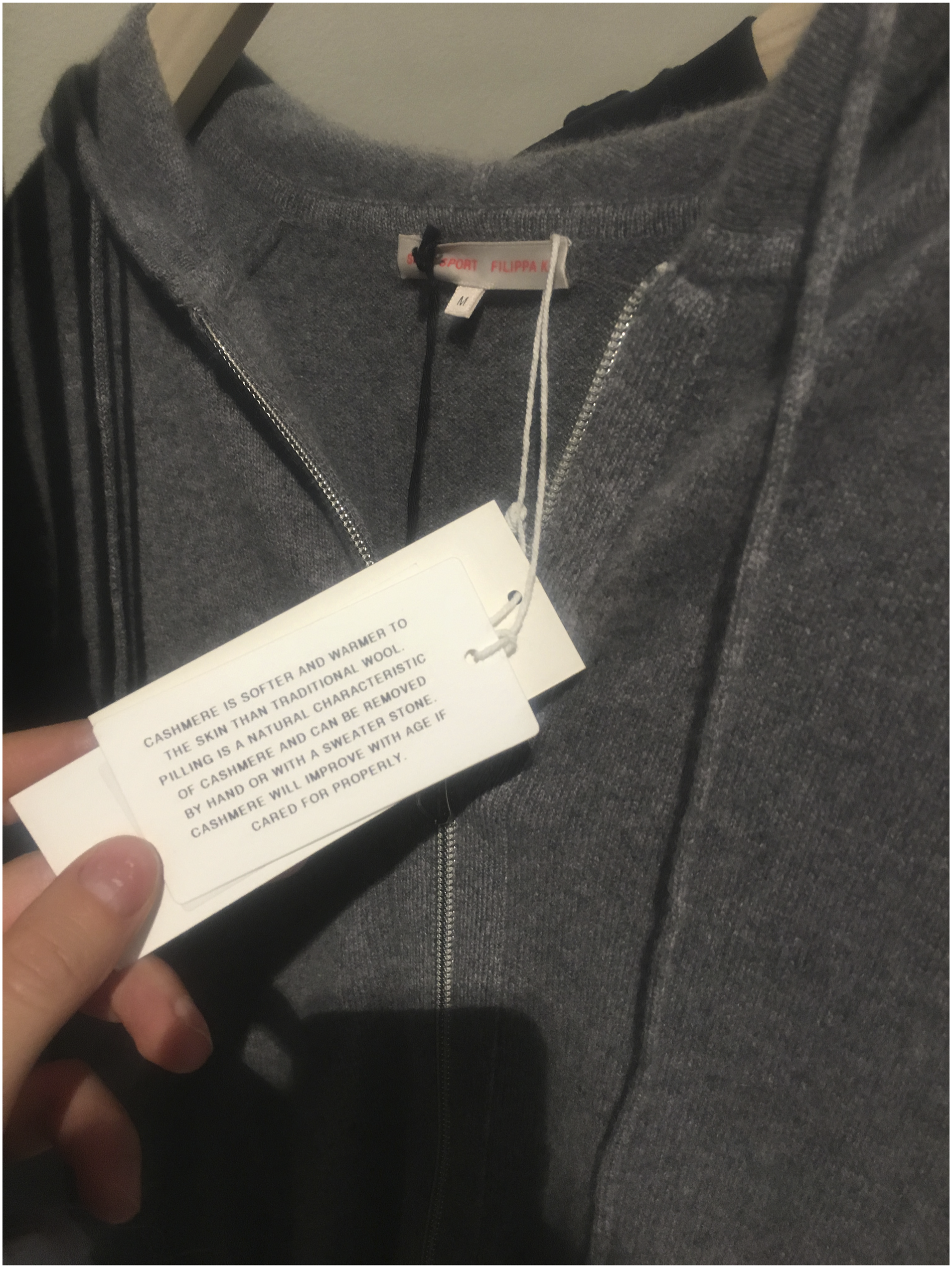
On the other hand, the care offerings also include more complex lessons, made available through online guides or videos. The technique enabler quality attached to these care offerings argues for the possibility of consumers themselves performing more complex care-giving. This focus on care-giving differentiates the technique enabler quality from the sustainability proxy quality, which would rather advocate for ‘caring about’ and ‘caring for’ environmental challenges (see Shaw et al., 2017). H&M’s Take Care Hub contains a guide on the complex task of mending a hole in a pair of jeans, which aims to convey that denim mending ‘might sound like a lot of work, but it is actually quite basic’ (own translation, No 44/81 on H&M Sweden’s Take Care Hub captured in Autumn 2020). The guide is a four-step elaborate instruction on how to use patches, why to hand sew them first and which setting to use on the sewing machine. Furthermore, it also recommends the use of the retailer’s own denim patches. Thus, the attachment of the technique enabler quality to the denim patches and the mending care guide positions these offerings as simplifying and enabling the even slightly more complex technique of mending a pair of jeans. According to this quality, consumers who are willing to make a special effort and attempt to learn how to mend the hole in their jeans are doing the right thing by caring for the garment, as opposed to the problematised act of not ‘caring’ about learning the new skill, despite it being made accessible.
The qualification of care products and services as technique enablers positions consumers’ garments as objects of craft by equipping consumers with the skills that allow them to open up the garments (Meißner, 2021) and start being crafty. This aspect of the qualification process is connected to how consumers appropriate their garments and make them their own by wearing and caring for them. As opposed to garments as ‘closed objects’, the technique enabler quality opens up garments’ properties and transforms them to be able to receive different care activities from consumers (see also Meißner, 2021). Nudie Jeans draws on this as their key message, namely, that ‘they all started out as a pair of dry denim’, but now they reflect the person who is wearing them through the different, unique fades that become part of the denim (see Figure 3). Nudie Jeans’ Facebook post (collected by the author in autumn 2020, posted by Nudie Jeans 21/06/2020 https://www.facebook.com/nudiejeans).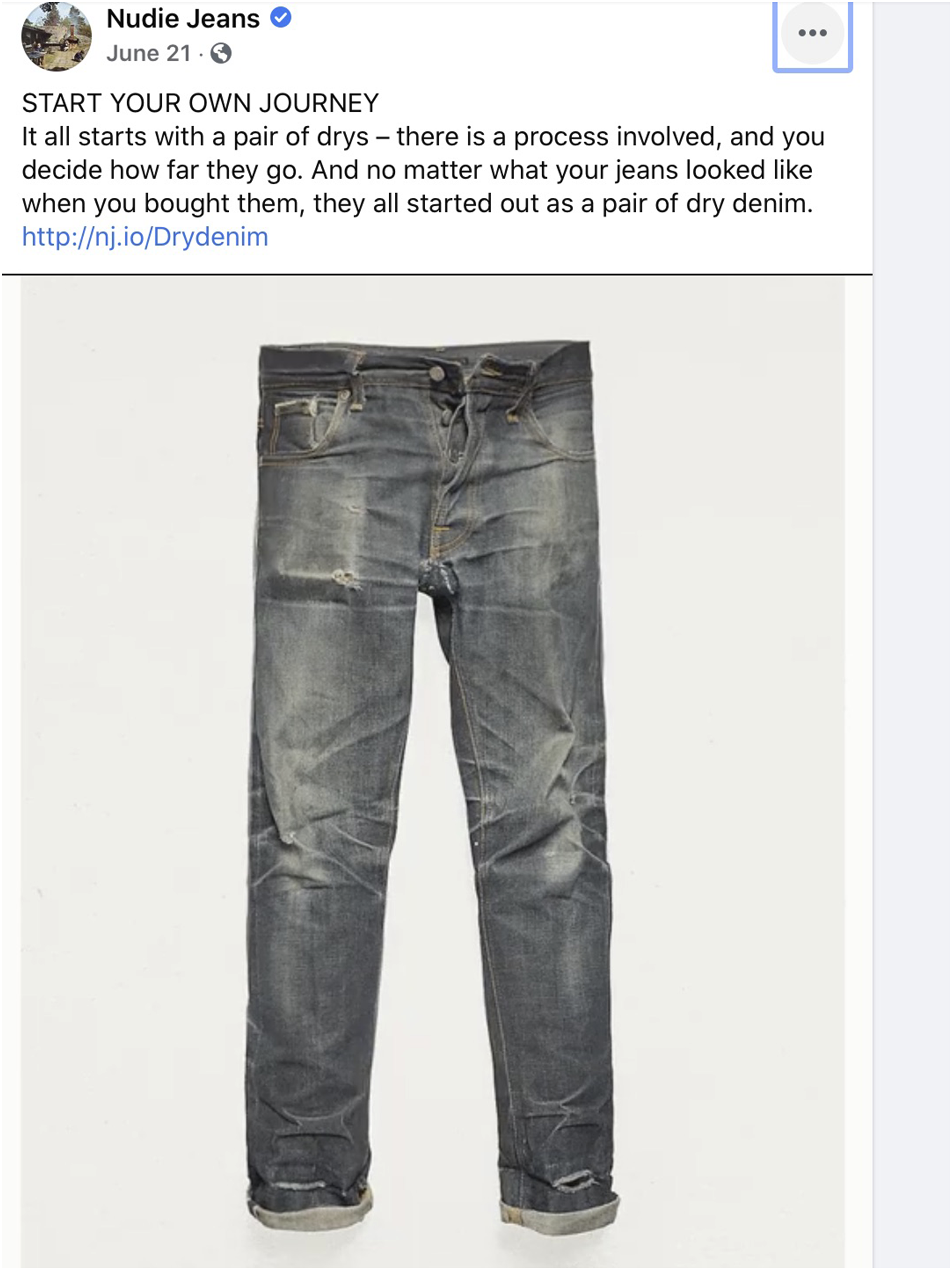
Looking at a garment as an object of craft makes further care activities possible. This shift, which the technique enabler quality aims to create regarding how consumers’ garments are understood, invites the purchase and use of further ‘technique enabling’ offerings to develop the required skills and perform further caring activities.
Emotional durability tool
In the selling of care products and services, the emotional durability tool quality also works on preparing the offerings for exchange. This quality furthers the ethicalisation of consumption by problematising and positioning boredom with clothing as a form of care-lessness. Emotional durability is argued to be one of the key reasons why consumers part with garments prematurely (McNeill et al., 2020). Thus, this quality aims to tackle another challenge, which might divert consumers from buying the care offerings and caring for their garments. The quote below from H&M’s Take Care guide on refreshing an old jacket directly addresses emotional durability by presenting a scenario of getting tired of a wearable item (quote taken from H&M UK in English in Autumn 2020, also available in Swedish on H&M Sweden): Tired of your trusty old friend yet not quite ready to let go of it? Solution: switch out half your jacket, add a new collar or make the length shorter (Jacket Hacks No 72/79 Take Care UK or No 72/81 Take Care SE)
This advice, followed by a step-by-step guide, is attached with the emotional durability tool quality, as it is framed as a creative solution for boredom with garments. Furthermore, H&M also offers simpler tools to ensure emotional durability, such as iron-on patches and an embroidery service. These care offerings aim to motivate consumers to keep garments for longer by strengthening their connection with them. The emotional durability tool quality shows that even when consumers get bored with garments, there are fun, creative ways to revive them again. Thus, this quality further prepares the care offerings for exchange by showing that by using care offerings, consumers can ‘fall in love’ with their garments again instead of disposing of them due to boredom. While positioning the care offerings as a solution to a challenge that would impede caring garment consumption, the attached quality also problematises disposal by pinpointing that there are other, better ways of using and owning garments. As the selling of care offerings shows that more caring is possible, everyday routines become questioned. Through this quality, avoiding boredom and the disposal of clothing as a form of caring garment consumption is juxtaposed with inaction.
The emotional durability quality attached to care products and services speaks of consumers’ garments as old favourites, life companions, second skin, memory capsules or friends. This position garments as the objects of love, where it is implied that they are worthy of care, further preparing the care offerings for exchange and problematising the lack of care. For instance, in the H&M quote above, the care-receiver garment is referred to as an old friend, which emphasises its love worthiness. In that quote, the relationship to garments is compared to interpersonal relationships, such as friendship or love, where caring is common. Thus, when garments are viewed as objects of love, their care-receiving position is further supported, as well as the idea of buying and using the care offerings, since they are made necessary for care-giving. Another illustrative example of showing garments as objects of love is, for instance, Nudie Jeans positioning old and worn garments as companions on a journey in different inspirational ‘user stories’ (see Figure 4). Nudie Jeans’ Instagram post (screenshot taken by the author in autumn 2020, post from 17/11/2019 https://www.instagram.com/nudiejeans/).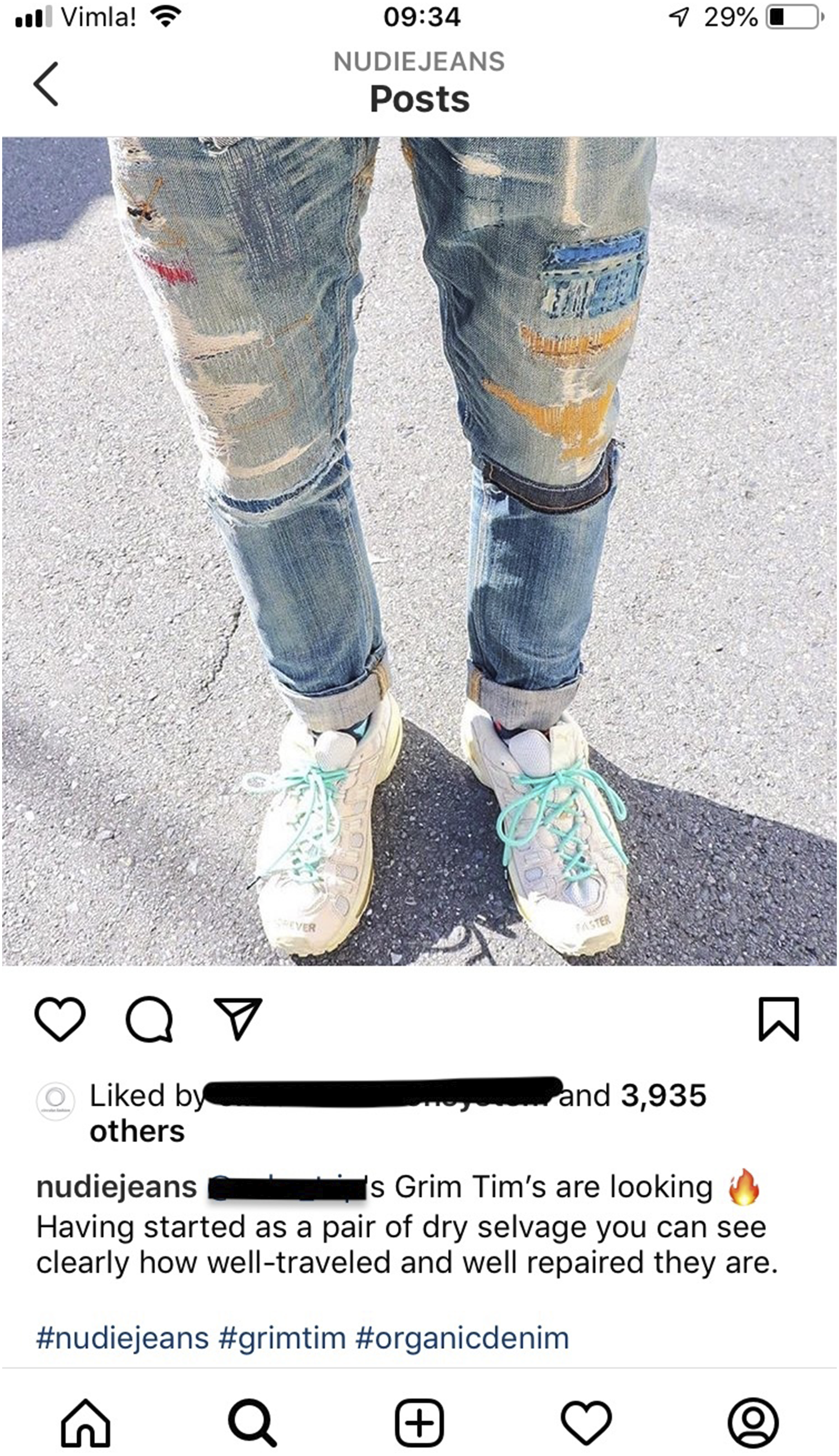
In this example, the worn-out look indicates a well-loved and cared-for garment that is constantly kept interesting through different mending techniques, where the owner of the jeans has the option of deciding the style of mending. Thus, the pair of jeans presented in the picture seems to have overcome the challenge of emotional durability. The emotional durability quality shows that through caring, as enabled and defined by the care offerings, garments can spend a prolonged time in consumers’ wardrobes as opposed to the care-less way of disposing of them prematurely.
From care-less to caring, the ethicalisation of garment consumption
To summarise, in the selling of care offerings, the sustainability proxy, technique enabler and emotional durability tool qualities work together to avoid different scenarios that would lead to a lack of care-giving for garments and impede the purchase of these offerings. While preparing the care offerings for exchange, these qualities also address garments as the objects of investment, craft and love, which further support the idea of investing resources into the purchase and use of the care offerings. As a form of ethicalisation (Fuentes and Sörum, 2019), these qualities question the everyday routinised ways of how consumers manage their garments while presenting and enabling the possibility of an alternative, caring garment consumption. Thus, according to the selling of care offerings, caring consumption is performed as part of the ethicalised mundane chores and it is supported through retail market settings. This argument is elaborated upon by first outlining how the different qualities contribute to the ethicalisation of consumption by proposing the shift to caring consumption. Second, how this allows retail settings to shape ethical consumption beyond the question of ethical choice by defining a specific form of caring consumption performed with the care offerings. Lastly, this section concludes by highlighting how this way of selling the care offerings allows for tying caring consumption to markets.
The qualifications of care offerings contribute to the ethicalisation of consumption by attempting to make the shift from care-less to caring garment consumption. This repositioning and problematising of the everyday mundane chores (Fuentes and Sörum, 2019) is attempted in three ways in connection to the identified qualities. The care offerings, as sustainability proxies, explain why care has a renewed importance for environmental reasons and propose to look at garments as investment pieces as opposed to throwaway items. Moreover, the technique enabler quality not only teaches about how to care for garments by reducing the barriers to doing garment care, but it also opens up the garments and transfers them from ‘closed objects’ to things that can be the objects of crafty activities, once again creating a position for garments as care-receivers. Lastly, the emotional durability tool quality shows that boredom with clothes is avoidable and that garments should not just be used up and consumed, since they are more similar to friends or life companions, once again showing the importance of caring for garments by emphasising that they are the objects of love. Thus, the qualities that prepare the care offerings for exchange centre around problematising the use of garments as throwaway pieces, not learning about care techniques and being bored with clothes by pinpointing the care-lessness embedded in these practices. This suggests that the ethicalisation of everyday consumption is not only achieved through market devices, such as ethical consumption-focused smartphone apps (Fuentes and Sörum, 2019). The way care products and services are prepared for exchange on retail settings advocates for caring consumption by transferring mundane chores, such as laundry and clothing repair, into an arena associated with ethical obligations. Thus, the way different care products and services are offered for sale in retail settings contributes to the ethicalisation of consumption, by arguing that consumers should care for their belongings also at home.
Problematising the lack of care for garments and presenting solutions not only questions the routinised and mundane everyday chores of handling one’s clothing, but it also positions the use of the care offerings as the necessary, right way to own and consume garments. This shapes how caring consumption as part of the ethicalised everyday chores should be conducted according to the retailers. In Hawkins’ (2021) paper, the mundanity of plastic packaging is questioned, and it becomes requalified as unnecessary when consumers are asked to give it up while shopping for groceries. The plastic packaging, when requalified and attempted to be removed from shopping, becomes a ‘potent force capable of generating new concerns and capacities for care’ (Hawkins, 2021: 409). In the present study, the qualifications generate concerns and define how a more caring consumption should be conducted through the use of the care offerings. For instance, the technique enabler quality shows that the care offerings are designed to help with caring for belongings across a wide variety of skillsets, addressing the knowledge needs of different groups, starting from simple guides on how to iron shirts, but also aiming to address more complex tasks, such as how to patch up broken jeans.
These findings contribute to previous studies discussing the connection between ethical consumption and markets (Carrington et al., 2016; Coffin and Egan-Wyer, 2022) and the question of care and ethical consumption (Hawkins, 2021; Kipp and Hawkins, 2019; Pecoraro et al., 2021). The paper contributes to these studies, by showing that when care products and services are offered for sale, the ethicalisation of consumption goes further than simply asking care to be demonstrated through the purchase of products. When care products and services are offered for sale, the ways caring consumption should be enacted are also put forward by the offerings. Thus, the present paper argues, that when care is not only asked to be demonstrated through purchase choices (cf., Kipp and Hawkins, 2019), but caring through products and services are offered, the extent to which markets shape ethical consumption is stretched further. In other words, in the selling of care offerings, the ethicalisation of consumption goes beyond purchase, as they put forward suggestions on how garments should be used, for example, washed, stored, repaired and upcycled, in ethical ways as a part of everyday life. According to the care offerings, ethical consumption is not only about making good choices while shopping, but also about establishing a lasting relationship with the purchased goods, committing to taking care of them with the help of the retailers’ offerings on a daily basis and keeping the same items for an extended time. However, while this form of caring consumption is put forward to consumers, the retailers simultaneously also remain focused on selling clothes, attempting to align the selling of clothes and caring for clothes on retail markets. This suggests that different professionals go further than pre-designing the ethical choice or the illusion of it on markets (Carrington et al., 2016; Coffin and Egan-Wyer, 2022). By drawing on the notion of care, these professionals can further maintain that ethical consumption is possible through markets if consumers perform caring consumption with the help of the offerings through everyday chores.
Last but not least, it is important to highlight that the care products and services that are made central to the performance of caring consumption are presented on markets. As care products and services are offered for sale through retail market settings, and as they ethicalise everyday chores, caring consumption becomes connected and defined by market-bounded offerings. While it has been argued that the packaged selling of care is an increasingly visible phenomenon, often leading to carewashing (Chatzidakis and Littler, 2022; Chatzidakis and Maclaran, 2022), this paper shows how the performance of a pre-defined and enabled form of caring consumption also gets attached to markets. This was visible, for instance, when Filippa K connected the purchase of the cashmere sweater to the purchase of a sweater stone, which suggests that for the caring use and maintenance of cashmere jumpers, the purchase and the use of this tool are necessary. Furthermore, the jeans mending guide from H&M, who also offers denim patches for sale, seems to suggest that to be able to conduct the repair, consumers should purchase the pre-made and packaged denim patches. This is proposed instead of, for instance, advocating for consumers to keep old textile pieces for future necessary repairs, which may be counter to the retailer’s textile collection strategy (Corvellec and Stål, 2019). These findings suggest that the clothing retailers tie the performance of caring consumption to retail market settings, instead of, for example, suggesting local repair services or clothes sharing as forms of more ethical consumption. Thus, retailers define and try to maintain their control over how caring consumption as part of the ethicalised everyday activities should be performed. These insights add to previous research regarding care being offered for sale on markets (e.g., Chatzidakis and Littler, 2022; Eckhardt and Dobscha, 2019), by pinpointing how this leads to a specific market-bounded form of caring consumption being defined by retailers.
Conclusions on care, markets and ethical consumption
The aim of this paper has been to answer the following research questions: How does the socio-material enactment of care offerings in retail settings contribute to the ethicalisation of consumption? To answer this question, the present paper studied the qualifications of care products and services in clothing retail settings to illustrate how care offerings are prepared for exchange and how this way of selling care products and services shapes how ethical consumption should be performed as part of everyday mundane activities. While care being offered for sale on markets is a more and more visible phenomenon (Chatzidakis and Maclaran, 2022), and it has been studied how corporate branding and customer care lead to carewashing (Chatzidakis and Littler, 2022), the implications of this for ethical consumption has required more attention.
As certain care offerings ask consumers to care beyond choosing ethical products or services and attempt to intervene in everyday chores, a different relation between markets, care and ethical consumption arises. Thus, this paper looked at the selling of these care offerings and posed questions – based on the ethicalisation of consumption (Fuentes and Sörum, 2019) and the qualification approach (Callon et al., 2002) – such as how the qualifications speak of consumption, what forms of actions they problematise and what they attempt to enable. Through the study, it has been argued that the way care offerings are offered for sale and prepared for exchange contributes to the ethicalisation of consumption by transforming the mundane everyday chores of handling and managing garments into an arena for ethical action. In this process, the market-bounded care offerings are made central to the performance of this specific form of caring consumption. This suggests that the notion of care on markets is used to articulate what is considered to be the appropriate way for consumers to use their belongings as part of ethicalised everyday chores. Hence, making the argument that ethical consumption through markets is possible, if consumers care for their belongings.
With these findings the paper offers a contribution to the discussion regarding the role of markets in shaping ethical consumption (Carrington et al., 2016, 2020; Coffin and Egan-Wyer, 2022; Fuentes and Sörum, 2019; Hawkins, 2021; Pecoraro et al., 2021), with respect to the phenomenon of care being packaged for sale on markets (Chatzidakis and Maclaran, 2022). Previous research analysed to what extent different care offerings are examples of carewashing (Chatzidakis and Littler, 2022), as well as how markets further limit ethical choice and form ethical consumption caps (Carrington et al., 2016; Coffin and Egan-Wyer, 2022). This paper provides more empirically grounded findings on how specific forms of care offerings being offered for sale further the ethicalisation of consumption beyond the question of choice on markets. The findings point to how this form of selling the care offerings on the one hand defines and enables specific forms of caring garment consumption being performed through ethicalised everyday chores in homes, while on the other attempting to maintain retailers’ control and make caring garment consumption connected to markets. As a contribution to previous studies on the shaping of ethical consumption through markets (Carrington et al., 2016, 2020; Fuentes and Sörum, 2019; Hawkins, 2021; Kipp and Hawkins, 2019; Pecoraro et al., 2021), the present paper demonstrates how the selling of care products and services defines specific, market-bounded forms of caring consumption to further maintain that ethical consumption through markets is possible.
Contributing to the discussion on the presence of care on markets, the present study provides empirical insights into how care is offered for sale and its relation to ethical consumption. Some scholars argue that market logics and care logics are in conflict (The Care Collective, 2020) and that any attempts at reconciling them carry the risk of a commodification of care (Sato, 2022), otherwise known as carewashing (Chatzidakis et al., 2020; Chatzidakis and Littler, 2022). However, the need to think beyond market logics is also recognised, and markets as places of exchange should not exclude the possibility of caring (Chatzidakis, 2022). Taking it even further, some argue that markets may invite caring (Hawkins, 2021), or that markets need to be made into sites of care (Puig De la Bellacasa, 2017). In relation to this discussion, the present paper outlines how care is being used to further maintain that ethical consumption through markets is possible, if consumers care through different ethicalised everyday chores, such as repair, laundry and general maintenance of garments.
In the present study, different clothing retailers were included, where some engage with care more, such as Nudie Jeans offering free repairs for all their sold products, while others have a more decoupled approach to care (Stål and Corvellec, 2018), such as H&M’s Take Care campaign. As the investigated care offerings are diverse, it may be that some of the offerings enable ethical consumption action and assist consumers in translating benevolence to beneficence (Shaw et al., 2017) in a clothing retail setting where they would normally buy their new garments. However, incrementally raising individual caps and creating some ethical consumption agencies is not sufficient for creating caring or more moral markets (Coffin and Egan-Wyer, 2022; Puig De la Bellacasa, 2017). At worst these care offerings can be considered a way to sell even more things to consumers, while they keep buying the same number of garments. In this case, the care offerings end up as another form of carewashing (Chatzidakis and Littler, 2022) that legitimises the overproduction present in the fashion industry. Through this, perhaps it is not markets that have been shaped to nurture and facilitate alternative caring consumption to emerge. On the contrary, there is a risk that with care offerings specific, market-bounded and enabled forms of caring consumption have been outlined that better fit market logics.
This study provides examples of how retailers introduce different care offerings. The observed qualifications around the care offerings were thorough, as these care offerings had to be made part of clothing retail settings, which traditionally focus on selling large volumes of garments. Care offerings may be more prone to exchange, requiring less thorough qualification in an environment, where caring for belongings and others is common. For instance, caring consumption has previously been discussed in connection with different aspects of managing and raising families, such as eating, health and childcare (Epp and Velagaleti, 2014; Fuentes and Brembeck, 2017; Hall, 2011). While the present findings focus on how products and services on markets attempt to bring about specific forms of caring garment consumption, the questions raised with the help of ethicalisation and qualification can be relevant for other product categories, such as food products or different childcare services. For instance, how do those marketing campaigns connect caring to markets, or to what extent do they focus on nurturing already existing forms of caring consumption embedded in family relations?
As the present study focused on the selling of care offerings, their ‘purchase’ and ‘use’ have not been studied. Future studies can thus examine how the proposed shifts from care-less to caring consumption configure consumer action. One such study could track whether these care offerings enable caring consumption and reduce the purchase and production of new items in the long term or if the care offerings remain decoupled from retailers’ main activities (Stål and Corvellec, 2018). Upon such investigation, one could identify what specific installations of care offerings are another attempt to reinforce the ethical consumption gap ideology (Carrington et al., 2016) and maintain caps on the possible ethical actions of consumers (Coffin and Egan-Wyer, 2022), or which have a potential to make markets a site of caring (Puig De la Bellacasa, 2017). A further study investigating how and why consumers care for their belongings could show what forms of caring for garments already exist outside retail settings. The question remains whether the proposed care offerings can be integrated into consumers’ everyday lives and how they use garments. Lastly, the present material suggests that retailers invite consumers to negotiate clothing sustainability responsibilities through garment lifetime extension. With the care offerings, retailers aim to enrol consumers to work together towards the sustainability of the fashion industry, and this requires further understanding.
Footnotes
Acknowledgements
The author would like to thank Elina Närvänen, Maria Fuentes and Hervé Corvellec for the discussion and valuable comments on different versions of this manuscript, as well as the editorial and review team for being generous with their time and providing constructive feedback during the review process.
Declaration of conflicting interests
The author(s) declared no potential conflicts of interest with respect to the research, authorship, and/or publication of this article.
Funding
The author(s) received no financial support for the research, authorship, and/or publication of this article.
