




Abstract
This conceptual paper explores how consumers become entangled in persistent struggles of care in consumption. While extant marketing theory focuses on the neoliberal responsibility of care as an autonomous and independent act, we problematise and extend the current theorisation of consumers’ struggles of care by examining the interrelated struggles of consumer responsibility of care and market relations of care. Building on marketing and interdisciplinary insights, we develop a novel lens of consumer interdependency of care to capture how a consumer responsibility is negotiated within varied relations of care. We contribute to a holistic and critical understanding of care in consumption as a problematic interplay between a responsibility of care and a dependency of care. By examining three types of consumer interdependency across consumption contexts, we discuss challenges and future research direction in the provision, mediation, and positioning of care, and bring critical attention to the power imbalances of care and consumer vulnerability.
Care refers to ‘a moral orientation–as an ethics or a set of values that can guide human agency in a variety of social fields’, and a ‘concrete activity’ of being attentive to and meeting other more dependent individuals’ daily needs (Sevenhuijsen, 2000: 6). How consumers understand and enact care in everyday life is intertwined with the market and consumption (Godin 2022; Tronto, 2013). In everyday consumption, products and services such as baby cameras or nannying services are increasingly being used by working parents to care for young children remotely (Epp and Velagaleti, 2014; Huff and Cotte, 2013). Consumers also swap idle products in online marketplaces to reduce waste to care for the environment and community (Albinsson and Perera, 2012). With a growing number of brands attempt to promote care and claim themselves as a resource provider (Chatzidakis and Littler, 2022), consumers face growing pressure to care and are struggling enact a responsibility of care (c.f., Heath et al., 2016; Shaw et al., 2017; Szmigin et al., 2009).
The concept of care entails ‘a moral salience of attending to and meeting the needs of particular others for whom we take responsibility’ (Held, 2006: 10). First theorised in domestic consumption, an interpersonal responsibility of care involves ‘enhancing the well-being of others and a sensitivity to the interpersonal consequences of one’s actions and choices’ (Thompson, 1996: 401). The responsibility of care is shaped by social and normative ideals such as ‘good mothering’ of putting the children’s needs first (Parsons et al., 2021a).
Care is increasingly extended to distant others as a commitment to collective wellbeing and justice. The concept of care is broadened to ‘a species activity that includes everything that we do to maintain, continue, and repair our “world” so that we can live in it as well as possible’ (Fisher and Tronto, 1990: 40). The broadened notion of care is found in ethical consumption where consumers assume a responsibility to change the status quo (e.g. plastic waste or gasoline vehicles) (Bahl et al., 2016; Cherrier and Türe, 2023). This neoliberal perspective views the responsibility of care as an empowering and heroised act against social injustice and inequality (Trnka and Trundle, 2014). The plastic bags ban in supermarkets across Chile is an example of individual consumers being exhorted to take responsibility for how their actions intersect with societal implications and care towards the environment (Gonzalez-Arcos et al., 2021).
Yet care is fundamentally relational, and interconnectedness is important in informing a responsibility of care (Gilligan, 1995). Tronto (2013) suggests that ‘the more aware people become of their interconnectedness with others, the more responsible they become’ (59–60). Perceived similarities towards those in need of care is found to be a main motivator for consumers recognising distant others’ unmet needs and enacting their responsibility of care (The Care Collective, 2020). While literature recognises interconnectedness in motivating a responsibility of care, current understanding of relations of care remains limited. Relations of care is more than a precondition of giving care. Instead, care creates dependency that ‘we all rely on each other to fulfil our needs and to lead our lives’ (Godin, 2022: 399). Yet consumers do not always experience or enact idealised relations of care in the market.
In the marketplace, relations of care involve multiple actors (i.e. producers, retailers, brands) and are more complex than the traditional dyadic relations of care (i.e. caregiver and care receiver such as parents and children) (Shaw et al., 2017). In an ideal world, consumers enact a responsibility of care towards the environment and community of farmers and retailers by purchasing and consuming organic produces (Thompson and Coskuner-Balli, 2007). Meanwhile, consumers also benefit from organic produce in improving their own and family’s health. This enables a mutual dependency among market actors in sharing the responsibility to meet each other’s needs of care.
The dependent and vulnerable relations of care are however underexplored in marketing research on care and responsibility (CRIS Collective, 2023). Care involves ‘a recollection of our own vulnerability’ as people become connected to those in need of help (Maio, 2018: 53). Consumers can feel pressured and overwhelmed by a responsibility of care, from their loved ones (e.g. children) (Thompson, 1996) and distant others in need (e.g. local homeless population) (Eckhardt and Dobscha, 2019). For example, the Panera Cares café is designed to task consumers to support the food insecure population through conscious pricing (pay-what-you-want). However, Eckhardt and Dobscha (2019) found that café consumers who were tasked with a responsibility of care expressed discomfort dining with those in need of care and being publicly judged for how much they pay.
This study critically examines the assumption that care is enacted by an autonomous and capable caregiver (Hillcoat-Nallétamby and Phillips, 2011). Consumers may recognise unmet needs of care from distant others (such as worker conditions in sweatshops), but they often experience a lack of support from other market actors and market infrastructure to enact the responsibility (Cherrier and Türe, 2023; Shaw et al., 2016). Unsurprisingly, consumers often feel little hope in transforming other uncaring market actors such as multinationals, suppliers or other consumers (Shaw et al., 2017). Therefore, our research question asks, how do consumers understand and manage the varied relations of care that exist in the market? And how do these relations of care explain consumers’ struggles with a responsibility of care?
We extend the limited research on market relations of care and its interplay with a responsibility of care by introducing an interdisciplinary lens of interdependency. Interdependency highlights interrelated actions and reactions of responsibility of care, which differs from individual goals, actions and exchanges that exist in neoliberal perspectives (Arriaga, 2013; Kittay, 1999). Although interdependency is a well-used lens in social work and disability literature (Kittay, 2022; Sevenhuijsen, 2000), it is used sparsely, and is often romanticised and under-theorised in the current marketing literature (Shaw et al., 2017; The Care Collective, 2020). Following our examination of interdependency theory from the fields of moral economics, social psychology, and social work, we engage with Kittay’s (1999) ‘nested’ form of interdependency to explain how consumers are entangled in a nexus of interdependent market actors and market actions.
We develop a novel conceptual lens called ‘consumer interdependency of care’. We define it as ‘the ongoing interplay between dependency and responsibility as consumers give, exchange, and receive care’. We investigate the dynamic manifestations of consumer interdependency of care across three consumption contexts (domestic consumption, collaborative consumption, and ethical consumption) to conceptualise the problematic interplay between a responsibility of care and a dependency of care. This provides a more critical and holistic explanation of how and why consumers feel burdened, trapped, and disadvantaged (Chatzidakis and Maclaran, 2022; Cherrier and Türe, 2023; Eckhardt and Dobscha, 2019). Thus, we de-romanticise interdependency as an ideal mechanism to facilitate care and justice (The Care Collective, 2020) by revealing the problems associated with the provision of care, mediation of care and positioning of care in the market. We conclude by proposing a set of research avenues that aim to support future research on consumer interdependency of care in different consumption contexts.
Care in consumption
Care in consumption entails ‘a wider duty, obligation, commitment, and responsibility to those in need of (or more dependent on) care’ (Shaw et al., 2016: 263). Those in need of care include our loved ones, neighbours, communities, strangers, animals and the planet. For example, adult children care for their elderly parents by using tailored market services to preserve their parents’ perceived autonomy and quality of life (Huff and Cotte, 2016). Mothers may care for their children by carefully selecting nutritious products and/or acquiring relevant skills (e.g. attending potty training boot camps) (Epp and Velagaleti, 2014). Consumers also enact a responsibility of care in mindful and sustainable consumption to support collective wellbeing and future generations (Bahl et al., 2016; Cherrier and Türe, 2023).
It remains less well understood how relations and responsibilities of care interact across individual differences and geographical distances (Bowlby, 2012). Consumers struggle to relate to a distant other or social or environmental causes (Öberseder et al., 2011). Consumers also face multiple relational demands of care, and they need to actively work out ‘the proper thing to do’ according to individual and local circumstances (Sevenhuijsen, 2000: 10). For instance, an environmentally conscious consumer who is also a mother faces competing relational demands and responsibilities of care especially. Environmentally conscious mothers are found more likely to prioritise the needs of care towards their young children over their perceived responsibility to protect the environment (Heath et al., 2016). Next, we examine and problematise how a responsibility of care and relations of care are currently studied in the marketing literature to understand consumers’ persistent struggles of care.
Problematising the responsibility of care
Marketing literature often studies care as a conscientious moral project of responsibility (Cherrier, 2006; Newholm and Shaw, 2007). The neoliberal responsibility lens assumes consumers are capable and reflexive actors who are able to determine right from wrong forms of consumption (Giesler and Veresiu, 2014). Caring consumers are also portrayed as social heroes who make independent decisions and reflexive judgements (e.g. Supermums or environmental activists) (Cherrier, 2006; Parsons et al., 2021a). For example, some consumers feel ‘empowered’ by supporting community-based agricultural initiatives and taking up a responsibility to protect the environment (Thompson and Coskuner-Balli, 2007: 292). However, research reveals contradictory findings on how consumers understand and enact a responsibility of care.
On the one hand, consumers may perceive and resist an excessive responsibility of care. Consumers questioned the responsibility placed on them when the national ban on plastic bags in Chile triggered serious disruption of their habitual shopping practices. Tensions also emerged due to the lack of shared responsibility among consumers, brands and retailers when plastic packaging for vegetable and fruits remained in use while plastic shopping bags were banned (Gonzalez-Arcos et al., 2021). It suggests that consumers can actively negotiate their responsibility of care in relation to how other market actors support consumers and enact their own share of responsibility.
On the other hand, consumers are found a victim of a romanticised ideal of empowerment and independence designed by brands. As brands frame themselves as ‘public service institution[s]’ that support the public welfare (Chatzidakis and Littler, 2022: 275), they promote an individualised responsibility of care as a consumer virtue, moral obligation and voluntary effort (Chatzidakis and Maclaran, 2022). Brands and corporations craft a romanticised and egocentric narrative of consumer responsibility by ‘authoris[ing] parameters around what consumer responsibility is and is not” (Caruana and Crane, 2008: 1513). This, however, creates the risk of more passive roles of consumers in ‘choos[ing] between responsible alternatives’ that make people feel good, in control and empowered, rather than actively assessing ‘whether one option is more responsible than another’ (Caruana and Crane, 2008: 1513). We problematise relations of care in the market next to further understand how consumers understand and enact their responsibility of care.
Problematising relations of care in the market
Market relations of care involve ‘a wider set of socioeconomic relationships’ where market actors possess different resources, abilities and positions (Bowlby, 2012: 2104). Although existing literature recognises market inequality and power imbalances (Carrington et al., 2010), discussion on market relations of care and how it shapes a responsibility of care are scant. We argue that market relations of care include those that actively shape how consumers understand and enact care; namely corporations, service providers, products, families, and consumer groups (Caruana and Chatzidakis, 2014; Chatzidakis and Maclaran, 2022).
Giesler and Veresiu (2014) find that the dominant market narrative of self-responsibilisation operates under the assumption of an independent and self-reliant consumer. Even for consumers who suffer from chronic illness and financial insecurity, dependency is stigmatised, and they must figure out their own solution rather than rely on the government and corporations. Nevertheless, responsibility is often not an active moral choice. Rather, responsibility emerges as a functional and instrumental decision in response to a market where ‘the individual has no choice but to look out for themselves’ (Henry, 2010: 682). Although consumers assert that they cannot be completely independent, the narrative of consumer responsibility pervades when there is little market support and regulation (Henry, 2010).
Chatzidakis and Maclaran’s (2022) recent work recognises dependency and vulnerability as inescapable parts of human existence. They assert that people inevitably find themselves dependent on others and existing social and environmental infrastructures, such as family support in motherhood or palliative care facilities for ageing parents. They critique a notion of independency as socially constructed and argue that independent and autonomous consumers are ‘likely to be the ones that most heavily rely on others for their (assumed) independence by outsourcing as many responsibilities of care as possible. In this case, consumer independence is achieved through hiring personal assistants, nannies and personal tutors for their children, cleaners to care for the home, gardeners to care for their yard, and so on’ (Chatzidakis and Maclaran, 2022: 160). This further suggests that the dynamics of consumer dependency may be inadvertently overlooked in consumer research.
To explain how consumers navigate a responsibility of care within market relations of care, there is a need to study ‘the wider web of interdependent social relationships to which it belongs and social environments within which it is embedded’ (Hillcoat-Nallétamby and Phillips, 2011: 212). For example, in domestic consumption, families often struggle with competing priorities as autonomous caregivers while also being dependent on outsourcing care from the market (Barnhart et al., 2014; Barnhart and Peñaloza, 2013). Market relations of care can also involve social pressures and competition, with consumers feeling socially judged for their unwillingness or inability to care about social problems by ‘voting with their US dollar’ (Eckhardt and Dobscha, 2019). Next, we draw on interdependency theory to develop an integrated and critical understanding of the dynamic market relations and responsibilities of care.
Interdependency theory
In this section, we build on theories of interdependency from moral economics, social psychology, and social work to unpack two main conceptual perspectives of interdependency that becomes critical to understanding market relations of care and consumer responsibility of care issues that appear in consumers’ struggles of care: one that emphasises independency and productive coordination, and a second that emphasises dependency and social support.
The first perspective from moral economics emphasises independency and productive coordination. Adam Smith (1790) proposed anonymous market exchanges as a way to facilitate an impersonal form of interdependency, enabling greater independence for individuals (Witztum, 2010). That is, interdependency is argued as an idealised system of market exchanges that enables individual independence. This school of thought sees interdependency as a means to achieve the more ‘valued’ state of being independent in society. Smith further argues that this idealised market system facilitates ‘impersonalised’ interdependency among equals, which could solve problems of dependency and vulnerability (Özler, 2012). However, this conceptualisation of interdependency relies on market actors that are able to make rational and utilitarian-oriented decisions. It overlooks interdependency’s social aspect, particularly where people are dependent on others and may not be able to reciprocate because of their own physical, financial, and/or social inabilities (Kittay, 1999; Robertson, 1997).
A theory of social interdependency from social psychology literature also contributes to this perspective of productive coordination. Rusbult and Van Lange (2008) theorise interdependency as a dyadic interaction in which partners mutually shape one another’s abilities and actions to meet their goals. It implies that ‘every move of one member will…affect the other members’ (Lewin, 1948: 84-88), which creates a mutual dependency that continually evolves. For example, interdependency can explain collaborative coordination when individual market actors within a group support each other with shared goals, values and interests (Ozanne and Ozanne, 2016). However, interdependency can also be instrumental when the interests and values of different parties do not converge (Johnson and Johnson, 2005). Still, dependency is experienced as a threatening state and as a result, people can strategically work with others to maximise their own goals and gains (Rusbult and Van Lange, 2008).
In comparison, the second perspective of interdependency – dependency and social support – emerges from social work literature. This perspective challenges the assumption of independency as natural and desirable and moves away from dependency as undesirable (Bowlby, 2012). In this literature, interdependency refers to a recognition of social support and responsiveness ‘when poor individuals are entitled to social aid, when those better-off are obligated to provide aid, and what kinds of claims anyone – landowners, employers, governments – can legitimately make on the surplus product of anyone else’ (Stone, 1984: 19). People can experience an ‘inevitable dependence’, which is characterised by a need for assistance where ‘care can create or deepen dependence’ (Fine and Glendinning, 2005: 608; Kittay, 1999).
Interdependency involves ‘sharing, helping, receiving help and other forms of social exchanges’; a state different from being independent and self-sufficient (Storø, 2018: 106). It highlights the dynamic links and interrelated experiences within ‘a web of [social] entanglement’ (McMahan, 2008: 135). Nevertheless, becoming and remaining independent is often more desirable, even when it is not always attainable (Fotaki, 2023). Whereas dependency on others is often perceived as a weakness or neediness because it is associated with vulnerability (Fotaki, 2006; Özler, 2012). Although moral economists see interdependency as ‘collectively shared basic moral assumptions constituting a system of reciprocal relations’ (Kohli, 1991: 275), interdependency is rarely balanced, and some people may never be able to reciprocate care (Kittay, 2022), thus highlighting their vulnerability. Both perspectives on interdependency contribute useful insights on consumers’ struggles of care, which involve both productive coordination and social support. Next, we draw on the limited marketing research on interdependency and propose a new conceptual lens of consumer interdependency.
(Re)conceptualising interdependency of care in consumer research
Although implicitly, consumer research foregrounds a utilitarian and transactional perspective on interdependency, similar to the emphasis on productive cooperation in moral economics and social psychology. Thus, interdependency is often romanticised and under-theorised in consumer research (see, e.g. The Care Collective, 2020; Shaw et al., 2017). Shaw and colleagues (2017: 428) theorise ‘interdependencies’ among market actors in co-enacting care in ethical consumption; for example, ‘in purchasing a fairtrade product, there are multiple relations of dependency of one agent on another (farmer and producer, producer and retailer, retailer and consumer, producer and consumer, farmer and consumer)’. While these ideas offer important insights into its mutual and potentially circular nature, the conceptualisation of interdependency as interconnectedness does not fully recognise the power relations among market actors.
Consumer interdependency of care is also distinctive from related theoretical constructs such as social relatedness and solidarity. Social relatedness assumes a sense of belongingness (Deci and Ryan, 2000). Similarly, solidarity implies a socio-political glue that binds individuals where ‘the individual while becoming more autonomous, depends more upon society’ (Durkheim, 1960: 37). Yet, consumer researchers approach solidarity as a given trait of consumption collectives (Chatzidakis et al., 2021). Both social relatedness and solidarity are assumed as personal traits or social emotions and are grounded on practices of moral exchange in helping consumers escape individualism and the dehumanising effects of modern societies (Chatzidakis et al., 2021; Fuschillo and D’Antone, 2023).
Compared to the romanticised interdependency that enables an idealised consumer society, we elaborate how a consumer interdependency of care can trigger insecurity, a fear of belonging, and vulnerability. Existing perspectives assume that people can and will make rational independent decisions (Olsen, 2019), and that social and economic market actors are ready to support these care actions of responsibility (Fuschillo and D’Antone, 2023). Consumer interdependency of care highlights social insecurity, which often emerges in the process of depending on others (Kittay, 1999; Kröger, 2009), in contrast to the social relationships and traits that motivate consumers to collaborate for mutual gains. Nevertheless, current marketing research often focuses on mutual responsibility of care and overlooks the dependency and vulnerability evident in relations of care (The Care Collective, 2020).
We present our framework of consumer interdependency of care in Figure 1 below to explore the interplay between consumer responsibility and consumer dependency. Building on the interdisciplinary insights above, we propose a specific ‘nested’ form of interdependency that is most relevant to care in consumption contexts and unpacks consumers’ persistent struggles of care (Kittay, 1999: 67–68). We conceptualise consumer interdependency of care as consumers’ involuntary entanglement with market actors, including other consumers, families, brands, producers, retailers, governments and non-government organisations. Here, an involuntary dependency exists amongst multiple actors regardless of their status or power, making them socially entangled in varied forms of responsibility and dependency in the market. We theorise a working definition of consumer interdependency of care as ‘an ongoing interplay of dependency and responsibility as consumers give, exchange and receive care’. Conceptualising Consumer Interdependency of Care in Consumption.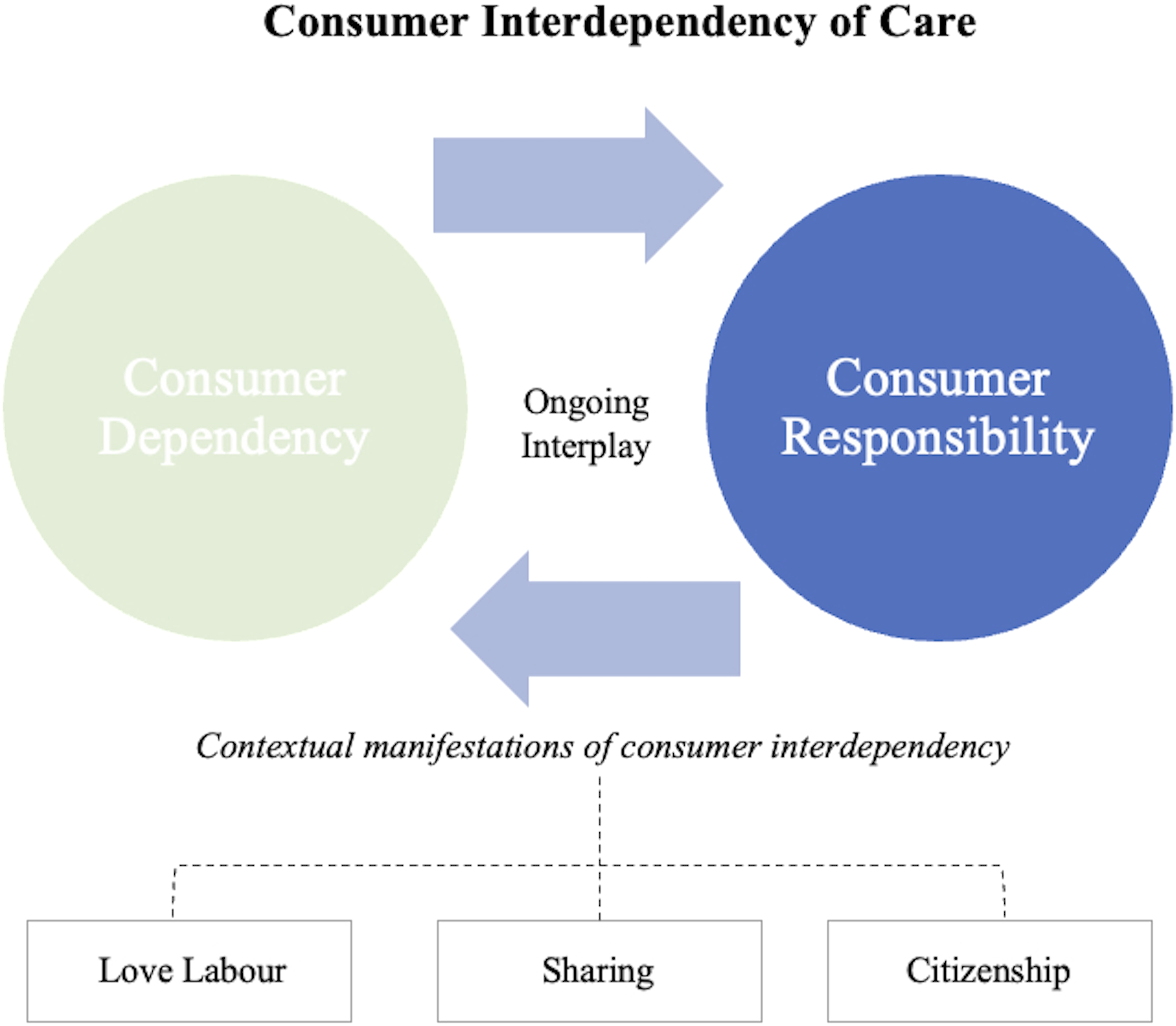
Types of consumer interdependency of care across consumption contexts
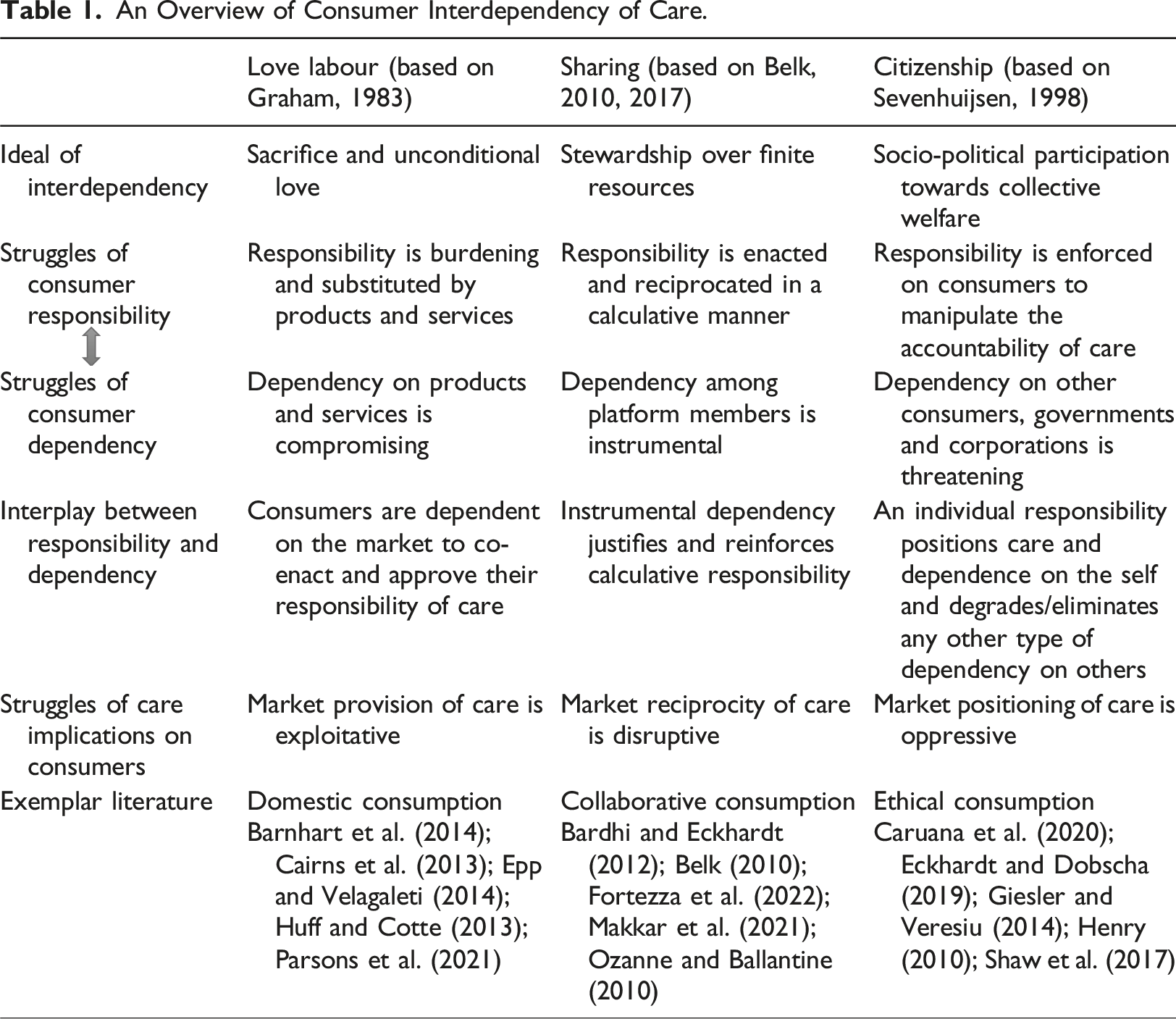
An Overview of Consumer Interdependency of Care.
Interdependency of love labour
Ideal of interdependency
We contextualise the first type of consumer interdependency of care within the context of domestic consumption, as inspired by Graham’s (1983) notion of the ‘labour of love’. This interdependency is oriented around ideals of sacrifice, selflessness and unconditional love as shown in Table 1 (Garcia-Rada et al., 2022; Hughes et al., 2005). It creates belongingness within a family – ranging from cooking and eating together to supporting elderly parents (Epp and Price, 2008; Huff and Cotte, 2016). The interdependency of love labour demands ongoing ‘affection, commitment, attentiveness and the material investment of time, energy and resources’ (Lynch, 2007: 557).
Struggles of consumer responsibility
In domestic consumption, consumers often experience their responsibility of care as burdensome, repetitive and emotionally demanding (Lynch, 2007; Nomaguchi and Mikie, 2020). Consumer responsibility is governed by the moral ideal of unconditional attention and care for loved ones, such as the image of the selfless and capable mother (Huff and Cotte, 2013). Prior literature highlights the tensions in sharing responsibilities within a family (e.g. between husband and wife caring for their young children; among adult siblings caring for their elderly parents) (Barnhart et al., 2014; Huff and Cotte, 2013). Increasingly, these responsibilities are commodified and, at least in part, outsourced to the market. From ready-made meals to high-tech baby monitors, consumers actively engage with products and services that help them meet their everyday responsibilities more conveniently or enable them to care from a distance (Epp and Velagaleti, 2014).
Struggles of consumer dependency
While prior literature focuses on dependency experienced by care receivers such as young children or disabled family members, consumer dependency on the market in fulfilling one’s responsibility of care is less explored. On the one hand, using market substitutes is seen as a compromise to the ideal responsibility. For example, consumers perceive paid care products as inferior to authentic domestic ways of caring: serving ready-made meals, for example, may be seen as a second-rate substitute for preparing wholesome home-made family dinners (Carrigan and Szmigin, 2006). Service providers offering elderly care are often inflexible and fail to recognise consumers’ emotional needs. For instance, family members often struggle to recreate family time when one of the members is moved to institutionalised care facilities, which may organise shopping trips for their care receivers without considering the needs of other family members accompanying them (Huff and Cotte, 2016).
On the other hand, when care services become too intimate, it can also compromise consumers’ ideal responsibility of care. When mutual love develops between children and their paid caregivers, parents fear that their position as the most loved and respected caregivers is challenged (Barnhart et al., 2014; Barnhart and Peñaloza, 2013). As a result, parents deliberately construct ‘family time’ that excludes paid caregivers to defend their own love and control. Similarly, consumers invest in video technology products to create a sense of togetherness by watching their children while at work (Epp and Velagaleti, 2014). Both of these struggles of consumer dependency suggest a need to preserve one’s responsibility and demonstrate personal efforts.
Interplay between responsibility and dependency
The interdependency of love illustrates a ‘virtuous’ cycle of care where consumers are dependent on the market to co-enact their responsibility as socially approved. Brands employ and reinforce sociomoral narratives in framing domestic caregivers as social heroes, praising those who fulfil their responsibilities unconditionally (Higgins and O’Leary, 2023; Vincent and Ball, 2007). Common narratives such as ‘good mothering’ and ‘intensive parenthood’ frame parents as powerful actors with the autonomy to determine the future of their children who, in turn, are framed as vulnerable and mouldable (Huff and Cotte, 2013; Thomas and Epp, 2019).
The same empowerment narratives often expose consumers to sociomoral judgements and vulnerability in pursuing a heroic social image (e.g. Parsons et al., 2021b). Personal sacrifices and a lack of control are expected and normalised, whereas their own satisfaction and wellbeing are often compromised in the process (Nomaguchi and Milkie, 2020). Despite finding the market with limited options of care products and services, consumers feel guilty for not being able to make the best choices for their families (Huff and Cotte, 2013).
Implications
The consumer interdependency of love labour reveals an exploitative market provision of care that contributes to social competition and inequality. Consumer responsibility of care is provisioned by brands, products and services. Instead of consumers finding help to meet their responsibilities more flexibly, they experience more pressures to fulfil a narrow and idealised notion of a responsibility of care (Huff and Cotte, 2013). Brands explicitly promote the value of hard work and the personalisation of care products to reinforce the social pressure of consumer responsibility, indicating that both consumer participation and superior products are essential in delivering good care (Garcia-Rada et al., 2022).
This can have severe impacts on consumers with lower socioeconomic capital (Lynch, 2007). For instance, mothers with lower purchasing power may rely on not-for-profit organisations such as food banks due to their financial situation to sustain their moral worth as ‘good mothers’ (Parsons et al., 2021a; Vincent and Ball, 2007). Carers of disabled individuals may also feel compelled to adapt to meet marketplace ideals of the family by excluding their disabled children from certain family experiences (Mason and Pavia, 2006; Pavia and Mason, 2012). In these examples, the market contributes to a demanding provision of care that contributes to consumer vulnerability under the guise of empowering domestic consumers as ‘supermums’ or ‘superdads’.
We suggest that future researchers interested in investigating the interplay between consumer responsibility and consumer dependency in contexts such as domestic or familial consumption should ask questions around relations of power and control between the market and consumers. These would highlight struggles of care that are not yet researched and would potentially uncover ways consumers could tackle these challenges or simply cope with them. We provide specific research questions in Appendix 1 to support inquiries into provisions of care in the market.
Interdependency of sharing
Ideal of interdependency
We contextualise the second consumer interdependency of care in collaborative consumption. Inspired by Belk’s (2010) notion of sharing, this interdependency is oriented around ‘a model of group stewardship over finite resources’ (Ozanne and Ozanne, 2020: 272). As shown in Table 1, this interdependency facilitates the joint pooling and consumption of common resources by a group of market strangers (Ozanne and Ballantine, 2010). Although interdependency of sharing can also emerge within families, neighbourhoods or communities (such as parents sharing a family car or meals with children), we focus on collaborative consumption amongst market strangers to demonstrate an interesting facet of interdependency (Philip et al., 2019). The ideal interdependency of sharing is about consumers being entrusted with shared resources and demands mutual and in-group responsibility towards a more effective long-term management of resources (Albinsson and Perera, 2012; Belk, 2010).
Struggles of consumer responsibility
In collaborative consumption, market strangers often struggle with calculative responsibility. For example, in a toy library, consumers enact and reciprocate the responsibility of cleaning the toys to ensure that other members can enjoy them in the future (Ozanne and Ballantine, 2010). Yet most literature on collaborative consumption reveals a calculative form of consumer responsibility (Lima and Belk, 2023; Makkar et al., 2021). First, consumers often freeride the system by consuming shared resources yet they reject any personal responsibility. Consumers employ a market narrative of framing responsibility as an added cost and burden (Leipämaa-Leskinen et al., 2022). Second, consumers may strategically accept responsibilities and expect immediate rewards. For example, Airbnb hosts stage their responsibility (offering a clean and comfortable home and being attentive to guests’ requests) as a marketing tactic to earn positive reviews (Makkar et al., 2021). Thus, consumers instrumentalise their responsibility for monetary gains.
Struggles of consumer dependency
Dependency in collaborative consumption is often utilitarian-oriented and instrumental. For example, consumers focus on the utilitarian values of sharing cars and experience psychological contamination when encountering rubbish left by previous users (Bardhi and Eckhardt, 2012). When the shared objects are perceived as limited and even scarce, consumers reject dependency because they see other platform members as competitors rather than collaborators (Lamberton and Rose, 2012). Consumers also blame free riders and hustlers for failing to fulfil their responsibilities, at least authentically, and they subsequently rationalise their own lack of responsibility for the returned dirty cars (Schor and Fitzmaurice, 2015). Thus, reciprocal responsibility is disrupted, and any dependency that exists among platform members is dismissed (Bardhi and Eckhardt, 2017).
Interplay between consumer responsibility and dependency
The interdependency of sharing illustrates a vicious cycle of calculative responsibilities and instrumental dependency (Arvidsson, 2018). As the responsibility becomes commodified and associated with a price tag, consumers are trapped in a negative cycle of care (i.e. tit-for-tat). This resembles the tragedy of the commons, in which individuals care for communal goods only when their own interests are not violated (Hardin, 1968). For example, the car-sharing platform Zipcar, implemented big-brother governance to prevent disrupted responsibilities by punishing those that fail to fulfil their responsibility of care such as returning cars on time (Bardhi and Eckhardt, 2017). However, instrumental dependency helps justify and reinforce calculative responsibility.
Implications
Ideally, a responsibility of care creates dependency and vice versa. However, in collaborative consumption, paying-care-forward can be a problematic way of facilitating a shared responsibility because some consumers in this context are opportunistic with responsibility and dependency in order to maximise their personal gains. Effective organisational mediation is particularly important in managing a vicious cycle of disrupted care in consumption (Shaw et al., 2017).
We recommend future research look into the process of reciprocity carefully when investigating collaborative consumption contexts. As depicted in Appendix 1, questioning interdependency processes at work in this market can provide novel insights into the interplay between consumer responsibility and consumer dependency aspects that we are yet to uncover in network-mediated platforms, such as Airbnb or Rent-the-Runway. We encourage future scholars to ask different questions as they study these contexts. If responsibility is commodified for the benefit of consumers and to provide greater value for all members, how does this change the meaning of the core concern of interdependency (e.g. stewardship and collaboration) in sharing, and more importantly, how does that impact consumer dependency? We believe our suggested research questions in Appendix 1 can explore appropriate mediation of paying-it-forward responsibility practices that can create fewer instrumental forms of consumer dependency.
Interdependency of citizenship
Ideal of interdependency
We contextualise the third consumer interdependency of care in ethical consumption. Inspired by Sevenhuijsen’s (1998) notion of care as citizenship, this consumer interdependency of care is oriented around how ‘citizens are connected to each other by participating in their society’ (Storø, 2018: 106). It underlies a socio-political participation to address existing social challenges such as food access, ecological concerns and marketplace inequality (Jubas, 2007; Trentmann, 2010). In comparison to the first two types of consumer interdependencies of care found in love labour and sharing, the interdependency of citizenship is not limited to an existing social unit or organised group of consumption (Turner, 1990). Rather, it is anchored in common concerns of welfare and social support (Johnston, 2008), as shown in Table 1. The interdependency of citizenship demands consumers to be accountable for their actions in consideration of democracy and justice for all (Sevenhuijsen, 1998).
Struggles of consumer responsibility
Consumers often struggle with the idea of viewing an individual responsibility as the solution to ‘collective struggles to reclaim and preserve the social and ecological commons’ (Johnston, 2008: 243). For example, governments demand consumers to fulfil their citizenship duties by constraining their hedonic consumption in times of economic hardship (Coskuner-Balli, 2020). Consumers are oriented towards a ‘moralistic mandate’ (Giesler and Veresiu, 2014: 842) that exhorts them to feel compelled to take responsibility for certain social or environmental problems, exercise self-reflexivity in moral terms and link these moral concerns with their own ethical responsibility (Cruz et al., 2023). Brands and corporations also target individual consumers through romanticised narratives of care, while minimising critical reflection or negative feelings towards people in need of care (Bajde and Rojas-Gaviria, 2021; Caruana and Crane, 2008). While prior literature tends to adopt an egocentric view of a responsibility of care as an autonomous choice, responsibility as a protective and coping mechanism remains less well understood.
Struggles of consumer dependency
Consumers are expected to be self-dependent and any dependency on the market can be risky for consumers. The market often tasks consumers to take more responsibility of their own livelihoods, as it stigmatises consumer dependency, for example, by encouraging self-management of chronic illnesses (Giesler and Veresiu, 2014). When facing a careless banking system, consumers accept that they are the only ones that can protect themselves from ‘predatory corporate activities that coerce or deceive consumers’ (Henry, 2010: 675). Although they believe in tighter regulations to protect consumer rights, market actors such as banks have limited sympathy towards other consumers that lack the capability to navigate risk in the market system (e.g. those with lower levels of financial literacy) (Henry, 2010). The market attempts to shift the responsibility to individual consumers and in turn minimise (or underplay) their need of hope and dependency on other consumers and the market system (Fotaki, 2023).
Interplay between consumer responsibility and dependency
The interdependency of citizenship illustrates an ongoing repositioning of consumer responsibility of care, where dependency is disdained and regarded as weak and passive (Giesler and Veresiu, 2014; Trnka and Trundle, 2014). The problems of consumer interdependency of care identified earlier raise questions about the paradox of ‘selfishness and the collective good’ (Henry, 2010: 671). For instance, Eckhardt and Dobscha’s (2019) study of the ‘Panera Cares’ initiative investigates the rejection of shared responsibility via the brand’s pay-what-you-can cafés to support the local homeless population. Here, consumers refuse to take up a responsibility of care because they feel socially pressured and vulnerable to social evaluations of their care actions. However, consumers may suspend or reappropriate their responsibility of care for food waste when they feel they have no control over their food waste management or depend on government information that is far too abstract (Cherrier and Türe, 2023).
Unsurprisingly, recent neoliberal movements promote taking care of oneself first and then considering caring for others as a voluntary personal choice (McDonagh and Prothero, 2014). A further challenge is that this type of consumer interdependency of care recognises the human condition as susceptible to harm and risk, which raises anxiety in consumers about their survival (Fotaki, 2006, 2023). Consumer self-responsibilisation is utilised (by consumers, brands, governments and not-for-profit institutions) to avoid this unbearable existential fear to fall for a fantasy of invulnerability (Fotaki, 2006). While collaborative caring arrangements and shared responsibilities would help mitigate consumer vulnerability that is intrinsic to the human condition, the market seems to ignore this condition in favour of a more functioning and utilitarian-oriented state of being autonomous and capable of taking responsibility (Cherrier and Türe, 2023; Giesler and Veresiu, 2014; Henry, 2010).
Implications
While the interdependency of citizenship advocates equality and inclusion, consumers are often found to reconcile tensions between their desires for morality and personal pleasures in consumption by rationalising the deservedness of those receiving care, and an ‘us versus them’ approach that is a less contradictory moral framing of consumption (Caruana et al., 2020). Here, the market and consumers co-create narratives of ‘we can never be “right,” but we can be “good,” or at the very least, not “bad”’ as a way to safeguard the rights of care (Caruana et al., 2020: 155). We encourage further investigation of consumer interdependency of care in research relating to the context of ethical consumption as that would highlight the struggles of care unbeknownst in current research on consumer responsibilisation. By investigating additional aspects relating to the interplay between consumer responsibility and consumer dependency, marketing research can further explore why consumers are not participating in a form of collective welfare.
Concluding remarks and guideposts for future marketing research on care
We develop an embedded and critical understanding of the persistent struggles of care in consumption. By highlighting and theorising consumer interdependency of care via dependency as a relational dimension of care, we are able to develop more dynamic understanding of consumer responsibility. Consumers are not interconnected as independent actors with shared interests to advance the collective welfare and common good. Instead, consumer dependency shows that consumer responsibility is entangled in interdependent relations and emerge as part of interdependent actions and reactions. We therefore extend the neoliberal responsibility of care and argue care as an ongoing interplay between one’s perceived dependency and responsibility (see Figure 1).
We also contribute to the current literature of care as a paradox of vulnerability and empowerment (Chatdzidakis and Maclaran, 2022; Olsen, 2019). Our critical examination of three types of consumer interdependencies across consumption contexts reveals that care is a response and reaction to a context-specific consumer dependency and responsibility, in addition to care as a conscious will and free choice. In fact, the three types of consumer interdependencies of care highlight an ongoing production and reproduction of responsibility and dependency. We argue that it is not sufficient to focus on how to equip consumers with responsibility as an autonomous choice. Instead, we need to better understand how consumers navigate and manage market constrains in the market provision, mediation and positioning of care.
This conceptual paper contributes to the understanding of persistent struggles of care in consumption using a novel lens of consumer interdependency of care. Extending neoliberalism that focuses on consumer individualism and autonomy and tasks consumers to take up a responsibility of care (Bajde and Rojas-Gaviria, 2021; Giesler and Veresiu, 2014), we argue that the responsibility of care is contextual and involves relations of power (Chatzidakis et al., 2021; The Care Collective, 2020). Thus, we reveal nuances between the acceptance and rejection of a consumer responsibility of care, where consumers enact a responsibility of care in an emergent, contextual and relational manner. We show that successful consumer responsibility does not always rely on agency and independence. Instead, dependency and responsibility always coexist and care is understood as a form of interdependent actions reactions of responsibility among interdependent on market actors.
We de-romanticise interdependency as an ideal state and condition of care and unpack ongoing enactments and negotiation of consumer interdependency of care. Within the interdependency of love labour, consumer responsibility is embedded in a social and moral competition where the market promises liberation for both caregivers and care receivers, yet it ends up exploiting consumers through an oppressive narrative of care by reinforcing care as a moral competition rather than a moral choice. Within the interdependency of sharing, reciprocity of consumer responsibility is disrupted and enters a vicious cycle, where the market implements immediate rewards and punishment, and ends up shaping consumer responsibility as instrumental and calculative. Within the interdependency of citizenship, the distribution of consumer responsibility overrides consumers’ entitlement to be cared for and subsequently converts rights of care to a responsibility of care. This enables us to articulate the role of the market in the provision, mediation and positioning of care, and therefore consumer responsibility.
We develop three potential directions of research of which future researchers can find beneficial to study through the lens of consumer interdependency of care: (1) the role of market products and services in the provision of care; (2) the market mediation of reciprocal care; and (3) the positioning of care (see Appendix 1 for potential research applications). Although we primarily focus on care from a consumption perspective, the three consumption contexts and types of consumer interdependencies of care also capture the production, exchange and consumption of care, which can provide future research avenues. Researchers could utilise the three processes of consumer interdependencies of care to understand and further explore how sociomoral struggles of care emerge, persist, resolve and/or evolve. We now move on to suggest specific future research opportunities that can further unpack the emergent and problematic process of care. Our hope is to help care scholars utilise the conceptual lens of consumer interdependency of care to advance future research on care, marketplace equality and consumer rights of care.
Examining the dynamic role of the market in the provision of care
Marketing literature often focuses on how consumers recognise unmet needs of care. However, we find that market provision of care seeks to frame and shape both demands and supply of care simultaneously through products and services of (quality) care. The problem that is evident in our research is how this process facilitates an exploitative discourse that not only burdens consumers but also makes them vulnerable in the market, and thus renders consumption as a desirable solution to solve consumers’ insecurities (e.g. Thompson and Hirschman, 1995). The market provision of care reinforces a sociomoral competition of responsibility, which shifts the attention from responsiveness to those in need of care to preventing social criticisms. Furthermore, most literature employs a European and North American perspective where responsibility is favoured, and dependency is discouraged. Yet Asian, Eastern, South Eastern and Middle Eastern cultures, for instance, have different notions of responsibility and dependency due to the prevalent social norms on care, particularly family-based care for the elderly or children (Zhang and Yeung, 2012). Future researchers may investigate the role of the market in the provision of care and consumers’ struggles that appear in these cultures as they grow to depend more on the market.
As the market creates a virtuous yet ‘exploitative’ process of care that makes consumers more burdened and concerned about their ability to care, we encourage further investigation on the relations of power and control between the market and consumers, and how superior (or inferior) market products/services can benefit (or threaten) some market actors over others. Can these relationships be made more harmonious? Given that there are multiple webs of relationships that take place in a market that supplies solutions for care (e.g. suppliers, companies, parents, children, paid care workers) and plays a dominant role in generating demands of care, we must also consider the agency of products and services in the provision of care. Technology, for instance, is often viewed as supportive of consumers in the provision of care (e.g. Epp and Velagaleti, 2014), however we are yet to understand the dark sides of technology in shaping consumer interdependency of care. How does technology complicate care and dependency between caregivers and care receivers through the ways in which care is substituted or mediated via technology (e.g. food shopping via smart fridge)? Similarly, technology is ever present in contemporary love providing opportunities for romantic connections (e.g. Tinder, Bumble). What sorts of interplays take place between responsibility and dependency when love is viewed as more instrumental (e.g. sexual exchanges) versus more enduring ones (e.g. searching for long-term romantic partners)? The market’s provision of care likewise may reinforce a competitive responsibility where some consumers who seek to provide better quality of care are caught in a market mediated race of self-worth (e.g. consumers eventually feel burdened and more concerned about their capability to provide quality care).
Investigating the paradoxes of market mediation of reciprocal care
Contemporary mediation of reciprocal care such as the sharing economy demonstrates how the market provides a solution to mediate an exchange of care amongst strangers. The market has the potential to facilitate stewardship, joint pooling of resources and responsibility. Yet we find that reciprocal exchanges of care are disruptive as they create a calculative form of responsibility that leads to a detached and instrumental dependency. Responsibility becomes opportunistic – consumers take advantage of the market itself and other members, thus creating a vicious and disruptive cycle of minimising responsibility and dismissing dependency. With responsibility being associated with monetary rewards or punishment by the organisation, consumers are systemised to expect an immediate return for their enactment of responsibility rather than the romanticised discourse of ‘sharing is caring’. The process of care is considered tit-for-tat, with consumers viewed as competitive rather than collaborative members. Future research can further investigate the different types of reciprocal responsibility and how this contributes to different normative understandings of care.
In this paper, we argued that consumers’ struggles of care are both moral struggles of responsibility and social struggles within relations of care. Such struggles persist because care in this form of sharing is more of an exclusionary act of selfishness rather than a prosocial behaviour. For example, biohacking enthusiasts who believe in a do-it-yourself biology to support their wellbeing as well as others have been found to do more harm than good when sharing their self-experiments and alternative healthcare solutions against COVID-19 (Lima and Belk, 2023). In this instance, biohackers are more driven by egoistic elements such as financial rewards and a sense of self-morality and social appreciation in their coupling of care and self-interests rather than ‘doing the right thing’ by sharing information, material resources and their bodies for biohacking. Their motivations are symptomatic of impure altruism (Andreoni, 1990). We encourage future research to explore biohacking and other forms of market mediation of care through the lens of consumer interdependency of care. Who are the market actors involved that gain (or lose) in this example of care, what are the limits of responsibility and dependency, and how can governments mediate ethical and quality care keeping in mind the potential harms for biohackers on their bodies and the health care literacy and socioeconomic constraints of some consumers over others when tackling societal issues in sharing knowledge?
Exploring the positioning of care in the market
Existing literature suggests people are expected to participate in socio-political challenges and take on a responsibility as consumer-citizens (Jubas, 2007; Trentmann, 2010). Governments along with other institutional bodies work together to legitimise a neoliberal narrative of social responsibility as an individual concern where consumers are treated as responsible for societal and environmental issues. In this paper, we presented a counterargument; market actors contribute to an ego-driven and disembedded responsibilisation where consumers take responsibility (and eventually care) for themselves, rather than participating in society for the collective good and caring for one another. Thus, responsibility becomes individualised and disembedded, where consumers with socioeconomic or physical disadvantages are expected to take up their own responsibility. This is linked to a fragmentary responsibility (‘us vs them’) framing in the market (rather than a collective responsibility by market actors and in collaboration with governments). This requires further investigation to better understand how care can induce conflicts among consumers rather than connections and collaborations. Future research with a consumer interdependency lens of care should investigate which market actors are most at risk, and which receive more rights and are privileged over others. An oppressive cycle of self-responsibility that is prioritised in markets substitutes the rights of dependency and can influence the state of vulnerable collectives. We hope future care scholars interested in the problematic nature of neoliberal responsibilisation study how consumers experience care in a market that degrades dependency during a collective crisis (e.g. COVID). Does the experience of a crisis transform the meaning of dependency over self-responsibility? Further questions might ask about the ways the market can positively legitimise a balanced responsibility for self and others, and an appreciated and respected dependency that is valued, and positioned for the common good. Are there also ways to dismantle a neoliberal perspective of responsibility that is self-interested? These examples for future avenues of care research are not exhaustive but suggest potential research directions.
Footnotes
Acknowledgement
The authors would like to thank Robert Caruana and Paolo Franco for their constructive feedback on an earlier version of this manuscript, and the anonymous reviewers and editor for their supportive comments throughout the review process.
Declaration of conflicting interests
The author(s) declared no potential conflicts of interest with respect to the research, authorship, and/or publication of this article.
Funding
The author(s) received no financial support for the research, authorship, and/or publication of this article.
