




Abstract
This study examines how consumers navigate their spiritual needs for transcendence in everyday consumption. While extant literature shows that both spiritual utilities and tensions emerge in sacred consumption, we build on and extend this research by illuminating how consumers navigate sacralisation and problematise profane consumption objects and practices. We employed Mary Douglas’s pollution theory to examine how consumers navigate cultural meanings of purity and transgressions. Through a qualitative study of vegan fashion consumption, we found that consumers negotiate the meaning of purity to govern everyday consumption practices in ways that resemble characteristics of religious institutions (e.g. faith and doctrines). Vegan consumers tolerate consumption transgressions through practices and rituals to sustain their faith within what is regarded as a polluted marketplace. Our study contributes to a novel perspective on consumer spirituality in regulating sacred and secular consumption and moralising relationships with the material world.
Spirituality entails an ‘exploration of the inner self’ and ‘a discovery of the interrelationships of that self with the broader reality’ (Kale, 2006: 109). Popular spiritual practices such as Zen meditation, yoga, and pilgrimages enable transcendental experiences of self-awareness, oneness, and connecting with the divine (Coskuner-Balli and Ertimur, 2017; Husemann and Eckhardt, 2019b). The marketplace supplies consumers with accessible transcendental experiences that are ‘spiritual but not religious’ and enables them to ‘believe without belonging’ (Rinallo and Santana, 2023: 133). For example, Star Trek fans experience a ‘higher existence in the world of Star Trek’ (Kozinets, 2001: 76); Apple Newton loyal consumers reference the restoration of a dead computer battery as ‘yet another Newton battery miracle’ (Mūniz and Schau, 2005: 742); and consumers feel connected to nature as a sacred space by participating in river rafting (Arnould and Price, 1993). This interplay between the marketplace and spirituality is well documented within consumer research literature.
A growing ‘spiritual supermarket’ promises transcendental experiences with ‘a lower degree of formal organisation’ (Roof, 2001; Stolz and Usunier, 2019: 8). Consumer spirituality (e.g. yoga) shifts the focus from how consumption is regulated as a system of faith and transcendence to emphasise utilitarian benefits (e.g. health and stress management) (Ertimur and Coskuner-Balli, 2015). For example, the sacred site of Lourdes is repurposed as a servicescape for emotional healing (Higgins and Hamilton, 2019). Similarly, the Camino de Santiago pilgrimage is a popular spiritual experience for emotional discharge from an overly accelerated lifestyle (Husemann and Eckhardt, 2019b).
Extant literature emphasises that consumer spirituality is enabled by goods and services that are ‘purposefully designed to quench consumers’ thirst for meaningful encounters with one’s inner self or a higher external power’ (Husemann and Eckhardt, 2019a: 393). On one hand, spiritual products and practices are packaged as liberating commodities to construct individualised lifestyles (e.g. New Age spiritual thinking for self-actualisation) (Rindfleish, 2005), signalling religion’s decline and loss of authenticity (Jain, 2020). On the other hand, hybridisation of religion and the market creates both synergies and tensions (Appau and Yang, 2023; Moufahim et al., 2023). Spirituality is engaged by entertainment brands through magical phenomena and supernatural beings (e.g. witches, vampires) (Rinallo et al., 2013). Rinallo and colleagues (2013: 36) also find that branded rosaries enable individualised expressions of faith and intimate transcendental experiences that ‘draw consumers nearer to a sense of divine’; however, their commercial success may also provoke a sense of transgression.
Our study responds to calls for further research into ‘the interrelated practices and processes in which people engage when consuming market offerings’ to meet their spiritual demands (Husemann and Eckhardt, 2019a: 393). Consumers’ spiritual journeys involve careful navigation of everyday consumption objects and practices, such as in dieting and dress codes. For example, Camino de Santiago pilgrims carefully plan what to wear or bring along (e.g. roaming telephone services) to control any distractions from possible spiritual enlightenment (Husemann and Eckhardt, 2019b). Consumers also repurpose profane objects (e.g. essential oils) through blessing rituals to ensure a sense of order and control in people’s lives (Shepherd and Kay, 2019). These examples illustrate the prominent role of market offerings in negotiating the boundary between the profane (and ordinary) and the sacred (Belk et al., 1989).
Our research question asks, ‘how do consumers navigate their spiritual demands for transcendence when they are not readily supported with market offerings?’ We examined this research question in the context of vegan fashion consumption in Australia. Veganism represents niche spiritual consumption threatened by under-developed market offerings and incompatible mainstream norms (Smith and Cragun, 2019). It exhibits spiritual characteristics such as bad karma from killing animals and equality of life in all forms (Johnson, 2015). We consider veganism a moral philosophy whose adherents practise ideas of knowledge and right and wrong in their search to obtain the truth about themselves and their relationship to the world. Everyday consumption’s use of animals in food, clothing, medical, and other products challenges vegans’ spiritual needs. Veganism in dietary practices is featured in many religions such as ahimsa in Jainism and Seventh Day Adventists, which suggests connections with God (Stephens Griffin, 2017) and structured religions (e.g. Hinduism and Buddhism). However, vegan consumers’ engagement and rejection of certain products of animal origin are linked to individualised spirituality and pursuit of the sacred (Nath, 2010). In this paper, we employed Mary Douglas’s (1966) pollution theory, which builds on Durkheim’s (1973: 159) characterisation of sacred things as ‘collective ideal[s] hav[ing] fixed themselves on material objects’, to understand how vegan consumers navigate their transcendental needs and problematise everyday consumption as a sacred domain.
Spiritual utility of sacred consumption
Many brands and services supply sacred and transcendental experiences. White-water rafting can engender magical thinking and enchantment that offer consumers change or transformation (Arnould and Price, 1993). Corporal pain is framed as a vehicle to higher spiritual states during adventure racing (Scott et al., 2017). Climbing Mount Everest is comparable to a spiritual pilgrimage in which individuals overcome obstacles to achieve self-transformation (Tumbat and Belk, 2011). Profane consumption practices are also repackaged as sacred offerings (e.g. Christian gospel music) in the form of secular-styled songs (e.g. by Hillsong Church), using music to evoke the power of the Spirit (Yip and Ainsworth, 2020).
Brand symbols, consumption objects, and personalised places can create and enhance ‘ecstatic, self-transcending, extraordinary experiences’ (Belk et al., 1989: 13). For example, consumers wear religious symbols (e.g. crucifixes) to communicate and connect with God (Higgins and Hamilton, 2019), and purchase objects from pilgrimage sites (e.g. monasteries) to keep as sacred relics (Belk et al., 1989). Consumers engage profane objects in varied ways to enhance their transcendental experiences (Zinnbauer et al., 1997), offering food or flowers at religious sites, performing sacrificial rituals, or purchasing religious objects to precipitate blessings they need to deal with uncertainties in life (Husemann and Eckhardt, 2019b; Moufahim, 2013; Shepherd and Kay, 2019). Thus, products can move along a profane and sacred continuum via processes of distribution, purchasing, and gifting (Paquier, 2019).
Tensions in sacralising consumption
While some market offerings can provide consumers with transcendental utilities, they may also create tensions in everyday consumption. Camino pilgrims attempt to resist the use of mobile phones, which violate their understanding of spiritual wellbeing (Husemann and Eckhardt, 2019b). In the Apple Newton community, consumers frame market failures of Apple Newton as a misunderstanding by the public and they use ‘technopagan magic to demonstrate the Newton’s powers’ against ‘persecution’ (Muñiz and Schau, 2005: 739–740). Other consumers form online communities to identify suitable and unsuitable products, services, and experiences to construct spiritual identities (Santana et al., 2022). Sacralising consumption thus can lead to anxiety as consumers manage tensions between seduction (e.g. uninhibited behaviours) and morality (social regulation) (Rauf et al., 2019).
To manage such tensions, consumers may problematise the consumption of everyday profane objects (Gauthier, 2018). For example, some profane objects (e.g. prayer beads or cloth) are granted sacred status to support a transformative pilgrimage experience (Moufahim, 2013). Consumers may also engage material artefacts ranging from the most sacred (e.g. rosaries or sacred statues) to the most profane (e.g. handbags or scarves) in constructing sacred connections and experiences (Santana and Botelho, 2019; Turley, 2013). Santana and Botelho (2019) explain consumers’ alternative approaches to engaging in market offerings during their movement between their homes and sacred sites (e.g. Catholic pilgrimages). By liquefying and solidifying their relationships with material objects (even special or sacred ones), they can relate to God and saints without affecting their attachments to sacrificed possessions. Consumers also employ and repurpose profane objects (such as essential oils) in blessing rituals to ensure a sense of order and control in their lives (Shepherd and Kay, 2019). These are examples of how consumers manage the tensions between the sacred and the profane.
In contemporary consumer spirituality, a need for self-transcendence becomes a never-ending search towards an ultimate reality and an enlightened or pure self. As consumers focus on ‘the sacrifice of the self, of the subject’s own will through obedience and contemplation’ (Rindfleish, 2005: 356), they reflect on mainstream norms that order ‘things’ to determine their ‘proper/improper’ use. For instance, Goth consumers use Christian crosses to challenge society’s definition of ‘inappropriate’ behaviour (Powell, 2007). Thus, consumers may challenge the dominant culture for the appeal of ‘more experiential rather than creed-based forms of religion’ (Gauthier and Martikainen, 2013: 4). In the next section, we explain how pollution theory provides a useful lens for investigating how consumers navigate their spiritual demands in everyday consumption.
Pollution theory of purity and danger
Mary Douglas (1966) argued that things considered dirty and ‘out of place’ violate or disrupt the existing social order. Douglas’s work was inspired by Durkheim (1973), who argues that a priori intuitions about the natural world, couched in the idiom of religion, are compelled by human social existence. Drawing on Durkheim, Douglas (1966: 28) defined pollution as ‘a violation of each society’s designated boundaries’ – a dangerous transgression that will ‘likely confuse or contradict cherished classifications’ (1966: 37). Douglas’s analysis includes three aspects relevant to our study: (1) classification via symbolism, where cultural meaning represents how the world is segmented into discrete, intelligible parcels organised into a larger coherent system; (2) drawing boundaries of purity relative to social structures and individual ways of thinking (e.g. inner beliefs, values) that combine to shape the social world; and (3) transgressing boundaries using impure things that do not conform to accepted notions of social order (Dürr and Jaffe, 2010).
First, Douglas’s metaphorical thesis assigns ‘clean’ and ‘dirty’ cultural labels: dirty = disordered = unstructured, versus clean = orderly = structured. Various groups, individuals or societies designate persons, animals, places, foods, or activities as clean or dirty at different times (Kaufmann, 1998; Smith, 2007), creating and perpetuating cultural norms and social units. Therefore, symbolic pollution is a cultural construct, existing in ‘the eye of the beholder’, rather than a universal understanding (Douglas, 1966: 24).
Second, boundaries are drawn where symbolic systems are interlaced with social structure. Douglas distinguished between ‘group’, the outer boundary of a community, and ‘grid’, the structural divisions within a community. Some societies emphasise boundaries between themselves and others, as well as internal hierarchies; others set similar boundaries but have little internal hierarchy. Thus, societies structure themselves in varying, sometimes internally complex ways. Rituals and symbols mark relationships between insiders and outsiders, or between those with more or less power within a group.
Third, impurities are classified as boundary transgressions that render a society unstable (Bagger, 2007). Impure things are usually anomalies that do not conform to accepted notions of social order. Ultimately, pollution is derived from deeply held beliefs (i.e. danger-beliefs), that flag transgressions, and become guarding points of entry especially when political and social sanctions are weak, indirect, or incomplete. Danger-beliefs attached to pollution also become ways of enforcing conformity. Douglas explained objects as classified into mutually exclusive categories and organised into a hierarchical sequence; no object belongs to two classes simultaneously. Thus, anomalies are symbolically separated from ‘normal’ things to reinforce structure and social order and avoid pollution.
To explain how consumers navigate their needs for transcendence in everyday consumption, we drew on Douglas’s pollution analysis. We included a micro-social analysis to consider individuals’ experiences in problematising mainstream meanings of consumption.
Methodology
Context: Ethical vegans in Australia
We chose Australian vegans as our context for several reasons. Vegans are a minority group in a marketplace that prioritises mainstream norms for non-vegans (Greenebaum, 2012). Globally, popular media perpetuates an overwhelmingly ‘vegaphobic’ discourse (Cole and Morgan, 2011), framing vegans as ‘killjoys’ in their attempt to challenge norms of animals as consumable objects (Twine, 2014). These representations perpetuate stereotypes of vegans as deviant to social norms and maintain humans’ dominion over animals.
Australia is an important site of growth in veganism, as per government reports, policy reviews, media attention, and vegan-specific events show (Jobs, Precincts, and Regions, 2020). Within increasingly individualistic societies, veganism as an all-encompassing lifestyle provides an interesting site to study consumption behaviours. We focus on vegan consumption of fashion (clothing, accessories, and bags) rather than food, because diet-based veganism has as a long history in religion that provides clear guidelines for consumers but is misunderstood with respect to fashion products and other areas of consumption (Wrenn, 2011).
The philosophy underlying veganism is that all beings are sacred (Johnson, 2015). While pastoral societies treat animals as profane objects or sacrifices and gifts to the gods, veganism regards all living beings – humans as well as animals – as equally worthy of life (James, 1962). As a result, veganism demands personal sacrifice via restraining oneself from consuming products of animal origin. Veganism’s philosophy of compassion and elimination of harm has gained popularity since its formalisation in 1944 (Wrenn, 2011). It is promoted by multiple interest groups and organisations (Jamieson, 2009), with two key players being The Vegan Society and People for the Ethical Treatment of Animals (Springirth, 2016). These groups, as we explain in our findings, help maintain the ideal boundary of purity, specifically in developing cultural categories that separate permissible and impermissible market objects and practices.
Data collection
Our inquiry began with a broad interest in veganism that went beyond diet. Data collection involved in-depth interviews and netnographic analysis of social media groups. We performed participant observations of four vegan communities on Facebook to collect data specific to vegan fashion discourses in Australia.
Participant observations
Online datasets.
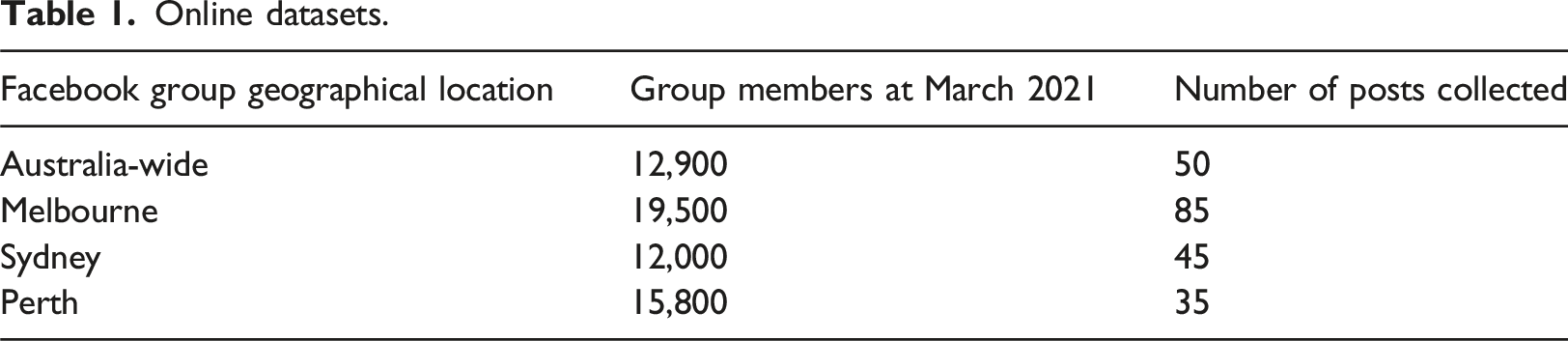
An author on the research team – a vegan herself – joined Facebook community groups to gain a sense of immersion and belonging with other vegans. She co-created text and ideas on maintaining a vegan lifestyle, reconciling with her own non-vegan possessions, and communicating with other vegans for social connection. She gathered rich data on vegan stories and experiences of fashion consumption, while keeping reflexive fieldnotes about her emotions and thoughts (Kozinets, 2010). Her active membership of vegan communities was valuable in providing insider knowledge of vegans’ specific language (e.g. referring to non-vegans as ‘omnis’; ‘nooch’ for nutritional yeast) and an understanding of participants’ personal narratives. The other authors – non-vegans – acted as cultural outsiders; their unfamiliarity allowed for active questioning of the studied phenomenon. Data collected from online communities added depth and nuance to the narratives and helped in understanding participants’ personal accounts.
Interviews
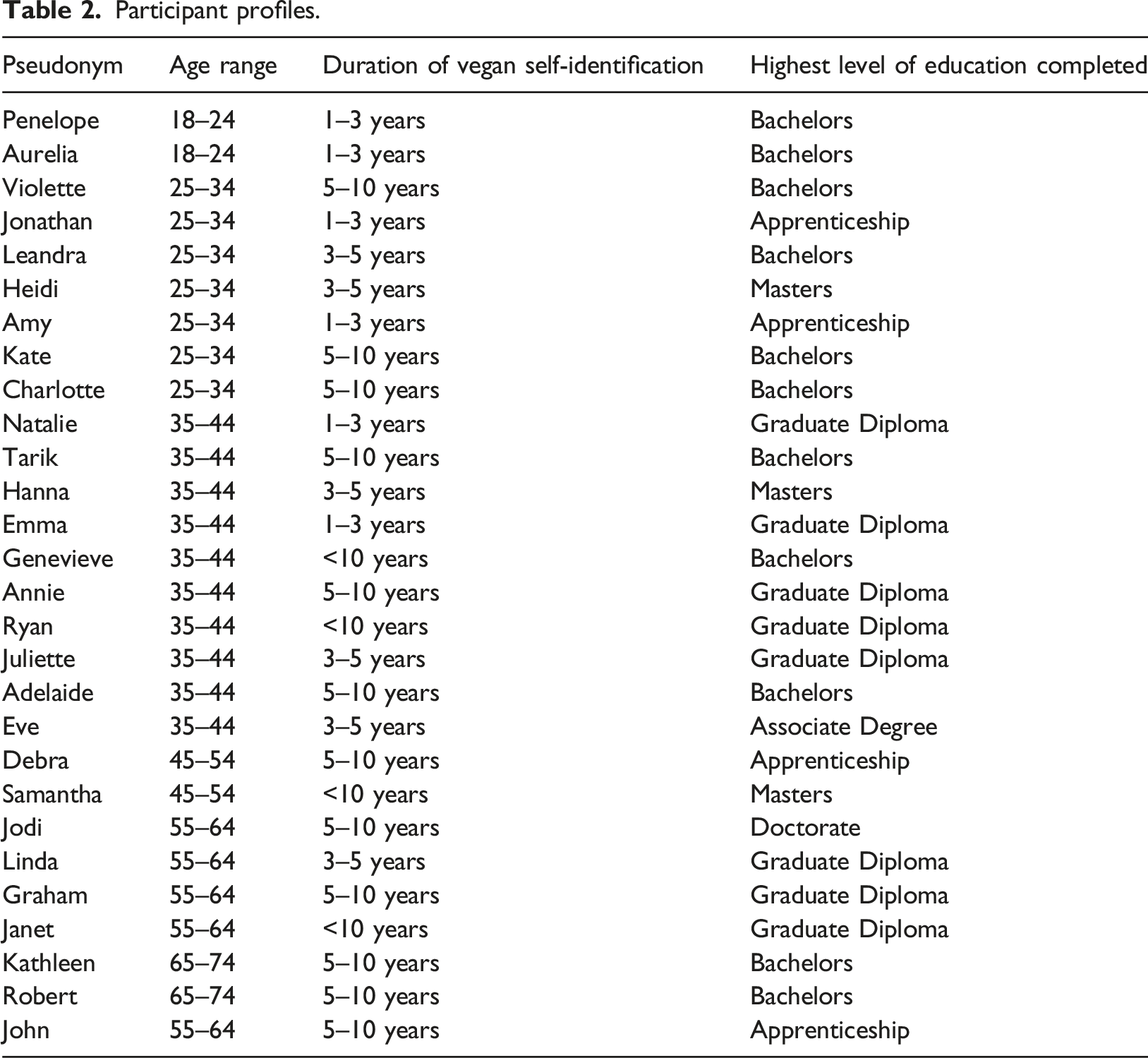
Participant profiles.
Data analysis
All data collected from Facebook groups was entered into NVivo qualitative data analysis software. We recorded and transcribed all interviews before manually coding and transferring them to NVivo. Rounds of open and axial coding enabled the grounding of participants’ voices within emergent data categories and identified additional layers of interpretation and meaning. We used axial coding to detect relationships between the original codes and reveal themes. Throughout the theorisation process, we reviewed literature while iteratively grouping and regrouping codes into more abstract themes until theoretical saturation was reached.
Findings
Veganism as a philosophy of purity
Our participants assert that being vegan demands sacrificing desires of consumption and marketplace participation as a pathway towards purity. Despite obstacles to restraining consumption desires in a marketplace tailored to a dominant non-vegan group, the participants believe their sacrifice is worthwhile because ‘it’s about stopping pain, suffering, waste, and all hurtful things that come from animal agriculture’ (Charlotte). This is in contrast to a capitalistic view of consumerism, in which financial sacrifices fulfil consumers’ material desires to become part of a consumer society (Belk et al., 2003). Their perspectives resemble a moral worldview and belief system in which personal sacrifices enable individuals to save others (in this case, animals) from their suffering (Belk et al., 2003; Cherrier, 2009), and ultimately purify and transcend themselves.
Participants credit Donald Watson for formalising The Vegan Society (TVS) and the meanings of purity that inform a philosophy of veganism: Veganism is a philosophy and [a] way of living which seeks to exclude—as far as is possible and practicable—all forms of exploitation of, and cruelty to, animals for food, clothing, or any other purpose; by extension, [it] promotes the development and use of animal-free alternatives for the benefit of animals, humans, and the environment. In dietary terms, it denotes the practice of dispensing with all products derived wholly or partly from animals. (Australia-wide online group, 2021)
This definition of veganism sacralises all consumption objects and practices by creating a boundary of purity between ‘good-sacred and evil-sacred’ (Belk et al., 1989: 24). Specific terminology and labelling are employed by TVS in defining this boundary, identifying market practices of ‘exploitation’ and ‘cruelty’ as evil acts towards the sacred animal. Likewise, ‘evil’ holds sacred power that elicits a strong repulsion for what it can unleash in the world and is used to signify the impure. One way to signal this boundary is via TVS’s vegan trademark that our participants believe is used to certify ‘pure’ vegan products.
Besides the formal guidelines by organisations like TVS, informal groups such as online communities contribute to establishing meanings of purity and ‘correct’ affiliations. Building on TVS’s definition of veganism, which informs doctrine-like meanings of how individuals relate to the world, community members work together to establish ‘pure’ consumption behaviours and how they can increase their levels of purity in consumption. The first step often involves identifying oneself as a pure (vegan) self: Labelling yourself as vegan in a way forces you to [behave correspondingly]. I couldn’t tell you a lot about generic silkworms, and sometimes non-vegans will pick on these obscure things. It’s more like I’m doing these actions because it falls under this label that I’m vegan, but I don’t know everything about the cruel practices of the industry, or how to explain them to another person. I’m just doing it because I know it’s right and I trust that it’s part of this movement. (Amy)
The primary goal of vegans is not about challenging and transforming the market (Kozinets, 2001; Powell, 2007). Our participants were less interested in modifying or purifying the world. Instead, a typical vegan practice focuses on self-discipline, as Amy portrayed, by establishing a ‘purity cloak’ that protects oneself from marketplace harms. The purity cloak is a metaphorical ‘vegan’ label and instructs them to follow vegan guidelines indiscriminately; as Amy identified, it is part of the ‘movement’. This is different from consumer activism that strives to challenge the market such as Muslim consumers’ attempts to condemn modernity and boycott global brands (Izberk-Bilgin, 2012). Vegan practices of purity involve self-transcendence through meaningful encounters with a higher moral calling of responsibility in a polluted world.
Many participants described their first experience with veganism as a ‘big spiritual awakening’ (Hanna) that opened their eyes to the ultimate truth: I finally saw the truth of what’s going on in the world and made a decision [to go vegan as] I felt it was in alignment with what I had to do now that I’ve seen. That was a massive, massive part of the shift for me. (Hanna)
Such a sacred experience foregrounds veganism as a life-changing and ‘self-transcending’ encounter (Belk et al., 1989: 13). That is, these consumers have a desire for ‘meaningful encounters with one’s inner self or a higher external power’ (Husemann and Eckhardt, 2019a: 393), and do so by participating in ‘pure’ vegan fashion consumption. Interestingly, some secular vegan participants drew direct comparisons with traditional religious institutions to justify their beliefs: Sometimes I have to explain it [to others], “it’s like people who believe in God”. Everybody understands religion. Even if they don't agree with it, they understand religion. When I put it in the context of veganism is my life, I think about it in everything I do, and I put it in the context of somebody who believes in God, I think it’s an eye-opener for some. They are like, oh, that's kind of big. (Kate)
For these consumers, veganism is not just about making the right choice but fulfilling a sacred duty to avoid harming animals. Kate’s comparison of her vegan philosophy with faith in a divine agent such as ‘God’ demonstrates how our participants situated veganism as encompassing ethical, moral, and spiritual aspects of their lives.
While purity as a good-sacred practice is cultivated amongst the community through consumer narratives and product labelling, vegan consumers invest in identifying the evil-sacred through imagery. They share (via newsletters and online forums) graphic images of evil acts of animal slaughter to represent pollution. Our participants circulated many vegan texts portraying disturbing yet thought-provoking reminders of the evil-sacred, such as The Sexual Politics of Meat: A Feminist-Vegetarian Critical Theory and Eating Animals, and documentaries like Dominion and Earthlings that feature undercover footage of animal agriculture and cruelty. Vegan followers attempt to shield themselves from the social and material pollution that go against vegan beliefs of compassion.
While non-vegans and the market are accustomed to some vegan dietary practices (e.g. product information specifying no animal ingredients, and popular vegan foods), our participants explained that vegan fashion involves a much tougher consumption journey. For example, consumers may find it easy to ask for a vegan meal at a restaurant, but they often struggle to identify cruelty-free and vegan makeup if the brand does not specify it, or salespeople are unaware of its components. Hence, defending the boundary of purity in specific consumption practices becomes critical to protecting vegan consumers from market evils.
Hierarchies of purity
Through their vegan fellowship, participants collectively shield their beliefs and faith in a pure self from external market threats. However, the meaning of purity varies across product categorisations and consumption practices, even amongst vegan followers. We find that vegan consumers create a hierarchical system to defend the blurred boundary between evil (dangerous) and sacred (pure) categories amongst insiders (i.e. purity-seeking vegan or vegan-like consumers). These hierarchies are established based on vegan consumers’ evaluations of members’ motivations and consumption objects.
Figure 1 illustrates how our participants categorised the status of insider vegans (e.g. purity-seekers, plant-based, and vegetarian). We conceptualise the vegan system of social hierarchy as a continuum of purity practices tied to motivations that align with the vegan doctrine. The bottom of the pyramid illustrates the lowest level, or least pure vegan consumers, whose motivations for going vegan are largely physiological (i.e. diet-based). These consumers may still buy fashion products incorporating animal materials from retailers or second-hand shops. The middle of the pyramid captures consumers driven by ethical motivations to consume products that do not harm the environment. This group’s members are also considered impure, because they may retain their non-vegan possessions for the sake of circularity and less waste. The top of the pyramid captures purity-seekers with idealised motivations of spirituality, who strive to consume second-hand vegan products. We conceptualise the varying levels of ideal fashion objects (i.e. right hand side triangle with progressions – from non-vegan products/second-hand products to new vegan products, and finally second-hand vegan products) as material dimensions that roughly correspond to consumers’ upward shifts in their motivations – from physiological to ethical, and last, spiritual. A vegan hierarchy for insiders.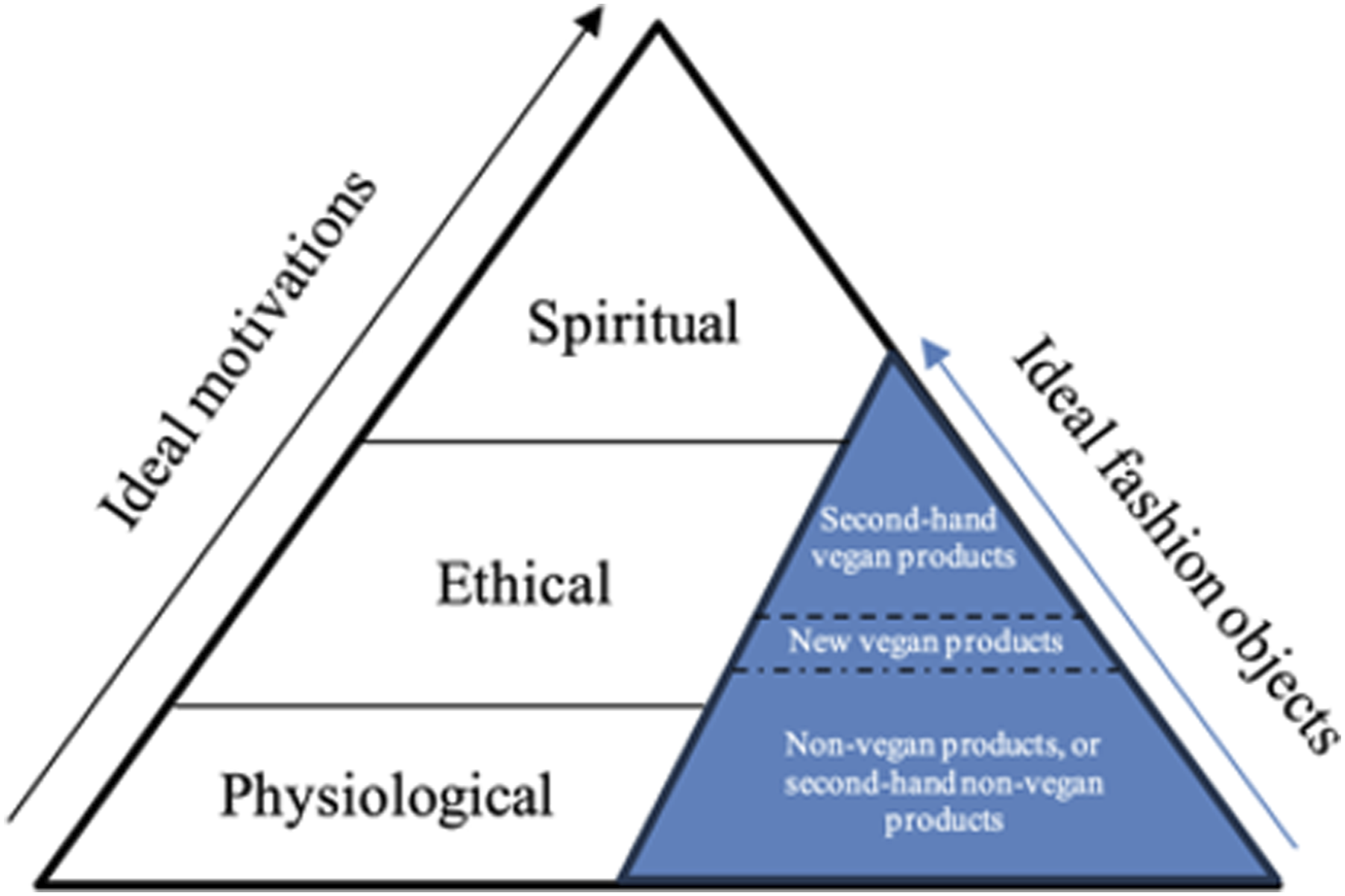
Classifying motivations
Vegans often scrutinise the motivations of others in the marketplace to understand consumers’ actions and their degree of purity (Greenebaum, 2012). Based on interrelated themes from our data, we find that participants categorised physiological and health-based motivations as the lowest and least acceptable tier; ethics as a mid-level, acceptable tier; and spiritual development and compassion as the highest and most accepted tier (see Figure 1).
First, spiritual motivations are regarded as denoting the highest level of purity. Graham explained his quest for spirituality in the way he ‘feels…some sort of spiritual connection with that animal’ as sacred. Within this hierarchical system of insider-vegans, the most valued motivation is to have ‘experiences that transcend everyday life’ (Belk et al., 1989: 8). A desire for transcendence also casts an all-encompassing influence on vegan consumers’ personal, social, and professional lives: It [veganism] is my guiding light for everything. It transformed my life. To the point whereby I quit my career and I’m embarking on a new career. Veganism is responsible for that because everything has to align with my values and ethics. I’m feeling emotional… I had no idea it was going to transform my life. You understand the physicality of being vegan, but you don't realise it also implicates the psychological, emotional, and social elements of your life. That's been a way bigger part of it for me, particularly the social elements because it influenced my friendships, not always positively. And the way I see the world. (Annie)
Annie’s experience with veganism resembles how religious doctrines influence their followers’ major life decisions (Rauf et al., 2018). This is similar to McAlexander et al.’s (2014) concept of identity pillars of religion, which guide important facets of an individual’s experience from the sense of self, social networks, and professional choices. Unlike consumers who attempt to negotiate religious doctrine’s control over their lives (Rauf et al., 2019), vegan consumers who search for meaningful encounters with their inner self or a higher power allow vegan philosophical beliefs to creep into aspects of their lives other than consumption.
Second, some consumers are driven by an ethical motivation to minimise their impact on the environment. This is contested within the vegan community because it confuses two logics: a sacred duty, as exemplified above, and sustainability. As members of the online groups asserted, environmental concerns do not equate to veganism: Veganism is not an environmental panacea. It wasn’t ever meant to be linked to the environment; it is a moral, animal rights concept. While we now see some environmental benefits result from a plant-based diet, other aspects of veganism are not always environmentally-friendly. We need to acknowledge this and, if we have concerns about our impact on the planet, work towards our lives having a smaller impact. (Melbourne online group, 2020)
Tensions between consumers over how to remain pure while practising sustainable consumption bring on negotiations about acceptable and unacceptable motivations of veganism. Those motivated by ethics argue that some vegan products (e.g. faux leather) are non-biodegradable and environmentally harmful, with second-hand leather a better option, but purity-seeking vegan participants found no excuse for animal-derived product consumption: ‘Reminder that this is a vegan group, so don’t be surprised if vegans don’t take kindly to posts promoting the use of animal products (even second-hand ones)!’ (Melbourne group, 2020).
Third, purity-seeking vegans perceive that people who turn to veganism for dietary reasons alone perpetuate danger-beliefs about the market (Douglas, 1966). TVS’s definition above states that avoiding animal materials extends to clothing, footwear, and accessories, which are interpreted as dangerous products. A Facebook member contrasted faithful vegans to nonfaithful ones by saying that ‘Not all vegans care about animals…some just care about the environment or worse, just their health’ (Melbourne online group, 2020). Those who practise veganism for physiological or ethical reasons are considered non-adherent to vegan doctrine. This contributes to conflict between consumers with different vegan motivations. Hierarchies create this divide within the community and are used to establish social and moral distinctions based on consumers’ core values (or lack thereof), as per Heidi’s comparison: ‘There’s a difference between someone who’s on a plant-based diet or is vegan. You can live on a plant-based diet, and be inadvertently vegan, but you’re not really vegan, because you’re not vegan in your beliefs and values’.
Drawing boundaries of purity in relation to social structures and perceptions of how people should think, or act (Douglas, 1966) is also necessary given their long-lasting impacts on veganism: I realised there were people around, not eating animal products but not actually advocating for animals. This becomes problematic for two reasons. Firstly, non-vegans look at those that are plant-based and judge vegans because they see a “vegan” isn’t living to the ethical vegan standard of NO animal-derived products in their life to the best of their ability. Secondly, it dilutes the animal advocacy movement. (Melbourne online group, 2020)
Because motivations for veganism are hierarchy-based, fear of vegan dilution in the market, as this participant suggested, is a danger-belief not only to an individual’s degree of purity but to the entire vegan philosophy.
Classifying consumption objects
A second way to create hierarchies and segregate insiders is via individuals’ consumption objects. As Figure 1 (in particular, the smaller triangle) highlights, the lowest level of object purity is that of second-hand non-vegan products (or worse, new non-vegan products). Consumption objects featured prominently in our data, for example, participants shared that ‘you can’t say you’re vegan then buy leather shoes’ and ‘using wool is not vegan’ (multiple online groups). John also condemned those who act hypocritically:
[Vegans] that [buy second-hand leather] should take a hard look at themselves and say, “Come on, stop making excuses. Do the right thing”...if you’re flying the flag for any cause you deeply believe in. You can’t be a Muslim and eat pork!
John pointed out the contradictions between purity and danger for vegans. He compared his lifeworld’s spiritual beliefs with that of a Muslim eating pork (a sinful object). The sacred and profane, from John’s (and other devout vegans’) perspective, cannot and should not mix, just as devout Muslims must refrain from consumption of sinful objects (Jafari and Süerdem, 2012). Otherwise, this may instigate not only outsiders’ but insiders’ prejudices and transgressions. The consumption of vegan products is the material dimension that corresponds to the shift from a consumer’s physiological motivation to an ethical one (as exemplified by Figure 1).
Our findings demonstrate that within an insider-vegan hierarchy, strict boundaries between the sacred and profane exist, and mixing them is taboo. Thus, to be a truly pure vegan practitioner, consumers must always strive for a higher degree of purity, including in their fashion consumption. That requires them to not only purchase products that are animal-free, but ideally, search for vegan fashion in second-hand shops as part of an ethical motivation as well as spiritual pursuit ‘that benefits animals, humans, and the environment’ (Australia-wide online group, 2021). As Figure 1 suggests, second-hand vegan products are the material embodiment that corresponds to consumers’ shifts from ethical to spiritual motivations. Consumers sacralise everyday consumption through a symbolic capital of purity derived from consumption objects (Bourdieu, 1987). However, vegan insiders constantly negotiate the achievement of the highest levels of purity in consumption objects (represented by the dotted lines in Figure 1’s smaller triangle).
Tolerating transgressions of purity and danger
Although institutions such as TVS have contributed to shared understandings of veganism, many consumers struggle to integrate them into everyday consumption practices (Jamieson, 2009). Our participants who ‘subscribe to TVS’s definition’ can only try to ‘avoid products that [they] know [contain animal materials]. It’s always going to be difficult in a non-vegan society, that’s why [TVS] says “where possible and practicable”’ (Sydney online group, 2021). Consumers face the challenge of dealing with abundant animal-based products in a marketplace they perceive as evil and symbolically polluting. Consequently, they must manage unintentional contaminating effects (Belk et al., 1989) and dilemmas in their consumption choices.
The guiding philosophy of veganism demands rejection of all animal-based products. Therefore, consumers’ non-vegan possessions dating from before their transition to veganism are often treated as transgressions. They violate vegan classifications because they must be symbolically separated from other ‘normal’ elements to reinforce a sense of order (Douglas, 1966), or they should at least exist in a transient state (e.g. stored in a garage) as consumers strive towards purity. For vegans stuck between the dominant and counter-normative order, such possessions belong to more than one classification, creating a form of chaos in the social order, as Juliet related:
It’s so hard because some people will cut through and say, “you’ve got to get rid of everything”. Others say, “No, I buy second-hand handbags, it’s helping the lifetime cycle of these products”. I see it as “How can I walk around and say I don’t hurt animals yet still carry a leather item?” I don’t know how to break it down.
Consumers continue to debate the degree of purity of second-hand clothing and non-vegan possessions. While pollution (physical and symbolic) should be avoided, most consumers’ behaviours suggest pollution cannot be eliminated. Dion et al. (2014) explained danger-beliefs and chaos as context dependent, and that not all transgressions are polluting (Douglas, 1966). Our participants violated the boundary of purity and danger – without perceiving their consumption as polluting – by accepting chaos and ritualised practices, as explained below.
Accepting chaos
Some consumers conceal their retention of transgressive non-vegan possessions. Our participants that openly strive for a pure vegan lifestyle referred to their non-vegan purchases as shameful due to a fear of inconsistency with vegan doctrine and others’ critiques. Amy experienced conflict when confronted with her transgressions: I purchase a lot of items at op shops
1
. It’s been a moral dilemma for me with things there [and] makes me feel like a “bad vegan”. Recently, I had a whole life crisis in the middle of the [op shop] because I found this cardigan that I really loved; it was soft and beautiful. I don’t normally check, but it was 10% wool! I did ultimately buy it, but I had a bit of an existential crisis.
Fighting everyday danger-beliefs that become temptations and conflicting battles over doing the ‘right thing’ pervade vegans’ consumption struggles. Thus, second-hand stores are seen as contentious sites that lead to categorical chaos; products and their meanings are uncertain and can be assigned to different categories. While second-hand products could be framed as moral pro-environmental consumption and purified of sacred ‘contamination’ through rituals (Belk et al., 1989: 6), Amy’s purchase was non-compliant with the vegan order and led to internal conflict over her own attempts to reach purity.
Vegan consumers can preserve a sense of purity by implementing prohibitions, yet taboos, and danger-beliefs (Dürr and Jaffe, 2010), evil acts (visiting second-hand stores), and evil objects (non-vegan possessions) are often tolerated, despite consumers’ acknowledgment of their chaotic power. Consumers cope by expressing self-compassion: ‘I'm doing the best I can, I can’t be perfect. I'm not always going to make every single aspect of my life one hundred per cent compliant, because I don’t think that’s actually possible’ (Charlotte). Charlotte’s imperfect veganism reflects her recognition of veganism as existing on a purity spectrum. Identifying herself as imperfect is just another reflection of human mortality that is destined to perish due to the body’s impurities, as opposed to the sacred that is born but should not die. Charlotte’s faults are yet another danger-belief, which she and others accepted.
Ritualising practices
Consumers employ ritualising practices of burial and ‘ensouling’ (endowing something previously believed to be soulless with a soul; Kendall et al., 2010) to tolerate danger-beliefs. Burning or otherwise disposing of material possessions can be understood as a ‘transformational shrinking of this (over)extended material self’ (Kozinets, 2002: 36). Previous research explains this as an act of pure elimination–a constitutive relationship with the sacred that can give consumers transcendental experiences (Cherrier, 2009).
In our study, consumers reported hesitation to completely eliminate problematic practices and repurpose sacred-evil objects. Instead of reducing animal-based possessions to ashes, many participants buried them: What did you all do with your animal products when you went vegan? I have a leather jacket and bag and I don’t know what to do with them. The jacket is fairly old so I don’t think [op shops] would take it. Part of me wants to do a ceremony to thank it then get rid of it. But I feel guilty it will go to waste. My leather bag was given to me by my grandpa twenty years ago (he’s passed) and it has sentimental value. I feel like I’m torturing myself with past purchases and I don’t know how to respectfully let them go. (Australia-wide online group, 2020)
Consumers treat sacred objects with special care (Belk et al., 1989), and similarly, many of our participants reported handling animal-based possessions with respect and honour. Those trying to live a pure vegan lifestyle resisted sending possessions back to the second-hand marketplace. Ryan revealed this regret: ‘I would have preferred to bury [my non-vegan boots] just so the remains could not be used’. John focussed on the pure nature of the object (rather than its lifeless form): ‘The animal may have died several years ago, and it’s in the op shop. But maybe it's time for the funeral. Let’s bury it. Don’t use excuses’. This approach differs to that of ethical consumers who recycle and reuse consumption objects to maximise their utilitarian value (Arli and Pekerti, 2017).
Burial was a controversial practice for some participants because they feel a moral duty to repurpose materials. Debra refused to bury or dispose of her nonvegan shoes: ‘I took all my shoes to the op shop. I wouldn't throw them in the bin or anything. I'd much rather someone use them and didn’t buy new ones. I'm not going to bury them’. Debra also hoped that someone else’s use of the shoes would not be considered a violation of vegan doctrine (i.e. by continuing to circulate impurities). Such consumers manage dangerous transgressions via a sustainability logic to prevent transgressions that ‘confuse or contradict cherished classifications’ (Douglas, 1966: 37).
These examples are akin to the divestment rituals – self-cleansing practices – about which McCracken (1986) speculated, and Belk et al. (1989) discovered in people’s practices at swap meets. However, the selling of possessions into the profane market described in these studies differs from our participants’ beliefs that repurposing non-vegan possessions via ensouling keeps them in the realm of the good-sacred. This appears to be closer to how consumers use ensouling during boycotting activities as ways to moralise consumption, thus transcending the material (Kozinets and Handelman, 1998). Some vegan consumers assert that their animal-based possessions are both pure and sacred: I still have a pair of Doc [Martens] from my early twenties (I’m forty-seven now). When I wear them or something else old which isn’t vegan, I have a new appreciation and respect for the animal whose life was taken. I often stroke the boots as I put them on and say a little something out loud, showing my gratitude and also strengthening my resolve to never again contribute in any way to animal death or suffering. (Australia-wide online group, 2020)
Despite having non-vegan boots, this participant paid homage to the animal’s sacrifice. By stroking and talking to her boots before wearing them, she anthropomorphised them and purified her own transgressive act of keeping them, thus metaphorically bringing the animal back to life, if only for herself. She cleansed her conscience and rationalised that ‘wasting it is way worse than appreciating it, caring for it well, and having it last for years to come’. This reflects Cherrier’s (2009) finding that voluntary simplifiers experience transcendence as they prefigure the death of the profane and birth of the sacred in material circulation. However, as demonstrated above, simple disposal does not light the pathway to transcendence for vegan consumers.
Discussion
Our findings explain how vegan consumers craft narratives of transcendence and develop a sacred system governing everyday spiritual consumption. Consumers practise the vegan philosophy that treats all beings as sacred and problematises the ‘rightness’ of everyday consumption. Unlike in the purposefully designed spiritual marketplace (Husemann and Eckhardt, 2019a), vegan consumers must exercise self-discipline and self-sacrifice to guard themselves from an evil and polluted marketplace. Thus, we extend our understanding of the more grassroot form of consumer-led spirituality by explaining how organised consumer spirituality can manifest in the form of strict moral guidelines of consumption (Husemann and Eckhardt, 2019a; Rinallo and Santana, 2023).
Vegan consumers craft transcendental narratives and practices to defend their religion-like faith and doctrines. Compared to commercialised religious and spiritual practices where faith is commodified and often diluted (Stolz and Usunier, 2019), vegan consumption asserts a hierarchical structure of vegan purity to reinforce a sacred code of conduct that governs the ‘right’ way of consumption. Contrary to religion’s strict prohibition and permission to consume certain goods (e.g. halal goods that are proscribed, made, and stored using equipment cleaned according to Islamic Shari’ah law), vegan consumers exhibit more flexibility in negotiating acceptable and unacceptable degrees of purity (Rinallo et al., 2013).
Our findings reveal that spiritual utility is negotiated on both individual and group levels. Extending prior studies that focus on more individualised spiritual demands and experiences (Husemann and Eckhardt, 2019b; Kale, 2004), we show that transcendental experiences manifest as both individual consumption practices and as symbolic capital within a community of spiritual consumption. For instance, various segments of society turn to religion to resist the commodification and secularisation that Western fashion influences are perceived to catalyse (Sandikci and Ger, 2009). We found that consumers can achieve varying spiritual utilities within a community of consumption by negotiating distinctive capital of purity through a hierarchical system of motivations and consumption objects (Bourdieu, 1987).
Consumer spirituality in the governance of everyday consumption
Consumer spirituality is often understood as a more secular and individualised form of religion, diluting religious understandings of faith and doctrine into marketplace myths as consumers look elsewhere for experiences that ‘transcend everyday life’ (Belk et al., 1989: 8). It is generally regarded as a loose and convenient means of accessing spiritual utility through products, services, and spaces (Husemann and Eckhardt, 2019a). Whereas vegan philosophy may appear to be merely a lifestyle choice and moral worldview, it indeed promises consumers a new sense of self and ultimate truth through accepting and abiding by strict compassionate doctrines. This contributes to a religious-like social order that sacralises and problematises everyday consumption practices and objects, governing choices, and meanings of consumption (Rauf et al., 2019). Veganism resembles New Age spirituality practices in which consumers problematise existing reality and seek solution through visualisation and meditation that ‘claim to help us realise our “true self”’ (Rindfleish, 2005: 357). While veganism has religious roots (e.g. Buddhism, Hinduism; Nath, 2010), its sacred order of purity is achieved through systematically and materially re-ordering everyday consumption practices and objects. This is akin to religious structures that traditionally map out the boundaries of ‘good’ and ‘evil’.
Our work extends existing literature on the user-friendliness of consumer spirituality, in which individuals can mix and match elements in religion they find most attractive based on their personal values and sensibilities (Kale, 2006; Rinallo et al., 2016). Our findings extend this notion of user-friendly consumer spirituality by showing that achieving spiritual enlightenment is also challenging and requires personal effort through social and moral ordering. That is, consumers carefully negotiate rules, boundaries, and restrictions to navigate everyday consumption practices. Particularly, our findings reveal that consumers (e.g. vegans) may negotiate a hybrid spiritual – market order by establishing hierarchies and status distinctions where some transgressions are tolerated.
Spirituality and transgressive objects in the marketplace
Spirituality shapes the ordering of materiality and vice versa (Higgins and Hamilton, 2019; Rinallo et al., 2013). Through consumption practices, ‘the material world can become the seat of the sacred again; consumption can become (re)ensouled’ (Kozinets 2002, 32). Vegan consumers not only engage the ‘right’ objects to achieve self-transcendence; they also identify evil objects that can lead to transgression and disrupt their sacred order of purity. Thus, we extend the sacred consumption literature by shedding light on negative spiritual utility and how consumers manage sacred disorder of consumption objects via the lens of pollution and danger (Rinallo et al., 2013).
Compared to Muñiz and Schau’s (2005) study of the abandoned Apple Newton product that was sustained by loyal consumers’ magico-religious storytelling, our findings on the vegan community suggest that consumers bind together to legitimise their beliefs, which depend on profane material objects. Extending the powerful storytelling attached to the Apple Newton computer, vegan consumers must navigate the material challenges to realise their spiritual needs and defend their purity. Also, while the Apple Newton community facilitates more unified beliefs where the sacred and the profane are symbiotically present (Belk et al., 1989; Muñiz and Schau, 2005), we find varied approaches in accepting, engaging, rejecting, or tolerating consumption objects in order for vegan consumers to realise purity they can achieve in a polluted marketplace. Vegan consumers do so by assigning and engaging material objects with different levels of purity.
We concur with Rauf et al.’s (2019) finding that consumption can be negotiated to resolve a tension between the pursuit of pleasure and morality. However, unlike their finding that an Islamic code of conduct exists to delineate sacred from profane objects, the ambiguity in vegan doctrines, consumer discourses, and practices contribute to persistent tensions between morality and object desires. Yet this also creates more room for consumers to find alternative ways of negotiating consumption. Prior researchers often studied objects’ ability to enable consumers to achieve divine experiences via sacred objects (e.g. Higgins and Hamilton, 2011; Santana and Boltelho, 2019). In contrast, we demonstrate how consumers may be threatened by the material agency of sacred objects (e.g. the ‘evil-sacred’ status of pre-owned nonvegan possessions) and find that semblances of religious structures help them negotiate their consumption. Indeed, this negotiation promotes consumers’ ability to sustain and support their worldviews, and further explicates links between spirituality, religion, and materiality in establishing and stabilising a system of beliefs and practices (e.g. blessing profane objects or material exchanges to help experience divinity) (Appau, 2021; Bonsu and Belk, 2010). Beyond separating sacred and profane objects (Durkheim, 1973), our findings explain how consumers (re-)order their profane objects to create a symbolically unpolluted surrounding (albeit temporarily) or allow certain forms of transgression to be tolerated (Dion et al., 2014).
Our findings show that consumer spirituality and transcendence involve an ongoing process of purifying consumption. Similar to the crucifix is for Christians a reminder of sacrifice and redemption, transgressive objects symbolise a permanent search for purity in vegans’ consumption and lives, which may never be fully realised. Vegans flexibly adapt TVS’s doctrine of rejecting animal products by practicing it ‘where possible and practicable’. They reject animal materials to strive for purity while accepting the possible dangers in the marketplace (e.g. nonvegan products). To sustain their spiritual practices within the marketplace, vegan consumers have no choice but to manage internal battles with market temptations and transgressions around consumption objects with animal-derived materials.
Limitation and future research
Our research has several limitations. We studied a community of middle-class vegan consumers in Australia. Despite offering valuable insights on consumer negotiations of consumption to access spirituality, we could not explore the financial difficulties that vegans from lower social classes or less affluent countries might experience during this process. For example, low-income Turkish Muslim consumers use various discursive strategies to moralise their consumption and condemn modernity and globalisation (Izberk-Bilgin, 2012). Future researchers can explore how social class dynamics interact with cultural classifications and boundaries in consumption that shape the desire and experiences of transcendence.
Our study focused on vegans in Australia. In a more well-established vegan market, such as the United Kingdom, consumers may practise vegan doctrines in stricter ways with more developed and diverse market offerings. Future researchers could also investigate how other (religious or spiritual) philosophies that provide all-encompassing identity pillars (McAlexander et al., 2014) might employ the strategies and negotiations we have identified to solidify a purity boundary and regulate cultural classifications and individual behaviours.
Pioneering research into the sacralisation of the secular within consumer culture has led to the growing acceptance of the sacred being ‘operant’ in domains outside of religious institutions (Belk et al., 1989: 2). We have shown that it is possible for secular consumption fields to mimic religious structures and behaviours in useful and sometimes ‘dangerous’ ways (Douglas, 1966). We hope future scholars continue to investigate individuals’ experiences with spirituality, religion, and sacred objects.
Footnotes
Declaration of Conflicting Interests
The author(s) declared no potential conflicts of interest with respect to the research, authorship, and/or publication of this article.
Funding
The author(s) disclosed receipt of the following financial support for the research, authorship, and/or publication of this article: This research was supported by an Australian Government Research Training Program (RTP) Scholarship.
