




Abstract
This commentary section presents a dialogical discussion on Appau’s (2021) ‘Toward a divine economic system’, an article in which he explores religious exchanges in the context of a Pentecostal Church in Ghana and proposes ‘the divine economy’ as an alternative economic system to interrogate and extend scholarship on the relationship between the market and religion. In a thought-provoking conversation, four commentators (including Appau) engage in a critical discussion aimed at generating new ideas on theorizing the complex relationship between the market, consumption, and religion.
Keywords
Theorizing consumption and markets in the context of religion: A commentary section on Appau’s (2021) ‘divine economic system’
Aliakbar Jafari
University of Strathclyde, UK
This commentary section presents a dialogical discussion on Appau’s (2021) article titled ‘Toward a divine economic system: Understanding exchanges in a religious consumption field’. In his article, Appau explores ‘religious exchanges’ at a Pentecostal church in Ghana and identifies three forms of exchange churchgoers engage in: exchange with the church (paying a membership fee for church services), exchange with fellow church members (contributing to a communal fund), and exchange with God (tithing in return for God’s favour). For Appau, whilst exchange with God is sacred, the other two forms are more profane because they involve exchange with humans. Comparing these forms of exchange with market and non-market exchanges, Appau asserts that religious exchanges ‘are hybrid because each manifest[s] traces of the other forms of exchange’ and constitute ‘a single economic system of exchange governed by the Pentecostal God’ (p. 192). This, for Appau, is ‘a divine economic system of exchanges not because the system itself is divine but because it is centralized and legitimized by the divine, rather than by the market or by social norms’ (p. 194).
Four authors participate in this forum: Jafari, Moufahim, and Rinallo comment on Appau’s (2021) paper and Appau responds to their comments. The commentary begins with Jafari’s critique of Appau’s theory development on two key grounds: (1) insufficient engagement with sociological theories of religion and of markets can render any attempt made at theorizing the complex market-religion nexus incomplete; and (2) overlooking the ‘context of context’ (Askegaard and Linnet, 2011) in which institutions (e.g. religion, the market, the state, and so forth), their actors, and their behaviours and relationships (see Jafari et al., 2022) evolve over time can significantly result in inaccurate understanding of the phenomena under investigation. Next, contemplating the applicability of Appau’s conceptual model to other religious contexts, Moufahim makes some important suggestions including the following: (1) the role of individuals (i.e. independent agentic entities) as participants in exchanges should be acknowledged more because, given their circumstances, individuals tend to behave differently; (2) since the institution of the church in Appau’s study has a mediating role, it should appear in the centre of the conceptual model to allow for understanding situations wherein individuals engage in exchanges without institutions. In the third part, sharing some views with Jafari and Moufahim, Rinallo argues: (1) since religious institutions assume an undeniable legitimacy for themselves to mediate between human beings and the divine, placing such institutions in the centre of the conceptual model would better reflect that assumption. (2) Understanding exchanges in spirituality contexts is more complicated than those in the context of organized religion mainly because the nature and source of authority are different. (3) There is a need for more self-reflexivity when researching religion. (4) More attention should be paid to issues of oppression, discrimination, stigmatization, and exclusion. Finally, in response to the above points, after explaining the motivations driving his study, Appau justifies centring the divine in his model (a point raised by Moufahim and Rinallo) by arguing that this is what holds everything together for believers. That is, for those who believe in God, the divine is the central entity around which everything else rotates. Regarding self-reflexivity (raised by Rinallo), he explains how his personal experience with religion informs his study. Lastly, acknowledging the clarity Jafari’s critique has brought to his study, he explains that by proposing the ‘religionization of the market’ he meant to stimulate thinking and to draw attention to contexts wherein organized religion is still more prominent.
Although all four commentators’ views converge at some points, there are obvious divergences too, particularly with reference to what matters to theorizing consumption and markets in relation to religion. This is because this forum is not meant to create consensus among researchers in the field. Instead, this dialogical discussion seeks to generate new ideas and help advance theory on the relationship between the market, consumption, and religion, a topic that, beyond marketing and consumer research, is increasingly important to many social science disciplines including sociology, cultural studies, political studies, human geography, general business and management studies, and so forth.
It is worth emphasizing, it is worth emphasizing that social scientists may view religion as either a divine or socially constructed entity; yet, when studying human behaviour in the context of religion, what they (particularly marketing and consumer researchers) examine is not religion (or the Divine) per se but a) what humans (on individual, communal, or institutional levels) make sense of religion (e.g. through imagination, idealization, idolization, or demonization); b) what, (why, and how) they interpret, internalize, and enact as religious, irreligious, or anti-religious beliefs; and c) how, and under what political, economic, and sociocultural conditions, such beliefs, especially when performed, shape people’s behaviours, and attitudes towards and relationships with different human and/or non-human entities in society (for a more detailed discussion, see Jafari et al., 2015). The same applies to the notion of what is generally known as ‘spirituality’. Adopting this approach to the study of consumption and markets in the context of religion/spirituality will allow for critical examinations of a broader set of global, regional, and local dynamics such as identity salience, sociocultural reflexivities, economic imbalances, political polarizations, changing human ecologies, existential security, and competing or conflicting moral values. This will, in turn, encourage/necessitate the scrutiny of multiple institutions, actors, processes, and mechanisms, and histories involved in shaping what we see as contemporary market and consumption phenomena in the context of religion/spirituality.
The importance of adopting a multi-theoretical approach to the analysis of markets and consumption in relation to religion
Aliakbar Jafari
University of Strathclyde, UK
Criticizing marketing literature’s overemphasis on ‘the marketization of religion’, Appau (2021) proposes ‘religionization of the market’ as a potential alternative lens to examine the relationship between the market and religion. His proposition arises from the observation that while ‘a silent takeover of religion by the market’ is happening in the West, many non-Western contexts are witness to the ‘religionization of the market’ because in these societies ‘where religion has never been separated from other spheres of life, institutional religion remains omnipresent in the market and consumption’ (p. 195).
I recognize that Appau’s study is invaluable as it contributes to our understanding of the relationship between the market and religion. However, I argue that his hasty proposed conceptualization of ‘the religionization of the market’ warrants a critical appraisal, mainly because: (1) he embarks on developing a sociological theory about the complex nexus of religion and the market without engaging with the sociological theories of religion and of the markets; and (2) his oversight of the ‘context of context’ (Askegaard and Linnet, 2011) discounts the macro political, economic, social, and cultural dynamics that underpin people’s behaviours in a rather micro setting. In this essay, I will present a focused critique of Appau’s thesis to conclude that ‘a broad spectrum of theory is needed to advance our knowledge of complex phenomena’ (Bajde, 2021: p. 416) such as the religion-market relationships.
Three assumptions seem to underlie Appau’s thesis: (1) there is a take-over of religion by the market in the West; (2) such triumph equates to the marketization of religion; and (3) non-Western contexts are witness to the religionization of the market. The first assumption represents the ‘opposition view’ in the sociology of religion, which sees religion (the sacred) and the market (the profane) in conflict (see Haddorff, 2000). It aligns with a (quasi) Marxist view (Bauman, 2000; Marx and Engles, 1967/1848) that in a (neoliberal) market economy, people’s traditional religious values are replaced by false values generated by the market. Yet, the relationship between religion and the market is far more complex than what Appau presents. For example, the ‘absorption theory’ (see Haddorff, 2000) – epitomized by Durkheim (1984/1893), argues that religion and the market have a symbiotic (not a conflictual) relationship as neither one takes over the other. This is because both are socially constructed and, over time, society creates balance between the two.
Similarly, the ‘ambiguous tradition’ (see Haddorff, 2000) – advocated by Karl Polanyi (2001/1944), rejects the opposition view because some of the most important values (e.g. honesty, love, fraternity, and generosity) in transcendental religions endure in human society and are infused in people’s everyday life activities. This latter view is specifically reinforced by Adam Smith (1982/1822) who highlights the contributions of religious moral values to economic prosperity in the 18th century UK. Likewise, Jafari and Sandikci (2016) showcase that many religion-oriented moral values are better practised in secular Western marketplaces than they are in the so-called non-Western religious societies. To these, one could also add Auguste Comte’s (1858) thesis of the Religion of Humanity that promotes certain moral values (e.g. altruism, order, and progress) that themselves are deep-rooted in religion. Altogether, these views call into question the belief that, in the West, religion has succumbed to the market.
Regarding the second assumption, Appau tends to interpret the marketization of religion merely as the commoditization of religion for financial gains, which, in his reading, testifies to the supremacy of the market over religion. Such interpretation, however, fails to recognize a wider range of factors and actors that surround the marketization of religion. As research in sociology and marketing (e.g. Gauthier and Martikainen, 2013, 2020; Süerdem, 2013) informs us, beyond economic gains, many other motives (e.g. political, social, cultural, psychological, and religious) are involved in the marketization of religion by different entities (e.g. businesses, religious institutions, and states). For example, Jafari and Sandikci (2016) show how by marketizing religion, Islamist individuals/institutions use ‘the halalization of the market’ to ideologically proselytize society, which in Appau’s terms would paradoxically translate into the religionization of the market.
Concerning the third assumption, Appau’s juxtaposition of Western and non-Western contexts suggests that he regards the former as gradually ‘secularized’ (not secular, apparently because the institution of religion is no longer omnipresent) and the latter as essentially ‘religious’ (not religionized, presumably because the institution of religion has always been omnipresent). That is, once religious, people in the West are now (becoming) secularized by the market; and the always religious people in non-Western societies like Ghana engage in religionizing the market. Although Appau’s thesis seems to be a substantive theory about non-Western religious societies, his reference to the American people’s donations to religious organizations in the US is indicative of his interest in proposing a general theory.
Nevertheless, the major problem with Appau’s third assumption is that he bypasses the established literature on secularization, de-secularization, and post-secularism (see Berger, 1999; Spohn, 2015). Due to space constraints, I cannot delve into these theses, but perhaps it would suffice to say that, in these debates, there is a consensus about the critical role of politics, cultural reflexivity, history, and social identity, among others, in people’s approach to religion (see Ger, 2013). Differentiating between individual faith and religiosity, scholars argue that the latter is intertwined with a variety of local, regional, and global dynamics such as colonialism, migration, wars and historical animosities, ethnic and tribal conflicts, human rights, social justice, equality, and so forth (Ger, 2013; Jafari et al., 2015; Spohn, 2003). For example, and to use Appau’s own example of Americans’ donations, many critics (e.g. Brooks, 2020; Jones, 2021) argue that certain Christian forms of religiosity in the US are inspired by racism, xenophobia, and extreme nationalism. This means that the economies involved in such movements serve not Christianity, but other ideologies disguised as religion. Seen from such a viewpoint, therefore, Appau’s religionization of the market thesis – built upon a narrow model of exchange theory – omits and, at best, oversimplifies many important elements that may constitute the complex concept of ‘religionization’.
Considering these discussions, now I turn to Appau’s case of the Pentecostal church in Ghana. Whilst Appau explains his context (with a brief reference to the beliefs and origin of Pentecostalism), he does not explicate the ‘context of his context’ (Askegaard and Linett, 2011). That is, we remain in the dark about how his context is historically embedded in a broader political, economic, social, and cultural setting and how the dynamics of this context have shaped his contemporary participants’ behaviours. A glance at the history of Pentecostalism in Ghana (among other African countries) confirms that before being seen as a religious entity, Pentecostalism is largely regarded as an emancipatory socio-political movement, a revolt against British colonialism, political and economic corruption, and socio-economic injustice in the country (Gifford, 1994). Many scholars (e.g. Gerrard, 2009; Okon, 2014) argue that with the British colonization of Ghana in the 19th century, Christian missionaries played a key role in the establishment of colonial institutions such as modern education and churches that paved the way for further exploitation of the country’s resources. In other words, colonialism instrumentalized religion to establish its own ‘extractive institutions’ (see Acemoglu and Robinson, 2012). Poverty, corruption, and underdevelopment are some of the most prominent consequences of such exploitation.
Against this background, Pentecostalism (specially its prosperity Gospel branch) rapidly grew and gained legitimacy in Ghana because: (1) given its characteristics (e.g. effervescence, speaking tongues, the presence of spirits, and music and dance) it shared many features with traditional African religions; (2) by its charismatic leadership and playing down the role of formal doctrines, it could quickly mobilize the masses who would aspire for a better future; (3) by distancing itself from the traditional church leaders (perceived to be involved in political corruption and nepotism and serving colonialism) and engaging in politics, it motivated people to take charge of their destiny; and 4) the tribal nature of the population accelerated evangelism among Pentecostals (Garrard, 2009; Togarasei, 2011). Seen through this analytical lens, therefore, the growth of Pentecostalism cannot be associated with ‘religiosity’ only. In the absence of strong political and economic institutions (see Acemoglu and Robinson, 2012), Pentecostalism could help people to realize some of their long-sought dreams (e.g. both sacred (e.g. freedom) and profane (e.g. materialistic prosperity)). In doing so, the church has had no reservation for being seen as a political entity. For example, as Gifford (1994) reports, whilst Catholic and Protestant leaders refused to support Jerry Rawlings’s (leading a liberatory anti-colonial movement) presidency in 1993, Pentecostal leaders did support him. Such support, however, was not an ideological one; it was a pragmatic step to win the support of the government for material gains. Therefore, it is not the celestial (i.e. the divine) but the very terrestrial entity (i.e. a human organization with a political-economic agenda) that sought to gain more power in a historically complex field in which human institutions (not the divine) are central to all actions and interactions.
In sum, because the concepts of religion and the market and, consequently, the phenomena of religionization and marketization are complex, any attempt made at their theorization requires meticulous engagement with the established sociological theories of religion and of markets. Like other religions and religious denominations, Pentecostalism entails both the profane and the sacred (as Appau also states) the boundaries of which cannot be easily demarcated. Therefore, tendencies towards conceptualizing the economic activities of the individual or institutional actors who are, in one way or another, associated with religion as the religionization of the market would oversimplify complex concepts. As Jafari, Aly, and Doherty’s (2022) analysis indicates, apart from religion, several other institutions and institutional actors (at societal, organizational, and individual levels) interactively, and through complicated processes and mechanisms, historically co-shape a society and its socioeconomic landscape including its markets and marketplace phenomena. And, in all these interactions and dynamics, power relations bulk large. Therefore, it is of paramount importance that researchers studying markets and consumption in the context of religion employ a multi-theoretical approach to gain a holistic view of what they intend to examine.
On the role of god, individuals and the church in a religious exchange economy…how does the model hold in different contexts?
Mona Moufahim
University of Stirling, UK
I am partial to Samuelson Appau’s thesis and his objectives in trying to elucidate the nature and process of exchanges in religious contexts. Through his research at the Redeemed Baptist Church (RBC), a Ghanaian Pentecostal church, he wants to explore how monetary exchanges facilitate or inhibit the ‘consumption of religion’. In his discussion, he proposes a ‘divine economic system’ which highlights the hybridity and interdependence of those exchanges. In my pilgrimage research (see Moufahim, 2013), I have also observed and discussed exchanges which could not be neatly captured by ‘secular’ conceptualisations. There were exchanges aplenty during the pilgrimage: monetary, non-monetary, secular, hybrid, and sacred, between various parties (including the ‘pilgrimage producers’, ‘merchants’ and hospitality service providers), but I decided to exclusively focus on the practices of religious gift-giving and gift acquisition and exchanges between humans and with the Divine (Moufahim, 2013). In his paper, Appau calls for further insights on religious, including non-monetary, exchanges in other contexts. I am therefore exploring the propositions offered in his paper, focusing my discussion on the model proposed and whether it would apply to other contexts, such as gift exchanges in an Islamic pilgrimage.
Appau identifies three forms of exchanges parties and links them in his representation of the divine system of religious exchanges at RBC (see Appau, 2021: 193): (1) ‘Exchange with the institution/church’, (2) ‘Exchange with the sacred/God’ and 3) ‘Exchange with the community’. At the centre of the triangle, he places the ‘Divine’, which justifies and legitimises the exchanges, with three double-headed arrows respectively pointing at/from the three parties involved in the exchange (see Appau, 2021: p. 193).
Like many, I do appreciate the summary and clarification values of a figure, but I somehow found the figure provided askew and failing to properly capture -in my opinion-the research findings. I must admit spending quite some time scribbling different figures, trying to visualise and understand the relationship between the exchange parties and the nature of the exchanges discussed in the paper. I propose here the result of my musings, modifying Appau’s representation of his divine economic system.
My first proposal comes from the problematic absence of the ‘Individual’ in the model. Currently, the model presents both ‘Exchange with the sacred’ and ‘The Divine’. While I understand that exchanging with the sacred comes from a belief in the Divine, it appears as an unnecessary duplication of the sacred dimension. A clearer model would represent the parties involved (i.e. ‘Institution’ rather than ‘Exchange with the institution’) with the arrows between parties representing the actual exchanges taking place. Thus, the church-goer needs to be included and should replace the ‘Sacred’ as one of the angles of the triangle): based on the data, individuals do exchanges with the institution, the community, under the logic of the central Divine.
Another justification for this proposed change comes from the data itself. Appau notes 1 –- the use of the pronoun ‘they’ when respondents talk about the exchanges with the Church (the collection of the offertory, see p.184); and 2 – the use of ‘we’ when discussing the various pooled funds (e.g. the Welfare Fund, see p.186). Notably, respondents use ‘I’ (see p.189) when discussing their exchange with God, the tithe. Therefore, I would argue that the ‘I’, that is, the Individual, must be featured in the divine economic system (see Figure 1 see below). Exchange parties.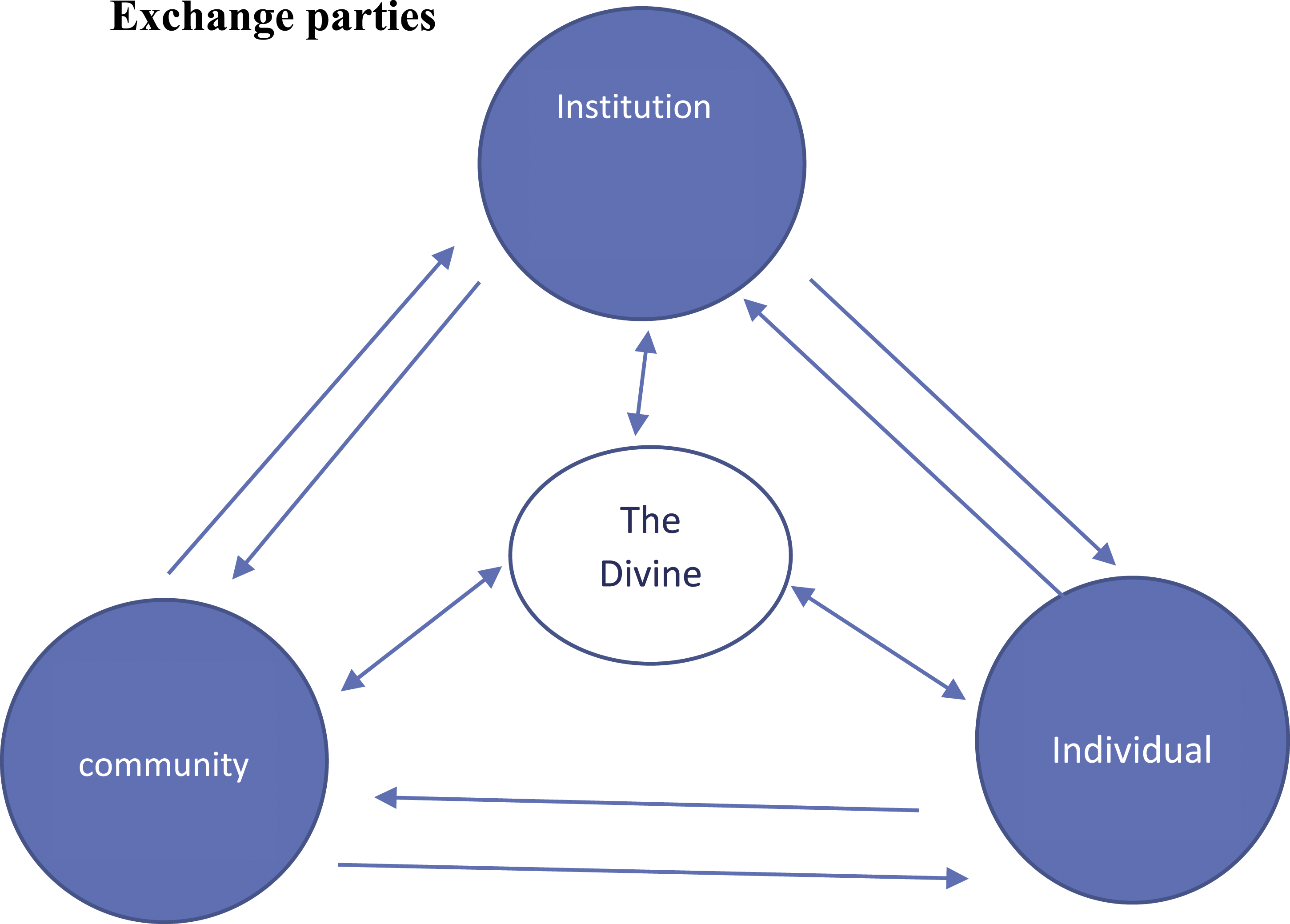
The modified model still represents, like the original one, the relationship with and between the Community and the Institution, with the Divine at the centre of the model, justifying/legitimising the various exchanges between parties. I would also claim that this modified version would also capture members’ varied experiences of exchanges (including ‘no exchange’) as part of the Church. For example, looking in Abena’s case: she has withdrawn from the exchange between members (Community), but still engages with her other duties and exchanges (tithe and offertory). Likewise, Mintah considers paying the offertory and tithe as substitutable, and therefore prefers – when he is financially constrained – to pay the ‘visible’ (under social pressure) offertory over the ‘private’ tithe, thus maintaining his church rights. Both examples can be accommodated within the modified model.
My second proposal is more consequential, as it is related to the place of the Institution in the model, and the potential of the model to be applied to other contexts/religious exchanges. Readers can gather from the account that the Church plays a significant role in the RBC. It appears to be firmly at the centre of the various monetary exchanges. The ‘Divine’ appears to just be one of the exchange parties. For a believer, with all her actions motivated by faith, God would be present in all forms of exchanges – dictating how to/what is/should be exchanged – but it is difficult to ignore the surrogate role of the Church, with its specific rituals of money collection, purification and detailed book-keeping activities. The ‘Institution’ here works as an intermediary to various degrees, in all monetary exchanges discussed in the case: (1) the offertory they directly collect during church services, (2) they collect and record tithe, gifted to God, and (3) the pastor has also a say in how collective funds are distributed.
I have found the collection and the bookkeeping of the tithe particularly telling: the Church collects it and uses it in the name of God. Bar the religious obligation on the believer to give it – it is virtually indistinguishable from the offertory. The Church, through its discourse (e.g. reminding believers of their sacred duty to support the church when calling for the offertory; when accepting and purifying the tithe) and rituals centralises, legitimises, and governs the religious exchanges in the RBC. As such, the Church, as a surrogate or agent of God, is firmly placed at the centre of the system of religious exchanges observed by Appau, and should thus take the place of ‘the Divine’ in the model.
Further, I am left wondering if the Institution was to be removed altogether from the divine economy, would the divine economic system collapse? Would we still have religious exchanges taking place, for example, between community members, and with God? Outside of RBC, my answer would be yes: even in the absence of an organised religious institution, people do engage in exchange relationships with others and with God, both in monetary (e.g. charitable donations, Islamic Sadaqah) and non-monetary forms (e.g. volunteering their services to others; acts of penance; fasting), as I have observed, for example, in the form of soteriological gifts (e.g. prayers for others) during the pilgrimages I studied. For RBC, the answer would be more debatable. Therefore, it is the very centrality of the Institution in the RBS exchange system that dictates its representation at the centre of the system. I propose Figure 2 (see below), as a more accurate picture of the divine economic system of exchange, with a central position for the Institution. Institution/Church at the centre of the divine economic system.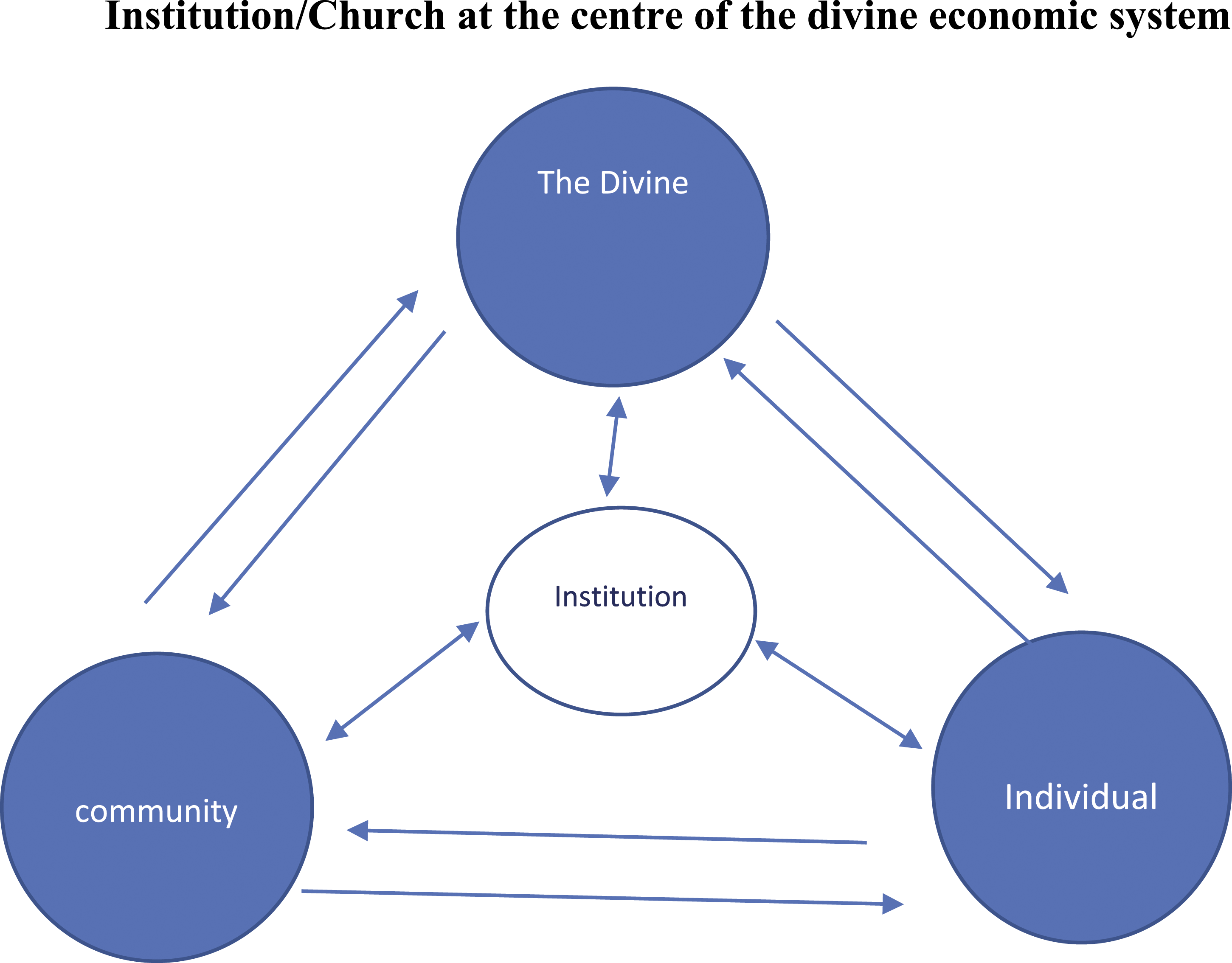
In addition, placing the institution at the centre also allows it to be ‘removed’ from the equation: one may still be engaged in religious exchanges without the intermediary role of the ‘Institution’. This modified model, focusing on the exchanges between the Individual, Community and the Divine/Sacred, could transfer more easily to other contexts, including with no/loose formal organisations, hierarchies, or ordained cultic agents. The level of control and intervention of the institution over the exchange economy would vary from one context to the next: from significant intervention (e.g. RBC’s services) to the simple role of facilitator (e.g. providing information, access to space for soup kitchens or food banks, for example). Besides, the Institution’ does not have to be a religious organisation: it can be a charity or even a local government agency acting as an organiser/facilitator, for religious exchange to occur (providing the presence of the three religious exchange parties). This is important to accommodate this, as there are growing numbers of ‘religious’ people who do not engage with their ‘church’ (e.g. McManus,2016; Jones, 2021), while still actively engaging in religious exchanges with their community (e.g. donations, volunteering,…) and their Divine.
With Appau’s model developed by unpacking monetary exchanges in a religious context, I would like to end my commentary by reflecting on whether the conceptualisation of religious exchanges offered here would apply to other forms of religious exchange besides money such as service, donations, gifts, and prayers. To avoid too long an essay, I will be focusing on the exchange of gifts (monetary, non-monetary, material, and immaterial) during a Muslim pilgrimage and the exchange of gifts. In the context of the pilgrimage to the shrine of Imam Husseyn in Karbala, Iraq (see Moufahim, 2013; Moufahim and Lichrou, 2019), what is exchanged can be listed as money gifts (donations to the shrines; donations to voluntary hosts), non-monetary supplication gifts to other pilgrims, to local worshippers, to family and friends, self-gifts in various material forms (food, liturgical and religious objects, books) and immaterial (prayers, supplications, acts of worship). I should explain, because it does not appear in my original religious gift-giving paper that a significant number of locals donate their time to be at the service of the pilgrims, for the duration of the pilgrimage. They call themselves ‘The Servants of Imam Hussayn’; they believe that high otherworldly rewards come from welcoming pilgrims and facilitating their visit. The Servants save money all year to be able to offer various services from feeding pilgrims to offering free boarding to pilgrims in their homes. More formal volunteering arrangements include working at the shrine (e.g. cleaning, security services); local medical professionals offering their time to tend to the health of the pilgrims.
Following the model, the three exchange (gifting) parties include the Individual, the Sacred (God/the Saint), and the Community (local population, hosts, pilgrims); at the centre of the model, we can identify the Institution, which is, in this case, the Shrine or ‘Pilgrimage Producer’.
The Pilgrimage Producer provides access to and manages the sacred site –legitimised/sanctified by God – to the community of worshippers who agree to follow the guidance and rites set up. The Institution managers provide many services: safety/security, information services (specialist answering questions/queries related to religion), imams leading the prayers, sermons and lectures; they also offer highly sought-after meal services and various religious objects (both for sale in the shrine shop and for free in return for a money donation (e.g. prayer stones/flags/blessed fabric pieces/rice). - The Individual (the believer/the pilgrim here) donates money to the Institution. Some also offer to volunteer to serve others. - The Individual exchanges gifts with the ‘Community’: it is common to receive sweets, fruits, prayer beads, bank notes, and even toys, on-site from other pilgrims. The giver would typically expect a prayer in return: they often would explicitly ask the nature of what they want out of the prayer (divine grace for a deceased parent, marriage, health, etc.). Reciprocal ‘promise’ gifts to God can also take the form of thanksgiving sacrifice (e.g. a sheep) that will feed pilgrims or the needy, for answered prayers. - In addition, similar to the case of RBC, the pilgrimage Community contributes to the individual’s socialisation, identity maintenance, faith multiplication, mental and emotional support, and the communal experience of the pilgrimage. Individuals are parts and parcels of the community of believers and as such would see other pilgrims as an extension of themselves (see Moufahim, 2013; Moufahim, 2016; Moufahim and Lichrou, 2019). - Finally, the exchanges between God and the community and the individual take the form of prayers and acts of worship (including donation of money, gifts, and services to others). Reciprocity from God includes material benefits, fulfilling wishes, divine protection, and otherworldly salvation. Interestingly in Islam, God also reciprocates exchanges between humans done with the intent to please Him, and as such the pilgrims are also exchanging with God in those religious ‘earthly’ exchanges (e.g. a gift to the shrine benefits your fellows, and therefore earns you good deeds; volunteering your time to clean the site benefits both pilgrims and the pilgrimage producer, but also grants you good deeds from God).
I have kept the example brief but tried to illustrate that the model would capture well the exchanges in this pilgrimage gift-giving economy. Like Appau, I have not included traditional market exchanges in my discussion, even though they significantly contribute to the ‘secular production’ of the pilgrimage (e.g. ‘professional’ hospitality service providers, transport, grocery shops, bakeries, etc.… who benefit from the exchanges taking place during the pilgrimage – including gift-giving). The reflection triggered by Appau’s article provided useful insight, allowing me to fruitfully revisit my case under the lens of exchange. I would thus reiterate Appau’s call for more research in different religious contexts about different parties and forms of exchanges to further our understanding of the central concept of exchange in marketing theory.
God at the centre of religious exchanges? addressing emic/etic issues when studying religious consumption fields
Diego Rinallo
Emlyon Business School, France
Based on his analysis of the Pentecostal consumption field in Ghana, Appau (2021) advanced the notion of a divine economic system, consisting of three interdependent forms of religious exchanges (with the church as an institution, among church members, and direct sacred exchanges with God). This system is qualified as divine ‘not because the system itself is divine but because it is centralized and legitimized by the divine, rather than by the market or by social norms’ (p. 194). Appau’s work has undeniable merits, as it brings religion back to the centre of religious consumption and marketing research, thus offering a useful theoretical vantage that respects consumers’ worldviews. This is in line with Ozanne and Appau’s (2019) exhortation to take seriously into consideration consumers’ metaphysical conceptions of reality, even when they clash with researchers’ own and the politics of the publication game, which often requires to marginalize and explain away data that does not fit well with a secularist social science standpoint. Having served as a reviewer for Appau (2021), I find myself in the uncomfortable position of constructively criticizing again a work that, to some extent, has already dealt satisfactorily with the critical remarks I had moved against previous versions of the manuscript. Still, no work is perfect and the points I am raising here should be seen as avenues for reflection on how work in marketing theory and culture-oriented consumer research could better integrate insights from critical social studies of religion.
My first critique is that in religious fields characterized by strong institutions, it is precisely these institutions that assume a central role in prescribing appropriate forms of exchange with God and legitimizing exchanges with religious institutions themselves and other members of the community. Taking an example I am familiar with, throughout the long history of Catholicism, ecclesial authorities have kept on policing how to appropriately worship God through evolving and at times contrasting theological reflections distinguishing religio (the true religion) from the proscribed superstitio – enduring pagan beliefs and practices unsanctioned by the Church and scrutinized because of possible incoherence with or opposition to the official doctrine (Schmitt, 1988). Theological reflection also legitimized the role of the institutionalized Church as the rightful mediator between God and mankind based on the notion of apostolic succession, according to which the authority of the pope (Saint Peter’s successor) and the bishops is founded in an uninterrupted continuity with Christ’s apostles. The authority of the Magisterium of the Church (i.e. the Pope and the bishops in communion with him) as the sole interpreter of the Word of God was thus asserted against dissenting or heretic voices, including those of consumers.
Perhaps no better example of the central role of the ecclesial authorities in legitimizing religious exchanges is the doctrine of the ‘treasure of the Church’ – a term that does not refer to its material wealth accumulated over the centuries, but rather to the treasure of merit in the eyes of God, of infinite value and inexhaustible, capable of cancelling the punishment of all possible sins committed by humankind – before or after the advent of Christ, until the day of the Last Judgement. Such spiritual asset, of which the Church is the only administrator on earth, had been accumulated thanks to Christ’s sacrifice on the cross and had been further augmented by the prayers and good deeds of the Virgin Mary, the saints, and church members. The doctrine of the treasure of the Church constitutes the ecclesial hierarchy as the only counterpart of a religious exchange having as object possibly the most important spiritual good, salvation, for which ongoing and significant demand is also guaranteed given the theological impossibility of not committing at least venial sins during one’s lifetime. The doctrine also underlines the ritual modalities of religious exchanges, of which the most important ones are the sacraments of Baptism, which permits to erase the original sin – human’s tainted nature and proclivity to sinful behaviour, which is the result of Adam and Eve’s disobedience to God when they ate the forbidden fruit in the Garden of Ede; and Reconciliation, which requires the confession of sins to an ordained priest, sincere repentance, and the acceptance of a penance. The Church is a monopolist also of the eucharistic celebration, the ritual commemoration of Jesus’ last supper with his disciples, which is a central act of worship in Catholicism, requiring an ordained priest to perform the transubstantiation – that is the transformation of the consecrated bread and wine into the body and blood (together with the soul and divinity) of Jesus Christ.
Catholic theological elaborations also legitimize religious exchanges among the faithful through the doctrine of the communion of saints – or the spiritual union of all members of the Church (living and dead, whatever their sanctity as individuals might be, as all are holy because of their consecration to Christ), who are all part of the same ‘mystical body’. As magisterially expressed in the teachings of the Church: “There reigns among men. . . a supernatural solidarity whereby the sin of one harms the others just as the holiness of one also benefits the others. . . Following in the footsteps of Christ, the Christian faithful have always endeavored to help one another on the path leading to the heavenly Father through prayer, the exchange of spiritual goods and penitential expiation. The more they have been immersed in the fervor of charity, the more they have imitated Christ in his sufferings, carrying their crosses in expiation for their own sins and those of others, certain that they could help their brothers to obtain salvation from God the Father of mercies. This is the very ancient dogma of the Communion of the Saints, whereby the life of each individual son of God in Christ and through Christ is joined by a wonderful link to the life of all his other Christian brothers in the supernatural unity of the Mystical Body of Christ till, as it were, a single mystical person is formed.” (Pope Paul VI, 1967).
In the most important of Catholicism’s religious exchanges, the Church thus keeps to itself the role of intermediator between God and the faithful, limiting the extent to which religious consumers can have direct exchanges with God, and providing a theological rationale for communal exchanges within the community of believers. Of course, vernacular religious practices might differ from official theological views, and the Church also validates other forms of direct sacred exchanges with the divine, such as prayers or reciting the rosary (see Rinallo et al., 2012). My point here is that to the extent to which the modus operandi of the Catholic Church can be extended to other monotheistic organized religions characterized by strong institutions, from an emic (that is, theological) perspective, it is the religious institutions themselves, rather than God (or other spiritual entities), that should be put at the centre of the divine religious exchange system.
My second critical remark regards the generalizability of the notion of the divine exchange system. In his conclusion, Appau (2021) calls for further research on other religious contexts or in spiritual fields outside of institutionalized religions, possibly characterized by different dynamics. My point, here, is that it would have been relatively easy to analytically generalize to other contexts. Building on the work of Davie (1997), who observed the persistence of religious beliefs coupled with dwindling active church membership (a situation vividly captured by the phrase ‘believing without belonging’), the divine (however conceived) might regain a central role as the direct counterpart of sacred religious exchanges. The divine religious exchange system would however be much leaner given the loss in the importance of exchanges with religious institutions and coreligionists – the former being limited to rites of passage such as marriages or funerals.
Similarly, in fields where consumers are ‘spiritual but not religious’, authority lies in individual consumers (Laubach, 2007) who, thanks to various (often market-mediated) awareness-changing experiences and training offers (e.g. meditation, ecstatic dance, shamanic retreats, rituals with entheogenic substances) can have direct sacred exchanges with the divine. In these contexts, spiritual leaders’ authority is legitimized by market success and, increasingly, social media influence (Rinallo et al., 2016; Zanette et al., forthcoming), but consumers’ postmodern mixing and matching from a plurality of sources in the globalized spiritual marketplace (Rinallo et al., 2013) makes it difficult for most spiritual institutions to centralize exchange systems. Social media might however enable forms of direct consumer-to-consumer spiritual exchanges that might differ remarkably from those in organized religious fields.
My third critique of Appau (2021) is that there’s limited reflexivity on how the author’s situated subjectivity has affected his fieldwork. Our field has just started addressing the specific challenges posed by reflexivity in research about religion and spirituality, which is instead a topic of a heated ongoing debate since the scientific study of religion(s) stood in oppositional contrast with theology. Here, key concerns are researchers’ insider/outsider status (McCutcheon, 1999) and, relatedly, the representation of emic/etic perspectives in published work (see Mostowlansky and Rota, 2016, for a discussion of key dimensions of the debate).
Appau’s (2021) methodology does include some brief remarks in this regard: ‘Although I am a practicing protestant, I was raised both as a Catholic in my childhood and later as a Pentecostal. My own religious background and academic training enabled me to be more reflexive in my analysis and interpretation of informants’ experiences and narratives’ (p. 183). I would have however welcomed more extended reflexivity. Recently, a group of scholars (Appau included) suggested that research on spirituality and religion could benefit from adopting an intersectional logic (Crenshaw, 1997; Gopaldas and DeRoy, 2015), specifically integrating insight from critical gender and sexuality studies (Rinallo et al., forthcoming). Future work on spirituality and religion in marketing theory and interpretive consumer research could benefit from critically examining how researchers’ religious (or spiritual) background, but also gender, social class, education level, and ethnicity, affect fieldwork, data analysis/interpretation, and theorization.
My final remark touches again upon emic/etic issues from a different perspective. While I enthusiastically agree with Ozanne and Appau’s (2019) call for greater respect for informants’ (emic) metaphysical worldviews, it remains an open problem how to reconcile respect with a critical scholar’s emphasis on highlighting power unbalances and patterns of oppression, discrimination, stigmatization, and exclusion. Religious worldviews might prevent women from assuming positions of religious leadership or support a view that ‘God hates fags’. Religious exchanges accepted by consumers and consistent with their metaphysical worldviews might negatively affect consumer physical, emotional, or financial wellbeing. Appau (2021) offers a detailed description of the ‘collection’ of money offerings during religious services through a process that ‘makes it very conspicuous if someone is unable to pay’ (p. 184), thus exerting social pressure on members to pay the offertory even if they do not have the financial means to do so. Appau vividly describes the discomfort of religious consumers caused by such a surveillance mechanism. As a researcher, I share this discomfort and wonder whether the exchange between these consumers and their church is balanced, as Appau proposes. Critical theory, building on Marx’s famous statement that religion is the opium of the people, has long criticized religion for taking advantage of the faithful. A balance needs to be maintained between respect for emic religious/spiritual worldviews and the possibility for an ethically grounded critique of the psychological, social, cultural, economic, and environmental consequences of such worldviews. Respecting informants’ worldviews is, therefore, necessary, but maintaining a space for researcher discomfort (see Chadwick, 2021) in fieldwork and theorization might be equally fruitful.
Response to Jafari, Moufahim, and Rinallo’s critique of Appau (2021)
Samuelson Appau
University of Melbourne, Australia
Here, at this table of academic discourse, a former Catholic, two Muslims and a Protestant look God in the eye and ask, ‘what have you done to us?’. God looks back and responds, ‘which version of me are you speaking to?’. Alas, that is the problem with asking questions of God. Yet, for some people, the need to ask questions of God, whichever version we (no longer) declare faith in, is inevitable, maybe inescapable. Since God is quite elusive with his answer, let us then turn our attention to each other and ask: what did your God do to you? Where do I even begin to answer that question!
Let me begin with what God did not do. Jafari, Moufahim, and Rinallo, three very esteemed colleagues have read with great interest and written very insightful critiques of my 2021 Marketing Theory paper titled Toward a Divine Economic System: Understanding Exchanges in a Religious Consumption Field. This paper is based on my ethnography of a Pentecostal church in Ghana, where I had among other interests, to follow the monies people pay in the church to understand the reason and consequence of such payments. My purpose in that paper was threefold. First, I wanted to highlight what people are doing with their monies in the name of God; this was my contextual point of interest. Secondly, I wanted my colleagues in the academy to see that even though we are marketing scholars, we need not imprison our conceptualization of economic systems within their conformity or deviation from the market. By proposing the divine economic system, I wanted to highlight that there are more ways to understand exchange beyond the binary of market/non-market economic systems and the hybridity betwixt and between (Eckhardt and Bardhi, 2016; Scaraboto, 2015). This was my theoretical point of interest. My third purpose in that paper was to show that God is not dying and that before the market became like God (Wood, 2015), God was and still is God. This is a personal point of interest and I have this point of view because of what my God did to me. To be clear, I use God here loosely to refer to religion.
Moufahim’s critique of the paper centres on my second point of interest and my conceptualization of the divine economy. Jafari took great interest in my third point about the relationship between God and the market, especially on the notion of the religionization of the market. Rinallo’s critique lies in between both, interrogating what people do in the name of God and what God has done to me to influence such scholarship. My colleagues make many other interesting points, but these are the major concerns on which their critiques are built. I will need a dissertation and another to fully address these issues, but within the limits imposed here, I offer responses which, though they cannot fully answer their questions, attempt to do so with room for continuity of this conversation for others touched by God or this commentary in all the wrong and right ways.
The discomfort of putting God in the middle
Moufahim’s commentary is in many ways an excellent extension of my paper and key theoretical arguments, demonstrating the application of the divine economic system and its similar manifestations in her Islamic exchange context. As expected, there are many differences as well that she highlights. Her key argument however is her discomfort with putting the divine in the middle of the divine economic system as I evidenced in my Pentecostal research context. Instead, she sees the institution as being central to the exchanges and provides many examples from my paper and her own research context of Islamic exchanges to make this point.
I have no concerns about an economic form of exchange that centralizes religious, economic, social, or political institutions. This is a point that Sherry (1983) espouses in his seminal treatise on gift exchanges in anthropological thought. The political science literature also highlights the role of political institutions in the exchange of votes and voter interests (Grossman and Helpman, 1996). The prescient role of marketing institutions such as firms, advertisers, and brands in shaping marketing exchange is now textbook knowledge. Prior research on exchange in religious contexts also tends to implicitly centre the religious institutions (Bonsu and Belk, 2010; Moufahim, 2013), although there is room for more concerted examination in that space.
However, it is impossible to talk about a divine economic system that does not centre the divine (gods, spirits, saints etc.), in the same way, that one cannot talk of the market economic system if the market was not central to that system. As I explain and demonstrate throughout the paper, the church institution and community exist because of God. Without the God factor, the church members are strangers with no affiliation with an institution that professes a God. To follow in Moufahim’s own argument, if you took out the institution or community, the divine economic system would persist. This is something she evidences in her own research context and which Rinallo also notes with his example of spirituality consumers (see also Rinallo et al., 2013). If you take the divine out, however, the entire economic system collapses. This is the logic of centring the divine and not the institution.
Even if we as scholars have discomfort with putting the divine in the middle, the central role of the divine is a defining worldview for millions of people who believe in God or some divine agent. It is the worldview of these people that I seek to represent in the divine economy. As I showed in the paper, someone may become disgruntled with the church, but because their faith in God remains, they simply move to another church (or religious institution) where they continue to give money. If, however, they lose faith in God, they are less likely to continue in their church or another religious institution. They may even turn to the market, but as McAlexander et al. (2014) show, even that transition can be painful and persistent. It is not easy to divorce God. For those still married to systems centred on God, the divine economy is very salient, and I reiterate my call for scholars to critically examine it further.
Rinallo’s discomfort with putting God in the centre stems from his concern about who puts God in the centre. In his opinion, the institution is the who that centres God and assigns to God all manner of power and prescriptions that serve the institution’s interest. If the priest wants your money, he says God wants your money and goes on to tell you all the terrible things that will happen to you if you do not give ‘God’ the money, and the good things that will happen to you if you do. This is a common critique of institutional religion and of more neoliberal religious ideologies like the prosperity gospel (Bonsu and Belk, 2010). This is why Rinallo critiques Ozanne and Appau’s (2020) admonition to take emic religious perspective seriously. Scholars have an etic/ethical responsibility to be critical of emic knowledge that informants share. In this regard, Rinallo urges us to centralize the institution in religious exchanges and critically assess its role not just in facilitating other forms of exchange in this context but also in putting God in the centre to legitimize the institution’s discourses and power. This is not a straightforward matter because even what constitutes the nature, function, and importance of any religious institution is steeped in multiple historical, cultural, and political processes that Jafari excellently raises in his critique in this commentary.
My view of this critique brings into focus Rinallo’s other point about researcher reflexivity on matters of religion. That is, what did my God do to me (him) and how did that influence my (his) purpose in that paper (in this commentary)? Studying religion or spirituality is almost always personal. Like my colleagues in this commentary piece, many scholars who study religion and spirituality (in marketing) were, are, or have recently become religious or found a new spirituality. I was raised in very religious contexts, both in my family and in a country in which 95% of the population say they are religious. Salient to that ethnographic study and paper is that I spent most of my youth in a Pentecostal church and my father is (at the time of this writing) a pastor of that Pentecostal church in Ghana. I am still religious and maintain my faith in the Christian God. Certainly, this background and declaration of faith leaves more than a trace when you write about religious matters in an academy that tends to concern itself with secular matters (see Appau, 2016 for detailed ethnomethodology).
For me then, centrally responsibilizing religious institutions on matters of exchange (or any other function including its theology and doctrines) begs the question. To do so, one must set aside faith in God or in the existence of God and consider the church in this case as a purely social, economic, or political institution, which is not a simple matter because if the church were only these things, then it would not be a religious institution, but because it is, we cannot set aside its divine-centred legitimation. I believe that to fruitfully engage and interrogate the function and influence of religious institutions, we must inevitably engage its divine-centred worldviews to understand and dismantle its excesses. As an example, Ozanne and Appau (2020) noted how they used the religious logic of tithing to help discourage members of the same church studied by Appau (2021) from taking monies out of their business capital to pay their tithes. We do not have to believe in God before we engage the divine-centred worldview of religious institutions to address their problems (and there are problems), but we must believe that others do and that is a starting point to have an engaged debate. This does not guarantee the outcome we want, but it is more fruitful.
A final point on this matter is that we must be even-sided in our call for reflexivity. In the scholarship on the consumption of religion and spirituality, non-religious scholars must be critical of their secular bias in the same way that religious scholars must be critical of our faith bias. In our study of religious consumers, we must take Michel De Certeau’s (1984) advice that ‘it is always good to remind ourselves that mustn’t take people for fools’ (p. 176) just because they believe something we do not. Here and there, we have some agreements on moral violations and exploitation by religious institutions and agents that must be challenged, condemned, and discarded. In between, there is a vast sea of subjective interpretations, each necessary to progress our thinking, and each with the potential to change our lives. Reflexivity makes us aware of our biases, but it does not prescribe what to do with such awareness. What to do with the presence or absence of God’s influence in our scholarship is, perhaps, the bigger conversation topic for another paper and place.
God versus the market
Jafari’s main critique has to do with my assertions on whether the market is taking over religion or religion is taking over the market. To some extent, I think Jafari misunderstands my answer to this debate but here, I want to take responsibility for that misunderstanding and offer some clarification. I point out marketing research that builds on secularization theories to suggest that the market is taking over religion through the marketization of religion (e.g. Carrette and King, 2005). Then I note examples in both Western and non-Western contexts where this assertion does not hold sway and in which one might argue that religion is rather appropriating the market and marketing tools and systems (Appau and Awaworyi Churchill, 2019; Botez et al., 2020). So far, so good, as Jafari and I seem to agree on this. I go on to query that if the former example is presented as the marketization of religion, can we then present the latter as the religionization of the market? This question was meant to be provocative, and it did provoke; Jafari’s commentary is a response to this intellectual provocation.
Let me note again that to a large extent, Jafari and I are on the same page about the complex but non-hierarchical relationship between religion and the market. In the sentence following that question, I note: ‘Perhaps, the point is not that the market is taking over religion or religion is taking over the market. They have always coexisted and commingled, and either taking primacy is a matter of context’ (p.195). I, therefore, do not consider Jafari’s critique as a criticism of my stance on the religion versus market debate because I do not have or make the assumptions he notes. Rather, I consider them an extension to the question I raised but did not have the space to fully address in that paper. Indeed, his explication of the political context of Pentecostalism in Ghana, even if understandably oversimplified, is a gift to my paper because he adds more context of context to my context of context. His unpacking of the sociology of religiosity and religionization has added more flesh to the bare bones I espoused. He also added more joules to my purpose to demonstrate that God is not dead or dying. I wonder what Jafari’s God did to him to influence his own stance.
On a closing note, I would like to again provoke my colleagues at this table and beyond further. In recent times, some researchers have argued that despite an evident decline of institutional religion in the West, the persistence of what Jafari calls ‘religion-oriented moral values’ suggests that religion is not dead (e.g. Botez et al., 2020). However, there is little reason to believe that these moral values stem from religion. Rather, what is more likely is that religion appropriated them to gain legitimacy as it institutionalized (Taylor, 2007) in the same way that the market appropriated them from religion for its own legitimacy (Graeber, 2011). Perhaps these moral values persist in the market and elsewhere because they are enduring sociocultural values that were and are still integral to the formation and organization of human societies (Harari, 2014). Certainly, they pre-dated institutional religion and will most likely survive its eventual decline in one form or another. Even if theoretically God will die someday, it is probably less debatable to say now that God is not dead yet. If, when and how God was born, however, is an interesting and unresolved debate. Within that debate are many insights about what God was, is and will be, and how they (no longer him or her) will be reborn in the fluidity of identities, times and spaces, the depths of which our imaginations cannot even reach. Now, that is a feast for thought!
Footnotes
Declaration of conflicting interests
The author(s) declared no potential conflicts of interest with respect to the research, authorship, and/or publication of this article.
Funding
The author(s) received no financial support for the research, authorship, and/or publication of this article.
