




Abstract
The scientific tradition in marketing research has alienated marketing practitioners from academics. As a counterpoint, we argue that theory from the humanities, especially theatre and drama studies, can provide meaningful insights into consumer culture. Inspired by the Theatre of the Absurd, we develop four absurd prompts present in consumer culture: menace, aphasia, parody, and frustration. Taken together, these prompts amount to an absurd condition, a hall of mirrors, in which consumers inevitably find themselves. While the market promises different ways out of this condition, through manners, speech, sincerity, and attainment, we argue that these promises remain empty, amounting only to absurd inversions leading to new halls of mirrors. Through the lens of the Theatre of the Absurd, we map such promises of inversions and their implications for marketing theory.
Consumption constitutes not only a symbolic text but a kind of theatrical space. —Laura Oswald (1999: 313)
Prologue
Absurdism, the philosophical theory that existence is irrational and meaningless, is generally disregarded by both marketing researchers and practitioners alike. Yet absurdity, in which the smooth flow of daily life breaks down, is a common feature of consumer lives. As Foley (2010) notes in his book The Age of Absurdity, modern life makes it notoriously hard to be happy. Indeed, our contemporary times may be best characterised as absurd through the increasing frequency of menacing historical events that we experience (Södergren, 2022). Most notably, the recent coronavirus crisis and its shift in social relations, means of communication, and limits of consumption activities (Butler, 2022), but also the farce of resurgent right-wing politics (Luedicke, 2015), a pervasive sense of dread and anxiety in the face of climate change (Campbell et al. 2019), and the confusing parody played out through our attitudes towards ethical consumption and de facto consumption behaviour (Lewis and Potter, 2013). While social media and technological innovations have brought about an unprecedented capacity for communication, we now witness an alarmingly diminishing ability to reach shared understandings (Dean, 2010), with consumers increasingly embedded in echo chambers and filter bubbles.
These absurd times are further exacerbated by a consumer culture wherein attention (Davenport and Beck, 2001), emotional outbursts and engagement (Dean, 2010), the self (Ruckenstein and Granroth, 2020), and ‘dividual’ data (Hietanen et al. 2022) enter the operations of ubiquitous marketing (Darmody and Zwick, 2020) that thrive on polarisation and conflict (Ulver, 2022). Social media, once hailed as a promise of democracy, has become dominated by profit-driven cloud empires (Lehdonvirta, 2022) that encourage and profit from outrage and engagement, obstructing the conditions of meaningful dialogue (Hietanen et al., 2016). Consumer society, the promise of material abundance and freedom of choice, has reached such an absurd degree that finding anything satisfactory amongst a vast selection of goods has itself become a frustrating challenge (Mick et al., 2004). The happiness brought about by such material abundance appears increasingly suspect too (Shankar et al., 2006), as consumption falls short of satisfying our desires in any stable fashion. As marketplace stakeholders, politicians, and policy makers struggle to formulate geopolitically viable action to address humanitarian and ecological crises (Bradshaw and Zwick, 2016), we note how consumer culture has become suffused by a growing affective backdrop of absurdity, a pervasive mood conjoining all forms of consumption experiences. Not to mention all those absurd memes floating around the internet…
However, while we witness a growing corpus of marketing literature dealing with issues of an absurd phenomenological meaninglessness experienced by consumers (e.g. Elliott, 1997; Hietanen et al., 2022; Wickström et al., 2021), its affective mood remains notoriously tricky to approach. This difficulty is compounded by an epistemological lineage striving for scientific rigour that has tended to favour more clear-cut, operationalised forms of knowledge production following rational models of behaviour (cf. Arndt, 1985). As such, despite long standing remarks concerning how consumers’ passions ‘seldom, if ever, [are] cultivated through rational arguments’ (Thompson et al., 2006: 50), interpretive consumer researchers still struggle to account for and make sense of the prevalent forces of emotion, irrationality, and conformism vis-à-vis rational reason (Elliott, 1997; Jantzen and Østergaard, 1998).
In this paper, we seek to contribute to recent calls to broaden the monoculture of knowledge production within marketing thought (Chandy et al., 2021; Kravets and Varman, 2022; Moorman et al., 2019). More precisely, we contribute to the ‘art or science?’ debate that influenced the field of marketing for much of the previous century (Sherry, 2014). For as Brown (1996: 255, italics in original) points out, the great art/science ‘debate’ never actually took place! As a glance at even the earliest contributions clearly indicates, the controversy was always about ‘marketing: science or non-science?’. Art never came into it. Not a single person in the entire history of the contretemps attempted to make a case for marketing as an ‘art’.
To that end, we offer the Theatre of the Absurd from the humanities to theorise the production of meaning in consumption and consumer culture vis-à-vis an ontological meaninglessness and to account for the absurd nonsensical facets of consumer culture. The paper builds on the nascent tradition of ‘Terminal Marketing’ (Ahlberg et al., 2022), in which meaninglessness is an inherent human condition, with meaning only retroactively inscribed by human agents to make sense of a world always too much in its excess (Bakhtin, 1984; Gupta et al., 2024). From an ontological starting point of meaninglessness as a fundamental facet of being, we note how many market actors seek to offer cohesive narratives of meaning, efforts that become increasingly strained as consumer culture continues an absurd axiom of endless accumulation (Arnould, 2022).
Following recent calls to develop new epistemological approaches to address the deadlock and challenges of consumer culture, we offer the notion of the ‘Theatre of the Absurd’ from drama and theatre studies as one fruitful avenue to explore. The value of drama and theatre has long been recognised as a useful lens with which to examine the cultural collective negotiation of our times (Adorno, 1974; Benjamin, 2003; Feyerabend, 1967; Jameson, 1998), and the Theatre of the Absurd has been regarded as a notion ‘uniquely relevant to understanding our troubled times’ (Starkey et al., 2019: 591). Inspired by the Theatre of the Absurd, we offer a framework for producing consumer insights and knowledge in the face of an increasingly absurdist world. As the Theatre of the Absurd presents a rather novel concept in the context of marketing thought, we begin this paper with a review of extant marketing literature that has engaged with the ‘absurdity’ of the human condition and noted its expressions in various acts of consumption, service encounters, and customer interactions. Thereupon, we unpack the central tenets of the Theatre of the Absurd and how they relate to marketing and consumption phenomena. We conclude the paper by detailing how thinking with the Theatre of the Absurd expands the boundaries of marketing thought, aids in developing new insight for interpretive consumer research. Finally, we address what the implications might be for understanding consumer culture.
Act I: All marketing is absurd
Absurdism is often associated with European writers such as Albert Camus, Franz Kafka, and Søren Kierkegaard. The Myth of Sisyphus (in which Camus makes the case for the human situation being essentially absurd and devoid of purpose) has been specifically influential in the development of absurdism. But there are also traces of other movements such as dadaism, surrealism, and symbolism (e.g. Antonin Artaud’s Theatre of Cruelty, Alfred Jarry’s Ubu Roi). The term ‘absurd’ has its roots in the Latin word ‘absurdus’, meaning ‘contrary to reason’ or ‘inharmonious’ (in contrast to its vernacular usage as a synonym for ‘ridiculous’). As Esslin (1962) points out, it was initially a musical term for a note or a melody being ‘out of harmony’. In short, absurdism implies that the world lacks meaning or a higher purpose and is not fully intelligible through reason. In turn, absurdist fiction in play form is known as the Theatre of the Absurd (Esslin, 1962).
The ‘Theatre of the Absurd’ is a term coined by Martin Esslin (1962) to describe certain features of certain plays – especially the type of drama associated with the playwrights Samuel Beckett, Eugène Ionesco, Arthur Adamov, Jean Genet, and Harold Pinter – and foreground their underlying thematic similarities. A typical trope is the exploration of what happens when human existence lacks meaning or purpose and communication breaks down (see also Bennett, 2011). This is not to say that all dramatists of the Absurd subscribe to similar political or ideological viewpoints, nor did they take part in any self-proclaimed or self-conscious school or movement; all it does mean is that the artists of this epoch, spanning from 1950s to the early 60s, have certain traits in common and that they resemble each other in certain basic structural respects. Contrary to writers such as Jean-Paul Sartre and Albert Camus, who addressed a sense of metaphysical anguish at the absurdity of the human condition in the form of highly lucid and logically constructed reasoning, the Theatre of the Absurd strives to express such themes through the open abandonment of rational devices and discursive thought. In other words, whereas the existentialists address our disillusioned age in which the world has ceased to make sense in the realm of ideas, the Theatre of the Absurd does so in the realm of intuition (Esslin, 1962). This has important implications for research on consumer culture, for to understand the lack of logic in certain types of consumption practices, some of which we will elaborate on later, logical construction and argument sometimes must give way to irrational and illogical speech, as so often depicted in the Theatre of the Absurd.
The Theatre of the Absurd has received attention in adjacent disciplines within the social sciences and journals such as Management Learning (Starkey et al., 2019) and Theory, Culture & Society (Denzin, 1991). In sociology, drawing on Lyman and Scott’s (1970) ‘sociology of the absurd’ as a tool for understanding capitalism’s contradictions, scholars have used the literature of the absurd – including the writings of existentialists such as Camus, Sartre, and Kierkegaard – to conceptualise rebellion in the face of ‘institutional absurdity’ (Goodwin 1971), hence overcoming the sociological controversy of the absurd as the conflictual encounter between the individual and society (Shoham, 1974). Thus, human geographers have urged us to take absurdity seriously, including its implications for geographies of consumption (Phelps, 2018). In consumer research, however, it has only been touched upon tangentially by scholars who have an enduring interest in literary criticism, such as Barbara B. Stern (1990) and Stephen Brown (2006). Its role in marketing thus remains shrouded even though absurdism more generally has been the subject of some research, especially in advertising (e.g. Arias-Bolzmann et al., 2000; Gelbrich et al., 2012; Weinberger et al., 2021).
Nevertheless, the theatre has been used as a metaphor for consumption in prior marketing scholarship. Dholakia and Firat (2003) propose the term ‘theatres of consumption’ to illustrate how consumption patterns evolve, transform, and proliferate from a cultural perspective. Solomon (2017: 389) describes retailing as a theatre where ‘the quest to entertain means that many stores go all out to create imaginative environments that transport shoppers to fantasy worlds or provide other kinds of stimulation’. Moisio and Arnould (2005) applied a dramaturgical framework to study shopping experiences. In sociology, Goffman’s (1956) theory of self-presentation suggests that consumption is part of a theatrical performance which, in turn, has informed a lot of service research that adopts theatrical terms such as roles, script, staging, and actors to develop insight into service management (e.g. Clark and Mangham, 2004; Grove et al., 1998; Stuart and Tax, 2004). Nonetheless, while the metaphor of the theatre is often used, as marketing scholars we are yet to bring perspectives from dramatics and theatre studies to our field, at least attempts are few and far between (Drummond and Krszjzaniek, 2015; McDonagh and Prothero 1996; Stern 1994).
As interpretive consumer researchers, our efforts to understand consumers’ actions and practices are far from complete. For example, Tadajewski (2022) illustrates how the academic subject of marketing grew out of economics and a preferred reading of psychological theorising. Yet markets are complex and operate at many levels. On a socio-cultural level they can be difficult to define, and traditional perspectives based on economics and consumer psychology are not always sufficient. This is especially the case when consumers are forced to deal with the meaningless absurdity of the human condition. From Brown and Reid’s (1997) account of shoppers on the verge of nervous breakdowns to Fitchett’s (2002) reflection on sadistic TV shows, to Scott and colleagues’ (2017) report of consumers purchasing and enjoying painful and dangerous experiences. And – perhaps the most poignant example – the fact that we continue to burn fossil fuels in our automobiles in the face of the climate emergency, our cultural environment is characterised by nonsensical, non-rational, and generally inexplicable (i.e. absurd) consumption phenomena. In turn, the marketplace offers increasingly absurd consumption activities in striking fashion. Sandel (2012) catalogues how we live at a time when almost everything can be bought and sold, listing numerous absurd examples of things that are up for sale, such as ‘the right to shoot an endangered rhino’ (4). The author also offers examples of what you can do to make the money to afford these things, such as ‘rent out the space on your forehead to display commercial advertising’ (ibid.) or ‘buy the life insurance policy of an ailing or elderly person, pay the annual premiums while the person is alive, and then collect the death benefit when he or she dies’ (5). As various strange experiences become commodified, it is key that marketing grapples with its own absurd condition, this perhaps being best characterised by its pursuit of economic growth in conjunction with ecological redemption, despite the evident contradiction (e.g. Swyngedouw, 2022).
Entr’acte
To illustrate the Theatre of the Absurd, we use texts from four playwrights to which Esslin (1962) dedicated chapters in his book. These are The Birthday Party by Harold Pinter, Ping Pong by Arthur Adamov, The Chairs by Eugène Ionesco, and Waiting for Godot by Samuel Beckett.
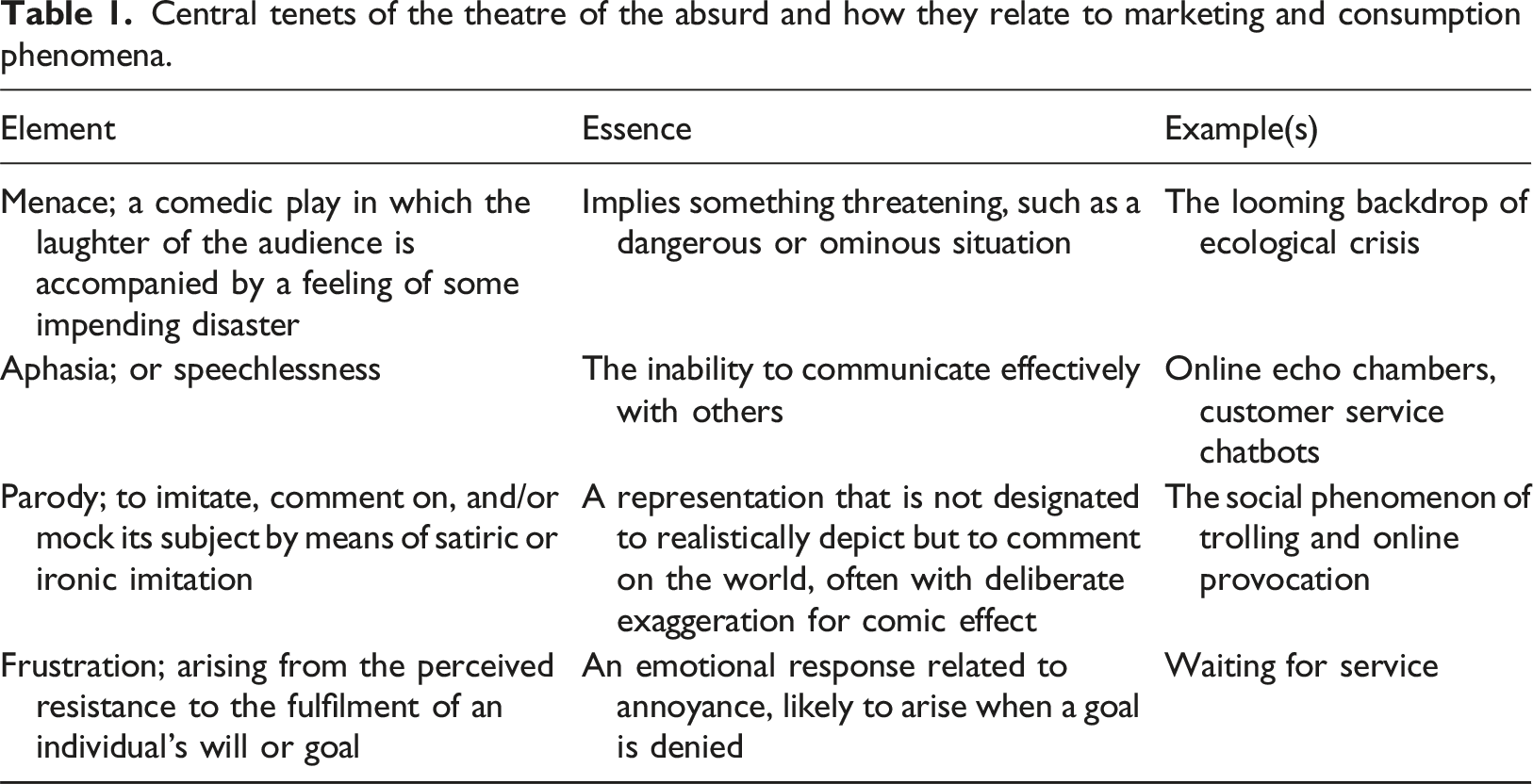
Central tenets of the theatre of the absurd and how they relate to marketing and consumption phenomena.
Menace
Menace was derived from the works of Harold Pinter, whose early plays were referred to as ‘comedy of menace’. To illustrate menace, we have used Pinter’s play The Birthday Party as our exemplar. A comedy of menace is a play in which the laughter of the audience is accompanied by a feeling of some impending disaster. The aim is to make the audience feel uneasy, even while laughing, because of the perception of some threat (the vaguer the better) to the principal character or to the audience itself.
In The Birthday Party, the protagonist Stanley, a pianist in his thirties, is living in a dingy seaside boarding house run by Meg, a motherly old woman, and her tongue-tied husband, Petey. Stanley is the first tenant they have had in years, and it is evident that he has taken shelter from a hostile world. The peace is disrupted when two sinister strangers, Goldberg and McCann, show up unexpectedly. They organise a birthday party for Stanley even though he insists that it is not his birthday. They terrorise him with a nonsensical cross-examination. GOLDBERG. You verminate the sheet of your birth. MCCANN. What about the Albigensenist heresy? GOLDBERG. Who watered the wicket in Melbourne? MCCANN. What about the blessed Oliver Plunkett? GOLDBERG. Speak up, Webber. Why did the chicken cross the road? STANLEY. He wanted to–he wanted to–he wanted to… MCCANN. He doesn’t know! GOLDBERG. Why did the chicken cross the road? STANLEY. He wanted to–he wanted to… GOLDBERG. Why did the chicken cross the road? STANLEY. He wanted… MCCANN: He doesn’t know. He doesn’t know which came first! GOLDBERG. Which came first? MCCANN: Chicken? Egg? Which came first? GOLDBERG AND MCCANN. Which came first? Which came first? STANLEY screams. (Pinter, 1991: 51-52).
Eventually they take him away, leaving the audience terrified and laughing but none the wiser; a narrative that is not too different from the recent Netflix motion picture Don’t Look Up, in which scientists keep providing alarming facts about an impending disaster but various interlocutors, such as the morning show hosts who want to maintain a comic tone, just obsess over ratings. In terms of contemporary consumer culture, it serves as an allegory for the climate crisis and ethical concerns over sustainability, a pervasive background affect for almost all consumption nowadays. As a friendly reviewer pointed out, even when ‘I’m “just” choosing what I want for lunch, there is a menacing sense of civilization collapsing just over the horizon if I choose the wrong (i.e. the least sustainable) option’. Such feelings of guilt reproduce themselves ad nauseam as consumers find themselves responsible to solve the crisis by consuming ethically (Lewis and Potter, 2013). However, consumers rarely adhere to their ethical purchase intentions (Holt, 2012). And even if they do, such efforts remain insufficient to solve the wider issue (Bradshaw and Zwick, 2016). Consumers are thus wedged in place; individual ethical consumption, despite being doomed from the outset, is internalised as an ethical failure (Carrington et al., 2016). As consumers come to shoulder responsibility for systemic ecological issues, a feedback loop forms wherein a continued failure of ethical consumption gives rise to calls for more ethical consumption: a disavowal of reality (see Bradshaw and Zwick, 2016) where a resolution for ecological menace is foreclosed amidst fantasies of a Deus ex Machina innovation and ethically responsible consumers. As the menace of ecological breakdown creeps closer, the absurd inability to articulate socio-political alternatives that breaks out from this phantasmal deadlock has given rise to fascist and populist movements (Swyngedouw, 2022) and a polarised cultural climate of conflict, spurred by menace and profited from by marketers (Ulver, 2022).
Indeed, profiting from the increasingly tangible affective mood of menace and disaster has itself become a source of business in the vast proliferation of Hollywood movies depicting our end (Bradshaw and Zwick, 2016). Thompson et al. (2023: 296) furthermore note that ‘contemporary ads now often soften their anxiety-inducing messages through humour’. As an example, they use Allstate’s long-running Mayhem campaign in which actor Dean Gerard Winters embodies the devilish voice in your head that tempts you into ill-advised actions with unfortunate consequences. For the authors, this is a potent illustration of how one cannot help but laugh at this postmodern mix of humour and negative reinforcement. Just as with the laughter in Pinter’s play, menace is unable to be articulated, only vaguely alluded to and dystopically enjoyed. Laughed at (Bradshaw et al., 2021). Once again, nothing demonstrates this better than the Hollywood blockbuster Don’t Look Up. The movie, categorised as a comedy, depicts the absurd events of a team of scientists trying to convince the world of the very real threat of an incoming meteor only to discover that nobody takes it seriously nor can address it in any meaningful fashion. Ending in a bang – spoiler alert! – the asteroid wipes out life as we know it. A not-so-subtle allegory of our political times and menace, the movie invites us to laugh at events happening contemporaneously. If Armageddon is the hallmark movie of marketing’s unconscious sabotage (Bradshaw and Zwick, 2016), then Don’t Look Up illustrates consumers’ inclination to laugh alongside our affective menace (also Kravets, 2021). One might even call it a parody.
Parody
Parody is a central theme of Arthur Adamov. Parody refers to a creative work designed to imitate, comment on, and/or mock its subject by means of satiric or ironic imitation. Often its subject is an original work or some aspect of it (theme, author, style, etc), but a parody can also be about a real-life person (e.g. a politician), event, or movement. Dentith (2000: 9) defines parody as ‘any cultural practice which provides a relatively polemical allusive imitation of another cultural production or practice’. Hutcheon (1985: 6), furthermore, said ‘parody […] is imitation, not always at the expense of the parodied text’.
Notably influenced by the likes of Bertolt Brecht and August Strindberg, Adamov began writing for the theatre towards the end of the Second World War. His plays, which depict ‘a senseless and brutal nightmare world’ (Esslin, 1962: 92), were largely influenced by his friend Antonin Artaud’s manifesto on the ‘Theatre of Cruelty’. Ping Pong (Adamov, 1955) is a masterpiece of the Theatre of the Absurd and, in this paper, we have used it as an exemplar of parody. The world of the play is a parody of modern man’s helpless quest for life’s meaning; even if it exists, it is tragically inaccessible to us. In other words, Adamov is not trying to represent the world but to parody it. His argument is that parody can make manifest the hidden and the invisible, the latent content that coexists with the visible world. When I arraign the world around me, I often reproach it for being nothing more than a parody. But the sickness I admit to—is it anything more than parody? (Adamov, 1946: 85).
In Ping Pong, two men, Arthur and Victor, are obsessed with a pinball machine. The machine becomes the dominant influence in their lives, dominating both their dreams and emotions. With every decision they make, they devote themselves to pinball machines and believe in their absurd ideas with the fervour of objective truth. In the play, Adamov convincingly elevates the pinball machine to a representation of all human endeavour.
Parody and satire have prevalent roles in contemporary consumer culture. As noted by Mikkonen and Bajde (2013), for example, parody is a common tactic of playful consumer resistance. Parodic resistance, they argue, critically refunctions dominant consumption discourses and market ideologies. Elsewhere, Jean (2011) introduces the notion of ‘brand parody’ to illustrate how companies use aggressive advertising and media campaigns to parody competitors. Vanden Bergh et al., (2011) study how user-generated ad parodies in social media influence brand attitudes. This could possibly give rise to ‘parodic’ doppelgänger brand images (Thompson et al., 2006). Parody also corresponds to ironic consumption, that is, using a product with the intent of signalling a meaning that reverses the conventional meaning of the product (Warren and Mohr, 2019). This practice permeates postmodern consumer culture. In popular culture, the recent Barbie movie could be seen as a parody of female empowerment and outdated patriarchy, reflecting regressive beliefs that persist in our society and the absurdity of viewing women as subservient to men. Perhaps the most striking example of parody in our contemporary meme culture is the social phenomenon of trolling and online provocation (e.g. Golf-Papez and Veer, 2017; Kravets, 2021) in which people spread ‘fake news’ online, eroding consumers’ trust in authoritative websites as credible sources.
Ping Pong also bears a striking resemblance to modern-day relations between consumers and commodities. The consumer-commodity relation has been noted to be one of fetishism (Cronin and Fitchett, 2021). In the menacing affective mood of today, consumption objects are attached with ideological fantasies that serve as a guardrail to placate the horror of an absurd reality. However, such fantasies are far from stable. Indeed, as we will discuss below, there is a constant risk of encountering the absurd lack of meaning undergirding consumer culture. As such, consumers are stuck in an unceasing neoliberal pursuit of commodities to anchor the self. Just as Arthur and Victor devote themselves to a pinball machine in a helpless bid for stable meaning, consumers pursue a stable relation through consumption to make sense of an absurd existence.
Aphasia
Aphasia, or speechlessness, emerged as a central theme in the works of Eugène Ionesco. For this article, we used his third play, The Chairs, as an exemplar of aphasia. The play, depicting the futile struggle of two elderly people attempting to convey the meaning of life to the rest of humanity, has been described as a tragic farce full of disconnected dialogues. At one point early in the play, the old couple struggle to communicate with the audience: Both [together, laughing]: And then we arri. Ah! … arri … arri … Ah! … Ah … ri … ri … rice … awry … fat hat awry … fat tummy funny … rice arrived awry … [And then we hear] And then we … fat tummy … arri … the case … [And the OLD COUPLE slowly quieten down.] Cried … ah! … arrived … ah! … arri … a … wry … rice … face … arri … va … ris (Ionesco, 2000: 131-132).
In The Chairs, the elderly couple await the arrival of an audience to hear the old man’s last message to posterity, but only empty chairs accumulate on stage. The old man laments, ‘I haven’t given up hope of saving mankind… but I find it so difficult to express myself’ (Ionesco, 2000: 167). They thus hire an orator to convey the message, however, it turns out that the orator is afflicted with aphasia and can speak only gibberish. The play ends with the old couple committing suicide. Ionesco himself has stated that the subject of the play is not the message, nor the failures of life, nor the moral disaster of the two old people, but the chairs themselves; that is to say, the absence of people… The theme of the play is nothingness… when the unreal elements speak and move... nothingness... is made concrete.
Aphasia suffuses contemporary consumer culture where much of our everyday market communication (e.g. choice of brands) is increasingly confused by counterfeits (Hietanen et al., 2020), an oversaturation of advertisement messages (O’Donohoe, 2001), and the unstable meanings of commodities themselves (Gabriel, 2015). Through service chatbots, a great deal of consumers’ marketplace interactions is conducted with a machinic interface equipped with a framework of possible interactions, much like an ATM. A facsimile of dialogue is upheld if consumers follow the standardised interaction format. These interactions quickly falter whenever consumers go off script, leading to stark frustrations at the incapability of speech or dialogue (Crolic et al., 2022). In addition, much of the interaction on online platforms (e.g. Twitter, absurdly rebranded X after Elon Musk’s takeover) is populated by chatbots, making it unclear the extent to which participation is driven by people or bots (Gilani et al., 2017). While people may clamour to replace chat and service bots with human interaction (Castelo et al., 2023), company service scripts and dialogue frameworks for customer encounters facilitate a similarly machinic encounter in the form of a bureaucrat (Hietanen et al., 2016). In short, these machinic encounters are aphasic because they lack intention and meaning; they cannot communicate because there is no communicative intent in them. This would require some level of reciprocal respect (Arnould and Rose, 2016).
In global online platforms, communication and speech quickly get subsumed under a circulation of interaction and engagement (Dean, 2010). As a larger amount of human interaction takes place on vast social media platforms, especially with and after the advent of the coronavirus pandemic, consumer culture is plagued by the paradox that the increased possibility of connection through technology leaves us even more socially isolated (Turkle, 2012): a culture of hyper-connectivity through technology conjoined with immense alienation (Berardi, 2017) and widespread aphasia. The algorithmic operations of social media platform behemoths have spurred such developments with echo chambers and filter bubbles (Hietanen et al., 2022), the functioning of the platforms being more concerned with maintaining attention (Davenport and Beck, 2001) and facilitating engagement through emotional reactions (Dean, 2010) than facilitating public discourse.
Frustration
Frustration, a common emotional response to opposition related to anger, annoyance, and disappointment, emerged as a central theme in the works of Samuel Beckett. Frustration arises from the perceived resistance to the fulfilment of an individual’s will or goal and is likely to increase when a will or goal is denied or blocked. Frustration originates from feelings of uncertainty and insecurity which stem from a sense of inability to fulfil needs.
Beckett is perpetually concerned with finding his own answer to the question, ‘Who am I?’ Early in his career, Beckett wrote a study on Proust that foreshadowed many of the themes in his later theatrical works (e.g. the difficulty of communication between human beings, the self–deception of friendship). He famously once said that ‘he was dead and had no feelings that were human; hence he had not been able to fall in love’ (Ellmann, 1959: 662). For this paper, we use Beckett’s greatest triumph, Waiting for Godot, as an exemplar of frustration. Waiting for Godot is a strange, tragic farce in which nothing happens. On a country road by a tree, two characters, Vladimir and Estragon, engage in a variety of discussions and encounters while awaiting the titular Godot, who never arrives. When asked who or what was meant by Godot, Beckett responded, ‘If I knew, I would have said so in the play’. Esslin (1962) writes that In Waiting for Godot, the feeling of uncertainty it produces, the ebb and flow of this uncertainty—from the hope of discovering the identity of Godot to its repeated disappointment—are themselves the essence of the play (45). And the subject of the play is not Godot but waiting, the act of waiting as an essential and characteristic aspect of the human condition. Throughout our lives we always wait for something, and Godot simply represents the objective of our waiting—an event, a thing, a person, death. Moreover, it is in the act of waiting that we experience the flow of time in its purest, most evident form. If we are active, we tend to forget the passage of time, we pass the time, but if we are merely passively waiting, we are confronted with the action of time itself (50, italics in original).
To wait – an experience salient in Waiting for Godot – opens a subject up to profound metaphysical boredom. Our culture today is one that loathes waiting, with boredom being especially egregious. The promise is profuse, overexcited engagement and meaningfulness across all social encounters: a neoliberal promise of commodified experience and ‘that life will feel eventful and boredom will be absent’ (Anderson, 2021: 199). As such, waiting and boredom are typically relegated to the realm of something ‘bad,’ something absent of meaning, to be banished so as not to constitute a blockage (Anderson, 2021).
The struggle to provide meaningful consumption opportunities is thus conjoined with an expanding effort to occupy consumer attention, the commodification of consumers’ free time and hobbies (Minina et al., 2022) for the sake of eliminating waiting and boredom and increasing consumer convenience (Finkielsztein, 2023). In the few direct mentions boredom receives, it is immediately drawn as something negative, something to be circumvented, ameliorated, or diminished by introducing more activity and eventfulness (Woermann and Rokka, 2015). For it is in the phenomenological experience of waiting, when we passively experience time at its fullest (Esslin, 1962), that frustration risks coming to the fore, as the flow of time confronts us with the uncertainty of being – the indecipherability of our own subjectivity. In particular, the passive act of waiting, as depicted by Beckett, makes us conscious of things we suppress when we constantly distract ourselves by engaging with different tasks in our daily lives. When forced to wait for something, such as in a queue, the customer is faced with that dilemma. Nobody likes to wait in line. Whether it is fast track services or ticket scalping, consumers pay good money to jump the queue (Sandel, 2012). To maintain the distance, the consumer stays in perpetual motion, engendering a subject in constant oscillation between habit formation and its breakdown, constantly engaged in consumption.
Act II: The market as a hall of mirrors
The works of Beckett, Pinter, Adamov, and Ionesco highlight absurd elements that, taken together, amount to an absurd condition. Another playwright of the Theatre of the Absurd, Jean Genet, summarises this phenomenology of absurd life through the concept of a ‘hall of mirrors’ which serves as a metaphor for the travails of our society (Esslin, 1962). Genet, who at an early age resolved to be a thief (see Sartre, 2012), spent his life in and out of prisons, repudiated by society, before he picked up writing. All his books are set in the world of prisons, inhabited by homosexual outlaws. Genet’s plays are concerned with the feeling of helplessness when confronted with the despair of being lost in the ‘hall of mirrors’. In Esslin’s (1962: 200) words, a hall of mirrors is described as ‘one of those labyrinths [on a fairground] constructed partly of mirrors, partly of panes of transparent glass that are arranged in such a way that the crowd outside can watch the antics of those who are trying to find their way out of the maze’. For Genet, humanity is inexorably trapped in a hall of mirrors where man is lost in endless progressions of his own distorted reflections. On a similar note, contemporary consumer critic Naomi Klein (2023) refers to the ‘mirror world’ to grapple with the increasingly distorted sense of reality in the political realm. Pollay (1986), likewise, describes advertising as a distorted mirror.
To Genet, the hall of mirrors indicates some sort of inversion. This designates a world turned upside down, where, for example, the women are portrayed by men (‘If I ever had to stage a play with women’s parts in it, I should insist that these parts should be played by young men’), ‘where treachery is beautiful’ (Genet 2009: 18–19), and the scenes in a brothel are presented with the solemnity of a cathedral. In Genet, anything, especially hierarchies of power, can transform and change shape into something-other-than-itself. Criminals and convicts are elevated to the status of saints and heroes.
Be that as it may, the promise of inversion remains symbolic, without ontological consequences. The consumer in the hall of mirrors is destined to remain lost. Genet’s criminal remains a criminal. The brothel, no matter how holy, remains a carnal purveyor. Although the marketplace is sold as the site of various carnivalesque inversions, such promises remain unfulfilled. Nonetheless, inversion, as derived from the work of Genet, is key in understanding the structure of the absurd marketplace; by treating the market as a hall of mirrors, we can see how the marketplace promises to defer absurdity by providing meaningful experiences. Yet, behind the smokescreen of these inversions, no matter how seductive they are, it is impossible to escape the ontological meaninglessness that shapes the human condition in consumer society.
Hence, in our framework for the absurd marketplace (Table 1), complemented with the writings of Genet (especially The Thief’s Journal which, strictly speaking, is not a play, yet it encapsulates the theme of inversion in a way that makes it easier to grasp with intellect rather than emotions), marketing is interwoven with the promise of inversion, denoting a sort of fantasy of new possibilities that is provided by the market, akin to the hall of mirrors in Genet’s work. Consumption cannot liberate us from absurdity, but nevertheless promises to do so, ultimately constituting its own absurdity expressed through phantasmal promises of manners instead of menace, sincerity instead of parody, speech instead of aphasia, and attainment in place of frustration. As Esslin (1962: 250) points out, consumer culture ‘transmutes the jargon of contemporary brand names into a dreamlike world of wish-fulfilment’. Anxiety and dejection brought about by seemingly absurd prompts (i.e. menace, parody, aphasia, frustration) along with their inverted counterparts form an affective dialectic. This dialectic presents the tension between the fracturing promises of consumer culture (Shankar et al., 2006) and capitalism’s many contradictions in a novel way. As Hartmann et al. (2020: 268) argue, ‘market offerings always need to come with a promise of transformation’. It is hardly surprising that marketers will use any trick in the book to sell lies of transformation, absurd inversions, whether it is to alleviate the menacing doomsday clock tick-tock-ticking in the background, the parody of global politics, the aphasia of not being able to communicate. Or the frustration of constantly waiting for something that never arrives.
What the Theatre of the Absurd adds to attempts at describing the cultural logic of late capitalism is an explicit focus on a feeling of ontological meaninglessness that the consumer attempts to ameliorate through the act of consumption. In short, the Theatre of the Absurd can help us understand the paradoxes and ambiguities by which consumers turn to market offerings for fresh narratives and fantasies that avert encounters with ontological meaninglessness. Below, we map the halls and mirrors of consumer culture as a promise of inversion of ontological meaninglessness; a hall of distorted mirrors with empty promises of manners, sincerity, speech, and attainment, which inevitably results in evermore spiralling absurdity in the marketplace.
The promise of manners
‘Comedy of menace’ is a play-on-words derived from comedy of manners – menace being pronounced as manners in some accents. In our framework, menace promises to turn into manners when people behave in a respectful way towards one another. This was, at least to some extent, the case during the global coronavirus pandemic. Although the pandemic caused the panic buying of toilet rolls in many societies (Stratton, 2021), people were also respectful, complying with social distancing restrictions. However, it is important to recognise the distinction between menace as an affective backdrop in consumer culture (thus situated on the macro-level), and manners, which are expressed individually (on the micro-level).
One of the most successful advertising campaigns of all time, Coca-Cola’s Share a Coke, illustrates the promise of manners as it encourages people to get together and share the sickly-sweet product. Airlines offering their passengers to climate compensate their flights, cafés providing the opportunity to pay extra to help in the fight against exploited coffee bean farmers, and fashion retailers offering so-called conscious collections at a higher price are other examples of how individualised manners are being sold as the solution to macro menaces caused by the sellers themselves. Another recent example of manners in advertising promotion is the UK government’s emotive Covid campaign that encouraged people to obey the social distancing restrictions to minimise the spread of the virus, while, at the same time, asking them to Eat Out to Help Out. However, as postmodern advertising literacy is becoming increasingly heterogeneous (Puntoni et al., 2010), attempts made by marketing to promote manners, which often include some idealised version of individual consumer behaviour, can easily fall back to something more menacing. As Bradshaw et al. (2021: 518) point out, ‘one person’s utopia is another person’s dystopia’. Moreover, drawing on the initial definition of the absurd as a melody which is out of harmony (Esslin, 1962), it certainly seems ‘inharmonious’ or out of tune to shift focus from menace (i.e. a macro-level backdrop in consumer culture) to manners (which is situated on the micro-level) in the consumer’s lifeworld. The menace-to-manners inversion is absurd precisely because it promises to transform the menacing backdrop of, for example, global warming into a question of individual choice.
The promise of sincerity
In a ‘mirror world,’ parody promises to turn into the highest form of sincerity, which is to be understood as a synonym for honesty and truthfulness. In consumer culture, sincerity is often manifested in the search for authenticity (Trilling, 1972), both in relation to the self and in brands (Beverland, 2009). Yet, Trilling (1972) distinguishes between sincerity and authenticity as two separate modes of being; in Western philosophy, sincerity means acting upon societal expectations, whereas the discourse of authenticity has come to be synonymous with the search for a true inner self (Laermans, 2018). In recent memory, Potter’s (2010) insightful writings on how consumers get lost finding themselves and why the ‘real’ things we seek often fail to make us happy illustrate the absurdity of the current obsession with authenticity in consumer culture.
While the ambiguity of authenticity is familiar postmodern ground (Södergren, 2021), it is perhaps more meaningful to talk about sincerity (Cova et al., 2013). Fed up with postmodern parody and pastiche, consumers seem to exclaim: ‘Let’s get real and sincere, now!’ (Canavan, 2021). Instead of getting lost in a ludicrous quest for self-fulfilling authenticity (Potter, 2010), consumer culture seems to be moving towards a return of sincerity in the social domain (Dunne, 2018). In our current world, however, all too familiar with alternative facts and fake news, the promise of sincerity manifests as its own absurd parody with Donald Trump’s Truth Social platform, not to mention Calvin Klein’s I Speak My Truth in My Calvins and Patagonia’s Don’t Buy This Jacket campaigns. It seems that cultural discourse around sincerity and authenticity, and the continuous demarcation of what is not sincere and authentic is what often constitutes that which is. As Hietanen et al. (2020: 37) succinctly put it, ‘without counterfeit (or its constant reminder) as part of the sign system, the claim of authenticity becomes increasingly vacuous, void of meaning’.
The promise of speech
In our conceptualisation of the absurd marketplace, speech is the inversion of aphasia, what contemporary sociologist Hartmut Rosa (2019) refers to as muteness or dissonance. Through inversion, or anwervandlung, the absurd notion of aphasia promises to turn into speech or resonance: a situation where participants can communicate with each other and other market actors. The promise of speech is aptly captured in the spirit of the early internet days. Hailed as a social arena of equal access for participation and communication, the internet heralded an unprecedented possibility of speech on a global scale.
It did not take long, however, for the promise of speech to shift into a new configuration of absurd aphasia with the development of the World Wide Web into, effectively, a few ‘cloud empires’ (Lehdonvirta, 2022), which premised on behavioural data (Zuboff, 2019) and replaced speech with aphasic engagement (Dean, 2010). Similarly, when ChatGPT was released, social media was flooded with screenshots of people’s weirdest, dumbest, and most troubling conversations with the AI (Atlantic, 2022) – some of which make the dialogue excerpts from The Birthday Party (Pinter, 1991) and The Chairs (Ionesco, 2000) seem relatively conversational.
In a world of aphasia, the market offers a partner in conversation but ends up delivering another form of absurdity. Instead of speech and resonance, the hall of mirrors of consumer culture endlessly echoes of ‘machine talk’ (Bergner et al., 2023) in which chatbots talk to other chatbots. If Ionesco’s characters are struggling to get their words out, the opposite is the case in contemporary consumer culture: the words never end. From AI assistants (Castelo et al., 2023) to AI girlfriends (Depounti et al., 2023), the promise of speech delivers endless talking that is, arguably, just as meaningless as the aphasia that preceded it. Such aphasic communication becomes synonymous with communication as what is said is less important than that something is being said (Dean, 2010). The absurd marketplace gives rise to a vertigo of communication without content that promises speech but demands a ‘necessity of talking, without there necessarily being anything to talk about’ (Cubitt, 2001: 70).
The promise of attainment
Lastly, the final inversion promises to turn frustration into attainment, the end goal of the consumer. For this paper, attainment is understood as the moment of deliverance when one achieves a goal towards which one has worked. Consumer society is rife with stories of deliverance (Ahlberg et al., 2022), arriving at a satisfying conclusion when consumers heroically attain their goals. Consider, for example, commercially organised pilgrimage (Cova and Cova, 2019). However, the market offers only transient moments of attainment; market activities cannot turn frustration into attainment in a long-term fashion without the need for further market activities.
As an inversion of absurd frustration, dormant in the act of waiting, the marketplace promises attainment through ubiquitous offerings to remain in a ‘permanent state of anticipation’ (Lupinacci, 2021: 273); an elimination of boredom as ‘waiting isn’t boring if you are shopping’ in a ‘consumerist dreamscape in which everything you can imagine yourself wanting can be had in commodity form, even if that wasn’t what you originally wished for’ (Buchanan, 2017: 278-9). The fire of desire, as Belk and colleagues (2003) have shown us, keeps on burning.
The absurdity of the promise of attainment is evident in its paradoxical relation to the capitalist promise of endless growth (Arnould, 2022), where full attainment would effectively entail the end of consumer culture. As such, rather than a provider of attainment, consumer culture must be a frustrated movement without endpoint, and, thus, the market becomes a tragic farce, filled with situations such as the one depicted in Waiting for Godot, where attainment, just as Godot, never arrives. In total, the dialectic between absurd prompts (menace, parody, aphasia, frustration) and their promised inversions (manners, sincerity, speech, attainment) denotes an ongoing tension within consumer culture: behind every door is another hall of mirrors.
Act III: endgame
“HAMM: We’re not beginning to… to… mean something? CLOV: Mean something! You and I, mean something! (Brief laugh.) Ah that’s a good one!” (Beckett, 1958: 32-33)
While previous research has studied the marketisation of theatre (Walmsley et al., 2013) and used the theatre as a metaphor for consumption (Dholakia and Firat, 2003, this paper expands the boundaries of marketing theory by bringing to bear a novel perspective from theatre and drama studies on to research on consumer culture. We thus follow the avenue proposed by Bradshaw (2010) for consumer research interpreting art. Hirschman (1986) was early to recognise that inputs from the humanistic modes of inquiry can help us address topics related to marketing and consumption. Holbrook and Grayson (1986), for example, argue that the semiology of consumption symbolism in movies and other art forms deserves a place in the annals of consumer research. Stern (1994), furthermore, demonstrates the value of drama criticism in enriching marketing theory. Thus, drawing on the Theatre of the Absurd, particularly The Birthday Party by Harold Pinter, Ping Pong by Arthur Adamov, The Chairs by Eugène Ionesco, and Waiting for Godot by Samuel Beckett, we illustrate how an atmospheric backdrop of menace, expressed through parody and aphasia, permeates consumer culture as an ontological meaninglessness which often leaves the consumer frustrated (Table 1).
Following the Theatre of the Absurd, we also complement recent efforts to explain how similar aesthetic movements such as surrealism can be used by consumers to address unexpected challenges and disruptions when trying to escape from reality (Jones et al., 2020). As a philosophical movement, it is perhaps worth noting that absurdism is an extension of existentialism. As a complement to extant existential-phenomenological perspectives in marketing (Thompson et al., 1989), absurdism also fits neatly into the ‘psychoanalytic turn’ in marketing and consumer culture theory (Shankar et al., 2006), helping us as consumer researchers uncover how absurdity is unconsciously repressed. Advancing prior research on the affective dimensions of consumer culture, the Theatre of the Absurd also allows us to approach facets that marketing thought has traditionally shied away from (Table 1). Future research could complement the explorations from the present study, which is entirely conceptual, with data from consumers exploring their encounters with absurdity in the marketplace. While we present the four absurd themes separately, future research may explore how they interrelate and interact. How much aphasia lies in our inability to articulate a vague global sense of dread? How much of paradoxical attachments to ping-pong machines derive from our aversion to waiting and the encounters it may give rise to?
Furthermore, we have argued that the contemporary marketplace offers inversions to absurd prompts (menace, parody, aphasia, and frustration) into their supposedly meaningful counterparts (manners, sincerity, speech, and attainment). However, drawing on the prose of Jean Genet, we show that these inversions only lead us into new halls of mirrors with absurdities of their own.
In depicting the market as a hall of mirrors, with its empty promises of transformation (inverting menace to manners, parody to sincerity, aphasia to speech, and frustration to attainment) the Theatre of the Absurd offers a perspective where consumers derive meaning from the marketplace insofar as it fends off encounters with ontological meaninglessness and absurdity, in contrast to a consumer culture where consumers are said to express personal sovereignty and find meaning through brands (Cova et al., 2013; Holt, 2002; Oswald, 1999).
In this paper, the marketplace is seen as a stage for negotiations of ontological meaninglessness, where consumers akin to the characters in the plays by Pinter, Adamov, Ionesco, and Beckett, struggle to make sense of an absurd world. The market as a Theatre of the Absurd inverts the liberatory promises of consumer culture, positing them rather as absurdities that occlude emancipation through never-ending empty promises of meaning as micro-emancipations that prevent encounters with ontological meaninglessness. That, for the absurdists, is the necessary starting point for the freedom from false hopes and beliefs. For example, to understand Camus, who believed that one must accept that life is absurd to be able to rebel against its meaninglessness, Foley (2014) argues that one must begin by realising the relationship between ‘the absurd’ and ‘revolt’. Or, as Foley (2010: 3) puts it, ‘is it possible that a starving African farmer has less sense of injustice than a middle-aged western male who has never been fellated?’ As such, the Theatre of the Absurd could potentially have implications for political marketing theory, especially the notion of revolt.
As a concluding remark, the Theatre of Absurd aids in understanding the absurdity of consumer culture and the empty promises of an escape, which nevertheless ends up in a perpetual journey from one absurd hall of mirrors to the next. “ESTRAGON: I can’t go on like this. VLADIMIR: That’s what you think.” (Beckett, 1954: 115)
Footnotes
Acknowledgements
The authors wish to thank Stephen Brown, Eric Arnould, and Pierre Guillet de Monthoux for their helpful comments in the development of this article. We are also grateful to James Fitchett who served as associate editor and the three anonymous reviewers who provided constructive feedback throughout the review process.
Declaration of conflicting interests
The author(s) declared no potential conflicts of interest with respect to the research, authorship, and/or publication of this article.
Funding
The author(s) received no financial support for the research, authorship, and/or publication of this article.
