




Abstract
Ontology is implicitly or explicitly the impetus of any study. However, what are the implications of a scholarly field whose prevailing ontological assumptions and resultant epistemological commitments impede more nuanced theorizing? In this paper, we caution against theorizing norms in fields characterized by a non-diverse and non-inclusive set of ontological assumptions. We contend that editorial practices therein create a certain kind of methodological conformity and conduct, that is, an undue justification and explanatory overtones related to methods that are set against the predominant grain. Through a thematic review of qualitative papers in international marketing as a case in point, we argue against narrow onto-epistemological arsenals, we discuss the value of critical theorizing and put forward two modest proposals to address this kind of scholarly conformity in the future.
Introduction
Scholarly fields are communities of practice in which research and education take place (Holmlund et al., 2016). As such, the public intellectual discourse that scholars nurture through their participation in them inevitably revolves around some common denominators and rhetorical devices – a lingua franca that enables and sustains those discussions. We frame these denominators within the themes of ontology–epistemology–methodology (OEM) and contend that discussions in such communities reflect the dominant nomenclature (Gabbott and Jevons, 2009), the disciplinary conventions (Piekkari et al., 2009), and the normative OEM mantras (Poulis, 2020) that characterize a field since its inception. These characteristics are thus core and not peripheral issues that determine the identity, diversity, and inclusiveness of a field as a whole (or the lack thereof) (Billsberry et al., 2019; Cilesiz and Greckhamer, 2020).
This discussion about a field’s diversity has meaningful applications to marketing, too. Despite the expanding scope of theories, paradigms, and methodologies, there are still narrow onto-epistemological arsenals within sub-fields, or an infertile balkanization between ‘mainstream’ versus ‘critical’ studies (Bajde, 2013; Brown et al., 2001; Hill et al., 2014; Patsiaouras, 2019; Woermann, 2017). In this paper, we question such conservatism in a sub-field as a case in point – specifically, international marketing, which we label an ‘ontologically ring-fenced field’. As discussed subsequently, the term refers to disciplines that employ a non-diverse and non-inclusive set of ontological assumptions, ones in which ontological and, by extension, (O)EM conventions are commonly accepted and appropriated while excluding others.
In turn, these fields induce a certain methodological conduct, which we label as ‘justificative conformity’ (henceforth, JC). We define JC as a scholarly nomenclature, which seeks to justify methodological choices that are misaligned with the dominant modes of inquiry in a field. JC is normally evident in methodology sections, which are replete with justificative overtones. Ultimately, the associated oeuvre is unduly imbalanced not least because such scholarly practice is prevalent only in certain modes of inquiry, that is, one does not witness similar narratives across dominant research traditions, designs and paradigms. To redress this effect, we perform a thematic review of qualitative papers in three journals (Journal of International Marketing, International Marketing Review, and European Journal of Marketing). In turn, we problematise JC, which enables us to stress what is problematic about justification narratives while calling for more inclusive OEM approaches across scholarly activities (e.g. paper evaluation, doctoral theses assessments, and review of funding proposals).
We focus on international marketing as a paradigmatic albeit not the only case in point. Namely, as shown subsequently, international settings present an inherently ontologically challenged domain for marketing research. In turn, this makes epistemological and methodological choices similarly challenging, too. Nevertheless, it seems that the foundational framework of ‘internationality’ has not led to a diverse ontological outlook that could accommodate associated challenges more meaningfully. Instead, it has cemented ring-fencing and conservatism, a stagnant attachment to known toolkits. We contend that this must be more consistently problematized by scholars who care about the field. Hence, we call for more nuanced attention to JC to reveal the reasons behind the lamentable lack of post-positivist research in international marketing scholarship and eliminate ring-fencing.
To achieve that, we structure the paper around two objectives: First, we review the language used to justify qualitative choices. Second, based on this assessment, we discuss alternative onto-epistemological perspectives in international marketing theory and why critical knowledge production is essential therein. To meet those objectives, we outline current research practices as a segue to our review and clarify some caveats that act as organizing structures for the rest of the study. Following examples of JC summed up in five categories and two themes, we discuss our contribution, and conclude with two modest proposals to address JC in the future.
The role of entrenched scholarly practices
Drastic departures from OEM denominators are rare and sporadic because breaking away from the norms of a glorified past challenges the ontological continuity of the field, the privileged position of certain gatekeepers, and the embedded wisdom painstakingly developed over years. Because of an ideological way of theorizing, then, marketing often loses a much-needed ‘otherness’ (see Bajde, 2013; Woermann, 2017). As such, marketing scholarship, at times, seems to promote compliance, consensus, and a rigid institutionalism that discourages creativity, innovation, and imaginative leaps (Poulis and Kastanakis, 2020). This practice is by no means limited to marketing, as other fields also ‘suffer’ from such conventionality (e.g. history, Breslin and Gatrell, 2020; or management, Alvesson et al., 2017).
Such departures are also practically difficult to achieve, as OEM conventions have a performative aspect that continually reproduces them. By appropriating OEM principles, studies do not simply describe those norms in Methodology; they perform them in practice by perpetuating their soundness and their purported superiority for theorizing purposes. By conducting research, scholars ‘do’ OEM practices and pass them on to subsequent scholars as a boilerplate (Patterson and Larsen, 2019; Thompson et al., 2013). This ‘proper’ conduct is especially impactful upon young scholars who become accustomed to appropriating these practices early, normally during their doctoral education. Thus, any subsequent deviation requires a certain sense of scholarly courage but also the cognitive ability to ‘undo’ oneself – a sort of scholarly disembodiment that has the potential to generate novelty. Arguably, these tasks are difficult to achieve, making conceptual novelty an obscure and not well-trodden path in certain disciplines (Hunt, 2011; Poulis, 2020).
As a result of these challenges, an academic field’s receptiveness to change is sometimes slow-paced – an unproductive process. In other words, parts of academia often turn out to be conservative fields. For example, methodologically, theorizing-wise, or onto-epistemologically, some fields rely on standard research practices (so-called ‘mainstream’ studies), whereas ‘other’ perspectives are usually labelled as ‘critical’ (Tadajewski, 2010; Tronvoll et al., 2011; Wooliscroft, 2008). We do not portray conservatism as inherently detrimental, as preserving collective, accumulated wisdom serves many well-intentioned purposes: It solidifies methodological mastery; it is an ethical mechanism of paying tribute to the pioneers who created a field; it creates reservoirs of knowledge that reflect epochal concerns, and so forth. However, when advances that challenge the status quo are sidelined or ignored for institutionalized (Askegaard and Linnet, 2011), ideological (Askegaard and Scott, 2013), or political reasons (Cluley, 2020) (i.e. unrelated to scholarly merit), then, learning opportunities are lost. These advances may be related to: (1) the three denominators, that is, philosophy of science advances that require revisiting OEM conventions (Poulis and Poulis, 2018) or (2) wider macro (e.g. political, economic, and technological) or industry advances that require rethinking the utility of theorizing approaches (Wright and Phan, 2017). Nevertheless, in many cases, we witness JC, which we intend to problematize further below. Before doing so though, we stress some caveats.
First, an initial look elsewhere reflects similar concerns. For example, recent service research laments the lack of qualitative papers (Epp and Otnes, 2021; Holmlund et al., 2020; Witell et al., 2020) while an earlier paper by Hanson and Grimmer (2007) exploring the use of qualitative and quantitative methods in JM, EJM, and JSM between 1993 and 2002 reveals a similar trend. Yet, marketing is a wide, ever-increasing field even reaching the point of sub-fields turning into distinct disciplines (e.g. consumer behaviour). As such, other sub-fields may not be characterized by the JC that we highlight herein. Therefore, a limited ontological breadth may not be unique to international marketing but, we cannot provide an in-depth discussion of marketing scholarship as a whole. Rather, our critique relates only to international marketing (i) via the outlets we reviewed (ii) during a given period. Other editors during other periods may rejuvenate a journal’s content or redefine its priorities. Thus, we remain agnostic about other journals or periods and base our analysis only on the timeframe noted below (see Methodology).
Second, we identify as critical authors in fields of limited ontological breadth. However, our purpose is not to evangelize ‘other’ approaches. After all, such approaches may not be properly deployed by aspiring authors (e.g. our own versions that rightfully led to rejections). Rather, our purpose is to critique gatekeepers’ editorial practices, and not authors. Simply, authors may be forced to comply with norms (e.g. following reviewers’ comments) that contradict or are misaligned with their ‘craft’ (qualitative or critical traditions). Hence, the focus on those who assess their work; the gatekeepers who either enable inclusive approaches or maintain a stagnant regime (McQuarrie, 2014; Tadajewski, 2008). Their role is key in tackling conservatism since they legitimize what is ‘truth’ while dictating OEM content that subsequent scholars will appropriate as valid (Breslin and Gatrell, 2020; Corley and Schinoff, 2017).
Third, some journals favour particular types of knowledge claims and epistemological or methodological orientations. This is fair enough. Yet, when political decisions overshadow novel approaches or when an ideological approach is promoted at the expense of the quality of ideas then, theorizing outcomes are challenged (see Tadajewski, 2010). Certainly, exceptions in marketing exist, for example, political marketing, service dominant logic or transformative consumer research foster critical dialogues (Butler and Harris, 2009; Tadajewski, 2010). Nevertheless, in fields such as supply chain management or corporate branding, OEM conventions often verge on methodological fetishism (Poulis and Kastanakis, 2020), whereas critical or philosophical approaches are seen as ‘peripheral’ in the discourse. It is such latter fields that we strive to problematize since monothematic agendas therein infiltrate journal policies, too.
Fourth, we may be discussing ontology but the term is as ancient as science, logic, and linked to epistemological inquiry ever since Aristotle. Therefore, we do not pretend to offer a comprehensive treatise on the nuanced ontologies that philosophers of science discuss as a focal point. What we try to achieve is to join papers that have eloquently discussed the interface of marketing and onto-epistemology (e.g. Jafari et al., 2012; Tadajewski, 2009; Tadajewski and Saren, 2009). In turn, we echo the gist of such ‘critical ontologies’, which view phenomena away from particular boxes and have challenged the dominant politics of knowledge production in the field (e.g. Kravets and Varman, 2022; Tadajewski, 2008, 2010; Tadajewski and Jones, 2016).
Lastly, we may challenge non-diverse ontological assumptions but, in a study, all such assumptions must be a priori coherent and exclusive in a sense. In fact, authors need to adopt a bold assumption about the nature of reality early on and consistently ‘honour’ this choice as a commitment and as they cascade down to their epistemological and methodological choices. This does not mean that there are no more or less holistic or multi-dimensional ontological assumptions. There are even within the same branch of ontological families (e.g. see the intellectual war between ‘strong’ and ‘weak’ process philosophers; Cloutier and Langley, 2020). Nevertheless, an ‘anything goes’ approach is never an option. Thus, we clarify that by ‘non-diverse’ and ‘non-inclusive’ we do not refer to individual studies, but to a disciplinary field collectively. Specifically, we problematize a field’s adoption of an ontological monoculture and what may be monolithically taken for granted across such a field as ‘reality’.
The ontological breadth of international marketing/management
International marketing sits at the crossroads of its ‘parent’ disciplines of marketing and international business, which are often criticized for a limited OEM arsenal (see Jack et al., 2008; Piekkari et al., 2009; Zeithaml et al., 2020), tautological arguments (Poulis and Poulis, 2018), ontological inconsistencies (Welch and Paavilainen-Mäntymäki, 2014), and theoretical stagnation (Shaver, 2013). Hence, their ‘under-diversified epistemological portfolio that overly emphasizes global positivism constrains progress’ with non-conventional methods ‘at best, being used as secondary tools’ (Norder et al., 2020: pp. 10, 13). Thus, studies call for researchers to revisit ‘the well-worn road of largely testing or extending theories by borrowing from allied disciplines’ and ‘leaving the comfortable confines of our faculty offices to explore, identify, and define new marketing concepts in their natural habitat’ (Zeithaml et al., 2020: p. 32).
Indeed, in both fields, the prevailing ontological assumption is one of substance (Welch and Paavilainen-Mäntymäki, 2014), and epistemological commitments predominantly relate to abstraction, measurement, and representation, with generalization and prediction as applauded pursuits (Katsikeas, 2003). Thus, methodological choices fall under the rubric of traditional functional positivism (Jack et al., 2008) and quantitative designs (Andriopoulos and Slater, 2013). In international business, ‘qualitative methods appear with less than half of the frequency of “regression”’ (let alone other quantitative techniques) (Norder et al., 2020: p. 10). In marketing, the state is often direr because ‘qualitative methods are used in the exploratory purpose to prepare better quantitative studies’ (Petrescu and Lauer, 2017: p. 2257). Inevitably, these remarks would cascade from parental disciplines to the derived one of international marketing. Parts of scholarship therein are replete with inconclusive, fragmented, and contradictory results following onto-epistemological univocality and rigid methodological choices (Birnik and Bowman, 2007; Poulis, 2020; Schmid and Kotulla, 2011).
These conventions are also evident across sub-themes that tie in with ‘adjacent’ fields (e.g. international management). For example, the treatment of perhaps the defining concept of international marketing’s distinctiveness – national culture – has little potential to offer additional insights (Birkinshaw et al., 2011). Long-held operationalizations (e.g. Hofstede and GLOBE) define the cultural differences/similarities agenda along a polarized logic, and thereby prevent more nuanced understanding of contemporary issues.
Another example is ‘born global firms’, that is, firms that have been international since inception. The concept has attracted lots of scholarly attention and has enriched scholarship that deals with cross-border commercial activities. However, an award-winning article raises questions associated with ontological presuppositions that remain unanswered (Knight and Cavusgil, 2004). What are the growth trajectory and survival prospects of such firms? How can the variability in international growth of such firms be explained across time? (Cavusgil and Knight, 2015) These questions are well suited to being addressed through processual means, yet process philosophy is poorly represented in the requisite discourse.
One more characteristic example is the celebrated concept of internationalization and its preeminent Uppsala model (Johanson and Vahlne, 1977). ‘Although the formal Uppsala model focuses on process, the actions and activities of managers, while in part acknowledged, remain subordinate and neglected’ (Lamb et al., 2011: pp. 674, 687). Moreover, how and why the process begins lacks explanation and, as such, in an archetypal processual theme, staticity and variance theorizing prevail (Welch and Paavilainen-Mäntymäki, 2014).
Following such examples, scholars have called for more inclusive approaches; otherwise, disciplinary mortality will ensue (see Delios, 2017). Of course, one must acknowledge that marketing is not complacent; it has reflected on its OEM limitations and becomes more critical and pluralistic (e.g. consumer studies; Mamali et al., 2018). After all, Marketing Theory is a testament to this. Nevertheless, international marketing is still ‘narrow’, and, via the following methods, we demonstrate its crystallized onto-epistemological commitments. Yet, there are also limitations in such an ambitious project. Namely, this paper may stress a novel point but does not constitute a holistic review around the defence of international marketing towards critical approaches.
Methodology
A thematic literature review is an important vehicle for theorizing. However, we do not do so to fill a gap but to problematize aspects of extant scholarly practice. In turn, we clarify that our critique is not that international marketing does not add to knowledge. Our concerns relate to the appropriation of language while explicating one’s choices (Patsiaouras, 2019; Woermann, 2017). Scholarly nomenclature signifies what collectively matters in a field; what is the status quo and what, if any, needs to be problematized (Gummesson, 2001; Patterson and Larsen, 2019). Therefore, we focused on how extant works articulate methodological choices in the field’s top outlets and, by bringing forth theorizing stereotypes, we open the possibility for more confident modes of qualitative inquiry.
In line with Cronin and George (2020), we reviewed methodology sections to first determine our ‘raw data’. To avoid losing focus, we evaluated studies from the top-rated outlets in international marketing (Journal of International Marketing [JIM] and International Marketing Review [IMR]) published from 2000 to 2020 (i.e. 420 and 433 papers, respectively). Based on the CABS list, these journals are the only ones dedicated to ‘international marketing’, while ranking higher than other similar outlets in the list (3*). To corroborate our arguments, we used one more journal of the same standing (European Journal of Marketing [EJM]) that does not focus on international marketing exclusively but is friendly to international marketing papers. In the latter outlet, for consistency purposes, we focused only on papers that have an explicit international marketing focus (102 of them) and, within those, we isolated all qualitative papers during the same period (14 of them).
Together with the latter papers in EJM, we categorized JIM and IMR papers based on their method, resulting to quantitative (607), qualitative (94), mixed methods (47), and conceptual (207) papers, including editorial notes, book reviews, and commentaries. Following this first-level assembly of data, ‘the next task is to take a position on what, collectively, this literature demonstrates’ (Cronin and George, 2020: p. 11). Reflection led to two observations: First, prevailing OEM choices demonstrate the dominance of a substance ontology, representational epistemology, and regression techniques (see previous section). Second, propelled by our focus on ‘justification’ versus ‘description’, we thematically analysed the employed language. An outlook therein revealed a sharp contrast with ‘adjacent’ areas (e.g. organization studies) as well as with the parent fields of marketing and international business, which experience an increase in qualitative studies. Thus, our review confirmed Andriopoulos and Slater’s (2013) assertion that international marketing is widely skewed toward positivism.
This context offered a felicitous platform to demonstrate how qualitative studies justify their choices. As noted, other marketing fields have become more pluralistic, while international marketing seems to insist on the well-trodden path of regression techniques and ‘distant’ theorizing (see Poulis, 2020; Zeithaml et al., 2020). Drawing on this observation about international marketing’s OEM conventions, we thematically analyzed the 94 qualitative papers across three journals and identified what the emergent pattern was along a justification/description nexus (i.e. whether studies not only describe what they do but also justify why they do so and how). This pattern matching enabled us to conceptualize JC.
Following Cronin and George (2020), we looked for commonalities in the empirical material (reflected in extensive quotes), which resulted in JC types. Specifically, we identified phrases denoting justification or pure description. We documented relevant excerpts and page numbers and, out of the 94 papers, 89 had a justificative stance explicated in several examples. In turn, these examples were summed up in five categories (Figure 1): • Adopting a positivistic logic in conducting qualitative research • Undermining the goodness of qualitative research by placing limits to its truthfulness • Qualitative research as a steppingstone • Preemptive explanation of methodological choices • Qualitative research is not even good in what are supposed to be its main strengths. Justificative conformity in international marketing scholarship.
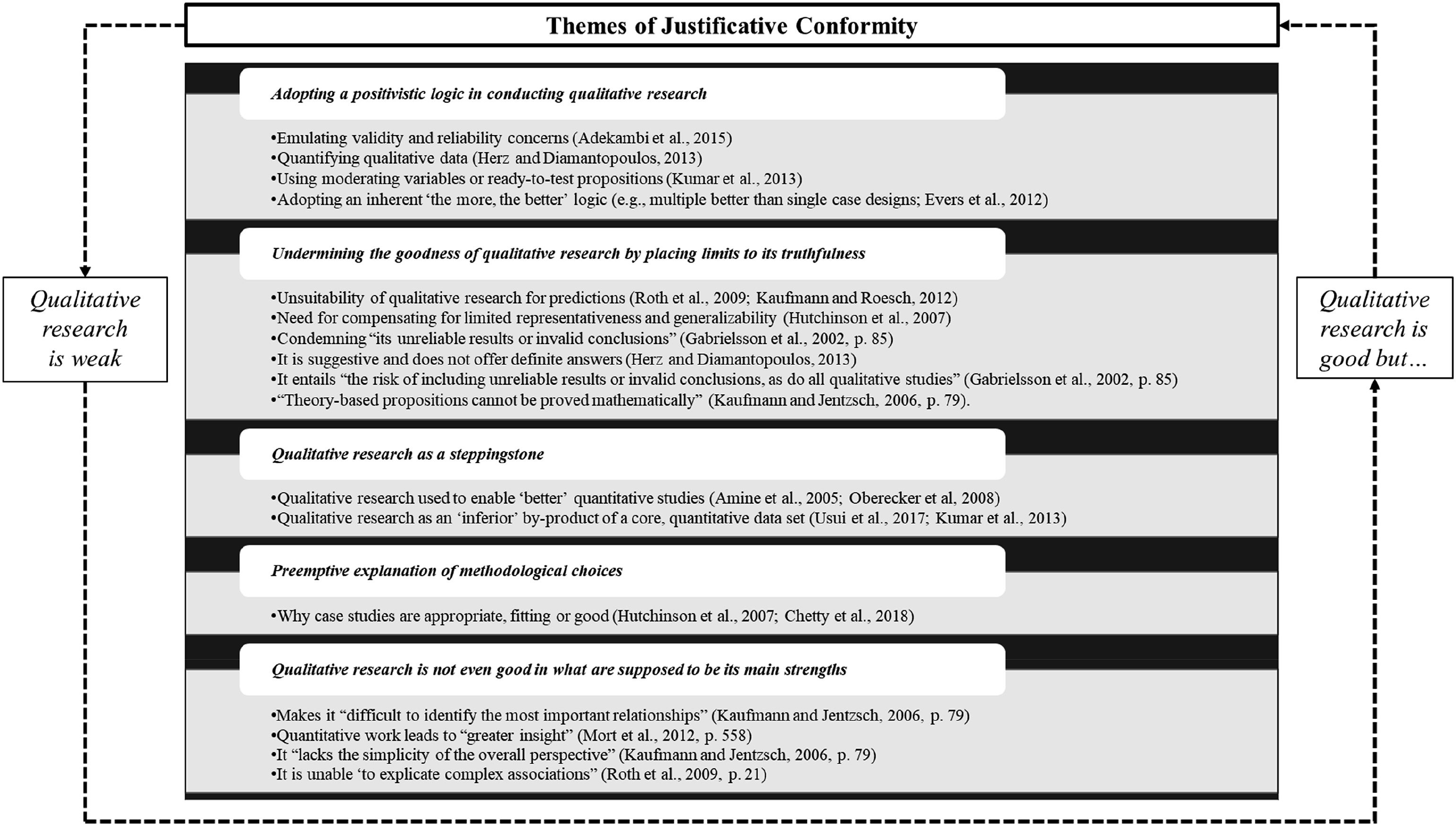
In turn, we frame those categories under two key themes of JC, which we discuss further below: (i) ‘Qualitative research is weak’ (ii) ‘Qualitative research is good but…’.
Figure 1 summarizes findings, which ‘coalesce into a broader framework of meaning’ (Cronin and George, 2020: p. 14) and address our original objectives. Categories and themes were chosen to be parsimonious so that they do ‘not overwhelm the reader’ but simply ‘reduce the emerging framework to its essentials’ while ‘seek [ing] the minimum number of categories’ (Cronin and George, 2020: p. 14). Indeed, this brevity reflects dominant trends in the limited qualitative attempts in the journals (see Table 2, Online Appendix). Given these trends, we did not identify instances of JC in quantitative studies. That is, latter studies proceed to merely describe their choices unapologetically and without a commensurate attempt to justify why.
Therefore, the 94 studies provided us with ample evidence to discuss the status quo in the field’s leading journals (echoing Patsiaouras, 2019; Cronin and George, 2020). Collectively, the overarching impression is threefold: a disproportion of quantitative versus qualitative papers; qualitative papers are characterized by justificative overtones; qualitative papers (circa 10% of total papers) are emulative of specific traditions – positivistic case studies as advocated by Eisenhardt (1989) or Yin (1984) (e.g. Agndal and Chetty, 2007; Spence and Essoussi, 2010; Mort et al., 2012) or, exceptionally, Gioia’s methodology (see Mees-Buss et al., 2020).
Concluding, JC signifies something ‘hidden’ that matters in our scholarship (Cornelissen and Clarke, 2010). Thus, our method echoes Huff’s (2008) ‘sensemaking/sensegiving circle of scholarship’ (p. 4), which evokes a different kind of ‘conversation’ with literature. Our ‘conversation’ promotes problematization through critical evaluation – neither affirmation nor a mere description of the status quo (Cronin and George, 2020). Thus, by sketching impediments to OEM novelty, we contend that non-diverse designs may result in marginally useful knowledge. Given such stumbling block to scholarly creativity, we illuminate JC as a subtle epistemic bias that often escapes our attention.
Presentation of thematic analysis
Compliance with norms that shape and are being shaped by established legacies is the norm in several fields. Conventionality is nurtured by those commitments, and, in turn, those commitments constitute the ‘proper’ way of conducting science. Thus, by stressing JC, we elucidate how conservatism is perpetuated from within. To demonstrate this, we identified a series of examples, which we subsequently sum up in five categories (Figure 1). In turn, these categories help us frame JC, which oscillates between two themes.
Theme 1: Qualitative research is weak
The first theme is that qualitative research is a weak approach, one that studies seem to recognize as weak through certain language. For example, case studies ‘suffer from small sample size and generalizability problems’ (Morgan et al., 2018: p. 81) and a study is ‘limited to’ only four cases (Spence and Essoussi, 2010: p. 1050) that allow generalization ‘with caution’ (Liu, 2017: p. 8). Thus, qualitative research is routinely featured as having limitations reflected in words such as ‘suffer from’, ‘problems’, and ‘limited to only’ or under ‘Limitations’ (see Bianchi, 2009; Brookes and Roper, 2011; Dinnie et al., 2010; Gurau and Ranchhod, 2005). In this sense, qualitative inquiry is not a self-sufficient mode of knowledge production that offers meaningful results in its own right. Rather, it is framed as a mode with inherent weaknesses that should be rectified through further, quantitative studies, which ‘are needed’ (Kontinen and Ojala, 2012: p. 29). As noted ‘[o]ur research has several limitations… Consequently, we would encourage future researchers with large samples and different country settings to test the refined propositions’ (Ahi et al., 2017: p. 16). Similarly, qualitative studies claim that ‘the next step would be to conduct quantitative research to test the developed hypotheses with large data sets to confirm the generalizability of our research findings’ (Usui et al., 2017: p. 16).
Thus, qualitative research is a weakness, and the remedy is more quantitative studies – an opinion shared elsewhere, too (see Petrescu and Lauer, 2017). As a seasoned qualitative researcher would expect, such unfortunate treatment of qualitative studies as ‘weak’ has naturally led to their misappropriation (thus, making its weakness a self-fulfilling prophecy) or appropriation of qualitative research in a purely positivistic logic (thus, perpetuating its inferior status in relation to its ‘better’ counterpart—i.e., quantitative research). Typical positivistic concerns such as ‘validity’ or ‘reliability’ prevail, with qualitative data quantified to enhance a study’s status. For example, via excessive quantification of qualitative data, studies conclude that their ‘unconventional research design implies that our findings should be considered suggestive rather than conclusive’, and therefore ‘replication research is needed to provide a definite answer’ (Herz and Diamantopoulos, 2013: p. 112; emphasis added). Thus, a reader assumes that qualitative research is good to merely ‘suggest’, whereas quantitative studies are able to provide ready-made, ‘definite’ answers.
Overall, an overarching assumption is that quantitative studies are the answer to the ailments of qualitative research. Thus, managers can readily appropriate their findings whereas qualitative studies merely suggest; they are nebulous and inconclusive. Apparently, this truism is based on orientations for verification and proof (i.e. assumptions of Newtonian sciences). In the social world, though, unlike natural systems, such insistence on ‘truth’ (purportedly discovered through quantification) fundamentally ignores the socially constructed, idiographic nature of reality. Regardless of any ‘answer’, there will be a need to translate each research finding to one’s unique context of application. No matter what a quantitative study reports, for practitioners to apply generalised doctrines without a requisite adjustment to their own spatiotemporally confined practical settings would be naive.
After all, when findings are fragmented, contradictory, and inconclusive (see previous sections), what are marketing managers supposed to do? Should they simply apply them because they provide ‘definite answers’? If so, which part should they apply out of the contradictory whole? Nevertheless, a justificative nomenclature promotes this purported superiority of quantification and prevails even among qualitative studies. Consequently, to rectify its shortcomings, qualitative research must emulate the ‘goodness’ and ‘correctness’ of quantitative research by adopting the same criteria for judging its quality (see Online Appendix, Note 1). In this way, we strip qualitative research away from its main strength – namely, its flexibility and adaptability towards discovery, exploration, and refinement (Köhler et al., 2019). Thus, as Köhler et al. assert, we risk transforming qualitative inquiry into one more mechanistic enterprise based on similarly rigid protocols and templates that contravene its nature.
Overall, JC frames qualitative research as a limitation that cannot offer generalizations i.e., the cornerstone of scientific endeavour. As found in our review, the number of cases ‘restricts the findings’ interpretation’, and thus ‘[s]election of a greater number of cases might provide a clearer picture’. Up until then, ‘generalizations that can be made from the research findings are somewhat limited’ (Vasilchenko and Morrish 2011: p. 103 – see Online Appendix, Note 2). Other studies note that ‘[l]imitations in qualitative work include the subjectivity of the researchers, the process of analysis, the quality of the cases, and the inferences drawn. We have made every effort to provide details of the research design and analysis processes, recognizing the desirability of replication with an extended number of cases in other markets and industries to confirm or extend the typology and development of a conceptual framework’ (Freeman and Cavusgil, 2007: p. 30). In a similar vein, another study indicates that ‘the reliability, validity, and generalizability of our findings are difficult to establish because of many ingredients of our work’ – limitations being related to the qualitative nature of their work (Solberg et al., 2006, p. 43; see also Online Appendix, Note 3).
Theme 2: Qualitative research is good but…
Justificative overtones persist even when qualitative research is purportedly good at something. Studies extensively explain why they employ such modes of inquiry precisely because of their ‘goodness’. Indeed, preemptive explanations normally occupy whole paragraphs, apparently in the hope of convincing a ‘hostile’ audience. ‘Case studies are suitable for examining processes, because they explain events, enable researchers to encapsulate the developments over time… and provide rich data about the complexity, context, and behavior associated with firms’ internationalization’. Furthermore, ‘[i]nductive case study research… is an appropriate means for exploring and extending theory about opportunity discovery and creation and their connections, because it reveals their processes’ (Chetty et al., 2018: p. 72, 74). Similar themes emerge across almost all studies, as qualitative research ‘allows the findings to reveal themselves plainly’ or ‘allows for the emergence of new sources of understanding, which reveal unexpected elements of meaning in data collection and analysis’ (Gao et al., 2018: p. 49).
Elsewhere, studies note that ‘[q]ualitative research methodologies can be particularly appropriate in the early stages of an investigation and can be used for the purposes of description… and theory generation… In addition, qualitative approaches help develop rich insights into a topic that may be initially difficult to gain through the use of other research methods’ (Kaufmann and Jentzsch, 2006: p. 61). Such explanations also feature in the ‘Limitations’ section: ‘Although qualitative research promotes knowledge creation… there are also limits of this method that need to be acknowledged. Given the typically large volume of data, case study research can result in theory, which is rich in detail but lacks the simplicity of overall perspective. In addition, it might be difficult to identify the most important relationships because of the lack of quantitative measures, such as regression results…. Similarly, theory-based propositions cannot be proved mathematically’ (ibid, p. 79; emphasis added).
Thus, qualitative research is good at something but not entirely good. It may be adequate to answer, for example, ‘why’ questions, which call for non-quantitative approaches (Fletcher et al., 2013). Yet, even then, ‘empirical measures should be developed for each knowledge category to facilitate quantitative assessment’ (Fletcher et al., 2013: p. 67). Thus, qualitative studies, no matter how good they may be, have a ceiling of ‘goodness’. The goal should be to prepare the backbone of scholarly achievement – that is, quantitative designs. Without quantified empiricism, a study seems quasi-scientific. Apparently, this mathematical formalism is based on a narrow epistemological pursuit: generalization and prediction as the Holy Grails of science whereas deep understanding and idiographic illumination are seen as sub-optimal orientations.
Many studies adopt this logic of the conditional and restricted goodness of qualitative research. ‘[C]ase studies can be prescribed when the research problem requires rich, deep information; yet doing so can still result in significant findings, provided generalizability is not assumed’ (Evers et al., 2012: p. 52). Therefore, even if good aspects of a qualitative design are noted, studies must explain, articulate, and justify them while complementing them with positivistic tools that will rectify their weaknesses (see Online Appendix, Note 4).
Therefore, again, qualitative research is good but not that good. Only verification and proof can transform it into something practically useful. Thus, qualitative research is not performed for its own merits but as a steppingstone for other types of ‘better’ research: ‘Because this article is based on a qualitative study, it is explorative and mainly descriptive. Future confirmative research projects could help establish the normative merits of the theoretical framework and thus increase the potential managerial usefulness’ (Kaufmann and Jentzsch, 2006: p. 79). Contrarily, we could not identify quantitative studies justifying that they used, for example, regression techniques as suitable because they can, for example, explain covariance between selected variables. Requisite studies simply jump in to ‘do’ their regressions.
Therefore, what prevails is a simplistic justification of the appropriateness of qualitative research. For example, qualitative studies are good in exploratory stages in which knowledge is still minimal. As noted, ‘[e]xploratory case studies based on primary data are deemed to be appropriate when the existing knowledge base is poor’ (Hutchinson et al., 2007, p. 102; see also Online Appendix, Note 5). Even when qualitative research is fitting, studies portray it as a limitation, which must be acknowledged and cast as paving the way for something better (i.e. quantitative studies). Namely, ‘future studies should focus on empirical research to validate our findings here’, (Kumar et al., 2013, p. 75); a sentiment shared by other works, too, for example, qualitative approaches are done assuming that findings will be ‘validated by further (quantitative) research’ (Oberecker et al., 2008, p. 50; see also Online Appendix, Note 6).
Such wording takes place when (1) qualitative research routinely produces some of the most significant advances in business fields and (2) praxeological shortcomings of quantitative studies are so convincingly articulated (see Delios, 2017). Thus, new scholars entering the field are indoctrinated into the tautological viewpoint that qualitative research is not as ‘good’ as quantitative research or, epistemologically put, that verification, generalization, proof, prediction, and similar orientations of scientific rationality are more important than grounded illumination and situational richness.
Discussing JC in ontologically ring-fenced fields
Ontology aims to clarify what exists or what is real. ‘Substance’ and ‘processual’ worldviews are the main ontological assumptions in the philosophy of science and appear as the major metaphysical assumptions in business and management studies, too. They have spawned a plethora of studies, albeit in an imbalanced way, with substance-laden studies dominating by large margins (see Jack et al., 2008; Piekkari et al., 2009; Poulis and Poulis, 2018; Welch and Paavilainen-Mäntymäki, 2014; Woermann, 2017). An important aspect of ontology is that it implies certain epistemological commitments, namely, specific modes of knowing afforded by these ontological assumptions. Otherwise, misalignment between latter assumptions and epistemological commitments implies an undue disconnect between ‘what there is’ and ‘how we come to know it’, resulting in flawed theorizing (Poulis and Poulis, 2018). Consequently, the ontological assumptions one begins with are not peripheral areas of concern; they impact one’s theorizing choices, including epistemological and methodological ones.
A question then is: When some fields appear as ontologically ring-fenced (henceforth, ORFs), what does JC therein imply for theorizing? JC is an inevitable compromise, often forced upon scholars who opt to use ‘other’ approaches in research settings that appear to be institutionalized (Corvellec and Hultman, 2014) or politicized (Cluley, 2020). As shown, such studies undermine their craft or preemptively explain their modes of inquiry, often, against their will, and in a hope to convince editors and reviewers about the efficacy of their OEM choices. Thus, in ORFs, a knowledge claim seems legitimate only when non-typical research is re-enacted and domesticated. However, straightjacketing choices to fit normative mantras removes the value of critical modes in the first place. For example, narrative forms of inquiry may be reduced to variables in a quantitative sense, yet their value is associated with the richness and flow of the narrative itself. As a result of JC though and, presumably, to project scientific-ness expected by gatekeepers, quasi-scientific logics prevail. Conversely, studies using mainstream OEM approaches (usually, quantitative ones) simply describe their choices without a need to justify why they made them.
Such imbalanced practices then are often undertaken as a result of a political and not scholarly decision. For example, Tadajewski (2006) shows how social pressures and institutionalized logics (e.g. legacies stemming from the Cold War) ‘delimit what can and cannot be said within marketing theory’ irrespective of the merits of a theorizing approach (p. 165). This tendency to appropriate certain kinds of knowledge while excluding others leads to unfortunate knowledge hierarchies within marketing. These persist without being accompanied by a legitimate rationale; one that may convincingly explain balkanization and stratification of knowledge claims (see Kravets and Varman, 2022). Rather, we have simply learnt to take some things for granted whereas interrogation of the foundational premises of our craft is limited to so-called critical scholars (who often inhabit the periphery of a discipline).
We address this ‘politicking’ of knowledge creation through JC because the distinction between ‘description’ and ‘justification’ stresses the unfair treatment of intended contributions. Essentially, misaligned hierarchies reflect an ethical issue; if ORFs induce JC from the compromises that scholars need to make, a scientific principle may be violated: Marketing research is eventually judged not on its merits but, on its congruence with the known and the familiar (see McQuarrie, 2014; Hunt, 2011; Peattie and Peattie, 2003, for similar concerns). Certainly, the known and the familiar may have merits. Thus, judgement based on congruence is not incompatible with judgement based on merit. Nevertheless, if review outcomes favour congruence over interestingness; fittingness over importance; compliance over creativity or conformity over imaginative leaps then, reviews may be biased. As Poulis and Kastanakis (2020) note ‘[r]aising prior research to divine heights is a useful way to stifle innovation and creative thinking by pretending to “fit a journal’s dialogue,” “talking to key audiences and/or debates in a discipline,” and “perpetuating the tyranny of the extant literature without whose aid nothing new can be discovered”’ (p. 679).
Therefore, if the value of a new perspective is considered through an ORF’s conventions, its review may reflect mere emulation and not genuine assessment (Tadajewski and Jones, 2016). If a new perspective is considered a non-congruent threat that may de-legitimize established approaches, assessment of it may be laden on a safeguarding, defensive mechanism and not an authentically evaluating exercise (Breslin and Gatrell, 2020). Overall, if a study’s ‘value’, ‘quality’, or ‘rigor’ translates as congruence with an established legacy, it becomes less likely for critical approaches to penetrate a field. Indeed, a paper that is misaligned with what gatekeepers strive to maintain, is often discarded as discomforting, threatening, or heretical. Thus, congruence-related concerns during a review process may be fair enough (e.g. honouring and building upon prior work). However, they may also ‘squeeze out work which is provocative, irritating or stylistically demanding’ (Parker and Thomas, 2011: p. 426) no matter how important or interesting it may, in fact, be.
Then, instead of monolithic OEM lenses or politicized approaches, we advocate a parallel critical reconstruction and refinement (see Cluley, 2020; Corvellec and Hultman, 2014; Patsiaouras, 2019). Otherwise, a field is likely to induce JC. In turn, justificative overtones in one’s writing implicitly sustain isomorphic tendencies in scholarly inquiry and, thus, lack of novelty. This is because an employed oeuvre of inferiority subtly facilitates the reproduction of known and familiar norms from within. In a nutshell, the nexus between OEM and JC results in an unfortunate self-fulfilling loop with univocality in ORFs creating a contrived yet tangible barrier to more nuanced theorizing; one that can be circumvented only by convincing gatekeepers about the value of ‘other’ OEM practices.
Why are wider ontologies needed?
We stressed the inextricability of OEM terms – the idea that ontology and epistemology work in tandem – to induce methodological choices. In turn, OEM choices largely determine the practical relevance of our conceptualizations (Patterson and Larsen, 2019). Thus, wider ontologies are needed since, first, an ORF affords a narrow epistemological arsenal to researchers. Second, such narrowness implies less diverse methods that can be meaningfully employed under a consistent ontological and epistemological umbrella. Third, non-diverse methods imply a process of theorizing that must rely on established OEM norms. Thus, critical (or non-conventional, non-mainstream, etc.) studies are likely to use JC to feature in ‘mainstream’ journals. Fourth, such conventional theorizing reduces the possibility for conceptual novelty. Fifth, such incremental advances undermine a field’s praxeological utility.
Hence, ontology is not simply an abstract conceptualization about the nature of reality that may be articulated upfront by scholars. Rather, eventually, it becomes a rigid scholarly commitment that connects with our potential to demonstrate impact through conceptual appeal, importance, and interesting-ness. This does not imply that mainstream approaches (in our case, quantitative ones) are problematic. What we challenge is their unquestionable dominance in ORFs while arguing that other forms of knowledge attainment can also be meaningful. Nevertheless, despite the value of diverse scholarly practices, ORFs seem to be punctuated by, for example, propositional types of knowledge (If/the more x, then/the more y); Humean causality, logical empiricism and correlational designs, which accord with the traditional functional positivism noted earlier; and hypotheses-laden and measurement-oriented designs, as the cornerstone of Newtonian, scientific rationality (Poulis and Kastanakis, 2020; Tadajewski, 2008, 2010). We do not deny that all orientations contribute to a field. Yet, by insisting on a unilateral rampant empiricism, ORFs: • miss out on other types of knowledge (e.g. configurational, perspectival, historical, hermeneutic, and processual; Hunt, 2011; Tadajewski and Jones, 2016; Cluley and Dunne, 2012), which can be also meaningful in unraveling the complexities of marketing practice, • do not recognize inherent limits of methods in terms of what they can legitimately produce as knowledge outcomes (Poulis and Kastanakis, 2020; Tadajewski, 2004), • ignore the crucial role of ethics, subjectivities, and ideologies in the way we craft our research designs while demonstrating a notorious lack of trust in researchers, subjects, and theories (Lowe et al., 2005), • unduly insist on standards of accuracy, timelessness, and proof at the expense of attention to the miniscule, ephemerality, and flow (Cluley, 2020; Poulis, 2020).
Consequently, epistemic hierarchies may emerge because of power struggles, fetishization, or stereotypes (see Tadajewski, 2018; Poulis and Kastanakis, 2020). As a response, this study advances ‘other’ literatures of critical reflexivity and ontological pluralism and does so for two more reasons: First, their value has been proven in very close (e.g. consumer culture theory), adjacent (e.g. organization studies) and distant (e.g., anthropology) fields. Thus, we see no reason why this cannot be the case in international marketing (see below). Second, phenomena such as Brexit, the pandemic or the war in Ukraine make us revisit our assumptions. Global challenges such as inequality and poverty call us to reflect on the relevance of our scholarly toolkit when it comes to questions that matter and how we may answer them. Therefore, macro changes or specific events (e.g. alienation of communities or ecosystems under threat) force us to reconsider our certainties. They force us to see our scholarly arsenal not as fait accompli but as a resource in the making where situated choices may be unapologetically necessary (see also Woermann, 2017).
Critical ontologies and international marketing
We focus on international marketing as a paradigmatic ORF and, subsequently, we promote another onto-epistemological arsenal. To do so though, we first need to understand the reason of ‘ORF-ness’ therein. A likely explanation is a priori assumptions that are ‘automatically’ passed on generationally. Yet, neighbouring fields (e.g. consumer research) have taken a very different trajectory. Thus, we speculate that a reason is ring-fencing by privileged gatekeepers, which affords limited cross-fertilization with advances elsewhere (e.g. philosophy of science, cultural anthropology or critical studies overall).
We stress two examples. First, cultural anthropology has questioned the notion of national culture – the backbone of international marketing – and frames it as an imagined community. For some scholars outside international marketing then, culture is flowing and fleeting; a non-essentialist notion that is non-graspable, at least not through the conventional epistemological tools we have learnt to use in order to theorise. Therefore, its unassailable essentialization in international marketing implies not only conventions that are preserved unquestioningly (e.g. see Hofstede’s dimensions) but also defense against an existential threat to the domain itself. Second, phenomena such as marginalised communities become especially pertinent following regional wars (e.g. in Ukraine, Syria, and Sudan), the pandemic, and waves of refugees because of those unfortunate events. While other fields have considered such drastic events, grand challenges or perma-crises (e.g. via borrowed insights), international marketing has not really followed suit.
As a result of such observations, opinion pieces (e.g. in IB, an adjacent field) begin to recognize that political forces should be further explored within a multi-polar world (often, associated with an anti-positivist stance). As such, international politics, economic geography, and geopolitical perceptions are expected to increase in importance and their exploration might require alternative tools (e.g. qualitative/spatial ones). Thus, fields close to international marketing are predicted to change orientation and (re)connect themselves with, for example, area studies. Nevertheless, while such fields start considering macro, critical, interdisciplinary, or political aspects, international marketing insists on a theorizing and epistemological monoculture where policy implications are limited and a corporate-driven agenda prevails.
The purpose of this paper is not to dictate any thematic agenda to anyone. However, if international marketing sees merit in exploring ‘other’ views (we contend that it should) then, its monolithic treatment of OEM choices will keep aggravating its lack of impact and interesting-ness. Then, herein, we advance ‘alternative’ OEM choices not least because such a shift may help the field address wider concerns that international marketing is inherently linked with (e.g. consumption in transition or exploitation of labour via illegal networks). This can be achieved via psychoanalytic studies among MNC executives or ethnographic studies in international firms that use controversial practices. Therefore, notwithstanding pragmatic challenges, what we advocate is not an extra-ordinary or peculiar task. Rather, such approaches have already proven their value elsewhere (e.g., in IB) and, importantly, they may enable a much-needed cross-fertilization of international marketing with other scholarly foci; a perspective, which currently remains latent or largely unexplored.
For the time being though, international marketing scholarship appears as if it is a big echo chamber; a remark aggravated by peer reviewed processes, which are not good at fairly reviewing non-typical work. This has several implications such as perpetuating conventional wisdom through JC and thus, making ORFs a self-fulfilling prophecy. In turn, the field absorbs minimal insights from scholarly realms outside its own confines making radical advances less possible (Poulis, 2020). Such incremental knowledge creation not only has a limited impact beyond our disciplinary silo but also ring-fencing dictates how new studies are expected to articulate their choices. Since ‘other’ influences are less evident, over-reliance on known toolkits is what we become accustomed to working with.
Certainly, one could argue that a non-essentialist framing of culture is wrong or irrelevant to the field. Yet, aside sporadic exceptions, the main concern is that associated debates are marginalized. If plurality had been the case, then we would have already seen how e.g., drastic events reconfigure global supply chains or levels of demand. Thus, we would be better equipped to respond to, for example, the emerging needs of marginalised communities or understand how supply chains must be adapted to accommodate new market structures. Importantly, we would have already experienced the theorizing leaps that novel tools afford and epitomized in, for example, more processual and less covariance designs; more radical and less incremental advances; more impact of our domain and less repetition of known tools etc. Yet, such outcomes are limited, and this is not only unfortunate; it is also paradoxical. Namely, while one would expect that international marketing would be at a vantage point to discuss challenges such as refugee crises or a pandemic (given their global nature), its ring-fencing is less fitting to shed light on those emerging realities.
Certainly, narrow ontological lenses are found in many fields. However, as noted, we do not see what may justify narrowness in international marketing. Contrarily, the field loses out of its limited diversity and this may explain its contradictory, inconclusive and fragmented findings (Birnik and Bowman, 2007; Poulis, 2020; Schmid and Kotulla, 2011). These are fundamental observations especially because of the adjective ‘international’. Thus, we elaborate further on it since there is a disciplinary oxymoron at play. What does this adjective imply? Supposedly, this ‘international’ dimension of marketing makes ‘things’ of inquiry multifocal, even more complex and entangled. Yet, onto-epistemological traditions and theorizing lenses that are particularly suited to address such complexity are sidelined or ignored in international marketing studies.
In particular, the dominant mode of inquiry is abstracting this complex reality, condensing it into variables, and reducing it even further through representation techniques (e.g. Likert scales or control variables; Poulis et al., 2013). We acknowledge the convenience of doing so and the challenges of collecting data from multi-local environments. However, ontology’s concern cannot ever be a scholar’s ‘analytical convenience’. Rather, ontology’s focus is simple: Reality ‘out there’ and then, promoting epistemological modes, which are aligned to elucidate this reality. By pretending then that we accurately capture concepts such as national culture through, for example, nomothetic regularities, we commit a fundamentally flawed reversal of how scientific inquiry should be conducted. Namely, due to the convenience that abstraction and representational techniques indeed offer, we implicitly assume that the ontology of international marketing is fixed, timeless and thus, prone to reductionism, objectification, and measurement through those techniques. However, epistemological choices can never precede ontology, nor can they impose their logic on the latter. Ontology should be the first concern in order and then, epistemological choices should follow, in a way consistent with the ontological assumptions that we chose to originally embrace.
Then, nuances endemic to international contexts call for a diverse theorizing ‘infrastructure’. Or else, onto-epistemological traditions other than mainstream ones may be suited to address issues of an international nature such as refugee crises, climate change or a pandemic (see Patsiaouras, 2019; Crockett et al., 2013 for similar arguments). Thus, the pluralism we advocate is not promoted for the sake of it. Rather, it is the dynamicity of the ‘international’ nature of marketing or macro changes that call us to see phenomena through different angles, with acute awareness and a renewed scholarly sensitivity. Otherwise, by marginalizing alternative approaches, we risk relying exclusively on pre-existing ‘truths’ or known toolkits that have exacerbated those challenges or left significant topics/themes largely unnoticed in the first place.
Certainly, propositional knowledge, Humean causality, or hypothetico-deductive reasoning per se are in no way ‘wrong’. Overall, there is nothing inherently ‘good’ or ‘bad’ with any approach. As such, our call is not about abandoning them. Yet, we cannot neglect that (i) proof, causality, confirmation and such epistemological mantras are seriously questioned, too (e.g. by process philosophers) nor can we neglect that (ii) complex international phenomena may require situated approaches. In a nutshell, the ontology of international settings may be more complex than what our dominant epistemologies imply.
Then, critical theorizing is needed not least because such studies enrich our knowledge arsenal. Examples of critical refinements include the reconceptualization of marketing as habit creation and the destabilization of inertia (Tadajewski, 2019) or the reconceptualization of the consumer as producer and co-creator of value (Cova et al., 2011). Are ‘other’ approaches inherently ‘good’? As noted, there is no a priori appropriateness of any approach. However, they may be necessary. Alternative views not only do they challenge undue assumptions but also open a plethora of theorizing opportunities. Specifically, in international marketing, such departures are justified by: • The inconclusive and contradictory findings in extant literature. So, why should we insist on onto-epistemological mantras that created this theoretical stagnation and paucity? • Drastic events make us revisit our certainties. So, why should we insist on ‘old’ ways of appropriating ‘knowledge’ while neglecting ones that may shed clearer light on those new realities? • The ‘internationality’ of marketing. So, why should we insist on OEM traditions of ‘distant’ theorizing when faced with multifocal concerns and localized complexities?
What could be such critical approaches? For example, actor-network theory, through its ontological symmetry and openness, challenges the overlooking of the socio-material world and the relational assemblages that surround us (Bajde, 2013). Hence, it can help us understand international marketing activities beyond a priori assumptions (e.g. of global uniformity) and via a more acute lens, that is, to revisit marketing practices as idiosyncratic events, which cannot be stripped away of their localized context. Hermeneutic phenomenology, through its focus on shared schemas of pre-existing meaning, can enable us to understand consumers’ temporal perceptions of marketing practices such as global branding. Hence, it holds promise to explain why, for example, consumer divergences across the world persist. Process philosophy, through its focus on the ‘-ing’ of organizational acts, may shed light on the ephemerality of marketing practices, that is, beyond the timelessness of fixed approaches (e.g. see the standardization/adaptation dualism; Poulis, 2020).
Yet, our design does not allow us to claim whether substance or process ontologies; abstraction or non-representational epistemologies should take centre stage in marketing scholarship. Others have eloquently discussed such issues and we redirect readers therein (Tadajewski, 2010; Hill et al., 2014). Thus, our concerns are not antagonistic to established OEM wisdom; they are complementary. We seek balance and call for all possible ontologies in our domain if these are co-aligned with the rest of one’s (O)EM choices and without a need to justify their usage. The goal is intra-disciplinary legitimization of alternative traditions in ORFs, which enables us to claim a few contributions and put forward two proposals.
Contribution and proposals
First, we conceptualised two new terms (JC and ORFs), which imply ethical issues linked to scholarly publishing. Namely, a nebulous morality around their persistence denotes lack of a level-playing field. We explicitly problematized extant practices while cautioning about the OEM compromises often forced upon ‘other’ studies. This was based on a question: Why do qualitative studies need to justify and explain their choices whereas quantitative ones simply jump in to do their craft? This is an important distinction to make, and we do not see any reason to preserve this status. Our study then sets the scene to remove this undemocratic practice from ORFs; a practice that, as shown, makes our findings less societally relevant and useful. Otherwise, we will keep observing a collective set of ‘facts’ and ‘truths’ that reflect stereotypes or biases of privileged gatekeepers.
Second, JC and ORFs implicitly perpetuate an assumption: Qualitative research is somehow inferior whereas quantitative research offers “answers”. Then, we indoctrinate young scholars and glorify established ones, resulting in suppression of OEM novelty, limited impact, and lack of openness to the world and its emerging challenges. By questioning the marginalization of ‘other’ OEM practices, we hopefully help in reversing this state. Specifically, while non-diversity has been variably critiqued, few studies approach the problem from what we see as the mother of many ills, that is, a study’s ontological assumptions. This work then contributes via a rather rare approach: Challenging monodimensional metaphysics at field level while promoting more inclusive OEM designs.
Third, we join papers that question the credibility of reviewing processes (see Corley and Schinoff, 2017). Therein, it is noted that the arbitrariness of editorial decisions and reviewers’ judgements remains unabated, thus revisiting publishing norms is direly needed. From our perspective, associated problematization is couched in an observation: A certain Newtonian-style ‘scientism’ often drives editorial decisions, which is misaligned with the complexity of social sciences and aggravates concerns about the practical relevance of our thinking. In turn, this raises a fundamental issue: An attempt to accord with doctrines of scientific rationality, equates ‘marketing research’ with ‘market research’. However, we are not market researchers; namely, professionals who depict a supposedly fixed truth and enduring reality through for example, statistical processing. We are also scholars who should push the boundaries of knowledge a bit further and address societal concerns. As such, a certain intellectualism should permeate our work. Here, we contend that this can be meaningfully achieved via diverse OEM practices and without a monodimensional reliance on technical toolkits used in other professions.
Fourth, internationality enabled us to question OEM practices via an emphasis on the unique features of international settings. Even if international marketing is not the only field that ‘suffers’ from JC, internationality is an ontologically challenged domain that calls for dedicated attention. However, given its ring-fencing, associated problematization has rarely taken place. Thus, this is one of the few studies that highlight idiosyncratic concerns related to the field’s OEM conventions and explains why critical theorizing may be needed.
Finally, since we do not wish to flirt with pessimism, we contribute by promoting two modest proposals. First, we suggest scrutiny of potential JC in other marketing journals (Journal of Marketing, JAMS, etc.). This will allow our community to base its self-critique on a thorough review of the field. After all, marketing scholarship may be diverse enough. Yet, if it is not, what does this imply for our theorizing? Isn’t perhaps the time for deeper engagement with advances that have proven their worth elsewhere? This scrutiny is often missing, and JC seems to be evident in several strands of our scholarship.
Second, we suggest a bold effort that requires collective coordination. Namely, we call for analysis of editorial decision letters and reviewers’ comments, which led to rejection of ‘other’ (e.g. critical or qualitative) papers in ORFs. This becomes especially useful in the context of so-called ‘mainstream’ journals and is based on a caveat: Editorial responses and reviewers’ comments are empirical material. Critically analysing them can help us clarify, for example, our field’s onto-epistemological breadth; extant biases of editorial teams; or reviewers’ (un)familiarity with theorizing advances. Moreover, it can help explain the historical roots of ORF-ness in a field or, make power struggles therein more visible. In turn, our community’s reflection upon such findings can help us to, for example, confront ontological/epistemological misalignment in published work or eliminate epistemological compromises as contrived solutions to ontologically messy problems. Yet, this proposal makes sense only if materialized at the collective level and not via stand-alone examples. Thus, we do not portray it as an easy solution. Notwithstanding pragmatic challenges though, such analysis holds promise to elucidate how we tend to theorize, what we choose to take for granted and what we reject as knowledge claims in marketing (see also Gummesson, 2001; Kravets and Varman, 2022; Tadajewski, 2006).
Conclusion
A critical stance is a strenuous exercise. Entrenched perceptions may need to be ‘dethroned’ while showing the utility of a new proposal. Therefore, adding to what is known and trusted is neither easy nor unproblematic. However, JC is not the answer. Rather, it is part of the problem that perpetuates itself. Moreover, enacting new scholarly practices is neither anathema nor a blessing. Its value depends on the requisite skills of those who attempt it, and gatekeepers’ receptiveness to novelty and change. Otherwise, following unreflective introduction of new OEM approaches or via blind attachment of gatekeepers to disciplinary norms, scholars are left with an unhelpful meaning void. This study highlights why those voids must be problematized, and only if they are problematic in the first place.
To conclude, being critical implies something at a field’s periphery that attracts those courageous enough to voice their concerns. Thus, a sense of ‘bravery’ is often needed, notwithstanding any theorizing skills. But the need to be brave in a democratic process such as scholarly publishing is unfortunate. Hence, depending on a field’s ORF-ness, being critical often emerges as a scholarly duty. Otherwise, by maintaining an ORF unwaveringly, gatekeepers nurture scholars who are disinclined to appreciate novelty. In turn, recommendations will stem from conventional wisdom, whereas interesting or important advances may be marginalized. Thus, we join calls for polymorphic, less formulaic research (Alvesson et al., 2017; Breslin and Gatrell, 2020; Poulis and Kastanakis, 2020) in the hope that diverse OEM approaches will begin characterizing the ORFs that need them the most.
Supplemental Material
Supplemental Material - Justificative conformity in ontologically ring-fenced fields: Problematizing the scholarly nomenclature in qualitative studies
Supplemental Material for Justificative conformity in ontologically ring-fenced fields: Problematizing the scholarly nomenclature in qualitative studies by Konstantinos Poulis and Ioannis Christodoulou in Marketing Theory.
Footnotes
Declaration of conflicting interests
The author(s) declared no potential conflicts of interest with respect to the research, authorship, and/or publication of this article.
Funding
The author(s) received no financial support for the research, authorship, and/or publication of this article.

Supplemental Material
Supplemental material for this article is available online.
References
Supplementary Material
Please find the following supplemental material available below.
For Open Access articles published under a Creative Commons License, all supplemental material carries the same license as the article it is associated with.
For non-Open Access articles published, all supplemental material carries a non-exclusive license, and permission requests for re-use of supplemental material or any part of supplemental material shall be sent directly to the copyright owner as specified in the copyright notice associated with the article.
