




Abstract
This article explores the relationship between algorithmic personalization and brand loyalty by examining how personalization experiences are articulated within the context of music streaming consumption. Despite previous acknowledgement of the link between personalization and brand loyalty, an experientially grounded understanding of how this works has yet to be articulated. Building upon the concept of ‘experiential brand loyalty’, the Algorithmic Personalization/Depersonalization Loop highlights the development of brand loyalty through consumers’ interactions with algorithm-backed brands. Being seen and understood by the algorithm sets off an iterative, two-way learning relationship that ultimately heightens the consumers’ experience, activates positive emotions, and deepens the relational bond with the brand, leading to brand loyalty. If, however, the algorithm is unsuccessful in personalizing the service experience, a ‘depersonalization’ process can occur that erodes brand loyalty and can lead to brand switching or even consumer activism.
Introduction
The rise of digital technologies, particularly artificial intelligence (AI), has accelerated the pace of personalized consumer experiences (Pine 2018) in an increasingly wide range of products from online retail channels to content streaming platforms. Previous work examining the human–AI interface within marketing has theorized AI algorithms as non-human actors that actively shape consumer culture (Airoldi, 2021a) by mediating between marketer interests and control and consumer preferences and resistance (Airoldi and Rokka, 2022). Others have highlighted its potential as a medium for consumers to extend the self and shape their identities via digital platforms (Belk, 2013). Recognizing the potential of AI, many brands have developed automated, personalized systems across the customer journey to optimize tasks like content curation, data analytics, segmentation, and audience targeting (Gkikas and Theodoridis, 2022). Such personalization has been found to increase perceived service quality, customer satisfaction, customer trust, and ultimately brand loyalty towards a service provider (Coelho and Henseler, 2012; Ball et al., 2006). However, as Hoyer et al. (2020) note, we still have little theory that explains consumers’ perceptions, interactions, and experiences of brand loyalty in an AI environment.
Brand loyalty has typically been conceptualized as repeated purchases over time (Uncles et al., 2003) or attitudes that lead to committed relationships (Oliver, 1999). As these views have come under criticism for their inability to provide an understanding of the lived experience of the consumer (Fournier and Yao, 1997), more recent work on experiential loyalty (Obiegbu et al., 2019) has repositioned brand loyalty within an experiential landscape by accounting for the place of affect, emotions, and meanings. Thus, the notion of experiential loyalty is an important enabling theory through which we can better understand both the nature of and process by which brand loyalty ensues from positive AI-backed personalization experiences.
Drawing on an empirical study, this article therefore theorizes how AI-driven personalized services shape experiential brand loyalty. In doing this, we account not only for personalization but also the depersonalization that can be experienced when the algorithm ‘gets it wrong’. We explain how consumers navigate the personalization/depersonalization interplay, focusing on their resulting loyalty to the brand.
This paper utilizes and builds upon Puntoni et al. (2020) consumer AI experience framework, specifically by elaborating the relationship between the predictive capability of AI and the corresponding consumer experience of classification. Although AI-powered personalized recommendations have been acknowledged to produce positive outcomes of feeling understood and affirming the self (Puntoni et al., 2020), incorrect classifications can have the opposite effect of leaving consumers feeling misunderstood (De Bruyn et al., 2020). However, little is known about what happens after feeling understood, or indeed misunderstood, and how brand loyalty is impacted.
The empirical context of this study is the consumption of music streaming services, such as Spotify and Apple Music. These provide on-demand access to millions of songs either free for a basic version or on a subscription basis for more advert-free features. The vast amount of digital music content available to consumers provides convenience but can make the process of finding new music challenging (Webster et al., 2016). To meet the needs of consumers in this regard, music streaming services have developed automated, personalized recommendation services (e.g. Spotify’s ‘Discover Weekly’ and Apple Music’s ‘Favourites Mix’), which algorithmically curate content on behalf of consumers. The personal and intimate nature of music consumption (Prey, 2018) provides an ideal context to explore personalization and brand loyalty from the consumers’ perspective.
We proceed by exploring the brand loyalty literature and the use of personalization algorithms in service, particularly by music streaming services. Subsequently, an interpretive, qualitative enquiry is conducted. By focusing on experiential brand loyalty, the study adds depth and nuance to the understanding of personalized consumer–brand interactions. Finally, the managerial and theoretical implications of this study for personalization and brand loyalty are outlined.
Experiential brand loyalty
Brand loyalty, as the firm intention on the part of the consumer to repatronize a brand regardless of opposing competitive market forces (Oliver, 1999), has long held a central place in marketing theory and practice (Odin et al., 2001; Uncles et al., 2003; Dick and Basu, 1994; Tucker, 1964). Although there is no consensus on a definition, brand loyalty is usually conceptualized in behavioural or attitudinal terms. Behavioural loyalty refers to the repeat purchase of a brand over time (Uncles et al., 2003). Attitudinal loyalty highlights the expression of positive preferences, commitment, and attachment to the brand without necessarily taking purchase behaviour into account (Odin et al., 2001). These approaches are limited in their ability to provide an understanding of the consumer’s lived experience of brand loyalty (Fournier and Yao, 1997). More recently, an experientially driven understanding of brand loyalty has been developed, which highlights the emotional, symbolic, meaning-based, and active engagements that drive and underpin sustained loyal behaviour (Obiegbu et al., 2019). Experiential loyalty is viewed through the consumer’s constructed and negotiated meanings in any given brand context. It is these situated meanings and emotions with regards to personalization of streaming services that this paper examines.
One of the central foundations for experiential brand loyalty in marketing theory is the consumer–brand relationship (Fournier, 1998), which is built on the premise that brands have human-like qualities and can be seen as viable relationship partners. From this perspective, brands play a proactive role in driving the exchange process and evoking loyal-like feelings. This process is driven by anthropomorphization, through which brands are vitalized and given human-like qualities (Brown, 1991). Due to advances in algorithms, brands can act and think in response to the consumer (Arons et al., 2014) through personalization. This evolution in the means of personalization warrants examination of how the brand–consumer relationship and, by extension, brand loyalty is being recalibrated.
Personalization and music consumption
The customer relationship strategy of one-to-one marketing, which emphasizes tailoring aspects of the consumers’ experience with the brand, has brought the notion of personalized interactions with consumers to some prominence within marketing (Peppers and Rogers, 1999). Personalization entails a specialized form of product differentiation in which a solution is adapted to meet the needs of a specific individual (Hanson, 1999). Customization, on the other hand, combines mass customization of products with customized marketing (Wind and Rangaswamy, 2001).
Though initially driven by prospects of improving profitability and competitive advantage (Pine, 1993), more recent use of big data combined with advances in data processing and storage has exponentially increased the possibilities of customization and personalization. Firms can collect vast amounts of information about individual customers and use the information for specific segmentation needs, thus making mass customization realizable (Rust and Huang, 2014).
As a distinct form of information technology, AI is used to augment or replace human actors in the service process and thus drive innovation. AI can be described as machines that display aspects of Human Intelligence. AI may possess the ability to learn, connect, and adapt (Huang and Rust, 2021) and, accordingly, is increasingly used in services to engage customers at different levels and various stages of the service process (Rust and Huang, 2014). Relying heavily on thinking intelligence, big data, and machine learning, personalization is one avenue through which deeper consumer relationships are being forged.
Previous work within the emerging field that examines the human–AI interface in marketing research has considered the role of algorithms in actively shaping consumer culture (Airoldi, 2021b). For instance, Airoldi and Rokka (2022) consider the algorithmic mediation of consumer culture by theorizing algorithms as ‘non-human intermediaries’ that through repeated recursive iterations of indicative action by the consumer and algorithmic learning response, ‘articulate’ consumer culture. This provides a usefully holistic view of the role of algorithmic systems in the production and consumption of culture. However, further consumer-focused experiential research that explains how this process unfolds over time and shapes the ongoing relationship with the brand is needed.
This paper utilizes and builds on Puntoni et al. (2020) consumer AI experience framework, which highlights, on one hand, the technical capabilities of AI and on the other hand the consumers’ experience of those capabilities in their interactions with AI-backed brands. This reveals the symbolic and affective facets of these capabilities in addition to their functional affordances. These capabilities are as follows: ‘listening’ which consumers experience as data capture, for instance, giving data to AI using wearable devices; ‘predicting’, which is experienced as classification, for instance, receiving AI’s personalized predictions; ‘producing’, which consumers experience as delegation such as when AI performs tasks for the consumer; and ‘communicating’, which is experienced as social interaction with AI. The authors draw on relevant macro narratives from the field of sociology and micro-level real-world experience grounded in psychology to illustrate the tensions between experience in use and technical capabilities of AI. However as noted by Cukier (2021), the experiences captured by Puntoni et al. (2020) tend to rely on extreme scenarios drawn from a range of contexts and may not give the truest reflection of the experiences of most users of AI. Further studies that reflect situated experiences of consumers interacting with AI in day-to-day service and real-world contexts and outcomes of these interactions have thus been encouraged.
This study focuses on a specific aspect of Puntoni et al.’s (2020) framework –predictive capability and classification experience. Puntoni et al. note that classification experiences can lead to positive outcomes of feeling understood, affirmation of the self, or fulfilment of identity motives. However, perceived incorrect or biased classification assignments can also lead to feeling misunderstood. Questions remain about how these tensions play out. For instance, how do consumers respond to feeling understood or misunderstood? How is the relationship with the brand impacted? What actions do consumers take to counter poor or incorrect algorithmic predictions in the management of identity and how does the process unfold over time? Our research expands on previous work by providing clarity, fleshing out the personalization process more fully, and teasing out meaning as experienced within a specific brand context.
A key aspect of personalization is the use of previously collected or real-time information about the customer, upon which the exchange between both parties is altered to reflect or anticipate the identified needs of the consumer (Vesanen, 2007). Critiques have highlighted the uneven focus on the commercial implications of algorithms at the expense of nuanced exploration of how consumers ‘engage with and negotiate the algorithms that seek to “know” them through data’ (Kant, 2020: 7).
In the context of music streaming services, personalization is employed to provide automated recommendations which search out content for the consumer. Recommendation systems draw on the massive volume, velocity, and variety of data amassed from the music listening habits of consumers online (Webster et al., 2016). Streaming services use implicit feedback data, that is, data derived from the users’ behaviour and interactions with the system (Lerche, 2016) and collaborative filtering which makes recommendations to users based on the interests of similar users (Prey, 2018). This information can be extracted from navigation or transaction logs about which songs are played, skipped, shared, or added to playlists. Implicit feedback also considers the times and locations of activity and the devices used when listening to music (Hamilton, 2019). This allows for recommendations that consider contextual conditions that may influence the listeners’ preference, such as mood or location (Braunhofer et al., 2013).
Predictive music-based recommender systems are however not free of critique. Hesmondhalgh and Meier (2018) suggest that attempts at monetizing predictive capabilities powered by collecting and observing user data may facilitate and reinforce the commercialization of culture, for example, by artists and record labels using insights to cater to what audiences want to hear, or what they think audiences want to hear, rather than being driven by purely artistic intentions. Further, contrary to being neutral channels for music content, algorithmized streaming recommendation systems may reproduce inequalities that exist in the offline world. As systems that are ‘coded, run and maintained by human beings’ (Tofalvy and Koltai, 2021:6), recommendation algorithms ‘rely on and reinforce ideas about human and machine capacities in relation to music’ (Goldschmitt and Seaver, 2019:65). For instance, algorithmic systems tend to favour already popular artists by producing a feedback loop (e.g. through collaborative filtering) where already popular songs and artists are more frequently recommended than those of lesser-known artists.
Nonetheless, music streaming consumption makes for an interesting context to examine personalization from the consumers’ perspective because of the nature of music as a cultural product. The receptive practices of consumers to cultural products such as music on digital platforms may differ from other types of purchases, for example, product brands, since cultural brands serve as resources for consumers to direct their investment of affect and reveal their ‘mattering maps’, tastes, and meanings through their consumption choices (Grossberg, 1992). As algorithms play an increasingly significant role in shaping and orienting the tastes of cultural consumers through recommendations (Airoldi, 2021a), this study joins a limited but growing body of work (Airoldi, 2021b; Airoldi et al., 2016; Goldberg et al., 2016) that examines AI-backed, platform-based interactions between users and cultural content in the context of digital consumption. As the study focuses solely on the music product, and music-based platforms (Spotify and Apple Music), generalizability of the findings must be considered against that backdrop.
Methods
This study explores the relationship between AI-driven personalized service and brand loyalty as experienced and understood by the consumer in the context of contemporary music consumption, particularly music streaming services. A qualitative interpretive approach was ideal for generating rich insights into the consumers’ experiences with personalization. Emphasis was placed on unlimited, emergent descriptions as music consumers made sense of personalized services in contrast to the supply-side quantitative focus of previous studies (e.g. Ball et al., 2006; Coelho and Henseler, 2012), which while identifying a link are unable to flesh out the experience and meanings that underpin the relationship between personalization and brand loyalty.
Data were collected using two methods: Interviews and online ethnography. Depth interviews were conducted with 25 informants who were initially recruited using a purposive sampling method (Merriam, 2009). Participants were recruited on the basis that they currently, or very recently, used personalized algorithmic playlists on a music streaming service and had posted messages on Apple and Spotify online community boards. All respondents used either Spotify or Apple Music, which is unsurprising given that these are among the two most used streaming services on the market (Statista, 2020). Fourteen participants were subscribed to Spotify’s premium services, while six were on the free tier. Apple Music does not offer a free tier for its service. Both platforms offer some form of personalized service, with Spotify offering personalized playlists, like Discover Weekly and Release Radar on both free and premium options, and Apple music offering a personalized, weekly Favourites Mix. Snowball sampling (Bryman, 2015) was also used to recruit interviewees. At the end of the interviews, participants were asked to suggest other participants who fit the criteria for the study. A majority of participants (60%) were male. This is roughly in line with the demographic profile of music streamers, of whom 45% are female and 55% are male (Statista, 2020). The names of participants have been changed to protect their anonymity.
The interviews were structured into three parts. The first part focused on how participants listened to music before taking up streaming, particularly the formats used, quality, and the motivation for transitioning to streaming services. The second part was designed to yield an understanding of personalization, exploring how participants experience and use personalized services, how it structures their music listening, and what it means to informants. The final part probed how personalized services shaped the evolving relationship with the streaming service. Interviews lasted from 40 min to 1.2 h. All interviews were conducted via Skype or Zoom. Audio recordings were transcribed verbatim for analysis.
Following the interviews, data were also collected from the Spotify and Apple Music communities using online ethnography. This involved the use of ‘observation ethnography’ (Bainbridge, 2007) or ‘lurking’ (Kozinets, 2002) which is the static examination of online data without interaction with forum members. Both sites consist of message boards that anyone with an internet connection can access. Participants interact by choosing, reading, and responding to posts in the form of questions or statements left by other users. Data collection began with an initial read-through of the large number of posts made between April 2015, when services that employ personalization algorithms were first introduced on Spotify, and December 2020. Notes were made of what was observed and where.
A second read-through focused on threads and exchanges that referred to algorithms or specific personalized playlists. The aim was to achieve depth in analysing how personalization was talked about within both communities. The downloaded threads comprised 12,000 words from a combination of nine threads and individual posts from both communities. Each thread had anywhere from 10 to over 400 participants depending on the duration and participants’ interest in the topic under discussion.
Spiggle’s (1994) procedures for the analysis and interpretation of qualitative data in consumer research were followed. First, units of data that seemed to be representative of a general phenomenon related to personalization were labelled accordingly. In this sense, the ‘coherent meaning’ – the ability of the unit of data to stand on its own – was considered. Building on these categorizations, empirically grounded categories were then related to concepts derived from the literature. At this stage, unexpected categories were seen as opportunities to broaden existing preconceptions or conceive new ones (Miles and Huberman, 1984). Strauss and Glaser’s (1967) constant comparative method was undertaken to consolidate minor categories, by exploring differences and similarities across incidents within the data. In this way, attributes and properties of identified categories were fleshed out from the data. The properties represented conceptual dimensions that highlight varying manifestations of the categories or repertoires identified (Spiggle, 1994).
Findings
The analysis revealed that experiential brand loyalty due to algorithmic enhanced personalization unfolds in three key stages. In the first stage, successful experiences with the algorithm lead to the consumer feeling seen and understood by the brand. The feeling of being understood serves as an initial basis for the consumer to seek out even better interactions with the brand in the second stage, by training the algorithm to improve its recommendations and deliver on their preferences. Consumers do this by refining their taste through datasets. In the third and final stage, consistent exchanges between the algorithm and the consumer lead to an affective cycle that heightens the consumers’ experience and the relational bond with the brand, leading to experiential brand loyalty. If, however, the algorithm is unsuccessful in personalizing the service experience, a ‘depersonalization’ process can erode brand loyalty and lead to brand switching or even consumer activism. These themes are explored in detail below.
The feeling of being understood
An initial outcome of introducing algorithms to service is that the consumer feels seen by the brand. Spotify started introducing algorithm-driven services in 2015, while Apple Music followed suit a year later. Where experiences with such services were perceived to be successful, participants expressed delight at being intimately understood. I have really enjoyed using Spotify, especially Discover Weekly. It really made me feel seen, the first-time recommendations came through. Somehow it knew my music taste probably better than I did myself (Maddie 32, Interview).
Maddie, recalling the first time she used a Discover Weekly playlist on Spotify, views the ability of the algorithm to pinpoint her music tastes and preferences as evidence of being ‘seen’. By comparing the service positively to her own knowledge, she drives home the depth of its accuracy in understanding her tastes. I find it creepy (in a good way) that Spotify knows me so well. It’s like receiving a gift from someone who knows me and knows my tastes but is not afraid to surprise me with something unexpected (Moe 21, Interview).
Moe compares the algorithmic service to a gift from a close friend who understands his taste and knows him well enough to suggest ‘something unexpected’ (e.g. an unfamiliar song). The feeling of being understood entails a person wanting others to grasp: ‘their needs, abilities, traits, beliefs and preferences’ (Reis et al., 2017:1). When people feel understood by others, they believe that person ‘gets them’ in some fundamental way and tend to feel psychologically connected to that person (Reis et al., 2017:1).
Simply by buying or subscribing to its services, the consumer is engaged in some form of relationship with the brand. However, the feeling of being seen and understood provides the basis for a more intimate relational bond and an experiential type of loyalty. Being understood functions by building trust and establishing a connection that goes beyond mere exchange or delivery of the service. It activates positive affect (Laros and Steenkamp, 2005) through emotions like excitement, passion, gratitude, and even love, and demonstrates an effort on the part of the brand to engage with the consumer as a segment of one, as can be seen in the quote below.
I’ve already left positive feedback here, but this week’s playlist made me come back to leave more. This is going to sound cheesy as hell but it makes me want to thank the person who put it together for me, even though I know it’s all algorithms and analytics (Padma, 2015; Spotify Community).
By experiencing themselves as ‘known’ by the brand, consumers also display a willingness to develop and refine the relationship, as seen in the next stage. While previous research has acknowledged the role of AI in leading consumers to feel deeply understood (e.g. Puntoni et al., 2020), the implications for the consumer–brand relationship dynamic have rarely been explored.
One outcome of being understood is the endorsement of identity by the other party (Swann, 2011). People prefer to have others see them as they want to be seen. This confirms the sense of self and assures the consumer that they are whom they believe they are. To feel like the other person ‘gets you’ is to feel validated in your tastes and preferences. This takes on greater significance when considered in relation to the music product. Music can be an important symbolic resource in the construction of personal identities (Larsen et al., 2010). It is well established within consumer research that consumers use brands as resources for constructing and expressing the self (Fournier, 1998; McCracken, 1986). Consumers draw on cultural meanings as they engage in relationships with brands that help them live their lives (Fournier and Alvarez, 2019). Inherent in this view, however, is the assumption that the consumer is the only active party, picking up and putting down brands as desired in their self-constructive projects. Fournier (1998) employs the notion of anthropomorphization as a metaphor for brands as active relationship partners. However, this was limited by the inability of brands to ‘think or feel – except through the activities of the manager that administers it’ (Hoffman and Novak 2018: 28). Personalization algorithms, as used by streaming services, do, however, give brands the ability to respond to consumers in a way that has not previously been possible – as agentic partners with the consumer in the construction of identity and in the consumer–brand relationship. By learning and reflecting the tastes and preferences of consumers, algorithms partake in a shared understanding of the consumers’ tastes. Personalized algorithms thus play an active role in the cultivation of the aggregate self (Belk, 2013) of the listener.
The interaction between algorithm-assisted streaming services and the consumer raises questions about the current role of brands in identity projects. From participants in this study, brands can be seen as active partners. The autonomy of algorithms as decision-making entities allows brands to take on a more life-like and responsive appearance than current research on brand-person identity connections provides for. The songs it recommends are not perfect all the time. Sometimes it gets it wrong, and I see some songs that I feel should not be there, but the ones it gets right can hit with such potency that I don’t mind ignoring the off track here and there (Joseph 28, Interview).
Recommendations based on algorithmic machine learning may not always be accurate. Sometimes, recommended playlists may include songs that users do not feel accurately reflect their tastes. I tend to listen to music from my daily playlists in the morning as I prepare and head to work and in the evening. The music I listen to varies in terms of genre and tempo. I have an eclectic taste and I mix it up a lot, though sometimes I can get hooked on a particular genre for several days in a row. I usually don’t see this reflected in Discover Weekly. Each week I receive the same boring songs that do not reflect my broad taste in music (Jared, 35 Interview).
Jared’s frustration with his personalized playlist can, on one level, be seen to stem from the inability of the service to automatically deliver the type of music that typically fuels his daily routine. DeNora (2013) has previously highlighted the role of music in attaining, enhancing, and maintaining desired moods, feelings, and bodily energy. Consumers use music to amplify or change their emotions, identity, and state of being. The inability of the personalized algorithms to reflect these nuances of temporality and register the tastes of an eclectic and highly knowledgeable consumer can lead to negative emotions and frustration. On the other end of the spectrum, Jared feels misunderstood because of the inaccuracy of the algorithm in reflecting his tastes and mirroring his identity (Puntoni et al., 2020). The resulting implications of poor experiences with personalization will be drawn out in the next two sections.
Training the algorithm
The sense of being understood enforces for the consumer the reality of a two-way process with a responsive other – the Spotify/Apple Music algorithm. Against this backdrop, in the second stage, consumers attempt to deepen and further develop the relationship with the brand, or correct wrong assumptions by training the algorithm so that it better understands and responds to their needs and preferences. Consumer actions at this stage are aimed at gaining some control over the quality of recommendations, refining results, establishing boundaries, or correcting wrong recommendations. With the use of algorithms in the service process, discovery becomes less about searching or hearing about a new song from a friend and more about defining favourable datasets. In recent weeks I have been deliberately going out of my way to listen to more classic rock to change the theme of my playlists. I like a lot of the recommendations I receive, but I have been getting into AC/DC, Led Zeppelin, and Guns N′ Roses. I have yet to have any rock show up in my Discover playlists, but hopefully, that changes soon (Daniel, 32, Interview).
Daniel refers to his deliberate efforts to alter the theme of his weekly recommendations to reflect a genre of music he has recently started listening to. There is an assumption that the frequency with which he listens to the desired genre will positively impact the outcome of recommendations. His claim of ownership (‘my’ Discover playlists) highlights the investment of self in the process. Kirk et al. (2015) note that as consumers successfully appropriate technology, they develop feelings of psychological ownership, not just with respect to the digital technology itself (the medium) but also with the people, brands, and products that they communicate with through the medium, in this case, the playlist. The attempts to alter the recommended playlist can thus be seen as an attempt to build a more complete and reflective aggregate ‘extended self’ in a digital world (Belk, 2013), as well as self-expansion (Carpenter and Spottswood, 2013) to the extent that algorithms allow consumers to veer into musical territories they had not thought to explore on their own.
Putting effort into ‘training’ Spotify to understand my esoteric tastes have borne fruit (Zane, 2017, Spotify Community).
Whenever I hear a song I really like, I always add it to one of my playlists, or I try to skip songs I don’t like to get better reads on Discover Weekly (Moe, 21, Interview).
Zane highlights the investment of effort over time to refine the recommendations he receives. The attempt by Moe to take control of his experience with the algorithm can be seen as an example of individual appropriation (Kirk et al., 2015) or self-design (Franke and Schreier, 2010). As consumers interact with digital technologies such as music streaming services, they may make efforts to take control of such services in ways that have subjective relevance for them in the virtual environment. Self-design can be viewed as a tool that allows consumers to enhance or create value for themselves by pursuing their need for control or aesthetic appreciation using resources provided by the service provider, such as design toolkits and customizable interfaces (Kirk et al., 2015). By deliberately choosing which songs they like or skip, consumers attempt to teach the algorithm to ensure it produces recommendations aligned with their taste. Here, the consumer infers a relationship between these actions and the outcome of recommendations and utilizes them strategically to maintain or achieve desired recommendations.
The actions of consumers at this stage represent an understanding of the brand as an active and responsive partner. The investment of effort functions as a building block for experiential loyalty. It demonstrates a commitment on the part of the consumer to not just remain in but also to improve the relationship. The investment of self in this process constitutes the ‘stickiness’ that experientially loyal behaviour is made of. It amounts to two parties (consumer and algorithm) working together to nurture a more meaningful and robust relationship and service experience.
Some participants expressed an explicit desire for tools or buttons within the user interface for influencing recommendations.
I love the personal playlists, though sometimes I also wish they were a couple of knobs available to tweak things a bit. But I guess not knowing what to expect is also part of the appeal (Chizi, 22, Interview).
This desire for control was even more pronounced when participants felt dissatisfied with the algorithmic playlists.
When I initially started using Discover Weekly, it was great. I loved the results and couldn’t believe how accurate they were sometimes. But then I came across the sleep category and started listening to quiet piano, deep sleep etc., at night to fall asleep. Obviously, since I am asleep for over six hours every day, the system thinks I like that genre of music even though I have no real interest in it….. It would be great if I could reset the whole thing (Mya, 25, Interview).
The disconnect between Mya’s preferred style of music and the recommendations she receives reflects the inability of the algorithm to differentiate between active music consumption and the more passive use of music such as background noise when asleep. The desire for control is likely to be stronger when recommendations do not align with the consumer’s perceived sense of self. In that sense, training the algorithm is a means of correcting behaviour that might negatively impact the relationship. They do this by taking strategic steps using known or inferred tools and variables on the platform (increased listening to desired genres, skipping songs they do not like, adding songs they like to playlists etc.) to arrive at desirable recommendations.
Algorithmic personalization and loyalty
In the third and final stage, the interactive relationship developed between the algorithm-backed brand and the consumer leads to experiential loyalty that is anchored in identity and the strong affective, relational bonds.
Interviewer: Do you think your Discover weekly playlist is enough reason to remain with Spotify for the foreseeable future?
Liz 25: For me, discover weekly gives me that sense that within the vast universe of music out there, there is this little corner that is meant just for me; it is the unique result of all my listening quirks, at least as Spotify sees it. Even though it is not always accurate, for me, it is something to hold on to and maintain.
Liz describes the unique, personalized nature of her Discover Weekly playlist, a direct result of her ongoing interaction with the algorithm as a ‘little corner meant for her’ and the product of her unique consumption activity, thus highlighting the underpinning role of identity in strengthening personalization attempts and linking personalization to ongoing loyal behaviour.
I’ve been using Spotify since 2013. I’ve tried all the other streaming apps. There was a time Apple and Tidal offered three months free, so I tried them, but I always come back to Spotify. I think it’s because there was just that connection, and although it came later, the personal playlists are a big part of that. I like when I am listening to a song I like, and it goes right into other songs that capture the same feel. Also, the year-end top tracks and analysis that are based on my listening throughout the year. It’s like a story of my life in music, going back to listen and look at those from year to year (Craig, 20, Interview).
Craig highlights some of the functional benefits of algorithms as a basis for a ‘connection’ with the brand that keeps him coming back. Through personalized algorithms, streaming services can root themselves affectively within consumers’ lives. Pine (2018) describes this as a ‘learning relationship’, which grows and deepens over time as the consumer and the algorithm interact. The more the brand learns, the better it gets at customizing its recommendations to each customer, and the more the consumer benefits from and desires to remain in the relationship.
Drawing on experiential and meaning-based dimensions of consumption, Obiegbu et al. (2019: 262) posited that experiential loyalty denotes a highly engaged and intense form of consumption. They note that an experientially loyal consumer is ‘one who is sufficiently invested in a brand to find personal symbolic meanings in the act of consuming that brand and engaging around those meanings, individually or within the context of communities of similarly engaged consumers in the pursuit of identity projects’. The application of algorithms in personalizing the service experience heightens or creates personal symbolic value in the relationship with the consumer. Algorithms play an essential role in deepening the emotional bandwidth of the relationship, thus enabling a unique and personal experience between the consumer and the streaming service that is grounded in identity and the consumer–brand relationship, resulting in ongoing loyal behaviour.
Personalization was also highlighted as an added-value element, which in addition to other features keep consumers engaged with the brand.
Personal playlists are good, but it can really be a mixed bag sometimes. There are always some gems, but half the tracks on my weekly Discover usually miss the mark. I think as part of a complete package, it makes it harder for me to consider using another service. Spotify is easy to use and navigate. It’s user friendly……..Also, because I already have a lot of created playlists, going back years, It would be difficult to leave all that and start new with another provider (Jemma 21, Interview).
Jemma highlights the role of personalization algorithms as just one of an ensemble of features that keep her using the brand. Participants who had invested time and energy in establishing a base for their music consumption within a particular streaming platform were driven to remain on that platform rather than deal with the inconvenience of re-creating their experience somewhere else. Participants were also drawn to the functionality of platforms they had learnt to use over time. The familiarity with the user interface, intuitive sense of how things work, navigation, knowledge of kinks etc., were highlighted as reasons to remain on the same streaming service. Sinclair and Tinson (2017:6) noted similar findings in examining how experiences of ownership are articulated through music streaming in a post-ownership economy.
The depersonalization process
Algorithms are not always successful at personalizing the service experience. As noted earlier in the analysis, recommendations may sometimes include songs that do not align with consumers’ tastes or capture nuanced usage patterns. Failed attempts at personalization play out in several ways. Firstly, poor outcomes may lead to negative emotions such as frustration and anger, particularly for consumers who are invested in the process.
I am so frustrated and sick of having ludicrous suggestions pushed at me that it almost makes me want to cancel Spotify altogether (Spotify Community, Jana, 2019).
Jana’s frustration stems from the disconnect between the recommendations she receives and what she perceives her true preferences to be. Algorithmic personalization encounters that were initially successful may also ultimately stop delivering satisfactory results to consumers. This could be due to the algorithm giving recommendations that become too predictable or that fail to capture nuances of consumption patterns. This can destabilize consumer–brand bonds that resulted from personalization and trigger the contradictory process of depersonalization.
My radio algorithm now seems to work like an echo chamber and has made me detest some of my most beloved songs and honestly consider if it’s worth continuing to pay for premium. I feel like half of the listening features that I used to enjoy (playlist radios, Spotify radios, daily mixes, other personalized Spotify playlists) ALL PLAY THE SAME 50 SONGS NOW. I have a song library of over 3000 liked songs and I am constantly exploring new artists and genres, but this seems to have zero effect on the algorithm. I think this is because the more Spotify plays the 50 songs it thinks I love, the more listens they get, so the more it plays them. This is not sustainable (Spotify Community, Freddie, 2019).
Freddie compares his current experience with the algorithm to an echo chamber, a notion similar to Pariser’s (2012) ‘filter bubble’ – a form of isolation that can result from personalization algorithms when consumers get locked-into recommendations or content that are meant to be indicative of their tastes and preferences but may also prevent them from exploring beyond those preferences. He notes that the same predictable recommendation offerings have replaced previously enjoyable experiences. However, the key trigger for Freddie’s depersonalized experience is not simply the limited range of recommendations but rather the perceived broken link between himself and the algorithm. Despite his efforts at indicating and communicating his broad interests to the algorithm (by curating/liking a library of over 3000 songs) and purposefully exploring diverse artists from different genres (to guide the algorithm), he keeps receiving the same 50 songs. This perceived disconnect, non-responsiveness, and inability of the algorithm to continue to be ‘trained’ indicate to Freddie that there is a breakdown in the relationship and are the key triggers for depersonalization.
The clinical definition of depersonalization from the field of psychiatry is insightful here. They define depersonalization as an ‘alteration in the perception or experience of the self so that one feels detached from one’s mental processes or body’ (Sierra and Berrios, 2000: 155). To the extent that a personalized offering can be seen as an extension (Belk, 2013), or expansion (Carpenter and Spottswood, 2013), of the self in a digital world, the perceived non-responsiveness of the algorithm can be seen to sever the link to the version of self that is offered up by the service, as it ceases to reflect their tastes accurately.
How someone responds to this depersonalization depends, to some extent, on how central algorithmic personalization features are to the consumer’s enjoyment of the service. They may, for example, choose to switch brands, remain as neutral users of the regular/depersonalized service, or even voice their discontent and frustrations in varying ways.
I have been a premium Spotify subscriber Since 2016. There are things that I love about Spotify and all of my many playlists are there, so I don’t want to leave, but I’m definitely thinking about it! I’ve been struggling with how to explain why I’ve felt so upset with Spotify lately and it’s because I’m basically having to work really hard to make playlists on my own because I can’t just depend on my recommendations anymore. I want to find new music and be able to love this music service again! That was the whole reason I preferred it to any other service, it was sooo easy to find new music. I don’t think I’m left with much choice than to switch service providers if nothing changes. From what I hear YouTube Music has a much better prediction/radio service (Danni, Spotify Community, 2020).
After highlighting that she pays a premium for the Spotify service against using the free tier, Danni makes a reflective evaluation of her experience with the service. She indicates that although various features attract her to the service, for instance, its role as a base for her music consumption (her many playlists), her primary reason for using the service is its algorithmic recommendation function, which is key to her music discovery. She describes a time in the past when she ‘loved’ this service because of the ease with which the algorithm allowed her to discover new music, essentially linking that heightened, experiential state with the personalized algorithm. However, in her current depersonalized state, a more functional relationship emerges, and love has been replaced by frustration at having to perform tasks she could previously depend on the algorithm to do. The centrality of the algorithmic function to her music discovery and overall enjoyment of the service thus forces her to consider other brands where she can relive a properly functioning personalized experience. A user for whom this personalized feature is not paramount, however, may be content to continue with Spotify, less its personalized function, and will see no need to consider switching to an alternative brand. This sentiment is also echoed by Boni in the quote below.
I’ve had Spotify for some time now and loved when I would find a new song/artist/genre and then click on ‘song radio/artist radio’ and discover similar songs. It helped me explore and expand my knowledge of music. But now I can’t do that. It’s the same 12 songs when I click on a rapper, for the love of God, death grips are NOT like MF DOOM (RIP). Please have an option in settings to turn off the algorithm. I’ve been contemplating cancelling my premium (Boni, Spotify Community, 2016).
While acknowledging that personalization efforts could be improved, some users take a broader view of the performance of algorithms by situating it within the context of the stage of development of the supporting technology.
We are just at the early stages of recommendation algorithms that YouTube, Google, Facebook and the other online giants are bringing out. Spotify is no exception. Believe, me it will get a lot better. I would give it another few years or so and you probably will be scratching your head as to (‘how Spotify knew what I was thinking!':-). Trust me, it will get that smart (Jazz, Spotify Community, 2018).
Jazz explains away the limitations of algorithms by attributing them to the early stage of development of the technology, suggesting that personalization recommendations will improve not just for Spotify but for other services that deploy algorithms, as the technology that supports it gets better. Users like Jazz are also less likely to switch brands because of failed attempts at personalization.
The algorithmic personalization/depersonalization loop
This section synthesizes the empirical findings by offering a framework that links insights from our understanding of algorithmic-driven personalization on AI-backed platforms with the consumer–brand relationship. In doing so, we draw on the notion of experiential loyalty as an ever-evolving response and negotiation between the perceived alignment of the consumers’ sense of identity, self, and taste, with algorithmic personalized offerings.
Specifically, we conceive personalization-driven experiential loyalty as operating in a ‘loop’ that recognizes the interconnected process of response to positive and negative personalization experiences and the ongoing process of training/decoding the algorithm. This framework highlights how consumers negotiate personalized algorithmic readings, meanings, and suggestions while also refining or ‘articulating’ (Airoldi and Rokka, 2022) their preferences by taking strategic steps using known or inferred tools to train the algorithm – for example, skipping songs in a genre they do not like, or adding songs of a style they want more recommendations in to a playlist.
Through the iterative interactions between the consumer and personalization algorithms, positive experiences are re-enforced, with each successful iteration recursively strengthening the consumer–brand relationship and accepted meanings and interpretations. Negative personalization experiences on the other hand are corrected or managed by training/decoding the algorithm. However, where this fails, experiential bonds may not ensue or a depersonalization effect that erodes existing loyalty may result.
We argue that the personalization loop is valuable for understanding how algorithmic personalization affects the ongoing relationship with the underlying brand. First, it provides a holistic view of AI-backed personalization on service platforms by capturing the full range of processes of consumer reception and resulting response to positive and negative personalization experiences through which brand loyalty ensues. Secondly, it recognizes the dialectical exchange between algorithm-backed brand and consumer, through which the consumers’ identity project is managed and negotiated. In this sense, algorithms operate as responsive intermediaries, on one hand putting up an interpretation of the consumers’ behaviour on the platform, and on the other hand, responding to feedback and real time input to provide outputs more aligned with the consumers’ expectations. Through this ‘recursive’ process (Beer, 2013: 78), personalization works to strengthen situated meaning for the consumer and experiential loyalty. As illustrated in Figure 1, however, perceived non-responsiveness of the algorithm to corrective training/decoding attempts could lead to the perception of a broken algorithmic link which erodes the effects of personalization. Algorithmic personalization/depersonalization loop.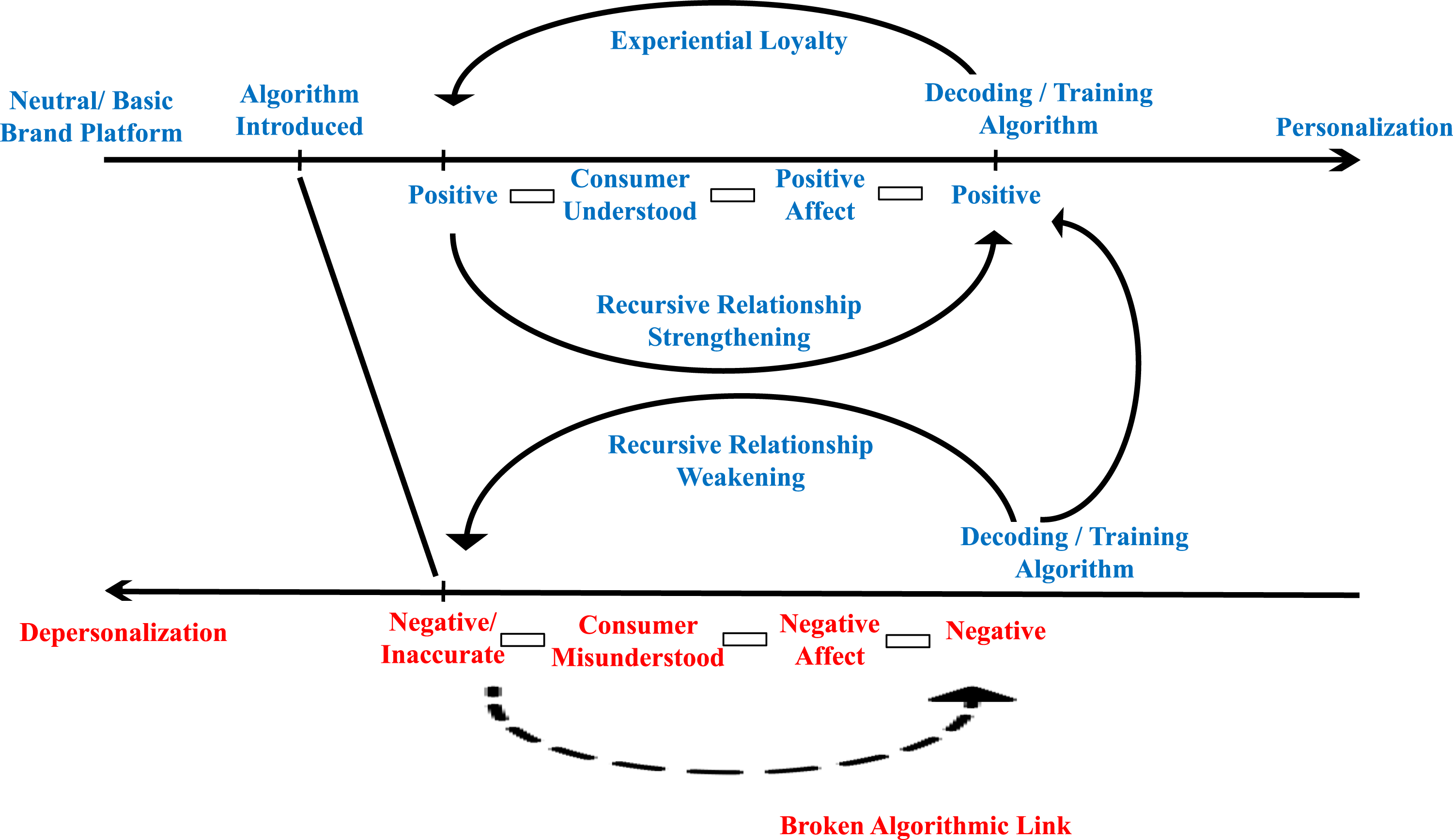
For example, after a consumer signs on as a subscriber, the Spotify algorithm processes the users’ activity, for example, through analysis of the audio characteristics of tracks consistently listened to and collaborative filtering (Prey, 2018). Based on the algorithms’ learning, a taste profile is created and a personalized browse section, playlists, and auto play features are presented. If the user sees these as a good representation of his music taste, positive affect may result. Ongoing effort may be made to finetune or maintain the profile through strategic listening activity, and with each recursive loop, the brand–consumer relationship and experiential loyalty are strengthened. However, a perceived misaligned or inaccurate prediction triggers negative affect. The user may make effort to decode/train the algorithm to better reflect his taste in personalized content. Where repeated corrective effort fails, the algorithmic link or sense of a two-way exchange is broken.
Discussion
The starting point of this study was the ambiguity in current knowledge regarding the implications of positive and negative AI-backed, platform-based, personalization attempts for the underlying brand, particularly regarding brand loyalty. Our study delivers empirical evidence from the consumer’s lived perspective on the workings of AI-backed personalization and provides implications for theory.
Previous research on brand loyalty has highlighted experiential loyalty as a heightened expression that goes beyond measurable purchase metrics (behaviours) and attitudinal preference to encompass personal symbolic meanings anchored in identity or community that underpin deeper levels of love, passion, commitment, and even fandom on the part of the consumer towards the brand (Obiegbu et al., 2019). This study provides empirical evidence of one way through which consumers may move from a basic, functional brand loyal relationship to a heightened experiential state, through the introduction of AI personalization in the service interface and the underpinning processes that facilitates this move. The Algorithmic Personalization/Depersonalization loop captures the role of algorithmic personalization systems and infrastructures in cultivating affect grounded in the consumers’ sense of identity and self, within the brand platform which then serves to strengthen experiential loyalty bonds. It reveals the personalization process as it unfolds through time, from the consumers’ initial encounter or its introduction in the service interface and plays out as a negotiation between positive personalization outcomes and the ability of the consumer to improve or train the algorithm to correct negative recommendations. Where this two-way exchange is responsive, positive experiential outcomes are recursively reinforced and strengthened through time and vice versa. This intensifies the relational bond between the consumer and the underlying brand, effectively moving consumption from passive and transactional to meaningful and engaged. Algorithmic systems transform the brand into a target for affect by situating mattering maps (Grossberg, 1992) – investments portfolios vitalized with meaning that organize their emotional and narrative lives and identities – within the service/consumption activity. The clarification of this previously vague process makes an important contribution to the field of brand loyalty by revealing the mechanisms behind the previously established link (Coelho and Henseler, 2012; Ball et al., 2006) between algorithmic personalization and brand loyalty.
From a theoretical perspective, this study also continues in the tradition of a still limited number of studies within the brand loyalty research field (Fournier, 1998; Fournier and Yao, 1997) that utilize interpretive work to draw out the meanings that underpin loyal behaviour by tapping into the experience of the consumer.
Secondly, we contribute to the literature on AI-backed personalization by showing how consumers respond to feeling misunderstood and what actions they take to counter poor or misaligned predictions. Findings in this study reaffirm existing knowledge that incorrect classifications can have the effect of leaving consumers feeling misunderstood (De Bruyn et al., 2020; Puntoni et al., 2020). However, the current findings advance theory by highlighting how consumers manage and navigate these negative personalization experiences – by trying to decode and train the algorithm through strategic use of known or inferred tools and variables on the platform. Where this fails consistently, consumer–brand bonds on the basis of personalization may not ensue, or are recursively weakened, leading to depersonalization. Thus, we highlight that experiential loyalty as a result of the introduction of AI personalization algorithms is not always a given and should not be taken for granted. A key point to note here is that the consumer can respond to this in many ways, none of which would benefit the brand. The least problematic response is that consumers may continue using the depersonalized service but in a functional way, that at best, could be understood as a behavioural form of loyalty. Any emotional commitment to the brand has been lost. Consumers may switch to another brand that is perceived to offer the potential for a personalized service. The most problematic response for a brand is if the consumer is so dissatisfied or angry that they engage in some form of activism against the brand. The data shows that, at the very least, some consumers express their discontent with a depersonalized service on community Internet boards. But it is quite conceivable that consumers might engage in other forms of activism directed explicitly at the brand (Harrison et al., 2005) or against broader cultural and ideological issues (Kozinets and Handelman 2004) related to the sector.
This study also contributes to critical algorithmic studies (Hesmondalgh and Meir, 2018) by highlighting the impact of socio-technical limitations of recommender systems as experienced by the consumer. For instance, we find at least some evidence that supports critiques of recommender systems regarding (in)equality that stems from a popularity bias. By recommending an increasingly limited range of popular songs, the discovery or novelty value of algorithm-backed personalization may become undermined, thus limiting the possibility for people to engage with a wide range of artists, many from under-represented geographies, genres, and/or social identities. Not only does this uphold existing structures, privileges, and invisibilities in the music sector, it also has an economic impact on the more diverse range of artists whose music is left out. Given the increasing power music streaming platforms now hold within the music industry ecosystem relative to artists/creators and consumers, the lack of clarity around their strategies as implemented by algorithms for promoting certain songs over others is problematic. This opacity and the lack of content diversity go hand-in-hand and contribute to denying consumers the benefit of a more diverse palette (Born et al., 2021). Where previous studies have investigated and identified this issue on streaming platforms (e.g. Tofalvy and Koltai, 2021) this study highlights the frustrating effect on consumers and potential to induce depersonalization.
Algorithms are fallible and are limited by their ability to capture the nuances of temporality and more complex usage patterns (Prey, 2018). There is never a guarantee that the consumer is who the algorithm thinks is being reflected. When algorithms are unsuccessful in predicting the tastes and preferences of consumers, they can lead to consumers feeling misunderstood, erode trust in the brand, and cause frustration at the failed personalization attempt. As such, algorithms can have as deleterious an effect as they can have a positive one. In practical terms, this highlights the need for firms to reflect thoroughly on the deployment of algorithms in service. In deciding to utilize algorithms, consideration should be given to the nature of the service, categories of consumers, and the likely effectiveness or accuracy of the algorithm. For example, long-standing consumers who are more familiar with a particular service may be less likely to change brands because of poor recommendations than new consumers who are sampling or trying a service out for the first time. Algorithmic recommendations may be less critical to a casual Netflix subscriber who is open to watching whatever comes up on his feed than to a hardcore music listener who depends on his Spotify subscription to discover new music. The use of algorithms should therefore depend on a careful weighing of their effectiveness in relation to the group in focus.
Limitations and future research
In this paper, we have presented and argued for the algorithmic personalization/depersonalization loop which advances theory by highlighting how consumers navigate positive and negative personalization experiences and the effect on brand loyalty. The findings offer several implications for future research on AI-backed personalization and brand loyalty. This study has mostly focused on responses from an iteration of AI that operates in the background and uses machine learning to analyse consumer listening behaviour and pinpoint pattern recognition. However, as AI technology evolves at a rapid pace, there has been a move towards more humanized systems that are personable and better able to interact with humans in a natural and intuitive manner (Herman, 2022). Digital Assistants, service robots, and chatbots like ChatGPT (Generative Pre-trained Transformer) and Bard deploy human-like qualities, for instance, generating responses in vocal or text-based speech, emotion-sensing capabilities, speech recognition, and natural language understanding that bridge the gap between humans and machines (Shau, 2023). These capabilities are being integrated into the service interface in hopes of improving the consumer experience and making AI systems feel more like warm and helpful humans and less like cold computer programs. For instance, building on the capabilities of humanized generative AI, Spotify has recently introduced its ‘AI DJ’ feature, an AI-voiced personalized guide that provides commentary between its curated line-up of songs to explain what the user is listening to, highlighting the increasing complexity of AI-based recommendations on service-based platforms. We presume that humanized AI would further deepen the perception of a human-like relationship with the AI-backed brand, and thus amplify the effects – both positive and negative – of personalization on experiential brand loyalty. However, further research is needed to investigate the impact of humanized AI-based features and advances, for example, commentary and generated text responses, on personalization and the consumer–brand bond. Do the enhanced anthropomorphizing affordances of humanized AI move the needle by strengthening or limiting aspects of the personalized effect or the consumer’s journey through the personalization/depersonalization loop, for instance, soften the blow of a negative reading or delay depersonalization? Further research in relation to personalization is needed as AI continues to evolve.
The personalization/depersonalization model provides a basic understanding of the relationship between AI-backed personalization and brand loyalty on digital interfaces but has not delved into the nuances of how responses might differ by product, brand, service type, consumer group, or time. For instance, we cannot say with certainty how long positive personalized responses might last, or how long consumers might persist in training the algorithm before going into a depersonalized state. However, the evolving fundamentals of the underlying technology may play a role in this process. For instance, as AI systems become more humanized, precise, and accurate at discerning and responding to consumer tastes and preferences through learning and training, instances of depersonalized responses might become more of a rare occurrence. However, this could also mean that when cases of inaccurate predictions or misclassification of the consumer do occur, they carry greater weight in the mind of the consumer in terms of negative consequences on identity and brand loyalty. Further research that teases out these details is welcome. Research that examines and extends the model in other sectors and service contexts, for example, in relation to non-cultural brands/products would also be useful. What is personalized service for different types of services? Are there personalized threshold points or more nuanced ways personalization attempts can fail? More precise, context-based understanding is needed.
Footnotes
Declaration of conflicting interests
The author(s) declared no potential conflicts of interest with respect to the research, authorship, and/or publication of this article.
Funding
The author(s) received no financial support for the research, authorship, and/or publication of this article.
