




Abstract
This study explores how a platform enables social media influencers to promulgate a consumption ideology. We show how gun influencers, or “gunfluencers,” use Instagram to link products, activities, and meanings to Second Amendment ideology—a gun-centric belief system in the United States colloquially known as “2A ideology.” Through a qualitative study of 25 Instagram gunfluencers, we identify a process of curating a consumption ideology wherein social media influencers employ four curatorial tactics: glamourizing, demystifying, victimizing, and tribalizing. Findings suggest gunfluencers extend audiences and leverage algorithms to prescribe and model how supporters of 2A ideology should look, act, speak, feel, and consume. Our research contributes to understanding how consumption ideologies are promulgated in a digital, platformized world. In the context of U.S. gun culture, implications address the role of platformization in supporting gun companies’ promotional efforts, despite government- and platform-based restrictions, and the political dimensions of influencer and consumer cultures.
Keywords
In 2018, U.S. pro-gun activist Kaitlin Bennett posed for a college graduation photo on the Kent State University campus with a provocative prop: an AR-10 rifle (see Figure 1). Her graduation cap was adorned with the phrase “come and take it,” a rallying cry of pro-gun activists who oppose bans on firearms and firearm parts (Howell, 2009). Bennett posted the photo on Twitter where it went viral, garnering over 27,000 likes and over 10,000 retweets, attracting news media attention, and catapulting the “Kent State gun girl” into internet fame, which she leveraged into pro-gun merchandise sales and paid speaking engagements. The post was fascinating, in part, because it implicated an ideology—a coherent system of beliefs—colloquially known as “2A ideology,” which values gun rights above other constitutional and civic rights (Boine et al., 2020), and which spurs social, cultural, and political controversy. Amid rising levels of gun death and injury, discourse related to firearms in the United States is politically charged and often polarizing (Cullen, 2019; Winkler, 2011). On the one hand, Bennett’s post drew ire from many who believe U.S. firearm restrictions, including those related to “assault weapons,” such as Bennett’s, are inadequate. On the other hand, the post was celebrated by those whose existing beliefs in 2A ideology were praised and validated. In communicating how to effectively demonstrate 2A ideology in specific consumption behaviors, the post helped to define a related ideology of consumption—a specific set of meanings ascribed to and conveyed through products and consumption activities (Hirschman, 1988). That is, the image appears to point viewers toward a set of consumption activities—owning a modern sporting rifle, accessorizing the firearm, openly carrying firearms on campus, depicting a rallying cry on one’s attire, and coordinating an attractive outfit—that bring to life 2A ideology. Kaitlin Bennett’s “Kent State Gun Girl” post via Twitter.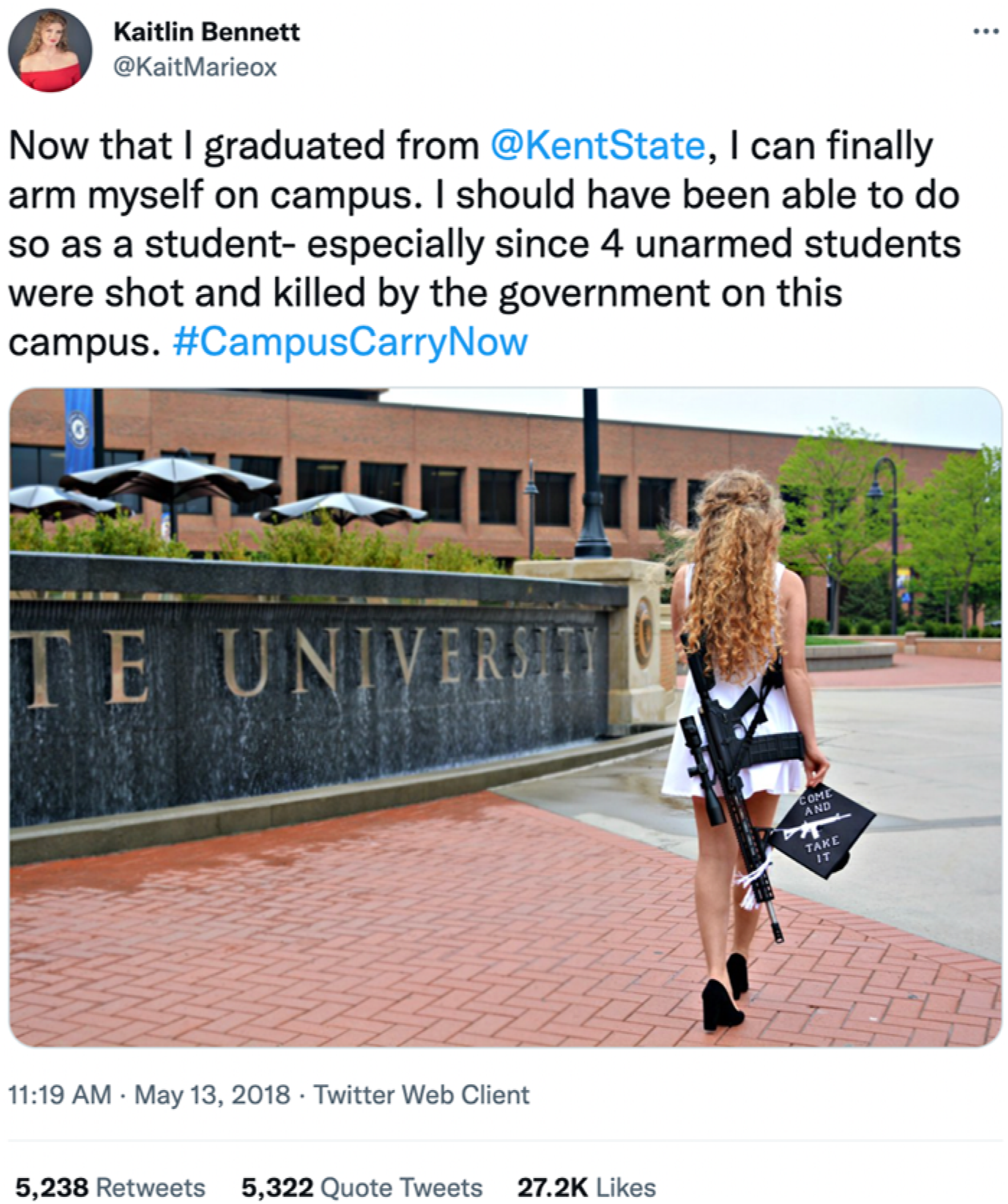
Owing to the potential harm from firearms’ use and related public concern, most social media platforms, including Twitter, Instagram, and TikTok, restrict the promotion of weapons and weapon accessories. However, gun-related promotional content is widespread online (Jordan et al., 2020) where “the proliferation of sexy, young, gun-brandishing [social media] influencers,” dubbed “gunfluencers,” have embraced the role of flag-bearers for 2A ideology (Light, 2021: 912). Gunfluencers’ explicit and enthusiastic pro-gun content—both paid and unpaid—introduces questions about how social media influencers use platforms to develop and promote a consumption ideology, defined as the set of consumer practices and products guided by an overarching set of beliefs and values. 1
Digital platforms have reconfigured mediated dynamics by bringing together consumers, producers, customers, suppliers, advertisers, and policy makers (Gillespie, 2010). This rise of digital platforms as the dominant infrastructural and economic model of the social web is known as platformization, and it is “fundamentally affecting the operations of the cultural industries” (Nieborg and Poell, 2018: 4276). Platformization is defined as “the penetration of infrastructures, economic processes and governmental frameworks of digital platforms in different economic sectors and spheres of life, as well as the reorganization of cultural practices and imaginations around these platforms” (Poell et al., 2019: 1). Put simply: platformization captures the platform-readiness of people, products, and policies (Helmond, 2015).
On platforms, social media influencers often operate in the liminal space between merely sharing personal preferences and peddling promotions for monetary gain. Previous research captures how social media influencers enable the platformization of ideologies of consumption of creative offerings (e.g., beauty, music, fashion, Poell et al., 2021), yet little is known about their role in producing and promoting ideologies of consumption based on controversial beliefs and in the context of restrictions on promotion. Discussion and content related to many controversial forms of consumption (e.g., vaping, Daniel et al., 2018; plastic surgery, Gupta et al., 2020) flourishes on platforms. In these contexts, the role of influencers is more critical because brands face increased promotional restrictions, thus making it an important topic for marketing research. Further, when viewed from a contemporary perspective, work on various forms of consumption communities over the last 30 years (Cova et al., 2007; Kozinets, 1999; Muniz and O’Guinn, 2001; Schouten and McAlexander, 1995) that insightfully describes aspects of ideologies of consumption also raises questions about how today’s platforms are used to generate these consumption ideologies. Contributing to an emergent stream of research on the digital platformization of consumer culture (Airoldi, 2021), the purpose of our research is to explore how social media influencers use platforms to produce and promote a consumption ideology. Specifically, we ask, how do gunfluencers use platforms to tie meanings, products, and activities to a controversial set of beliefs and values (e.g., 2A ideology) to produce and promote a consumption ideology?
To explore this question, we turn to the context of contemporary U.S. gun culture, which is a nation-wide, consumption-oriented phenomenon characterized by gun ownership, routinized consumer practices, ideological beliefs, social formations, market forces, regulatory policies, and politics (Boine et al., 2020). The cornerstone of U.S. gun culture is the U.S. Constitution’s Second Amendment (ratified in 1791): “A well regulated Militia, being necessary to the security of a free State, the right of the people to keep and bear Arms, shall not be infringed” (U.S. Const. Amend. II). The Second Amendment (2A) is often interpreted as an entitlement for individuals to consume firearms and practice armed self-defense (Barnhart et al., 2023). Early observations of U.S. gun culture noted its adherence to the “notion that the people’s right to bear arms is the greatest protection of their individual rights and a firm safeguard of democracy” (Hofstadter, 1970: n.p.). More recent studies have identified “2A ideology” as a hallmark of one of three U.S. gun subcultures (Boine et al., 2020). Our study examines how gunfluencers use platforms to cultivate a coherent set of consumption practices and products associated with this gun-centric ideology.
Our paper begins by conceptualizing platformization with a focus on influencers and ideologies. We then review the evolution of U.S. gun culture and describe our qualitative research study of 25 prominent gunfluencers on Instagram. Next, we present our findings, which outline the process of curating a consumption ideology: the ways that influencers use platforms and employ cultural resources to produce and promote the 2A consumption ideology. Our empirical findings identify four curatorial tactics in the process: glamourizing, demystifying, victimizing, and tribalizing. Finally, we conclude with our contributions and directions for future research on the platformization of consumer culture, specifically related to ideologies of consumption.
Platformization, ideology, and influencers
Platformization has been likened to industrialization or electrification because it is a complex process of transformation within globalized societies (Poell et al., 2019) that influences market structures, forms of governance, infrastructures, and activities of producers and consumers (Duffy et al., 2019). We conceptualize platformization as the process of creating, leveraging, or extending digital ecosystems in ways that mediate cultural systems and industries and (re)organize related cultural practices. As an evolving and dynamic process driven by human and nonhuman actors, platformization has been represented as a tree—a complex structure with hierarchical and interdependent layers (Van Dijck, 2021). By enabling both technological connections and data flows, platformization entails both “a platform’s outwards extension into other websites, platforms, and apps, as well as inwards extension, with third-party integrations that operate within the boundaries of the core platform” (Nieborg and Helmond, 2019: 202). It is underpinned by market arrangements, infrastructures, and governance, and through platformization, cultural practices can become more entangled with commercial logics (Duffy et al., 2019).
The production, distribution, and circulation of cultural content (e.g., fashion, beauty) has become increasingly platform-dependent (Nieborg and Poell, 2018). Research suggests that influencers subscribe to or resist consumption ideologies through their engagement on platforms (Schmitt et al., 2022). Influencers play a central role in mediating meaning on platforms and act as ideological intermediaries with increasing convergence between platforms and politics (Arnesson, 2023). Platforms are not neutral conduits in this process, but they are also not inherently powerful. They act as “matchmakers” (Evans and Schmalensee, 2016) that interface between “two sided” or “multi sided” markets (Nieborg and Poell, 2018). This raises questions about the role of influencers and their platforms in developing a consumer ideology grounded in political beliefs and values.
Stuart Hall defines ideology as “the mental frameworks–the languages, the concepts, categories, imagery of thought, and the systems of representation–which different classes and social groups deploy in order to make sense of, define, figure out and render intelligible the way society works” (Griffin, 2012: 344). Thus, by encapsulating the ideas, values, and beliefs that exist within society and frame an individual’s worldview, ideology has important consequences for the shaping of broader social arrangements. Platforms are valuable vehicles for ideological discourse (García-Sánchez et al., 2021), constituting an arena across which social actors “struggle for recognition and attention, try to organize consent to their ideologies, and seek to influence how people think and behave” (Mirrlees, 2019: 28). And, as prominent sites of political expression and engagement (Ferrucci et al., 2020), platforms provide space for ideological tensions to play out (Bock and Figueroa, 2018).
Understanding the nature of influence within networks is crucial for understanding the functioning of ideology across platforms—specifically who possesses influence in and across platformed networks (Gruzd and Wellman, 2014) and how the harnessing of mass self-communication can influence the choices and actions of others (Castells, 2011). Influencers are “professional, independent, content creators working on social media platforms across genres” (Bishop, 2021: 1), most often in exchange for compensation (Campbell and Farrell, 2020). Today, influencer labor is widely recognized as central to the production of platform content; in addition, influencers play a powerful role in dominating and shaping conversations online, including normalizing extremism and spurring radicalization processes (e.g., 4chan and the alt-right, Colley and Moore, 2022). Accordingly, there are calls for research to examine the networked and algorithmic mediation of ideologies across consumer culture (Rokka, 2021). We respond to this by examining how social media influencers use platforms to produce and promote a consumption ideology, specifically in the context of U.S. gun culture.
Second amendment ideology in U.S. gun culture
Gun-related ideologies are situated within a broader network of gun-related meanings, practices, beliefs, norms, policies, rights, and perspectives on problems that are understood as “gun culture” (Altheimer and Boswell, 2012; Barnhart et al., 2023; Brennan et al., 1993; Hofstadter, 1970; Witkowski, 2014). In recent years, as the United States’ relationship with guns has evolved, scholars have identified different gun subcultures, each with a distinct and coherent set of beliefs and values. These subcultures include collectors, “preppers, 2 ” and subsistence hunters (Blithe and Lanterman, 2022; Witkowski, 2020), as well as three predominant subcultures—recreation, self-defense, and “2A”—that are germane to our study. We chronicle these next.
The recreation subculture is focused on hunting and target shooting. The ideology of this long-standing subculture centers traditional American values of self-sufficiency, individualism, and rural life (Cook and Ludwig, 1996; Lizotte et al., 1981; Witkowski, 2020). The consumption ideology—the set of consumer practices and products guided by the overarching set of beliefs and values—supported by this subculture is oriented to game and fowl hunting and target shooting, and is instilled through intergenerational family and community relationships and engagement with recreational groups focused on hunting and target shooting (Littlefield and Ozanne, 2011). Importantly, this subculture is oriented around a set of activities that directly implicate a corresponding consumption ideology. Specifically, this consumption ideology encompasses products such as hunting rifles and shotguns, safety and protective gear, camouflage clothing, and gun-related practices that involve marksmanship, humane hunting, safety, and environmental protection (Blithe and Lanterman, 2022).
The self-defense subculture rose to dominance over the recreational subculture following two landmark Second Amendment cases heard by the United States Supreme Court, in 2008 3 and 2010, 4 in which the court affirmed individuals’ right to own guns for personal protection (Boine et al., 2020; Yamane et al., 2018). As with the recreation subculture, the self-defense subculture is oriented around an activity that directly implicates a particular set of practices and products; the consumption ideology includes and celebrates the lawful keeping, carrying, practicing with, and maintenance of handguns, in addition to longarms, in ways that shape identity and structure social life, engagement in politics, and beliefs about safety (Yamane, 2017). This consumption ideology has been promoted and instilled by the NRA (National Rifle Association) through consumer magazines, gun shows, and firearms training courses (Schwartz, 2022; Shapira and Simon, 2018). The emergence of self-defense subculture was coupled with changes in gun ownership—currently, 88% of gun owners report owning a gun for personal protection against crime, up from 65% in 2000 (Gallup, 2022)—and with the entrenchment of the National Rifle Association in U.S. politics (Lacombe, 2021; Schwartz, 2022).
Recently, Boine et al. (2020) identified an emergent subculture that focuses on Second Amendment (2A) activism. This subculture is guided by 2A ideology, which centers zealous defense of the Second Amendment right to bear arms and a belief that this constitutional right protects all other individual rights; members of the subculture deeply value defense of gun rights, laws that confer powers and protections on gun owners, and tight limits on the government’s ability to determine who can own guns, where they can be carried, and the types of guns available to civilians (Boine et al., 2020; Charles, 2022; Lacombe, 2021). In addition to endorsing gun rights, 2A ideology valorizes individual gun ownership. Gun ownership is understood as a hallmark of individual freedom and liberty, and as a necessary means for an individual to embrace and convey specific values, including patriotism, populism, limited government, support for military and law enforcement, and settler colonialism (Boine et al., 2020; Dunbar-Ortiz, 2018).
Notably, 2A consumption ideology is more ambiguous than those of the other, activity-focused gun subcultures. The recreation and self-defense subcultures are inherently oriented to specific consumer practices and products. In contrast, 2A subculture is oriented to a system of beliefs and values, such that consumers wishing to engage with the 2A subculture must rely on influential market actors to prescribe specific consumer practices and products (e.g., guns, accessories, clothing, Blithe and Lanterman, 2022) that enable members to translate their belief system into specific ways of consuming.
While we focus on market actors who platformize 2A ideology, instantiations of all three gun subcultures have emerged and rooted themselves on digital platforms. This platformization has occurred while discourse about guns has become increasingly contentious in the United States. Defensive gun usage, training, and consumer subcultures have proliferated (Barnhart et al., 2018, 2023) and gun control groups have launched countervailing campaigns toward the gun lobby (Huff et al., 2017). Meanwhile, some market actors operating outside the firearms industry have implemented restrictive firearms-related policies. Notably, such restrictions exceed any implemented by the U.S. Federal Trade Commission (FTC), which has authority to regulate deceptive or unfair advertising. Gun safety advocacy groups note that the FTC has largely “failed to fulfill this mandate with respect to the gun industry” (Firearms Accountability Counsel Taskforce, 2022: ii). Because guns can be construed as threatening, violent, or expressly emblematic of political ideology, most mainstream media companies have voluntarily enacted policies within the last decade to restrict gun advertising (Jordan et al., 2020). For example, Comcast and Time Warner, the nation’s largest cable-television providers, initiated bans on ads for firearms in 2013. Major newspapers, magazines, and television broadcasters, including CBS, NBCUniversal, ESPN, and Fox, do not accept advertisements for firearms or ammunition, and major digital and social media platforms, including Google, YouTube, Facebook, Instagram, Twitter, TikTok, and Twitch, prohibit ads for firearms and ammunition. Facebook advertisements may promote groups and blogs for gun enthusiasts, but Facebook’s official advertising guidelines prohibit paid advertisements from linking to a landing page where firearms can be purchased.
This fosters an unusual context for unconventional market actors, such as gunfluencers, to amass power and perform important marketing activities. Recent evidence indicates they are successful in navigating platforms’ algorithms and garnering engagement with viewers; a study of Twitter and YouTube posts by gun manufacturers and by influencers found that the top 12 influencers had 6.1 billion channel views, compared to 98 million views of manufacturer’s content (Jordan et al., 2020). Further, and directly relevant to our study, for gun-related posts on Instagram, the source of the post (e.g., the gunfluencer) is the most important predictor of engagement (Jacobs et al., 2020), indicating that influencers play a critical role in promulgation of 2A ideology and in translating it into a coherent set of consumption practices and products.
Method
We approach our study of platformization, influencers, and gun-centric ideology using digital ethnography. This method enables us to understand the broader context in which digital interactions occur (Pink, 2016; Pink et al., 2023) and to unobtrusively observe the online textual and visual content produced by influencers (Murthy, 2008). Digital ethnography facilitates a rich understanding of digital culture alongside the technological infrastructure, social norms, power dynamics, and cultural influences that shape and are shaped by online communities. We center listening as a form of participation in digital ethnography, including active listening, which constitutes “sustained engagement with the words and images that surround and give meaning to each post, including the captions, comments, and loops and webs of conversations that ensue” and adaptive listening, which “allows for the representation of digital cultures as their own distinct cultural entities and acknowledges that the variation in forms of expression in each requires researchers to be flexible in our ways of listening” (Winter and Lavis, 2020: 60).
To address our research question, we focus our inquiry on gunfluencer content on the social media platform Instagram, a well-established platform for influencer content (Leaver et al., 2020). Relative to other visually driven platforms (e.g., YouTube, TikTok), Instagram enables influencers to post a variety of content: static images, short-form video content, long-form video content, and text-based captions, among others. The combination adds depth to our data. Bishop (Bishop, 2022: 8) suggests a “strategic collection of published influencer social media content” is an ideal technique for studying influencers. This qualitative digital ethnographic approach captures the meanings produced and consumed through imagery (e.g., videos and photos on Instagram) and concurrently contextualizes visual content through text-based data (e.g., captions, Leeuwen and Jewitt, 2001). Prior to formal data collection, we immersed ourselves in the natural setting to become familiar with the context, and to “question [our] own assumptions and act like strangers to the setting as ‘naïve’ observers” (Flick, 2009: 12). We regularly browsed gunfluencer profiles on Instagram and discussed different themes and dynamics of their content. Following the two-month immersion period, formal data collection was initiated following Bishop’s (2022) guidance to collect content during an identified time period, on a specific platform, and from relevant influencers. To analyze the resulting data, we employ thematic analysis, which is “a method for identifying, analyzing and reporting patterns (themes) within data” (Braun and Clarke, 2006: 79).
Sample of Instagram gunfluencers.
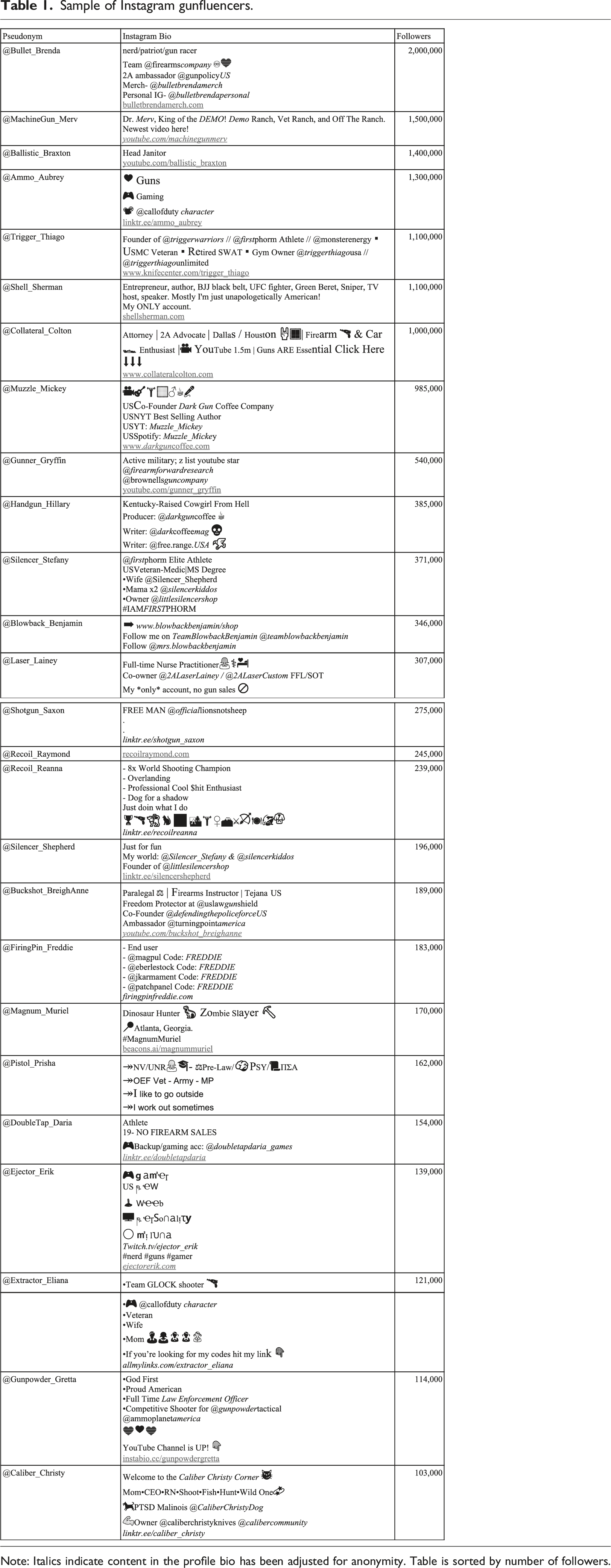
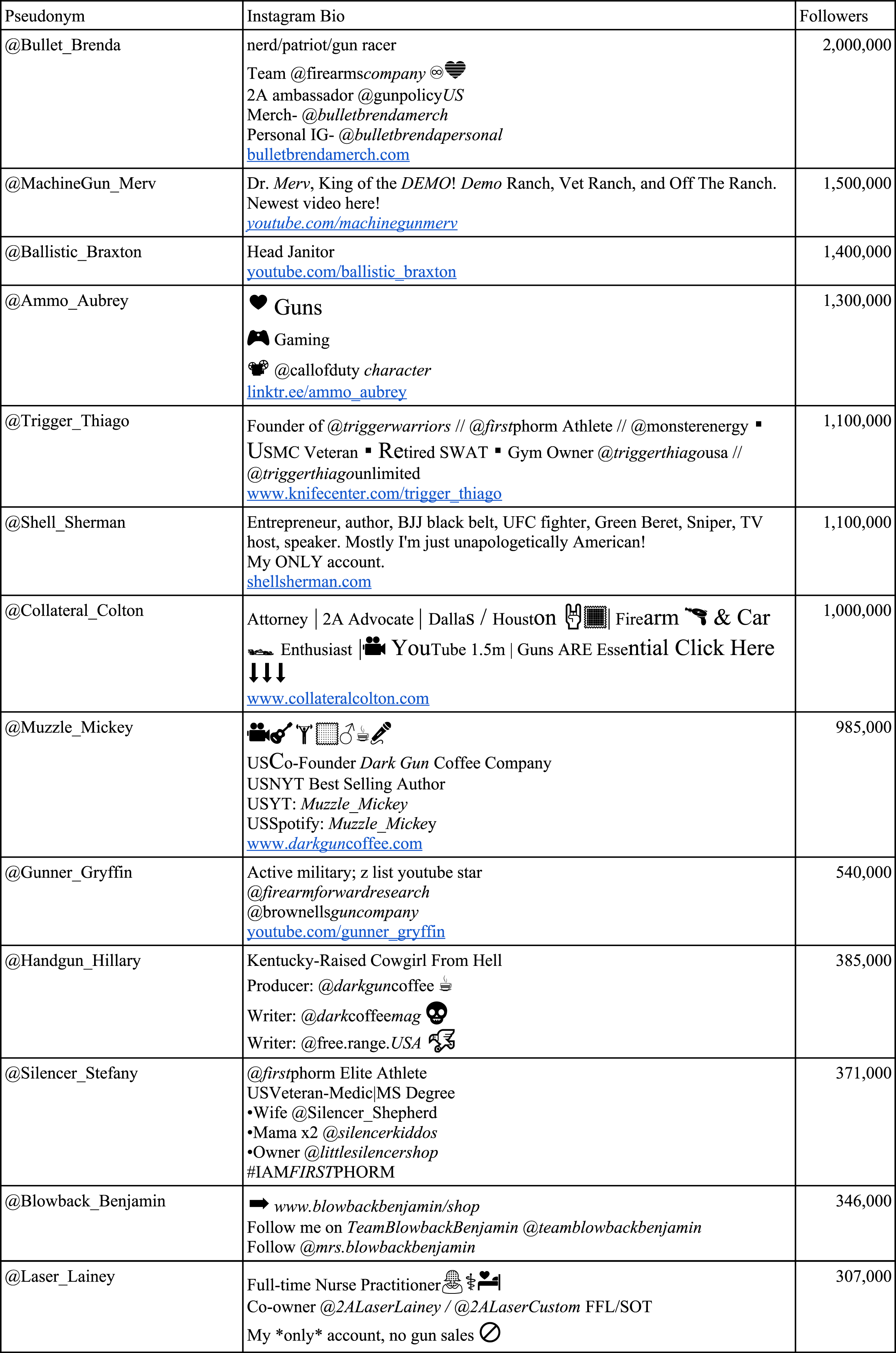
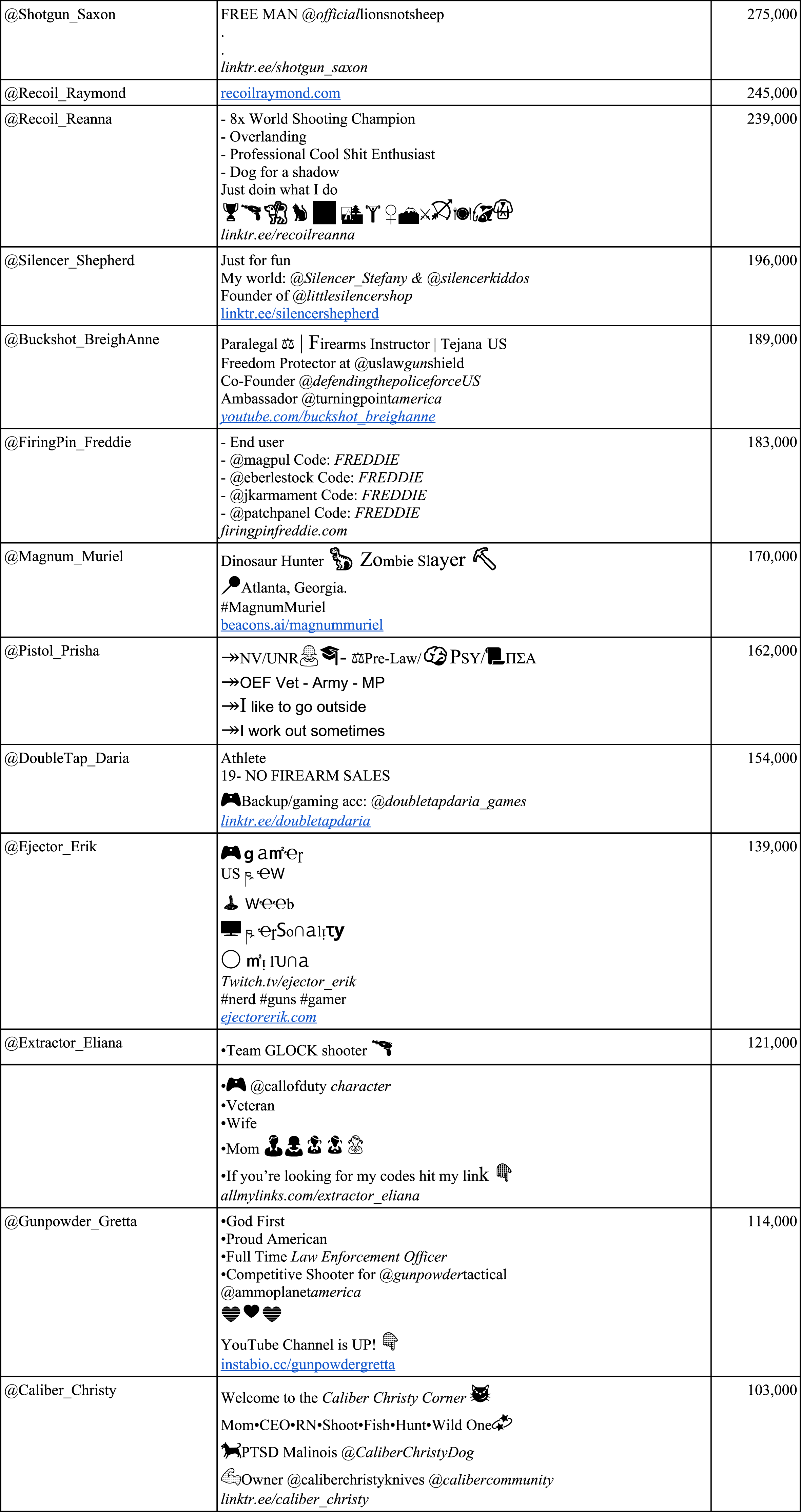
Note: Italics indicate content in the profile bio has been adjusted for anonymity. Table is sorted by number of followers.
Based on insights gathered during our initial immersion period, we systematically downloaded details from each profile, including the gunfluencer’s username, bio, and number of followers alongside posted content from their profiles. Formal data collection included 20 Instagram posts from each of the 25 gunfluencers’ Instagram profiles, starting from a common date of January 31, 2022 and working backward to download content related to guns and/or 2A ideology. Instagram allows users to post up to ten images and/or videos as one carousel post (i.e., swipe left to see more images in the same post). Thus, our data comprised 520 posts including 313 photos and 252 videos with accompanying captions. Data were managed via a Google spreadsheet. We continued to monitor each gunfluencers’ Instagram content after the formal data collection period by dipping in and out of the online platform. This resulted in additional supplementary posts, deemed to be representative of and directly related to 2A ideology.
Thematic analysis was used to iteratively code and organize data. We reviewed the data and established initial categories, with attention to the specific ways that gunfluencers use the platform to link consumption to 2A ideology. Thematic codes focused on the objects, posture, and expression of the influencer; and activities, values, and ideas that were depicted and referenced in the text and the image (Belk and Pollay, 1985). All four authors met regularly via Zoom to identify patterns and themes across the Instagram content while making sense of what these patterns and themes could mean in relation to theory (Gurrieri and Drenten, 2019). On average, we met bi-weekly throughout the duration of the data analysis process. The Instagram posts were independently analyzed, then analyzed across Instagram profiles to identify patterns and relationships to existing literature to develop theoretical insights. By looking for patterns and connections within these themes, meaningful clusters were developed in relation to platformization and the contextual frame of 2A ideology. Initial active reading of each post involved searching for meanings and patterns rather than casual descriptions of the data (Braun and Clarke, 2006). This approach allowed interpretations to emerge from the data alongside the theoretical underpinnings of platformization and consumption ideologies that feature controversial values and beliefs. The themes were continuously reviewed, refined, and organized using mapping techniques to create a clear structure for describing the data. This process went through multiple rounds of adjustments, including relabeling and reworking of themes and categories, until a comprehensive analysis was achieved. To ensure rigorousness and trustworthiness in the thematic analysis, we kept records of codes, used diagramming to map themes, and developed team consensus (Nowell et al., 2017). Each gunfluencer was assigned a pseudonym, and other selected information (e.g., personal websites, specific gun-related brand affiliations) was anonymized to minimize amplification of their content (Phillips, 2018).
Findings
We orient our findings using the framework in Figure 2, which is derived from our analysis and illustrates how social media influencers—specifically, gunfluencers—use platformization to produce and promote a specific consumption ideology by extending audiences and leveraging algorithms. This concomitant process, which we term curating a consumption ideology, unfolds as gunfluencers provoke and leverage negative, as well as positive reactions from viewers and platforms using tactics of conventional social media influencers (e.g., lifestyle influencers, beauty influencers). Tactics are activities performed by influencers in their work on a platform, and we label the work of gunfluencers curatorial tactics. These tactics prescribe consumption practices, ascribe meanings, and tether these practices and meanings to values and beliefs of the ideology, and are accelerated by audience engagement and algorithms. In the platformization process, online content is shaped by algorithmic forces through likes, comments, tagging, and collaborative filtering, and audience engagement is a primary source of data shaping such algorithmic results. In curating a consumption ideology, we find that gunfluencers draw on four curatorial tactics across two domains: products and people. In the material domain of products, gunfluencers use the curatorial tactics of glamourizing and demystifying. In the relational domain of people, gunfluencers use the curatorial tactics of victimizing and tribalizing. Together, these tactics connect a set of consumption practices, products, social relations, and their meanings to the beliefs and values of 2A ideology to produce and promote a 2A ideology of consumption. Notably, while we observe multiple brands being tagged and mentioned, we observe very few formal disclosures of paid partnerships and promotional content in our data—despite platforms and regulatory institutions (e.g., United States Federal Trade Commission) commonly requiring influencers to do so to maintain transparency in advertising (see FTC.gov/influencers). Such disclosures can include using hashtags like #ad, #sponsored, or #partnership, as well as clear and prominent captions indicating the commercial nature of the content. These are even more critical in the context of firearms, which have additional boundaries for advertising set forth by the platform. We conclude that gunfluencers shape ideological discourses beyond the limitations of stated policies and enforcement of such policies. Conceptual framework of curating a consumption ideology.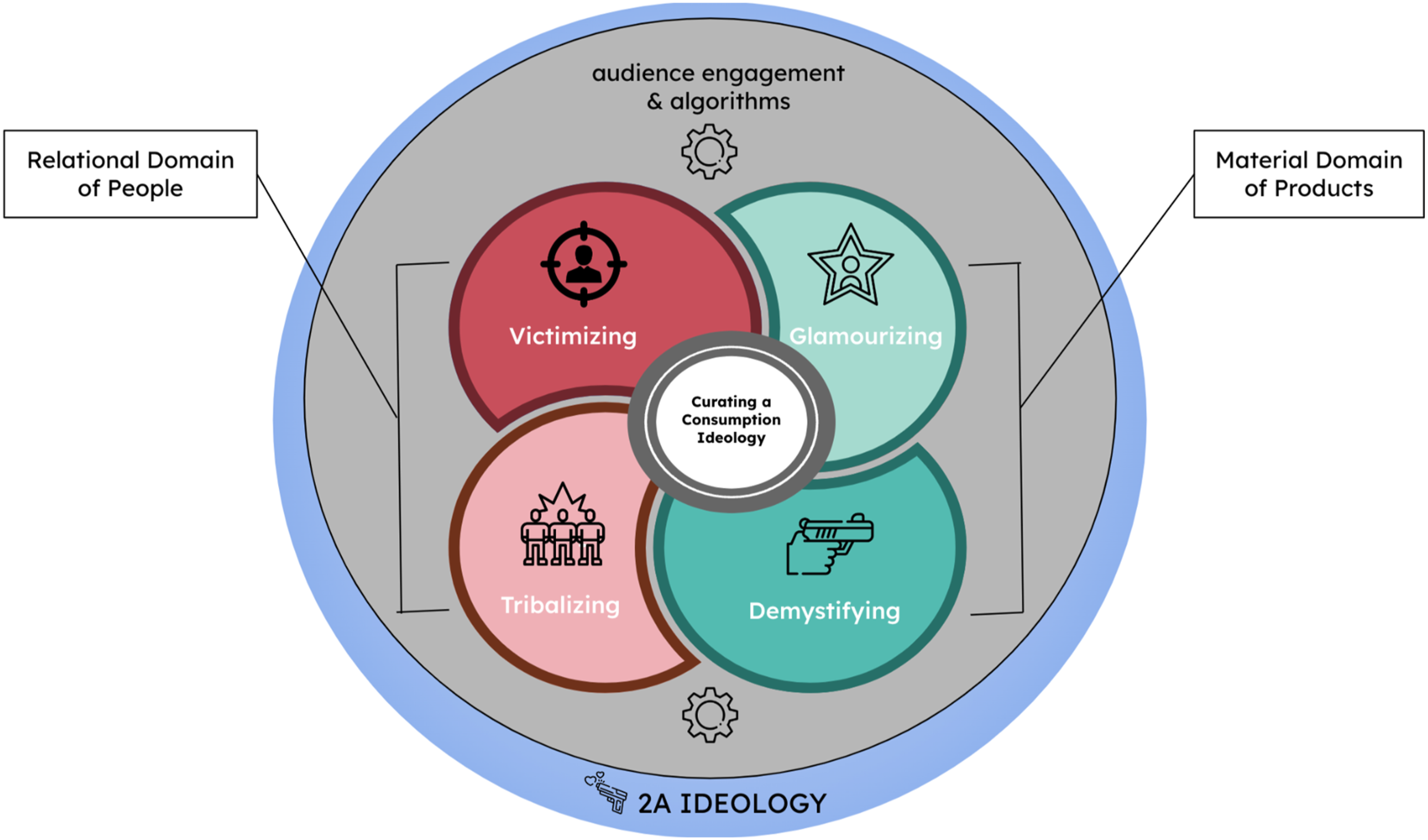
Gun consumption: The material domain of products
The values and beliefs of 2A ideology center the importance of citizens’ access to a material object—guns—and in producing a 2A consumption ideology; gunfluencers present guns as fundamental to this. Gunfluencers explicitly position guns as aspirational accessories, practical necessities, and material symbols of the values and beliefs that constitute 2A ideology. Notably, the guns presented often include a politically controversial type of rifle, which 2A advocates call “modern sporting” rifles and many others label “assault style” rifles. Within the material domain, we find that gunfluencers employ two complementary curatorial tactics, glamourizing and demystifying, which work in tandem to establish guns as materially essential to, and particular activities with these guns as enactments of, 2A ideology.
Glamourizing as a curatorial tactic
The curatorial tactic of glamourizing is characterized by cultivation of aspirational desires to deeply and lavishly embed a product into consumers’ everyday lives. Gunfluencers use this curatorial tactic to establish guns as a material pathway for demonstrating and valorizing U.S. ideals that 2A ideology asserts the right to bear arms protects and represents, including abundance and nationalism, and to convey the aesthetic ideals of the ideology by borrowing aesthetic norms of the Instagram platform.
First, our data suggest gunfluencers tether 2A ideology to more than simply gun ownership; they connect it specifically to idealized gun-related lavishness, excess, allure, and extremes that are emblematic of broader capitalistic, entrepreneurial, U.S. ideals (Luedicke and Giesler, 2007). Gunfluencers in our data post images of the numerous and varied guns that they own alongside photos that reflect other forms of material abundance. For instance, @MachineGun_Merv repeatedly shares images of the assemblage of hundreds of firearms that the Second Amendment has enabled him to amass (see Figure 3), posted alongside other images reflecting U.S. opulence (e.g., opulent home, vintage restored cars, outdoor hunting, and recreation items) on his Instagram feed. Gunfluencers’s use of glamourizing deftly combines ideals of material excess and 2A ideology. This tactic directs followers to valorize and pursue ownership of (many) guns for the purpose of celebrating and protecting their constitutional right, rather than (fewer) for practical purposes, and it borrows from the tactics of traditional influencer culture, wherein novelty and excess reign supreme as a part of the status economy (Page and Negra, 2022). Thus, gunfluencers use of glamourization implicates possession of a large quantity and variety of guns as an aesthetic marker of a belief that the Second Amendment represents and protects U.S. ideals, and as a pathway to status within the community that shares this ideology. @MachineGun_Merv enacting glamourizing as capitalistic abundance.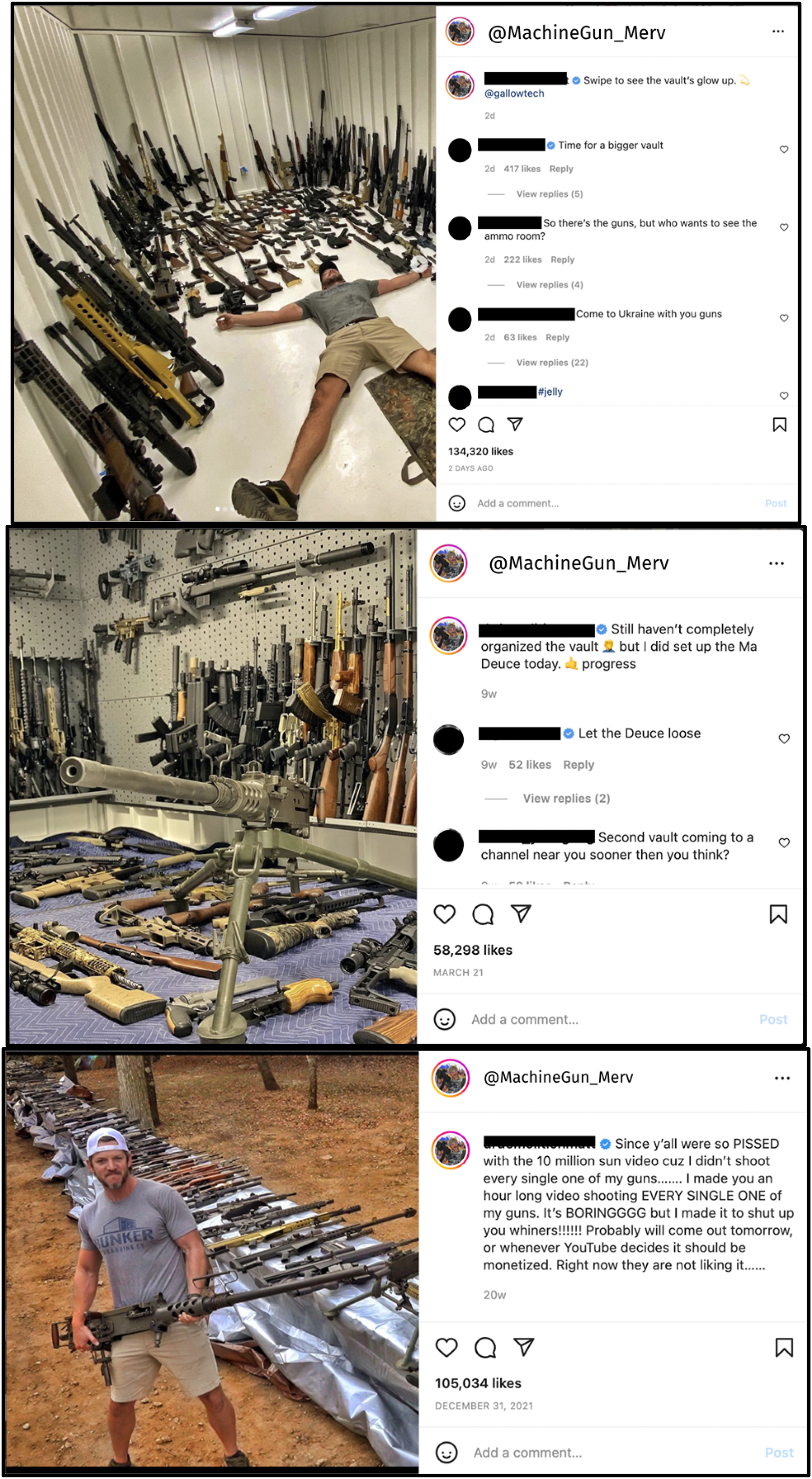
Second, gunfluencers combine guns and the aesthetic of displaying large quantities of guns, with valorized patriotism and nationalism. Gunfluencers use glamourizing as a curatorial tactic by posting content that infuses multiple firearms and accessories into portrayals of cultural traditions and that presents gun owners as ideal Americans (Lacombe, 2021). For instance, @Muzzle_Mickey makes snow angels in a bed of bullets, @Pistol_Prisha posts aestheticized images of the Thanksgiving dinner table, and @DoubleTap_Daria shares a rifle-wielding family Christmas photo (see Figure 4). Similar to how seventeenth century painters coupled firearms with idealized Christian angels (Witkowski, 2022), gunfluencers’ integration of multiple firearms into quintessential U.S. traditions symbolically connects pro-national 2A ideology to the ideal of the prototypical Good American (Coskuner-Balli, 2020) deeply rooted in a latent American-Christian association (Jacobs and Theiss-Morse, 2013). Moreover, by using hashtags such as #happyturkeyday for Thanksgiving, guns become embedded and dispersed into communications viewed by broader publics (Arvidsson and Caliandro, 2016) about U.S. rituals and traditions, thus proliferating gun-focused content beyond those who already subscribe to 2A ideology. Gunfluencers enacting glamourizing as idealized American lifestyles.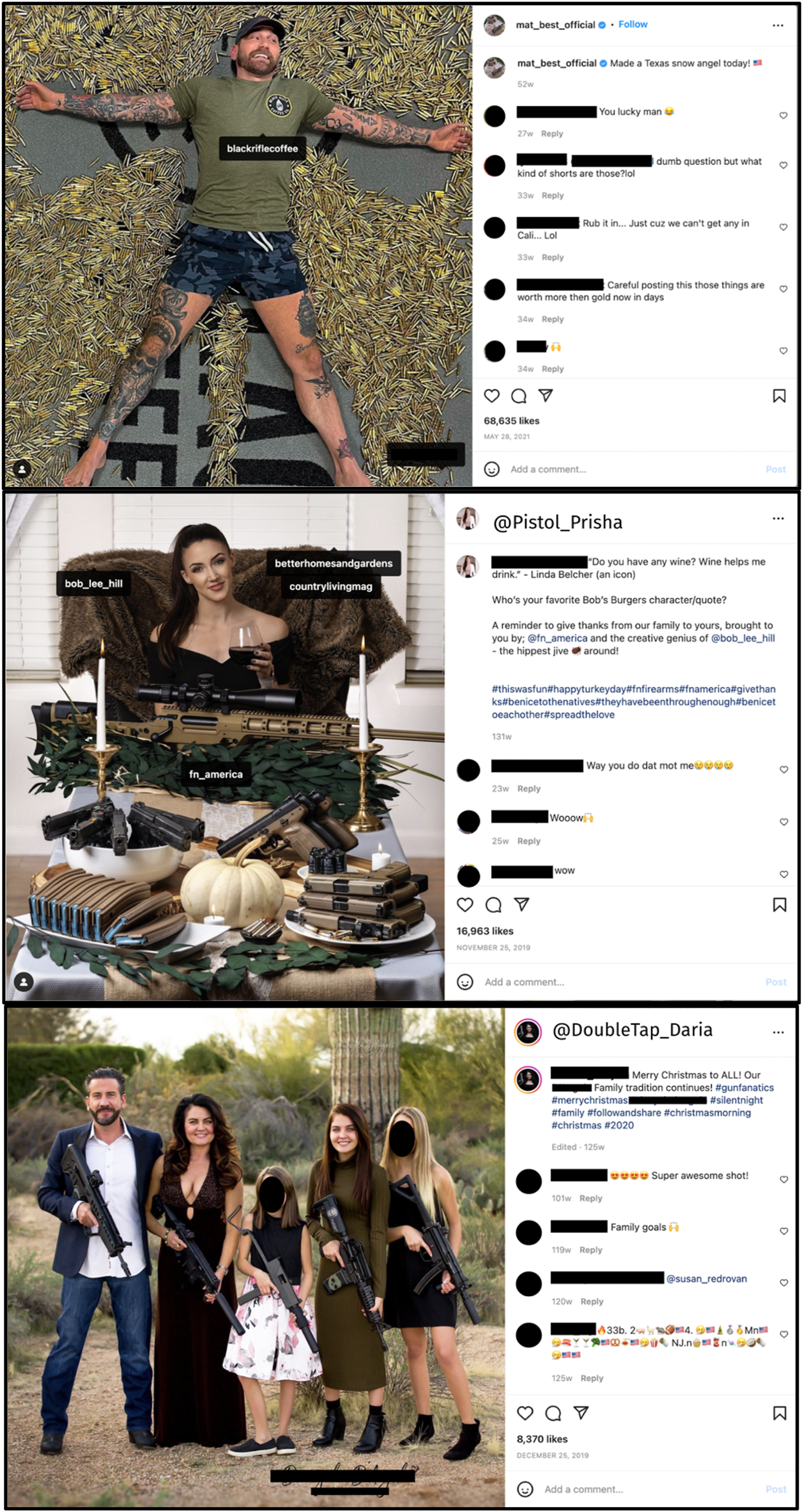
Glamourizing fosters a 2A consumption ideology by positioning guns as an aspirational lifestyle product and amassing large quantities of guns as an enactment of the capitalist dream in the United States. Glamourizing furthermore draws on norms of the platform by reflecting Instagram aesthetics and stylized elements that are emblematic of influencer culture. As a result of gunfluencers’ curatorial tactical work, the display of, and discourse about, one’s large collection of guns, including high capacity modern sporting rifles, become aspirational for adherents to 2A ideology, because these displays and discourses are its highest order manifestation—both demonstrating and protecting an idealized U.S. lifestyle marked by extreme conspicuous consumption, or status-seeking through ostentatious displays of material goods (O’Cass and McEwen, 2004).
Demystifying as a curatorial tactic
While glamourizing casts the 2A lifestyle as aspirational, the curatorial tactic of demystifying makes it accessible by explicating ways of enacting 2A beliefs in more mundane, everyday consumption. Demystifying involves characterizing guns as relatable, everyday products and specifying behavioral norms that enact 2A ideology. Gunfluencers demystify the 2A lifestyle in two ways: providing insider knowledge of gun use and positioning guns as part of domestic life.
First, gunfluencers post educational content of themselves using, loading, and shooting guns and discussing the features, benefits, and uses of different types of guns. This content conveys accessibility by providing a type of peer-to-peer user manual for firearms, mirroring offline instructional contexts (Shapira and Simon, 2018) and user-generated practices in other digital culture contexts (e.g., beauty tutorials, Gannon and Prothero, 2018). Thus, demystifying sanitizes the potential dangers associated with firearms by revealing best practices for gun consumption, including broad and specific content on gun purchasing, storing, cleaning, carrying, and shooting. Demystifying guides consumers to develop routines, knowledge, and skills with their firearms (Barnhart et al., 2018). This aligns with a foundational “guns don’t kill people, people kill people” narrative of 2A ideology in which guns can be objects that allow consumers to be heroic “good guys” who protect themselves and innocent others from harm (Stroud, 2020). For example, @Recoil_Reanna demonstrates how “hitting the mag release with [her] support hand” helps avoid having to “switch the gun around in [her] strong hand.” She suggests this is all “part of the process” of “putting in work.” In other videos, @Recoil_Reanna shows followers how to conceal carry two firearms at a time and identifies her favorite shooting range accessories (e.g., @taylorfreelance base pads, @webertactical mag pouches; see Figure 5). Notably, no promotional disclosures are provided for the brands linked in her caption. By offering a step-by-step introduction to gun ownership and use, gunfluencers play an important role in widening the audience for 2A ideology by making gun consumption more accessible and intelligible. In this way, demystifying serves as an important tool for breaking down barriers that can be observed in other controversial contexts. @Recoil_Reanna enacting demystifying as how-to demonstrations.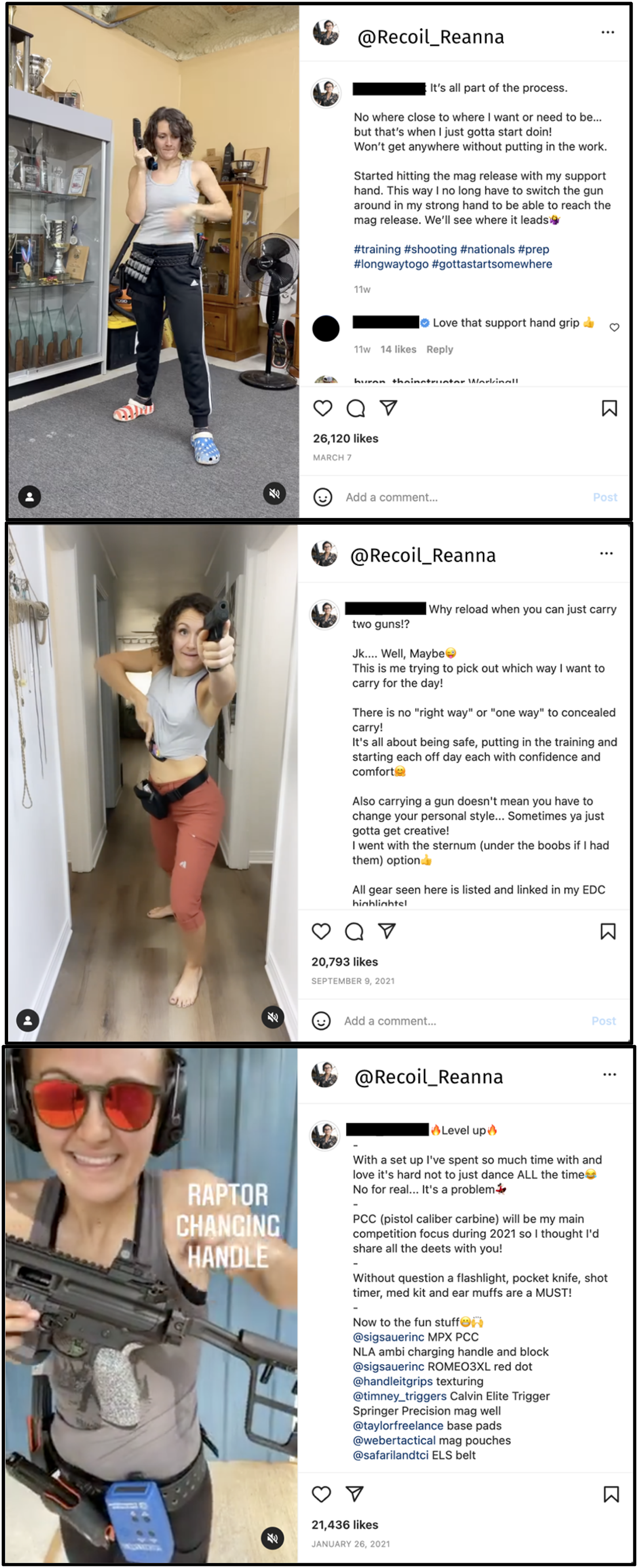
Second, gunfluencers position guns as an essential part of domestic life, taking on a persona of the prepared rebel who challenges societal norms by integrating guns into their everyday lives when going to the store, making dinner, parenting, hosting backyard barbecues, and more. This creates an alluring tension, framing enactment of 2A ideology as both pragmatic and rebellious, consistent with a core belief that the threat of a rebellious, armed uprising by average citizens well versed in firearms use is an essential, practical means of ensuring the continuation of U.S. freedoms. In Figure 6, @MachineGun_Merv displays a firearm alongside his taco dinner, @Ammo_Aubrey posts a casual range day photograph, and @Extractor_Eliana shares a wholesome “proud parent” moment excited for her two young daughters to “pick up shooting.” In these images, guns are not shown in use, but rather as essential materiality in domestic life, and appropriate for activities such as drinking coffee or spending time outside with the kids. Gunfluencers enacting demystifying as integration with domestic life.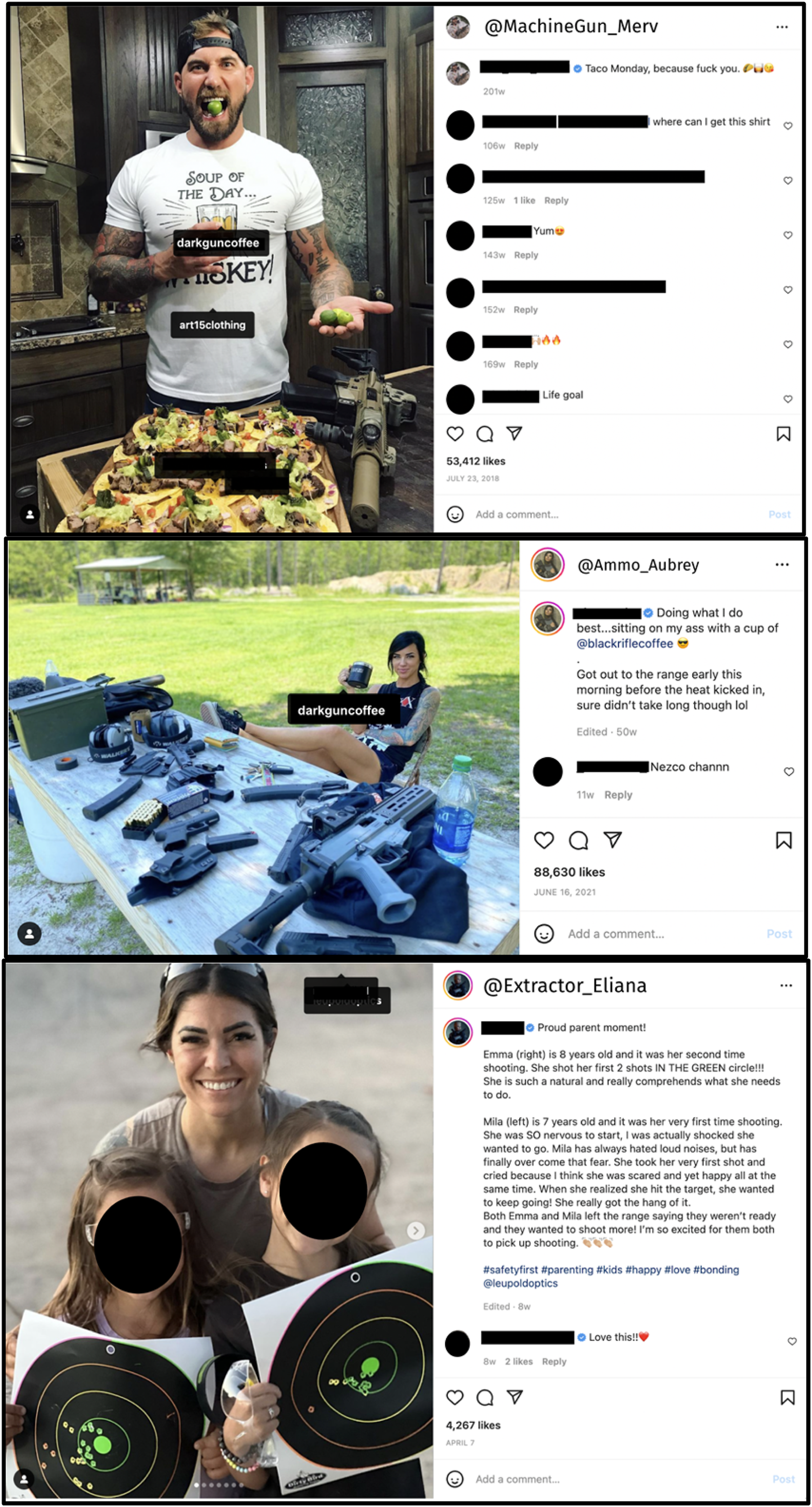
This portrayal of the everydayness of guns positions guns as practical consumer tools and as material accoutrements to celebrate gun rights that are essential to day-to-day life. Moreover, these slice-of-life representations display how 2A ideology should be performed and integrated into everyday consumption, which renders gunfluencers approachable and gun consumption more palatable. This is further reinforced through the algorithmic strategies of gunfluencers, who tag only clothing and food and beverage brands in gun-related content. For example, @MachineGun_Merv and @Ammo_Aubrey both tag the @darkguncoffee Instagram account, indicating a partnership with the brand and promoting it as part of the 2A lifestyle. These tags highlight the murky nature of platform governance, which gives voice to promotional content through influencer content in covert ways. In these posts, guns are not being directly sold, rather, the lifestyle of gun ownership is portrayed through tangential commodities (e.g., a specific pro-gun coffee brand). Veteran-owned Dark Gun Coffee Company, which is marketed as coffee “for people who love America,” is the commercial focus of a post that features a table laden with guns. As such, behavioral norms surrounding gun consumption extend to the language and products gunfluencers promote—many of which are not directly related to gun consumption but rather reflective of 2A ideology more broadly.
Demystifying ties the presence of guns in everyday life to 2A ideology, calling followers to regard guns as appropriate and necessary objects, and instilling the product knowledge and confidence in one’s ability to use guns necessary to fully embrace and enact 2A ideology. In contrast to glamourizing, demystifying draws on the norms of authenticity, making the aspirational seem accessible. Authenticity is a dominant mechanism for success in influencer marketing (Kapitan et al., 2022), and in this context, this is performed by gunfluencers to demonstrate how everyday people can enact a lifestyle grounded in 2A ideology.
Gun consumers: The relational domain of people
We identify two other curatorial tactics which are focused on the relational domain of people; with these tactics, gunfluencers highlight social relations and identities and tether meanings to ideological membership in the 2A subculture. The shared identity of followers of 2A ideology is central to the 2A subculture’s consumption ideology. In curating 2A consumption ideology, gunfluencers position members as persecuted victims and as a fiercely unified collective by employing two complementary curatorial tactics: victimizing and tribalizing. These curatorial tactics work in tandem to establish insider versus outsider dynamics and status.
Victimizing as a curatorial tactic
The curatorial tactic of victimizing is characterized by emphasizing and reproducing meanings constitutive of oppression and positioning members of the subculture as victims of oppression. In the context of 2A ideology, gunfluencers use the curatorial tactic of victimizing in two ways: stoking fear about the threat of gun regulation and decrying alleged unjust treatment based on their identities as gun consumers.
First, gunfluencers enact victimizing by claiming gun consumers’ individual rights are at risk due to potential gun regulation and arousing alarm. For instance, @Collateral_Colton posts a screenshot of his own Tweet suggesting public outrage over mass shootings is a threat to individual Second Amendment rights, and by proxy, a threat to individual safety (see Figure 7). His use of a fear appeal is evident in suggesting citizens will be more susceptible to armed robbery if their “2A rights” are diminished. Other gunfluencers in our data post similar screenshots of news stories about lawmakers “banning the sale of ammunition magazines” and “using coded language to attack your 2A rights.” Such arguments embolden followers, who offer comments such as, “They will have to pry my guns from my cold dead hands. #forever2A” and “If they come for my guns, I know how I will go.” This us-versus-them argument establishes members of the subculture as targeted victims who must stay vigilant in the face of oppression from tighter gun regulations, consistent with the theme of victimization of gun owners common in CEO editorials in the NRA’s American Rifleman magazine and speeches at NRA annual meetings aimed at mobilizing members to take political action (Lacombe, 2021). Gunfluencers enacting victimizing as oppressive gun regulation.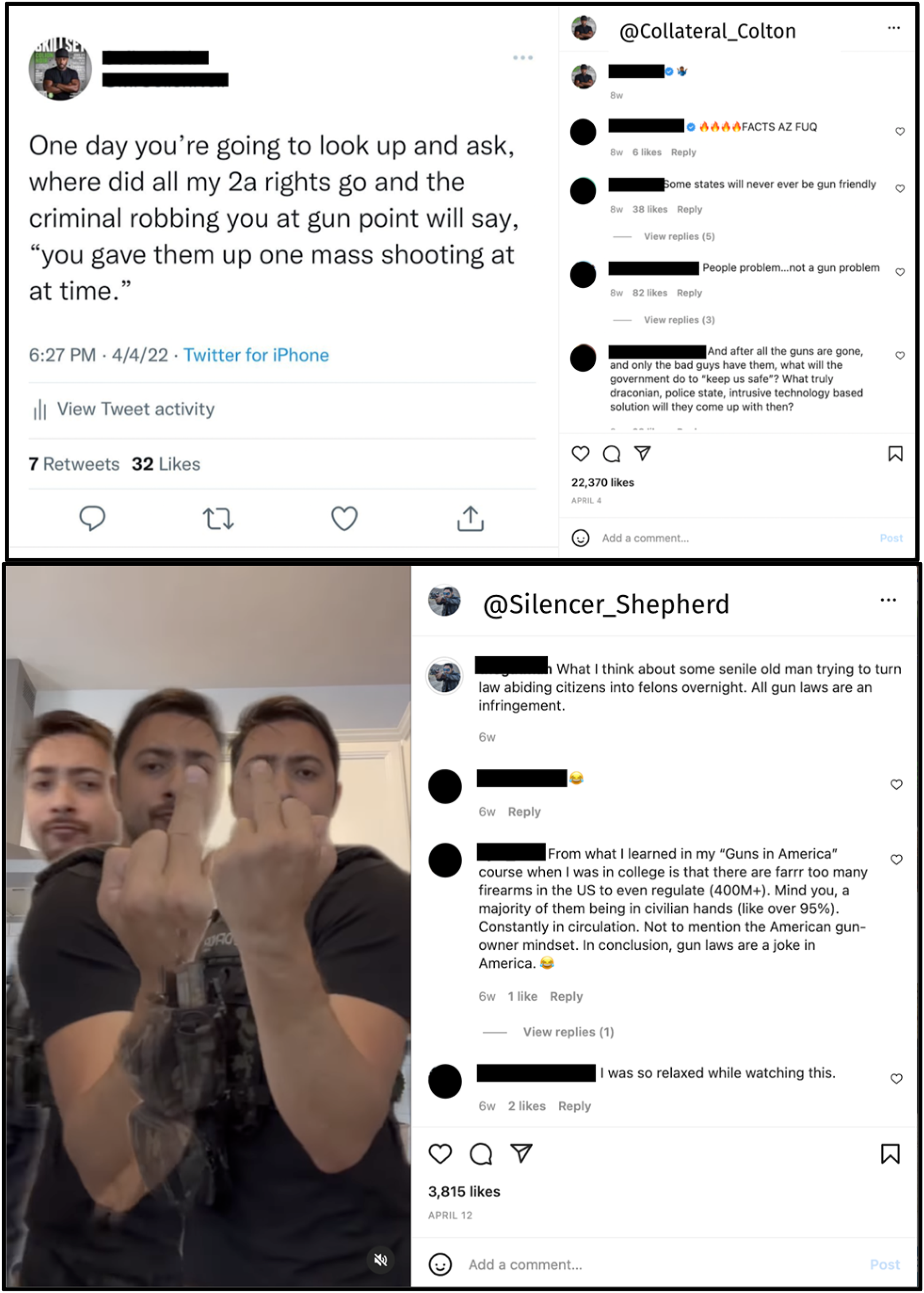
Further, by continuously emulating trends in digital communication, gunfluencers accelerate their appeal with a deeply online audience that speaks the language of the internet (McCulloch, 2019). For example, @Silencer_Shepherd records an Instagram Reel using the delayed filter and set to the song Waltz of the Flowers, giving the illusion of many doppelgangers of himself as he holds up his middle finger to the camera (see Figure 7). This combination followed a larger trend on TikTok to express disdain in a humorous way. In this case, @Silencer_Shepherd’s disdain is targeted toward U.S. President Biden, saying Biden is “some senile old man trying to turn law abiding citizens into felons overnight.” Thus, @Silencer_Shepherd is using the norms of the platform (e.g., viral content trends, filters) to engage their audience and communicate how gun consumers are being wrongfully targeted by the “infringement” of gun laws.
Second, gunfluencers enact victimizing by identifying ways in which they are treated unjustly based on their identities as gun consumers. A dominant means of positioning themselves as victims is through the use of censorship by the digital platform itself. Instagram’s Community Guidelines state the platform “is not a place to support or praise terrorism, organized crime, or hate groups” and “buying or selling firearms […] is not allowed,” and its advertising policies state “branded content must not promote firearms (including firearms parts, ammunition, paintball guns, and bb guns), firearm silencers or suppressors,” and other weapons. Nonetheless, gunfluencers challenge such mandates by repeatedly posting previously banned content and using bans as evidence of further victimization. For instance, @Laser_Lainey posts a video of four assault rifles on Instagram and notes “IG [Instagram] removed this in under 10 min because their AI [artificial intelligence] is a big ole’ loser. Gunfluencers enacting victimizing as digital censorship. ” 10 days later, she posts a photograph of the gun rack alongside stating the content was removed twice already, asking the audience, “will [Instagram] take down the photo?” (see Figure 8). In such instances, gunfluencers are aware their content is at risk of being removed by the platform, and, instead of abiding by its regulations, they use technology companies’ enforcement of policies as yet another example of victimization. Gunfluencers intentionally taunt the platform algorithms by posting borderline content that is in potential violation of the platform policies. In our data, banned content becomes a badge of honor. For instance, @Gunner_Gryffin posts memes and selfies emphasizing the frequency with which his account is banned by Instagram (see Figure 8). For gunfluencers, this is a win-win: if the content is not removed, they can reach a broader audience, and if it is removed, they can point to the ban as evidence of unjust treatment of people who subscribe to 2A ideology.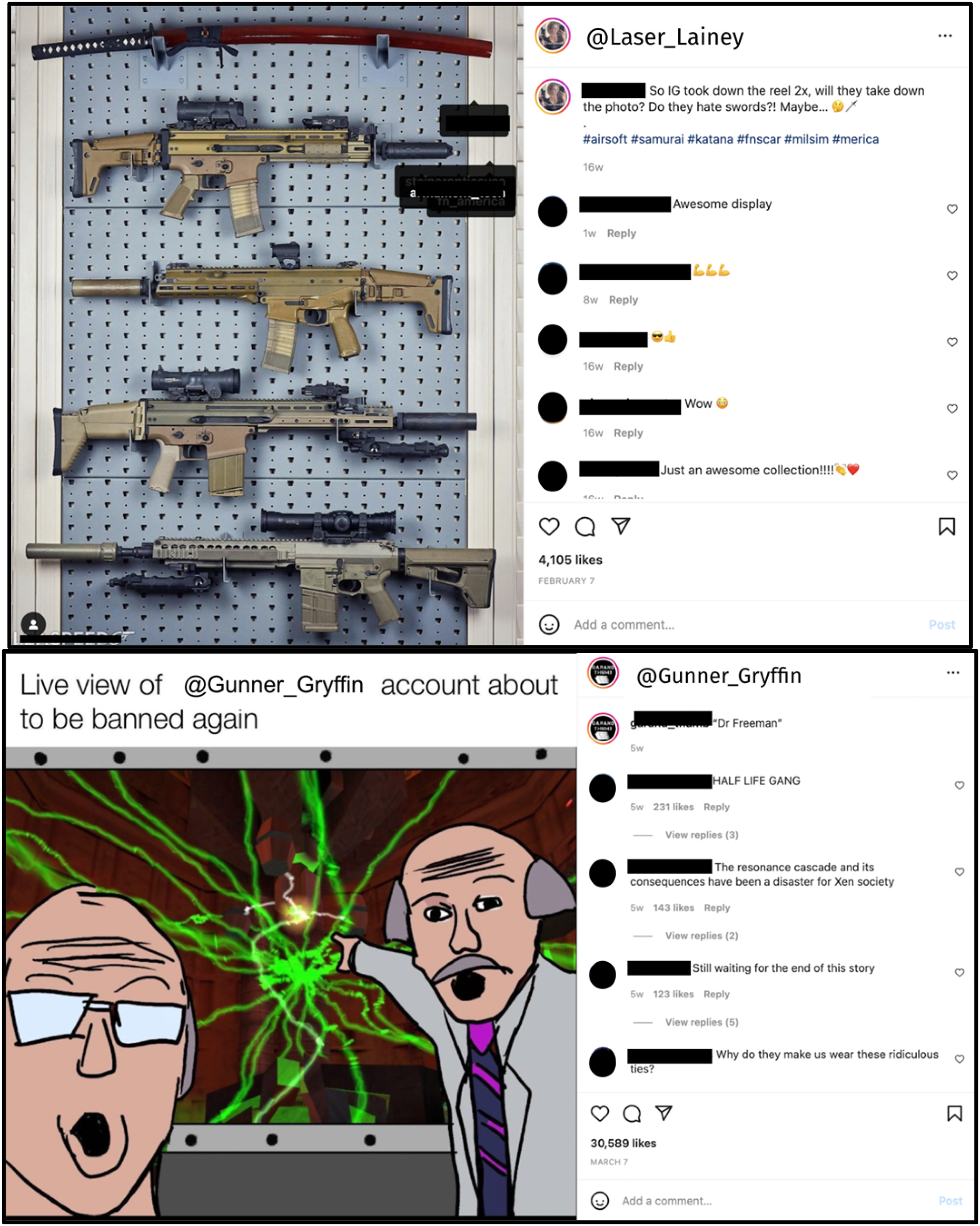
Gunfluencers’ use of the curatorial tactic of victimizing to ascribe an oppressed and mistreated position to members of the 2A subculture motivates and sustains support for 2A ideology. Victimizing extends previous work which suggests conservative-identifying (e.g., alt-right) influencers leverage a victim mentality (Lewis, 2018). By leveraging emotions such as fear and anger and exploiting the algorithms of the platform, victimizing builds an affective connection between gunfluencers and their audience that gunfluencers then leverage to promote 2A ideology and craft a collective imagining of its believers as persecuted cultural victims (Lacombe, 2021).
Tribalizing as a curatorial tactic
The curatorial tactic of tribalizing is characterized by ascribing and reinforcing meanings that define shared characteristics of those who enact 2A beliefs and values in their consumption. In the context of 2A ideology, gunfluencers enact the curatorial tactic of tribalizing in two ways: fostering a bond among individualistic members and deepening this affiliation in service to shared vigilantism.
First, gunfluencers unify their image of being independent rebels by shifting attention from the individual to the collective—the family, the community, and the generational passing down of 2A ideology. For instance, gunfluencer @Shotgun_Saxon shares a posed photo of his blended family with all members brandishing rifles and wearing his signature clothing line with the motto “Lions Not Sheep” (see Figure 9), which, when interpreted through the lens of 2A ideology, serves as a public declaration that he and his family refuse to conform to mainstream resistance to guns that leaves conformists defenseless against ever-present threats. This juxtaposition of a collective family identity alongside expressing self-reliant individualism is characteristic of tribalizing as unifying individualists. Gunfluencers formalize such affiliations using Instagram as a mechanism to foster community. For example, @Caliber_Christy is founder of @CaliberCommunity, an online community on Instagram (33.4k followers), YouTube (1.3 m subscribers), and Facebook (113.8k members) whose mission is to “empower women in the 2A community” and share “badass photos and videos by real women who shoot guns.” She often posts images with friends, conveying shared comradery and belonging among gun consumers (see Figure 9). Gunfluencer collaborations (“collabs”) with each other reinforces this kinship and community, not only among friends but also family. As another example, gunfluencers in our data related by blood (father @Recoil_Raymond and daughter @Recoil_Reanna) or marriage (wife @Silencer_Stefany and husband @Silencer_Shepherd) also collaborate and cross-post their content. Through tagging, this content is algorithmically bolstered within the platform and enhances discoverability of similar gunfluencers to follow. This brings others into the fold, similar to Arvidsson and Caliandro’s (2016) conceptualization of brand publics. Gunfluencers enacting tribalizing as unified individualists.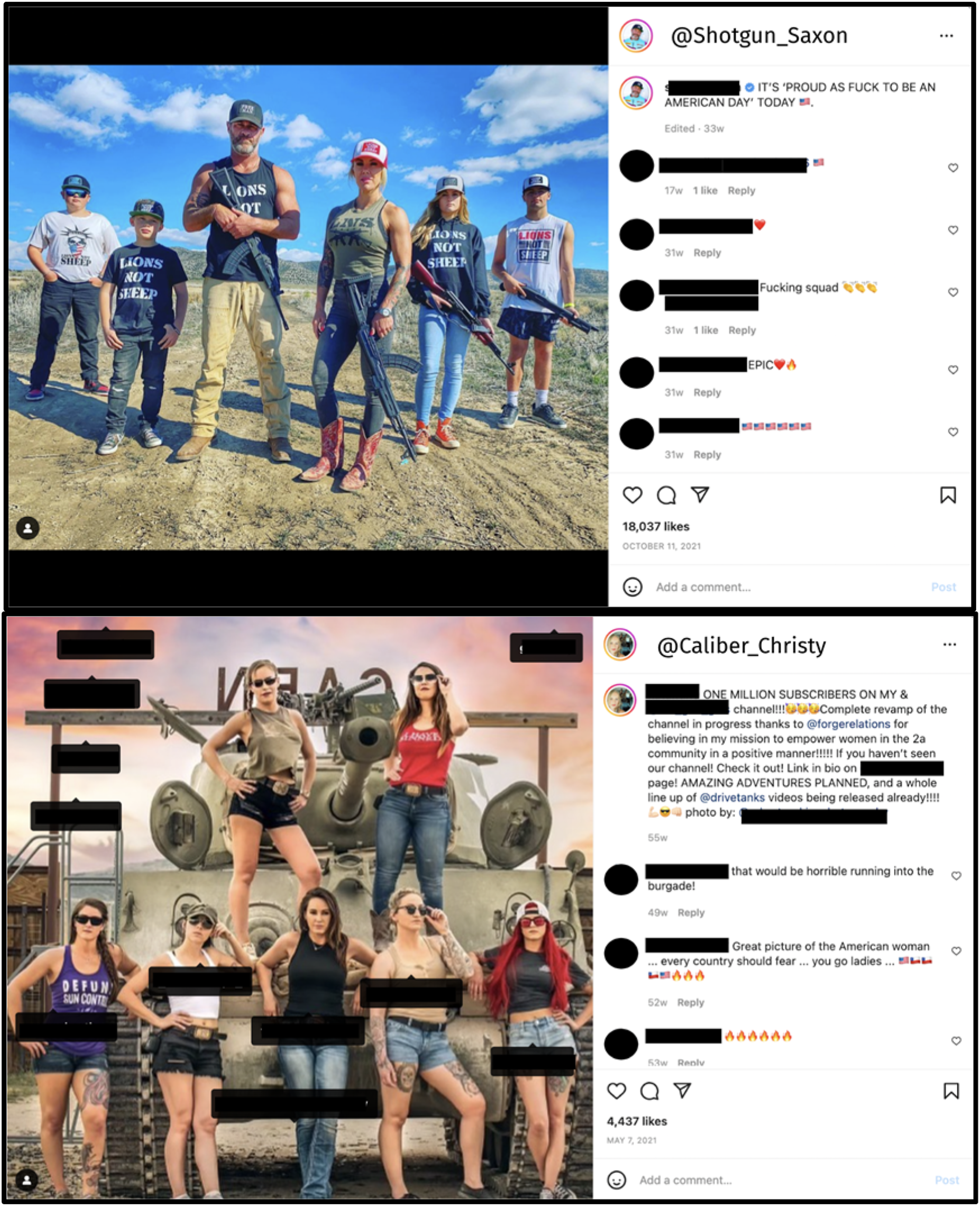
Second, gunfluencers enact tribalizing by promoting shared vigilantism. In our data, this us-versus-them theme emphasizes a range of common enemies, including the U.S. government, the liberal left, the “bad guys” with guns (e.g., mass shooters), and the mainstream media. This populist orientation is consistent with the 2A ideology promulgated by the NRA in magazines, speeches, and firearms training programs (Lacombe, 2021). Gunfluencers embrace these dynamics by proudly engaging in forms of social vigilantism, such as @Handgun_Hillary who shares a post (with influencer @Ammo_Aubrey) as self-proclaimed “cunt-servatives,” a derogatory term referencing their conservative values (see Figure 10). Other gunfluencers enact more traditional vigilantism by calling on their followers to prepare to take action against evil forces, either as individuals or organized groups. For instance, @Shell_Sherman often posts content depicting individuals who successfully used guns to save their own lives or the lives of others in the face of potential harm. In one post, following the 2022 Uvalde, Texas shooting where 19 children and two teachers were murdered, he writes, “For evil to conquer it takes good men and women to do nothing. It’s time that we start doing something! Go get trained. Go get equipped. Go get prepared. We need to TRY and prevent the next active shooter from happening but we CAN prepare for it.” This vigilante justice reflects a shared belief that individual citizens must collectively rise up to save themselves rather than wait for the government to protect them (Schwartz, 2022). The value-laden distinctions manifest in gunfluencer content position 2A ideology as not only positive, but superior to the ideologies of other gun consumers. In our data, gunfluencers espouse a common narrative that there are “good guys” with guns (well-trained gun consumers who ascribe to 2A ideology) and “bad guys” with guns (untrained criminals). In response, gunfluencers enact tribalizing by demonstrating their preparedness to protect their families and communities. For instance, @Silencer_Stefany tells followers to “always be ready just in case” in a post about how her concealed weapon might protect her family, and others in our data, such as @FiringPin_Freddie, engage in promoting MilSim, or live-acted military simulations, as a way for “good” gun consumers to collectively prepare for armed conflict scenarios and urban survival (see Figure 10). In both of these cases, specific brands and organizations are linked in the captions directing others to click, follow, and ultimately purchase from these companies. Thus, tribalizing conveys not only the characteristics that members of the subculture should share (e.g., preparedness) and how to achieve such characteristics (e.g., purchase from promoted brands, attend promoted military simulations) but also with whom members should associate as they prepare for enemy attacks. Gunfluencers enacting tribalizing as shared vigilantism.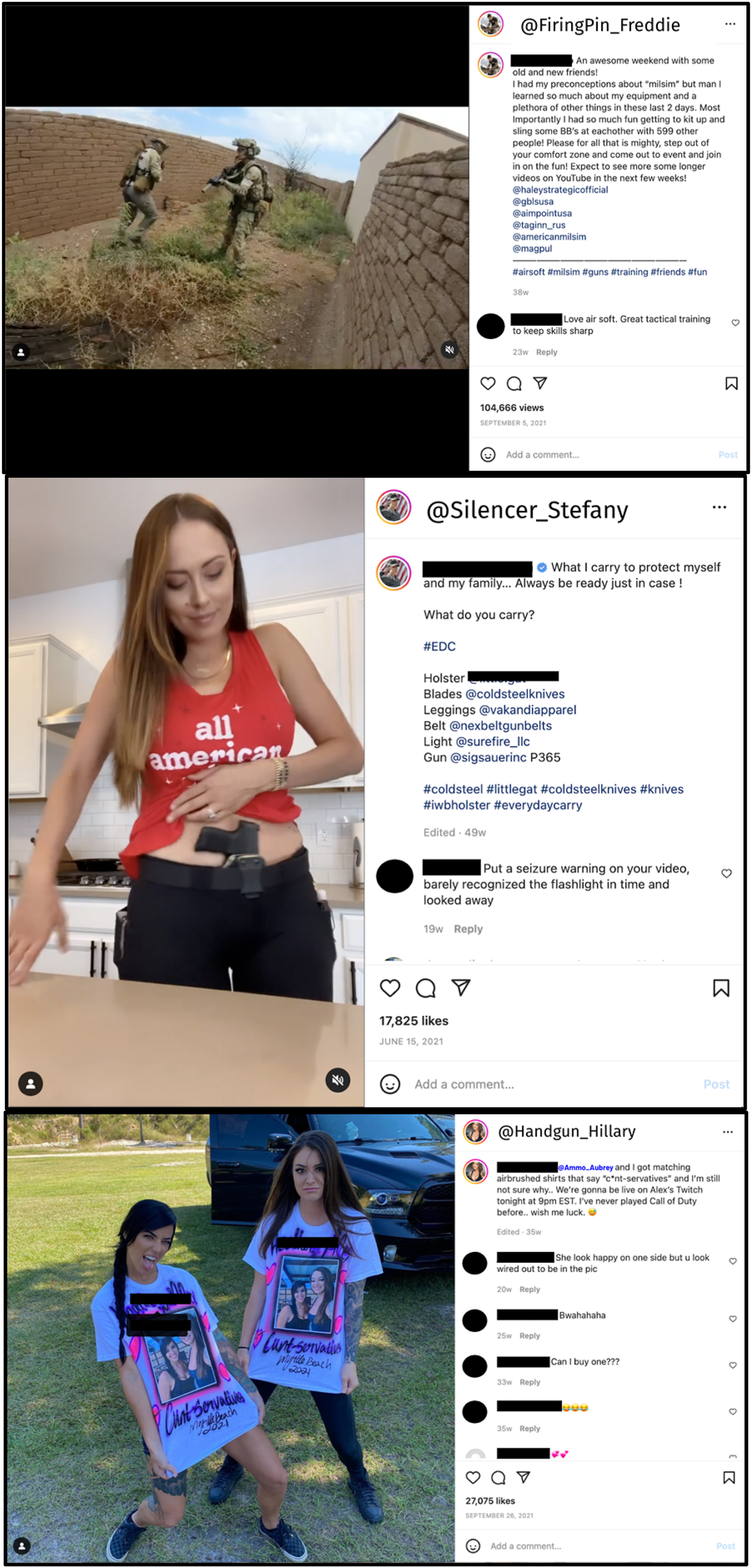
Tribalizing enables promotion of a 2A consumption ideology by ascribing the meanings that characterize those who follow the ideology as a fiercely like-minded collective. The curatorial tactics of victimizing and tribalizing work in tandem to collectivize gun consumers who coalesce against a perceived common enemy. Tribalizing promotes the socially conservative politics of the 2A ideology, which in turn reinforces a family first mentality and militia-esque tight knit group. Through curation of the 2A consumption ideology, collective bonds are established and then exploited to further promote the ideology's beliefs and values, and associated products and activities.
Conclusion
Our research illustrates how social media influencers use a platform to tie products, consumption activities, and meanings to an ideology, and thus produce and promote a consumption ideology in a digital, platformized world. This process, which we label curating a consumption ideology, extends audiences and leverages algorithms via the platform using four curatorial tactics across the domains of products and people. Here, we outline implications for platformization, influencer culture, and subcultures of consumption, and highlight relevant avenues for future research.
First, our research emphasizes how social media influencers produce and promote a consumption ideology centered around a polarizing, durable good with restrictions on its promotion. Previous research examines the dynamics and trajectories of platformization and social media influencers within cultural industries (Duffy et al., 2019); however, to date, such cultural industries have largely been confined to so-called creative markets (e.g., streaming music, podcasting, gaming, (Poell et al., 2021). Gunfluencers operate as “hired guns” for brands by glamourizing and demystifying guns for audiences, while powerfully drawing together a consumption collective founded on shared beliefs using victimizing and tribalizing.
Influencers are indeed tastemakers (Arriagada and Bishop, 2021). In the case of guns and other controversial consumer offerings, tastemaking is complicated by regulatory restrictions imposed on brands by media and platforms. Therefore, influencers act as the human face of the consumption ideology by mediating interactions between constellations of brands and consumers. In a marketplace of increasing platform dependence, influencers act as cultural curators by platforming ideologies of consumption (Arnesson, 2023). Here, the material and relational are leveraged and accelerated through audience engagement and algorithms, whereby enactments of ideological worldviews through consumption are made more visible and accessible. In the case of 2A ideology, this has the potential to engage both existing and new gun consumers and—as we discuss further below—embed them in a consumption ideology. Future research may more deeply explore how audience engagement and algorithmic functions interact with factors such as gender, age, race, and sexuality. For instance, gunfluencers in our data featured their young children in posts, and it appears that some children are gunfluencers in their own right (Albers, 2022). Further, gun ownership is a gendered phenomenon where men dominate the subculture, and women are often sexualized or victimized (Lawrence, 2023). Understanding who becomes a successful influencer in service to a consumption ideology—and why—is critical to pushing research on platformization forward. Importantly, our research identifies problematic practices in how gun brands operate in social media spaces through influencer marketing such as failure to disclose paid partnerships and murkiness in what constitutes “gun sales,” which are restricted on social media platforms. Content moderation warrants further investigation given the regulatory practices in place at the intersection of social media and the gun industry, including issues of disclosure, paid partnerships, advertising policies, and limitations on user-generated content (Goanta and Ranchordás, 2020). This is particularly important given gun influencers could be considered political influencers, who use digital platforms to promote political causes and engage in often binary issues, topics, and controversies (Riedl et al., 2023).
Second, our research contributes to an understanding of how a politically controversial set of beliefs and values evolves into a consumption ideology, with specific types and quantities of products, consumption activities, and meanings intertwined with these beliefs and values. Schouten and McAlexander’s (1995) pioneering research on subcultures of consumption laid the groundwork for subsequent consumer culture studies on virtual communities of consumption (Kozinets, 1999), brand communities (Muniz and O’Guinn, 2001), and consumer tribes (Cova et al., 2007). Each of these studies investigated consumer collectives with an established consumption ideology with existing ties between particular beliefs and values, and forms of consumption practiced by members. We take a step back to ask how these ties are formed. By investigating how gunfluencers produce a consumption ideology, with its specified products, activities, and meanings, from the beliefs and values about a civil right that constitute 2A ideology, we elucidate the ways that consumption ideologies develop in a platformized world. The 2A consumption ideology is curated through gunfluencers’ content and dispatched through the platform’s mechanisms—tags, likes, comments, and more. Thus, our research parallels previous work in consumer culture (Arvidsson and Caliandro, 2016) by demonstrating how influencers sustain particular practices—but in this case, a brand is not central; rather an ideology is. Digital spaces function as “vehicle[s] for visibility and publicity” (Arvidsson and Caliandro, 2016: 743). Our research shows that influencers play a key role in this “circuit of publicity” to the benefit of not a specific brand but rather an ideology.
Future research may explore the role of influencers and platformization in curating a consumption ideology across other controversial consumption domains (e.g., food, Halkier, 2020; climate, Luedicke and Giesler, 2007) in which consumers “explicitly challenge and critique each other’s consumption choices, behaviors, and ideologies” (Luedicke and Giesler, 2007: 812). Importantly, the 2A consumption ideology is grounded in a specific, politically controversial interpretation of the U.S. constitutional right to bear arms. Thus, platformization—via gunfluencers—sells consumers not on just a product or consumer identity but on a politicized, materially oriented worldview. Normative political ideology indeed shapes and is shaped by consumer behavior (Crockett and Wallendorf, 2004). Our research shows actively leveraging the controversial nature of the consumption ideology enables influencers to make their content—and thereby their politicized worldview—more compelling. For gunfluencers, leaning into such controversy results in expanded visibility and reach, allowing them to spread 2A ideology more efficiently than less provocative ideologies might. While our study focuses on how influencers produce and promote a particular subculture’s consumption ideology, future research might explore the impact of intentionally curated, rather than organically emergent, consumption ideologies on members of subcultures of consumption and their critics. Research might also more deeply explore questions about power dynamics and platformization (Castells, 2011; Srnicek, 2017) in relation to curating a consumption ideology.
In addition, our research contributes to work on U.S. gun culture by beginning to address an absence of empirical studies of the influence and use of social media (see Ranney et al., 2022 for exception). Future research could use alternative methodologies to more deeply explore how consumption ideologies are curated through digital platforms. For instance, depth interviews with gun influencers, their followers, and other stakeholders (e.g., brand managers for firearms) could provide insights into their experiences in situ. In the methodological tradition of autodriving, scholars could also use social media content (e.g., influencers’ posts) as prompts in interviews with consumers, who represent varying political positions (e.g., Second Amendment advocates, gun control activists), to better understand how consumers’ perceptions of ideological content on digital platforms intersect with their political beliefs.
Gunfluencers serve as hard-core, deeply committed exemplars of the 2A gun subculture, producing and promoting a 2A consumption ideology, in part, by modeling how to look, act, speak, feel, and believe. Through platformization, donning a t-shirt with a pro-gun slogan in a selfie or using the “#2A” hashtag on a mundane photo becomes a shared shorthand for belonging to and believing in 2A ideology, and prescribes specific consumption behaviors for enacting the ideology’s beliefs and values. Thus, curating the consumption ideology acts as a promotional means to an end, whereby influencers do the work to curate a very distinct ideology of consumption and to benefit corporations facing restrictions on promotion. Despite cultural pushback against the “politicization of guns” (Franks, 2019), curating the 2A consumption ideology makes guns expressly political by weaving gun ownership and usage with a particular political worldview, and benefits a lucrative firearms industry in the process.
Footnotes
Declaration of conflicting interests
The author(s) declared no potential conflicts of interest with respect to the research, authorship, and/or publication of this article.
Funding
The author(s) received no financial support for the research, authorship, and/or publication of this article.
