




Abstract
As an emerging category of non-human influencers, virtual influencers (VIs) have received increasing attention on social media. While VIs generate high user engagement, the underlying factors that drive social media engagement are poorly understood. Informed by communication theory, this study aims to explore Instagram users’ perceptions of VIs and the key source and content factors that prompt user engagement in tourism contexts. An initial netnographic observation of Instagram posts was followed by five online focus group interviews using a photo elicitation technique. The results indicated that Instagram users had mixed feelings towards VIs; however, most were receptive to VI marketing provided that ethical concerns had been addressed. Key source and content factors that stimulate user engagement with VIs are integrated into a proposed framework. The findings will assist tourism practitioners and content creators to design VI marketing campaigns that incorporate and leverage important influencer and post-related features.
Highlights
Virtual influencers are feasible alternatives to human influencers in tourism marketing.
Users are generally receptive toward virtual influencers provided that ethical concerns have been addressed.
Users prefer virtual influencers’ touristic posts highlighting tourism attributes rather than self-promotions.
The perceived human likeness is an important component of source credibility for anthropomorphic virtual influencers.
Introduction
Influencer marketing has grown significantly on social media in recent years, doubling in market value from US$6.5 billion in 2019 to 13.8 billion in 2021 (Statista, 2021). The term “Influencer” was inspired by the notion of “personal influence” coined by Katz and Lazarsfeld (1955). In a social media context, influencers are opinion leaders who use credibility, expertise and networks to create and curate persuasive online multimedia content (Casaló et al., 2020). Virtual influencers (VIs) are an emerging category of social media influencers. While some scholars (e.g., Baumgarth et al., 2021) have defined VIs as humanlike computer-generated characters, market reports (e.g., Baklanov, 2021) have also included non-human characters such as zoomorphic characters (e.g., bee_nfluencer).
Following the conceptualization in the study by Xie-Carson et al. (2023), anthropomorphic VIs can be defined as humanlike computer-generated characters created by humans and/or artificial intelligence algorithms with personalities depicted by first-person perspectives. VIs have been leveraged as an innovative digital marketing approach that is disrupting the current ecosystem of influencer marketing (Hudders et al., 2021). Researchers such as Miao et al. (2022) and Appel et al. (2020) have predicted that VIs will be prominent in the near future due to the development and convergence of virtual platforms (e.g., the metaverse) and technologies (e.g., extended reality and artificial intelligence). Since tourism is significantly impacted by electronic word-of-mouth on social media (Leung et al., 2013), travel and tourism have been identified as activities that are likely to be significantly influenced by VI marketing (Moustakas et al., 2020). Thus, understanding the phenomenon of VIs will enable practitioners to better promote their tourism products, services, and experiences online.
Studies have identified several benefits of adopting VIs in tourism. First, as a new phenomenon, the use of VIs creates a competitive advantage by capturing the attention of travelers, particularly younger generations such as Gen Z (Forsey, 2019). Second, since VIs do not have an “offline life”, the use of VIs gives tourism and marketing organizations greater control (Creasey & Vázquez Anido, 2020). VIs are less risky tourism ambassadors because they are not likely to make “human errors” that could damage a brand’s image and reputation (Moustakas et al., 2020). Third, tourism businesses and destinations have the option not only to collaborate with VIs, but also to create and customize their own VIs. Finally, as VIs are not human, they are able to “travel” continually and “work” simultaneously with a number of tourism businesses in multiple destinations (Creasey & Vázquez Anido, 2020). There are some concerns, however, the main one being that audiences may not trust VIs, particularly in situations where VIs review products and share feelings or experiences (Moustakas et al., 2020). Despite this, many reputable brands have successfully collaborated with VIs for brand promotion and consumer engagement.
Based on three dimensions illustrated in the work by Brodie et al. (2013), user engagement in a social media context can be referred to as the degree of one’s cognitive, emotional and behavioral presence while interacting on social network platforms. Intriguingly, the average user engagement rate of VIs is almost threefold that of human influencers, while the average VI post attracts four times more followers (Baklanov, 2021). This is important, as higher levels of user engagement can lead to consumer trust and commitment (Brodie et al., 2013), enhanced brand loyalty (Aluri et al., 2019), and increased firm value (Yang et al., 2021). User engagement is also an important precursor to intentional and behavioral outcomes (So et al., 2020). In the current study context, exploring user engagement with VIs will allow practitioners to adapt to the future trend of digital marketing by effectively employing VIs for tourism promotion. Understanding user engagement with VIs is an important first step for exerting influence and persuading potential tourists to adopt travel behaviors.
The current study explores user engagement with VIs to provide insights into the effective adoption of VIs in tourism marketing. This investigation was conducted through the theoretical lens of Lasswell’s (1948) model of communication, a theory that has been adopted in research on social media influencers (e.g., Sundermann & Raabe, 2019). Two research questions are addressed. First, what are users’ perceptions about the emergence of VIs on social media? This inquiry is important because users’ perceptions affect their engagement behaviors. Understanding users’ general perceptions of VIs lays the foundation for investigating user engagement with VIs’ touristic posts. Second, what are the key source (influencer-related) and content (post-related) factors that drive users to engage with VIs in tourism contexts? Although VIs generate high levels of user engagement (Baklanov, 2021), the underlying appeal that promotes such engagement is unknown (Appel et al., 2020). Responses will inform the development of a conceptual framework mapping the key source and content factors that drive user engagement with VIs.
Literature Review
In this section, several key constructs that are closely related to user engagement with VIs are discussed. The conceptualization of user engagement is presented followed by a discussion of current literature in the tourism context. The literature on engagement in the context of social media influencers is then conceptualized as a communication process, and two important theoretical underpinnings (i.e., source credibility model and uncanny valley theory) are explored to identify current research gaps.
User Engagement
Studies of consumer engagement are evident in a wide spectrum of disciplines, including psychology (Achterberg et al., 2003), marketing (Ashley & Tuten, 2015), management (Mone et al., 2018), sociology (Kent Jennings & Zeitner, 2003), and tourism (So et al., 2020). Consumer engagement has been conceptualized from various perspectives, however, to date, no consensus on a definition has been reached (Schultz & Peltier, 2013). While some scholars have focused on behavioral (e.g., Van Doorn et al., 2010) or psychological aspects (e.g., Fang et al., 2017), most researchers (e.g., Brodie et al., 2013) consider engagement as a multi-dimensional construct comprising cognitive (e.g., being interested in influencers’ posts), emotional (e.g., being affected emotionally by influencers’ posts), and behavioral facets (e.g., intending to visit the destination endorsed by influencers). Thus, in the context of social media, user engagement can be defined as the degree of one’s cognitive, emotional and behavioral presence while interacting on social network platforms. Although various metrics have been adopted to measure social media engagement rates, the most common approach is to quantify users’ interactions through likes and comments (e.g., Yu & Sun, 2019).
Studies in tourism have focused on engagement conceptualization and measures (So et al., 2014), engagement barriers (Chathoth et al., 2014), antecedents and outcomes (Touni et al., 2020), and social media engagement (Gruss et al., 2020). Despite a growing literature on social media engagement, research on the use of technology to enhance user engagement in tourism and hospitality remains underdeveloped (So et al., 2020). Existing studies are anthropocentric with few (if any) conducted in non-human contexts. The development and convergence of technologies such as computer-generated imagery and artificial intelligence have made it simpler for tourism businesses and destinations to create non-human entities that can entertain and engage with social media users. Given the significantly higher engagement rates of VIs compared to human influencers (Baklanov, 2021), it is critical and timely to further explore user engagement with VIs.
Social Media Influencers
Arguably, social media engagement is fundamentally about communication. Lasswell’s (1948) model of communication identified the source, content, receiver, channel, and effect as important factors in the communication process. Source factors relate to messenger characteristics such as attractiveness; content factors encompass the type of arguments and appeals in the message. Audiences’ characteristics, such as demographics and personality, are often labeled as receiver factors, whereas channel factors are associated with the transmitted media and context. Finally, effect factors are the desired outcomes of the communication, such as the immediate or delayed impact on travel behaviors (Lasswell, 1948).
The scope of this study is limited to source and content factors as previous studies have identified these as being influential in driving user engagement with social media influencers (e.g., Ge & Gretzel, 2018). Few studies have investigated more than one factor. While Jaakonmäki and colleagues’ (2017) study explored both source and content factors using big data derived from Instagram users in German-speaking countries, the study did not provide information on VIs, nor was it conducted in a tourism context.
In order to investigate user engagement with VIs, it is necessary to understand users’ general perceptions of VIs first. Research about users’ perceptions of VIs has generally been obtained through users’ comments on social media (e.g., Park et al., 2021); however, this approach is unlikely to obtain rich insights into users’ perspectives and overlooks the views of those who engaged with VIs in other ways (e.g., viewing or liking posts). Furthermore, there has been little systematic investigation of the underlying communication factors that drive user engagement with VIs. Previous studies (e.g., Choudhry et al., 2022; Shin & Lee, 2020) tend to focus on followers rather than non-followers, examine specific types of social media users, and fail to provide a holistic view of the key source and content factors that stimulate high levels of engagement. However, the perspectives of users who do not currently follow VIs are important as these are potential followers who could be converted by leveraging the factors that drive engagement.
Theoretical Foundations
The source credibility model has been applied extensively in communications and marketing research, particularly in studies of celebrity endorsement and more recently in influencer marketing (Weismueller et al., 2020). Source credibility refers to “a communicator’s positive characteristics that affect the receiver’s acceptance of a message” (Ohanian, 1990, p. 41) and incorporates attractiveness, perceived expertise, and trustworthiness. Specifically, attractiveness refers to the physical appeal of the source, perceived expertise refers to the source’s perceived level of valid assertions, and trustworthiness refers to the source’s perceived level of confidence in making valid assertions (Ohanian, 1990). While researchers such as Molin and Nordgren (2019) have started to employ the model in the VI context, the insights into its application in a VI context remain limited with most research conducted in the human context.
The uncanny valley theory (Mori et al., 2012) has also been applied in recent research on non-human entities such as robots and VIs. This theory speculates that humans’ affinity for a non-human entity increases with the entity’s perceived human likeness. This applies up to a certain point, after which an eery “uncanny valley” evokes negative responses. Positive responses toward an entity increase once again when it closely resembles humans (Mori et al., 2012). The prevailing literature presents mixed and inconsistent findings regarding the uncanny valley theory. For instance, Arsenyan and Mirowska (2021) supported the theory by examining three influencers’ Instagram posts and users’ comments. They found that the human influencer and the anime-like VI received more positive reactions than the somewhat humanlike VI. In contrast, Hanson and colleagues (2005) used an online survey to evaluate humans’ reactions toward videos of two robots mimicking humanlike facial expressions, and subsequently used a second online survey to examine humans’ acceptance of six VI frames ranging from cartoonish to realistic. They found no evidence of the uncanny valley and reported that realistic robots could be appealing with aesthetic designs. The applicability of the uncanny valley theory, particularly in the emerging context of VIs, has yet to be ascertained.
In summary, several research gaps have been identified. First, research on user engagement is primarily anthropocentric with limited insights (if any) into non-human entities such as VIs. Second, research related to users’ perceptions of VIs has mostly been captured through users’ comments on social media, neglecting the perspectives of users who engage with VIs in other ways. Third, there is a lack of a systematic investigation of the underlying source and content factors that stimulate user engagement with VIs. Lastly, attempts to explore the source credibility model and the uncanny valley theory in the VI context have been limited. This study addresses these research gaps by investigating engagement from the perspectives of VI followers and non-followers and exploring the applicability of the source credibility model and the uncanny valley theory in a VI context.
Methodology
This study employed netnography followed by focus group interviews. Netnography is grounded in ethnography, and focuses on people’s cultural experiences through traces on social media (Kozinets, 2020). The netnographic observation consisted of immersion and investigation (Kozinets, 2020). Since Instagram is a major platform that VIs use to connect and engage with their audiences, Instagram users were the targeted research population. Ethical approval was obtained from the university and consent was not sought from users as the perceived risks were trivial and comments were publicly available.
In the immersion stage, the lead researcher (in a team of three researchers) lurked on Instagram following over 40 VIs based on the list of top VIs on Instagram (Baklanov, 2021). VIs’ content and users’ comments were perused daily for eight months to gain a deeper understanding of aspects that users pay attention to in VIs’ posts. In the investigation stage, a data scraping service (http://exportcomments.com/) was purchased to collect the top engaging posts (by the number of likes and comments) and associated users’ comments from Lil Miquela—the most followed VI on Instagram with content created in English (Baklanov, 2021). To keep data manageable, user comments from the top five liked and top five commented posts were collected. The top liked comments in those posts were analyzed because they were more relatable to users at large, meaning they are more likely to represent users’ general viewpoints.
Given that some top liked posts were also the posts most commented on, a total of eight posts from Lil Miquela were collected along with 189 users’ comments. Comments were thematically analyzed to identify factors included in the photo elicitation used in the focus groups (see Appendix A in the online supplemental material). For instance, the main features mentioned in comments were human likeness, cultural background, and appearance, hence, posts incorporating VIs with various levels of human likeness, diverse cultural backgrounds, and different appearances were selected. Other commonly-cited features included other sources, hashtags and product-endorser fit, VI identity, parasocial relationship, and relatability. These factors were also incorporated in the posts selected for the photo elicitation.
Semi-structured focus group interviews were employed as this approach is particularly suitable for exploratory research where little is known about a specific phenomenon (Stewart et al., 2007). A group environment enables participants to explore, clarify, and build on each other’s perceptions (Morgan, 1997), which has the potential to yield valuable data about users perceptions of VIs. Focus group interviews using Zoom were considered suitable because of Instagram users’ familiarity with computer-mediated communications.
Given that Instagram users engage with VIs through highly visual Instagram posts, the photo elicitation technique was considered highly suitable. Specifically, participants were shown VIs’ Instagram posts to ensure the discussions were supported by contextual clues (Folkestad, 2000). This approach also triggered the memory of participants’ previous encounters with VIs to enrich the conversations (Prosser & Schwartz, 1998). Moreover, it was envisaged that the stimulation of relatable VI posts and information might trigger further sharing and elicit unexpected findings (Collier & Collier, 1986).
Sampling and Participant Information
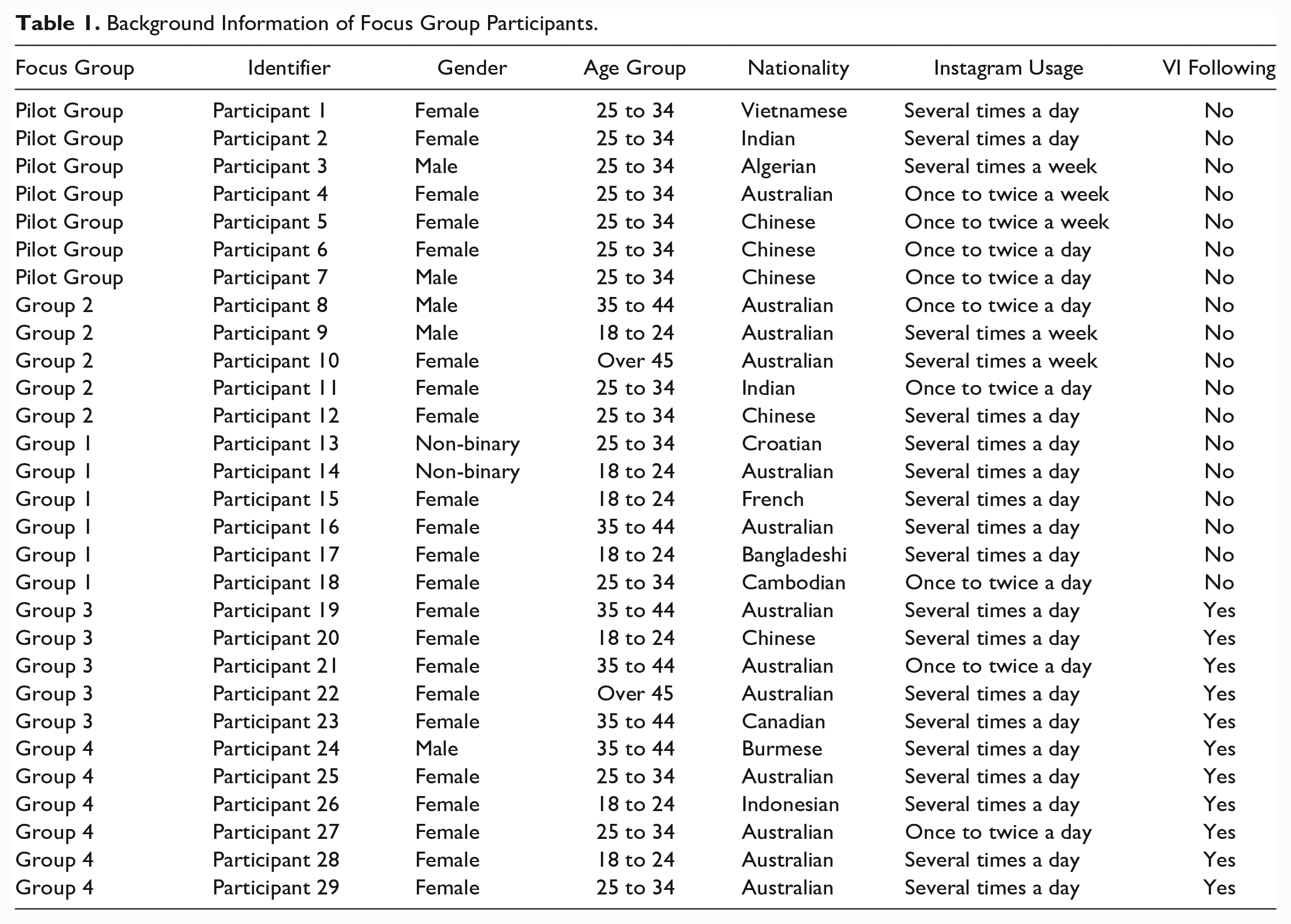
Purposive sampling was adopted. Instagram users who were at least 18 years old and residing in Australia were recruited. Both VI followers and non-followers were recruited as it is important to not only understand how followers engage with VIs but also how non-followers might be attracted to VIs. Table 1 displays participants’ background information labeled with identifiers to ensure confidentiality. Overall, five 90-minute focus groups were conducted with a total of 29 participants (22 female, five male, and two non-binary). Approximately 48% of participants were aged 25 to 34, 28% were aged 18 to 24, 17% were aged 35 to 44, and 7% were aged over 45. Participants were drawn from a range of nationalities but were residing in Australia at the time of the data collection. Over half of the participants used Instagram several times a day.
Background Information of Focus Group Participants.
Data Collection
A focus group interview protocol (see Appendix B in the online supplemental material) was developed and cross-checked by the research team. The protocol adopted a “funnel-style” moving from broad, participant-oriented questions to more specific research-oriented questions (Morgan, 2012). As the focus of this study is on anthropomorphic VIs, eight Instagram posts from different humanlike VIs were displayed to stimulate discussion among participants. These posts were carefully selected to cover source and content factors that encourage Instagram users’ engagement with VIs, as identified in the netnographic investigation. The VIs chosen were diverse (i.e., different in human likeness, gender, and cultural background), and an array of indoor and outdoor tourism settings (i.e., restaurant, destination, hotel, event) was covered to increase generalizability (see Figure 1).
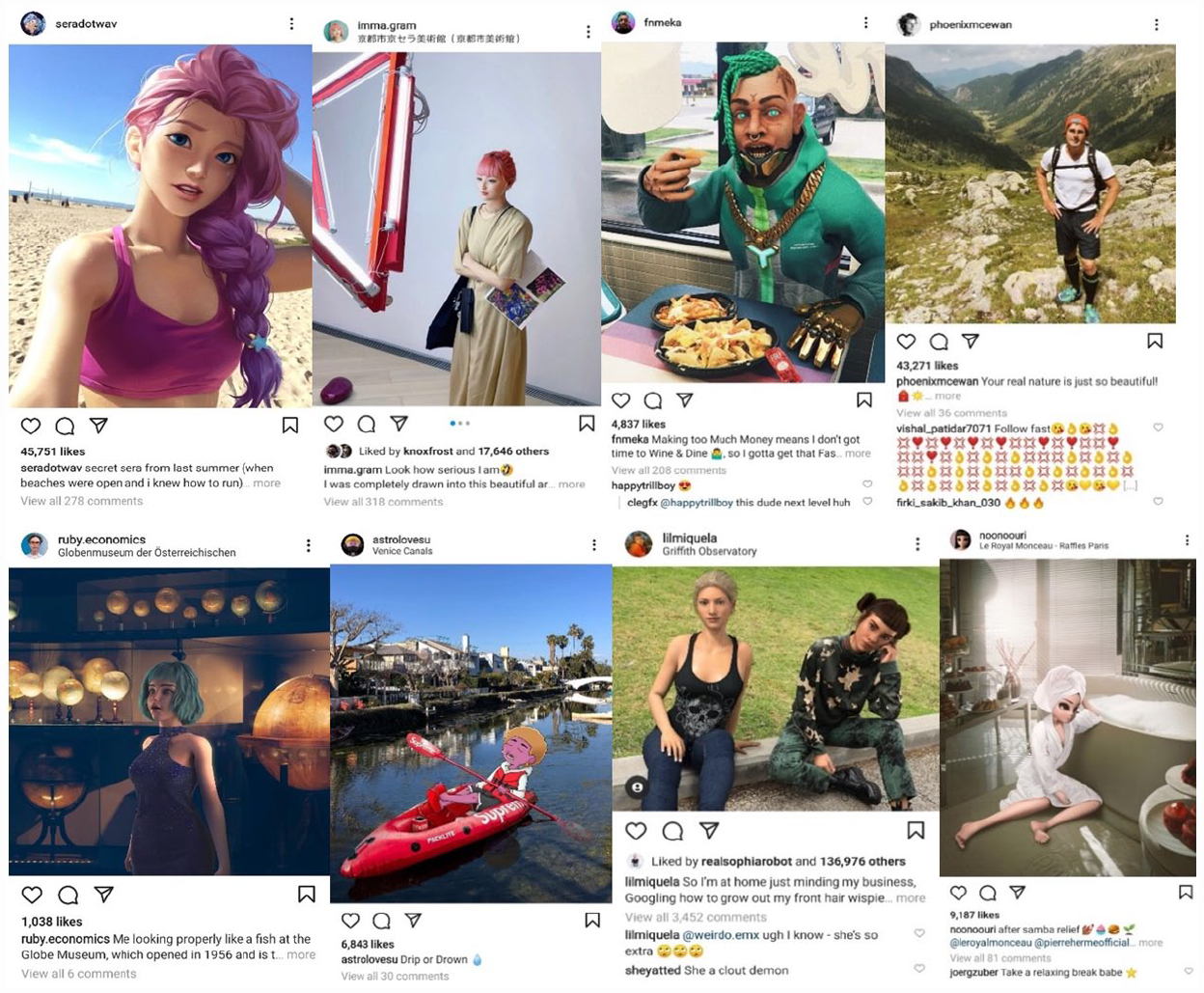
Selected VIs’ Instagram Posts.
To emulate a dual processing approach (Chaiken & Trope, 1999), the interview protocol was designed in two phases: initial inspection and focused examination. This is because users’ initial reactions may be different from those generated by closer scrutiny. As liking and commenting are the most common ways to engage with Instagram posts (Yu & Sun, 2019), user engagement was measured based on the likelihood of participants pausing on a VI post, liking the post, or intending to comment on the post.
During the initial inspection stage, participants were invited to browse eight Instagram posts (see Figure 1). This activity was designed to emulate the way users scroll on their Instagram feeds. They were instructed to choose one post that caught their attention to identify engagement factors at first glance. In the focused examination stage, the eight VIs’ Instagram posts were divided into two sets of four posts (i.e. top and bottom four posts as shown in Figure 1). Grouping of those posts took into account VIs’ human likeness, tourism contexts, and gender. Participants were invited to discuss one set of posts in relation to image(s), caption, and a selection of three comments/dialogues (see Figure 2).
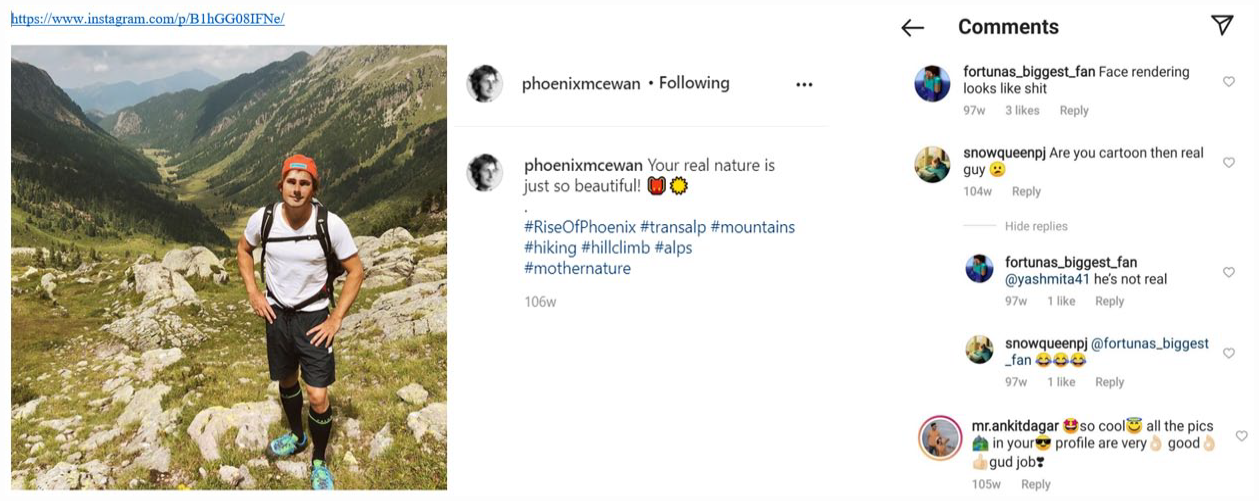
An Example Post Used in the Focused Examination Phase.
While a 2 (groups of Instagram users) by 2 (sets of four Instagram posts) design was adopted, this was not intended to be an experiment. Rather, participants were grouped based on whether they followed VIs. This sampling approach was adopted because homogeneity among participants is more likely to elicit rich insights in focus group discussions (Morgan, 1997). Due to time constraints and to avoid possible fatigue, each focus group was given one set of four VIs’ posts during the focused examination phase. Each set was viewed by at least one group of VI followers and one group of non-followers to ensure all posts were examined equally.
Ethical approval was obtained from the university’s ethics committee prior to data collection. The lead researcher recruited and trained an assistant moderator to facilitate Zoom focus groups. This was critical, as participants’ verbal cues and body language are more difficult to observe and capture in online environments (Krueger, 1997). To minimize the potential bias of researcher positionality, an assistant moderator of different gender and cultural background was selected.
Participants were recruited using Facebook advertisements and a university e-newsletter with an incentive of a $30 AUD eGift Card for participation. Five focus groups were recruited with one pilot group of PhD students from different disciplines who did not follow VIs, two focus groups of Instagram users who followed VIs, and two groups who did not follow VIs.
The data were collected over 5 days between September 23 and October 19, 2021. Data collection and data analysis were conducted concurrently, meaning that data analysis commenced as soon as a focus group was concluded and before the next focus group was conducted. This process helps to include further questions and validate participants’ responses in the subsequent focus group. As no new themes emerged after the fifth focus group, it was assumed that data saturation had been reached (McQuarrie & McIntyre, 1987). Groups were kept relatively small (i.e., five to seven participants) to counter issues such as transmission delays and insufficient social cues, and to facilitate the emergence of rich data (Liamputtong, 2011). During data collection, the order of the eight Instagram posts in the initial inspection was randomized to avoid potential bias. Fieldnotes were taken during each focus group and a debriefing between the lead researcher and the assistant moderator was recorded immediately after each session. The data derived from fieldnotes and debriefings were used to inform the content of subsequent focus groups and for analyzing participants’ responses.
Data Analysis
Focus groups were recorded on Zoom and transcribed verbatim using the in-built auto transcription software. Since no change in the protocol was implemented after the pilot group, data collected from the pilot group were included in the final dataset. The lead researcher manually checked and cleaned each transcription before importing to it NVivo 12 Plus for data analysis.
Data were analyzed using an inductive approach. Thematic coding was employed to allow constant comparison and interpretation of the data following Creswell’s (2011) visual model. This involved reading to understand participants’ discussions, segmenting transcriptions by interview questions, labeling segments with codes, reducing and combining codes into categories, and collapsing categories into three groups of factors.
The data were interrogated in a systematic and iterative process of coding and recoding using Nvivo to generate major categories. The lead researcher validated data interpretation with the assistant moderator in the preliminary data coding phase before scrutinizing each stage of the coding process with the other two researchers in the team to improve research rigor. The discrepancy in data interpretation was reconciled through an iterative process of data interrogation among the research team.
Results
Research findings are presented in two sections. First, Instagram users’ general views about VIs are described. Second, the findings of the initial inspection and the focused examination of VIs’ posts are presented.
General Views of VIs
Overall, Instagram users had mixed feelings toward VIs on Instagram. Followers were receptive to VIs as a new form of influencers expressing sentiments such as, “I think they [VIs] have their place and they have a purpose.” Some followed VIs out of curiosity, stating that “It’s a fairly new concept . . . so I’m still learning more about them and what they’re doing on Instagram.” On the other hand, non-followers expressed feelings ranging from surprise: “Wow, it’s a thing! I don’t even know where to place it”; to interest: “I think it’s interesting. It’s kind of a cool idea and kind of expected with this day and age”; to skepticism: “I tend to dislike them or be suspicious of them when it’s a person trying to create a character.” These reactions imply that users do not follow VIs for a variety of reasons, including lack of awareness, lack of strong persuasion, and lack of trust.
Although receptive to the idea of VIs, some non-followers raised ethical concerns about VIs’ usage. For example, the issue of social comparison surrounding body image is raised by Participant 17: “We shouldn’t compare ourselves to these creatures that are clearly modified and set to look a certain way to appeal to the public.” In addition, Participant 13 mentioned “I don’t have a problem with it [VIs] inherently because it’s a tool. . . . My main problem . . . is that it can be very ‘Hello fellow kids’ if it’s not self-aware.” It is notable that the transparency of VIs’ identities was concerning. In other words, participants supported the need for clear boundaries between the real and the fake on social media.
Initial Inspection
In the initial inspection, participants were asked to browse eight Instagram posts from eight VIs with various degrees of human likeness. Interestingly, the perceptions of VI followers and non-followers were consistent across five focus groups. Of the eight posts, the ones from more humanlike VIs (i.e., imma.gram and phoenixmcewan) and the least humanlike VI (i.e., astrolovesu) stood out. The factors that caught participants’ attention were mostly image related, and included the VIs’ appearance, image background, post sentiment, and users’ familiarity with a certain VI.
In relation to VIs’ appearance, perceived human likeness and physical attractiveness were discussed. Participants paid attention to VIs that are more humanlike because they “blend in” and were “more relatable.” Some participants felt they would “take it a little bit more seriously when they are promoting something.” However, VIs’ perceived human likeness is a double-edged sword. Some explained that the reason VIs’ human likeness caught their attention is because it was “a bit creepy” and “a bit uncanny.” In addition to perceived human likeness, VIs’ physical attractiveness was also mentioned. Participants used phrases such as “unusual kind of cool looking,” “distinct,” “striking and interesting,” and “beautiful” to describe the appearance of VIs. The image background was another key factor discussed, with descriptions such as “the scenic beauty,” “a beautiful view” and “the nature.” Some participants alluded to post sentiment such as “I like the humor aspect of it [the post]” as a key factor that attracts their attention. In the groups where participants followed VIs, familiarity with a certain VI was a drawcard, for example, “I saw this profile a couple of times.”
Focused Examination
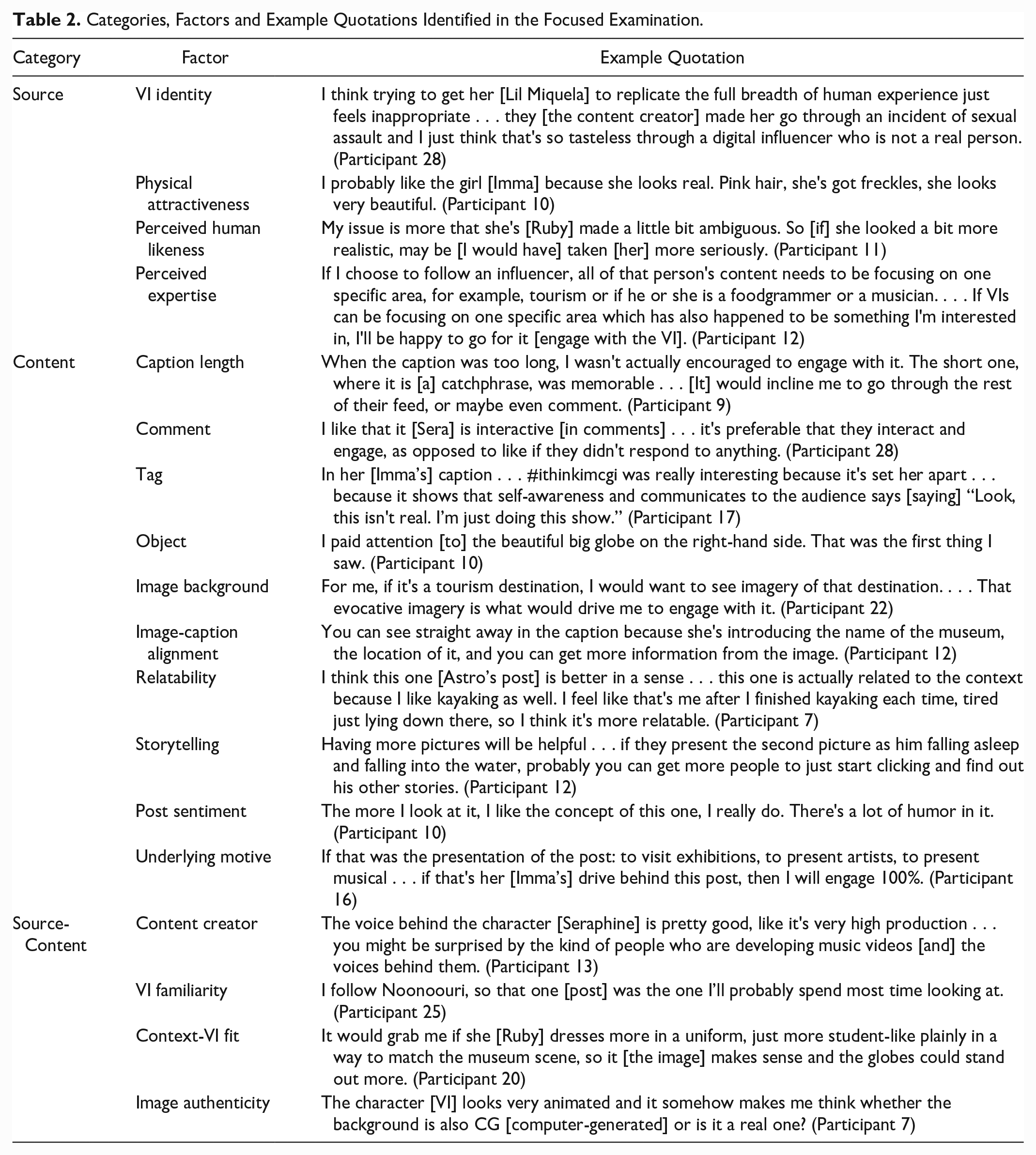
In the focused examination, participants were asked to closely examine four Instagram posts (one of the two sets) derived from those presented in the initial inspection phase. Participants were shown Instagram image(s), the caption, and three comments/conversations of each post. Surprisingly, gender, age, and VI following did not impact participants’ overall responses, although a few nuances were identified and discussed below. Based on participants’ responses, the key factors discussed were grouped into one of three broad categories: source factors (related to VIs), content factors (related to posts), and source-content factors (related to both VIs and posts). Table 2 provides a summary of the categories, factors, and example quotations.
Categories, Factors and Example Quotations Identified in the Focused Examination.
Within the source category, VI credibility (physical attractiveness, perceived human likeness, and perceived expertise) was deemed important in driving user engagement. Several participants commented that VIs’ appearance seemed to be meticulously designed to appeal to certain demographics. Intriguingly, some participants advocated for leveraging technology to create a more distinctive VI appearance instead of trying to emulate humans. However, participants had disparate views on whether VIs should appear in tourism settings. For example, Participant 22 commented, “if the purpose of the images [is] to sell this destination, then I could live with or without an influencer in it.” In contrast, Participant 4 stated, “I think that the majority of that audience comes from the way they [influencers] look, and that is why they are putting themselves in every photo, even though it’s not required.”
The perceived human likeness of a VI played a significant role in terms of VI trustworthiness. Many participants preferred VIs that appeared more humanlike or clearly not humanlike. VIs that appeared somewhat humanlike made participants feel uncomfortable. Additionally, participants discussed the importance of demonstrating VIs’ expertise in travel and tourism in their posts and that it was the content creators’ responsibility to showcase this through travel related posts.
Within the content category, participants were motivated to go to the comment section for curiosity and entertainment. VI’s replies to users’ comments also attracted attention. Participants’ discussions suggested that comments have two essential functions: to validate Instagram users’ assumptions about a VI’s identity and to signal whether a post was worthy of further engagement. Another important content factor is tags (hashtags, geotags, and image tags). The function of tags is threefold: to promote tourism settings, to provide post contexts, and to disclose VIs’ identities. Participants felt tags were essential for tourism marketing on Instagram but they preferred it when tags were used to promote tourism rather than to promote VIs.
On the post level, participants preferred posts where they could see a connection between the image(s) and the caption, particularly when the image(s) and the caption complemented one another. Relatability was also seen as critical in stimulating user engagement. Participants responded positively to tactics such as having “an open-ended question”, offering opportunities to “learn about places,” incorporating “social messaging” in tourism promotion, and having a direct and clear message such as “get yourself down to the museum”. They highlighted the importance of believability in making VIs’ content relatable. Participant 23 explained, “For it to be relatable, it needs to be believable. . . . I need to see myself there for me to think, ‘Yes, this is something I want to do’, . . . and a Bratz doll in a fake-looking room doesn’t do that.”
Storytelling was another key factor discussed. Most said they would not read a story in a long caption and preferred stories presented as swipe-able images. They agreed that details shown in Instagram images helped to build visual storytelling. Examples included VI’s facial expressions such as “eye contact” and interactions with the background such as “looking at the food on the table or trying out some of the food.” Moreover, participants felt the focus of the story should be about tourism contexts. For instance, Participant 4 stated, “I’d rather see what she [Ruby]’s so amazed at and I would put the camera behind her or you can just see maybe the smallest part of her head and body and then what she’s staring at as the main focus.”
Post sentiment was also a main factor that influenced user engagement, although, interestingly, this was not mentioned by male participants. Female and non-binary participants said they tend to connect with posts that elicit emotional reactions. The underlying motives for creating tourism related posts were also mentioned, although only by younger participants. Several participants expressed the difference between tourism promotion and self-promotion, stating that they were interested in engaging with posts where VIs were used as a marketing tool to promote tourism experiences. Further, building an overarching narrative for VIs (e.g., a sense of purpose or perceived expertise) was preferred over endorsing a series of arbitrary brands and products.
Within the source-content category, it appeared that familiarity with certain VIs impacted whether VI followers would engage with certain VIs’ touristic posts. The congruence between VIs and tourism settings was also important, although only female participants articulated this point. Image authenticity was highlighted, with some mentioning that they associated the fakeness of the VI with the fakeness of the tourism setting. In other words, participants were more likely to doubt the realness of the tourism background when the influencer in the image did not seem realistic. Likewise, the tourism background was not perceived as authentic when it appeared staged. Figure 3 illustrates a proposed conceptual framework of the key source and content factors identified.
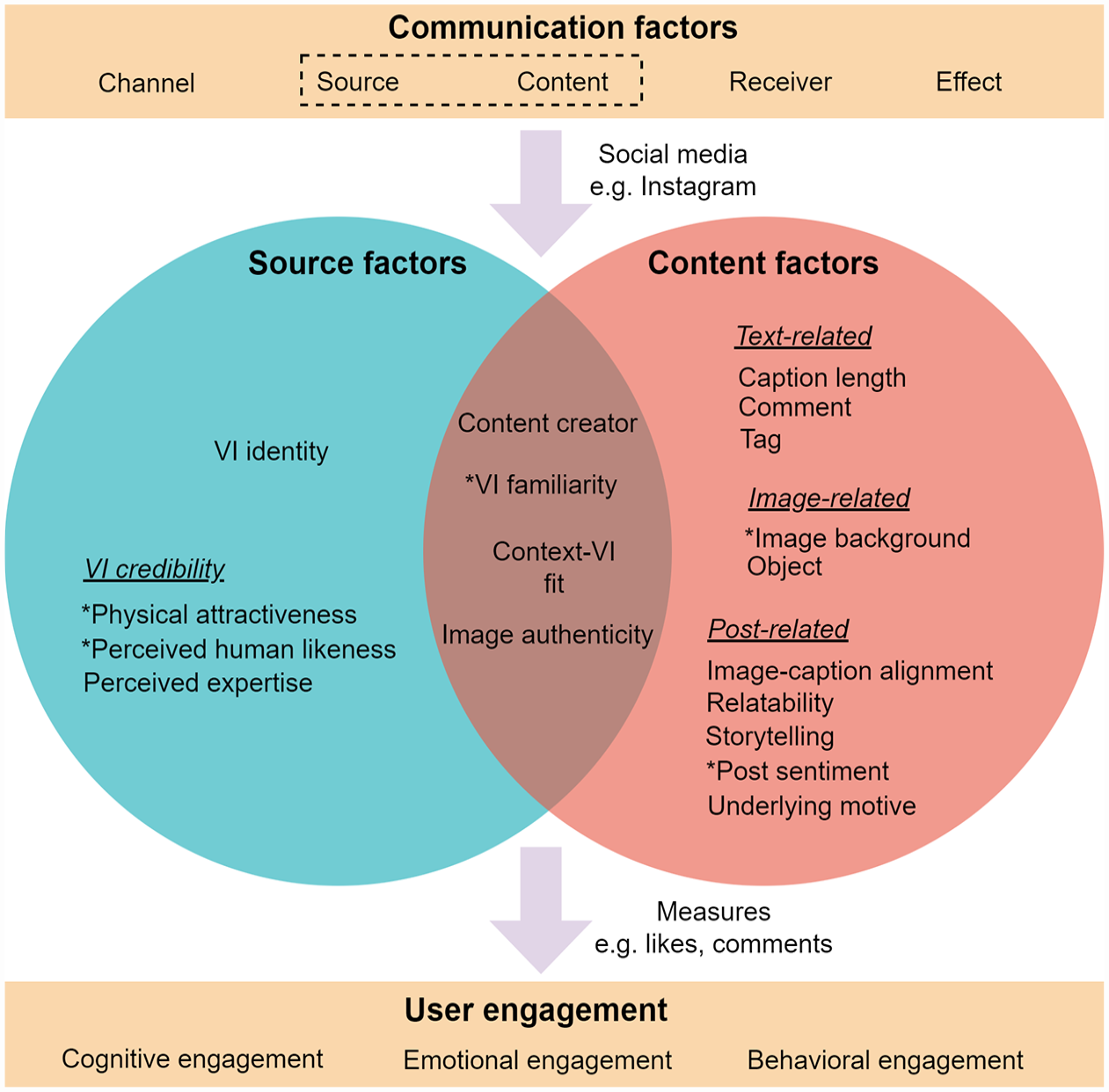
Proposed Conceptual Framework of Key Factors Prompting User Engagement With VIs in Tourism Contexts.
Discussion and Conclusion
This study found that VI followers were receptive to VIs being used to market tourism products, services, and experiences. Most non-followers were also receptive, provided that ethical concerns had been addressed. Intriguingly, the factors that stimulated engagement were consistent between VI followers and non-followers, with the exception of VI familiarity. Extending on previous studies related to human endorsers (Ohanian, 1990), factors that determine source credibility of VIs not only include physical attractiveness and perceived expertise, but also perceived human likeness. The present study supports Molin and Nordgren’s (2019) finding that perceived human likeness plays a crucial role in influencing source credibility in the VI context. Participants were more likely to engage with VIs in tourism settings when they appeared either more humanlike or clearly not humanlike. VIs that appeared somewhat humanlike triggered unease. This supports the uncanny valley theory aligning with previous research (e.g., Arsenyan & Mirowska, 2021). These findings suggest that it would be wise to leverage technology to create VIs who are clearly at one or the other end of the humanlike spectrum.
Findings support those reported in studies of human influencers. For example, context-VI fit mirrors product-endorser fit in the human context (e.g., Schouten et al., 2020). It is evident that the congruence between VIs and tourism settings is pivotal. The current study found that only female participants identified this factor, maybe because females are more receptive to influencer-endorsed marketing (Hudders & De Jans, 2022) and therefore pay close attention to the congruence between the product and the endorser.
Also in support of previous studies with human influencers (e.g., Terttunen, 2017), tags such as hashtags, geotags, and image tags were deemed important content-related factors for tourism marketing. In addition to how human influencers use tags, VIs leverage hashtags to disclose their identity. This is not only ethical but also creative in distinguishing VIs’ posts from those of human influencers. It should be noted that participants emphasized the importance of using tags for tourism promotions rather than VIs’ self-promotions. This was also evident in their preferences for image backgrounds and underlying motives where participants explained that the focus should be on tourism rather than VIs. Simply put, participants preferred the VIs’ stories and experiences not to overshadow the tourism product, experience, or destination.
In terms of storytelling, participants preferred to engage with visual content that conveyed storylines in tourism contexts, supporting Moustakas and colleagues’ (2020) argument that storytelling plays a key role in VI marketing. Users’ preference for visual storytelling through swipeable images may be due to Instagram being primarily a photo-sharing application. Visual content might also help users to absorb information more readily (Lankow et al., 2012).
The sentiment of travel posts was an important point of discussion, supporting Shin and Lee’s (2020) findings that some users engage with VIs’ sentimental content. Given participants’ preference for tourism-related information in the caption, it is unclear whether users prefer to engage with tourism information or sentimental content. This could be explored in future research.
Unlike reactions to, and perceptions of, human influencers, viewers were far more focused on the content creator in VIs’ posts. The lack of transparency about content creators raises ethical concerns, which aligns with Choudhry and colleagues’ (2022) finding that content creators’ potential manipulation of VIs was concerning. The embodiment of image authenticity in the VI context also differs from the human context. Participants associated the fakeness of VIs with the fakeness of the tourism settings in images. That is, the audience has limited trust in VIs, which transfers to the lack of trust in their content (Choudhry et al., 2022). Establishing VIs’ credibility is therefore critical.
Research Contribution and Implications
This study is the first comprehensive investigation of user engagement with VIs in tourism contexts. Collectively, it has three key theoretical contributions. First, it sheds light on the novel phenomenon of VI marketing in tourism. This is important as the innovation of information communication technologies is the driving force for tourism competitiveness (Buhalis, 2019). By bridging VIs, user engagement, and tourism marketing, this study unlocks new avenues for conceptualizing VIs as tourism ambassadors. It lays the groundwork for future research on this emerging trend and challenges the assumption that VIs and human influencers are inherently different. The current study also suggests that VIs could be effective alternatives to human influencers if carefully curated. The factors that prompt VI followers’ engagement mirror those mentioned by non-followers, indicating that little would be needed to convert non-followers into followers.
Second, this study used Lasswell’s (1948) model of communication as a basis for exploring the key source and content factors that drive user engagement with VIs. While the theory has been used to conceptualize social media influencers (e.g., Sundermann & Raabe, 2019), few researchers have applied it to scope empirical studies. This study took a pragmatic and systematic approach to investigate user engagement, which produced a nuanced and critical understanding of the emerging phenomenon of VIs.
Third, this study developed a framework for exploring user engagement with VIs holistically. It differentiated factors that drive user engagement with VIs in the initial encounter and in the closer scrutiny phase. Apart from identifying individual engagement constructs, this study validates that the source credibility model and the uncanny valley theory are applicable to VIs. It also reveals that a VI’s perceived human likeness is an important component of source credibility. Current research related to VI engagement, such as Choudhry et al. (2022), is in its infancy, with fragmented knowledge that lacks a systematic overview. In the absence of a holistic understanding, tourism practitioners are not likely to implement strategies to leverage VI marketing effectively. This is particularly important given the lack of VI research (if any) conducted in the tourism context.
This study provides a foundation to explore engagement with VIs on other virtual platforms (e.g., the metaverse) and in other contexts (e.g., education and healthcare). Several suggestions for leveraging VIs in tourism marketing are proposed. First, practitioners should design VIs in a way to minimize potential ethical concerns. They could consider creating VIs with a variety of body shapes and physical features. As Participant 17 articulated, individuals tend to set unrealistic expectations of themselves in comparison to VIs’ flawless appearances. Marketers should be transparent about VIs’ identity and content creators, as these foster trust between the audience and VIs. Practitioners are encouraged to disclose VIs’ identity by sharing behind-the-scenes content and using hashtags. For example, apart from being used to emphasize tourism attributes, hashtags could be employed to clarify the nature of the post (e.g., #sponsorship) and disclose VIs’ identity (e.g., #virtualhuman).
Second, practitioners have greater control over the appearance and actions of VIs compared to human influencers. This affords them the opportunity to increase the relatability of VIs in promoting tourism. Such an approach is important, otherwise audiences may find it difficult to resonate with VIs when they are not physically in the setting and are expressing feelings that are innately human. That said, no clear evidence was found in the current study that VIs’ non-human identity plays a detrimental role in influencing user engagement in tourism contexts.
Third, practitioners may be able to increase VIs’ credibility by manipulating factors such as physical appearance, perceived human likeness, and perceived expertise. Specifically, practitioners should use VIs’ non-human identity to their advantage by making VIs’ physical appearances unique. For example, Imma’s pink hair allows her to stand out from other humanlike VIs. In addition, VIs with either extreme human likeness or extreme non-human likeness are more likely to drive user engagement. Hence, practitioners should avoid the use of VIs that appear somewhat humanlike as this triggers discomfort. Since VIs do not have innate personalities, there is an opportunity for practitioners to create VI personas to attract specific target populations. VIs’ travel content could be strategically curated to align with their designed personalities (Moustakas et al., 2020). Regarding expertise, unlike human influencers, practitioners can “create” expertise for VIs in travel. Building tourism expertise by carefully orchestrating posts is important for the credibility of VIs. For instance, LG Electronics created a VI named Reah Keem and developed her travel and music expertise through a number of posts, which allowed Reah Keem to build credibility that supported future advertising endorsements (Hiort, 2022).
Fourth, sentimental posts and storytelling encourage user engagement. When used appropriately, emotional content resonates well with the audience. Participants in the current study preferred to view VIs’ storylines through swipeable images. That is, using multiple images to visualize VIs’ storytelling on social media. Particularly, creating images that emphasize the setting rather than the VI (e.g., selfies) may be more effective in a tourism context.
Finally, in addition to enhancing VIs’ credibility, practitioners could increase VIs’ image authenticity by implementing a more natural or candid approach to image composition. This is crucial as participants found it difficult to trust VIs’ images when they appear perfectly staged. One example of a plausible solution is to include real tourists in the image background of a tourism destination.
Limitations and Future Research Directions
This study is one of the first research to explore the use of VIs in tourism; however, it is not without limitations. The research sampled adult Instagram users in Australia, thus the sample may not be representative of all Instagram users or users on other social media channels. Future research is encouraged to investigate engagement with VIs using sample populations from different social media platforms, geographical locations, and age ranges. While evaluating cultural differences was beyond the scope of this study, it would be valuable to explore the role of cultural factors in individuals’ engagement with VIs. Further, this study focused on user engagement with anthropomorphic VIs but not zoomorphic VIs. According to Baklanov (2021), there are a number of zoomorphic VIs that ranked in the top Instagram VI list in 2021, indicating that zoomorphic VIs are on the rise. Hence, it would be valuable to explore user engagement with zoomorphic VIs or compare the similarities and differences between anthropomorphic VIs and zoomorphic VIs.
Two issues that emerged in focus group discussions warrant future research. First, participants had opposing views of whether to incorporate VIs or even human influencers in tourism related posts. It would be useful to conduct experiments investigating the differences in user engagement among posts that include VIs, posts that include human influencers, and posts that have no influencers. Second, it is unclear whether participants preferred captions with rational and information-heavy rhetoric or captions expressing emotional rhetoric. While some studies highlight the significance of rational discourses in communication (e.g., Wang & Lee, 2019), other research (e.g., Shin & Lee, 2020) indicates the importance of emotional appeals for generating engagement with VIs. In the present study, the importance of both rational discourse and emotional discourse was expressed by participants. Further research to ascertain the relative significance, appeal, and impact of each is needed.
The conceptual framework proposed in the current study provides a guide for exploring and refining the key source and content factors that drive user engagement with VIs in tourism contexts. In addition to source and content factors, it would be beneficial for future research to explore other communication factors (i.e., channel, receiver, and effect) listed in the framework. Moreover, this study focused on factors that stimulate user engagement; it is still not clear how user engagement affects the audience’s subsequent uptake of targeted behaviors. Thus, future research could involve collaborations with tourism practitioners to explore the return on investment of using VIs to market tourism products, experiences, and destinations.
Supplemental Material
sj-docx-1-jht-10.1177_10963480231180940 – Supplemental material for Keep it #Unreal: Exploring Instagram Users’ Engagement With Virtual Influencers in Tourism Contexts User engagement with virtual influencers
Supplemental material, sj-docx-1-jht-10.1177_10963480231180940 for Keep it #Unreal: Exploring Instagram Users’ Engagement With Virtual Influencers in Tourism Contexts User engagement with virtual influencers by Li Xie-Carson, Pierre Benckendorff and Karen Hughes in Journal of Hospitality & Tourism Research
Footnotes
Declaration of Conflicting Interests
The authors declared no potential conflicts of interest with respect to the research, authorship, and/or publication of this article.
Funding
The authors disclosed receipt of the following financial support for the research, authorship, and/or publication of this article: The first author Li Xie-Carson was supported by an Australian Government Research Training Program (RTP) Stipend and RTP Fee-Offset Scholarship through The University of Queensland.

Supplemental Material
Supplemental material for this article is available online.
Author Biographies
References
Supplementary Material
Please find the following supplemental material available below.
For Open Access articles published under a Creative Commons License, all supplemental material carries the same license as the article it is associated with.
For non-Open Access articles published, all supplemental material carries a non-exclusive license, and permission requests for re-use of supplemental material or any part of supplemental material shall be sent directly to the copyright owner as specified in the copyright notice associated with the article.
