




Abstract
Resources are central to value creation processes. Hence, marketing and service research rely heavily on conceptualisations of resources and resource integration for theory building efforts. One of the most widely accepted marketing lenses on resources and resource integration is the service-dominant (S-D) logic. Depicting resources as becoming and contextual, S-D logic argues that their usefulness co-depends on other resources. Some assumptions of S-D logic have been challenged particularly its dichotomous categorisation of operand and operant resources. To inform ongoing S-D logic theorising, our article problematises the multiple and contradictory ontological views upon resources and resource integration present within S-D logic. Moving beyond critique, we propose concrete means for reconciling these contradictions. Seeing a parallel between S-D logic’s ontological inconsistencies and past ontological disagreements in the philosophy of science, we draw on the philosophical perspective of Karen Barad to develop a consistent onto-epistemological foundation for conceptualising the becoming nature of resources in S-D logic. The theory adaptation we perform enhances the applicability and explanatory capacity of S-D logic, while also offering a more robust and rigorous foundation for marketing and service research at large and giving managers new means to make sense of co-dependent resource phenomena.
Introduction
Resources have an immanent role in value creation, such that their conceptualisation is fundamental to marketing and service research. In resource theorising, an important milestone has been the acknowledgement that resources are ‘highly dynamic functional concepts; that is, they are not, they become, they evolve out of the interaction of nature, man, and culture’ (Zimmermann, 1951: p. 814–815, emphasis added). This understanding of resources as not being, but rather as ‘becoming’ (Vargo and Lusch, 2004), has also been at the core of the development of what is now known as the service-dominant (S-D) logic (Vargo and Lusch, 2008, 2016, 2017). This paradigmatic lens (Brodie et al., 2019) has positively influenced marketing research and theorising for nearly two decades.
S-D logic recognises the emergent and dynamic (rather than pre-determined and static) nature of resources and assigns primacy to intangible resources, such as knowledge and skills (Vargo and Lusch, 2004). Overall, S-D logic views resources as contextual and co-dependent, such that ‘the usefulness of any particular potential resource from one source is moderated by the availability of other, potential resources from the other sources’ (Vargo and Lusch, 2011: p. 184). In S-D logic, resourceness – defined as the ability of potential resources to facilitate the accomplishment of something desirable – is determined in interactions of potential resources. These can function in combination, as either complementary or inhibiting, and they include actors’ own ability to recognise and integrate resources (Lusch and Vargo, 2014; Vargo et al., 2020). But while the becoming nature of resources is a core tenet of the S-D logic, it has received relatively little focused research attention compared with other features of the S-D logic, such as the co-created and phenomenological nature of value (e.g., Akaka and Vargo, 2014; Becker et al. 2023; Koskela-Huotari and Vargo, 2016; Peters, 2016).
This lack of in-depth investigation into the becoming nature of resources may have contributed to recent critiques of the S-D logic, such as questions about the usefulness of its categorical separation between operant and operand resources (e.g., Campbell et al., 2013; Mele et al., 2018; Nenonen and Storbacka, 2018). In the S-D logic, the term ‘operant resources’ refers to resources that are generally intangible and capable of acting on (i.e., integrating) other resources (e.g., humans, human knowledge and skills, humanly devised institutions). The term ‘operand resources’, on the other hand, refers to resources that are generally tangible and must be acted upon (i.e., integrated) by other resources (e.g., raw materials) (Akaka and Vargo, 2014; Constantin and Lusch, 1994; Vargo, 2018). This dichotomous conceptualisation of different types of resources has been questioned for prioritising the unilateral integration of operand resources by humans (as operant resources), without considering other ways in which the social and natural worlds might relate. Emerging empirical developments give force to this criticism. For example, the primacy of humans as operant resources is less evident when we consider service robots, chatbots and artificial intelligence, as well as the unfolding of climate change and the COVID-19 pandemic. As these phenomena highlight, value creation and the development of service ecosystems cannot be determined exclusively by humans as operant resources. Moreover, as we elaborate below, this dichotomous conceptualisation of resources is based on assumptions about the inherent agency of different types of resources that are inconsistent with the idea of resources being a fundamentally contextual and becoming phenomenon.
Extending these critiques, we specify three inconsistencies in the S-D logic's current conceptualisation of resources. These reflect an underlying contradiction between the S-D logic’s relational, process-ontological understanding of the becoming nature of resources on the one hand, and its substance-ontological understanding of resource integration on the other. A substance-ontological view asserts that entities such as resources have an independent existence and persist over time, even though their properties may change. In contrast, a relational, process-ontological view emphasises that entities such as resources only exist in relation to other entities, and that the ever-changing nature of those relationships determines the nature of the entities themselves (Langley and Tsoukas, 2010). S-D logic simultaneously adopts both of these contradictory ontological positions, generating critical inconsistencies pertaining to (1) what actually gets integrated in resource integration, (2) who coordinates resource integration and (3) how agency manifests in this process.
Inspired by Hunt’s (2020) foundational premises approach and Vargo and Lusch’s (2017) calls for further development of the S-D logic, we move beyond critique to offer an internally consistent, onto-epistemological foundation for conceptualising resources as contextual and becoming phenomena. To establish this foundation, we draw on comprehensive discussions about the merits of substance- and relational, process-ontological perspectives in the philosophy of science. In particular, the quantum physicist and social theorist Karen Barad (2003, 2007) offers an internally consistent conceptualisation of the contextually becoming nature of objects and subjects, conceiving all natural and social entities as fundamentally entangled, and co-constitutive of one another. This Baradian perspective is well-established in wider business literature (e.g., Cecez-Kecmanovic et al., 2014; Leonardi, 2013; Orlikowski and Scott, 2008) and has been implicitly identified as a way forward for the S-D logic (Mele et al., 2018; Nenonen and Storbacka, 2018; Vargo, 2018). Moreover, Barad's work has also featured in the marketing and consumer behaviour literature (Cheded and Skandalis, 2021; Petersson McIntyre, 2020; Steinfield, 2022), albeit with less concern for how their work might contribute to resource theorising. By drawing on Barad’s lens, we propose a fundamental reconsideration of the resource and resource integration concepts in the S-D logic. Our proposal builds on a coherent onto-epistemological foundation that pays full respect to the concepts’ ‘becoming’ nature, and the ethical considerations that arise as part of this becoming.
In this sense, we perform a theory adaptation to amend a focal theory (S-D logic) by applying a method theory (Lukka and Vinnari, 2014; Jaakkola, 2020) – the philosophy of Karen Barad (2003, 2007). This allows us to make several contributions. First, we clarify the challenges currently inhibting S-D logic theorising about resource becoming. Identifying two distinct and contradictory ontological perspectives underpinning the S-D logic, we distil three specific inconsistencies that, despite the wide-ranging literature on and impact of S-D logic theorising (e.g., Wilden et al., 2017) limit its continued proliferation and generation of insights. Second, we propose conceptual remedies. By making sense of resources and resource integration through a Baradian entanglement and indeterminacy lens, we arrive at an alternative conceptualisation of resources and resource integration that overcomes the internal inconsistencies of the S-D logic. This new conceptualisation can function as an onto-epistemological foundation for further investigations of becoming marketing phenomena, and holds important ethical implications.
The remainder of this paper is structured as follows: We first identify the ontological inconsistencies in the S-D logic and explain why other resource-related theories are unable to address them. Drawing on Baradian philosophy, we then build an alternative perspective that comprises four concepts – resource indeterminacy, resource intra-action, resource-enacting phenomenal practices and resource intra-activity – and also calls for a reconceptualisation of agency within the S-D logic. As we show, these conceptualisations can overcome the ontological inconsistencies currently present in the S-D logic. Finally, we discuss the theoretical and ethical implications that stem from this new perspective.
An S-D logic lens on resources
Definition and categorisation of resources
The S-D logic defines resources broadly as ‘anything an actor can draw on for support’ (Vargo and Lusch, 2017: p. 740). In this sense, all actors (e.g., customers, suppliers, other stakeholders) provide and benefit from applying resources (Kleinaltenkamp et al., 2012; Vargo and Lusch, 2011) – a process referred to as resource integration (Vargo and Lusch, 2016: p. 7). In this process, actors integrate resources to co-create value, such that they improve their own well-being by improving the well-being of others (Lusch and Vargo, 2014). Resources can be tangible or intangible, as well as internal or external to actors (Lusch and Vargo, 2014). Lusch and Vargo (2014: p. 119) also acknowledge that ‘[a]ctors themselves are ‘operant resources’ when they apply their resources (primarily knowledge and skills) to provide service to other actors’. In addition to mental, relational and behavioural resources, skills and competences often are cited as operant resources (Vargo and Lusch, 2004). Moreover, social roles (Akaka and Chandler, 2011) and signs and practices (Löbler and Lusch, 2014) can be key resources for value co-creation.
S-D logic has always striven to avoid an overemphasis on tangible and static resources (e.g., natural resources), traditionally viewed as real and embedded with value, to ensure a more comprehensive and dynamic view (Lusch and Vargo, 2014; Vargo and Lusch, 2004). In this sense, the S-D logic views resources not as inherently valuable, but instead as becoming more or less valuable according to the context of their integration with other (potential) resources (Chandler and Vargo 2011; Koskela-Huotari and Vargo, 2016) and the benefits they afford in those contexts.
The categorisation of operand and operant resources reflects a mathematical view, in which operands, as quantities (e.g., the number 5), and mathematical operations (e.g., addition) both constitute necessary, but fundamentally different types of inputs (Koskela-Huotari et al., 2018). Accoding to the S-D logic, there can be no value co-creation without the activity of operant resources, because any use of an operand resource requires its integration through operant resources (e.g., actor’s knowledge and skills). By distinguishing operand and operant resources and viewing agency as inherently vested in the latter, the S-D logic seeks to shift discussions of resources from a focus on the accumulation of scarce operand resources toward the integration and generation of adaptive operant resources (Lusch and Vargo, 2014; Lusch et al., 2010; Vargo and Lusch, 2004). Nonetheless, the categorical separation of operand and operant resources as inherently vested with different degrees of agency in the process of resource integration evidences how the S-D logic is, in part, underpinnined by a substance-ontological perspective that focuses on distinct entities holding stable attributes over time.
Finally, the S-D logic asserts that resource integration is not random. Instead, resource integration activities and interpretations of resourceness conducted by actors, as operant resources, reflect institutional arrangements (Edvardsson et al., 2014; Koskela-Huotari and Vargo, 2016). In this view, the constellations of rules, norms and taken-for-granted beliefs that form an institutional setting (Scott 2013) provide the basis for attributing potential and realised value to resources. Institutional arrangements thereby structure resource becoming and provide options for value co-creation (Kleinaltenkamp, 2018).
The becoming nature of resources
In addition to the preceding core definitions and categorisations, resources in the S-D logic are understood as continually forming and reforming through processes and outcomes, rather than being fixed inputs or outputs. This conceptualisation implies a world filled with resources whose potential value is realised only when they are appraised and acted on in practice (Lusch and Vargo, 2014). Accordingly, the S-D logic does not view resourceness as an inherent quality of things or offerings. Rather, the S-D logic’s conceptualisation of resources and their becoming nature is grounded in the recognition that resourceness is an on-going and actor-defined accomplishment (Lusch and Vargo, 2014; Peters et al., 2014). It acknowledges that resources' potential to facilitate some desired outcome is contextually transformed into realised value through human appraisal, intentionality (Taillard et al., 2016) and action. The acquisition of resource status then represents the result of ‘a functional relationship between the thing, person, machine, money, institution or concept on the one hand and the intended activity being performed on the other’ (Löbler, 2013: p. 424).
In this vein, S-D logic recognises that resources are always integrated in the context of other resources (Lusch and Vargo, 2014; Vargo and Lusch, 2004, 2011), such that the potential usefulness of a resource depends on its interaction with other potential resources (Vargo and Lusch, 2011). When resource-integrating actors (i.e., operant resources) connect through reciprocal service exchanges, they conjoin their unique constellations of potential resources and form a new context for resource integration (Chandler and Vargo, 2011). As this dynamic understanding of context requires, a group of actors and their reciprocal links form the specific context for a given instance of resource integration, whereas another group of actors or relationships would produce a different context (Chandler and Vargo, 2011; Vargo and Lusch, 2011). This conceptualisation emphasises how resources become in a contextual process, highlighting its spatial and temporal dimensions. Understanding resource integration thus requires zooming in and out to understand actors’ (e.g. firms’ and customers’) dependencies and interdependencies, as generated not by isolated actions but rather by webs of service-for-service exchange relationships.
These recognised interdependencies evidence the S-D logic’s relational, process-ontological understanding of resources. Overall, the S-D logic's conceptualisations of resources and resource integration also have important ethical dimensions. On the one hand, based on its statement that ‘the purpose of exchange is to serve each other’ (Vargo and Lusch, 2008: p. 5.), S-D logic takes an integrative approach that holds opportunities for reducing ethical conflicts in marketing (Abela and Murphy, 2008; Laczniak 2006). On the other hand, the primacy of operant resources (e.g., humans, human knowledge and skills) in resource integration always entails particular power relations in which some resources are considered valuable, privileged and capable of action, while others less so or not at all (Williams and Aitkin, 2011).
Inconsistencies in the S-D logic’s theorisation of resources
Because the S-D logic views resources as contextually becoming by nature, it does not see them to have a stable, independent existence beyond specific service-for-service exchange activities. This understanding represents the relational, process-ontological perspective underpinning the S-D logic. But it is at odds with the S-D logic’s description of resource integration, particularly the categorical separation of resources that it makes when explaining this process. Regarding the latter, the S-D logic primarily attributes the role of the integrator to operant resources (e.g., human actors, human knowledge and skills) who inherently (i.e., independently of context) possess the capacity to appraise potential resources and coordinate their integration (Vargo et al., 2020). Thus, the S-D logic espouses an understanding of resources as fundamentally relational, such that they are becoming across space and time (relational, process-ontological perspective), but in practice, it maintains that attributes such as the agency of different resources are inherent qualities of different fundamental categories of resources (substance-ontological perspective).
This contradiction between ontological perspectives also shines through in the S-D logic's description of how operant resources’ inherent agency becomes expressed: Operant resources are understood to appraise and integrate ‘potential resources’ (i.e., operand resources), which seemingly pre-exist the resource integration process as stable and independent entities, readymade to be subjected to agency and appraisal. Where do these potential resources come from, and what is the process by which they become? Beyond the categorical split of resources with different inherent degrees of agency, the S-D logic recognises that resources relationally and processualy become through resource integration processes on the one hand, but on the other substantively assumes the existence of ‘potential resources’ that precede this process of becoming. We argue that these tensions result in three theoretical inconsistencies that must be addressed to move the S-D logic forward.
First, the tensions raise a fundamental question about the ontology of resources and resource integration. Current resource integration concepts rest on a substance ontology, such that initially separate, ex ante existing operant resources and operand/potential resources become connected through the inherent agency of operant resources (i.e., operants appraise the operand/potential resources and decide to integrate them). Yet resource integration supposedly is grounded in an understanding of resources as contextually becoming, which as a relational ontology implies that no resources can exist independently or have inherent attributes such as agency. This ontological inconsistency raises the question of what is actually being integrated in resource integration? Do independently existing potential/operand resources get integrated (substance-ontological perspective), or is it the contexts through which these potential/operand resources become over time (relational, process-ontological perspective)?
Second, questions about coordination arise. The narrative underlying a substance-ontological understanding of operant resources and operand/potential resources possessing different inherent degrees of agency postulates that operant resources have inherent agency, exist separately from the operand/potential resources, and unilaterally coordinate the latter’s integration. If all resources are contextually becoming however, then the operand/potential resources being integrated by operant actors would already be part of the very context that allows the operant actor to exist and exercise agency in the first place. Accordingly, we must ask, who coordinates resource integration? Is it operant resources with inherent agency, or the contexts through which these operant resources become? And to what extent do these contexts already include supposedly separate operand/potential resources to be integrated?
Third, the tension surrounding the coordination of resource integration cuts to the core of how agency is understood in the S-D logic. The basic categorisation of resources into operant ones that are inherently have agency and are primarily human, versus operand/potential resources that inherently do not have agency and are primarily non-human clashes with the relational, process-ontological understanding of resource becoming. In other words, resource becoming raises the question of whether agency really is inherent to certain resources. A relational process understanding instead might view agency as a contextual enactment. But if agency were an enactment, what does it imply for the S-D logic’s institutionalised understanding of human actors as operants in resource integration and mundane materials as the operands?
In summary, we seek an ontological foundation that can cohere resource and resource integration concepts in the S-D logic. To do justice to its critical insights and advance this meta-theoretical framework, we need an ontological lens on resources and agency that can reconcile the clashing substance- and relational, process-ontological understandings currently present in the S-D logic.
Potential remedies from other resource-related theories
Ontological perspectives of resources in literature.
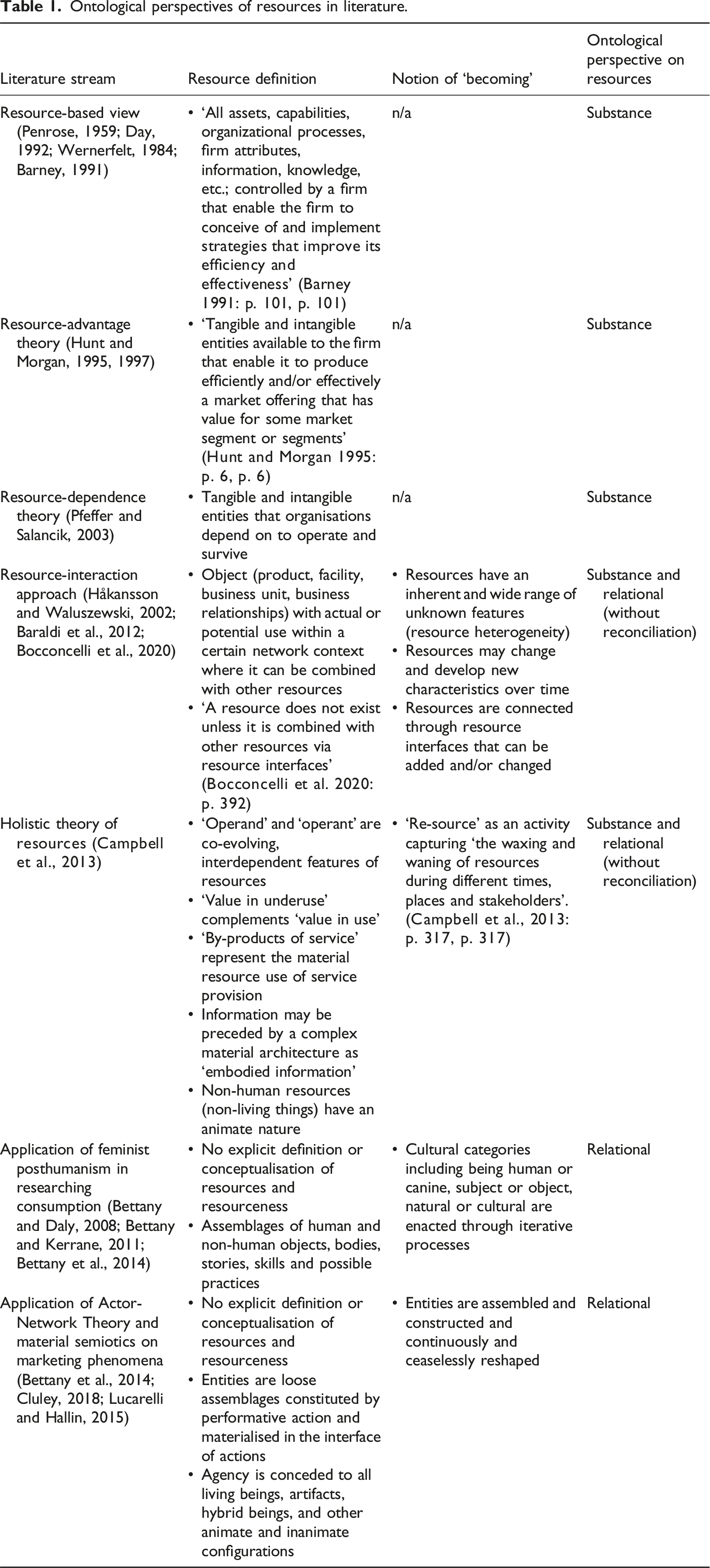
One attempt to reconcile the different ontological perspectives present within the S-D logic adopts a ‘holistic’ conceptualisation of resources that draws on actor-network theory and emphasises ‘the complex entanglement of operant and operand resources’ (Campbell et al., 2013: p. 306). This holistic conceptualisation includes an explicit critique of the primacy of operant resources over operand resources, as well as the lack of consideration of the relationality of resources. Furthermore, this lens introduces the ‘re-source’ concept to describe an activity that captures ‘the waxing and waning of resources during different times, places and stakeholders’ (Campbell et al., 2013: p. 317) (see Table 1). This view thus takes an important step toward reconciling ontological inconsistencies, but it does not explicitly theorise how the relations of various animate and inanimate, or natural and social entities lead to more or less resourceness or to the existence (or non-existence) of resources. Nor does it sufficiently address underlying assumptions about the nature and relationship of resources to provide a foundation for an internally consistent resource perspective. In the illustrative examples they offer, the authors of the holistic conceptualisation appear to maintain a substance-ontological understanding of resources, describing different constellations in which pre-existing resources do (or do not) serve a certain purpose or end.
Finally, several streams of research apply a relational, process-ontological view to investigate marketing phenomena more generally. For example, Bettany et al. (2014), Cluley (2018), and Lucarelli and Hallin (2015), adopt actor-network theory and material semiotics (e.g., Callon, 1986; Latour, 1993; Law, 1992) to shine new light on the development of marketing metrics and the phenomenon of brand regeneration. Moreover, Bettany and Daly (2008) and Bettany and Kerrane (2011) employ Haraway’s (2003) feminist posthumanism to consumption research (see Table 1). Such studies emphasise the sociomateriality and performativity of both human and non-human objects, bodies, stories, skills and possible practices – such that they concede agency to all living beings, artifacts, hybrid beings, and other animate and inanimate configurations. However, they do not explicitly define or conceptualise resources or resourceness, thereby missing an opportunity to provide foundational theorising that might inform the S-D logic and broader marketing research.
In summary, existing resource and marketing theories do not present a sufficient or coherent solution for overcoming the ontological inconsistencies in the S-D logic. We argue that the most fruitful avenue for addressing these inconsistencies may lie in adapting the S-D logic by way of an underutilised method theory, namely, the ‘agential realism’ offered by Karen Barad (2003, 2007). First, in a striking parallel to the current state of the S-D logic, Barad developed their philosophy in direct response to a clash between substance- and relational process-ontological viewpoints that emerged in the philosophy of science during the early days of quantum physics research. Similar to the foundational drive of the S-D logic, Barad’s motive was to acknowledge the fundamentally relational and becoming nature of all phenomena, by providing a coherent onto-epistemological lens that would allow natural and social scientists to do so. Second, with a few exceptions (Cheded and Skandalis, 2021; Petersson McIntyre, 2020; Steinfield, 2021), Barad’s philosophy has not yet been used explicitly to advance marketing theory. In contrast to this underutilisation of Baradian philosophy in marketing, Barad’s lens has had a strong impact on management and information systems research, serving as a foundation for the concept of sociomateriality (Orlikowski, 2007; Orlikowski and Scott, 2008), which resolves the contradiction between technological determinism and human determinism by conceptualising human actors and technological artefacts as mutually constitutive of one another.
More recently, S-D logic scholars have expressed interest in sociomateriality and identified the concept as a promising avenue for moving beyond the often‐criticised dichotomy of operant versus operand resources (Mele et al., 2018; Nenonen and Storbacka, 2018; Vargo, 2018). We agree with this notion but also argue that the most promising approach is not to simply integrate the sociomateriality concept into the S-D logic – which cannot resolve or reconcile the ontological inconsistencies – but rather to leverage the Baradian foundations of the sociomateriality perspective to fundamentally rethink the S-D logic.
The philosophy of Karen Barad
Barad began their academic career as a physicist but came to the attention of the social science community in 2003, when they proposed linking work by sociologists such as Pickering (1984, 1995), Butler (1989), and Foucault (1970) to quantum physics as a means to conceptualise a ‘posthumanist performativity’ (Barad, 2003). In a subsequent book, Barad (2007: p. 26) further specified their philosophical lens, describing it as ‘agential realism’, which questions the dichotomy between the natural and social worlds, as well as the Cartesian dichotomy between observing subjects and observed objects. Barad highlights the ‘entangled’, i.e., inherently linked and co-constitutive nature of social and natural entities, as well as objects and subjects. This concept of ‘entanglement’ is key. Inspired by quantum physics, the concept captures the idea that, at the most fundamental level, everything is tied to everything, to the point where there are neither individually identifiable or separate entities, nor fixed meanings. Barad then explains how natural and social processes still appear to create separately existing, independent entities (e.g., ‘resources’) from this base entanglement. Barad’s thinking is unorthodox, and expressing it in common language can be challenging. As Orlikowski and Scott (2008: p. 468) note in their Barad-inspired conceptualisation of sociomateriality: ‘Part of the difficulty in discussing this perspective is that our language makes it difficult to express indissolubility. We are used to dividing, separating and distinguishing. Thus, even terms such as “mutual constitution,” “entanglement,” “assemblage,” and “relationality” allude to separateness, even as they try to move beyond it’. Despite these linguistic challenges, the potential of the Baradian perspective to advance S-D logic beyond the current ontological inconsistencies warrants deeper engagement with it.
Onto-epistemological directions in quantum physics
Barad’s philosophical work originates in the so-called uncertainty relations of quantum physics and particularly the divergent conceptualisations of this phenomenon by two pioneers of the field, Niels Bohr and Werner Heisenberg. According to Heisenberg (1927), uncertainty relations describe the phenomenon by which two complementary properties of a quantum particle (e.g., its location and momentum) cannot be known simultaneously with precision. Bohr (1928) noted a similar ambiguity when investigating whether light is a wave or a particle. With his famous two-slit diffraction experiment, Bohr confirmed that light could behave as both, depending on the measurement apparatus diffracting the light. Yet the two physicists took their experiences with uncertainty relations as departure points for fundamentally different onto-epistemological positions (Barad, 2007).
Heisenberg formulated an ‘uncertainty principle' based on a substance-ontological view, proposing that light exists as a stable and independent entity, but that measuring apparatuses could only imperfectly access its existence (e.g., measuring either location or momentum). Barad summarises Heisenberg’s uncertainty principle as follows: a determinate value of the electron’s momentum is assumed to exist independently of measurement, but we can't know it; we remain uncertain about its value, owing to the unavoidable disturbance caused by the measurement interaction. (Barad, 2007: p. 116; emphasis added)
Bohr instead adopts a relational, process-ontological understanding of uncertainty relations and offers an ‘indeterminacy principle'. If different apparatuses could change the properties of light, then ‘a sentence like ‘we cannot know both the momentum and the position of an atomic object’ raises at once questions as to the physical reality of two such attributes of the object’ (Bohr 1963a [1949 essay], pp. 40-41; emphasis added). According to Bohr, the interaction between an object and the scientific apparatus measuring it had traditionally been neglected, but in quantum physics, this interaction formed ‘an inseparable part of the phenomenon’ under consideration, effectively bringing it into existence (Bohr, 1963b [1958 essay]: p. 4). Heisenberg took uncertainty relations as a starting point for making an argument about what we can know; Bohr took them as a starting point for making an argument about what exists: Bohr’s indeterminacy principle can be stated as follows: the values of complementary variables (such as position and momentum) are not simultaneously determinate. The issue is not one of unknowability per se; rather, it is a question of what can be said to simultaneously exist. (Barad, 2007: p. 118; emphasis added)
A footnote in Heisenberg’s publication also indicates that he ultimately agreed with Bohr’s indeterminacy principle (Wheeler and Zurek, 1983). Bohr’s position that quantum experiments do not measure the existence of light imperfectly, but that they rather determine the existence of light particularly, fundamentally challenges the Cartesian distinction between an ‘object’ under consideration and the ‘subject’ appraising it. Working from this understanding, Bohr suggests that ‘phenomena’ are the fundamental onto-epistemological unit, fusing ‘object’ and ‘subject’ in an essential wholeness of a proper quantum phenomenon [that] finds logical expression in the circumstance that any attempt at its well-defined subdivision would require a change in the experimental arrangement incompatible with the appearance of the phenomenon itself. (Bohr 1963a [1954 essay]: p. 72)
To illustrate Bohr’s argument, consider the property ‘position' that Heisenberg measured for light particles. According to Bohr’s indeterminacy principle, the phenomenon of a ‘located particle' (i.e., Cartesian object) only exists in the context of specific subjects that co-constitute the particle and its locality, such as a measurement apparatus that includes a light emitter and a ruler nailed to a table (Barad, 2003). In addition to demonstrating Bohr’s argument about the essential wholeness of the subject and object, this example also entails the radical implication that the subjects co-constituting phenomena can be both material (i.e., the ruler) and discursive (i.e., the concept of location) (Barad, 2007).
Overall, Heisenberg and Bohr’s onto-epistemological disagreement mirrors the ontological inconsistency presently underpinning the S-D logic. In the S-D logic, different degrees of agency are undertood to inhere in different categories of ex ante given resources, and variance exists only with regard to the contextual expression of this agency. In line with Heisenberg’s substantive uncertainty principle, the inherent agency of operant resources (e.g., human actors) is understood to allow them to appraise (i.e., measure) and integrate different operand/potential resources that exist independently of the operant resource. This appraisal and integration are akin to Heisenberg's imperfect measurement, in that they draw attention to some attributes of the independently existing operand/potential resources, while neglecting others. In contrast, an understanding of resources and their agency being fundamentally and contextually becoming corresponds more to Bohr’s indeterminacy principle. According to this view, rather than drawing attention to certain pre-existing attributes of operand/potential resources, the operant resources make them contextually determinate in the process of becoming. However, because the operant resources themselves are contextually becoming as well, they do not actually possess an inherent agency that allows them to unilaterally conduct this appraisal and integration. Rather, the operant resource and its agency become only through the configuration of their context, which must already include the operand resource that lacks agency and is supposed to be integrated. Thus, the distinction between operant and operand resources, and the idea that an independent entity needs to be ‘integrated', lose their meaning. Both operant and operand/potential resources co-constitute an agential space at the outset. The resources are entwined in an existential wholeness, independent of the degree to which they become physically integrated.
Bohr’s thoroughly relational and process-ontological perspective does justice to the S-D logic’s conceptualisation of the becoming nature of resources. However, it also raises profound implications for the S-D logic’s conceptualisation of resources and resource integration, which have yet to be recognised or theorised. We propose overcoming the ontological tension in extant S-D logic theorising by embracing Bohr’s indeterminacy principle and rethinking the S-D logic from an entanglement lens.
Key concepts of Baradian philosophy as a foundation for theorising resources in S-D logic
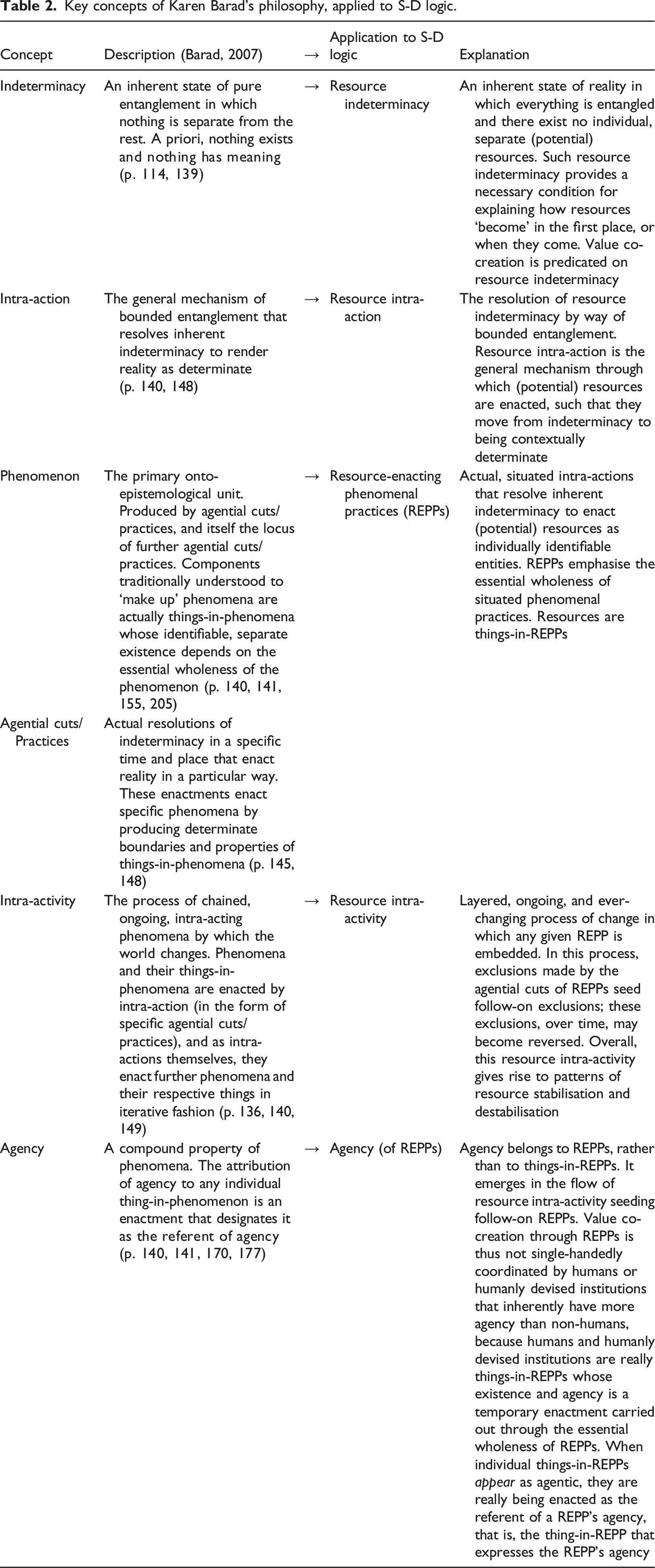
Inspired by Bohr’s observation of the essential wholeness of phenomena, Barad (2003, 2007) proposes a critical social and natural philosophy focused on the idea of entanglement, with several key concepts.
Indeterminacy
As an a priori assumption, Barad (2007) asserts that indeterminacy is inherent to reality and best conceptualised as an agential space of pure entanglement in which nothing is separate from the rest. In this sense, indeterminacy has ontological and semantic implications: A priori, nothing exists, and nothing has meaning. It is only in specific contexts that indeterminacy gets resolved and that things exist and take on meaning (cf. Barad, 2007, especially p. 114, 139).
Intra-action
The resolution of indeterminacy, which allows ‘individual’ entities to exist and have meaning, occurs through a mechanism that Barad calls intra-action. In contrast with the more common notion of interaction, intra-action describes the production of the world not as a coming-together of entities that are a priori given and separate but rather as a separation of these entities from the pure entanglement of indeterminacy. 1 Where indeterminacy captures pure entanglement, intra-action captures bounded entanglement, meaning that phenomena and entities are encated through a process of exclusion. Involved entities exist and are then individually identifiable only by virtue of their co-constitution, such that when they seem to ‘interact’ as separate entities, they actually ‘intra-act’ as components of phenomena, and the existence of these components depends on both the presence of all other components and the absence of everything that has been excluded (i.e., phenomena and their components exist in an essential wholeness). Moreover, intra-action does not bound entanglement randomly but is always seeded by the intra-actions that precede it (cf., Barad, 2007, especially p. 140, 148).
Phenomena
In accordance with Bohr, Barad considers phenomena as the primary onto-epistemological unit and defines a phenomenon as the ‘ontological inseparability’ of components (Barad, 2003: p. 815), such as subject and object. Focusing on phenomena means to regard the essential wholeness of specific situations, as opposed to singling out specific components of such phenomena and conceptualising them as independent entities. Barad argues that singling out components that supposedly constitute a given phenomenon is itself a practice that enacts these phenomena and their components in a specific way. Therefore, Barad argues that rather than speak of ‘components' of phenomena, one should speak of ‘things-in-phenomena': ‘phenomena are constitutive of reality. Reality is composed not of things-in-themselves or things-behind-phenomena but of things-in-phenomena’ (Barad, 2007: p. 140).
Agential cuts as practices
Specific phenomena can be enacted through agential cuts that ‘produce determinate boundaries and properties of “entities” within phenomena, where “phenomena” are the ontological inseparability of agentially intra-acting components’ (Barad, 2007: p. 148). Such specific agential cuts represent concrete practices that create a focused agential space, as well as a situated resolution of inherent indeterminacy to materialise a particular phenomenon and its things-in-phenomenon. Barad (2007: p. 58) further asserts that ‘who and what are excluded through these entangled practices matter: different intra-actions produce different phenomena’. Whereas the concept of intra-action describes the resolution of inherent indeterminacy in general, agential cuts describe practices enacting actual resolutions, which are always situated in a specific time and place and thus enact reality in a particular way. The subjects and objects, as well as material and discursive components traditionally understood to constitute phenomena, are actually things-in-phenomena whose individual identifiability and supposedly separate existence rests on the essential wholeness of the practices that enact them (cf., Barad, 2007, especially p. 145ff.).
Moreover, Barad argues that practices have no inherent boundaries, an idea that holds three important implications. First, such practices themselves intra-act, so any one practice is never solely the output of a single preceding practice but rather stems from the intra-action of multiple practices. Second, observing a focal practice is itself a practice that can draw boundaries around the focal practice in various ways, making different inclusions and exclusions and thus enacting different things-in-phenomena. Third, things-in-phenomena excluded from one practice do not necessarily cease to exist. Other, intra-acting practices in the same time and space still may include and enact them (albeit differently). If a focal practice excludes a thing-in-phenomenon, then it ceases to have a semantic (meaningful) existence for the purpose of the focal practice, while its existence for the purpose of other, intra-acting practices is likely to change (materially and/or semantically). But only if all practices in the same time and space exclude a thing-in-phenomenon will that particular thing-in-phenomenon fully return to indeterminacy (cf., Barad, 2007, especially pp. 148ff.).
Intra-activity
Whereas intra-action describes the general mechanism of indeterminacy resolution, intra-activity captures the process of chained and ongoing practices through which the world gets enacted. As specific intra-actions themselves, these constellations of practices enact further phenomena and respective things-in-phenomena in iterative fashion. Here again, Baradian philosophy emphasises becoming: ‘As the rings of trees mark the sedimented history of their intra-actions within and as part of the world, so matter carries within itself the sedimented historalities of the practices through which it is produced as part of its ongoing becoming’ (Barad, 2007: p. 180). In ongoing chains of intra-activity, one practice manifesting a certain agential cut may reverse the exclusions made by another, such that the resolution of indeterminacy is only ever temporary and always provides possibilities for different practices that manifest other agential cuts. Therefore, ‘exclusions foreclose the possibility of determinism, providing the condition of an open future’ (Barad, 2007: p. 177).
Agency as enactment
The preceding concepts are intimately tied to Barad’s conceptualisation of agency. If nothing has inherent boundaries that allow it to exist outside of practices that manifest agential cuts, then agency cannot be inherent to any individual entity either. Rather, ‘agency is an enactment, not something that someone or something has. It cannot be designated as an attribute of subjects or objects (as they do not pre-exist as such)’ (Barad, 2007: p. 178). Furthermore, agency captures the ‘possibilities of change entailed in [chained practices], including the boundary articulations and exclusions that are marked by those practices in the enactment of a causal structure’ (Barad, 2007: p. 178). In this sense, agency is best conceptualised as a compound property of phenomena that reflects its codetermination of the future (together with other, intra-acting practices).
From this perspective, the attribution of agency to any individual thing-in-phenomenon, as is commonly done, is an enactment of said thing-in-phenomenon, which designates it as the referent of agency and ascribes it a privileged role in determining the flow of practices that manifest agential cuts. However, the agency that the thing-in-phenomenon is being designated is actually a compound property of the practice of which it is a part. This practice simultaneously excludes other things-in-phenomenon from being agentic or from existing altogether. Phenomena and their more-or-less agentic things-in-phenomena exist in an essential wholeness, and they cannot exist the same way if the practices that manifest agential cuts produce different exclusions. As such, individual ‘agents’ are merely the enacted referents of the agency of phenomena (cf., Barad, 2007, especially pp. 140f., 170, 177).
In summary, from Barad’s perspective, changes in the world do not stem from actions that are unidirectionally imposed by human actors (i.e., operant resources) on independently existing entities (i.e., operand/potential resources). Rather, they stem from a chain of practices (i.e., intra-activity), by which the inherent indeterminacy of the world becomes iteratively resolved to enact specific and essentially whole sets of things-in-phenomena (e.g., humans, artifacts, concepts) such that agency becomes a compound property of these sets.
Informing S-D logic with Barad’s philosophy
Key concepts of Karen Barad’s philosophy, applied to S-D logic.
Spatial becoming of resources: Resource indeterminacy, intra-action and enacting phenomenal practices
Resource indeterminacy
Adopting Baradian philosophy to advance the S-D logic, we regard resource indeterminacy as an inherent state of reality in which everything is entangled and there is no material and/or semantic (meaningful) existence of individual, separate (potential) resources. As such, we do not assume that (potential) resources or other components are given ex ante or that they exist as antecedents to resource integration (Figure 1(a)). Rather, according to a Baradian view, when a (potential) resource or component is identified, inherent resource indeterminacy has already been resolved in a specific way to render that specific resource or thing-in-phenomenon determinate and identifiable. Explicitly conceptualising resource indeterminacy this way is key for understanding the becoming of resources, because ‘becoming’ means moving from a state of resource non-existence to resource existence. Resource indeterminacy captures the starting point of this movement; it explains whence (potential) resources come. (a) Resource indeterminacy; (b) Relationships of resource indeterminacy, REPPs and things-in-REPPs. Notes: Dotted lines represent the essential wholeness of the REPP and the things-in-REPP.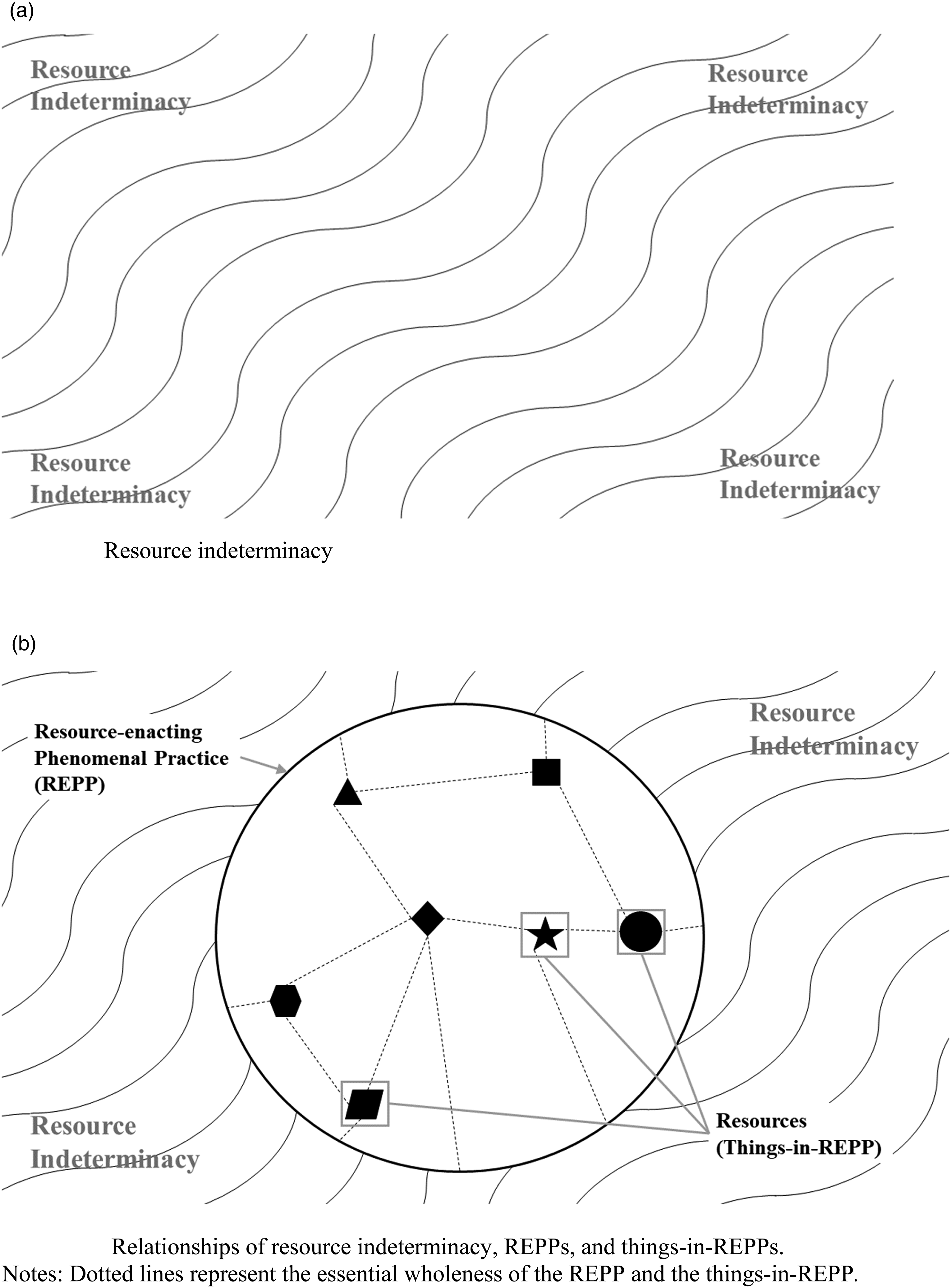
Resource intra-action
The resolution of indeterminacy occurs through the general mechanism of intra-action, a limited entanglement that draws a boundary by excluding some aspects and including others to constitute reality contextually (illustrated by the circle in Figure 1(b)). Therefore, we argue that resource intra-action – the resolution of resource indeterminacy through bounded entanglement – is the mechanism by which (potential) resources are enacted, such that they move from indeterminacy to being contextually determinate. A relevant implication of this argument is that, from a Baradian perspective, the act of identifying an individual (potential) resource already constitutes a practice that enacts the (potential) resource in the first place; and it could enact it differently by making alternative exclusions through a different focus in context. We similarly assert that exclusions by resource intra-actions are not random but are rather seeded by the resource intra-actions that precede them, in an ongoing chain.
Resource-enacting phenomenal practices (REPPs)
Barad argues that practices manifesting agential cuts produce phenomena, but they also argue that practices themselves are phenomena. In turn, Barad tends to use the terms ‘phenomenon’ and ‘agential cut’ or ‘practice’ somewhat interchangeably, though the ‘phenomenon’ concept highlights the output character of a specific intra-action (i.e., existence as a consequence of a preceding intra-action), whereas the concepts of ‘agential cut' and ‘practice’ emphasise the input character (i.e., existence as an ingredient of an intra-action). To simplify, we refer to this focal onto-epistemological unit as ‘phenomenal practice’ hereafter and propose that phenomenal practices refer to specific, concrete resolutions of indeterminacy that enact a particular situation. They capture the essential wholeness of the intra-acting object and subject, matter and discourse, so one component would not exist in the same way if any other components were missing, because the phenomenal practice enacting it would have imposed different exclusions. Accordingly, (potential) resources exist only as components of phenomenal practices and are better understood as things-in-phenomenal practices, rendered determinate and made individually identifiable only by virtue of the overarching phenomenal practice that enacts them (see ‘Resources (Things-in-REPP)’ in Figure 1(b)). To understand resource becoming, the focal onto-epistemological unit should not be (potential) resources but rather the situated phenomenal practices that enact resources as individually identifiable entities in the first place, allowing them to become spatially, in the sense of S-D logic. Resource-enacting phenomenal practices (REPPs), defined as specific, situated intra-actions that resolve inherent indeterminacy to enact (potential) resources as individually identifiable entities, thus are a more serviceable focal onto-epistemological unit for understanding the spatial becoming of resources in the S-D logic. This decentred perspective is in line with but radically extends the systemic orientation of the S-D logic, such that it does not focus ex ante on given, independently existing (potential) resources that interact and are integrated by human actors with inherent agency. Rather, REPPs emphasise the essential wholeness of situated phenomenal practices in which the intra-action of subjects (i.e., human actors as operant resources) and objects (i.e., mundane materials as [potential] operand resources) and of material and discursive components enacts these things-in-REPPs in the first place.
Temporal becoming of resources: Resource intra-activity and agency
Resources do not become only once and in a static context. Rather, they are constantly becoming and re-becoming across time. Thus, theorising the contextually becoming nature of resources requires an explanation of both their spatial and temporal becoming. To capture the latter dimension, we leverage the concept of resource intra-activity.
Resource intra-activity
In the previous section, we established that REPPs are chained together: Phenomenal practices intra-act across time and seed one another, according to the exclusions they make, which changes reality in a processual and ongoing fashion. Through this intra-activity, resources (as things-in-REPPs) and their surrounding reality are constantly being determined. This process of intra-activity is not deterministic though, and reality is never enacted by a single phenomenal practice. It reflects an ever-changing multiplicity of intra-acting phenomenal practices, in which some focal practices may re-enact previous performances exactly, thus leading to resource stabilisation (see Figure 2(a) and (b)). In other cases, the exclusions established by the agential cuts of a phenomenal practice can be reversed, so the resolution of indeterminacy is temporary and always open to change. (a) Enactment of a focal REPP; (b) Resource stabilisation, that is, an exact re-enactment of a previous REPP; (c) Change of focal REPPs through intra-action with other REPPs; (d) Patterns of resource stabilisation and destabilisation in the flow of resource intra-activity.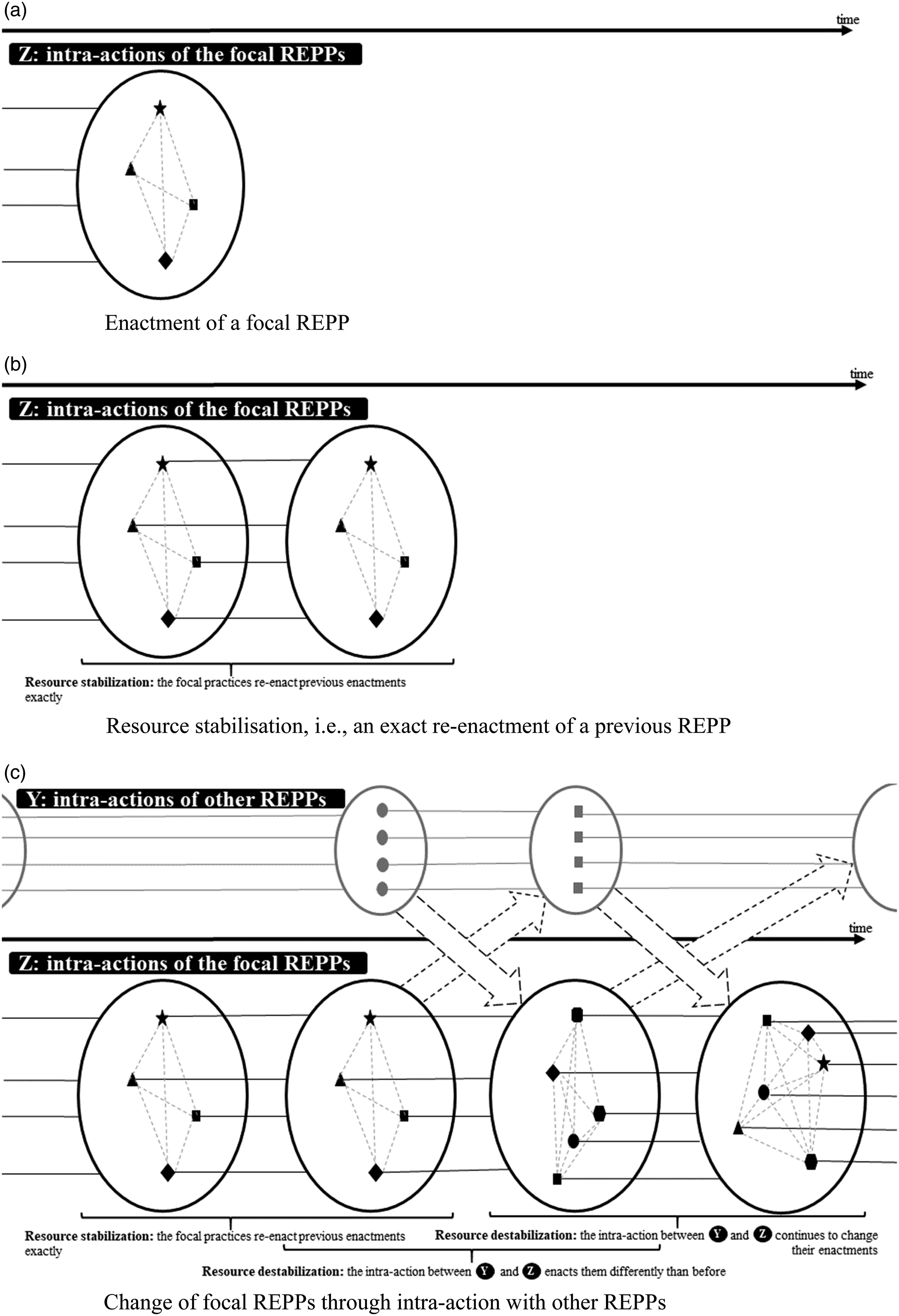
A focus on REPPs thus must reflect an understanding of resource intra-activity, such that any given REPP is embedded in a layered, ongoing and ever-changing process of change. In this process, REPPs seed subsequent REPPs; over time, the exclusions made by the REPPs also may be reversed (arrows between lower and upper layers in Figure 2(c)). The intra-action between REPPs thus enacts resources (as things-in-REPPs) differently than occurred before, leading to a resource destabilisation and possibly continuing change in their performances (in the development of the focal REPPs, lower layer of Figure 2(c)).
Agency of REPPs
These reconceptualisations suggest a new understanding of agency and the coordination of value co-creation. Applying the Baradian perspective to the S-D logic, we reject the view of agency as an inherent property of any individual entity. By working from the preceding concepts, we instead conceptualise agency in the S-D logic as a compound property of REPPs, rather than an attribute of any single thing-in-REPP. Furthermore, we propose that REPPs express this agency by seeding follow-on REPPs and thereby, together with other REPPs, determining the flow of resource enactments.
In practice, it is customary to ascribe agency to (supposedly individual) components such as human actors. But in our perspective, we propose, identifying a thing-in-REPP as in possession of agency is a deeply relational enactment. The capacity to determine the future (by seeding follow-on REPPs) is a property of whole REPPs, with which the things-in-REPPs that are assigned agency exist in an essential wholeness. This argument may be difficult to accept from within the dominant paradigm of institutionalised practices that enact agency as an exclusive and inherent attribute of human beings. To illustrate it better, we offer an example.
The best-selling piano album of all time is a live recording of the Köln Concert by Keith Jarrett. During the concert, Jarrett unexpectedly had to play on a small, worn-out instrument with sticking black notes, out-of-tune white notes and malfunctioning pedals (Harford, 2016). To provide a good performance, Jarrett adapted his play. He avoided certain registers, used rumbling bass riffs, and played while standing up and with great force to ensure the sound could fill the space of the venue. The result was an entirely unique, captivating and valuable musical performance. In its becoming, Jarrett’s piano concert REPP constituted and was constituted through Jarrett, the piano, the audience and venue acoustics, all of whom were also constituting and constituted through other intra-acting REPPs. If the piano provided had been a professional, institutionalised version, Jarrett would likely have been enacted as the referent of the REPP's agency, driving the value co-creation process (by playing in his conventional style). But in this particular REPP, both the pianist and the piano were enacted as the referents of the REPP's agency, because an institutionalised piano was excluded and replaced with a lacklustre one. Jarrett did not so much play on the lacklustre piano as the concert REPP had him play with said piano. The actual agency to determine follow-on REPPs (e.g., high-volume sales of the recorded album) rested not with any one of these things-in-REPPs, but was a compound property of the piano concert REPP as a whole.
Our perspective recognises such situated differences in agentic enactments by focusing on that which exists and is enacted as determining the future, as well as that which does not exist and is not enacted as capable of determining the future in any given situation. This recognition highlights the historicity and reversibility of focal REPPs and their enactments. The co-creation of value through ongoing resource enactments is partially but not exhaustively coordinated by things-in-REPPs that the S-D logic would consider operant resources, such as human actors. Things-in-REPPs that the S-D logic would consider operand resources, including algorithms, tools, natural resources or the climate, have an a priori symmetric role to play in the agency of REPPs. In specific circumstances, humans and humanly devised institutions (as things-in-REPPs) have crucial roles in the compound agency of individual REPPs. However, the same is true of algorithms, tools, natural resources or the climate (as other things-in-REPPs). A Baradian perspective does not assign automatic primacy (by way of agency) to any particular thing-in-REPP; the roles emerge through entanglement and enactment, in view of a REPPs’ agency.
If a REPP enacts only a single thing-in-REPP (e.g., human actor) as referent of its agency, it bundles all its agency to determine follow-up REPPs in that single thing-in-REPP (which still exists only as part of the essential wholeness of the REPP and all other things-in-that-REPP). Were that REPP to be the only REPP in existence, the single human actor might appear to determine the future single-handedly, but that appearance would be deceiving. The terminology of a thing-in-REPP being enacted as agentic emphasises that the underlying agency still resides in the REPP. When individual things-in-REPPs appear as agentic, they really are being enacted as the referent of a REPP’s agency, that is, as the thing-in-REPP that expresses the REPP’s agency. Because REPPs intra-act, such that it is always the agency of multiple REPPs together that seeds a focal REPP, it is unlikely that any individual thing-in-REPP could steer the flow of a particular chain of REPPs for any prolonged period of time. In the flow of these resource enactments, any actor is only one of many things-in-REPPs enacted as agentic in the multiplicity of all REPPs’ agency. In summary, from our Baradian perspective on the S-D logic, ongoing resource enactments are not coordinated exclusively by humans and humanly devised institutions but rather reside in whole REPPs, which intra-act across time.
Advancing S-D logic theorising by resolving its resource-related ontological tensions
Not only is the S-D logic founded in the integration and synthesis of different streams of literature (Koskela-Huotari and Vargo, 2018; Vargo and Lusch, 2017), but it also has been informed by multiple theories, such as structuration theory (Chandler and Vargo, 2011; Edvardsson et al., 2011), institutional theory (Edvardsson et al., 2014; Vargo and Lusch, 2016) and systems thinking (Vargo and Lusch, 2011; Wieland et al., 2012). This synthesis of ideas has enabled an S-D logic metatheory to evolve and flourish (Brodie et al., 2019) but also created critical inconsistencies, because not all the theories’ foundational assumptions are naturally aligned or compatible.
In this article, we have explicitly identified three underlying inconsistencies, related to the conceptualisation of resources and resource integration in the S-D logic. These inconsistencies stem from the contradiction between the S-D logic's relational, process-ontological understanding of resources as contextually becoming on the one hand and the substance-ontological understanding according to which different kinds of resources in the resource integration process exist independently and have different degrees of inherent agency. We have introduced the philosophy of Karen Barad as a remedy. Specifically, by applying Barad’s philosophical lens, we conceptualised resource indeterminacy, resource intra-action, REPPs and resource intra-activity as means for resolving the inconsistencies and providing a coherent onto-epistemological foundation for the S-D logic's core tenet of resource becoming.
The first inconsistency can be summarised as the following question: what is actually being integrated in resource integration? The contradiction between the substance-ontological perspective of resource integration and the relational, process-ontological perspective of resource becoming provides inconsistent answers to whether resource integration targets separate and ex ante given (potential) resources or the contexts that allow them to become across time. Resource indeterminacy, resource intra-action and REPPs, along with our reconceptualisation of resources as things-in-REPPs, help resolve this ambiguity. These concepts fully embrace the contextually becoming nature of resources by establishing a starting point for their becoming (resource indeterminacy), explicating becoming's relational mechanism (resource intra-action) and providing a focal onto-epistemological unit for understanding the essential wholeness of entities and their contexts (REPPs and things-in-REPPs). Resource integrators and academics studying resource integration do not naturally recognise this essential wholeness, because they are more accustomed to looking at the individual entities that allegedly ‘make up’ complex phenomena. Our things-in-REPPs concept provides a way to conceive of components without reifying their supposedly independent existence or inherent attributes, which is incompatible with the foundational S-D logic assumption that resources are contextually becoming. In this light, the categorical distinction between operand and operant resources becomes obsolete.
We thus answer our first question: Insofar as we retain the term ‘resource integration’, both the resources being integrated and the resources doing the integrating should be conceptualised as things-in-REPPs that are part of the same, temporally and spatially specific REPP. Neither could exist in the same way without the other. In this entangled and co-dependent view, ‘resource integration’ is something of a misnomer. All types of resources are things-in-REPP, always and already deeply entwined; otherwise, they could not exist as identifiable. Resource integration is less a matter of integrating supposedly stable and independently existing resources into new contexts but rather one of redrawing the boundaries of REPPs (by making different agential cuts), such that focal REPPs and things-in-REPP can be productively entangled for value co-creation purposes.
The second inconsistency we identified pertains to who coordinates resource integration. Due to the contradiction between the substance-ontological understanding of resource integration and the relational, process-ontological understanding of resource becoming, extant S-D logic theorising cannot determine whether the coordination of resource integration is done by operant resources or by the contexts in which those operant resources become. A focus on the context would need to include supposedly separate and less agentic operand/potential resources as an element of the coordinating force, which challenges the attribution of agency to individual (human) actors. Resource intra-activity and the reconceptualisation of agency as a compound property of REPPs clarify this point. The concept of resource intra-activity fully embraces the spatially and temporally becoming nature of resources, capturing the idea that resource integration at its core is coordinated not by singular entities but by the resource integrations (through REPPs) that precede it. Agency as a compound property of REPPs finds expression when the REPPs maintain, reverse or otherwise alter the inclusions and exclusions that had been made by any preceding REPPs. Agentic enactments refer to different things-in-REPPs that may, at different times, be presented as referents of REPP agency, thus being ascribed unique roles in the seeding of follow-up REPPs.
Therefore, we answer the second question as follows: insofar as we want to use the term ‘resource integration’, it should be understood as coordinated by the resource integrations that preceded it. Agency is an attribute not of individual entities but of REPPs, as is expressed when those REPPs seed follow-up REPPs in an ongoing chain of resource intra-activity. Consequently, it is the REPPs where service gets enacted; they constitute the foundation of service-for-service exchange and value experience. From this perspective, REPPs, rather than instances of resource integration, become focal onto-epistemological units for understanding value co-creation. Academic inquiries into value co-creation that seek to do justice to the becoming nature of resources should investigate the ongoing process of resource intra-activity and patterns of resource stabilisation and resource destabilisation it produces.
The third and final inconsistency we identify involves whether agency is inherent to certain resources or is a contextual enactment, as well as what agency being a contextual enactment implies for the S-D logic’s institutionalised understanding of human actors as operant resources. Using the insights related to the previous two answers, we address this question by arguing that agency is not inherent to certain resources, and as outlined, it does not make sense to differentiate operant and operand resources categorically. Nevertheless, we recognise the taken-for-granted and consequential association of different components (things-in-REPPs) with different degrees of agency. Ascribing specific things-in-REPPs a privileged role in the seeding of follow-up REPPs is ultimately arbitrary; different REPPs enact different things-in-REPPs as agentic, resource destabilisation can always disrupt stabilised agentic enactments that have existed for a long time, and ultimately, the actual agency to seed follow-on REPPs is a compound property of the entire focal REPP, as opposed to any individual aspect of it. Accepting that human agency is a spatially and temporally contingent enactment in which human beings merely become the referents of REPPs’ agency may appear unsettling, but it also is a logical conclusion of the S-D logic’s foundational understanding of resource becoming.
Theoretical implications
By problematising the extant conceptualisation of resources and resource integration in the S-D logic and providing conceptual remedies to the identified inconsistencies, our article offers an important theory adaption (Jaakkola, 2020) to a deeply influential perspective on resources in current marketing and service research. Our proposed theoretical scaffolding offers a more robust and internally consistent perspective on resources for S-D logic, which can increase the applicability and explanatory capacity of this perspective. The related theorising helps overcome puzzling and even contradictory views on resources and resource integration ingrained into the S-D logic, which may stem from its basis in various theories with potentially distinct underlying assumptions. The updated logic that we establish also follows through on the co-constitutive and co-dependent nature of resources, which have always been fundamental assumptions of the S-D logic lens. Our reconceptualisations thus raise important theoretical implications for marketing and service research into value co-creation, service ecosystems and institutions, along with meaningful ethical implications.
Value co-creation
According to the notions of resource entanglement and indeterminacy we offer, value co-creation that occurs through REPPs is not single-handedly coordinated (i.e., determined) by operant resources such as human actors that inherently have more agency than operand resources. Rather, humans, humanly devised institutions and any other components, including operand resources, are things-in-REPPs whose existence and agentic character is an enactment carried out through the essential wholeness of REPPs. Consequently, the ability to co-create value is a characteristic of REPPs, not of any single or multiple (human) actors. The creation of value always and necessarily occurs through the productive intra-action of REPPs that exist in an essential wholeness with their things-in-REPP. From one perspective, the prefix ‘co’ in ‘value co-creation’ already corresponds to this insight of value creation occurring through relations. However, one might also argue that, when adopting a Baradian perspective, this prefix ‘co’ actually becomes redundant or even counterproductive, because in emphasising the conjoined nature of resources in value creation, it assumes those resources to initially be apart, ignoring their default entangled nature. In this sense, the ‘co’ prefix implicitly maintains the substance-ontological views within S-D logic.
Further, our perspective highlights that the beneficiaries and their phenomenological experience of service-based value creation are themselves things-in-REPPs, exchanging said service and creating said value. From this perspective, the productive intra-actions of value creation can never be ‘observed’ from the outside, because beneficiaries always necessarily participate in the enactment of value creation, co-constituting it through their phenomenological involvement. This resource entanglement and indeterminacy perspective also creates a theoretical foundation for attributing value to other (non-human) actors, as well as to systems, as REPPs. With such an understanding of the S-D logic, further research can investigate patterns of how non-human and non-institutional things-in-REPP serve roles in value creation, resource stabilisation and resource destabilisation.
Moreover, according to our Barad-informed perspective, different definitions of value creation result from researchers’ particular perspectives and interests (i.e., research REPPs) and the ways that these lead them to delineate the boundaries of focal REPPs. As Bohr recognised, by applying their own research focus, researchers enact agential cuts that draw boundaries, make exclusions and thus performatively co-constitute the phenomena they research. What value is, how it emerges and how it is determined in the context of or through resources thus depends fundamentally on the focal actors' (e.g., researcher, consumer, manager) recognition of the entanglement and enactment of resources, creating meaning at a specific point in time and location through REPPs. Value typically is imagined as an individual assessment, but when agency is acknowledged as a compound property of REPPs, value becomes fundamentally a co-dependent, collective or entangled phenomenon in itself.
Service ecosystems
The Baradian perspective also helps resolve ambiguities that can arise when applying the service ecosystem perspective to S-D logic (Vargo and Lusch 2011, 2016) and beyond. The delineation of the boundaries of an ecosystem and attempts to distinguish micro, meso or macro levels of such ecosystems (Chandler and Vargo 2011) repeatedly lead to fuzzy observations and statements derived from this basis. Our theorising is in line with the idea that ‘each instance of resource integration, service provision and value creation, changes the nature of the system to some degree and thus the context for the next iteration and determination of value creation’ (Vargo and Lusch 2011: p. 185), but the concept of resource intra-activity also offers a more nuanced way of explaining how various states of ecosystems are interlinked across levels and time.
First, because REPPs exist in essential wholeness with their things-in-REPP, each REPP is a service ecosystem of its own, in which the resources co-constitute focal phenomena. Similar to our discussion of the concept of value (co)creation, the perspective of the researcher determines the boundaries of the focal REPP, thus co-constituting the phenomenon they are researching. Therefore, whether a phenomenon represents a micro, meso or macro level cannot be determined using objective criteria but instead reflects the research REPPs of which the researchers are a part.
Second, across time, our conceptualisation of resource intra-activity allows for patterns of stabilisation and destabilisation to emerge in chains of REPPs that seed one another. The agency of REPPs and the agentic enactments they produce provide a possibility for service ecosystems to stabilise over time, making them more apparent and palpable, as well as more consequential for practitioners and researchers.
Institutions
The resource enactments we describe provide a direct extension of the institutionalisation dynamics that currently serve to explain the coordination of resource integration in S-D logic literature (e.g. Vargo and Lusch, 2016). The dynamics of REPP agency reflect some critical insights about institutionalisation (Berger and Luckmann, 1966), in that stabilisation accounts for self-reinforcing mechanisms and thus taken-for-granted characterisations of certain entities or attributes as external and objective, including the enactment of human actors as inherently agentic resources, regardless of context. REPP destabilisation instead acknowledges the eventual disruption of these aspects through institutional contradictions (Seo and Creed, 2002). Our Barad-inspired perspective extends these dynamics by moving away from a self-reinforcement and disruption frame that solely pertains to human actors or humanly devised institutions. Instead, it specifies that dynamics become enacted through the material-discursive intra-actions of REPPs, in which the varying degrees of human and non-human agency are not inherently given.
Ethical implications
A Barad-inspired conceptualisation of resources holds ethical dimensions. If value is always created in REPPs, through the intra-action of all respective things-in-REPPs, then considerations of the consequences of activity cannot be limited to (focal) human actors alone (Barad, 2007). Decentering attention away from human actors leads one to assign more consideration to systemic factors and consequences, including the roles and responsibilities of non-human things-in-REPPs. However, such a shift does not exempt humans as resources from their responsibility and accountability for the entanglements they enact in REPPs. Instead, humans must be accountable for the ‘marks on bodies’ (Barad, 2007: p. 89) that REPPs leave, that is, the effects that agential cuts have on resources (included or excluded), regardless of whether they are humans, natural entities or REPPs as a whole. Humans thus must take responsibility for the power or political dynamics that emerge within REPPs; at the least, humans, with their consciousness, should be aware of the entangled materialisations of which they are part (Barad, 2007) and the effects of their behaviours in REPPs. Entangled human and non-human forces demand greater consideration in REPPs, which resonates with calls to stop viewing and treating these forces as separate and independent in praxis (Åsberg and Braidotti, 2018). Such an approach also suggests ideas for avoiding reckless resource stabilisations and enacting more responsible resource destabilisations. The concept of REPPs offers an opportunity to make the responsibility and accountability of human actors, beyond their own immediate actions, more transparent. It also gives further research a path to delve more deeply into the ‘ethic-onto-epistemological’ aspects of resource integration.
Our arguments also pertain to the ethics of marketing research itself. From a resource entanglement and indeterminacy perspective, marketing scholars always co-constitute the phenomena they research (see also Bettany and Woodruffe-Burton 2009; Joy et al. 2006; Steinfield, 2021). In choosing some phenomena to study over others, and defining ex-ante the relevant levels, actors or boundaries of these phenomena, marketing scholars enact REPPs that intra-act with the world and thereby participate in the (potentially agentic) enactment and stabilisation of the resources in question. By excluding other phenomena from study, or determining the boundaries of focal phenomena in certain ways, marketing scholars contribute to the destabilisation of other resources and deny the possibility of their agentic enactment. We assert that S-D logic scholars have not paid enough attention to the ethical consequences of their epistemological considerations or reflected on the extent to which these considerations can be attributed to an institutionalised S-D logic REPP of which they are a part. The Baradian perspective, in which ‘even the smallest [agential] cuts matter’ (Barad, 2007: p. 384), presents an opportunity to remedy this state of affairs.
Practically speaking, genealogical (Foucault, 1970) and ethnomethodological (Coulon, 1995; Gephart, 1993) approaches represent a preferred approach for engaging in social research from a Baradian perspective (Barad, 2007). Within marketing research, S-D logic scholars may utilise these tools to trace the histories of the REPPs and resources that interest them, thereby attaining a deeper understanding of how certain inclusions and exclusions have, over the years, contributed to their stabilisation and destabilisation.
Footnotes
Acknowledgment
The authors thank Kaisa Koskela-Huotari who gave extensive feedback on a former version of this manuscript.
Declaration of conflicting interests
The author(s) declared no potential conflicts of interest with respect to the research, authorship, and/or publication of this article.
Funding
The author(s) received no financial support for the research, authorship, and/or publication of this article.
