




Abstract
Little has been written about co-creational aspects of happiness. Happiness is generally treated in the marketing literature as an individual outcome of exchange. However, the notion of value in exchange has been challenged by service-dominant (S-D) logic. To stimulate the research discovery process, an account of co-creation of happiness is offered, based on the experience of the lead author, in playing blues music. We propose value is co-created in a context when it is perceived by an individual to be adding to their happiness/subjective well-being (SWB). Thus, the concepts of value and happiness/SWB are closely linked and interconnected. The contribution to S-D logic is in recognising the interconnectedness between value co-creation and happiness/SWB. In particular, this article draws attention to the co-creative role of the artist, in cultural ecosystems. This is relevant to the development of the field and has potentially significant implications for policy in allocating society’s resources.
Keywords
Introduction
‘No man is an island’ – John Donne (1624)
Definitions and approaches to the subject of happiness
There has been a continuing interest in human happiness and the factors involved in making people happy (Dennis et al., 2016; Diener et al., 1985; Easterlin, 2003; Lyubomirsky and Lepper, 1999; Mogilner, 2010). While it is broadly agreed that happiness is about feeling good (McMahon, 2006), the word is also confusing because it can mean different things to different people in different contexts (Diener et al., 2018). Thus, generally in the social sciences, the term subjective well-being (SWB) is preferred. SWB is defined as an overall evaluation of the quality of a person’s life from her or his own perspective and the topic has been mentioned in over 170,000 articles since 1999 (Diener et al., 2018). So, happiness is a popular word that is rather broad concerning an emotional state and SWB is a more tightly defined word for scientific use and relating to a rather more rational individual evaluation.
In the marketing context, happiness mainly features as an individual outcome from consumption (Catapano, 2017). Customer happiness can be seen as a wide concept synonymous with SWB, psychological well-being, quality of life and immersion experience (Giacalone et al., 2005). Possession of products is said to be one of the most common strategies that people use to satisfy their needs and increase their happiness (Bhardwaj et al., 2011). Happiness is also associated with consumption of services (Aksoy et al., 2015; Yim et al., 2008), in particular where consumption involves social relationships (Caprariello and Reis, 2013). Where a purchase provides a meaningful customer experience, the effect may be said to have a strong impact on the way the customer feels.
Related to this approach, the marketing literature also considers the economic and social factors that are associated with happiness (Agrawal et al., 2011; Breslin et al., 2013). The findings are not conclusive. Income is found to have little influence on happiness in some studies (Easterlin, 2003; Easterlin et al., 2011) but is found to have a positive relationship in others (Aknin et al., 2009; Sacks et al., 2012). Transformative service research tends to take a wider perspective, aiming at improving the lives of customers (Anderson and Ostrom, 2015). Under the social marketing concept, firm performance is measured by social outcomes such as customer happiness (Dagger and Sweeney, 2006).
Thus, happiness is generally treated in the marketing literature as an individual outcome of the exchange of goods and services. As such it overlaps with customer value, an important idea in marketing, that has been seen to be an outcome of exchange. However, the utility of the notion of value in exchange has been challenged in recent years by S-D logic’s central idea of value being co-created in use (Vargo and Lusch, 2004). This suggests an opportunity to consider the S-D logic narrative on co-creation in relation happiness.
S-D logic narrative and the co-creation of happiness
From the beginning, in Vargo and Lusch’s (2004) article, the authors made the distinction between goods-dominant logic, based on exchange of goods and services and S-D logic based on value in use. The idea of value is central in this. Value is co-created between supplier and customer and is experienced phenomenologically by customers. The S-D logic perspective then developed to talk about the central importance of resource integration between economic entities (Lusch and Vargo, 2006) and then the elimination of the producer/consumer distinction in value creation to move to an actor-to-actor collaborative model of value creation (Vargo and Lusch, 2011). Value is a term that is used extensively in the marketing field but is not generally used more widely in the social sciences. Yet value can be seen to be connected to SWB: ‘Value is benefit, and increase in the well-being of a particular actor’ (Lusch and Vargo, 2014: 57). The move from value being seen as something that is exchanged to something that is experienced by the customer relates value to the area of an actor’s wider experience: ‘Value in the experience is determined by the individual service customer’s context and is constantly changing and will very much depend on the particular service customer’s specific interest and personal lifeworld context’. (Helkkula et al., 2012: 62). In S-D logic, value is experienced by social and economic actors in specific contexts (Löbler and Wloka, 2019; Vargo and Lusch, 2016). Thus, we propose that happiness and SWB is closely connected to co-creation of value between actors in different contexts. We will consider this further in the specific context of the heuristic account in the next section.
As the S-D logic narrative developed further, Vargo and Lusch (2014) condensed their fundamental ideas into four Axioms: Axiom 1 ‘Service is the fundamental basis of exchange’; Axiom 2 ‘The customer is always a co-creator of value’; Axiom 3 ‘All economic and social actors are resource integrators’; Axiom 4 ‘Value is always uniquely and phenomenologically determined by the beneficiary’. A further Axiom 5 was then added: ‘Value cocreation is coordinated through actor-generated institutions and institutional arrangements’ (Vargo and Lusch, 2016), resulting from Vargo and Lusch’s reassessment of value co-creation, as being a far wider concept than originally envisaged. ‘Actors can be defined as humans or collections of humans, such as organizations, who are involved in the logic of human exchange systems – including economy and society – and who are typically categorized according to their discrete roles and functions’ (Lusch and Vargo, 2014: 102). This widening of the concept is significant in the development of mid-range theory (Brodie and Löbler, 2018) relating the domain of S-D logic to actors engaging in value co-creation in different contexts and at different levels (Brodie et al., 2019). It is in this area, of advancing S-D logic around this broader agenda, that exploring the co-creation of happiness/SWB in relation to value co-creation in different contexts can contribute to knowledge development.
As discussed above, the approach to happiness/SWB in the marketing literature has mostly been concerned with happiness/SWB as an outcome from the exchange of goods and services. Yet, one of the most common findings in the general literature is that of the importance of human relationships to human happiness/SWB (Cacioppo and Patrick, 2008; Mehl et al., 2010; Moghaddam, 2008; Mogilner, 2010; Rath, 2006; Stark and Maier, 2008). We contend that co-creation can be fundamental to human happiness/SWB and that the ideas from the development of thinking of S-D logic on co-creation of value may contribute to our understanding. While there has been some interest in co-creation and overall quality of life (Sweeney et al., 2015), so far there has been little exploration of value co-creation and happiness/SWB. In particular, there is a gap in S-D logic’s understanding of artists, as social actors, in co-creating happiness/SWB. In relation to this, there follows a brief heuristic account of the lead author’s experience of playing and performing blues music.
Playing the blues: A heuristic account of co-creation of happiness
Why a heuristic account?
The subjective and personal nature of happiness/SWB suggests the need for a subjective and personal approach in exploring the phenomenon. In studying creativity, qualitative reflective studies are seen to offer a valid alternative approach to uncover personal worlds in the social sciences (Gergen, 2018). Autoethnography, broadly understood as the use of first-person, subjective accounts of experiences, feelings and memories has started to gain acceptance in consumer behaviour studies (Hackley, 2016). In taking an autoethnographic approach, the authors have been inspired by Moustakas’s (1990) heuristic method. In heuristic inquiry, knowing is a highly personal process involving self-reflection (Moustakas, 2015). Heuristic inquiry is a method that has been used by researchers working in a number of disciplines (Braud and Anderson, 1998; Etherington, 2004; Wohlfeil and Whelan, 2012) but it has not been used to any extent in research in the marketing discipline. Moustakas (2015) stresses the value of heuristic research at the beginning of the research discovery process. It is in this spirit, of using personal experience to get insights into the highly subjective area of co-creation of personal happiness, that this account is offered. The following is a personal account of the lead author’s experience of learning to play the guitar and performing regularly at local venues. This will be followed by reflections on the different aspects of co-creation in relation to S-D logic.
Around 2012, I took up learning guitar to mainly play country blues music. This is a fingerstyle method of guitar playing used by the traditional country blues players in the United States, mainly stemming from the 1930s and 1940s. In recent years, I have been playing at local folk and acoustic clubs and open mic nights. In addition, I sometimes play with other amateur musicians and in a group at blues jams. I have four steel string guitars. An acoustic, a semi-acoustic, a solid electric and a resonator (this contains a metal cone and is typically used for playing slide guitar). On reflection, I would say that playing guitar has added greatly to my general happiness. This is both in the pleasure of learning new skills and playing but also in the new social connections that I have made and acceptance in new communities based on my artistic efforts. While guitar playing is only part of a mixture of life elements that contribute overall to my SWB, I can confidently assert that it has been and continues to be very important. Having established this, the next question relates to value and happiness. In my mind, value is co-created in a context when I perceive it is adding to my happiness in some way, thus the two concepts are closely linked and interconnected. Value is the benefit I gain from co-creation in a particular context which I experience as happiness and I evaluate as contributing to my SWB. If I don’t experience happiness or if I consider a co-creative context is not contributing positively, then I am not gaining value from co-creation in that context. For example, if I played at a club where no-one appreciated my music I would probably not go again. Bearing this in my mind, I will consider co-creation in relation to different contexts that I have encountered in playing the blues.
Co-creation in the context of guitar and equipment manufacturers and retailers
The sound coming from an instrument depends both on the quality and set-up of the instrument and the skills and feel of the player. A great instrument will not sound good in the hands of a poor player and an inferior instrument will limit the quality of sound achieved by a master player. The type of sound required by players in different styles will determine the types of instruments and amplification equipment used. In addition, the set-up of a guitar needs to be tailored to the needs of the player. For example, the ‘action’ (the height of the strings above the frets) needs to be set for the individual player. Here guitar and equipment retailers are closely involved in co-creating value for the player. Hence, value is co-created (Axiom 2) through resource integration (Axiom 3) and phenomenologically determined by the beneficiary (Axiom 4). In these commercial contexts, value is co-created because the resulting happiness experienced in the act of playing is immense.
Co-creation in the context of tutors and other learning aids
Learning an instrument is often facilitated by regular lessons with tutors. In my case, I learned from video material on the Internet; suppliers of words and tablature (a method of showing which notes to fret for a song); guitar tutoring books; professional players at guitar workshops and recently from a US guitar tutor who provides a library of lessons over the Internet for a monthly subscription. Learning a complex instrument, like a guitar, to be able to play competently at a good level requires not only a high degree of application by the student over a sustained period of many years but also expert tuition and other support. Again, this involves commercial engagements and value creation following the narrative of S-D logic and I perceive the value through happiness in relation to personal achievement and satisfaction in the act of playing proficiently.
Co-creation in the context of other players, communities and audiences
As mentioned above, after about 5 years of learning the guitar I sang and played guitar in front of an audience at a folk club for the first time (typically at folk clubs a large number of the people involved also perform, usually playing a couple of songs each). Since then, I play at least once a week at various clubs, open mics and blues jams. In performance, a feeling of happiness is co-created with the audience. It is experienced in applause and feedback. Folk clubs are typically social events and this leads to new friendships and a sense of belonging to a musical community. Through these clubs, I have met other guitar players and also harmonica players who I have worked with to perform in duets. On reflection, this element of connecting with other people is perhaps the most important aspect relating to co-creation of well-being in acceptance in a musical community, based on my playing and singing. This context differs from Vargo and Lusch’s (2004) original conception, as value is being co-created in a non-commercial situation. However, actor with actor value co-creation in this context is immensely contributing to my personal happiness.
The scope and complexity of the co-creation of happiness
The co-creative contexts, summarised in Figure 1, demonstrate the many ways in which value is co-created, in this example, all closely connected to an overall perception of happiness/SWB, relating to both the activity and surrounding activities to guitar playing and performance. Resource integration (Axiom 3), in the example, comprising a wide range of both commercial and non-commercial actors in a complex network of relationships at local, national and international levels. The value created is uniquely and phenomenologically determined by that individual (Axiom 4) in relation to the happiness/SWB experienced.
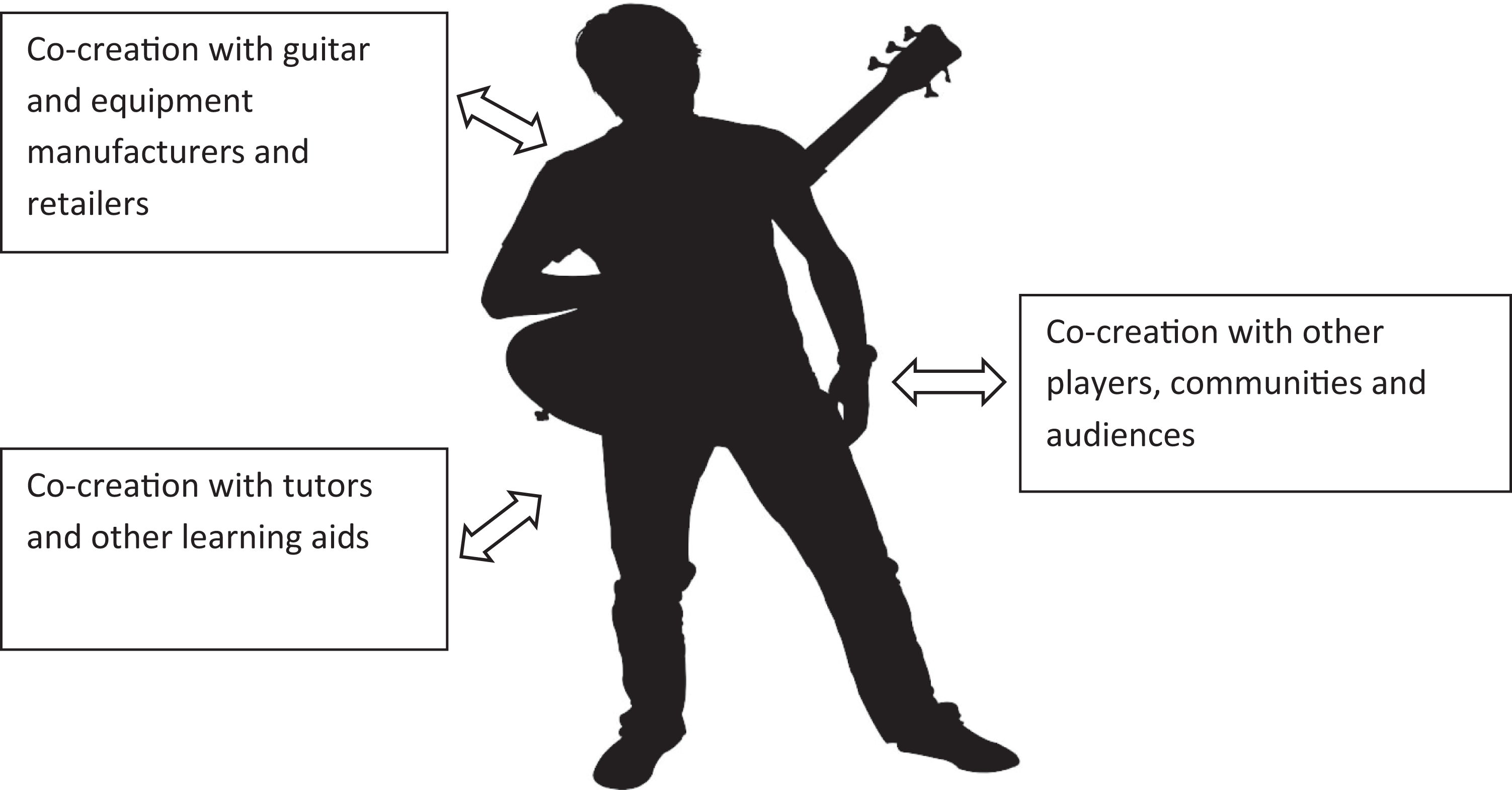
Co-creative contexts for ‘Playing the blues’.
The contention of this Commentary is that co-creation of value occurs widely between both commercial and non-commercial actors in different contexts and this value is closely interconnected with the individual’s perception of happiness/SWB. This article has focussed on one specific area of activity, but for any individual it could be extended to many areas that contribute to their happiness. Max Weber (1978, 2004) coined the term ‘spheres of life’ to create typologies for these different aspects of social life. Hence, we contend that the S-D logic narrative provides new perspectives for researching happiness/SWB and the ways in which it is interconnected with value co-creation across the full range of contexts in which an individual operates.
Implications
Research
S-D logic provides promising approaches to understanding happiness/SWB more fully than considering it to be simply an outcome from the exchange of goods and services. Seen as a co-creative phenomenon, happiness is uniquely and phenomenologically determined by the beneficiary (Axiom 4) but is often co-created with other actors (Axiom 2). Just as the understanding of value in specific contexts is enhanced through the views of multiple actors, who bring with them multiple meanings, and value systems (Mele et al., 2019), the same thinking can be applied to research on the co-creative aspects of happiness/SWB. As advocated by Brodie et al. (2019), a multi – meaning approach requires an understanding based on the subjective (individual actors experience) and the intersubjective (what kind of interactions co-create value and in which contexts do actors create value). Löbler (2018) puts forward the need for co-creation of value to be considered at different levels: the macro level (societal groups and communities); the meso level (organisations); the micro level (individuals and firms). This leads us to ask the fundamental question: What is the relationship between the co-creation of value and what actors experience as happiness/SWB? Further questions include: What do actors experience with respect to co-creation of happiness/SWB? What kinds of interaction co-create happiness/SWB? In which contexts do actors create happiness/SWB?
The co-creation of happiness/SWB can be seen as dynamic, through interaction and resource integration among all the economic and social actors (Axiom 3). Understanding the operand and operant resources that are mobilised by the actors to co-create value in different contexts would add to our knowledge of how human relationships create happiness/SWB. Furthermore, understanding the way these resources are integrated in interactions between actors (Mele et al., 2019) would be insightful. Resource integration is also said to have emergent properties in enhancing resources and creating new resources (Peters, 2016). So, how are resources enhanced and created through the co-creation of happiness/SWB?
The development of Axiom 5, relating to the coordinating role of actor-generated institutions and institutional arrangements (Vargo and Lusch, 2016), has generated interest in service ecosystems (Akaka et al., 2013; Lusch et al., 2016; Vargo and Lusch, 2008). In a service ecosystem, actors try to create mutual value through the activities of resource integration and service exchange (Ng and Wakenshaw, 2018). In considering ecosystems, S-D logic increasingly represents an interdisciplinary endeavour (Vargo et al., 2017). Siltaloppi and Wieland (2018) insightfully point out that actors have multiple institutional arrangements at their disposal that provide meaning to their lives and experiences as they move across the contexts of daily life. This very wide description of co-creation of value relating to actors lives and experiences across many contexts demonstrates again where S-D logic research and research into co-creation of happiness/SWB intersects and offers potential for new insights.
Policy and practice
Our Commentary poses an important question for social policy: What role does value co-creation play in the individual’s overall happiness and wellbeing? For institutions concerned with their citizens’ well-being, this is a key question particularly in the light of the social challenge of loneliness and exclusion among aging populations in the West. In the healthcare field, Gallan et al. (2019) point to the need to involve different communities to get the overall picture of what is happening in someone’s life.
Table 1 links the research strands from the previous section with the potential benefits for policy and practice of undertaking research in these areas.
Research implications for policy and practice.
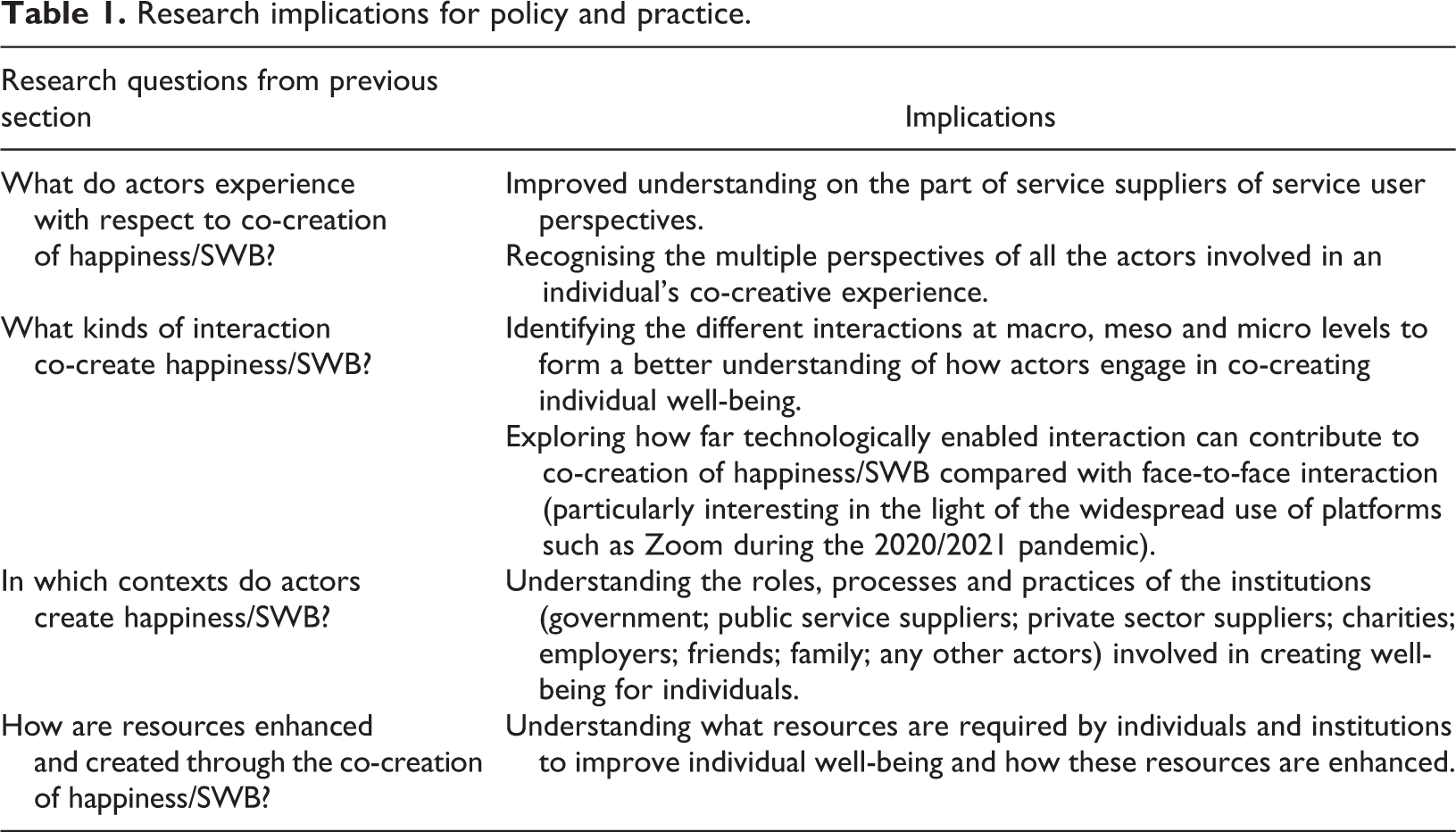
A better understanding of the multiple perspectives of actors provides a lens to view the different aspects of an individual’s life and how institutions and other actors contribute to the individual’s well-being. This potentially has significant implications for policy in understanding where to allocate resources at the macro and meso levels. At the macro level, how do policymakers and other relevant institutions engage with each other? At the micro level, how do individual service providers engage with users and how do users engage with each other and other stakeholders (e.g. friends and family)? The meso level of analysis would explore how engagement occurs between the macro and micro. Where can resources be boosted to be most effective? Can savings be made by minimising overlapping roles between institutions? Recognising the interdependencies in delivering certain services is crucial. For example, a lack of resources in the social care system has implications for the hospital system. Policymakers can use resources to encourage working across institutions.
Conclusions
Applying S-D logic to investigating the co-creation of happiness/SWB is a logical consequence of the broader scope of S-D logic studies in recent years. Pohlmann and Kaartemo (2017) ask an important question: ‘What are the definitions, forms, and limits of value and value co-creation?’ (p. 66). Value is a word much used in the marketing field, but less so elsewhere. Perhaps, the learning for S-D logic is in recognising interconnectedness between value and happiness/SWB and the universality of co-creation across commercial and non-commercial contexts. This does not diminish S-D logic rather it increases its scope. Research into the co-creational aspects of happiness could be beneficial in exploring this. The contribution of this Commentary is to highlight the appropriateness of extending S-D logic to the higher purpose of studying human happiness/SWB and of course human unhappiness. This includes social and cultural actors or artists, as exemplified in the heuristic account of ‘Playing the Blues’, and the way that resource integration occurs in cultural ecosystems. Extending the scope of S-D logic in applying the theory to the benefit of society as a whole would be a significant step forward in developing the field. S-D logic provides a means to apply some of the fundamental ideas of marketing to the overall well-being of citizens. It is about understanding the perspective of the citizen and service user of what is of value to them rather than service provider’s perspective on what service is offered. But, more than this, it recognises that happiness and well-being is influenced by multiple actors that need to be understood in relation to their connections to the individual and that effective engagement with these individuals requires the ability of actors to be able to integrate appropriate resources.
Footnotes
Declaration of conflicting interests
The author(s) declared no potential conflicts of interest with respect to the research, authorship, and/or publication of this article.
Funding
The author(s) received no financial support for the research, authorship, and/or publication of this article.
