




Abstract
Extant consumer research interested in disruption and adaptation to routines undertheorizes the role of 'meanings' in adaptation processes, which are implicated as obstacles, or understood as adjustable to achieve adaptation. Practice theory foregrounds the dynamics of practices and their elements as shaping practice transition. From this, we explore and theorize meanings in practice adaptation by mobilising the theoretical leverage of concept of ‘teleoaffective structures’ to provide a granular theoretical account of how meanings shape adaptation after practice disruption. Through our empirical material, with strength training practitioners adapting to home training after gym closures, we illuminate how multifaceted teleoaffective 'components' are configured differently into routinised practice performances. These constitute practice–practitioner relationships. The characteristics of these teleoaffective configurations stretch across a spectrum from rigid to fluid, and shape adaptation pathways termed ‘replicate’ or ‘tolerate’. Rigid teleoaffective configurations constrain adaptation, demanding replication of the practice, which is often impossible because its feel and purpose become lost in new spatio-material contexts. Fluid configurations are more transportable and foster tolerance of reconfigured practices, often because of the variety of end goals, lack of dominant affective ends and because variability is built in, which means the practice is transportable. The theorisation of teleoaffective configuration contributes to existing research that foregrounds the role of creative consumer striving in practice adaptation by identifying how the life of elements and practitioners' intentional activity intersect to shape adaptation attempts. The study also advances from research that uses a collapsed conceptualisation of ‘meaning’ by embracing the complexity of teleoaffective structures. Furthermore, the framework connects understandings of practitioner and practice variance with adaptation outcomes whilst keeping practice elements, particularly the teleoaffective structure, as the central unit of analysis.
Introduction
Consumer research is interested in disruption to consumption routines (Campbell et al., 2020; Mason and Pavia, 2006). There has been a particular focus in recent research on disruption from external threats like environmental disaster (Venugopal et al., 2019), poverty (Mguni et al., 2020) and COVID-19 (Menon et al., 2022), as well as life-disrupting events such as becoming a parent (Thomas and Epp, 2019), divorce (Molander, 2017), physical separation in families (Epp et al., 2014), and ill-health (Cordoso et al., 2020). Much of this research uses practice theory, which offers a comprehensive theoretical toolkit through which routinised everyday activity can be understood, and through which analysis of disruption and adaptation can focus on the practical carrying out and carrying on of everyday life (Warde, 2005).
Practices are understood to have ‘something of a life of their own’ (Blue et al., 2016: 41), and the dynamics of practice building blocks, or elements, have been explored in relation to practice transition (Pantzar and Ruckenstein, 2015), as practices evolve in relation to technological, social and cultural innovations (Hand et al., 2005; Spurling et al., 2013; Shove et al., 2012). Research also highlights the significant interconnections between competences, materials, space, time and shared cultural templates that can make routinised practices very difficult to adapt after disruption. For example, research finds that domestic water practices are difficult to adapt to drought due to the ‘rigid materiality’ of urban drainage systems (Phipps and Ozanne 2017). Also, adapting to plastic-free grocery shopping in specialist stores can be challenging for consumers because new skills are required, such as recognising unlabelled foods and learning what receptacles to use (Fuentes et al., 2019). Particularly, meanings are often obstacles to adaptation. Gonzalez-Arcos et al. (2021) found that shoppers resist the new consumer-responsibilisation meanings fostered through the plastic bag ban, and Epp et al. (2014) illuminate that in attempts at recreating family mealtimes using technology when the family is separated, core meanings must be retained or practices will ‘fail to reassemble’ (p. 88). Elsewhere research points to the way entrenched meanings can constrain adaptation to new versions of photography (Shove and Pantzar, 2007), fishing (Venugopal et al., 2019), everyday shopping (Thompson et al., 2018) and eating snacks (Evans et al., 2020).
However, adaptation research also finds that under some conditions, meanings are fluid rather than fixed and can be reconfigured in order to integrate with elements available after disruption. For example, Phipps and Ozanne (2017) found that grey water could take on new meanings by practitioners adapting to severe drought; shifting from just wastewater to being reusable in the garden. Gonzales-Arcos et al. (2021) found that some practitioners could derive different meanings and positive emotions from the ban on plastic bags, such as looking ‘cute’ carrying cloth bags. Studies identify that meanings can be shifted by practitioners who are motivated to restabilise practices after disruption (Cardoso et al., 2020; Epp et al., 2014; Gonzalez-Arcos et al., 2021; Mason and Pavia, 2006; Phipps and Ozanne, 2017). For example, Thomas and Epp’s (2019) participants respond to disruption ‘by finding ways to make practices work; they problem-solve, trouble-shoot and try to realign elements’ (p. 569). Other studies find that realigning meanings is done through practitioners’ imaginative capacity (Epp et al., 2014; Gonzales-Arcos et al., 2021), reflexivity (Cordosa et al., 2020), or discursive engagement (Phipps and Ozanne, 2017).
Extant disruption and adaptation research has tended to rely on Shove et al.’s 3-element model (Shove et al., 2012). Accordingly, the reference to practice ‘meanings’ in these studies represents a ‘simplifying move’ (ibid, p. 23) that ‘collapses’ (ibid, p. 53) the range of teleoaffective ‘components’ (Schatzki, 1996: 186) comprising the teleoaffective structure into the one broad element. ‘Meaning’ is described as ‘core’ to practices (Phipps and Ozanne, 2017; Epp et al., 2014) or ‘conventional’ (Gonzalez-Arcos et al. 2021), obscuring its complexity and the interpretations, negotiations and contestations it triggers during performance. Rather, Schatzki (1996; 2002) conceptualises teleoaffective structures as complex, indefinitive, multifaceted, relational and flexible. For example, people can care differently about practices as they progress through their career (Reckwitz, 2017). An example is motorbike riding, which can offer speed and excitement or skill and safety depending on career stage (Murphy et al., 2019). The components of teleoaffective structures can be integrated into performances differently because people are affected in diverse, ‘uneven’ (Schatzki, 2002) ways by things and ideas.
Illuminating the role of teleoaffective structures in practice-practitioner relationships can shed further light on processes carrying consumers from settled performance, through disruption, and to different adaptation outcomes, and under what conditions practitioners are able to accomplish the ‘micro-adjustments’ (Phipps and Ozanne, 2017: 371) necessary to adapt practices after disruption. This study therefore mobilizes the theoretical leverage offered by Schatzki’s ‘teleoaffective structures’ to explore the ‘relative, situated and emergent’ (Shove et al., 2012: 53) characteristics of ‘meanings’ that shape the performance of practices and their adaptation after disruption. With this theoretical foundation, we ask ‘how do teleoaffective structures shape practice adaptation after disruption?’ Our context is gym-based strength training, which was severely disrupted by gym closures in The United Kingdom (UK) during the COVID-19 pandemic.
Our study illuminates how adaptation pathways are shaped by the characteristics of ‘teleoaffective configuration’ along a rigid-fluid spectrum. Teleoaffective configuration represents the relationship between practitioner and practice. They form as shared teleological (end goals) and affective characteristics of a practice intersect in the routinised practice with other available elements such as spatio-materiality and practical know-how, and also with practitioner histories and goals. First, we set out our theoretical framework via Schatzki’s teleoaffective structures. Next, we explore our theoretical proposals with our qualitative interview material on the disruptions and adaptations that happened to strength training practice routines during UK lockdowns. Lastly, we discuss the consequences of our argument for marketing theorists and practitioners.
Teleoaffective structures
Although various models of practice elements exist (Reckwitz, 2002; Shove et al., 2012; Warde, 2005), we understand practices as activities that consist of ‘elements such as material setup, bodily skills and routines, teleoaffective structures, rules, and cultural understandings’ (Woermann and Rokka, 2015: 1487). Teleoaffective structures include ‘a range of acceptable or correct ends, acceptable or correct tasks to carry out for these ends, acceptable or correct beliefs (etc.) given which specific tasks are carried out for the sake of these ends, and even acceptable or correct emotions out of which to do so’ (Schatzki, 2001: 53). They provide the normativity of practices and set out what it makes sense to do for the purposes of meeting the practice’s ends, why this is signified as meaningful and what emotions and moods (if any) are associated with enactment (Schatzki, 2002). Given the recursive nature of practices, the normativity that characterizes a practice’s teleoaffective structure also informs the mental conditions arising in practitioners, manifesting as expectations and desires. Teleoaffective structures are described as a major topography of practice (Akaka and Schau, 2019; Schatzki, 2010) because they give practice shape and distinctiveness (Gram-Hanssen, 2021).
During performance, practitioners interweave teleoaffective structures with materials, in space and time, and with practical know-how and understandings in the form of embodied skills and routines relating to how materials should be used and objects moved (Reckwitz, 2002). The practice template constitutes all its elements, and performance involves their integration in a ‘moment of coming together and temporarily creating a whole in the form of a specific outcome’ (Molander and Hartmann, 2018: 4). Teleoaffective structures guide normativity in terms of a core set of end goals, affects and tasks to which practitioners attune their performances (Denegri-Knott et al., 2018). Normative end goals interconnect with normative affective moods, incentives and emotional expectations of a practice, and drive the tasks considered acceptable to ‘carry out for these ends’ (Schatzki, 2001: 52) and for purposes that matter. Performances that do not align with the teleoaffective structure create negative emotional experiences (Woermann and Rokka, 2015), render practices unstable (Phipps and Ozanne, 2017; Thomas and Epp, 2019), and initiate adaptive responses (Robinson and Arnould, 2020) such as efforts to restabilise practices.
Teleoaffective structures also account for the diverse, ‘uneven’ ways people are affected by things and ideas (Warde, 2014). Ends, projects and tasks are multiple and hierarchical, and are connected ‘to varying degrees with normativized emotions and even moods’ (Schatzki 2002: 80, emphasis added). Furthermore, practitioners bring their own personal histories and interests to a practice, which shapes the attention they give it and the intensity of how it comes to matter (Fuentes et al., 2019). In this sense, teleoaffective structures can form ‘myriad possible hierarchical orders’ (Schatzki, 1996: 101) when they are integrated into performance. For example, Plessz and Gojard (2015) emphasise difference in both degrees of commitment and modes of engagement between practitioners enacting cooking practices depending ‘how they connect to the teleoaffective structure of the practice’ (p. 4). Teleoaffective structures therefore provide normativity as well as conflicting experiences and emotions (Molander and Hartmann, 2018) that are important for performance.
Conceptualising meanings in terms of multifaceted teleoaffective structures opens the possibility of paying closer attention to the dimensions and dynamics of practice orientations towards end goals, tasks and emotions, or ‘how things matter’ (Schatzki, 2005: 60). Yet, more theoretical detail is required to understand how they shape adaptation pathways after disruption.
Gym-based strength training
Strength training is ‘any activity that makes your muscles work harder than usual. This increases your muscles’ strength, size, power and endurance’ (National Health Service NHS, 2023). It can involve ‘using your body weight or working against resistance’ (ibid). Often, practitioners perform strength exercises in a gym. Consumer culture offers a variety of strength sports like powerlifting, weightlifting, bodybuilding and CrossFit, but each involves the same core practice elements. Materials include an array of weights such as dumbbells, barbell and kettlebells. Practical know-how involves understanding how and how often to lift weights for maximum strength gains. The teleoaffective structure includes the end goals of muscle strength and shape, interconnected with affective dimensions such as the way personal satisfaction and achievement come to matter to the practitioner. For example, strength gains and aesthetic outcomes foster self-esteem and emotional significance as practitioners experience a body becoming shaped in line with cultural ideals of fitness.
Even amateur strength training practitioners often train multiple times per week in a gym, where specialist equipment is available. However, bodyweight exercises like press-ups, sit-ups, burpees and squats can also form a core part of a strength training routines, and bodyweight-only strength training is recommended as effective for building muscle strength (Schoenfeld et al., 2017).
In March 2020, the onset of the COVID-19 global pandemic and consequent ‘social distancing’ measures resulted in extended closure of many gyms and leisure facilities as part of wider measures; colloquially referred to as ‘lockdown’. As such, the routines of millions of strength athletes were disrupted and to continue strength training, they were required to adapt to home training. In the UK, gyms and leisure facilities were closed in March 2020 and did not reopen fully until July 2021, although there were brief periods of reopening (in July 2020 for England and Northern Ireland, and a month later for Wales and Scotland) (ukactive, 2021). Results from a global quantitative study Steele et al (2021) revealed that the majority of regular strength training practitioners were able to continue at home (82.8%) using bodyweight training only, or a mixture of bodyweight training and minimal home equipment. Research found that home-based strength training could be effective at maintaining and building strength (Carlson et al., 2022).
Empirical material and methods
Interviewees.
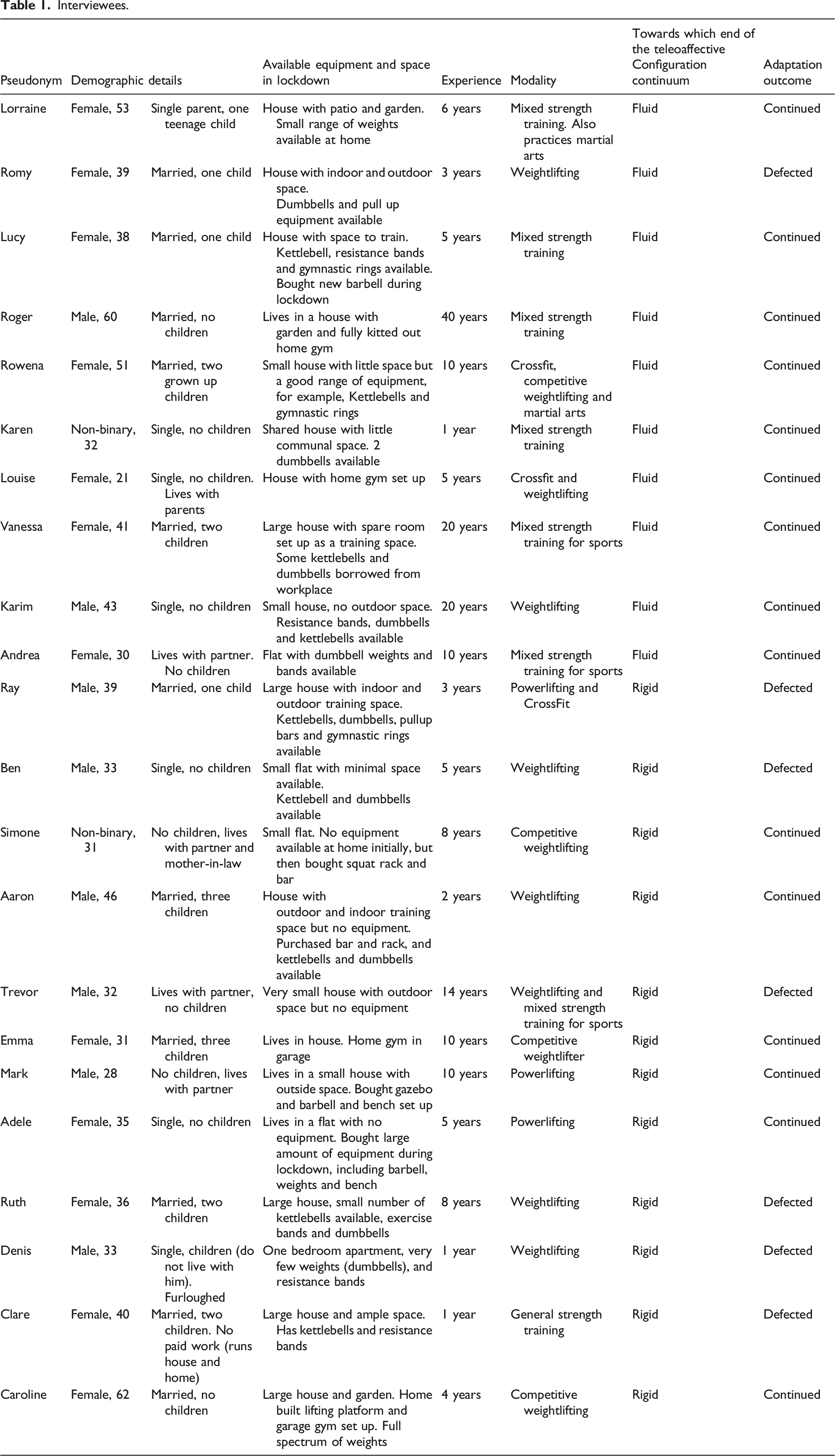
First (main) interviews were conducted with all participants in May–June 2020, just before gyms were due to reopen, in July, and after lockdown had closed the gyms, in March. Interviews all lasted over an hour, and included a virtual tour of the home training space, or a discussion of photos of home equipment and training space that had been emailed prior to the interview (for an example, see Figure 1). Following the piloted topic guide, participants were encouraged to talk about (Hitchings, 2012) their strength training routines before the pandemic, and their experiences of disruption and adaptation. Interviewers used their own experiences of strength training to build rapport and probe, gleaning otherwise hidden inferences in verbal and visual material. Particularly, participants were encouraged share the mundane detail of their practice performances, such as repetitions and sets (numbers of lifts completed with different weights), equipment preferred and what bodyweight exercises had been introduced during adaptation. The combination of knowledgeable interviewers and visual material, used as an enabling device, meant interviews moved beyond reflexivity and conscious awareness (Hill et al., 2014). Example of a photograph of home training space discussed during first interview.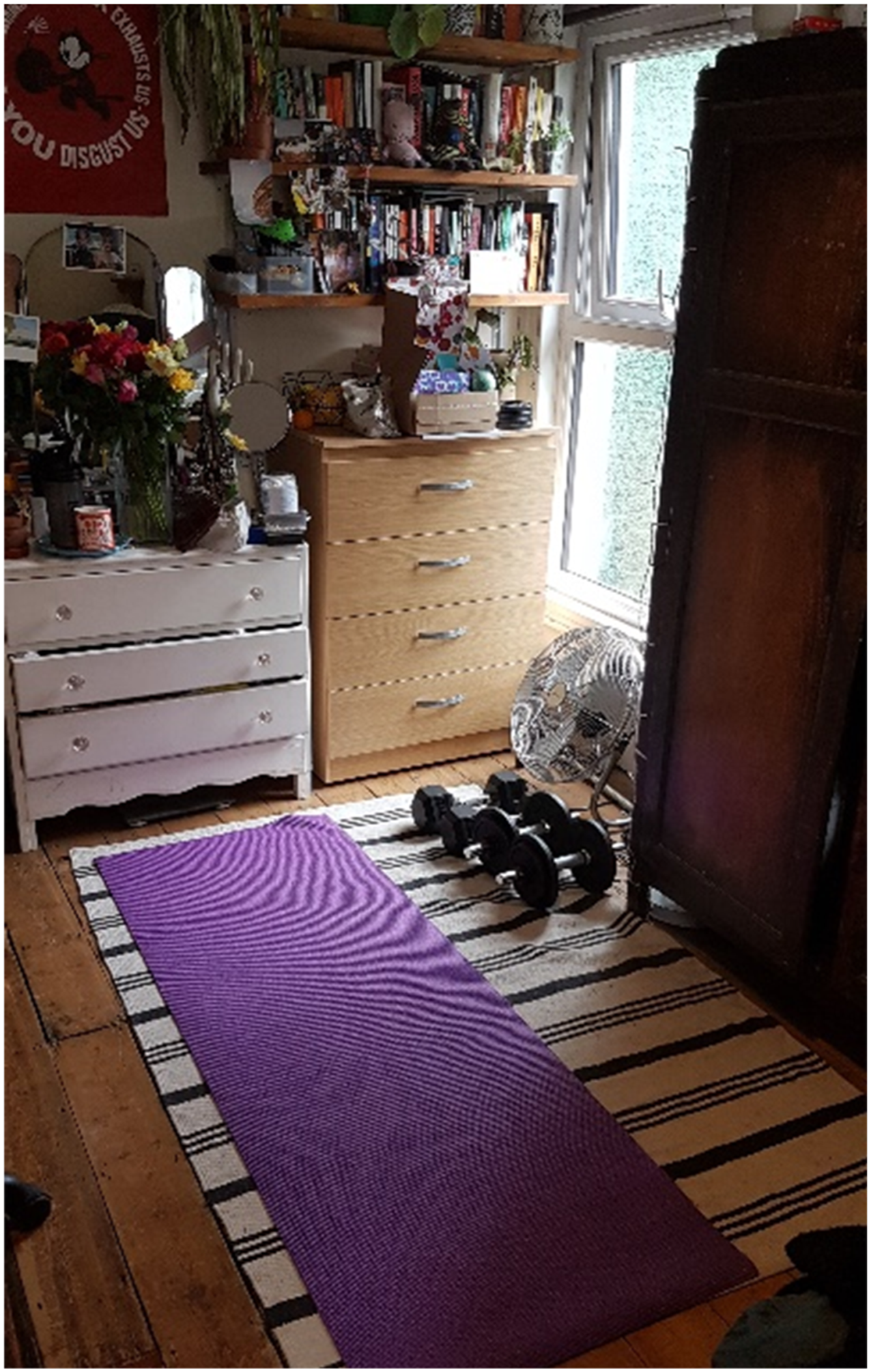
Gyms did not reopen as planned in March, so follow-up interviews were conducted online in March/April 2021 to further explore how participants’ adaptation to home training had continued. 13 follow-up interviews were conducted, each lasting just under an hour. The main topic was plans for re-commencing training when gyms did open (which happened in July 2021), although second interviews also corroborated insights from the first interview, and provided a sense of how practitioners had settled into their new routines. The study received ethical approval and followed careful data privacy and consent procedures, in line with ethics and General Data Protection Regulations (GDPR).
Interviews were transcribed, anonymised and analysed using NVIVO20, taking an interpretivist approach based on principles of reflexive thematic analysis (Braun and Clarke, 2019). Three of the authors initially created open codes from the data, coding ‘at the level of the consumption practice’ (Epp et al., 2014: p. 84) to categorise practice elements and adaptation outcomes. Through this analysis, we identified differences in practitioner-practice relationships with routinised strength training, tracing these through disruption and adaptation experiences. Next, through an ongoing, iterative process involving back-and-forth examination of theory and data (Spiggle, 1994), axial coding was applied, and theorization using Schatzki’s ‘teleoaffective structures’ illuminated their dynamic involvement in practice adaptation. Meaningful constructs were reviewed critically by all authors and member-checked with participants.
Teleoaffective configuration and adaptation pathways
For the practice of strength training, like all practices, the teleoaffective structure informs what it is for the practice to be carried out and ‘what specifically and unequivocally should be done or said…. Which projects, tasks, and actions carried out for that end, and which emotions possessed… when one is engaged in the practice’ (Schatzki, 1996: p. 101). In this line, our participants could explain with notable uniformity that strength training is done to improve muscle strength and shape; the dominant incentive to participate (Reckwitz, 2017). Tasks that were part of strength training were also identified uniformly, such as particular lifts and movements. However, a further range of end goals was also apparent, which mattered to practitioners in different ways and with different intensities depending on their personal histories and routinised practice performances. The variety of way strength training matters included the aesthetics of muscle shape and size, social connections forged through training, the satisfaction of quantifiable progression and the mental and physical wellbeing fostered through committed training. We found that the shape and hierarchy of these various teleological and affective components into performance exhibited different characteristics that give shape to practitioners’ relationship with the practice. Practitioner–practice relationships emerge over time as particular goals are in focus, or because particular spatio-material and other resources are available.
Figure 2 captures our theorisation of the way teleoaffective components – orientations to end goals, tasks and how they matter (Schatzki, 2005) – configure along a continuum from ‘fluid’ to ‘rigid’. Fluid configuration includes a wider range of teleoaffective components, guides performances with greater variability, is transportable to new spaces and possible to integrate more smoothly with adapted materials in line with available competences and know-how. Practitioners are able to strip back fluid teleoaffective configurations to make adaptation possible. At the rigid end of the continuum, teleoaffective configuration has more narrowly defined goals and tasks, and matters to practitioners in ways that are tightly entangled with the spatio-materiality of the original practice. Adaptation is far more challenging, as affective intensities dominate the practitioner–practice relationship, resisting transportation and integration with adapted practice elements. Practices can only adapt with significant effort to foster alternative end goals, preserving appropriate affective intensities. Thus after disruption, teleoaffective configuration shapes the adaptation pathway (adaptation experience and outcome) across a continuum, which are also guided by the availability of adapted materials, bodily skills, and practical know-how. Teleoaffective configuration and adaptation pathways after disruption.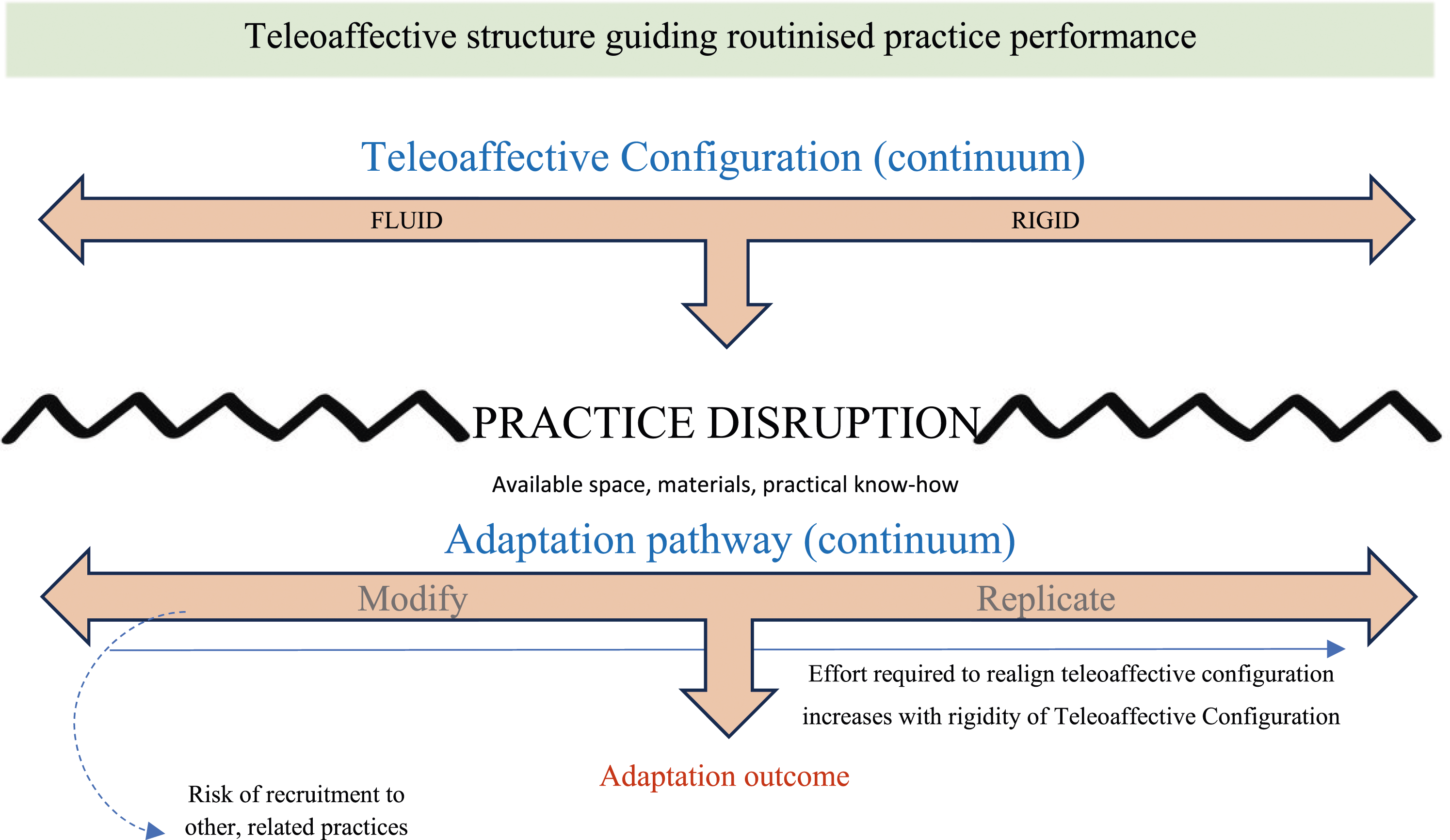
The interconnections between teleoaffective configurations and adaptation pathways are next explored through the empirical material.
Rigid teleoaffective configuration
Rigid teleoaffective configuration inhibits adaptation after disruption because narrowly defined affective intensities dominate the routinised practice, which are fostered through a narrow set of tasks directed towards a narrow set of dominant end goals. Furthermore, teleological and affective dimensions of the practice are locked tightly with practice spatio-materiality. Practices adapted outside the gym can feel intolerable.
Practitioners integrating rigid teleoaffective configurations into their routinised practice engaged in a narrow, tightly defined set of tasks, repeated to meet a narrow set of end goals dominated by muscle bulking and strength. Dennis describes his reasons for lifting as simply that ‘everyone likes to develop a big bench, a big squat, a big, big deadlift’ and further explains his focus on ‘strength plus overall body composition’. Similarly, Ray explains that bulking and strength requires volume and repetition of ‘the “big three lifts” – squat, deadlift and bench press’. Some practitioners are explicit that the aesthetics of bulking muscle size are as important as strength. As Trevor commented, ‘vanity is certainly part of it because you do want to look good… I’m only human’. Ray is clear, that the purpose of his training is ‘like, you know, getting stronger building more muscle’.
These dominant end goals require a narrow set of movements that shape participants’ weekly training, centred on the ‘big bench, big squat, big deadlift’ and accessory movements like rows that form the ‘bulking routine’. Characteristically, Dennis’ training tasks are repetitious, lack variation and are sequenced in a highly controlled way that was described in detail to the knowledgeable interviewers: “I was doing either to two upper body days with one lower body day and then the following week it'd be to lower body days with one upper body week. So essentially I would have two primary movements in your sort of like three to six rep range… So like, you know, 105 110 that might be four by six on that, but then doing like the equivalent volume in, like, bent over rows, usually four… And so there's sort of like the two big things and then do some, two more movements… very similar to what sort of outlined in line [a] generic bulking routine…”
Mark similarly describes his routine as ‘consistent’, unwaveringly enacted after work each day: “So it was mainly strength bodybuilding training, I was training sort of consistently, 5, 5 days a week. Mainly sort of doing an upper lower part split. I work about nine to about 6, 4 days a week. And then I usually go straight from work to the gym. I get there for about 7.30 and then I train for around an hour and a half to two hours. That'll be sort of Tuesday, Wednesday, and a Friday Saturday Sunday. So 5 days a week. So yeah, after work always, never before”.
This narrow range of repeated movements are typical in training for the pursuit of muscle bulking and strength, which dominate other goals such as socialising or health. Crucially, they are carefully planned, programmed and measured, as Dennis describes: “There is a there’s a physical and then you can say psychological process to weightlifting you know. You go and do X amount of work, the muscle gets bigger you can move a heavier weight… to grossly oversimplify. I think most people who are serious about training do track their progress. I can sort of see that there’s the working weight and volume creeping up. Depending on what your goals are, you can just keep a positive track of that so that I think there is that control element in there”.
The ‘process’ of strength training involves planning, tracking, putting in work and receiving measurable outcomes. Dennis is committed to the process: ‘there’s something to be said for the process… It’s something you will spend months working on’.
Narrow end goals dominated by strength and particular bulk aesthetics bring dominant affective intensities, or ‘beliefs, hopes, expectations, emotions and moods’ (Schatzki, 2001: 60), connected to the successful enactment of the strength training process for muscle bulking. First, affective intensity is fostered through the achievement of controlled progress. As Trevor explains, the appeal of strength training is the fact ‘You can get predictable results for specific outcomes’. The predictability, control and progression matters deeply. Dennis commits to the repetition of narrow movements and finds the control he can exert deeply satisfying as he tracks his carefully measured progress. Similarly, Ray fixates on measurable progress that ‘feels good’: “You know, progressive overload is important… It just feels good. I like the, I like to see the progression in the body as well”
Simone also describes how she ‘loves chasing the numbers’ involved in tracking her progress. Practitioners with a rigid teleoaffective configuration enjoy deeply the feeling of control and measurable progression. In this form, strength training requires a commitment that practitioners feel sets them aside from ‘recreational’ gym-goers.
Second, the aesthetic outcomes connected to muscle bulk bring an affective intensity that dominates the ‘rigid’ practitioner relationship with strength training. Ben had spent his twenties and thirties ‘in bad places’ mentally, then started the training that changed his appearance and self-esteem: “[strength training] sort of absolutely changed my whole wellbeing. It sort of, you know, I was like smiling at myself in the mirror. I can look in the mirror and go, ‘actually, you look better”.
Ben’s history of low self-esteem and poor body image intersects the teleoaffective configuration that governs his performances. He describes the ‘transformative nature’ of strength training to his appearance, which dominates how it has come to matter. This locks in a narrow set of end goals and associated tasks necessary to maintain the desired affective intensity. Ben has to lift heavy (with careful tracking of a narrow range of movements) to look the way he wants, which he describes as ‘getting great results’.
Along very similar lines, Dennis describes his commitment to lifting heavy weights as emerging from a history of poor body image. He describes the ‘issue’ of historically being overweight: “One of the issues I've always had, to various degrees, I’ve been quite overweight, and you, with that you do get some of the whole psychological body image self-esteem. I don't want to say so much like depression in the clinical sense, but it's like you don't feel good about yourself”.
Dennis’ history narrows his focus and offers little tolerance for deviation. For different underlying reasons, but with equal intensity, Clare was committed to six-day-a-week training ‘because I know that if I want the body composition, this forms part of it’.
The affective intensities dominating the rigid teleoaffective configuration are especially characterised by their tight entanglement with the spatio-materiality of the gym. For some practitioners it is the specific objects, commonly only available in a gym, that hold the key to how the practice can be performed in ways that matter. Ray explains that his training is usually ‘primarily focused around the barbell’, only available at his gym. Alongside the metal bar itself, a seven foot long piece of ‘Olympic standard’ equipment weighing 20 kg, Ray also describes the multitude of plates he uses to load on the bar. To progress his strength and muscle size, which for him are the reasons to perform the practice, he needs an array of weights, specialist equipment such as a ‘squat rack’ and regular access in order to incrementally increase the load of his lifts. He describes not wanting to miss a session in the gym, which is where all the components of his training come together; the repeated movements, the incremental increases in intensity and the trackable progression: “The intensity is increasing over time, you don’t want to miss a session... I’d typically follow a programme all the way through. At the gym you can sort of see progress better, you know?”
The affective intensities of strength training governed by rigid teleoaffective configuration are inseparable from the spatio-materiality of the gym.
Others describe the affective intensities of gym training in terms of the bodily sensations achieved specifically through touching and moving specialist gym equipment, or in terms of the mental focus achievable through the gym’s atmosphere. Adele describes the bodily ‘tension’ that she is drawn to, only satisfactorily achievable using gym equipment: “It’s the specific type of tension that you get from doing some exercises with the cable machine that you just can’t quite replicate outside of the gym.”
Dennis, too, describes the draw of the sensation brought by the weight of a bar on his back; the familiarity of ‘grabbing the knurling (markings) on a bar’: “I will say that and a lot of it comes down, I don’t know, like there’s a tactile aspect to it, like a degree of sensation to go through with the process of training, particularly with barbell training. Sometimes it can be, you know, that sort of familiar sensation of like when you are grabbing the knurling on a bar, you know what you’re doing when you feel it, digging into your back, things like that.”
For others, the desired affective intensity is fostered through sharing the gym with other committed practitioners, which helps them go off in a ‘little world of your own’ (Ruth). Ruth particularly likes that ‘everyone just gets on with what they are doing, no distractions’. The gym is central to the way practitioners with a rigid teleoaffective configuration accomplish the practice because it underpins dominant affective intensities and connected end goals involving a narrow range of repeated, heavy movements.
Adaptation pathway: Replicate
Rigid teleoaffective configuration resists smooth adaptation because acceptable end goals, tasks and particularly affective intensities demand integration with available practice elements in a way that largely replicates the feel and purpose of the original practice. Adaptation outcomes occur across a continuum from (rare) successful replication, to effortful surfacing of alternative practice end goals, to defection. For example, Mark describes the unavailability of his specialist gym as ‘scary’. After lockdown started, he focused on immediately buying equipment for his garden, spending thousands of pounds so he could continue pursuing a narrow set of strength goals: “My gym is one of the best gyms in the UK sort of for bodybuilding. So going from that to nothing was a bit scary to be honest. So at that stage, I kind of had to invest in some equipment… I just went on eBay and started to look for look for a bench, a squat rack., bar... like the cost wasn’t really an issue… I’ll pay whatever needs to be paid”.
Mark bolstered his skill and know-how by hiring a coach so he could carry on training in a way that replicated the end goals of strength progression and the affective intensities created through unwavering commitment and careful control: “I hired a coach as soon as the lockdown happened…. I mean, I was fairly experienced anyway but, [he showed me] the best ways potentially to, to stimulate muscle growth even with bodyweight exercises.”
Mark was able to continue strength training at home with a reconfigured practice that was close enough to the original to feel acceptable, particularly because the main reason his training mattered was to work towards strength goals associated with a competition he had planned later in the year.
In other cases, practitioners were only able to integrate rigid teleoaffective configurations with available practice elements through extreme effort representing ‘an occasional and largely intentional process’ (Schatzki, 2002: 241) of effortful teleoaffective realignment. With considerable effort, some practitioners were able to surface alternative end goals to a position of prominence in the teleoaffective configuration in order for strength training to carry on in a way that fostered familiar, replicable affective intensity. For example, Aaron describes his pre-lockdown strength training goals as maximum strength and muscularity. He was an archetypal ‘5 days a week’ gym-goer with unwavering commitment to a carefully controlled programme and a commitment to strength goals. In lockdown, he attempted replication, buying a squat rack, bench, barbell and weights, but could not achieve the focus, control and progress he desired without the gym. He felt he was ‘just spinning wheels’, rapidly losing motivation: “There was no question that my motivation suffered. It really did for weeks. It just didn’t feel right at all, and it definitely wasn’t enjoyable and that was one of the unfortunate side effects”.
Eventually, Aaron shifted his focus towards body aesthetics, which prior to lockdown had been a less important. The aesthetics of achieving ‘cut’ (prominent) muscles and extremely low body fat provided purpose to the adapted, less-than-perfect version of strength training he could do at home: “I had time to think ‘well where do I go next with it… I wasn’t going to get any stronger. My main goal had been to focus on making sure I didn’t lose any strength, but I was never going to win that one. I just didn’t have the weights to do it. So yeah it’s now around my nutrition. That’s what I decided to focus on a bit more because at home you can know do everything in the right way. What I’ve decided to do obviously was to try and preserve as much lean mass as I had but now to remove body fat too… which meant effectively going into a calorie deficit but using full body resistance to tell the muscle to hang around”.
Aaron’s active surfacing of alternative end goals brought new tasks that he could control carefully, such as weighing food and calculating macronutrients. As such he was able to preserve the affective intensity he most required from strength training, fostered through expert insight, controlled precision and measurability. Strength training felt meaningful again.
Adele also worked hard to surface alternative end goals to enable adaptation. She was an elite-level powerlifter and had previously found pleasure in working consistently on her exceptional strength with specialist equipment in a characteristically controlled way. Without her gym she lost motivation and almost gave up: ‘The beginning of lockdown made me lose a lot of motivation to train. At one point I almost wanted to give up’. She describes feeling ‘quite stressed’ at this loss of familiar training, yet over time and with considerable effort she managed to surface different end goals relating to technique perfection and connection with her body: “Like today for example, I was doing some Romanian deadlifts, and I just sort of tweaked my form a little bit more so that I could feel it more in hamstrings and that was just through practice really and slowing things down and using a lighter weight. You just pay more attention to yourself… I now focus a lot more on the full range of motion, the tempo, I like to slow things down a bit more, and really think about the connection to, to feel the muscles working. I slow it down. I’ve been, you know, practicing on that. The feeling, more, yeah…”
Despite losing the satisfaction attached to ‘getting big numbers’, which she describes as ‘ego-lifting’, Adele was able to foster familiar affective intensity through performing her training with expertise, rather than trying to replicate the heavy lifting she had previously relished. Her accrual of expertise validated her sense of being an exceptional, elite ‘lifter’. Adele ‘slowly started to enjoy training more again, almost like week by week’: “I’m starting to look forward to it now and it’s not it’s not just something that I just force myself to do. I am slowly getting better at adapting and accepting it now – I’m accepting the new challenge”
Realignment of rigid teleoaffective configurations is challenging, blocked by the dominance of the affective intensity demanded by strength training performance. As Adele explains, the shift away from absolute strength end goals was ‘very hard to accept’.
Defection was more common. Often the rigid teleoaffective configuration could not easily be integrated into the adapted practice. Adapted practices felt unsettled, unable to foster affective intensities that were sufficiently familiar. Trevor had sufficient ‘creativity’ (know-how) to adapt to home training, and had some equipment. However, he found the experience unsatisfactory: “I had a few pieces of equipment but not exactly much… And it’s been trying to use that and bodyweight at home, and training with my partner as much as reasonably possible. But it’s been a pretty big difference between what you were doing before, to suddenly… you have to have a degree of creativity to be able to get in even remotely similar resistance training. And you certainly can’t do any sort of max strength work, it’s extremely hard to replicate that sort of stuff at home…”
Despite attempts at using a resistance band and training with a heavily loaded rucksack to add weight, Trevor found he could not replicate the affective intensities achievable through his gym-based strength training, focused on ‘max strength’. Trevor described his gym a ‘performance gym’ that was a ‘leading training centre’. He missed the specialist equipment and gym space, explaining that in lockdown ‘I missed everything, space, oh my god I missed space’. Prior to lockdown, his training had been dominated by the affective intensities associated with regular, committed training, trackable strength outcomes and the ‘vanity’ of muscle bulking. With an adapted routine, he could not connect with strength training in a way that mattered. Trevor found himself finishing workouts early and his motivation to train ‘dwindled’: “I couldn’t be bothered to carry on… there was very little steam left… I tried as best as I could to stay motivated but there comes a point where it adds up too much. You end up missing workouts or just trying to avoid exercise in general”.
Even for those with a good range of suitable equipment and ample skills and know-how, adapted home training often felt empty because of the closely entangled affective-spatio-materiality fostered through gym training. Ray had kettlebells and other equipment at home but admitted ‘I just couldn’t get excited about it’, partly because he needed a range of weights to achieve the controlled, trackable version of strength training he loved, dominated by muscle bulking goals and affect associated with muscle size, strength and aesthetics. As he explained, ‘Yeah, I don't think there's anything else that's that sort of just so incrementally loadable. And certainly at home, like I struggled to get excited about any kind of leg exercise… there's no real substitute for deadlift’. A few weeks into lockdown, Ray also gave up, unable to replicate the rigid combination of tasks, outcomes and affect.
Dennis similarly described the loss of purpose in home training, which did not ‘feel the same, and you begin to really lose all kind of enthusiasm for anything’. He had thrived in the gym environment, feeling masterful as he routinely lifted huge weights, seeking to repeatedly overload his muscles and progress: “I'd complete the work volume for [the leg press] and add some more next time and just keep on going until you feel like, you know, you're actually getting to a point where you really are stalling out... That was just what I did.”
Dennis’ training was serious, so the disruption of lockdown felt like a ‘catastrophe’, given the significance of his prior relationship with the practice. Specifically, he describes how having his ‘gym taken away from me’ triggered a sense of desperation. Without his gym, he described home strength training as “total bollocks” (pointless) because the desired affect centred on careful progression and muscle bulking for aesthetics is impossible to recreate: “I mean, I could do decline press ups off of my sofa or do a one legged, you know, rearfoot one legged, elevated things and find something heavy to carry, just go and put all the tins of beans in a rucksack and slap that on my chest.. [but] after about four weeks, I found that this is complete and total bollocks and is not doing anything for me…”
Dennis became depressed and ‘very familiar with the counch’. Similarly, Ben stopped training at home during lockdown despite having dumbbells. He describes home training as ‘flogging a dead horse’ and that he ‘needed something to lift… So yeah the whole thing just stopped’.
Rigid teleoaffective configurations contain limited tolerance for alternative, or lesser, affective intensities achievable through modified practice performances. Some degree of teleoaffective realignment may be possible, where alternative end goals are surfaced to preserve familiar affective intensities. Yet the effort required for such realignment means that many attempts at adapting practices governed by rigid teleoaffective configurations fail. Adaptation can fail to replicate appropriate, dominant affective intensities and triggers defection, which is emotionally unsettling as the reconfigured practice feels ‘intolerable and therefore inappropriate’ (Hui, 2017: p.56).
Fluid teleoaffective configuration
The characteristics of fluid teleoaffective configuration afford smoother transportation to the new spatio-material arrangements of home training. Although muscle strength end goals continue to represent the normativity of strength training, fluid teleoaffective configuration includes a greater range of tasks and end goals, with variability ‘built in’, and also brings broader forms of affective intensity. Teleoaffective fluidity therefore affords greater tolerance to adapted affective intensities within the modified practice.
Fluid teleoaffective configurations are characterised by an enhanced range of tasks beyond a dominant focus on the main lifts. Rowena did Crossfit specifically because it incorporates multiple tasks from powerlifting, gymnastics and weightlifting. She often trains with others but will also train alone. Similarly, Vanessa takes part in varied group strength training classes as well as her own focused weight training. Other practitioners also describe how their strength training includes a broad range of tasks, even integrating strength training alongside other sports like running, martial arts, cycling or rugby. Indeed, strength training guided by fluid teleoaffective configuration tends to have variability of tasks and end goals ‘built in’, meaning variability forms part of the affective draw of the practice. For example, Roger describes how his training routine has changed often over the years, explaining he always enjoys ‘switching it up a bit’. Although Roger describes his training as always having ‘the goal of strength and hypertrophy’, he also admits ‘I'm always fairly flexible. I don't periodise. I still work the same muscles, but in different ways’.
Roger describes a characteristically detailed weekly training programme that sounds similar to the rigidity of Ray’s or Dennis’, but he regularly includes extra challenges for variety. He recently started boxing classes and has even ‘started doing some running occasionally’ because he wanted to try obstacle racing: “And whilst I've got the strength, the upper body strength especially, to get over these obstacles, but if you're not very good at running, which I wasn't, I thought ‘I've got to get better at that’… So I started doing that [running] as well”.
Roger relishes variability in his routine. As such, he is flexible on its detail, even describing his training programme as ‘sort of structured but… a little bit more fluid’. Similarly, Rowena describes systematically ‘changing up’ her training and is drawn to the unpredictability of Crossfit workouts, which are programmed by the gym, explaining the fun of ‘just turning up and doing whatever was on the board’. Variability had always been part of her training: “I used to be heavily into kettlebells, then I sort of started supplementing that a bit with powerlifting… then I got into Crossfit, which I do for that cardio endurance as well as strength and a bit more gymnastic stuff.”
Rowena trains at her Crossfit gym five or six times a week and supplements this with her own strength training.
Variability is also central in Vanessa’s relationship with strength training. She flexes her training depending on how she feels: “So it could be one day that I'm thinking, ‘Oh, I don't really fancy doing like my heavy weight session I was gonna do’, or go and do some stuff on the racks and use the gym like the heavy gym balls and stuff like that. So yeah, I mix it up”.
Vanessa is habitually flexible in contrast to the unyielding training programmes governed by rigid teleoaffective configurations. Furthermore, like Rowena, she takes part in strength training classes she has no control over, which she enjoys for the social aspect and for the very fact they are variable. These involve ‘strength work with weights which can be weighted lunges, rows, stuff like that’, but she explains ‘I don’t know what they will throw at me… I won’t know what we are doing from session to session’. Variability part of the appeal.
As well as variability of ways strength training matters, fluid teleoaffective configurations tend also to include inherently broader and more transportable affective dimensions. Louise lists strength as one in a list of equal goals, pointing to a range of ways that strength train matters. She trains to ‘feel good, mental health, strength goals, aesthetics, routine and commitment’. Andrea similarly explains that ‘there’s a lot of very good things to do with resistance training’, emphasizing the variety of equally important end goals. Yet often, strength training matters to practitioners for broad health and wellbeing benefits, social connection, and a general enjoyment of physical activity as well as for the normative satisfactions associated with gaining muscle strength. Strength goals and aesthetics are present in practitioner accounts, but muscle bulk and absolute strength gains do not dominate. Rather, strength training is for ‘feeling good’. For example, Vanessa likes feeling ‘a bit broken’ and somewhat vaguely likes ‘feeling strong’, rather than feeling she has to hit particular, measurable strength targets that she can only do with a barbell: “[Strength training] makes me really happy. It's if I don't train, I think life is harder for me. It just gives me a bit of clarity. It just gives me some headspace. Yeah I think obviously the physical is really important. I like feeling fit. I like feeling strong”.
Along similar lines, Lorraine describes the appeal of strength training in terms of a general physical and mental feeling brought by training: “I like the way I feel when I’m training and after I’ve trained. I suppose I know it’s good for my mental health as well as my physical health. I can tell if I don’t train or if I didn’t go for a jog or do something; I wasn’t as happy with myself.”
Practitioners value broad wellbeing benefits of strength training as physically active leisure, with strength gains as part of, rather than dominating, the appeal. They recognise that a number of modes of strength training, in multiple places, can foster appropriate affective intensity.
Range, variability and breadth of affective and teleological components characterising fluid teleoaffective configuration make the practice more transportable, particularly because the teleoaffectivity is less entangled with the spatio-materiality of the gym. Although the gym provides focus, friendship and equipment, the gym is not the affective anchor it is for practitioners guided by a rigid teleoaffective configuration. As Roger explains, the gym is not what ‘keeps him going’: “The gym itself is in a warehouse. They play loud music and the setups are really nice. There’s a good gym etiquette. But, but that’s not what keeps me going. It’s a benefit. It’s like icing on the cake. But if it’s not there, I’ll still get it done”.
Like Vanessa and Lorraine, Roger’s relationship with strength training incorporates a broader enjoyment of strength training as purposeful physically active leisure and is not centred on the gym. Vanessa similarly explains that she missed the gym ‘for the social aspect’ but reworked her training fairly quickly when lockdown was announced, because ‘I need to train like eating and sleeping, to be honest’. She prioritised finding a way to carry on without the gym. Performances include, but are not dominated by, the end goals and affective intensity of muscle strength, and the affective dimension they desire is not solely achievable through a narrow set of end goals and tasks. Fluid teleoaffective configurations are characterised by variability and transportability.
Adaptation pathway: Modify
Fluid teleoaffective configuration fosters smooth transportation and adaptation. Roger was somewhat self-conscious about the ease at which he adapted to home training: ‘I know it sounds bad but [lockdown] doesn’t really impact me too much’. The appeal and enjoyment of strength training for Roger was never tied closely to the gym, and the inherent variability of his routine and his flexible approach meant that during lockdown he simply dropped a few activities and increased others so that training continued in a plausible way, using his home equipment. Although he missed the ‘presence of other people, largely’, he introduced online training sessions with friends: ‘I would write a programme and we would train together so I always had that’.
Furthermore, Roger relished the changes enforced by gym closures. He explained how he enjoyed ‘the opportunity to learn a few other things’ and did some online nutrition courses. He even came to ‘love’ some of the creative variations he included in home training, like ‘rear foot elevated squats off the sofa’, explaining ‘I find it very effective’. He took delight in setting himself challenges, such as working towards achieving 10 straight pull ups, admitting ‘I actually got to 15’: “When I got bored I set a new challenge. It was fun. ‘I’ve got to think of something else now’”.
Given Roger’s bodily skills and know-how, the available spatio-materiality of home exercise equipment and the fluidity of the teleoaffective configuration governing his routinised performance, practice adaptation was particularly smooth.
For other practitioners, adaptation required some effort to modify the teleoaffective configuration guiding their relationship with strength training. However, given the greater range of tasks, end goals and affective intensities guiding practice performance, the process of adaptation could be relatively smooth. Prior to lockdown, Karen’s strength training had been guided by broad mental and physical health goals but also included a range of other benefits, including the ‘aesthetic allure’ of more prominent muscles and the enjoyment of being recognised as a strong, capable woman in a male-dominated space. Karen found going to the gym to do strength training also helped her gain confidence and to not ‘feel weak and helpless’, which she valued as she struggled with early-onset arthritis: “Strength training made me feel confident just being in my body. Gaining muscle has made me more confident in my body as well”.
Karen noticed a tangible improvement in her pain levels when she trained: ‘If I don't exercise for a few days, I start to get pain symptoms’.
Despite Karen’s lack of equipment at home (one pair of dumbbells) and minimal space in a small bedroom of a shared house, she was able to modify the teleoaffective configuration guiding her training by stripping away end goals and affective intensities that were not possible to integrate with available spatio-materials and competences. To carry on, she fixated on reducing her pain: “I would have probably stopped completely, but I have arthritis and the exercising helps manage my pain… And so first I wanted to try and avoid losing as much muscle as possible during lockdown. I was doing more upper body exercises. But, like, I just decided I didn’t really care so much. And, and the main motivation just became not being not having knee pain.”
Karen describes the process of reconfiguring the way strength training mattered as simply ‘deciding’ to not care about unachievable aspects any more.
Like Karen, other practitioners would also ‘strip back’ the teleoaffective configuration from the range of components included in the fluid configuration guiding their routinised performance, preserving only those that were most transportable and easy to integrate available materials, bodily skills and know-how. Prior to lockdown, Rowena’s strength training routine at her gym had carved out dedicated time and space to train as well as providing social connection and, importantly, an overall feeling of fitness and wellbeing. From this fluid, that is, broad and varied, starting point, Rowena was able to modify the teleoaffective configuration and focus on training to feel fit, introducing rest days and a focus on sustainability and safety. She could carve out a way of training that fostered an appropriate affective intensity so the motivation to continue home training remained. Rowena describes the ease at which she adapted her training to use the equipment available at home: “Well, I've got kettlebells at home, so I kind of went back to kettlebells quite heavily. So I haven't really been able to do any of the Olympic lifts and stuff that I like to do. I've had to go drop the weight a little bit just to be safe. But the volume, load the weight down, up the volume…”
She describes how her training ‘actually it feels better now’ and as ‘working well for me’. Although she remained committed to strength, ‘as the main thing’ her training is for, ‘I think actually [adapting] has been good for my mindset. So I think actually I feel fairly positive about the whole thing. Although I’ll be glad to see all my friends again’. Rowena was able to work at the teleoaffective configuration and carry on training in a meaningful way.
Similarly, Louise describes being able to suppress the drive for ‘strength gains’ and reimagine her training so it was ‘just about moving’ and ‘feeling good’. This allowed her reimagine the point of carrying on at home: “For me the whole reason why I work out is like intrinsic, like to feel good and that. Like, that is my underlying reason. But when I was in the gym obviously I was like programming my training to like hit certain [strength] goals as well. So then like when lockdown happened it kind of like stripped that back and it was again just about moving because that made me feel good kind of thing. Like I wasn’t really thinking about like, strength goals or anything like that because I was kind of out my control so it was just keeping moving try and do something to like to still ’make me feel good”.
Although Louise is characteristically passionate about regular, committed training and her strength goals, as with all strength training practitioners, the fluid teleoaffective configuration guiding her training meant she could strip away unachievable end goals and focus on the enjoyment and physical sensation of ‘just keeping moving’ during lockdown. In a similar way, Lorraine describes the training she did at home as ‘maintenance’. She ‘didn’t expect to make any gains in strength or aerobic capacity…’, which were previous goals. She stripped these away so that goals and affect associated with training could centre on being for ‘my mental and physical health’. These goals could be integrated with other available practice elements and bring purpose and sufficient motivation to continue. Although her training effectiveness reduced, Lorraine explains ‘that was fine, it was maintenance rather than improvement I was aiming for’.
Vanessa missed the focused atmosphere, people and equipment at the gym, but modified the teleoaffective configuration to focus on the social side of training, which she found helped with motivation and mental wellbeing: “I love the gym environment. I missed it through the first lockdown but I feel like I’ve replaced it now doing the outdoor circuits and running with my friend instead. I think I’m getting that social angle that I needed in other ways”.
As Vanessa’s quote attests, a risk of modifying the fluid teleoaffective configuration to focus on particular end goals or affective ends, is that strength training could lose practitioners to other practices through this process. Vanessa’s focus on social side of training shifted her towards outdoor circuit training, allowable during lockdown, but she also starting cycling and running far more, weakening her relationship with strength training. Similarly, Romy was able to strip back the fluid teleoaffective configuration guiding her strength training to focus on ‘just moving’ and ‘the endorphin rush’. Despite the kettlebells and other equipment she had for home strength training, Romy was recruited to gardening, which satisfied her desire to move, with cycling on a static bike enough to achieve an endorphin rush: “I guess because we were home, and we were stuck at home, but we found a way within our lives to move constantly with the gardening, I think that probably took away some of our innate need to be at the gym... And for me that need for activity is quite extreme and the cycling, it’s not the addictiveness. It’s not like having endorphins.”
Romy defected from strength training.
Discussion
Our theorisation of ‘teleoaffective configuration’ illuminates how practitioners build different relationships with the same practice without breaking normative orientations governed by the teleoaffective structure, and what this means for practice adaptation after disruption. First, our theorisation advances consumption research that tends to conflate the various components of teleoaffective structures into the broad element of ‘meanings’ (Shove et al., 2012). This obscures their complexity. Teleoaffective structures house affective and teleological dimensions that interconnect and relate with other practice elements in complex ways. Although our analysis consistently confirms strength gains as the central normative feature of strength training, other end goals and affective intensities are variously present and configured differently. From the same teleoaffective structure, a ‘collection’ of its constitutive components (Schatzki, 2002: 80) form bodily-mental conditions that shape complex practice–practitioner relationships, shaping and shaped by the way the practice is done and why it matters. Often, practitioner histories guide the way practitioners connect with particular teleoaffective configurations. Ben's history of poor body image, for example, shapes his intense desire for the aesthetic outcomes of strength training, whereas the multiple ways Rowena has engaged in strength training over her career means she relishes variety.
Specifically, our theorisation of teleoaffective configuration adds theoretical detail to accounts of practice adaptation that point to the importance of ‘meanings’ to practice performances (Epp et al., 2014; Gonzales-Arcos et al., 2021; Phipps and Ozanne, 2017; Thomas and Epp, 2019). Our study theorises how teleoaffective components are integrated into performances in configurations with fluid or rigid characteristics, across a continuum. The characteristics of these configurations stem from their breadth of end goals, and the dominance of particular affective intensities that exert force over performance and defines its purpose. Rigidity is characterised by a narrow range of end goals and tasks relating to these goals, and a dominant affective intensity tightly connected to their accomplishment. Materials and space are also closely entangled with the affective mood governing appropriate performance. In contrast, fluidity is characterised by the range of end goals and tasks that may include variability as core, and by broader affective intensities such as ‘general wellbeing’.
Second, our theorisation extends existing understandings of how meanings shape adaptation outcomes and experiences. Extant studies suggest meanings can often be obstacles to adaptation (Gonzalez-Arcos et al., 2021; Epp et al., 2014; Venugopal et al., 2019) yet also point to the possibility of their realignment (Cardoso et al., 2020; Phipps and Ozanne, 2017). Our analysis adds depth to these insights, pointing to a continuum of adaptation pathways and outcomes linked to the characteristics of teleoaffective configurations guiding the routinised practice. At one end of the continuum, rigid teleoaffective configurations demand replication of practice elements in support of dominant affective intensities and narrow end goals and tasks. Yet even when near identical materials and know-how are available, strong spatio-material-affective entanglement central to the routinised practice resists transportation. At the other end of the continuum, fluid teleoaffective configurations afford smoother practice transportation and adaptation, particularly because variability is ‘built in’ and because easier modification of the teleoaffective configuration by practitioners is possible. This fluidity allows for smoother integration with available materials and know-how and enhanced tolerance for the adapted practice (Hui, 2017).
We take inspiration from Schatzki’s critique that social theory tends to focus on normative consensus in practices at the expense of variation (1996, 2002). Rather, our account embraces ‘complexities, differences and particularities’ (Schatzki, 1996: 12) with how practice normativity is integrated into routinised performance, and how these complexities shape adaptation. We illuminate how adaptation outcomes can occur along a continuum, from emotionally distressing defection, as with Ben, Dennis or Ray; to painful, effortful adaptation as with Adele or Aaron, or smoother adaptation, as with Roger, Rowena or Vanessa. By theorizing adaptation outcomes through the lens of teleoaffective configuration, we illuminate outcomes and experiences of adaptation as varied, emotional and unique to practitioners, yet always unfolding in relation to the practice template that houses the teleoaffective structure. This allows us to bring different experiences and emotions into our account of adaptation yet remain centred on practices and the life of their elements.
Finally, our framework advances existing research that illuminates how practitioners work to shift or ‘adjust’ meanings of practices in order to achieve successful practice adaptation after disruption. Existing accounts tend to foreground the role of creative consumer striving, such as on the ‘problem solving’ or ‘imaginative capacities’ that make adaptation possible (Cardoso et al., 2020; Epp et al., 2014; Lindsay and Supski, 2017; Mason and Pavia, 2006; McAlexander et al., 2014; Thomas and Epp, 2019). Practitioners make an essential contribution to the processes of practice reproduction and evolution through ‘occasional and largely intentional processes’ (Schatzki, 2002: 241) of realignment and modification. However, performance and practice templates are recursive, and neither should be reified. Our study reimagines practice adaptation processes by foregrounding the characteristics of teleoaffective configurations as shaping the capacity for practitioner creative processes. That is, we theorise how fluid teleoaffective configuration facilitates easier modification and integration of a stripped back version with other available practice elements. Rigid teleoaffective configurations pose significant challenges to practitioner effort, demanding preservation of original affective intensities. From a rigid starting point, practitioners like Aaron and Adele are able to ‘surface’ alternative ends but this is extremely challenging. We position practitioner creativity as able to shape adaptation pathways in the context of the life of elements, particularly teleoaffective configuration.
To conclude, this study advances our understanding of the dynamics of meanings in practice adaptation in the face of disruption by bringing into focus and operationalizing the characteristics of teleoaffective configurations that shape adaptation pathways and outcomes. As such, we contribute to understandings of adaptation to practice disruption as part of the flow of human activity that is embodied, automatic and conditioned through social structures acting in the ‘peripheral vision’ of everyday life (Hill et al., 2014).
Furthermore, our theoretical toolkit will be useful to marketers for interpreting and codifying smooth, impossible or variously challenging adaptations to consumption routines that become necessary in the face of market disruption, particularly when adaptation involves transportation of a practice to new settings. The same practice may be variously adaptable, depending on the way the teleoaffective configuration guides routinised performances.
Our particular active leisure context may also help social marketers and transformative consumer researchers seeking to support consumers in adapting to disruption in way that preserves mental health benefits of exercise. Our findings usefully show that when performances are guided by rigid teleoaffective configuration, aesthetic affective intensities guiding exercise can dominate and adaptation can be emotionally distressing. Fostering fluid teleoaffective configuration in relation to exercising may help practitioners form healthier, more flexible and more transportable relationships with exercising practices.
More broadly, future research may consider whether marketing can help foster or shape fluid teleoaffective configuration in routinised practices, encouraging fluidity as a precursor to smoother adaptation. For example, it may be important to explore how intersecting practices play a role in fostering fluidity or rigidity in the teleoaffective configuration. Future research might also consider how practitioner creative efforts such as ‘surfacing’ and ‘stripping back’ can be fostered, and whether other similar capabilities can help practice adaptation in different contexts.
Footnotes
Acknowledgements
We would like to acknowledge the tremendous contributions of all the authors involved with the original international survey study that led to the ability to complete this current project. Without their efforts it would not have been possible. They are: James Fisher, Luke Carlson, David Williams, Stuart Phillips, Dave Smith, Brad J. Schoenfeld, Jeremy P. Loenneke, Richard Winett, Takashi Abe, Stéphane Dufour, Martino V. Franchi, Fabio Sarto, Tommy R. Lundberg, Paulo Gentil, Thue Kvorning, Jürgen Giessing, Milan Sedliak, and Antonio Paoli. Further, we would like to acknowledge the contribution of Milo Wolf and Nick Michalopoulos who conducted some of the interviews used in this study.
Declaration of conflicting interests
The author(s) declared no potential conflicts of interest with respect to the research, authorship, and/or publication of this article.
Funding
The author(s) received no financial support for the research, authorship, and/or publication of this article.
 .Horme Lab Web site. Currently, he supervises PhD students, teaches research methods and leads on the dissertation modules for our undergraduate and postgraduate courses.
and Chief Editor of REPS Research Review. Pak did his PhD on the ‘minimum effective training dose for strength’ and his research focuses on resistance training for muscle strength and hypertrophy. As a coach, Pak works with individuals of all sporting and professional backgrounds, from beginner lifters to competitive strength and physique sports athletes.