




Abstract
This study develops and tests an integrative model of destination loyalty to tourist hotspot destinations. The study highlights the role of perceived destination adaptation and psychological reactive behaviors in determining tourist satisfaction and loyalty. The model was tested using data collected from 582 respondents who had recently visited one of the “overcrowded” Mediterranean coastal tourism destinations. Findings suggest that perceived destination adaptation negatively influences tourist satisfaction and positively influences reactive behaviors of approach, avoidance, and tolerance. Approach and avoidance behaviors predict assessed crowding levels and tourist satisfaction. Tourists’ tolerance levels on assessed crowding was insignificant. Assessed crowding levels negatively affect tourist satisfaction and intentions to revisit and recommend the destination while positively influencing objections to revisit and recommend the destination. Concomitantly, overtourism awareness moderated the effect of assessed crowding levels on tourist satisfaction and intentions to revisit and recommend the destination. Theoretical and managerial implications are discussed.
Introduction
Tourist hotspot destinations can be considered as very famous mass tourism destinations that attract holidaymakers usually on brief visits, which can affect host community’s livelihood (Jacobsen, Iversen, and Hem 2019). Due to the growing accessibility of places through low-cost carriers, cheap accommodation, and social media influencing demand (Oklevik et al. 2019), destinations such as Venice, Ibiza, and Barcelona have become iconic hotspots or “must-go” destinations. The high volume of yearly tourist arrivals raises concerns not only for the sustainability but also the carrying capacity of such destinations. These places are highly dependent on tourism economically and have also reached their social and environmental carrying capacity, exemplifying the phenomenon of overtourism characterized by, for example, over-crowdedness (Insch 2020; Peeters et al. 2018). While residents are usually the first to complain about the damaging effects of high tourist densities on their lifestyle and the local environment (Gössling, McCabe, and Chen 2020), tourists have also joined the bandwagon given the undesirable consequences of overtourism on their own destination experience, having implications on tourist satisfaction and loyalty (Koens, Postma, and Papp 2018; Sæþórsdóttir and Hall 2021).
Within this context, tourist loyalty to hotspot destinations seems to be a research gap that has yet to be addressed. To maintain high satisfaction and loyalty, tourists’ expectations and motivations must be managed (Baker and Crompton 2000; Chen and Chen 2010). While studies on the determinants of tourist loyalty examine factors such as satisfaction (Prayag and Ryan 2012; Ribeiro et al. 2018b), destination image (Sun, Chi, and Xu 2013), perceived value (Sun, Chi, and Xu 2013), service experience (Gursoy, Chen, and Chi 2014), evoked emotions (Bigné, Andreu, and Gnoth 2005; Prayag, Hosany, and Odeh 2013), emotional solidarity (Ribeiro et al. 2018b), destination knowledge (Palau-Saumell et al. 2013), perceived safety and place attachment (Patwardhan et al. 2020a, 2020b), emotional experience (Patwardhan et al. 2020b), mood and tourist characteristics (Jurado, Damian, and Fernández-Morales 2013; Pons and Laroche 2007), involvement (Prayag and Ryan 2012), and travel characteristics (Gursoy, Chen, and Chi 2014), a significant gap remains in that psychological factors of how tourists cope with and manage perceptions of overcrowdedness, and the subsequent impacts on post-consumption behaviors are yet to be ascertained. Specifically, existing research on the antecedents of destination loyalty examine a range of cognitive and affective predictors (Prayag et al. 2017) without considering the intervening roles of adaptive behaviors in influencing post-consumption behaviors. Previous studies have also not considered tourists’ psychological factors such as perceptions of destination adaptation (Jacobsen 2004; Sæþórsdóttir and Hall 2021), approach and avoidance reactions (Jacobsen, Iversen, and Hem 2019), tolerance levels and perceptions of overcrowding as well as awareness of overtourism (Vaske and Shelby 2008) as determinants of satisfaction and loyalty.
Considering the abovementioned research gaps, alongside the scarcity of overtourism studies on places susceptible to this phenomenon, this study aims to test an integrative model of destination loyalty. In particular, the study proposes a theoretical model based on the expectancy-disconfirmation theory (EDT), stimulus-overload theory (S-OT), and social interference theory (SIT). As EDT suggests, tourists have pre-visit expectations which are then compared to the actual experience in determining positive or negative disconfirmation of expectations. This is linked to both S-OT and SIT, providing support for an examination of crowding assessments in relation to the exposure of tourists to high density environments and uncontrolled interactions (S-OT) and to the ability to fulfill visitation goals and/or achieve psychological states (SIT) during the experience. Since hotspot destinations are characterized by different tourist norms and tolerances (Papathanassis and Beckmann 2011), the study assesses psychological reactions (approach and avoidance) and tolerance levels as determinants of destination loyalty. As some of these factors are also influenced by overtourism awareness, this study also examines the latter as a moderator on the relationship between crowding assessments, tourist satisfaction, and destination loyalty. Thus, the three theories underpinning the proposed conceptual model (see Figure 1) attempts to answer the following research questions:
RQ1: Are tourists’ perceptions of overcrowding affected by their perceived destination adaption, approach and avoidance behaviors, and tolerance levels?
RQ2: Do the factors in RQ1 affect tourist satisfaction and loyalty?
RQ3: Does overtourism awareness moderate tourist satisfaction and loyalty?
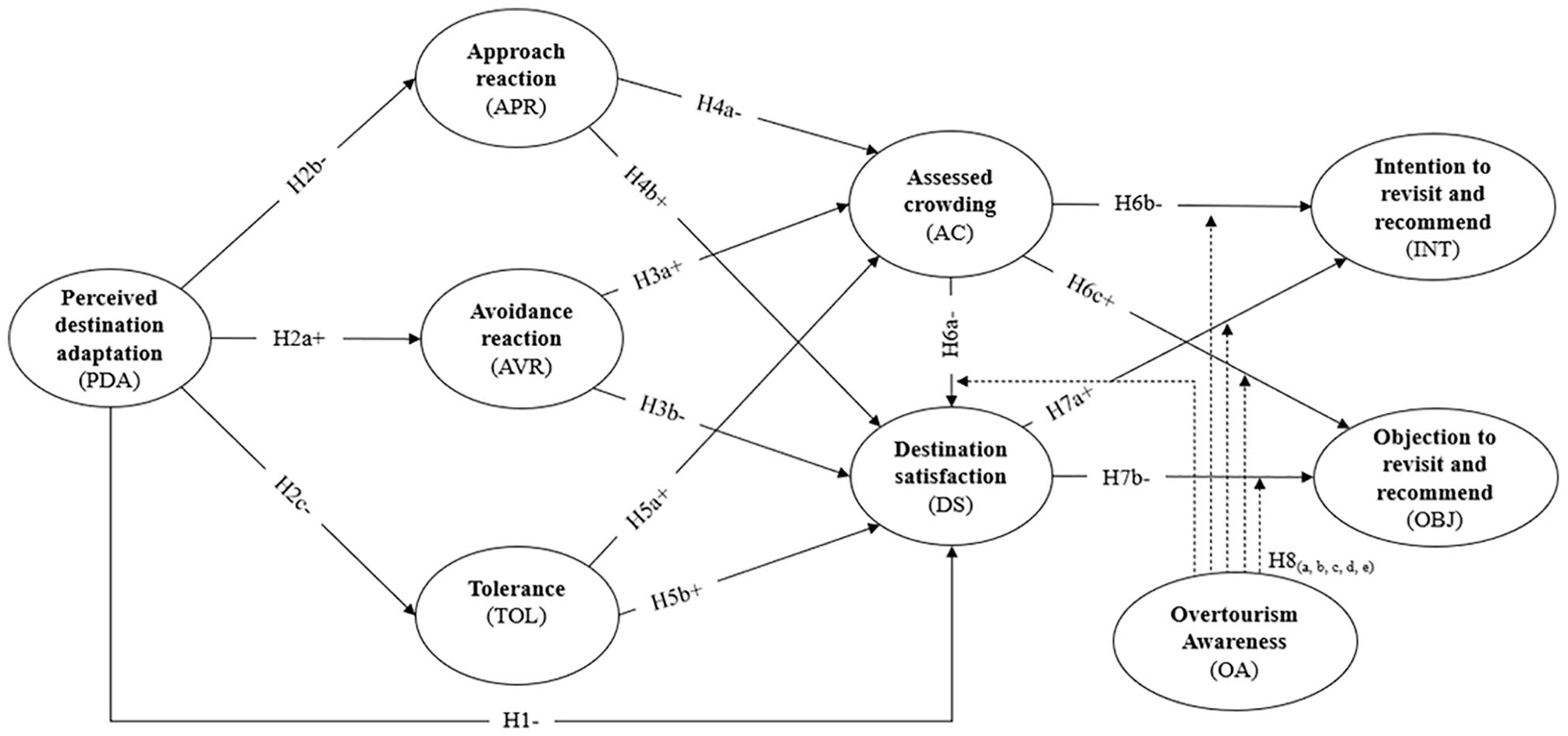
Proposed theoretical framework and hypotheses.
Our findings provide several theoretical and managerial contributions. First, rooted in various psychological and marketing theories, we provide evidence on how tourists employ both approach and avoidance behaviors when faced with overtourism, thereby extending knowledge on coping mechanisms of the human system in response to tourism overdevelopment. Second, by investigating iconic hotspots in the Mediterranean, this study clarifies the role of perceived adaptation of destinations by tourists as triggers of several psychological reactions including crowding assessment and the use of tolerance levels to evaluate the destination experience, which subsequently impacts post-consumption evaluations. Third, this study assists the current tourism research agenda on carrying capacity by providing the tourist perspective on desirable crowding levels and the impact of social density on the tourist experience as well as on post-consumption behaviors. Integration of tourists’ objections to recommend and revisit the destination in the model allows destination managers to capture and quantify the extent to which tourists’ destination perceptions influence both favorable and unfavorable loyalty intentions explicitly. Fourth, the study quantifies travel intentions after COVID-19, which are salient to destination managers and policymakers in their decision to support post-pandemic travel thereby extending the limited studies (e.g., Neuburger and Egger 2020; Wachyuni and Kusumaningrum 2020) on travel behavior after a health-related crisis.
Theoretical Background and Hypotheses Development
Overtourism, Overcrowding, and Destination Loyalty
While the term “overtourism” might be recent (Namberger et al. 2019), the multifaceted phenomenon has been discussed in the tourism growth (Wall 2020; World Tourism Organization [UNWTO] 2018), carrying capacity (Jurado, Damian, and Fernández-Morales 2013), mass tourism (Goodwin 2017), and destination crowding (Manning et al. 2000; Shelby, Vaske, and Heberlein 1989) literatures. Recent media attention on the issue (Minihane 2018), alongside concerns by the UNWTO, and intensifying anti-tourist protests by residents in hotspot destinations have highlighted the severity of the problem (Gössling, McCabe, and Chen 2020; Milano, Novelli, and Cheer 2019). However, anti-tourist sentiments are not exclusively related to overtourism, with emerging definitions also referring to excessive visitor growth associated with mass overcrowding “in areas where residents suffer the consequences of temporary and seasonal tourism peaks” (Milano, Cheer, and Novelli 2018, 2). Existing definitions acknowledge the consequences of overtourism on residents and communities such as a diminishing sense of place (Dodds and Butler 2019) and the permanent changes to lifestyles and available amenities (Milano, Novelli, and Cheer 2019). The deterioration of visitor experience due to over-visitation is also noted (Capocchi et al. 2019; Koens, Postma, and Papp 2018; UNWTO 2018).
Concerns with excessive tourism growth and the effects of over-visitation were first highlighted by Doxey (1975), who conceptualized residents’ negative reactions to increasing visitor numbers. Since then, several studies have questioned the desirability of volume growth strategies for destinations (Gössling and Stavrinidi 2016; Peeters et al. 2018) in relation to their carrying capacity limits (Oklevik et al. 2019). Crowding can be considered as a psychological evaluation of perceived human density in an area (Shelby, Vaske, and Heberlein 1989; Stokols 1972) and was initially perceived as an indicator of a destination’s popularity (Alegre and Cladera 2006). Overcrowding, however, can negatively impact destination image and the tourist experience (Namberger et al. 2019). Recent studies suggest that (over)crowding can be a source of negative traveler reactions (Jacobsen, Iversen, and Hem 2019; Machleit, Eroglu, and Mantel 2000), having a negative impact on revisit and recommendation intentions (Jurado, Damian, and Fernández-Morales 2013; Neuts and Nijkamp 2012).
Intentions to recommend (Prayag and Ryan 2012) and revisit (Ribeiro et al. 2018b) destinations are well-established proxies for studying destination loyalty, which remains a well-researched area. Being a key issue in destination management (Wang and Hsu 2010), tourist loyalty is taken as an indicator of destination success. Yet, limited studies have examined the effects of overcrowding on destination loyalty. Existing research examines the influence of overcrowding on the tourist experience (Jacobsen, Iversen, and Hem 2019; Popp 2012; Weber et al. 2017), with some studies arguing that tourist preferences and characteristics affect overcrowding assessments. Overtourism and overcrowding have also been researched in hotspot (Jacobsen, Iversen, and Hem 2019), city, and urban destinations (Koens, Postma, and Papp 2018; Peeters et al. 2018; Vaske and Shelby 2008). Research on overcrowding in coastal areas remains a significant omission despite the implications for sustainable management of these areas given their limited carrying capacity (Jurado, Damian, and Fernández-Morales 2013; Peeters et al. 2018). As such, greater clarity is needed for a better understanding of the determinants of destination loyalty in relation to overtourism and overcrowding in hotspot destinations.
Destination Adaptation, Crowding, Satisfaction, and Destination Loyalty
Places are constantly changing and evolving both in terms of destination and visitor characteristics. Tourism growth and change have been studied in numerous ways, including Butler’s (1980) lifecycle analysis and other spatial approaches. Yet, how tourists perceive change at a destination is relatively less well understood, particularly, in relation to how a destination adapts to changes in the external environment. With a few studies on climate change adaptations (Jopp et al. 2015) and commercialization of destinations (Ponting and McDonald 2013), visitors may perceive both minor and major destination change as exceeding their own acceptable levels of change (Jacobsen, Iversen, and Hem 2019). Exceeding tourists’ levels of acceptable change can lead to expectation disconfirmation, in line with EDT, prompting tourist dissatisfaction (Neuts and Nijkamp 2012). In this context and based on EDT, the notion of perceived destination adaption by tourists can be described as a mental state related to the evaluation of a place’s features in terms of acceptable change levels (Jacobsen, Iversen, and Hem 2019). The acceptable level of change at a destination is conceptualized as a comparison of tourist expectations and perceptions in relation to how place features are changing, including crowding levels.
Expectations are beliefs regarding the performance of a set of services and attributes that tourists will experience at a destination (Spreng, MacKenzie, and Olshavsky 1996). EDT in the marketing context suggests that consumers form expectations before consumption which are then compared to the actual experience. Any discrepancy between the initial expectations and the actual performance/experience is known as disconfirmation of expectations (Oliver 1977). Depending on whether performance exceeds (or falls short) of what was originally expected, positive (negative) disconfirmation occurs, which can result in higher (or lower) l satisfaction (Lee and Graefe 2003; Prayag, Hassibi, and Nunkoo 2019). To this end, extensive destination adaptation to fit mass tourism can trigger positive (i.e., approach) and negative (i.e., avoidance) psychological reactions from tourists depending on either the confirmation or disconfirmation of prior place beliefs (Jacobsen, Iversen, and Hem 2019; Zehrer, Crotts, and Magnini 2011). These beliefs include the perceived destination use levels (i.e., density), with tourists generally expecting a crowded place in peak tourist season (Sæþórsdóttir, Hall, and Stefánsson 2019). Social density and crowding perceptions by tourists should, therefore, be taken into consideration in destination management to avoid crowding related disconfirmation (Jacobsen, Iversen, and Hem 2019) that can lead to tourist dissatisfaction.
Social density refers to the number of people in a specific area (Stokols 1972), whereas crowding is defined as a subjective, usually negative evaluation of the population density in a geographical area (Manning et al. 2000; Shelby, Vaske, and Heberlein 1989). Stimulus-overload theory (S-OT) (Milgram 1970) has been used to explain crowding perceptions, with the assumption that high social density can be unpleasant for tourists and can cause high stress levels (Schmidt and Keating 1979). According to this theory, negative outcomes occur when social interactions or the rate of stimulation experienced by individuals exceed what they can handle. In an attempt to attenuate this excessively stimulating state, several strategies (i.e., behavioral and cognitive coping mechanisms) are activated by individuals including displacement (Johnson and Dawson 2004), rationalization (Heberlein and Vaske 1977), and product shift (Shelby, Bregenzer, and Johnson 1988). This implies some form of adaptation by individuals to cope with crowding. Effective adaptation can reduce or eliminate the undesirable effects of stress associated with crowding while maladaptation results in density-induced tension (Schmidt and Keating 1979) and, in line with S-OT, crowding is experienced.
Another relevant theory is the social interference theory (SIT) (Brehm 1966) which considers crowding as a situation when the presence of others might limit one’s behavioral options or desired experiences. One inherent assumption of this theory is that tourists crowding perceptions and related behaviors are driven by their desire to maintain or achieve mental states and goals. In this sense, it has been argued that use levels are not interpreted as crowding in a negative way until it disturbs one’s objectives or expectations (Liu et al. 2017). Therefore, tourists may feel the destination is crowded due to the loss of control over the situation regardless of the actual tourist density, affecting their evaluation of satisfaction and loyalty (Jurado, Damian, and Fernández-Morales 2013). In tourism studies, perceived destination crowding, and social density have been examined simultaneously under the term of “perceived social density” (Rasoolimanesh et al. 2016) but in this study we use the broader concept of (over)crowding.
As expectations can vary based on tourist types, destination perceptions, and assessments of use levels (e.g., tourist amenities and facilities), perceptions of overcrowding can differ (see Lee and Graefe 2003; Rossi et al. 2015). Crowding does not always entail a negative assessment of the experience, indeed, indications of “good crowding perceptions” also exist in the literature (Neuts and Nijkamp 2012; Popp 2012). Crowds can add value to an experience (Pons, Laroche, and Mourali 2006; Sun and Budruk 2017). Popp (2012) proposed that good crowding, during a high-density visit, might occur due to human-related motivations, for example sharing experiences with people, socializing and observing others, or undertaking group activities (Jacobsen 2002). In such circumstances, approach reactions are activated leading to low assessed crowding levels (Hwang, Yoon, and Bendle 2012). Therefore, greater clarity is needed on the relationship between perceived crowding based on use levels, tourist satisfaction, and destination loyalty (Jacobsen, Iversen, and Hem 2019; Neuts, Nijkamp, and Van Leeuwen 2012), in relation to tourists’ expectations, approach and avoidance behaviors, and tolerance levels.
Hypotheses Development
The Effect of Destination Adaption on Approach/Avoidance Reactions, Tolerance, and Satisfaction
According to EDT (Oliver 1977), unexpected destination adaptations that deviate from prior beliefs can result in low tourist satisfaction (Jacobsen, Iversen, and Hem 2019). Yet, through various coping mechanisms, tourists can have positive evaluations of destinations despite the presence of excessive use levels in relation to destination facilities and amenities (Johnson and Dawson 2004). For example, individuals may disregard real conditions at the destination, such as human density, in order to lessen inner conflicts, given that tourism activities often involve considerable time, money and effort investments (Kim, Lee, and Sirgy 2016; Manning 2010). To this end, how tourists perceive destination adaptation will affect their overall satisfaction. Specifically, for an overcrowded destination, it can be expected that the relationship between “perceived destination adaptation” and “tourist satisfaction” will be negative, with high perceived adaptation leading to poor overall evaluations and negative disconfirmation, in line with EDT. To test this effect, the following hypothesis is proposed:
Hypothesis 1: High perceived adaptation at the destination will have a negative effect on tourist satisfaction.
Previous studies suggest that perceived crowding can elicit both approach (Pons, Laroche, and Mourali 2006; Sun and Budruk 2017) and avoidance behaviors (Lee and Graefe 2003; Rossi et al. 2015). Human density in an area can activate an avoidance response due to anxiety and fear in line with S-OT. This implies that tourists experience a negative emotional state where experienced pleasure is low (Prayag, Hosany, and Odeh 2013) and therefore activate some form of coping mechanism. Destinations with high perceived adaptation and high perceived social density can evoke negative psychological reactions (i.e., avoidance reactions) (Maeng, Tanner, and Soman 2013). In contrast, pleasure responses (i.e., approach reaction) are hypothesized to take place when perceptions of adaptation and social density are low (Hwang, Yoon, and Bendle 2012). This occurs when the destination’s attributes, amenities, and facilities meet or exceed tourists’ expectations (Machleit, Eroglu, and Mantel 2000) and perceived adaptation and social density increase feelings of pleasure from the destination experience. Based on this reasoning, and to clarify the strategies that are triggered internally for tourists based on S-OT that lead to adaptation to crowding, the following hypotheses are proposed:
Hypothesis 2a: High perceived adaptation at the destination creates avoidance reactions.
Hypothesis 2b: Low perceived adaptation at destination creates approach reactions.
Reactions such as annoyance, negative emotional arousal, and even withdrawal from a specific place depend on the person’s tolerance for crowding, meaning the ability to “withstand the adverse effects of high-density living conditions” (Evans, Lepore, and Allen 2000, 204). In line with S-OT and EDT, it can be expected that tourists will show lower tolerance levels for destinations when perceived adaptation and social density are high, that is, there is overcrowdedness. Yet, the literature argues that tourists have different norms regarding density tolerance and their perceptions of destination change may differ in relation to their tolerance levels (Ryan and Cessford 2003; Sun and Budruk 2017). Therefore, driven by the assumption of S-OT, we propose that destinations with high perceived adaptation will have low tolerance with respect to crowding as hypothesized below.
Hypothesis 2c: High perceived adaptation at the destination leads to lower crowd tolerance levels.
The Effect of Approach/Avoidance Reactions and Tolerance on Crowding and Satisfaction
Perceived levels of social density are expected to generate emotional responses, either negative or positive (Hwang, Yoon, and Bendle 2012). Considerable research with regards to crowding and consumer psychology in retail settings classifies reactions to either approach or avoidance behaviors (Sweeney and Wyber 2002; Yüksel 2009). Approach reactions include responses such as willingness to stay, interact, and explore, while avoidance reactions include behaviors such shortening length of stay, moving to other places, and withdrawing from social experiences (Mehrabian and Russell 1974). In this sense, a positive relationship can be expected between approach reactions and tourist satisfaction and a negative relationship between avoidance and tourist satisfaction. Based on S-OT, stimuli overload can negatively influence place experience. This implies that cognitive and affective associations with a destination are rooted in approach and avoidance reactions due to crowding assessment by tourists (Jacobsen, Iversen, and Hem 2019; Lee and Graefe 2003). Thus, based on the above reasoning and embedded in S-OT, it is suggested that:
Hypothesis 3a: Avoidance reactions will lead to high crowding assessments
Hypothesis 3b: Avoidance reactions will lead to low tourist satisfaction
Hypothesis 4a: Approach reactions will lead to low crowding assessments
Hypothesis 4b: Approach reactions will lead to high tourist satisfaction
Although research on crowding assessments in tourism contexts is limited, evidence suggests that individual’s tolerance for crowding has an effect on their destination experience and overall satisfaction (Evans, Lepore, and Allen 2000; Ryan and Cessford 2003; Zehrer and Raich 2016). Machleit, Eroglu, and Mantel (2000) tested the proposition that an “intolerance for crowding” level exists in a retail setting and found that some consumers are not bothered by high density environments whereas others have a low tolerance level. In the same context, Eroglu, Machleit, and Barr (2005) argued that high perceived social density does not seem to decrease satisfaction for consumers with high crowding tolerance extending the main assumption of SIT that depending on one’s objectives, crowding assessments might differ for the actual density in place. Kim, Lee, and Sirgy (2016) proposed that this might also be true in crowded festivals. Given the contradictory evidence on consumers’ post-consumption evaluations related to their crowding assessment, the effect of individuals’ tolerance to crowding on how they assess crowding at the destination and the subsequent effect on tourist satisfaction has yet to be ascertained. Hence, we propose the following hypotheses:
Hypothesis 5a: High (low) tolerance for crowding leads to low (high) assessments of crowding at the destination
Hypothesis 5b: High (low) tolerance for crowding positively (negatively) influences tourist satisfaction.
Assessed Crowding, Satisfaction, and Destination Loyalty
The influence of perceived crowding on tourist satisfaction and loyalty is complex, with studies showing contradictory evidence (Li, Kim, and Lee 2009; Mehta 2013). High human density has a negative effect on tourist satisfaction, overall attitude, and post-consumption behaviors (Weber et al. 2017; Zehrer and Raich 2016). To the contrary, some studies argue that crowding can enhance the tourist experience (Pons, Laroche, and Mourali 2006; Popp 2012), implying that high crowding assessments can have a positive influence on loyalty behaviors (Eroglu, Machleit, and Barr 2005; Kim, Lee, and Sirgy 2016). Nevertheless, the empirical evidence suggests that crowding assessments can affect both tourist satisfaction and loyalty. Thus, we propose:
Hypothesis 6a: High levels of assessed crowding have a negative impact on tourist satisfaction
Hypothesis 6b: High levels of assessed crowding result in lower loyalty behaviors (revisit and recommend intentions)
Hypothesis 6c: High levels of assessed crowding result in higher objection to loyalty behaviors (revisit and recommend intentions)
Evidence suggests that high overall tourist satisfaction has a positive effect on both intention to return (Alegre and Cladera 2006; Chi and Qu 2008) and willingness to recommend a destination (Prayag et al. 2017; Ribeiro et al. 2018b). However, the relationship between low tourist satisfaction and positive loyalty behaviors still remain contested (Alegre and Garau 2010). Studies (e.g., Correia and Kozak 2012; Wang, Kirillova, and Lehto 2017) suggest that despite visitors having negative attitudes and appraisals toward a destination, they can still hold positive loyalty behaviors. This is because of tourists’ ability to downgrade the importance of the negative experiences in their overall satisfaction evaluations (Prayag and Ryan 2012). With reference to the COVID-19 pandemic, tourists might be reluctant to recommend and revisit a crowded destination that they have visited recently due to the difficulty of keeping social distance that enhances the possibility of contagion, even if they have high satisfaction with their trip. However, this assertion remains to be tested. To this end, we suggest that high tourist satisfaction will have a positive effect on loyalty, implying high recommend and revisit intentions, based also on the EDT assumptions. However, high tourist satisfaction can also lead to low objection to recommend and revisit the destination despite the concerns for COVID-19 in perceived crowded destinations. Thus, we proposed the following hypotheses:
Hypothesis 7a: High tourist satisfaction leads to positive intention to revisit and recommend.
Hypothesis 7b: High tourist satisfaction leads to low objection to revisit and recommend.
The Moderating Role of Overtourism Awareness
New moderators on the relationship between tourist satisfaction and loyalty behaviors are constantly being proposed in the tourism literature. For example, environmental consciousness (Leaniz, Crespo, and López 2018) has recently been shown to affect the formation of loyalty behaviors in destination settings. In the same way, it can be argued that overtourism awareness can also be a potential moderator on destination loyalty. With tourists’ environmental knowledge increasing and heightened media coverage of residents’ animosity toward tourists, there is a growing awareness of the negative impacts of tourism activities on destinations among visitors (Kucukusta, Mak, and Chan 2013). According to the social interference theory (SIT), crowding perception affects visitors’ desire to accomplish several psychological states (Brehm 1966; Stokols 1972). Additionally, perceived crowding is not only density related but might also rely on fellow tourists’ behavior (Lee and Graefe 2003). Therefore, it can be argued that tourists who are more aware of overtourism impacts will generally have higher sensitivity to crowding levels, in turn impacting tourist satisfaction and destination loyalty. To this end, the following hypotheses are proposed:
Hypothesis 8a: Overtourism awareness moderates the effect of assessed crowding on tourist satisfaction, in such way that the effect will be stronger when the level of overtourism awareness is higher.
Hypothesis 8b: Overtourism awareness moderates the effect of assessed crowding on intention to revisit and recommend, in such way that the effect will be stronger when the level of overtourism awareness is higher.
Hypothesis 8c: Overtourism awareness moderates the effect of assessed crowding on objection to revisit and recommend, in such way that the effect will be stronger when the level of overtourism awareness is higher.
Hypothesis 8d: Overtourism awareness moderates the effect of tourist satisfaction on intention to revisit and recommend, in such way that the effect will be stronger when the level of overtourism awareness is higher.
Hypothesis 8e: Overtourism awareness moderates the effect of tourist satisfaction on objection to revisit and recommend, in such way that the effect will be stronger when the level of overtourism awareness is higher.
Methodology
Sampling and Data Collection
To test the proposed model (Figure 1), data were collected from tourists who had visited at least one of the following Mediterranean hotspot destinations: Santorini, Dubrovnik, Valletta, Mykonos, Barcelona, Venice, Palma de Mallorca, Athens, Naples, and Marseille in the last three years. An online survey was designed on Qualtrics, and respondents were recruited via Amazon Mechanical Turk (MTurk). This online survey platform is frequently used by tourism scholars, and it has been shown to provide acceptable data reliability to test tourist engagement, destination assessments and loyalty (e.g., Chen and Rahman 2018; Denley et al. 2020; Martin, Jin, and Trang 2017). MTurk data quality has been reported to be as reliable as those acquired using other online sample platforms, as well as traditional methods (Bartneck et al. 2015). Respondents were compensated with a monetary reward of $0.60 per approved completed survey. To get more credible responses, first, two qualifying criteria for the participants were set up on MTurk: (a) HIT Approval Rate over 90% and (b) Number of HIT’s approved by more than 1,000, stating their proficiency as workers in ΜTurk. Secondly, five attention check questions were introduced in the questionnaire intended to access attentive reading of the survey (i.e., “For this question, please select strong disagree to demonstrate your attention”). Respondents who failed to answer correctly any attention check question were eliminated from the analysis. This type of question improves data quality and increases statistical power (Oppenheimer, Meyvis, and Davidenko 2009).
A total of 624 completed responses were gathered from May 6th to May 23rd 2020, suggesting that the data were collected during the COVID-19 pandemic. Due to travel restrictions and safety measures, face-to-face survey instruments were not applicable, making online surveys the only means to collect tourism data. Prior to undertaking the formal analysis, the dataset was cleaned and screened resulting in the deletion of 42 responses due to the outliers and failure to answer correctly the attention check questions. The final sample size of 582 was considered for the analysis. This sample size is considered adequate to run covariance-based structural equation modeling (CB-SEM) analysis (Kline 2016). Since the data were collected in the midst of the COVID-19 pandemic, people were already familiar with travel in this new reality. Therefore, the data are considered realistic, demonstrating the actual mental state of individuals during these unprecedented times.
Survey Instrument
A questionnaire consisting of three sections was designed for data collection. The nine constructs were adapted from existing literature to test the proposed framework (Figure 1). All items were measured on a 5-point Likert scale unless stated otherwise. Perceived destination adaptation was measured using five items adapted from Jacobsen (2002, 2004) and Jacobsen, Iversen, and Hem (2019). Approach reaction (five items) and avoidance reaction (five items) scales were borrowed from the existing literature (Jacobsen, Iversen, and Hem 2019; Kim and Runyan 2011; Maeng, Tanner, and Soman 2013; Neuts and Nijkamp 2012). To measure tolerance for crowding, three items were adapted from the “Intolerance for Crowding” scale developed by Machleit, Eroglu, and Mantel (2000). Assessed crowding was measured using a 5-point single item crowding scale ranging from “1 = not at all crowded” to “5 = very crowded” adopted from Neuts and Nijkamp (2012). This single-item assessing perceived crowding has been extensively used in more than 180 recreation studies according to Vaske and Shelby (2008) and is easier for the respondent to comprehend and answer. The use of single-item indicators is argued to achieve higher response rates and no common method bias, yet it might exclude some key dimensions of the specific construct (Bergkvist and Rossiter 2007). This is not applicable in the variable of “assessed crowding,” the dimension of which is accurately described in the question.
Tourist satisfaction was operationalized using three items that captured expectations and overall satisfaction adapted from Machleit, Eroglu, and Mantel (2000), Kim, Lee, and Sirgy (2016), and Wang and Hsu (2010). Finally, two dimensions of loyalty behaviors were captured by eight items, expressing the intention to and objection to revisit and recommend a crowded hotspot Mediterranean destination after the COVID-19 pandemic. The items to measure both constructs were adapted from existing literature and reworded to capture the study context (Baker and Crompton 2000; Prayag et al. 2017; Ribeiro et al. 2018b; Wang and Hsu 2010). Tourists’ overtourism awareness was measured using three items (Leaniz, Crespo, and López 2018; Nunkoo et al. 2018; Palau-Saumell et al. 2013), which were modified to fit the study context. The last section consisted of sociodemographic questions such as gender, age, marital status, education level, travel format, and country of residence.
Analytical Strategy and Initial Statistical Verification
Data analysis was undertaken using Mplus 8.4 (Muthén and Muthén 2017) and Maximum-Likelihood (ML) estimation method via the two-step approach process for SEM (Anderson and Gerbing 1988). First, a confirmatory factor analysis (CFA) was conducted to evaluate the validity and reliability of the measurement model. Then, the structural model was tested. To examine whether the relationships among the variables of assessed crowding, tourist satisfaction, and loyalty are moderated by overtourism awareness, Hayes (2018) PROCESS v3.5 Model 1 was utilized, a macro for mediation, moderation, and conditional process analysis. By using bootstrapping, this macro generates confidence intervals (CIs) to assess the moderating effect in which the effect of the independent variable on the dependent variable varies according to the value of the moderator. Bootstrapping is a broadly utilized method for evaluating the moderation effect’s significance (Preacher, Rucker, and Hayes 2007).
Our results rely on self-reported data collected via an online survey. In doing so, we assessed whether common methods bias (CMB) may inflate the relationship between the measured constructs following the recommendations put forth by Podsakoff et al. (2003). Herman’s single factor test (Podsakoff et al. 2003) using an unrotated exploratory factor analysis (EFA) was used. The results of the EFA indicated that a single factor model accounted only for 31.9% of the variance, demonstrating that CMB does not represent a threat to our data. Additionally, prior running the CFA, we evaluated the normality of the data by analyzing the values of both skewness and kurtosis that have the potential to influence the analysis of variance and covariances underlying SEM. The output provided by Mplus shows that the items values were below the recommended threshold of 2 and 7 for skewness and kurtosis respectively (Ribeiro et al. 2018a; West, Finch, and Curran 1995), supporting normality conditions and the use of the maximum likelihood estimation to run SEM.
Results
Sample Characteristics
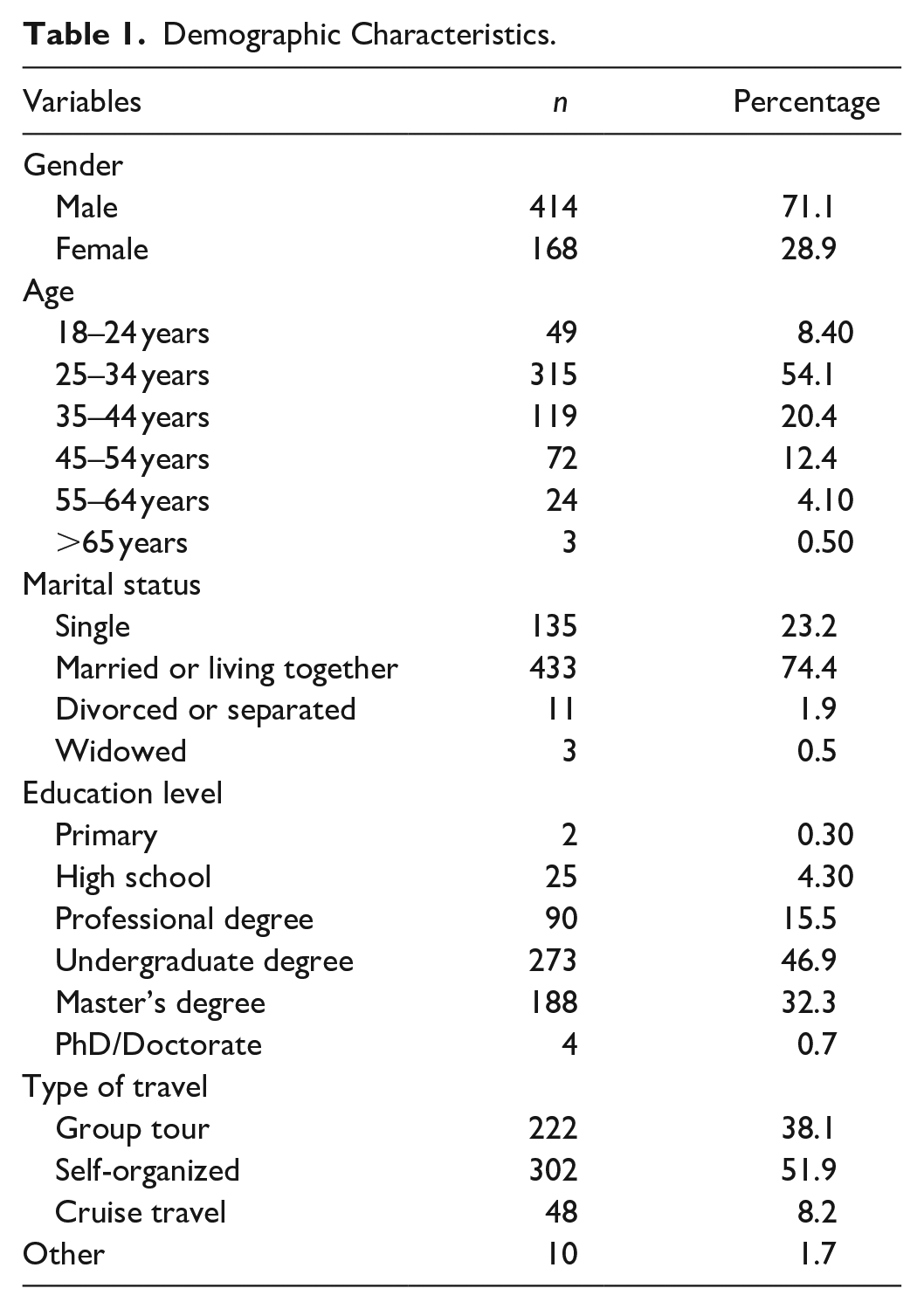
As shown in Table 1, most of the sample’s respondents were male (71.1%), with an age range from 18 to 65 and the largest proportions falling between the ages of 25 and 34 (54.1%) and 35 and 44 (20.4%). There was a predominance of individuals who were either married or living together with their partner (74.4%). Regarding the education level, respondents were well educated, with more than half holding at least an undergraduate degree (62.4%) and 33% having completed a postgraduate degree. In addition, the largest percentage of visitors hailed from the UK (41%), followed by Germany (31%), with the rest (28%) of respondents being from countries such as Italy, Spain, France, the US, and Canada. In terms of their travel format, visitors were almost split across those who traveled with a group (38.1%) and those who organized the trip by themselves (51.9%), with a small percentage (8.2%) being cruise travelers. Finally, the destinations the respondents had visited most recently, and choose to answer the questionnaire for, were Venice (31.6%), Barcelona (20.5%), Naples (9%), Marseille (9.7%), and Santorini (7.6%).
Demographic Characteristics.
Testing the Measurement Model
We conducted a confirmatory factor analysis (CFA) to assess the reliability and validity of the measures. The CFA model indicated a good fit to the data (χ2 = 1224.56, df = 495, χ2/df = 2.47, CFI = 0.99, TLI = 0.98, RMSEA = 0.052, and SRMR = 0.053) since all the fit indices exceeded the proposed cutoff criteria (Hu and Bentler 1999). As summarized in Table 2, all the constructs revealed a good reliability since the Cronbach alphas (α) and composite reliabilities (CR) estimates were greater than the suggested cut-off values of 0.70, ranging from 0.74 to 0.95 and from 0.75 to 0.95 respectively (Fornell and Larcker 1981). Afterwards, construct validity was evaluated via convergent and discriminant validity. Convergent validity was measured by factor loadings and average variance extracted (AVE) (Hair et al. 2019). All the item loadings were significant (p < .001), higher than 0.50, and the t-values (see Table 2) much greater than the 3.29 critical value (Tabachnick and Fidell 2019). Additionally, the AVEs (Table 2), which measure the amount of variance captured, are also above the recommended threshold of 50% (Fornell and Larcker 1981), supporting convergent validity. Discriminant validity was examined by comparing each construct’s square root of the average variance extracted (diagonal in Table 3) with their interconstruct correlations (Fornell and Larcker 1981). Since all AVEs are greater than the interconstruct correlations, there is a strong evidence of adequate discriminant validity.
Results of the Measurement Model.
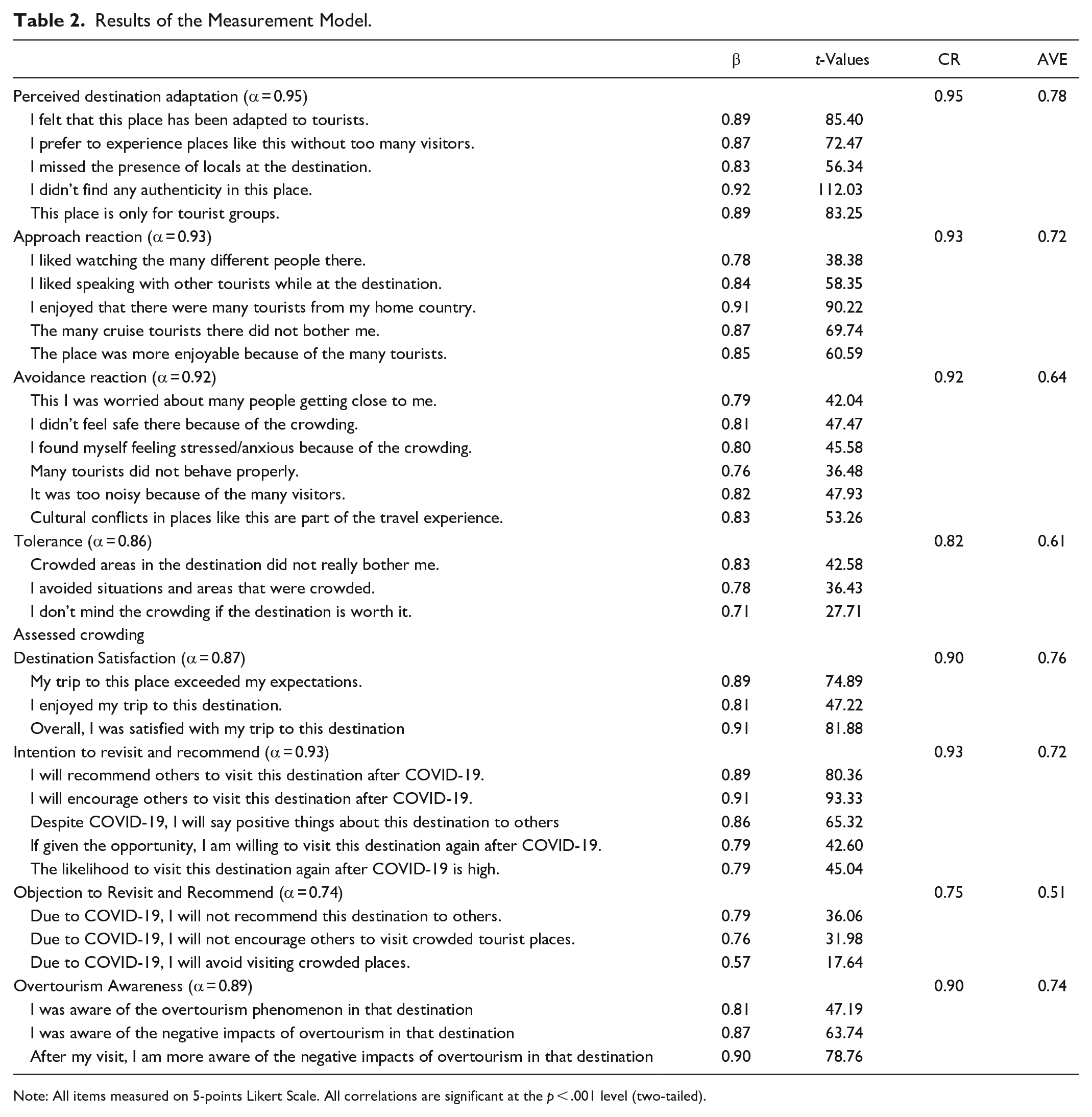
Note: All items measured on 5-points Likert Scale. All correlations are significant at the p < .001 level (two-tailed).
Descriptive Statistics and Discriminant Validity: Fornell and Larker Criterion.
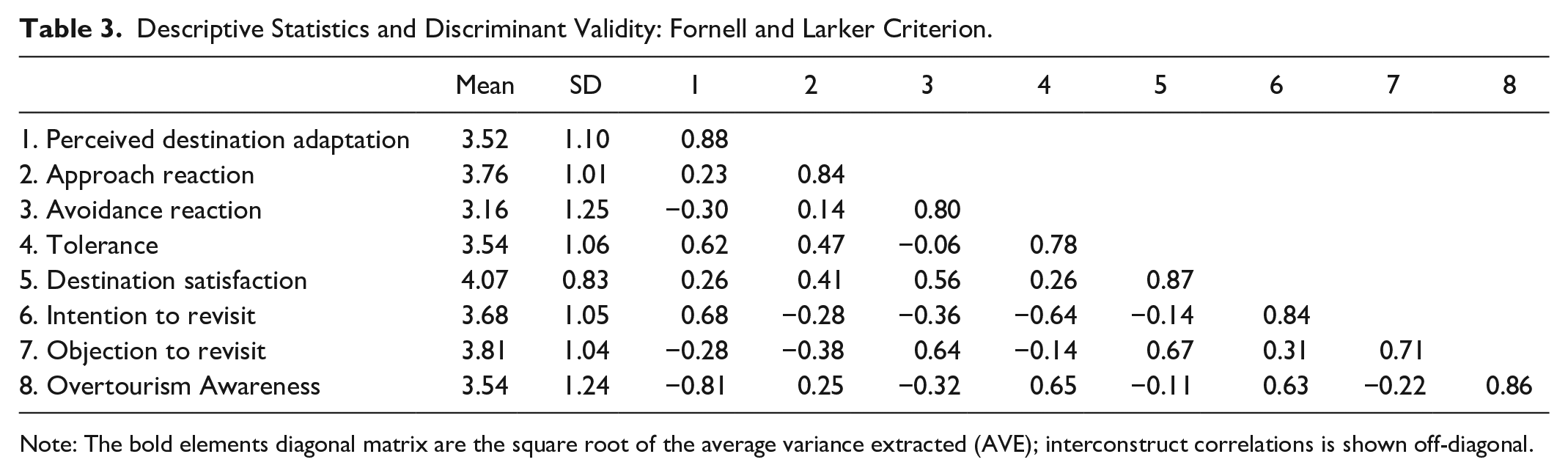
Note: The bold elements diagonal matrix are the square root of the average variance extracted (AVE); interconstruct correlations is shown off-diagonal.
Testing the Structural Model
The hypothesized relationships were tested using SEM. Overall, the fit indices indicated that the proposed structural model fits the data reasonably well: χ2 = 1384.83, df = 425, χ2/df = 2.64, CFI = 0.94, TLI = 0.93, RMSEA = 0.06, and SRMR = 0.06.
The standardized estimates path coefficients of the proposed relationships are demonstrated in Table 4. The results reveal that out of the fifteen hypotheses, twelve were accepted while three were rejected. Perceived destination adaptation had a significant and negative effect on tourist satisfaction (β = −0.64, p < .001), confirming H1 which states that high perceived destination adaptations to fit tourism hotspot destinations negatively affect tourist satisfaction. High perceived destination adaptation had a positive effect on avoidance reactions (β = 0.28, p < .001), and negative effect on approach reactions (β = −0.23, p < .001), therefore H2a and H2b were supported. However, the effect of high perceived destination adaptation on tolerance for crowding was found to be significant but positive (β = 0.62, p < .001) which is contrary to our hypothesized relationship, lending rejection of H2c. Next, avoidance reactions were found to negatively influence assessed crowding (β = −0.26, p < .001) and tourist satisfaction (β = −0.09, p < .01), lending to the rejection of H3a (in the opposite direction) but the support of H3b. The effect of approach reactions on assessed crowding was insignificant (β = −0.02, p > .05), while significantly affected tourist satisfaction (β = 0.43, p < .001). Thus, H4a was rejected while H4b was supported.
Standardized Regression Weights for the Structural Model.
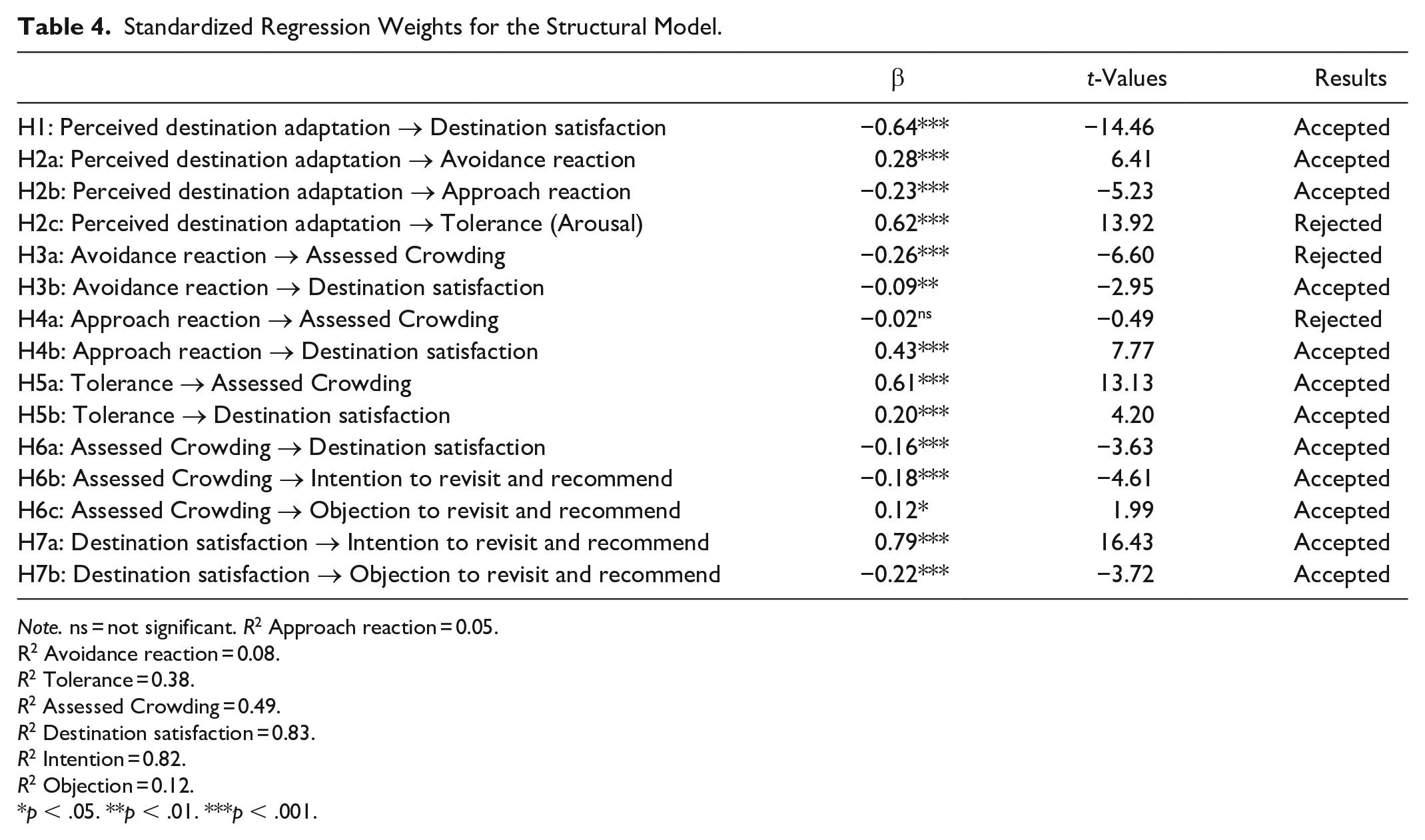
Note. ns = not significant. R2 Approach reaction = 0.05.
R2 Avoidance reaction = 0.08.
R2 Tolerance = 0.38.
R2 Assessed Crowding = 0.49.
R2 Destination satisfaction = 0.83.
R2 Intention = 0.82.
R2 Objection = 0.12.
p < .05. **p < .01. ***p < .001.
The positive destination valuation from increased approach reactions was stronger than the negative evaluation from increased avoidance. In addition, those findings demonstrate that when avoidance and approach reactions are triggered due to excessive touristy adaptations, those evoked reactions directly boost or lessen tourist satisfaction. Moreover, higher levels of tolerance for crowding were found to lead to lower crowding assessments (β = .61, p < .001) and more favorable tourist satisfaction (β = 0.20, p < .001) in support of H5a and H5b. Furthermore, high levels of assessed crowding negatively influence tourist satisfaction (β = −0.16, p < .001) and intention to revisit and recommend (β = −0.18, p < .001), and is positively related to the objection to revisit and recommend the destination (β = 0.12, p < .05). Therefore, H6a, H6b, and H6c were supported. Finally, the findings revealed that the more satisfaction with the destination increased, the higher the tourist’s intention to revisit and recommend the destination (β = 0.79, p < .001), and lower is the objection to revisit and recommend the destination (β = −0.22, p < .001) post-COVID-19. Thus, providing support for H7a and H7b respectively.
The proposed structural model had also predictive relevance. In particular, the proposed model was able to predict 83% of the total variance in tourists’ satisfaction with the destination, 38% of tourists’ tolerance levels, 49% of assessed crowding, 82% of the intention to revisit and recommend, and 12% of the objection to revisit and recommend the hotspot destination they visited.
Testing the Moderating Effects of Overtourism Awareness
Overtourism awareness was hypothesized to act as a moderator in the relationships between assessed crowding, tourist satisfaction and loyalty behaviors (intention to revisit and recommend and objection to revisit and recommend). Following Hayes (2018) PROCESS Model 1, the five moderation hypotheses (H8a–e) were assessed by generating asymmetric confidence intervals (CIs). The moderating effect is significant when the obtained 95% bootstrap CI of the effect (5,000 bootstrap samples) does not cross zero (Hayes 2015; Montoya and Hayes 2017).
H8a stated that the negative effect of assessed crowding on tourist satisfaction would be moderated by overtourism awareness, such that the effect would be stronger when the level of overtourism awareness is higher. The results showed that the hypothesized interaction effect was significant (β = 0.15, p < .001, 95% CI [0.088, 0.206]) lending support to H8a. Along with the conditional effect patterns, assessed crowding has the strongest effect on tourist satisfaction at higher levels of overtourism awareness and becomes weaker (and negative) at lower levels of overtourism awareness and insignificant at average levels of the moderator.
H8b predicted that the relationship between assessed crowding and intention to recommend and revisit a hotspot destination post-pandemic would be moderated by overcrowding awareness, such that the effect would be stronger when the level of overtourism awareness is higher. The interaction effect was also significant (β = 0.30, p < .001, 95% CI [0.182, 0.376]) supporting H8b. Assessed crowding has the strongest effect on intention to revisit and recommend a Mediterranean hotspot destination at higher levels of overtourism awareness and becomes weaker (and negative) at lower levels of overtourism awareness and insignificant at average levels of the moderator.
The moderating effects of overtourism awareness on the relationship between assessed crowding and objection to recommend and revisit a hotspot destination (β = 0.09, p > .05, 95% CI [−0.031, 0.208]), the relationship between tourist satisfaction and intention to revisit and recommend (β = 0.182, p > 0.05, 95% CI [−0.042, 0.405]) and on objection to revisit and recommend a Mediterranean hotspot destination (β = 0.066, p > .05, 95% CI [−0.079, 0.212]) were all insignificant, since the CIs included zero. Therefore, H8c, H8d, and H8e were rejected.
Discussion and Implications
Drawing on the expectancy-disconfirmation theory (EDT), stimulus-overload theory (S-OT), and social interference theory (SIT), this study extends our understanding on destination loyalty formation by providing empirical evidence on several (over)crowding-related psychological antecedents of loyalty to tourist hotspot destinations post-COVID-19. Although tourist satisfaction and destination loyalty are widely studied topics, key psychological determinants such as perceived destination adaptation, approach and avoidance reactions, tolerance, and perceived crowding on their formation remain absent from the current literature.
As implied by the findings of H1, tourists have acceptable levels of destination change and when these exceed their expectations, dissatisfaction occurs. The level of acceptable destination change conforms to EDT, given that when tourists’ perceptions fall short of expectations, tourists are dissatisfied. This implies that incongruous change to tourists’ expectations and high social density at the destination trigger psychological reactions, indicative of tourists using various coping mechanisms to adapt to change. As highlighted by the results of H2a, H2b, high levels of perceived adaptation heighten avoidance reactions while lowering approach reactions. In contrast to our predictions, the result of H2c suggests that high perceived destination adaptation by tourists increases rather than decreases their tolerance for crowding. A plausible explanation for this resides in the sociodemographic and/or cultural characteristics of the sample (Pons and Laroche 2007), as well as the coping mechanism that is deployed by individuals to reduce the undesirable effects of perceived high social density (Zehrer and Raich 2016). According to the result of H2c, tourists increase their tolerance level as a coping mechanism, implying that when the acceptable level of destination change exceeds their expectations, they respond by increasing their tolerance level for crowding. Another plausible explanation is that tourists expect high social density in hotspot locations such as Venice and Barcelona and visit such locations due to the opportunity for social status enhancement that can be accrued through visitation, which drives them to overlook conditions that contribute to negative experiences (e.g., Correia and Kozak 2012; Manning 2010). This type of psychological adjustment is consistent with, for example, overall satisfaction assessments where tourists downgrade negative elements of an experience and prioritize the positive elements (Ryan and Cessford 2003), and this behavior aligns with EDT and compensatory attitudes of consumers (Oliver 1997).
Our findings suggest that avoidance reactions do not necessarily assist in adjusting to a destination environment that is overcrowded, given that this environment still generates high crowding assessments (H3a) and dissatisfied tourists (H3b). Thus, despite respondents demonstrating high tolerance for change at destinations and of crowding, and that they would activate avoidance reactions if they perceived a destination as overcrowded, their own actual assessments of crowding show maladaptation. Furthermore, although high social density may evoke both avoidance and approach responses as coping mechanisms (see Popp 2012; Sun and Budruk 2017), this study does not echo the findings of prior studies, stating that social density conditions may contribute to a more attractive destination due to a “collective gaze” (Eroglu, Machleit, and Barr 2005; Kim, Lee, and Sirgy 2016) given that the proposed relationship between approach reactions and lower assessed crowding (H4a) was not supported by the data. Yet, it seems that evoked approach reactions can lever the excessive stimulation and work successfully in terms of not lessening tourist satisfaction (H4b) as hinted in previous studies (Li et al. 2017). By suggesting tourists’ tolerance to high social density environments (Machleit, Eroglu, and Mantel 2000) as a determinant of crowding assessment and tourist satisfaction, it was found that, depending on the individual’s high or low tolerance levels, assessed crowding and satisfaction were influenced accordingly (H5a, H5b). Therefore, high tolerance for crowding leads to positive assessments of actual crowding and high levels of satisfaction, implying that destinations need to acknowledge the limits of excessive growth to avoid negative sentiments by understanding the alignment or lack of, to successfully manage overtourism perceptions (Miao et al. 2021; Thyne et al. 2022).
Although crowding assessments influence both tourist satisfaction and loyalty, the direction of these relationships is still contested (see Li, Kim, and Lee 2009; Mehta 2013; Pons, Laroche, and Mourali 2006). By testing the negative impact of high assessed crowding on tourist satisfaction (H6a) and favorable intentions (H6b), as well as the positive influence on objection to revisit and recommend (H6c), the findings are in line with past studies, indicating that in high density places, crowding dampens positive post-consumption evaluations of tourists. As measured by the proxies of intention to revisit and recommend (H7a), tourist satisfaction was found to increase loyalty whereas as confirmed by the result of H7b, high satisfaction lowers objection to revisit and recommend the destination, highlighting the importance of the inclusion of the objection variable within loyalty models.
Findings also revealed that high levels of overtourism awareness decrease the level of satisfaction and lower the intention to revisit the destination (H8a and H8b). Conversely, the moderating effects of overtourism awareness on the relationship between assessed crowding and objection to recommended (H8c) was not supported, suggesting that tourists are still likely to recommend a place that they are aware of and perceived as crowded but will have lower revisit intentions. The moderating effect of overtourism awareness on the relationship between tourist satisfaction and intention to revisit and recommend (H8d) and objection to revisit and recommend (H8e) were not supported. SIT asserts that one of the psychological states that tourists try to achieve is social interaction (Stokols 1972). By being aware of the high density of tourists at the destination, tourists downgrade this aspect in their evaluations of satisfaction and intention to revisit/recommend and objection to revisit/recommend. In a way, tourists enact mechanisms that potentially increase their resilience to high social density at the destination and find ways to reduce the negative impacts on their destination experience. Together, the above discussion provides several theoretical and managerial contributions.
Theoretical Implications
The findings of this study provide several contributions to the tourism literature by extending prior research on loyalty formation.
First, we found that tourists are sensitive to destination adaptation levels implying that not all levels of destination change are perceived favorably by tourists. While the results indicate that tourists are sensitive to visitor numbers, they also expect authentic experiences, interactions with locals and tourist attributes that are integrated with the broader destination environment. As such, destination change should be considered in tandem with destination development and management issues that are community rather than only tourist centered. As supported by the findings, high levels of perceived adaptation do not necessarily increase avoidance reactions or decrease approach ones. These psychological reactions of lower approach reaction and high avoidance reaction (Hwang, Yoon, and Bendle 2012; Maeng, Tanner, and Soman 2013) when expectations are not met influence destination evaluations but not necessarily in positive and negative ways suggested by Neuts and Nijkamp (2012) findings. This implies that destinations have to find the right mix of change and adaptation to trigger approach rather than avoidance reactions. In particular, high human density and behaviors of other tourists can trigger negative psychological reactions, through stimulation overload (crowd related stress, anxiety, and personal safety issues) which aligns with the central tenets of S-OT. Overcrowding, poorly behaved tourists, and cultural conflicts, among others, trigger some form of avoidance reactions.
Second, S-OT suggests that approach and avoidance reactions are outcomes of interactions with the environment, suggesting that high crowding levels will negatively impact tourist satisfaction. In line with this reasoning, evoked reactions triggered to minimize the negative effects of perceptions of social overload may lead to maladaptation (Lee and Graefe 2003; Schmidt and Keating 1979). In contrast to our predictions, high avoidance reactions have a negative relationship with assessed crowding, suggesting that they would not avoid the destination even if they perceived it as crowded. However, high avoidance does contribute to low tourist satisfaction levels. Yet, it seems that tourists who enjoy a busy atmosphere at a destination are likely to downgrade the negative experiences associated with overcrowding, which then do not impact satisfaction evaluations negatively, as implied in prior research (Li et al. 2017). Hence, further investigation on triggered reactions due to social density and whether the latter contributes to a destination’s attractiveness is needed.
Third, the antecedents of destination loyalty such as perceptions of destination adaptation and social density (Sæþórsdóttir and Hall 2021), as well as evoked approach and avoidance reactions (Lee and Graefe 2003; Maeng, Tanner, and Soman 2013) have not been evaluated in tourism studies. In this sense, this research has moved beyond the conventional focus of tourism loyalty frameworks by further extending Jacobsen’s framework and incorporating the tolerance variable as a determinant of crowding assessments and satisfaction (Evans, Lepore, and Allen 2000; Zehrer and Raich 2016) with the outcomes implying a symbiotic relationship between tolerance for and actual assessments of crowding in determining place judgments. Since it is well established that the latter subsequently influences visitors’ loyalty, tolerance needs to be taken into consideration when studying the antecedents of tourists’ behavioral intentions in crowded tourist destinations environments.
Fourth, this study enriches the destination loyalty literature by identifying two relevant dimensions of behavioral intentions. Recent studies (Gursoy et al. 2019; Ribeiro, Gursoy, and Chi 2022) suggest that a bidimensional construct (including both positive and negative dimensions), that is, loyalty behaviors (akin to intention) and negative (objection) outcomes can improve our understanding of the underlying dynamics of destination loyalty formation in crowded settings. Our findings confirm the well-established relationship between tourist satisfaction and loyalty (e.g., Chen and Chen 2010; Prayag, Hosany, and Odeh 2013; Ribeiro et al. 2018b) that assumed that dissatisfaction with the destination will result in lower loyalty (Alegre and Garau 2010). However, by including tourist objection to revisit and recommend a destination within a destination loyalty model, we advance this line of research to demonstrate the importance of understanding not only positive but also negative post-consumption evaluations.
Fifth, since many overcrowded destinations are still facing overtourism (pre-COVID-19), this study uses overtourism awareness as a moderating variable to decode the complex relationship between crowding assessments by tourists and their subsequent satisfaction and loyalty (intention and objection). While previous research has indicated that perceived crowded spaces affect negatively consumer behavioral intentions (e.g., Li, Kim, and Lee 2009; Mehta 2013; Zehrer and Raich 2016), our results echoed these findings and indicate that the negative effects of assessed crowding on tourist satisfaction and intention to revisit and recommend are stronger when the level of overtourism awareness experienced at the visited destination is high. Until now, existing research has explored how positive and negative perceptions of crowding affect future behavior of consumers (e.g., Li, Kim, and Lee 2009; Mehta 2013; Zehrer and Raich 2016). Extending this line of research, we integrate social interference theory (SIT) to better understand how crowding facilitates or hinders tourists’ behavioral options. In this way, we demonstrate how perceptions of crowding affect loyalty behaviors and the dependencies, or lack thereof, in these relationships on overtourism awareness.
Managerial Implications
Measuring tourists’ appraisals and future intentions is vital for a destination’s success, especially when tourist hotspots are reaching their carrying capacity limits (Prayag et al. 2017; Song et al. 2012). To this end, our findings offer numerous managerial implications for DMOs, governments, local authorities, and tourism managers in general. First, although most of the hotspot destinations that were surveyed are historic city centers not characterized by small capacities overall, it appears that human density and perceived adaptation at such destinations by tourists contradict their expectations. Thus, to achieve more sustainable tourism outcomes, tourism authorities need to (re)estimate the maximum number of daily visitors, understand carrying capacity, and, if necessary, proceed further in developing soft or hard policies to manage overtourism. Some potential measures include the attraction of high yield/sustainable travelers that spend more and stay longer (Nickerson, Jorgenson, and Boley 2016), the promotion of off-season travel, and putting a cap on cruise/air arrivals during peak season. Large cruise/airlines, tour operators, or even the governance of tourism-dependent destinations will probably oppose such actions, yet efforts have still to be made to transform the growth model that has been prioritized for such destinations. This will require a greater integration of local community needs and tourist requirements given that high levels of adaptation to meet the tourists’ expectations are not always perceived favorably by them.
Second, as indicated by the findings, increasing tourists’ awareness regarding overtourism and overcrowding phenomena in those destinations can also be beneficial to change tourist behavior. By doing so, travelers might be able to develop positive coping mechanisms to crowding and become more resilient to such experiences having less of an effect on their intention to revisit or recommend the destination. For example, educational campaigns before the tourist visit can shape their expectations in such a way that these are not disconfirmed during their visit. Since visitors will be expecting high social density accompanied by noise and less individual space, they would be less susceptible to be dissatisfied with the experience based on perceived overcrowded spaces. As demonstrated by the results, while overcrowding can dampen tourist satisfaction when overtourism awareness is high, this does not increase objection to revisit and recommend the destination. Smart technologies can be used by the DMOs to monitor crowded attractions, while social media can be used as an effective communication tool to provide information to tourists on crowded localities, amenities, attractions and destinations. It would be worthwhile, for example, for the European Tourism Commission (ETC) to fund the setup of a pan European overcrowding barometer, monitoring crowd levels at popular destinations. This would help to also manage tourists’ safety post-pandemic by providing timely information that can be used for destination choice.
Third, the demonstrated effect of COVID-19 on travel demand highlights that a destination’s success measured by growth in tourism numbers is outdated (Burgen and Giuffrida 2020; Gössling, McCabe, and Chen 2020). Destinations plagued by tourist hordes have a unique opportunity to reinvent themselves (Dodds and Butler 2019) and direct their tourism strategy on a sustainable and resilient path that will also guarantee health security of tourists. We anticipate that destinations need to take measures for two distinct time periods. First, while some destinations reopen or design new health safety strategy to attract vaccinated visitors, inter-regional and international visitors might still avoid places where their personal space and subsequently health is in danger, that is, overcrowded settings. To this end, if iconic hotspots are willing to recover from the COVID-19 pandemic, measures to manage uncertainty and to make people feel safe when traveling to and exploring such destinations need to be taken. Temporal dispersion of visitors by season and location with the creation of new routes and attractions (Peeters et al. 2018), and by advertising off-season and non-traditional areas of the city are potential solutions. However, it is difficult to discourage visitors from congregating at iconic sites and thus a crowd management system to control busy places needs to be developed as well. COVID-19 has severely affected the transport industry, especially the low-cost airlines and cruises, as well as people’s attitudes to mobility (Burgen and Giuffrida 2020). Consequently, it might be easier to attract high-end travelers who are willing to stay longer than day-tourists who highly contribute to crowding but not to a destination’s economy (Minihane 2018). In this sense, DMOs and marketers need to invest in promoting the destination to sustainable travelers or what Nickerson, Jorgenson, and Boley (2016) termed as the geotravelers who showed a high interest to explore less known and less densely populated areas and take part in diverse activities that may promote sustainable tourism that protects the environment and benefits local communities.
Fourth, when tourism gets back to normality, without any or minimal threat of COVID-19, our findings indicate that tourists will return to hotspot destinations. Although it cannot be surely predicted whether tourist behavior will be similar to the pre-COVID-19 era, by investing in a more sustainable tourism system now, hotspots destinations can better plan for and manage the high influx of visitors’ post-pandemic whilst maintaining the destination’s unique attributes, social capacity, and community support for tourism. In previous studies where tourists’ norms and density tolerances were examined among independent travelers and cruise travelers, place alternations to fit mass-tourism was not supported by tourists (Eroglu, Machleit, and Barr 2005; Kim, Lee, and Sirgy 2016). Thus, governments and authorities should slow down and reconsider the benefits of excessive tourism development that may threaten the economic prosperity and social recovery of hotspot destinations post-pandemic. By applying more consistent and sustainable tourism planning procedures in city centers, especially at non-traditional sites, and with private-public collaborations (Shoval 2018), other parts of the destination can become more attractive, leading to more evenly clustered tourists in peak tourism season. Marketing and promotional campaigns, and technological innovations such as Artificial Intelligence (AI) or Virtual Reality (VR), are powerful tools that, if used efficiently, can play a vital role in destination sustainable development. For example, with VR technologies, tourists can explore hidden unknown locations in advance, motivating them to eventually travel to these destinations. Therefore, promoting smart and digital tourism needs to be at the forefront of destination policies, with efforts from destination marketers to make the best use of technologies related to destination management.
Conclusion, Limitations, and Directions for Future Research
In conclusion, the study sought to answer three different research questions that pertain to the antecedents of loyalty formation at destinations that are perceived as crowded by tourists. Several variables (perceived destination adaptation, approach and avoidance behaviors, and tolerance) were examined as antecedents of overcrowding and satisfaction. The relationships between these variables and loyalty were also explored as well as the intervening role of overtourism awareness. The findings confirm the centrality of tourists’ perceptions of a destination’s adaptation to change as the trigger for both approach and avoidance behaviors that are not necessarily detrimental to how they assess overcrowding. Tolerance levels can attenuate perceptions of overcrowding to some extent. Approach and avoidance behaviors as well as overcrowding impact satisfaction and loyalty in relation to tourists’ intention and objection to revisit/recommend the destination. As such, the study contributes to the tourism literature by offering a destination loyalty model that takes into account the phenomenon of overtourism in hotspot destinations. Despite this contribution, the study is accompanied by several limitations that shape the directions for further research. First, participants in this study are international visitors who visited at least one of these Mediterranean destinations in the last three years. Prayag et al. (2017) state that perceptions and satisfaction levels differ between international and domestic travelers. Since promoting domestic travel is one of the main strategies for driving tourism recovery after COVID-19 (OECD 2020), behavioral research on this specific market should be conducted separately to understand overtourism perceptions and behaviors. Second, demographics could be used as moderators to see whether the relationships between the constructs vary across gender, and generational groups, etc. In this line, expectations and motivations for visiting such places can also be integrated to have a clearer understanding of what travelers expect in terms of crowding and overtourism spaces after the COVID-19 era. A third potential limitation is related to the cross-sectional nature of our data which may limit the ability to detect changes in visitors’ behavior during COVID-19 era. Future research should take a longitudinal approach in measuring the constructs in the loyalty model proposed and identify changes in perceived adaptation, approach and avoidance reactions, assessed crowding and tourist satisfaction over time. These variables are valuable for destination management and tourism governance. A fourth limitation of this study is that the model does not consider the functional, affective, and symbolic attributes of each destination. Future studies can include these attributes to ascertain their relationship with perceptions of overcrowding. Furthermore, travel patterns and mobility data can be added to the model to improve its explanatory power. Lastly, after the reopening of tourism in the Mediterranean hotspot destinations, future research could explore perceptions of overtourism awareness further and differences between destinations in relation to the model evaluated in this study.
Footnotes
Declaration of Conflicting Interests
The author(s) declared no potential conflicts of interest with respect to the research, authorship, and/or publication of this article.
Funding
The author(s) disclosed receipt of the following financial support for the research, authorship, and/or publication of this article: This work is partially financed by Portuguese Funds provided by FCT – Fundação para a Ciência e a Tecnologia (Foundation for Science and Technology, Portugal) through project UIDB/04020/2020.
