




Abstract
This introduction to the special section brings into focus how little interest the marketing and consumer research academies have shown in money and debt: both philosophically and historically. When recognised explicitly, money and debt continue to be treated largely as 'givens' – epiphenomena morally embedded in consumer culture and rarely questioned. We assess how this situation has come about in these fields' theoretical lineages and anticipate future directions of inquiry. We also introduce our three contributions and weave them into the narrative of our story.
Introduction to the special section
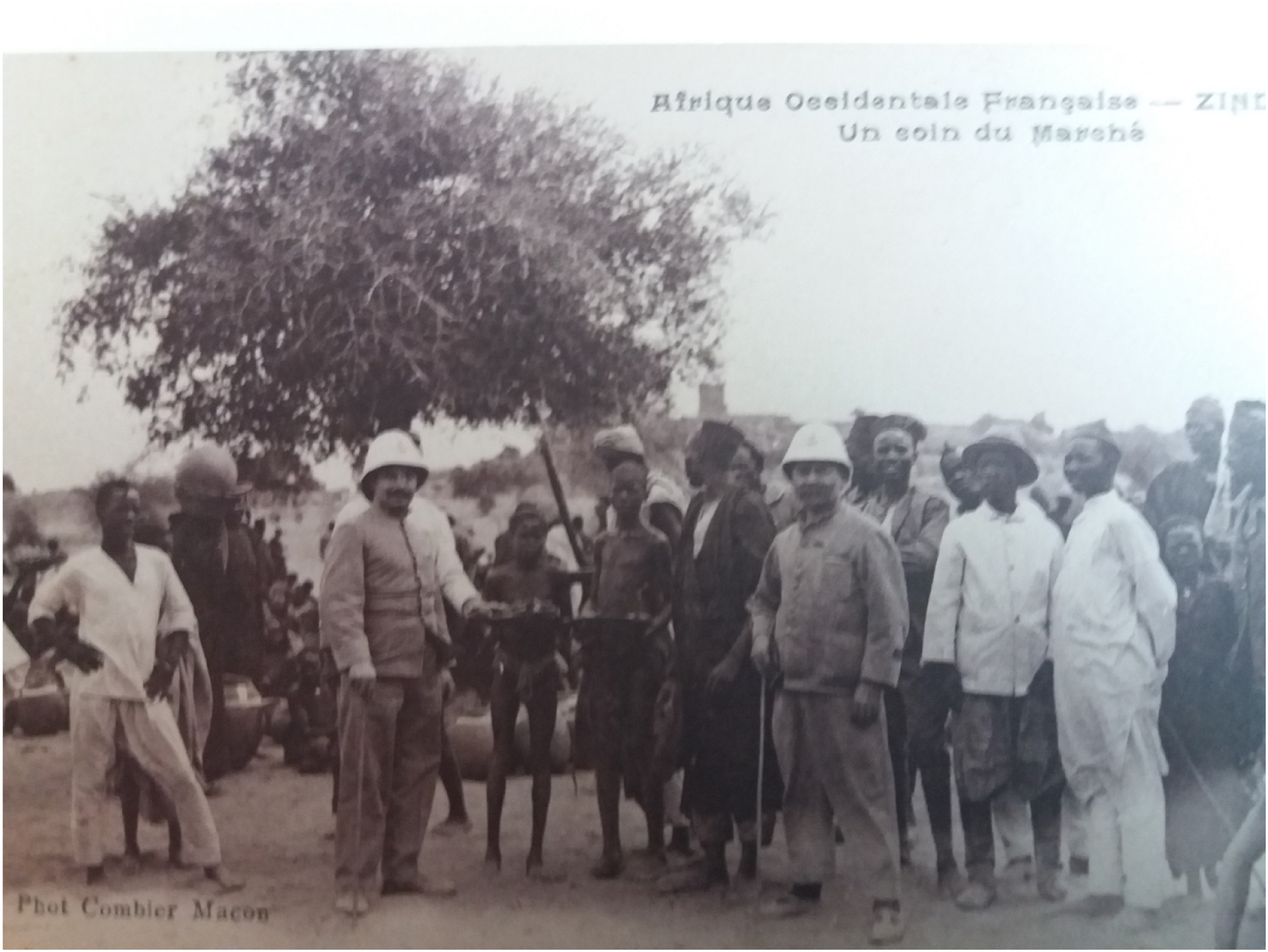
One notes that many special sections start with some revelatory moment that coalesces thought and renders a topic as worthy and necessary. Ours was an encounter with Eric’s pre-WWI monochrome postcard. Irresistibly, its image lingered with us. The postcard is a photograph depicting a market square in Zinder, Niger, in colonial West Africa. Upon closer inspection one can note the smiling faces of both black and white people including French military officers, a conscripted Senegalese soldier, and local youngsters, and how they have all gathered under a legend written in French. Strikingly, it designates a marketplace, the entry into what Zinderois still to this day call the Forced Market, a place through which the military authorities introduced French colonial currency and enforced transactions to link Zinder’s economy with the colonial metropole (also Arnould, 2015). A companion postcard shows chained prisoners carrying partially tanned sheepskins under the watchful eye of this same Senegalese soldier. Debt peons, those unable to pay the capitation tax were sometimes forced to work off their tax debts by provisioning colonial French business interests. Later developments of these colonial policies still linger in present day Niger as one of the reasons behind the recent political unrest. 1 This example gives us a view of how market relations are not simply natural cultural developments but are brought into being and shaped by various power relations including social tension, coercion, and violence (see Fanon, 1967; Graeber, 2011).
Confronted with such historical disruptions that contradict conventional accounts perpetuated by marketing and consumer research about money and debt having to do with access, usefulness, and consumer choice, we started to discuss how much we actually are doing in terms of critically thinking and debating the philosophy, history and morality of money, debt and the diversity of exchange relations (also Askegaard and Linnet, 2011; Brown et al., 2001; Tadajewski, 2012). When going through the literature in the field broadly speaking, we think it becomes evident that these concepts continue to be both largely ‘given’ and simultaneously rather epiphenomenal. These tendencies include a myriad of research on psychological attitudes towards debt, pricing, and spending, the financial responsibilisation of consumers, which seem to continue with little societal critique in both mainstream marketing and consumer psychology. While some work certainly problematises how money and debt work to structure society as cultural constructions (Kotler et al., 2006; Lloveras et al., 2020; Peñaloza and Barnhart, 2011), strikingly little has been said about being, agency, and society philosophically or historically with regards to these core societal notions (Tadajewski, 2010, 2012), nor indeed of their moral normalisation and legitimisation in cultures across the globe (Arnould, 1989; Arnould and Rose, 2016). From various perspectives, we wish to thus uncover how the idea that we do not need any idea for how money and debt came to undergird our life worlds came into being, and continues to constitute the horizon of our imaginations, power relations, and desires.
If one follows the more critical scholarship in the history of economic relations, such as how we have come to live in a monetary market society as described by Marx, Veblen, Keynes, and Polanyi, it is notable how commonly we tend to think of money as a neutral vehicle of exchange. We thus overlook how deeply its endless accumulation is the core and ultimate aim of capitalist markets. This is not a mundane truism but important motivating factor for society as those with financial resources hold the power over production decisions. Today, an individual without capital has little say in what should be produced and how, and they must accept and be taught to desire what is produced or be without. As Marx (1955) and Simmel (1982) both understood, a double freedom is a necessary precondition for a modern individualised market society. First, one must be free to engage with it, which seems like a positive condition. However, a second condition is to be free of resources, so that one must engage with the market. This is a condition of scarcity, one experienced not only by the colonised Africans depicted above, but similarly 150 years earlier by British peasants displaced from their land during the enclosure movement (Tate, 1967). Today’s consumer typically enters consumership only with their human capital to sell, and the debt accrued in acquiring it, which of course must be paid back with money.
In contrast, anthropological history provides evidence of a wealth of extensive geographically dispersed resource exchange arrangements, where the circulation of valuables was based almost entirely on provenience incorporating social ties, carried by oral tradition and linking people in different ways, often as guarantors and symbols of peaceful social relations. Examples like the Kula or the North American potlatch system (Barnett, 1938; Kan, 1989; Rosman and Rubel, 1971; Steltzer, 1984) illustrate that what we might call esoteric forms of exchange have constituted the grounds for sociality long before the emergence of Western ideas of commerce. In fact, as so many historical examples tell us, production and distribution of resources can be arranged in myriad of modes, with varying goals and can differ widely across human societies (Graeber, 2001; Mauss, 2002; Sahlins, 1972), in ways so different ontologically that we can only despair of attempt to describe them in their own terms (see Descola, 2014; Viveiros De Castro, 2014). In our culture, such possibilities must naturally be deemed exotic and outmoded, as our faith in the myths of rationality and utility (Pawlett, 1997) have irreversibly moulded us towards a society we witness today in Western markets. But one needs to only consider Finnish festivities of midsummer where people travel hundreds of kilometres to burn piles of wood to see that this kind of development has not, at least completely, civilised us, so something else, far more symbolic and overcoded than ‘value’ persists. Thus, as Cheal (1988) argued, a gift economy continues side by side with the dominant market economy.
Our Forced Market example further brings into stark relief, instead of a natural development of social relations, we need to further recognise how asymmetrical power relations are at the core of the development of monetary market societies (also Dholakia, 2012; Tadajewski, 2013). The political production of marketised society is thus neither simple nor natural, and likewise how it also infiltrates sociality in various ways (Bell and Henry, 2001). Veblen (1994/1889) powerfully illustrated that while monetary profits are the ultimate aim of the capitalist market economy, money could be transformed into a moral economy of prestige and social standing, one that replaced the old aristocratic system based on land ownership and genealogy. Polanyi (2001) and his colleagues (Polanyi et al., 1957) showed markets to be political in nature and the ‘state of nature’ to be varied institutionally (also Arnould and Press, 2019). Sahlins (1972, 1996) questioned the ontology of scarcity, property, and efficiency in the modern market economy, highlighting the inherent moralism in the conventional narratives of both modernism and colonialism. What is becoming ever clearer from modern archaeological and ethnological work is that the application of human ingenuity means that economies, markets, and monies have not followed a linear path of development, instead reflecting a vast array of opportunistic historical contingencies (Graeber and Wengrow, 2021; Guyer, 2004).
It would seem that these are not simply esoteric observations for theoreticians. Every spring on a bachelor’s level lecture on consumer behaviour, a few of us try to make the case for the ideological infiltration of the taken-for-grantedness of the money economy by trying to explain the Melanesia Kula (Malinowski, 2014/1922) to students. We ask them to invent a social resource circulation system that would employ resources without the use of money. The students always find this exercise difficult. Instead of being able to imagine an alternative they often end up simply discussing the various potential problems, which in the barter myth traditional to economics (Graeber 2011), led to the development of money and consumer markets. Yet, as has been argued in anthropology (Bohannan, 1959; Dalton, 1962; Graeber, 2011; Mauss, 2002), sociology (Dodd, 2012; Ingham, 2004), neo-chartalist/Modern Monetary Theory (MMT) economics (Bell and Henry, 2001; Forstater, 2005; Tcherneva, 2002), economic history/numismatics (Grierson, 1978; Grubb, 2003), and legal theory (Desan, 2014; Grey, 2020), the assumedly linear and necessary transition from barter to a monetary society, no matter how appealingly simple it is, is not historically accurate, not theoretically sufficient, and sidelines important political and social forces such as those illustrated in the Forced Market example. The taken-for-grantedness of this global hegemonic order 2 and its ideologically ingrained assumption is what we wish to problematise further with this special section. We wish to encourage work that both reminds us about what we have largely overlooked and directs our attention toward a more politically, historically, and theoretically reflexive future.
The dearth of interest in the historical contingency of, and the interrelations between money and markets has been recognised within marketing. Indeed, ‘research on money in marketing is scant’ (Bradford, 2015: 79), and there is a general ‘underlying premise of much of [marketing and consumer research] that all consumers share the relative affluence necessary to partake in the abundance available within the material world’ (Hill, 2002: 289; also Hietanen et al., 2018; Langley, 2014). Nevertheless, marketing literature has focused on a wide array of related topics such as local currencies (Lloveras et al., 2020), novel currencies and cryptocurrencies (Moor, 2018), children and money (Ruckenstein, 2010), money/power in relationships (Elliott et al., 1996), time and money (Macdonnell and White, 2015; Okada and Hoch, 2004), valuation of money (Wertenbroch et al., 2007), and sacred and profane monies (Belk and Wallendorf, 1990). In what could be described as an unmistakably flavour to the aforementioned work, there is a broad tendency to focus on how ‘people are creating, maintaining, symbolising, and transforming meaningful social relations’ in their uses of money (Zelizer, 2000: 338; also Zelizer, 2005). That which, however, does not receive much interest is how the monetary system undergirds global social relations as a quasi-ontology, and more problematically how there is a persistent ‘individualistic focus [that] makes it impossible for consumer research to move to the macro, social level necessary for theorising resource circulation’ (Arnould and Rose, 2016: 83).
As our first contribution for this special section, Alan Bradshaw’s (this issue) essay alerts us to the current stakes of money-as-accumulation in capitalist monetary society by revisiting Marx. The work presents us a critique of commodities in consumer culture not as something neutral presented for the uses or needs of the consumer, and instead as means of existence and perpetuation of the system as such. The attraction to continue thinking of ‘needs’ as primary and as commodities as ‘helpful’ is shown to be only indirect, as the accumulative force behind capitalism’s self-expansion assumes priority, even as it lies beyond society’s recognition (see also Sahlins 1976). It is capital that is the subject in marketised society, not the consumer seeking usefulness, enjoyment, and thrills. The work offers critical caution necessary when so much written about the sustainability imperative neglects the axiom that the ‘requirement for growth is non-negotiable within our globalised capitalism’. In this situation, fanciful talk about zero-growth economy or other notions would mean also eradication of marketised society and the finance capital that propels it (Hickel, 2019). In this way, the historical tendency of marketisation worldwide to become a hegemonic ideology shows itself in how marketing generally grounds itself within its topical field, thus ignoring its historical constitution, and the way the intensification of money and debt in the production of marketised societal relations does not constitute a general scholarly concern (also Andéhn et al., 2020; Cluley and Dunne, 2012; Lambert, 2019). Rather, when the issue of money and debt is raised, what tends to get recognised is that monetary resources are necessary for both business and consumer survival within market society (e.g. Kotler et al., 2006). Similarly, when monetary resources are not available due to downturns and other economic failures, consumers may try to organise their aggregate resources (if they have any) in seemingly other ways, ways which nevertheless struggle to challenge market ontology in itself (see Lloveras et al., 2020). This isomorphic tendency has been clearly articulated also in other work depicting consumers attempting to collectively form alternative modes of exchange (Hietanen et al., 2016; Kozinets, 2002). As a notable exception to the hegemonic taken-for-grantedness of money, Godinho and colleagues’ (2017) study of indigenous Australians foregrounds the idea of money as a destructive, external threat as indigenous participants comment on the incommensurability of their traditional modes of social intercourse and the money logic, which forces them to accept Anglo-European norms. In comparison, Vikas and colleagues (2015) offer another striking example where participants embraced market exchange to actively contest caste hierarchies. Taking the two examples together we are reminded of Simmel’s point that monetary market economy offers liberatory potential, and that this potential is destructive of social orders, but in ways that always reflect and be limited by the interests of the expansionist imperative of the monetary market system (see Wray, 2004).
There is a growing literature on debt/credit in marketing and consumer research (Abrantes-Braga and Veludo-de-Oliveira, 2020; Brennan et al., 2011; Cordeiro et al., 2019; Elliott et al., 1996; Hamilton et al., 2014; Langley, 2014; Nepomuceno and Laroche, 2015; Pellandini-Simányi and Vargha, 2020; Peñaloza and Barnhart, 2011; Yurdakul et al., 2017). While this literature investigates multiple micro and meso level phenomena, it tends to avoid analysis of the workings of macro systemic processes that produce debt relations under market capitalism. Debt is the defining feature of the modern consumer society as we face monetary liabilities constantly as payments, taxes, fines, fees, and tributes (Graeber 2011; Wray, 2004). What we wish to recognise is the striking difference between owing something that can be seen as attainable, be it with effort, and being in incessant perennial, abstract and ideological indebtedness that is a feature of immersion in the monetary market system (Lazzarato, 2012; Wray, 2004). In order to repay debt, consumers must realise market income as money. For the vast majority this only manifests by participating in exchange of labour. Monetary debts that bind us to the system are also morally binding in often irresolvable ways. In this sense, there is an embodied symbolism in debt that constructs human sociality in excess of straightforward material/monetary equivalents (Bataille, 1993; Baudrillard, 2007; Mauss, 2002; Sahlins, 1972, 1996). As has already been noted, one can thus argue that it is impossible to escape the capitalist market (Arnould, 2007; Haase et al., 2018; Kozinets, 2002), and that is indeed the designed purpose of its creation (Bell, 2001; Forstater, 2005; Tcherneva, 2002). Monetary debt, money as we know it today, is thus a social technology that subsumes consumers into the capitalist market.
In our second featured contribution, Pellandini-Simányi (this issue) turns to focus on how marketing shapes and normalises class subjectivity and inequality through the increasingly algorithmic mediation of credit. The analysis shows how financialisation of everyday life is inherently linked to the active production of class by automatising the social fabric that operates through the constant reproduction of financial subjectivity deeply entrenched in economic difference and subjection. These processes produce class, making consumers both the object of algorithms through segmentation, and their subject through constant processes of allowing certain kinds of access to financial products through ‘nudging’. Most of these processes today are veiled in everyday service encounters, and perhaps more clandestine and hence more influential.
Apart from a more nuanced and philosophical understanding of the powers involved in the historical emergence of money and debt, Pellandini-Simányi’s (this issue) contribution directs us to consider the possible futures of the historical contingencies inherent to the current institutional order of money and debt. Legitimisation of marketisation and monetisation through coercion and violence may have been more direct historically (Forstater, 2005). Today there are forces of discipline and control in play that may escape recognition (Cluley and Brown, 2015; Shankar et al., 2006; Zwick and Denegri Knott, 2009) that are embedded in increasingly algorithmically ordered social relations in consumer society (Cheney-Lippold, 2011; Dholakia et al., 2021) that further escalate the financialisation of everyday life (Arvidsson, 2016; Dholakia, 2012; Pellandini-Simányi, 2020).
Moving further in this direction, in our final contribution, Paul Haynes (this issue) elaborates on these current tendencies through a critique of money and digitalisation. The work links Simmel’s premonition of ‘perfect money’ that will go on to become increasingly abstracted from any recognisable notion of tangible value to a poststructural analysis of cryptocurrencies. Haynes cuts through the (fictions) of money and debt as having a real-world content by themselves or ‘established measure’ beyond both the social fictions they produce and the social fictions that guarantee their production. His essay shows the depth of illusion needed for money to operate as the producer of contemporary financialisation of social ties. The work produces a conception of cryptocurrencies as ‘minor currencies’ and provides an in-depth take-off point for assessing ongoing processes of depersonalising social ties in digitally mediated acceleration. In this vein, the ongoing technologisation of social relations in consumer society is also based upon naturalised monetary market relations and indebtedness, and reproduces capitalised subjectivation (Guattari, 2011, 2014; Lazzarato, 2014). This points to an increasingly totalised subjectivity in constant flows of production and accumulation (Genosko, 2011; also Hietanen and Andéhn, 2018; Lambert, 2019). In this way the monetisation of the entire lifeworld ostensibly becomes so invisible that it is no longer recognised; it becomes a quasi-ontological fact (Lazzarato, 2012).
In conclusion, what we hope to catalyse with this special section is more work problematising the inherently unnatural, which is to say political nature of money and debt in consumer society; to uncover how financialised institutional arrangements reinforce themselves via or side by side with marketing and consumption. One of the key limitations of marketing continues to be its uncritical acceptance of a teleology that has appointed Western market capitalism as the epitome of civilisation, occupying a position all societies should imitate, and from which we can make value judgements about others in the contemporary context and in historical settings. There is a persistent tendency to continue rewriting shared understandings of the naturalness of money, markets, and debt and their organisational effect on society. This tendency impoverishes marketing’s understanding of the historical, social, and political grounds on how consumer society emerged, which would be crucial for analysis operating beyond such self-imposed mythologies.
Already, perpetuating the taken-for-granted normalcy of marketised society is becoming ever more untenable, as capitalism is producing increasing inequality and global catastrophe (Bradshaw, this issue), and as our entire lifeworld and the myth of consumer choice are subordinated to algorithmically mediated commodification (also Dholakia et al., 2021). These processes are reaching the point where money, debt, and with it marketing and consumption disappear into the fabric of being in society in a way that makes it everywhere an all-encompassing mode of being (Haynes, this issue; Pellandini-Simányi, this issue). As noted, this effectively constitutes the ontology of capitalist subjectivation (Botez et al., 2020; Darmody and Zwick, 2020; Hietanen et al., 2022). We hope this special section can inspire more work that recognises the foundational assumptions our field has with money and debt and the ways they are continuously rewritten as moralities that go largely unquestioned, undebated, and unseen.
Footnotes
Declaration of conflicting interests
The author(s) declared no potential conflicts of interest with respect to the research, authorship, and/or publication of this article.
Funding
The author(s) received no financial support for the research, authorship, and/or publication of this article.
