



Abstract
Drawing upon a cultural-historical reading of the witch, we discuss how modern capitalism is chronically haunted by obstreperous vestiges of what preceded it yet remains proficient in assimilating all that returns to challenge it. By adapting and extending a theoretical toolkit informed by Jacques Derrida and Mark Fisher, we trace market and state administrators’ co-optation of the primeval witch figure and her ideological trappings: initially, to expropriate those who threatened incipient modernising structures; later, to provoke increasingly secularised subjects towards consumption; and eventually, to calibrate rather than obviate capitalist expansion so that it remains aligned with consumer interests. Introducing the new concepts of ‘retrocorporation’ and ‘marketplace revenant’, we discuss how long-foreclosed, ancient imaginaries become re-invoked and re-programmed to perpetuate capitalism’s dominance. Our message for the nascent tradition of ‘Terminal Marketing’ is that the collision and collusion of past and future has the potential to ossify capitalist realism in the present.
Introduction
Marketing scholarship has long reported on consumer culture’s fascination with relics from its own past (Brown, 2007; Cantone et al., 2020). Recent accounts have drawn upon Jacques Derrida’s (2006) hauntology to offer an onto-affective conceptualisation of: the ‘haunted’ status of our late capitalist moment (Ahlberg et al., 2021); the mournful retrospection of its most iconic brands (Brown et al., 2021); and the temporal disjunction of its consumer subjects (Takhar, 2021). These applications of hauntology to marketing scholarship emphasise consumer culture’s collective realisation that its best times are behind it, or as Ahlberg and colleagues suggest, recent market developments are characterised by ‘a half-lost remembering that we no longer participate in the optimisms of the past’, and ‘the happy days of marketing have increasingly evaporated’ (2021: 169). Although these analyses reveal a cultural longing for a return to some indeterminate but happier episode in capitalism’s history, little work in marketing scholarship has considered the possibility that the best times potentially predate capitalism. Although exceptions do exist (see Södergren, 2022), hauntological critiques within marketing and interpretive consumer research are yet to grapple with how pre-modern and semi-mythic pasts that pre-exist capitalism’s totalising structures return to shape, and become shaped by, consumer culture. Following the tradition of critical philosophy to interrogate modernity’s repressive nostalgia for the authenticity of cultural predecessors (e.g. Marcuse, 2002 [1964]), we propose for critical marketing scholarship, a contemporary diagnosis of the allure of surpassed worlds. Understanding the appeal that derives from that which no longer exists despite, or perhaps because of, its negation by the hegemony of consumer culture, we argue, can tell us more about the temporal dynamics of capitalism’s ‘realism’ (Cronin and Fitchett, 2021; Fisher, 2009; Hietanen et al., 2022; Jones and Hietanen, 2023).
In this paper, we adapt and extend Derrida’s hauntological sub-concept of ‘revenant’ to interrogate how capitalism has, since its incipience, remained chronically haunted by the pre-liberal, anti-commercial Others it effaced through its complex, evolving cultural expansion. Defined vaguely as a figure ‘whose expected return repeats itself, again and again’ (Derrida, 2006: 10), we position the revenant as an amorphous ghostly Other that re-appears with visions of a time before capitalist realism normalised ubiquitous marketisation, depriving political subjects of any alternative futures.
To assist in our theorisation, we draw upon a cultural-historical account of ‘the witch’ – an ancient and undying Other recently discussed in the pages of Marketing Theory (see Zanette et al., 2023) – who first returned as a dissident threat to inchoate modernity in the 15th century and has for much of the transition from subsistence agriculture to complex variants of merchant, liberal, and neo-liberal capitalism, haunted the cultural imaginary. This haunting, we argue, stems from nostalgic reverberations of a kind of magical thinking that pre-exists and once challenged the creeping economic pragmatism and political logic of our times. Unable to provide any ‘real’ connection with some authentic past, the witch’s resurrections function as ‘temporal pieces of flotsam’ (Ahlberg et al., 2021: 168) that provide a glimpse of a less rational, more enchanting reality before market fundamentalism sunk all conceivable alternatives. Impossible to repress, the witch continues to haunt consumer culture as various simulations of her history but also, increasingly, as the imagined absence of her own hyper-commercialisation.
While the Derridean revenant suggests a subversive agent whose hauntings remind us of the fragile contingency of present structures of power, we draw upon the witch to introduce the concept of ‘marketplace revenant’: a ghostly Other who becomes retroactively assimilated into the circuitry of marketplace structures and supporting ideological systems. Using the witch, we consider how the marketplace revenant’s role in capitalism’s continuity has, over modernity, been characterised by ‘safe’ reappearances in culture, consumption, and identity while being made indifferent or even complicit to the reigning political economy. The arch-fantasy reproduced by the marketplace revenant is that capitalism’s forever-present can somehow be subverted by remembering and returning to the social symbolism of a pre-modern, magical Other without needing to re-engage with any of her proto-political subtext. In scaffolding our concept, we provide a theoretical extension to Fisher’s (2009) notion of precorporation relating to predictive or pre-emptive aspects of market co-optation. We suggest there is also at play retrocorporation: the retroactive reconfiguring of long foreclosed futures, desires, and subjectivities as depoliticising forces for perpetuating capitalist monoculture in the present. Using the materials of Derrida and Fisher, our work centres on two interrelated research questions: what are the main functions of marketplace revenants?; and, how are these revenants retrocorporated to capitalist culture?
In diagnosing the key functions of the marketplace revenant, our work speaks to the nascent agenda of Terminal Marketing (TM), an ultra-realist tradition that problematises the transformative potential of consumption and the utopian assumption that consumers act – and resist – authentically (Ahlberg et al., 2022). Following TM’s pessimistic axiology, we clarify how political agency is weakened by nostalgic attachments to superseded modes of countercultural expression that carry only the illusion of transformation without challenging underpinning political-economic logics. Using historical methods, we map out how the co-optation of pre-capitalist imaginaries has evolved throughout modernity in ways that reflect and adapt to capitalism’s changing economic imperatives and its subjects’ increasing inertia. This evolution pushes us to consider market co-optation as a historically contingent and non-static process; one that works not simply by poaching countercultural styles, practices, and aesthetics, but dynamically through the hollowing out of political subjectivity. By emptying historic, disappeared Others of their proto-political subtexts, the market can ensure that all contemporary countercultural formations based upon their revival remain limited to a regressive reimagining of what might have been, rather than what could be.
Theoretical underpinnings
Hauntology: A closer look at revenants
Originally deployed by Derrida (2006) in his book Spectres of Marx in reference to the enduring legacy of Marxism after Soviet communism passed into history, ‘hauntology’ is a portmanteau of ontology (how we view ‘what is’) and haunting (the ‘return’ of something) to infer that all that is can only exist against a backdrop of returning, excluded Others. Derrida’s emphasis on the relationship between the existing and the returning reveals how past, present, and future can never be completely divorced from one another. A language of haunting is offered encompassing ghosts, specters, and revenants wherein ‘a specter is always a revenant’ and, in reverse, a revenant is a specter which is synonymous with a ghost (Derrida 2006: 11). Etymologically, revenant derives from revenir (French) meaning ‘to come back’ whilst specter derives from spectrum (Latin) meaning ‘apparition’, suggesting that the notion of returning is inferred more directly by the former, though Derrida emphasises equivalence between the terms: ‘A common term for ghost or specter, the revenant is literally that which comes back’ (2006: 224).
Revenants are characterised by ‘dyschronia’ – temporal disjuncture – which conflicts with understandings of time passing in a unidirectional trajectory (Fisher, 2018: 140). Derrida conceptualises time by its recursive nature, as out-of-joint; punctuated by backward-lookingness, impelling us to revisit why things are the way they are (and are no more), spurring us ‘to learn to live with ghosts’ (2006: xvii-xviii). To explain dyschronia, we must consider hauntology’s philosophical grounding to an ethical axis between that which is allowed to exist and what has and will be oppressed (Södergren, 2022). By appealing to justice for ghosts of the oppressed, hauntology is suffused with ethical responsibilities that modern subjects have to the Other. Derrida (2006: xviii) intimates that modernity is burdened with debts owed to disappeared victims – ‘certain others who are not present, nor presently living’ – ensuring that the modern subject remains haunted by ‘the ghosts of those who are not yet born or who are already dead, be they victims of wars, political or other kinds of violence… victims of the oppressions of capitalist imperialism or any of the forms of totalitarianism’. Revenants can thusly be understood by their paradoxical presence of absence; they are the reminder of what has been repressed – or made absent – for the present to be what it is.
The revenant functions as an indictment of hegemony. Derrida (2006: 46) clarifies: ‘Hegemony still organizes the repression and thus the confirmation of a haunting. Haunting belongs to the structure of every hegemony’. A hegemony is constituted by haunting reminders of that which has been excluded or otherwise extinguished. In consumer research, Södergren’s (2022) example of the semi-mythic Viking figure and its perpetual haunting of Swedish consumer culture clarifies the complex reappearance of what is no longer. In today’s liberal-democratic Sweden, the pre-modern, pre-liberal Viking stalks the present with fantasies of what has been displaced for the current hegemony of liberalism to take hold: brutalism, patriarchy, traditionalism, and white supremacy. The making absent of these illiberal features allows the Viking to return as a popular figure for far-right populists, providing them with a lodestar for how things may once have been but are no longer. For consumer culture at large however, ‘the Viking archetype becomes a haunting specter through the collectivization of guilt’ whose ‘excluded histories can come back to unsettle the consumer’ (Södergren, 2022: 457). For Derrida, those living under a hegemony cannot avoid collective guilt since they must reconcile themselves with a past that has been written out of their present. What is less clear is what is to be done with this guilt, let alone how it might be harnessed, suppressed, or repurposed when there is nothing on the political or economic horizon to suggest the imminent re-emergence and reintegration of the ghosts of disappeared Others. Capitalism’s veteran hegemony has shown itself to be adept at absorbing and rechanneling, rather than reckoning with, the feelings and desires of its subjects to ensure its continuity (Hietanen et al., 2022; Jones and Hietanen, 2023). To explore how revenants can be made to work in the service of capitalism, we must first consider the possibility that market co-optation functions retrospectively.
The retrospective functioning of co-optation
The many ways that hegemonic systems detect, decipher, and disarm challenges to their reigning ideologies and safely reroute them into their service have been discussed in accounts of market co-optation theory (Goulding et al., 2009; Karababa and Ger, 2011; Sandikci and Ger, 2010; Thompson and Coskuner-Balli, 2007). A key principle of co-optation under capitalism is that market agents make use of adversarial social formations, reformatting them as commercial resources through dynamic processes of cultural engineering. In Fisher’s (2009: 9) Capitalist Realism, the principle of co-optation is reimagined in his concept of precorporation. Unlike traditional understandings of co-optation that assume adversaries to capitalism become incorporated to mainstream consumer culture through dramatic moves, countermoves, and compromises over time (Giesler, 2008), Fisher’s precorporation suggests that adversaries already have the veteran hegemony’s beliefs and practices written into their DNA, making them functional rather than antagonistic to market logics from the outset: [T]he old struggle between detournement and recuperation, between subversion and incorporation, seems to have been played out. What we are dealing with now is not the incorporation of materials that previously seemed to possess subversive potentials, but instead their precorporation: the pre-emptive formatting and shaping of desires, aspirations and hopes by capitalist culture (Fisher, 2009: 9).
Precorporation is predictive, future-looking, and terminal, reflecting a perverse reconstitution of libidinal desire itself (Ahlberg et al., 2022; Jones and Hietanen, 2023). It presupposes that those who are opposed to capitalism will self-limit their imaginaries to what is possible and desirable under capitalism: ‘Capitalism seamlessly occupies the horizons of the thinkable’ (Fisher, 2009: 8). For example, many popular forms of countercultural participation in today’s social media age have virtue-signalling, self-expression, or some aspect of private interest for the consumer taken into consideration from their point of inception; all of which strengthen and support (rather than undermine) the networked desiring tendencies of consumer-capitalism.
Precorporation works through engendering an inertia amongst subjects that is debilitating and depoliticising in its effects. This in turn functions on two levels. The first is self-defeating pessimism that naturalises the belief that capitalism cannot ever realistically be replaced, meaning any efforts to resist or rectify its problems must inevitably borrow from, work within, or emulate capitalism (Cronin and Fitchett, 2021). The second is the cynical acceptance that conforming to capitalist mechanisms is simply a matter of ‘pragmatic survival’ – a case of simply getting on with how things are, and therefore has no ideological agenda (Fisher and Dean, 2014: 27). As Fisher warns though, ideology functions at its purest when it is experienced as non-political; when it is misrecognised as how things are or ought to be. Because of this entrenched inertia, all countercultural movements emerging under capitalism become deprived of genuinely subversive potential and have ‘no significant popular desire for revolution, or even serious social democratic reform of the system’s economic core’ (Winlow et al., 2015: 14).
This inability to herald anything genuinely oppositional to existing capitalist ideals is premised upon a corrosion of political imagination, or what Fisher (2009: 2) identifies as the realism of capitalism, where ‘it is now impossible even to imagine a coherent alternative to [capitalism]’. As the stultifying effects of precorporation make a post-capitalist future inconceivable, the pre-capitalist past becomes the only available source for informing subversion. Yet, because the past has already occurred, been superseded, and rendered knowable, any potential for it to inform some ‘shock of the new’ that might challenge capitalism remains limited at best (Winlow et al., 2015: 164). Beyond their ethical attachments to the disappeared Other, we may speculate that Derridean revenants can bolster capitalism’s continuity through stultifying the political imaginary. Revenants may elicit feelings of guilt towards what has been effaced, but their transformative potential is limited to simply ‘against that which is’ (Marcuse, 2002 [1964]: 66). Revenants may be against the depredations and injustices of the past and the present, but do not by themselves offer a progressive alternative. While Fisher suggests that all conceivable futures are pre-emptively formatted by capitalist desires, the inability to generate forms other than those that have already passed us ensures retrospection is as important to securing capitalist realism as prefiguration. This behoves analysts to consider co-optation in terms of ‘pre-’ but also of ‘retro-’ corporation.
As we shall explore, retrocorporation limits the political imaginary by ensuring that we have only the defeated Others from our past to turn to; figments of disappeared ways of life that cannot compete with today’s advanced modes of political economy. The outcome we presuppose is the marketplace revenant; a perverse misconstruction of the past that works to reproduce and assimilate with the consumer-capitalist present. Before diagnosing this figure’s functions, we briefly define what a witch is, then elucidate on our methods.
Who is a ‘witch’?
The witch is a vision from the past, for only in the past can an alternative to the modern world be imagined. The sense of connection with a lost past is important to modern witches in part because they see themselves as the recoverers of the values lost to modern industrial society (Purkiss, 1996: 41).
The witch is an ever-altering entity simultaneously anchored to and unmoored from history, combining past and future – a fricassee of fact, fiction, and fantasy. As the above quote from Purkiss suggests, the witch presents a yearning to find oneself in what has been lost to modernity. The witch can be traced back to ancient Mesopotamian and Assyrian-Babylonian cultural belief systems (Abusch, 2002). Her long history aside, the witch is best characterised by her reappearances throughout the modern period, with her meanings over the past five centuries proving to be ‘every bit as expansive and protean as modernity itself—thriving on its contradictions and its silences, usurping its media, puncturing its pretensions’ (Comaroff and Comaroff, 1999: 286). Because of her protean nature, the witch remains as culturally varied as the real or imagined persons, objects, meanings, and practices attached to the term, preventing anthropologists and historians from reaching a consensus on what or who a witch really ‘is’.
For Sempruch (2004: 117), the witch functions as a fantasmatic Other, a distinctively female (‘herstorical’) type of imaginary, ‘a central strategic signifier, a crucial metaphor or metonymy for herstorically transmitted female values’. Comparably, Zanette et al. (2023: 167) argue that the witch is characterised by ‘periods of resurgence’, as a signifier that is re-adopted by women and other marginalised groups seeking representation over the course of various mythopoetic cycles. To Zanette and colleagues, the witch’s eternal value lies in the identity-seeking efforts of consumers, particularly those who face hardship in some way, to resurrect and reclaim the empowering characteristics attached to herstory. The authors discuss how individuals acquire small victories for themselves in the field of identity politics by performing, queering, and ‘looking the part’ of the witch (2023: 172). However, no victories in the realm of traditional politics are identified, with contemporary witches’ collective actions centring on ‘heroic’ personal expression and separatist or cultural issues rather than the critique of underpinning socio-economic structures. In contrast to Zanette and colleagues’ account of the witch as empowering and heroic, our epistemic focus will centre on the disempowering and subjectifying roles the witch performs throughout modernity.
Methods
Our analysis of the witch’s hauntings throughout modernity follows prior historically informed accounts in marketing and consumer research (Karababa, 2012; Karababa and Ger, 2011; Patsiaouras and Fitchett, 2023). We trace modernity in accordance with Karababa’s (2012: 15) definition of the period, characterised by ‘mass production, the establishment of capitalist markets, the formation of a reflexive enlightenment subject, and increasing mobility among class structures’. Our analyses begin in the late 15th century when long-distance trade, diversifying relations of production and consumption, and the idea that the world can, in principle, be known and controlled began to gain primacy. We then explore middle modernity, formulated in the late 18th century by the philosophers of the Enlightenment and reaching an apex around the Atomic Age of the mid-20th century. We close out with late modernity commencing with the Cambrian explosion of information-technological amenities and lifestyle expressions between the late 20th century and the present period. Research procedures were informed by a critical review of secondary sources (i.e. existing scholarship; materials that have been written about historic events subsequent to those events) and primary sources (i.e. original artefacts; period-specific materials produced at the time of historic events), accessed from digitised archives (Smith and Lux, 1993).
Beginning with secondary materials, we pursued a process of iteration among multi-disciplinary literatures on the history of witchcraft, identifying and comparing alternative explanations and underpinning theoretical perspectives. This involved seeking out scholarly books and chapters, monographs, and academic articles, using evolving key terms across early, middle, and late modernity. This was facilitated using online academic search systems (OneSearch, Google Scholar, Google Books) that allow for Boolean search phrases which narrowed-down results beyond what analogue paper-based indexes could achieve. Key terms for searches included evolving combinations of people (e.g. women, witches); events (e.g. witchcraft accusations, rituals, executions), and; analytical categories (e.g. gender, ideology, markets). To minimise the risk of inheriting original writers’ biases or misinterpretations, we avoided reliance on a single secondary historical source or perspective for reaching analytical judgements; instead, comparing multiple accounts including those from philosophically and politically conflicting authors and sources (Karababa and Ger, 2011; Patsiaouras and Fitchett, 2023).
Primary sources consisted of period newspapers, popular mass-market books, magazine articles, art, advertisements, pamphlets, and public records, helping us to locate witches within ‘the record of what really happened’ (Smith and Lux, 1993: 599). Searches for original materials were assisted digitally using online archives, evolving key terms, and manual assessments of results. For early modern marketplace depictions of witches, we sourced digitalised woodcuts, pamphlets, paintings, and related materials from the Wellcome Collection, the Städel Museum Digital Collection, The Survey of Scottish Witchcraft Database, The British Library, and Cornell University Library’s Digital Witchcraft Collection. Art was examined in recognition that literacy rates were lower in early modernity. For middle-late modernity, we sought digitised newspaper and magazines (Sandikci and Ger, 2010; Patsiaouras and Fitchett, 2023) concentrating on three archives: ProQuest Historical Newspapers, Gale Primary Sources, and Women’s Magazine Archive, which gave us access to titles including the New York Times, Daily Mail, Daily Mirror, Time, She and Cosmopolitan magazine.
For our analysis, all primary and secondary sources, notes, and evolving observations were combined and categorised by early, middle, and late modern periods. This ‘synthesis’ stage involved developing preliminary accounts for each period that were incrementally added to, problematised, and developed into an overall ‘explanatory narrative’ (Smith and Lux, 1993: 604) of the witch’s reappearances and retrocorporation to the marketplace. We adopted iterative procedures by engaging in a continuous back-and-forth process between the data and emerging explanations. Synthesis was followed by ‘address[ing] the implications of the narrative for the research question’ (Smith and Lux, 1993: 605). Sub-explanations for each historical period were abstracted using hauntological theory to conceptualise the changing nature of the witch’s co-optation and to identify the functions of marketplace revenants.
Hauntological analysis
In the following three sections, we explore the witch’s re-appearances over modernity, with each haunting providing key theoretical insights into how revenants come to be assimilated by the structures they haunt. Each section discusses first, why the witch re-emerged during the period in question; and second, how the witch as marketplace revenant came to function in the service of capitalist expansion. Commencing our analysis in early modernity, we explain how the witch re-emerged as a cultural juxtaposition to liberal-humanist transformation but also as a catalyst to justify violence against those who defied incipient capitalism. The witch, while ideologically oppositional to economic pragmatism and rationalism, was co-opted to dispossess – or expropriate – anyone who threatened the development of modern markets. Moving into middle modernity, we explain how advanced industrialisation, social conformity, and bourgeois conservatism were haunted by the witch’s provocative cultural identity – reimagined as fodder for informing consumer objects and individual status. Finally, we explore how the witch returns to haunt late modernity with reminders of pre-technological and animistic ways of life resulting in cultural actions that calibrate – rather than obviate – techno-capitalist expansionism so that it aligns with consumer interests.
The witch in early modernity: Expropriation
The collapse of medieval feudalism and the migration into mercantilism in the 15th century saw regular reappearances of the witch-as-revenant and her organised persecution. Early modernity saw the ferment of commercial and intellectual humanist innovation through the introduction of the printing press, precocious urban economies, and a worldview supported by empirical pragmatism. Yet, it also became a cradle to renewed fear and imbittered superstition underpinned by market-mediated texts such as the treatise on witchcraft Malleus Maleficarum (translated as the ‘Hammer of Witches’), remaining a bestselling book (behind The Bible) for over two hundred years after its publication in 1487 (Thorén, 2015: 35). During this period, we discern the first key function of the witch as a marketplace revenant: expropriation.
The reignition of interest in witches and witch-hunting across Europe, and gradually her colonies in North America and beyond, between the 15th to late 18th centuries has been interpreted as an index for the traumatic socio-economic discontinuity with pre-capitalistic patterns of village existence, communitarian-subsistence, and demesne farming. ‘[T]he persecution of the witches, in Europe as in the New World’, Federici (2004: 12) argues, ‘was as important as colonization and the expropriation of the European peasantry from its land were for the development of capitalism’. We argue that these features of capitalism’s development were not mutually exclusive but, rather, expropriation was achieved through use of the witch to exacerbate divisions between men and women and hinder the potential for solidarity amongst peasantries. In an act of what Derrida (2006: 56) calls the ‘[c]ommerce and theatre of gravediggers’, the witch was dug up from her proverbial grave by merchant classes – ‘gravediggers’ – and put into the theatrical service of expropriating capital for the modernising market. For example, the claim of ‘alewives' (peasant women who homebrewed ale and beer as a modest means of income) to consumer expenditure was considered a threat to the merchant classes' burgeoning power in the manufacture and distribution of alcohol and so attaching the spectre of witchcraft to homebrewing activities became an effective mode of their expropriation (Graefe and Graefe, 2021).
Whilst the normalcy of alewives had previously ensured that women controlled the ale trade in the late medieval period, by 1600 the modernisation of brewing meant that production largely moved from women’s humble village-based operations to urban purpose-built breweries staffed by men to supply markets at home and abroad (Bennett, 1991, 1996). The introduction of legislation throughout the 16th century, such as the Reinheitsgebot purity laws in Germany and local ordinances controlling the quality and sale of alcohol by women in cities in England and Ireland, afforded merchant classes greater leverage to legitimise men’s trade guilds and monopolise the market (Wade, 2018). Women who continued brewing were viewed with suspicion in industrialising areas and disparaged as ‘beer witches’ (Graefe and Graefe, 2021: 50). Bennett (1991, 1996) accounts for the diffusion of hostility towards alewives through early modern literary and artistic forms that allude to sin or witchcraft. Poems such as John Skelton’s The Tunning of Elynour Rummyng (c.1517) portray alewives as devil-worshipping purveyors of befouled and/or adulterated beverages. Such representations thwarted women’s ‘ability to compete with men for the customers, capital, and official approbation’ (Bennett, 1991: 169).
In harnessing the ‘power of the primitive’ (Taussig, 1986: 168), the spectre of witches propelled incipient capitalism by systematically dispossessing women of their liberties. As Federici (2004: 11) explains, the witch was co-opted ‘as the embodiment of a world of female subjects that capitalism had to destroy: the heretic, the healer, the disobedient wife, the woman who dared to live alone’. The expropriation of women’s liberties was managed most viscerally through anti-witch market materials including fine art and literature. For example, marketplace depictions of witchcraft linked to the dangerously sexed bodies of women is expressed in the work of German artist Hans Baldung Grien such as his panel painting Two Witches (1523), illustrating two nude women (Figure 1). One looks seductively over her shoulder as the other sits atop a flowing bed sheet draped over a goat, symbolising Satanism and sexual desire. Such artistry can be interpreted as fomenting the necessary expropriation of those deemed incompatible with the dour, puritan work ethic of early capitalism, but also as helping to legitimise the marketability of the witch as a super-desirous object of consumption. Hans Baldung (1523), ‘Two Witches’ [painting]. Digital edition sourced from Städel Museum Digital Collection. Public Domain.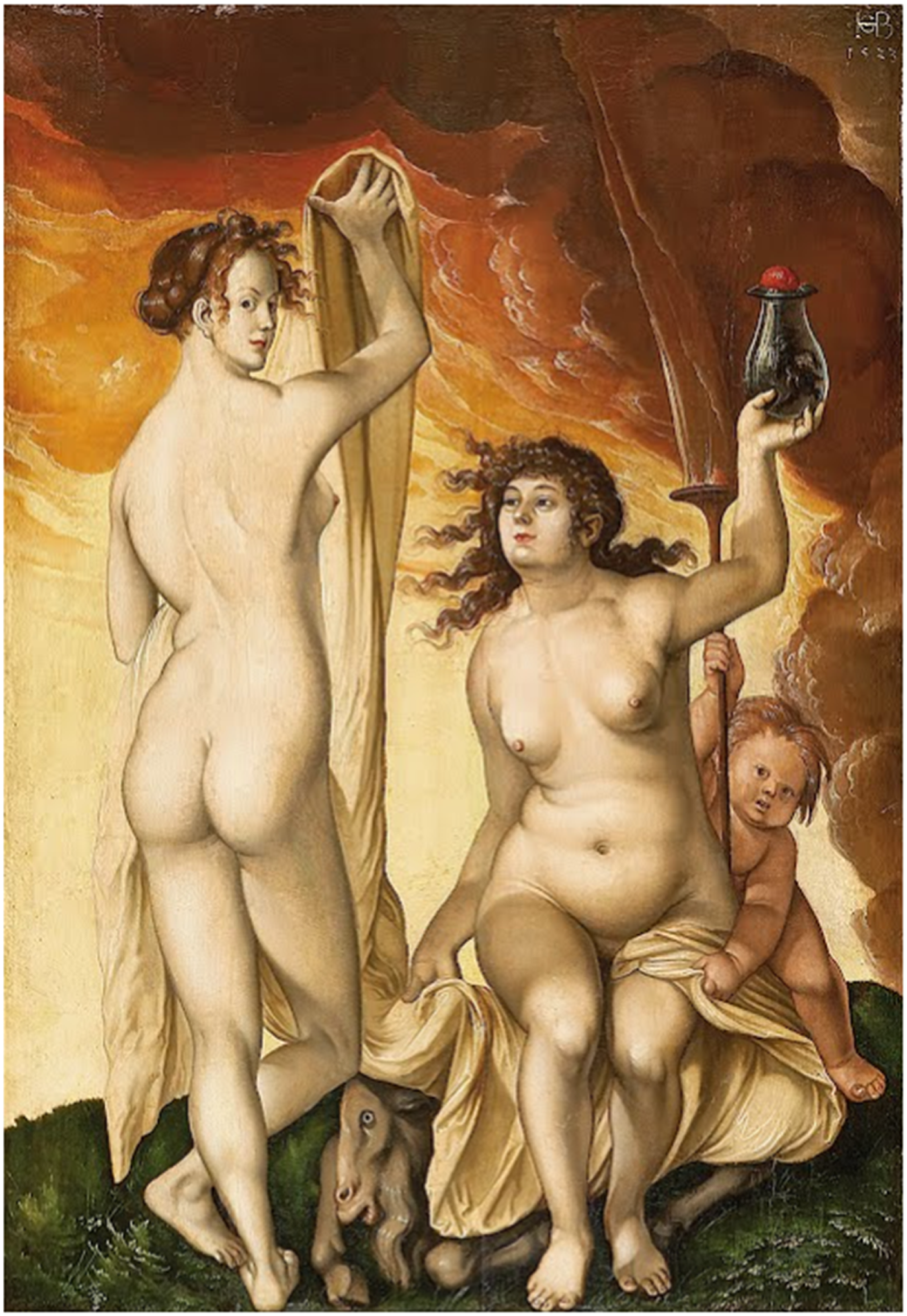
The witch was further co-opted between the 16th and 17th centuries in new modes of mass communication facilitated by the popularisation of the printing press, such as woodcut illustrations and ‘witchcraft pamphlets’ marketed to the semi-literate public (Suhr, 2012). These texts can be interpreted as efforts to make the complexities and inequities of capitalist expansion comprehensible for the general public using the spectre of witchcraft as an explanatory tool. The upsetting of established social structures and power dynamics is, for example, reflected in a woodcut reproduced in The History of Witches and Wizards (1720). The image shows common folk offering up dolls as oblations to the Devil in return for material comforts for themselves, playing upon the jealousies that readers might have held towards their upwardly mobile neighbours whose improvement in fortunes seemed inexplicably linked to the modernising conditions around them (Figure 2). Unknown artist, ‘Wax dolls being given to devil’ [woodcut] in The History of Witches and Wizards (1720: 15). Digital edition sourced from Wellcome Collection. Public Domain.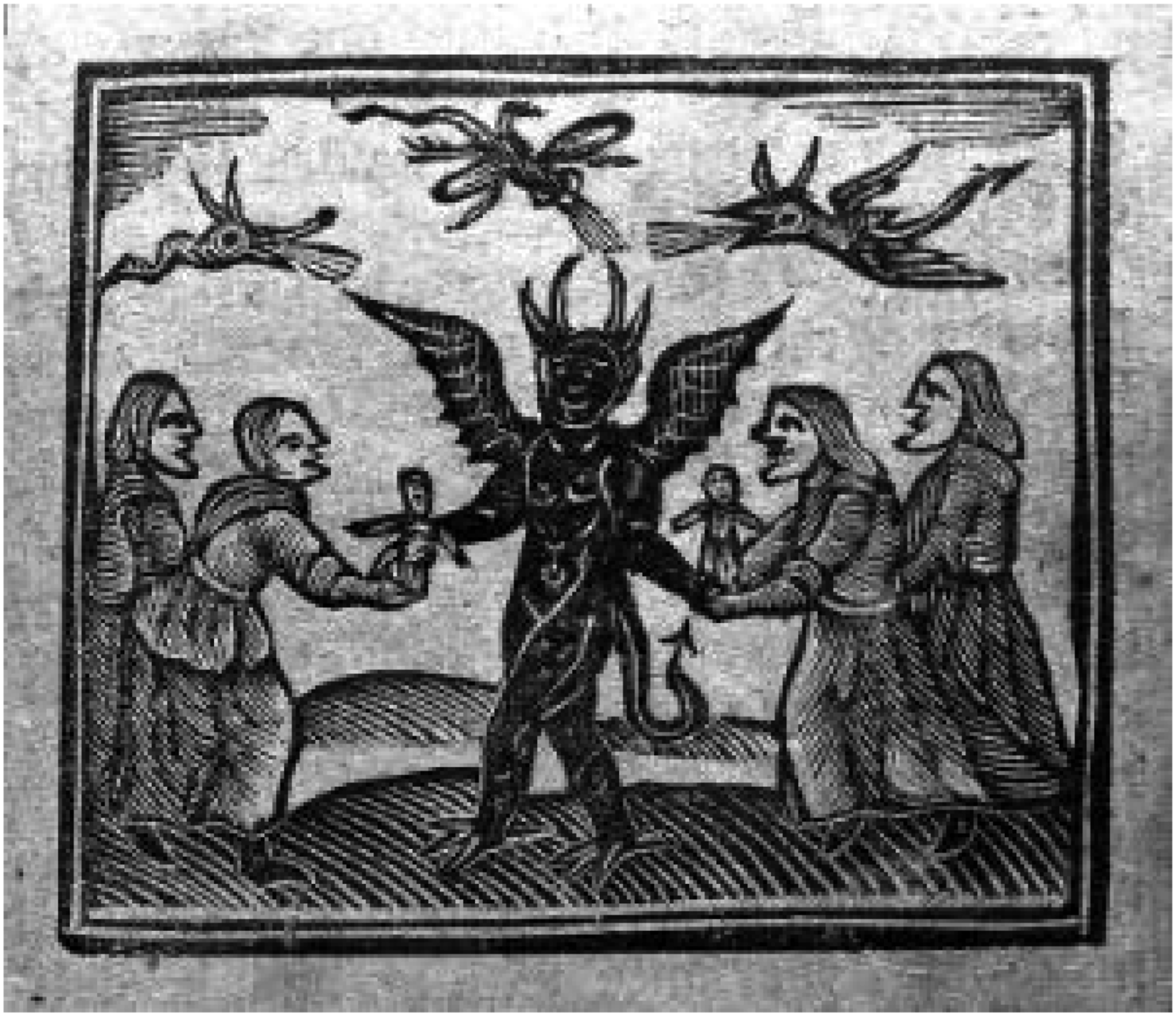
Witch hysteria became associated with increased commercialism and urbanism in the late 17th century versus the stagnating quality of life at agricultural hinterlands. Through critical analysis of socio-economic and geographic trends, Boyer and Nissenbaum’s (1974: xii) neo-Marxist account of the witch-trials of 1692 in Salem, Massachusetts reveals a brutal acting out of ‘inarticulate men and women’ whose ‘lives were being shaped by powerful forces of historical change’. Comparable evidence documents how the people of Old Calabar in southern Nigeria became preoccupied with witchcraft as overseas trade, newly acquired merchant wealth, and conspicuous consumption upset traditional class structures in the 18th century. Latham (1972: 249) argues that Old Calabar became haunted by reignited interest in witches as ‘a way of relieving tensions which arose from the repressed conflict between those who owed their status to the traditional lineage system, and those who owed their status to their wealth as merchants’. Whether in Europe or any of her colonies, the birth of global capital coincided with the return of the primeval, or as Derrida (2006: 3) states: ‘Haunting would mark the very existence of Europe’. Although the English Witchcraft and Conjuration Act of 1736 (repealing capital punishments against witches) defined the end of the early modern era, the witch by no means became less valuable as a resource for market administrators in the centuries that followed.
The witch in middle modernity: Provocation
A second function of the marketplace revenant can be discerned from the witch’s reappearance as a provocative force throughout the 19th and early to mid-20th centuries. During this period, the witch was resurrected and reimagined to countervail cultural stagnancy entrenched by conformity, expertism, and rationalism. The conservative climate was crystallised by the words of Hart (1893: 348), the editor of the British Medical Journal, who criticised a resurgence of interest in the ‘follies’ and ‘false phenomena’ of witch activities (seances, mesmerism, and faith-healing) amongst Victorians, including ‘some ladies of the upper class’, as conducive to ‘an abundant harvest of mentally disordered and pathological creatures’. Newspapers including the Daily Mail warned of the returning spectre of witchcraft as a seditious activity ‘inimical to Church and State’ and ‘harmful to the mental and moral outlook of the devotees’ (Daily Mail, 1934: 14). Parallels were even drawn between witchcraft and Marxism, evidenced by a piece in the New York Times outlining how, in the view of some, ‘modern communism is the linear descendent of the black traditions of medieval sorcery’ (Wells, 1927: 3). Contemporaneously, in A Popular History of Witchcraft, Montague Summers (an English convert to Catholicism and despiser of atheist communism) warned that: ‘Witches are as numerous, as malign and mischievous in England to-day, as ever they were in the sixteenth and seventeenth centuries, and legislation is as much needed now as then’ (Summers, 2011 [1937]: 246).
For Derrida (2006: 60), ‘the dead can often be more powerful than the living’. The return of the witch in middle modernity proved to be more powerful in her provocation than many of the political agents of the living present. The witch’s provocativeness can be viewed as beneficial rather than oppositional to capitalist expansion however, providing a stimulating model for identity seekers searching for a path out of modernity’s increasingly suffocating culture of conformity without threatening underlying politico-economic structures. Correspondents at the time said little about witches’ politics but identified subversion in witches’ reliance on dark forms of consumption such as young men and women engaging in ‘drink, drugs, and perverted practices’ and black masses that ‘soon degenerated into erotic orgies’ (Daily Mail, 1934: 14). By abandoning politics for mysticism and hedonism, the provocativeness of the witch provided disaffected subjects of middle modernity with a ‘safe’ apolitical route out from rational society. As recorded in She magazine, ‘in an age when men are preparing to go to the moon in spacecraft, the interest in witches on broomsticks is on the increase. Covens are being quietly formed and Sabbats take place’ (Hill, 1965: 64).
Assimilation of the witch to market interests is reflected in the spread of covens as escapist gatherings for sensation-seeking middle-class consumers, spearheaded by retired colonial administrator Gerald Gardner and his British Wicca movement in the 1950s (Truzzi, 1972). By mourning the passing of a more matri-focal, naturalist, and spiritual way of life before the acceleration of masculinist-technocracy, adherents of Wicca revived the disappeared ancient witch as a figure that Derrida (2006: 52) suggests, ‘cries out the truth, it promises, it provokes’ (at least in an illusory sense). Seemingly unmotivated by transformational politics, adherents of British Wicca privately went about their practices, desublimating whatever rage they had towards socio-economic structures into their own insider esoterica, symbolism, and secret rituals centred on feminist spirituality and goddess empowerment. Adherents of mid-20th century feminist-witch movements have been assessed critically as politically hollow and ‘self-deluded’ escapists who substituted in an obscure ‘personal spiritual solution’ in place of an articulate, unified, and popular critique of capitalist patriarchy (Rountree, 1999: 138).
Without comprehensible politics at its heart, British Wicca contributed little disturbance to popular discourse other than prurient material for newspaper tabloids. The Sunday Mirror reported on: ‘Men and women dancing in the nude’ and engaging in ‘[s]timulation through wine, music and drumming’ (Hawkins, 1955: 7), whilst the Daily Mirror recounted how ‘witches met naked, in a circle, with the high priestesses… wearing blue and green garters on the left thighs’ (Coolican, 1964: 2). The provocativeness of the returning witch was achieved by consumer symbolism, evidenced by the Wicca movements’ reliance on esoteric material artefacts (e.g. an athame, chalices, candles, or incense) rather than an expandable political consciousness. Like licentious Ottoman coffee houses of the 16th century (Karababa and Ger, 2011), backstreet cabaret of the 19th (Blaszkiewicz, 2021), or illicit raves of the contemporary period (Goulding et al., 2009), woodland covens of the mid-20th century provided modern subjects with sites for cultural experimentation to escape rather than resist bourgeois capitalist norms. Reborn as a performative and participative identity category, the returning witch served less as a revenant for confronting modern subjects with foreclosed pre-capitalist proto-politics and more as ‘a play-function’ (Truzzi, 1972: 26) for curious tribes of consumers.
Outside of the UK, the personal branding efforts of feminist countercultures throughout the United States in the 1960s further demonstrate the assimilation of the witch’s provocativeness to consumer identity projects. Like British Wicca, whatever resentment members of the US-established women’s liberation group Women’s International Terrorist Conspiracy from Hell (W.I.T.C.H.) held towards the structural constraints of their lives were obfuscated through theatricality and performativity. In the absence of credible political solutions to women’s dissatisfactions, W.I.T.C.H called for the following modes of artistic provocation: “Your weapons are theatre, magic, satire, explosions, herbs, music, costumes, masks, chants, stickers, stencils and paint, bricks, brooms, guns, voodoo dolls, cats, candles, bells, chalk, your own boundless beautiful imagination. Your power comes from your own self as a woman, and from sharing, rapping, and acting in concert with your sisters” (W.I.T.C.H., 1969: 77).
Bereft of any symbolically efficient politics, W.I.T.C.H. relied on guerrilla theatre and consumption materials to achieve aestheticised, identarian modes of expression under capitalism rather than by mobilising popular opposition against it. Examples of their aestheticised approach included marching on Wall Street dressed in capes and pointy black hats (W.I.T.C.H., 1969) and posing ‘in white face with brooms’ when dispensing a hex against First Lady of the United States, Pat Nixon, for her support of the Vietnam war (Robertson, 1969: 16).
Whether British Wicca or W.I.T.C.H in the US, those who resuscitated interest in the witch were unable to translate their shared experiences to a political project that could help wider audiences to understand and structurally locate their exploitation. Instead, they found themselves propagating narratives of play, identity, and artistic symbolism that propel rather than subvert capitalism’s hierarchical and communicative structures of cultural domination. This co-optative relationship between the market and the provocative trappings of the witch reached its apogee with the release of popular cultural products including the motion picture Rosemary’s Baby (1968) portraying witches’ darker motivations and the comedy TV series Bewitched (1964–1972) portraying their more benevolent, both depicting the witch as fully integrated to the very culture she seemingly rejected. Contemporaneously, commentators observed: ‘A mystical renaissance is evident everywhere, from television to department stores’ (Time, 1968: 42) and ‘tools of the trade–charms, folk stones, herbs, amulets, incense, candles–they’re available in a proliferation of shops springing up across the nation’ (Fleming, 1972: 137). These accounts starkly reflect the witch’s haunting of middle modernity as embedded in the consumerist circuitry of market society.
The witch in late modernity: Calibration
A third function of marketplace revenants is detected in the witch’s calibration of late modernity’s technological hold over its subjects, making computers and applied sciences appear compellingly hostile yet paradoxically hostage to the interests of capitalism. A rapid proliferation of digital technologies and the general creep of gadgetry across all aspects of material life from the early to mid-1970s onwards marked an acceleration of ‘disenchanted enchantment’ characterised by the ‘dubious-but-willing consumer’ who, as Belk et al. (2021: 26) suggest, ‘suspends disbelief and continuously plays along with a procession of one technological magic show after another’. For Derrida, the continual invasion of reality by ‘techno-tele-media apparatuses’ (2006: 98) brings about a present that feels profoundly out-of-joint and prone to being haunted by ‘[e]ntire regiments of ghosts… armies from every age’ (2006: 100).
Amongst Derrida’s returning regiments of ghosts, we can count the witch who has, since the 1970s, haunted the steady drip-feed of new technologies with both enthusiasm and pessimism; re-emerging to challenge technological advances deemed to be detrimental, while abiding by those that might be integrated to her vision of a utopian feminist future. Increasingly disenchanted by the apocalyptic potential of atomic technoscience, polluting effects of urbanism, and military-industrial escalation of the Cold War, witchcraft-oriented groups formed in the late 20th century to haunt what Derrida (2006: 72) calls ‘scientifico-military forces’. Throughout the 1980s, activists dressed as witches at the Greenham Common Women’s Peace Camp in Berkshire, England to protest nuclear weaponry – one of ten ‘plagues’ Derrida (2006: 100) identifies as endemic to the contemporary late modern apparatus. Likewise, the witchcraft movement Pagans Against Nukes (P.A.N) in their pursuit to re-establish a semi-mythic culture of harmony with nature, declared themselves as ‘an activist organisation dedicated to the banishment of nuclear technology from our Earth… to coordinate all pagans, of whatever land or tradition, in political and magical work to achieve this end’ (P.A.N, 1983: 1).
These groups’ invocations of the witch were undertaken not to dispel technological culture per se but rather to preserve it by way of curbing its most self-destructive tendencies. Beyond their protestations against nuclear technology, several accounts of neopagans and witches in the late 20th century reveal that a decent proportion worked in computer-related occupations, were avid computer users, and ‘supported high technologies, scientific enquiry, and space exploration’ (Adler, 1979: 21; Jorgensen and Russell, 1999). Conforming with Haraway’s (1991) thesis on cyborg feminism, the seduction and promise of technology in late modernity appeared to blur the lines between men and women, nature and culture, or organisms and machines. Haraway hoped that technology’s erasure of such boundaries would enable women to drop their self-limiting attachments with nature (as earth ‘goddesses’) and identify instead as ‘cyborgs’ that transcend simple binaries and tools of patriarchal epistemology, thus constituting a way out of subjugation. Haraway’s hopes were nonetheless eclipsed by her recognition that women faced renewed subjugation through electronics-dependent jobs, exclusion from masculinist technocultures, and displacement by the high-tech military establishment’s phallocentric priorities. If genuine cyborg-witches did exist, they functioned only to provide a human face to techno-capitalist expansion rather than its undoing.
The witch’s haunting of late modernity, Derrida (2006: 100) might argue, has been to challenge ‘the postmodern excess of arms (information technology, panoptical surveillance via satellite, nuclear threat, and so forth)’ rather than to challenge techno-capitalism generally. The witch, as a ghost from a gynocentric past without nuclear weapons, played a role in calibrating late modern technologies such that they remain in the service of techno-capitalist growth through consumer lifestyles rather than military-industrial aggression. Those interested in witchcraft in the 1980s curiously defined themselves as apolitical or rather, ‘rejected politics narrowly defined except for anti-nuclear and environmental causes, and feminism’ (Kirkpatrick et al., 1986: 37). As with their predecessors in middle modernity, those who resuscitated the witch in late modernity seemed less interested in articulating a clear political alternative to capitalism and more concerned with achieving representation within it. The witch’s full integration with techno-capitalist culture is evidenced by a wave of celebratory consumerist paperbacks launched at the turn of the millennium including Knight and Telesco’s (2002: 62) The Cyber Spellbook which advocates for ‘techno-tools for beautification’ such as electric hairdryers, straighteners, and curlers to be used in late modern witchcraft.
Besides enrolling everyday consumer objects into their fantasy play, since the 1990s, witches of the late modern period have been increasingly catered to by specialist brands and retail stores. Use of the witch to align capitalism’s technological advances with consumerism rather than with militarism or any other mass-destructive ideology has been evidenced most recently on the social media platform, TikTok, where content posted under the ‘#WitchTok’ identifier has attracted global attention (Barnette, 2022). As a digital form of witchcraft, WitchTok centres on liquid aesthetics rather than articulate, unified beliefs and is made up of various short-form videos posted by users exploring witch consumption including tarot reading, protection spells, divination, charms, and manifestation (actualising one’s material desires by magical means). Gaining prominence between 2020 and 2022, a period of accentuated social and economic hardship linked to the COVID-19 pandemic, the popularity of WitchTok might be read as the techno-capitalist retrocorporation of the primitive as a playground for reflexive doubt (Thompson, 2005). Against a backdrop of political indecisiveness, previously improbable alliances between scientific, corporate, and governmental actors, and seemingly never-ending, and sometimes contradictory technocratic discourses on personal-protective measures, digital witchcraft during the Covid-Era allowed for critical reflection on the fallibility of expert systems; and a channelling of the ‘general desire among young adults to feel powerful and capable of using witchcraft to solve problems their elders cannot or will not resolve’ (Barnette, 2022: 102).
While cultural scepticism and discourses intended to foster reflexive doubt have been attached to resurgences of witchcraft throughout late modernity, capitalist realism remains practically unchallenged. The late modern subject’s appropriation of the witch to aestheticise criticisms of expert systems while maintaining a full and apolitical embrace of consumer culture’s techno-tele-media apparatuses serves only to calibrate rather than obviate capitalism, ensuring it remains aligned with (rather than antagonistic to) consumer interests.
Discussion: The function of ‘retrocorporation’
Through a historical-cultural reading of the witch, we have explored how capitalist modernity has, since its incipience, co-opted and integrated the ghosts of those it effaced. Moving beyond established understandings of co-optation based upon the incorporation of emergent countercultural symbols and practices to the market (Giesler, 2008; Thompson and Coskuner-Balli, 2007), we traced the logic of retrocorporation to demonstrate how counterculture remains delimited to the ghosts of what has already been and gone, producing anachronisms that contribute to, rather than challenge, dominant economic and political structures of the present. The logic of retrocorporation turns attention away from market actors’ capabilities to predict or control the future, and towards counterculture’s own regressive and restrictive commitments to the past. ‘The “past” here’, Fisher (2014: 122) recognises, ‘is not an actual historical period so much as a fantasmatic past, a Time that can only ever be retrospectively – retrospectrally – posited’. It is that potential to ‘retrospectrally’ restructure and rewrite the past that has facilitated the colonisation of its disappeared victims as frameworks for consumer desire and market-mediated cultural experimentation.
To explain this, we have introduced the concept of marketplace revenant which differs from Derrida’s (2006) original concept in several critical respects. First, while Derrida’s revenant is framed as a repressed phantom of sorts, the manifestation of a posthumous desire for justice that disrupts the symbolic present; the marketplace revenant remains a perversion of this, manifested in a consumerist desire for what is missing but might somehow be non-disruptively included in the symbolic present. Second, while the disruptive hauntings by the Derridean revenant are characterised by an ethical relationship, wherein the self is brought to account by the repressed spectral Other, hauntings by the marketplace revenant are distinguished by an extractive relationship which makes the Other little more than a source of ornamentation for the self. While for Derrida (2006: 47), capitalism will remain ‘haunted by what it attempted to foreclose’, the ongoing usefulness of disappeared Others for market co-optation suggests that capitalism can remain exalted too by what it attempted to foreclose. Third, and relatedly, unlike the Derridean revenant that resists any sense of reconciliatory closure under capitalist hegemony, the marketplace revenant – because of its co-optation – functions in the service of capitalist hegemony. The marketplace revenant aligns with Jones and Hietanen’s (2023: 227) recent discussion of ‘an apparatus of capture’ which explains how capitalism readily co-opts (or ‘captures’) consumer resistance before it is imagined. For Jones and Hietanen, the desire to resist is often fuelled by affective excitements whose radical intensities necessarily become overtaken by that which is controllable and predictable, ensuring that ‘the seeds of capture are present from the start’ (Jones and Hietanen, 2023: 231).
In mapping out how pre-capitalist imaginaries become retroactively assimilated to the machineries of the market, but also how the mode of assimilation itself changes depending on capitalism’s current imperatives, we reveal a non-static, evolving process of co-optation that varies from expropriation to provocation to calibration. Based on these functions, we define the marketplace revenant as: a disappeared Other from our collective past that, upon re-appearance in the living present, is retroactively co-opted to expropriate noncompliance with current structures of power, privilege, and their cultural fields; provoke interest in commodifiable cultural identities; and calibrate the market’s most objectionable logics to more palatable adjustments. Like Derrida’s original conceptualisation, the marketplace revenant carries with it a divergent vision incompatible with the injustices of the present system. Both Derrida’s and our new conceptualisation of revenants can be said to reflect the ‘Real’; that which is repressed yet keeps re-emerging and re-asserting itself no matter how much psychic distance the reigning political economy puts between it and us (Cronin and Fitchett, 2021). However, unlike Derrida’s revenant, we propose that the marketplace revenant can only inspire subjects of the living present to go so far as stylisation, affectation, and simulacrum in pursuing an open future. The marketplace revenant offers only sentimentality for an impossible past, ‘objectively ironized’ (Fisher, 2009: 4), emptied of its subversive potential, and cynically reduced to a convenient and toyetic anachronism. When revenants are rationalised and commercialised, our collective ‘hostility toward ghosts, a terrified hostility’ (Derrida, 2006: 58) becomes supplanted by individualist desires sated through market-located gratifications.
Although we have presented only a rough schema of the relationship between the capitalist project and the pre-modern disappeared Others it helped to efface, our conceptualisation of the marketplace revenant via the witch is not intended to be read as a form of ‘therapeutic resolution’ (Ahlberg et al., 2022: 670; see also Cronin and Fitchett, 2021). In contrast to Zanette et al.’s (2023) reading of the witch as a benison for self-transformation, offering ‘new forms of empowerment against antagonising forces’ (pg. 177), our conceptualisation aligns with the countervailing ultra-realism of terminal (Ahlberg et al., 2022) and de-romanticist (Fitchett and Cronin, 2022) marketing scholarship. Though we recognise Zanette et al.’s interpretation of the witch as a source for identity politics and mythmaking, their assumption that self-identification as witches functions as problem-solving ‘heroism’ for marginalised individuals risks ossifying and reifying the inscribed fantasies of capitalism itself. To quote Ahlberg et al., ‘conceiving the individual as identity projects in-the-making is manifestly utopian and optimistic about the possibilities of the ‘self’ as a capable actor in negotiating, understanding, and improving their situation’ (2022: 673). Rather than undermine the socio-economic structures that render them marginalised to begin with, those who reclaim the witch today do not heroically contradict but arguably conform to the basic ethos of consumer culture: demand representation from the marketplace and seek reprieve from life’s injustices through consumption.
The reclamation of a disappeared Other – such as the witch – for self-expression and fantasmatic projection in many ways plays out in a mode similar to Marcuse’s (2002 [1964]) repressive desublimation. By retroactively restructuring the mythology and proto-politics of ancient figures to fit better with the liberal-capitalist present, those who identify with and benefit from those figures are, ‘no longer images of another way of life but rather freaks or types of the same life, serving as an affirmation rather than negation of the established order’ (Marcuse, 2002 [1964]: 62).
Implications for future research
Our accounts of retrocorporation and the marketplace revenant in the latter periods of modernity raise an important question for future research: if the resurrection of pre-capitalist imaginaries is motivated by repressive nostalgia more than articulate and politicised dissatisfactions, how can the past ever be invoked to avoid its co-optation? Disappeared figures such as the witch return and haunt modernity so frequently arguably because of their affective potential to create opportunities for individuals to have fun and inform their identity projects more so than any political consciousness-raising. This, we must recognise, makes their co-optation likely if not inevitable. Nonetheless, theoretical fundamentalism that necessitates the universal and unreflective devaluation of all identarian, affect-based action should be avoided. The liberated self-representations attached to identity-seeking and affective affirmation can and should be faulted for misdirecting resistant energies to the field of culture rather than to political-economic structures but perhaps not at the expense of overlooking their positive effects. As repressed Others (whether witches, ethnic minorities, religious devotees, LGBTQ+ or other historically marginalised groups) organise to seek representation from a liberalised consumer culture and their recognition becomes market-mediated, their social stigma becomes ameliorated (Zanette et al., 2023). Future researchers concerned with social representation might alternatively re-interpret our account of capitalism’s move from expropriation to provocation to calibration as a destigmatising evolution from ostracization to exoticization to eventual acceptance (see Eichert and Luedicke, 2022). There is an opportunity to build inventive praxis through reconciling political consciousness-raising with reflection on the greater degrees of recognition and respectability afforded to previously stigmatised subjects through the liberalisation of legislation, markets, and the media.
Looking to the future, unless we resign ourselves to endlessly re-examine the deadlocks of a repressed life under capitalism, analyst-activists must depart from straightforward leftist critiques and graduate to pluralistic theorising and experimental political praxis. Seeking ways to inject nuance to terminal modes of expression in critical marketing scholarship would not constitute a volte-face on the stultifying effects of the market’s repressive desublimation, but could offer more reflexive and adaptive critiques of political economy. As a possible seedbed for informing inventive work in the terminal, de-romanticist space, Fisher (2018: 689) counterposes old leftist ascesis with his unfinished ‘acid communism’ thesis, a (symbolically) psychedelic ‘mass avant-garde’ based upon the speculative convergence of new social movements, socialist-feminist consciousness-raising, permissiveness, and aestheticism with the communist project. Acid communism, a confluence that liberates human consciousness from the norms of capitalism while preserving the destigmatising potential of expressive and collective consumption, has not yet come together in full but ‘would be unimaginably stranger than anything Marxist-Leninism had projected’ (Fisher, 2018: 682-683).
Though faint glimmers of such an acidic move can be detected in W.I.T.C.H’s identarian street theatre of the late 1960s, this attempt at organisation failed to engender solidarity amongst the wider ‘substratum of the outcasts and outsiders’ – a group consisting of ‘the exploited and persecuted of other races and other colors, the unemployed and the unemployable’ (Marcuse, 2002 [1964]: 260). Efforts to re-politicise and re-aestheticise the witch unfortunately tend to succumb to insiders’ own prejudices, tribalism, and desires for difference, delivering little more than spectacle. Still, the witch – like any mythical, rebellious archetype – if somehow cleansed of the prejudices and biases of those who appropriate it, might become a psychedelic vehicle for delivering acidic, post-capitalist praxis. Today, carnivalesque ‘memeable’ material like WitchTok content could be creatively hijacked by the online left, expanded, and made oppositional to the banality of self-interest, with egalitarianism and solidarity writ in its memetic qualities instead. For now, radically creative, communitarian activity remains, like a ghost, only somewhat present and disappointingly elusive.
Footnotes
Acknowledgements
The authors would like to express their gratitude to Rohit Varman and the three anonymous reviewers for their encouraging, thought-provoking comments which helped us to deliver a stronger manuscript.
Declaration of Conflicting Interests
The author(s) declared no potential conflicts of interest with respect to the research, authorship, and/or publication of this article.
Funding
The author(s) received no financial support for the research, authorship, and/or publication of this article.
