



Abstract
In this paper, we challenge the prevalent idea that anti-consumption functions as an ideological act of antagonism. We enlist the work of the late cultural theorist Mark Fisher to account for the reflexively impotent (anti-)consumer, a politically hollowed-out and knowingly helpless subject endemic to the futureless vicissitudes of semiocapitalist consumer culture. Drawing on netnographic data and interviews with ‘digital detoxers’, we explore how gestural – rather than transformational – anti-consumption emerges through individuals’ reflexive awareness of their political inertia, the lack of collective spirit to bring about improved conditions, and their perpetual attachment to market-based comforts and conveniences. Our analyses reveal three features that underpin the reflexively impotent (anti-)consumer’s resigned acceptance of the reigning political-ideological status quo: magical voluntarism, pragmatism and self-indulgence. In the absence of any unifying and politically-centred solidarity projects, mere gestures of resistance are undertaken towards managing personal dissatisfactions with – instead of collectively transforming – their structural conditions.
Keywords
Introduction
With the resurgence of public interest in political movements and the impact of a global ‘return to politics’ on consumer culture (Cronin and Fitchett, 2022: 134), renewed attention has been directed to political ideology as a crucial motivator for anti-consumption (Cambefort and Pecot, 2020; Ulver and Laurell, 2020). In the case of ideological progressivism on the political left, anti-consumption practices often appear in demonstrations and protests related to addressing environmental issues, unethical corporate behaviours, and social injustice (Kozinets and Handelman, 2004). In the context of re-emerging social conservatism on the political right, anti-consumption activities such as brand rejection and corporate boycotts are a mainstay of new rightist groups’ efforts to challenge liberal business practices and influence civil debates (Cambefort and Pecot, 2020). Moreover, while anti-consumption has long been impelled by anti-imperialist movements to signal discontent with globalisation and the neoliberal model of global capitalism (Varman and Belk, 2009), socio-economic populist groups have also made political use of reducing and rejecting consumption to protest unfair domestic market forces (Hershkovitz, 2017). Many of these cases underline that anti-consumption practices can reflect ideological attachments that are oppositional to the perceived structures of power that underpin today’s socio-economic life. However, despite the revitalisation of antagonistic politics across consumer culture, we should not lose sight of those forms of anti-consumption that function apolitically and, in doing so, potentially reproduce and perpetuate the status quo.
In this paper, we set out to conceptualise how anti-consumption practices, when lacking discernible political alternatives at their core, are incessantly assimilated into the circuitry of semiocapitalism and its desiring forces (Hietanen et al., 2022). In the absence of any genuinely transformative politics, we identify what we call ‘gestural anti-consumption’, a performance that works to relieve individuals’ personal dissatisfactions with, rather than to collectively transform, the underpinning semiocapitalist hegemony and its futureless vicissitudes (Ahlberg et al., 2021; Fisher, 2014a). When undertaken in a ubiquitous market-society where market fundamentalism 1 reigns supreme and all beliefs in some kind of post-capitalist future are slowly being ‘cancelled’, anti-consumption functions as a mere gesture of resistance rather than a genuinely antagonistic force. Consumers and anti-consumers, we argue, become conflated and integrated as the one ‘(anti-)consumer subject’. This singular and amalgamated (anti-)consumer subject position remains deadlocked in its actual effects while only appearing differentiated in superficially experiential and symbolic terms. Without unifying political alternatives underpinning them, this subject’s gestural anti-consumption practices remain tied to self-expression and self-fulfilment which are fully commensurate with market logics and can be safely commodified. By adapting and extending the late cultural theorist Mark Fisher’s (2009: 21) concept of ‘reflexive impotence’, we unpack how gestural anti-consumption unfolds via the intersection of the (anti-)consumer subject’s reflexive awareness of her political inertia, inability or unwillingness to bring about structural change, and perpetual attachment to the desiring forces of capitalism itself. This paper is underpinned by two interrelated research questions: What are the main features of gestural anti-consumption? How is the perceived impossibility of structural change prefigured into practices of gestural anti-consumption?
To address these questions, we reflect on netnographic data and in-depth interviews with people who engage in ‘digital detoxing’, that is individuals who limit or temporarily abstain from the consumption of digital technologies. Digital detox, while classifiable as a form of anti-consumption, has become, as Syvertsen (2017: 96) emphasises, a mundane and routine act of consumption itself – a ‘part of everyone’s toolbox’ in coping with digital overload and dissatisfaction – rather than a collective action to address the root causes of consumption-related problems. For many individuals, digital detox practices are not motivated by political solidarity against a shared adversary, whether ‘Big Tech’ firms who ostensibly manipulate their consumption or the liberal capitalist structures of power that make such manipulation possible. Crucially, digital detox does not function according to the typical formula of collective ideological resistance – ‘a clear-cut case of “us” and “them”’ (Syvertsen, 2017: 96) – rather it is often a case of disorganised individuals undertaking ephemeral and practical attempts to make their consumption better work for themselves.
Our paper makes two important contributions to the emerging strand of ‘terminal’ (Ahlberg et al., 2022) or ‘de-romanticist’ (Fitchett and Cronin, 2022) writings within critical marketing scholarship. First, in line with this strand’s calls to revisit and de-romanticise the institutionalised concepts of our discipline, we offer an update to the subject position of ‘the reflexively defiant consumer’ (Ozanne and Murray, 1995). Under semiocapitalism, we suggest that resistant consumer subjectivity is better understood as ‘the reflexively impotent (anti-)consumer’. In contrast to the celebratory view of an autonomous, self-determining postmodern rebel who, through critical reflection, ‘choose[s] to defy or resist traditional notions of consumption’ (Ozanne and Murray, 1995: 522), we offer an image of an increasingly helpless subject who, with reflexive awareness of his or her utter embeddedness in commodified desiring flows, is disinclined to genuinely defy dominant market forces. In this regard, we challenge the prevalent idea that ‘anti-consumption must be an act of ideological extravagance – wandering beyond the accepted limits of cultural acceptance’ (Kozinets et al., 2010: 226–227).
Second, our analyses provide clarification for how any potentially energising relief from capitalism ultimately capitulates under what has been theorised as a cultural atmosphere of ‘no hope’ or futurelessness (Ahlberg et al., 2021; Fisher, 2014a; Hietanen et al., 2020). By tracing how the reflexively impotent (anti-)consumer is as much aware of the problems of technologically-mediated consumer capitalism as she is of her own powerlessness to confront them, we illustrate how living with the slow cancellation of the future impairs any efforts of resistance. The value of identifying the lived effects of this ‘futurelessness’ is not simply in offering a pessimistic perspective on subjects’ potential for resistance, but is in the implication for fellow (anti-)consumer researchers to think more ‘futuristically’ about where our critiques could – or should – land. For the analyst-activist to genuinely challenge the futureless vicissitudes of consumer culture, it becomes necessary to locate ongoing epistemic enquiry not just at the level of the structural but also at the level of the experiential. This means taking into account capitalist subjects’ own justifications for pursuing personal interests and pleasures rather than any kind of political praxis when faced with systemic problems.
Theoretical underpinnings
Anti-consumption and political ideology: A brief background
Anti-consumption can be defined as ‘intentionally and meaningfully excluding or cutting goods from one’s consumption routine or reusing once-acquired goods with the goal of avoiding consumption’ (Makri et al., 2020: 178). Anti-consumption practices are expressed through three non-exclusive forms: rejecting (i.e. refusing or avoiding); restricting (i.e. reducing); and reclaiming (i.e. changing or co-opting the meanings of) goods, services or experiences (Lee et al., 2011). Although the drivers and manifestations of rejecting, restricting, or reclaiming consumption are manifold, the motivating role of political ideology has been underwritten by a significant stream of research (Izberk-Bilgin, 2012; Kozinets and Handelman, 2004; Ulver and Laurell, 2020). Political ideology denotes a fantasy framework of beliefs, aspirations and aversions concerning the proper functioning of society and how it might be achieved. At an elementary level, political ideology can be mapped out on a continuum with liberal progressivism on the left and conservativism on the right (Cambefort and Pecot, 2020). Although many cases of anti-consumption detected in consumer research are motivated by leftist ideology – for example, liberals’ ‘anti-unethical’ and ‘anti-colonialist’ rejection of global brands that offend their moral shibboleths – antagonisms have also been detected between social conservatism and the market. Examples of rightist anti-consumption include boycotts of supermarkets that sell Halal products by nationalist groups in England (Lekakis, 2019) and Christian-conservative groups’ rejection of Disney products following the brand’s corporate decision to better represent gay employees and consumers (MacDonald and McDonald, 2014).
Recognising that anti-consumption is neither an exclusively left- nor right-wing activity, Pecot et al. (2021) suggest that political extremism in general should be understood as an important predictor for anti-consumption. Individuals positioned at either extreme of the left-right political spectrum are more likely to be suspicious of consumerism and to engage in anti-consumption compared to those in the centre ground. It is the political centre – or ‘mainstream’ – that is understood to function as ‘a constant adversary’ for politically extreme individuals to fight against (Ulver and Laurell, 2020: 490). Whether extremely leftist or rightist, those who undertake anti-consumption in opposition to this real or imagined mainstream adversary are assumed to have committed to a form of lifestyle activism within a movement of like-minded political subjects ‘pos[ing] a viable alternative’ to the existing system (Izberk-Bilgin, 2012: 678; Kozinets and Handelman, 2004).
Nevertheless, a ‘viable alternative’ that can truly supplant the existing system is rarely, if ever, taken seriously or considered achievable by lifestyle activists whose practices are typically undertaken in the individualist pursuits of self-expression, social distinction, therapy or hedonism (Kozinets, 2002). Although lifestyle activists may share political beliefs that deviate from the mainstream, it is rare that these beliefs are mobilised in ways that lead to authentic and durable change. For example, Moraes et al. (2010: 293) argue that individuals and groups who ‘share their own notions of the good life’ engage in oppositional practices that, while potentially aligned with extremist views, are undertaken ‘not with a view to change society at large […] but with the aim to restructure the meanings of their own lived experiences as seductive alternatives’. High-profile anti-market or anti-marketing events such as Burning Man have long provided us with illustrations of an anti-consumption that is largely deskinned of any revolutionary potential; serving to provide weekend-trippers with a short-lived, experiential sense of respite from (rather than reformation of) dominant market structures (Kozinets, 2002). For Kozinets, consumption might fall under scope for extreme criticism at such events and alternative modes of exchange are encouraged, but they are ‘not about major social change’ (Kozinets, 2002: 36); instead, they are more about personal growth and expression, and thus denuded of the political narratives that might motivate enduring and genuinely transformative solidarity in wider cultural life. Similarly, Mikkonen et al. (2011: 99) illustrate how online cadres of lifestyle activists who reject the hyper-consumerised ways of celebrating Christmas engage in mischievous anti-consumption discourses as a way of pursuing a cynical and playfully self-aware identity project, ‘the Scrooge’, rather than to genuinely educate and rescue seasonal shoppers from marketers’ manipulation. Even commercial brands sometimes seek to incite consumers’ rejection of – and resistance against – dominant market institutions, not in the pursuit of any kind of post-market politics but simply to achieve legitimacy for their own offerings (Koch and Ulver, 2022).
Central to the above anti-consumption projects is the absence of earnest political demands and the subordination of meaningful critique to individual conceits and self-interest, what has been referred to as ‘the hollowing-out of political subjectivity’, resulting in a subject positioning founded on ‘base pragmatism and instrumentalism work[ing] in the service of the dominant ideology’ (Treadwell et al., 2013: 4–8). Moreover, the pluralisation of politically hollow anti-consumption projects works to ossify the status quo by aligning resistant energies with individual-expressive rather than collective-transformative logics, ensuring that no single anti-consumption position is consolidated enough to become a genuine threat. No matter how cynical or dissatisfied anti-consumers are, without social solidarity and popular political dissensus, their behaviour is better understood as an alignment to the unrelenting individualism and diversification of consumptive capitalism, rather than as ‘reflexive defiance’ (Ozanne and Murray, 1995: 516) to it. The result is, we argue, a form of anti-consumption that remains gestural and, for the most part, objectless. However, while it might be devoid of collective political objectives, gestural anti-consumption is not without objects, as it constitutes a series of ‘alternative’ consumption choices rather than the refusal of consumption altogether (Chatzidakis et al., 2012; Cronin and Fitchett, 2021). To help us to better understand the political objectlessness of gestural anti-consumers and what underpins their inability or unwillingness to pursue genuine transformation, we now turn to Fisher’s (2009) onto-affective concept of ‘reflexive impotence’.
Reflexive impotence and semiocapitalist horizons
A common theme of critical marketing scholarship is that consumption today functions within a culture of disavowal whereby consumers are fully aware of their own complicity in systems of power and domination yet maintain an ironic distance to their actions (Bradshaw and Zwick, 2016; Cronin and Fitchett, 2021). Under these circumstances where consumers can disavow yet nonetheless participate in and reproduce the problematic aspects of dominant systems, an incontestable status quo is maintained through what Fisher (2009: 21) refers to as ‘reflexive impotence’, that is, ‘They know things are bad, but more than that, they know they can’t do anything about it’. Reflexive impotence denotes a state of being fully aware of one’s dissatisfaction with today’s increasingly technologically-saturated consumer-capitalist zeitgeist but acquiescing to it under the belief that it is unrealistic and near impossible to change the system. Even when undertaken on mindless autopilot or without significant meaning, day-to-day consumerist preoccupations such as routinely logging calories on digital self-tracking devices (Kristensen and Ruckenstein, 2018), keeping smartphones charged for idle scrolling on public transport (Robinson and Arnould, 2020), posting photos to social media (Kozinets et al., 2017) or binge-watching the latest ‘trending’ TV series via streaming services (Jones et al., 2018), all remain deeply entrenched regimes that many of us cannot imagine no longer doing.
Collectively these vortices of digital artefacts and signs (‘semios’) – and the resigned acceptance that perpetuates their consumption – can be located within the parameters of ‘semiocapitalism’, a technologically-mediated global capitalist formation reliant on identifying, influencing and automatising consumers’ informational and semiotic flows, techno-cultural activities and modes of personal stimulation, expression, and meaning-making for its regime of accumulation (Hietanen et al., 2022; Hoang et al., 2022). Under semiocapitalism, consumers remain plugged into what Fisher calls ‘the drip-feed of digital stimulus’ because of: (1) the pervasive lures of an always-on digital culture that is seductively (and competitively) desirous, indulgent and egotistic; and (2) the naturalisation of ritualistic compliance that works to obviate any opposition to it (Dean and Fisher, 2014: 30). Importantly, semiocapitalism reproduces itself through the mixture of ‘perpetual pleasure’ and ‘an endless insomniac drift’ which always happen simultaneously (ibid.). Although its subjects almost never feel wholly present when consuming under semiocapitalism, its endlessly rotating carousel of pleasures keeps the majority committed. The result is reflexive impotence, a deep sense of inertia that is ontological–affective: what is felt becomes what is lived, and what is felt is that there is no popular impetus for change.
There are three critical aspects to reflexive impotence’s onto-affectivity. First, Fisher’s (2009: 21) concept has an intellectual dimension centred on ‘marketplace metacognition’ – a subject’s social intelligence about his or her positioning as a consumer and marketers’ operations upon them (Wright, 2002: 677). Within a networked, gadget-driven, and computer-literate consumer culture, subjects are often not ignorant to market actors’ attempts to surveil and influence them but are also appreciative of the many indulgences and conveniences on offer (Hietanen et al., 2022). Consumers are painfully aware of the benefits that their digital consumption provides, resulting in a state of ambiguity that is conceived of as vaguely manageable rather than resolvable. This is seen in what Fisher (2009: 25) calls an ‘ahistorical, anti-mnemonic blip culture’ wherein time becomes fragmented into ‘digital slices’ that allow consumers to treat their relationships with technology as discrete encounters with benefits, which compensate for the cumulative costs of semiocapitalist subjugation (e.g. addiction, targeted advertising, algorithmic manipulation, etc.) (Hoang et al., 2022).
Second, reflexive impotence has an attitudinal dimension best described in terms of ‘post-pessimism’, ‘the understanding that neither an optimistic nor pessimistic attitude is justified due to the lack of alternatives’ (Gonnermann, 2019: 27). Gonnermann describes post-pessimism as an attitude ‘meandering between resignation and stoic acceptance’ (p. 37). Reflexive impotence, for both Fisher and Gonnermann, is not the same as apathy. Instead, it mirrors closely the idea of ‘disaffected consent’ (Gilbert, 2013: 18) whereby subjects feel that they have no choice but to accept that the existing socio-economic world they live in, while deeply problematic, constitutes the only viable form available to them. Experienced as ‘a penumbral burden of suppressed meanings and closed-off social possibilities that cannot be completely eliminated or denied’ (Gibson-Graham, 1995: 25), the post-pessimistic attitude is characterised by recognition that today’s capitalist zeitgeist is here to stay for better or worse; all other possibilities are cancelled (Ahlberg et al., 2022). The result is a cultural atmosphere of futurelessness (Fisher, 2014a) where any conceivable futures that are radically different to the semiocapitalist present have evaporated. The prevailing assumption is that ‘capitalism can only be resisted, never overcome’ (Fisher, 2009: 28).
Third, reflexive impotence has a behavioural dimension centred on a kind of play-acting whereby consumers ‘act as if’ they are unaware of what they already are well aware (Fisher, 2009: 13), namely, that their consumption may have negative effects on themselves and others, and that any anti-market behaviours they pursue will likely not result in any significant changes. An example of this is Bradshaw and Zwick’s (2016: 278) account of the sustainable business field under ‘sustainable capitalism’ which allows subjects ‘to act as if they are doing something of significance in the face of clear evidence to the contrary’. This logic is exemplified by e-commerce websites selling ‘ethically sourced’ products with eco-friendly shipping options and promises that each online purchase supports environmental causes thereby ensuring the very consumerist act buys one’s redemption from being a consumer, negating the felt need for any radical change (Cronin and Fitchett, 2021).
Taking these key dimensions together, reflexive impotence might be reasonably deployed in helping us to identify the main features of gestural anti-consumption and how the perceived impossibility of structural change is prefigured into its performativity.
Research context: Digital detox
In today’s semiocapitalist culture of technological dependency, practices of digitally-oriented anti-consumption have become hugely popular (Syvertsen and Enli, 2020). Digital detox, as a blanket term that captures this trend, was added to the Oxford dictionary in 2013 and is defined as ‘a period of time during which a person refrains from using electronic devices such as smartphones or computers, regarded as an opportunity to reduce stress or focus on social interaction in the physical world’ (Strutner, 2015). Although this definition exclusively emphasises temporary rejection, digital detox also encompasses diverse and much less rigid forms of restricting and reclaiming digital consumption.
Far from being a renegade, fringe act of disruption, an entire cottage industry has developed around digital detoxing including health care, travel, tourism, and hospitality, as well as a social media trend amongst influencers and micro-celebrities (i.e. ‘#digitaldetox’). Scores of self-help guides, websites, apps, tools, devices and training have emerged to assist consumers with unplugging from digital culture (Syvertsen and Enli, 2020). A cursory browse online reveals hundreds of digital detox retreats, camps and holidays offered by specialist operators. For example, a major international service provider, eponymously entitled ‘Digital Detox’, arranges for-profit summer camps (‘Camp Grounded’) and ‘unplugged’ nights out and mystery trips (http://digitaldetox.org). Microsoft, Apple and Google have all incorporated ‘Screen Time’ or ‘Digital Wellbeing’ features into their operating systems to assist users to detox. Demand for ‘dumb' or ‘minimalist' phones such as the Light Phone, the Punkt MP01 and the rebooted Nokia 3310, which are marketed as antithetical to smartphones, further reflects a commodifiable desire amongst consumers to reduce digital distractions.
Neither politically leftist nor rightist, there nonetheless exists the façade of vaguely anti-market and anti-corporate sentiment to digital detoxing. For example, the manufacturer of The Light Phone proclaims on their website: ‘Light was born as an alternative to the tech monopolies that are fighting more and more aggressively for our time & attention. Light creates tools that respect you’ (The Light Phone, 2022). Comparably, the Mental Liberation Front (MLF), a spinoff group of Adbusters, espouses critiques of Big Tech’s corporatism and privacy issues but, despite the group’s vaguely militaristic discourse, does not advocate the total rejection of technology. Instead, the MLF encourages their ‘true warrior[s]’ to ‘[s]witch to an alternative, open-source email service, like Tutanota, that exempts [them] from relentless surveillance’, to ‘[u]se a search engine other than Google', ‘to use my smartphone with a little more discretion and thoughtfulness’ and so on (Adbusters, 2022). As aptly described by Hietanen and colleagues: [W]hat we usually see are approaches to ‘fight’ technology with, of course, more technology […] We fight Google with Google-esque alternatives, and we fight Facebook, and proclaim its death, of course, with Facebook-esque alternatives that are what it was in its ‘early days’. (Hietanen et al., 2022: 174)
In the absence of articulate political demands, digital detox appears to be less about transforming the digital marketplace and more about redeeming and reinvigorating one’s own consumerist tastes and preferences.
Research methods
Two main sources of data are drawn upon to inform our analyses of digital detoxing: a 12-month netnography and 21 in-depth interviews. First, non-intrusive observational netnography was conducted by the first author who collected data from online conversations and interactions centred on digital detoxing over an approximately 12-month period (Beckmann and Langer, 2005). This observational form of netnography has been advocated by prior researchers as an effective mode of allowing the researcher to access naturally occurring data while minimising any influence on consumers’ disclosure of their experiences (Canavan, 2021; Cronin and Cocker, 2019). After obtaining ethical approval for the research, the first author collected data from public sites, that is, online spaces that are free to publicly access without any restrictions (i.e. no registration or sign-ins required) (Beckmann and Langer, 2005).
Following Kozinets’ (2020: 227) five criteria for selecting suitable netnographic sites (i.e. relevant, active, interactive, diverse, data-rich), the Nosurf Reddit page (‘stop wasting life on the net.’) was chosen as the primary site for observation. As an online group with over 150,000 subscribers at the time of data collection, Nosurf is designed for individuals to exchange ideas and support each other in cultivating ‘a healthy, mindful, and purposeful internet use’ (Nosurf, 2021). Reflecting a wide spectrum of lived experiences centred on rejecting, restricting or reclaiming digital consumption, the site attracts thousands of new members each month, having a high frequency of postings with a total of more than 15,000 threads (between January 2018 and November 2021) and an average of about 119 new threads each week (at the time of data collection in 2021), showing a significant level of activity, interaction and a sense of a living culture.
In working our way through the Nosurf Reddit page, we were conscious of the paradox of people posting online about trying to reduce being online. We recognise this paradox as illustrative of the very real messiness, ambiguity and contradiction that characterises gestural anti-consumption. Maintaining an appreciation of the makeshift and imperfect concessions that ‘real’ people rely upon when they are knowingly constrained by – yet reliant upon – digital culture afforded us what Kozinets (2020: 288) calls, ‘an intuitive grasping of the reality of another real-seeming person’. The principle of ‘listening’ which means unpacking deeper layers of meaning behind each post including how and what people chose to share was also followed. Listening allows the netnographer to counter surface-level misconceptions, ‘to engage completely with posts, by avoiding removing these from their embedded context’, and to actualise ‘the ethical imperative of hearing the emotions behind participants’ words’ (Winter and Lavis, 2020: 59).
Keeping with netnographic principles recommended by Kozinets (2020), pertinent data was identified based on rich content, descriptiveness, relevant topic matter and conversational participation by a range of posters and was subsequently downloaded into a Word document. A collection of high traffic threads with a large number of response postings was identified by applying the ‘Top’ filter on the forum. In total, 124 threads (originally posted between 2019 and 2021) were selected for further examination. As recommended by Kozinets (2020: 136), verbatim posts were supplemented by the first author’s reflective field notes, resulting in 528 pages of textual data. Out of respect to the posters, we have not reproduced anything that we considered to be overly sensitive. Only publicly-accessible posts that are visible to everyone were collected. All usernames have been replaced with pseudonyms.
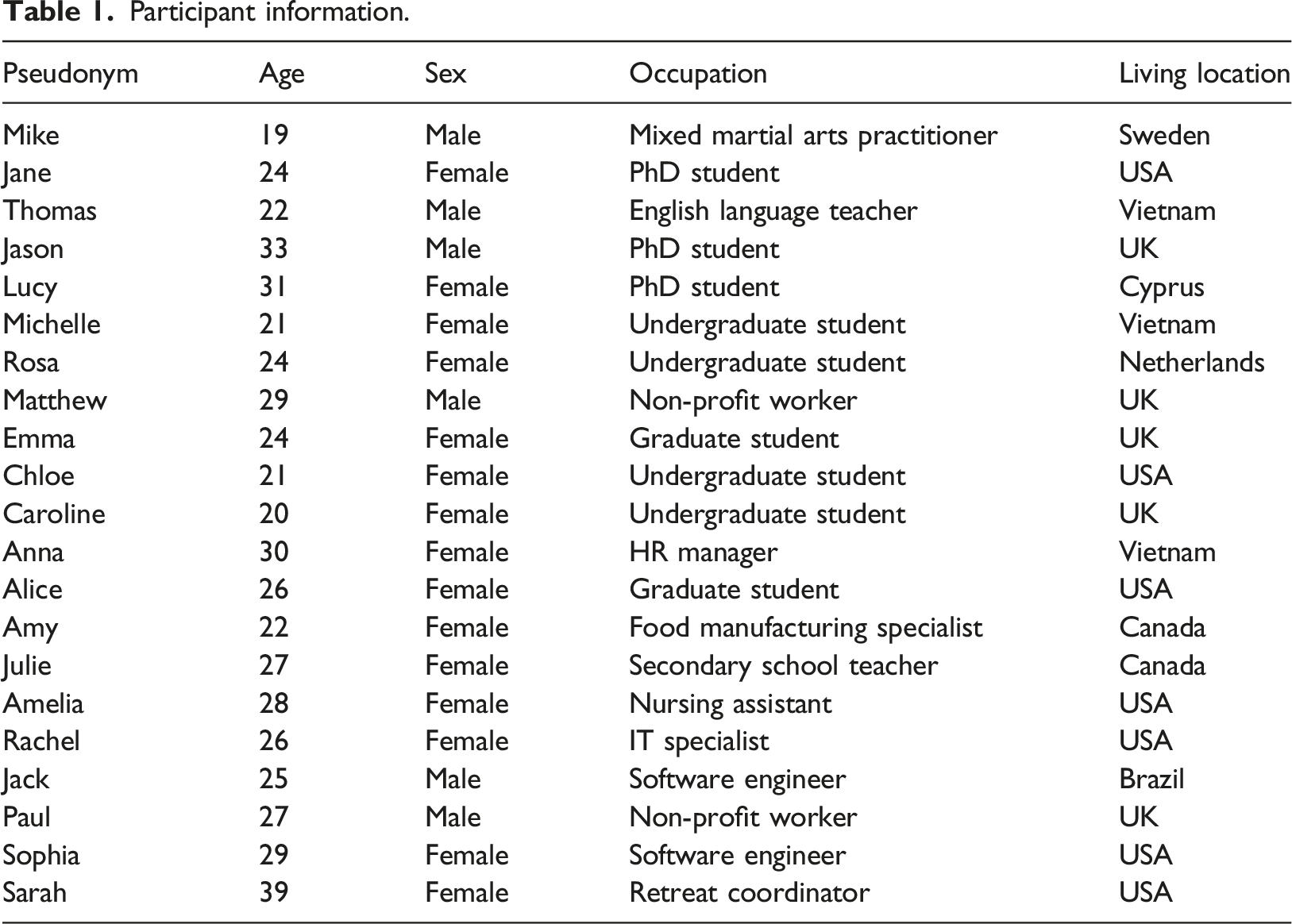
Following a combination of purposive and snowball sampling, the first author reached out to the Nosurf group and to her social circle to recruit participants for undertaking in-depth semi-structured interviews. A recruitment poster was placed on Nosurf with an invitation to contact the first author via email. The combined sampling measures resulted in a total of 21 participants including 15 women and 6 men, ranging in age from 19 to 39 years and living in different countries. Due to the geographic dispersion of the sample and COVID-19 lockdown restrictions at the time of data collection, all interviews were conducted remotely and, ironically, by digital means. Of the 21 participants, 20 interviews were conducted via video calling software and 1 via asynchronous email exchange.
Participant information.
The netnographic data and interview transcripts were brought together as a combined data pool for analysis. The unified analytic approach adhered to a hermeneutical back-and-forth and part-to-whole procedure (Kozinets, 2020; Spiggle, 1994) which involved the first author’s iterative movement between constituent parts of data and the emerging composite understanding of the entire data pool. Lists of provisional themes were formed, challenged, modified, and further developed over time as the first author continually coded, categorised, and abstracted data while consulting the literature to support the emerging themes (Spiggle, 1994). The other authors collaborated on subjecting interpretations to scrutiny, seeking out disconfirming observations – what Spiggle (1994: 496) calls ‘refutation’ and Kozinets (2020: 377) calls ‘troublemaking’ – and agreed conceptual explanations for the final themes.
Findings
Using insights from the digital detox context, we report on what we consider to be the three main features of gestural anti-consumption: magical voluntarism, pragmatism and self-indulgence. First, at the heart of gestural anti-consumption, we argue, is the magical thinking that it is within each individual’s volition to make their world better for themselves, resulting in ‘privatised’ acts of resistance centred on self-improvement rather than collective change. Second, we discuss the fantasy of pragmatism as supported by acts of ‘functional stupidity’ and ‘functional alibis’ that, in tandem, enable detoxers to situate their privatised resistance within the narrow parameters of instrumental rather than political concerns. Third, by exploring the pleasures that digital detoxers derive from minor symbols of resistance, we highlight the self-indulgent and interpassive character of gestural anti-consumption, in contrast to the active struggles and self-sacrifice implicit in more authentic resistance. Taken together, these three features demonstrate how gestural anti-consumption, while couched in an oftentimes superficially oppositional ethos, functions only to gesticulate and relieve reflexively impotent (anti-)consumers’ frustrations with the current semiocapitalist order without challenging it.
Magical voluntarism: The privatisation of resistance
The theme to emerge most forcefully from our data centres on the redirection of attention away from structural issues to oneself, suggesting a strong private character to gestural anti-consumption. Digital detox, for many of our participants, is undertaken exclusively to manage and ‘correct’ the personal problems that they encounter in their digitally-saturated lives rather than to confront the systemic causes of those same problems. Such self-orientation relates to what Fisher (2009: 19, 2011) refers to as the ‘privatization of stress’ whereby the growing problems of disaffection, depression and anxiety within our ultracompetitive and image-obsessed consumer culture are often diagnosed as individual pathologies and treated as private issues that are fixable through self-care, responsibility and personal agency (also Lambert, 2019). Across our data, we see instances of a ‘privatisation of resistance’ that is characterised by a pervasive atmosphere of inner-directed guilt, shame and unhappiness. In the absence of meaningful alternatives to the technologically-mediated capitalist system, many digital detoxers are unable to configure their dissatisfaction in any structural sense, instead thinking of themselves as the only problem they might conceivably repair. For example, one poster in the NoSurf group discusses how she has come to accept the impossibility of bringing about a ‘perfect system’ versus the relief she gains through self-control: Personally I genuinely feel a lot more in control of myself. Last year I struggled heavily with Youtube binges, but I’ve come to feel a lot more in control of myself simply by starting with accepting myself. Understanding that the reason why I go to these things are because I feel lonely, or because I enjoy the thrill of watching a funny YouTube video, or the feeling that I’m learning something. And in breeding this control over myself, I found it really important to first notice when I was about to apply self judgment. That feeling of revulsion – the frustration that’s akin to slapping your computer or keyboard when it’s not working the way you want. And to attempt to replace it with a zen acceptance: instead of hating myself for getting sucked down a rabbit hole, to learn to understand its causes, and why I am here. We often blame social media for being addictive, which is ABSOLUTELY true… But what we ultimately need to learn to take control of, is that there is a part of our minds that crave that dopamine to begin with. The ultimate way to breed control is not to find some perfect system of punishment to suck all the fun out of social media, but in fact to learn to find fun effectively in other places. (‘Cindy’, Nosurf)
Although critically aware of the market causes for her distress, such as the addictive properties programmed into social media platforms, ‘Cindy’ attributes the distress that she’s experiencing to her own neurochemistry: ‘there is a part of our minds that crave that dopamine’. ‘[W]idespread pathologies’, under late-stage capitalism, as Fisher (2009: 21) suggests, are treated ‘as if they were caused only by chemical imbalances in the individual’s neurology and/or by their family background’. Cindy refers to her reflexive impotence as ‘a zen acceptance’ through which she comes to terms with her inability to change a system where it is incumbent on individuals to resolve their own psychological distress.
Comparably, ‘Mike’, a 19-year-old fitness enthusiast who lives in Stockholm and aspires to make a career out of mixed martial arts, emphasises a need to repair oneself rather than society. Mike who gave us little information about his present employment status or whether he is in full-time study, spoke about his efforts to help a friend to open an MMA-centred gym. Clearly invested in physicality, contact sports and the non-digital arenas of life, Mike nevertheless shows a broad understanding of technology, social media, Internet companies and their business models. Despite his knowledge, however, he registers his over-reliance on digital devices as his own fault and personal responsibility: I’ve been trying to cut down on my [digital] consumption, but it’s still quite high. It’s quite embarrassing, but you know first thing in the morning when you wake up, you usually check it [the phone] […] So yeah, I think that people need to take responsibility and that’s what I’m trying to do. But I think that it’s hard to do that because, you know, when you do that, you have to realise that you’re flawed and you’re not complete…. (‘Mike’, 19)
Mike’s call for people to ‘take responsibility’ and his mission to somehow battle his own ‘flaws’ and ‘incompletion’ suggest his resistance is directed against personal shortcomings rather than any structural problems, thereby privatising and depoliticising his anti-consumption practices. By channelling resistant energies into themselves rather than collective action, Mike and other detoxers exemplify the ethos of ‘magical voluntarism’ (Fisher, 2011: 131); an idealist perspective on human agency whereby it is more conceivable for subjects to achieve success and happiness by their own self-directed wish-fulfilment than by collective and political solutions. Under magical voluntarism, any meaningful supportive relation between the collective body and the individual must be abandoned, and we are resigned to accept that the only help we should realistically hope for is from ourselves; ‘[i]f we don’t succeed, it is simply because we have not put the work in to reconstruct ourselves’ (Fisher, 2011: 131). Magical voluntarism is sometimes euphemised by digital detoxers as ‘mindful’ or ‘healthy’ consumption as illustrated by the following Nosurf poster, ‘Janice’: […] i think there is a way to mindfully consume internet / tv content. [...] i think that there is something beautiful about being able to find online communities and people who inspire you. but the problem for most people, most of the time, is that it isn't mindful. it's a mindless scroll […] in the same way you can have a healthy or unhealthy relationship with food consumption i believe you can be healthy in the way you consume content / movies / articles. surfing or scrolling with no intention is like eating a whole bag of hot cheetos because it feels nice. i want to be the master chef who is cooking people a healthy meal that will make them feel full and good. not empty and craving more. (‘Janice’, Nosurf)
Janice’s desire to be ‘the master chef’ who can produce utterly enrichening outcomes from her internet consumption reflects the illusion of entrepreneurialism – the principal architecture of magical voluntarism – or, rather, ‘the belief that it is within every individual’s power to make themselves whatever they want to be’ – (Fisher, 2014b: n. p.). The illusion of entrepreneurialism is nurtured by the belief that ‘little mundane utopias’ (Bradshaw et al., 2021: 521), like Janice’s ‘online communities and people who inspire’, are out there to be found and connected with through enterprising digital consumption. Through subjects’ fetishisation of market objects and little market-located utopias, semiocapitalism is insulated from critique and magical voluntarism is allowed to supersede collective political action. For some digital detoxers, the courage to aspire for systemic change is so obscured by magical voluntarism that even quixotic desires for restoring lifestyles from bygone eras are more conceivable than political solidarity. As illustrated by ‘Natalia’s’ post: I was born in the early 80s so the bulk of my childhood was in the 90s. Looking back, that decade seemed to have the perfect balance of technology and life…We spent waaaaay more time offline than we did surfing. We used technology, but today, technology uses us…Like many of you, I fell into the trap day-after-day of pulling out the phone at the moment of idleness or boredom and began mindlessly scrolling. A lot of times, my mind would be completely blank as I scrolled. I was like a zombie. When I noticed my toddler son looking at me to play with him while I ignored him to respond to some asshat on Facebook, I knew I had to change. While it’s still an ongoing journey for me to limit my online time, I came up with my own mantra, “live like it’s the 1990s,” and made a few rules for myself to help me. (I must acknowledge there there [sic] some modern-world demands that necessitate modern-day technology like smartphones, so while we can’t completely go back in time, there are a few things we can do to help revisit that lifestyle of yesteryear). (‘Natalia’, Nosurf)
Natalia’s nostalgic yearning to ‘live like it's the 1990s’ suggests that a personal experiment in simulating an imagined past is sometimes preferable to striving for a shared future. This aligns with what we might consider to be the ‘hauntological’ affectivity of magical voluntarism; the pervasive feeling that we are haunted by our own lost optimism (Ahlberg et al., 2021; Fisher, 2014a). Nostalgia for a pre-WiFi, pre-social media, or pre-smartphone era across our data pool not only reveals detoxers’ longing for a ‘non-digital’ past but also their reflexive impotence to change the present or future, resulting in a hauntological tendency to ‘continuously recycle the old rather than invent any new energizing alternatives’ (Ahlberg et al., 2021: 168; Fisher, 2014a). Whether through recycling older lifestyles, fetishising mundane utopias or executing acts of self-control, digital detoxers uphold a magically voluntarist illusion that most choices are conceivable except for the collective choice to band together and change the basic operating conditions of our consumer culture.
Pragmatism: The functional ethos of resistance
The second theme to emerge from our data centres on pragmatism as a fantasy framework that structures gestural anti-consumption. The rhetoric of pragmatism is a mainstay of the reigning market capitalist ideology and is constituted by the triumph of ‘hard-boiled practicality’ over the ‘motley of far-fetched and impracticable idealists both within and without the marketplace’ (Cronin and Fitchett, 2021: 10). Under the truncated parameters of capitalist meritocracy, those things that can be chosen, evaluated and consumed for their practical results are enshrined as more marketable and, thus, more ‘valuable’ ideologically than less concrete, less determinate arenas of life like political revolution and social change. Claims to pragmatism are abundant throughout our data. To mitigate digital culture’s worst effects, most of our participants incorporate self-described ‘practical’ detoxing routines into their lives and doggedly set up ‘small wins’ for themselves, like successfully minimising their screen time over the week, switching to a dumb phone at the weekends, or deactivating a social media account for a month. Here, practical (i.e. short term and nominal) lifestyle adjustments are favoured over more radical political activities, what many detoxers perceive to be ‘naïve utopianism’ (Fisher, 2009: 16).
Despite many of our participants displaying an in-depth knowledge about – and dissatisfactions with – the functioning of a digitally-mediated marketplace (e.g. many spoke about internet cookies, smartphones listening to their intimate conversations and social media causing their loneliness and depression), they stopped short at substantively thinking of an alternative, suggesting instead that: ‘it’s impossible to stop this wheel’ (‘Jack’, 25); ‘to win that battle is not that easy’ (‘Mike’, 19); ‘it’s freaking impossible to avoid this stuff […] it’s just like such an uphill battle’ (‘Sophia’, 29); ‘there’s nothing I could do about it as a single entity’ (‘Jane’, 24); or ‘I’m not advocating complete abstinence, but relegating the internet to being the tool that it was designed to be’ (‘Kevin’, Nosurf). By clinging to the felt impossibility of change, digital detoxers spare themselves the risk of diverting ‘intellectual resources into “non-productive” critical thinking, existential anxiety, and other miseries’ (Alvesson and Spicer, 2012: 1209). To come to terms with their lack of alternatives, many detoxers uphold a kind of ‘functional stupidity’ (Alvesson and Spicer, 2012) that limits their critical faculties and restricts all rebellious efforts to instrumental, narrow concerns. Functional stupidity is understood as the ‘inability and/or unwillingness to use cognitive and reflexive capacities in anything other than narrow and circumspect ways’ (Alvesson and Spicer, 2012: 1201). For digital detoxers, reflexively exercising their functional stupidity allows them to disavow larger systemic issues that they feel unable to reverse and risk distracting them from nominal gains in their own digital lives.
‘Chloe’, a 22-year-old environmental science student who had been living with her boyfriend’s family during the COVID-19 pandemic and, as part of her detox regime, uses a website blocker and applies a grayscale method (i.e. putting her phone screen in black and white) to reduce her screen time, explains how verbalising her reflection on privacy concerns risks introducing ‘unproductive’ anger to her life: I would say on a day-to-day basis it [privacy violation] doesn’t bother me so much, but it really bothers me that people are not really talking about it very much, or like if they do, it’s in a very like “Oh well, what can you do?” or like “we have no privacy, you know?”. I guess that’s just the way it is […] I can’t like spend all my time, you know, just getting angry about it all. You know ‘cause that would be very unproductive. But it’s just like if I talk to someone else about it, they’re not like, “yeah, you know, we should write a letter to our state legislature” and I ask like “why aren’t there better laws around this?” and people would just be like, “well, why are you so worked up about it? (‘Chloe’, 22)
To avoid disagreements with others, Chloe keeps her thoughts about digital dependency, privacy issues and so on, to herself. By engaging in a ‘process of stupidity self-management’ (Alvesson and Spicer, 2012: 1207–1208) that involves giving up thinking or debating about the system, Chloe prevents herself from getting ‘getting angry about it all’ and spares herself the trouble of ‘explor[ing] substantive questions through dialogue’ (p. 1208). Comparably, in a Nosurf thread about online fandoms, their toxicity and lack of authenticity, ‘Patricia’ alludes to how she consciously tempers her critical reflexivity when indulging in selected fan activities: I still make time to take care of my mental health and live in the real world first, but the surplus of positivity and artwork (art is really motivational for me) keeps me in two fandoms. I don’t argue in ridiculous conflict [sic], but instead I take the time to learn the lessons this story teaches, and draw what makes me happy. That is what a fandom was meant to be about. (‘Patricia’, Nosurf)
‘Patricia’ defends her continued fandom by engaging in what Keinan et al. (2016) refer to as a ‘functional alibi’; a means of reducing any personal guilt by emphasising consumption’s functional values such as ‘the lessons this story teaches’ or its ‘surplus of positivity and artwork’. Similarly, ‘Oliver’, another poster in the Nosurf group, justifies his digital consumption through elevating the usefulness and functionality of the Internet: I don’t think the point is to flat out not use technology at all, i think the main idea is to limit or stop viewing overstimulating content on the internet/tv, its the difference between using YouTube to learn how to play an instrument or learn new math equations and just mindlessly scrolling through YouTube for hours on end, living without tech would be miserable, the idea of this sub imo isn’t to really get rid of tech from our lives, but rather stop doing useless stuff like scrolling for hours watching things that will never help you. (‘Oliver’, Nosurf)
In Oliver’s narrative, digital consumption is shielded from critique because of the functions it serves, like helping users to learn a musical instrument or how to solve mathematical problems. His rejection of total digital abstinence reveals a conscious dependence on the digital marketplace whereby functional alibis are relied upon as a matter of ‘pragmatic survival’ (Dean and Fisher, 2014: 27). By setting aside loftier ambitions for systemic change in favour of the post-pessimistic rhetoric of small wins, digital detoxers such as Oliver will their reflexive impotence into existence. Whether through functional stupidity or functional alibis, digital detoxers dispense with any kind of optimistic or pessimistic social possibilities and commit their disaffected consent to the semiocapitalist present.
Self-indulgence: The thievish joy of resistance
Lastly, our findings reveal self-indulgence to be a key dimension of gestural anti-consumption. For a number of our participants, digital detox functions as a joyous rather than strenuous activity. In contrast to more transformative acts of resistance which are typically marked by personal sacrifice and the deferral of enjoyment, digital detoxers seem to derive a kind of perverse pleasure from their abstinence. For many of these individuals, the identity – or ‘appearance’ – of detoxing provides a great level of pride and joy regardless of how much or how little they commit to that identity. In such cases, detoxers often do not directly exercise willpower or enact resistance per se, but undertake an ‘interpassive’ (Fisher, 2009: 75; Žižek, 1998) gesture whereby the act of resistance is delegated to someone or something else – such as a dumb phone or a blocking app (like ‘Cold Turkey Blocker’ or ‘AppBlock’) – that performs anti-consumption for them. Instead of revolutionary acts, some ‘symbol’ of abstinence, usually a commodity form, is enjoyed and fetishised by digital detoxers as a gesture that enables them to roleplay as rebellious actors without needing to do anything of substance. This joy is not unlike the pleasure that ‘clicktivists’ or ‘armchair activists’ derive from virtual gestures (such as signing and sharing an online petition) without needing to undertake any real-world sacrifice themselves (Hopkinson and Cronin, 2015). The phenomenon has been referred to as ‘thievish joy’, that is, the ‘joy of having escaped the task implied in the activity as well as the belief that such a delegation is possible’ (Walz et al., 2014: 67); or rather, the joy that comes from believing you have gotten away with something for nothing.
Across our data pool, we observe instances of thievish joy experienced through distractions or diversions that, while bringing about some form of abstinence, typically work to redirect detoxers’ attentions elsewhere: ‘I’ve been playing like a puzzle game on my phone to not use Reddit…it’s not necessarily a huge step above Reddit, but at the very least like it’s not consuming content’ (‘Alice’, 26); ‘The best thing I’ve done has been setting an extremely strict Cold Turkey block on all my computers for a span of several days at a time’. (‘Ava’, Nosurf); ‘Man I just uninstalled and blocked Facebook and instagram on my phone and my phone is SILENT now. I feel like I have more control over my phone than it does to me. The goal is to reduce my phone to a tool that is there whenever I need it instead of a toy’ (‘Tyler’, Nosurf). In many of these cases, some ‘symbolic act’ (i.e. gesture of resistance) takes over the functioning and meaning of ‘the original symbolized activity’ (i.e. actual resistance), allowing detoxers to fall under the illusion of being an active resistor (Walz et al., 2014: 68). Detoxers’ acts of abstinence, in most cases, do not allow them to achieve distance from the marketplace, but largely lead to the privileging of new commodity forms – whether substitute games, assistive apps or rediscovery of the now ‘silenced’ no-longer-so-distracting phone as a tool.
The thievish joy that detoxers derive from the appearance of resistance mirrors what Dean and Fisher call ‘little nuggets of pleasure’, moments of levity that allow subjects to distract themselves from, or otherwise to disavow, the ‘overall dreariness’ of their reflexively impotent existence (Dean and Fisher, 2014: 29). For Dean and Fisher, ‘dreariness and the little nuggets of pleasure are [not] opposed to one another’ (p. 30), but are inherently interwoven, resulting in half-measures and bleak prospects, a kind of ‘entertainment that doesn’t really entertain’ (p. 33). Whatever abstinence they can accomplish serves only as a gateway for other kinds of consumer desire to emerge and become materialised through new, perhaps drearier, commodities and technologies that function as temporary surrogates for the abstained object.
In the following description of leaving Facebook, a poster on the Nosurf group, ‘Lucas’, reveals how abstinence is only made achievable through working closely with the abstained object and ensuring that substitute commodity forms are in place: [A] couple of years ago I went on a Facebook diet. I started with un friending anyone who had annoying posts, and anyone I didn’t want to talk to iRL. That cut the friends down. Then I removed almost all of my photos and previous posts. That took ages, and sometimes posts popped up again. I scrubbed it all clean. Then I unliked any books, movies posts and anything I had commented on. That took a while. Then I turned all privacy settings to maximum. At this stage I was very seldom logging into Facebook and only used it to receive invitations from my college friends. The last thing I did was get in touch with the group of friends, make sure I had all their numbers and email addresses and set up a group text message thread for chat and get together invites. Then I left Facebook for good. (‘Lucas’, Nosurf)
Here, rather than undertake radical critique or militant political acts against Facebook, Lucas enrols a series of incremental micro-processes via action tools and settings available through Facebook such as unfriending, unloading photos, ‘unliking’, gradually tweaking privacy settings and so on to perform his resistance for him. Lucas characterises the micro-processes that allow him to go without Facebook as ‘[going] on a Facebook diet’. By undertaking a personal ‘diet’ rather than participating in some dramatic collective purge, Lucas expresses his will to reject Facebook, but to a large degree escapes the pressure of needing to exercise any willpower or creativity in the process, simply outsourcing his agency to machinic settings within rather than outside of the Facebook system. Only when some substitute (albeit drearier) commodity form (the ‘group text message thread’) becomes available, is rejection considered complete.
Comparably, ‘Rachel’, a 26-year-old software specialist, relies on services like the Self-Control app to lock herself out of certain websites, and keeps a special physical lockbox to seal away her smartphone. By delegating her restriction efforts to dedicated commodity forms, Rachel achieves periods of digital abstinence that enable her to pursue more wholesome and less-mediated activities like going to church and spending time with her pet: When I’m working and I don't need my phone, I will often lock my phone in the box, like they sell these little lockboxes that I think were originally designed for people that are like really struggled with losing weight and food […] [I]f you look at the reviews, I mean there’re like drug addicts using these kinds of things, but a lot of people use them for phones and stuff too […] Sometimes I’d just like, I locked my phone in a box for Easter and was like I’m not going to look at my computer or anything. I’m just going to have a nice Easter and play with my dog and go to church and you know do all the things that are in person and that was really nice. (‘Rachel’, 26)
Here, Rachel’s smartphone lockbox functions as ‘an object-thing’ that ‘acts in [her] place’ (Žižek, 1998: n.p), freeing her from needing to exert any control over her consumption. Such gestures of interpassive resistance provide psychic relief and allow her to dedicate her energies elsewhere, assured in the belief that the market itself is already undertaking action on her behalf. Although dreary and limited in their effects, the appearance of resistance provided by ‘object-things’ negates the felt responsibility for actual resistance, allowing for a sense of thievish joy.
Discussion and conclusion
Our analyses of digital detoxing have allowed us to conceptualise gestural anti-consumption as scaffolded by magical voluntarism, the fantasy of pragmatism and self-indulgence. Considering these three features altogether, gestural anti-consumption can be defined as a performance of dissatisfaction with consumption, characterised by an apolitical and privatised resistance, functionalistic ethos and interpassive character rather than genuine anti-market efforts and collective pursuits of structural change. Resigned to the unchangeability of their structural conditions, reflexively impotent subjects settle for whatever efficiencies and pleasures they can derive from better coping with the insecurities, instrumentalism and cynical opportunism prescribed by the coordinates of the existing system. Our conceptualisation of gestural anti-consumption has two important contributions for de-romanticist marketing scholarship (Fitchett and Cronin, 2022) – what has recently been branded as ‘Terminal Marketing’ (Ahlberg et al., 2022).
First, it allows us to update the concept of ‘reflexively defiant consumer’ (Ozanne and Murray, 1995) with the ‘reflexively impotent (anti-)consumer’, a subject position that, we argue, is more closely aligned with the brutal realities of semiocapitalist society wherein any anti-consumption initiative simply represents new consumption opportunities. The original and visionary archetype introduced by Ozanne and Murray in the mid-1990s – and long heralded as the default subject positioning of market-located rebels, resisters and bricoleurs – was largely informed by the postmodern pastiche and irony that carried through that decade. Ozanne and Murray compellingly made a case for the possibility that post-Cold War, post-politics, post-ideological consumer subjects of the late 20th century were sufficiently decentred, empowered, and self-reflexive to truly defy dominant consumption regimes through ‘forming a different relationship to the marketplace in which they identify unquestioned assumptions and challenge the status of existing structures’ (Ozanne and Murray, 1995: 522). Ozanne and Murray foresaw that by being critical and creative through reflexive consumption choices and lifestyles, an organised mass of individuals could ‘become the architects of their own history’ (Ozanne and Murray, 1995: 523). Optimistically, Ozanne and Murray foresaw the potential for genuine freedom – ‘the idealism of a true democracy’ (Ozanne and Murray, 1995: 524) – in a kind of hypermuscular agency of networked individuals and their capacity to challenge standard meanings and tastes in search of new consumption styles and sign values. That vision, as we can appreciate from our terminal standpoint today, can hardly be realised for a generation ‘whose every move was anticipated, tracked, bought and sold before it had even happened’ (Fisher, 2009: 9). The truncated agency and depressive reflexivity of today’s (anti-)consumers, we argue, can lead to neither authentic defiance nor Ozanne and Murray’s vision of true democracy.
In the ubiquitous unfolding of semiocapitalism, defiance becomes predicted, neutered, and integrated into the marketisation of more signs and sign values ‘to the delight of consumers eager for more immersion, technological gadgetry, and “convenience” associated with further escalating the automation of consumption’ (Hietanen et al., 2022: 172). In this context, the ‘reflexive act’ is not ‘mass refusal’ (Ozanne and Murray, 1995: 523) but is mass resignation to accepting digital consumer culture’s small ‘goodies’, comforts, and conveniences (Dean and Fisher, 2014: 29). In the absence of any unifying political alternatives to carry it further, the reflexive act can only result in a politically hollowed-out subjectivity, borne not from apathy but from the sobering realisation that any attempts at rejecting, restricting or reclaiming consumption remain in the service of one’s self rather than for anything bigger.
In some ways, gestural anti-consumption relates to – but also differs from – the act of ‘virtue signalling’ (Levy, 2021). In terms of similarity, virtue signalling and gestural anti-consumption are both matters of superficial performativity and not political praxis. However, while virtue signalling functions as a communicative and conspicuous act undertaken purely as an act of moral ostentation, gestural anti-consumption as a cynically pragmatic act is undertaken instrumentally, modestly, and not always publicly to make one’s personal consumption work better for oneself. Although both concepts function to varying degrees at the levels of self-expression and self-fulfilment, gestural anti-consumption is not about signalling to others the moral urgency that the world must be changed but is instead about acquiescence to the perceived reality that so little of the world can be changed.
Reflexively impotent (anti-)consumers might also be considered ‘futureless subjects’ which brings us to our second contribution. Our analyses help to trace the lived consequences of a cultural atmosphere of cancelled futures – or futurelessness – that ossifies capitalism and all of its horrors as permanent features of tomorrow (Ahlberg et al., 2021; Hietanen et al., 2020; Hoang et al., 2022). The voices of digital detoxers in this paper reflect the cultural ‘suspicion’ that ‘the end has already come’ and that ‘it could well be the case that the future harbours only reiteration and re-permutation’ (Fisher, 2009: 3). Today detoxers can deactivate their Facebook or Instagram account like they did with their MySpace or Flickr accounts long ago, but tomorrow only brings for them new commitments to Twitch, Discord, the Metaverse or the whatever. Although they can delight in the minutes they claw back from their digital screens through monitoring and setting goals on Apple’s Screen Time or the Cold Turkey Blocker today, those minutes will inevitably be stolen back by the more addicting amenities of tomorrow that will require newer, more assistive and more invasive tools to suppress. It is almost a point of fact that there are ‘no breaks’ and ‘no “shocks of the new”’ to come (Fisher, 2009: 3); only renewed, rebooted, retweaked, resolved, reinvigorated commodified objects that are perpetually subsumed and consumed ad nauseam in the marketplace. The resigned acceptance that the latest technologies and their pathways to manipulation are here to stay, for today and for many days to come, reflects a ‘pervasive sense of exhaustion, of cultural and political sterility’ (Fisher, 2009: 7). What our analyses show is that the slow disappearance of any optimism for new and imaginative futures does not just bring about the nostalgic yearning for some less tarnished material culture of our pre-smartphone, pre-Internet collective past (Ahlberg et al., 2021) but also a compensatory hungering for pseudo-resistance that temporarily staves off (or perhaps disguises) the futureless vicissitudes of today’s semiocapitalist consumer culture.
In conclusion, we argue for a de-romanticist approach to conceptualising anti-consumption, consumer resistance, countercultural practices and so on. Here, we depart from the predominant understanding of anti-consumption as grounded to alternative ideological attachments or a comprehensible political dissensus (Kozinets and Handelman, 2004; Ulver and Laurell, 2020). Our central argument is that consumption and anti-consumption are not poles apart but are increasingly and despairingly linked as two sides of the same coin under the interminable and indefatigable reflexive impotence that pervades the present (Fisher, 2009). Through reflexive impotence, the consumer and anti-consumer become conflated as the one (anti-)consumer – a subject that cannot bring into clear relief a conceivable means of moving beyond the capitalist hegemony and its disappointments. This subject looks to itself and its own consumption for solutions to shared injustices and systemic challenges, rather than to collective political acts and thus remains entrenched in consumerist individualism.
Beyond the reflexively impotent (anti-)consumer, questions must also be raised about the future (lessness) of the (anti-)consumer researcher. Arguably, any romantic or optimistic accounts of anti-consumption that elevate anti-consumers’ market-located transformative power to an idealistic level might simply strengthen the capitalist status quo (see Ahlberg et al., 2022); but what about the lasting impact of a terminal, de-romanticist research tradition that merely confirms time and time again the ideological first principle that no alternative to consumer capitalism will ever be conceivable for its subjects? This cynical realism or ideological deadlock of consumer culture will surely remain ossified if even those of us who tenaciously critique it contribute to its hypostatisation through repetition, theorisation and confirmation. Future work might therefore self-reflect on the horizon endpoint of a tradition that concentrates so much on anatomising capitalism’s seemingly intractable hold over reality: will that endpoint be one where the (anti-)consumer researcher remains as reflexively impotent as those subjects that he or she identifies as such? As recently discussed by Coffin and Egan-Wyer (2022), the critique of capitalist ideology remains an urgent task, but any interventive potential for the tradition requires analyst-activists to move beyond solely deconstructing capitalism’s ills. ‘Capitalism is problematic, yes’, they agree, ‘but so too are aspects of the human condition, which will be altered in a postcapitalist society but not entirely negated’ (Coffin and Egan-Wyer, 2022: 63). What is perhaps needed from future research is a willingness to delve deeper into the reflexive subject’s conscious and unconscious processes that underpin, precede and ultimately calcify the structures that we often find to be so stubborn in their effects. To better understand – and someday overcome – the futureless vicissitudes of today’s semiocapitalist consumer culture, it will be necessary to think beyond depressing structural horizons and more about the human conditions, beliefs and fantasies that prolong our long, dark night at the end of history.
Footnotes
Acknowledgement
The authors would like to express their gratitude to the Editor and three anonymous Reviewers for their insightful comments that helped us to develop a stronger paper.
Declaration of conflicting interests
The author(s) declared no potential conflicts of interest with respect to the research, authorship, and/or publication of this article.
Funding
The author(s) received no financial support for the research, authorship, and/or publication of this article.
