



Abstract
This paper contributes to the research on the symbiotic relationship between religion and the market by examining the nature and implications of the marketization of religion in a contemporary Christendom in which religion and the market are hegemonic. Based on our analysis of 3741 church advertisements in Ghana over a 6-year period, we conceptualize three symbiotic relationships that coexist between the market and religion—commensalism, mutualism, and competition. We argue that these symbiotic relationships mirror how religion hegemonizes popular imagination and members’ consumption through marketization in contemporary Christendom. This study extends our understanding of the dialectical relationship between religion and the market by showing that religion can use marketization to perpetuate its hegemony within and beyond the market.
Introduction
Hegemonic institutions are those that exercise domination through the unwitting and concerted submission of the dominated by popularizing a particular ideological worldview as everyday common sense (Anderson, 1988). Religion has been one such hegemonic institution, which has historically firmly controlled social, moral, political, and economic thought and practices (Forlenza, 2019; Taylor, 2007). Christendom describes societies in which Christianity holds such hegemonic control over almost all aspects of public and private lives (Dawson, 2008; Fulton, 1987). In most traditional Christendom, Christianity was officially recognized as the religion of the state, and religious and political authorities worked in collaboration or were often unified in a singular figurehead or structure (Dawson, 2008; Jenkins, 2011). The genesis of Christendom has been traced to the fourth century when Roman Emperor Constantine converted to Christianity and Theodosius I made Christianity the Roman Empire’s official religion. This made the Roman Empire the first notable Christendom, which later disintegrated into multiple smaller Christendom that dominated Europe for more than a millennium (for a detailed history). There is consensus, however, that traditional Christendom has effectively disappeared from Western societies (Jenkins, 2011). Since the period of Enlightenment, most Western societies have gradually shed their unquestioned submission to Christian religious authority, largely fulfilling secularization theories that prophesied the decline of religion as society becomes more industrialized, secularized, and disenchanted (Fulton, 1987; Taylor, 2007; Weber, 1905/2002).
Scholars suggest that the rise of the market economy also spurred the divorce of Western society from religion (Berger, 2014; Billings, 1990). All-knowing, omnipotent, universal, invisible, and mysterious, the market seems to mimic the attributes of the Christian God and possesses transcendental power across all aspects of life from economic to social prosperity (Wood, 2015). While the institutional power of Christianity declines in the West, the market continues to grow through the triad of commodification, marketization, and consumerism (Ger and Belk, 1996; Kozinets, 2002; Taylor, 2007). The growing marketization of religion—the adoption and use of marketing tools and practices by religious institutions—may have weakened religion’s socializing authority over its members (McAlexander et al., 2014). The continuous blurring of the boundary between the sacredness of religion and the secular market shows the pervasiveness of the market (Belk et al., 1989; O’Guinn and Belk 1989). Although religion maintains some symbiotic relationship with the market (Haddorff, 2000; Higgins and Hamilton, 2019), religious hegemony in the West is dissipating and the market’s hegemony prevails (Carrette and King, 2005). It appears then that in the West, God is dying, and the market—being a key architect and beneficiary of that death— knows a lot about it.
However, in many non-Western societies—like the Global South and the Middle East—where religious hegemony and enchantment never disappeared and the marketization of religion is commonplace (Appiah, 1993; Hasan, 2017; Keddie, 1972), this thesis may not hold sway. Religious hegemony is officially recognized in Islamic states like Iran and Saudi Arabia (Al-Rasheed, 2013). Scholars also note contemporary forms of Christendom—notably in the Global South—where Christianity is not only dominant in most aspects of public and private life but is also the de facto state religion (Jenkins, 2007; Mahn, 2016). Many of these countries—like Ghana, a West African country where most people are religious and Christian—have undergone rapid marketization and modernization with globalized capitalist economic systems, but still exhibit strong religious hegemony in everyday life (Berger, 2012; Hasan, 2017; Meyer, 2004, 2012; Ozanne and Appau, 2019). Although religious hegemony in Ghana has not always been Christian, since the advent of European Christian missionaries—who themselves sought to extend their Christendom—and colonialism in that part of Africa, religious hegemony in Ghana has become increasingly Christian (Appau and Bonsu, 2020). As we demonstrate, the dominance of Christianity in Ghana casts the country as a contemporary Christendom with its local peculiarities.
Importantly, as we demonstrate, these religious institutions (churches) adopt and engage with marketing tools and practices to “market” their services. Thus, not only is Ghana a contemporary Christendom, but it is also one in which churches engage in the marketization of religion (Appau and Bonsu, 2020). McAlexander et al. (2014) examine the consequence of the Mormon church’s marketization on the church’s traditional socialization control over its members, and how this may influence some (former) members’ decision to leave the church. They mostly problematize market-religion symbiosis at the institutional level of church and field capital in a North American context in which although Christianity is popular cannot clearly be cast as Christendom. Appau et al. (2020) examine how Pentecostal converts in Ghana become trapped in an endless transition as they seek to adopt a Pentecostal identity but do not fully examine the macro structures of market-religion symbiosis in Ghana as a contemporary Christendom. We build on these two relevant papers by examining the relationship between religion and the market in a context where both religion and the market are hegemonic and in which the marketization of religion is commonplace. Thus, we ask: how does the relationship between religion and the market manifest in a context of mutual hegemony in which the marketization of religion is commonplace? More specifically, how does the religion-market symbiosis occur in a contemporary Christendom (like Ghana) in which the market is similarly dominant, and the marketization of religion is commonplace?
To address these questions, we analyze 3741 pieces of church advertising content in Ghana across multiple channels over 6 years. Church advertising is a key example of the marketization of religion as modern advertisement is an important marketing tool (McAlexander et al., 2014; Percy, 2000). Although some prior studies tend to assume an antithetical relationship between the market and religion, we seek to contribute to research that examines the “symbiotic, conflictual, complementary and contested” relationship (Haddorff, 2000, 495) between religion (sacred) and the market (secular) (e.g., Appau, 2021; Belk et al., 1989; Izberk-Bilgin, 2012; Moufahim, 2013; Sandikci and Jafari, 2013; Sandikci and Ger, 2010).
Using a relational lens from symbiosis theory in biology, we unpack three coexisting symbiotic relationships between the market and religion—commensalism, mutualism, and competition. We argue that these symbiotic relationships mirror how churches in Ghana use marketization to hegemonize popular imagination and their members’ consumption in contemporary Christendom. These findings make important contributions to the literature on the relationship between religion and the market by showing that (1) the hegemony of religion can coexist with the hegemony of the market in diverse symbiotic relationships at the same time (2) religion can use marketization to reinforce its hegemony, (3) religion can undergo marketization without being subsumed by the market, and (4) religion can use marketization to successfully compete with and even absorb the market.
Religion and/versus the market
In this literature review, we explore the evolution of the relationship between religion and the market by loosely adopting Haddorff’s (2000) organizing concepts of opposition, absorption, and ambiguity. With the growing interest in “whether religion is declining, resurging, or expanding in society” (Jafari, 2014, 612), we adopt Haddorff’s three concepts to showcase how the marketing literature’s theorization of the relationship between the market and religion has developed and evolved, noting their relevance to Christendom.
Opposition
Earlier marketing research treated religion and the market as two oppositional and essentially incompatible hegemonic value systems, casting religion as essentially sacred and moral and the market as essentially secular and amoral (Belk et al., 1989; Ozanne and Appau, 2019; Miller, 2005). This perspective is steeped in religion’s perceived historical opposition to commerce as evidenced, for example, in Jesus’ destruction of merchant goods in the temple, and the long-standing prohibition of interest-based loans by many religions throughout history (Graeber 2011). While religion remained dominant for centuries as evidenced by Christendom, secularization theories predicted that religion’s hegemony will wane in a disenchanted society with increasing industrialization and socio-economic development (Haddorff, 2000). Inspired by these secularization theories, earlier marketing scholarship suggested that the death of religion was imminent in the face of growing market hegemony, disenchantment, and marketing pervasiveness (Ozanne and Appau, 2019).
In the opposition between religion and the market, the verdict is that the market has now replaced the once taken-for-granted authority of religion and contributed to a common perception of religion as traditional, conservative, and declining. The decline of religion is evidenced by religion’s need to adopt market (ing) practices to survive, rather than previously when the market needed to adopt religious principles for legitimacy (Einstein, 2007; Graeber, 2011). This marketization of religion is considered a secularization of the sacredness of religion (Belk et al., 1989; Einstein, 2007; Percy, 2000; Wrenn, 2010). Even megachurches that successfully marketize themselves are criticized for being inauthentic and “water(ing) down the faith” (Thumma and Travis, 2007: p. 91). By contrast, in many places where religious hegemony persists, some religious consumers retain their opposition to the market such as the case of Turkish Islamic consumers who boycott “infidel” global brands that they consider as opposed to their religious values (Izberk-Bilgin, 2012).
However, this oppositional perspective overlooks many instances where religion and the market have historically coexisted and co-operated (Haddorff, 2000). Western market economies did not only develop in Christendom but were also influenced and legitimated by Christian beliefs and values (Schoenberger, 2008). Moreover, secularization theory does not fully capture how religious institutions remain relevant and powerful, especially in many non-Western contexts (Ozanne and Appau, 2019). Even in the West, this perception that religious hegemony has disappeared in a disenchanted world has proven to be an exaggeration (Botez et al., 2020), and some researchers have questioned the veracity of the secularization thesis in view of the persistence of religious beliefs and practices in people’s lives and in the globalizing marketplace (Berger, 2012; Hirschman, 2004; Crockett and Davis, 2016; Ozanne and Appau, 2019).
Absorption
The second school of thought suggests that religion is in decline not due to secularization, but because of the growing apotheosis of the market as it absorbs religion’s qualities (Stolz and Usunier, 2018). In this perspective, the market and religion are not in opposition, but rather represent an evolutionary flow in which social hegemony is passed on from a declining structure to a rising one. Like a baton change, the absorption theories suggest a more inevitable changing of the guard than a coup, and marketing research from this school of thought reflects this conciliatory nod to religion’s desirable functions that have now been absorbed into the market (Cova and Cova. 2019; Rinallo et al., 2013).
This body of research suggests that although religion was historically powerful in organizing symbols and storytelling that helped people make sense of everyday life (Berger, 1967, 2014), the market now manifests religious characteristics through popular market symbols like brands, logos, and celebrities that mimic religious symbols (Kanuss, 2016; Boeve, 2012). The market has the potential to offer anything and everything to consumers, from material wealth to spiritual well-being (Einstein, 2007; Sheffield, 2006). Transcendental meanings and believer-church-like relationships are no longer exclusive to religious institutions and practices (Schouten et al., 2007). Religiosity and communal experiences are now commonly formed around brands and via the worship of discontinued products (Muniz and Schau, 2005). A newly reenchanted consumer society promises sacred meanings through market goods and experiences (Wallendorf and Arnould, 1991; Otnes and Scott, 1996).
Advertising is one such medium through which the market symbolically mimics religious enchantment (Gitlin, 1979). Advertising reinforces a new order “through image, language, ritual, and seemingly supernatural powers” associated with consumption goods and marketplaces (Sheffield, 2006: p. 16). It endows consumer goods and consumption experiences with transcendental meanings that make people feel worthy and provide pathways to social recognition and interconnectedness (Jhally, 2000; Moore, 2005). The new market religion establishes a contemporary meaning system and legitimizes the endless desire for commodities and “a deep-seated need for the sacred” (Nardella, 2014, 7). As Haddorff (2000: 491) summarized, “in a secular and materialistic society, the market becomes sacred.”
The recent explosion of consumer spirituality, as seen in spiritual goods, services and places, also highlights how the market seamlessly absorbs value offerings that were once the preserve of religion (Haddorff, 2000; Husemann and Eckhardt, 2019). Yoga and meditation are examples of religious practices that have been appropriated from their religious roots and successfully established in the market as everyday physical and well-being practices (Stolz and Usunier, 2018). Consumer spirituality can offer an individualized transcendental experience by promising an escape from the constraints of religion and consumerism (Husemann and Eckhardt, 2019).
Despite the differences between the opposition and absorption perspectives, the latter also suggests that religion is declining, and the market has now become what religion once was—like a new form of Christendom in capitalistic clothing (Botez et al., 2020). Particularly, the absorption school of thought is limited in its ability to account for contexts where religion and the market both appear dominant, and those in which religious institutions and the market both successfully coexist, absorb, and shape each other (Rinallo et al., 2013; Crockett and Davis, 2016; Touzani and Hirschman 2009; Turley, 2013).
Ambiguity
Compared to the first two perspectives, which assume that religion is declining in the face of the market’s growing hegemony, the third school of thought sidesteps the relational power struggle by refusing to acknowledge it or declare a winner, hence its ambiguity (Haddorff, 2000). Rather than arguing which is more powerful and which is taking over the other, the ambiguous perspective studies the market and religion as a dialectical relationship, particularly how they influence each other and how either has evolved under the influence of the other.
On one hand, this perspective examines the market’s influence on religion and how religious institutions successfully and flexibly adapt to a contemporary market society (Gauthier et al., 2013; Jafari, 2014). For example, religious institutions diversify their value offerings to keep their members engaged and satisfied (Mottner, 2007). A hybrid of corporate-church brand identity and entertainment services has been effective in preserving and even expanding religion’s influences (Thumma and Travis, 2007; Yip and Ainsworth, 2016). Religious institutions also organize a hierarchical hybrid of religion and market logics to negotiate a differentiated market positioning by “subsuming incompatible market prescriptions into religious ones and by integrating compatible marketing prescriptions” (Dolbec et al., 2022: 14).
Other studies similarly highlight how the dialectical relationship between the market and religion shapes the consumption of religion and religious experiences, providing consumers with a “therapeutic servicescape [that] orchestrates emotional ordering and consumer wellbeing” (Higgins and Hamilton, 2019: 1250). Some consumers may no longer seek the “curing power of a wise-woman or a cunning-man” but resort to other re-enchantments, such as alternative medicines and alternative lifestyles that resist the capitalist market (Jenkins, 2000). Consumers also need adequate market infrastructure and services to experience sacredness and spiritual transformation (Van Laer and Izberk-Bilgin, 2019). In the Muslim pilgrimage, market objects are enchanted and granted sacred status to support a transformative religious experience (Moufahim, 2013). Consumers also engage diverse material artifacts ranging from the most sacred (e.g., statues of saints, rosary beads) to the most mundane (e.g., purses, keys, scarves), in constructing and sustaining sacred connections and experiences (Santana and Botelho, 2019; Turley, 2013).
On the other hand, religion also mutually influences the market because “the market, like all areas of human activity, is infused with moral values, principles, and virtues which draw from the public role of religious and ethical discourse” (Haddorff, 2000, 498). As noted, traditional European Christendom influenced the development and legitimation of European market economies (Schoenberger, 2008). This ambiguous perspective thus highlights how religion continues to provide relevant moral guidelines and understanding for many consumers in the market (Engelland, 2014). For example, religious beliefs shape consumer evaluation of advertising and marketing communication (Abela, 2014), marketplace morality (Izberk-Bilgin, 2012), business ethics (Arli et al. 2016), and brand choice and loyalty (Choi et al. 2013). Christian theology continues to shape the ideologies of contemporary Western market economies (Botez et al., 2020).
Although this ambiguous perspective offers valuable insights into the dialectical relationship between religion and the market, its pacifist stance means it also avoids contexts where religion and the market can be oppositional or incompatible and where each exerts its hegemony at the expense of the other. Thus, while all three perspectives are important, we extend their limitations by integrating their diverse and disjunctive orientations.
Towards symbiosis
To better understand how religion and the market interact as two hegemonic structures, we adopt and develop a relational perspective of the market and religion that extends on the dialectical lens proposed by Haddorff (2000). Specifically, we employ the biological concept of symbiosis to understand the co-constitutive, intertwining, and paradoxical interplay between religion and the market. The concept of symbiosis implies relational interaction between two dissimilar organisms for singular or mutual benefit and can include commensalism, parasitism, competition, mutualism, and mimicry (Varadaragan and Rajaratnam 1986). Symbiosis has been used in marketing research to understand cooperation between and within the marketing functions of companies (Toon et al., 2016). Adopting the concept of symbiosis offers useful conceptual metaphors that can enrich the understanding of how religion can coexist with the market. Importantly, a symbiotic relationship does not assume relational or hierarchical order between the relational actors, but only specifies the nature of (inter)dependence and direction of value from the relationship. This particularly makes this lens suitable for our study, as we seek to extend perspectives that denote a relational order of hegemony between the market and religion especially as religious institutions marketize.
To summarize, in this study, we investigate how religion co-exists with the market as two hegemonic systems in contemporary Christendom using the context of mass church advertising in Ghana. While both religious and market hegemony is present in Ghana, the complex interplay between the two, especially in such contexts where the market and religion can both thrive, remains understudied (Gauthier et al., 2013). Our main objective is to extend the current research on the relationships between religion and the market by showing their symbiotic manifestations in a contemporary Christendom where the marketization of religion is commonplace. We discuss the consequence of these symbiotic relationships for the hegemony of religion in this contemporary Christendom.
Methodology
Context: Ghana as contemporary Christendom
Ghana is a contemporary consumer society where institutional religion has maintained its hegemony and has never been separated from everyday life, including the market (Appiah, 1993). Here, we briefly highlight key manifestations of Ghana as a de facto Christendom. In this West African middle-income country, about 99% of the population is religious and 71.3% Christian (Ghana Statistical Service, 2021), and it is home to thousands of churches (Appau and Bonsu, 2020). Most Ghanaians practice Christianity as a normal part of their daily routines of shopping, working and family gathering. Christian images adorn people’s homes, cars, and workplaces (Meyer, 2012). The locals very much embrace the common sense of God, spirits, and angels in the marketplace such that the use of marketing tools and marketization of religion is commonplace and expected (Bonsu and Belk, 2010; Ozanne and Appau, 2019). In short, religion is deeply embedded in everyday life in Ghana (Appau et al., 2020).
A key reason and manifestation of this religiosity in general and Christendom, in particular, has been the historical collaboration between politics (rulers) and religion (religious leaders) that provided mutual legitimation and support for the worldviews, words, and actions of the state and religion, which in turn shapes popular imagination (Dawson, 2008). In Ghana, this politics-religion collaboration predates Christianity and European colonization. Many pre-colonial traditional rulers (chiefs/kings) ruled in alliance with powerful traditional religious leaders (Appiah, 1993; Bediako, 1995). A notable example is the friendship and collaboration between Okomfo Anokye (a traditional priest) and the Ashanti King Osei Tutu I, whom both led the successful expansion of the renowned Ashanti kingdom in pre-colonial Ghana (McCaskie, 1986). The Christianization of modern Ghana is largely attributed to Christian missionary work in Africa, which benefited from missionaries’ collaboration with and support from colonial political authority, in addition to their role in establishing formal schools through which many future indigenous political leaders were trained and converted to Christianity (Groves 1948; Horton, 1971).
Although Ghana’s constitution protects religious pluralism, notably, all Ghana’s post-independence leaders are self-identified Christians and have worked closely with church leaders. Ghana’s current President, Nana Akuffo-Addo, is a Christian and integrates his faith into his political career. He ran his successful presidential campaign on the slogan “The Battle is the Lord’s” after losing two previous elections, and he organizes a thanksgiving service each year of his presidency (since 2017). At the peak of the COVID-19 pandemic, he invited all the major church leaders to his residence to pray for God’s protection for the country (Prempeh, 2021). Despite an economic crisis, he has committed to building a National Cathedral as appreciation “to the Almighty for the blessings he has bestowed on our nation for sparing us the ravages of civil war that have bedevilled the histories of virtually all our neighbors and the outbreak of deadly mass epidemics…but also as a rallying point for the entire Christian community of Ghana” (Citi Newsroom, 2022). In short, the historical alliance between religion and politics persists in Ghana’s Christendom, in which church and state unite and collaborate in shaping popular imagination.
We focus here on the marketization of religion through the popular use of advertising (ads) by churches in Ghana. On every major street, highway, market square, radio, TV, newspaper and even on social media, churches use ads to promote their brands and services in the same space as commercial organizations and brands (Meyer, 2012; Appau and Bonsu, 2020). The proliferation of mass media in Ghana began in 1990 when church leaders helped influence then-leader, Jerry Rawlings to democratize Ghana’s media industry to allow private individuals to operate media stations (Gifford, 2004; Meyer, 2012). This began the democratization of the media in Ghana, which from that onset was adopted by both commercial businesses and churches alike (Meyer, 2012, 2019). Thus, Ghana as a contemporary de facto Christendom and the pervasiveness of church ads in the country provide a theoretically interesting context to explore the symbiotic relationship between the market and religion and to critically examine the nature and implication of the marketization of religion in contexts where the market and religion are both hegemonic.
Data collection
Summary of data sources.
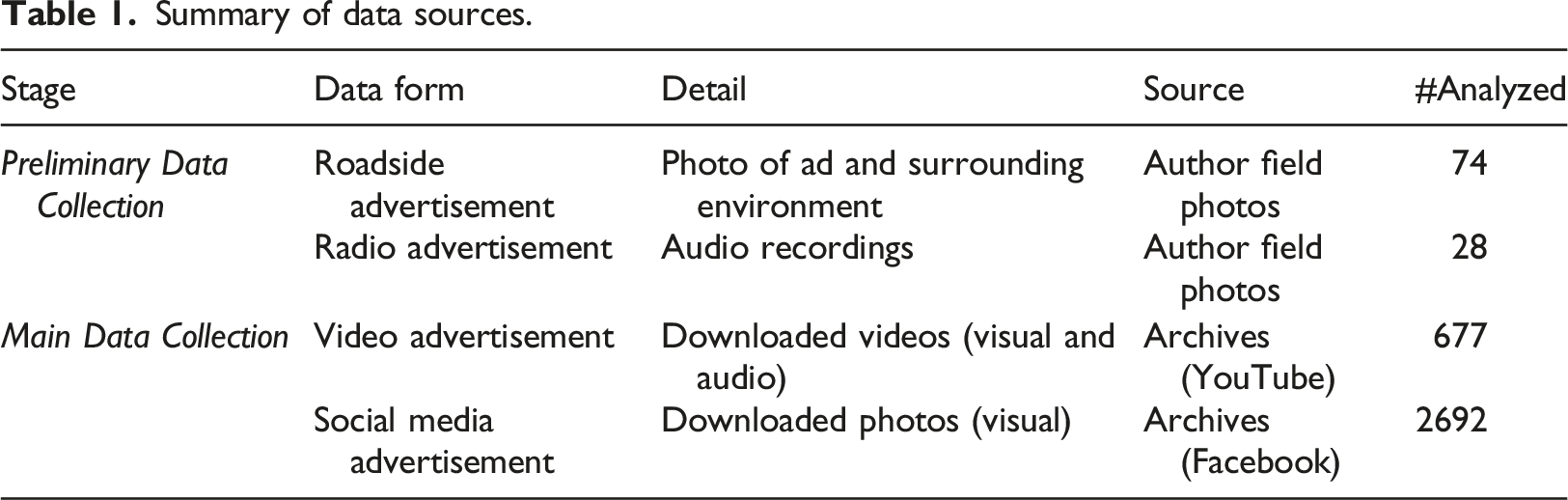
As part of the main data collection, we collected and analyzed video ads and digital poster ads by the five main megachurches in Ghana because they collectively have the largest share of voice of church ads as well as church membership (Heuser, 2020). We downloaded and reviewed all archival digital advertisements of these megachurches on publicly available digital media channels. All five megachurches have active YouTube accounts both for the church and their celebrity pastors. These YouTube channels contained nearly a decade of video content, including some that have aired on national and cable TV channels. This enabled a more systematic and inclusive data collection of advertisement content without being limited to a fixed geographical location and timeframe.
Collectively, we identified over 5000 video content from August 2014 to July 2020 created and published by the churches. We excluded videos of recorded sermons, church events, and previous live-streamed events, and instead focused on advertising content that promotes a church value offering (e.g., event or service). Our video data consists of 677 video ads, which each averaged a minute in length. In addition, we reviewed archival digital posters from all five megachurches for the same period. From the over 18,000 digital church posters available on Facebook, we identified and analyzed 2692 digital posters that were advertising content produced and posted by the big five megachurches from August 2014 to July 2020.
In short, our data includes visual and audio, digital and traditional, and live and archival ads (see Table 1). While the “call to action” of the radio and roadside ads appeared more targeted to the mass Ghanaian audience, the video and social media ads were more targeted to the church members as we believe that the majority of the subscribers and followers of the church YouTube and Facebook accounts are church members. This was pivotal in our analysis. There was, however, some overlap as some of the church videos and social media ads were also advertised through mass media.
Data analysis
We performed qualitative content analysis (Mayring, 2004) of all the selected ads from the various media channels. Each author independently coded the ads, noting their purpose, themes, sequence, visual (audio) representations and designs (van Leeuwen, 2011). Because ads are windows into the product or service they are communicating about, we paid special attention to the nature and purpose of the events or services being marketed in the ads. We first sorted the ads based on their core value offering (e.g., prayer service, church collaboration). Then we conducted a micro-analysis and identified patterns of audio-visual representation within and across these advertising images. Both authors then combined notes and built meta-themes that we iteratively examined through a systematic review of the literature. We also reflected on each author’s positionality as part of data analysis, especially in balancing the insider versus outsider, etic and emic understanding of the marketing practices of religion. Following Belk (2017), we applied a socio-cultural lens to our iterative analyses and arrived at the theoretical positioning that we present next.
Findings
To address the research questions, we unpack three coexisting symbiotic relationships between religion and the market in Ghana’s Christendom by analyzing churches’ use of mass religious advertising. These symbiotic relationships include commensalism, mutualism, and competition, which we derive and develop from symbiosis theory to structure our findings. In our analysis, we show that these symbiotic relationships mirror how the churches perpetuate their hegemony in Ghana’s Christendom by shaping popular imagination and control over members’ consumption—an issue that we take up in the Discussion. Next, we present our findings on the three symbiotic relationships.
Commensalism
We use commensalism to theorize the symbiotic relationship between religion and the market in which religious institutions or agents benefit from using marketing tools and services without any clear harm or benefit to the market. Compared to Haddorff’s (2000) notion of absorption in which the market absorbs religious tools and practices, here we find absorption in the opposite direction—religion absorbs the market(ing)’s tools, practices, and products/services.
First, we argue that the mere use of advertising by churches is a form of commensal relationship because it does not clearly harm nor benefit the market. Rather, it reflects how the churches shape popular imagination through their ubiquitous presence in every aspect of Ghanaian society, even outside the religious domain, and particularly through the market. As evidence, we found that many church ads are often placed in the same advertising space as commercial ads, thus sacralizing the secular and secularizing the sacred at the same time (Belk et al., 1989). Figure 1 is a photograph of a church roadside ad (right) sitting side by side with a commercial ad selling a malt beverage (left). Unlike the single (seemingly out of place) Mormon ad in a sea of commercial ads in Times Square (McAlexander et al., 2014), the church roadside ads in Ghana are far more common and widely available, co-enabling each other’s effect on people’s exposure, attention, memory, and imagination (see Ukah, 2008 for similar occurrence in Nigeria). Church Ad (right) beside a commercial Ad (left) on a busy traffic road.
This commensal use of ads is not just limited to roadside ads; Ghana’s radio and TV channels are replete with church ads, sharing ad space and spending with commercial businesses. For example, because we collected the field photographs and radio ads within the same month, we found that many roadside ads also had complementary radio ads. As noted, this absorption of the market by churches in Ghana’s Christendom is steeped in a historical and ongoing alliance between state and religion, which has also shaped the market (Appiah, 1993) and the local media space since 1990 (Meyer, 2012).
Another notable illustration of religion’s commensal relationship with the market in Ghana’s Christendom is seen in church ads that market services, which are typically considered secular market services. For example, Royal House Chapel (RHC), one of the megachurches offers members an annual beauty pageant for entertainment (see Figure 2 for digital promotional poster). Here, the pageant bears almost the same form as secular beauty pageants but the substance is modified to showcase Christian themes. Like any other beauty pageant, RHC’s pageant is targeted toward young women who will compete for a crown and prizes; in this case $500 cash prize and a fully paid trip to South Africa. The corresponding video ad for the pageant also emphasizes the common desirable qualities of beauty and intelligence, but in this context also “God-fearing”. Beauty pageants have titles and this one is called Queen Esther alluding to the Biblical story of the Jewish Queen (wife) Esther of the Persian King Ahasuerus whose “wisdom” saved the Jews—then captive subjects of the Persian Empire—from being killed. This also explains the theme of “Wisdom and Intellectual Parade.” RHC’s Queen Esther beauty pageant.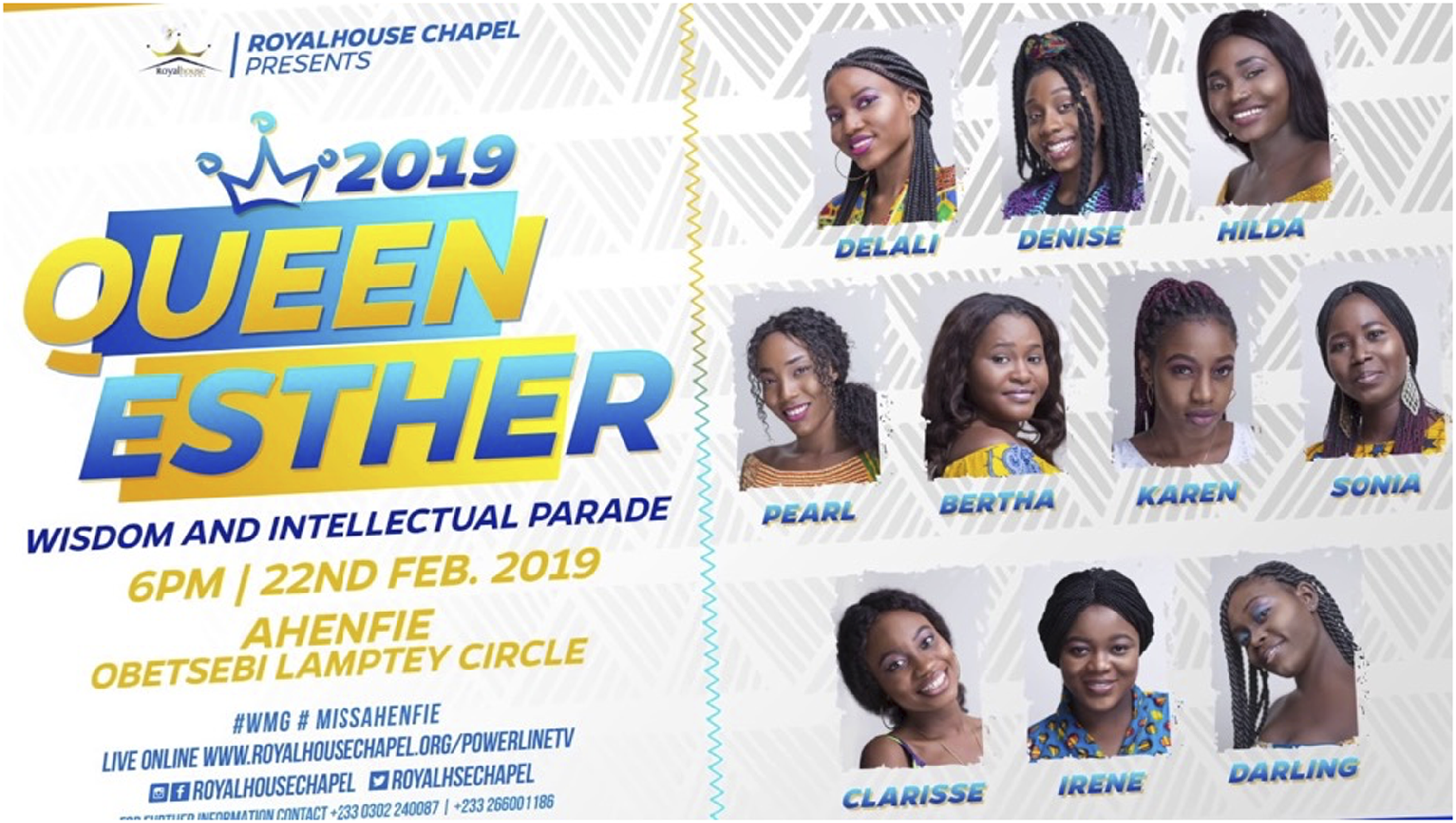
This beauty pageant mimics secular market pageants, but creolizes the content to suit the church’s needs, depicting Wilk’s (1995) idea of systems of common difference—a form of cultural flow in which cultural forms diffuse widely but their substance and practice are adapted to local conditions. The church does not simply copy the market’s offering but modifies its substance while staying true to its form, enchanting an otherwise market offering through sacralization. This is similar to consumer experiences of musical concerts at Hillsong Church, which delivers gospel songs in the form of secular concerts (Yip and Ainsworth, 2020) and those consuming theme parks and shopping at Heritage Village (O’Guinn and Belk, 1989). For RHC’s beauty pageant contestants, Hillsong members, and consumers at Heritage Village, these service offerings also enable them to pursue their secular interests within the confines of the church where the content of the entertainment may be deemed more sacred. In summary, in Ghana’s contemporary Christendom, churches maintain a commensal relationship with the market in which they behave (un)like the market, promoting their services in the market and absorbing the market’s services into those of the church.
Mutualism
We identify a mutualistic symbiotic relationship in which both religion and the market benefit from such a relationship. In commensalism, churches appropriate tools and services from the market for the church’s sole gain, but in mutualism, churches and market institutions and agents deliberately collaborate for their mutual gains. Our data shows that churches in Ghana frequently collaborate with commercial businesses and media organizations to co-organize events, or in which the commercial and media organizations sponsor some of these church events. In one of the radio ads, we found a church musical event that was produced in collaboration with a bank and a major telco brand. The collaborations enable co-branding and co-enchantment, which benefits both the collaborating church and commercial organizations by introducing each entity’s consumers to the mutually transformative services of the other (Besharat and Langan, 2014). Like commercial services at religious sites, these collaborations enable consumption and improved consumer experiences of both commercial and religious services through mutual enchantment, legitimation, and accessibility (Higgins and Hamilton, 2019; Moufahim, 2013).
Another notable illustration of religion’s mutualistic relationship with the market in Ghana’s Christendom is seen in church ads that offer business, finance, leadership, and career education conferences and masterclasses to church members in collaboration with businesses. A prominent example is the International Central Gospel Church (ICGC)’s annual series of events dubbed the Life Improvement Seminars. Figure 3 is just one example of the seminar series, with this one bringing a panel of business experts to advise members on issues relating to building wealth in real estate, with topics specifically targeted to different member segments based on their assumed financial position. In addition to this, the 2019 version also offered seminars on career planning, personal pension plans, financial planning, and investment. This is capped off by bringing in real estate developers to exhibit homes for members along with mortgage financiers at the “Life Improvement Fair” (see bottom of Figure 3). This benefits both the church (by expanding its service value to members) and the businesses that may acquire new customers through the church. ICGC’s Life Improvement seminars.
Through the mutual relationship, religion and the market become more complementary in blending sacred and secular consumption. These services regarding wealth accumulation are consistent with the Pentecostal prosperity doctrine, which promotes material wealth accumulation as evidence of God’s blessings (Bowler, 2018; Haynes, 2012). Unlike Catholicism which tends to reflect Haddorff’s oppositional perspective to the market as illustrated by recent Papal criticism of the market’s excesses and greed, Pentecostalism is decidedly pro-market, dynamically blending the divine power of God with the magic of capitalism (Appau and Awaworyi Churchill, 2019; Jenkins, 2000). Evidently, these seminars actively train members to understand and succeed in acquiring material prosperity through the mysterious market (Wood, 2015). Such mutualism shows how the market and religion endorse and legitimize each other’s hegemony in contemporary Christendom.
Competition
In symbiosis theory, competition describes a symbiotic relationship in which engaged parties struggle for control over the same limited resources, which in our context, are people’s time and money. Two key factors characterize our analysis of competition. First, church members (and their time and money) can be considered as finite resources that are exhaustible, and thus invoke competition in a Christendom with thousands of churches and a hegemonic market with myriad value offerings. Second, our analysis of competition focuses on services that churches have traditionally offered to adherents. This is different from our analysis of commensalism in which the church appropriates the market’s services. Additionally, in the competitive symbiotic relationship, the church does not collaborate with the market (like in mutualism) in delivering these traditional services. We argue that this is because the market has substitute offerings with which the church’s offerings compete. As McAlexander et al., (2014) demonstrated, consumers who exit religious consumption fields turn to the market as a substitute. Similarly, Appau et al., (2020) show that Pentecostal churches in Ghana encourage their members to consume safe space, time, and products in the church and to avoid those of the market, which are seen as dangerous.
The marketization orientation in competition is, therefore, more defensive, seeking to defend the churches’ influence over aspects of the members’ lives and consumption that religion has traditionally controlled (see also McAlexander et al., 2014). This is similar to the way Brazilian religious schools adopted marketization into their practices to compete with growing market substitutes (Dolbec et al., 2022). Thus, competition here is not direct but indirect. That is, churches are not seeking to take members' time and money away from the market; they already have hegemony over these aspects of members’ lives in Ghana’s Christendom. Rather, by taking up more of members’ limited time and money towards more consumption of services they have traditionally offered, they inevitably make less available for members to spend in the market and elsewhere. From the analyzed church ads, we discuss two traditional services the churches seek to defend in competition with the market through marketization—spirituality and faith and socialization.
Spirituality and faith
The first of such church service offerings pertains to the practice of Christian spirituality and faith, which is a basic religious service that has traditionally defined the role of the church, especially in Christendom. This is a role that has historically persisted in Ghana’s religious hegemony, which is now dominantly Christian (Appau and Bonsu, 2020). With its growing hegemony, the market has continued to absorb many of these roles, offering multiple spirituality services and enchanted religious products through the marketplace (Husemann and Eckhardt, 2019; Sandıkcı and Ger, 2010). The church ads reveal how churches in Ghana defend their faith and spirituality services by offering round-the-week services that envelop more of members' time and spending in the church (see also Maxwell, 1998).
For example, in addition to routine Sunday services, we found that many churches had regular services that provided different benefits for almost every day of the week, encouraging members to spend more time in church. For example, Action Chapel International (ACI) has a 2-h service on Sundays, a 3-h late morning service on Thursdays, and a 1-h early morning service every Monday to Friday. These services include a mix of sermons, prayer, fasting, and community socialization at the church place, which is promoted as an everyday social space for members. In addition to the regular services, the five main megachurches in Ghana all have special monthly or annual events that are heralded by both internal and external church ads. All the churches have tailored events for men, women, and youth which involve issues of interest to these specific segments.
To further the multiplication of spirituality and faith in members’ lives, all five mega-churches also publish daily devotional guides that members are encouraged to use for prayer, reading their Bible, and meditation. ICGC, for example, has the Living Word Devotional, which provides daily reading for the year and is advertised for members to purchase ahead of the coming year; they are also available on Amazon to be accessible by the church’s global membership.
All the pastors of the mega-churches are also prolific authors of (audio) books on motivation and empowerment, faith, spirituality, theology, self-actualization, and morality that members are encouraged to consume as part of their mundane activities—such as cooking, driving, and even in the shower (see Figure 4). These ads reify sacred consumption research that also notes how churches offer a wide array of routine and targeted services and books that deepen members’ faith and encourage them to continue to consume more church spirituality services and products (Appau et al., 2020; Yip and Ainsworth, 2020). Sales promotion Ad for audiobooks by LCI’s Dag Heward-Mills.
Life course socialization
In Christendom, churches control important aspects of people’s lives throughout their life course, from childhood to adulthood, by socializing them to believe and accept certain worldviews, norms, and behaviors as everyday common sense (Jenkins, 2007; Mahn, 2016). However, with the growing hegemony of the market, many of these socializing roles that used to be guided by traditional religious value systems now have detraditionalized and disenchanted substitutes that are offered through the market-like schools, cinema, and the media (McAlexander et al., 2014; Miller, 2005). In Ghana’s contemporary Christendom, our analysis of the church ads reveals that churches compete with the market by offering services that enable them to retain their socializing roles and control various aspects of members’ life courses.
For example, we found several church services that help marriage-ready singles find marital partners. A notable example is an ad (Figure 5) from ACI offering 24 h of prayers to help marriage-seeking singles “overturn the error” of their “inability” to get married. Because Ghanaian religious cosmology has historically had a teleological orientation that has persisted into its Christendom, remaining unmarried at a certain age is understood as a negative deviation from one’s destiny (Appau and Bonsu, 2020). Pastors like ACI’s Duncan-Williams promise to correct such deviations through the spiritual power of prayers, justified by the enchanted local metaphysical worldviews where divine spirits can intervene in people’s lived experiences (Meyer, 2019). Delayed marriage is thus problematized within the religious domain of the church such that instead of resorting to market offerings like dating apps, members are encouraged to rely on the church to help them find marital partners, often within the church community. ACI’s prayer service for singles.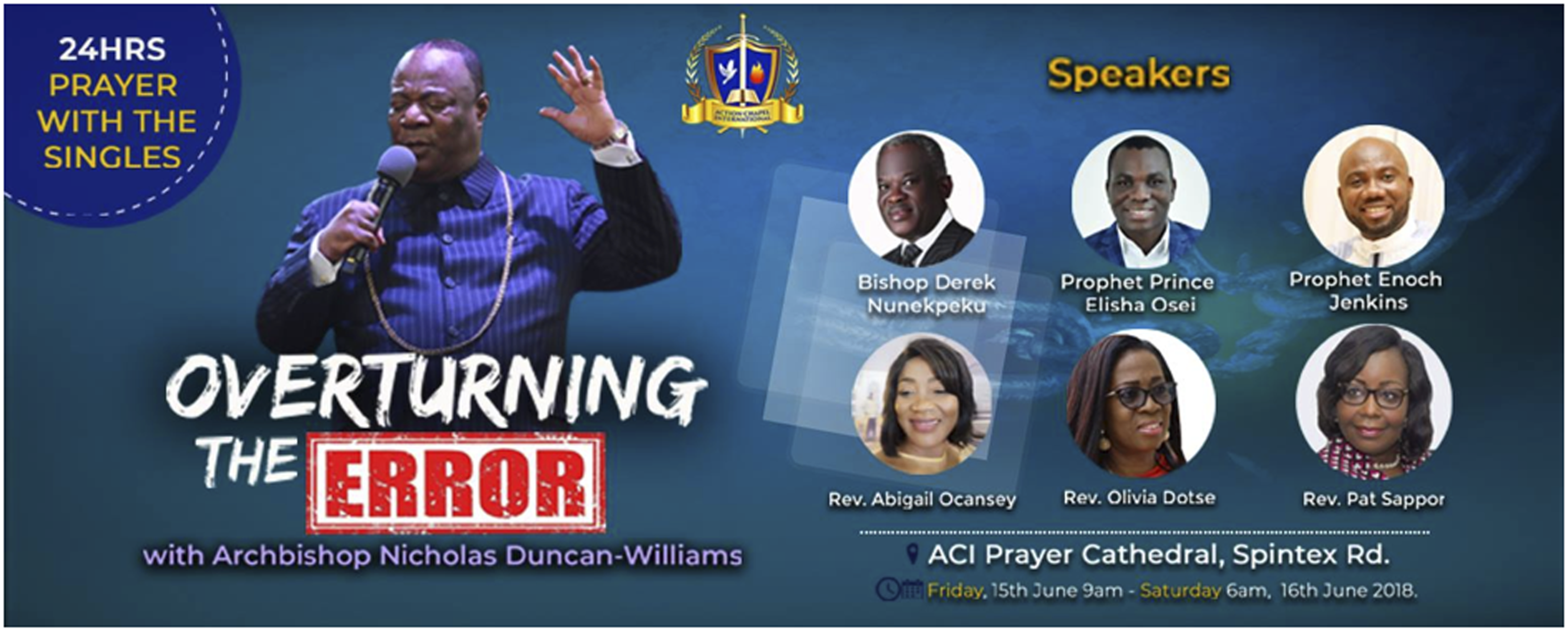
The churches also offer services that help prospective couples prepare for their marital lives, and help existing married members stay married. One notable example is Perez Chapel International (PCI)’s “Ask the Counsellors” service, which is broadcast weekly on the church’s Precious TV channel and live on Facebook and YouTube (see Figure 6). Through these services, PCI’s Bishop Agyin-Asare and his wife—who have both been married for more than 30 years—offer advice on topical marital issues while responding to live questions from their audience. Considering the importance of marriage to family, consumption, and well-being as well as the cost of divorces, marriage counseling is an increasingly popular yet expensive market offering. To retain their traditional socializing roles and influences on marital issues, the church directly offers members moral guidance on family issues to support and sustain their marriages, making the market offering less relevant. Sample Ads for PCI’s marriage service support.
Another key aspect of a person’s life course is parenthood, and for many couples becoming parents is an important transition in their lives and marriage. In marketing their childbirth service offerings—like the reasons for delayed marriages—churches problematize the inability to give birth for those trying to become parents as an “error,” with allusions to Biblical characters like Hannah and Elizabeth who needed divine intervention to correct the error of their “barrenness.” Some churches in Ghana even offer special services to help people get pregnant. An example is this radio ad by the House of Power Ministries International.
[High-tempo gospel music background] Whatever God has said about you, the time has come for it to be fulfilled. It is God, who by his miraculous deeds, provides a woman’s womb with a child to glorify his name [emphasis added]. This is the Voice of Healing Crusade for the Barren. The time has come again, and God’s Prophet Francis Kwarteng of the House Power of Ministries International is bringing his annual childbirth crusade to the people of Ghana who are trying to give birth. There are many people who are testifying to the glory of God about giving birth thanks to this annual crusade. This is also your time! Prophet Francis Kwarteng is inviting you wherever you are to attend this crusade. All your childbirth problems will come to an end.
In Ghana’s enchanted religious cosmology, children are given by God (gods/spirits), which is consistent with Christian beliefs (Appau and Bonsu, 2020). This ad thus reinforces long-held religious attributions of childbirth as a divine solution, differentiating it from secular market options like fertility clinics and sperm donations that scientifically engineer childbirth (Sobande, Mimoun and Torres, 2020). When members have children, the church serves as an important socializing agent, including offering members guidance for parenting in response to different situations in members’ lives and in those of their children. For example, one of PCI’s “Ask the Counsellors” sessions in 2020 was on the topic of “Relating with your Spouse and Kids Under Lockdown.” In short, the church ads show how churches in Ghana’s Christendom use marketization to (indirectly) compete with the market to defend their traditional roles of providing spirituality and life course socialization in the face of potential substitutability by the market. Churches re-(enchant) people by helping them find love, sustain their marriage, become parents, and raise their children. This enables the church to absorb more of members’ time and money in the church, which could otherwise have been spent on growing market substitutes.
Discussion and conclusion
In this research, we used a relational lens from symbiosis theory in biology to unpack three coexisting symbiotic relationships between the market and religion in contemporary Christendom. We extend the Christendom literature by not only demonstrating that Christendom is not dead but by also showing how they persist through marketization. Using data from mass church advertising, we explain three symbiotic relationships that mirror how churches in Ghana use marketization to reinforce their hegemony in the popular imagination and their members’ lives. This Christendom is itself both evidence and outcome of religion’s hegemony in Ghana, which is sustained through these symbiotic relationships with the market. While there are many discontinuities between contemporary Ghanaian Christendom and its historical traditional religions, there are many continuities between both (Appau and Bonsu, 2020; Bediako, 1995). It is within this continuity that we locate our analysis. Our findings present a current snapshot of an enduring reality that is being reinforced and reproduced under contemporary conditions. In short, we find that what is being marketized in Ghana is not just “religion”; it is the marketization of religion’s hegemony. Our findings make several contributions to the literature on the dialectical relationship between religion and the market that we discuss in detail below.
Contributions to religion-market symbiosis
This study contributes to understanding the paradoxical interdependence between religion and the market. First, we show that the hegemony of religion can coexist with the hegemony of the market in diverse symbiotic relationships without one necessarily usurping the hegemony of the other (Haddorff, 2000; Higgins and Hamilton, 2019). Specifically, through integrating the conceptual lens of symbiosis and Christendom, we explain how religious hegemony facilitates a contemporary Christendom that simultaneously absorbs, collaborates, and competes with the hegemonic market.
Extending past research that shows religion often makes compromises to coexist with (in) the market (Dolbec et al., 2022; Rinallo et al., 2013), we explain how religion can undergo marketization without being subsumed by the market. By mobilizing the hegemonic market as an ally, religion keeps itself relevant and powerful in the popular imagination and everyday consumption. In this contemporary Christendom, religion maintains its hegemonic influence not through opposing market values and services but through legitimizing and shaping the market to serve religious moralities. Thus, unlike the common tensions and resistance experienced by religious consumers moving between religion and the market (McAlexander et al., 2014; Sandikci and Ger, 2010), the religious hegemony in Ghana supports a Christendom that seamlessly blends both religion and the market.
Using these three symbiotic relationships between religion and market, we also extend Haddorff’s (2000) concepts of absorption, ambiguity, and opposition by demonstrating a related but extended perspective on religion-market symbiosis in contemporary Christendom. We illustrate this contribution with Figure 7, in which we distinguish our symbiosis typology from Haddorff’s (2000) typology while noting their interconnection (with the two circulating arrows in the middle) to show how together they help improve our understanding of the relationship between religion and the market. Notably, our analysis of commensalism shows that religion can use marketization to absorb the market by appropriating market tools and practices towards religious purposes, without benefiting the market. Such absorption has been commonly observed in the other direction (Haddorff, 2000), where the market absorbs sacred qualities in spiritual and sacred consumption (Santana and Botelho, 2019; Cova and Cova, 2019; Husemann and Eckhardt 2019). In this process, religion becomes more market-like to reinforce its hegemony. An extended perspective on the relationship between religion and the market.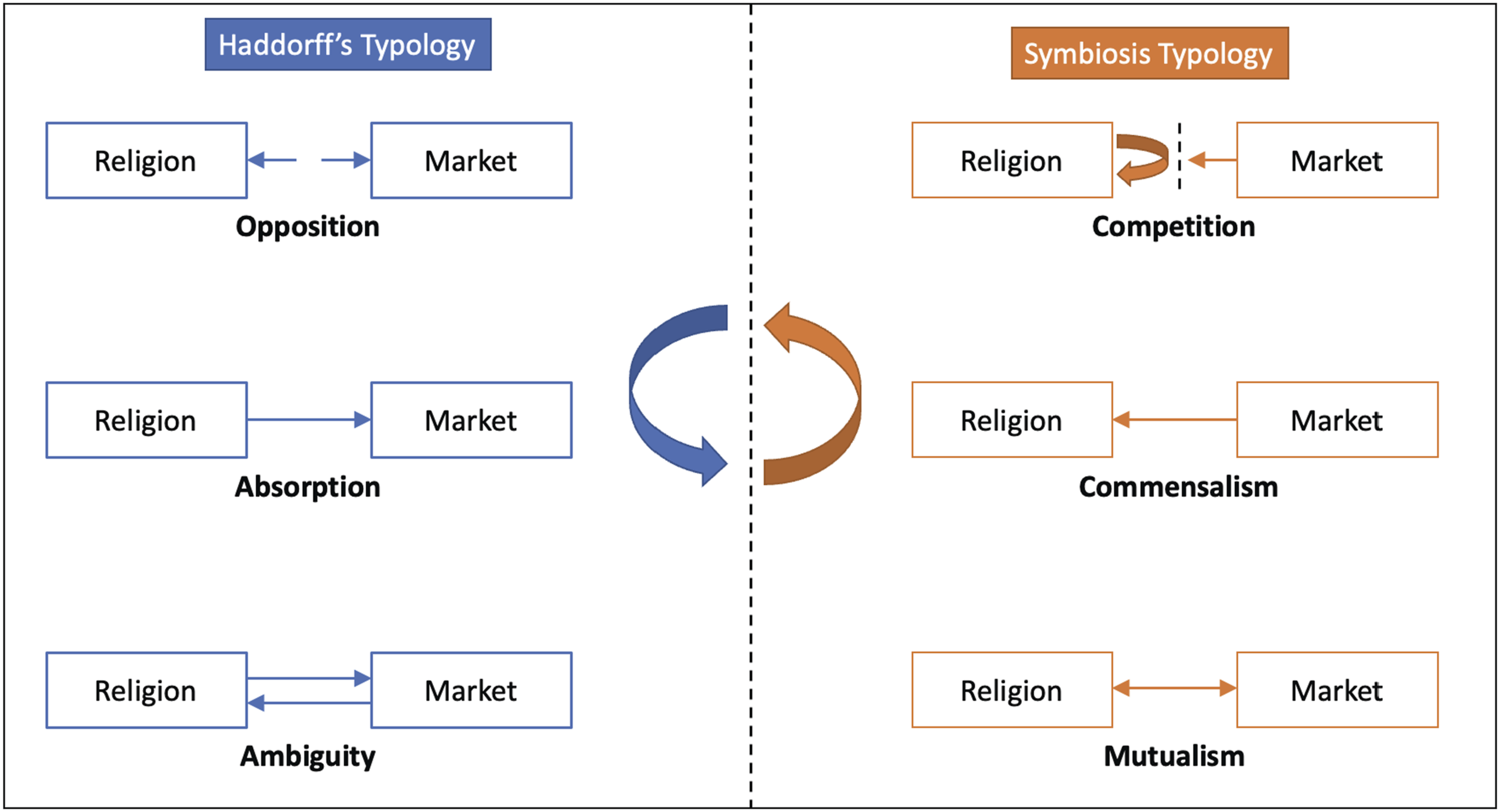
Similarly, our findings of mutualism suggest that religion and the market could collaborate and co-legitimize for their mutual benefit without one subsuming the other. Here, religion and the market become complementary players in accessing a combined bigger consumer pool and better service for consumers. This enriches Haddorff’s (2000) concept of ambiguity that explains how mutualism facilitates reciprocal gains through strategic collaborations between churches and the market. In our case, religious institutions not only endorse members’ participation in the market but also co-legitimize religious and market values (e.g., success in the marketplace and prosperity) (Appau and Mabefam, 2020). Rather than reducing religion to a market player and commodity, we find the opposite where religion appears as a mediator in assisting and shaping the way consumers access the market’s products and services.
The co-existence of religion and the market in Ghana’s Christendom, nonetheless, also manifests some tensions. Here, our findings show how religion uses marketization to successfully compete with the market. We highlight what they compete for (member’s time and money), why the church competes with the market (to defend its traditional role and services in view of market substitutes), and how (indirectly, by making less time and money available to be spent in the market). We do not identify parasitic relationships between religion and the market because we cannot verify that either the market or churches are harmed by the churches’ marketization or the market’s potential as a substitute. Unlike Haddorff’s (2000) notion of opposition, here, we cannot establish that the church seeks to overthrow the market through competition because the church maintains other non-competing symbiotic relationships with the market.
On the sacred and secular in Christendom
Despite notable research that shows the constant blurring of the boundary between the sacred and secular in consumption, some research notes disruption and resistance during and because of marketized religion (McAlexander et al., 2014). In this research, we show that churches in Ghana’s Christendom leverage their historically embedded hegemony to strategically negotiate the boundary between sacred and secular consumption. On one hand, religion selectively loosens the sacred and secular boundary in order to appropriate the secular into the religious sphere (commensalism and mutualism). On the other hand, religion selectively tightens the sacred and secular consumption boundary when they need to defend the loyalty of its members and traditional church services against market substitutes (competition).
Such a flexible negotiation of the sacred and secular boundary in Ghana’s Christendom is key to understanding how religion undergoes marketization without the significant tensions and resistance seen in most post-Christendom societies elsewhere (McAlexander et al., 2014). Extending prior research that often assumes secularization of the sacred because of the marketization of religion (Belk et al., 1989; Percy, 2000; Wrenn, 2010), we note how religion appropriates the market’s tools and services without diluting its power and its members’ loyalty (O’Guinn and Belk, 1989).
Re-enchantment and co-enchantment
Enchantment is often associated with magic, wonderment, and mystery, which are presumed to be lacking in a mass consumer market that is “inherently ephemeral, fragmented, and dystopian” (Haddorff, 2000: p. 490; Wood, 2015). Weber (1905/2002) famously argued that industrialization and modernization contribute to a disenchanted world with no space for magic, divine power, and mysticism. However, contemporary consumer culture theory has extensively noted how the market has appropriated or maintained sacred and religious ideologies and practices to (re-)enchant the market and consumption (Botez et al., 2020; Firat and Venkatesh, 1995). As noted, advertising is an important marketing tool that is used to enchant consumption and many marketplace offerings (Jhally, 2000). Thus, in one sense, advertising appropriates the enchantment of religion to enact market hegemony. In our context, however, we show that religious advertising re-appropriates that enchantment for its own hegemonic purposes—a double re-enchantment of sorts. To speak of the marketization of religion may be to conceptually privilege the market (Appau, 2021) but in this context, we use marketization to recognize the market of religion in a contemporary Christendom, which is advertised through, with, and as an alternative to the commercial market’s enchantment.
Additionally, our analysis is situated in a society that has never been disenchanted (Ozanne and Appau, 20,190). In Ghana’s historicized religious hegemony and contemporary Christendom, God has never left, and the market has always been magical (Appiah, 1993; Ozanne and Appau, 2019; Wood, 2015). What we find is not God re-enchanting a disenchanted market, but how the divine power that is, for example, responsible for miraculous childbirth, works with the magic of the market in a co-enchantment. Our findings suggest a fruitful future research direction on how such a co-enchantment between religion and the market may evolve over time (Corrette and King, 2005). Extending Haddorff (2000)’s dialogical thesis that religion limits and regulates the market as a subtle moral force, our findings reveal that religion and the market can co-create an enchanted market society through multiple symbiotic relationships.
Limitations and future research
One limitation of our advertisement data sample is that we are unable to fully capture tensions within the religion-market symbiosis. The advertisements studied project a more harmonious relationship between religion and the market. However, in practice, the use or effects of marketization can create tensions and frustrations for some members of religious organizations, and religious business owners (Fathallah et al., 2020; McAlexander et al., 2014). Our focus on advertisements limits our ability, for example, to examine church members’ attitudes to their churches' use of advertising and other marketing tools. Future research may examine how the market (could) also respond to the churches’ appropriation of its services through commensalism while defending against the market’s substitutes through competition.
The context we capture in Ghana is one in which the marketization of religion is ubiquitous and already well-diffused, but how does the marketization of religion begin to take root and what (other) kinds of symbiosis would take place in the global expansion of religion? What factors account for the successful marketization of religion in a particular context and what factors may inhibit the adoption of marketization in others? Another potential avenue for future research to address this question could be to examine the key institutional actors (e.g., church leaders) and market systems that support the marketization of religion such as advertising agencies, media channels, and relevant regulatory bodies to understand how they enable and legitimize the adoption of marketing tools and practices to support the religious function. Addressing these questions could provide more insights into other different symbiotic relationships between religion and the market and how such symbiosis comes to be. Even more, it may extend our understanding of how structural hegemony is formed and legitimized.
Finally, it will be important to examine the effect of religion’s marketization on consumption and people’s lives, especially in such contexts of religious hegemony. In discussing the church's competition with the market, we note how churches extend their influence into more aspects of the members’ lives that otherwise would have been spent outside the church. While we note the hegemonic gain for the church, does the marketization effort by the church in this Christendom have a positive and/or negative transformation in people’s lives? McAlexander et al. (2014) have noted how the extended influence of the Mormon church led to a painful experience for those who sought to leave the church. In contexts of deeper religious hegemony such as Christendom, members may find it challenging to question or resist the church’s authority when religious hegemony is so well reinforced in popular imagination and consumption through a market-religion symbiosis (Fulton, 1987). Thus, we wonder similarly how those who seek to leave a church in Ghana and/or not become religious fare in a context where almost everyone is religious and in which religious institutions entrap members in permanent liminality to support continued consumption of church services (Appau et al., 2020).
Also, on this matter of impact, it is important to note that there is generally poor regulation of church activities in Ghana, and prior regulation attempts to do so have not been effective (Oduro-Marfo, 2018). In some regards, this is a testament to religion’s hegemony in Ghana, and Tweneboah (2019) suggests that religious institutions are even able to influence the creation and implementation of laws in Ghana. Thus, although there is some regulation of advertisement in Ghana, it is not clear what are the legal regulations to control the excesses of religious advertisements to protect vulnerable consumers from being misled or harmed. Addressing these important practical issues is important not just for marketing research, but also for policies that seek to safeguard and improve consumer well-being against the dark sides of a religious hegemony that is reinforced through marketization.
Footnotes
Acknowledgements
The authors acknowledge the helpful input of the editor and reviewers. The authors also thank Pao Franco for his insightful comments on an earlier version of the article.
Declaration of conflicting interests
The author(s) declared no potential conflicts of interest with respect to the research, authorship, and/or publication of this article.
Funding
The author(s) received no financial support for the research, authorship, and/or publication of this article.
