



Abstract
This paper seeks to extend existing conceptualisations of risky and harmful consumption. Our work draws on a qualitative, rhizomatic study of Australian consumers’ sports betting practices. We utilise Deleuze and Guattari’s related concepts of molar and molecular lines and lines of flight to draw attention to sports betting’s mutually affecting discursive, socio-material and emotional intensities. We examine the ongoing tensions between how people understand themselves as gamblers, the social normalisation of gambling and the parameters of risky betting behaviour. We argue that conceiving gambling consumption through molar and molecular lines challenges the binaries inherent in current framings of risky and harmful consumption. We also consider the possibilities for lines of flight and implications for gambling harm.
Keywords
Introduction
Gambling is big business, and the global market is dynamic and growing, with an estimated value of US$711.4 billion in 2020 (Global Industry Analysts, 2021). New technologies such as online casinos, electronic gaming machines, fixed-odds betting terminals, and mobile smartphone betting applications (apps) have changed the market, making it easier to gamble anywhere, anytime, with anyone and on anything (Gordon and Reith, 2019; Hing et al., 2017; Reith and Dobbie, 2011; Ridley et al., 2020). Increasingly liberal policy and regulatory environments have facilitated market growth in countries such as Australia, the USA and the UK (Markham and Young, 2015). Gambling is now heavily marketed by the industry (Newall et al., 2019). The advertising and promotion of gambling often uses appeals associated with humour, sport, popular culture and sociality (Deans et al., 2016).
Research also acknowledges that marketing positions gambling as a legitimate and everyday consumption practice associated with skill, sociality, sport, leisure, fun and the night-time economy (Gordon et al., 2015; Humphreys, 2010b; Westberg et al., 2017). Overall, this has led researchers to identify gambling as expressive of contemporary consumption in neoliberal capitalism (Young, 2010) – forming machinic arrangements through which flows of desire, bodies, affects and emotions, and capital, converge (Deleuze and Guattari, 1983).
However, gambling is associated with significant health, economic and social harms (Yani-de-Soriano et al., 2012). These include headaches and nausea, insomnia, stress, anxiety and depression, self-harm, suicide, social and cultural exclusion, financial hardship, domestic violence, family breakdown, reduced productivity at work or study and criminal activity (Langham et al., 2016). Market growth, policy liberalisation, emerging new technologies and increasing availability have been identified as mechanisms that are generating significant gambling-related harm (Markham and Young, 2015; Schull, 2012). The financial cost of gambling-related harm is considerable – estimated to have totalled between A$4.7 billion and A$8.4 billion per annum in Australia in 2010 (Productivity Commission, 2010) and up to £1.2 billion per annum in the UK in 2016 (Thorley et al., 2016). According to Gordon et al. (2015) and Sato et al. (2017), further research on the risks and harms associated with gambling is necessary. The unique discipline knowledge that marketing and consumer research scholars possess can help provide valuable conceptual and empirical insights about gambling consumption and inform appropriate policy and practice responses.
Existing conceptualisations of risky and harmful consumption in marketing and consumer research mostly concentrate on either the individual psychological level or the macro-environmental level, instead of considering the intricate interplay between the two. Much research is framed through psychology and addiction perspectives focusing on the individual consumer (Harris et al., 2015a; Hirschman, 1992; Hwang and Yun, 2015; Mowen et al., 2019). Such research attributes gambling to personality characteristics (Mowen et al., 2019), impulsivity (Foxall, 2010), motivations (Debevec and Diamond, 2012) and emotions (Cowley, 2013). In turn, individual gambling behaviours are framed as misbehaviour, fanaticism, deviant, compulsive, maladaptive or addictive (Chung et al., 2018; Foxall, 2010; Hirschman, 1992; O’Guinn and Faber, 1989; Thomas et al., 2016). Research has also pointed to the role that low self-esteem, inclinations to fantasise (O’Guinn and Faber, 1989), family dysfunction, trauma (Hirschman, 1992) and parental influences (Grier et al., 2007; Harris et al., 2015b; Islam et al., 2014) play in influencing risky and harmful consumption.
Other research draws attention to how markets, marketplace institutions, producers and marketers promote the consumption of risky and harmful products (Polonsky et al., 2003), including gambling (Humphreys, 2010a, 2010b). Here, studies focus on the social and structural environment and how shifts in policy, regulation and marketing normalise gambling (Humphreys 2010a, 2010b; Lainer Jnr and Rader, 2015). Research in this domain has illustrated how a laissez-faire policy environment, dynamic marketing and increasing efforts to normalise gambling, have legitimised its consumption (Humphreys, 2010a; Lainer Jnr and Rader, 2015; Westberg et al., 2017). The marketing of gambling is widespread, skilfully targeted towards different consumer segments, and has been associated with more frequent and riskier gambling behaviours, especially concerning sport (Deans et al., 2016). The emphasis is on increasing brand awareness, promoting financial incentives for participation and advertising betting odds (Newall et al., 2019). Moreover, systematic reviews demonstrate that gambling marketing has increasingly moved online, across an expanding range of digital and social media platforms (Guillou-Landreat et al., 2021).
However, behaviours such as gambling are complex, multi-faceted and influenced by a combination of macro-, meso- and individual-level factors (Egerer et al., 2020). Therefore, as Lamberton and Hill (2016) identify, there is a need to focus on the interplay between individual drivers of risky consumer behaviour and risky contexts to understand issues like gambling-related harm better. Such approaches recognise the impact on risky and harmful consumption of both inter-/intra-personal and macro-environmental influences. Celsi et al. (1993) proposed a model for understanding risky and harmful consumption which they applied in the context of skydiving as a leisure activity. Their model considers the dynamics of individual motivations as well as the impact of new technologies, media representations, and cultural norms. However, Celsi et al. (1993) distinguish between high-risk leisure activities like skydiving and compulsive or impulsive behaviours such as gambling. They note there are likely differences in the motives and subsequent implications between such risky behaviours. It is not surprising then that Celsi et al.'s (1993) analysis of high-risk consumer behaviour does not include the concept of harm, as their study is primarily focused on the context in which risky leisure activities are pursued. Yet harm is a critical consideration for contemporary research on the real-world consequences of consumption behaviours such as gambling, drinking, smoking and even unsustainable practices like flying (Prentice and Cotte, 2015; McDonald et al., 2015).
The complex individual-macro interactions shaping risk are also highlighted by Thompson (2005), who, through a study of the natural childbirth community, examined the crucial and often countervailing interplays between culture, ideology, individual risk perceptions, communally shared constructions of risk and risky consumption behaviours. In contrast to the natural childbirth community, where an anti-establishment, communal reflexive doubt challenges expert risk assessments (i.e. natural vs medicalised childbirth), such a sentiment is not present in the realm of gambling. Although some individual gamblers may hold dissident views of risk that contradict expert warnings, there is no larger communal movement questioning the validity of such warnings. Instead, the gambling industry is characterised by shades of grey regarding what can be conceived as risky and harmful consumption, structured by a multiplicity of actors, voices and standpoints (Reith and Dobbie, 2011).
Accordingly, despite these important contributions, there remain opportunities to enrich our understanding of risky and harmful consumption through the gambling context. This necessitates engaging with conceptual frameworks that account for complex interplays between macro structures and individual agency (Gordon et al., 2015) and that challenge the binary thinking that frames much existing research on risky and harmful consumption. We consider it essential to not only understand why people gamble as a recursive socio-material arrangement, but to also consider the consequences for consumers’ everyday lives.
Our consideration of alternative conceptual approaches was prompted by engaging with the extant literature and questioning the binaries between individual level and structurally focused understandings of risky and harmful consumption encouraged us to consider alternative conceptual approaches. These considerations led us to the rhizomatic ideas of Deleuze and Guattari for understanding socio-material consumption arrangements, such as gambling. Specifically, we identify the conceptual contributions offered by Deleuze and Guattari’s (1987) ideas of molar and molecular lines for rethinking risky and harmful consumption. Such an orientation enables us to acknowledge multiplicity, whereby molar and molecular are not opposed to one another as binary forces but rather constitute overlapping tendencies. We draw upon these ideas in a study of sports betting to answer the following research question: How are risks and harms navigated in becoming a sports betting consumer? After Deleuze and Guattari (1987) our analysis here is processual – we consider sports betting as an ongoing (un)becoming, that is, complex, fluid, subjective and multiplicitous – but which creates specific outcomes for consumers that mediate risk and harm.
The remainder of our paper is structured as follows. We first introduce our molar and molecular conceptual framework and identify how this can enrich existing theorisations of risky and harmful consumption, specifically gambling consumption. We then outline our methodology, comprising a rhizoanalysis of narrative interviews with 51 low-to-moderate-risk gamblers. This is followed by our findings presented in the form of vignettes. Finally, we discuss the conceptual, practical and empirical implications of our research, offering suggestions for critical and transformative approaches to social policy and social change to ameliorate gambling harm.
Conceptualising gambling consumption through molar and molecular lines
Our conceptual approach builds upon scholarship that has engaged with the ideas of Deleuze and Guattari’s (1987) ideas in marketing and consumer research. Scholars have introduced assemblage thinking to understand how resources, contingencies, capacities and relations work to enable consumption, provide care, as well as experience nature (Canniford and Badje, 2016; Canniford and Shankar, 2013; Epp and Velagaleti, 2014). Kozinets et al. (2017) harnessed the concept of desire to understand how technology increases our passion to consume. Additionally, Deleuze and Guattari’s ideas on ‘becoming’ are employed to consider dynamic relations between consumers, social media and celebrities in everyday life (Carrington and Ozanne, 2021) and how marketers can rethink places (Coffin, 2020). We extend these conversations by considering Deleuze and Guattari’s concepts of molar and molecular lines and lines of flight as enabling theory (Dolbec et al., 2021) to help understand consumers’ gambling consumption experiences and enrich existing conceptualisations of risky and harmful consumption. Our theoretical approach follows Deleuze and Guattari in considering molar and molecular lines not as ‘things’ that are binary opposites but as relational forces and overlapping movements that co-exist and can become entangled (Merriman, 2019). We conceive gambling practices as always ambivalent and unfolding, changing in terms of the flux between molar and molecular lines.
Molar lines are representative of being. They consist of prescriptive and rigid segmentarities: dominant structures, shared sets of norms, ideas, and doings, clear-cut and calculated gestures, practices, and discourses (Deleuze and Guattari, 1987; Merriman, 2019). Molar lines operate as control forces by ordering and categorising; they help establish and fix markets and consumption through their performative quality and repetition, working against forces of creativity and change. Molar lines territorialise, capturing the intensities of ‘being at home’, identifiable through sensations of comfort and security. Molar lines help understand how gambling markets and consumption and the subjectivities and emplaced sensibilities of risk and harm emerge through the dominant practices, ideas, and knowledge of gambling bodies.
Molar lines in our context can refer to structuring forces that work to shape gambling markets and consumption, such as the political economy of gambling capitalism (Young, 2010; Humphreys, 2010a), which includes the marketing of gambling through new technologies and products, price inducements, widescale access and availability, and intensive advertising and promotion (Newall et al., 2019). The normative psychological framing of gambling as a risky or harmful individualised behaviour in which the addicted gambler is the problem, not the product, also represents a molar line in our context (McCormack and Griffiths, 2012). Humphreys (2010a), Deans et al. (2016), and Gordon et al. (2015) also point to how molar lines emerge from how the gambling industry codes gambling bodies and practices with legitimacy, skill, masculinity, sociality and solidarity. These molar lines operate as ordering forces of control over gambling markets and consumption practices that allow people to gamble, including formal and informal regulations about who (predominantly men), where (e.g. home, betting shops or clubs) or when it is appropriate to gamble (e.g. Saturdays, sports events). Subjectivities thus may emerge along molar lines that dictate what constitutes a ‘responsible gambler’ or a ‘lucky gambler’ through how, when and how much they win or lose.
Molecular lines acknowledge the possibility of ambiguity, slippage, mutation and complexity. Molecular lines create forces and flows of desire that have no clear origin, logic or destination (Windsor, 2015). They are conceived as cracks, mini ruptures or subversions that capture the flux of everyday experience (e.g. a word, a look, a practice of momentary escape), which reflects a movement away from the molar. Molecular lines are still ordering but are more supple than molar lines. Deleuze and Guattari (1987: 98) write that molecular lines are ‘mutating and not overcoding, marking their mutations at each threshold and each combination’. For example, transformations in gambling desire may occur after reading form guides, setting betting limits, and imposing checks and balances on card expenditure (Cowley et al., 2015), creating a sense of comfort or safety. In such examples, molecular lines represent ways of pushing away to momentarily evade molar lines.
At other times, molecular lines entangle with molar lines to reinforce the rigid segmentarities of molarity (Gordon et al., 2021). As Deleuze and Guattari (1987: 213) tell us: ‘Every society, and every individual, are thus plied by both segmentarities simultaneously: one molar, the other molecular’. Consider how female gamblers may eschew the molar social norms of gambling masculinity to become knowledgeable about sports, familiarise themselves with sports betting apps and engage actively in sports betting practices (McCarthy et al., 2020). While this might symbolise a rupture against gendered social norms, it also serves gambling capitalism by providing another consumer segment from which to extract value. Anxieties about money, cultural understandings of gambling as immoral, or the blurring of private and public spaces may prompt secretive gambling practices (Lopez-Gonzalez, 2021) – a molecularity that can work to serve the molar commercial desires of gambling capitalism. Yet, equally, being caught gambling in secret may lead to monitoring or a ban on betting, thus working against the molar lines of gambling consumption.
Lines of flight, on the other hand, are conceived as chaotic forces that point to the dangers of living without structure and boundaries and the potential rewards of creativity that break away from existing gambling market and consumption arrangements (McCormack, 2007). Lines of flight that eschew structure and boundaries may descend into an unending spiral of mounting debt, guilt, despair or even suicide, or an opportunity to quit gambling altogether. In our context, we submit that conceptualising gambling consumption through molar and molecular lines and lines of flight can help enrich existing theorisations of risky and harmful consumption, challenging existing binaries that privilege either the individual or the structural. We identify that these concepts help us to conceptualise risky and harmful consumption by considering the symbiotic relationships between stabilising molar forces and the micro-ruptures offered by molecular forces. This conceptualisation helps us to understand when one gains ground on the other, to identify spaces in which they oscillate, reinforce, or collide with one another, or instances where a line of flight breaks free from the molar and the molecular leading to a different sports betting arrangement for consumers.
Methodology
Participant Sample Characteristics.

Participants were screened using the Problem Gambling Severity Index (Ferris and Wynne, 2001). Most of our sample were of Asian ancestry (44%), followed by Anglo-Australians (26%), Europeans (18%), New Zealanders (6%) and South Americans (6%). Young males aged 18–35 are the biggest consumers of sports betting, but consumption among young females is also starting to increase (Browne et al., 2016). Accordingly, our sample included 38 males and 13 females, aged 19–35, of whom 26 were single and 25 were partnered or married. Individual incomes ranged from A$15,000–300,000. We focused on low- and moderate-risk gamblers because there is less research on these groups, yet they account for the highest proportion of the burden of gambling-related harm in Australia (Browne et al., 2016).
During the interviews, we discussed participants’ gambling histories, their consumption patterns, how they reacted to advertising and marketing, how they felt about the risks and harms associated with gambling, and demographic information such as occupation, gender, household composition and marital status. The narrative interviews were conducted in places of participants’ choosing, including their homes, on the university campus or at coffee shops. All interviews were audio-recorded and transcribed with participants’ permission. Ethical approval for the research was secured from the appropriate University Human Research Ethics Committee. Pseudonyms are used for all participants to help protect their identities.
Our research approach utilised rhizoanalysis. This approach aligns with non-representational marketing theory (Hill et al., 2014) and is often referred to as ‘non-methodological’ (St. Pierre, 2019) because it has no prescribed linear process (Cumming, 2015). A rhizomatic approach contrasts with more conventional inductive or deductive approaches (Hyde, 2000). In the words of Deleuze and Guattari (1987: 12), ‘a rhizome is not amenable to any structural or generative model’ and so demands an openness to research and to data that gives attention to how meanings may arise through ‘movement, singularity, difference, and entanglements of language and matter’ (MacLure, 2013). Rather than a discrete stage after data collection, rhizoanalysis encourages critical-creative exchange to co-produce knowledge. As illustrated in Figure 1, rhizoanalysis involves an ongoing fusion of methodology, data and analysis mixed with theorising extant literature and practising the theory (Masny, 2016). Our rhizomatic approach enabled us to explore the affective and embodied experiences, the spaces and flows of everyday gambling consumption, and how these connect to larger-scale factors such as the regulatory environment, the gambling industry and social norms that shape the market. Diagram of the rhizoanalysis process: understandings of markets, consumption and consumer experiences are negotiated through paying attention to the cross cutting of ‘movement, singularity, difference, and entanglements of language and matter’ (MacLure 2013). Researchers can ask themselves what are: i) Molar lines – the rigid segments that fix and code markets and consumption. ii) Molecular lines – the supple lines, fluxes, sets of movements and interruptions in market and consumption contexts. iii) Lines of flight – that signify a rupture and transition away from existing market and consumption arrangements towards something else (Deleuze and Parnet, 1987, pp 143-144).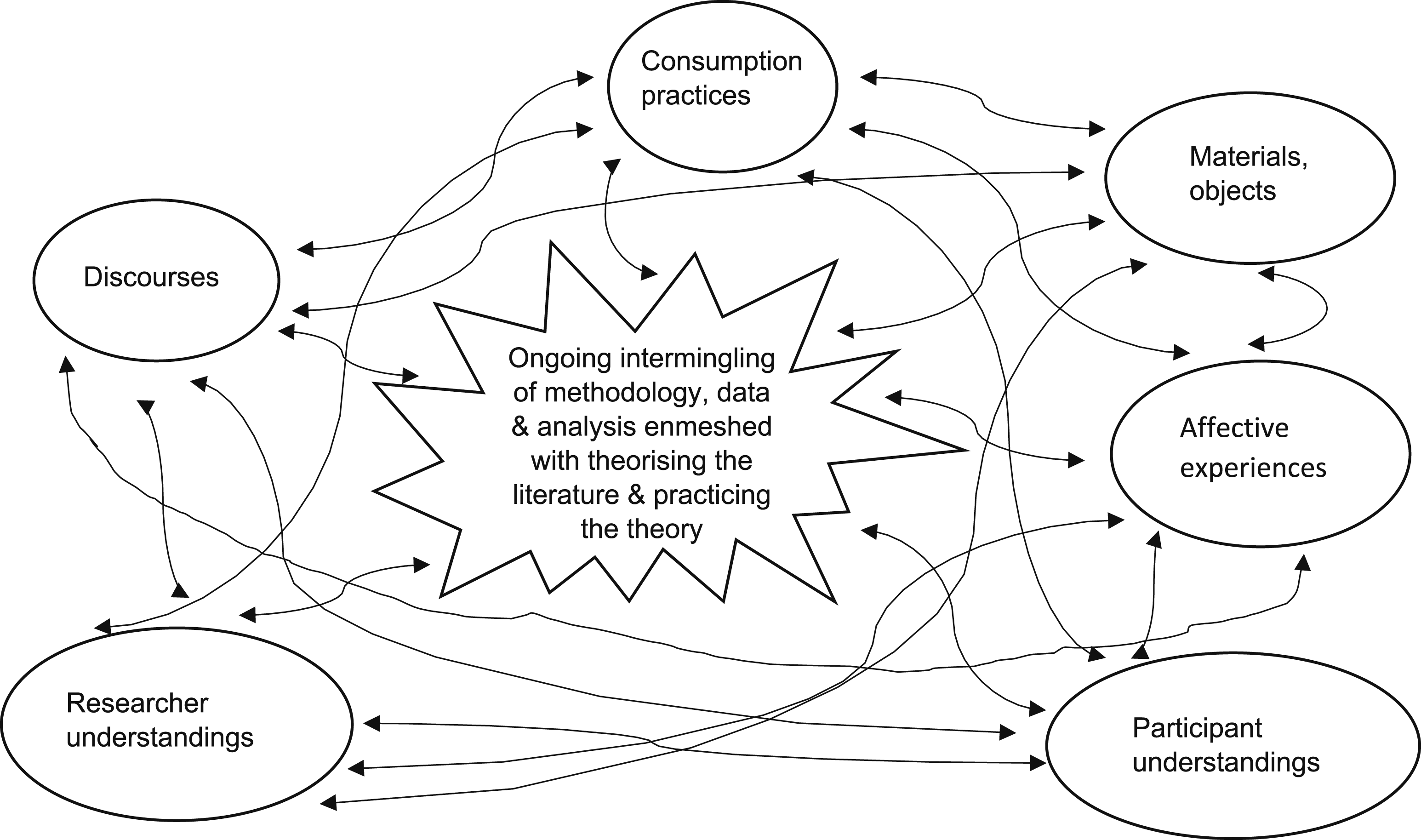
Rhizoanalysis contrasts with more commonly used approaches to qualitative analysis in marketing research, constituting a more discrete stage in the research process (Goulding, 2005). Inspired by Deleuze and Guattari (1987: 8), this ongoing process helps map the ‘linguistic … perceptive, mimetic, gestural, and cognitive’ in relationship to gambling-related practices, subjectivities and territories. In practice, this means paying close attention to how ideas, words, material and embodied dimensions come together (Masny, 2013, 2016; Roffe, 2016). For example, most participants invited the researcher into their homes, behind closed doors to avoid discussing gambling in front of family members or in public. Here, participants became emotional recounting gambling-related stories, becoming animated, breathless, embarrassed, or tearful, as well as gleeful and/or boastful. Thus, meaning was negotiated through reciprocal relations, affective flows and moments of intensity that opened up avenues for discussing gambling practices about shifting notions of identity at the intersection of social and material worlds.
Attending to how data function and what data produce within research arrangements helps overcome the limitations of more conventional reductive and codifying practices and encourages creative ways of reading data (Lather, 2013; Masny, 2016). Following Coffin (2021), we consider that Deleuzoguattarian thinking helps us to disrupt established theorisations, and through rhizoanalysis encourages us to move away from interpreting what research data means but towards sensing its virtual potential to become (Masny, 2013). Here, researchers enter the middle of the research arrangement becoming part of the territory. The rhizome becomes a map to analyse and report data in ways that pay attention to events, forces and moments of transgression, difference and repetition, ruptures, unpredicted directions and deterritorialisations. As researchers we reflected upon the rhizomatic connections between data in the research assemblage and how this constantly unfolds and enfolds – always becoming.
That said, reliability and rigour were addressed through data structuring that attended to first- and second-order themes as they unfolded, data and participants were revisited for clarification, and mutual discussions with our team of inter-disciplinary researchers helped to develop understandings of consensual interpretations (Gioia et al., 2013). Using this approach, we no longer refer to data organised by themes but consider vignettes as a form of representation (Masny, 2013). Vignettes can be understood as presenting ‘an illustrative scene, a literary sketch’ – the ingenuity of which lies in their ability to map and reveal ‘the hidden depths of an interior view’ (Galef, 2016, p1). Our findings are presented in three vignettes that enabled us to map sports betting arrangements and give insights into how gambling risk and harm are negotiated in ways that consider the context, the individual, the material and the social.
Findings
Sylvie
Sylvie is a 24-year-old woman who lives apart from her partner. Originally from Aotearoa/New Zealand, she has lived in Australia for the past 10 years. Sylvie had been gambling for many years, sometimes gambling intensively for brief periods, and losing significant amounts of money, resulting in times of financial hardship. Sylvie recalled traumatic memories of her father gambling and now keeps her gambling secret from her family and partner: Never, I would never gamble in front of family, never. No, I would never gamble in front of him [partner], I should say because he's never gambled in his life … I would just worry that he would think differently of me and judge me. And he just wouldn't understand, so I don't gamble in front of him.
Sylvie fears that exposure of her gambling might change how her loved ones perceive or relate to her. The threat of gambling disclosure cannot disrupt the molar line of the respectable familial home as a site of domestic commitment and responsibility. The molecular line that prescribes secretive gambling practices at once evades the molar lines of domestic commitment and reinforces the molar lines of gambling. Her fears do not lead her to break away to stop gambling; rather, the molar and molecular work to produce new arrangements.
However, space and time are not neutral backgrounds. Gambling occurs at conventional public gambling venues, such as racetracks and sports grounds, reinforcing it as a spectacle of shared elation and despair. Sylvie works full-time in the hospitality industry at a sports ground and horseracing track. For Sylvie, being part of the crowd and being alongside other sports fans give rise to affective intensities of pleasure and excitement – ‘the rush’ of sharing what she terms a ‘miraculous thing’. Sylvie understood sports betting to function within relationships that helped to reinforce her understanding of herself as a sports fan: I like to read about it [sport], and I think if you're only putting in 10 bucks, even if you only do the two-dollar bet, and you got to watch the game, and you read about it. Learn the scores, the style and the skill of the game, and everything in its entirety. It's quite interesting in that regard, alone, without even actually winning money or worrying about betting.
We can think about this as overlapping molar lines with shared territory. The molar lines of a sporting consumer culture are reinforced by Sylvie’s knowledge, passion and interest in sport. Such molar lines are reinforced by specific skills and competencies – knowing the odds, making complex bets, following the game. These molar lines are not discrete; they intersect and overlap to enable participation and belonging. Here, the coming together of materialities and socialities of gambling generate affective intensities named as happiness, thrill and excitement. These affective intensities are reinforced through the overlapping molar lines of becoming both a sports fan and a savvy, skilful gambler. Sylvie illustrates how the positive affective intensities of gambling help reinforce molar understandings of winning and skill.
Sylvie also demonstrates how the affective molecular forces generated by sensations of ‘losing’ at a sports event evade the molar lines of a gambling identity as skilful and successful. For Sylvie, this molecular line moves outside the safe territory of the savvy gambler who does not lose large amounts of money: It's a feeling that comes over you. If you're losing especially. You feel horrible; it's a sense of unease. But that's when you're losing. But if you're winning, it's great ... But the feeling of losing. I hate even talking about it; as you can see, it makes me so upset. I get so upset because I remember what it feels like to lose. It drives you crazy … I've dropped my phone, smashed the screen in the place because I was so upset. That's how you know you're crazy … but obviously, I lost a bit of money; I was out of my mind, it's horrible.
For Sylvie, her description of the affective intensities of ‘losing’ illustrates how molecular lines may work to deterritorialise or break away from the molar lines of the savvy gambler. A molecular line from the hurt of losing money has the potential to develop into a line of flight that evades from the molar towards total deterritorialisation; in Sylvie’s words, ‘you know you’re crazy’ and ‘I was out of my mind’. When conceived as a line of flight, the sensations of losing allow chaotic forces to enter lives, creating the gambling harms and despair of living without a territory. But this line of flight is tempered by the molar line of sports, which aligns sports stadiums, sports fans, social status and winning with the excitement of gambling. The constant interplay between molar and molecular means that Sylvie must negotiate the affective intensities of winning or losing within a sporting spatial order that carries the risk of harm.
Gambling generates molecular intensities that at once reinforce and evade molar lines of the savvy gambler. Sylvie describes how the gambling territory is always in flux: Once I did win, it was like, ‘800 dollars – I won it from 20 dollars.’ It was just amazing luck. I was betting high, but because I was winning the money from the beginning, I wasn't really playing, and money loses the meaning when you win it. Because you think, ‘Oh, it's free money.’ … So, I was really happy, and I left straight away, but I went back two months later. And that's what everyone says, right? Lost it all, plus more. That's probably when I lost my first 1000, there.
Money, as a key material element of the gambling territory, becomes de-contextualised; it functions only to increase the intensities of winning. Set free from econometrics, ‘free money’ reinforces molar understandings of the lucky gambler. Yet, molecular lines may open up, leading the gambler to risk gambling more than they can afford to lose as they try to relive the affective pleasures of the win. These molecular movements that temporarily evade the molar lines of the savvy gambler or the lucky gambler evoke self-reflection on potential lines of flight: You'd have to bet at least a $100, or you have to bet a larger amount, but you'd risk that. Is it worth the risk of losing it, and usually it shouldn't be. The answer should be ‘No.’ Because you're going to obviously be digging your own grave over time because you always will be a loser in gambling. That's what it comes down to because addiction will set in. So, I don't play much … I've gambled in the past. I've won a few jackpots here and there. But that was a long time ago, and I've stopped doing that because I know that it's something that you don't want to play with. Play with fire, don't expect to not get burned.
Sylvie illustrates that negotiating the gambling market requires a set of skills (i.e. to be able to monitor and control spending) to avoid the molecularities of chasing a loss or betting too much – always with the potential to break away towards gambling addiction. In Sylvie’s words, ‘playing with fire’ comes with the risk of getting ‘burned’.
Lucas
Lucas is a 31-year-old, full-time employed man with a partner and two children, aged 8 years and 6 months. Together they live with his partner’s family. Lucas has been gambling for many years and has lost large sums of money, which has had financial implications. His online sports gambling life history is embedded in negotiating the affective bonds of a sports fan and family life: I remember when I was five years of age, I used to read the paper, just the sports section of the paper. I was full-on into it … I enjoy watching the sports and that ... I support Manly and NRL [National Rugby League]. I love my NRL. I like all the rest of the sports, but I really like NRL, and I like really like cricket. They're my two big ones … football, cricket. I love it. My wife thinks I'm obsessed with it. I'm on it all the time, checking the scores … As I said, if I'm not watching YouTube or telly, or sports or something like that, if I'm by myself, I'll have a bet. But generally, I'll sit there, and I'll say, for instance, put $100 on whatever.
Like Sylvie, for Lucas, the molar lines of sports fandom overlap and reinforce the molar lines of sports gambling. The sensibilities of sports gambling, conveyed as love and excitement, operate to reterritorialise molar lines that comprise the familial home by generating a personalised gambling territory. Furthermore, these affects reinforce the molar lines of gambling marketing, which position sports betting as a legitimate leisure pursuit. Within the familial home, the materialities of the sports betting app allow for opportunities to gamble anytime, anywhere. Yet, this impacts on social relations that make up the home, where gambling becomes an object of hate, a source of conflict, and disrupts domestic harmony: It's what I like to do ... Like I said, I have a fight or have an argument. And she's like, ‘I hate you gambling.’ ... And it has caused a lot of fights, so I have to be aware of that. And I want to keep her happy but also myself happy. And it's kind of a fine line.
Following Deleuze and Guattari (1987), domestic arguments may be conceived as generating molecular lines, evading the molarity of the familial home. Lucas negotiates these moments by balancing the affective pleasures of sports betting with the emotional pain of his wife and children, his feelings of shame, and the need for concealment. Reterritorialising the family home through routines to produce private space and creating permissions associated with the molar lines of gambling as leisure help Lucas to reduce conflict at home. For example, Lucas explained: I don't do it in front of my wife because she gets the shits [annoyed] ... So, it’s something that I don’t do in front of her … I'd wait till she wasn't around. And not that I'm necessarily hiding from her. I just don't want her to get the shits with it. Do you know what I mean? If I'm rubbing [it] in her face, she's going to get the shits with it … I wouldn't tell her family or anything like that because they are a bit old and that ... I don't know. I probably am a little bit ashamed... I probably would classify myself as a gambler.
The routines to reterritorialise the familial home as a personal gambling territory by keeping his gambling activities secret at home were predicated not only on the molecular movements from the emotional harm but also on identifying what he was doing as problematic. Like Sylvie, Lucas spoke about gambling more intensively when chasing losses: I'll put in heaps. And then I'll lose it. And I'll be like, ‘I feel sick. I feel sick.’ You actually get a gambling hangover, especially the next day … I'd win $1000 one night … Or you'd win $1000, and you'd play it all the way down to, say, $500. I'm like, ‘Oh, I'm going get it back up.’ And you keep playing, keep playing, and then you would actually be down the whole $1000. And it'd be really bad. You just think to yourself after ... You just straightaway get this hit of ... your stomach drops. And it is really sickening.
Lucas’s loss of control is explicable by how molecular movements can open into deterritorialising lines of flight that break away from the existing context. Lines of flight towards risky and harmful consumption are evoked by the affective intensities that grip the body – feeling ‘sick’ in the stomach, feeling regret – as the wins turn to losses. During a series of financial losses, Lucas’s embodied and affective responses intensify as he moves away from the molar lines of the savvy gambler who knows when to stop. Lucas illustrates how the embodied affects of gambling loss persist and are experienced as a ‘hangover’.
Consequently, Lucas implemented a strategy to limit his gambling to reinstate his understanding of himself as a savvy gambler, imposing a limit of $500 per month so that he may continue to gamble along molar lines: For instance, about a month ago, I put myself [on] a $500 limit for the month. And then I pretty much went over that limit within about two weeks. So, I had two weeks to go. And they sent me a text message say[ing], ‘If you deposit $250, we'll give you a $250 bet bonus.’ So, whenever they'd used to do that, I'd always do it. And I’d put it on. Then I'd put $250 on one, $250 on the other. Some weeks I'd spend, when I was really bad, spend half my pay cheque before I'd even bloody left work. Then I'd be like, ‘How I'm going to tell my wife? I think I have to tell her.’ But I put it off. Yeah. It's actually quite bad because when, especially when you lose a lot, you start [to] not so much lie, but you [are] kind of hiding, yeah, and the truth, kind of [gets] left out.
Lucas describes experiencing gambling practices from a bonus bet offer after limiting his deposit as ‘bad’. Advertising promotions reinforce the molar lines of the lucky gambler as committed and someone who knows a good offer. Lucas’s resolve to stay within his self-imposed limit is eroded by the affective pleasures of the lure of the win – a molecular line which evades the molar line of the responsible gambler, respectable husband and father. The molar and molecular are constantly negotiated through how Lucas conceals his gambling practices and losses, deceives his partner, and understands himself as a responsible husband and father with the gambling territory.
Solomon
Solomon is 35, newly married and employed full-time as an accountant. Solomon self-identified as a ‘passionate football fan’. Solomon learnt to gamble as a member of a football club. His passion remains integral to organising his social life, creating time and space to gamble with male friends in public. Solomon admits that gambling is necessary to make sports exciting unless he is watching his NRL team: I support Parramatta Eels. I could just sit there and watch them play without a bet on it … Yeah, if it's another team, then I need a bet to grab my attention to the game … it adds more intensity to the game while I'm watching it. I watch tennis, and if I've got a bet on it, I'm fully into it. If I don't, I probably almost fall asleep.
For Solomon, sports fandom is limited to particular teams and sports. Yet within the gambling territory, sports betting enhances the excitement of a game that is otherwise of little interest. The affective intensities of sports betting as part of the molar lines of the sports fan are intensified within the gambling territory. Molecular lines of boredom are thus enlisted which serve to reinforce the molar lines of the sports fan and savvy gambler.
The molar lines of gambling capitalism create new forms of participation by encouraging those who do not usually access in venue betting services to gamble online (Wood and Williams, 2007). Indeed, Solomon reflects on the ease of access and the ever-present opportunity to gamble: It's just so easy to just get on the app on your phone and sign up and put in your credit card detail or your bank account details and put some money onto your account, and there you go … It [online gambling] could be everywhere because occasionally I'll be at the shops, and I'll put a bet on while I'm waiting for something. It is everywhere. I'll do it at work sometimes … Even when we'll be at dinner, and my partner will go to the toilet, I'll pull out my phone and put a bet on because it's Saturday night, lots of sport on TV or sport going on. Yeah, I generally would open my app anywhere.
Under the molar lines of gambling capitalism, gambling can be seamlessly absorbed into everyday routines, opening new gambling locations, including workplaces, shops, restaurants and homes. For Solomon, sports betting has become a way to dispel the affective intensities of boredom he associates with waiting, which reinforce the molar lines of gambling as accessible, convenient and expedient.
That said, for Solomon, the appeal of online sports gambling may be explained by the molar lines that secure private living rooms as a ‘home’ territory aligned with sporting masculinity: We'll watch the sport at someone's house or make sure we got a bet on it. We'll know what each other's bet is sort of thing, and we just watch the game … It is a bonding experience. It definitely is because we're just all there for the same thing, just to watch the game because we've got an end result on it. It might not be the same end result, but we're all into the game.
The affective force of molar lines for Solomon translates to a bonding experience that reterritorialises living rooms through a gendered schema and sustains his sense of self as a ‘mate’. Solomon explains how gambling routines reconfigure territories that operate to privilege group betting: We talk about, obviously, boosts.
1
If someone's run out of boosts and someone else has got one, they'll ask if you can put it on for us, for instance, and stuff like that. Yeah. We'll do joint multi’s [multi-bets
2
] together, so we can use the boost together … I get a text message now once a week, ‘Deposit $100, and you get $50 back in bonus bets.’ That encourages me to put $100 in my account because I get a $50 bonus bet.
For Solomon, sharing ‘boosts’, placing multi-bets with friends and accepting promotional offers provide opportunities to reinforce molar lines of the skilful gambler and what mateship means within a shared gambling territory. Promotions and boosts are used within the molar lines of gambling to facilitate the social bonds between group members. Furthermore, Solomon’s experience of gambling is a culturally sanctioned response to competition: Obviously, it's competitive between mates. Obviously, we go to the races, and we're all ... always boast about who won... like, ‘I won this much today,’ and ‘I won this much.’ The person that lost doesn't say much, but yeah ... We talk about when we get up. We talk about when it's our last leg of our multi. We talk about, if a race is coming up or when it's a game, we'll say who we've got, who we've picked... especially within my group of friends, betting definitely comes into lifestyle. We all play a different way on these betting apps.
We can think about the molar lines of gambling here as a process of territorialisation of public racetracks through social arrangements that involve generating gendered hierarchies. For Solomon, the molar lines of gambling are reinforced by experiences of winning and belonging. Gambling losses are silenced because they evade the molar lines of gambling, and those who lose are displaced. Furthermore, these sensations become subsumed into new molar lines that constitute gambling as a ‘lifestyle’. Routinised leisure gambling practices give rise to affective pleasures that territorialise racetracks and living rooms, where gamblers betting together can achieve a sense of self as mates, winners and living day-to-day with thrill and excitement.
The gambling territories formed through the experience of online sports gambling as a normalised and routine leisure practice draw attention to the molar line of this lifestyle. People can use their skills to beat the system or bond with friends as well as for exercising exclusionary tactics. Solomon recounted how at his wedding several months ago, he and his male friends used their sports betting apps at the church and the reception to place group bets. After the church ceremony, Solomon and his friends shouted ‘Multi!’ when instructed to ‘Say Cheese’ by the photographer: When we said ‘Cheese!’ it was ‘Multi’s!’ instead, and the whole bridal party were saying ‘Multi’s!’ The girls didn't know what it was.
Marriage, alongside birth, divorce and death, is one of the most significant life events for most people. Traditionally a ceremonial occasion shaped by religious and cultural norms, Solomon demonstrates how the molar lines that shape masculinity and mateship within a gambling territory exert affective forces to exclude certain bodies, including his wife. On such a momentous occasion, Solomon demonstrated belonging to a gambling territory through knowledge, skills and familiarity with the lexicon around sports betting. We can consider the affective pleasures of the gambling territory as a way of reinforcing understandings of self through the practice of everyday sports betting behaviours. Thewse can then cross over as well as interweave with the molar lines that comprise other territories or lifelines. The complex entanglements of molar and molecular lines that shift the experience of living with and without a gambling territory illustrate the constant oscillation exhibited by our participants towards and away from risk and harm.
Discussion
Our research enriches existing conceptualisations of risky and harmful consumption by interpreting gambling consumption through molar and molecular entanglements. Our participant vignettes foreground how molar forces such as gambling capitalism, marketing, Australian sports and betting cultures, and the social normalisation of betting (Humphreys 2010a, 2010b; Lainer Jnr and Rader, 2015; Westberg et al., 2017) interplay with molecular forces such as self-imposed restrictions, going ‘cold turkey’, justifying gambling as a legitimate pastime, secretive practices of gambling in bathrooms and bedrooms, or eschewed norms of gambling masculinity (Gordon et al., 2015; Waitt et al., 2020).
Figure 2 maps how molar and molecular lines entangle to shape gambling arrangements constituted by material dimensions, such as bodies, smartphones, betting apps, and homes, and expressive dimensions, such as norms, language and affects (see also Roffe, 2016). The molar and molecular lines that shape sports betting entangle in different ways, representing evasion, reinforcement or a break away from the molar forces shaping the gambling market. These molar and molecular entanglements work to transition consumers towards and away from gambling risk and harm. The mobile smartphone sports betting arrangement.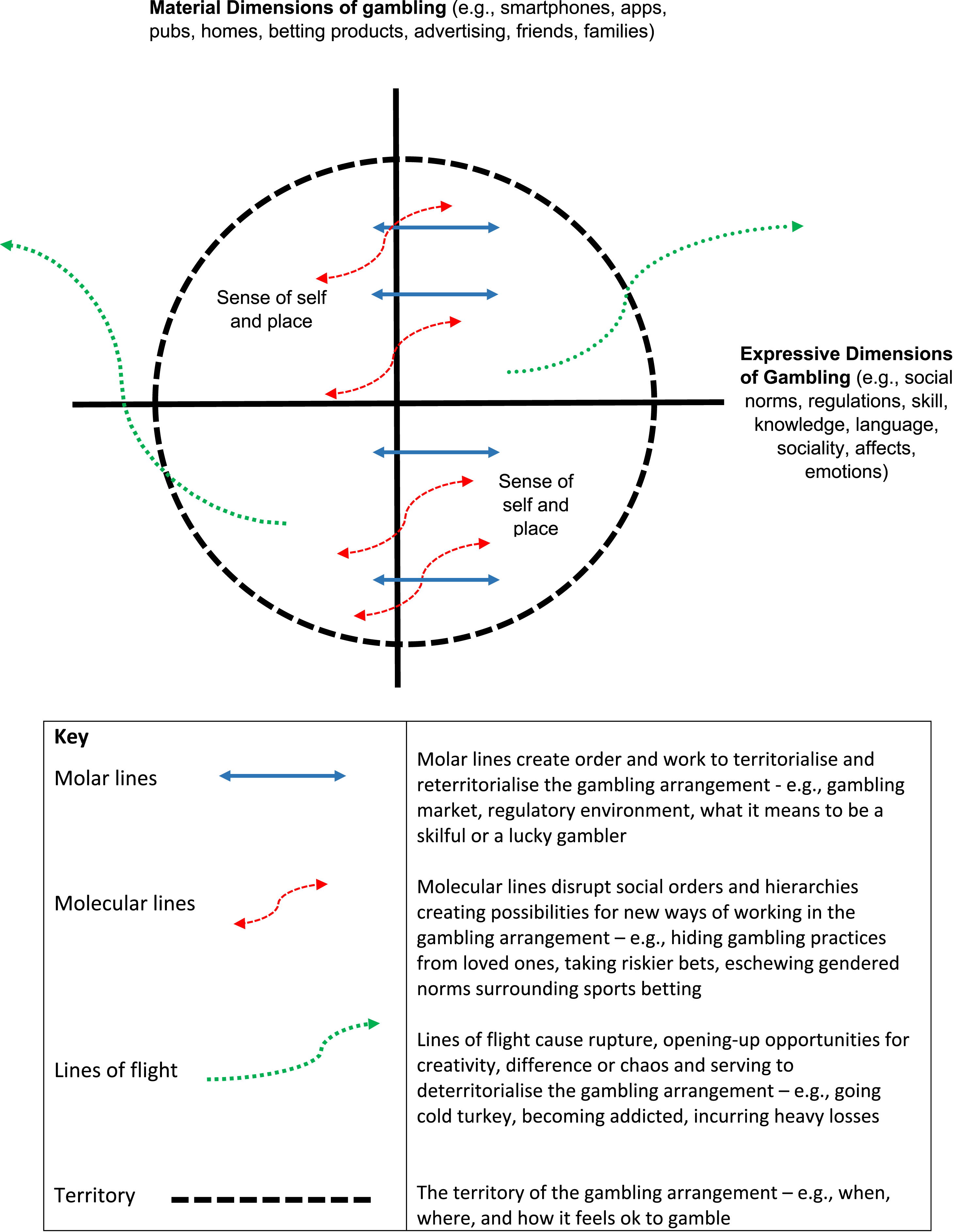
Our findings illustrate that, at times, becoming molecular enables consumers to temporarily evade the molar lines shaping the gambling arrangement. Our participants deployed various strategies to navigate the risks and harms associated with sports betting to become skilful gamblers while trying to avoid falling off the edge. People follow molecular lines by upskilling, betting in private, blocking their cards or deleting their apps to subvert the molar forces that establish their gambling routines and subjectivities (Waitt et al., 2020). While some molecularities, such as upskilling or using gambling blocks, might help consumers to escape harm, others, such as betting in secret, harm personal relationships.
Yet, becoming molecular does not usually offer a total escape. Indeed, becoming molecular, for example, by learning to be a skilful gambler or for a woman rejecting masculine norms to place sports bets (Gordon et al., 2015), ends up reinforcing the molar lines of gambling capitalism and the social normalisation of wagering (Young, 2010). As our participant narratives illustrate, the odds of a skilful gambler still beating the house remain long, and reshaping gender norms by engaging in sports betting also carries financial, health, and social risks and harms. As our participants demonstrate, this creates an ongoing process of tension and flux, evoking intensities experienced as anxiety, shame, conflict, loss, secrecy, ostracism, escape and re-entry into the market and making a complete departure from the gambling market difficult to achieve. Possibilities for lines of flight can emerge that may work to break away from the molar lines. At times these lines of flight can be destructive, hurtling consumers towards gambling addiction and accelerating risk and harm. At other times, lines of flight can represent a total escape from gambling. But these lines of flight hold no certainty or fixity.
We identify that interpreting the ways that molar and molecular lines and lines of flight entangle to temporarily evade, reinforce or break away from market and consumption arrangements, and understanding the outcomes that are produced, offers a sophisticated and nuanced perspective for marketing theory. Our insights enrich established conceptualisations of risky and harmful consumption that are understood through psychology, physiology, motivation, addiction and deviance (Hirschman, 1992; Thomas et al., 2016; Chung et al., 2018; Mowen et al., 2019) or that focus on institutional structures (Polonsky et al., 2003; Humphreys, 2010a). Following Lamberton and Hill (2016), consumers are constituted through interaction with the wider world (both social and material). Here, we have drawn attention to the power of gambling sensations in everyday life in shaping who people are, and the risks and harms associated with how people gamble. Our molar and molecular framework acknowledges the importance of personal characteristics in tandem with social and structural factors, such as shifts in policy, regulation and marketing (Humphreys 2010a, 2010b; Lainer Jnr and Rader, 2015; Westberg et al., 2017).
We identify that understanding risky and harmful consumption requires acknowledging the complex interplay of mutually affecting discursive, socio-material and emotional intensities. Conceptualising gambling through the entanglement of molar lines that are structuring and molecular lines that denote agency helps to account for the multiplicity of consumers’ lived experiences of risky and harmful consumption. In doing so, we extend extant research which has considered structure/agency interplays in risky consumption but has focused on countervailing forces as opposed to multiplicities (e.g. Thompson, 2005) or has neglected considerations of harm (e.g. Celsi et al. 1993). We also foreground our use of rhizoanalysis, which fuses methodology, data, and analysis with extant conceptual literature and practice of theory together in a research arrangement (Masny, 2016). Rhizoanalysis offers a useful approach for marketing researchers who draw on socio-material frameworks and are open to approaches that address multiplicities and contradictions by considering the ongoing processes by which ideas, words, material and embodied dimensions of research encounters come together.
Given the significant risks and harms associated with gambling (Langham et al., 2016), after Deleuze and Guattari (1983), we are interested in possibilities for transformative change in policies and practices that shift us outside the molar and molecular lines and represent a line of flight towards a new arrangement. Molar forces dominate current gambling policy and practice, with gamblers’ addictive personalities – not the marketisation of a risky and harmful product – being the problem (Miller et al., 2018). The policy environment is liberalised and establishes gambling as a legitimate and normative practice (Humphreys, 2010b), paying scant attention to addressing risks and harm beyond simplistic encouragements to ‘gamble responsibly’ (Yani-de-Soriano et al., 2012). However, as gambling harms increasingly affect consumers and society in countries such as Australia, the USA and the UK, there is growing social support for more robust action (Thomas et al., 2017; Johnstone and Regan, 2020). As Yani-de-Soriano et al. (2012) identify, there may be a need to ban digital gambling, products such as electronic gaming machines and fixed-odds betting terminals, and strictly regulate or ban gambling marketing. By implementing policies, public advocacy and counter-marketing, it is possible to challenge the legitimacy of gambling and potentially transform social norms. Such actions offer possibilities for lines of flight away from the shadow of gambling capitalism.
Gambling social marketing behaviour-change programmes, and the provision of support services, could be more effective if they take into account the intricate interplay between structural and personal factors that influence gambling practices. Programmes are encouraged that share consumers’ tips and practices for mitigating risks and harm using storytelling approaches, building self-efficacy, and providing social support to stick to limits or successfully exit the gambling market by pursuing other leisure interests. Gambling support services could pay more attention to how personal, material, social and structural factors coincide. Moreover, support services could better equip and enable those engaged in sports betting to recognise, diagnose, and act when risks and harms are evident. Financial institutions could also be encouraged to monitor for risky consumption patterns, use digital nudges or facilitate card blocks and bans on cash withdrawals to support gamblers seeking to avoid harm.
There are some limitations to our research that we acknowledge. First, our use of molar and molecular lines merely offers one possible way to rethink our understanding of risky and harmful consumption. While identifying the benefits of attending to molar and molecular forces, other socio-material and systems frameworks may likely be useful. Furthermore, our research shares findings from a qualitative sample of low- and moderate-risk gamblers aged 18–35 in Australia. Further research across age groups, cultural contexts and other forms of risky and harmful consumption, such as drugs or extreme sports, would be welcome to explore how molar and molecular entanglements play out in various ways, creating different effects for markets, marketing and consumers. Following Coffin (2020) there is also a need for research on how more-than-human entities such as technologies, spaces and places, and other bodies shape gambling consumption arrangements and mediate risk and harm to consumers. In addition, studies that involve data collection at multiple levels of analysis could help enrich the knowledge base beyond our current study, which features narrative interviews with consumers. Such work can help develop more sophisticated conceptualisations of risky and harmful consumption and inform policy and practice that can help to ameliorate such harm.
Footnotes
Declaration of conflicting interests
The author(s) declared no potential conflicts of interest with respect to the research, authorship, and/or publication of this article.
Funding
The author(s) disclosed receipt of the following financial support for the research, authorship, and/or publication of this article: This work was supported by the Australian Research Council (DP190101405).
