




Abstract
Following the recent #GameStop ‘market disruption’ where r/wallstreetbets ‘rogue’ traders were able to momentarily topple billion dollar hedge funds, we employ Deleuze and Guattari’s ‘war machine’ concept in order to comment on the potential of consumer resistance when matched up against global financial markets. While most extant theory follows the Foucauldian tradition in asserting that consumer resistance is a reaction to power, we use Deleuze and Guattari’s immanent theorisation of desire to make the case for thinking of resistance as primary. Far from a hagiography of affective affirmation, our immanent perspective draws attention to how state and corporate forms are readily able to co-opt consumer resistance. Ultimately, we make the case for reorienting consumer resistance research away from seeking out ruptures and breaks in stable structures of power to asking a more difficult question: how can resistance be organised to avoid capture?
Keywords
Everything is rational in capitalism, except capital or capitalism itself. The stock market is certainly rational; one can understand it, study it, the capitalists know how to use it, and yet it is completely delirious, it’s mad […] an enormous flux, all kinds of libidinal-unconscious flows that make up the delirium of this society (Deleuze quoted in Guattari, 2009: 36). We can stay retarded longer than they can stay solvent (organizing slogan of r/wallstreetbets)
1
Introduction
The movies The Wolf of Wall Street, The Big Short, and American Psycho depict how financial capitalism spawns particular social orders driven by a “world-wide disembodied phantasmogoria” (Jameson, 1997: 251) in which the commodification and exchange of virtually everything leads to a cataclysm of any meaningful social symbolic coordinates, readily replaced by a manic drive for more 2 . Both deal wonderfully and terrifyingly with the dazzling thrill of accumulation in ‘late capitalism’, where financial markets have become all but completely abstracted from ‘tangible’ value 3 (Davis, 2018; McGoun, 1997; Schinckus, 2018), and separated “from the ‘concrete context’ of [their] productive geography” (Jameson, 1997: 251).
Jean Baudrillard (1994) noted that capital in financial markets has become “irresponsible, irreversible, ineluctable” (p. 153), amounting to detached simulations that “create their own fictions or disembedded forms of hyperreality” (Davis, 2018: 16). Similarly, Bataille’s (1988) theory of the ‘general economy’ emphasised how capitalism taps into relations of desire rather than utility (also Pawlett, 1997). From a cultural perspective, we are dealing with a gargantuan ritualistic performance of excess as the ‘thrill of expenditure’ driven by flows of unconscious desire rather than sensemaking and meaning (Crostwaite, 2010), which is maintained and perpetuated by ‘seductive’ myths, dizzying technological ‘speeds’ (Malsch and Gendron, 2009), and an “increasingly feverish search […] for new kinds of profits extractable from financial transactions themselves” (Jameson, 1997: 251). Given this increasing intensification and financialization of social life (Arvidsson, 2016), accompanied with the rise of online digital culture(s) (Boler and Davis, 2018), investing is increasingly woven into contemporary subjectivity (Aitken, 2003; Schroeder and Zwick, 2021), is as much a libidinal engagement as it is a monetary one (Karppi and Crawford, 2016; McGoun et al., 2007), and is only escalated by the possibilities of fully computerised cryptocurrencies promising “absolute certainty but with no god” (Dodd, 2018: 49).
Moreover, the financial industry holds an extraordinary influence on contemporary consumer society (Davis, 2018), and today 6.9% of all economic output and 3.2% of all employment is tied to financial hotspots like London (Hutton and Shalchi, 2021). Even by conservative estimates, only 10-20% of trading is done by actual humans today (see Kissell, 2020). Instead, arbitrage is found in the automated algorithmic realm of lightning-fast ‘high-frequency trading’ (Arnoldi, 2016) where “capital transfers […] abolishes space and time” (Jameson, 1997: 252).
From this viewpoint, it seems striking how markets were traditionally theorised as relatively benign and sensible entities that simply satisfy consumer needs. Today, this view is thoroughly contested (Cherrier and Murray, 2004; Holt, 2002; Tadajewski, 2010) and all but the most pro-market scholars acknowledge inequalities and power differentials are inherent to the marketplace. Out of this recognition rose the great protagonist of consumer research, the empowered, individualised postmodern consumer (Askegaard and Linnet, 2011), who reflexively resists market-mediated injunctions (Murray and Ozanne, 1991). Through resistant acts, this consumer attempts various ‘emancipations’ from marketized orders (Firat and Venkatesh, 1995), even if only experiential, local, and momentary (Arnould, 2007; Hietanen and Sihvonen, 2020; Kozinets, 2002). More recent work on escapism focuses not on how the consumer can escape the market, but how the market can facilitate escape from everyday life and banal daily routines through extremely immersive consumption where ‘losing it’ is an inherent part of the experience (Cova et al., 2018; Jones et al., 2020; Hietanen et al., 2020). Yet, resistance continues to instead typically constitute a ‘meaningful’ practice in the pursuit of market mediated identities (Kozinets and Handelman, 2004; Kozinets et al., 2010; Sandlin and Callahan, 2009) and in reshaping markets (Cova and Dalli, 2009; Karababa and Ger, 2011). However, contemporary consumer resistance is also co-dependent on the market system itself (Jameson, 1991; also Cherrier and Murray, 2004; Kozinets et al., 2010) because it is “a form of market-sanctioned cultural experimentation through which the market rejuvenates itself” (Holt, 2002: 89).
In this essay, we tread the threshold between digital financial markets and consumer resistance, which seem at first rather disconnected. Following the recent r/wallstreetbets ‘market disruption’, where ‘rogue’ online traders momentarily toppled billion-dollar hedge funds, we comment on the potential of consumer resistance when matched up against global financial markets. Instead of the largely sovereign consumer typically depicted as the resistant actor, we build on recent theorizing that argues a coherent meaning-making consumer identity is illusory (Cluley and Dunne, 2012; Gabriel, 2015; Hietanen et al., 2020). Focusing instead on Deleuze and Guattari’s (2013a, 2013b, hereafter D+G) philosophy of how unconscious desire constitutes human sociality, we scrutinize the Foucaultian tradition of consumer resistance which tends to focus on clear and antagonistic power relations (Karababa and Ger, 2011; Roux and Izberkin-Bilgin, 2018; Thompson and Üstüner, 2015). These approaches have been insightful, but we believe there is still something more troubling in the thresholds of structure/agency. Rather than power manifested in symbolic representations, D+G theorizing focuses on desire as the immanent production of the entire social sphere, which global online connectivity and social media powerfully intensifies (also Beck, 2016; Boler and Davis, 2018; Just, 2019). This is to say, there is no miraculated structure or power that desire only then reacts against, but rather that desire is all there is, and all that constitutes all social relations (also Smith, 2016).
By articulating r/wallstreetbets as D+G’s war machine rather than a meaning-making collective with individual motivations and interests, we outline how the movement was able to momentarily upset the edifice of global financial markets and critically assess its potential as resistance. We then theorize how technocapitalism has reached a point where meaningful resistance is increasingly unlikely (also Darmody and Zwick, 2020; Zwick et al., 2008). We assess capitalism not as an external epiphenomenon that’s vampirically feeding on an otherwise benign humanity, but rather as an apparatus of capture that channels excited energies in the form of desire on a global scale (Fisher, 2009). In this sense, capitalism continues to incorporate resistance even before it’s imagined. From our D+G perspective, we must thus reimagine resistance itself as immanent desiring flows which are primary to power and constitute the socius, not as a reactionary, goal-directed, meaningful activity aimed against external power structures.
The ontological basis of consumer resistance
Scholars have studied a variety of resistance practices in which consumers “stand up against what is perceived as a power” (Roux and Izberk-Bilgin, 2018: 294). Following Peñaloza and Price (1993), resistance refers to the “ways individuals and groups practice a strategy of appropriation in response to structures of domination” (p. 123). Historically, what could be considered overt consumer resistance came in the form of boycotts (Kozinets and Handleman, 1998; Sen et al., 2001) and buycotts (Friedman, 1996; Neilson, 2010), which allow consumers to ‘vote with their wallets’. Extending this theory of agency through purchasing power to a more collective level, studies have focused on highly visible anti-consumption movements which take aim at entire economic trends such as globalization (Sen et al., 2001), colonialism (Varman and Belk, 2009), and the expansion of Western products into the Arabic world (Izberk-Bilgin, 2012), among others. Importantly, new social movements (Kozinets and Handelman, 2004) have converged with technological developments in the form of cyber protests which “with no clear leadership and decisional center” (Odou et al., 2018: 44).
More covert consumer resistance has aimed at bypassing, escaping, and reshaping markets through ‘little gestures’ of everyday resistance (Roux and Izberk-Bilgin, 2018). Within this category, much attention has been paid to various forms of anti-consumption behaviour such as voluntary simplicity and culture jamming along with subcultural anti-consumption (Cherrier, 2009; Portwood-Stacer, 2012). Anti-consumption typically comes in the form of identity driven brand rejection (Sandicki and Ekici, 2009; Thompson and Arsel, 2004) or even brand owner antagonization (Luedicke et al., 2010). The adoption of transgressive or stigmatised styles (Sandikci and Ger, 2009), as well as engaging in transgressive leisure (Karababa and Ger, 2011) and ‘ideological edgework’ (Thompson and Üstüner, 2015) have also been recognised. Consumer resistance thus often comes in the form of identity negotiation more so than ‘emancipation’, evidencing that market-mediated resistance does not generally stem from a desire for social change (Holt, 2002; Izberk-Bilgin 2010; Kozinets, 2002; Kozinets and Handleman, 1998). Instead, resistance often marks the signs of ‘cool’ that are appropriated by consumer culture as another ‘lifestyle choice’ (Frank, 1998; Kates, 2002), because “even the choice of what is to be resisted […] conveys a desire for social distinction from nonresistant consumers” (Izberk-Bilgin, 2010: 313). For example, Kozinets and Handelman (1998) found boycott motivation stems from expressing a unique identity and, at Burning Man, “the urge to differentiate from other consumers” (Kozinets, 2002: 36) drove participation, not a genuine, grand project to uproot or fully escape the market. Thus, while a subsection of the literature revolves around escaping the marketplace itself (Dobscha and Ozanne, 2001; Firat and Venkatesh, 1995), this is increasingly seen as impossible and undesirable (Arnould, 2007) or at best partial, temporary, and local (Hietanen and Sihvonen, 2020; Kozinets 2002). Even in the dedicated work on ‘escapism’ (Jones, 2020; Jones et al., 2020) which sometimes proposes a more radical urge to escape one’s own conscious identity (Cova et al., 2018), escape is depicted primarily as a temporary deviant negotiation of market offerings.
Depicting power as hegemonic, the consumer resistance doxa adopts the “premise that power works […] through discourse” (Thompson and Üstüner, 2015: 235), where the “individuals’ agency is enacted through the utilization of alternative meaning systems in society” (Karababa and Ger, 2011: 739, italics added). Following de Certeau’s legacy wherein “cultural consumption is the terrain of struggle […] using […] cultural resources in everyday life to resist domination” (Izberk-Bilgin, 2010: 309), the field is broadly indebted to a Foucauldian paradigm (also Sandikci and Ger, 2010; Thompson and Üstüner, 2015), which promptly views resistance as a secondary reaction to power (Checchi 2014; Smith, 2016). For example, Karababa and Ger (2011) make explicit this hybrid Foucault–de Certeau discourse-power rubric that underlies their orientation towards consumer resistance, explaining how de Certaeu’s theory of practice complements Foucault’s later analysis of the structures of power in that the individual’s agency is enacted through the utilization of alternative meaning systems in the society (p. 738–739).
Equally, in their comprehensive review of the literature stream, Roux and Izberkin-Bilgin (2018) note how “power is central to understanding resistance” precisely because resistance is “the outcome of power” (p. 296, italics added). While “decidedly unromantic views of resistance […] as a Sisyphean struggle against polymorphic power structures” have been put forth, these more immanent readings of Foucault are rare in consumer research and are still wedded to rubrics of “power-resistance dynamics” (Thompson, 2004, 173).
As illustrated in the examples above, the legacy of consumer resistance research is one of the primacy of power and discursive negotiation through consumption practices, with few exceptions. While these theorizations of power have been insightful in what they have illuminated, it remains important to pursue new conceptualizations of core constructs if consumer research is to move forward and remain viable as a discipline (MacInnis, 2011; Yadav, 2010). Rather than a rubric of power, in the section below we ground our discussion of consumer resistance in a rubric of desire.
The primacy of desire in D+G
While consumer resistance literature tends to relegate resistance in subordination of power, treating it as a reaction to power, D+G’s (2013ab) rubric of desire asserts the primacy and irreducibility of desire-as-resistance. For D+G, whose collaborative work entailed a multifaceted development of poststructural psychoanalysis and experimental social theory, the focus was to upset various stabilities we tend to use to secure and maintain our world and its relations as sensible and taken-for-granted. Thus, their work focuses on difference over identity, immanence over transcendence, the pre-subjective over the subjective. For them, desire is a primordial flow of relentless unconscious energy that only seeks its own proliferation (also Coffin, 2021; Fox and Alldred, 2013; Hietanen et al., 2020). It operates in a world producing an incessant bombardment of affect wherein the subject is constantly overwhelmed by the excesses of embodied experiencing (also Hemmings, 2005; Ruddick, 2010). Unmeasurable intensities of affective encounters take the place of stable objects and predictable processes. Affect is immanent and precognitive, an immediate sensation before language can solidify ‘emotion’ into a concept. It is not reducible to a personal feeling; rather, “it is a prepersonal intensity corresponding to the passage from one experiential state of the body to another and implying an augmentation or diminution in that body’s capacity to act” (Massumi, 2013: xv). From this view, the affirmative question becomes how one can be emancipated when the urge to break free of domination is the same desiring impulse that seeks to dominate, subjugate, and control.
Thus, D+G emphasize structures of power do not manifest out of nowhere but are themselves parts of a system of desiring relations that constitutes the socius. As Deleuze (1997) explains, the status of phenomena of resistance is not a problem; since lines of flight are primary determinations, since desire [and not power] assembles the social field, it is rather the dispositifs of power that are both produced by these agencements and crushed or sealed off by them (pp. 188–189).
In A Thousand Plateaus, D+G (2013b) clarify their position by noting how in their approach “lines of flight […] are primary, which are not phenomena of resistance or counterattack […] but cutting edges of creation and deterritorialization” (p. 618–619). We could thus surmise that, for D+G, the reason resistance is primary to power is that resistance is what obliges power to change; power manifests in immediate anticipation of resistance it expects to encounter (also Checchi, 2014; Smith, 2016). Power tends towards solidifying that which already exists. It does not need additional action to preserve a specific relationship of force. In D+G, although power and resistance are both forces, the core qualitative distinction is that resistance is active whereas power is ultimately reactive. Such active forces are affirmative, emergent, creative, and transformative whereas reactive forces are defined through conservation of the status quo and adaptation to change (also Lambert, 2010).
The hegemonic orders of power that consumers resist are also the products of social processes themselves. Power relations, when articulated as such, are thus already far removed from the immanence of desiring forces, already marked by stratifications and representations of all kinds (Beck, 2016; Patton, 1984). Moreover, in D+G, desire is ‘excessive’ (O’Doherty, 2007; also Pawlett, 1997), constituting the social in its immanence before reasoned thought ‘catches up to it’ to make the world stable through language and identity (also Deleuze, 1995).
Capitalism emerged as a global hegemony because it opened up endless possibilities for desire to flow (‘accumulate more, enjoy endlessly’) while also endlessly mutating to accommodate all these possibilities, including critiques and attempts to escape. Today, “capitalist production and circulation […] functions only by reproducing and widening these limits on an always vaster scale” (D+G, 2013a: 287). In capitalism, deterritorialization, mutation, and resistance are not novel political aberrations, but the ontological norm and capital is able to channel desire precisely because of this indefinitely moving target at its centre. Capitalism’s deterritorializing vector, however, places a limit on its own expansion because absolute deterritorialization would undermine the entire regime of ownership and accumulation itself. As a result, capitalism must constantly capture or reterritorialize its deterritorialized social field to save itself from itself. Capitalism may deterritorialize one oppressive mode of subjectification (a traditional oppressive social structure for example), but this is met with simultaneous reterritorialization (for example, upon identity now transformed into a new target market or resistant subculture ripe for advertising). For this reason, we also need an account of how this capture unfolds. Because capitalism has already unleashed a deterritorializing force that threatens to undermine its own regime, the key task is not to look for new deterritorializing vectors or cracks in structures of power but to prevent capitalism from turning the social fields it deterritorializes back into the image of capital (also Munro, 2016).
When one begins with the conditions of knowledge in power like Foucault, they must account for change by seeking out breaks in the status quo (Smith, 2016). A D+G rubric of desire, on the other hand, proposes that the social field is founded on an ontological ‘leaking’ or ‘flight’ which escapes in every direction. The primary political problem changes from seeking out new emancipatory ruptures in the actual to probing how social formations manage to capture, re-territorialize, and recode always already existing lines of flight (also Patton, 1984). This means the legacy of consumer resistance would present a different problem for D+G. If it’s true desire organizes power and gives rise to the social structures that oppress consumers, then a new question must be asked: “can desire organize power in such a way that the social machine it constitutes is a truly revolutionary machine?” (Smith, 2016: 279). To answer this, D+G introduce their war machine concept, detailed in the section below.
The nomadic ‘war machine’
To upset conventional positions, one needs to carve conceptual space for something in-between (power/resistance). To do so, D+G (2013b) conceive of the war machine, which marks something escaping the usual social order, “as linear [assemblage] constructed along lines of flight” (Deleuze, 1995: 33). Despite its name, the primary object of the war machine is not war. Rather, it denotes a tendency to upset established orders. D+G (2013b) emphasize that an “ideological,” scientific, or artistic movement can be a potential war machine […] to the extent to which it draws […] a creative line of flight, a smooth space of displacement […] this constellation defines the nomad and at the same time, the essence of the war machine (p. 492).
This upsetting of established orders occurs when the nomadic war machine propagates and occupies smooth space. To understand this tendency, it’s necessary to distinguish between smooth and striated spaces. Whereas striated space denotes a structurally organised and ordered context of determinate directions, “nomadic [smooth] space is a pure surface for mobile existence without enclosures or fixed patterns of distribution” (Patton, 2018: 210). In this sense, D+G (2013b) explain that
Each time there is an operation against the State – insubordination, rioting, guerrilla warfare, or revolution as act – it can be said that a war machine has revived, that a new nomadic potential has appeared, accompanied by the reconstitution of a smooth space or a manner of being in space as though it were smooth (p. 450).
‘State’ refers to a structuring force, which the war machine undermines through “creative displacement, deterritorialization, and the propagation of smooth spaces in which connections between different forces are possible” (Patton, 2018: 218). Whereas the state is defined as processes which capture, interiorize, and appropriate primary lines of flight through the striation of space and regulation of free action, the war machine is characterised by its ‘power of metamorphosis’ resulting from its tendency towards absolute deterritorialization. Put differently, the state operates through a centre of appropriation (a king, landowner, market etc.) that creates a field of interiority to police while the metamorphic war machine remains inherently plural and exterior to the state.
The war machine exists only to undermine structures, both real and conceptual. Its nomadism is what allows it to slip away from hegemonic systemics attempting to bring it back into its fold (also Beck, 2016). Thus, the war machine is irreducible to structures of power because it can constitute their total undoing as a “pure form of exteriority” (D+G, 2013b: 412). Classical thought always relies on the presupposition of stable structures (e.g. the state, the consumption community) to give it shape and to a coherent subject doing the resisting (Patton, 1984). However, the war machine is never a thing or a coherent and delineated entity, but an indiscriminate tendency or ceaseless irreducible movement. Put in use, the war machine radicalizes political action by imagining movements that affirmatively break from hegemonic structures which always assume an “equilibrium of forces” (D+G, 2013b: 462).
The war machine points to something much more than reactionary resistance, something “at once eccentric and condemned” (D+G, 2013b: 414), as it too faces capture by structural forces in the end. For D+G (2013b), the seeds of capture are present from the start, and indeed the whole capital-state apparatus, “the entire regime of signs” (p. 493), operates by binding people to reified structures stratified by power. In its strata-defying “stupidity, deformity, madness, illegitimacy, usurpation, sin” (p. 412), the war machine exists outside this all-encompassing order, but only as “a short revolutionary instant, an experimental surge” (p. 427) until it runs out of its “pure intensity” (p. 440). This is because the forces dealing with ‘strategy’ tend to triumph over a flow of desire that only has immanent ‘tactics’ in its disposal (Brassier, 2010). For D+G (2013b), the “hesitation of the nomad is legendary” (p. 487), denoting how even the most radical tendency is readily overtaken by the inertia of the social order. Facing the possibility of fizzling out, the war machine reaches a moment when it is forced to organize to keep carrying out its purposes, but this return to structure is what ultimately assigns it back into the realm of controllability and predictability. In the end, the same social desire circles around to create both structure and resistance.
Case r/wallstreetbets: Intensification of digital consumer trading
Founded in 2013, the free financial trading application Robinhood marketed itself as a product of the Occupy Wallstreet Movement which would ‘democratize finance’ by offering a platform with no minimum balances or commission. The app allows novice ‘retail investors’ to execute sophisticated trades and features an easy to use and addictive interface. This business model raises an obvious question: if it removed barriers to entry and all costs for users, how does it make money? Like social media firms, Robinhood’s real product is its end user and their data which it sells to quantitative trading firms like Citadel Securities. These firms plug Robinhood user data to sophisticated algorithms to shave tiny fractions off bid and offer prices in trades to generate a profit. Because Robinhood takes a percentage of the spread on each trade, it profits namely from retail investors who pursue volatile stocks, irrationally ignore the size of spreads, and frequently speculate through options trading. Among options trades, the most profitable are ones that allow buyers to set automated triggers that close out their positions, thus preserving profits or limiting losses. After a user sets one up, Robinhood essentially sells this information to a high-speed trader who can trade off this knowledge.
Following Robinhood’s lead, a number of firms such as TD Ameritrade, Fidelity, Schwab, Vanguard, and Merril Lynch released similar trading platforms facilitating the rise of a new group of digitally enabled retail investors. Needing a place to discuss trading, this growing mass turned to Reddit, creating r/wallstreetbets. Described by its users as “like [if] 4chan found a Bloomberg terminal” 4 , it’s now infamous for discussing trading in a way more akin to gambling than traditional investment strategy, involving aggressive speculation and highly leveraged trading. The group also tends to coalesce around the pursuit of so-called ‘meme stocks’, wherein trading volume depends largely on social media hype.
In the wake of the COVID-19 pandemic which found millions of potential retail investors locked in their homes with newfound economic stimulus checks, the popularity of r/wallstreetbets skyrocketed, its user base rise to over 13 million registered accounts, rivalling the industry powerhouse Charles Schwab 5 . Over time, a short squeeze on the GameStop stock emerged on the subreddit, intended to wreak havoc on hedge funds who had ‘shorted’ the asset. In a nutshell, a short sell is a bet that a speculative asset will decline in price. To profit off this decline, investors first borrow the asset from a broker and sell the borrowed asset at the current price. If the asset does decline in price, the investor is then able to buy it back at the lower price to cover the stock they borrowed and earn a profit off the difference (minus interest paid on the borrowed asset). However, if the price of the asset rises, the potential losses of the short position are theoretically limitless.
Here is where the r/wallstreetbets subreddit, particularly a user with the handle DeepFuckingValue, came in to play, encouraging users to rapidly buy up GameStop stocks which the now infamous hedge fund Melvin Capital held in a short position. Trading in mass, they aggregated enough purchases to rapidly pump up its price, and on January 26th 2021 alone, the stock price rose over 600% causing short sellers to amass a mark-to-market loss of greater than $5 billion on the year. As a result of this unprecedented volatility, trading was halted several times 6 . As the price rose, the focus of the subreddit was encouraging other retail investors to hold the stock and resist the urge to sell at a profit, which could result in a price decline that might allow the short sellers to mitigate losses. “We can stay retarded longer than [the short selling hedge funds] can stay solvent” 7 echoed in across the forums as a new rallying cry. The following day, r/wallstreetbets users initiated another short squeeze, this time to pump up the stock of AMC, which had been shorted by prominent hedge funds 8 . In both cases, the retail investors seemed largely motivated by the thrill of the ‘lulz’ 9 of bankrupting some ‘hedgies’ rather than earning profit. Less than 1 week after the kickoff of the GameStock short squeeze, the subreddit added 2.4 million subscribers 10 .
The winners and losers and the institutional response
As a result, r/wallstreetbets created losses for short sellers of nearly $13 billion as of February 2nd of 2021 11 . In particular, Melvin Capital sustained such great losses it sought a nearly $3 Billion bailout 12 . However, not all institutional investors were losers. For example, Blackrock, Vanguard, and Fidelity were able to make money elsewhere through lending securities to short sellers in exchange for collateral 13 . Because the collateral needed was equivalent to the inflated price, short sellers essentially were forced to hand over substantial collateral just to get out of their failing short positions. In the end, while some large institutional investors incurred massive losses, others profited immensely, undermining the celebratory David versus Goliath narrative circulating in the media.
The r/wallstreetbets frenzy triggered an institutional response led by actors on three fronts: 1) commission free-trading platforms, 2) institutional investors and financial experts, and 3) governmental regulatory agencies and policy makers. First, on the same day Discord banned the r/wallstreetbets server due to “hateful and discriminatory content”, TD Ameritrade responded by temporarily halting trading of meme stocks due to “unprecedented market conditions”
14
. Charles Schwab
15
and Robinhood
16
soon followed suit. The second front of institutional response consisted of financial professionals and industry insiders expressing outrage in the media. They argued for market control to protect the interests of financial titans from the irrational whims of ‘amateur’ investors. As Josh Barro, a Business Insider columnist tweeted, I know people think this is fun but – why do we have a stock market? So productive firms can raise capital to do useful things. Detaching stock price from fundamental value (GameStop is now worth almost as much as Best Buy) makes the markets serve the real economy worse.
17
After Robinhood walked back their trade halt due to public scrutiny, Thomas Peterffy, chairman of Interactive Brokers Group proclaimed that the situation is so severe that it “can take down the entire system”
18
. In similar fashion, Michael Burry, a celebrity investor who as of September of 2020 held nearly two million shares of GameStop wrote in a now deleted Tweet that trend was “unnatural, insane, and dangerous”
19
. For these industry insiders and financial professionals, the issue was not so much that retail investors were engaging in coordinated speculation (something institutional investors have been doing for decades), but that outsiders were doing it. As one financial analyst put it, after years of overlooking predatory hedge funds that have hammered fragile companies into extinction, the SEC [Securities Exchange Commission] is hearing from hedge funds that now want protection — as the hunter becomes the hunted
20
.
The final front of the institutional response consisted of policy makers calling for additional regulations to prevent future swings in stock prices that do not reflect a stock’s ‘fundamental’ value. Most notable among these was Senator Elizabeth Warren, who argued “these wild fluctuations are just the latest indication that […] investors, big and small, are treating the stock market like a casino” 21 . She called on the SEC to “act to ensure that markets reflect real value, rather than the highly leveraged bets of […] those who seek to inflict financial damage on those [established and highly leveraged] traders”. As of now, it’s too early to say what new financial regulations might be put in place. Yet, institutional investors have a massive and historically successful lobbying machine, and if the legacy of the 2008 financial crisis is any indicator of the regulatory response to come, it’s likely the largest financial players are protected while the little are not 22 .
The r/wallstreetbets war machine as a new mode of unification without unity
What is r/wallstreetbets constitutive of? Unlike traditional resistant entities in consumer research, it facilitates a unifying mode without clear organization. Neither adhering to the expert capitalist discourse of ‘rationally’ pursing profit nor the revolutionary discourse of committed social movements, r/wallstreetbets is characterised by a multitude of divergent discourses. Their collective trading, even when politicised, does in no way ‘step outside’ the inherent logics of the system nor does it adhere to any particular party affiliation. These characteristics make r/wallstreetbets an open-ended organizing that emerges according to the logic (or lack thereof) of the war machine. Politics are actively shunned on the site as demanded by the moderators (Figure 1): An excerpt from the rules of r/wallstreetbets shows r/wallstreetbets shuns ‘political bullshit’, pursuing a mode of organizing not predicated on a shared political affiliation, ideology, or policy platform.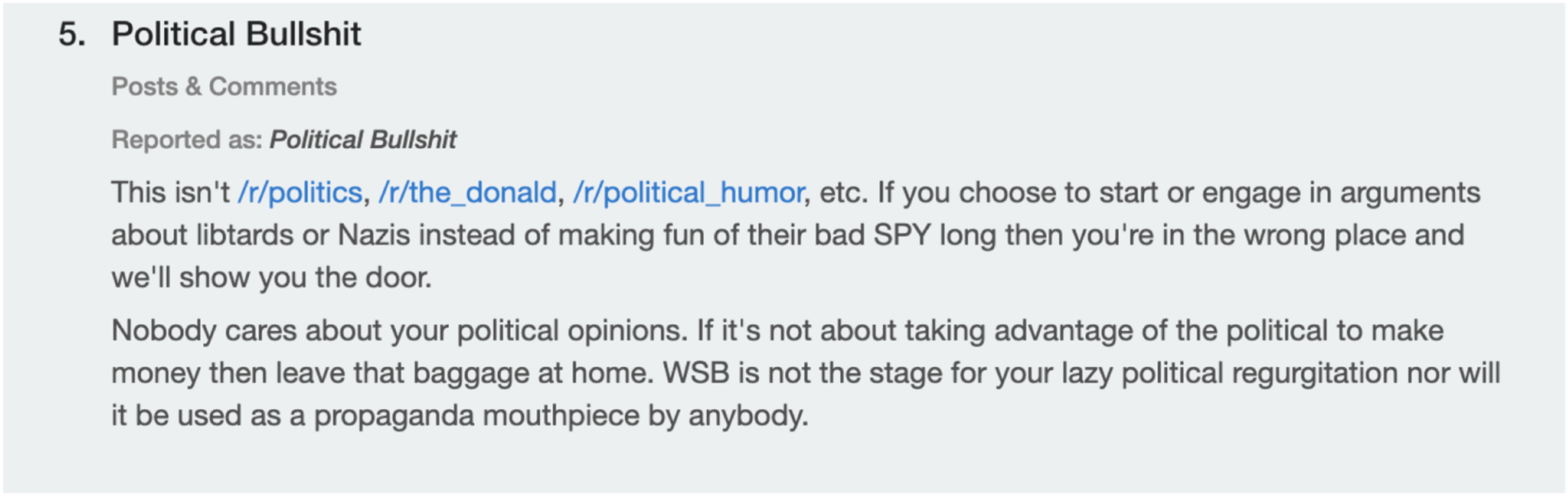
Continually “evading the codes of settled people” (Deleuze, 1985: 149), r/wallstreetbets runs on affective rushes rather than reason (also Boler and Davis, 2018; Just, 2019), and embraces an openly profane and immature demeanour against the conventional expertism and hierarchies of Wall Street. Its users regularly describe themselves as ‘retarded’, ‘autists’, ‘degenerates’ and even ‘apes’ 23 , 24 displacing the restrained and analytical ways of talking about trading. Instead, we see a tendency of technologically intensified affectivity akin to a swarm (Han, 2017) going for irrational but apparently enthralling trading for the ‘lulz’, shock value, and outrage rather than a rationalised pursuit of profit or a strategic approach to resisting financial capitalism. Clearly, the movement is a crowd phenomenon (see Brighenti, 2010; Lopes et al., 2021) rather than a community marked by structures and ‘members’. Without stable leadership, an overarching agenda, or a teleological end game, it’s simply a means in and of itself, described in the media as a “swarm of rowdy bros playing out their wildest Wolf of Wall Street fantasies.” 25
As such, the swarm reported flippantly investing its life savings in meme stocks like AMC 26 . From the position of the establishment, this unchartered mass of activity was utterly baffling. R/wallstreetbets seemed to suddenly “come like fate, without reason, consideration, or pretext” (D+G, 2013b: 412). To the extent that r/wallstreetbets is organised, it’s only through Reddit’s built in upvoting/downvoting system, a system of algorithmic intensification based on which post excites the most and receives most upvotes. The posting system is not marked by calm deliberation and dialogue, but by affective outbursts which escalate through feedback-loops that channel desiring intensities (Boler and Davis, 2018).
To the extent to which r/wallstreetbets can be said to have a clear ‘enemy’ (one might readily offer up the hedge funds they short squeezed), it’s only one clearly articulated and assigned after the fact, through the public and media’s attempts to pin the divergent phenomena in stable and familiar resistance templates. Meaning must be made, and whenever a nomadic force disrupts the social order, “there is a man of the State, a shadow or an image of a man of the State, that counsels and admonishes him, and wants to assign him a target or ‘aim’” (D+G, 2013b: 441). Take, for example, one attempt by Business Insider to assert that “Wall Street Bets traders claim to be pouring thousands into a company called UWM holdings” 27 , an asset untargeted by the forum.
In more precise terms, r/wallstreetbets is irreducible to identifiable power structures. It’s a desiring tendency too unsettled to be ‘meaningfully’ decoded in terms of oppositional entities. Lacking unification through in-group/out-group binaries or an accessible meaning-making “consciousness of kind” (Muñiz and O’Guinn, 2001: 413), it grafts various affective enunciations without synthesizing them into a struggle against some big Other (also Etter and Albu, 2020). As covered by Bloomberg, r/wallstreetbets trades had little agreement on the direction of the effort and did not view themselves as a collective, group, team, or organization principally aimed at toppling hedge funds. 28
Whereas an identifiable regime of power (‘state’) “distributes binary distinctions, and forms a milieu of interiority” (D+G, 2013b: 410), the war machine is “always something that flows or flees, that escapes the binary […] and the overcoding machine” (p. 252). In this sense, r/wallstreetbets presents itself as a form of unity without unification, ideological commitment, recourse to shared identity, or shared teleological goals. In its untraceable and multitudinous character, its war machine-like ‘stupidity’, ‘deformity,’ and ‘eccentricity’ allowed it to function without immediate detection or response. Moreover, detection was hindered because resistance came in the form of a capitalist desire itself. Interrupting it would be an immediate recourse to hypocrisy, which contemporary capitalist tendencies will certainly not hesitate to do, as we will soon see.
The r/wallstreetbets war machine consists of dividualised nomads who occupy the smooth space of the stock market
Beyond a clearly demarcated, meaningful, and purpose driven community, r/wallstreetbets also deterritorializes the goal directed individual. Financial capitalism is marked by a highly abstract mode of production which facilitates profit accumulation from financial transactions themselves, rather than from concrete production (Jameson, 1997). It indexes a shift wherein capital “becomes free floating” (p. 251), spatially ambiguous, and removed (also Hewer, 2020). In doing so, it creates the smooth space of the stock market, freeing money from production, labour from land, and capital from the state’s territorial boundaries, transforming the social field into the image of capital and fragmenting the identity of individuals on the smooth space of stock markets (also Beck, 2016). Intensified by online anonymity and algorithmic intensification, traditional roles break down, allowing participation fuelled by affective excitement (Boler and Davis, 2018; Fisher, 2020; Just, 2019), wherein fragmentation is actually sought after and actively paid for by consumers (Darmody and Zwick, 2020). This smooth space where classical loci of meaning and identity evaporate is thus associated with the ‘dividual’, the subject whose identity is fragmented, who is at the same time worker and consumer, debtor and financial speculator (or investor) […] by deterritorializing corporations, nations, workers, finance (and financialization) contributes to the production of dividuals […] finance establishes a ‘smooth space’ without borders (Barthold et al., 2018: 11).
This ‘dividualization’ (Deleuze, 1992) in datafied communications, where we can decreasingly speak of coherent individuals, is clearly manifest in r/wallstreetbets. Not only are posts fragmented affective exclamations (also Cheney-Lippold, 2011; Galič et al., 2017), but also, through gamified trading apps with addictive, easy to use interfaces, retail investors and speculators have become at the same time also consumers (of Reddit and the various trading platforms/apps) in addition to being debtors and workers. The apps create what Fisher (2020) terms “frictionless digital space” (p. 94), blending sociality, financial speculation, and excitement into activity that is marked by its “intensive qualities” (D+G, 2013a: 30), rather than clear demarcations between entities, meaning or reflection. In fact, so extreme was the blurring of meaningful boundaries that in several instances, r/wallstreetbets speculators claimed to work for the very firms they were short squeezing 29 ! In this sense, the war machine conceptually highlights how the Robinhood application merged the finance worker and keyboard warrior into a ‘new type’ of trader that mapped herself on the relatively smooth space of the market. Instead of the economic (wo)man of structure, what emerged in the anonymous dividuality of r/wallstreetbets existed only for the excitement of perpetuating the ‘lulz’. To be clear, despite its deterritorializing vectors, the stock market is not a purely smooth space where nomadic life is truly possible given its underlying axiomatic (the endless accumulation of capital).
Importantly, for D+G (2013b) nomads do not merely inhabit a pre-existing smooth space, they actively smooth the spaces they encounter, as “the nomads make the desert no less than they are made by it” (p. 445). Thus, the stock market is striated by masses of institutional investors seeking to perpetuate their positions. More striations are created when fixed paths and points are established – the institutional investor chooses to trade when specific conditions are met such as when a price rises or falls to a predetermined amount, generally calculated by algorithms that attempt to interiorize market dynamism (also Etter and Albu, 2020). However, in a smooth space the speculative investment behaviour (the path) of nomadic retail investors is not dictated by such concerns but instead follows immanent desiring flows. Put differently, the nomad is not ignorant of […] points […] strictly subordinated to the paths […] exist [ing] only as a relay. A path is always between two points, but the in-between […] enjoys both an autonomy and a direction of its own (D+G, 2013b: 443).
In r/wallstreetbets there was keen awareness of the dates and price points at which a successful short squeeze would result in a given hedge fund going solvent. However, these points did not determine their path, which had autonomy of its own, akin to a “release of a Speed vector that becomes a free or independent variable” (D+G, 2013b: 462). This free vector is visible in the retail investors rallying cries to pump up the price to infinity (‘AMC to the moon!’ 30 ). In this sense, by subordinating the points to the path, r/wallstreetbets set loose its desiring tendency, a weaponised line of flight that smoothed the stock market.
By detaching value from the concrete, the stock market allows for a kind of speculation that can be wildly profitable so long as it does not go ‘too far’ and delegitimize the entirety of the capitalist machine by exposing the mismatch between valuation and underlying production. Capitalism must be quick to adjourn a human mask of reason to not expose its inhuman desire of pure accumulation (Fisher, 2014). A bit of speculation is permitted, so long as it’s done by a handful of elites, the ‘right’ people who play by the ‘codes of settled people’ (Deleuze, 1985). When the secret is well kept from outsiders, there is little risk of a deterritorializing line of flight undermining claims that predatory and speculative finance do serve rational and productive economic functions. What was striking about r/wallstreetbets is that it publicly exposed this disconnect in between valuation and underlying ‘concrete’ reality. In doing so, it demonstrated that the map given by financial experts does not innocently represent reality but actively creates it.
The seeds of state capture are built into the war machine from its inception as evidenced by the institutional response
Conventional perspectives assume a meaningfulness driving consumer resistance and imply that a teleological outcome of change is possible if the act of resisting is successful. Yet, as noted above, this analysis tends to reify power binaries and implicitly favour resistance as an activity of identity construction and resistant lifestyle (and market) recreation. A D+G reading of r/wallstreetbets allows us to assess the dynamic interplay of these desiring flows. As we have seen, financial capitalism deterritorializes capital by creating the partially smooth space of the stock market. While smoothness potentially tackles oppressive structures, it should be remembered that it can also operate to conceal vast manipulation and control, as many simple and easy-to-use but massively addictive applications demonstrate (Fisher, 2020). However, when the flows are indeed weaponised, the ‘state’ (as in the locus of appropriation tending to structure) urgently channels them back into pathways that stabilize social relations. Today, the state is inseparable from capitalism and its corporate arms and “the capture of the war machine by state apparatus [takes] place […] by constituting it in accordance with the rules corresponding to civil society as a whole” (D+G, 2013b: 488), in our case global finance and consumer society, in the sense that “there is only one culture: capitalistic culture” (Guattari and Rolnik, 2008: 33).
While there was giddy anticipation surrounding the long-term potential of r/wallstreetbets, it was in fact doomed from the start. For D+G, there is always a surplus of stratification (Brassier, 2010), and any moment a war machine starts to ‘succeed’ and thus to solidify, it loses the inertia that allowed it to evade capture. The capturing of rogue trading occurred in several ways in r/wallstreetbets. First, we saw attempts to capture nomadic ‘free action’ or “activity in continuous variation […] with intense but rare peak moments” (Smith, 2018: 225) into sanctioned forms of labour. It’s not so much that the state had an issue with questionable speculative practices. In truth, institutional investors have been practicing predatory speculation for decades. The real issue is that the nomad tendency of r/wallstreetbets “impl [ies] a division of labor opposed to the norms of the state” (D+G, 2013b: 429), wherein only the ‘right’, ‘institutional’, ‘professional’, or state-captured investor is allowed to engage in such activity.
While the state subordinates free action to regimes of work, nomadism traverses these striations through a movement of decoding. In becoming nomadic, the r/wallstreetbets retail investors refused to play into their ascribed roles. As a response, the institutional investors, financial experts, and regulators called for further role definition of outsiders, turning nomads into predictable components of the system again. It was also demanded that retail investors be warded off (ban the nomads from occupying the smooth space they created by enclosing the territory with barriers to entry) as evidenced by pressure put on free trading platforms to halt meme stocks trades as well as on Discord to ban the r/wallstreetbets server. As r/wallstreetbets unleashed its war machine against state-corporate interests by turning investors into purely numerical, abstract, and deterritorializing lines of flight, the financial industry put pressure on the state to re-territorialize these desiring flows before capitalism’s internal limits were exposed.
Second, from its inception, the r/wallstreetbets war machine had seeds of state capture built into it by virtue of the technology it weaponised. As explained above, Robinhood and other free trading platforms’ biggest source of profit comes from selling its users’ trading data to high-speed traders who use this information to decipher the application user’s trading strategy. According to one former high-speed banker, It’s like you’re writing a secret on a piece of paper and handing it to your broker, who sells it to someone who has an interest to trade against you
31
.
Because the war machine’s core advantage over the state is its secrecy and absolute speed, this monetization system radically limits its ability to upset the system it’s itself constitutive of. Upsetting a system while still within highlights another key element of nomadology concerning the difference between tools and weapons. For D+G, there remains an openness about how tools are used (or weaponised) beyond binary notions of power and resistance (also Crogan, 1999). Something like a trading application is not inherently good or bad, inherently part of the state’s regime of labour or the nomad’s mode of free action. Instead, their status depends on the particular assemblage they are plugged into (also Beck, 2016). In this case, the technology systemically allowed r/wallstreetbets data flows to be captured by large institutional investors who exploited it by predicting when retail investors were likely to trade. Insofar as speed and secrecy are the weapons of the war machine, selling these order flows reduces the machine’s weaponry to the status to tools which “do not “tendentially” (approximately) have the same relation to movement, to speed […] the discovery of speed invents the weapon” (D+G, 2013b: 461). Like other algorithmic applications which offer the “illusion of autonomy” (Fisher, 2020: 94) but run on clandestine control, the trading applications offer a smoothness of experience but deliver an accumulation of profit, not freedom. However, if it had been plugged into a different assemblage, it’s possible that the war machine could have preserved its secrecy and speed longer, thus fending off state capture for another day.
War machines in consumer research
From D+G’s perspective, every social event consists of passionate excitations as immanent desiring flows. Although it’s not easy to loosen our ties to the strongholds of coherent meaning and identity or embrace a theory which replaces stability with a ‘leaking’ and escaping desire, this radical perspective can greatly complement more structuralist views of consumption (also Hill et al., 2014). As the movies American Psycho and The Wolf of Wall Street express, the desire for endless accumulation that undergirds the stock market (Crostwaite, 2010; Ertürk et al., 2010; Smith, 2011) is a machine of unruly excess (O’Doherty, 2007; also Pawlett, 1997) which readily undoes meaning in favour of a technocapitalist desiring mania (Hietanen et al., 2020), similar to social media’s excessive qualities (Boler and Davis, 2018; Etter and Albu, 2020; Just, 2019). In light of this, we approach consumption from the perspective of desire as a starting point rather than a reaction or outcome of power (also Coffin, 2021) and offer a rethinking of technologically-mediated consumer resistance by focusing on affective flows over structural positions of power and identity.
First, placing primacy on desire, on an excessive rather than meaningful force in social formations, profoundly reorients the consumer resistance researcher away from seeking new resistant identities or transgressive market-mediated meanings. It redirects interest towards keeping (already primary) lines of flight from being captured and reterritorialized. D+G’s perspective ontologically depicts society through affective, desiring flows that constantly leak or take flight in all directions yet are readily captured by corporate-state forms. From this standpoint, the primary concern of consumer resistance should revolve around organizing and uniting various modes of escape without reproducing a state apparatus or corporate form (also Culp, 2016). While the notion of desire has not eluded consumer research, when consumption of technologies remains primary to desire (see Belk et al., 2020; Kozinets et al., 2017), resistance will likely continue to be seen as a reaction, ignoring how desire already constitutes the socio-technological assemblage to begin with. For researchers attempting to imagine something perhaps more striking, this means avoiding the seductive impulse to celebrate new cracks in stable structures of power or the latest resistant consumer identity project in favour of asking a more difficult question: how can anything avoid capture?
Although extant research notes consumer resistance is co-opted by marketers (Holt, 2002), it does not shed much light on how to organize resistance to avoid capture. Instead, the search for small and contextual liberations through resistant identities and lifestyles (Cherrier, 2009; Hietanen and Sihvonen, 2020; Kozinets, 2002) has become central. While there is no doubt identity is an important perspective, the question of how to motivate resistance becomes problematic when one acknowledges that affective desiring flows constitute the social. Although negotiating resistant identity may seduce participation, it also makes resistance more readily co-optable by corporate-state forms which turn the resistant identity into a new target market, niche, or lifestyle choice (Desmond et al., 2000; Holt, 2002; Izberk-bilgin, 2010; Kates, 2002). From a D+G (2013ab) perspective, any recourse towards reterritorialization upon identity is already a capitulation to capture. In contrast, in a war machine, deterritorialization of a given oppressive system is never met with a subsequent reterritorialization upon identity or a consumer ‘consciousness of a kind’ (Muñiz and O’Guinn, 2001).
In addition to motivating resistance, consumer resistance and consumer-driven new social movement research underscores identity’s role in framing adversaries and, in turn, defining movement goals (Kozinets and Handelman, 2004). Here, exigent research tends to theorize resistance as a binary struggle between some in-group of consumers and a big Other, generally articulated as a structure of power which appears to emerge ex nihilo, as if desire was not immanent to the construction of the social formation being resisted to begin with (also Checchi, 2014; Smith, 2016). As a result, resistance is depicted as linear and teleological, basing its trajectory not on an affirmative pursuit of emancipation by emerging on the periphery (also Munro, 2016), but the overthrowing of a clearly recognizable contextual adversary, ignoring the almost limitless shape-shifting capacity of capitalism to accommodate identity-based struggles.
By analysing r/wallstreetbets as a war machine, we evoked an affective intensity that comes together through online mediation and algorithmic intensification (also Boler and Davis, 2018; Beck, 2016; Just, 2019). We have attempted to show its immanence and in-betweenness, including a lack of stable identity or readily identifiable goals or political purposes. We have proposed a striking reading of communicative intensification in late capitalist consumer society – rather than meaningful goals, desiring flows as thrilling means have become primary. While the energy of the war machine can momentarily upset structure, we have also highlighted several forms of capture that have already and will continue to undermine r/wallstreetbets. First, we noted how corporate-state depictions of r/wallstreetbets investors as amateurs who are uninformed and in need of protecting recoded their free action back into the regime of labour and created the justification for new regulations which threaten to pre-empt future short-squeezes. Second, we highlighted how the state capture of r/wallstreetbets was inevitable due to the particular financial tools and social platforms it tried to weaponize which were inherently corporate, there precisely to intensify capitalist accumulation and control (also Beck, 2016; Cheney-Lippold, 2011). Because free trading platforms profited by selling user data to high-speed traders, they undermined the war machine’s key weapons (speed and secrecy). Despite invoking the revolutionary figure that steals from the rich and gives to the poor, Robinhood ironically turned its users into the product and sold their data flows to the very corporate institutions they sought to undermine (also Best, 2010; Zwick and Denegri Knott, 2009).
If one wishes to imagine unconventional forms of consumer resistance, we suggest that a) speed, b) secrecy, and c) non-identarian, affect-based organizing are key to warding off capture in the current global situation of technologically-mediated consumer desire. Rather than a form of reactionary resistance, r/wallstreetbets is better described as a form of in-sistance, an imminent, unpredictable, and open-ended mode of political action free from the reactionary connotations of conventional resistance. Whereas resistance is ultimately a reaction or counterattack to what is perceived as a structure of power, the term in-sistance implies an active, creative, affirmative, transformative, autonomous, and self-directed mode of free action. While capture is always immanent, nomadic in-sistance highlights the value of staying put or staying ‘in’, clinging to the smooth spaces of capitalism, and inhabiting deterritorializing lines of flight that internally push capitalism towards its limit. As Deleuze (1985) notes, nomads “do not move; nomads […] stay in the same place and continually evade the codes of settled people” (p. 149). D+G (2013b) further explain that “whereas the migrant leaves behind a milieu that has become […] hostile, the nomad […] does not depart [but] clings to the smooth space” (p. 444). In other words, the migrant changes their habitat in order to preserve their habits, while the nomad changes their habits, so as not to change their habitat. In this sense, nomadic insistence shares some similarities with the post-workerist canon of ‘within and against’ (Toscano, 2009) through its emphasis on insisting from ‘within’. Moreover, both traditions theorize resistance as primary to power/capital. In the workerists tradition, working class resistance is not a reaction to power but what obliges power to react. However, they differ in that the post-workerist canon returns to structure and political identity, emphasising the importance of class composition and the development of an insurrectionary program.
In r/wallstreetbets, investors kept the same habitat (e.g. holding their meme stocks, occupying the smooth space they erected) precisely by changing their habits (rejecting traditional approaches to investment, or the codes of settled people in favour of this irrational trading for the ‘lulz’). This nomadic strategy differs from several classic consumer resistance activities, which are migratory in nature. First, the nomadic approach is distinct from ‘vote with your dollar’ approaches like boycotts (Kozinets and Handleman, 1998) and buycotts (Friedman, 1996; Neilson, 2010) in which consumers change their habitat (i.e. they chose to not shop somewhere or shop somewhere new) so as not to change their habits. Second, nomadic in-sistance is distinct from resistant or transgressive identity projects (Karababa and Ger, 2011; Scarabato and Fischer, 2013; Thompson and Üstüner, 2015), in which one oppressive mode of subjectification is deterritorialized, but the deterritorialization is met with a subsequent reterritorialization upon identity, now co-optable as a new market niche. Third, nomadism is distinct from consumer-driven new social movements which Kozinets and Handelman (2004) note are marked by shared political “ideology constituted of […] a goal, a self-representation, and an adversary” (p. 269). Fourth, nomadism is distinct from attempts to escape the market and alternative forms of anti-consumption such as minimalism or voluntary simplicity. Reflecting on such migrant strategies, D+G (2013a) ask Which is the revolutionary path? […] To withdraw from the world market […]? Or might it be to go in the opposite direction? To go still further […] in the movement of the market, of decoding and deterritorialization? For perhaps the flows are not yet deterritorialized enough, not decoded enough […] Not to withdraw from the process, but to go further, to “accelerate the process” (p. 239–240).
Thus, although we point out affirmative potentials of nomadic in-sistance, we are not writing a hagiography of affective affirmation like more ‘joyful’ D+G scholarship tends to do (Culp, 2016). Nomadism is a never-ending task, becoming immediately captured and co-opted when it stagnates. Deleuze (1992) himself, in his famous Post-Script, already foreshadowed this foregone optimism of radical experimentalism or, put more bleakly, “the (thought) experiment in nomadology seems to have gone sour” (Greve, 2020: 10). Although we would argue r/wallstreetbets’ nomadic tendency resulted in momentarily disrupting several powerful financial institutions, it nonetheless came with seeds of state capture built in and, like all war machines, eventually fizzled out.
Indeed, while momentarily portrayed as an emancipatory anti-capitalist movement, r/wallstreetbets investors did not share an identity grounded against an adversary that would have sustained the articulation of a teleological agenda. It was made up of an ambiguous diversity of debtors and speculators, keyboard warriors and workers, financial advisors, and short squeeze pirates. Far from an us versus them there was only a cyclical intensification of territorializing and deterritorializing desire. It was not meaningfully goal-directed, but affectively charged, a means in and of itself. As such, it did not carry out a ‘project’ of resistance against financial capitalism, but simply subverted and undermined its contours due to its very form that eschews control and subservience. As a war machine, its tendency cuts across structures of order, rushing “from one moment to the next” (D+G, 2013b: 463). In the technocapitalist financialized order where all stable coordinates seem to have vanished and been dispersed globally, any serious goal-directed strategy of resistance is precarious. Today, we need an imagination of war machines to understand the libidinality of increasingly common, irrational, collective phenomena, facilitated by dividualization and algorithmic intensification. Foregrounding the primacy of desiring flows gives us a novel way of talking about such phenomena, and ultimately, (re)thinking their in-sistant potential politically.
Footnotes
Declaration of conflicting interests
The author(s) declared no potential conflicts of interest with respect to the research, authorship, and/or publication of this article.
Funding
The author(s) disclosed receipt of the following financial support for the research, authorship, and/or publication of this article: This study is part of the ‘Algorithmic Selves: The algorithmic intensification of societal control’ research project funded by the Finnish Cultural Foundation, Suomen Kulttuurirahasto grant number (00210377).
