




Abstract
This study examines participatory logics as a process of the platformization of culture in the context of fitness body culture on Instagram. Building upon meme theory and applying a networked content analysis of #fitness, we highlight the memetic logics of participation that manifest in and derive from an interplay between consumers and affordances. Our findings, first, detail how content exhibiting common characteristics forms contextual memes that make up the platform's meme complex of fitness body culture. We, second, outline how the memetic logics of participation interconnect, cross-reference, and reinforce a standardized and platformized consumer culture. This study ultimately points to a networked public in which consumers follow both context-specific and platform-afforded—memetic—logics of participation in cultural production.
Keywords
Introduction
The pervasion of platforms has shaped cultural production (Poell et al., 2022), that is, “social processes involved in the generation and circulation of cultural forms, practices, values, and shared understandings” (Oxford Reference, 2023). With user engagement as the driver of cultural production, corporations seek to bind consumers to their respective platformized ecosystems. This interplay between social actors as cultural producers and platforms (Poell et al., 2022) ultimately foregrounds platformization—“the platform as the dominant infrastructural and economic model of the social web and the consequences of the expansion of social media platforms into other spaces online” (Helmond, 2015: 5).
Platformization, “capturing […] digital life in an enclosed, commercialized [,] and managed realm” (Hands, 2013: 1), brings forth walled gardens (Dekker and Wolfsberger, 2009), “geared toward the systematic collection, algorithmic processing, circulation, and monetization of […] data” (Van Dijck et al., 2018: 4). Through this technological apparatus, platforms establish conditions of border patrol that guide usage (Couldry and Van Dijck, 2015). In turn, social actors—cultural producers, advertisers, service providers, and data intermediaries—aim “to defend or promote their interests, pushing the platform operator […] to adapt its infrastructures and governance framework” (Poell et al., 2022: 8). Such participatory cultures invite consumers “to actively participate in the creation and circulation of new content” (Jenkins, 2006: 290) by producing and “[sharing] sophisticated cultural artifacts” (Manovich, 2017: 4). Affordances, for example, hashtags, provide action possibilities (Gibson, 1986) that play a central role in forming participatory cultures—enabling and constraining consumer actions (Kozinets et al., 2021; Schöps et al., 2022). The cultural production of participatory cultures forms networked publics which “are simultaneously (1) the space constructed through networked technologies and (2) the imagined collective that emerges as a result of the intersection of people, technology, and practice” (Boyd, 2011: 39).
Bruns and Burgess (2011) investigate the role of platform affordances in public formations and find that consumers build ad hoc formations around trending hashtags. These networked publics exhibit memetic cultural production as imitative practices (Nicoll and Nansen, 2018). Scholars further argue that affect constitutes a vital component of these practices (Stage, 2013), becoming apparent as affective publics (Papacharissi, 2016). In those, affordances and standardized semiotic repertoires propel collective expressions of sentiment, for example, grief in the case of #PrayForParis (Döveling et al., 2018) or desire in the case of #foodporn (Kozinets et al., 2017). Brand publics also constitute a type of affective public. In these publics, geographically dispersed—disconnected—consumers instrumentally use brand-related platform affordances, for example, #louisvuitton, as “[vehicles] for visibility and publicity” (Arvidsson and Caliandro, 2016: 742). Caliandro and Anselmi (2021) demonstrate that such publics manifest in affordances-based relations in which consumers memetically draw on platform-afforded grammar and vernacular (Gibbs et al., 2015) and produce branded templates.
However, research on the interplay between consumers and affordances and the underlying memetic logics of participation in public formations remains scant. Particularly, Caliandro and Anselmi (2021, 15) call for research investigating how consumer culture unfolds “below, between, and beyond the constraints of social media platforms,” arguing that “[memes] can be a suitable heuristic to interpret the processes of platformization of culture on social media” (Caliandro and Anselmi, 2021: 2; Nieborg et al., 2020). Thus, our study aims to investigate how participatory logics, as one such process of the platformization of culture, manifest in and derive from an interplay between consumers and affordances—the actionable properties and physical and cultural constraints of Instagram (Gibson, 1977). Properties on Instagram encompass hashtags, filters, or others for expression; physical constraints may relate to supported content formats, while cultural constraints are conventions developed by “cultures of use” (Rieder et al., 2018: 52). To investigate these participatory logics, we build upon a meme theoretical perspective (Dawkins, 1976/2016; Shifman, 2014a; 2014b) and apply a networked content analysis (Niederer, 2016). Our study turns to the fitness body culture that unfolds at the intersection between consumers and the hashtag #fitness on Instagram as a context in which “the cultural aspects and the technical specificities of the online [site] employed for the data collection” tie together (Rogers and Giorgi 2023, 3). We aim to extend Caliandro and Anselmi’s (2021) research on memetic logics of branded material consumption objects. As such, our study illustrates that memetic logics of participation may also manifest in consumer embodiments emerging through sociocultural practices, for example, postures and gestures, which are central to the digital fitness body culture (Ferguson et al., 2021). We decided to focus on Instagram due to the predominance of the simplest visual format on the platform—the image—allowing us to describe the complex memetic logics intuitively.
The contribution of our study is twofold. First, we add to the discourse on platformized consumer culture by demonstrating how the interplay between consumers and platform affordances follows memetic logics of participation. Second, we advance the understanding of platformized publics by illustrating a networked public of recursive imitation and standardized expressions of sentiment.
Theory
Platformized consumer culture
The social media platform Instagram affords consumer culture through semiotic resources of visual material, that is, feed posts, reels, stories, and filters, on the one hand, and semantic resources, that is, captions and hashtags categorizing and contextualizing the image (Caliandro and Gandini, 2017), on the other hand. These visual and textual components constitute the front-end affordances of the platform. Kozinets et al. (2021) demonstrate that not merely policies and algorithms but also such affordances govern a platform’s digital infrastructure, pointing to the potential of platforms to control consumer empowerment. Algorithms and affordances mediate “the visibility of culture as curators and gatekeepers” (Schöps et al., 2022: 81), enabling and constraining consumers’ action—cultural production. However, such nonhuman platform actors also respond to usage histories of social actors, for example, accounts followed, posts liked, shared, commented, or saved, while aggregating data into content clusters that exhibit common visual and textual characteristics (Schöps et al., 2022). Airoldi and Rokka (2022) even refer to the recursive loop as an iteration scheme of influence between computational recipes (Gillespie, 2014) and consumers. On the one hand, platforms afford content creators’ labor processes and creative expression; consumers, on the other hand, accommodate their cultural production to Instagram’s affordances and shape the platform ecosystem themselves (O’Meara, 2019).
As platforms reconfigure how consumers produce content and, in doing so, relate to others in an individual or group setting (Varnelis, 2008), “contemporary life is dominated by the pervasiveness of the network” (Varnelis and Friedberg, 2008: 15). This intersection between society, culture, and technology constitutes networked publics (Boyd, 2011). There, digital mass communication actively “[caters] to a wide arena of cultural life” (Ito, 2008: 2). According to Boyd (2011), these networked publics revolve around the dynamic that, first, many-to-many conversations may involve invisible and non-co-present audiences, second, social contexts may no longer be distinct as their spatiotemporal boundaries become blurred, and, third, interactions unfold at the interplay between privacy and visibility. With the questioning of traditional top-down relationships between media and consumers, networked publics “of cultural production freely combine informal and amateur domains of culture with formal and professional ones […] [through] mashing up, remixing, playing out alternative narratives” (Russell et al., 2008: 46). Persistence, replicability, scalability, and searchability afford such networked publics and, thus, consumer participation (Boyd, 2011). Recently, Caliandro and Anselmi (2021: 5) point out that this social, cultural, and technological intersection references “a fertile ground for the production and circulation of memes and meme cultures.”
Meme theory
Meme theory conceptualizes memes as the sociocultural analogy of genes. Dawkins (1976/2016: 249) introduces the meme as a “unit of cultural transmission, or a unit of imitation” to illustrate how any cultural entity with a copyable quality, that is, ideas and concepts, behaviors, and practices, circulates, replicates, and propagates within culture and society. Dawkins’ work resulted in the creation of a new discipline—memetics. In line with his ideas, scholars have theorized that memes, using the human brain as copying machinery (Blackmore, 2008), compete for limited resources and respond to selective pressures, determining their chances of survival (Spitzberg, 2014) by three essential qualities: (1) longevity, that is, the chance of a meme to survive long enough to replicate, (2) fecundity, that is, the pace at which a meme replicates, and (3) copying fidelity, that is, the accuracy of a meme’s replication (Dawkins, 1976/2016). Moreover, memes tend to mutate with every transmission. Memes may also complement, cooperate, and replicate together (Heylighen and Chielens, 2009). They tend to become part of one or more memeplexes, that is, a complex of interconnecting, cross-referencing, and self-reinforcing memes (Spitzberg, 2014) that are memetically related (Heylighen and Chielens, 2009) and, therefore, stabilize the memeplexes’ identities.
While acknowledging the founding fathers, modern meme scholars challenge two characteristics of memetics (Shifman, 2014b). First, its biological analogies may be problematic due to their reductionist nature, framing humans as passive entities exposed to “memes as the cultural equivalents of flu bacilli” (Shifman, 2014b: 11). Second, scholars point out the “who’s the boss” issue, referring to memetics’ conceptualization of human agency, that is, “agents are essentially viewed as ‘vectors’ of, rather than actors behind, cultural transmission” (Aunger, 2000: 87). Yet, memetics’ jargon lives on in the contemporary usage of meme(s) to describe digital content “that is passed very quickly from one internet user to another, often with slight changes that make it humorous” (Oxford Learner’s Dictionary, 2023). Scholars define these internet memes as “(a) a group of digital items sharing common characteristics of content, form, and/or stance, which (b) were created with awareness of each other, and (c) were circulated, imitated, and/or transformed via the Internet by many users” (Shifman, 2014b: 41).
These common characteristics manifest in (1) prospective photography, that is, a standardized template, (2) operative signs, that is, “textual categories that are designed as invitations for (creative) action” (Shifman, 2014a: 354), and (3) hypersignification, that is, “the code of the message is the message itself” (Caliandro and Anselmi, 2021: 5). Internet memes are “circulated, imitated, and transformed through the internet by multiple users” (Shifman, 2014a: 341). As such, users follow “economic, social, and cultural logics of participation” (Shifman, 2014b: 32)—memetic logics. Economic logics refer to the attention economy on social media, that is, memetic content reproduction of popular formats to grasp as much attention as possible. Social logics manifest in users’ urge for networked individualism, that is, users craft an outstanding digital self through unique and creative memetic content creation while referencing to and affiliating with the broader community’s content. Cultural logics imply that memes protrude over platforms by following and reinforcing norms, practices, and aesthetics that constitute the “building blocks of complex cultures” (Shifman, 2014b: 34). As such, “memes can be seen as sites in which historical modes of cultural production meet the new affordances of Web 2.0” (Shifman, 2014b: 34).
Our study draws on both the source material (Dawkins, 1976/2016) and its contemporary conceptualizations (Shifman, 2014a, 2014b) to illuminate the memetic logics inherent in platformized fitness body culture on Instagram. While not subscribing to the source material’s idea that “people are merely devices operated by the numerous memes they host and constantly spread” (Shifman, 2014b: 12), we employ its ideas and terms from a sociocultural perspective. Accordingly, we view Instagram as a platformized ecosystem that fosters an interplay between consumers and affordances. This interplay produces memeplexes, that is, meme complexes, which we understand as groups of contextual memes (Shifman, 2014b) where meaning materializes following “the specificities of the platform, its material architecture, and the collective cultural practices that operate on and through it” (Gibbs et al., 2015: 258). In this sense, platforms and (web-)sites are the source of memes and therefore shape their compositionality—memes, after all, “are collections of technical content constructed in software environments online” (Rogers and Giorgi 2023, 13). We understand that memes materialize as compositions of material and expressive components, that is, standardized templates (Shifman, 2014a). These standardized templates manifest in prospective photography on a semiotic level and hashtags as operative signs or “organic, categorical markers” (Leavitt, 2014: 137) on a semantic level. However, as memes “are more about the process of meaning-making than about meaning itself” (Shifman, 2014a: 344), they not only become apparent in repeatedly emerging semiotic and semantic codes (e.g., two persons hugging each other). Memes also crystallize in the “culturally coded signs” (Shifman, 2014a: 350) they confer (e.g., sense of unity, intimacy, or liking), that is, their hypersignificant quality (Shifman, 2014a) and the contextual climate surrounding them (Leavitt, 2014).
Methodology
This study draws on a networked content analysis (Niederer, 2016) to examine the memetic logics of fitness body culture on Instagram. Networked content analysis constitutes a quanti-quali approach, meaning that data analysis consists of a computational analysis to structure the data and “a qualitative close reading of the data” (Niederer, 2016: 103). This methodological approach is particularly beneficial to understand how “memes interact with social, cultural, and political realities” (Shifman, 2014b: 175). Networked content analysis necessitates identifying the platform-afforded grammar and vernacular (Gibbs et al., 2015), that is, “the terms employed by the actors” (Niederer, 2016: 36), as a first step. On Instagram, this platform-afforded vernacular manifests in hashtags. The hashtag #fitness is the most used in the context of body culture on Instagram, accumulating 395.8 million postings and ranking at position 26 of all hashtags (Top-Hashtags, 2023). Our study performed a single query of ‘#fitness’ by running the InstaCrawlR scripts in RStudio, gathering a metadata set of 10,000 posts. InstaCrawlR is “a collection of R scripts that can be used to crawl public Instagram data without the need to have access to the official API” (Schröder, 2018). The metadata set contains, for example, post URLs, image URLs, and captions (including hashtags). Our study used a python-based script to extract co-occurring hashtags from the metadata set. We then loaded the extracted co-occurring hashtags into Gephi for computational analysis. The computational analysis encompassed the calculation of average degree (48.3)—a centrality measure determined by the number of connections of a specific hashtag (Yang et al., 2016), and modularity classification (0.472)—an algorithm that clusters densely connected, thematically-related hashtags together (Brandes et al., 2008). We scaled the label size by degree, that is, the higher the degree, the bigger the label size. We found little clusters in different languages, which we identified as linguistic variations of the English clusters, and, therefore, filtered out in the final visualization.
Concomitantly, we conducted a qualitative close reading of the images in the metadata set, using the post URLs to access the images. We followed a systematic sampling strategy in which we selected every tenth image (Rose, 2016). We skipped deleted links to videos or posts and—relating to our context of fitness body culture—excluded visuals not depicting at least one consumer body in part or whole. We then performed a visual content analysis (Rose, 2016) in which we iteratively open-coded the images by their material and expressive components (Rokka and Canniford, 2016; Schöps et al., 2020). We followed this procedure until we achieved theoretical saturation at 449 analyzed images, composed of 116 material and 29 expressive codes, illuminating the compositionality of fitness body culture on Instagram.
The methodology of this study necessitates a couple of ethical considerations. First, we used a crawler that bypasses the official API—a practice commonly accepted in social research if done ethically (Venturini and Rogers, 2019). Meta currently only offers access via its CrowdTangle API, which allows access to “all public Instagram accounts with more than 50K followers, as well as all verified accounts” (CrowdTangle, 2023), that is, data of commercially oriented public figures, for example, influencers. We are, however, interested in consumer culture, that is, regular users, making this tool irrelevant to our study. Second, we treated all data ethically and respectfully, that is, “(a) when present, faces in the pictures are obscured; (b) photos do not include usernames; (c) captions are not associated to any specific username or photo” (Caliandro and Anselmi, 2021: 8). As such, our methodology complies with the Terms of Service of Instagram (Bainotti et al., 2020).
Findings
This study foregrounds the memetic logics of participation that manifest in and derive from the interplay between consumers and affordances. First, we detail seven contextual memes, that is, categories or “[groups] of digital items sharing common characteristics of content, form, and/or stance” (Shifman, 2014b: 41). Those come into being through participatory logics of cultural production and build up the whole memeplex—the gym-selfie, before-after, yoga, holiday, vehicle, nature, and wall-pose meme. Contextual memes do not solely encompass and reproduce specific material and expressive components. Instead, we understand these contextual categories as “shared symbolic [worlds]” (Kozinets et al., 2017: 667), propagating cultural codes and norms and vehiculating contextual discourses, that is, realizing hypersignificant memetic qualities. Second, we outline how memetic logics of participation interconnect, cross-reference, and reinforce a standardized consumer culture. This study finds that the interplay between consumers and affordances renders a networked public in which consumers follow context-specific and platform-afforded—memetic—logics of participation. These logics unfold as consumers fluidly use memetic components across contextual memes, that is, in “reciprocal imitation and collective expressions of sentiment” (Caliandro and Anselmi, 2021: 3) and memetic reproduction of attention-seeking and visibility-maximizing platform conventions.
The fitness body memeplex
Gym-selfie meme
The gym-selfie meme (9.35% of all images in the sample) (Figure 1; Appendix B) consists of self-portraits in which consumers self-confidently present their bodies by eagerly and tensely posing in fitness center settings and networking their content through the affordance of the hashtag, for example, #gym and #selfie. In these rather dreary and cold surroundings, they critically and seriously scrutinize their surface appearance, that is, partly naked and spotlessly shaved bodies in mirrors. While doing so, they imitatively emphasize muscular and slim body parts, for example, abdominal and arm muscles, calves, and thighs wearing skin-tight training gear—echoing the normative networked fitness narrative framed around hashtags such as #weightloss, #muscles, #abs, #shredded, #arms, and #legs. We find that consumers use mirrors to display their trained bodies “as exhibited objects for visual consumption” (Schroeder and Zwick, 2004: 46). They artificially frame a meme that propagates the illusive aesthetics of an immaculate bodily appearance (Manovich, 2017) rather than comprising “attributes of truth” (Schroeder and Zwick, 2004: 43). Gym-selfie meme.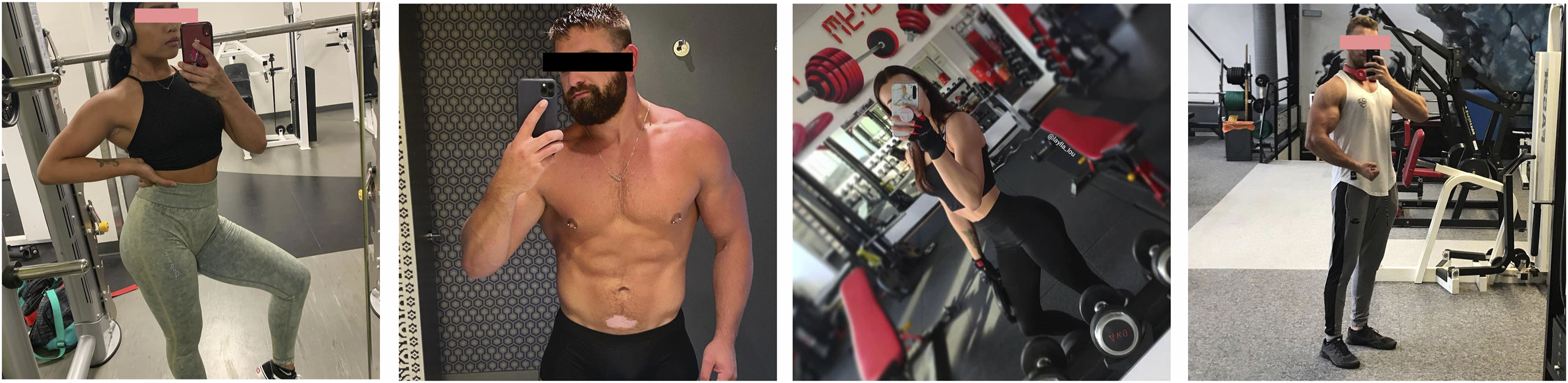
More specifically, we find that men frequently expose the upper part of their bodies, tensing their muscles and angling arms to make their chests, arms, and ripped abdominals appear even more muscular. These visual fitness body components reflect and connect to the hashtags #abs, #shredded, #sixpack, #ripped, and #chest (Figure 2). In contrast, female consumers participate in the cultural production of content, stretching one leg while bending the other or pushing their glutes in one direction, using the hashtags #legs, #glutes, and #booty to contextualize and network their content. Additionally, female consumers put their hands on their waists and wear high-waist leggings in combination with crop tops, once more making glutes, and breasts appear roundly shaped and legs, stomachs, and waistlines slim (Ferguson et al., 2021; Srivastava et al., 2022). Hashtags co-occurring with #fitness on Instagram.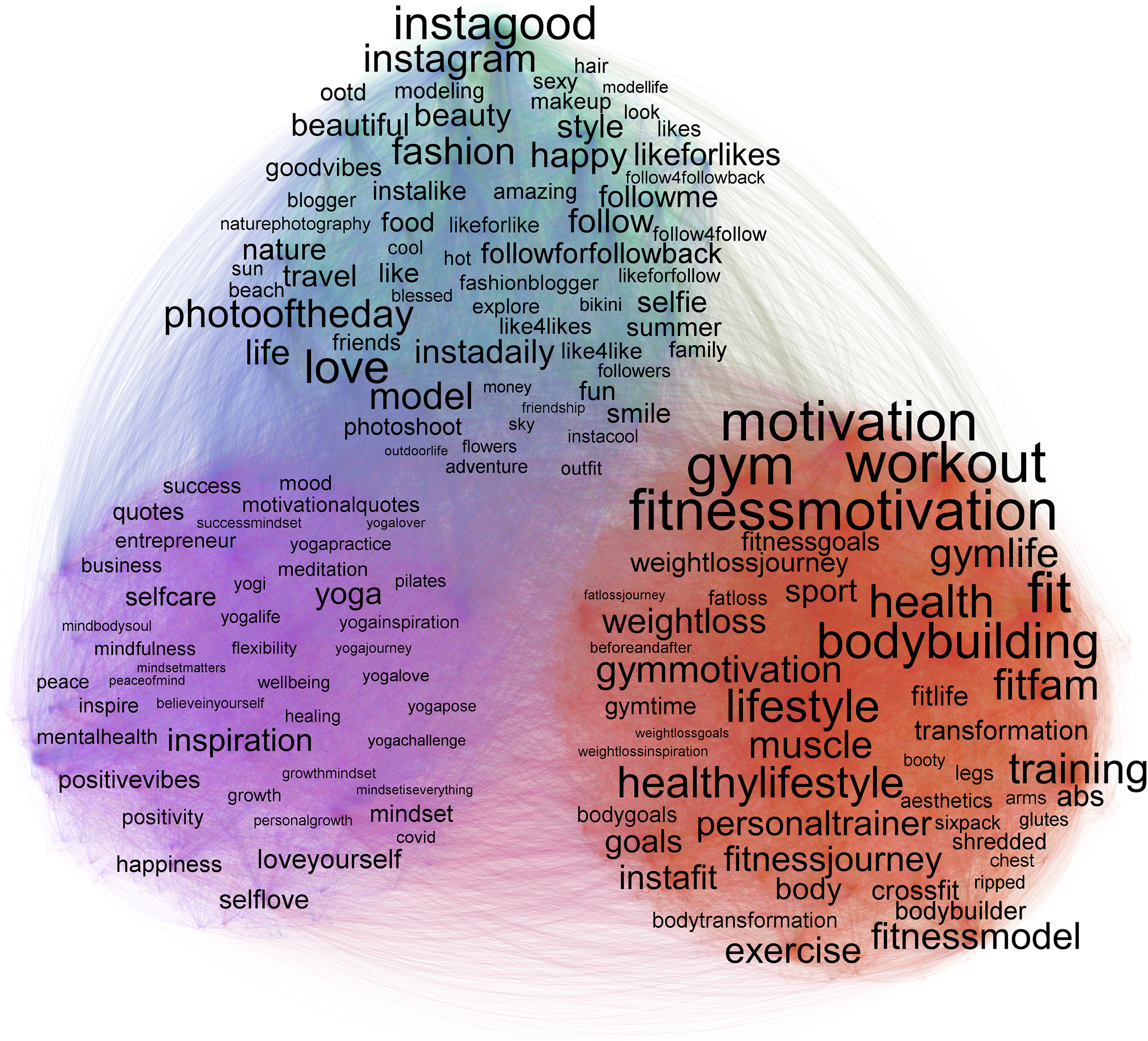
Before-after meme
The before-after meme (3.78% of all images) (Figure 3; Appendix C) comprises mirror selfies in dreary yet homely indoor settings (Manovich, 2017). That is, consumers use the mirror as a focalizer (Rose, 2016) to self-confidently exhibit their partially bare and shaved bodies as “products of labor (body work)” (Schroeder and Zwick, 2004: 25). Particularly female consumers who participate in the cultural production of this meme wear clothing and engage in postures and gestures that focalize the results of their body labor even further, such as bikinis, underwear, training leggings, and crop tops, and the benching of one knee while stretching the other posture. Before-after meme.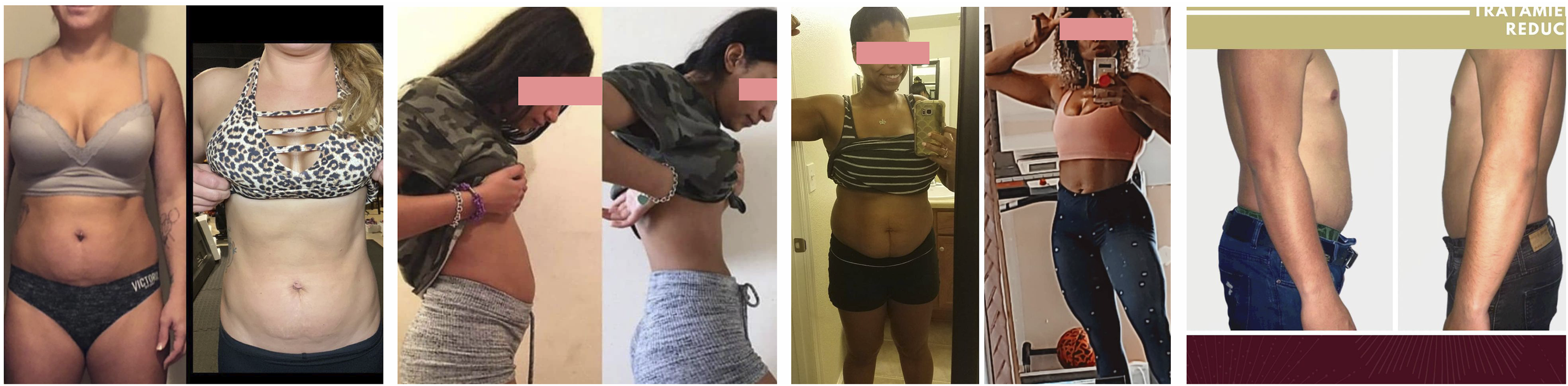
However, in contrast to the propagated fitness ideal of a slim and well-shaped body, consumers reproducing the before-after meme exhibit body fat, cellulite, stretchmarks, or sagging breasts. More specifically, this meme crystallizes in the split and squared “close-ups of […] bodies” (Manovich, 2017: 69) that display pretentious body transformations over time—contrasting past (left) and present (right) (Figure 3). Consumers connect their transformative journeys to conventional body labor hashtags, such as #fitnessjourney, #weightlossjourney, #bodytransformation, and #fatloss (Figure 2), reinforcing ideological aesthetics of the fit body.
Yoga meme
The yoga meme (5.12% of all images in the sample) (Figure 4; Appendix D) consists of athletic yoga poses and meditative practices in which consumers demonstrate their bodies’ flexibility and contemplatively turn their gazes away from the camera lens. Yogis contextualize and network their content through hashtags such as #yoga, #yogis, #meditation, #inspire, and #yogainspiration. We also find that these consumers memetically embed their yoga activities in a relaxed, calm, dreamy, and warm atmosphere, either in homely indoor settings—often in front of walls—or idyllic outside surroundings entailing plants, the sky, or the seaside. Yoga meme.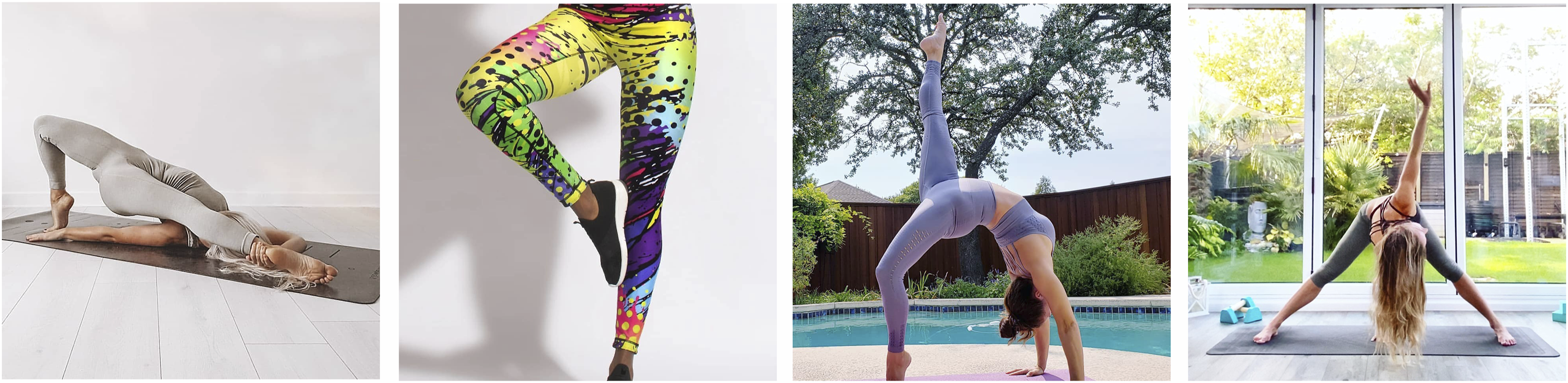
However, our findings unveil that, besides echoing a dynamic or meditative sportive performance, consumers continue the cultural reproduction of self-confident and designed self-representations (Manovich, 2017). Consumers pretentiously exhibit their bodies to the viewer, emphasizing the body’s muscular and slim shape through color-intense high-waist leggings, crop tops, and shaved body parts. As such, these consumers memetically propagate the ideological aesthetics of a slim and trained body and platform-typical bright, clean, and color-intense performances by drawing on the affordance of filtering (Manovich, 2017).
Holiday meme
The holiday meme (8.24% of all images in the sample) (Figure 5; Appendix E) unfolds in vacation-like settings. Consumers use the hashtag #beach to contextualize and network images of the sea or poolside, plants, blue skies, sunglasses, and swimwear, framing an idyllic summer situation. Holiday meme.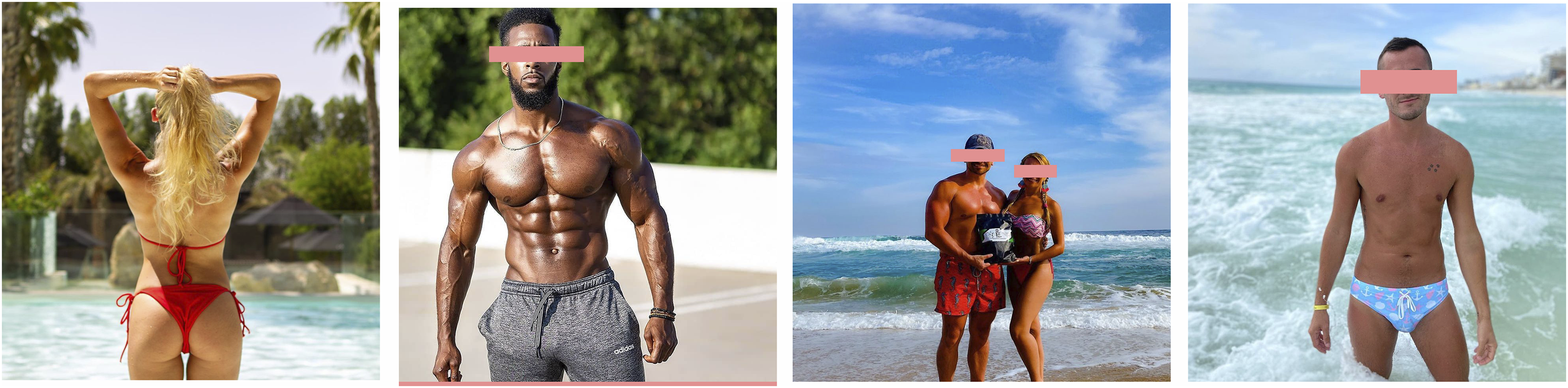
Consumers’ bodies once more constitute the core memetic component in these images, that is, consumers reenact the one-person photograph, self-confidently exposing their partly naked, shaved, muscular, and slim bodies to the camera. Female consumers dress in colorful skin-tight clothes, for example, bikinis or swimsuits, making breasts and glutes appear roundly shaped, and touching their bodies by either putting a hand on the waistline or touching their long hair (Srivastava et al., 2022). These consumers further accentuate their playful body performance by drawing on soft and seductive facial expressions—memetically echoing and propagating the stereotypical construction of women as innocent, albeit sexualized objects (Srivastava et al., 2022). Likewise, men expose their trained bodies at the beach, exuding a sense of positivity and happiness. The hashtags #happy, #positivity, #goodvibes, #fun, #sun, and #summer (Figure 2) semantically circumscribe and propagate the meme’s overall spirit.
Vehicle meme
The vehicle meme (3.11% of all images in the sample) (Figure 6; Appendix F) includes serious one-person photographs in which consumers once more replicate exhibitions of the body by eagerly resting in rigid, artificial postures. In doing so, they pretentiously showcase their bodies in straight view to the camera, leaning against, sitting on, or standing in front of a car and/or motorbike—culturally fetishized commodities (Schroeder and Zwick, 2004). Female consumers replicate the bending of one knee while stretching the other posture, reproducing the emphasis on their roundly shaped glutes and long hair (Srivastava et al., 2022). In contrast, male consumers stress their masculine “presence and power” (Schroeder and Zwick, 2004: 23) by angling their arms to touch their triceps, frowning, and indifferently leading their gaze to one side instead of directly looking into the camera (Srivastava et al., 2022). Vehicle meme.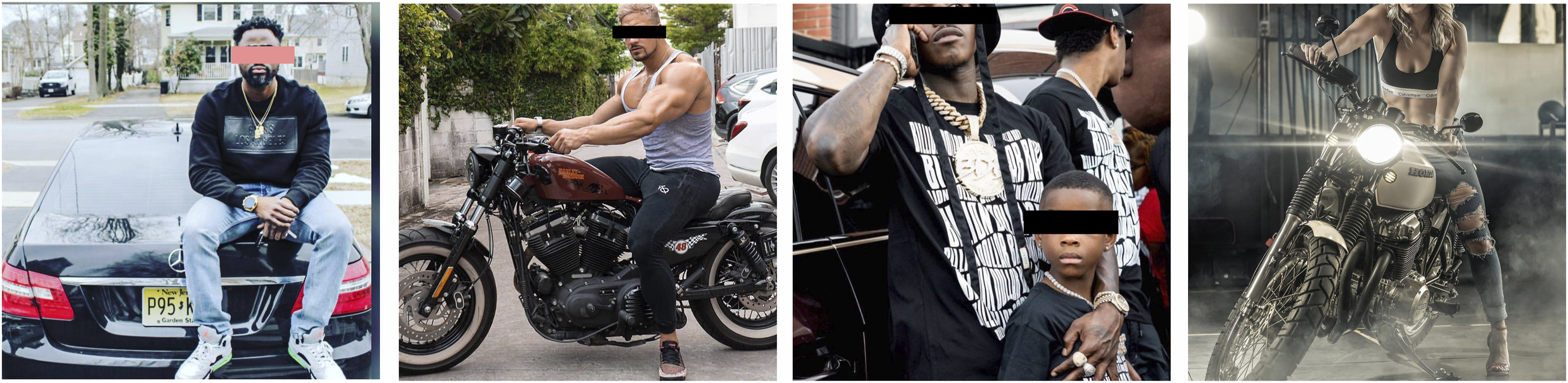
Moreover, we find these consumers accumulating fashion-related cultural items, that is, men are foremost dressed in shirts/t-shirts and trousers/jeans, combined with white sneakers and sunglasses, networking their content to hashtag feeds such as #style, #look, #fashion, and #cool (Figure 2). Similarly, female consumers wear skin-tight clothes which further accentuate their body’s shape, complemented by seductive expressions, “willingly posing in a sexy manner” (Srivastava et al., 2022: 513), and mirroring networked content of #sexy or #hot. The frequent appearance of jewelry and watches and consumers’ participation in the hashtag feeds #success, #entrepreneur, and #money additionally indicate the mimicking of a posh lifestyle, propagating the portrayal of the consuming (fit) body (Schroeder and Zwick, 2004) “in a high-status light” (Marwick, 2015: 156).
Nature meme
The nature meme (8.24% of all images in the sample) (Figure 7; Appendix G) consists of consumers in idyllic and relaxing surroundings in nature. That is, they network forests and different kinds of plants, as well as sunshine and blue skies, to nature-related feeds, such as #nature, #naturephotography, #flowers, and #outdoorlife (Figure 2). Nature meme.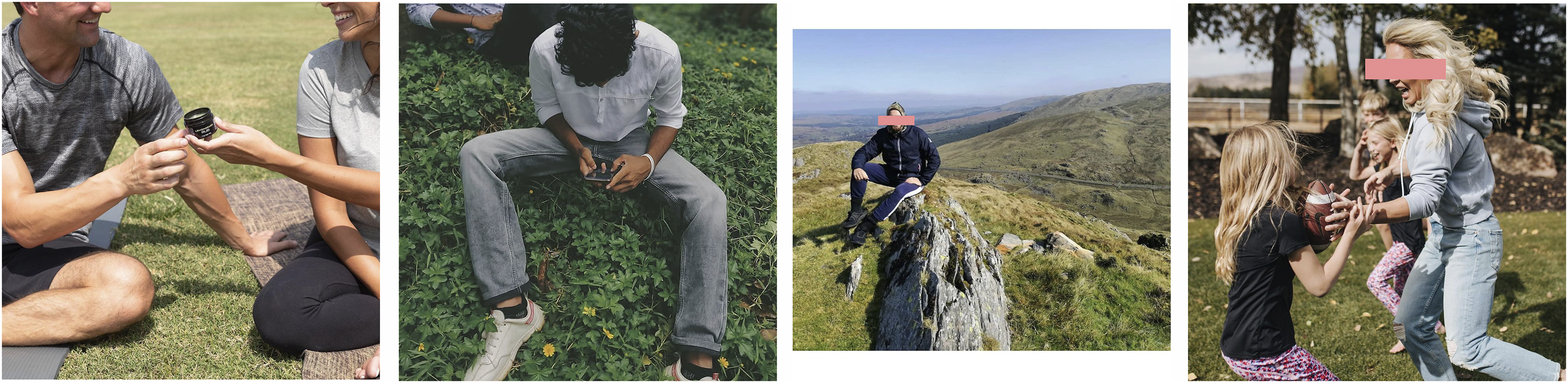
Although this meme details consumer bodies from head to toe, body aesthetics are not the focal point. Instead, we find human bodies being “immersed in the experiences, moments and situations” (Manovich, 2017: 125), that is, consumers posing on meadows, park benches, or rocks surrounded by plants, drawing attention to dreamy outdoor settings, a stunning view, or private moments with others in the park. These images entail smiling faces, feelings of happiness, softness, warmth, affection toward others, and natural settings. As such, the nature meme constitutes a visual effigy of networked affordances such as #happy, #goodvibes, and #blessed, as well as #explore and #adventure, radiating contemplative and calm expressions. However, even though this meme accumulates dynamic movements, visuals replicate a designed impression as consumers are, once more, consciously posing for the image (Manovich, 2017).
Wall-pose meme
The wall-pose meme (7.35% of all images) (Figure 8; Appendix H) comprises consumers contrasting their partly naked, impeccably thin, and muscular bodies to the background, reenacting tense and artificial postures in front of a wall. Additionally, consumers accentuate their body performance by touching their bodies and wearing skin-tight clothes. Women replicate the benching of one knee while stretching the other posture while imitatively putting one hand on the waist in this meme, accompanied by high-waist training leggings and crop tops. Wall-pose meme.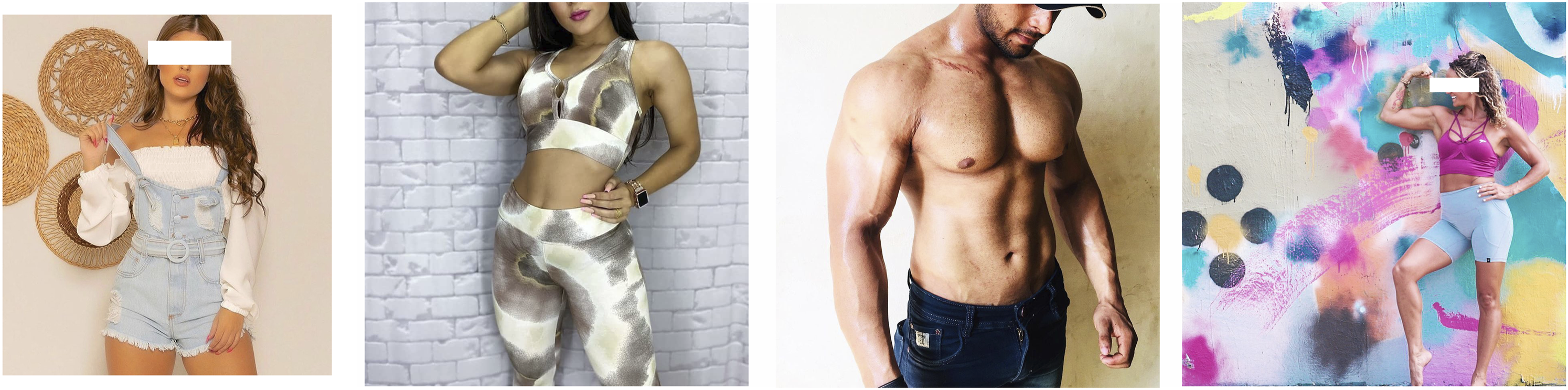
Intensively employing the affordance of filtering and the hashtags #model, #modeling, and #photoshoot (Figure 2), consumers symmetrically position their bodies in front of these plain backgrounds, rounding off a very minimalistic and staged attitude echoing the normative character of strategically arranged commercial photoshoots (Manovich, 2017).
Memetic logics of participation
First, the gym-selfie and before-after meme (Figures 1 and 3) semiotically cross-reference each other by sharing a serious, dreary, and cold atmosphere. In both memes, the focal point is a single consumer presenting specific body parts to the camera. With that, the gym-selfie and before-after meme semantically interconnect in the red hashtag cluster of the network (Figure 2) that entails hashtags such as #muscles, #weightlossjourney, #aesthetics, #fitnessgoals, #bodygoals as well as #gym, #fitnessjourney, and #workout. As such, consumers memetically reinforce and act in line with the cultural conventions of fitness on Instagram—the narrative “from obesity to thinness and muscularity”—in the memetic format of the mirror selfie.
Second, the yoga and holiday meme cross-reference via memetic components such as colorful clothes or dreamy surroundings marked by sunshine, plants, sky, and seaside elements (Figures 4 and 5). Their overall clean, bright impression (Manovich, 2017), that is, the wall background visible in yoga-related content, also replicates in the wall-pose meme. Similarly, the nature meme (Figure 7) portrays idyllic, relaxing surroundings in nature, entailing plants, sky, and sunshine components, further following a memetic logic (Leavitt, 2014) by reproducing the yoga meme’s contemplative and calm expressions and simultaneously providing a pastiche of holiday memes’ happiness and positivity. Following these memetic logics, the vehicle and yoga memes share components of arrogance, like female consumers in the holiday meme who reproduce the vehicle meme’s seductive charisma. On a semantic level, the hashtags of the turquoise cloud (Figure 2) not only circumscribe but also interconnect the holiday, nature, vehicle, wall-pose, and yoga memes within the network by hashtags such as #happy, #fun, #life, #goodvibes, #fashion, #style, #sexy, #photoshoot, as well as #summer, #beach, #love, #friends, #travel, and #nature.
Besides these interconnecting and cross-referencing logics, our results indicate that fitness consumers do not merely reproduce and network conventional fitness templates by combining particular components (Manovich, 2017) but follow the logic of networked individualism (Shifman, 2014b) in that they attach “small compositional changes” (Caliandro and Anselmi, 2021: 14) to these templates, resulting in mutations of the fitness memes. Accordingly, we find the holiday setting embedding the yoga pose, the natural surroundings turning into the background for fashion photoshoots, the bikini in indoor mirror selfies rather than beach scenes, and vehicles appearing next to training leggings or within idyllic atmospheres (Figure 9). However, consumers do not seem to design new, unique, and creative meme creations. Instead, they demonstrate their strong affiliation with the “common, widely shared memetic […] formula” (Shifman, 2014b: 33) of fitness afforded by Instagram (Gibson, 1977). Consumers draw from the ever-same pot of existing memetic fitness components, resulting in remixed, collapsed (Boyd, 2011) versions of the contextual fitness memes, that is, homogenous, conventional instead of creative, innovative mutations. Remixed memes.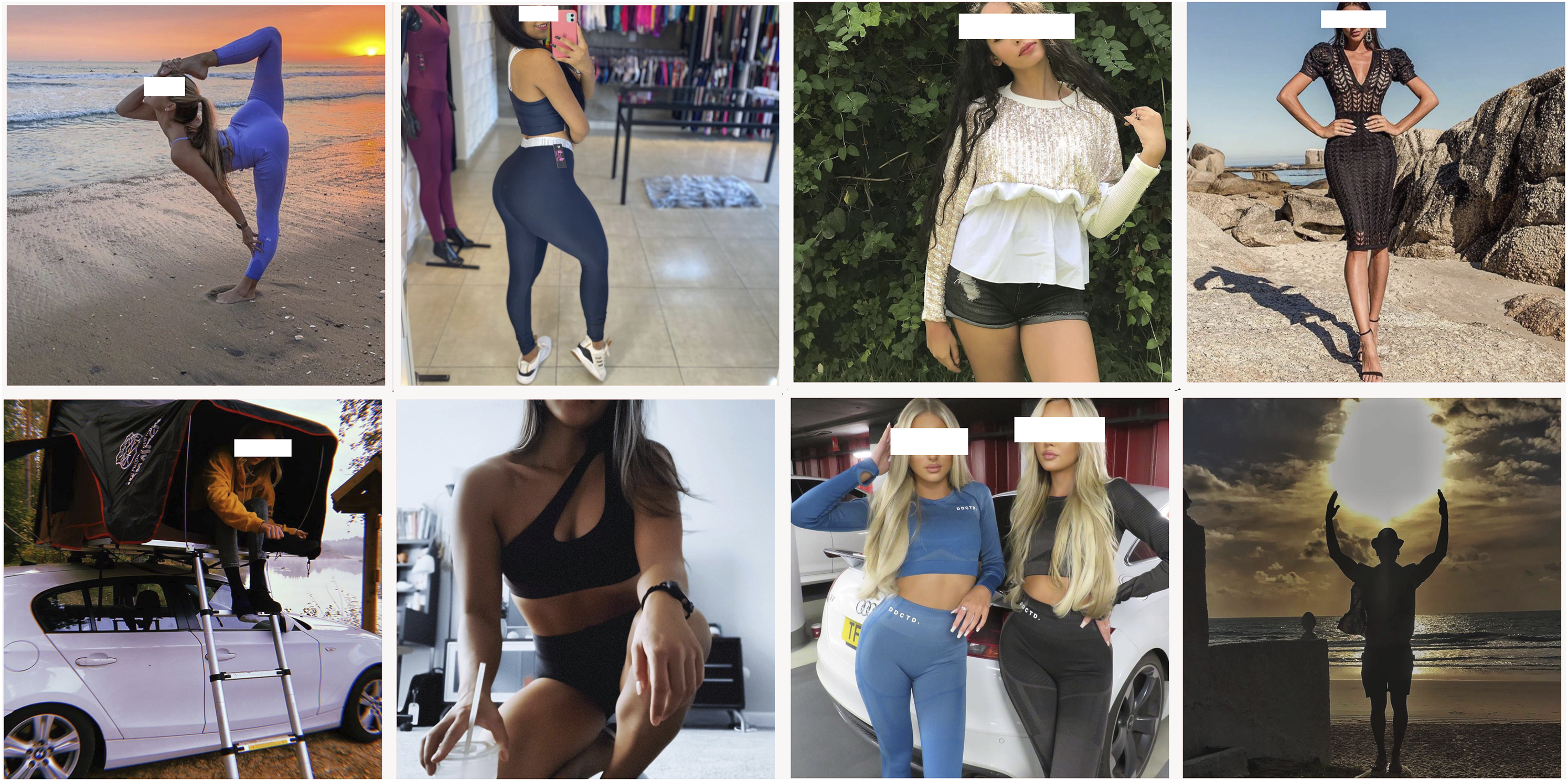
The overall memeplex (Appendix A) additionally shows that the interplay between consumers and affordances results in the frequent and accurate reproduction of specific memetic components (Dawkins, 1976/2016). One of these components is the one-person photograph in which consumers rest in tense postures and gestures to carve out the muscular parts of their bodies while hiding potential flaws, for example, fat, cellulite, stretch marks, or facial imperfections. Female consumers particularly accentuate their glutes and slim waistlines by benching one knee while stretching the other and wearing high-waist leggings—in the gym, on the street, or in the shopping mall. Repeatedly appearing crop tops stress toned abdominal muscles—complementary putting the limelight on the ideal shape of a female body that is athletically thin but muscular and curvaceous (Ferguson et al., 2021).
Following these memetic logics, that is, participating in self-confident exhibitions of seemingly flawless bodies, consumers render and reproduce standardized body posture templates (Figure 10). They do so with such high copying fidelity (Dawkins, 1976/2016) that it appears they have just been copied and pasted into new settings (Manovich, 2017). As a result, consumers collectively facilitate the longevity (Dawkins, 1976/2016) of the normative ideal of a slim, muscular, and impeccable body shape. On the one hand, these templates illustrate fitness consumers’ firm adherence to widely shared cultural norms and conventions of fitness and fit body aesthetics (Shifman, 2014b)—context-specific logics of participation. On the other hand, we find that these templates comprise still and tense poses, slight smiles, frozen gazes into the camera, and a principal designed guise (Manovich, 2017) that merge into “well-rehearsed digital self-portraits” (Marwick, 2015: 138)—propagating Instagram’s cultural convention of acting (Senft, 2013)—platform-afforded logics of participation. Body posture templates.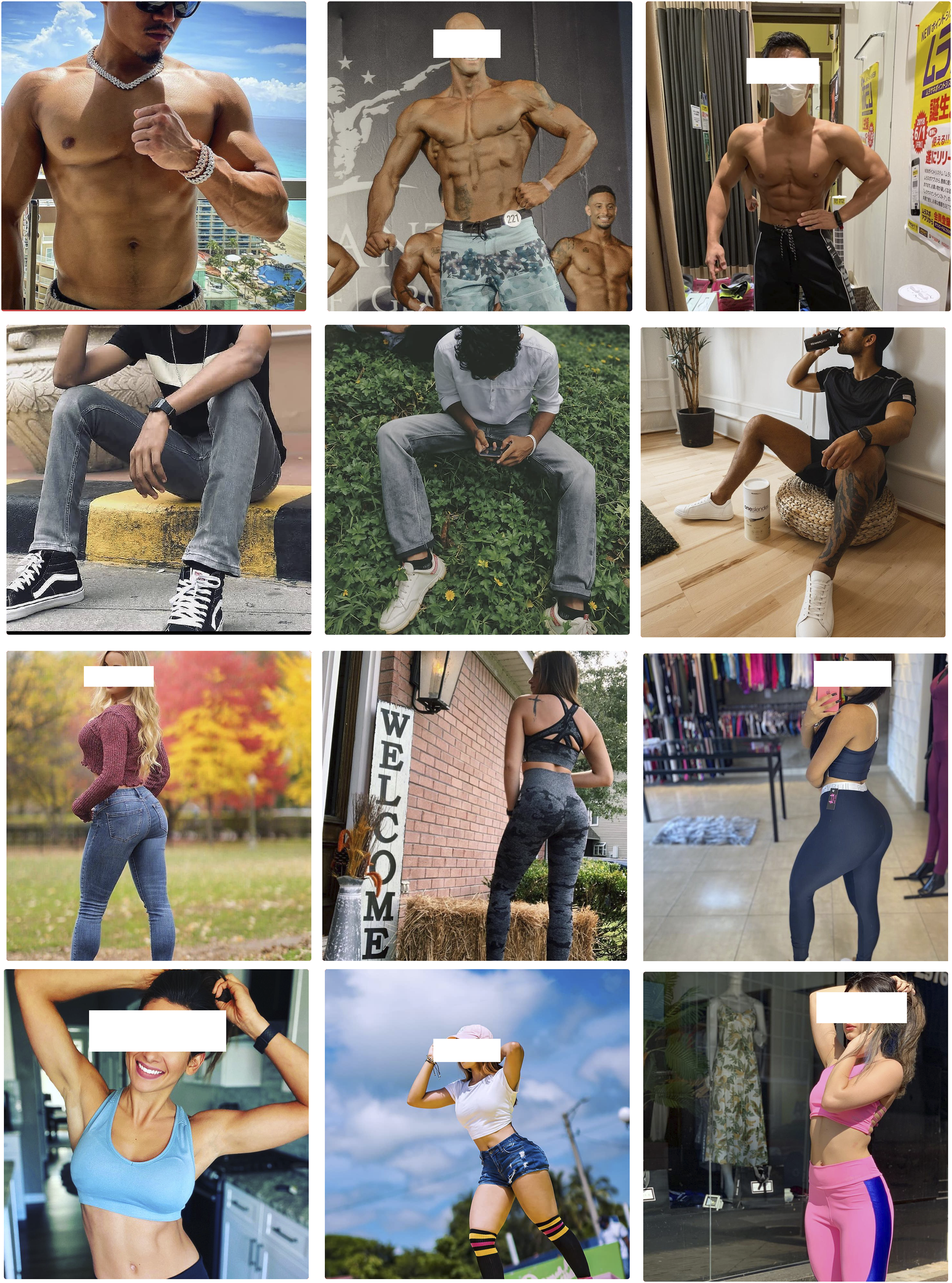
Furthermore, these platform-afforded logics of participation unfold in consumers’ use of attention-seeking hashtags (Marwick, 2015), for example, #followforfollowback, or #likeforlikes, and visibility-maximizing, generic hashtags, for example, #happy, #fun, and #love. Consumers strategically employ these affordances to “[game] the system” (Cotter, 2019: 899), networking their content to the generic platform public to maximize their visibility. This tactical use of “[mediums] that can offer publicity to a multitude of diverse situations of identity” (Arvidsson and Caliandro, 2016: 727) embeds the networked public of #fitness amidst the platform’s attention economy and microcelebrity culture, forming around loosely interconnected actors (Kozinets et al., 2017) and blended consumption contexts. In other words, a blending of different modes of cultural production in which context-specific and platform-afforded—memetic—logics of participation collide and interconnect.
As a result, we find the fit body peregrinating through different sceneries of “fluid and situational consumption” (Caliandro and Anselmi, 2021: 1), assuming cross-contextual hypersignificant qualities that “[derive] from a broader Instagram culture” (Caliandro and Anselmi, 2021: 2). These dynamics are particularly apparent between certain contextual memes (Appendices B-H). The gym-selfie and before-after meme accumulate contextual content related to fitness and fit body aesthetics. In contrast, the vehicle, holiday, and wall-pose meme illustrate the “proliferation of celebrity and microcelebrity culture, and conspicuous consumption” (Marwick, 2015: 139) on social media in which consumers exhibitionistically display the fit body within a glamorous frame or sunny beaches and amidst designer goods or luxury cars—detached from the actual consumption context. Additionally, consumers decorate their bodies with further “tropes and symbols of traditional celebrity culture” (Marwick, 2015: 139), such as jewelry, watches, sunglasses, and other fashion items. Accordingly, we observe that consumers participating in the cultural production of these memes propagate the fit body as a social signifier (Schroeder and Zwick, 2004) to demonstrate their adherence to the platform’s “cultural norms and expectations” (Shifman, 2014b: 34) of “glamour, luxury, wealth, good looks, and connections” (Marwick, 2015: 141).
Similarly, this platform-afforded logic unfolds in the nature meme. Although consumers show affective tensions towards nature, they reenact the artificial standardized one-person photograph, placing their bodies in front of idyllic settings (Manovich, 2017). Affordance-based color-intense and bright filtering of vacation and landscape images drive the public’s attention to these impressive moments and consumption experiences (Kozinets et al., 2017)—propagating sophisticated and thus “consistent snapshot aesthetics” (Manovich, 2017: 39). Likewise, consumers in the yoga meme not only replicate yoga-specific practices, for example, meditatively closed eyes, and networked narratives of mental harmony and health by hashtags such as #selfcare, #mindset, #mentalhealth, and #wellbeing (purple, Figure 2), but also propagate “[projects] of self-production and self-improvement” (Cotter, 2019: 897). The fitness consumers network designed Instagram performances (Manovich, 2017) through the conventional platform-afforded memetic vernacular, such as #success, #entrepreneur, or #business.
Overall, the interplay between consumers and affordances results in a networked public of affective nature in which consumers follow both context-specific and platform-afforded—memetic—logics of participation. While context-specific logics manifest in consumers remixing and blurring the boundaries between the contextual memes of the fitness memeplex, platform-afforded logics manifest in consumers’ adherence to conventional platform vernacular and attention-seeking and visibility-maximizing platform conventions. As such, these logics manifest “as collections of technical content resulting from a combination of digital participatory culture as well as software production practices” (Rogers and Giorgi, 2023: 2)—they interconnect, cross-reference, and reinforce a consumer culture beyond the affective context in which the consumption takes place—a platformized consumer culture.
Discussion
This study theorizes how participatory logics, as one process of the platformization of culture, unfold in the context of fitness body culture on Instagram. That is, we foreground the memetic nature of participatory logics that manifest in and derive from an interplay between consumers and affordances. Our study contributes to scholarship on platformization (Helmond, 2015; Poell et al., 2022), in general, and to platformized consumer culture and networked publics, in particular.
First, we pay particular attention to the memetic logics of participation that emerge in the platformized ecosystem of Instagram. Doing so, we extend Caliandro and Anselmi’s (2021: 14) recent work on the memetic logic of branded material, that is, “a collection of branded posts circulating across social media networks, which derive from a standard branded template that repeats from user to user with small compositional changes at every iteration and on top of which users attach expressions of their vernacular creativity.” This study draws on the context of fitness body culture on Instagram, where memetic embodiment—postures and gestures—carries symbolic meaning. The dynamic nature of the research context enabled us to zoom into the comprehensive semiotic and semantic compositionality of the fitness memeplex and the contextual fitness memes. With that, the context-specific and platform-afforded—memetic—logics of participation not only center around material consumption objects, such as branded cups, bags, or bottles (Caliandro and Anselmi, 2021) but also become literally embodied by consumers themselves. In this regard, we emphasize the body and its capacities as platformized consumer culture’s focal point.
This study demonstrates how the interplay between consumers and affordances renders a participatory culture that materializes in and expresses itself through standardized templates, that is, prospective photography (Shifman, 2014a), on a semiotic level and hashtags, that is, operative signs and categorical markers (Leavitt, 2014), on a semantic level. These contextual memes exhibit a hypersignificant quality (Shifman, 2014a) by containing cultural codes and norms. While Caliandro and Anselmi (2021: 12) argue that standardized templates enable consumers “to superimpose their personal (vernacular) creativity on a collective imaginary,” we stress that the context-specific and platform-afforded—memetic—logics of participation may instead constrain the creativity of consumers’ cultural production. Cultural production manifests in the accurate and redundant reproduction of relatively few memetic components, along with attention-seeking and visibility-maximizing platform conventions (Marwick, 2015), across all contextual memes of the memeplex. Thus, our study shows that while, in principle, content creators experience creative autonomy in their cultural production and labor processes, their visibility and circulation depend on the platformized ecosystem (O’Meara, 2019). That is, affordances offer properties for cultural production but also constrain content creators both physically and culturally (Gibson, 1977). As such, interdependent memetic logics of participation interconnect, cross-reference, and, therefore, reinforce a consumer culture of standardized imitation and expression—a platformized consumer culture.
Second, we expand the discourse on networked publics (Arvidsson and Caliandro, 2016; Boyd, 2011) by detailing a networked public of affective nature “mobilized and connected (or disconnected) through expressions of sentiment” (Papacharissi, 2016: 320). We introduce the idea of memetic publics, in which these expressions of sentiment take the form of standardized memetic templates that constitute a common ground for the networked public’s cultural codes and norms. However, unlike Döveling et al. (2018), we find that consumers’ expressions of sentiments do not draw on a shared semiotic repertoire that accumulates under a shared hashtag, for example, expressions of grief forming around the hashtag #PrayForParis. Instead, these expressions of sentiments assume a private character (Arvidsson and Caliandro, 2016; Boyd, 2011). With that, the networked public of #fitness embodies an affective nature inviting consumers to participate in an imaginary of individual accomplishments, achievements, and transformations.
The networked public of #fitness comprises “structured aggregations of heterogeneous meanings without the formation of collective values” (Arvidsson and Caliandro, 2016: 743). However, consumers express these private and individual meanings and experiences through a homogenous set of memetic components. This homogeneity of the #fitness public contrasts the heterogeneity of branded hashtag publics, for example, #louisvuitton (Arvidsson and Caliandro, 2016) or #moetchandon (Rokka and Canniford, 2016). There, brand- and consumer-generated content clashes, eventually causing a destabilization of “meanings, uses and aesthetic ideologies constructed by brand managers” (Rokka and Canniford, 2016: 1790). While the public of #fitness does exhibit heterogeneous, context-detached material consumption objects (Rokka and Canniford, 2016), for example, luxury goods, these objects are nothing but fetishized commodities of the standardized, homogenous—memetic—attention economy (Marwick, 2015) afforded by the platformized ecosystem of Instagram.
This study corroborates prior research by illustrating that “[t]he overall driver of participation is not [a collective] identity but publicity” (Arvidsson and Caliandro, 2016: 731). Networked expressions of sentiment do not seek to create visibility and attention for a collective cause but for disconnected consumers (Papacharissi, 2016). Thus, the hashtag #fitness constitutes a public of “empty signifiers” (Arvidsson and Caliandro, 2016: 743) and “collapsed contexts” (Boyd, 2011: 49) in which the cultural production of fitness, microcelebrity, and attention culture blends. Consumers strategically use the networked public of #fitness as a gateway to publicize themselves to wider “invisible audiences” (Boyd, 2011: 49) by diffusing their content to generic hashtag feeds such as #happy, #fun, or #love (Marwick, 2015). As such, the networked public of #fitness constitutes “an interconnected desiring-machine that produces consumption interest within the wider social system and among the interconnected actors” (Kozinets et al., 2017: 677). Hashtags such as #weightlossjourney or #bodytransformation in combination with attentional hashtags, such as #followme or #likeforlikes, thus, propagate and reinforce these desired modes of cultural production, that is, the conventional cultural codes and norms (Shifman, 2014b), beyond the networked public of #fitness. With that, the interplay between consumers and affordances frames a platform-wide networked public where cultural production manifests in recursive imitation and standardized expressions of sentiment—a public driven “by a continuity of practices of mediation that are centered on a mediation device” (Arvidsson and Caliandro, 2016: 742), that is, #fitness. Accordingly, the networked public of #fitness constitutes an “imagined collective” (Boyd, 2011: 39). That is, a self-promoting and competitive public of “collapsed contexts” (Boyd, 2011: 49) where only consumers adjusted to the specificities of the platformized ecosystem (Gibbs et al., 2015; Rogers and Giorgi, 2023) become successful in ensuring longevity (Dawkins, 1976/2016) of their attentional capital—a networked public permeated by individual pursuits of attention and visibility. There, metaphorically speaking, only the fittest will survive.
This study is limited to memetic logics afforded by a single platformized ecosystem—Instagram. We invite future consumer culture and marketing research to embrace the idea that affordances tend to differ across platforms. An avenue for future studies could be to acquire a more nuanced understanding of platformized consumer culture by examining how different social media platforms, for example, Instagram, Facebook, YouTube, Snapchat, and TikTok, may curate different memetic logics of participation. We consider TikTok a fruitful platform for future research, as the content format centers around imitable videos with dynamic and embodied movements. Future research could also draw attention to TikTok’s equivalent format on Instagram—the Reel. Ultimately, comparative studies should elicit deep insights into the memetic platform- and cross-platform logics of participation. Such follow-up research could holistically account for memetic networked publics. Scholarship unpacking platformization in various consumption contexts could benefit from zooming into networked expressions of sentiment circulating, replicating, and propagating differently from platform to platform.
Footnotes
Declaration of Conflicting Interests
The author(s) declared no potential conflicts of interest with respect to the research, authorship, and/or publication of this article.
Funding
The author(s) received no financial support for the research, authorship, and/or publication of this article.
