




Abstract
This article combines the theoretical lenses of bridal identity and liminal consumption to illustrate the processes of problem-solving, negotiation and reconciliation through which the bride creates her bridal identity, in the Global South context of Nigeria. Most wedding ritual studies typically emphasise the processes of creating and negotiating a successful bridal identity, but few acknowledge the possibilities of failure and its effect upon the liminars. In addition, within liminal consumption studies, the role of liminars’ mentors is often under-theorised. Thus, we contribute to the field by expanding on the concept of ‘liminal gatekeepers’ as the individuals and institutions who control and enforce certain norms associated with the liminal experience. Following an interpretivist approach, the article also advances our understanding of the ways in which the demands of liminal gatekeepers affect the liminars’ experiences and identifies three novel bridal identity outcomes, namely, (i) Embedded Bridal Identity; (ii) Synthesised Bridal Identity; and (iii) Marginalisation. In this way, we advance marketing research around how a liminal consumer identity such as bridal identity is co-constructed between liminars and gatekeepers.
Keywords
Introduction
Marketing theorists have expressed increasing interest in consumption that occurs at the margins and social boundaries (Cody and Lawlor, 2011; Hirschman et al., 2012; Ourahmoune and Ozcaglar-Toulouse, 2012; Roux et al., 2017). In this context, the study of liminality has been co-opted to help interrogate consumption patterns that occur at the limits of social hierarchy and boundaries (Appau et al., 2020; Cody and Lawlor, 2011; Hackley et al., 2012). Liminality refers to the experience of being between and betwixt two or more distinct phases, identities and/or statuses and involves an understanding of three main components – roles, scripts and artefacts (Noble and Walker, 1997). The term ‘liminal consumption’ has been coined to refer to consumption during liminality (Cody and Lawlor, 2011). This allows us to draw further insights into how liminality is experienced via an emphasis on consumption, based on the assumption that the study of consumer cultures offer an important lens for understanding the lived experiences of contemporary culture (Arnould and Thompson, 2005). Although authors tend to emphasise the individualised aspects of consumer strategies employed when navigating liminal experiences (Cody and Lawlor, 2011; Tonner, 2016), there is also theoretical value in understanding the collective aspect of liminal experiences. However, such studies are often limited to communitás and the study of co-liminars (Tumbat and Belk, 2011; van Gennep, 1960 [ 1906], cited in Bell, 1997).
Typically omitted is the crucial and sometimes coercive role played by liminal gatekeepers (Hackley et al., 2012). Drawing on Moore and Gargett (2012), this article introduces the term ‘liminal gatekeepers’ to consumption and marketing theory as individuals, institutions and/or collectives who monitor, enforce and regulate the collective norms and processes within a liminal space. To date, earlier studies on liminal gatekeepers have expanded on the roles they play and the services they provide. This includes being mentors that guide the liminar to ensure the appropriate social/ritual scripts are identified and adhered to; or help liminars to acquire needed consumption artefacts (Cody and Lawlor 2011; Hackley et al., 2012; Kerrane et al., 2020). However, few have theoretically engaged with the boundary setting, boundary enforcement and boundary blurring roles played by gatekeepers. (Wickstrom et al., 2021). This article addresses this gap by attending to how gatekeepers’ demands and behaviours impact liminars’ experiences. The article further advances this gap by delving deeper into the strategies employed by liminars when engaging with gatekeepers.
For clarity, it is worth differentiating liminal from the liminoid. Similar to liminal experiences, liminoid experiences exist outside everyday conventional norms with a focus on ‘leisure spaces’ (Tumbat and Belk, 2011) such as nightclubs (Taheri et al., 2016). However, a core difference is that limonoid experiences typically do not require identity transitions (Hackley et al., 2012; Tumbat and Belk, 2011). Therefore, liminars always have the option of walking away should the demands of gatekeepers be deemed unattainable. Focusing on liminal phases specifically, where the liminal experience is obligatory for a successful post-liminal identity, the gatekeeper role tends to be under-theorised (Wickstrom et al., 2021).
Turner’s (1969) seminal study on liminality was originally based on African rituals, yet Darveau and Cheikh-Ammar’s (2021) literature review concluded that few liminal consumption studies discuss identity transitions focused on rituals. This could be due to a decline in the importance of rituals in identity transitions in the Global North (Gentina et al., 2012). In contrast, rituals are a core part of most communities in the Global South (Ourahmoune and Ozcaglar-Toulouse, 2012), whereby ‘…ritual events such as weddings serve as a reflection of changes in a society’ (Nguyen and Belk, 2013: 110). Ingraham (2008) and Otnes and Pleck (2003) give a detailed illustration of the intensified consumption opportunities that wedding rituals create and the billions of dollars (and £GBP) they generate globally. Therefore, a significant opportunity exists for further investigation into consumption around the liminal experience of wedding rituals, and especially in the context of the Global South.
Focusing on consumption studies that centre around wedding rituals, the term bridal identity has been used to describe the process of a bride using the wedding ritual to perform a consumer identity project (Boden, 2003; Sykes and Brace-Govan, 2015). From this perspective, it is generally agreed that the bride is the primary decision maker, albeit with input from other parties (Adrian, 2004; Boden, 2003; Ingraham, 2008). Bridal identity, therefore, helps us understand wedding rituals as a consumption site from the perspective of the bride (Sykes and Brace-Govan, 2015). Currently, there is little consensus on the definition of bridal identity, but it is broadly treated as an embodied consumer identity project where the bride uses the opportunity of her wedding ritual to perform a feminine ideal based on her image, typically, via the wedding dress (Boden, 2003; Broekhuizen and Evans, 2016; Nash, 2013).
Most prior studies around wedding rituals take place in the Global North (Ibid), and therefore reflect the individualistic tendencies of the Global North. In contrast, cultures in the Global South with their more collectivist tendencies (Nguyen and Belk, 2013) offer an opportunity for further exploration which can add nuance to current conceptualisations of bridal identity. Such collectivist tendencies also make it more likely for liminal gatekeepers to have significant impact on the wedding ritual compared to their Global North counterparts. This is due to the typically patriarchal systems that rigidly enforce gendered cultural norms (Fernandez et al., 2011; Ingraham, 2008). As liminal gatekeepers often function as mentors who see themselves as enforcers of collective expectations (Hackley et al., 2012; Houston, 1999; Kerrane et al., 2020), we ask how is bridal identity expressed in this specific, and potentially, conflict-inclined context, if expressed at all? In responding to this research question, the present article examines liminars’ experiences and gatekeeper’s roles in the context of Nigerian weddings.
As a result of our investigation into consumption around the liminal experience of wedding rituals in the context of the Global South, we contribute to consumption and marketing literature by proposing a revised definition of bridal identity as the reconciliation of the bride’s consumer tendencies with the collective norms and expectations of the social group(s) she subscribes to, negotiated by market forces and actors, in the planning and execution of her wedding ritual. Further details of this definition will be expanded upon subsequently. Previous studies have also shown that bridal identity might be individual in its aesthetic, but its creation and expression is a collective process (Boden, 2003; Nash, 2013; Sykes and Brace-Govan, 2015). However, also under-theorised is the context within which the individualised aesthetics of bridal identity conflict with the collective expectations of the wedding ritual. This potentially enhances our study of the wedding ritual in the Global South due to their collectivist tendencies, enabling this study to closely examine how these collective expectations are manifested and by whom. In so doing, we contribute further by theoretically advancing our understanding of this phenomenon by identifying three potential bridal identity outcomes, including Embedded Bridal Identity, Synthesised Bridal Identity and Marginalisation. All of which will be discussed in detail in subsequent sections of the article. Prior to outlining our theoretical underpinning, our article begins with an overview of the Nigerian context.
The Nigerian context
Reverting to the beginnings of the study of liminality, fleshed out by Turner’s application to African rituals (1969), we turn to Nigeria, Africa’s most populated country. In the absence of any market-scale quantification of the Nigerian wedding industry, the following sources provide background information to support the prominence of wedding rituals in Nigeria. For example, Nigeria’s ‘Nollywood’ is one of the most influential film industries on the continent (Ryan, 2015). Only surpassed by USA’s ‘Hollywood’ and India’s ‘Bollywood’ on a global scale (Ibid). More specifically, the Nigerian film ‘The Wedding Party I’ launched in 2016 remains the highest grossing Nigerian film of the decade (Augoye, 2020). Nigeria also has one of the largest consumer markets within the Middle East and Africa, worth about $300 billion (Euromonitor, 2015, 2016). This suggests that the Nigerian wedding industry, at least from an entertainment perspective, has a significant presence.
The popularity of the Nigerian wedding website bellanaija.com which receives under a million visitors per month also gives an indication of the ritual’s importance. ‘Naija’ being a colloquial term for Nigeria. Similarly, hashtags like #naijaweddings have over 2,700,000 posts on social media platforms such as Instagram, whilst accounts like Nigerian Wedding, BellaNaija Weddings, Igbo Weddings, Wedding Digest Naija and Naija Glam Weddings have a cumulative 370,000 followers on Pinterest (Pinterest 2022). Moreover, the most popular Nigerian wedding video on YouTube has 4,500,000 views (Nigerian Wedding Diary, 2020). In terms of lavishness and/or scale, CNN estimated that Nigerian weddings can cost between £7500 and £12,000 (2017). For context, the Nigerian minimum wage is less than £1000 a year, meaning the typical Nigerian wedding costs more than 7 times the yearly income for those on minimum wage (Yusef, 2022). To further ground this, the full-time yearly income on minimum wage in the UK is about £19,000 (Gov.Uk, 2022) whilst the average wedding costs about £20,000 (Burke, 2022). This 7:1 ratio further contextualises the importance, breadth and depth Nigerian weddings play in her society. Despite this cultural trend and its role in marking an important transition into adulthood (Ubong, 2010), the contemporary study of Nigerian weddings is yet to be adequately explored (Nwafor, 2012, 2013; Ubong, 2010). Consequently, this article adds to this nascent field.
Nigeria is predominantly regarded as a collectivist society (Adebanwi and Obadare, 2010), with entrenched patriarchal institutions which emphasise familial relations and reputation over individual preferences. This manifests in a consumption pattern guided by socially sanctioned consumer goods (Gbadamosi et al., 2009; Ogbadu et al., 2012). In addition, there is evidence that Nigerians do not trust market actors (Folorunso, 2013; Ogbadu et al., 2012), and instead typically rely on their social collectives for advice on consumer goods and services (Janson and Akinleye, 2015). Gbadamosi et al. (2009) concludes that Nigerian consumption is often limited to products that have been deemed as ‘good’ by one’s collective(s). Therefore, this potentially creates tension around how market actors such as wedding vendors 1 typically operate outside the social collective and therefore are generally distrusted by Nigerians to play the role described in the wedding ritual literature when helping the marrying couple actualise their ‘dream’ wedding (Boden, 2003; Ingraham, 2008).
The article now proceeds by providing an outline of the theoretical underpinnings, followed by an overview of the methodology employed. This is followed by a discussion of the article’s findings and then conclusions.
Literature review
This section provides an overview of the theoretical thrusts of the article. Specifically, it uses bridal identity to illustrate how consumer identity pursuits within liminality is influenced, corrected and shaped by liminal gatekeepers.
Whose bridal identity?
Weddings are increasingly about bridal identity, a consumer identity that is manifested via the use of consumer artefacts, specifically those associated with weddings, for the expression of the brides’ tastes, aesthetics and preferences (Boden, 2003). However, this description moves away from the tradition of collective identity management originally associated with wedding rituals (Ingraham, 2008; Leeds-Hurwitz, 2002; Sykes and Brace-Govan, 2015). This perceived difference has the potential to cause conflict and wedding vendors typically position themselves as being able to resolve it (Boden, 2003). This is not unique to wedding rituals, as prior studies have detailed how people use consumption in resolving identity conflicts (Thompson et al., 2013). However, Ingraham (2008) and Nash (2013) contend that this reconciliatory effort by vendors is illusory, instead, bridal identity is dictated mainly by vendors. For example, brides might be offered a choice when choosing the colour of flowers, but market actors typically insist and compel the bride into purchasing flowers, regardless of colour. Although this is somewhat contradicted by other studies that focus on how consumers use artefacts in resolving identity conflicts (Ahuvia, 2005; Ferreira and Scaraboto, 2016; Slater, 1997), the wedding ritual consumption space is typically a novel category for the bride to be, therefore limiting her effective deployment and articulation of a reconciled consumer identity via consumption artefacts. Due to the novelty and lack of experience held by the engaged couple in comparison to the likes of wedding vendors who are typically much more experienced and knowledgeable, this study is likely to contribute further to Ingraham (2008) and Nash’s (2013) emphasis on the role played by vendors, as a result of brides struggling to implement their ideal wedding.
As in most consumption processes and/or spaces, consumers typically want to stay in control (Slater, 1997). In partial agreement, Sykes and Brace-Govan (2015) posit that brides initially resist the standard models of a generic wedding ritual offered by wedding vendors, but also that they eventually partially/fully relinquish control as they draw nearer to their wedding date due to time pressures. Thus, suggesting that there is a significant opportunity for investigating conflict surrounding what wedding vendors offer and what brides prefer. Otnes and Pleck (2003) and Lin et al. (2012) argue instead that markets increase the autonomy of the bride in the form of consumer choice, fantasy and fairy tales. Others have positioned market actors as ‘consumption experts’ who help consumers consume the ‘right’ way (Lurry, 1996; Slater, 1997; Zukin and Maguire, 2004). Boden (2003) counterargues that autonomy (from wedding vendors) only occurs if the bride has significant flexibility in changing the wedding ritual script(s), but that this rarely happens due to substantial resistance from vendors and a risk of losing face. Boden (2003) and Ingraham (2008) further conclude that brides simply move from the overt coercive control of family and religious institutions, typically headed by men, to the more covert control of market actors, also (typically) headed by men. Which then begs the question, are brides typically in control of the wedding ritual and their bridal identity as is to be popularly believed? Underpinning the above discussion is that wedding vendors are competent and play an important gatekeeping role within wedding rituals. This article will reveal that this is not always the case.
Otnes et al. (1997) present a detailed account of the issues and coping strategies that brides deploy whilst planning their wedding ritual. The primary focus of their research was on the ambivalence that is produced through the different compromises, resignations and refusals that come with interacting with other ritual participants. Several of Otnes et al.’s participants make multiple references to other ‘people’ who they are trying to impress and/or aim to avoid disappointing. However, limited detail is provided as to who these people are. Typical of ritual studies, they tend to be the ritual audience (Ingarham 2008; Rook 1985); however, Otnes et al. (1997) mention the parents of the bride. Due to the familial and intimate nature of wedding ritual, there is likely to be conflict between the bride and her parents (Kalmijn, 2004; Otnes et al., 1997). However, deeper investigation is needed to fully appreciate the role of parents and other ritual audiences in how they guide and shape the bride’s decisions and their consumer identities.
Of the studies that explicitly consider bridal identity, emphasis is predominantly on how the bride uses her wedding dress when pursuing bridal identity (Broekhuizen and Evans, 2016; Laskey and Stirling, 2020; Nash, 2013; Ourahmoune and Ozcaglar-Toulouse, 2012; Sykes and Brace-Govan, 2015). Yet, the entire wedding ritual should be considered as an avenue for pursuing bridal identity. The wedding dress is but one facet that illustrates the bride’s (consumer) tastes, preferences and aesthetics. As Leeds-Hurwitz (2002) illustrates, every facet of the wedding ritual is considered by the liminars on how it reflects on them and to the ritual audience. Therefore, this article expands the boundaries of bridal identity to encompass the entirety of the wedding ritual in addition to the wedding dress. Moreover, the article will further investigate the main outcomes of pursuing a bridal identity that encompasses the entire wedding ritual. However, as the bride is using the entire wedding ritual, which is typically a collective rite to pursue or perform an individualised (bridal) identity, the opportunity for conflict with liminal gatekeepers significantly increases (Adrian, 2004). The following section gives an overview of liminal gatekeepers.
Liminality and gatekeepers
Within the literature on liminality (Hirschman et al., 2012; Noble and Walker, 1997; Ogle et al., 2013; O’Loughlin et al., 2017), including recent iterations of the blending of liminal and liminoid experiences (Appau et al., 2020; Roux et al., 2017), more could be said on the dynamic role which liminal gatekeepers play in the liminal process (Cody and Lawlor, 2011; Hackley et al., 2012; Kerrane et al., 2020). Liminal gatekeepers can be understood as non-liminars who are deeply involved in the liminal process, typically functioning as guides and mentors for liminars, during their liminal journey (Ladipo et al., 2018). Others have used terms like mentors (Kerrane et al., 2020), guides (Houston, 1999), and shaman (Hackley et al., 2012) to describe this role. The term liminal gatekeeper does not exclude these descriptors, rather it emphasises their capacity at controlling and influencing the liminal phase, while other descriptors are typically focused on their influence on the liminars (Ladipo et al., 2018). Of note, is the power they tend to possess over the liminal space and over the liminars (Hackley et al., 2012). In fact, they usually have authority to significantly shape the liminal process and to determine who is permitted to enter and exit the liminal space (Lumbwe, 2013), going beyond the role of mentors, which implies an advisory role with indirect impact. Examples of liminal gatekeepers include religious leaders, parents, community leaders, consumption experts and vendors. However, it is common for the roles to overlap, for example, the father of the bride could also be a community and religious leader.
Turner (1969) describes liminal spaces as boundless and liquid in terrain; that permit for the revision, criticism, inversion and renewal of social structures and norms. Should the gatekeepers’ status be tied to current socio-cultural norms and structures, it becomes intuitive for them to insist on minimising socio-cultural disruptions within liminal spaces (Fernandez et al., 2011; Nash, 2013). Hackley et al. (2012) describe gatekeepers as mentors with shamanic powers to fully transform liminars. However, gatekeepers’ activities can also make liminars’ lives more difficult and more unstable than they could be (Cody and Lawlor 2011; Tonner, 2016). It appears that both perspectives are valid, depending on the liminar adhering to the gatekeepers’ demands, regardless of the inconvenience attached to such demands. Should they deviate, their lives would be made difficult (Kochuyt, 2012); however, if they give in, mentorship and (socio-cultural) status elevation is the (promised) outcome (Kalmijn, 2004; Kerrane et al., 2020). From the specific experience of engaged brides, gatekeepers in the form of religious officiants, patriarchs and state governments determine who is permitted to be engaged, how long they stay engaged for, where and how they get married. For example, some churches may refuse to marry a couple if the bride is (visibly) pregnant (Boden, 2003; Ingraham, 2008; Rudwick and Posel, 2015). Thus, it is evident that existing liminal consumption research on liminal gatekeepers (e.g. Cody and Lawlor 2011; Hackley et al., 2012) has not fully unpacked the impact of gatekeepers on liminars who are undergoing rites of passage. Here, we acknowledge the valuable contribution of Hackley et al. (2012) who specifically consider a gatekeeper within a liminoid space, but liminoid spaces do not require any change in status for successful emergence. Instead, this article focuses on liminal transition, and liminal phases, specifically those related to rites of passages that require a change in social and/or cultural status for a successful exit (Turner, 1969). 2
Within liminal consumption studies, the role of gatekeepers has typically been under-theorised (Darveau and Cheikh-Ammar, 2021). Wedding rituals provide an exemplary ground in studying gatekeepers as they are often mandatory to the transition from pre-liminal to post-liminal identity (Ingraham, 2008). The term gatekeepers allow us to demarcate the ritual audience who might judge and comment on the wedding ritual but have limited control of the script (i.e. peers and other reference groups). As opposed to ritual participants, liminal gatekeepers are involved in the wedding ritual, not as passive attendants but intimate with the (consumption) decision-making and going further as to having the power to modify, create and enforce ritual scripts. Thus, our emphasis on bridal identity allows for the consideration of how consumption decisions associated with the liminal phase, impacts the performance on the liminars’ desired consumer identity. This article specifically focuses on how gatekeepers influence the bridal identity of female brides going through the liminal phase of wedding planning. Due to the individualist tendencies of the Global North, gatekeepers’ roles are typically not as overtly pronounced (Boden, 2003; Thompson et al., 2013). In the Nigerian context of patriarchal collectivism, their presence is significantly more visible and easier to scrutinise.
Method
This article is concerned with subjective experiences of liminars. Therefore, an interpretivist epistemology is employed, whereby, the research is concerned with how participants view and understand their social reality (Belk et al., 2013). Subsequently, this article uses qualitative inquiry, typified by other studies interested in liminal consumption, consumer identity and wedding rituals (Boden 2003; Cody and Lawlor, 2011; O’Loughlin, et al., 2017). Face-to-face, in-depth interview was the primary data collection method, as it allows participants to re-construct their social reality, albeit with the aid and possible interference of the interviewer (Crotty, 1998). Snowball sampling was the chosen sampling method, as it takes advantage of collectivist societies’ preference for social ties over more formal connections (Nguyen and Belk, 2013). As is common amongst snowball sampling approaches, participants were sourced from the first author’s social network of friends and family. Other participants were sourced by referrals from those already interviewed, taking advantage of the fact that there is a tendency for women within a friendship group to get married around the same time (Ingraham, 2008). In addition, interview participants were sourced from Nigeria’s two main cities, Lagos, the commercial centre, and Abuja, Nigeria’s capital. A discussion guide was created via a pilot study of recently married Nigerians living in the UK, with the sample drawn from the first author’s UK social network.
As homosexuality is still illegal in Nigeria (Obadare, 2018), our focus is on heterosexual wedding rituals. In total, 32 men and women were interviewed but due to our focus on bridal identity, our findings in this article exclude men, and focus only on the 19 female participants. This is akin to previous research on weddings which typically focus on brides, due to women being the primary decision makers regarding the ritual consumption (Boden, 2003; Nash, 2013). Some authors go as far to describe the groom as no more than a cog within the bride’s ideal wedding ritual (Adrian, 2004; Boden, 2003; Nash, 2013). Additionally, Boden (2003) concludes that brides are culturally centred in the wedding ritual process by family, religion(s) and market actors. Ingraham (2008) and Nash (2013) further argue that centring of women in wedding rituals are patriarchal controls over women’s autonomy. Consequently, this article is specifically interested in how Nigerian brides experience, plan and execute their wedding ritual as a liminal phase. Thus, our sample consists of women married less than 12 months prior to the interview and women who were ‘engaged’ and planning to be married within the next 12 months from the interview.
Participant profile.
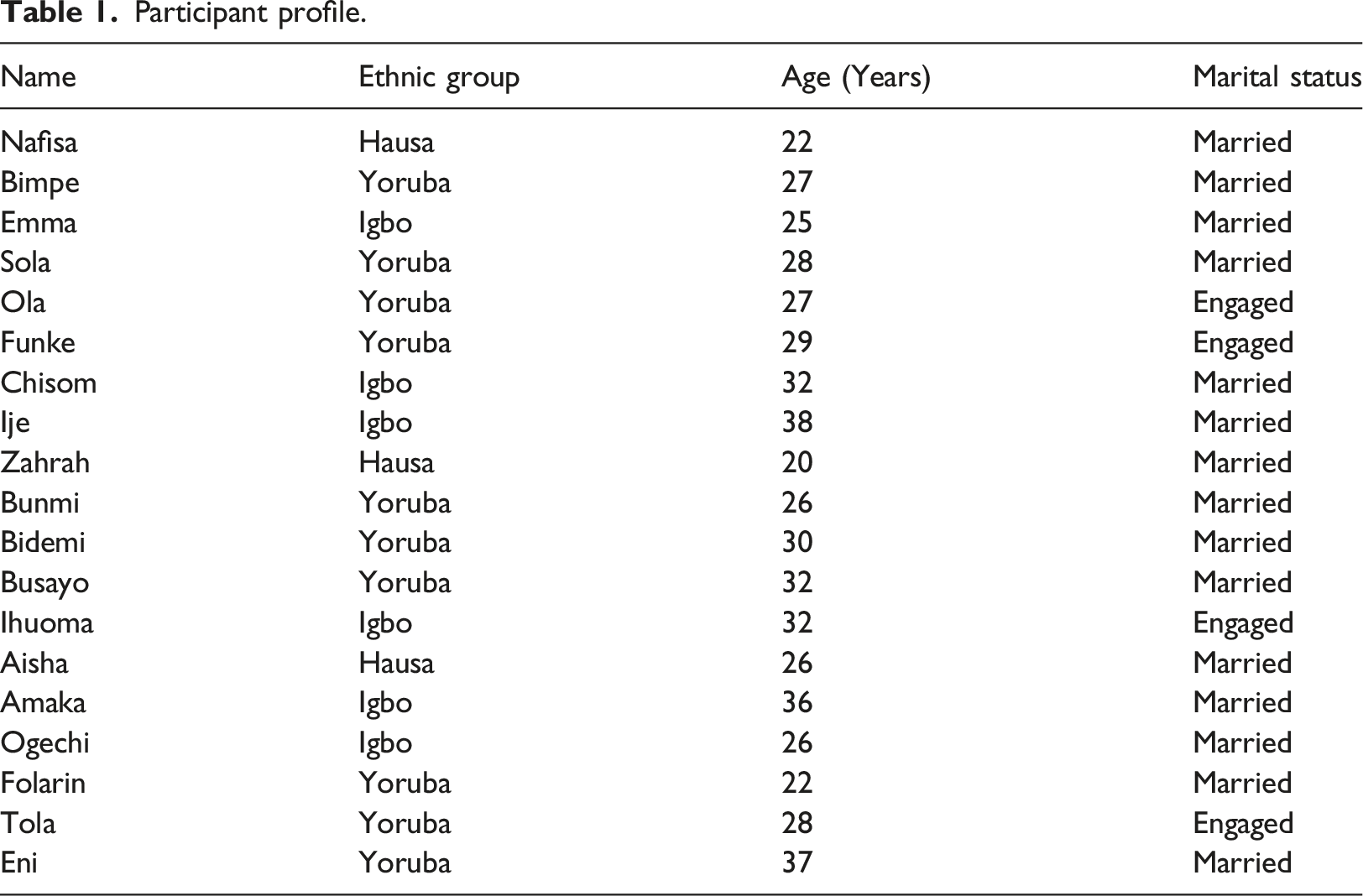
All interviews were conducted and transcribed by the first author, in English. As all participants were fluent in English, no translation was necessary. All 32 interviews were transcribed to generate over 500 pages of single spaced, font size 12, A4 Word documents. Data analysis was conducted using thematic analysis, as a means of clustering relevant data excepts into manageable themes (Spiggle, 1994). Thematic analysis can be ‘used to identify patterns within and across data in relation to participants’ lived experience, views and perspectives, behaviour and practices’ (Braun and Clarke; 2017: 297). Using NVivo 11 data analysis software, the transcripts were (manually) coded and clustered into smaller manageable ‘chunks’ of data. However, thematic analysis has a tendency of data reductionisms, of removing contexts from data excerpts (Belk et al., 2013). This was minimised by having the different authors with varying cultural backgrounds individually analyse the data and then negotiate the meaning collectively. Thus, the first author who is Nigerian, aimed for an emic reading of the data, whilst the other authors are of European heritage, and aimed for a more distanced and balanced view of the data. Following Braun and Clarke’s (2006) phases, latent meanings were sought, going beyond the surface and semantics of the data set, that is, ‘what is the participant trying to say’? which moves towards reading in-between the lines. This approach is suitable for the constructionist stance taken; whereby, the meaning assumed behind the words or actions is constructed between the researcher, participant and research community (Crotty, 1998). Subsequently, over 300 codes were generated, and after multiple rounds of reviews, negotiations, clustering and discussions amongst the authors, six overarching themes were produced with the data. As the research presented is part of a larger study, only two core themes are presented here, as they correspond with the specific focus of this article, thus building on the foundation of how Nigerian weddings are performed and experienced by liminars.
Findings and discussion
Extant literature on wedding rituals already provides in-depth analysis of the ‘happily ever after’ associated with weddings (see, for example, Lin et al., 2012; Otnes and Pleck, 2003). Thus, we focus less on this theme and identify two main themes from the transcribed data. The first theme focuses on gatekeepers and how it impacts on the (lack of) control the bride has over the wedding ritual. The second theme focuses on bridal identity and how it is conceived, negotiated and performed by brides. Whilst discussing these themes, pertinent questions raised in prior sections are also addressed.
Managing the support of and opposition from gatekeepers
The importance of parents in the wedding ritual increases the propensity for conflict between parents and the wedding couple (Otnes et al., 1997). Echoing this view, Folarin concludes that while ‘…marriage is for the both of you [i.e. the couple], the wedding is for the family’. Therefore, the inclusion of an individualistic (consumer) identity such as bridal identity, is bound to cause conflict with parents/family who are more fixated on the collectivised image of the wedding ritual (Kalmijn, 2004; Nguyen and Belk, 2013). Due to gatekeepers’ being more focused on collective image management, they do not automatically give their support to liminars, as the label implies, they also restrict who gets to be a liminar. This section discusses some of factors that encourage gatekeepers’ support for liminars and the conditions that foster opposition. In addition, we further highlight some of the consequences of support and opposition from gatekeepers. It is also worth emphasising that opposition or support is rarely absolute, rather, it is arbitrary and often on a contextual basis. Therefore, the demarcation we make between the two is to aid exposition.
Tonner (2016), Hackley et al. (2012), Otnes et al. (1997) and Thomsen and Sørensen (2006) all provide detail on what strategies liminars adopt to secure approval from gatekeepers, and therefore their support. However, what these studies typically take for granted is the need to gain gatekeepers approval before they can become liminars within collectivist societies. Specifically in the wedding ritual context, gatekeepers need to be satisfied before a woman can be considered a liminar (i.e. bride to be), thus suggesting that gatekeepers are already involved before the individual becomes liminal. As Nafisa cannot begin the process of the wedding ritual including performing her bridal identity until both families acquiesce to the union, the following quote shows that Nafisa’s family do not just scrutinise her soon-to-be groom, but also the family he comes from: “His family comes with an elder person, …they spoke to our oldest uncle and told him that they are there for Nafisa’s hand… Usually they say ‘OK, we're going to get back to you,’ because they have to go and search and ask people; ‘what do you know of this family, is he a good guy, blah blah’. So that's what they did, they said we're going to get back to you. But in my own case, we already knew of him and we're family friends, it wasn't a long a while. And after that, they come back and talked about a wedding date” Nafisa.
This scrutinising process is the norm in collectivist societies (Nguyen and Belk, 2013; Ustuner and Holt, 2007); however, as the above quote demonstrates, this does not appear to concern the bride. In a collectivist context, regardless of bridal identity ideal, the initial consumption purchases and planning only begins at the family level with approval of key gatekeepers (Lumbwe, 2013; Nguyen and Belk, 2013; Ourahmoune and Ozcaglar-Toulouse, 2012), the oldest uncle (i.e. patriarch) in Nafisa’s experience. This family behaviour may also explain why the label of gatekeeper seems more appropriate than stakeholders and/or ‘interested parties’. Therefore, should the groom and his family not pass the vetting process, the wedding is unlikely to take place (Fernandez et al., 2011).
Consequently, Cappellini and Yen (2016) give details of how liminars gain the support of gatekeepers specifically, by diligently adhering to social norms. Although social norms differ by class, religion and ethnicity, they were typically known to this article’s participants and participants overtly adhered to them before becoming liminars. Some authors have commented on liminars’ willingness to embrace liminal roles/stereotypes, typically linked to reducing liminal anxiety and ambivalence (Kalmijn, 2004; Ogle et al., 2013). This resonates with studies that illustrate how consumers embrace certain roles/stereotypes as a means of managing identity anxiety (Cappellini and Parsons, 2014; Ferreira and Scaraboto, 2016; Zukin and Maguire, 2004). Recalling Folarin’s earlier comment about the ‘wedding being for the family and marriage for the couple’, this suggests that brides might be more willing to embrace liminal stereotypes as a means of ensuring transition to their desired post-liminal end states. However, less has been said on authority figures, typically gatekeepers, who shape, and influence said stereotypes. Specifically, why do these liminal roles/stereotypes exist and what do gatekeepers gain by encouraging liminars to embrace them (Kalmijn, 2004)?
Often, stereotypes exist as a means of maintaining and reiterating the contemporary social order (Besel et al., 2009; McDonald and Wearing, 2013; Obinna, 2012), where the bride publicly performs the role of a ‘wife’ and the groom enacts the ‘husband’ equivalent during the wedding ritual (Ingraham, 2008). On a granular level, gatekeepers encourage the bride in embracing a pre-determined role as a means of collective image maintenance or enhancement (Fernandez et al., 2011; Lumbwe, 2013). The following quote illustrates Chisom’s family seeking to enhance and/or (appropriately) portray the family’s social and cultural status by increasing the size of her wedding ritual to about four times as many guests than she originally envisioned. “We wanted to just do a wedding for like 200 people, but my family objected…it was too small for them, owing to the fact that I am the last child in the family, and everybody seems to be OK, so they needed to give me something befitting…my wedding had about 700 to 1000 people” Chisom.
It is interesting to note Chisom’s acceptance that ‘everybody seems to be doing OK’, that is, other members of her family were in ‘good’ social (read financial) positions, and therefore, she needed a larger and more ‘befitting’ wedding ritual. Befitting in this context can also be interpreted as not just for her benefit, but as a proportional representation of the family’s (social, cultural and economic) status. In Chisom’s case, the significant number of guests is used as a tool to maintain and/or enhance the perceived reputation of Chisom’s family (Rudwick and Posel, 2015). This illustrates that gatekeepers’ roles go beyond mentoring liminars (Hackley et al., 2012) or maintaining the liminal phase (Cody and Lawlor, 2011). Moreover, gatekeepers are also keen on ensuring the collective image is appropriately expressed (Nguyen and Belk, 2013), as a means of portraying or enhancing their position within contemporary socio-cultural hierarchy. By having a large wedding of between 700–1000 guests, Chisom is performing the role/stereotype of belonging to a relatively wealthy family (and class) (Tonner, 2016). Thus, gaining the support of gatekeepers is not only about acquiescing to their requests, but also about actively contributing to the public image of the collective in a positive way (Cherrier and Belk, 2015; Sobh et al., 2014). A less cynical interpretation can be observed from Boden’s (2003) study, whereby wedding vendors find it easier and less expensive to manage the ritual process if the brides’ preferences stay within established ritual norms. That is, gatekeepers might insist on the bride embracing established stereotypes as a means of easing the (financial) burden of managing the ritual process.
The benefits of having gatekeepers on-side during the liminal phase of wedding planning include, financial support (Kalmjin, 2004), advice (Sykes and Brace-Govan, 2015) and access to a large social network. The first two benefits have been sufficiently investigated by prior studies, but the third benefit becomes more important in the Global South where the use of wedding planners is not as common as in the Global North (Nguyen and Belk, 2013). With gatekeepers being typically older, specifically parents and parental figures, they can facilitate social access to the liminar, allowing liminars to reach a wider audience of skills, knowledge and consumption artefacts. Below is an excerpt that illustrates how involved Sola’s father was when sourcing the ritual venue; “My parents did the most part of the hall [selection of the wedding venue]…I visited just three halls, he [bride’s father] visited the area, and saw the three halls and said I should go to so, so, so place, that he saw three different halls and gave me the prices of the hall, I should go there, check the halls out and check the one that I would like …so, we checked three halls, it was the last one we checked, then we concluded that we were going to use and we met with the manager of the hall …because it was a 200-sitter hall, it was N250,000. And we [bride and groom] were like, was he not going to reduce the price? He [venue manager] said no, that that was the price he was going for, so we got home, I told my dad, eventually my dad found out that he had a friend that knows, that his friend knows the owner of the hall, so I left the bargaining of the hall to him, to do, and then he eventually came back that the man agreed that we should pay 200,000 [Naira]. So, we took the hall for 200,000 [Naira]” Sola.
As the above quote shows, Sola’s father helped source the wedding venue and additionally engaged his social network to secure a 20% discount on the hall. It is reasonable to assume that Sola could have found the venue on her own, but her father’s involvement saved her time and effort. However, as a 20% discount on a wedding venue is rare within the (Nigerian) wedding industry, it is difficult to think that Sola could have secured such a discount without her father. This could also play into the improved social status gained post-liminality, as they adopt the contacts that gatekeepers introduce them to, thus, enabling liminars to then start their post-liminal experience with a wider social network (Nguyen and Belk, 2013; Soucy, 2014).
There are also instances where gatekeepers inhibit the consumption choices of liminars, if they feel it goes against social norms. To this end, the most common strategy that gatekeepers employ is to continuously apply (emotional and verbal) pressure until the liminar gives in (Geller, 2001). However, an interesting strategy is the threat of absence, where gatekeepers threaten not to attend and/or recognise the wedding ritual. In Nigeria, and as witnessed in many collectivist societies, wedding rituals are not just legal processes but public events that require the blessings of specific audiences to be fully complete (Fernandez et al., 2011; Ubong, 2010). As Bunmi points out in the following quote, the threat of failing to secure this blessing is much more than simply not attending the wedding ritual, but sends a public signal to their social group(s) that the gatekeeper (i.e. the father), does not acknowledge the union: “My dad won't come to your wedding if it’s not in church, he's very [church]ish…he does everything the [church] way, so if it’s not in church, it’s not a wedding, it’s not his business. So, you have to get married to a church member, you have to get married in church. …It has to be, that's the way, if it’s not that way, it means, it looks like you're being rebellious …my mum feels the same way, she supports her husband in everything” Bunmi.
Any public rejection from gatekeepers can derail the entire wedding (Fernandez et al., 2011; Soucy, 2014). Additionally, due to Bunmi’s father insisting on the wedding location having to take place in a church, his rejection also has ramifications on the type of consumer artefacts that Busayo can use in accordance with the church’s expectations, as shown in the following excerpt: “So my wedding dress was ready officially, but it was not taken [accepted] by the church…so on getting to the church [a day prior to the wedding for inspection]… they [church officiants] were castigating the ballgown, that it’s too long, its overflowing, its sweeping the ground, it’s not meant to sweep the ground…the professional tailor had already done the finishing touches that there was no need for adjustments at all…but we had to start stitching it, so, that was what we did, the night before…it was really hectic…it came out, it was manageable” Busayo.
Busayo went on to discuss that the church had clearly stated rules on wedding dresses, specifying that there had to be complete coverage of the cleavage and that the dress must be long-sleeved and reaching the ankle. Although Busayo was aware of these rules and had no intention of breaking them, the church pastors still complained that the dress was too long (i.e. ‘overflowing’). This rule, according to Busayo, was never made explicit, despite being a member of the church for many years, thus suggesting that gatekeepers’ preferences are not always concrete, instead, they are considered arbitrary and evolve on a case-by-case basis. Also revealed here, is that brides are constantly negotiating with gatekeepers even when they have no intention to actively oppose gatekeepers (Otnes et al., 1997).
Managing wedding vendors appears to be a complex task for liminars more generally. This tends to be due to being novices within the consumption market that the liminar is engaging with (Tonner, 2016). In Nigeria, this becomes more complex due to the limited means of consumer protection in Nigeria (Folorunso, 2013), whereby, vendors face little retribution for not delivering on paid for and/or promised services. Here, Amaka illustrates how vulnerable brides can be when vendors do not deliver as promised: “I’ve never seen a [venue] decorator that comes to decorate on the morning of your wedding …we already knew this was a catastrophe, we already had guests coming in and they were still arranging tables and seats …we now realised that they had taken too many events and probably, they went to tend to those who could, because there are actually a lot of politicians who can deal with them. …[people] they were more afraid of” Amaka.
Amaka further accuses wedding vendors of being deliberately inept if they perceive the bride has limited capacity of seeking retribution and focusing on more powerful Nigerians (e.g. ‘politicians’). Therefore, brides might not be aware of the type of precautions they need to take regarding unreliable vendors. Compared to the Global North where vendors are often an effective counterbalance to the traditional institutions of church and family (Sykes and Brace-Govan, 2015), they appear to play a more, lacklustre role according to the Nigerian participants of this article. All participants had multiple experiences of dishonest and incompetent vendors, further inflexing the power that family and church wield. This contradicts Otnes and Pleck (2003) and Lin et al.’s (2012) assertions that market actors increase the autonomy of brides. Moreover, it also refutes Ingraham (2008) and Nash’s (2013) conclusions on vendors having near, complete control of wedding rituals.
Amaka had two wedding rituals, one in her family’s ancestral home in rural eastern Nigeria with between 300 and 500 guests. It was at this wedding ritual that the venue decorator arrived on the day of the wedding, rather than the anticipated night before. On discussing her second and significantly larger wedding (approximately a 1000 guests), taking place in the city of Abuja, Amaka talked about how family often steps into the vacuum created by vendors. Her mother conscripted close friends to help and better control the execution of the wedding ritual, a role typically occupied by vendors in the Global North context, for example, the wedding planner (Geller, 2001; Ingraham, 2008). “…because we had learnt …we had decided that we wanted to meet all the vendors [prior to the wedding] …to set down rules, we had to call a meeting, because like I told you, we were planning for a thousand people…my mum had a committee of friends, and amongst those people they had people who they had given certain responsibilities to. Someone's responsibility was to map out what the people [vendors] would do, map sections they will be [in], so someone was in charge of that” Amaka.
Participants’ wedding ritual experiences support both assertions that Nigerians do not trust market actors (Folorunso, 2013; Ogbadu et al., 2012) and that there is limited consumer protection when things go awry (Folorunso, 2013). This article further adds that market actors are partly to blame for this mistrust. All participants spoke of at least one unpleasant experience with a vendor. In Nafisa’s case, she referred to vendors as displaying not just the odd misunderstanding here and there, but a mixture of incompetence and outright deception: “…she sent us a contract, we're not lawyers but when we read that contract it was clear she was going to dupe us. Because in that contract it was stated that if we cancel at any point we don't get that money back, even if it's a month before the wedding, which is odd and some other things you know …Then we called her and said we're not comfortable with your contract and we noticed that they are no chairs, oh yes, she sent us a 3D rendering of the hall, she sent us something that wasn't our dream, that wasn't our vision, we really wanted something floral and big but she sent us minimal, like, columns and stuff, it was simple and nice but not the floral dream we had …so we got a lawyer involved …the lawyer was our family lawyer, and obviously my dad pays for that… it was a mess really, because we were mad, we were not happy…I was so tired of planning, I was demoralized, I was so sad, but you know… we got our money back, but we had to write a petition [to a government anti-fraud agency]” Nafisa.
As expressed above, Nafisa had a disagreement with the venue decorator and when she tried to cancel the contract and get a refund, the vendor completely refused. This is despite the vendor who provided 3D renderings that contrasted with what they had previously verbally agreed upon. It’s unlikely for many Nigerians to have access to legal/government resources in solving wedding vendor disputes; therefore, Nafisa was the only participant who had some form of recompense from unreliable vendors, via the use of a family lawyer and the involvement of a government anti-fraud agency. Other participants, such as Amaka, for example, simply had to rely on family when things went wrong. This also supports Gbadamosi et al.’s (2009) ‘bandwagon effect’, in that Nigerians only consume products after they have been certified as safe by one’s collective, to help minimise instances like this and to avoid not being able to hold a market actor accountable.
There are also occasions where there is little room for negotiation and/or compromise between gatekeepers and liminars (i.e. a stand-off). As negotiations between both parties is an ongoing process during the wedding planning, this scenario is typically resolved with the liminar relinquishing control, also referred to as resignation (Otnes et al., 1997). This concession is due to the considerable influence that gatekeepers have over the liminal phase, whom Hackley et al. (2012) describe as them having ‘shamanic powers’. Otnes et al. (1997) identify other outcomes including modification, compromise and defiant non-purchase. Our participants illustrate two other possibilities, brokering and withdrawal. Withdrawal is discussed in detail in the next section alongside the different outcomes of bridal identity but brokering is another means to resolving a stand-off between liminars and gatekeepers. Here, the liminars can employ the influence of one gatekeeper against the other. In a sense, they borrow the power/status of a different gatekeeper that rivals that of the gatekeeper they are currently at odds with. As shown by the following quotes, this happens at both an individual and institutional level: “…somehow, I got his [bride’s father] elder brother involved so; he has been talking sense into [him]… I’m insisting I don't want erm, bridal rites, …it’s a mood spoiler, because by the time the two families finish negotiating …most people will be unhappy… he's probably just too excited and then he has some other advisers around him that maybe if he finishes deciding to do something they will tell him ‘Oh no, it’s not done like this, tell her'… his excitement is exhausting us” Ihuoma. “….they [the church] only do weddings twice a month, two Saturdays a month and they already had, the two Saturdays they already had weddings…[we] had to write an application to ask them for special permission to get married during the week, blah blah blah, my mum intervened, they finally allowed us to marry on Thursday at 10am” Emma.
As shown above, Ihuoma employs her uncle’s status to influence her father’s demands and gain additional concessions from him. Additionally, there are other advisers on her father’s side also trying to influence the wedding ritual. Akin to the premise that bridal identity goes beyond the wedding dress and encompasses the wedding ritual, Ihuoma is keen on maintaining an overly positive mood around the wedding ritual to reflect her preferred bridal identity. Whilst Ihouma’s brokering takes place within the family, Emma’s occurs between family and church. Here, Emma’s mother successfully lobbies for the rules to be changed on her behalf. Illustrating that although gatekeepers are typically invested in maintaining the status-quo, on a granular level, their interests do not always align. Emma’s experience is near identical to Sykes and Brace-Govan’s (2015) Australian brides, whose mothers were instrumental in resisting the undesired influence of market vendors. Together, Ihuoma and Emma illustrate multiple and overlapping trajectories of negotiations required by liminars, therefore, explaining why liminality can be so exhausting and stress inducing (Turner, 1969), especially where wedding rituals are involved (Boden, 2003).
Re-defining bridal identity
A typical understanding of bridal identity, via Western studies, is that it is a consumer identity consisting of the bride’s tastes, aesthetics and preferences expressed via consumer artefacts through a wedding ritual (Boden, 2003; Ingraham, 2008). However, this definition is limited to considering the bride as socially isolated and fails to account for the socio-cultural context that informs the bride’s preferences, aesthetics and tastes (Mupotsa, 2015). Building on prior studies, we propose a revised definition of bridal identity as the reconciliation of the bride’s consumer tendencies with the collective norms and expectations of social group(s) she subscribes to, negotiated by market forces and actors in the planning and execution of her wedding ritual. This definition differs from previous studies in that, while we acknowledge that wedding rituals do not occur purely within the market, they are intermingled with contemporary socio-cultural norms, structures and actors (Mupotsa, 2015). Furthermore, this definition considers the contradiction earlier expanded upon, that bridal identity is an expression between individual preferences and collective expectations, particularly due to the collective nature of wedding rituals with the simultaneous centring of the (consumer) bride (Boden, 2003; Ingraham, 2008).
When there is conflict between the bride’s individual preferences and collective expectations, an outcome often ends up somewhere between the two endpoints. To determine where bridal identity belongs on the individual consumer identity and the collective socio-cultural identity continuum, two important factors need to be considered: a willingness to compromise and script control. Our participants were limited to liminars; therefore, the emphasis is on how much the bride is willing to compromise with gatekeepers and how much script control she has or is afforded (rather than other involved actors). A willingness to compromise simply focuses on to what extent the bride is willing to compromise her preferences compared to opposing preferences, suggestions and expectations of other parties of the wedding ritual planning and execution. This resonates with prior studies that illustrate how compromise is a typical strategy for consumers when dealing with conflicting interests (Ahuvia, 2005; Boden, 2003; Otnes et al., 1997). In the Global South context of collectivism, compromise with gatekeepers is the norm (Fernandez et al., 2011; Nguyen and Belk; 2013), therefore, to what extent the bride is ready to compromise is a factor worth emphasising.
However, it is not enough to know whether the bride is willing to compromise or not, but rather, more detail is needed about the level of control she is permitted by gatekeepers over the ritual script. Here, script control refers to the ability to change the procedure(s) of the wedding ritual (Rook, 1985). Most consumption instances have a script that consumers tend to follow that is typically dynamic, as they tend to be influenced by multiple factors (Jenkins, 2008; Rook, 1985). However, ritual scripts tend to be more rigid than everyday consumption scripts (Ibid). This is more likely, as liminal gatekeepers tend to be significantly invested in the maintenance and adherence of ritual scripts (Adebanwi, 2005; Lumbwe, 2013). As these scripts tend to recreate and demonstrate contemporary social norms and hierarchies (Nguyen and Belk, 2013). Figure 1 offers an illustration of how bridal identity can be distributed with regard to the two aforementioned factors – a willingness to compromise and script control. Positioning bridal identity in times of conflict.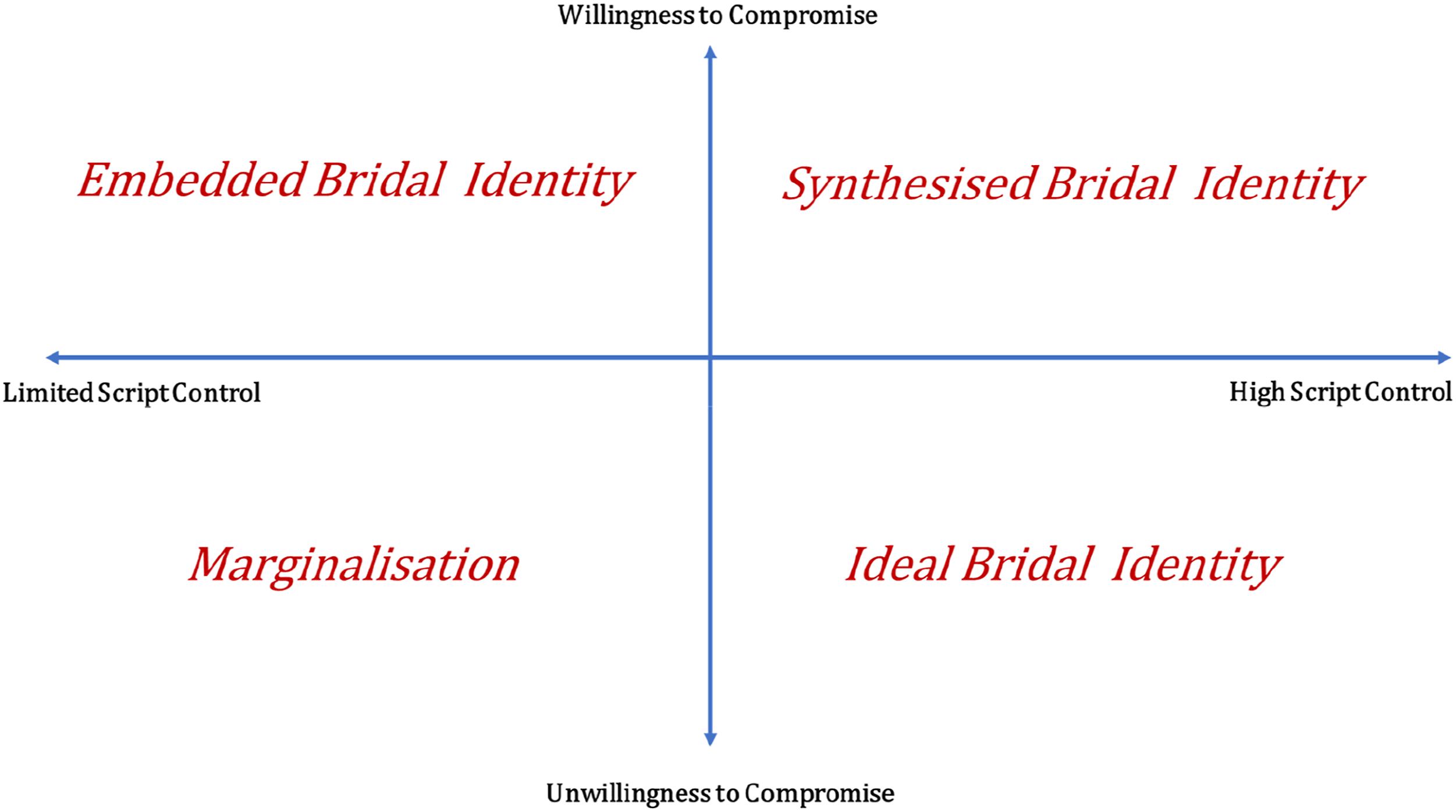
Consequently, we identify and reflect on three potential outcomes of bridal identity, including Embedded Bridal Identity, Synthesised Bridal Identity and Marginalisation. Each of these will now be discussed in turn. Limited discussion takes place on participants’ Ideal Bridal Identity, and therefore, we conclude that participants interviewed did not achieve this position. This echoes with the earlier assertion, whereby compromise is the norm in Global South wedding rituals (Nguyen and Belk, 2013; Ourahmoune and Ozcaglar-Toulouse, 2012). Moreover, even in the Global North, an area associated more strongly with individualism, Boden (2003) and Sykes and Brace-Govan (2015) conclude that such interaction with markets, tends to shift brides away from their bridal ideal. Although most brides often start their wedding planning with an ideal in mind, their limited capacity and experience in wedding planning means they must rely on others for its implementation. Boden (2003) specifically details how market actors systematically undermine the bride’s ideal to encourage a standardised wedding ritual. This push for standardisation is driven by the need for efficiency on the side of market actors (Adrian, 2004; Boden, 2003) and therefore profits (Nash, 2013). The reasons for ideal bridal identity being near impossible to achieve, can be illustrated along a continuum between two extremes set by Ingraham (2008) and Otnes and Pleck (2003). On the one extreme, Otnes and Pleck (2003) describe contemporary wedding rituals as driven by consumer choice and market availability. However, unless the bride has unlimited resources, time and know-how, her capacity for achieving her ideal bridal identity is limited by her unique social, cultural and financial position (Boden, 2003). At the other end of the spectrum, Ingraham (2008) asserts that the ideal bridal identity is simply an unachievable myth sold by market actors. Additionally, due to the patriarchal underpinnings of wedding rituals, such ideals will always be out of reach to the bride (Nash, 2013).
Nonetheless, the ideal bridal identity acts as a guiding vision which brides pursue as they navigate the complex landscape of wedding planning (Boden, 2003). Focusing on Figure 1, a high script control is, therefore, achievable – this will be expanded on when Synthesised Bridal Identity is discussed. However, unwillingness to compromise sets the bride up for conflict with the gatekeepers. Novice status of the bride reduces her chances of success if she does not compromise (Boden, 2003; Otnes et al., 1997), whilst in the Global South where social and cultural hierarchy plays a bigger role in the wedding planning (Mupotsa, 2015), this further diminishes the bride’s capacity for a successful ideal bridal identity. This will also be expanded on when Marginalisation is discussed.
Embedded bridal identity
In contrast to Ideal Bridal Identity, participants’ more commonly expressed Embedded Bridal Identity. Embedded Bridal Identity represents brides situated in the top left quadrant and can be understood as a bridal identity outcome when the bride has limited script control and is willing to compromise with gatekeepers to a higher degree. This bridal identity was more likely to adhere to established norms and expectations of wedding rituals and/or of the gatekeepers. The following excerpt introduces how this bridal identity is typically experienced: “I actually wanted a big wedding, but [laughs]… my brother, who represented my late dad, didn't want it. So he advised me to cut down and that we should not just show ourselves and all that …the number of people, we were hoping for was 400 but, erm, it was cut down to 200. Because we didn't invite as many family members as I wanted to, because I wanted people from my mum's side, from my dad's side but my brother said no, that we should just invite the immediate [family]” Eni.
As shown in the above quote, Eni relinquishes her own wishes in favour of her brother’s preference for a smaller wedding, despite her preference to have twice as many guests. Her brother, who can be seen as the family’s patriarch (i.e. he represented her ‘late dad’), had full control over the ritual script. Although Eni frames her brother’s suggestion as advising, the actual wedding audience size was reduced as per his suggestion. Eni’s brother’s words – ‘…we should not just show ourselves and all that’, can be interpreted as him wanting a small-scale wedding that does little to illustrate the family’s status. This is contrasted with Eni’s preference for 400 people that could comparatively be interpreted as ‘loud’. Here, the experienced conflict is about a wedding ritual consumer identity between a quiet, small ceremony with only immediate family versus a bigger and louder wedding ritual, which is eventually resolved in favour of the former.
As shown, Embedded Bridal Identity does not remove instances of conflict, rather, having a high ritual knowledge, is likely to reduce opportunities for conflict (Ourahmoune and Ozcaglar-Toulouse, 2012). However, as illustrated by Chisom, brides appear to continue their attempt to minimise any possibility of disappointment towards gatekeepers and the ritual audience: “…my family in particular, I expected that they don't get disappointed …because, since they've already accepted to help with the wedding [organisation] …I don't think they would have wanted to be disappointed if we failed on our part. And we also did everything to make sure we didn't fail them. …apart from my family, my village people [bride’s kin], they expected something, something extraordinary, because of the background I’m coming from…” Chisom.
Here, Chisom categorically declares that she and her groom did not disappoint her family’s expectations. It also follows that the more a family contributes to the wedding, the more they are likely to control and influence it (Kalmijn, 2004). Chisom further suggests, that by avoiding disappointment, the family will continue to be involved through their assistance with the wedding. Hence, she is willing to go to great lengths to ensure she fits in with their expectations, thus displaying an Embedded Bridal Identity. This resonates with Ahuvia’s (2005) demarcation consumer identity strategy, whereby consumers pick one identity over the other when they come into conflict.
There is also a moral undertone attached to the Embedded Bridal Identity, whereby participants are not just trying to fit in but see themselves as fulfilling important moral obligations (Lumbwe, 2013). For example, when discussing the notion of ‘bride price’ (i.e. a series of gifting opportunities between the two families to illustrate goodwill and acknowledgement of the wedding ritual – see Rudwick and Posel (2015) for more details), Ije stated that any omission of the bride price process will result in making the bride look “cheap” and subsequently, impact upon her social standing amongst other traditionally married women: “If a man didn't pay your bride price…that person could receive any insult. Ah! Yes, 'look at you…you're a cheap girl, did they even pay your bride price, you just follow [him]'. …in fact, the lady will not be fulfilled. Even if she is there eating money,
3
she will not be fulfilled. Because your bride price was not paid, there is this prayer that parents [pray], 'oh god, my child is going to that home, she will be a blessing to that home'. You know you're now going with your parents’ blessing; it gives honour” Ije.
In this context, the label of ‘cheap’ and the ‘eating money’ phrase, suggests that being considered as ‘cheap’ is not explicitly connected to the financial status of the bride or the actual cost of the bride price. Rather, the omission of the bride price (socially) degrades the value of the bride as a woman (and perhaps as a human being?) (Lumbwe, 2013; Rudwick and Posel, 2015). In addition, the honour Ije mentions goes beyond herself and extends to her parents and family (Adrian, 2004; Ubong, 2010). This was also echoed by Chisom, whose family wanted a wedding ‘befitting’ of their status, as expected by her ‘village people’. In this context, ‘village people’ can be interpreted as extended family or kin (Nwafor, 2012, 2013; Ubong, 2010). Ije further elaborates about how women with an unpaid bride price, could receive insults for not being married in the traditional way, or viewed as ‘dishonourable’, or as Bunmi terms it, for being ‘rebellious’. This implies that the stereotype of being a ‘cheap’ woman is not just enforced by gatekeepers, but by society at large (Wickstrom et al., 2021; McNeill and Graham, 2014). McNeill and Graham’s (2014) study also identified participants who engaged in specific liminal consumption activities to avoid judgement from society in general. Thus, confirming that gatekeepers play a significant role regarding how social norms are performed within liminal experiences.
Consequently, Ije attempts ‘othering’ such women by demarcating herself and enforcing a rigid boundary, established prior to her wedding ritual (Wickstrom et al., 2021). This is a common occurrence by people who are deeply embedded within traditional systems, reinforcing social boundaries (Cherrier and Belk, 2015; Kerrane et al., 2020; Sobh et al., 2014). A similar process of ‘othering’ is revealed by Thomsen and Sørensen’s (2006) participant, who uses the purchase of certain prams to distance herself from migrant ‘others’ that she lives close to, to present herself as ‘Danish’ (i.e. not a migrant), during the liminal phase of early motherhood. In sum, Embedded Bridal Identity illustrates an outcome that encourages adherence to expectations of liminal gatekeepers whilst simultaneously distancing oneself from an undesirable ‘other’, an ‘other’ typically seen as rebellious.
Synthesised bridal identity
Situated in the top right quadrant of Figure 1 and staying on the axis of being willing to compromise whilst wielding more script control is Synthesised Bridal Identity. Here, there is a sense that the bride can skilfully reconcile her preferences with those of the collective(s). The following quote illustrates that Ola’s relationship with her father is more liberal. Her description of her family as being ‘free’ implies she was given more autonomy than other (Yoruba) brides are likely to experience (i.e. having a larger influence on the ritual script): “My dad respects my choice, whatever choice I made, it's fine, he will only advise me if it's not going to be good, but whatever good choice I make, he's fine with it. …actually, on a normal Yoruba typical setting, I’m not supposed to be involved, with whatever decision made, it should be fine. But then, my family is a free one” Ola.
Nevertheless, such autonomy is still expected to fall within implicit guidelines – in other words, a ‘good choice’. It is important to note that none of our participants went completely against collective, socio-cultural norms, instead, there were specific deviations. This is supported by Gbadamosi et al. (2009) in another consumption context, who suggests Nigerians consume within a pre-approved set of options/markets. Thus, if the scale of deviation is not significant, the bride is offered some element of control regarding the ritual script as suggested by the quote from Ola. A common strategy employed when the bride wields a considerable amount of consumption ritual knowledge, is to successfully combine both tendencies, that is, to follow guidelines but deviate only slightly (Boden, 2003). This was apparent in conversations with Bimpe who requested that her wedding dress sleeve be elongated to meet the ‘gospel standard’ of her parents: “…when I got the wedding gown [dress], it was a short sleeve, most of their wedding gowns don't have long sleeves… I told the lady [dress vendor], maybe there's a way they could give the designer or the tailor or something for them to fix a hand. …so she said there's a way to do it, but I have to pay more. …they helped me fix it …my dad was just insisting that he wanted to see [inspect] the wedding gown [dress], that I should not just go and embarrass him …I was like ‘you guys [bride’s parents] should not worry, that the wedding dress is nice and everything, it is according to gospel standard, according to what you guys want’” Bimpe.
Whilst Bimpe and Ije both insist on fulfilling social expectations, Bimpe seems much keener on aesthetics compared to the socio-cultural conformity of Ije. Here, Bimpe insists on reinforcing her pre-liminal tastes, aesthetics and individuality, rather than ‘othering’. Thus, the focus is on herself and how she presents her image to the wedding audience. Despite Eni’s willingness to compromise with gatekeepers resulting in demarcation (Ahuvia, 2005), Bimpe’s attempt at creating a novel/unique wedding dress resonates with the ‘strategy of synthesis’ as posited by Ahuvia (2005), for when consumers are dealing with identity conflict. Aisha presents a more thorough example of changes to the ritual script to suit her preferences, as she inserts an additional process within the ritual script for her own benefit, by having her groom conduct a ring proposal even as her family’s custom was for the groom’s family to make a formal proposal to her family before wedding planning can begin, for example: “…so his family had already come to formally introduce themselves to my family and asked for my hand in marriage. …that happened I think a month before the ring came, like 3 weeks before, so, of course I already knew, what was coming. But I still wanted a proposal, he knew from day one” Aisha.
Aisha later elaborates upon how her groom proposed with a ring after wedding preparations had begun, when both families had formally agreed to their union. Instead of insisting on a ring proposal before both families agree to the wedding ritual, she compromises by having the ring proposal later. This compromise is only made possible, however, by modifying the ritual script. Here, the aim is to satisfy her own preference for a ring proposal without upsetting the customs of her family. Compared to Ije and Chisom, who exemplify an Embedded Bridal Identity, Aisha and Bimpe demonstrate a Synthesised Bridal Identity, and are therefore less concerned with perfectly fitting into the mould created by their wedding ritual gatekeepers, and more concerned with differentiation within their own social groups (Nash, 2013; Ourahmoune and Ozcaglar-Toulouse, 2012). Moreover, Aisha specifically employs ritual script modification as a means of achieving her preferred bridal identity. In essence, liminars with Synthesised Bridal Identities leave monitoring of traditional (or collective) boundaries to gatekeepers, whilst enforcing a smaller space within the collective that they deem as their personal space that requires individual expression and performance by exercising stronger control and modification of the ritual script.
Marginalisation
Alternatively, where the bride is unwilling to compromise and yet, she has limited script control, she is likely to be marginalised from the wedding ritual process and/or execution. It is difficult to call this outcome a bridal identity, as there is no clear indication of reconciliation. Rather, as illustrated by Nafisa, it can be viewed as a failed attempt at bridal identity: “she [the makeup artist] didn't come on time, and my aunties were putting so much pressure on us …one of my aunties was even cursing at me …so I just broke down, …I was crying and I couldn't stop …but you know you've planned everything, what you're wearing and how you're going to look and someone will just come and take it away from you …At some point I just left the dancefloor …and went into the house and that was it for me” Nafisa.
Nafisa’s quote summarises a failed attempt at changing the wedding script and the repercussions of such an attempt. This can be seen as an example of withdrawal, as a process of dealing with (over-demanding) gatekeepers (Otnes et al., 1997). Due to the makeup artist’s tardiness, accompanied by Nafisa not having anticipated such a situation, she withdrew early from her own wedding ritual and felt her plans and vision of the wedding were taken away from her. Here, Nafisa lacked the needed resources to enforce her personal boundaries and instead, had to acquiesce to the demands of gatekeepers (i.e. aunties), leaving her marginalised from the process. This mirrors the prior studies by Jafari and Goulding (2008) and Ustuner and Holt (2007), that illustrate how consumer identity projects were crushed by more powerful groups, resulting in Marginalisation, followed by withdrawal. Interestingly, Nafisa’s withdrawal still allowed the wedding ritual to continue despite her absence from the decision-making. This is more likely to occur in collectivist societies where the wedding ritual is less about the couple and more about their families (Fernandez et al., 2011; Nguyen and Belk, 2013).
Conclusions, limitations and avenues for future research
This article uses wedding rituals as the site of understanding liminality, specifically from a consumption and marketing perspective. In liminal consumption studies, the role gatekeepers play is typically under-theorised. Further, limited prior research exists about unresolved disputes between liminars and gatekeepers. This article responds to these gaps by attending to how gatekeepers’ demands and behaviours impact liminars’ experiences and the conflicts it generates. Specifically, feelings of marginalisation, disappointment and more positive instances of joy, enthusiasm and satisfaction. In so doing, our findings advance our knowledge by illustrating how gatekeepers support and impede liminars’ quest for successful transition. Evidently, gatekeeper support is not automatic, rather, liminars must earn gatekeepers’ approval, typically by performing certain stereotypes. Likewise, when liminars deviate from gatekeepers’ expectations, impedance can be in the form of threats of absence from gatekeepers from the wedding ritual, and/or via emotional pressure. Instead, gatekeepers give support to liminars when their approval is earned in the form of financial, social network and consumption advice. In revealing these behaviours, liminars employ a host of strategies in managing and negotiating with gatekeepers. While prior studies had detailed some of these strategies, this article contributes specifically to the ‘stand-off’ between both parties, which results in little room for negotiation or compromise. Thus, the typical outcome is for the liminar to relinquish control to the demands of gatekeepers, or less common, the liminar withdraws from the process. An additional strategy is for liminars to employ brokering, where they pit gatekeepers against each other, at both individual and collective levels.
Within this article’s context of wedding ritual consumption, bridal identity was previously coined as the process whereby liminars use wedding ritual consumption, specifically the wedding dress, in crafting a consumer identity project. We advance our current understanding of bridal identity by defining it as the reconciliation of the bride’s consumer tendencies with the collective norms and expectations of social group(s) she subscribes to, negotiated by market forces and actors in the planning and execution of her wedding ritual. Moreover, this article shows that the pursuit of a bridal identity is not linear, rather, a series of negotiations with potentially multiple outcomes. These outcomes include an Embedded Bridal Identity, a consumer identity that poses little opposition to the demands, expectations and preferences of gatekeepers. The second outcome is a Synthesised Bridal Identity, where a successful reconciliation of individual and collective preferences within the wedding ritual occurs. Consequently, Marginalisation occurs when there is no resolution to the conflict between the bride and gatekeepers, leading to the bride being excluded from the ritual process. Conceptually, there is a possibility of an Ideal Bridal Identity, whereby the bride stays in full control of the ritual script and does not have to compromise with the ritual gatekeepers; however, we do not see direct evidence of this. The article concludes that liminal gatekeepers play an important role in influencing bridal identity outcomes. Although the article focuses on liminars, we can assume that the more gatekeepers are willing to compromise with the bride, the less likely she is to be marginalised from her wedding ritual. To the authors’ knowledge, no previous article has considered the consequences of a failed attempt at bridal identity. Building on Hirschman et al.’s (2012) critique of contemporary marketing research on liminality that rarely address the negative experiences of the liminal phase, this article presents Marginalisation as a consequence of a failed attempt at bridal identity.
Specific to the Nigerian context, the article also helps explain why there is little trust for market actors amongst Nigerians. In so doing, we reinforce a prior study that concludes that little can be done to hold Nigerian market actors accountable for mistreatments (Folorunsho, 2013). Here, our article shows a general tendency of wedding vendors failing to meet expectations. Prior non-Nigerian studies have illustrated how the marketplace becomes a useful arena in negotiating individual and collective preferences and disputes. However, in the Nigerian context of this article, the marketplace appears to be underequipped with dealing with these tensions. Rather, we see market actors who are conceived in Western studies as resolving these conflicts, are instead inflexing the power of traditional gatekeepers through the family taking on roles originally assigned to the market actors.
Potential limitations of this article may be that our data collection excluded the recruitment of gatekeepers and that our participants were mainly middle to upper class Nigerians. Therefore, we conclude by inviting Marketing researchers to build on our work by including the voice of the gatekeeper and by comparing wedding rituals between and across different class segments. In so doing, we believe marketing scholars will be able to develop further insights around liminal consumption in the Global South.
Footnotes
Acknowledgements
We acknowledge the constructive comments from the presenters and participants on this initial paper from the 11th European Association for Consumer Research conference in Ghent, Belgium. Additionally, we appreciate the constructive comments from Prof. Pauline MacLaran and the anonymous reviewers from Marketing Theory.
Declaration of conflicting interests
The author(s) declared no potential conflicts of interest with respect to the research, authorship, and/or publication of this article.
Funding
The author(s) received no financial support for the research, authorship, and/or publication of this article.

Notes
Biographies
Ladipo Fagbola has recently completed his PhD at the University of Salford and is a p/t lecturer in Marketing at Nottingham Trent University. At present, he also works as part of a FCMG brokerage agency as the digital advertising manager, search and display. Working for brands such as Weetabix, Perfetti Van Melle and Baylis and Harding. Prior to his PhD, he worked within social media marketing and portrait photography.
Morven G. McEachern is Professor of Sustainability and Marketing Ethics at the University of Chester. Her research interests focus on business and consumer behaviour within a variety of sustainable production and consumption contexts. In addition to various peer-reviewed international conferences, she has published in academic journals such as Sociology, Marketing Theory and the Journal of Business Ethics. She has also co-edited various Journal special issues around her related research interests and contributed to edited books.
Christina Raftopoulou’s research focuses on exploring the underlying assumptions and structures that support marketing activities in a variety of contexts as well as the role of marketing in creating and sustaining such assumptions as well as identities and power relations. Her research has mainly focused on government marketing activities and has a critical focus. She gained her PhD from the University of Manchester and is currently working for the Grenoble Ecole de Management.