



Abstract
Marketing scholarship has commonly demonstrated how consumers assemble heroic identities as a means to facilitate forms of empowerment and emancipatory consumption. Although some insight into more troubling aspects of heroic discourses has been shared, prioritisation of the positive potentialities of heroism remain privileged. We invoke social heroism as an interpretive lens to study the lived experiences of parent-carer’s to children with impairments, employing paradoxes of heroism as heuristics to explore how heroic discourses disempower parent-carers. We find that parent-carers do not identify with the heroism surrounding care. Instead, they view themselves as unessential due to the ableist tenets that underlie heroic discourses. We uncover three problematizing and subtle practices of ableism; purification, micro-aggressions and responsibilized-commoditization. Such insight, (i) advances marketing theory’s understanding of the socio-political structuring of heroism, (ii) advances discourse on consumer vulnerabilities and ableism and (iii) begins to meet the calls for research into care politics and justice.
Introduction
In 2019, Annemarie Plas began a social movement in the UK during the Covid-19 pandemic. Her ‘Clap for our Carers’ initiative, (C4C hereafter), which mimicked similar campaigns in other European countries, soon turned viral and witnessed millions clapping for carers each week. At its height, the initiative was covered by all major media, endorsed by numerous celebrities and brands, and became central to political discourse in responding to the pandemic. This created a wave of ‘caring nationalism’ (Wood and Skeggs, 2020) and positioned the Covid-19 crisis as ‘above all a crisis of care’ (Chatzidakis et al., 2020: 889). Heroic discourse underscored the movement, with care workers, and subsequently key workers venerated as heroes.
However, commentaries have extended that the socio-politicisation of heroism in the context of care remains problematic (Chatzidakis et al., 2020; Dowling, 2020; Wood and Skeggs, 2020). A study by Hennekam et al. (2020) establishes that heroic discourses are viewed as perfunctory by carers. They find rather than facilitating feelings of empowerment for carers; doctors, nurses and hospital staff feel manipulated and objectified for purposes of social camaraderie in face of the Covid-19 crisis. They maintain that the heroic discourse that surrounds care masks the need for transformative action in care systems, with it instead being used to foster solidarity and camaraderie so society can avail of a sense of empowerment or escape from the turmoil which the crisis has invoked. Such criticism speaks to the belief that ‘most people are not interested in the hero, but in what the hero can make them feel’ (Cooley, 1902: 346) and in this respect it is questionable if Covid-19 truly changed public discourse on care. C4C can thus be interpreted as being less about carers as heroes, and more about how individuals have managed and maintained themselves during lockdown. This aligns with consumer research on heroism, where its potential as a discursive tool facilitates identity projects and senses of consumer empowerment.
Heroism and heroic understanding underscores much knowledge in consumer research (Belk and Tumbat, 2005; Cronin and Hopkinson, 2018; Giesler, 2008; Holt and Thompson, 2004; Pearson and Mark, 2001; Preece et al., 2019; Sobande et al., 2020; Woodside et al., 2008). Common themes in heroic expositions demonstrate how consumers discursively assemble heroic identities (Holt and Thompson, 2004; Sobande et al., 2020), to facilitate forms of empowerment (Hollenbeck and Patrick, 2016; Patsiaouras et al., 2018) and emancipatory consumption (Belk and Costa, 1998; Goulding et al., 2002; Giesler, 2008; Schouten and McAlexander, 1995; Tumbat and Belk, 2011). This discourse relies on, and establishes, classic heroic archetypes, wherein the hero ‘is incarnated through a higher case that is personally satisfying’ (Hollenbeck and Patrick, 2016: 78). These accounts thus prioritise the positive potentialities of heroism as a restorative, emancipatory or empowering discursive tool. However, Franco et al. (2011: 99) note that ‘while heroism is primarily a positive and prosocial act, a simplistic view of this behaviour misses important (and sometimes negative) aspects of the phenomenon’. Consumer research has shared some insight into more troubling aspects of heroic discourses. For example, Holt and Thompson (2004) and Hollenbeck and Patrick (2016) both allude to the pressures which men and women feel in being compelled to act rebelliously or heroically in order to occupy certain culturally idealised subject positions. Equally Sobande et al. (2020) note that the oversexualisation of men in sperm bank advertisements romanticises the male body, in turn making many men feel stigmatised. Likewise, Belk and Costa (1998) extend how certain celebrations during Mountain Men rendezvous rely on a heroic rhetoric steeped in misogyny. However, these efforts are a consequence of our critically orientated tradition rather than overt attempts to unpack and understand more disturbing aspects of heroism and heroic discourse. It remains that the positive potentialities of heroism as a discursive tool have been prioritised by marketing scholarship, with negative and dark sides of heroism receiving less attention. Such imbalance is problematic as it reduces awareness of the controversial ways through which heroism and heroic discourse can subjugate and disempower consumers. In seeking to redress this, we investigate how the lived experiences of parent-carers to children with impairments, 1 intersect with heroic discourses that have contemporarily enveloped care and care practices. To do so, we focus on the sustained experiences of parent-carers prior to and during Covid-19.
Within this article, parent-carers comprise those who enact ‘informal care’ for their children (Dowling, 2020), many of whom have severe impairments rendering them terminally unable to walk, talk, feed or bathe themselves. It is estimated that Covid-19 has increased informal carers from 8.8 million in 2019 to 13.6 million in 2020 (Carers UK, 2020). This figure indicates that approximately one in every five people in the UK now undertakes some caring responsibilities. Carers UK estimate that this labour saves the UK economy on average £132 billion per year. Yet despite this, parent-carers representation in C4Cs was not as pronounced as NHS staff or key workers. Given that parent-carers lived experiences centre on caring needs, and that they impart significant savings onto broader society, it is noteworthy how ‘some’, but not all, notions of care have recently been embellished with heroic status. Considering this, the objective of this research is to nuance understanding of heroism and heroic discourses, furthering critical literature on heroism in consumer research.
To do so, we invoke social heroism as an interpretive lens to understand parent-carers lived experiences, employing paradoxes of heroism as heuristics to explore how heroic discourses disempower parent-carers. This interpretative study finds that parent-carers do not identify with the heroism that surrounds care, instead they view themselves as unessential due to the ableist tenets that underlie heroic discourses. Ableism refers to a ‘network of beliefs, processes and practices that produce a particular kind of self and body (the corporeal standard) that is projected as the perfect species-typical and therefore essential and fully human’ (Campbell, 2001: 44). In this respect, ableism is not merely a form of discrimination or structural divide, but underscores conceptions of what it means to be human, with the classic heroic archetype usually being able-bodied (Goodley, 2017). Indeed, as this article will present, predominant discourses of heroism socially, globally and within consumer research to date, perpetuate the ideal of ableism and its search for the perfect human. In studying parent-carers, we thus adopt a ‘studies in ableism’ approach (Campbell, 2001, 2012) prioritising how normative ideals disempower and disable not only those with impairment, but also those who are ‘able-bodied’.
Our paper makes the following contributions. We uncover how heroic discourses perpetuate ableist agendas, and exacerbate the subjugation of parent-carers. Thus, we advance consumer research’s critical understanding of the socio-political structuring of heroism, uncovering how heroism can be a discursive tool of subjugation in classifying and ‘othering’ particular segments in society. We uncover three problematizing and subtle practices of ableism; purification, micro-aggressions and responsibilized-commoditization. Such insight contributes to an emerging discourse on consumer vulnerabilities and systems of ableism in consumer research (Higgins, 2020; Hamilton et al., 2015; Kaufman-Scarborough, 2015; Kearney et al., 2019). Ultimately, this paper in drawing attention to specific practices and processes of ableism calls marketing researchers to conduct further research that illuminates how ableism is entrenched in our marketplaces.
In the sections that follow, we provide background on social heroism and care and outline the paradoxes of heroism that we employ to interpret our findings. We consider how marketing scholars have approached ableism and situate how social heroism can advance understanding of the inequities that ableism endows upon society. We discuss our research methods and present our findings, before finally offering a discussion of the core contributions that our research makes.
Social heroism and caring
Heroes and heroism have been subject to broad scholarly debate. Historical accounts postulate of a ‘heroic elect’, heroes of almost divine descent that wield power onto society (Carlyle, 2001, [1841]; Weber, 1978, [1921]). Such interpretations are understandable, given the mythic and pious antecedents that occupy many heroic narratives (Campbell, 1949). However, others contend that heroism is more fluid and complex than this. Situational perspectives on heroism rely on a social constructionist ontology and debunk ‘the significance of personological factors’ in heroic acts (Walker et al., 2010: 908). Zimbardo (2007) claims that there is a ‘banality of heroism’, wherein particular situations, at particular times any one person is capable of acting in a heroic manner. This relativism is captured in how understanding of the concept has developed from a paradigm of great men and deities as heroes (Frisk, 2019), to more fluid conceptualisations and accounts of heroes, from ‘idols of production’ to ‘idols of consumption’ (Lowenthal, 1961: 116). Contemporary literature is replete with nuanced examinations of ‘relatively mundane’ figures such as celebrities, mountain rescuers and sportspeople within the ‘heroic category’ (Frisk, 2019: 90).
Franco et al. (2011) put forward a conceptualisation of heroism in which heroic acts coalesce around three forms: martial (military) heroism, civil heroism and social heroism. Martial and civil heroism are characterised by courage, bravery and physical risk. Military heroism is captured in heroic acts that military personnel, but also police officers, firefighters and paramedics, perform as part of their professional service. Civil heroism involves extra-ordinary acts wherein one puts themselves at considerable risk to save another from physical peril. Social heroism, however, accommodates an alternate understanding.
In contrast to military and civil heroism, where physical risk is a classifying indicator, social heroism is manifest through personal sacrifices, such as ‘financial consequences, loss of social status, possible long-term health effects and social ostracism’ (Franco et al., 2011: 100). Heroic archetypes which fit the social heroism mould include whistle-blowers, environmentalists (Glazer and Glazer, 1999), activists, artists, scientific explorers (Csikszentmihalyi et al., 2017), religious/political leaders and good Samaritans (Franco et al., 2011). Here heroism is formed from benign actions that seek to promote positive social impact. The goals of social heroism are to preserve ‘a community sanctioned value or standard that is perceived to be under threat,’ or establish a ‘set of extra-community standards’ that push towards a ‘new ideal that has not yet found wide acceptance’ (Franco et al., 2011: 100). This conceptualisation provides a far more inclusive paradigm for interpreting various groups and people as heroic. In doing so, various scholars have labelled social heroism as involving ‘courageous resistance’ (Shepela et al., 1999), ‘moral rebels’ (Monin et al., 2008), or ‘moral courage’ (Staub, 2011).
Tangentially consumer research has addressed how some consumers operate as social heroes. For example, Giesler (2008) notes how ‘hacker heroism’ pushed new ideals onto the music industry, revolutionising how content was shared and consumed, creating a more egalitarian marketplace for music producers and consumers alike. Similarly, Patsiaouras et al. (2018) outline how protestors use art to foster social solidarity for remonstrative movements that oppose social injustices. Likewise, while not previously considered as social heroes, consumer research has also demonstrated how carers and caring encompass experiences of personal sacrifice aligning with social heroism. Mason and Pavia (2006) and Pavia and Mason (2012) outline the difficult sacrifices enacted by parent-carers, whereby they have to ‘elect’ which familial experiences to exclude their child with impairment from (Pavia and Mason, 2012), and ‘adapt’ as a family as a means of meeting marketplace norms (Mason and Pavia, 2006). Equally, Hunter-Jones (2010) finds that carers make sacrificing consumption decisions to meet the needs of those they care for, often emplacing themselves socially within a position of exclusion and vulnerability. Dean et al. (2020) contend that this vulnerability can affect carer’s mental health, as they experience a loss of control over their own lives and well-being in caring for others.
Recently Chatzidakis et al. (2020: 893) have called on scholars to craft a ‘caring politics’, issuing a remit for research that acknowledges ‘the intricacies of human interaction’ involved in care. For them, Covid-19 has created a ‘crisis of care’, simultaneously elevating care into public consciousness, where it has become a contemporary trope for heroism, while also distorting ‘what counts as meaningful care’ (Chatzidakis et al., 2020: 890). The implication is that carers (and others – i.e. keyworkers) are glorified for purposes of social solidarity (Hennekam et al., 2020), rather than legitimate appreciations for the challenges that they encounter on a daily basis. This raises concerns about the recent socio-politicisation of heroism, and the prosocial nature of heroism as a rhetorical device, leading Wood and Skeggs (2020) to call for research to move discourse from care gratitude to ‘care justice’. Social heroism can nuance understanding in this domain. Rather than conceptualising heroism as a purely prosocial activity, social heroism situates heroic acts in the realities of everyday life. It focuses on personal sacrifices as opposed to personal gratifications. This is important as it can expand our understanding of heroism in consumer research, moving beyond the positive potentialities of heroism as a discursive tool, towards a more nuanced understanding of ‘caring politics’ (Chatzidakis et al., 2020) and ‘care justice’ (Wood and Skeggs, 2020). Positive societal dispositions towards care must be tempered by the lived realities of care, to ensure that truly transformative change in care systems can be advanced.
To promote this agenda, we invoke social heroism as an interpretive lens to understand the lived experiences of parent-carer’s, employing paradoxes of heroism as heuristics to explore how heroic discourses disempower parent-carers. We concentrate on two paradoxes of heroism offered by Franco et al. (2011). Although Franco et al. (2011) discuss these paradoxes separately, it must be noted that they are mutually inclusive, with one reinforcing and informing the other. Franco et al.’s (2011: 102) first paradox relates to ‘the duelling impulses to elevate but also negate heroic actors’, uncovering how heroic acts are often elevated and venerated by the public but equally they can be negated and degraded. They detail how whistle-blowers for example may be viewed as moral protagonists by some, while others can view their acts with contempt. The well-publicised activities of NSA whistle-blower Edward Snowdon highlight this paradox of heroism. He is viewed as a liberator and hero by many, whereas others contend that he should be sentenced for treason. Franco et al.’s (2011: 103) second paradox refers to the ‘disparity between the public ascription of heroic status onto individuals and groups, and the profound effects, which the interiority of the decision to act heroically belies’. They delineate that the social construction of heroism, and what is assigned as heroic, is selective and subjective, as evidenced by the first paradox. However, Franco et al. (2011) maintain that the public interpretation of heroism will always be at a dissonance with the actual experiences of heroes. The romanticism of heroism rarely captures the arduous labours involved in acting heroically. For example, while political activists can be venerated as heroes e.g. Jane Addams and John Hume, the personal sacrifices needed to affect change are rarely publicly understood. We explore these paradoxes in our study of parent-carers, and their reactions to heroic discourses that recently have occupied representations of care. Our aim is to expose how heroic discourses for parent-carers are perpetuated by, and sustain, ableist dominated logics, structures and culture.
Ableism
Kearney et al. (2019: 548) present that ableism ‘encompasses an ability-justified realisation of a person’s body and conception of their being in relation to others in social space’. They continue that ableism incorporates numerous ‘ism’s including racism, sexism and ageism. Ableism thus, correlates with restricted notions of humanism, which privilege white, masculine, able-bodied, highly productive notions of humanity (Braidotti, 2013). Similarly, like humanism, which is only truly understood through comparison with the other – ‘the non-human, the inhuman, the anti-human’ (Braidotti, 2013: 2), ableism can only exist through the existence of disability – the presence of a contrary notion to the perfect human, the perfect body. Chouinard (1997: 380) describes how ableism suggests ‘a way of being’, wherein able-bodied abilities and characteristics are assigned value as ‘normal’ in society. This subjugates persons with impairment into a spectrum of understanding wherein they are cast as occupying ‘diminished states of being human’ (Campbell, 2001: 44).
Heroic discourses most often prioritise a perfect ideal. Media representations of heroes are strong, super-powered and traditionally able-bodied (i.e. Superman, Batman and Spiderman), whereas the impaired body is perceived often in media as ‘sinister, evil, ungodly, lacking’ (Goodley, 2017: 15). It is notable how the impairments of Captain Hook’s hook and Darth Vader’s heavy breath are both crucially used to signify their villainous character. Those superheroes who are bodily impaired (i.e. Professor Xavier in X-Men), redress their limitations through extra-ordinary abilities (i.e. telepathy) rendering them again super-abled, super-human (Kearney et al., 2019). In consumer research, various studies detail how heroic identities are largely occupied by able-bodied consumers (Belk and Costa, 1998; Schouten and McAlexander, 1995; Tumbat and Belk, 2011). For example, the rebellious hero of Holt and Thompson (2004), or the sperm donating heroes of Sobande et al. (2020) are masculine, strong and most crucially ‘able’. Thus, predominant discourses of heroism socially, globally and within marketing theory to date, perpetuate the idea of ableism and its search for the perfect human.
Ableism encapsulates two core dimensions; (i) what is normal and (ii) constitutional divide (Campbell, 2012). The former, normalcy, is defined through comparison with the abnormal, and those with impairment are through their difference thrust into abnormalcy and assumed to live tragic lives (Goodley, 2017; Swain and French, 2000). The latter refers to the social expectation that we all identify with and assume particular categories – age, gender, social class, ethnicity, dis/ability. Constitutional divide is reinforced through the use of paperwork and bureaucracy to govern disability and perpetuate ableism. Campbell (2012: 216) notes that ‘ableism assists in the government of disability ensuring that populations that appear dis-ordered (maybe even causing social disorder) become ordered, mapped and distinct’. These dimensions impose onto disability a negative ontology (Campbell, 2001), whereby those with impairment are castigated as burdening to society.
To date, disability focussed research within marketing has privileged a social model of disability, perceiving, not one’s medical impairment, but our socio-cultural environment as disabling. This work predominantly focuses on two areas. First, the physical barriers to commercial settings that are exclusionary, discriminatory and disabling to persons with impairment (i.e. Baker et al., 2001; Falchetti et al., 2016; Kaufman-Scarborough, 1995, 2001; Navarro et al., 2014). Second, how persons with impairment enact coping strategies as a means of navigating such discriminatory barriers (i.e. Beudaert et al., 2016, 2017; Echeverri and Salomonson, 2019; Mason and Pavia, 2006; Pavia and Mason, 2012). Tangentially this body of research has addressed ableism, recounting how able-bodied parameters structure marketplace settings and inhibit persons with impairment in various ways. Such understandings draw attention to what Hutton (2019) characterises as a ‘care-less’ marketplace, which generates and perpetuates structural inequalities and exclusions for those differing from conventional norms. Although limited, some work in marketing has begun to more specifically connect ableism to understanding consumer vulnerabilities. Downey and Catterall (2006: 127) note how ableism perpetuates restrictions to markets for persons with impairment so as not to disrupt ‘the day-to-day activities of non-disabled citizens’. Kaufman-Scarborough (2015) extends understanding of this, offering an ability/inclusion matrix, which frames differing forms of inclusion and exclusion that consumer’s with impairment experience. This has been useful in building awareness of ‘unnecessary social exclusion’ (Kaufman-Scarborough, 2015: 166) in marketplace settings, thus affirming how the ‘marketplace is not a level playing field’ (Saren et al., 2019: 476). More recently, Higgins (2020) adopts a psycho-emotional model of disability (Reeve, 2012). Her study highlights how ableist structures entrenched within marketplace settings can emotionally disable not only persons with impairment but also those associated with them (i.e. their family and carers) causing both those with and without impairment to at times self-exclude from the marketplace. These studies thus begin to situate the exclusionary and ableist parameters of consumer culture. Kearney et al. (2019) further this by documenting how misrepresentations of impairment within advertising perpetuate ableism. Focussing on the ‘We are Superhuman’ Paralympic campaign of 2016, they uncover how, although having some positive implications, the campaign primarily reinforced inability, advocating that persons with impairment need to exceed normalcy and become superhuman. Their insight further demonstrates that ableist tenets govern heroic discourses.
This body of work has been critical in helping to understand the key marketplace barriers and stigmas that are experienced by persons with impairment. However, to date marketing scholarship on impairment prioritises a discriminatory perspective, wherein discourse centres on the negative experiences, and consequences of discrimination for persons with impairment. While this is understandable, and indeed useful, scholarship in ableism has also called for research that situates our understanding of disability beyond discrimination. Campbell (2001) considers discrimination as an output of ableism, rather than a cause of it. She calls for scholars to adopt a ‘studies in ableism’ approach. This approach prioritises a normalcy perspective that unpacks how normative ideals disempower and disable (Hodge and Runswick-Cole, 2013). Probing normativity will help scholars and policy makers to reveal instances of oppressive ableism and thus, begin to challenge such oppression. In short, turning our gaze towards able-bodied society and prioritising ability may permit us to unravel ‘the true origins of oppression’ (Goodley, 2017: 196).
Method
The empirical data presented in this paper was collected as part of a wider and on-going ethnographic study that began in 2016 and investigates commercial experiences for persons with impairment. As part of this wider ethnography, the first author has worked closely with disability charities across the UK, volunteering as a carer for persons with impairment. Doing so has allowed her to develop an ‘insider’s view’ (Hudson and Ozanne, 1988; Molander and Hartmann, 2018) of the needs and practicalities of caregiving for persons with impairment, as well as establishing a network of contacts with parent-carers. This network was drawn upon as a means to elicit commentary for this study. Initial contacts in volunteering communities were used purposively, and subsequently served as contacts for snowball sampling, permitting insight into a range of parent-carer experiences from across the UK.
Table of respondents.
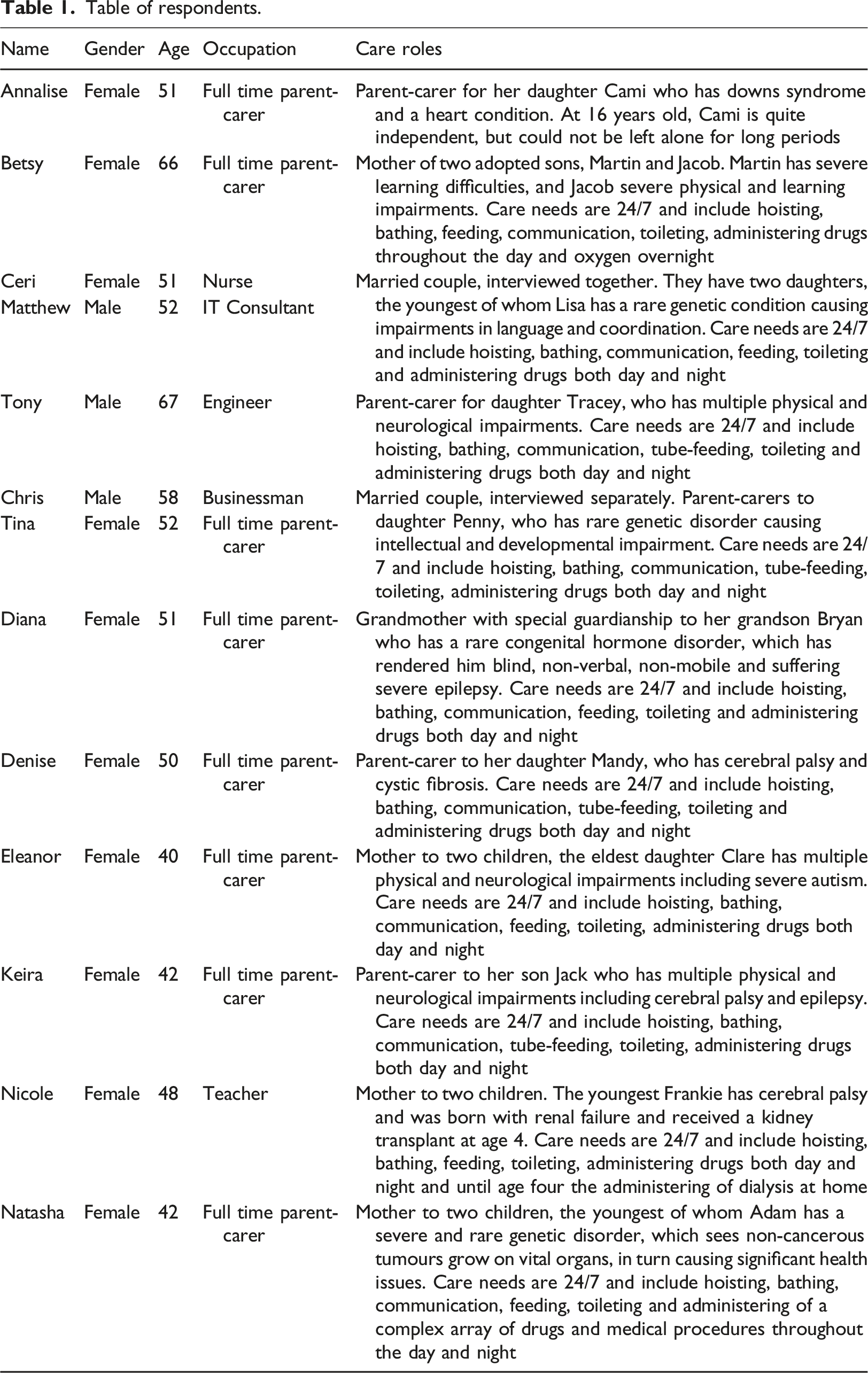
Interviews ceased after coming to a point of saturation. All sensitive or identifying data has been removed, and pseudonyms have been used to ensure respondent privacy and protection. Data was coded thematically, and iteratively examined with back-and-forth analysis undertaken between interview data and theory (Spiggle, 1994). Given the closeness of the first author to the study, the second author worked to challenge findings and interpretations throughout the project with etic observations. This ensured that emergent themes were questioned, critiqued and re-developed in order to ensure a holistic representation of the data set (Strauss and Corbin, 1990). For example, and as will be outlined throughout the findings, respondent discussions around the C4C movement, care expertise, support and labour, as well as political representations of parent-carers uncovered themes of paradox and heroism within our data, which ultimately led us to electing Franco et al.’s (2011) paradoxes of heroism. Finally, member checking was conducted with all respondents to audit theoretical interpretations and ensure accurate representations of the findings (Thompson et al., 1989).
Findings
We structure our findings around two of Franco’s paradoxes of heroism (Franco et al., 2011). Our first finding, purification practices that elevate and negate parent-carers as heroes revolve around paradox one, uncovering how ableist purification practices are enacted upon parent-carers as a means of simultaneously elevating and negating their heroic status. Our second and third findings centre on paradox two. Finding two: ableist microaggressions that publicly ascribe parent-carer’s as anti-heroic reveals the disparities between the public ascription of heroic status and lived realities of parent-carers. Whilst finding three: responsibilized-commoditization that internalises fear within parent-carers elicits insight into the profound effects which the decision to act heroically has on parent-carers. Structuring our findings around these paradoxes uncovers the socially heroic role of parent-carers, drawing attention to (i) the entrenching practices and processes of ableism, and (ii) how heroic discourses subjugate and disempower parent-carers.
Purification practices that elevate and negate parent-carers as heroes
Purification, as discussed within ableism theory, is a process of constitutional divide that marks ‘distinct archetypes’ (Campbell, 2012: 218), separating persons and groups into social hierarchies. Campbell (2012: 217) explains that although we rarely fit the social hierarchies we are ordered within, purification is used to ‘neaten up’ such misrepresentations. Our data revealed the presence of ableist purification practices that simultaneously elevate and negate parent-carers as heroes.
All respondents communicated that C4C brought the issue of care into public consciousness (Chatzidakis et al., 2020). However, while the initiative elevated care and some carers in UK society, our respondents indicated that C4C was not inclusionary of their efforts. ‘It was a good thing. They were putting themselves in danger. Really, it is like a vocation working in the health service. So fulfilling that vocation was such a noble thing. We were happy to go out on our doorstep. But I wouldn’t be expecting anyone to be clapping for us for looking after Penny, because that is just what we do’ (Chris).
Chris’s use of the descriptor ‘vocation’ evokes the idea that the care work of the NHS workers goes beyond employment to being a calling, which he describes as a ‘noble thing’ to do. Campbell (2005) claims a vocation goes beyond mere life tasks, becoming part of one’s sense of self and offering a profound sense of satisfaction. Parenthood could therefore be interpreted as a vocation. Despite this, Chris’s words ‘it’s just what we do’ highlight how he sees the vocational care work of professional carers as more important than what he does for his daughter. However, the care enacted by most parent-carers in this study is often highly medicalised, with many expected to administer drugs via needles and tubes, and perform intricate procedures such as dialysis at home (see Table 1). These skills often require years of medical training. Our respondent’s separation between professional care workers and themselves highlights a process of ableist purification. Whereby ‘distinct archetypes’ of care are created, sharpening ‘the divide of exclusion’ (Campbell, 2012: 219), and dissociating the care work of parent-carers from that of professional care work. This signifies an exclusionary, status-enforcing form of purification, as parent-carers assume their status is less essential than professional carers.
Parent-carers assume this status because they receive a lack of social and governmental support, which was exacerbated during the Covid pandemic. For example, Eleanor outlines how medical training is rarely offered to parent-carers and thus their efforts in this domain, as well as other care giving roles, as Diana indicates, remain largely negated: ‘When you have a special needs child nobody gives you a manual with the child, you just have to come home from the hospital and get on with it. I am a parent-carer, but I want to be recognised as a worker… I mean the label means people do not think you work; they think I just care for my daughter. So, for example, if I was applying for home insurance and it asks my occupation, I have to say housewife, because care workers are only for paid carers or someone providing paid care to someone, but parent-carer’s aren’t included in that. We aren’t one of the options on paperwork’ (Eleanor). ‘Due to Covid and lockdown, I've gone from being a carer to being a carer, a physiotherapist, a teacher, a dietician, literally, everything under one umbrella, and all without any guidance’ (Diana).
Eleanor highlights a lack of recognition for her care work. Diana expresses a similar sentiment. Their roles as a parent-carer can be all encompassing and the labours involved, as well as their expertise, remain detached from public consciousness. Eleanor’s comments also reveal how the label ‘parent-carer’ has become a form of status-enforcing purification. Her revelations that people and institutions assume that ‘she does not work’ in her role as a parent-carer signify such purification.
The term parent-carer is widely used by charities, within media, politics, academia and has become co-opted by parent-carers themselves. Indeed, the term was learned by the first author during her time immersed in the field. We uncover, the term ‘parent-carer’ to be a negative ontology (Campbell, 2001), that etymologically prioritises the term ‘parent’, who normatively speaking should care. This invisibly purifies and renders invisible the ‘carer’ component of ‘parent-carer’. This subliminally negates the professional, medical and pastoral roles enacted by parent-carers, as Eleanor and Diana allude to, which subjugates them. Such subjugation is often enforced through bureaucratic processes, such as applications and forms, as Eleanor mentions, that categorise parent-carers as ‘non-workers’. This delegitimises the efforts of parent-carers and negates their heroic status contrary to political claims. For example, the highly skilled labours of care enacted by parent-carers have historically seen them hailed as heroic. Prime Minister Tony Blair characterised parent-carers as ‘unsung heroes’ and a ‘lynchpin of community care’ in 2001 (BBC News, 2001). However, when asked how they felt about being labelled as ‘unsung heroes’, our respondents replied unanimously that they were ‘not a hero’, with many sharing how they found such labelling ‘insulting’. ‘It’s very insulting really. You know, if you are saying we are unsung, then why are we unsung? If they can say that then why aren’t they doing something about it? If we are unsung, then we are unrecognised for what we are doing and that is just insulting’ (Nicole).
Nicole’s description of the labelling of ‘unsung hero’ as ‘insulting’ affirms Hennekam et al.’s (2020) findings, wherein heroic discourse is viewed by carers as perfunctory when used without any actionable plan for transformative change. Such labelling is thus a process of tokenistic purification that publicly and discursively elevates parent-carers to the ranks of hero, whilst simultaneously negating them, as they remain socially excluded and ‘unrecognised’ for their efforts. Shaw et al. (2017: 419) outline that for ‘caring intent to be realised, or practiced, benevolence – as a desire (or disposition) to do good – has to be translated into beneficence – as doing good’. We uncover tokenistic purification to be a politicised strategy of benevolence used to promote a rhetoric of care and gratitude that was and may never be formally translated to beneficence. Shaw et al. (2017) outline that a lack of benevolence-beneficence translation is common, and C4Cs provides us with a further translation failure. After all, what did clapping do to transform UK care? In what ways did clapping ‘to do’ good tangibly translate to ‘doing good’? (Shaw et al., 2017).
Hennekam et al. (2020) uncovered that initiatives such as C4C objectified healthcare workers as a means of creating social solidarity, and as such these endeavours were for the public not for the care-workers themselves. We support and advance these findings uncovering that through ableist processes of status-enforcing and tokenistic purification, the pandemic driven initiative, in clapping for carers, elevates ‘some’ as heroic. Whilst simultaneously negating and delegitimising the status, role and sense of self of an invisible hub of carers that has and continues to silently support, sustain and save the UK economy over £132 billion per year (Carers UK, 2020).
Ableist microaggressions that publicly ascribe parent-carer’s as anti-heroic
Our data indicated parent-carers to be recipients of ableist microaggressions. Seminally discussed within the context of race (Sue et al., 2007; Sue, 2010), microaggressions are ‘subtle verbal, behavioural, or environmental slights and insults that communicate a hostile or derogatory message based on an individual’s social status’ (Lett et al., 2020: 1442). Consequently, ableist forms of microaggression refer to prejudices that subjugate and demean the disabled community (Fierros, 2006; Kattari, 2020). Lett et al. (2020: 1444) note that these prejudices are ‘maintained through individual biases that favour able-bodied people and discriminatory structures and practices within institutions’. Despite being able-bodied themselves, parent-carers in this study relayed that they are often discriminated against for seeking benefits. ‘You always feel as if you are been looked down upon. But it’s not as if I am in this position because it is the life I made for myself. I am in this life now [as a parent-carer] because I have got no alternative. But I am being looked down upon because I claim benefits’ (Diana). ‘I am worth less than somebody who has no intention of ever working in their lives. It makes me feel like benefit scum and that’s how social services talk to you’ (Tina).
Olkin et al. (2019) explain how microaggressions encompass political and policy systems that discriminate minority groups. The UK benefit claiming processes exemplify such policy level microaggression. The 2010 austerity programme and its reduction of disability funding by £14.3 billion rendered the disabled community as ‘prime targets’ in the vilification of benefit claimants (Ryan, 2019: 28). Diana and Tina express how they feel vilified through this system, its processes and employees, indicating how these often instantiate feelings of ‘worthlessness’ upon parent-carers whereby they feel like ‘benefit scum’ and ‘looked down upon’. These feelings exemplify how parent-carers are often upheld to the standards of the economic model of disability, wherein disability is viewed ‘primarily as a deficit in human capital that limits labour force participation’ (Scotch and Schriner, 1997: 154) and in turn steals productivity from society. Tina’s words ‘I am worth less than somebody who has no intention of ever working in their lives’ shows how parent-carers are upheld to the economic model of disability and thus ascribed as anti-heroic and a burden to society.
Many of our respondents shared the desire to retain employment alongside their care duties. However, while this was feasible usually until their child reached the age of 8–12, very often the strain of this balance becomes too much. ‘For the most part something snaps or gives, or you've compromised your health... I got to my sixth day without sleep and working night shifts around Penny, and I realised this is not tenable. I handed my notice in and I didn’t tell anyone for a week, because I felt like I should still be working. I still feel like that to be honest. I know I am working but it is not considered, it is not valued’ (Tina).
The rules surrounding carer’s benefit allowances are precarious. To receive universal credit parent-carers must provide at least 35 h per week of ‘substantial caring responsibilities’ to someone with severe disabilities (UKGOV, 2022). Ultimately, such rules mandate that the care work and duty involved is equivalent to a full-time, working week. Tina’s words ‘I know I am working but it is not considered, it is not valued’ resonate with Eleanor’s earlier frustrations at being socially and politically unvalued or unacknowledged for her care-work, and bureaucratically labelled as a ‘housewife’. Consequently, this study uncovers the socio-political welfare system to emplace parent-carers within a position in which their consumer adequacy rights are negated. Hill (2018: 414) defines consumer adequacy as the right of all persons to ‘unimpeded, lifetime access to goods and services that meet basic needs within the context of their living environments’. He continues that consumer adequacy needs fall into two categories, items, products and/or services that: (i) ensure our basic survival including, food, clothing, shelter and healthcare, and (ii) ensure our continuous development through access to education, training and job options. Consistent with the latter category, parent-carers in this study are uncovered to suffer consumer inadequacy, denied the services and support necessary to be able to balance full time care and paid employment. Such consumer inadequacy dismisses the huge economic savings parent-carers offer through their care work, and simultaneously societally perceives them as burdensome, unproductive and anti-heroic citizens.
Further public ascription of parent-carers as anti-heroic was demonstrated in the lack of financial reward offered to parent-carers during the pandemic. The UK government offered a £500 payment to full and part-time care workers as a reward for their hard work and continued care commitment during the pandemic. Carer’s UK uncovered that 81% of parent-carers took on additional sacrifices and longer hours of care during the pandemic, yet they were not included in this reward scheme (The Guardian, 2021
Franco et al. (2011) outline that social heroes often suffer from a loss of status and social ostracism. This is exemplified in the case of parent-carers. The recent heroisation of care masks ableist microagressions that entrench parent-carers in a system of consumer inadequacies. The effect of this is that the lived realities of parent-carers become ascribed with a false belief that they are unproductive and villainous anti-heroes who devalue the economy.
Responsibilized-commoditization that internalises fear within parent-carers
Dowling (2020: 12) outlines how the rhetoric of ‘personal responsibility’ is used to commoditize care, with care driven by ‘market logics’ which seek ‘profitability, financial returns on investment, and upward redistribution of wealth’ (see also Wood and Skeggs, 2020). Our findings affirm such insights with ‘parental responsibility’ used advantageously by state services. ‘He [social worker] said, “Well, you see you mustn't underestimate parental responsibility”. I just looked at him, and I said, “I understand that. However, it's not anything like parental responsibility”. So, that's actually a key phrase in the way that social services calculate support’ (Natasha).
The UK Government defines parental responsibility as the role of a parent to provide for their child: ‘a home, protection and maintenance, discipline, education and agree medical treatment(s)’ (UKGOV, 2021). The complex care duties enacted by the parent-carers in this study go well beyond these defining parameters offered by the UK government (see Table 1). However, as shared by Natasha, ‘parental responsibility’ is a calculative tool used to move care responsibility and support away from the state towards parent-carers. This resonates with Giesler and Veresiu’s (2014) work on consumer responsibilization, which they define as a four-fold governmental process encompassing: personalisation, authorization, capabilization and transformation. The rhetoric of parental responsibility used by social services aligns with personalisation, which Giesler and Veresiu (2014) explain is a shifting of responsibility and societal problem solving from the macro-state to the micro-individual level. Such personalisation exemplifies a further ableist constitutional divide, with disability care and responsibility socially and politically re-ordered and re-mapped onto the individual rather than the state (Campbell, 2012). Thus, personalisation can be interpreted as supporting the antiquated medicalised model of disability that perceives impairments to be an individual not societal matter, and thus believes disability to be the responsibility of the impaired individual, or those who care for them (Goodley, 2017; Higgins, 2020). Personalisation, however, must translate then to authorization, whereby consumers are mobilised to become responsible, which only occurs with support from expert knowledge and systems (Giesler and Veresiu, 2014). In the case of parent-carers, such authorization comprises support from medical and social welfare experts. However, recall Eleanor and Diana’s earlier words and how they are not provided medical and specialist training but rather as Eleanor outlined ‘you just have to come home from the hospital and get on with it’. Couple this with the lack of definition surrounding what is parental responsibility in the context of parent-carer’s and it is evident parent-carers are not offered the ‘authorization’ needed to become mobilized responsible consumers. Further, the aforementioned consumer inadequacies facing parent-carers, and the lack of state and welfare support offered to address such inadequacies highlight how parent-carers are not provided with ‘capabilization’ – ‘an infrastructure of products and services that support the individual’s self-management’ (Giesler and Veresiu, 2014: 843). Resultantly, parent-carers are emplaced in a precarious position where welfare and state systems use language that responsibilizes them, whilst simultaneously withholding authorization (expertise and authority) and capabilization (resources) necessary to become responsible consumers. This in turn denies parent-carers the opportunity to ‘transform’ into responsibilized consumers that are able to ‘actively self-govern, calculate their own interests and navigate the moralized landscape of choice’ (Giesler and Veresiu, 2014: 843). Thus, this paper uncovers parent-carers to experience what we term responsibilized-commoditization, whereby structural and systemic processes imperceptibly responsibilize parent-carers as parents yet simultaneously commoditize them as carers, suppressing them into a commoditized position (Hirschman and Hill, 2000).
Commoditization refers to the ‘transformation of a human being – normally considered to be an autonomous, self-directed agent – into a unit under the control of another human being’, with a person’s skill and labour popularly commoditized (Hirschman and Hill, 2000: 470). Natasha’s experiences outline such commoditization, whereby instead of having autonomy and agency parent-carers become controlled by state services, who use the rhetoric of ‘parental responsibility’ to deny support and in turn disempower their status and position in society. Further commoditization was prevalent in the use of the parent-carer’s skills and labour for little to no payment. ‘They registered me as a carer that gets paid at zero pence. Because they say my widow’s pension is an allowance and so that cancels the carer’s allowance out’ (Betsy). ‘You’re forced to live on that money [meaning carer’s allowance]. I can’t work because of Clare, if she’s not in school who has her? Who will give me time off a job if Clare is not well? The government won’t pay for respite for you to work. So, as a parent-carer it is not really possible to have a life you know, I can’t and never will retire’ (Eleanor).
Betsy, in being ‘paid at zero pence’ for her carer role, coupled with Eleanor’s words ‘forced to live on that money’ illustrate how parent-carers can be financially commoditized. If administering 35+ hours of care per week, parent-carers are entitled to carer’s allowance of £67.60 per week before tax. This equates to £1.93 per hour for the 35 h of care they administer. Yet many administer 24/7 care (see Table 1), this equates to approximately £9.60 per day and £0.40p per hour for their labours. The high level of care needed by their children, render many of our respondents unable to work and reliant on state help. However, as Eleanor shares the state ‘won’t pay respite for [parent-carers] to work’ and therefore, Eleanor and many other parent-carers in this study are trapped in a system of responsibilized-commoditization. Their parental responsibility in effect becomes a mechanism to subjugate parent-carer’s within a system of consumer inadequacy.
Such responsibilized-commoditization was further exacerbated during lockdown. Given the underlying health conditions of many of their children, most respondents ceased additional support (i.e. additional carers and respite), for fear of their child contracting Covid-19. This fear was stimulated by many respondents in this study receiving DNR
2
letters during lockdown, informing them that if their child contracted Covid-19, they would not be resuscitated. Such practices by the state can be viewed as highly insensitive and ableist. It also reveals how responsibilized-commoditization internalises a sense of fear within parent-carers. For example, our respondents shared a collective anxiety of how care support might be changed because of Covid-19. ‘I worry that they [social services] will say “oh well she’s managed this long, she can carry on managing without any help”. But I am barely managing, I am managing because I need to keep him [her son] safe’ (Barbara).
Respondents shared collective fears of social care ‘cutbacks’ (Natasha) and ‘redirecting of funds’ (Chris), with many like Barbara worrying they will be pressurised into continuing to care unsupported as they have done throughout lockdown. These fears are not unwarranted. During fieldwork, parent-carers shared with the first author the challenging fights and battles to apply and qualify for welfare and care support. Barbara’s words ‘I am barely managing’ highlights how reliant on state support she has become, she cannot sustainably manage without it. Couple this with Eleanor’s sentiments on how she is ‘forced to live on that money’ and it is evident that parent-carers are at the liberty of the state. However, the sacrifices made by parent-carers during lockdown offers a rare example of successful care intent, with their benevolence (desire to keep their child safe) translating into beneficence (keeping their child safe) regardless of the sacrifice and potential repercussions (Shaw et al., 2017). Such care exemplifies how, although fearful and reduced to a state of responsibilized-commoditization, parent-carers internalise the positioning of social heroes making personal sacrifices to protect and care intently for a community who are excluded, and at times threatened.
Discussion and conclusion
In introducing social heroism to consumer research, and employing paradoxes of heroism as heuristics, this article offers the following contributions. Firstly, we show how heroic discourse can be disempowering and subjugating for particular consumer groups. Secondly, our adoption of a ‘studies in ableism’ approach, which prioritises ability and able-bodiedness, allows us to uncover three problematizing and subtle practices of ableism; purification, micro-aggressions and responsibilized-commoditization. These insights advance critical understanding of the socio-political structuring of heroism, whilst also extending current discussions on consumer vulnerability and ableism in marketing theory.
To date, marketing discourses on heroism have prioritised its positive discursive potentialities, denoting how ideologies of heroism endow and facilitate restorative, emancipatory and rebellious forms of consumption (Goulding et al., 2002; Giesler, 2008; Holt and Thompson, 2004; Hollenbeck and Patrick, 2016; Schouten and McAlexander, 1995; Tumbat and Belk, 2011). Although some work has alluded to the problematic outputs of heroic discourses (i.e. Holt and Thompson, 2004; Hollenbeck and Patrick, 2016; Sobande et al., 2020), more disturbing and controversial aspects of heroism have received less attention. We turn attention to these negative facets of heroism by introducing social heroism to consumer research. Contrary to previous consumer research that elucidates heroism as offering positive emancipatory potentialities, we find that heroism is used as a discursive tool to mask the disempowering subjugation of parent-carers.
Being a ‘trajectory of perfection’ (Campbell, 2014: 80), ableism constantly seeks an imagined ideal of wholeness. As previously outlined, heroism is one such ideal, with popular discourses of heroism most often perpetuating the ideal of ableism. Our work however, exposes how those often publicly ascribed as anti-heroic can indeed be the most heroic of all. We reveal how parent-carers can be forced into a position of unpaid employment, and then are publicly and negatively ascribed as unproductive to society. Facing financial loss as well as social ostracism, parent-carers although able-bodied become disabled and ‘othered’ within the world of ableism. Thus, although never personally identifying with the status or label of hero, the ableist practices and processes that socially and financially ostracise parent-carers, ironically elevate them to the status of social hero. Our study therefore offers to consumer research, deeper awareness of the precarious ambiguities of heroic discourse, uncovering the disturbing and controversial ways through which heroism and heroic discourse can subjugate and disempower consumers. Such insight not only advances marketing scholarship’s awareness of how conceptions of heroism are publically understood and consumed, but also raises awareness of how such conceptions are systemically used to elevate or negate particular groups, persons, or cultures in society. Thus, we call for future research to invoke a social heroic lens as a means of further eliciting how heroic discourse perpetuates ableism.
This article advances an emerging discourse on consumer vulnerabilities and systems of ableism in consumer research (Higgins, 2020; Hamilton et al., 2015; Kearney et al., 2019; Kaufman-Scarborough, 2015). Our adoption of a ‘studies in ableism’ (Campbell, 2001, 2012) approach, that prioritises able-bodied parent-carers, coupled with our interpretation around two heroic paradoxes allow us to usefully uncover three subtle yet entrenching practices and processes of ableism – purification, micro-aggressions and responsibilized-commoditization.
Firstly, we advance Campbell’s (2012) work by exposing two specific forms of ableist purification – status enforcing and tokenistic. We find status-enforcing purification to separate paid and unpaid care work. Particularly, our findings problematize the term ‘parent-carer’ uncovering it to be a core form of status-enforcing purification. Although widely co-opted and utilised (even by parent-carers) the term ‘parent-carer’ is a negative ontology (Campbell, 2001). It foregrounds the ‘parent’ component of the term, subliminally masking the care work and economic savings that parent-carers bring to society. We find tokenistic purification to be often bureaucratic or politicised strategies of benevolence that never fully translate to beneficence (Shaw et al., 2017). Thus, although the profile of care has been societally elevated, it has been done so tokenistically, with a failure to transform structural care issues. Our ‘studies in ableism’ approach outlines how pandemic driven heroic movements, such as C4Cs, elevates some not all, masking how parent-carers and minority groups can be surreptitiously negated, delegitimised, and excluded.
Secondly, we offer to consumer research insight into microaggressions and the internalising effects they can have upon marginalised groups. We expose how these micro, small slights become normalised within wider society, and in turn publicly ascribe their recipients as unproductive and anti-heroic. However, we outline a critical issue of microaggressions – how they can be used to hide systems, policies and practices that create, permeate, and prolong consumer inadequacy (Hill, 2018). We uncover parent-carers to be embedded within an ableist micro-aggressive circle of consumer inadequacy. Denied the support to balance care and work, they become cast as anti-heroic and unproductive by the same structures that deny them such support.
Finally, we expose how parent-carers are emplaced within an ableist state of responsibilized-commoditization. Entrapped within a social system that denies the appropriate capabilities necessary to balance work and care, parent-carers can be publicly ascribed as ‘benefit scum’. Knowing parent-carers have internalised a responsibility of care, the social system uses the rhetoric of ‘parental responsibility’, to control and commoditize the care labour and skill of parent-carers (Hirschman and Hill, 2000). Thus, responsibilized-commoditization further exemplifies the negative ontology of the term ‘parent-carer’, whereby through models of consumer responsibilization (Giesler and Veresiu, 2014), parent-carers are responsibilized as ‘parents’, yet simultaneously commoditized as ‘carers’. Responsibilized-commoditization ultimately delegitimises parent-carers as valued market actors, (i) in terms of being free and autonomous consumers, through the delimiting of leisure time and resource support, and (ii) by failing to acknowledge the care duties they undertake and the socio-economic savings they provide. Thus, parent-carers are positioned as vulnerable, ‘flawed consumers’, who lack the necessary resources, capabilities and autonomy required by contemporary consumer culture (Bauman, 2007: 25).
Together, the practices of ableist purifications, microaggressions and responsibilized-commoditization combine to create, permeate and subjugate parent-carers within an ableist hierarchy of care. This hierarchy (dis)imbues upon parent-carers multiple identities, as all at once they are parent yet carer, antihero yet hero, consumer yet commoditized, responsibilized yet vulnerable. The hierarchy therefore, in emplacing parent-carers in such liminal positioning, ‘others’ them economically, politically and societally. Reeve (2015) shares that until disability becomes a normalised part of society, it will remain ‘othered’ and perceived with ‘disgust’. Our work, unfortunately, supports and advances Reeve (2015), uncovering that not only those with disabilities, but also those close to them are ‘othered’. This ableist hierarchy of care entraps parent-carers within the economic model of disability (Scotch and Schriner, 1997), perceiving them as ‘unproductive’ to neoliberal society, and belittling the value and status of those whom they care for. Bauman (2007: 35) outlines that when facing threats to its reigning structure, society will suffer from ‘ambivalence-born anxiety’ and react in a manner supportive of the reigning structure. The ableism discussed in this paper unearths such ambivalence, rendering all associated with disability to be ‘othered’, and disability reinforced as unwelcome, unwanted and unwarranted in society.
This article elevates marketing theory from its predominant discriminatory focussed understanding of disability, to reveal the pervasive yet hidden presence, influence and nature of ableism. The last 20 years has witnessed marketing scholarship call for interpretive and critical understandings of consumption, seeking research that aims to understand and transform consumer vulnerabilities (Baker et al., 2005; Hamilton et al., 2015) and marketplace exclusions (Hutton, 2019; Saren et al., 2019). A growing body of work, this article included, has taken up this call. This study however, extends these calls, asking researchers working in the domains of marketplace vulnerability, exclusion and inequality to be more aware of, and seek out further practices and processes of ableism. Such insight will help marketing practitioners and policy makers to understand how systemic structures and particular discourses can (dis)empower select segments in society. Ableism, after all, is everyone’s problem, not just the impaired. We all have impairments of differing levels, and we are not immune to bodily impairment and deterioration (Shakespeare, 2004). A limitation of this study is its prioritisation of parent-carers. Future research should aim to look at not only wider instances of informal care but also at wider systems of care and how they are entrenched, influenced and affected by ableism. Indeed, such insight will not only help to destabilise ableism but will help to position care at the ‘front and centre of life’ (Chatzidakis et al., 2020: 892). Elevating care research from discourses of gratitude that merely clap for ‘some’, but not all, carers, to truly promoting ‘care justice’ (Wood and Skeggs, 2020) that transforms and improves care ideologies, care structures and care services. Given consumer culture is a domineering global structure; it is the responsibility of marketing practitioners and researchers to challenge care and ableism in our marketplaces, our societies and our world.
Footnotes
Declaration of Conflicting Interests
The author(s) declared no potential conflicts of interest with respect to the research, authorship, and/or publication of this article.
Funding
The author(s) received no financial support for the research, authorship, and/or publication of this article.
