



Abstract
In this paper, we are concerned with how we might account for the under-appreciated relation of intensities that flow through and around consumption experiences. In pursuing clarity, researchers have tended to treat consumer experiences as bounded and discrete, segregated from the messy unfolding of life around them. In this work, we look to acknowledge this everyday unfolding of the experience to appreciate how we might articulate the more-than-representational excess of seemingly un-spectacular, quotidian moments of encounter, and how we might attune ourselves to the constant unfolding of consumer experiences. In addressing these concerns, we produce a series of narratives designed to reveal both the ecologies and processual registers of experience. These narratives seek not just to inform, but also to evoke and provoke. Moreover, they work to engage readers with the messiness of everyday life attempting to give form to phenomena that are essentially formless and in continuous circulation.
Keywords
Number 93 to Putney bridge
Okay, let me try do this justice. Is it weird that I still even remember this? Probably because I nearly died of hypothermia,
1
I’m not even joking. I genuinely thought I was going to die, on Christmas Eve. Just die standing up. Frozen to a disgusting footpath covered in God knows how many peoples’ festive winter phlegm.
2
Charing Cross station waiting for a bus [squirms]. It was me, my mum and my sister. We were stood there for about an hour, in the queue. I could tell that people were starting to get annoyed despite my dear mum’s best attempts to distract me. The distinct sounds of adults punctured the air.
3
‘Fuck sake, are you fucking serious? This is a fucking joke’ My mum didn’t like swearing. It made her nervous, uneasy. I could see in her face that she was getting panicky. The hand that held mine wouldn’t be still. Shaking.
4
Seeing her like that made my sister and I nervous. Your mum is supposed to be the steady one. Once she began to shake the atmosphere kind of changed. I could feel a bit of a frenzy start to grip people.
5
Suddenly it was just a sea of people. They were bustling through, knocking off us. The gross stench of body odour. My face pressed up against smelly arses [wretches]. Horrific. I had a paper Hamleys Toy Shop bag in my right hand. The cord wrapped around my fingers so that I wouldn’t lose it. People kept barging past and knocking against it. The cord wrapped around my hand – tighter and tighter.
6
I started screaming with the pain. I’ll never forget, I looked down at my hand and it was purple, red and white all at the same time. My sister screamed because I was screaming. It was impossible to see or even look down at my feet. I couldn’t tell if we were on the footpath anymore. My left hand, the hand being held by my mum, was suddenly down by my side. My mum was on the ground.
7
She was quite gentle my Mum. She didn’t belong in a place like this, in the middle of these savages. We tried to help her as she hurriedly picked up the ‘Santa’s List’ toys that had fallen from the bag. She didn’t want us to see them. We pretended we never did. Her hand was black and blue with bruises from being trod upon on the ground. My sister and I continued our screaming. Pushing and kicking people’s legs to get them to move. One man could see what was happening and felt sorry for us.
8
He ushered us through to the top of the queue. Finally, I could breathe. As we gathered ourselves my sister and I shuffled into mum, buried our faces in her coat so that her smell might calm us and help us feel safe again.
9
I just couldn’t bear to see London any more than I had to. Smells and noise and lights.
10
‘This is us!’ I couldn’t believe it, the Number 93 towards Putney Bridge. ‘This is us!!’ It pulled up right alongside us. And there we were, first in the queue. Mouths open, eagerly waiting for the door to open. Waiting to be hit by the rush of musty bus air! And then you know that noise a bus makes when the engine gets turned off? And the whole bus makes a noise and sinks a few inches closer to the ground? That. That happened. That noise. And my heart sank with it. I’ll never forget that noise [makes noise of bus shutting down]. ‘Number 93 departs in 10 minutes!’ Stood there like shivering penguins. My mum was ever the optimist. ‘Did you have a nice day darlings?’ ‘Yes mum!’ said my sister, hope on the horizon. ‘Alice?’ ‘Alice?’ Mum, that woman is naked.
11
Towards accounts of onflow
In this paper, we are concerned with how we might account for the under-appreciated relation of intensities that flow through and around consumption experiences (Canniford and Bajde, 2015; Canniford et al., 2018; Hill et al., 2014); how we might articulate the more-than-representational excess of seemingly un-spectacular, quotidian moments of encounter and how we might attune ourselves to the constant unfolding of consumer experiences. In addressing these concerns, we produce a series of narratives designed to reveal both the ecologies (Simpson, 2013) and processual registers of experience (Dewsbury et al., 2002). These narratives seek not just to inform, but also to evoke and provoke (Sherry and Schouten, 2002). Moreover, they work to engage readers with the messiness of everyday life (Rojas-Gaviria, 2021; Stern, 1998), attempting to give form to phenomena that are essentially formless and in continuous circulation (Armstrong, 2000).
In their explorations of consumption assemblages, Canniford and Bajde (2015) urge consumer researchers to seek out the flows of relations between the bodies, spaces and objects constitutive of marketplace cultures and the consumption experiences occurring within them. Bodies, as Edbauer (2004: 9) states, ‘cannot be defined apart from relations with the world … we understand the body as those groupings of capacities that are always being affected by (or affecting) another body or bodies. This encounter between bodies is a relation of intensities’. Indeed, it is this relation of intensities around ‘things’ that assumes importance, rather than the ‘things’ themselves (Lopes et al., 2021). Consumers are bound up in these relations that often exert little tangible presence in research, but which are nonetheless pivotal in producing affect.
For its part, affect is volatile and, as such, it may appear difficult to capture in any conventional methodological sense. To this end, we adopt a more-than-representational framework to craft a series of composite narratives of onflow. The methodological task becomes a matter of grasping and re-presencing (Dewsbury, 2003) intensities, their relation and their constantly unfolding nature, while also acknowledging the requirement for boundaries (Hill et al., 2014). This re-presencing works to provide the reader with a degree of ‘visceral resonance’ (Sherry and Schouten, 2002: 218), allowing them to feel as much as understand. More-than-representational theory has sought to enrich extant work on experiential consumption by attempting to conceptualize the messy, unpredictable and contagious affective energies that constitute and shape embodied life (Canniford and Bajde, 2015). That is, experiences do not have natural boundaries. Rather, boundaries are imposed for ease of illustration and contextual focus. As de Man (1970) argues, experience is lived in a continuum of altering affective states. We attempt, therefore, to render again the assemblages of everyday life that circulate affective flow, shaping consumer subjectivities and the inevitable meanings drawn from experiences. Our focus lies squarely on the process of consumption. Therefore, in negotiating onflow we address the ebbs and flows of everyday life and the more-than-human, more-than-textual, pre-cognitive, embodied, multisensory energies that pervade the atmosphere of experiences (Lorimer, 2005).
As the opening narrative demonstrates, in accomplishing our goals we explore the first encounters of consumers with an image of Kate Moss. Moss is a culturally pervasive icon renowned for her charismatic authority. But our work is not about Kate Moss. Nor is it about the visual image despite the fact that photographs and other ‘apparatuses of actualization’ (Massumi, 2002) increasingly amplify and circulate affective flow. The image of Kate Moss, in this instance, is merely the fulcrum around which affective intensities abound. In our narratives, then, we consider the multiplicity of ‘things’, concentrating on the embodied intensities that vibrate, ripple and flow in, through and around the image, suffusing the atmosphere and constituting the consumption experience.
We move forward by offering accounts of onflow throughout, both to re-presence consumption experiences and to explicate relevant concepts. Next, we situate our work within extant literature on consumer experiences, meaning and affect, to consider consumers as sensing agents. Following this, we outline our methodological approach, as an example of more-than-representational research that utilizes literary data construction to produce composite narratives of onflow. Finally, we delineate the contributions of this work before concluding with the implications for consumer research.
Consumers as experiencers
Consumption remains one of the foremost cultural practices that makes life meaningful. Meaning, in turn, lends purpose, structure and stability to life. Much seminal and insightful work within the discipline has demonstrated this idea of consumption as a route to existential wholeness or coalescence with a higher sense of self (e.g. Karababa and Ger, 2011; Murray, 2002; Thompson and Haytko, 1997). While consumers are conceptualized, therefore, as active interpretive agents pursuing and negotiating marketplace meaning, consumption is simultaneously acknowledged as an experiential, aesthetic and embodied process (Borghini et al., 2021; Joy and Sherry, 2003; Murphy et al., 2019). Here, consumers are considered sensing agents, engaged in the transcorporeal mingling of bodies, materials and environment (Hamilakis, 2013). As such, meaningful experiences also incorporate our embodied immersion in the flow of intensities that constitute the experience. In their seminal treatise on hedonic consumption, Elizabeth Hirschman and Morris Holbrook (Hirschman and Holbrook, 1982) draw attention to the afferent and efferent experience of multisensory impulses. They outline how we respond as human beings to multisensory stimuli present in the world of consumption, imbuing both responses and stimuli with meaning. Further, they identify that exposure to the world produces in us a constant array of bodily sensations that are also experienced. In her anthropology of the senses, Constance Classen (1997: 402) reinforces this dual nature of sensory perception as ‘not simply one aspect of bodily experience, but the basis for bodily experience. We experience our bodies – and the world – through our senses’.
Holbrook and Hirschman observe that ‘sensations, imagery, feelings, pleasures, and other symbolic or hedonic components, which are frequently paired together in experience tend to become mutually evocative’ (1982: 138). They lay out the foundations for an experiential approach, exposing the wide range of unconscious images, emotions and acts involved in the overall consumption experience (Holbrook, 2018). Holbrook and Hirschman (1982) also prompt the use of phenomenological, introspective, narrative-based research methods, marking a renewed interest in interpretive consumer research methods once originated in motivation research but by then largely forgotten (Tadajewski, 2006). In effect, this accounting for the experiential perspective signals a turn towards cultural accounts of experiences in consumer research (Jantzen et al., 2012). A significant body of consumer research emerges, focused on the meanings of consumption experiences in diverse experiential contexts. This body of work reveals the potential for consumption experiences to underpin personal transformation, enabling consumers to participate in self-actualizing and ‘cathartic’ activities (e.g. Arnould and Price, 1993; Celsi et al., 1993; Kozinets, 2002), to enact cultural myths (e.g. Belk and Costa, 1998; Wallendorf and Arnould, 1991) and even to perform individualistic identities (Tumbat and Belk, 2011).
In conducting this work, researchers tend to problematize the Cartesian distinction between body and mind, recognizing that there is no clear division between thinking and feeling, cognition and emotion (Jantzen et al., 2012). For the imaginative consumer (Joy and Sherry, 2003), meaning and feeling become entangled as consumers respond to objects and environments in embodied ways. Joy and Sherry (2003) distinguish between the conscious and unconscious levels of awareness in these experiences. Phenomenological accounts give us access to the former, but the latter require methods that can probe into the deeper level of unconscious processes. For example, in their study, Joy and Sherry (2003) use consumers’ primary metaphors as proxies for the unconscious level of embodied experiences. Indeed, Joy and Sherry’s (2003) discussion of the unconscious level of embodiment offers a useful conceptual link with affect theory. Key conceptualizations of affect describe it as a non-conscious experience of intensity, thus locating it prior to or outside consciousness (Shouse, 2005). Accordingly, affect can be distinguished from the related terms of feeling and emotion. Affect is pre-social, abstract and not fully realizable through language, whereas feeling is personal and biographical and emotion is a display of feeling (Shouze, 2005).
However, conceptualizations of the consumer experience have also worked to isolate the consumer from the onflow of the everyday (Hill et al., 2014). In pursuing clarity, researchers have tended to treat consumer experiences as bounded and discrete, segregated from the messy unfolding of life around them. In this work, we look to acknowledge this everyday unfolding of the experience. Our accounts of onflow attempt to re-presence the ‘stream of experience … that treats the process of formation of moments of experience and relations among them, showing how moments of experience are connected in the stream, as each now opens into a next’ (Pred, 2005: 2). The experience is offered up as a ‘progressing moment, ever materializing’ (Andrews and Duff, 2020: np); as movement (Vannini, 2015).
Consumers as sensing agents
For Hamilakis (2013), the senses are centrally implicated in the production of affect. Affect is quite possibly the most difficult plane of human experience to describe. Yet every second of human life is suffused with the force of affective energies that vivify moments of experience, perception and knowing (Lopes et al., 2021). Affect encapsulates omnipresent, embodied processes and flows of life (Blackman, 2012) that circulate through material and non-material bodies, forever evading logical determination or capture. It is transformative in the sense that it permeates the ‘porous boundaries’ of bodies (Thrift, 2008), leaving traces in our enduring dispositions. In opening up to affect, energy levels change and bodies come to inhabit altered affective states (Higgins and Hamilton, 2019; Hill et al., 2014, 2022) producing vitality, aliveness and changeability (Wissinger, 2007). These states are indicative of the cyclical process of affective flow; a ‘rippling’ or ‘doubling back’ of intensities (Ahmed, 2004). Bodies thus come to exhibit a lack of boundaries. They are perpetually open to affecting and being affected, to evoking change and having their world changed for them. When consumers engage with networks of affectivity, they are in a perpetual state of becoming (Lopes et al., 2021).
Edbauer (2004: 17) suggests that ‘before we can make sense, we sense. Before we react cognitively, we respond affectively’. It is at this point that affect becomes known, filtered through cognition, translated as emotion, meaning and memory. Such is its immanence to experience; affect has been described as ‘the most basic form of communication that stands as the basis of the construction of a common social world’ (Arvidsson, 2005: 190). The unpredictable, anarchic and contagious nature of affective flow is such that it can ‘leap between and take hold of bodies without an individual’s volition’ (Hill et al., 2014: 388), resonating with enduring dispositions, and becoming our own (Blackman, 2008; Brennan, 2004; Hill et al., 2014). As sites from which we perceive the world, our bodies are thus engaged in an incrementally altering process of de-composition and re-composition (Ruddick, 2010) during which they act and are acted upon.
In consumer research, our experience of the world is often presented as a succession of ordinary moments that are offset by ephemeral escapes from a scripted, monotonous and banal ‘everyday life’ through the pursuit of extraordinary experiences (Holbrook and Hirschman, 1982). Such experiences are often consciously orchestrated by consumers in collaboration with the marketplace (Biehl-Missal and Saren, 2012; Diamond et al., 2009; Kozinets et al., 2004; Penaloza, 1998), nature (Arnould and Price, 1993; Edensor, 2000; Celsi et al., 1993; Canniford and Shankar, 2013), other consumers (Belk and Costa, 1998; Kozinets, 2002; Lopes et al., 2021), subjective imagination (Cohen and Taylor, 1992; Joy and Sherry, 2003), etc. Legitimating the need for such extraordinary experience in one’s life, ‘everyday life’ is presented as uncomfortably tedious; a burden, stressful and difficult to negotiate and live in, owing to its incessant rules, structures and rationality. Nonetheless, we argue that the everyday rationality, ordinariness and stresses present in the stream of experience are also productive. That is, the ordinary and mundane also possess affective capacity, the intensities of which flow through bodies and resonate with enduring dispositions and deeper desires for renewal and transcendence (Lee, 2010).
But the dichotomy between ordinary/extraordinary (Binnie et al., 2007) and structure/anti-structure (Husemann et al., 2016), is a false one. These are theoretical constructs developed to conceptualize and situate experiences that are felt with intense affective vitality into a more comprehensible, and thus, representational paradigm. Deconstructing our preoccupation with extraordinary experiences, Carù and Cova (2003) point to the fact that not all experiences are extraordinary nor are all consumption experiences commercial. They illustrate their argument with the example of ‘do nothing’ holidays, in which ordinary activities – or the absence of intense activity – can be particularly restorative as they allow consumers time to contemplate. They revisit Abrahams’ (1986) thesis on extraordinary experience. Indeed, Abrahams (1986) argues that the ordinary and the extraordinary co-exist.
A more-than-representational approach thus allows for attention to ‘the sheer complexity and extraordinariness of the ordinary’ (Binnie et al., 2007: 517). Ordinary experiences occur in a continuum of ‘creative potential’ (Binnie et al., 2007) in the banal and mundane moments of ‘everyday life’, constituted as it is by immanent flows of affective intensities that can be actualized or embodied in various ways but that can never be reduced to these actualities. Our work seeks to appreciate this continuum of experiential consumption. Through onflow accounts, we present ordinary moments and experiences as productive. While such experiences might not be considered extraordinary (e.g. sitting in class, waiting for a bus, etc.), that the experience leaves traces within enduring dispositions and cognitive psyches as memories, insists significance and implies that something has happened, yet gone ‘unnoticed, in the background of our lives’ (Thrift, 2000: 274).
The day my mother collapsed
My mother was, and still is, an immaculately glamorous woman.
12
It is incredible how she makes it look so effortless. How she carries herself. She just emits this aura.
13
It can be quite intimidating, but it draws you in. How she speaks. How she walks. How she turns the pages of a magazine, drinks a cup of tea, pushes a shopping trolley. Pure glamour. I’ve never seen her on the toilet, but I am sure she carries out those duties in just as debonair a fashion despite nobody watching. I bet she probably pretends there are people watching. She loves any kind of an audience does my mother. Before she retired, she ran a really popular hairdressers off King Street. Except, she didn’t [laughing]. As an entrepreneur, she owned and operated a successful salon, not a hairdressers. But you get the point. Women were jealous of her Jackie O bob.
14
She easily replicated that cut on the crowns of many middle-class ladies of leisure. From there, word began to spread and she got quite the following. Each person would ask for this celebrity or that. I remember she would buy all the celebrity magazines each week. She could keep up with what was popular and practice how to achieve each cut perfectly. She was so dedicated. She also refused to do some styles – the ‘Rachel’, for instance, much to the disappointment of the legion of teenage girls who turned on their heels and left. She said it wasn’t sophisticated. It was just a passing fad. I wasn’t allowed in the salon. Well, I was initially, because I would do my homework in the office upstairs. But then I was barred [laughs] after I came downstairs and, while my mother was entertaining her clients, I gathered up the hair on the floor and glued it to my face. Everyone was horrified.
15
I just thought it’d be funny. They sounded like they were having a great time before I came down so I just wanted to join in. I think my mother was secretly embarrassed of me. I was a tomboy, scraped knees and dirty clothes from playing in the green. I had really thick, wavy hair that she adored. But it used to infuriate her when I insisted on having it up in a scrunchie [laughs]. So, after that incident it was my grandmother’s house after school. She was a nice woman but I didn’t like it there. I just remember experiencing pain in that environment.
16
The boredom was painful. The TV was so loud it hurt. The smoke from the open fire made my throat sore and my eyes itch. On days when my cousin was there it was a bit more bearable. He and I would play hide and seek and do whatever ten-year-olds did back then. On this particular day we were playing dares and he dared me to go into my uncle’s old room. We had always been forbidden from going in there. As an adult, I can now appreciate that my grandmother wanted to preserve it as it had been before my uncle’s death. While my grandmother was outside gathering sticks for the fire, we crept in. In the corner was a grandfather clock that made a loud harrowing noise when the hands would move. I used to brace myself moments before it struck the hour. The entire house shook. It was quite eerie. The grotty linoleum floor and the damp yellowy, mouldy-looking wallpaper. I’m pretty sure I heard the room groan. There was an increasingly large collection of magazines piling up against the back wall. When my mother dropped me off she would leave stacks of the previous month’s magazines. That was where they ended up. I don’t think my grandmother was very happy about that. I remember the mattress was stained from the damp. A fold-out bed. There was a box of old records that he left behind. Used bandages littered the floor. I remember hearing how he had really bad ingrown hairs. He’d had them operated on. The bandages were a reminder. You could still see the yellow puss and dry blood on the inside of them [gagging].
17
Sorry. We started looking at the magazines. As I flicked through, I landed on a particular page and was just transfixed by what was in front of me
18
… [description of a black and white image of a young girl staring directly at the camera/viewer, short greasy looking combed back hair, wearing black denim dungarees with one strap fallen to her side, exposing a bare shoulder]. It was a strange feeling. Like a combination of relief and release.
19
I completely wanted to be her.
20
I didn’t stop for a second to think. I tore the page out of the magazine and pinned it to the wall for reference. I told my cousin to go get the shearing scissors our Nan used for flower arranging. We got to work. I still remember the warm sensation of blood trickling down my neck as my cousin cut lumps out of my hair. Different to how my mother used to do it. My mother genuinely collapsed when she saw my butchered head. I felt like Kate Moss, I didn’t care.
21
Resonance, memories & data construction
The genesis of this research lies in a memory. In childhood, while at the fishmongers with his father, Paddy Paddy stood holding his jumper over his nose and mouth to block out the smell. As the fishmonger approached, he drew a bottle of cologne from his apron pocket and sprayed it liberally around his neck and throat. ‘What can I get for you sir?’ Now, in the throes of an academic career Paddy is aware of the carnival of affective energies that compete within, suffuse and constitute mundane experiences, the vast majority of which are never reflected upon. But some experiences still mark us. They feel significant somehow and linger in the depths of our unconscious as dormant memories. Every now and again they become present once more. These initial thoughts percolated for some time until Paddy found himself in conversation with work colleagues about Kate Moss. Arguably a cultural icon, her endurance is such that it is often difficult to recall ‘the first time’ we laid eyes upon her, and more, what that moment felt like.
This study developed in earnest in Nottingham and Manchester between 2018 and 2021. A method of narrative inquiry was employed over a 3-year period, during which time Paddy lived amongst and worked with a fashion community in the Art & Design School at Nottingham Trent University and later, Manchester Fashion Institute. Sensemaking emerged organically through conversations with colleagues and students of both schools. Kate Moss became a semi-frequent topic that arose in conversation naturally. Participants would reflect upon and discuss her presence in recently published editorials, in the media, exhibitions, etc. During these preliminary conversations, a research question began to percolate, informed by various stories of devotion and indifference. Further probing initially frustrated Paddy, confronted as he was with articulations that bordered on the poetic but which seemed to lack any real substance. Much of the language used was ambiguous, and spoke of the ‘aura’ and ‘specialness’ of Moss, her ‘effortless’ ability to conjure a sort of ‘magic’ that is ‘incomparable’, etc. While one might argue participants were attempting to reaffirm the illusion (Bourdieu, 1984) of Moss’ cultural presence, Paddy could feel the commitment of these people to this cultural icon and narrative. There had to be something more. Something had to have happened to these people in relation to Moss. So, we went back to the beginning. After several rounds of interviews and unfruitful bouts of analysis, a new round of narrative inquiry opened with: ‘Tell me about the first time you saw Kate Moss. Tell me about that experience’.
Throughout these interviews, attention was paid to the explicit circumstances of the consumption experience. In particular, there was close consideration of what we might consider external or inconsequential aspects of the consumption experience (e.g. as the narratives demonstrate, we scrutinized the weather, smells, decor, sounds, etc.) as participants began to express and frame their experience. In effect, we were ‘extending personal accounts gathered through interview texts outwards to include a wider network of actants’ (Hill et al., 2014: 384). The narratives collated over this 3-year period took the form of quasi-biographical stories, allowing greater access to and articulation of individual points of view by framing lived experience, saturated as it was with affective intensities and moments of vitality. At no time in any interview was a picture of Moss presented, decoded or analyzed, which is why we have declined to insert any in this work. All narratives and allusions to images, experiences, etc. were exactly that, narrated and recalled from memory.
In constructing this work, we have been much informed by Alvesson and Kärreman (2000) who provide a classification of research perspectives that are sensitive to the linguistic turn and that differ in terms of their views on issues of representation, the central issue in their research, and in terms of the researcher’s primary task. Our project here is one of literary data construction. Such a classification acknowledges the natural slippage that occurs between experience, the recording of that experience and writing such that any ‘reality’ can only be ever loosely re-presenced (Alvesson and Kärreman, 2000). This approach, then, uses writing to imperfectly capture the essence of experiences and, however possible, to place the reader in the middle of those experiences (Denzin, 1989). Importantly, writing is used not just to represent affect, but to permit ‘words into the affective encounter as another part of the event from which a new material experience arises’, (Truman, 2016: 137). Further, the use of fictive writing allows for interpretive gaps (Leavy, 2020) where readers are encouraged to do the work of interpretation, to develop empathy, and, in essence, to become writers themselves (Dunlap and Harmon, 2021). The construction of the research text becomes a key focus and, while data collection is not abandoned, we concentrate on how the data may be used to construct a persuasive and interesting research tale that promotes verisimilitude (Denzin, 1989). Alvesson and Kärreman (2000: 146) continue: Empirical material is fitted into and subordinated to a mode of writing research. The fictional and rhetorical qualities of the research product become paramount. Genres of writing, norms of producing a text, efforts to persuade and establish authority through various rhetorical devices guide the processing and use of empirical materials in the final text.
Although this work is grounded in empirical data, we still contend that it draws upon Bruner’s (1986) narrative ways of knowing. Our work is not so much a matter of fictional realism then, conjuring things out of the ‘real' (Reed, 2011). Rather, it is fictive, a purposeful act of imagination or play, through which we forge compelling narratives while simultaneously building theoretical arguments and connections and being creatively analytic (Campbell, 2000; Glover, 2007). The outcome is ‘a world created from fragments or whole pieces of an experienced or observed reality, but with an intention of being an “un-world” – a possibility within boundaries, but not actually existing’ (Savage et al., 2018: 985).
Interview participants.
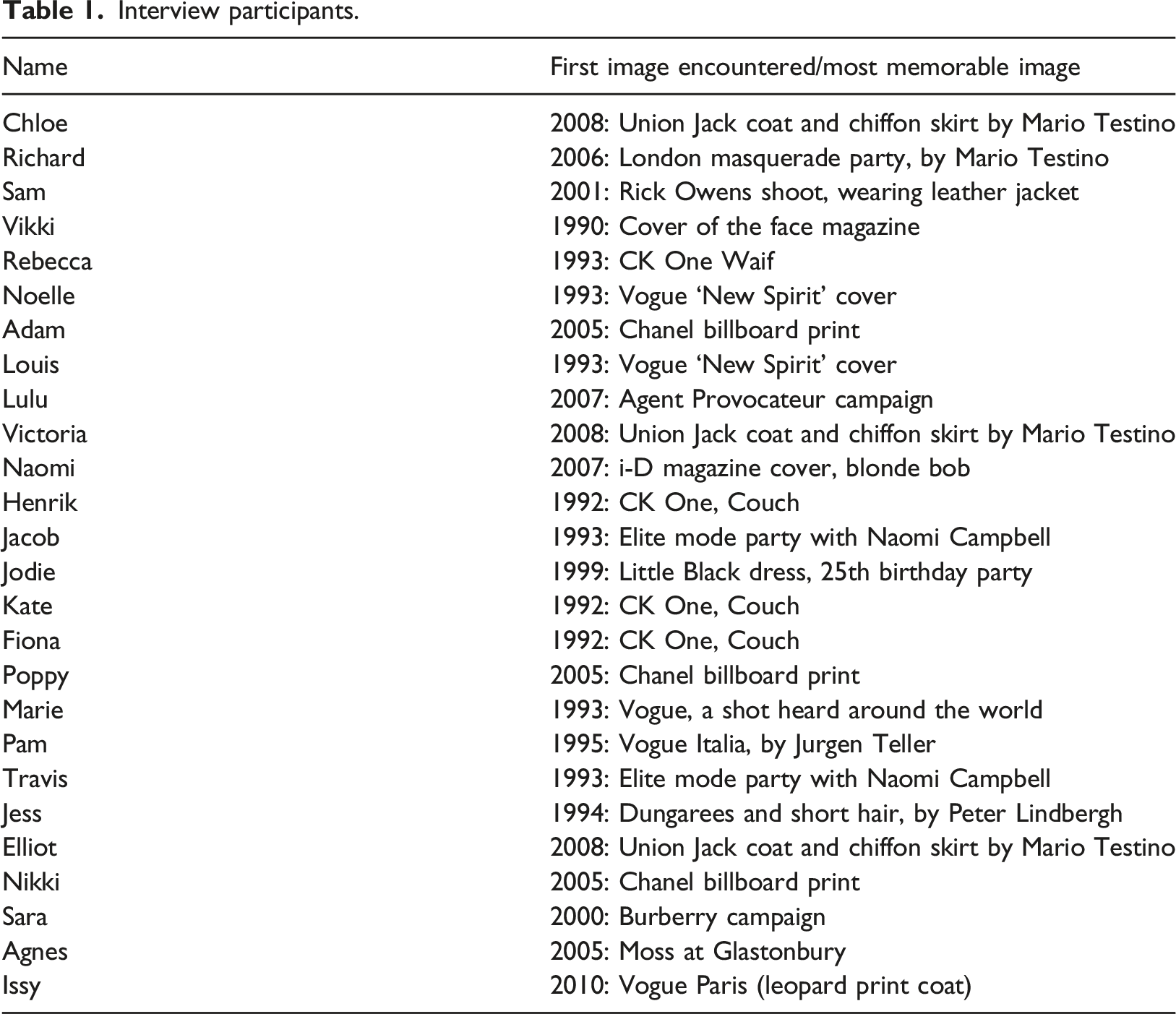
In using the empirical material to produce our narratives, we were informed by Iser (1997) who advocates selecting and/or omitting elements from extratextual realities to highlight issues of interest. These elements are then combined in such a way as to ‘unfold a play space between them in which the present is always doubled by the absent, frequently redistributing the weight by making the present totally subservient to the absent’ (Iser, 1997: 2–3). Finally, the authors signal the fictive nature of the work such that readers might suspend their natural attitude. ‘In offering these three processes (selection, combination and self-disclosure) in the triad between the real, fictive and imaginary, Iser … fleshes out the actual processes through which fictions are constructed and are considered real or believable’ (Savage et al., 2018: 986).
That the fictional might be used as a legitimate mode for research writing is now well established elsewhere (see Brown and Kerrigan, 2020; Rhodes and Brown, 2005; Vickers, 2010). Significantly, Iser (1997: 1) contends: ‘Fictions … are not the unreal side of reality, let alone the opposite of reality, which our “tacit knowledge” still takes them to be; they are, rather, conditions that enable the production of worlds whose reality, in turn, is not to be doubted’.
Nonetheless, we acknowledge that a reliance on fiction may still be met with resistance in many quarters. But fiction has a place in social science writing for it responds to the crisis of representation in consumer research (Shankar and Patterson, 2001). Such efforts underline the significance of more-than-representational modes of research in appreciating and re-presencing the intersubjective, affective and transient qualities of embodied consumption experiences. In the end, more-than-representational research seeks less to question previous contributions and, more, to enrich representational offerings by adding further detail and nuance (Canniford and Bajde, 2015). Moreover, as Rhodes and Brown (2005: 469) contend the incorporation of fictive modes of writing ‘implies a heightened, rather than reduced, sense of researcher–author responsibility … [and] … draws attention to an ethics of writing’.
We herald onflow accounts as a means to capture the fleeting moments where intensities resonate and shape our enduring subjectivities. The point to be made here is that by focussing on what might be considered inconsequential, a preamble to the core consumption experience, we begin to appreciate the body as one in a constant state of becoming. In short, the body is open to being affected, and has been affected many times just moments before engagement with the image. It is the intensity of such moments, we argue, that shape subjectivities and that are central to what we are ultimately interested in – the embodied response and enduring affective tie.
Constitutive of onflow accounts, this research prioritizes memories (Lieblich et al., 1998) and discourse (Wetherell, 2013) as key ontological resources for people to give presence to the affect-laden, intersubjective and transient characters that vivify consumption experiences. Lieblich et al. (1998: 79) consider memories to be ‘personal creations; they consist of choice, distortions, and inventions of past events in a manner that befits the individual’s current goals, interests, or moods’. Memories are thus always emotionally significant even if they do not seem important or relevant to a conscious mind. As Adler (1958: 73) notes, ‘there are no chance memories: out of the incalculable number of impressions which meet an individual, he chooses to remember only those which he feels, however darkly, to have a bearing on his situation’. The act of telling stories is therefore not just one of remembering or re-telling, but more significantly, one of creation (Shankar et al., 2009). When participants unconsciously appropriate the narrative form to negotiate or recount experience (Bruner, 1987), the stories told, while perhaps not true, remain credible and affective. They possess verisimilitude. They are ‘truthlike statements that produce for readers the feeling that they have experienced, or could experience, the events being described’ (Denzin, 1989: 83–84). Here, the subjectivities of researchers, participants and readers become inseparable as they negotiate the creation of an evocative, affect-laden and believable research tale.
Our narratives offer up everyday experience and resonant affective vibrations (Patterson and Larsen, 2019). We attempt to explicate and reinstate the affective capacity of ‘embodied movements, precognitive triggers, practical skills, affective intensities, enduring urges, unexceptional interactions and sensuous dispositions’ (Lorimer, 2005: 84) constitutive of consumption. Rather than neat snippets of testimony from participants, onflow advances and celebrates lengthy narratives, in this case related to first encounters. This is an attempt to appreciate the wider assemblage of affective impulses and actants through which experience and meaning ultimately emerge. We act to re-presence rather than represent (Dewsbury, 2003), to write rather than write up (Richardson, 2000). Our accounts build expressions of the inbetweenness of atmospheres and offer glimpses of the affective minutiae of consumption (Hill et al., 2014). These are not just retellings, but performances that attempt to exert their own affective capacity.
Concerning analysis, Canniford (2012: 403) asks: ‘Why use a medium that destabilizes dominant paradigms and textual expectations before fixing interpretation within the prevailing structure of an academic manuscript?’ It is to this end that we leave interpretive gaps (Leavy, 2020). Attempts to pin down meaning are minimized, replaced instead by discussion and appreciation of the research process coupled with our own personal introspections on encounter (first and otherwise). We are also conscious of the need to present our work for purposes of illustration and reflection so that it is capable of being traced, discussed and built upon by future research.
Within the various accounts of onflow, footnotes are provided to better acclimate the reader with the actants that we believe are significant in shaping consumer subjectivities. We argue here that footnotes can be an integral part of interpretive research, literary data construction and subsequently, the production of onflow accounts. Footnotes do not impinge upon the account of onflow, nor do they constitute an analysis. Rather, they allow the accounts of onflow to remain fluid, sometimes erratic, but always affective, as they were in memory, without reproducing a vocabulary of emotions. The footnotes and the subsequent discussion are thus not intended to close off meaning. Rather, in navigating the onflow accounts we recommend a first reading without recourse to the footnotes. This will help the reader to orient themselves to the experience in question. A second reading, in conjunction with the footnotes, will guide the reader and aid in the process of attuning the senses to the affective triggers, amplifiers, conduits, etc. within an otherwise ‘ordinary’ encounter. A final reading, once more without the footnotes should allow the reader to immerse themselves in the affective flow of the experience.
The girl in the puffball chiffon skirt
I was the perfect student. You know one of those goody-two-shoes who’d be devastated if they got less than 90% in an exam. My mum was very proud. Once, I remember, after a PT meeting, she arrived home and re-enacted the glowing review. ‘I wish I had a class full of Matthew Rundles!’
22
They spoilt me rotten that weekend. Alton Towers. McDonalds. And they let me wear gel in my hair! That’s probably the happiest I’ve ever seen her. I was 15. That was a great day. Then, at 16, I broke her heart.
23
Where do I begin? I went to a very strict religious school – all boys. The only females were the nuns. I don’t know why, but there is something about the nun’s habit. I never got a sense of compassion and charity from that uniform. It always struck me with a sense of dread [laughs].
24
They wore discipline and we wore fear and obedience. Flimsy white shirts that hung from a collar. The collars scraped our necks like sandpaper. Lord help you if you moved suddenly, or yawned – you’d draw blood [laughs]. You think I’m exaggerating, but seriously, I used to walk around with a tub of Sudocrem on me all the time, trading dollops of it for sweets with other students [laughs]. We had these fusty old polyester jumpers that clung to our frightened little bodies. We weren’t allowed take them off even in warm weather. It was like walking around in a portable sauna in June, July. The trousers were no better. We weren’t allowed take those off when it got hot either [laughs]. It was September I remember, and we were just back from summer break. There was a general air of melancholy around the halls as our bodies became accustomed to the uniforms once more. Everyone was feeling the weight of it.
25
We had just had a double economics class and were on our way to a double maths. Nobody was saying a word. Our feet scraping along the ground as we wearily hobbled along with our heads down. I remember feeling very low at that point. There was no end to it. To this day, I don't know how the culprit - managed it. We walked into double maths. Squeezed ourselves into these children’s desks with the folding seats and the ink wells.
26
I heard a giggle to the left of the room. Two boys sniggering. Then two more, until it caught hold of the entire class. I looked up and there it was on the chalkboard. A centre page pull-out. This woman, the likes of which I’d never seen knocking about the boarding school, stood on a shabby timber floor against the most amazing faded aqua blue/green wall. Just stood there with a Union Jack blazer. Hiking up this feminine puffball chiffon skirt. Showing off her biker boots and see-through lace knickers.
27
It actually gave me shivers and I couldn’t take my eyes off it, it was just the exact opposite of my world at that time. It was like a window into a different, more exciting and colourful dimension. There was another way of being. All of the boys were bellowing and whistling while I was just transfixed by this woman. It wasn’t long before the Sister went absolutely crazy, storming in when she heard the commotion. She was mortified and ripped the picture down as soon as she could and kept shouting at us – threatening detention. We collectively took our jumpers off and started swinging them around our heads. It was absolutely chaotic excitement. It was quite an epiphanic moment. They couldn’t control us with their dogma. My mother, on the other hand, wasn’t very impressed. Still, it could have been worse. One guy took his trousers off [laughs].
Non-representational excess
The key idea in any research discussion on affect is the idea that as bodies, we are in a constant state of becoming, our subjectivities continuously altering as we are perpetually open to affect and being affected. Accordingly, our onflow accounts attempt to evoke the affective experiences involved in encounters with a fashion icon as part of fluid consumption assemblages. What is more, objects for aesthetic consumption operate as a ‘coalescence of sensuous elements’ (Dufrenne et al., 1973, cited in Anderson, 2009: 79). In our onflow accounts, arrays of objects, bodies and symbols combine momentarily: homes, garments, crowded spaces, vehicles, haircuts, fashion magazines, billboards, the bodies of various characters including that of Kate Moss, and the evoked cultural representations imbued in highly aestheticized images of Moss.
We work to produce affect rather than simply describe it. In so doing, our accounts illuminate the moments of rupture sensed by participants. These embodied experiences of rupture are akin to what Hill et al. (2014) describe as breaches of everyday normality. Their encounters and the settings in which they occur are not simply filled with diverse emotions, such as pressure, boredom, fear and so on. Rather, they point to something more; the intense affective energies that spark a contrast with taken-for-granted affective environments and trigger a moment of realization and desire. These atmospheres (Biehl-Missal and Saren, 2012; Steadman et al., 2021) and their attendant vibrations (Patterson and Larsen, 2019) ‘touch, invade, and permeate people’s bodies’ (Biehl-Missal and Saren, 2012: 170). What is more, the past and future selves of our participants permeate their consumption experiences (Steadman et al., 2021) as each experience signals a distancing from a previous affective environment and a reaching towards a new one. Realization, desire and other feelings named in the experience are aspects that participants made sense of using the appropriate vocabulary of emotions, yet there is a force at play, a non-representational excess (Anderson, 2017) which is not readily captured by reflexive accounts of experience. Our onflow accounts attempt to approximate this force. As Hickey-Moody and Malins (2008: 9) attest: ‘affect enables us to think about how certain assemblages, languages or social institutions impact on bodies in ways that are not conscious. Affects have the capacity to disrupt habitual and entrenched ways of thinking. They have the capacity to make us move our bodies in new ways, to force us to relate to, and think about, the world differently’. The intensity of affect will determine the extent to which the affected body experiences changeability and vitality.
In an effort to best capture the various becomings of our participants, we have chosen moments of first encounter as key scenarios. These moments help us understand the presence of Kate Moss in the lives of participants beyond the conscious justifications they expressed as reflexive agents (e.g. Moss as a cultural icon, surrounded by a unique aura and mystique). Because affective qualities are ‘differently expressed in bodily feelings of being and differently qualified in named emotions’ (Anderson, 2009: 79) we were compelled to resist representational descriptions. The resultant accounts of onflow piece together fragments of conversations where stories slip from the conscious ideological descriptions of their experience to reveal moments of affective intensity. Far from conscious decision making, consumers seem to be overwhelmed by the intensity experienced. Further, the first encounter moments are significant because they pre-date the elevation of Kate Moss as a meaningful cultural figure who embodies and expresses a multitude of culturally saleable ideas and beliefs around fashionability. Her current recognizability makes it difficult to engage with her image now in a truly affective sense, as cognition and predetermined meanings are introduced to the consumption experience. Our starting point in understanding how an image becomes meaningful, lies in first appreciating the affective environment for the ‘bundles of affects’ (Biehl-Missal and Saren, 2012) that constitute and pervade it and that offer the potential for a wide range of becomings.
Our accounts of onflow extend the material and insights gathered through more traditional methods like interviews by including a wider network of actants that while, posing little obvious or tangible influence on consumers’ cognitive representations and retrospectives, do in fact levy a significant effect on the inevitable meaning interpreted and projected (Lorimer, 2005). Extant accounts of the onflow of everyday life have sought to express the ongoing relation between bodies, spaces and objects, all of which are considered conduits for the fluid mobilization of affective energies. In this respect, we seek to extend the work on affect within consumer research. Hill et al. (2014) note that accounts of onflow must recognize and embrace the ‘messiness’ of lived experiences and resist the urge to neatly define or slice these experiences into precise representational categories. Accounts of onflow are by their nature lengthy without being meandering. While they do not present a complete break from meaning or indeed representation (they are still discursive accounts of experience), they work to evoke (Thrift, 2008) rather than categorize and list the affective intensities and constituents of an experience (Dewsbury, 2003) through offering a ‘highly detailed rendition of the experience from within’ (Pred, 2005: 1).
Marketers and cultural intermediaries continue to attune their sensibilities to the more sensory (i.e. more-than-representational) and arguably mundane energies that surround the images they create (Lonergan et al., 2018). As demonstrated by this research, while spectacular and thematic environments are effective at capturing our attention, orchestrating our behavioural movements and patterns of feeling, the onflow of ordinary experiences can also resonate with and connect to our deeper dispositions. Where image production and the orchestration of experience is concerned, it is important to consider design as an embodied practice, where our bodies and minds are open to affect and being affected, engaging not just with the image or experience created, but with the onflow of intensities just outside the ‘normal’, ‘traditional’ and ‘accepted’ parameters.
Theming, retail theatre, sport spectacle and fashion photoshoots are some of the practices involved in the systematic engineering of affect to enchant/entrap (Thrift, 2004) consumers in marketized experiences (Carù and Cova, 2003). In our case, Kate Moss was selected by the fashion industry precisely because of the affective capacities of her body. Furthermore, the production and circulation of her highly stylized photographic images made these affective capacities visible to the mass market. Our onflow accounts show how participants, conceived as sensing agents, felt these images through their bodies. Yet, while fashion images are highly engineered by an array of professionals (makeup artists, fashion photographers, designers, etc.) our onflow accounts also show that ‘the affective body is open to misreading and provides an excess of embodied information’ (Featherstone, 2010: 200). It is precisely this possibility for misreading that affords consumers as sensing agents the potential to resist marketized meanings, and to also create new meanings.
Affective atmospheres often unconsciously, disrupt what are perceived as ordinary moments of lived experience. The flow of affective energies can antagonize notions of convention within the socio-cultural assemblages in which we live. From the passages above, it is difficult not to draw correlations between affect and abjection (Kristeva, 1982) as both possess this disruptive capacity. Indeed, the abject is affect and is affective. Kristeva (1982: 2) describes the abject in the same way as affect theorists conceptualize affect; as ‘the place where meaning collapses’. Both refer to the flow of liminal, pre-discursive, embodied intensities capable of invoking moments of rapturous vitality and threatening an established order. The intensity of impact can antagonize the institutional assemblages and ideologies (i.e. capitalist society, family, religion, school, consumer tribes, etc.) into which individuals and consumers become indoctrinated.
During cognitive recall, while the image appears as the focal point, the site of affective intensity and the transformative force, there is a range of multitudinous and ambiguous influences that are acting upon our pre-cognitive embodied sense of being. These are also significantly responsible for the inevitable projection of meaning onto the image. The subject can thus never be radically separated from that which has affected them but rather, is constituted by it, as sediments of affective intensities remain pinned to their deeper enduring dispositions, shaping their perception of the world. In contrast to the consumer research tradition, consumer longing is not positioned as an explicit pursuit of meaning, but rather, as Campbell (1988) notes, we imagine that consumers seek moments of rapturous vitality, changeability and aliveness, which they experience through engagement with multitudinous conduits for affective flow.
Conclusion
In this paper, we adopt a more-than-representational approach to better contextualize aesthetic consumption experiences. In doing so, we produce accounts of onflow in consumption, appreciating the broad assemblage of human and non-human vibrations (Patterson and Larsen, 2019) that pervade the atmosphere, flow through and around affective imagery to shape bodies’ subjectivities and induce change in how they perceive their lived reality. A more-than-representational approach then does not consider Kate Moss as Kate Moss – a cultural icon upon whom we project a host of diverse cultural meanings, brand symbols and personal emotions. Rather, such an approach considers Moss an affecting presence; a body independent of any culturally qualified meaning, whose existence and affective energy is felt through engagement, and contagion. The production of onflow accounts can help to better grasp and attune our sensibilities to the affective (i.e. more-than-representational) processes of image reception and visual consumption. In doing so, we can better reconcile both representational and more-than-representational approaches so that we not only appreciate signification, but also the onflow of embodied responses to affect, that underpin our cultural qualifications. Our intention has thus been to enrich extant consumer research and further demonstrate from a nuanced perspective how aesthetic consumption is not, and never was a linear process. Rather, the register of intensity during image reception is dependent on and influenced by many other vibrations that are flowing through bodies during the interpretive process. The accounts of onflow presented here are intended to foreground the underappreciated affective minutiae of consumption and to exist alongside representational ways of theorizing visual imagery and individuals’ interpretation of meaning.
Footnotes
Declaration of conflicting interests
The author(s) declared no potential conflicts of interest with respect to the research, authorship, and/or publication of this article.
Funding
The author(s) received no financial support for the research, authorship, and/or publication of this article.
