



Abstract
The rich tradition of stigma theoretics in marketing and consumer research develops understanding of consumer stigma management, mitigated via marketing-mediated solutions, broadly within a Goffmanian liberal frame. However, building on classic liberal formulations of stigma, sociologists of stigma further examine the impact of the neoliberal political economy in terms of where stigma is produced, by whom and for what purposes. Using the empirical illustration of the emergence of HIV PreExposure Prophylaxis (PrEP), this paper seeks to develop these stigma theoretics towards the concept of stigma diffraction exploring the multiple stigma effects that can be identified and conceptualised through a diffractive lens. This encompasses and theorises beyond traditionally stigmatised contexts, groups and individuals to conceptualise a dynamic and diverse field of ‘stigmas that matter’.
Keywords
Introduction
Many cultures have become increasingly liberal, celebrating an array of sexual desires, practices and identities. Despite this apparent progress (Keating and McLoughlin, 2005) areas of resistance and even regress remain (Coffin et al., 2019). As such, stigmatisations relating to sexuality persist, albeit in more dynamic and diffuse forms. This becomes particularly obvious when considering the consumption of recent sex-related biotechnical developments (e.g. ‘chemsex’ substances and pre-exposure prophylaxis drugs). These products, consumed largely by gay and bisexual men (GBM) contribute to a nexus of sociomaterial arrangements that empower but also stigmatise consumers as hedonistic, irresponsible or even criminal. In marketing, much has been written on how consumers manage stigma via market resources, following Goffman’s (1963) classic formulation. However, in this paper we pose the question of how to theorise stigma consumption in a context of diverse, dynamic and often-contradictory stigmatisations. To address this question, we adopt a material-semiotic stance, considering the material technology of pre-exposure prophylaxis (PrEP), a drug emerging in the early 21st century to prevent transmission of the Human Immunodeficiency Virus (HIV) (McCormack et al., 2016). To complement and extend the rich literature on stigma theoretics, rather than treat stigma as a socio-symbolic mark applied to an individual or group, we draw on the concept of diffraction (Barad, 2014), to understand how stigmatisation ripples across networks with multiple effects. This applies diffraction beyond traditionally stigmatised contexts, groups and individuals to conceptualise a dynamic field of ‘stigmas that matter’.
Context: The PrEP revolution
Initially, HIV/AIDS emerged in the early 1980s as a largely fatal disease with the initial response focus on abstinence or condoms. However, from the late 1990s treatment advances downgraded HIV to a chronic, manageable health condition. Alongside an emergent culture of condom-free sex, this lessened threat led to a concerning rise in new HIV diagnoses (Hammack et al., 2019). Initial clinical trials of PrEP proved c.99% effective in preventing HIV transmission (Molina et al., 2015), but although PrEP was approved, and despite a strong business case (Cambiano et al., 2018), NHS England declined to provide PrEP outside a limited impact trial (2017–2020, c.26,000 enrolled). During this period, a private 30-day PrEP supply cost c.£500 in UK pharmacies. In the years following the first approval of the drug Truvada for HIV pre-exposure prophylaxis by the US Food and Drug Administration (FDA), activist-consumer groups formed, sharing information about PrEP and facilitating significantly cheaper overseas supply-chains. Following this market development, double-digit declines in new HIV diagnoses were reported across the UK (Public Health England, 2018), with an 80% drop in diagnoses at the UK’s biggest sexual-health clinic (2015–2017, Dean St). The success of PrEP is credited to this alternative market (Matthews-King, 2018) yet it remains largely unstudied. Nwokolo et al. (2017: 482) for example, only briefly comments that gay men in London were amongst the first to ‘purchase generic PrEP from India’ at a fraction of the UK retail price, and that this process was ‘facilitated by community activists offering advice and links to online pharmacies’. PrEP is a transformative actor, ostensibly enabling gay and bisexual men to engage in ‘barrierless’ intimacy, remaining protected from HIV, and disrupting long-established cultural norms about safer sex. However, despite proven benefits, counter-narratives also emerged around ‘profligate’ use of resources, the pull of heteronormative behaviour, the stigmatising of ‘promiscuous’ PrEP users and resistance to medicalisation of sexual activities (Calabrese, 2020; Pawson and Grov, 2018). This complexity of possible stigmatisations make PrEP a fruitful context to explore how to theorise stigma and consumption in a diverse and dynamic context.
Theorising stigma: Gazing across to gazing up
The preeminent stigma theorist Erving Goffman (1963) developed the concept of stigma to theorise a range of discriminatory ideas and practices. He argued that within social contexts, people respond to stigmatisation by employing strategies of identity management. Goffmanian stigma theory has been influential in marketing and consumer research (Adkins and Ozanne, 2005; Crockett, 2017; Henry and Caldwell, 2006; Sandikci and Ger, 2010) focussing largely on stigma management through consumption. For example, Crockett (2017) illuminates how black, middle-class consumers manage stigma through consumption relating to distancing from the source of stigma (normative respectability) and destigmatising by reframing stigma as high status (oppositional respectability), and Sandikci and Ger (2010) explore how consumer processes of de-stigmatisation transform stigma-suffused fashion practices, like veiling.
These approaches might be conceptualised as sitting within a liberal framework, developing understanding of the role of consumption in enabling effective management and amelioration of stigma – where consumers are at liberty to manage their stigma via market resources and may be liberated by de-stigmatising consumption. However, writers in sociology have developed this liberal approach, facilitating a closer analysis of the role of neoliberal ideologies in transforming stigma into ‘a form of governance which legitimises the reproduction and entrenchment of inequalities and injustices’ (Tyler, 2013: 212). This ‘neoliberal stigma power’ approach (Link and Phelan, 2001; Tyler and Slater, 2018: 733), focuses on how stigma is weaponised in myriad ways to reproduce inequalities directed at particular groups (Parker and Aggleton, 2003; Tyler, 2020), by analysing ‘the daily, pervasive production and mediation of stigma…a core organ [of] neoliberal governmentality’ (Tyler, 2013: 212).
These scholars highlight the importance of understanding stigma via a liberal, but also a broader socioeconomic frame. Paton (2018) crystallises this by calling for stigma theorists to gaze across, examining the management and experience of stigma, but also to gaze up, considering structures of neoliberal stigma governmentality. While marketing theorists acknowledge how neoliberal conditions encourage consumers to take responsibility for social issues via their market choices and to stigmatise those that expect state aid (Giesler and Veresiu, 2014), more could be done to explicate this articulation.
Stigma, materiality and diffraction
Studies of stigma acknowledge the importance of material objects in stigma management, following Goffman (1963), who considers objects as material ‘props’ people use to manage stigma. Throughout marketing literature, ‘props’ are similarly reimagined as stylish veils (Sandikci and Ger, 2010), and collections of black GI Joe and segregated scouting badges (Crockett, 2017). Beyond this, marketing scholars have explored food coupons (Argo and Main, 2008) and using clothing and internet technologies to manage body-type stigma (Scaraboto and Fischer, 2013). In sociological studies attending to critical theorisations of neoliberal stigma governmentality, material objects also contribute to understanding the stigmatisation of particular groups. Shildrick (2018) discusses the cheap cladding that led to the Grenfell Tower disaster (London, June 2017) exposing the role of stigmatisation vis a vis disinvestment in social housing as government policy; Fortier (2021) includes the role of waiting rooms and complex documentation forms in her discussion of the stigmatisation of new migrants to the UK.
These conceptualisations of materiality are both relevant and useful. However, other conceptualisations of materiality, such as those dubbed ‘material-semiotic’ (Haraway, 1991; Law, 2004), recognise the agency of these non-humans. Within material-semiotics, agency is not seen as the property of a consumer subject (Bajde, 2013), as might be found, for example, in a study where different groups of gay and bisexual men who consume PrEP use this consumption as part of sexuality stigmatisation management. In a material-semiotic approach, agency is instead seen as distributed among an interconnected and heterogeneous network, resulting in formations of meaning and materiality that come ‘to matter’ (Bettany, 2007: 44). Therefore, a material-semiotic handling of materiality in stigma studies would not see materials as props being deployed by a prefigured social group or individual, but as having agency that emerges within a heterogeneous context. One way of theorising this is examining how a material actor, such as PrEP, as it enters a broad field of activity leads to reiterative interference patterns, or ‘diffractions’ (Barad, 2003, 2014; Haraway, 1997; Seghal, 2014), which in this case result in emergent diverse and not easily prefigured stigma effects. Traditionally, ontology privileges entities (prefigured people, objects, etc.) as the basis of analysis, with difference being understood as derivative, whereas with the material-semiotics of diffraction, difference comes first and entities come to matter only through repetition (Barad, 2014). Therefore, the material artefact is also not fetishised in this approach, as will be seen, PrEP also ‘comes to matter’ differentially in our analysis.
Deploying diffraction develops Goffman’s (1963) conceptualisation of stigma as a socio-symbolic marker managed by those already prefigured as stigmatised, understanding stigma instead as emerging less predictably from collisions between heterogeneous waves of activity. A diffractive account attempts to follow these waves, analysing how they interfere with established patterns and identifying new waves that result from the impacts of their intra-actions. Crucially, as waves of stigma travel across more conventionally wrought boundaries and contexts, they are often translated into new and less easily captured stigma effects. A diffractive account of stigma can encompass, but also develop, the ‘gazing up’ of critical theorisations of neoliberal stigma governmentality and the ‘gazing across’ of liberal stigma theoretics by analysing the waves rippling from PrEP creating diffractions of un-prefigured, emergent and often unexpected stigma effects with heterogeneous origins and trajectories.
Methodology
In this study, PrEP is not analysed as a stigmatised object per se; but following typical diffractive methodologies (Udén, 2018), provides an entrée through which to track diverse and dynamic stigma effects (Bettany and Daly, 2008). In material-semiotic ethnography (MacLeod and Cameron, 2019) an artefact traces and configures a diverse human and non-human dataset wherever illumination and engagement is found. This allows for a myriad of PrEP-related stigma effects to emerge (Figure 1). Shifts between liberal-theorisations of stigma, neoliberal stigma governmentality and diffractive stigma theoretics.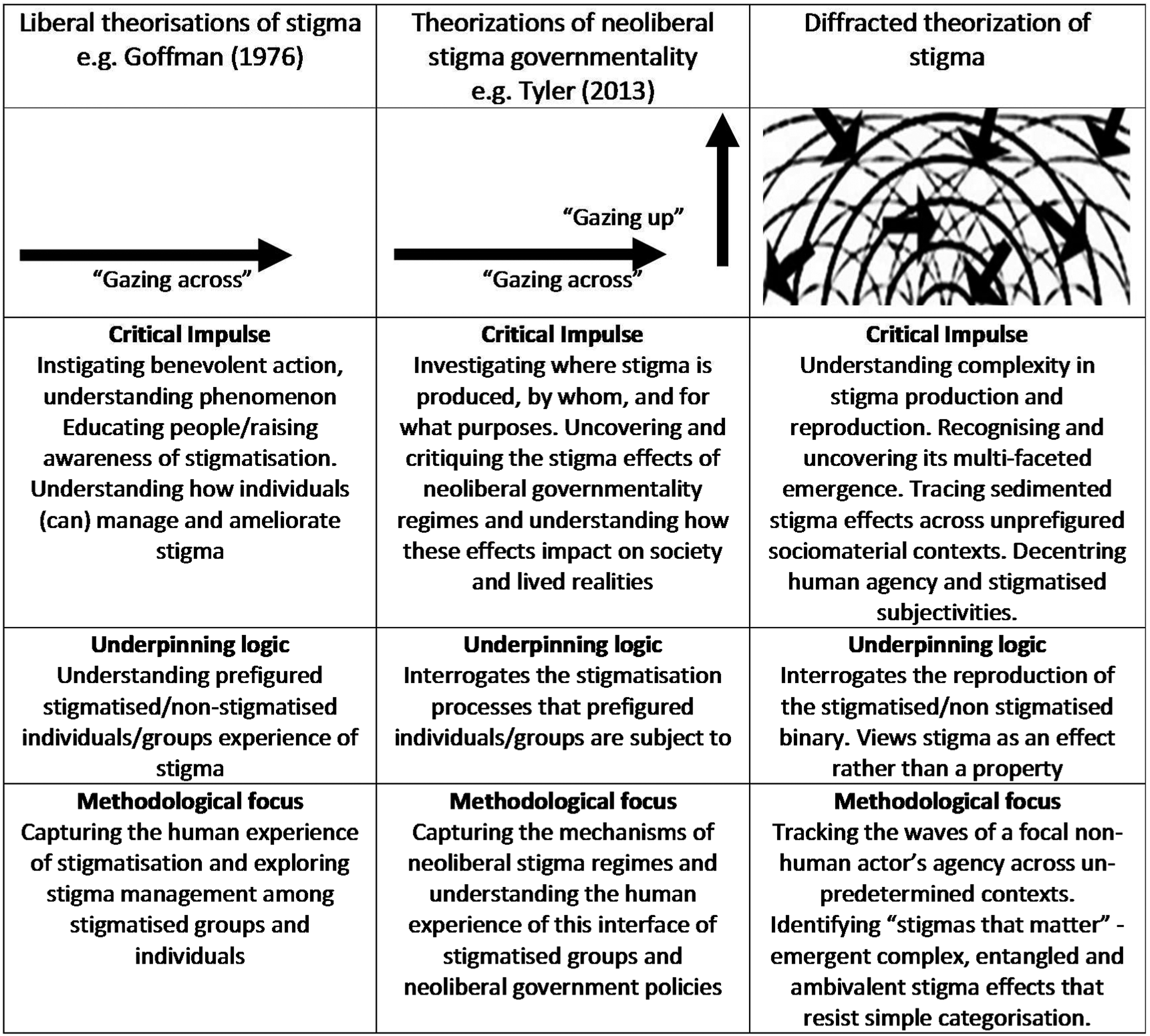
This then provides a different mode of researching stigma to typical phenomenological research (highlighted by Askegaard and Linnet, 2011). Diffractive methodologies critique the idea that knowledge exists through research engagement with the human subject alone, and as such are not seeking a reading of stigmatised consumers or social groups (Murris and Bozalek, 2019). For example, this approach does not equate to multiple uses of a new technology by different sub-groups of consumers, as here the ‘the consumer’ is not seen as the key focal actor, but as one aspect of the dataset. Quotes from consumers and other stakeholders are not lionised as empirical evidence (Moisander et al., 2009); the not always immediately harmonious interpretations of diverse data from an immersed, multi-author team provide the basis of analysis. Therefore, while quotes may be provided from participants, these should be read inseparably from other data sources (Figure 2) and our own interpretative explanations as forming the complete dataset (Bozalek and Zembylas, 2017). Data sources.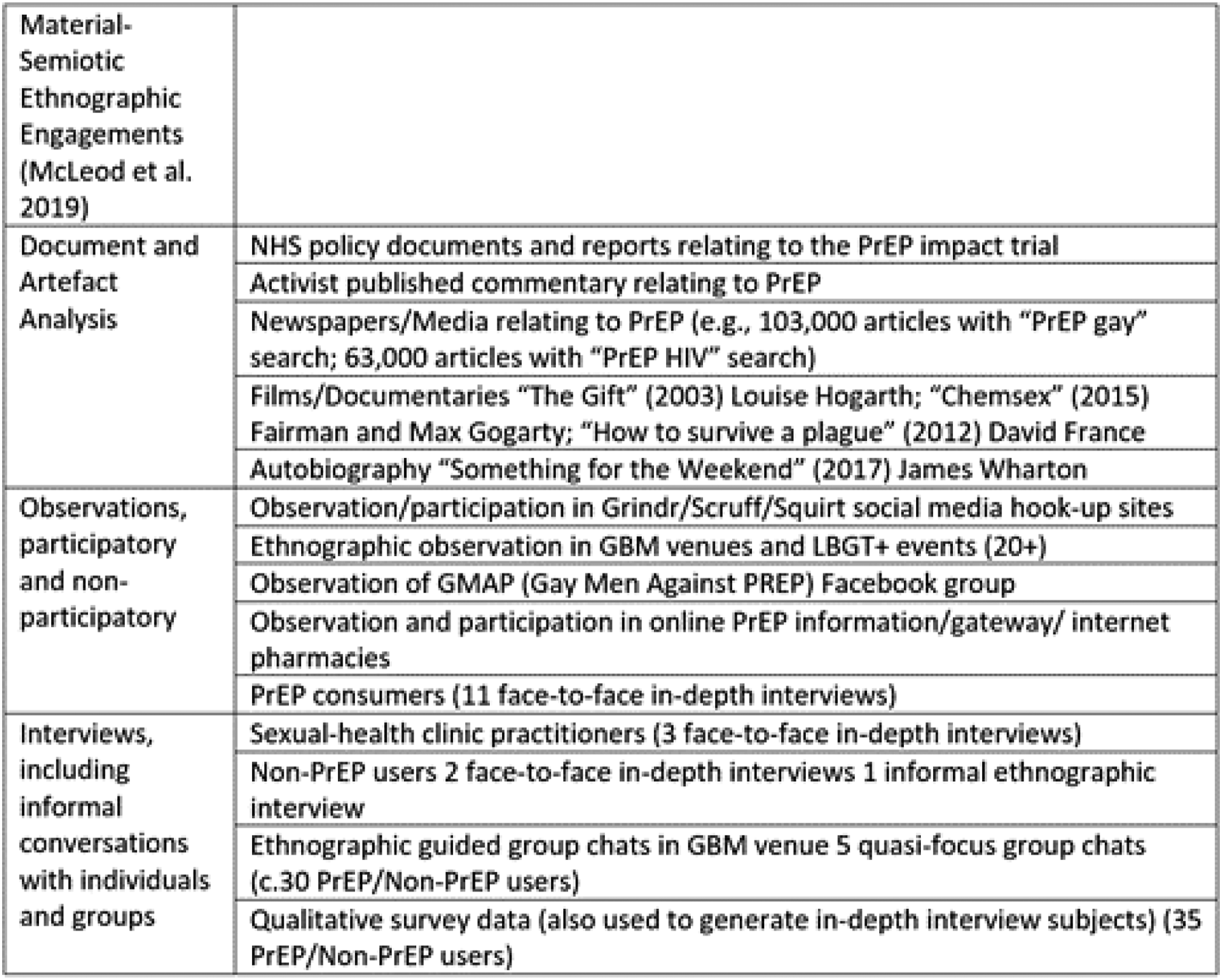
It might be argued that PrEP is more central to the milieu of sexual health than PrEP-consuming subjects, given that consumers are just one of many actants involved in ideas of healthy sexuality. Also relevant are sexual-health clinics (private and state-funded), media outlets, creative outputs, religious authorities, condom producers, sauna owners, NHS and other governmental regulatory bodies, online pharmacies, activists, marketing scholars, the HIV virus, other STIs, condoms, competing supply-chains, even seemingly disconnected diseases like Covid-19. Although any of these may provide some insight into sexual-health markets, PrEP’s interference patterns represent an entanglement of them all.
The study follows MacLeod and Cameron. (2019) in grouping material-semiotic ethnographic engagements into: (1) document and artefact analysis, where these materials are taken as important sedimentations to be analysed in terms of what their agency is, what they do, (2) observations, where participation and non-participation by the researchers is used to uncover what is being achieved by human and non-human actors in live encounters and (3) interviews, which comprise informal conversations and guided group-chat (quasi focus-groups) in the ethnographic setting, in addition to formal recorded and transcribed interviews of key actors (see Figure 2).
Diffraction favours a performative understanding of method, where the researchers co-perform the patterns of reality-making, even when ‘just’ observing (Seghal, 2014). For example, one co-author was enrolled in the NHS PrEP Impact Trial (and had previously sourced PrEP from online pharmacies overseas) which provided experiences that contrasted sharply with other authors. Such differences further facilitated a diffractive analysis. The diverse research team tracing PrEP to and through the multiple sites it defined uncovered the ‘differencing’ processes characteristic of stigmatisation. Sharing those differencing processes formed the basis of data analysis. Rather than ‘code’ the data into ‘themes’ based on similarity, we encountered processes of differentiation, pointing us to the presence of interference patterns. Given the subject matter the study was subject to a rigorous university research ethics process.
Findings
This section presents illustrative empirical material in three sections, tracing how stigma diffracts across (and beyond) the PrEP consumption milieu and illustrating how stigma diffraction develops and enhances previous theoretical approaches. First, drawing on a liberal theorisation of stigma, we engage with the extant idea of PrEP consumption as an oscillating position of stigma management, illustrating emergent stigma effects with the paradoxical figure of the ir/responsible consumer. Second, we engage with critical theorisations of neoliberal stigma governmentality where the semi-legal, unregulated drug market generates stigma effects vis-à-vis non-normativity. We examine using the figure of ir/responsible markets how this is charged with the cultural complexities found within post-gay networks and counter-stigmatisations of neoliberal self-reliance. Third, we explore how heterogeneous diffractions ripple even further outwards with emergent stigma effects. Importantly, the analytical categories that emerge throughout our analysis are not to be taken as social groups or differential human responses to stigma. The categories used in our analysis instead signal diffracted material-semiotic stigma effects that have become entitative (i.e. ‘come to matter’) within the context of the emergence of PrEP.
Gazing across: The ir/responsible consumer
Goffman (1963) argues there are two main responses to stigma, embracing stigma and downplaying stigma through carefully controlled performances of normalcy. In practice, an individual may embrace stigma in one context and mask it in another (Crockett, 2017; Visconti, 2008). In our data, PrEP generated stigma effects, but also facilitated complex contradictions. One participant recounted displaying his PrEP consumption status on his Grindr 1 profile. This, a common signal of taking responsibility for one’s sexual health, might be assumed to reduce the stigma suffusing this ‘hook-up’ activity. However, within GBM hook-up apps, PrEP consumption can be associated with ‘barebacking’; condomless sex that is intentionally high-risk (Carballo-Diéguez and Bauermeister, 2004). This chimes with recent findings (Pawson and Grov, 2018) that some GBM see PrEP as a social problem and express moral indignation at the perceived sexual irresponsibility of PrEP users. As such, acknowledging PrEP consumption on one’s profile is taken as a signal of certain preferences and practices that attract stigma, regardless of veracity.
Grindr and similar apps are often understood as enablers of casual sex, and in ethnographic encounters, it was observed that an individual opening these apps in a group of GBM might be accompanied by responses ranging from laughter and leg-pulling to outright judgement. This is surprising, given it is argued that GBM are more likely to treat casual sexual encounters as more acceptable (Mitchell et al., 2012) and Grindr was often characterised in our data as the ‘Orange Facebook’. Similarly, open relationships are also more common amongst GBM, with Hoff and Beougher (2010) reporting that 60% of their sample had adopted some form of ‘not-quite-monogamous’ relationship. Despite the widespread liberalisation of sexual norms in many Western societies, open relationships and casual sexual encounters remain largely stigmatised as ‘promiscuous’ and detrimental to public health by facilitating the spread of infection (Matsick et al., 2014). PrEP interferes with this latter association by preventing the spread of HIV infections across the population but transforms the former by generating the figure of a consumer emboldened by PrEP to engage in more risky activities.
One of our participants, Niall, reported that he took PrEP to facilitate his open relationship, presenting this as a responsibilising act. However, he suggested that GBM often did not discuss PrEP during sexual encounters. PrEP offers protection from HIV for both parties, even if only one person is consuming the pill without the need to negotiate unlike condom use which could often ‘kill the mood’ through awkwardness; however, with PrEP, ‘I feel like I have got a shield up and almost like a little glow around my body protecting me… I know I have got nothing to worry about’. Yet, despite these benefits, stigma still surrounds PrEP as it does not prevent other STDs (Payne et al., 2017). This means that sexual encounters can be ambivalent mixtures of ir/responsibility. Mark, a sexual-health practitioner seemed uncomfortable while discussing the rise in rates of non-HIV STDs following the PrEP revolution, stating ‘my role is HIV prevention, and although I might advise service-users to combine PrEP and a condom, my priority is to get people onto PrEP’. Further ir/responsibility complications were highlighted by our observations of the Gay Men Against PrEP (GMAP) Facebook group, strong advocates of prophylactic condom use, who campaign against PrEP use as it encourages what they view as irresponsibility, and they object to the widespread pharmaceuticalising of GBM. These research encounters illustrate how PrEP disrupts assumptions and confounds cultural categories. These often-contradictory stigma effects imagine the figure of the ir/responsible consumer, where it is not clear whether taking PrEP is responsible or irresponsible. To return to our respondent displaying his PrEP status on Grindr, this seemingly simple example exceeds the classic stigma oscillation formulation of ‘embracing stigma in one context and downplaying in another’.
Gazing up and across: ir/responsible markets
In the terms of critical theorisations of neoliberal stigma governmentality which call to ‘gaze up’ as well as ‘gaze across’, the key governmental actors involved with PrEP are NHS England and NICE, the drug regulating policy body in the UK. As already discussed, delaying the widespread release of PrEP, NHS England instead implemented a very limited impact trial (2017–2020). However, it has been argued that the trial protocol was ‘a tool of power…deployed to strategically ration healthcare; introduce uncertainty about commissioning PrEP and shift the boundary between individual responsibilities and state responsibilities for public health and HIV prevention’ (Naginton and Sandset, 2020: 176). In this context, the alternative market for PrEP emerged and was quasi-legitimated through online information sites such as iwantPrEPnow.co.uk that promote PrEP as a route to ‘empowerment and control’ in the face of HIV infection threats. Iwantprepnow displays links to online pharmacies that require varying customer checks, although they do advise that sellers they promote have undergone independent drug monitoring/testing. Other similar sites are more ambiguous, although no-less popular for it.
Although as the commercial success of these sites attest, PrEP users outside the NHS trial clearly purchase drugs through these unregulated markets, but there remained a degree of stigma in regard to this pill not being available through the ‘normal’ routes. Media, political and popular narratives during the data-collection period typically chimed this way. One high profile example was the National AIDS Trust court battle with NHS England that included interventions from the Daily Mail reporting that children’s services would be cut to accommodate the PrEP roll out 2 ; the then Health Secretary Jeremy Hunt arguing against the rollout due to his concern about what the Daily Mail would say 3 and NHS England releasing incendiary statements about PrEP such as ‘PrEP is a measure to prevent HIV transmission particularly for men who have high-risk condomless sex with multiple male partners’ (Wharton, 2017: 124). To make sense of this, we must consider how such narratives implicitly rely on and help to inculcate neoliberal ideals of self-reliance, with dependence upon the state as shame-inducing (Walker and Bantebya-Kyomuhendo, 2014).
Building on the ‘gazing across and up’ articulation of theorisations of neoliberal stigma governmentality, our data also indicated the importance of embracing non-normativity within the GBM context (Kates, 2002). The opposing nomenclature to gay, ‘straight’, has entered the broader lexicon of contemporary Western societies to colloquially connote average conservative lifestyles. From the perspective of stigma theory, one might argue that this represents a process by which a stigmatised group (non-heteronormative people) counter-stigmatise the (heteronormative) mainstream as a defence mechanism and boundary-marker (see Kates, 2002; Visconti, 2008). While ‘normals’ are the standard against which the stigmatised are largely judged as ‘other’ (Goffman, 1963), here it was normality that was stigmatised. From such a perspective, the NHS statement above might be read against-the-grain as a call to embrace the emerging counterculture of ‘high-risk’ activities by using PrEP to lower actual risk – without reducing social risk. Accessing PrEP through the alternative market affords a performance of being a good neoliberal subject in that it demonstrates taking individual responsibility for one’s own health outside state provision. However, the contentious sourcing of pharmaceuticals though the internet is also culturally considered a high-risk and irresponsible activity. Taken together this can be viewed as affording a ‘virtuous non-normalcy’ to this activity in terms of accessing PrEP via a definitively ‘non-straight’ supply-chain.
Here our analysis shows how gazing across and gazing up illuminate the entanglements of diffracted stigma effects. Specifically, just as the diffractions of PrEP afford the figure of the ir/responsible consumer, diffracted waves of activity from legitimated and alternative market logics converge around PrEP, and an ir/responsible market emerges. Interestingly, the assumption that these consumers want their alternative market to be displaced by NHS provision should not be made. Unlike the plus-sized ‘frustrated fatshionistas’ of Scaraboto and Fischer’s (2013) study, mobilising to reform the fashion industry by influencing designers and retailers to be more responsive to their needs, GBM created their own quasi-market, an alternative activism which marked the community as both responsible and non-normative. Just as subcultural consumers build their sense-of-self through oppositions (Kates, 2002; Schouten and McAlexander, 1995), the monolithic concept of the ‘mainstream’ becomes refashioned as a normative mirror image to non-normative subjectivity. However, instead of acting as a simple reflection, this mirror image is diffracted by being partly internalised, partly rejected and partly admixed through activities that cannot be defined clearly as either responsible or irresponsible.
Stigma effects beyond the milieu
The above describes how PrEP affords a complex dynamic between stigma and normalcy not-so-easily categorised into a normalised/stigmatised binary (as imagined by the figure of the ir/responsible consumer). It then describes the equally complex inculcation of neoliberal stigma governmentality effects versus valorisation of stigmatised activities (as imagined through the figure of the ir/responsible market). The final section explores how the diffraction waves of PrEP ripple further, causing material-semiotic interferences of various kinds creating and/or reinforcing other stigma effects, and escaping what might traditionally be thought of as the PrEP consumption milieu. We illustrate this point with four further diffractive stigma effects.
Self-stigmatisation: Bug-chasers and viral kin
While PrEP consumption is inflected by narratives of controlled ir/responsibility, the ripples of PrEP interfere with other milieu, suggesting that some GBM eschew the rhetoric of responsibility altogether. Our methodological tracking strategy of following PrEP found evidence of an emergent stigma effect, ‘the bug-chaser’. This term was introduced in the film The Gift (2003), that shows two young GBM actively seeking HIV infection (Moskowitz and Roloff, 2007). Bug-chaser representations found in our data largely recount a visceral manifestation of someone rejecting responsibility, pushing to further extremes in their desire for authentic experiences of dangerous sexuality. This is akin to Foucault’s ‘limit experience’, risk-embracing resistance to subject governmentality through transgressive behaviour (Holmes et al., 2006) here encompassing elements such as erotic expression and political and social liberation (Garcia-Iglesias, 2020). This is also highlighted in popular gay media that discuss the contemporary resurgence in risky, secretive GBM encounters where the aphrodisiac properties of secrecy and fear are just as powerful as they were in less-liberated times (Ball, 2017). This follows an historical dialectic of non/normalisation: when homosexuality was illegal, any non-normative sexuality was dangerous; when homosexuality was decriminalised, certain acts remained at the fringes, but the HIV/AIDS crisis infused homosexuality per se with risk once more; the subsequent introduction of retroviral drugs and, more recently, PrEP have diminished this risk, which in this context might be seen as at-odds with ‘authentic’ GBM identities. Here, stigma is configured not as a negative marker to ‘manage’ but rather a mark of authenticity to seek out, and the ripples of PrEP, paradoxically, intensify the stigma possibilities available. Following available representations one might assume young, hedonistic and authenticity-seeking males would be more apposite for the designation of bug-chaser. However, one of our respondents, Martin, discussed his period of ‘bug-chasing’ following his husband’s HIV+ diagnosis, ‘I did not want anything to come between us, I did not want that worry coming between us, can I catch it? Will he give it to me?’ Here the PrEP/HIV articulation in terms of stigmatisation is further complicated by the intimacy needs of becoming viral kin. Where PrEP holds the promise of barrierless intimacy, so does HIV, it seems.
Hyper-stigmatisation: HIV+ in the PrEP revolution
HIV+ status is inextricably linked to stigma (Berger et al., 2001). If an invisible protector like PrEP exists and is available at low cost, then being HIV+ seems to carry more stigma potentials than ever. Here PrEP sends out ripples of stigma that affect HIV+ people by interfering with the recent trajectory of de-stigmatisation following years of activism and policy-changes. The PrEP revolution produces a stigma effect we name hyper-stigmatisation, as it confers the idea that the stigma effects are compounded in this case. Initially, one might assume that PrEP would de-stigmatise HIV+ people, given that the pill can be used to prevent transmission to HIV- partners. The introduction of PrEP and its diffractive disruption of well-rehearsed risk-reduction practices (e.g. using a condom) appears to suffuse new shades of stigma into the lives of HIV+ people, even those infected before the arrival of PrEP. One research contributor, Johan, for example, who declared his HIV+ status following an ethnographic encounter, felt hurt by the deep irony of people taking PrEP who displayed ‘no poz’ (i.e. HIV-positive users need not apply) on their online profiles and railed against the fact that he had campaigned for PrEP to be available even though he would never be able to take it. As part of our dataset, we observed these and other activities of blocking on hook-up apps of declared HIV+ men (with often undetectable and thus non-infectious) status, even amongst people taking PrEP themselves.
Pre-stigmatisation: The PrEP closet
Our dataset included people who were considering using PrEP but had yet to try it. Here, the ripples of PrEP combined to create a stigma effect of anxiety around becoming stigmatised. In surveys of PrEP-related attitudes, the belief that PrEP causes people to have more risky sex and that people should pick their sexual partners more carefully instead, has emerged (Golub, 2018). Importantly, taking PrEP has been argued to signal the intent to engage with high-risk activities and thus has the potential to draw a stigma effect. This is particularly acute in the era of new homonormativity of post-gay identity construction (Ghaziani, 2011) that has seen the emergence of a ‘PrEP closet’ (Grace et al., 2018) where disclosure of PrEP status is avoided due to fear of stigmatisation. Within an increasing liberalisation of attitudes towards homosexuality, the collision of a life lived largely stigma-free and the stigma complexities of PrEP crates a stigma effect we call pre-stigmatisation. Thus, those who might benefit from PrEP, but had yet to begin doing so, the possibility of ‘opting-into’ stigma weighed on their decision-making. Pre-stigmatisation was an interesting effect, as Phil, one of our sexual-health service respondents recounted, ‘people who are undecided on PrEP often see themselves as stigmatised either way, if they do not take it is bad, if they do, it is bad’. It could be argued that as PrEP consumption has the possibility of being invisible, then these stigma potentials can be avoided. However, this does not adequately reflect the negative effects of what has been called the slow violence of secret stigma (Barnwell, 2019) that the PrEP closet would likely engender.
Alt-stigmatisation: The exclusions of PrEP
During our research we encountered non-consumers of PrEP whose non-consumption could not be explained by the factors discussed above. Upon probing, some of these respondents felt that PrEP was a neutral technology, neither good nor bad, in fact, they largely saw it as irrelevant. Most of these accounts derived from GBM in stable long-term non-open relationships who were ambivalent towards PrEP, seeing it as generally a good thing, with some controversial elements. However, some older GBM reported an antipathy towards PrEP not captured in other stigma diffractions. In a group, ethnographic encounter in a GBM venue Donald argued, ‘I am far more concerned about cancer, heart disease’. He reflected (and the group agreed) that on the whole, the PrEP discourse excluded him as it was set in the arena of youth and framed as the most important factor in GBM health. He argued, ‘gay health is about more than sex!’ Several older GBM recounted these views, that the youth-valorising nature of GBM representations, whether through sexual-health advertising, media representations and/or the field of debate, stigmatised and excluded them, and that PrEP with its entire milieu, was an inextricable part of that stigmatising wave. Similarly, one sexual-health practitioner noted that recipients of the NHS impact trial tended to be those with sufficient cultural capital of sexual-health literacy (Nutbeam, 2000) to negotiate the application process for the trial. ‘It tends to be the same sort of people, white, cis, middle-class men who could probably afford the online PrEP anyway’. These examples directed us analytically towards a stigma effect we categorise as alt-stigmatisation, stigma that results not merely from non-consumption, but from the field of discourse and practice surrounding PrEP and GBM sexual health stigmatising through barriers, omissions and exclusions.
Discussion and conclusion: Diffracting stigma theoretics
We argue that in marketing and consumer research, stigma theoretics typically follow a liberal approach, focussing on the crucial role of consumption in stigma management (Crockett, 2017; Kates, 2002; Sandikci and Ger, 2010; Scaraboto and Fischer, 2013). Sociological theorisations, developing this liberal style of analysis, extend this towards critical theorisations of neoliberal stigma governmentality (Tyler, 2013, 2020; Tyler and Slater, 2018), gazing across the various contexts of stigma experience and gazing up to examine how stigma is produced, by whom and for what purposes. This type of analysis addresses important aspects of how processes of governmentality become self-regulating mechanisms and embed as implicit value-judgements.
In this paper we employ PrEP to develop these ideas towards a diffractive stigma theory that seeks to represent stigma effects that matter, without reducing these to specific social groups. To this end, we explore diffracted and contradictory stigma effects that emerge in the management of stigma via the figure of the ir/responsible consumer. Further, in the context of the reproduction of neoliberal stigma governmentality we explore how contradictory stigma effects relating to the sourcing, purchase and supply of PrEP emerge via the figure of the ir/responsible market. Finally, we further employ this diffractive approach to engage with other emergent stigma effects that lie outside what might be considered the typical phenomenologically defined research field. This theoretical move answers calls within marketing and consumer research to further contextualise phenomena (Askegaard and Linnet, 2011), but does so in a ‘flatter’ manner that tries not to impose prefigured boundaries on the data (Bajde, 2013; Canniford and Bajde, 2015). Crafting an analysis of stigma around particular groups can be problematic, particularly in relation to sexuality where increasing fragmentation and heterogeneity makes a priori definition of a sample more problematic, resulting in important omissions and exclusions. A diffractive approach provides a more agnostic path by utilising a tracking strategy, developing a broad systemic theorisation of the focal phenomenon (stigma effects) by tracing waves emanating from an important new actor in sexual health. This allows other phenomena, like the contradictory figures and unexpected stigma effects highlighted here, to emerge, and could be employed in a range of other empirical contexts.
Engaging beyond the stigma literature, this paper offers a contribution to ongoing debates in marketing and consumer research around the challenges and discontinuities of enacting flatter ontologies. Faced with the challenge of how to present our insights in a typically humanistic field, a holistic description of multiple and heterogeneous human and non-human data was employed to illustrate our analysis. Using this diverse dataset, with our own equally diverse interpretations and positionalities with regard to PrEP, we attempted to weave stories of not-so-easily categorised contradictions and discontinuities in the emergence of stigma effects around PrEP. This created challenges in terms of handling and representing the data, particularly in trying not to slip too far into the almost inevitable draw of the primacy of the consumer (the PrEP user), and how to signal the reader to take all sources in our analysis as part of the dataset per se. Ultimately this work is a modest intervention, mediating necessarily between our posthuman ambitions and the humanistic representational conventions in this field. As noted by Hill et al. (2014), a programme of more-than-representational research is needed to craft more diverse presentational devices. It is hoped that future research developing diffraction theoretics might draw on this paper as either a provocateur or a building block for future ‘flatter’ academic endeavours.
Developing stigma theoretics specifically, a diffractive approach may potentially contribute to marketing theorisations of stigmatised intersectionality, viewed traditionally within the literature as ‘the convergence of multiple stigmatised identities within a person or group’ (Turan et al., 2019). In exceeding this more typical ‘person or group’ formulation, diffraction enabled the analysis to include hard-to-predict barriers to PrEP’s success as a sexual-health actor by uncovering intersections with other stigma effects (e.g. age, HIV status and partner status). Moreover, the sexual-health professionals in our sample bemoaned how the NHS impact trial was dominated by younger, white, cis, male subjects. This highlights how the institutional process of the NHS PrEP impact trial was implicitly inflected by processes that stigmatised other ages, gender identities and races and creating the conditions for exclusion. In a field where the most vulnerable and at-risk consumers are those most likely to not access PrEP (Calabrese, 2020), the illuminative potential of diffraction developed here seems relevant and useful. Building on Crockett’s (2017) ‘within intersectionality’ analysis of stigma as it impacts on the black, middle-class consumers of his sample, we would alternatively call our approach an ‘open intersectionality analysis’. Here, the boundaries of stigma remain open to redefinition through tracing intersecting and exceeding stigma effects beyond a focal stigmatised group. Working in this way, as we have shown, exposes often surprising intersections of stigma that are not prefigured by a traditional sample, but allow emergences of ‘differencing’ to guide the analysis. This potential contribution of diffraction theory could prove highly fruitful for further research on a diverse range of stigma effects beyond sexuality.
A further contribution, we suggest, is found in our discussion of how the ir/responsible market for PrEP encompassed socioeconomic diversity, as emergent activism helped drive down the price and increase accessibility. This may enhance work on consumer responsibilisation, which describes how neoliberal ideologies are internalised so that state-led solutions to societal issues are rejected in favour of individuals using their initiative within free-market mechanisms (Giesler and Veresiu, 2014). Here we note that contra this, neoliberalism is shown here as not entirely antagonistic toward the state. Consumer responsibilisation can be enacted through the power of the state, for example, the NHS ‘public service’ messages against free PrEP availability. While marketing and consumer research is usually critical of consumer responsibilisation, here seems to be a case of neoliberal logics working efficiently to profitably deliver social betterment – a suggestion against the grain of critical discourse, raising the question of whether neoliberalism might have its merits. Yet, we do not take this apparent success at face-value. Inspired by sociological thinking, our analysis shows how the ‘success’ of neoliberal mechanisms comes at the cost of subtle and contradictory stigma effects. The ir/responsible consumers and ir/responsible markets that emerge from waves of stigmatisation should be taken as perennially ambivalent – neither ‘good’ nor ‘bad’, ‘successful’ nor ‘unsuccessful’ – with any conclusions complicated by the fact that seemingly unrelated actors may be stigmatised as well.
As an interesting and illuminative trope in the physical sciences and beyond, Barad (2014: 181) describes diffraction as ‘empirical evidence for a hauntology’. By this she means that the phenomenon of diffraction confounds the common-sense conceptualisation of physicality as solidity because it demonstrates that sound, light and matter are comprised of probabilistic waves rather than definite particles. This leads to a further contribution to marketing theory addressing the now commonplace description of symbols, subject positions and other semiotic phenomena as ‘fragmented’ (Firat and Venkatesh, 1995) or ‘fluid’ (Bardhi and Eckhardt, 2017), with materiality – objects like combs (Bettany, 2007), tables (Epp and Price, 2010), chicken coops (Bettany and Kerrane, 2011) or smart assistants (Hoffman and Novak, 1996) – often considered more singular and stable. Although it is important to deconstruct the consumer trope (Fitchett et al., 2014; Saren, 2015), transposing subject-centricity for object-orientation is problematic in that it tends to essentialise both as pre-existing entities entering into temporary relations. Analyses have demonstrated the indeterminacy of objects, but materiality tends to remain tacitly solidified. Thus, diffraction should be taken literally to describe how matter is fundamentally indefinite, only taking a particular form when observed and always able to reform under different observational conditions (Barad, 2007; Seghal, 2014). Quantum physics provides evidence that the world is not comprised of entities inter-acting, but rather intra-actions whose interference patterns give rise to effects that are in a state of becoming (Barad, 2003). When they repeat in similar ways, they may be taken as entities with ‘essences’, but employing diffraction is a reminder that entitativity is an effect, something that could be otherwise and as such has the potential to provide a critical intervention into things (objects, people and ideas) that seem obdurate.
In this paper, stigma is theorised as waves and interference patterns that collide as the pebble of PrEP is skimmed across the surface, generating unpredictable, emergent stigma effects that matter. In doing so, a diffractive approach decentres entities as far as possible, trying to remain with the processes or flows for as long as possible. Of course, the prevailing epistemology of academia and everyday life is based on entities, so it is difficult to think and write without referring to people, products, places and so forth. Diffraction may act to help avoid this impulse as much as possible, rethinking entities as they come to matter rather than presuming that they matter a priori. The analysis and theorisation remain ‘haunted’ by the idea that matter is not as solid as it seems, that no interpretation can put to rest the process of reality-making nor exorcise the potential influences of forces as-yet-unaccounted for. This accords with Bajde’s (2013) call for ‘flatter’ theorisations of markets and consumption and facilitates the ‘de-fetishisation’ of marketing and consumer research (Cluley and Dunne, 2012). Typically, it is the consumer subject who is fetishised as an autonomous agent whose individual decisions contribute to the constitution of free-forming markets (Fitchett et al., 2014). Attempting to challenge this subject-centricity has been an important contribution of material-semiotic analyses by marketing and consumer researchers, and we argue that diffraction makes an important contribution to those academic endeavours. However, as outlined above, this modest intervention does not purport to be the solution to these ongoing conundrums regarding enacting flatter ontologies (Hill et al., 2014) but acts as a further contribution to the debate, employing a carefully wrought empirical example in an important and impactful context. Approaching stigma as diffractions, waves and interference patterns offers a useful approach to understanding contemporary stigma, interrogating stigma effects in terms of where they emerge and how they become entitative. This both enhances and moves beyond the dualistic approach of Goffman and the structures of neoliberal stigma governmentality, developing the theory of diffracted stigma. Perhaps our engagement here with stigma and diffraction even presages a novel, productive future of further diffractive interventions into other ‘stigmas that matter’.
Footnotes
Declaration of conflicting interests
The author(s) declared no potential conflicts of interest with respect to the research, authorship, and/or publication of this article.
Funding
The author(s) disclosed receipt of the following financial support for the research, authorship, and/or publication of this article: This work was supported by the Academy of Marketing Research seed funding.
