




Abstract
The notion of the identity project fosters a persistent emphasis on consumer goals and plans and has dominated many interpretations of consumers undergoing transformation. This article contrasts this self-will view by introducing the lived experience of poetizing. Poetizing represents our moments of humble vulnerability when we wonder about life circumstances that we do not control or understand as we experience transformation. In those moments of humble vulnerability, we are possessed by our identities, rather than owning an identity project. By adopting the theoretical lens of poetizing, we enrich our capacity to represent the messiness of life and make space for a critical understanding of the accidentality of identity in creation and its embedded vulnerability.
Keywords
The identity project has long been a theoretical tool used by consumer researchers to scrutinize consumers’ desired identities. Researchers interpret and analyze the desired identity of consumers as projects, charting the plans and ambitions of consumers as tools that allow them to complete their project. Although critical marketing theories have shed light on how social representations and narratives of socialization “constrain our ability to choose who we want to be” (Shankar et al., 2009: 81), the insistence on identity projects remains. The identity project lens directs our attention toward consumers’ attachment to an identity, their failure to reproduce a desired identity, or their willingness to invest into an identity (Shankar et al., 2009: 88, 86, 81). This agentic self-will representation equips researchers to explain successes and failures in relation to an expected outcome or a desired project (Cardoso et al., 2020), rather than to explain the process of identity in creation (Türe and Ger, 2016).
Although the identity project makes for a powerful analytical lens, it only provides part of the story and offers little visibility on the experience of becoming in which we embody the strange and unfamiliar aspects of our coming-into-being self. To better account for the effects of the unplanned, the contingent, and the unexpected in life, this article inverts a traditionally accepted idea in the literature on consumer identity projects by showing that heartbreaking times result in consumers being owned by identities rather than them being the strategic authors of one. Instead of focusing our attention on the process of choosing or negotiating a realistic or unrealistic, desired identity, we focus on the moments of existence when one is humbly being grasped by the question: “Who am I to become?” In the case of chronic illness, for instance, our sense of self is disrupted, abrupt transformations occur in the form of changes in our bodily capacities, and the multiple demands of the illness force us to act and learn from unchosen experiences and to reorient our sense of self.
To fulfil its purpose, the article draws on a set of eight memoirs by authors living with Alzheimer’s. Those living with Alzheimer’s encounter the illness as an agentic force that works on them, making them feel the intense power of the unresolvable in their daily lives. Although loss and disruption are present at various degrees in ordinary life, drawing on an extreme case such as Alzheimer’s allows the article to illustrate more vividly these moments of humble vulnerability. The writer Elizabeth Gilbert poignantly describes this humble life attitude when she discusses her experience of losing her best friend and life partner, Rayya Elias, to cancer: the posture that you take is you hit your knees in absolute humility, and you let it rock you until it’s done with you, and it will be done with you eventually, and when it’s done it will leave. But to stiffen, to resist, to fight it is to hurt yourself. (Gilbert, 2018: 45′:08″)
For those many situations of humble vulnerability, when we experience life not from the agentic position of an identity project maker but as if our identities were possessing us, we need new analytical lenses. Inspired by Heidegger’s (2011, 2013) work on the philosophy of poetry, this article develops an analytical framework that responds to previous calls to use representation tools to give “more voice to consumers’ experiences of becoming by going beyond identity projects” (Türe and Ger, 2016: 21–22). Heidegger’s ideas on poetizing provide a refuge from the identity project and invite us to consider the human experience as being thrown into the world with the salient recognition of our finitude. Poetizing interprets the lived experience as an emerging understanding of our identity in creation, and it is inspired by the literary form of the poem applied to our understanding of human existence. Through the “poem-light” (Hirshfield, 2000: 9), we see life as an encounter with the unknown in which, without a predefined destination, we grasp our emerging-into-being-self in our relations with ourselves, others, and the material world (Heidegger, 2011). Through poetizing, we learn to see the world though different eyes. Poetizing is “not merely an act of will, it is also an act of opening to that which lies outside the will, outside the already known” (Hirshfield, 2000:10).
The poetizing lens is well suited to representing the life meanderings that are a result of being possessed by one’s identity. Being possessed by one’s identity means that we are on no fixed course; we are moving, perhaps circuitously, often aimlessly, with no direction or guide. We improvise and respond to what comes our way in the best way we can, in the only way we know how. These meanderings, although aimless, are not useless. They have an immense power to transform us: it is “something that one undergoes, and to one’s depths—to the point that it could very well address, challenge, and transform the way in which one comports oneself in the world” (Lysaker, 2002: 11).
Adopting the theoretical lens of poetizing does not require the researcher to compose poetry; poetizing equips researchers to better embrace the poetic without needing to become poet-researchers. Here, poetizing functions as a theoretical lens rather than as a literary representation of consumers’ lived experiences. This theoretical lens advances our understanding of poetics beyond the genre of the poem, as the poet Octavio Paz invites us to consider: “There is also poetry without poems; landscapes, persons, and events are often poetic: they are poetry without being poems” (Paz, 2013: 91).
Poetizing and consumer representation
The need for poetizing within identity projects
The idea that consumers can choose who they want to be, and that they apply themselves to achieving this identity as if it were a goal, underpins the notion of identity projects. This idea of active identity construction has helped consumer researchers and participants to give coherence and direction to the contradictions, tensions, and ambiguities of consumers’ narratives. For instance, researchers have explored consumers’ strategies to deal with the uncertainty and fragmentation of daily life and have analyzed phenomena such as consumers’ compensatory or coping mechanisms, leading them to consider consumers as “identity seekers and makers” (Arnould and Thompson, 2005).
This idea of identity construction also forms the basis of more critical studies that reflect on the constraints consumers face when performing an identity project. These studies show how, occasionally, consumers’ strategizing and improvising prove to be ineffective (Rojas-Gaviria et al., 2019; Shankar et al., 2009). Hence, although consumption routines are seen as empowering resources (Schau et al., 2009) in consumers’ quest for identity-making, they are also seen as hindering obstacles for the same (The Voice Group, 2010). Research on older consumers, for instance, illustrates the negotiations elderly consumers undertake to fight against undesired social positions imposed upon them by those helping them to consume (Barnhart and Peñaloza, 2013). When consumers’ efforts to resist social positionings fail, their desired identities are interpreted as being compromised. The framework of identity projects has, for instance, highlighted shattered identity projects (Üstüner and Douglas, 2007) or portrayed consumers as being “locked” or “trapped” “in transitional processes, never reaching a resting status in their desired identity” (Appau et al., Forthcoming).
To compensate for researchers’ tendency to focus on identity projects, the current article offers a novel analytical tool: Poetizing. Poetizing draws on the philosophy of poetry (Heidegger, 2011; Lysaker, 2002; Paz, 2013; Whyte, 2019). While the identity project works under the logic of an author who claims a desired identity, poetizing examines the phenomenon of the artist who is in the process of discovering an identitarian quality to his art: “The artist most fit to produce beautiful works are those least in possession of the idea of absolute truth and beauty. They lack the idea precisely because they are possessed by it” (Schelling, 1984: 131–132). Accidentality and poetizing are at the heart of our existence; as in life, we are sometimes possessed by an idea, a cause, a tragedy, an unplanned encounter, a separation, or an unresolvable illness.
Accounting for the accidentality of identity in creation will not only nourish our capacity to represent consumers’ lived experience, it will also reinforce our reflective capacity to challenge our most popular well-rounded interpretations. Stern’s (1998:73) work reminds us to resist following well-rounded theoretical interpretations to avoid becoming a “bossy narrator” who curates and declutters the lived experience for the sake of analytical loyalty. Stern urges us to adopt theoretical lenses that allow us to take the courage to explore and represent the messiness of life.
Poetizing sheds light on our understanding of this messiness by interrogating the moment of becoming, in which the temporary suspension of a desired identity is embedded. In so doing, we open space for representing the mysterious and the unknown, and it allows us to better account for the accidentality of identity in creation. Heidegger embraces this thinking in his philosophy of poetry. This article builds upon the spirit of Heidegger’s ideas rather than literally adopting a set of Heideggerian analytical categories. The poetizing lens in this article is composed of three analytical categories: Poetic Sweats, Poetic Companions, and Poetic Projection.
Poetic Sweats is a term inspired by Heidegger’s ideas of Gelassenheit, translated as releasing, letting happen, waiting for things and meanings to transpire to us (2013). Gelassenheit is also translated as composure, which means it can include planning and organizing. However, the notion of Gelassenheit is not to be understood from the perspective of the will, as calculative predictive thinking, but from a meditative viewpoint, from an embodied perspective, an embodied quest that makes space for the unknown (2011). Therefore, although there is hard work that goes into meditative thinking, the intention is not to master or control, but to make space, to pause, ponder our circumstances, and clear our understanding. In Heidegger’s words, we need to “engage ourselves with what at first sight does not go together at all” (Heidegger, 2011: 55). Poetic Sweats represents the ideas involved in the notion of Gelassenheit as applied to the context of chronic illness. Sweating represents the event of the illness in its occurrence, and poetic represents the active and humble cultivation of Gelassenheit.
Poetic Companions is also a non-Heideggerian term. However, a dominant theme in Heideggerian philosophy is the use of the artistic light to understand the world. In The Origin of the Work of Art, Heidegger discusses Van Gogh’s painting of shoes. He turns our attention to how the painting transforms the familiar and ordinary into something extraordinary, allowing us to see it with fresh eyes (Babette, 2003:159). In this way, Poetic Companions represent this power of art to reveal the agentic extraordinariness of objects through the poetic light.
Poetic Projection is a Heideggerian term. It reflects the future orientation of poetizing by contrasting the agentic viewpoint of an author choosing a future with a way of dealing with the future that appears mysterious. In this future, we, humble and vulnerable, open ourselves to the mystery of life to further discover and understand what is about to be disclosed. For Heidegger, the poem-light thus offers a guiding “illuminating projection” (2013: 70).
The idea of poetizing to improve consumer representation in marketing theory rests not only on Stern’s critiques of our well-rounded analytical tools, or on Heidegger’s philosophy of poetry but also on two decades worth of conscious efforts by poet-researchers to bring the power of poetry to marketing theory (Brown and Patterson, 2000; Brown and Wijland, 2015; Canniford, 2012; Downey, 2016, 2020; Rojas-Gaviria, 2016, 2020; Sherry and Schouten, 2002; Stern, 1998; Tonner, 2019; Wijland, 2011a, 2011b; Wijland and Brown, 2018).
Poetizing and poetry in consumer research
Poetry in marketing has proven to be an effective research method to challenge conventional thinking, dominant discourses, and well-rounded representations in the field (Brown and Wijland, 2015; Canniford, 2012; Wijland, 2011). Wijland and Fell’s (2009) work on critical branding, for instance, applied the sensuous knowledge of poetics to branding. This sensuous materialization was fruitful in challenging well-rounded branding models, such as “onions, icebergs, and pyramids” (Brown and Wijland, 2015: 555), proving that poetry had the power to “unfix marketing knowledge from dominant discourses within our field” (Canniford, 2012: 339). Wijland’s (2011) collaboration with Geoff Cochrane, a consecrated poet, poignantly illustrates the messiness of consumers’ agentic meaning-making and helps us appreciate and “celebrate the endless complexities of the moment” that embeds the poetics of branding (Wijland, 2011: 139).
Poetry has long been an ally in our understanding of markets and consumers (Brown and Patterson, 2000; Stern, 1998). Since Sherry and Schouten’s formative work (2002) arguing for more poetic representation in the field of consumer research, interest in poetics and consumer research has grown (Brown and Wijland, 2015; Canniford, 2012; Downey, 2016, 2020; Rojas-Gaviria, 2016, 2020; Sherry and Schouten, 2002; Tonner, 2019; Wijland, 2011; Wijland and Brown, 2018).
Poetry’s capacity to foster sensuous knowledge and visceral representations (Sherry and Schouten, 2002) has helped researchers expand their understanding of their research context and their participants. Poetry allows researchers to engage in conversations with participants that further elicit their embodied experiences (Rojas-Gaviria, 2016). The tool of “poetic witness” (Canniford, 2012) allows researchers to capture, more holistically, the different voices and agencies of human and nonhuman actors that intertwine in consumption. As Canniford highlights, this inherent power of poetry to capture life as it unfolds “help[s] us to better acknowledge the emotionally charged nature of consumption experiences that involve, for instance, addiction, loss, bereavement, or loved objects” (Canniford, 2012: 393). Stand-alone poetry in consumer research also gives voice, for instance, to palliative care and broken bodies (Rojas-Gaviria, 2020), to the soothing nature of consumption during pain (Wijland, 2011b), or to losses of the heart (Schouten, 2009). And Hilary Downey (2016, 2020) demonstrates how poetry is an ideal research tool for investigating the lived experience of consumer vulnerability, as ethnographic poetry captures both the everyday moments and the long-term journey of those living alone within the worlds of “liminality, hopelessness, marginalization, and voicelessness” (Downey, 2016: 361).
The poetic path is the cornerstone of this article; it is a path to understand consumers’ life meanderings and tribulations to improve consumer representation. This path is poetic and therefore involves the risk of piquing researchers’ interest in poetry but does not involve the need for them to become poet-researchers.
Alzheimer’s: The unresolvable disease
This article draws empirically on eight memoirs about living with Alzheimer’s, which were read and coded between January 2016 and April 2019 (Table 1) in iteration with theories on the philosophy of poetry. Some memoirs are written by the person with the condition, and others are written by a team including a family member and a person with Alzheimer’s (Mitchell, 2018; Smith and Gasby, 2016) and are, in this sense, autobiographies; yet others are written by a family member alone.
Memoirs.
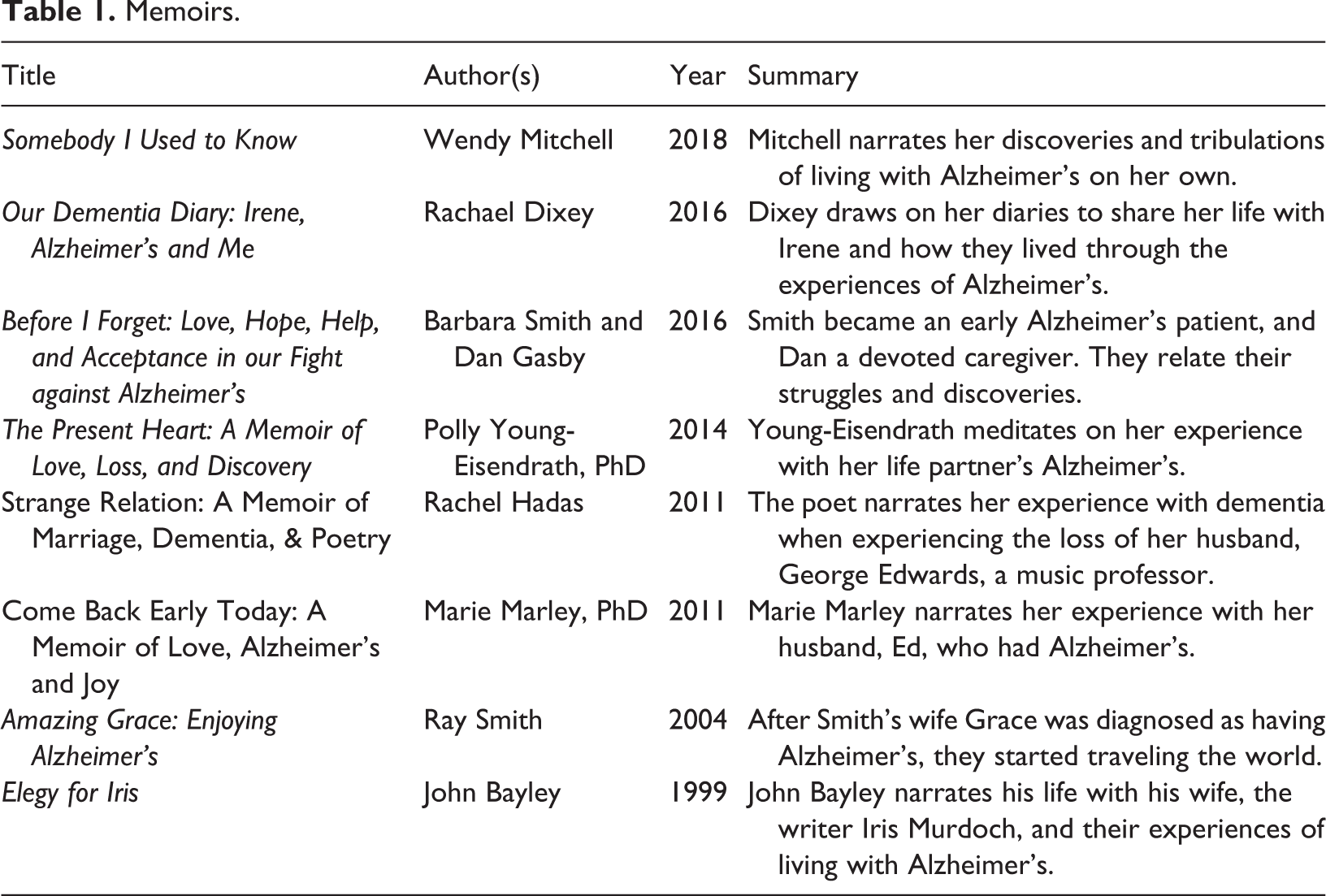
In reading the memoirs, selecting excerpts for analysis, and comparing the texts, the limitations of the identity project became clear. For instance, a dominant idea across memoirs was the authors’ narratives on how the illness was transforming them, the person diagnosed with Alzheimer’s, and the caregiver, into someone they did not want to be. To further analyze this idea that relativizes the omnipresent attention to a person’s self-will in choosing and making a desired identity, the researcher drew inspiration from her academic training in philosophy and her experience as a poet-researcher.
The potential of literary theory to improve consumer representation has been well-grounded since Stern’s groundbreaking work in 1998. Even so, turning to memoirs to gather insights is not a popular methodological choice in marketing (see e.g. Turley and O’Donohoe, 2012). Yet, as Turley and O’Donohoe (2012) show, memoirs do offer a variety of surprising perspectives which can enrich our interpretations by challenging conventional assumptions.
Memoirs of those affected by Alzheimer’s are valuable for this research as they deal with an unresolvable condition, and therefore their narrative development focuses on the process of living and becoming with the illness; people living with Alzheimer’s and their caregivers are not focused on a medical cure. In fact, the very act of narrating an illness “is less a work of reporting and more a process of discovery” (Frank, 2013: XVI). An incurable condition, such as Alzheimer’s, offers poignant insights into the process of living and becoming with the illness as the nature of its outcome is seen as being out of the narrator’s control.
Poetizing: Alzheimer’s life meanderings
The uncertainty is what fills my chest with panic. The not knowing how quickly time will become irrelevant. I thought I had life under control. Hadn’t I pictured retirement a long way from now, my car and me, driving to all the places in the British Isles too far to reach within a week’s annual leave? Hadn’t I just started earning enough to plan trips further afield, long weekends in Dublin, Paris? Wasn’t I going to see the world? What happened to all the time I thought I had? (Mitchell, 2018: 82)
Poetic sweats
The notion of “poetic sweats” is akin to the biological process of perspiration. Our bodies perspire, releasing sweat through the pores of the skin, to regulate their temperature. In extreme moments of stress or during very serious illnesses, such as blood cancer, sweating can be excessive. One could soak through nightclothes and bed linen. This situation is similar to what the consumers undergo in moments of intensive questioning and feeling, in which they do not have the answers, as the quote above illustrates. They are merely embodying life as it happens; they are undergoing poetic sweats. As in the sweating one experiences during illness, poetic sweats amplify the intensity of one’s condition, announce its severity, call for our attention, and push us into unexpected discoveries.
Poetic sweats are not concerned with carrying out projects or reaching life goals; they are concerned with the hard work of opening the senses and preparing us to follow a path that, even if already embarked on, remains to be unveiled. Wendy Mitchell reflects, for instance, on her sense of urgency to curate the family photographs to be prepared for the challenges of losing her memory, doing all she can to not forget her daughters: I feel an urgency, staring hard at the photograph, determined to outwit my fading brain, to memorize every pixel of it; a big blue Norfolk sky, the pink flip-flops in Sarah’s hands I hadn’t noticed before, Gemma’s navy-and-red-striped shorts, other holidaymakers on the beach. A photograph where once I only saw the girls I know is suddenly filled with tiny details. I will store it to memory. I won’t let it slip away. I turn the photograph over and write on the back: Sarah and Gemma. Norfolk holiday. Caister? 1987. I won’t forget…making the most of today’s active brain, reaching from one photograph to another, my arms aching, my mind tiring, but not daring to stop in case the momentum is lost. (Mitchell, 2018: 69–71)
Another example of poetic sweats is what Polly experiences—she finds refuge from her solitude by using Buddhist techniques of meditations: “Waking in the early morning, recording my dreams, meditating, and sitting in the dark (also swimming in the dark pond on hot summer nights) help me become my own brave companion” (Young-Eisendrath, 2014: 55). Engaging with their bodies, Wendy and Polly embrace their processes of becoming and their new activities to discover who they are about to become. Polly, for instance, discovers herself becoming her own bravest companion. Because their lives are possessed by the Alzheimer’s identity, their bodies are depleted of clear-cut memories, of energy, of companionship. Similarly, for the poet Rachel Hadas, her writing of poems is a way for her to feel how she is affected by life in moments of profound anxiety and doubt, a self-discovery rather than a self-expression: Since my father’s death when I was seventeen years old, poetry has steadily helped me not only to express what I was feeling at a given time, but also to figure out what I was thinking. In the case of a situation as elusive and amorphous, but also as powerful and all-pervasive, as George’s illness, poetry’s gift of trope often shed crucial light on the prevailing gloom. What did this situation feel like? What did it resemble? How could I better wrap my mind around it? Other questions arose too: how could I mourn, or rage, or explain? How could I speak to, and sometimes for, someone who no longer spoke to me?” (Hadas, 2001: x)
The memoirs alternate between moments of devastating hopelessness—when the effects of Alzheimer’s reveal loved ones as strangers, absent, or in danger—and moments of uplifting joy, when both the person affected with Alzheimer’s and their partner were entirely in the moment. Ray Smith (2004) narrates, for instance, his world tour with his wife, Grace, after her diagnosis. Ray is conscious that many of the magnificent places they have seen will be almost immediately forgotten by Grace. Yet, he sees his efforts as a way to be with Grace: “Even if Grace couldn’t remember anything, there was no reason why I shouldn’t make every moment of her life as interesting and comfortable as possible” (Smith, 2004: 121). Although their traveling together could be seen as a continuation of Ray’s identity project of being a devoted husband, the notion of poetic sweats opens our strategic interpretations to the possibility that these moments are also a discovered joy of how much life there is still to be lived: …we were both very happy in our outings. I would hold her hand all the way…and we would talk about the views we were looking at from the hills, or the animals we were passing, or I would recite poems I remembered, or sing songs. One day the only word she said was “pink.” I asked her what color she thought the trees were. “Pink.” The hedges? “Pink.” What color is the sky? “Pink”. (Smith, 2004: 118–119)
Poetic companions
Poetic companions are ordinary objects which accompany the actors in the memoirs in their life meanderings. As shown, Mitchell’s photographs help her to be more prepared for the unknown road ahead—they constitute clues for her memory. They are to become her poetic companions; they will help her to keep resonating with her infinite love as a single mother.
In the case of Alzheimer’s, photographic poetic companions provide support not just in recalling previous identity projects but in reviving life intensities. Dr Marley describes how Ed vibrated with the intensity of love when he saw their photographs, even though he seemed not to remember that the loving person in the pictures was his wife: The last one was a picture of him with a woman standing behind him. She had her hands on his shoulders and her head was peeking around his, facing the camera. “Ah…She loved me,” he murmured, an affectionate expression on his face. He kept looking at the photo. “What are you thinking?” I asked when he didn’t say anything anymore. “I am thinking of love,” he whispered. “That woman is me and I still love you.” He looked up and gazed into my eyes the way he did when we were lovers. I couldn’t tell if he was in the past or the present. I decided it didn’t matter. (Marley, 2011: 241) I started misplacing it, so now I have it down to a good science. I just carry it with me wherever I go, from room to room. My mother taught me that a lady always carries a handbag, and so I do. I still do. (Smith and Gasby, 2016: 69)
Besides preserving life resonance, Barbara’s handbag also materializes and makes visible, to her and her loved ones, how Alzheimer’s is possessing Barbara: Over the last months, the gold handbag has grown heavier, as more and more spare change accumulates in it. B. never used to keep spare change in her bag. She does now. I’d guess that bag has come to weigh five pounds, getting heavier all the time. Kind of a metaphor, right?…But she won’t let me empty it of all that spare change. It just clinks around with her, like a sack of gold, ready for purchases she no longer makes. (Smith and Gasby, 2016: 100)
Poetic companions are important material testimonies to consumers’ meanderings. A poetic companion can reveal and speak on behalf of consumers who lose their capacity to articulate what is happening to them. The light from poetic companions illuminates the process of becoming, more so than a specific outcome, goal, or choice can. Paying closer attention to the poetic companions in consumers’ lives allows researchers to visualize consumer meanderings in a way that merely focusing on the objects for their functional purpose does not. In Heidegger’s words, “things move us bodily, in the literal meaning of the word” (Heidegger, 2013, 25).
Poetic companions are not only old friends; they can also be new ones. An encounter with a simpler coffee machine, for instance, could bring back to an Alzheimer’s affected person and their family the joy of being able to prepare coffee again. Poetic companions enable us and affect our capacities to be. Dr Marley expresses how, for instance, she is tired of not being able to connect with her loved one. After some time spent losing faith, she suddenly decides to buy various stuffed animals to give Ed. She describes how, during one of her visits, she puts Adorable, a stuffed bunny, at the foot of Ed’s bed before using the bathroom on her way out. When she returns: […] the bunny was on Ed’s pillow. It was so touching. I’d expected him to be attached to Peter [the family’s “real” bunny], but who would have thought a 93-year-old demented man would relate to little stuffed animals on such an emotional level? I felt warm and connected to Ed all the rest of the day […] One morning I realized I was actually looking forward to visiting Ed. A profound change had taken place in me. I no longer felt bored, dejected, unloved and unloving during my visits. […] It was clear I’d had a dramatic change of heart. And what was more, I could pinpoint the day it started. It was the day when, on a whim, I took Ed the miniature chick he’d so proudly named The Little Yellow One. […] I realized that little by little and without noticing, I had accepted his illness and I had found new ways to relate to him, ways that were genuinely satisfying for both of us. (Marley, 2011: 190–195)
Poetic projection
Poetic projection is interpreted as a life invitation to surrender to an uncertain future. Through poetic projection, one perceives life as unfolding from a larger, situated, historical context, in which our identity emerges as a fragile understanding of our emerging-into-being self in our relations with ourselves, others, and the material world. In poetic projection, we sense and connect to others and the material world in a future that can be felt as both emanating from us and offered to us by the identities that possess us. As beings affected by present configurations of historical life forces, in wonder, we project our future.
The identity project and poetic projection are both future-looking tools, and yet they differ in how they represent this future orientation. The lens of the identity project can only see an individual persistently crafting their desired identity, whether successful or not. In contrast, poetic projection privileges a view of people as possessed by their identities—in this case, by Alzheimer’s—and as people who engage with poetic companions and relevant others—market or non-market actors—to project their lives into the future. This organic assemblage permits life disruption to be handled in a meditative way, as the actors and companions dwell on the mystery of their life meanderings. It is from this meditative and collective experience that we discover our possibilities (Heidegger, 2011).
Contrary to the identity project that originates from our will and our desires, poetic projection emerges from our humble vulnerability and life losses. Barbara, for instance, sometimes dresses inappropriately for the weather or social event, a sign for the former fashion icon that her capacity to nourish her dreams is visibly diminishing. Dan writes: …the closet stays as it is, and Barbara emerges from it, dressed at last. Sometimes she looks as put together as when I first met her, a quarter century ago: B. Smith, international fashion model and lifestyle guru, publishing and television star, a national brand…. Then there are mornings like this one, when B. comes out in a Christmas sweater, corduroys, and black boots. “You can’t wear that, sweetie,” I tell her gently. “Those clothes are for winter, and we’re here in June.” (Smith and Gasby, 2016: 6) In retrospect, I realize I might have tried making a series of nocturnal raids on the closet—not cleaning out large piles of old clothing at once, just a few old sweaters and shirts at a time. To avoid any risk of discovery, I might have stored them for a while to see if B. remembered them. If she didn’t, I could then donate them to charity. By gradually adding clothes of just one or two basic colors, I could simplify her wardrobe over time so that whatever outfit B. chose would be coordinated. (Smith and Gasby, 2016: 27)
As Dan and Barbara’s account shows, poetic projections are not free from intricate challenges and frustrations. Once she was diagnosed with Alzheimer’s, his constant efforts to support her “jumbled sense of time” and his advice felt overwhelming for Barbara: “As much as I love Dan, I need breaks from him too” (Smith and Gasby, 2016: 38). Across the memoirs are passages that recount similar feelings of being overwhelmed and of being dominated. In their effort to help, a partner engages in daily life decisions. Some moments in which the caregiver tries to organize daily routines can feel to the reader as going against the grain for the person with the condition. Bayley describes, for example, how daily routines are a way to bring Iris back to her senses. One routine is to watch Teletubbies on TV: Teletubbies. They are part of the morning ritual, as I try to make it, I have to insist a bit, as Alzheimer’s now seems to have grown inimical to routines. Perhaps we all know by instinct that an adopted routine preserves sanity. (Bayley, 1999: 226)
The perceived unfairness of some poetic projections is the result of many institutions being unprepared to accommodate the needs of those with early-onset Alzheimer’s. For instance, Wendy Mitchell explains how announcing her Alzheimer’s brought on a forced retirement. Although she could continue working at the National Health Service by making some reasonable adjustments, thus continuing to fulfil her life’s passion of helping others, the decision was imposed on her by others: The notes I’d made [with suggestions on how to adjust her work life] sit abandoned inside my folders. It is as if the decision had already been made for me before I even entered the room. I watch as she makes notes and fills in forms, her pen skipping along, ticking boxes. She doesn’t look up to include me. Perhaps she thinks she’s making it easier for me this way, making the decisions so I don’t have to. Others have also suggested I retire due to sickness, but I’ve shunned the idea. I’m not sick – I am well; I just need help and advice. But it’s sadness, not anger that wells inside me. (Mitchell, 2018: 93)
Poetic projection represents how the actors in the memoir enter a collective quest for self-discovery, actively working on letting the self they are about to become be revealed through their poetic sweats, with their poetic companions and relevant others. Rachael’s memoir shows how her poetic projections with her partner were both heartbreaking and enriching. “Maybe life is all about reconciling ourselves, gracefully, to what we cannot have” (Dixey, 2016: 156) or be: You were always faster than me on your bike, and you would wait at the top of the hill for me to catch up. We loved cycling on our identical bikes and even a few weeks before you left home for the last time we were cycling in Holland. Amazing how we managed to do so much right at the end, even though your disease was so advanced. You have taken me to places I never thought I’d go – the care homes, hospitals. I never thought our lives and our partnership would end up in the way it did. It has all added to the richness and all in the end is harvest, but I would have loved to have grown old with you, to see how your older years and a happy retirement might have panned out. I wonder what sort of person you would have become if you hadn’t been ill. I lost you in your fifties. We had such a hard decade as the dementia progressed and looking back, I don’t know how I managed. I did it for you, just as you would have done it for me. (Dixey, 2016: 191)
Poetizing to improve consumer representation
Full of merit, but poetically, man lives on this earth. Hölderlin (1996: 103)
Inspired by Heidegger’s work on poetizing, this article offers consumer researchers analytical tools to comprehend the less agentic and more mysterious way in which human beings dwell in the world when they are possessed by an identity instead of when they are the strategic makers of one. The theoretical lens of poetizing compensates for our tendency to structure consumers’ lived experiences as projects, giving “more voice to consumers’ experiences of becoming” (Türe and Ger, 2016: 21–22). By fostering a less agentic view on identity-in-the-making, poetizing reinforces our critical mindset to further understand the collective aspect of identity in creation and its inherent vulnerabilities.
Poetic sweats, the first component of poetizing, represents our efforts to understand the profoundness of our life configurations, losses, and uncertainties during moments of change. Sweating is a meditative reaction that helps us live with the questions that life has thrown at us. Adopting the poetic sweats lens is a suitable strategy to account for unexpected losses, accidentality, and life meanderings where one is deeply transformed, and the destination remains unknown. One productive framework for understanding consumers’ transformations has been the anthropological notion of liminality (Cody and Lawlor, 2011). This theoretical lens deals with consumers living “betwixt and between” two social categories. However, liminal interpretations are oriented toward an end destination—for instance, the achieving of adulthood. Instead, poetic sweats recognize that the very meaning of becoming involves the lived experience of the unknown. In this sense, poetic sweats amplify our capacities to represent life mysteries and unexpected joys within the moment’s ordinariness.
Poetic companions, the second component in poetizing, are material artefacts that play the role of companionship in our life meanderings. When we find it impossible to articulate what is happening to us, these companions can reflect our inner situation and offer clues about our experiences of becoming. A handbag, some stuffed animals, or the closet are ongoing experiments with a changing self. While consumer researchers recognize how our willingness to execute changes in our life materializes in our engagement with, usage of, or even disposal of symbolic and identity-related objects or services (Ahuvia, 2005; Epp and Price, 2010; O’Donohoe, 2016; Schau et al., 2009), poetic companions materialize what is happening to us and to our behavior in circumstances when we are, instead, possessed by our identities.
This study’s emphasis on the materiality of the poetic companion responds to calls in the field to turn our attention to material agencies as a compensating mechanism for “a focus on the human subject’s agency, intention, will, and desire” that support our assumption that “human beings could control the world and all its systems” (Borgerson, 2014: 141). While it is common to interview consumers living through different moments, it is less common to track their poetic companions through time. And yet, they may possess important clues to help us understand not only what consumers make of them or with them but also what consumers may be experiencing in terms of lack of agency or power.
Poetic projection, the third component in poetizing, presents identity-in-the-making as a process of self-discovery in which the self emerges from collective work: the essence of poetic projection is interaction with oneself, others, and the poetic companions of our material world. Sometimes, the agency we have is limited, as this article shows. In some episodes in the memoirs, the person with Alzheimer’s exhibits a high dependence on life partners or caring institutions. Adopting the analytical lens of poetic projection allows us to imagine these moments of humble vulnerability. We can then reinforce our efforts to better understand consumers in their voiced and unvoiced experiences during these humble moments to help us think about the designing of care, for instance.
By emphasizing the emergent creative forces present in humble vulnerability, poetizing proposes a research agenda that focuses not only on normalization (e.g. market inclusion) but also on creative enabling of consumers’ capacities to interact and contribute (market transformation). One example of this kind of creative transformation is the idea of humanizing care for Alzheimer’s through the construction of social communities. The project known as Dementia Village (Haeusermann, 2017) is currently implemented in several countries in Europe.
Memoirs are highly valuable in our understanding of poetizing in consumer research. The act of writing gives authors the freedom not to follow any scripts of the identity project nor to focus only on their roles as consumers. Through the intimacy of their lived experience, they describe and illustrate their tribulations without the need to incorporate a telos. Memoirs, as this work and previous studies (O’Donohoe, 2016; Turley and O’Donohoe, 2012) have shown, offer consumer researchers provoking data to challenge their well-rounded theoretical tools by allowing them to vicariously experience the drama, the sadness, and the joy of the moment.
Reading life stories as poetic projections offers us a holistic interpretation of identity-in-creation. One could imagine, for instance, studies examining different memoirs dealing with a concrete lived experience and spanning the last 100 years. This strategy could allow us to see how lived experiences with an illness have evolved with discoveries in the medical field, with new technologies emerging, or with communities of patients coming together. Adopting the role of a life-reader rather than an interviewer can support researchers in representing the consumption experience as part of a larger life experience that is connected to contextual changes. At the same time, adopting the memoir as a database could give access to narratives from less represented consumers, such as those living in non-Western contexts.
Although Alzheimer’s is an extreme case of identity possession, life accidents and losses are more present in daily life than we think. Many ordinary losses are not properly recognized as losses (Keirse, 2000; Marin, 2019) even though they have similar effects, albeit on a minor scale. Every day people drive for the last time, fail at school, do not get to see a close friend anymore or are separated from family relatives. Life losses more often than not come unexpectedly, and even when we know we are about to lose something or someone we cherish and love, we never know the specific shape of our losses. In a similar vein, we do not know what our lives will become when we are possessed by unchosen identity configurations, such as the color of our skin or a specific body configuration. In our lived experiences, more agentic perspectives in identity construction, the identity project, coexist with less agentic ones, being possessed by accidents and unchosen identity configurations. One does not spend all their time self-reflecting on the certitude of who one is, assertively claiming an identity but rather, many times, life destabilizes us, opening unexpected paths, crafting and shaping who we are. We are, for instance, suddenly affected by the identitarian forces of an illness that imposes upon us its own rules, which forces us to be someone we dislike, which works on us, which makes us tremble and sweat. Poetizing can help us better account for all these life meanderings and existential questions and doubts that operate within the multiple projects we drive to better recognize and represent the accidental aspects of identity in construction.
Footnotes
Acknowledgments
I thank the editor and the review team for their insightful guidance and my colleagues at Birmingham Business School for their continued support. Thank you to the authors in the memoirs who bravely and beautifully shared their insightful experiences of living with dementia. Special thanks to Flavia Cardoso and Tanvi Mehta for their encouragement and support. Thank you to my research assistants at Pontificia Universidad Católica de Chile, Katiza Mitrovic and Alejandro Bohn, for our insightful conversations on romantic medicine.
Declaration of conflicting interests
The author(s) declared no potential conflicts of interest with respect to the research, authorship, and/or publication of this article.
Funding
The author(s) disclosed receipt of the following financial support forthe research, authorship, and/or publication of this article: This project has received financial support from CONICYT - FONDECYT Iniciación en Investigación 2017- Project N° 11170785.
