




Abstract
A vignette can be considered a snapshot of a situation, or a moment in time that in its framing and composition might offer insights into more complex relations. In many ways, a vignette is a construction, a way of giving prominence to that which is precious or of significance. In this article, the authors consider the vignette as a form of ethical mediation and an intervention into conversations that are never fully whole. Their reflections have emerged in the context of the exhibition, Undocumented? – Paidal which gathered together narratives on displacement. The authors ask: What kind of memory work and documentation do vignettes perform within traumatic contexts such as those of undocumented migration? And how does this differ from witnessing as a form of evidentiary knowing and documenting of difficult events? These questions have ethical implications for how we might address forms of violence within academic and cultural work.
A plywood panel hangs from the ceiling; the text on its surface references dislocation. It asks the reader to question acts of translation in spaces where the harsh language and politics of contemporary migration demand consideration. The words are etched. In the paragraphs, several places are referenced, places with a history of conflict and colonialism – Yarmouk, Odessa, Jalalabad, Bajaur, Punjab – places that must also be connected by stories other than those of oppression. A gap in the panel confronts the reader, drawing them closer, disrupting the flow of the sentence, forcing them to peer down. Except the gap holds nothing; it is just a 4 x 1 cm rectangle cut out of the plywood that symbolizes censorship.
As we witness the current  of the Palestinian people, we might experience the reflection of stories elsewhere as ghostly familiar.
We open this article with a 50 x 50 cm piece of wood, suspended 1.5 metres off the ground, hung at a 35-degree angle, etched with the artist statement from the exhibition Undocumented? – Paidal, which featured the work of one of us and was curated by the other. 1 This exhibition was scheduled to open to the public in the UCL Urban Room on 16 October, just a week after the 7 October 2023 Hamas attacks and the beginning of Israel’s most recent assault on Gaza. As the curatorial and artistic research team, we decided to postpone the opening to allow us time to reflect on the content of the exhibition, in light of the escalating violence. Postponing a public event usually requires an explanation, and so we drafted two statements, one by the artist (quoted from above) reflecting on how the content of the exhibition related to the context of violence, and another by the curator. Boths texts reflected on how the context of war was affecting those of us working on the exhibition. We found out quite quickly that university management at all levels was not prepared to let us express our perspectives. It was made clear that the public exhibition should not express views perceived to be contradictory to the official message of the institution. It seems that, alongside many other universities and cultural institutions, UCL was also taking a stance of studied neutrality. We eventually did manage to publish a version of the curator’s statement on the platform we had used to send out invites to the opening. While the artist statement was displayed in the exhibition with the word ‘genocide’ being removed from the text two weeks after the opening of the show. Keeping the artwork and its creators at a mediated distance meant the institution could not be implicated in their perspectives and ethical positions. A negotiated politics of narrative and agency was at the core of both the exhibition and the decision to postpone its opening. These gestures of solidarity and care are central to our work, thus we did not foresee how controversial they would become. Institutional silencing around Israel’s genocide against the people of Palestine is now a matter of public record with many examples that are more serious in nature than our own experience.
This article is therefore not an exposition of this silencing per se, but an attempt to think through the ethical implications of what it means to refuse to witness, as was the case with the university’s attempt to censor the use of the word ‘genocide’. It is also an engagement with the power of the absent witness (Agamben, 2000), symbolized by the gap in the text and all that it represents in relation to institutional and wider silences on the issue of Palestine. This is especially important within the context of an exhibition that centred lives caught within the violence of contemporary borders where the exhibition itself was an attempt at presenting and producing forms of ethical witnessing. Through relating stories of migration, we wanted to practise a form of witnessing that did not rely on purely evidentiary modes in the form of numbers, statistics and testimonials of suffering. Instead, we wanted to create a space for an affective and relational witnessing that made space for ‘listening for what we don’t know’, as Kelly Oliver (2000) writes. The interstitial space produced through listening deeply and tending to the gaps gives a more relational reading of experience, one that does not centre traumatic events. Oliver is concerned with how trauma affects the subjectivity of those who are subject to oppression, writing that: ‘While trauma undermines subjectivity and witnessing restores it, the process of witnessing is not reduced to the testimony of trauma’ (pp. 7–8). We want to continue questioning the need to always view images of atrocity and suffering (Pearl, 2013). Our ethics of representation was and still is a tone of refusal: refusal to reproduce suffering, to objectify or make a spectacle of bodies in pain for the sake of witnessing.
Vignette as ethical mediation
In this article, we reflect on our curatorial approach that mobilized the vignette to create a space of circulation within the exhibition. Following the circulatory movements of undocumented migration and displacement, for us the vignette was an important conceptual device to address the ethnographic research that underpinned the exhibition. A vignette is defined as ‘a short piece of writing, music, acting, etc. that clearly expresses the typical characteristics of something or someone’ (Cambridge English Dictionary, 2025). It can be considered a snapshot of a situation, or a moment in time that in its framing and composition might offer insights into more complex relations. In many ways, a vignette is a construction, giving prominence to that which is precious or of significance. In the exhibition, the vignettes surfaced as short films collaged together with extracts from much longer interviews with refugees, carried out by an architect-researcher, Nishat Awan, in collaboration with artist, Cressida Kocienski. 2 The vignette also functioned as a design and curatorial device that prompted an engagement with the differing experiences of migration recounted in the films. It allowed us to create, with the curator Kara Blackmore, a situated yet interlinked series of moments that could propel a dialogue across the gallery space.
Vignettes may appear self-contained, yet when displayed in a collective format, they force an exchange between politics and ethics, creating a circulation of moral agreements between the artist, the curator, the people featured in the artwork and the audience. Underpinning the research and aesthetic decisions was a consideration of how to ethically account for ordinary lives caught within the violence of borders. In relation to such ethics, a standard mantra of migration research is to not assume a lack of agency on the part of refugees and migrants through framing them solely as vulnerable or needy subjects, despite the securitization of borders and the nature of their displacement. Instead, it is important to be aware that people make many small but highly consequential decisions within a context of extremely hard and narrow choices. Yet, this stands in contrast to the common division within migration studies between the binaries of forced and voluntary migration (Mainwaring, 2016). A sharp reader will notice that the terms ‘migrant’ and ‘refugee’ are being used interchangeably in this article, which stems from the unease around making distinctions between the ‘deserving’ and the ‘non-deserving’ seeker of asylum. It is also part of the slippage of language and translation that emerges from the people featured in the exhibition films. We will return to this in our section on language and affective listening as this article progresses.
Whatever form agency might take in situations of displacement, it will most likely be disparate and not necessarily articulated in an oppositional mode. Slogans such as ‘existence is resistance’, a cornerstone of Palestinian struggle, can give a sense of what everyday resistance within contexts of routine violence and oppression might look like. How can we articulate forms of resistance when they are not connected to a land that one claims as their own, as is the case with the migrant or refugee subject? In fact, the complete opposite is often the case for undocumented migrants where the continuation of a journey by making deals and brokering transit is often one of the most important ongoing acts of agency. Such agency is dependent on a familiarization with context and the ability to make social networks. Much like the journey, the vignette is also not without context; rather it is encased, connected to material and social structures. In its original definition, a vignetted shadow around a portrait breaks the linear edge, reflecting presence and purpose from the figure in the image. In the context of migration and displacement, precious photos brought along on the journey often signal a metaphorical rupture with the need for standardized time and a biography that demarcate life based on linear trajectories and fixed places. While mobile phone cameras have made photographs ubiquitous, many refugees lose their phones on the journey or they choose to own a cheap phone without a camera; some simply cannot afford such expensive luxuries. In these cases, photographs become rare and precious once more, often the same photo simultaneously acts as both a reminder of a past life and a talisman, longing for a future.
The passport photo and document ID, in contrast, are not vignettes. The format and contexts do not frame the image in a tender or embodied way. Rather, there is a harshness to how the image is captured, the ways in which the print is handled, laminated into a file, useful only for those able to achieve official documents. ID portraits are excluded from this discussion of vignettes because they signify a structural unwillingness to yield to a migrating person’s agency. Our concern is with the poetics of image making and how it can serve as a platform for aliveness, resisting the violence of evidentiary exclusion. The goal is not to objectify someone’s likeness through the image, it is to find a central point for narrative to be located.
Despite its usefulness for approaching difficult histories and complex narrative realities, the vignette is not widely used as a methodological vantage point. It has been suggested that the vignette is a largely unacknowledged method in Anthropology that has itself been borrowed from graphic design where it refers to the custom frame surrounding an image, usually as part of a decorative edge, or in photography through the darkening of the edges to focus on an image (Demetriou, 2023). Writing specifically from the field of migration studies, Demetriou’s discussion is an appeal to the anthropological discipline to reconsider the vignette as an important method within ethnographic practice and, in so doing, to open up the possibility that those not formally trained within Anthropology may also be conducting valuable and ethical ethnographic research through their use of vignettes. As Demetriou points out, this is particularly important in fields such as migration or refugee studies where an interdisciplinary approach is crucial to understanding the complexity of how legal, social, cultural and other types of relations produce the situations in which refugees find themselves.
Within the exhibition, journeys appear, revealing the ways in which people get caught within labyrinthine bureaucracies or lack the funds to go further, charting a never-ending continuum. They may meet others in a similar situation, or be in contact with the many NGOs and activists who assist people in need, but often these are fragile connections that can break easily. Where such relations persist, it is usually through coming into contact with the collective activist or NGO spaces that provide longer-term assistance to refugees. These spaces are often also the main conduit through which researchers are able to meet their interlocutors. For reasons of emerging solidarity across those with and without citizenship, such spaces provide some hope within Euro-American activist migration discourse that is shaped in response to increasingly hostile migration policies (García Agustín and Jørgensen, 2021; Picozza, 2021; Tazzioli and De Genova, 2023). Yet, if the vast majority of people on the move do not encounter any such space, then how do they find sources of creativity, hope and endurance within contexts of epistemic and instrumental violence? The exhibition explored these questions, considering how faith and friendship were a form of solidarity as well as a modality for reciprocal witnessing; some spoke about wanting to see each other reach Europe, others about how Allah was a witness to their suffering. Through being hosted within the UCL Urban Room – a public and pedagogical space – the exhibition introduced the audience as an additional witness in relation. The exhibition contended with the violence of dislocation, and the waxing and waning of friendship and faith, attempting to create moments of connection in which the visitor would become implicated in the work.
While each vignette created its own space, together they participated in what Sara Ahmed (2004) calls ‘affective economies’. Reflecting on the emotional responses to fear mobilized in the aftermath of the terrorist attacks in the USA on 11 September 2001, Ahmed writes that ‘fear does not involve the defence of borders that already exist; rather, fear makes those borders’ (p. 128). To work against such bordering, our curatorial approach insisted on addressing the movements of people in circulation as producing relation (Glissant, 1997). The militarization of borders combined with a global economy that relies on the cheap labour of those who can easily be exploited means that migrants are kept in circulation. As Shahram Khosravi (2018) writes, such circulation is ‘a controlled movement of people sent back and forth between undocumentedness and deportability: between countries, between laws, between institutions’. This circulation of people across borders often comes into violent contact with the circulation of affect around the question of the migrant subject. Fear has become part of a circulating global economy that vilifies the other through making equivalences between the migrant subject and criminality. This economy of fear, far from being an individual emotion, is a collective endeavour. As Ahmed notes: ‘It is the very failure of affect to be located in a subject or object that allows it to generate the surfaces of collective bodies’ (p. 128, original emphasis). By placing intimate migration vignettes next to each other, we invited dialogue through proximity that may have the capacity to generate other forms of affect. The overlapping of sound, the movement of visitors across the gallery space and their responses to the artworks produced an affective terrain that resonated through the exhibition. In many ways, the empty space in the artist statement amplified this terrain. The word ‘genocide’ has the capacity to make the studied neutrality of the institution untenable, and through its own erasure it became more powerful, acting as an absent witness to institutional silencing and censorship.
As researchers, artists, educators and curators living in 2025, we sense an urgency to witness. Yet the imperative to not witness seems to be around us all. Our duty to care is one that tends to the structural, institutional and representational violence that inevitably also creates wounds (Blackmore and Okwenje, 2021). Our approach to ethical witnessing chooses not to reproduce this violence or to create conditions for objectifying any migrant subject. Poetics and aliveness become central components of ethically presenting a vignette. Poetics offers a place for life to be articulated more fully, even if it has been shaped by the violence of borders and by a compromised state of listening. If held in a meaningful way, it could be what Helene Kazan (2024) calls ‘poetic testimony’. Such testimony works against evidentiary forms of exclusion, inviting a different linguistic register for knowledge to be expressed. In writing about aliveness, Kevin Quashie (2021: 109) explains that there is a certain ethics in this whereby: ‘One does not have to display one’s reckoning to another so as to have it be verified or confirmed.’ Aliveness comes also from the gesture made towards the storytellers to curate their vignette with a refusal to reproduce suffering, opting for an aesthetics of relational being that recognizes agency. Poetic testimony and aliveness thus provide an ethical orientation for the research within the exhibition format.
Affective listening
The exhibition was the result of a long-term engagement with experiences of undocumented migration from the vantage point of those who inhabit the edges. The edge could here be understood as the geopolitical border itself, a place where many get stuck or try to make increasingly desperate attempts to cross to the other side. Or it may be a place far from the physical border where border relations emerge, such as a grey market on the edges of a city that itself is at the edge of Europe. In Undocumented? – Paidal, Europe often functioned as the haunted centre, a place that stands in for an idea of a life yet to be attained, or for continually thwarted dreams (Berlant, 2011). These ‘edge spaces’ (Hall, 2021) can be found in a café or a square, a hub for people in similar situations, all waiting and hoping to be somewhere else, sharing a sense of suspension. They could also be the so-called reception centres, one of a myriad of institutional spaces that, for some, have to stand in for home. Researching such edge spaces means going on many journeys, often to border areas far from northern centres, but our own movement across borders is privileged and easy thanks to powerful passports. Each conversation featured in the exhibition was marked by this discrepancy. Yet, the distance that some things make is bridged by others as we often gravitate towards those with whom we share a language. Creating narrative spaces for affective listening positions the storytellers and researchers in a moment of circulation, held together by a linguistic affinity felt through each of the vignettes.
The screens were deliberately placed on the floor, with cushions scattered around to sit, watch and listen. The monitors were clustered and there were no headphones so that the sounds mingled across each other; a polyphony of voices that sometimes gave the impression of whispers, gossip, hearsay. This invitation to listen to the voices of people recounting their experiences of long journeys across hostile borders stands in opposition to the type of listening that occurs within legal spaces where refugees are asked to give an account of their reasons for leaving. The relationship between speaking and listening during an asylum interview speaks to unequal power relations, an economy of fear and an inclination to disbelieve. As Kanngieser et al. (2023: 152) write: ‘Listening tends to be conditional. Listening (like care) can be deployed in ways that un-human even when it claims to do otherwise.’ The asylum interview is the paradigmatic example of a listening practice that dehumanizes, and yet it is also the central tenet of the asylum process within many northern countries. In such interviews, the relationship between translation and interpretation across languages and cultures remains largely unexamined despite being a source of multiple misunderstandings and causing extreme distress to those seeking asylum. In their proposition of the ‘Listening State’, Craig and Gramling (2017) cite the 1951 Refugee Convention to highlight the responsibility states have to pay attention to ‘the (un)translatable’ within asylum claims. They write that the untranslatable is not necessarily something that cannot be translated but is that which through its ungraspable nature across languages requires constant translation and reformulation (Walkowitz, 2019). Listening across languages, then, must necessarily be a repeated and open-ended endeavour.
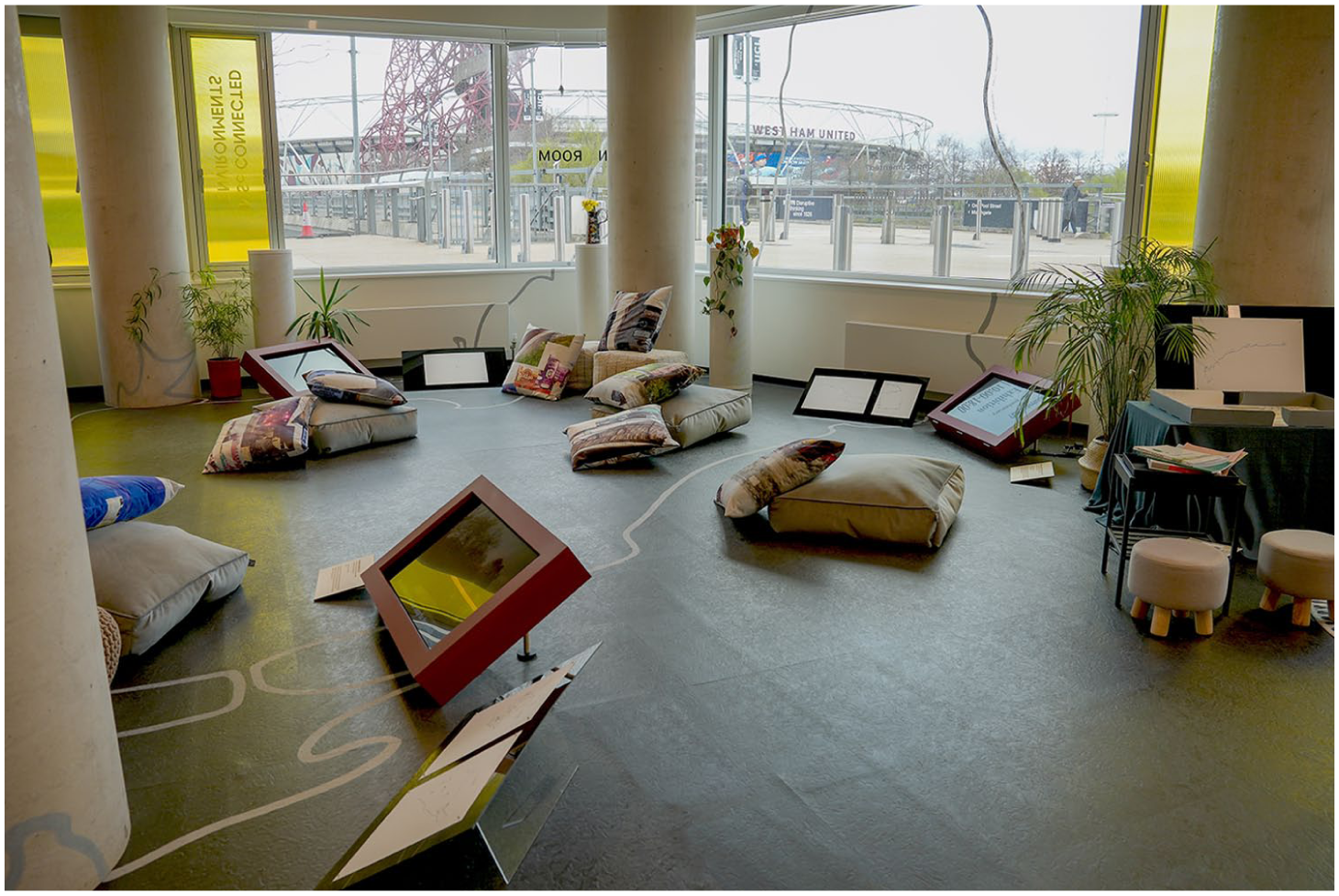
Undocumented? - Paidal, UCL Urban Room (2024).
Some of the films shown in the exhibition were in English, while others were in Urdu or Punjabi with English subtitles. As the voices carried across the exhibition space, they drew in visitors who may not have usually entered the gallery of an overwhelmingly White institution that folds within it the class-based privileges and hierarchies of UK higher education. It is no surprise that outsourced UCL employees working on reception, security, or as cleaning staff were the ones being drawn in. UCL has a responsibility to employ a percentage of its staff in retail and facilities from local residents, as part of its planning obligations within the Olympic Park Redevelopment, where the gallery is situated (Planning Obligation by Agreement, 2018). The planning agreement did not stipulate how such people should be employed, creating a chance to not extend the rights of academics and professional services staff to those subcontracted to the university. The racialized politics of this move are clear for anyone to see should they visit the UCL East campus in Stratford. The four designated Olympic Boroughs of Newham, Hackney, Tower Hamlets and Waltham Forest, whose residents count as ‘local’ within the planning agreement, all have a diverse population with large communities of South Asian heritage. 3 Working across languages drew in this wider audience, transforming the gallery into a space where the harsh politics of contemporary migration could be rethought.
While the exhibition was titled Undocumented? in English, its Urdu title was Paidal, which literally translates as ‘on foot’, but can be transliterated to refer to the experience of undocumented migration. Similarly Pahaar, the title of one of the films, literally denotes a mountain but can also refer to a problem that is insurmountable. In these acts of translation, there is a distinctive difference between our settled worlds that tend towards fixedness and the lives in flux of those who continually negotiate across borders. One person who had recently arrived in London from Pakistan, and had stumbled across the exhibition, commented in Urdu, ‘I saw the title and thought these must be my people.’ This anecdote points to our desire to not make the work legible to a default positionality; instead we wanted to engage in what Busi Dhalmini (2018) has described as ‘equitable discomfort’. For us, such discomfort was found in acts of translation, both in text and in experience, that arise when all the information is not transparent and easily available. The vignette keeps certain relations and ways of communicating encoded and intimate to different positions of knowing. The question of documents and their relation to whether a person is invited in is left for an anglophone audience to consider, while the movement Paidal is referring to keeps connection to the Urdu speaker. The English title also points to the important role that documents play in journeys of difficult migration where they can take on mythical status (Awan and Musmar, 2020). A lack of documents such as passports, visas, ID cards, proof of address, etc. is often compensated for by stories, advice and anecdotes from those who have gone before, on foot. They are crucial to navigating across what are hostile grounds and unknown lands.
To listen, and perhaps read the translations, the audience member was required to implicate their body in the vignette. Screens mounted on the floor required one to kneel, sit or crouch down to watch the films. To choose not to come close to the storyteller was also an embodied action to tower over them, reproducing distance through the act of looking down without listening deeply. To truly engage in a work, an audience member could not pass by with an abject form of witnessing, glossing at a glance, consuming the vignette for the 32 seconds an average UK museum visitor spends on an artwork. If an ear tuned to English voices would spend more than 10 mins in the exhibition space, they would hear an impassioned voice raise: ‘I’m so sorry about your country.’ The sincerity with which this phrase was exclaimed circulated as a reminder of the hostile environment surrounding the vignette of her voice, seemingly booming from a distorted floor map, positioned somewhere near Istanbul. Within the gallery space, affective exchange occurred through the circulation of sound and a refusal to decode through voiceover or excessive interpretation.
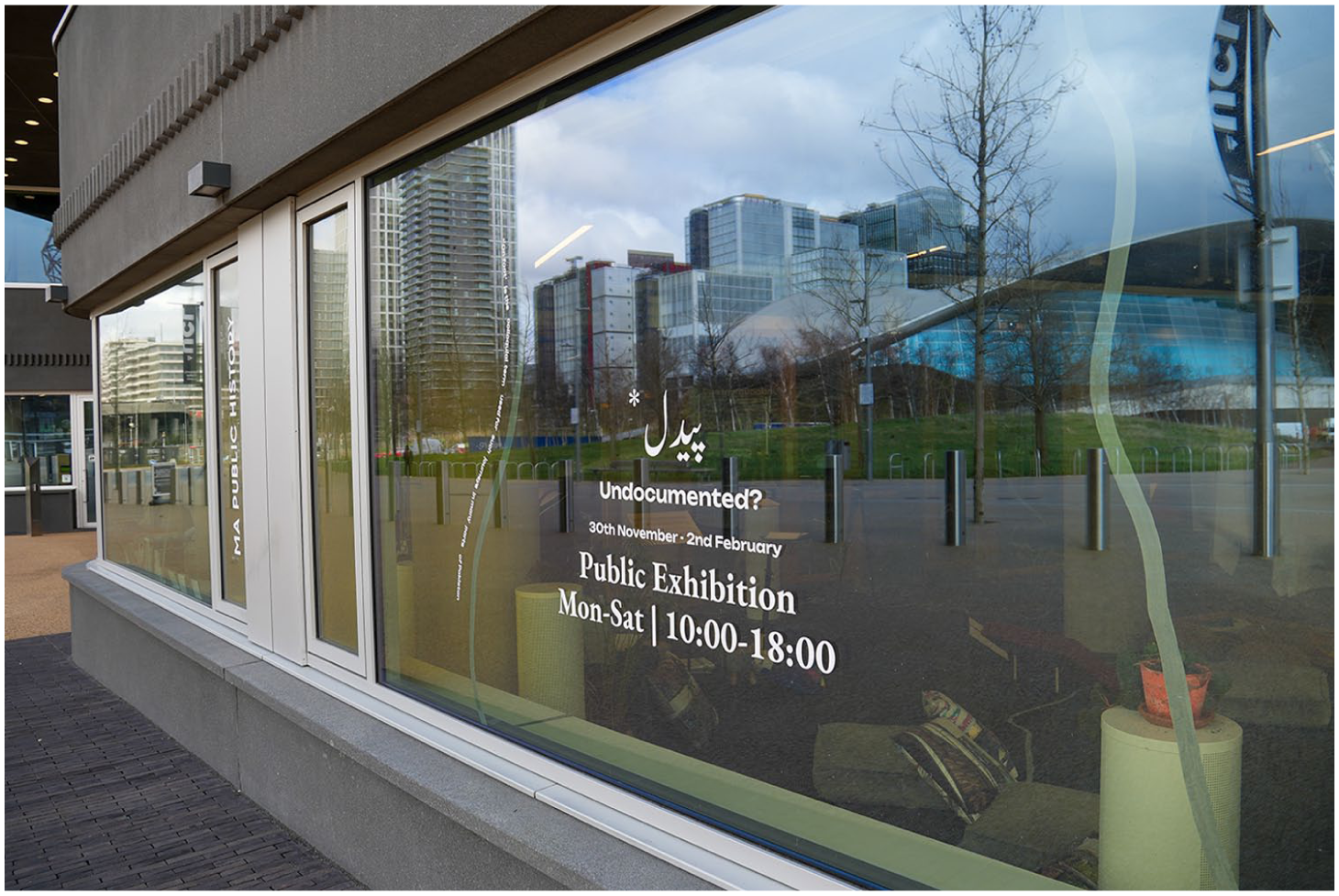
Undocumented? - Paidal, UCL Urban Room (2024).
While some audiences will be drawn by voices speaking to them in their language, others might be drawn to moments in the films that reference particular places, such as a close-up of someone drawing a map of their route, while the feet of two other young men can be seen in the frame as they gather close to tell their stories. They are wearing shoes that have walked far, the thin soles telling their own story. But it is the voices of the men that resonate as one interjects again and again into the narrative in a mixture of Punjabi and Urdu.
‘She asked you to make a sketch and you made a whole cartography!’ ‘Why go back, don’t you want to see Europe?’
Listening carefully to these interjections brings into view the researcher hidden behind the camera who has asked the men to draw maps. For those who can understand these languages, the translation of naqsha to cartography may give pause to reflect. While the affective listener may begin to consider when and how the demarcation lines between the figure of the migrant, the refugee and the traveller begin to blur as the young men dream of seeing Europe.
Designing the vignette
Five vignettes came together as perspectives on value systems as much as places or people. While vignettes can be understood as a curated collection of present predicaments, the stories face many pasts and multiple futures. They were organized in the exhibition space along a series of lines hand-painted on the floor. The lines traced a geography of edges; those from Turkey may have recognized the familiar contours of the Bosphorus, others might have spotted the island of Cyprus hidden in one corner, others still may have recognized the Aegean Islands clustering in the Mediterranean Sea. While parts of the map may have been recognizable, it was distorted, climbing up white plastered walls, concrete columns, glass windows, continuously circulating and disrupting the flatness of located readings. The map feature forced the eye to go on a journey and to be in relation to the vignettes presented.
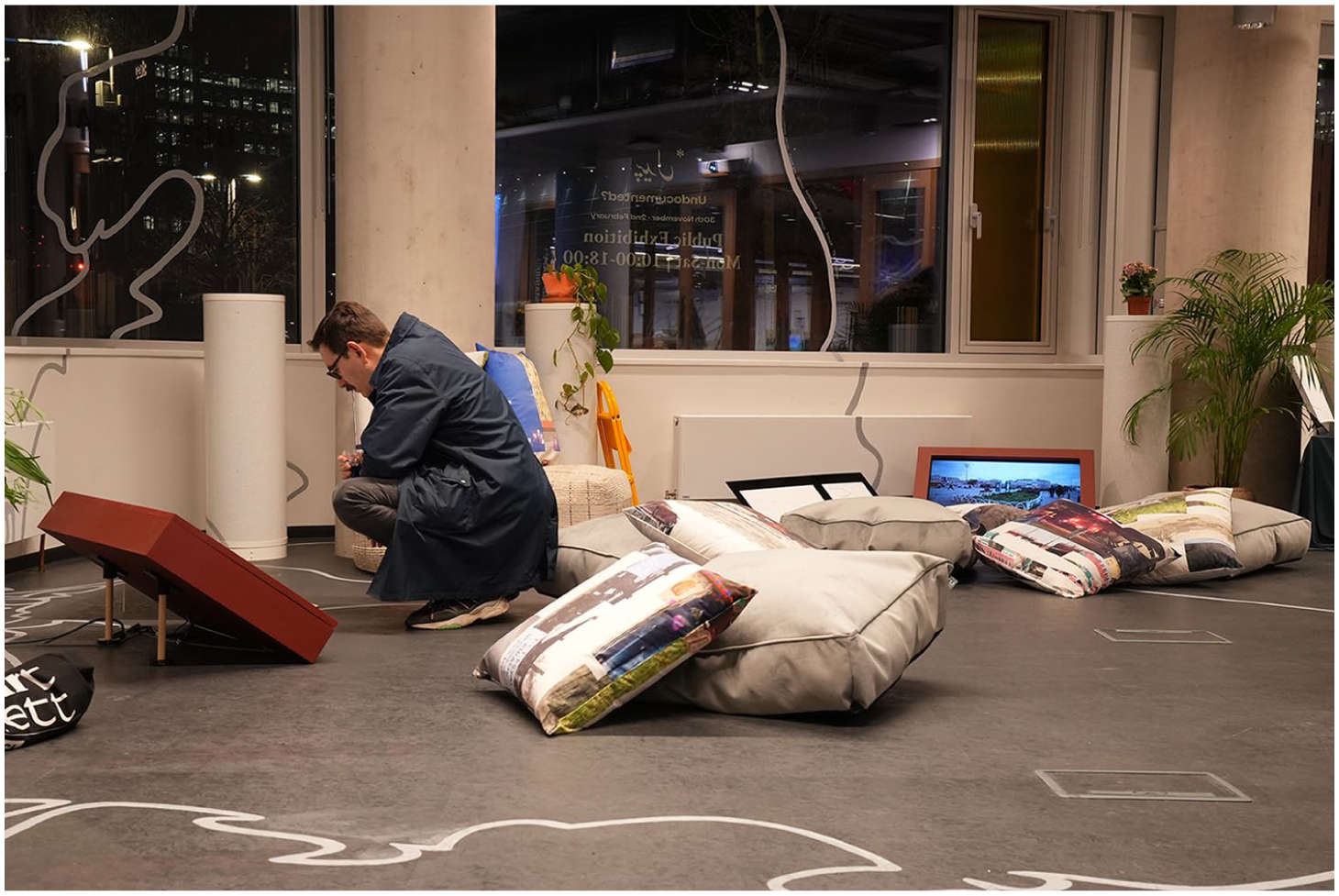
Undocumented? - Paidal, UCL Urban Room (2024).
Following lines along the edges of Europe, sometimes landing in cities like Istanbul or Odessa, gave a spatial reference but did not fixate on geographies. The distorted map gave value to place not as the setting of the story but as a grammar used to narrate migration biographies. This approach was a way of acknowledging that time and bodies are the most costly in journeys of undocumented migration, they are the real currency of unsettled lives. For this reason, we posit that the vignette is not just a way of seeing from a distance but is relational where one is required to traverse time, space and thought. One of the most emblematic examples of a vignette is the locket: a piece of jewellery worn around the neck framing photographs of loved ones inside. The locket holds precious people, a reminder of cherished memories encased away from prying eyes. It is significant as a way of bringing families along with their loved ones on journeys. Like the locket, our vignettes allow a way of seeing the image inside, within the context of its frame. It is a glimpse into the relationship between the image and the wearer, yet not the full face or body of the person who carries it.
In her book, Ordinary Notes, Christina Sharpe (2023) collates a series of ‘preliminary entries toward a dictionary of untranslatable blackness’, in which Tina Campt defines the Black Gaze as: ‘A set of viewing relations that refuses to reduce individuals to the status of objects to be consumed. A practice of looking that bears witness to the simultaneous precarity and possibility of Black life’ (p. 259). Learning from this position on viewing, we attempted to follow the relational ethics of the gaze, creating each vignette as a moment and a place. Each screen showed two films on a loop and was accompanied by hand-drawn maps made by the people featured in the films. Sitting on the floor on velvet cushions printed with images from research trips, an intimate space was created. Both the extracted images and maps had an incomplete aesthetic that insisted on the vignette as partial biography. Unlike the objectivity of the colonial map or surveyors’ plans, working deliberately across the legible and the illegible was a form of ethical mediation, the gaps serving as an invitation to make relations to other stories.
The deception of arrival in Europe Conversations of life between Syria and Istanbul
Refuge-e?
Documents are not the problem
These hand drawn maps describe what it takes to cross borders without a (powerful) passport but they also describe life stories. Sometimes they are linear, hiding difficult journeys behind fluid strokes of line. At other times they are drawn to the rhythm of the body, where time is punctuated by the birth of a child or counted from the moment of falling ill or recovering. Is freedom available for us? Conversations of life between Pakistan and Odessa
Not a war . . . it was a revolution
Exile
These maps show how the journeys of unsettlement are never simple or linear but consist of stops and starts and often impenetrable walls. The places depicted are drawn in response to questions asking where you were, where you want to be, and how you got here. Where we end up when the money runs out Conversations of life between Pakistan and Istanbul Don’t you want to see Europe?
I had those seven goats
These maps share a common impulse of relating how the act of moving gives hope while being stalled becomes its opposite. In some ways they document our collective failure to care for complex lives that are not so easily compartmentalised into those deserving of refuge and those not.
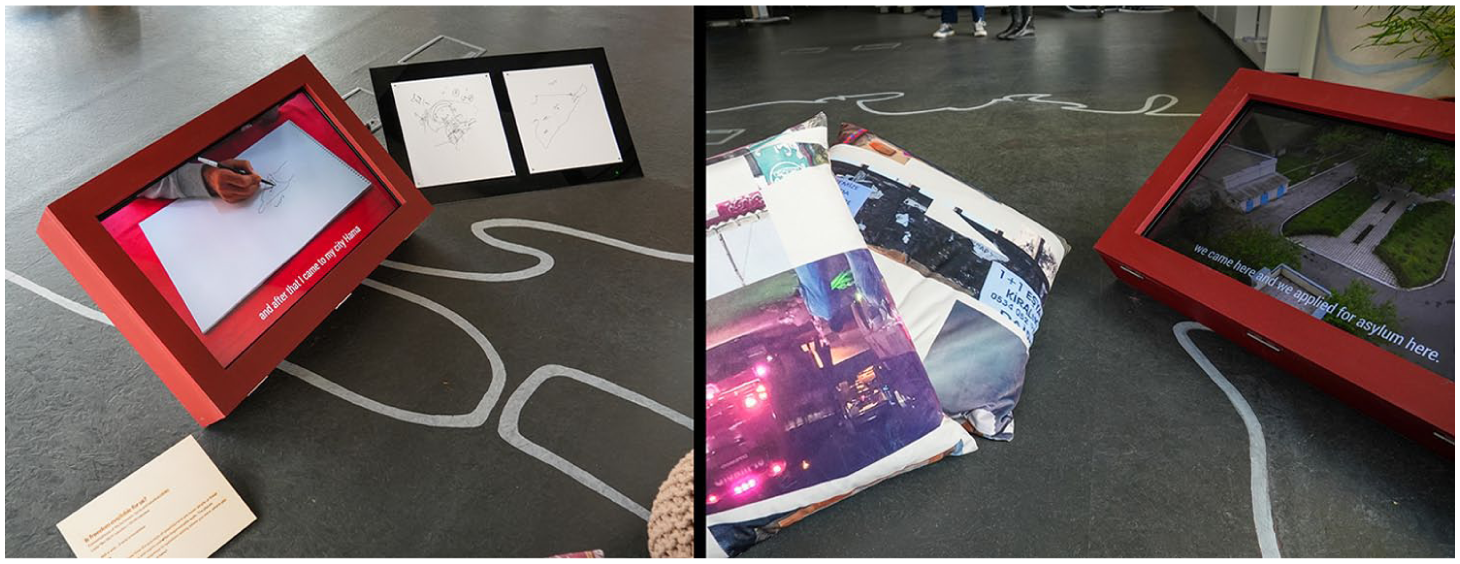
Undocumented? - Paidal, UCL Urban Room (2024).
The titles of the films give a sense of the violence that circulates within the stories being told, but they also show how forms of refusal, a certain endurance, and value systems other than those steeped in a capitalist imaginary, can produce moments of agency. The first vignette features an Afghan woman newly arrived in Odessa, her story demonstrating how the securitization of borders produces a situation where some will never attain the status of a refugee, but are instead destined to attempt escape again and again. It is followed by the story of an Afghan man settled in Odessa for a few years for whom the trap is no longer the border but the economy. A second vignette focuses on the epistemic violence embedded within a refusal to acknowledge how someone might want to name themselves and their predicaments, seen in a Syrian graphic designer’s insistence on calling himself an exile, not a refugee. For him, a refugee was someone in much more need. A glimpse of defiance surfaces in the next film where a Syrian couple insists on the politics of calling the conflict they had escaped a revolution, and not a war, since the term ‘war’ erased all the sacrifices they had made in rising up against a brutal regime. Another set of films speak of value systems that cannot be contained by the border regime, such as the desire of the group of young Pakistani men mentioned earlier to see other parts of our collective planet, a privilege they do not have. In the second film, we hear from a Pakistani man about the kinds of affinity one might have with an animal that is not a pet. The value of the goats he sold for his journey may have also been economic but it surpassed such a straightforward reckoning in monetary terms. The longing in his voice pointed to other forms of relation.
Conclusion
Our exhibition and this reflective article have proposed a form of affective witnessing that uses the vignette as a symbolic, narrative and ethical device. We have considered the implications of representing migrant communities in the context of ongoing spatial violence. Our contribution is addressed towards those architects, researchers, artists, educators and curators who find themselves hemmed in by institutions that challenge freedom and refuse a politics of ethical mediation.
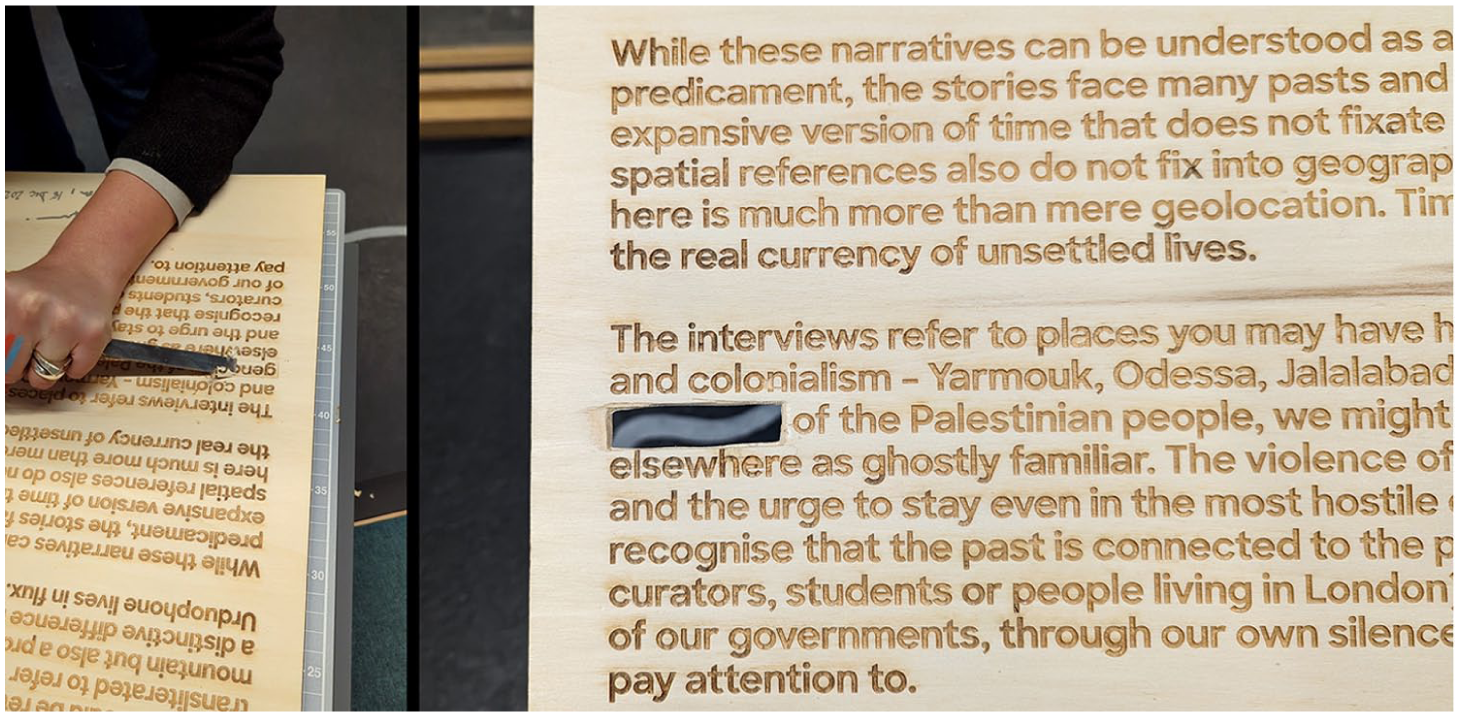
Removing the word ‘genocide’ from the artist’s statement.Undocumented? - Paidal, UCL Urban Room (2024).
In the context of our exhibition, it was the unexpected vignette created by our response to institutional censorship that was the most powerful. The gap we cut out of the plywood to remove the word ‘genocide’ brought into conversation people who would otherwise have drifted past the artist statement and its message. Asking what the word might be and why it had been cut out drew them further into the exhibition and its layered politics. In this sense, our understanding of the absent witness is very different from Agamben’s (2000) original formulation, which defined the notion of the absent witness through considering parts of a testimony that were obscured by the trauma of violence or by death itself. Instead, we were thinking with forms of witnessing that are made to disappear within unequal institutional power relations, knowing that these accounts that are so easily dismissed are often also the most fragile.
Circulation has been vital to how our work describes narratives that are difficult to witness. We have focused on the idea of a journey by using sound, image, text and texture. More than just a set of movements, throughout the space there is a construction of an ethnographic present, allowing the audience–witness to move through time and space, surfaced by the different yet interconnected vignettes. Aurality is a key mode of the ethical approach to circulation, refusing to silence people or reduce their stories to translated text. Instead, language and sound circulate throughout the exhibition, marking overlapping moments in time and place. Together the sound forms a rhythm that is unique based on a given moment of encounter and thus there is an insistence on the temporal reality of life on the move. Traces of sound, outlines of the map, loops of film, all circulate meaning, while maintaining an incompleteness. The display format allows for a spontaneousness in how the audience–witness interacts with the storytellers.
The gaps, shadows, blurs and edges are vignette devices that propose layers to seeing and affective engagement. The vignettes consistently blur definitions of a person’s position and context. Identities are obscured to preserve confidentiality. We continuously question the fixity of the people featured in the vignettes: are they migrant–refugee, documented–undocumented? The edges are important for the situatedness of these stories. As such, the vignette for us became an important interpretative device in the idiom of ‘example and relation’ (Glissant, 1997; Weheliye, 2014) that resists the comparative urge, while acknowledging the many ways in which we can make connections across disparate stories and geographies. Staying in the in-between of journeys creates a blur, refusing the fixation on points of arrival or departure that is often the case when relating stories of migration. The visual and sonic aspects of displacement and movement overlap and circulate across the gallery space, foregrounding one vignette while softly drifting into the next. Gaps, blurs and edges provided ways of honouring each story as its own unique vignette, while creating the conditions for interpretative moves to be made by the audience.
The ways of seeing proposed through Undocumented? – Paidal are not completely transparent or fully coherent since some things remain untranslated/untranslatable while others refer to events and thoughts beyond the frame. Yet, in the wider context of the exhibition, as one story melds into another, connections can be made across vignettes that hint at meanings and possible explanations. This mode of interpretation pushes beyond visual meditation as forensic interpretation to be consumed by the audience and into an embodied set of relational actions. Affective listening thus is about the relational implication of the body and the non-discursive space. This is different from exhibitions that promote dialogue as a multi-vocal space; instead we are suggesting that drawings, voices, images, text, all work as agents against the violence of documents and the bureaucracies of migration. To begin this contribution with a reflection on our own vignette – an artist statement – and the condition of our censorship is to fully tend to the ethics of mediation as political practice. At the time of writing that text, the UK government was embroiled in hostile migration politics, having just released the refugees they were keeping captive on the Bibby Stockholm, a ship owned by a Caribbean family with links to the transatlantic slave trade. Our closing rally call to the reader is to be reminded that the spatial violence of bordering, the narrative violence of defining and the representational violence of suffering does not merely exist, and we are not passive spectators in such phenomenology.
Footnotes
Acknowledgements
With immense gratitude to all those who trusted us with their stories. We wish them well on their further journeys.
Funding
The research for this article was funded by the Independent Social Research Foundation (ISRF) and European Research Council (ERC) under the Horizon 2020 research and innovation programme (grant agreement No 758529).

Notes
Address: University College London, Gordon House, London WC1E 6BT, UK. [ email:
Address: University College London, Urban Room, One Pool Street, London, E20 2AF [ email: