



Abstract
During the past decade, Colombia has received millions of Venezuelan migrants, leading to the creation of new administrative databases and classification categories to assess the magnitude and impacts of this population. One of the major challenges in responding to the migration crisis has been the collection of high-quality data. Based on semistructured interviews and ethnographic observations, we conducted a qualitative case study in 2022 to understand how migrants’ databases, specifically health-related databases, were produced within local institutions in Cúcuta, a frontier Colombian city and one of the reception epicenters of Venezuelan migrants. We aimed to unpack the processes of inclusion and exclusion involved in measuring migrants’ health status. In this endeavor, we found that pendular migration, a nontraditional type of the migration phenomenon, was affecting the performance of health entities and the reliability of migrants’ data and indicators. Framed within an ethnographic analysis of data production, we show that people who oscillate between countries, slipping through borders, also slip through quantification systems. We conclude that the quantification of states could include categories such as pendular migrants to provide evidence of the porosity of the established nation-state order.
Keywords
Introduction
Since 2015, Colombia has received massive flows of Venezuelan migrants due to the political and social situation in the neighboring country. According to the Ministry of External Relations, the Venezuelan population in Colombia in 2024 stood at 2.584.574 (Cruz Lopera, 2024). This migratory phenomenon has had several impacts on the arrival country, including increases in the population in vulnerable conditions, growth in informal employment, and soaring demand for health services (Rossiaco and de Narváez, 2023). The global migration system lacks reliable data to understand this phenomenon in its different manifestations and scales (Ahmad Yar and Bircan, 2023; Bircan et al., 2020).
In March 2022, we aimed to characterize the data produced by Colombian government institutions to assess the health status of Venezuelan migrants in the context of COVID-19. In this endeavor, we examined public records related to healthcare services provided to the migrant population and found multiple gaps in the reported services and the diagnoses given to patients. To better understand how these databases were produced and to unpack what kind of inclusion and exclusion processes were involved in measuring migrants’ health status, we conducted a qualitative case study in Cúcuta, one of the main reception epicenters of migration flows in the country.
Cúcuta, the capital city of the Norte de Santander department, is located in the northeast of Colombia, next to the border with Venezuela. We were interested in the narratives of individuals who manage and work with migrants’ health data, specifically in Cúcuta's context; this meant examining how local state officials, health professionals, and international cooperation agents explained the processes involved in data collection, digitalization, analysis, and use for decision-making. We conducted interviews and ethnographic observations focused on the production practices of four health databases that collect migrants’ information in Colombia: the individual registries of health services provision (known as RIPS, by its acronym in Spanish), the epidemiological surveillance system (known as SIVIGILA, by its acronym in Spanish), the health services managed by international cooperation entities, and a database recently created under a government policy called the Temporary Protected Status (TPS) (Estatuto de Protección Temporal para Migrantes, in Spanish) for Venezuelan immigrants, which includes the collection of migrants’ biometric photographs. 1
When we started exploring the production practices of these databases in Cúcuta, we soon realized the importance of a migratory dynamic that exists only in territories divided by a political border: pendular migration. The word “pendular” helps explain how this population is defined: it refers to people who oscillate between their country of origin and another, as if they were pendulums swinging at the frontier. Pendular migrants can refer to groups of people crossing national borders for extended periods, as in some labor migration waves reported in European countries, which may last entire seasons (Rechel, 2011). However, on the Colombian–Venezuelan border, the pendular population includes people who migrate for much shorter periods and even register numerous entries and exits on the same day through a single migratory control post (Ley 2136 de, 2021). In a way, the pendular population in Cúcuta's border is permanently migrating. 2
Several participants in our research highlighted that this phenomenon posed new challenges for the quantification of the Venezuelan diaspora: quantifying the pendular phenomenon requires thinking beyond the traditional type of migration, which usually refers to a permanent change of residence (Mojica et al., 2020; Wickramasekara, 2011). As we explained in a previous publication (Galvis-Malagón et al., 2023), pendular migrants are not distinguished as a separate group in the health data produced in Colombia; they are registered under the same category as nonpendular migrants. Excluding nontraditional forms of this phenomenon is one of the reasons for the lack of high-quality statistics on human migration worldwide (Ahmad Yar and Bircan, 2023). 3
In this case study, we show how the logic of quantifying all migrants as people who arrived in Colombia without the intention of crossing the national frontiers is a continuation of a familiar framework of social ordering (Douglas-Jones et al., 2021) defined by nation-state political borders. “The nation-state, as well as national political struggles, remain powerful contributors to the definitions of medical and social policies, categories, and identities” (Epstein, 2007: 7). Data emerges as an extension of the Colombian state's interest in demarcating its borders, particularly at the frontier between two countries with a long record of tense relations due to their political differences (Ramírez and Cadenas, 2006). Even when the dominant discourses in global health today “envision a world of diseases constantly in motion, always on the move to new places without regard to nation-state capacities” (Adams, 2016: 6), migrants’ health data in the Colombian–Venezuelan frontier continue to reinstate the dominant geopolitical order.
The nation-state order is linked to citizenship, an identity that migrants often lack when crossing borders. As Holston and Appadurai have argued, “nation-states have sought to establish citizenship as that identity which subordinates and coordinates all other identities – of religion, estate, family, gender, ethnicity, region, and the like – to its framework of a uniform body of law” (1999: 187). The sustainability of nation-states is based on a commensurable group of citizens (Holston and Appadurai, 1999), and in our datafied world, citizens’ commensurability is guaranteed through data; being quantified is a condition for accessing rights (Milan et al., 2021). When the Colombian state counts the Venezuelan diaspora as permanent immigrants, it grants them access to healthcare in the same way as other citizens, but it also reinforces the fixity of the border by assuming migrants’ permanence within a single nation-state. Quantifying pendular migration would thus reveal the nonfixity of borders, which can also represent what many scholars and politicians have called peripheries of the state: regions where the power of public institutions has not reached (Serje, 2012).
The state peripheries are continuously enacted through the movements of pendular migrants who slip through national borders. “'Slippage’ is a term coming from mechanical engineering that refers figuratively to deviations from the norm: from what we think will happen, what does not unfold exactly as intended, and the frustration of what doesn’t happen or is difficult to accomplish” (Barchetta and Raffaetà, 2024: 3). The pendular population deviates from what national entities expect of Venezuelan migrants once they arrive in Colombia: they are not permanently immigrating as new citizens attached to a single nation-state, but instead constantly cross national borders, even when the frontiers are officially closed. This was known to our participants, who were local state officials with a closer view of frontier dynamics but who must adhere to decisions made by the central government.
We argue that counting the people who constantly challenge the fixity of national borders would be an institutional practice that could make visible the porosity of a frontier. Contrary to classical modernization theory, which assumes the salience of the nation-state (Appadurai, 1996), we seek to position pendular migration as an inherently transnational practice that reveals the fractures within the nation-state order. The need to differentiate the pendular population in health databases was identified by the local state officials we interviewed, who manage migrants’ data in a border city. Thus, the “absence” of the state in the peripheries could also be explained as a disarticulation between national and local public entities: the pendular movement makes sense only at borders. The disarticulation between national and local entities’ needs and priorities is one of the fractures of the nation-state order that will be explored in the results section of this paper, following our methods section. In our results, we will also detail two peripheries: those enacted by pendular migrants and by international cooperation entities. We conclude by highlighting the importance of making the pendular movement visible and showing how this proposal can foster collaboration among governmental institutions and across different disciplines.
Our research is framed within the body of work concerned with the study of data from an ethnographic perspective. In this field, data's “objectivity” or “cleanness” is questioned (Barchetta and Raffaetà, 2024; Biruk, 2018; Bowker and Leigh Star, 2000; Leonelli and Tempini, 2020). Data is the mercurial result of the ever-changing relationship between technology and society (Boellstorff and Maurer, 2015; Gitelman, 2003). We explored migrants’ data production, focusing on the perspective of the subjects involved in constructing what is considered evidence. This standpoint has been largely ignored by some global health ethnographers (Biruk, 2018). Understanding pendular migration as a piece of information excluded from quantification practices, we suggest that visualizing this category in data might help challenge the taken-for-granted image of fixed nation-state borders. It may also enable a “transversal collaboration” between quantitative and qualitative approaches of analyzing the migration phenomenon (My Madsen et al., 2018).
Methodology
To understand the quantification processes of the health status of Venezuelan migrants in Colombia, we conducted our data collection and analysis in two stages. The first stage lasted three months and focused on characterizing the types of health-related data available for the migrant population in datasets consolidated at the national scale and released as open data. We were interested in understanding how migrants’ data were captured and represented in national datasets, and the implications of data availability or absence for public health analysis targeting the Venezuelan diaspora. We treated the datasets as artifacts that could be interrogated ethnographically in their own right and that embodied specific assumptions, categorizations, and epistemological frames about the migrant population (Burns and Wark, 2020).
During this first stage, we were interested in the datasets of the Public Health Surveillance (PHS) System (SIVIGILA), which monitors 58 health outcomes prioritized by the National Institute of Health as mandatory for epidemiological surveillance. To analyze these data, we assessed the surveillance notification forms used by SIVIGILA in 2020 to identify when and in what cases people were registered as migrants. We also explored the RIPS, the individual registries of health services provision. The National Ministry of Health compiles these datasets and includes information on all services provided in the health system. We assessed datasets produced between 2017, the year when the “migrant” category was included, and 2020. During this first stage of data collection and analysis, we concluded that although Colombia hosted the largest population of migrants and refugees from Venezuela, there was a significant lack of data on migrant's health status in the national-level open datasets.
Based on the findings of this first research stage, we decided to analyze how migrant's health data were being collected and transformed into digital datasets in a particular setting. We chose to conduct a rapid ethnography (Scrimshaw and Hurtado, 1988; Vindrola-Padros, 2021; Vindrola-Padros and Vindrola-Padros, 2018) in Cúcuta, a city that plays a central and highly visible role in the context of Venezuelan migration, given its strategic geographic location—right on the border with Venezuela. Rapid ethnographic research entails intensive fieldwork, including in-depth interviewing and observations, in a short and well-defined timeline. It also requires extensive prior knowledge of the social, political, and economic context of the place and the research problem. Rapid ethnography also requires prior knowledge of the relevant actors involved.
Before conducting our second stage of fieldwork, we listed the main actors providing services to the migrant population in the territory. We also had prior informal conversations with local stakeholders working in humanitarian organizations based in Cúcuta. Once we had identified some of our key informants and we had a preliminary understanding of the humanitarian crisis in Cúcuta, we conducted a one-week immersive fieldwork. We were able to conduct observations and semistructured interviews with 14 participants (n = 14).
The main topics that guided our primary inquiries, both in our interviews and in our ethnographic observations, were: (i) How is the category “migrant” constructed and used in the context of the production of health data on this population? (ii) How does the processes of recording, circulating, and using health data on the migrant population take place? Following the data journey and the people, entities, and relationships that sustain its construction, we were seeking to build a “critical framework to understand how data come to serve as evidence and the conditions under which this does or does not work, [in order] to confront the challenges posed by disputes over the reliability, relevance and validity of data as empirical grounds for knowledge claims” (Leonelli and Tempini, 2020: vi).
During our fieldwork, we conducted interviews with health professionals—including high-level decision-makers—working at the main public health institution at the departmental level (the Health Departmental Institute (HDI) of Norte de Santander) and at the municipal level (Cúcuta's Health Secretary). We interviewed health professionals working at two mobile health facilities of international humanitarian organizations that provided sexual and reproductive health services, mental health services, as well as the delivery of first aid, vaccines, hygiene kits, and food packages to the migrant population. We interviewed public health professionals leading the epidemiological surveillance and the health insurance division. In both cases, we were interested in understanding the processes of organizing, cleaning, and digitalizing migrant health data in a border city and within public health services. We visited one of the main public hospitals serving migrants and interviewed a health professional. Finally, we visited Tiendita's Bridge, where cooperation entities were registering data for the TPS.
Our interviews were pivotal to understanding how data was used for policy and decision-making at the local scale. All ethnographic information was recorded in daily field notes. Every participant signed an informed consent form before the interviews, and all our interviewees’ names are pseudonyms. The audio files were transcribed and anonymized in accordance with the University's ethical protocols.
All interviews and field notes were categorized using thematic analysis (Vaismoradi et al., 2013). We formulated analytical codes based on our initial questions, then added the emerging categories from our fieldwork. We created 23 codes in NVivo, enabling us to organize our data and identify patterns and thematic relationships between participants’ narratives and our observations. The quotations in this text seek to reflect these thematic connections.
This qualitative research was part of a wider project called COLEV, an interdisciplinary group at Universidad de los Andes dedicated to producing and communicating pertinent evidence with a gender perspective. COLEV aims to foster dialogue between academia and public health decision-makers, providing informed responses to the challenges posed by COVID-19 in Colombia. COLEV was approved by the Research Ethics Committee of the Universidad de los Andes (Acta No. 1394 de 2021).
Drawing a border by quantifying a population
Pendular migration in a conflicting border
Venezuelan immigrants are usually forced to cross the frontiers under conditions of vulnerability, but their situation became much riskier when the conflictive relations between the Colombian and Venezuelan governments hampered border crossings. During the administration of former president Juan Manuel Santos, a Colombian paramilitary group attacked members of Venezuela's national army in 2015. In response, Venezuelan former president Nicolás Maduro closed the border (Linares, 2019). Although this decision was supposed to last 72 h, the political situation in both countries worsened, and the border closure was extended (Linares, 2019). Then, Santos and Maduro made some agreements to reopen the border, but the election of former Colombian President Iván Duque and his public statement against the dictatorship in Venezuela generated new disputes between the two countries (Tendencias El Tiempo, 2020). The border closure lasted seven years until its recent reopening in September 2022 (Hernández, 2022). During this period, the impossibility of moving across international bridges forced migrants to use improvised and risky crossings known as trochas, which are normally controlled by illegal armed groups (Gandini et al., 2019; Mojica et al., 2020).
When we conducted our fieldwork in May 2022, the borders were still closed. Laura, one of our interviewees, worked as a port health officer at the HDI. The HDI is the health governing body that oversees the management, surveillance, and control of public health in Cúcuta. Laura told us about the difficulties of knowing how many migrants crossed the Colombian–Venezuelan border. She said that during the peaks of the Venezuelan diaspora, public institutions in Colombia had to manage crowds of people arriving at the official crossing points with insufficient personnel to keep track of everyone passing through the authorized bridges; “and if that's the bridges’ case – said Laura – imagine what happens in the trochas. That is why migrants’ information will never be completely true.”
Like most of our interviewees, Laura worked inside the headquarters of the HDI, on the top floors of a tall white building, where dark and maze-like hallways led to the staff offices. These shady corridors seemed to mimic how Laura described the trochas: paths, hidden in the opaqueness, where you may hear footsteps and see silhouettes of people moving, but it is easy to miss who is walking and where they are going. The trochas help us depict how fixing practices, such as closing a political frontier, are always challenged by realities that do not fit the established order (Law and Lien, 2013). The constant movement of the pendular population portrays the peripheries of nation-states. We will explore this argument in the next sections, starting with the latest quantification policy launched by the Colombian government to address the migration phenomenon.
Containing a territory through data: The temporary protected status
Tienditas is the name of a bridge that connects the state of Táchira, Venezuela, with the Norte de Santander department, Colombia. It was built by the two governments to alleviate traffic congestion on the existing bridges connecting both countries, with an investment of US$32 million, split equally (Ministerio de Transporte, 2014). Tienditas has two three-lane platforms made for vehicle and pedestrian crossings. Although the bridge was ready to be inaugurated in January 2016, by May 2022, it had not been used once because no commercial relationships were allowed at the frontier (Miranda, 2019). To prevent any vehicle from passing over the bridge, the Venezuelan National Guard placed containers that completely blocked the road (Caracol Radio, 2019). The closed frontiers were just another glance at the conflictive relationships between the Colombian and Venezuelan governments. Since it was not being used as a bridge, in 2022, Tienditas was adapted as a site where Venezuelan migrants could apply for TPS.
The TPS is a policy announced by the former Colombian president Iván Duque in March 2021. It aims to regularize the status of undocumented Venezuelan migrants and integrate them into the productive economy of the country (Cancillería de Colombia, 2021). To get the TPS, migrants must fill out some paperwork, make an appointment to get their biometric photos into the databases of the External Relations Ministry, and receive a special ID card. The collection of biometric data shows how governments are following the global trend of using digital technology to collect migrants’ data (Ahmad Yar and Bircan, 2023; Nair, 2021).
By law, people living in Colombia with an irregular status can only receive health services in the emergency medical network. 4 However, with the TPS card, migrants can get enrolled into the General Social Security System (GSSS), and have legal access to healthcare as any other Colombian. The TPS was an effective way for thousands of migrants to access healthcare. Iván Duque's government was internationally recognized by this policy. “The TPS process is staged in such a way as to adapt to the vulnerabilities of Venezuelans in Colombia, while still serving the objectives of protecting national security and informing policy making” (Rossiaco and de Narváez, 2023: 8). Being datafied usually means having access to healthcare, and “institutional solutions appear to timidly move in the direction of making migrant populations more visible” (Pelizza et al., 2021: 74).
Veronica, an official of the HDI, gave us a tour of the TPS application process in Tienditas. We reached the bridge toll booths and saw that they were being used by cooperation representatives as small offices to enroll migrants in the GSSS (see Figure 1). An official working inside the tollbooths showed us her computer screen while explaining the data collection process to be enrolled in the GSSS. Then she pointed to a sign listing several conditions for enrollment in the health system, including migrants’ obligation to prove their permanence in Colombia every four months. The official told us that, to fulfill this requirement, it would be enough to show, for example, a lease contract or a payment receipt from public services in the country. Migrants who benefit from the TPS are expected to remain in Colombia and permanently change their residence. 5
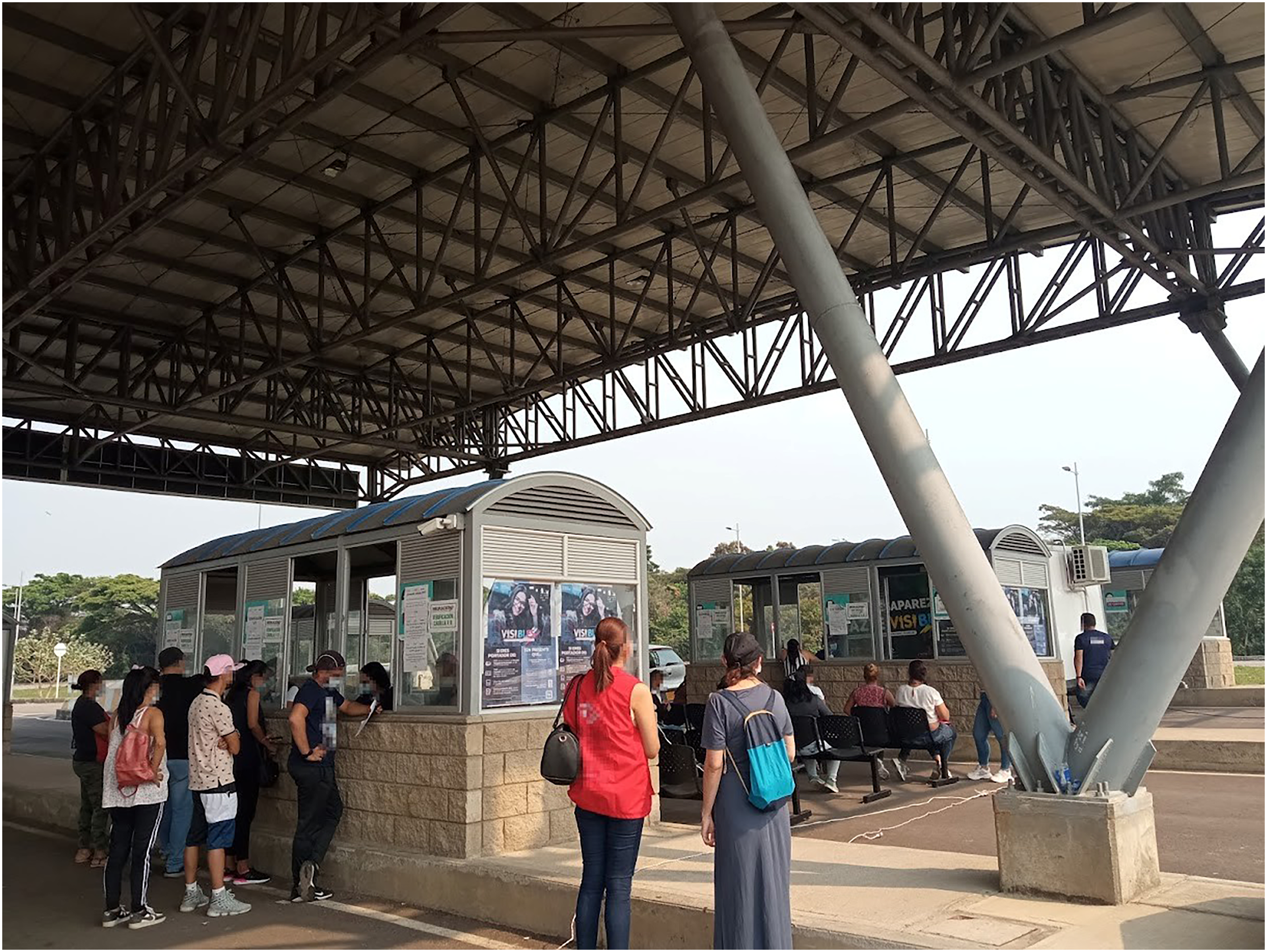
Tienditas’ bridge tollbooths being used as offices to enroll migrants in the General Social Security System of Colombia, one of the benefits of the Temporary Protected Status.
Veronica told us that this condition did not contemplate pendular migrants, a population that did not plan to change residence. Veronica is a member of a roundtable in which public officials and cooperation representatives discuss migrants’ health status. During one of the sessions, she warned about pendular migrants’ resistance to change their permanent residence: “I said to all of them: ‘You’re making a big mistake: you’re giving residency to 500 people, but if 500 of them came today to be enrolled in the system, I am sure that 300 live in Ureña, San Antonio, or San Cristóbal [Venezuelan municipalities]’” (Official of the HDI). This lack of recognition of the pendular phenomenon matched with the bizarre sensation of walking over a solid, huge bridge that could serve as a fluid connection for people and vehicles between two territories, but was instead blocked by containers. The closed bridge sends a clear political message to migrants: you must stay on one side of the border. Just as the containers in the middle of a bridge cannot really block the movement of people through a border (a division line that is more than two thousand kilometers long), what Veronica was implying is that the health quantification system cannot really guarantee that the person registered in the data lives within the national borders.
National borders are associated with a state's sovereignty, understood as the possession of supreme and independent authority over a territory. Vincanne Adams argues that the Westphalian idea of sovereignty present in the global health framework has increasingly been dominated “not just by the regimes of development aid that reiterated its national borders (indeed its right to national forms of knowledge) but by those that aim to transcend these borders” (2016: 7). According to Adams (2016), metrics have emerged as technologies of counting that form and sustain the sovereignty of each nation, but also the global health knowledge. This quantified language creates a regime that hopes to transcend nation-state borders and construct universal categories that make sense across countries (Engle Merry, 2016). Afterall, “pathogens do not recognize international borders” (Farmer et al., 2013: 10).
However, as Veronica's intervention and the containers on the bridge both showed, borders play a key role in the Colombian state's responses to the Venezuelan diaspora. 6 Even if global health metrics aim to create a common language beyond national particularities and boundaries, the sovereign powers that produce this language are seeking to contain the nation-state. Since data cannot really guarantee the fixity of national borders, we were interested in a new question: what would happen if the datafied worldwide knowledge made visible practices that are transnational, such as pendular migration? This would acknowledge the porosity of the nation-state order. In the next section, we will show that quantifying the migrant population as those permanently residing in Colombia could also affect the link between national quantification policies and the needs of local public officials managing migrants’ health registries right next to the border.
False locations and poor performance: The effects of not quantifying pendular migration in data
Some of our participants noticed that one of the main problems in working with migrants’ data was the perceived practice of providing false information. The most common “false” information recorded in the data was the place of residence. According to some of our participants, migrants register addresses that “are not real” or located in Venezuela. This has been reported in other studies on the quality and representativeness of migrants’ data, in which determining the usual place of residence is problematic (Ahmad Yar and Bircan, 2023). “Moreover, the coverage and territorial specifications of the data are not always reliable, affecting the quality and accuracy of the statistics generated” (Ahmad Yar and Bircan, 2023: 11).
The main problem with this data flaw in the health databases is that the information is not useful for public health surveillance (PHS). PHS is an essential process for national health security; it is based on systematic and continuous epidemiological data collection, analysis, and interpretation, to support decision-making in the health sector (Subdirección de Prevención, Vigilancia y Control en Salud Pública, 2022). PHS focuses on events of public health interest, i.e. those that can modify or affect the health status of a community. As we previously explained, undocumented migrants have access to the emergency service network. When health professionals detect a notifiable case—meaning any disease considered a public health risk by the National Institute of Health—it must be reported to the SIVIGILA health information system. Once registered, these cases are supposed to be followed up by health institutions as part of PHS. However, this process becomes extremely challenging when migrants’ reported places of residence are inaccurate or located outside the national territory.
One of our interviewees narrated these difficulties in the PHS process of pendular migration: If we provided healthcare to the pendular population and detected a notifiable case in public health, we had them registered in the SIVIGILA platform. But, in reality, we could not trace those cases. In the epidemiological record, many of them said they lived in Ureña, a city that is […] not part of our territory. […] It was a complex situation: first, we could not pass the border to follow the cases in Venezuela. Second, how could we be sure if the patient was not coming back? What if he or she came to Colombia to work informally every day? We had no address. Some patients, especially migrant patients, sometimes refuse to provide good information, to give clear information. This breaks the chain of epidemiological care that we are providing. (Official from the Health Secretary of Cúcuta)
The effects of this data flaw in the epidemiological surveillance process can be exemplified by the COVID-19 pandemic. In Colombia, part of the initial governmental response to the pandemic was to notify every case of COVID-19, so the health institutions in charge could track each of these cases and monitor patients’ health status and isolation period. However, migrants who did not have a permanent location and became infected could not be included in the surveillance protocols that a citizen was supposed to have under the same circumstances. Thus, the untracked diseases could lead to epidemiological outbreaks that would affect the Colombian population. Although having a false location in the data is not exclusive to the pendular population, according to our interviewees’ perception pendular migrants were the ones who were most frequently lying about their place of residence: “If the patient is one of those migrants who comes and goes [i.e., a pendular migrant], or maybe if he is living here on irregular conditions, if that patient is not attended, and we do not control his disease, then the epidemiological problem will grow in our region” (Official of de HDI).
The concerns of local officials were, of course, restricted by national limits, not only because their jobs as Colombian public workers are defined by a territorial delimitation, but also because not having control over a contagious disease like COVID-19 could lead to criticism of the local health entities’ performance. When pendular migrants are registered in Colombia as epidemiological cases, they might generate peaks of new diseases that do not “belong” to the territory, but that are visualized as such in the health indicators.
Another example of the same situation occurred with pregnant women who have been diagnosed with congenital syphilis. When we did our fieldwork, this number had recently increased in Norte de Santander. One of our interviewees explained that many cases behind this indicator belonged to women who temporarily migrate from Venezuela to have their children in Colombian hospitals. Thus, many women were not receiving enough prenatal checkups, or were not being treated on time, precisely because they were pendular migrants: As soon as these records began to affect our institutional indicators, everyone started to react. We began to compare the indicators with the SIVIGILA records, and we saw that, for example, the system was telling me that we attended a pregnant woman who was entering her second trimester of gestation, and we detected congenital syphilis in the baby. If the case was detected in the second trimester of gestation, then why the hell was the child born with congenital syphilis? The patient had to be treated, her case should have been tracked. So, we realized: if that woman had lived here in Cúcuta, and if she had come for more prenatal check-ups, everything would have been different. But the patient only came for a single prenatal check-up, because she wanted to know the sex of the baby, and then left. Later, she returned to Erasmo Meoz hospital and gave birth. (Official of HDI)
Our interviewee suggested that, although the indicators showed institutional negligence in providing the necessary health care in Cúcuta, the cases behind these metrics referred to people who were impossible to track and treat. Thus, “lies” in data may refer not only to “unreal” or foreign addresses, but to the institutional image built by metrics. As Marilyn Strathern has argued, data has become a tool to measure institutional performance, based on the assumption that visibility through data leads to the transparency of an organization's operation: “If procedures and methods are open to scrutiny, then the organization is open to critique and ultimately to improvement” (2000: 313). Thus, the challenges posed by dynamics such as pendular migration in the health quantification system are not only affecting epidemiological surveillance but also dulling the institutional image and obscuring the local efforts to address the migration crisis.
By examining data production through a qualitative lens, the presumed neutrality and accuracy of metrics begin to shatter, revealing quantification as a political and organizational practice rather than a descriptive one. Fixed categories within the quantification system enact particular orders of reality, producing a “cooked” image of institutional performance that reflects governance priorities more than lived practices (Biruk, 2018; Engle Merry, 2016). Here are, then, two effects of not differentiating pendular migration in the quantification health system: false locations that prevent the execution of PHS, and the image of bad governmental performance in the local health sector. These effects raise concerns among local state officials who govern a territory traditionally cataloged as one of the state's periphery.
As we briefly mentioned in our introduction, there is a long-term narrative used among Colombian power sectors to refer to national territories where the state “has never been able to reach.” This narrative, which usually pictures the Colombian state as a failed institution, is discussed by Margarita Serje. She suggests that Colombia has been historically narrated as a divided country; this two-sided territory mimics the center-periphery conceptualization that exists at a global scale (Serje, 2012). The central zone of Colombia lies along a north–south axis that connects the Andean region with the Caribbean (Serje, 2012). The peripherical zone surrounds the central area, and is identified as a vast, forgotten, poor, and wild territory (Serje, 2012). Within this narrative, Cúcuta's frontier would be a part of the Colombian periphery: the “Other Colombia,” a territory characterized by the state's absence and the lack of institutional control. “The existence of these vast and conflictive regions appears to be the scenario and, to a large extent, the reason for the intense violence that has been taking place in the country for several decades” (Serje, 2012, translation by the authors).
However, as Serje (2012) suggests, the idea of an “absent state” conceals the multiple ways in which public entities intervene and govern the peripheries. In the case we have explained here, the absence of the state would be better portrayed as the disarticulation between the national government's interests and the local health system needs when governing a border city. This is not necessarily a case of lack of communication, but rather a political issue; in fact, before the TPS, the Colombian national government had launched a public policy called Border Mobility Card (Tarjeta de Movilidad Fronteriza in Spanish), which was specifically aimed at facilitating pendular mobility. In the next section, we will explain the Border Mobility Card to show how acknowledging pendular mobility is treated as a risk to national sovereignty.
How data stabilizes a crisis
The Border Mobility Card was launched in 2017 by former Colombian president Juan Manuel Santos. The Card was aimed at migrants living in Venezuela who constantly need to cross the border to buy food, medications, or visit family (Migración Colombia, 2017). The Border Mobility Card was complemented by the Special Permanence Permission (PEP—Permiso Especial de Permanencia, in Spanish). The PEP was aimed at migrants seeking a permanent change of residence (Migración Colombia, 2017). Thus, this policy differentiated between pendular and permanent migration. One of the conditions of the Border Mobility Card was: “It does not allow entry to the interior of the country” (Migración Colombia, 2017). It was making the pendular movement visible, but it was, once more, asking migrants to restrict their movement; to keep the peripheries away from the center.
This policy ended soon after: in February 2018, after a peak in the Venezuelan diaspora, former president Santos “ordered the Police and the Army to mobilize 2120 men in the border zone, after announcing stricter migratory controls” (Noticias Caracol, 2018, translation by the authors), which included the suspension of the Border Mobility Card. After that, the next policy that impacted migrants’ health registries was the TPS. Patricia, a professional in charge of coordinating migrants’ health matters between the HDI and international cooperation entities, explained to us that, after years of dealing with the most critical moments of the migratory emergency, the TPS was the national government's attempt to pass to a “stabilization” phase. Patricia said that this policy pretends to include “migrants” as a category that adds up to the list of vulnerable groups in Colombia, right next to the indigenous communities, Afro-Colombian people, victims of the armed conflict, and people with disabilities. By making this population a new category on the databases, the “stabilization” phase is based on the datafication of the state's services for vulnerable populations.
As we have been showing, by “stabilizing”—a word that can literally mean “to remain in the same place for a long time”—the crisis, the state is also attempting to govern its peripheries and set its sovereign frontiers. And, as shown by our participants’ experiences, pendular migrants reveal fractures within the state's attempts to fix its political borders. This interaction between data, migrants, and the people who use and produce data, depicts how the state seeks to fix a reality—or stabilize it—through a quantification system, but those practices of fixing always create, as Law and Lien (2013) argue, a slippery otherness. By fixing the political borders, the TPS is creating the slippery other: migrants who pass through the borders, or who “lie” and then disappear when the state must perform epidemiological surveillance.
The slippery other seems to be well represented by an image we found in an office where officials from the Ministry of External Relations and cooperation entities were taking biometric photos of migrants. The image was displayed in three posters explaining the steps to be a beneficiary of the TPS. It had the heading: “There is still time. Make yourself visible” (see Figure 2). The posters had pictures of people of different ages who seemed to vanish in the air, dissolving into square pixels. This image seems to picture one of the main difficulties in quantifying pendular migrants: although they get registered in the Colombian databases, once they cross the border, the data loses its ground anchor and vanishes into thin air.

Posters with public information to promote migrants’ enrollment in the Temporary Protected Status.
The perspectives of our interviewees showed us that the slipperiness of pendular migrants primarily refers to international borders. As John Torpey argues, “modern states – and the international system of which they are a part – have expropriated ‘legitimate forms of mobility’ from individuals and private entities, particularly […] through the demarcation of international borders” (2020: 29). Pendular mobility becomes illegitimate because the state attempts to restrict its borders through quantification mechanisms. In this context, the trochas emerge as a resistance to the nation-state order; these risky roads represent what escapes from state control. As such, the trochas are also peripheries of the Colombian state.
Transnational trochas
The TPS is a quantification infrastructure that exemplifies how the central state governs the peripheries from a distance (Rose and Miller, 2010). While the Colombian national government was taking measures that demarcated its territorial borders, we saw local state officials having a much closer view of the frontier's porosity and identifying the implications of counting pendular migrants as people who will permanently stay in Colombia. This small but significant disconnection between the interests of the national and local state officials while managing the migratory crisis shows the multilevel center–periphery relationships that can be found in a single territory. The “peripheries of the state” would not only be the actual trochas through which migrants challenge the fixity of a political border, but also the multiple paths through which the articulation of the state gets lost in the way.
Another periphery that emerges in Cúcuta's context is the role of international cooperation entities. Since the local state institutions are unable to cope with every health attention required by the Venezuelan diaspora, international cooperation has provided a significant percentage of migrants’ healthcare. As a cooperation official told us, these entities “are in the territory. They can quickly detect any change in disease behavior that could generate an early warning. The [Colombian public] entities manage things from their desks” (Cooperation official). According to this perspective, working directly in the territory that migrants inhabit allows cooperation entities to have a closer and more immediate view of their health situation.
We thought something similar to what our interviewee told us while doing our research. For example, the only open-source report that we found about the pendular population's needs in Colombia was done by the Interagency Group on Mixed Migratory Flows (GIFMM, its acronym in Spanish), a team composed by multiple cooperation entities, such as the International Organization for Migration, the UNHCR (the UN Refugee Agency), UNICEF, among others. The report aimed to document profile information on the pendular population, including trends and specific needs, and to inform strategic planning for migration policies. This initiative reveals an interest from cooperation entities in making visible the porosity of the border. 7
Just as pendular migrants do, cooperation organizations are performing in the peripheries of the Colombian state. This is also evident in the health-related data they produce. Laura, an official who works in the port health office of the HDI, told us about seven healthcare points—known as CAS—managed and financed by cooperation organizations in Norte de Santander. We visited one of these healthcare points, called Los Patios, located in the south of Cúcuta. The health center was on a large lot, with prefabricated wooden houses and white tents. Each CAS offered different services; Los Patios provided vaccination services, health services for gender violence, food and emergency kits, general medicine, nutrition, and psychology services. Laura told us that, although cooperation entities collaborated with the local state, the main inconvenience with their services was that they did not report their health data to the SISPRO, which is the Integrated Social Protection Information System of Colombia. The SISPRO unifies all the data related to health insurance, financing, supply, demand, and use of health services in Colombia.
Laura explained the problem with a hypothetical case: imagine that a Venezuelan woman was being examined in Los Patios, and the doctor determined that she needed a cervicovaginal cytology. In Los Patios, the cytology service is not offered. Thus, the doctor would send the woman to a local hospital, where she could get tested. That is why you can find the record in a hospital about a woman who had a cytology test done, but nowhere can you find the medical appointment where the cytology was ordered. […] Since there is no unified system, the information does not flow; each cooperation organization makes its separate records according to the characteristics of the agreement they have with their donor. (Port health officer of the HDI)
In this context, quantification emerges to “stabilize” borders, and to create an integrated response for every migrant living in Colombia. But, in every ordering system, there will be trochas: cracks in the structure through which agents can slip beyond its limitations (Law and Lien, 2013). We would like to think about the possibility of including a category like “pendular migrants” in the databases: including a category that inherently recognizes the porosity of the border could be a way to pluralize how the territorial order is being defined by data. This perspective allows us to see migrants who do not seek to stay inside a nation-state border not as passive victims, but as people “constantly activating strategies to challenge and negotiate state forms of control” (Alvarez Velasco, 2020: 3) and thus creating what we could call transnational trochas.
The ontological turn in the social sciences has stressed the need to pluralize the notion of what exists (De la Cadena, 2015) and to truly recognize the divergences of worlds (Lehuedé, 2023: 4). By exploring pendular migrants’ cases, we stress how counting differently could make visible different versions of the dominant nation-state order. Nick Seaver, while studying music recommendation algorithms, argues that these technologies work by creating music spaces: “If you find yourself within such a space, you will be surrounded by music that you like […]. In the music space, genres are like regions, playlists are like pathways, and tastes are like drifting, archipelagic territories” (2021: 44). What Seaver is showing is how data systems can potentially create new territories; they can rethink frontiers. The territory of a pendular migrant has an ontology that is not legible through the national ordering system of health registries. Recognizing pendular fluidity, thus, requires collaboration among governments. Instead of a mere demarcation of frontiers, data's potential could be oriented toward the recognition of what is happening with open or closed frontiers: territorial fluidity.
Conclusions
Everyone on earth had the same language and the same words […]
And they said, “Come, let us build us a city, and a tower with its top in the sky,
to make a name for ourselves; else we shall be scattered all over the world.”
(The Contemporary Torah, 2006, Gen 11:1–3)
We talked about the trochas that we saw inside the nation-state institutional system: the disconnections between the needs of the central and local governments, and the quantification systems of the international cooperation entities. If the peripheries are present at multiple levels, then why not count these transnational movements? The inclusion of pendular migration as a category in the databases would, rather than fixing borders, reveal their porosity. The data would acknowledge that their representation of reality will always be partial. And, most importantly, since being quantified is a condition for accessing healthcare (Barchetta and Raffaetà, 2024; Milan et al., 2021), deciding what to count and what to exclude has concrete effects on the “peripheries” of the state, and might exclude a vulnerable population from health services.
A perfect quantification system will never exist because data inherently include and exclude variables (Bowker and Leigh Star, 2000; Davis, 2020). “That which fits and is desirable is impossible without that which does or is not” (Law and Lien, 2013: 9). However, amid the international efforts to build a language to address global health (Adams, 2016), it is crucial to consider the implications of giving data the power of being treated as a universal communication standard. As we argued in this article, even if health metrics aim to create a common language beyond national particularities, the absence of pendular migration in Cúcuta's databases shows that the supposedly universal knowledge of data ignores practices that are already global and that constantly challenge the fixity of the nation-state order.
Counting the pendular territory should be understood as a collective endeavor. It would require not only action from the Colombian state but also sustained collaboration between the two countries that share the frontier. Like any linguistic system, such collaboration could operate independently of changing governments, constituting a shared effort to render visible what occurs at the borders beyond the political orientations of those in power. We hope these reflections contribute to broader debates in the global production of health knowledge, particularly regarding populations whose lives must be datafied in order to meet their basic needs (Milan et al., 2021).
Finally, our article contributes to the question of how different bodies of data—such as a quantitative health data system and the qualitative insights presented in this article—can be “added up” into one another (My Madsen et al., 2018). To answer this question, we suggest that pendular migration can be placed as a category that allows a “transversal collaboration” between quantitative and qualitative approaches, which are two partially connected knowledge regimes (My Madsen et al., 2018). The transversal position of this category opens a discussion around the noncoherent representation produced by a quantitative system, and allows us to think, as De Laet and Mol (2000) put it, about whether it is possible to build more fluid technologies. Would the presence of pendular migration in a dataset remind us that borders are never really closed? Would pendular migrants agree to be counted as such? Although this last question is beyond the scope of our article, considering the perspective of people who embody our global connections would help to think of health as a universal right, not subjugated to political differences.
Footnotes
Acknowledgments
We would like to acknowledge the support of all the participants in our interviews who collaborated on this research. We are grateful for their guidance through the migrants’ data production process in Cúcuta and for the dedication they show as civil servants and international cooperation officials. We also thank the colleagues who reviewed earlier versions of this article and provided us with precise and necessary feedback.
ORCID iDs

Ethical considerations
COLEV was approved by the Research Ethics Committee of the Universidad de los Andes (Acta No. 1394 de 2021). All participants signed an informed consent form before the interviews, and all the interviewees’ names in our text are pseudonyms. All audio files were transcribed and anonymized, following the University's ethical protocols.
Funding
This qualitative study was part of a wider project called COLEV, an interdisciplinary group at Universidad de los Andes (Colombia) dedicated to producing and communicating pertinent evidence with a gender perspective. COLEV was funded by the International Development Research Centre and the Swedish International Development Cooperation Agency (Grant No. 109582).
Declaration of conflicting interests
The authors declared no potential conflicts of interest with respect to the research, authorship, and/or publication of this article.