




Abstract
This article focuses on the experiences of developing and using pictograms as visual devices to support Indigenous communities of Amazonian Ecuador. It recognizes the imbalances and contradictions amidst the complex histories and identities of a Latin American state such as Ecuador. The authors emphasize the need to decolonize the design activist imagination and highlight two key issues. The first is in appreciating how historicity operates in this context. The authors show how a non-teleological, historical consciousness is central to processes of deliberation and collaboration. Secondly, they introduce the concept of ‘militant design research’ to understand the role of the activist researcher in this context. These reflections challenge European and North American conceptions of design activism and social design. Consequently, the design-researcher’s subject position shifts away from an extractivist mode and, instead, commits to the tensions and Indigenous political processes within which the pictograms function.
Keywords
Guy and I just concluded a Zoom call. I shared with him that tomorrow, Efrén, the Indigenous leader of education from Confeniae,
1
and I will be socializing the communitarian design process of the Pictograms of Indigenous Amazonian Nationalities
2
of Ecuador with Indigenous education leaders of diverse nationalities. After the pictograms were validated in an assembly by representatives of all nationalities in the Ecuadorian Amazon region, we were encouraged to continue to mobilize them for educational and communicative processes that encompass interrelated issues of interculturality, environment and the defence of territories (see Annual Confeniae Assembly Resolutions, Confeniae, 2022a). The socialization action was proposed and organized by Efrén. In previous meeting spaces, we focused on discussing pictograms as semiotic instruments and how the assembly’s formalization of processes of deliberation related to representation and identity. However, in this meeting we found it useful for me to present an analysis of examples where pictograms had been used by Indigenous organizations in different political–educational actions, so we could respond to the need for more autonomous educational–communication material. This echoed Kankuana Canelos, an Indigenous communicator (K-W5), who had pointed out that pictograms add to processes of knowledge-building through complex image systems that have been happening in the Amazon for millennia. Following from this, organizational and decision-making spaces are strengthened, contributing to the continuous construction of Indigenous historical, cultural and political memory. This sparked a conversation with Guy about the power of presentations, meetings, and assemblies as forms of collective knowledge production. But, more interestingly, it deepened our previous discussion on the complex tensions that arise when academic demands are stretched to prioritize engaging and acting with Indigenous communities. This is a process that has involved taking the time, resources and sensibility for connecting to practices, organizational structures, needs, and historical consciousness, which are deeply rooted in the Indigenous movement experiences of resistance and struggle. In a broader framework, this highlighted militant research as a distinct Latin-American tradition where research and non-formal educational initiatives align with a particular political commitment.
Introduction
Although pictograms strongly figure in the visual culture and history of ‘the North’, as visual devices, they have supported heterogeneous traditions, histories and experiences that ‘express sophisticated dialogical theories of human society and politics’ (Wengrow et al., 2022: 12). In ‘the South’ transitions between images and words have been fundamental to the process of transmitting knowledge. For instance, many Indigenous communities, and certainly those inhabiting what is known today as Ecuador, have used a wide array of oral, gestural and iconographic forms as processes and products of knowledge production (see Beltrán et al., 2008).
This article focuses on the experiences of developing and using pictograms as visual devices to actualize knowledge and create resources together with historically marginalized Indigenous communities of Amazonian Ecuador in order to support their resistance struggles. We draw upon pictograms as educational and communicational tools utilized by Indigenous peoples for millennia to build counter-hegemonic knowledge and critically understand reality. The visual devices we reflect on, known as Pictograms of Indigenous Amazonian Nationalities, are schematic representations of the histories and complex knowledges of Indigenous nationalities. These pictograms emerged as part of the results of Emergencia de Educación en la Amazonía, a participatory design project contributing to an Indigenous Popular Education initiative in the Ecuadorian Amazon. The ongoing project seeks to collaboratively and interculturally design a visual system within the framework of Indigenous Community Communication (ICC), with the overarching goal of increasing national inclusion and identity with, for and by Indigenous peoples.
We do this, recognizing the crucial role of ICC as a space of resistance for Indigenous communities (Campos, 2019; Villalva Salguero and Villagómez Rodríguez, 2020), where formal and non-formal processes of representing Indigenous knowledge, traditions and struggles are interwoven. However, acknowledging that, despite the ongoing strengthening and significant achievements of ICC, there remains a need to develop self-representation resources that can further dialogue across and between nationalities, and continue to challenge various dominant contexts and worldviews beyond them. This will open an opportunity to connect design activity to the re-actualization of visual devices that engage with historical struggles and accumulated experiences of resistance of organized Indigenous communities in the Ecuadorian Amazon.
Within this context, the project recognizes the tensions, imbalances and contradictions that are born of the complex histories and identities of a Latin American state such as Ecuador. We are also alive to a need to decolonize the design-activist imagination. Thus, we draw attention to two processes in play here. The first is in the need to appreciate how historicity might operate differently in this context. We show how historical consciousness is central to processes of deliberation and collaboration as part of the designing of the pictograms. This re-ordering leads to the second consideration in taking on board a notion of ‘militant design research’ as useful to understanding how the activist researcher operates here. Both of these reflections challenge European and US conceptions of context and action in design activism and social design.
We take design objects and processes as social products. As Agustin Cueva – Ecuadorian cultural critic and dependency theorist – has noted, social products cannot be understood apart from their social conditions of production and, consequently, from the social structure from which they are produced (Cueva, 2012). For design researchers, this highlights how central it is to question the ways by which design objects and processes are produced, consumed, and circulated, as well as the values and power dynamics that underpin their production. In particular, we explore the design of image systems as building representation resources: sets of symbolic and material knowledges and historical identities mediated by social power that manifest cultural ideas, practices and needs that contribute to shaping social reality.
We are a mixed team of authors. Nathaly Pinto, the first author, is an Ecuadorian communicational designer and researcher of mestizo heritage, working between Ecuador and Finland. Since November 2020, she has been a project coordinator working with Indigenous organizations and youth in the Ecuadorian Amazon to bring greater visibility to marginalized communities’ struggles, while creating spaces of deliberation and learning. This experience is captured through participatory action research, ethnographic field diaries and unstructured interviews with project participants. The second author, Guy Julier, is a British-born, Finland-resident academic with experience of researching design activism and social design in Latin American contexts. He has been a supporter of Nathaly Pinto’s work, problematizing and exploring the intricate connections between local systems of thought and action, and the way they shape our understanding and approach to design. Andrés Tapia is an Ecuadorian–Amazonian communication leader of CONFENIAE since 2016. Since January 2021, he has supported the project through his expertise as a community communicator. His experience has been instrumental in providing a valuable perspective on pictograms, creating spaces of discussion with community communicators and supporting the distribution of material through the organization’s community communication media. This includes various digital communication platforms, the community radio station and the journal La Voz de la CONFENIAE, all of which are widely disseminated among the communities in the Ecuadorian Amazon.
Thus, this article builds on experiences from within the generation of its content matter while reflecting on its relevance and challenges to Western and “Global North” conceptions. The authors’ positionalities reflect this inside/outside characteristic and, indeed, the liminal spaces between. Just as we see the pictograms as having multiple producers, publics and performances, as they are developed in and moved through multiple sites, so we see that the status of what it is to be a researcher, designer or design-researcher is challenged and de-centred.
We start by recounting two examples of the use and circulation of the pictograms. Additionally, we provide a brief overview of their generation process to establish a baseline understanding of what they are and how they are mobilized. We then present some background context to the political situation for the Amazonian Indigenous nationalities and then review some organizational features of their resistance struggles relevant to the pictograms. This opens onto a discussion of historicity and militant design research and how an understanding of how each of these function in the Ecuadorian Amazon setting is distinctive. Amidst these, we explore how, by rejecting a Western solution-oriented approach which itself sits in a teleological practices of historicity, the design-researcher’s subject position radically alters. Here, the design-researcher no longer ‘ideates’, ‘visualizes’ or ‘proposes’, as may be traditionally thought of their role. Rather, they provide practical support to an open and reflexive systems of knowledge-sharing, politics and historical consciousness. Ultimately, then, this emphasis on the de-centring of both the objects and the subjects of visual culture is demonstrated through practical examples rather than through theoretical speculation.
Pictograms for resistance
During June 2022, 24 provinces of Ecuador mobilized an 18-day National Strike and Indigenous Uprising, led by CONAIE (Confederación de Nacionalidades Indígenas del Ecuador [Confederation of Indigenous Nationalities of Ecuador]). Different social organizations, popular neighbourhoods, workers, women and youth joined the struggle, primarily organized and led by the Indigenous movement. The Indigenous movement, whose organization is territory-related, not union-related, responded to provincial and regional entities that make a dynamic, dense social fabric where communication flows vertically – that is, from the bottom up. Thus, grassroots organizations claimed and sustained a series of nationwide demonstrations against the neoliberal policies of President Guillermo Lasso that had worsened the structural problems of poverty, lack of work and inequality. In spite of the violent systematic repression that surrounded the Indigenous and popular uprising, leaving at least 6 deaths and 500 injured, the strike confirmed the importance of direct action and social struggle to put popular demands at the centre of the national political debate. The discussion on sector demands continued through dialogue roundtables between government delegates and the Indigenous movement, aiming to strengthen collective oversight and encourage participation in policy teams. Social organizations contributed their concerns to these spaces, demonstrating that the collective discussion persists beyond mobilization (Lachimba, 2022).
During the strike, young Indigenous co-researchers from nine Amazonic nationalities of Ecuador, while supporting the struggle from their territories or joining the mobilization towards the capital Quito, contributed to the counter-hegemonic communication process by reporting events and constructing graphics, using previously developed pictograms combined with photographs taken of their own experiences during the social outbreak (Figures 1 and 2). The resulting images generated materials that were used in the wider Indigenous Community Communication actions against misinformation and the undermining of the social struggle by mainstream corporate media.
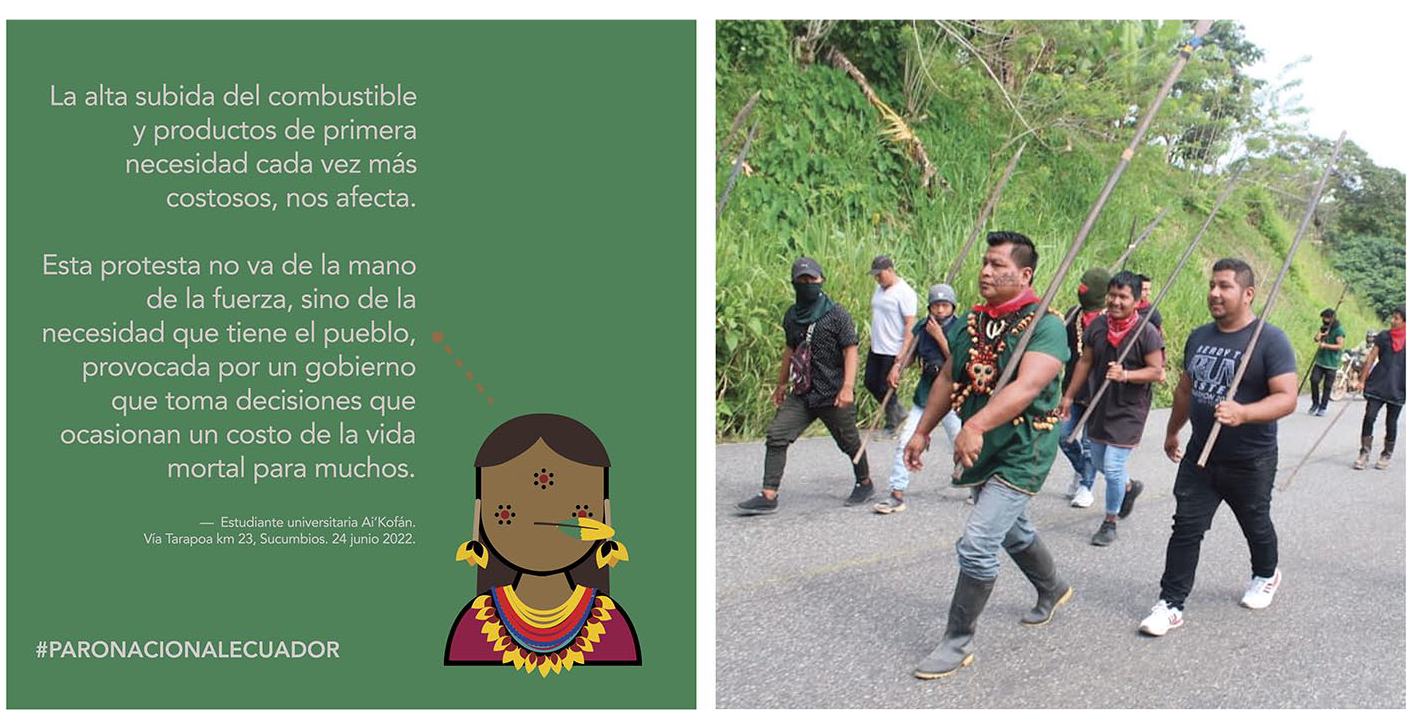
Reportage from Shakira Yumbo, Ai’Kofán co-researcher in Dureno, Sucumbios Province (Northern Amazon Region). Left: ‘The high increase in fuel and essential products prices affects us. This protest is not about using force, but about responding to the needs of the people, caused by a government that makes decisions that have resulted in a deadly cost of living for many.’ Right: Eduardo Mendúa, an Ai'Kofán and former CONAIE leader, is depicted in the photo, wearing a green shirt and holding a spear, leading a popular demonstration. He was later killed for his opposition to oil exploitation in his community territory (24 June 2022). Source: Archive of the project.
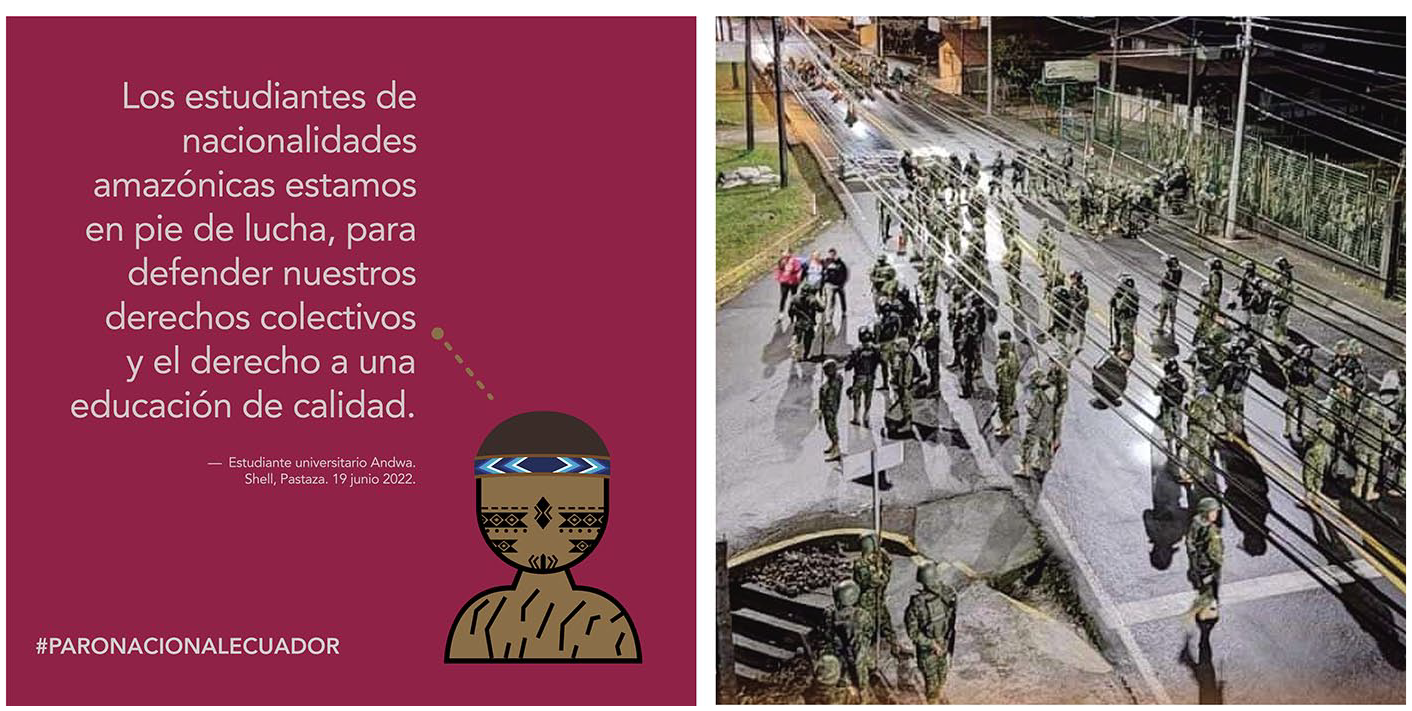
Reportage from Andwa co-researcher Roye Santi in Shell, Pastaza Province (Central Amazon Region). Left: ‘Amazonian nationality students are on the front lines of the struggle, fighting to defend our collective rights and the right to a quality education.’ Right: Photo showing the military intimidating protesters (19 June 2022). Source: Archive of the project.
Images were developed in digital format so that a rapid interchange between reporting, designing and sharing could be achieved. For distribution (Figure 3), we – Efrén Nango and Nathaly Pinto – followed the organic structure of Indigenous organizations. This started with consulting Andrés Tapia, leader of communication of CONFENIAE, who in turn shared the images through CONFENIAE communication social media as well as with Indigenous Community Communicators, Lanceros Digitales. The images were disseminated through respective nationality organizations (for example, in the case of Figure 3: Nawe, Nacionalidad Waorani del Ecuador). In some cases, young Indigenous co-researchers directly shared their own images with their nationality’s organizations.
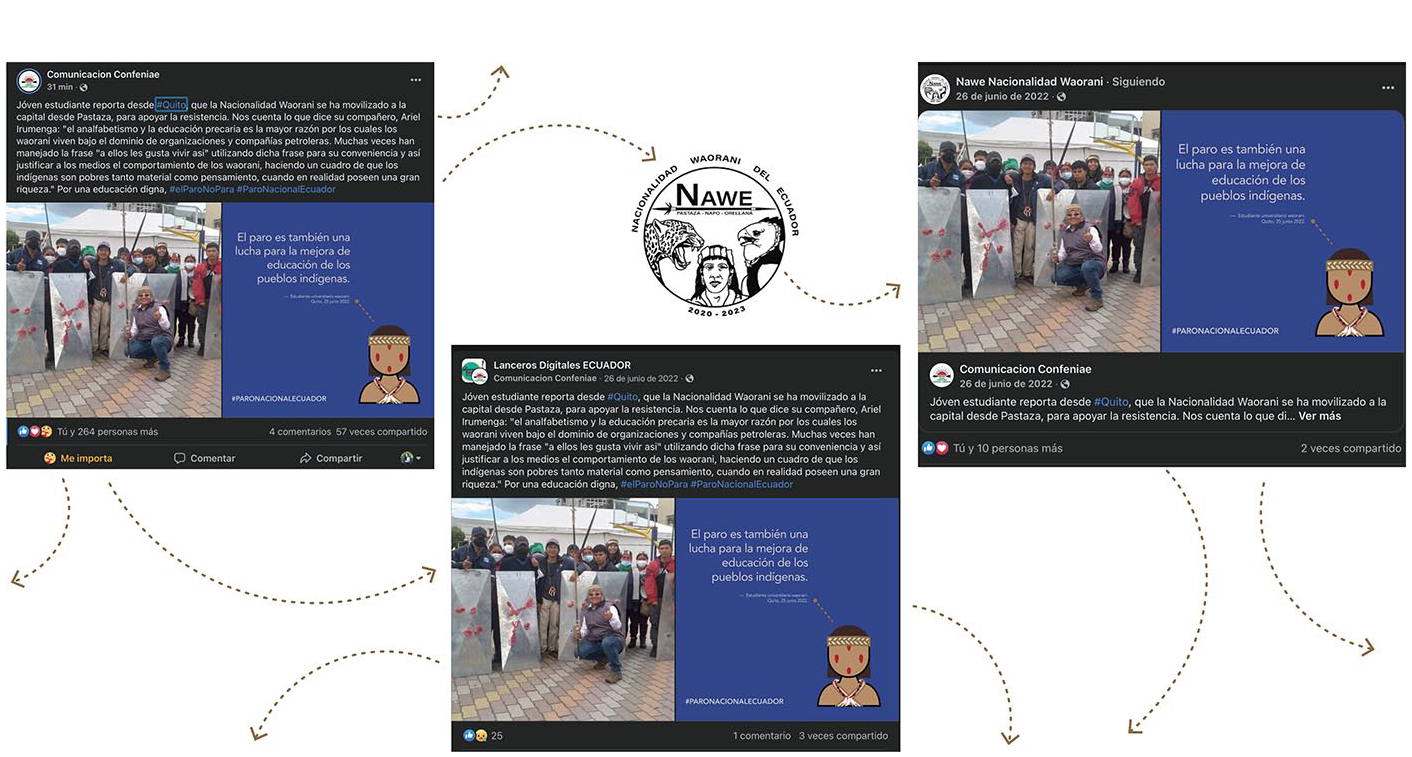
Sample of distribution of images constructed with pictograms and photographs, used by Indigenous organizations. Reportage from Nicxon Nihua, Waorani co-researcher in Quito, Pichincha Province (central Andean Region). Right: ‘. . . precarious education is the main reason why the Waorani live under the control of oil organizations and companies.’ Left: Photo depicting Waorani Nationality members arriving from their territory in Pastaza Province (Central Amazon Region) to support the resistance in Quito (25 June 2022). Source: Archive of the project.
Adding to the community logics that sustained the struggle from the territories and neighbourhoods, artists and designers’ collectives in the cities in Ecuador participated through interventions such as urban art and popular graphics to share on social media (see Figure 4).
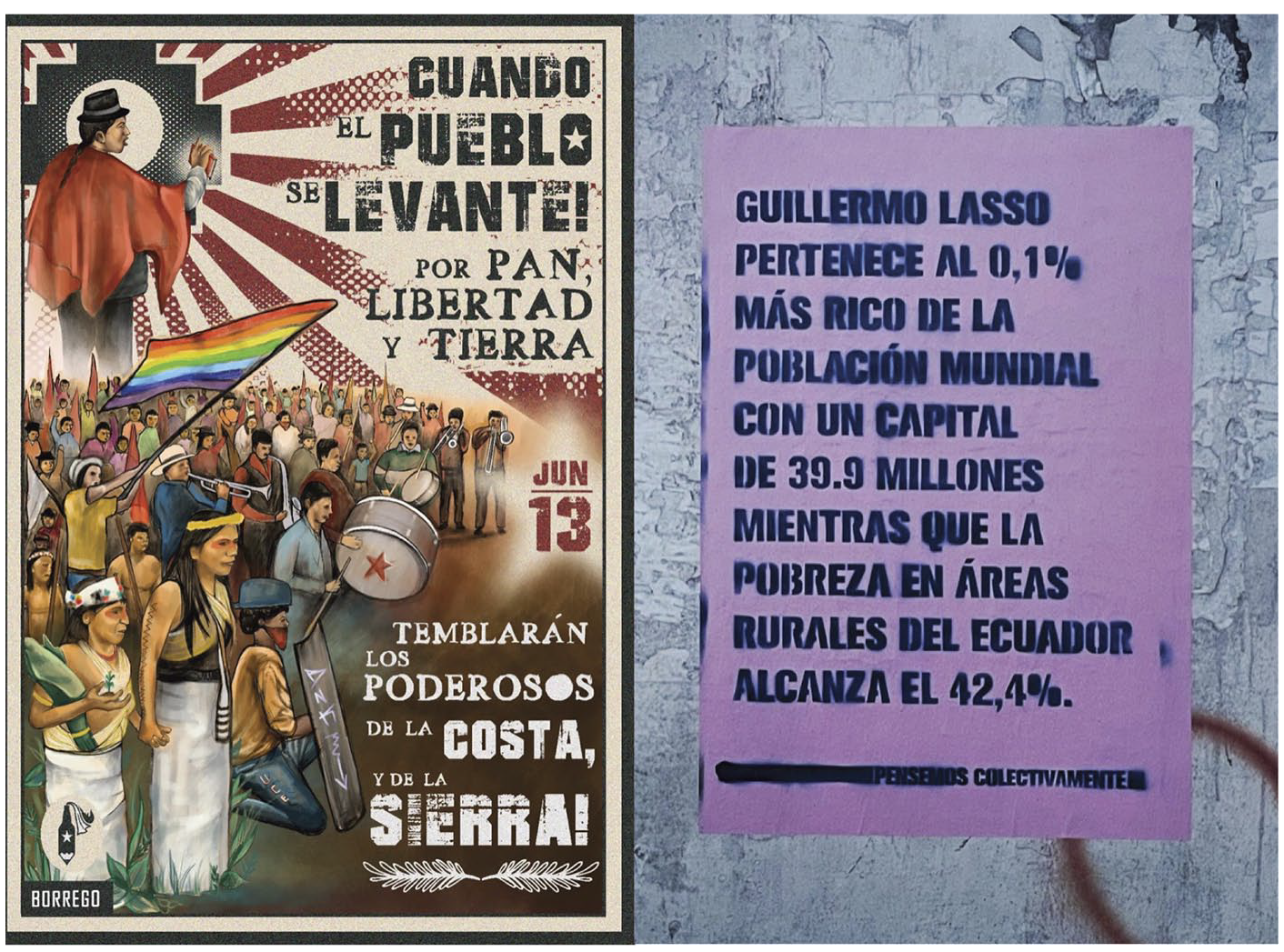
Sample of graphics supporting the Indigenous movement and national strike. Left: Image by Borrego, art worker, close to Ecuador Indigenous movement (Borrego, 2022). Right: David Sur, mestizo visual artist, supporter of the national strike (Sur, 2022).
Between January and September 2021, Amazonian women participated in training schools for female leaders that aimed to strengthen their knowledge, autonomy and skills for meaningful participation in the political governance system of Indigenous organizations. The training process was linked to close coordination with Indigenous Shuar and Kichwa grassroots communities and their organizations, grouped in the three training schools: ‘Yapit’ from Federation of the Shuar Nationality of Pastaza (FENASH-P), ‘Wankurishka warmikuna’ from Kichwa Nationality of Napo (NAKIAN); and ‘Red de Mujeres por la Vida’ from the Federation of Indigenous Organizations of Napo and the Nationalities of the North Amazon that belong to the Union of Men and Women Affected by Texaco’s Oil Operations (UDAPT).
Upon completion of the training initiatives, the next steps involved actions to socialize the experience of politicization and replicate training processes in the diverse Amazonian territories, within a broader network of communities. For this purpose, Nathaly collaborated with women engaged in training schools to develop a methodological guide, Mujeres de las Nacionalidades: Nuestro Método Organizativo (Pinto and Martínez, 2022), that could facilitate the practice of collective actions to strengthen the organizational process of more women – alongside men, communities and organizations.
To support the organizational work carried out by Indigenous organizations through training schools, the guide was collectively developed through a series of workshops and informal interviews guided by principles of popular and community education. These sessions brought together women’s experiences of the Amazonian reality and incorporated accumulated historical learnings from the organizational dynamics of the Ecuadorian Indigenous movement. Through the process of developing a creative workbook, we used pictograms as didactic resources, for example, to design infographics that could facilitate understanding that existed behind organizational actions. In Figure 5, the pictograms were used to convey and explain mechanisms, spaces and instances of organizational actions for resistance for territorial defence. The graphic elements of pictograms included the Shuar aja (an agricultural plot embodying a holistic and sustainable approach to farming, rooted in generations of knowledge, techniques and practices that foster a harmonious connection between the land and the community), the chankin (a basket used for transporting food products for the family) and the wai (a female powerful tool for sowing life, yuca and plants from the aja). These worked to represent and emphasize the role of women as sustainers of life. They also highlighted political actions rooted in civic life, where women, together with men, defend the conservation of the jungle, Indigenous ways of life and advocate for their community demands in the face of extractivist and neoliberal policies of the Ecuadorian government. For the redistribution of gathered knowledge through the process, initially, Indigenous women leaders printed guides that were handed back to the women from the organizations who actively took part in their construction. Simultaneously, the guide was published in digital format aiming to facilitate its copying, distribution and activation, enabling it to reach a wider range of organizations and individuals (see CDES, 2022).
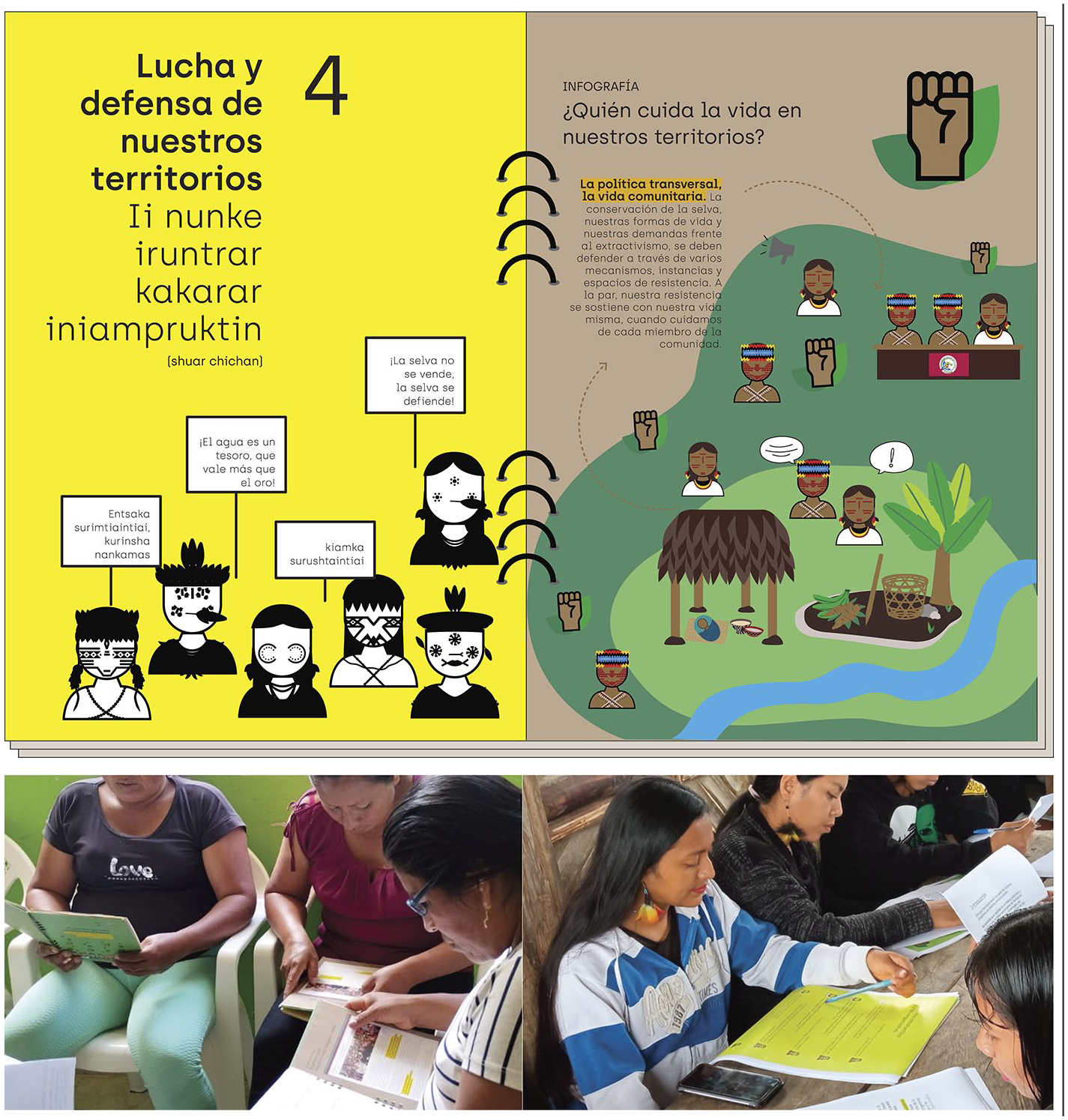
Sample of infographics using pictograms to support Indigenous woman training schools. Pictograms as part of pedagogical material, activated in non-formal education and action spaces. Source: Archive of the project.
The pictograms themselves were created through activities organized and sustained by the first author, Nathaly Pinto, together with university students 3 from nine different nationalities of the Ecuadorian Amazon and representatives of CONFENIAE, the mother organization for Indigenous peoples in the region. Different versions of pictograms were designed and discussed between January 2021 and October 2022 through: (1) joint workshops where different actors work together in the same space, usually for a day; and (2) distributed and virtual ways of designing with each student as co-researchers from each of their territories in the Amazon. After this process of deliberation and learning, Version 6.0 underwent a process of official validation in an Annual Regional CONFENIAE Assembly, October 2022 (see Figure 6).
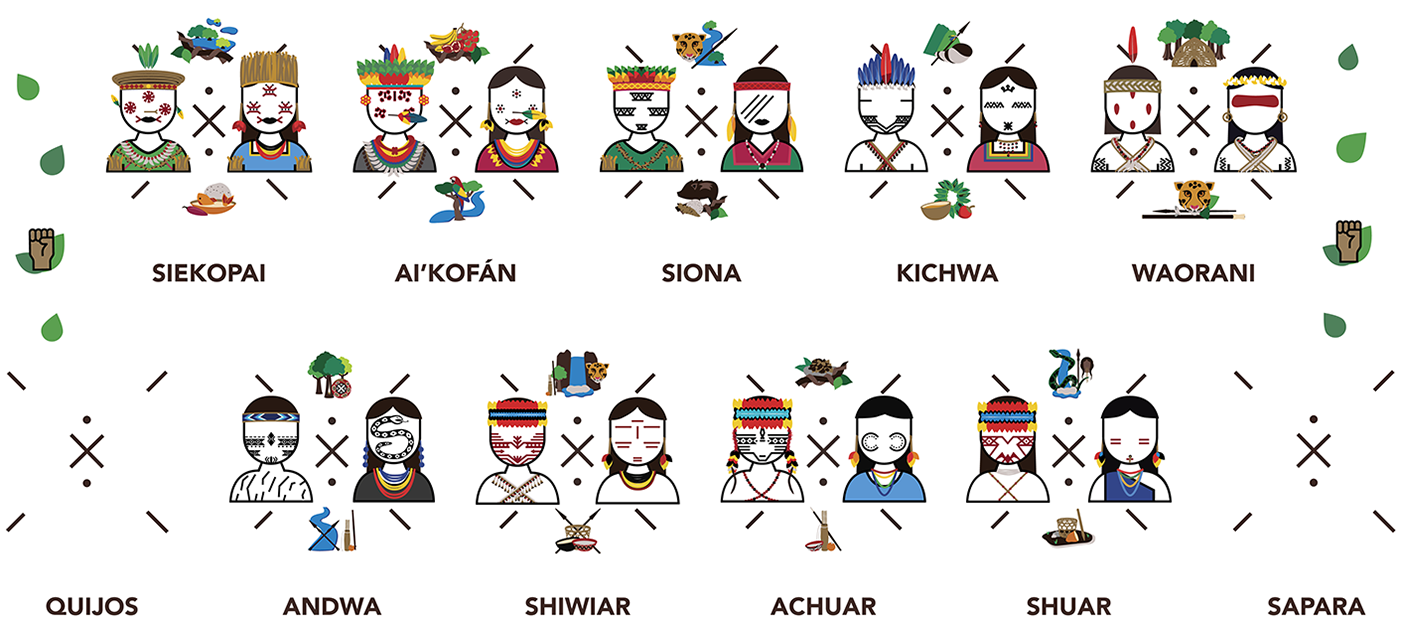
Version 6.0 of pictograms of Indigenous Amazonian nationalities of Ecuador. This is the validated version of the work with students and their communities, after going through an official process of negotiation and public consultation with authorities and nationalities representatives. Quijos and Sapara pictograms are currently under development (see project website, Confenaie, 2022).
Pictograms feature human and nonhuman elements, represented through interdependent sets of images depicting clothing and body painting, rituals and medicine, food sovereignty and flora, and warrior knowledge and fauna, specific to each nationality. Their design is community-based and comprises learnings of co-researcher youth from elders, territory defenders, members and young people from each nationality, incorporating perspectives and experiences from everyone to foster connections between generations and different forms of knowledge. Layered sets of graphics recount and produce memory of complex histories, representing and re-actualizing languages, history and relationships with the territory of each nationality (see Figure 7). Throughout the process, popular education teams, communication groups and Indigenous social movements have been key to sustain, activate and socialize learning and materials (for a full reflection on the design process of the pictograms see: Pinto et al. (forthcoming).
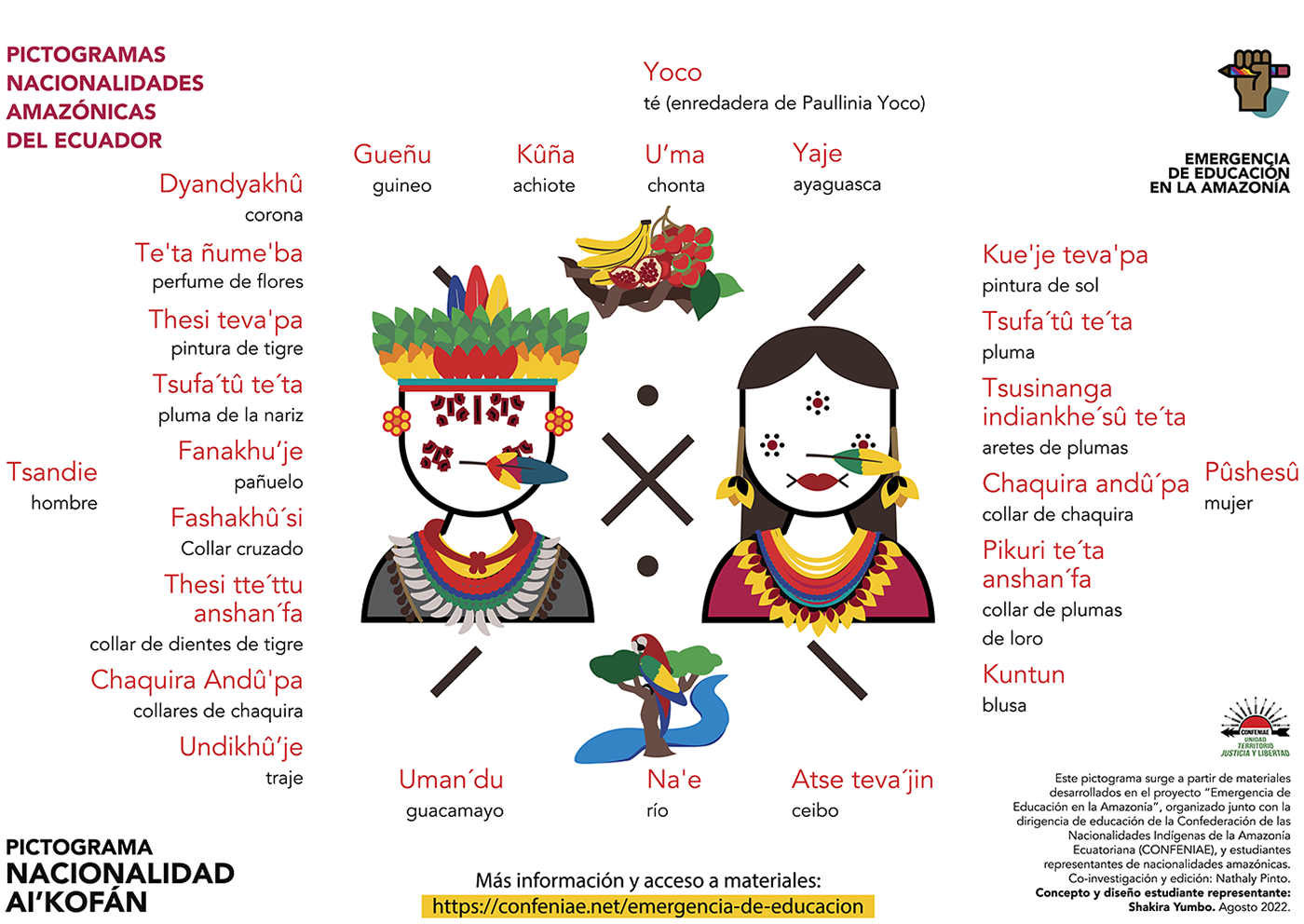
Ai’Kofán Nationality pictogram poster. Pictograms involve working with the language of each nationality as carriers of knowledge, histories and the interconnected relationship between beings and the sustainment of nature. A series of posters for each nationality was designed as educational–communication tools to be activated for situated education actions (see project website Confenaie, 2022).
Through the previous actions, we have mobilized the making, use and circulation of the pictograms to support strengthening the identity and build politicized spaces for education and action for the youth of Indigenous nationalities and their communities. In this way pictograms, as designed visual devices for social change, function as intertwined:
(a) Community-led design processes and alternative ways of production otherwise, that contest dominant systems through the material and discursive re-actualization of situated knowledges in connection to universal historical struggles.
(b) Popular educational and communicational tools, conforming with a visual communication movement in struggle around meanings, and acknowledging that every relationship of hegemony is necessarily a pedagogical relationship, were taking control of learning can effect social change.
Thinking and working with pictograms can be viewed as an iterative process rather than a fixed outcome. Through the use of visual devices, Indigenous communities engage in a critical recovery of practices: learning from experience and producing and sharing knowledge, while simultaneously building material resources to communicate their values, struggles and aspirations to a broader audience, amplifying their voices and advocating for their rights. This creative and dynamic use of imagery reflects the agency and resistance of Indigenous communities as they navigate complex social, political and cultural landscapes. In this way pictograms can be integrated into educational and communicational materials, connected to everyday and concrete life, while the process of pictograms process encourages a critical search to identify universal elements in the local reality, leading to diverse actions in response to shared social, economic, or political challenges.
Amazonian Ecuador and Indigenous resistance
In the Amazon region of Ecuador, in an area of 120,000 km, 2,265,100 Indigenous people live alongside mestizo settlers. The Indigenous peoples of the Ecuadorian Amazon, organized by 11 nationalities, are very different from each other in terms of practices, identity, worldview and language. The Amazon covers nearly half of Ecuador’s continental territory and is a culturally rich and bio-diverse complex natural system that contains productive areas associated with the extraction of non-renewable resources, such as oil. These complex conditions impact the local population, who face unfavourable circumstances resulting from limited access to basic services and coherent sustainable economic and social opportunities. In 2012, 74 percent of its women did not achieve secondary level education with 50 percent in the poorest quintile (Rios-Quituizaca et al., 2022). A further, related challenge is in the remote, distributed and technologically isolated reality of everyday life. According to a study by Luis Canelos, a member of the Kichwa nationality, communities in the region face challenges in accessing internet and telephony services due to their remote locations and limited ICT infrastructure (Canelos Vargas, 2021). For example, access to mobile telephony is less than half among its Shuar populations as compared to Ecuador’s mestizo population (Martínez Suárez et al., 2015). As a result, they resort to different means to access information and communication, with access to state-owned, private or community radio stations being a commonly used option.
Constitutions like those of Ecuador and Bolivia have made significant strides in promoting Indigenous rights by recognizing their countries as pluri-national and intercultural states. Ecuador was the first in the world to legally recognize Rights of Nature and embrace the concept of Buen Vivir. 4 Nonetheless, challenges persist in translating these strategies into practice and various sites of contention or tension exist. One is in the relationships between cultural autonomy and pursuing market-oriented practices within the economic structures of the Ecuadorian nation-state that question notions of ‘indigeneity’. Such practices might include, for example, tourism, intensive agriculture, oil-extraction negotiations, or, otherwise, wage-labour and extractive activities (Buitron, 2020; Valdivia, 2008). Through the 1960s and 1970s, the Ecuadorian state attempted to erase cultural differences and assimilate Indigenous identities into a project of ‘national progress’ (Radcliffe and Westwood, 1996). This included the imposition of a hegemony of mestizo practices and cultural markers. Nevertheless, this also led to greater interaction between Indigenous organizations as they sought to revindicate identities and their differences, for example, through dress, language and food (Valdivia, 2005). Unsurprisingly, this could also, at times, underline disparities, either between them or in their respective relationships with the dominant versions of development. The Ecuadorian Amazon territory is closely related to collective practices of production, where knowledge, food, care and protection are shared, and it holds a significant place in identity and social reproduction of Indigenous peoples. However, this relation also puts them at risk of disappearance or assimilation when their territories are not respected, such as where Western-based education demands that students leave their territories to be close to a university (Pinto et al., 2021).
In the early 1980s, the Indigenous movement saw the maturation of strong intellectual Indigenous leaders and organizations, partially prompted thanks to their inclusion in education. Indigenous people began to reflect further on their identity and assert themselves on two dimensions, the economic and the cultural. Subsequently, each Indigenous nationality formed its own dedicated organization, with their collective of regional organizations represented by a confederation, CONAIE (formed in 1986), that brought together the confederations from the coastal, highlands and the Amazon region. In the case of Amazonian organizations, their confederation is known as CONFENIAE (formed in 1980), which is the mother organization of Indigenous peoples in the region. The establishment of such organizations is a significant intercultural endeavour where nationalities come together based on shared economic, socio-cultural and political strengths, and struggles. As a result, CONAIE, backed by its grassroots organizations, stands as a leading force in Latin America. The organization possesses exceptional capacities for network mobilization, solidarity campaigns, organizational strength and community self-governance, setting it apart in the region.
A key basis for the development of the pictograms that this article centres on has been in sustaining a commitment to tensions through the design research and practice, rather than solving any such tensions arising from their ambiguous and changing circumstances. There is no attempt here to resolve or ameliorate these. Rather, the aim is to contribute to the elaboration of visual devices – the pictograms, that is – that function for and within agonistic spaces of dialogue between Indigenous organizations and their representatives. As such, the work operates within an agreed and shared communicational structure among and between Indigenous nationalities as set out in the next section.
Indigenous community communication and popular education
The Indigenous nationalities of the Amazonian Ecuador have constructed strategies and ways to speak through their regional confederation and nationality organizations. In this, Indigenous Community Communication (ICC) has been a very important resistance tool. ICC is part of the tradition of Popular Communication Studies (PCS), itself known under concepts such as community communication, horizontal communication, participatory communication, communication for development and communication for social change. PCS developed across socio-historical contexts of Latin America and was deployed through independent radio, print and digital formats (Bravo Mancero et al., 2021; Gil García et al., 2021; Tornay Márquez, 2021). As a political–communicational practice, ICC contests hegemonic, mainstream media not just through its content but also through creating participatory and recursive communication spaces (Ávalos, 2022). Like PCS, ICC is guided by three main principles that enhance and are sustained by collective educational experiences of ‘popular’, subaltern Indigenous people: a bottom-up approach embracing diversity of knowledges; a strong connection with social struggles; and an alternative configuration guided by the will of occupying the public debate (Suzina, 2021). Since ICC experiences have been an important aspect of community struggles to defend rights, build a memory and develop Indigenous communities’ own political identity (Ramos Martín, 2018), we deem it vital to link the work at the centre of this article with that tradition.
Formal and non-formal processes of representation of their knowledge, traditions and struggles are linked through actions such as training community communicators, acting as spokespersons and relying on the construction of Indigenous visual and informative media. For example, Voz de la CONFENIAE is an Amazonian journal that ‘counteracts the development of publications referring to Indigenous peoples told “from outside”’ (Muniz and Tapia, 2021).
From a Latin American design standpoint, building these resources requires engaging and learning with local communities, and incorporating situated critical thought and practice. Thus, in design practice and research an ethos of from and with Latin America has adopted methods, concepts and processes from fields such as social sciences and education, drawing on influential scholars like Paulo Freire, Orlando Fals Borda and Boaventura de Sousa Santos (see, for example, Iconoclasistas, 2015; Leitão et al., 2021; Van Amstel et al., 2021). In so doing, designers strive to support the understanding and sustainability of heterogeneous compositions of society (Orellana Aillón, 2020), highlighting how opposition – and even antagonism to homogeneity and consensus – can stimulate an organizing principle of political action that pursues heterogeneity as a transforming resource (Echeverría, 2010; Giroux, 2011).
Nonetheless, embracing particular diversities can dilute their universal necessities, demands and rights. Cultural critics and subalternity theorists from the South concur that, without submitting to Eurocentrism or reductionism, this view supports the idea that common interests and needs that people have across different groups are configured by culture, but not created by them (Chibber, 2013; Echeverría, 2010). This highlights the necessity of a commitment to tensions in the design process beyond including diverse experiences and participants or integrating their resistances (Pinto et al., 2022). Thus design becomes a cultural instrument of struggle when it supports the development of representation resources that emerge from social contradictions. Within this, we witness the design process operating within distinctive notions of historicity.
Historicity
Somos los hijos e hijas del Primer Levantamiento / No se construye el presente sin conocer el pasado / La verdadera historia es la que no nos han contado [We are the sons and daughters of the First Uprising / The present cannot be built without knowing the past / The true history is the one they haven’t told us.] (Popular chant used by the Indigenous movement during mobilizations)
In 1994, CONAIE launched the Indigenous Peoples’ Political Project, called for rights related to traditional knowledge, Indigenous languages, sustainable development, nature, Indigenous medicine, intercultural education and communication rights (CONAIE, 1994; Pertierra and Salazar, 2019). Communication serves as the primary medium for Indigenous self-representation, encompassing diverse media and messages disseminated within communities, among various Indigenous groups and towards the wider society. Thus, self-representation stands as a crucial element within the political and cultural agenda of Indigenous struggles to sustain and re-actualize their own image. Representation is an endeavour undertaken by Indigenous artists, writers, filmmakers and communicators to give voice to the Indigenous experience, knowledge and ontology. Through their work, they challenge the colonial society’s perceptions of Indigenous ways of life, belief systems and identity (Magallanes Blanco, 2020).
Traditionally, representations communicate through visual information such as textile attire, body and facial painting, ceramics and other aesthetic indicators (Figure 8) to express historical identities and traditional forms of social, economic and political organization. In contemporary contexts, Indigenous visual references are present in representative and informational media, such as Indigenous organizations’ identities, visual and written archive of protests, audio-visual productions about Indigenous past and present history, and production for social media of community communicators (Figure 9).
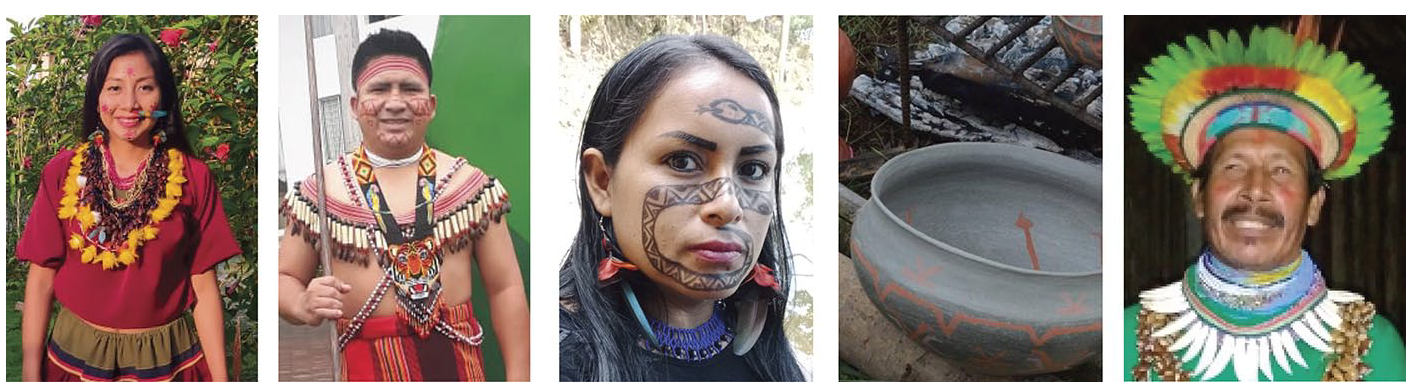
Sample of traditional visual referents: Ai’Kofán attire; Shuar attire; Andwa kwajaker-boa facial painting; Siekopai toyás (graphism or visual designs) represented in ceramics; A Siona bird feather crown with plant and animal-based accessories. Source: Archive of the project.
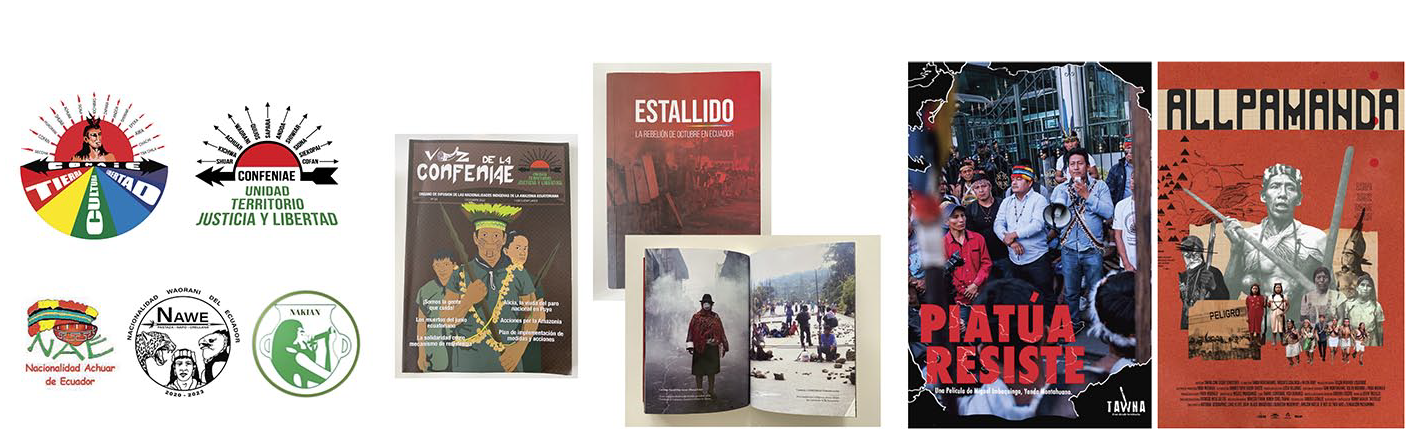
Sample of contemporary visual referents. Visual identities of CONAIE, Confeniae and Amazonian confederations; examples from publications about October 2019 protests in Ecuador: Estallido (Iza et al., 2020) and Special issue of Magazine Voz de la Confeniae (Confeniae, 2022b); posters for cinema with a focus on Amazonian narrative (Montahuano, 2017).
This change of material also opens onto a different set of cultural registers. Thus, for instance, just as the foundation of CONAIE brought in new processes of political organization and communication so new forms of representation and self-representation were generated. An outcome of this is in the pictograms under discussion, whose aim is not to replace traditional or contemporary representations but to complement them with new ones created by Indigenous peoples. In this way, they are required to be responsive to the narratives, visions and modern conceptions that shape the current Indigenous youth. They should not contradict the pursuit of ancestral reaffirmation, but rather embrace new perspectives that align with the current challenges faced by Amazonian society. These additional representations contribute to a collective pool of resources that support and strengthen a counter-hegemonic perspective, based on principles of critical thinking and a decolonial horizon. Thus, in them, traditional forms that derive from Indigenous symbols in, for example, origin myths, mingle with forms that suggest the contemporary interconnectivity of Indigenous nationalities.
Here, we want to push the analysis further beyond ‘old meets new’ or ‘tradition and modernity’ by considering this visual turn in the context of Ecuadorian Indigenous or, even, Latin American historicity. A copious anthropological literature explores the roles of historicity in Latin America and, in particular, in relation to its Indigenous societies (see, for example, Whitehead, 2003). Some of this pays attention to the importance of consciousness of Indigenous societies in relation to their historical background and self-identity, which have been predominantly suppressed by settler-dominated, Latin American nation-states (Whitten, 2008). Historical consciousness therefore becomes a contestation of essentializing, folklorizing and exoticizing narratives of indigeneity that, at the same time, depoliticizes it by leaving out questions of class and citizenship (Echeverría, 2010; Escobar, 2010; Fernández, 2018). The mythologizing and celebrating of a ‘glorious native past’ as against its present may even be folded into a teleological and Western view of history (Huarcaya, 2011; Thurner, 2003).
Crucially for us, also, is how history is conceptualized differently in this push-back. Settler narratives have ordered history in a linear, chronological way to underpin their version of modernity (now as a white-dominated, mostly patriarchal and urban, neoliberal nation-state) as representing teleological maturity. In this, history is not taken to be separate and outside the subject – something to be studied that helps to explain the present, but is taken to be active in the present. A more critical and anthropological view would therefore pay attention to how history is not structured by chronology but, deriving from Levi-Strauss’s (1966) analysis, by ‘myth and affective investment’ (Stewart, 2016: 88). Here, history is active and embodied in the present as an embodied consciousness.
To the Western reader who is used to thinking of history as continuous, orderly flow, this may be difficult to fully appreciate. But in the context of collaboratively designing symbols that are to work as representational devices across and between varying Indigenous societies, this approach to historicity is important. It means that seemingly disparate and even contradictory portions of historical knowledge or cultural and political memory are simultaneously invoked within the processes of generating ideas and synthesizing them into the pictograms. These might include: a political consciousness of the wider Latin American resistance thinking, embracing the ideas of Latin American intellectuals such as Carlos Mariátegui, Anibal Quijano and Enrique Dussel, and practices as inherited through, for example, the influence of Paulo Freire; detailed understandings of political struggles of Indigenous nationalities in Ecuador since the 1990s and the roles, for instance, of territory, self-determination and representation therein; respective origin myths and specific histories of the different Indigenous societies and their environments. All these, and other historical moments, are included in deliberations that are part of the collaborative design processes.
This requires a different conceptualization on the part of the trained designer who is engaged in facilitating such processes, one that is open to a different kind of historical ordering. It also points to the potential for a different positionality of the designer. As we develop in the following section, just as, in Western terms, history is re-ordered in this context, so might the role and aims of designers themselves. Here, we pick up on discussions that take us from design activism to a notion of what has been called ‘militant design’.
Militant design research
A Western teleological conception of history mobilizes it within a narrative of improvement. Past events are invoked in a linear fashion to demonstrate the steady amelioration of circumstances towards a point of maturity. In discourses of design history, this has occurred through the foregrounding of developments towards modernist aesthetics as an expression of the apotheosis of ‘good design’ (Julier, 2014: ch. 3). Even when this formalist historicity is challenged or discarded, then the ambition for solving problems or, at least, making things better persists. In this, Herbert Simon’s invocation of design as ‘changing existing circumstances into preferred ones’ (Simon, 1978:111) still haunts the design bibliography (e.g. Barnett et al., 2020; Verganti et al., 2020; Wakkary, 2021). As designers and design academics in the West have taken on board more collaborative and participatory approaches to co-design, particularly in relation to public-sector, communitarian or activist concerns, the historically-embedded, discursively-driven impulse to ‘be good’, in and through design, persists. To leave behind teleology is to leave behind this unerring quest for optimization. Instead, in the context of operating among Indigenous nationalities in Ecuadorian Amazonia, the activist–academic designer works with a sensibility of co-enquiry and support. In so doing, they occupy a different set of motivations and priorities.
Although certain aspects of the case draw upon platforms and intellectual resources sustained by academic research, given the first author’s affiliations with local and international universities, their connection extends beyond conventional academic engagement and collaborative advocacy. Instead, the project assumes a central role in broadening the horizons of the ‘work’ beyond the confines of activist–academic practice. This expanded approach encompasses a wider spectrum of political involvement and immersive participation, which is better characterized as militant research. Militant research operates in a state of tension with academic demands including opposition and even antagonism towards extractivist traditions that might characterize certain versions of activist design research (Serpa, 2023). This notion of extractivism in research also links to how ethnography might be undertaken among Latin American resistance politics. Valenzuela-Fuentes (2019) reflects on her unease at carrying out ethnographic fieldwork among Chilean activists while taking her data back to a European university for production into a PhD submission. In response to this, a methodological switch takes place where the researcher prioritizes an on-going process of collaboration and solidarity over the abstraction of research data. Therefore, in the Latin American experience, militant research is more than the intersection of academia and activism, since adopting the mindset and practice of a ‘circumstantial activist’ to gather study data does not simply produce militant research (Ross, 2013: 9).
The term ‘militant design’ may be misunderstood to suggest an adhesion to an aggressive and conquering approach to a set of political aims. Instead, we adopt it to separate it from (Western) design activist–academic research. The latter may be characterized firstly by a quest towards immediate problem solving and the discovering of ‘best practice’ ways to do this.
Secondly, it may stereotypically engage a largely extractivist approach wherein socially- or politically-embedded ethnographic or action research takes place primarily to derive research data for the writing of PhDs or academic journal articles rather than for the benefit of the research subjects themselves. The idea of the ‘militant’ researcher has previously been developed in social research from Latin America (e.g. Rojas Soriano, 2000; Sandoval et al., 1972) and in ethnographic studies of global political struggles (e.g. Juris, 2007; Russell, 2015).
In the landscape of Indigenous assemblies, meetings and cultural events in Ecuadorian Amazonia, it is common to encounter a foreign researcher, often of European origin. These researchers eagerly participate, take notes and display an interest in the proceedings. However, the practical, material benefits of such encounters and their subsequent utilization by the communities are rarely observed or experienced. This prompts us to propose an alternative position of militant design. Specifically, we characterize this as committing to tensions to reposition the design research as a creative force and not a mediating, explaining or problem-solving one. This requires stretching academic practicality, that is, taking the time, resources and sensibility for tensions to manifest, with a particular attention to giving precedence to political and everyday actions that address collective needs.
Committing to tensions
Committing to tensions through militant design research and a distinctive conception of historicity, sees heterogeneity as a transforming resource, articulating particular interests to systemic resistance. When designing with marginalized communities, commitment to tensions is expressed in devising ways to avoid diluting contradiction as an action space (Pinto et al., 2022).
In practical terms, this involves adopting an immersive approach that ‘rejects detachment between thinking and doing politics and the understanding of researchers as experts who will explain the movements [we work with] through disembodied knowledge’ (Valenzuela-Fuentes, 2019: 723). This means giving precedence to political and everyday actions that address the concrete collective needs of the people we work with, rather than academic demands that commonly involve long production circles, addressing a particular reduced audience. From a militant design-research perspective, this can involve engaging in activities that some may consider low-brow design, such as jointly designing materials for participatory activities or planning presentations with co-researchers and creating infographics, pictograms, publishing materials and visual content for social media. This gives priority to materiality as legitimate outcomes of research as processes and products are built with the communities we work with and that become their own resources of self-representation – material and symbolic knowledge en masse. Second, the relationships and collective work that allow for the research and more-than-research to happen imply widening its focus from data gathering moments to spaces for sustained collective work.
Here, designing with involves constant stating, planning and reassessing of the researcher’s personal expectation and practical forms of political commitment. This acknowledges a re-assessment of practices where extractivist academics capture critical thoughts forged in the popular struggle by less internationally ‘relevant’ intellectuals and personally gain financial, cultural and symbolic capital thanks to the recognition and certification of [Western] academic centres . . . [and where] as a result, after the intense international tour, the ‘decolonial turn’ returns to Latin America as a prescriptive and idealized explanation of reality, that does not resonate with the contradictory reality being forged at the grassroots. (Serpa, 2023: 5)
Conclusion
While this article centres on the pictograms, we do not offer them as objects of visual culture to be ‘read’ or interpreted, although we recognize the use of focusing on them and understanding something of their iconography as starting points for a wider discussion. Rather, as visual devices, they are moved through and distributed across multiple platforms and cultural–political registers, functioning in various ways. Attempts to fix them – either in their presentation, their use or in their significance – runs contrary to what they are and how they function. Critically, they are to be understood less as historical outcomes and more as open-ended becomings that are produced through multi-layered, multi-sited and heterogeneous understandings.
Nor do we indulge an explanation and analysis of their production as some kind of ‘best practice’ guide to undertaking participatory design with the Indigenous nationalities of Amazonian Ecuador. This seems a pointless or even patronizing task in such contexts where ‘participation’, ‘inclusion’ and ‘collaboration’ are so embedded, naturalized and socially reproduced into processes of deliberation that such words are meaningless. Indeed, we abandon any attempt altogether to create a meta-narrative that is framed by Western solutionism. Nonetheless, we acknowledge that Western design thought leaves its trace as, for example, evidenced in the clean, visual technicality of the pictograms themselves and the graphic design tools and skills used in shaping them.
By critiquing the notion of the activist designer, we draw on a set of Latin-American discourses and practices, re-positioning them as a militant design–researcher. This avoids normative solution-orientation and instead describes an open-ended service-orientation to the political processes of resistance. This is also encouraged by an appreciation of the re-ordering that is at play in terms of the historical processing that is at work. Visual devices supported and linked to the collective memory and historical resistance re-actualize the past as a source of strength, identity and knowledge in the present and for future generations. Here, historicity involves a knowing, if complex, interweaving between Indigenous traditions, Latin American political consciousness founded in resistance struggles and embodied experience of more recent and localized conflicts and advances.
As this work is still underway, we will undoubtedly continue to learn more about the consequences of the processes and understandings that are described in this article. However, for now, we suggest, firstly, that the pictograms acted not so much as outcomes but rather as tools, stimuli, prompts, connective tissues, starting- or mid-points, and as political and politicizing devices. Their purpose has not been to provide visual solutions for externally imposed national identity-making needs. Instead, they have helped in sustaining ongoing discussions and support the community’s engagement with important issues. The process is mindful of and embraces the diversity and unique context of the community while prioritizing support for the community’s demands for universal necessities and rights. The materials created through this process are designed with practicality and immediacy in mind, striving to serve the community’s needs and advocate for broader societal goals.
Secondly, in ‘taking the time, resources and sensibility for connecting to practices, organizational structures, needs and historical consciousness’ of the Indigenous movement (as we stated at the beginning of this article), we re-order the way history influences the design research process. This re-ordering allows different portions of shared history to work in dialogue by prioritizing heterogenic and situated experiences rather than dominant ones and ensuring that everyone involved acts as an historical subject and with a clear positionality.
Finally, embracing tensions within a militant research approach allows for collective knowledge production where researchers also generate sensibilities, skills, language and learnings ‘otherwise’. As designers and researchers, we not only aim, as we stated, to ‘contribute to the continuous construction of Indigenous historical, cultural, and political memory’ through design production but also strive to shape our own non-white-dominated, mostly patriarchal, urban and neoliberal nation-states and their visual and design cultures in the process. The spaces we engage with are not just spaces of education and political action for others; they are also transformative action spaces for us and, in that exercise, to the institutions we are connected to.
Footnotes
Funding
This work was supported by the Ecuadorian National Secretariat of Higher Education, Science, Technology and Innovation – SENESCYT [grant # CZ02-000478-2019].

Notes
Address: Aalto University, Otaniementie 14, Aalto, Uusimaa 02150, Finland. [ email: