




Abstract
While chemical attacks are rare and deemed an illegitimate form of warfare, the attempt to exploit international law in order to license military action is an eerily common custom. The practice of deploying a legal system to promote military objectives is now widely known as lawfare. In this article, the author focuses on what she calls visual lawfare, namely the weaponization of visual documentation used to provide evidence in order to either prove compliance, or to demonstrate violations, of international laws of warfare through appeal to a legal forum, in order to facilitate a military objective. Drawing on endeavours to affect the United Nations Security Council resolutions in the context of the Syrian Civil War, in addition to revisiting selected lawfare scholarship while providing the new concept of ‘visual lawfare’ itself, she expands on how visual evidence is employed or produced to sanction the lawful use of violence while citing international codes of conduct.
Keywords
One of the central factors shaping today’s armed conflicts is what is known as lawfare – ‘the use of law as a weapon of war’ (Dunlap, 2001: 2; Kittrie, 2016: 1). This article zeroes in on the role visual material plays in lawfare. I argue that the mounting instrumentalization of evidential imagery in the service of lawfare demands its own distinction, what I term ‘visual lawfare’: the weaponization of visual documentation to prove compliance or demonstrate violations of international laws of warfare through appeal to a legal forum to facilitate a military objective.
Visual lawfare involves diverse kinds of still imagery and video documentation which are deployed to justify (or condemn) a broad spectrum of military operations. These include pre- and post-war justifications, which affect the function of visual material in the constant tug-of-war over meaning. Visual lawfare’s manifestations may vary. It may take the form of documentation of real occurrences (either contemporaneous or post-hoc), on-site representative improvisations, staged reenactments in operational environments, or complete fabrications of events and scenes. 1
To define visual lawfare and identify its tactics, this article will outline a typology of its various expressions, intended to conceptualize the ever-tightening relations between law, war, and the representations of both. For this purpose, I examine four manifestations of visual lawfare, focusing on attempts to affect the United Nations Security Council (UNSC) resolutions in the context of the current war in Syria (2011–). Widely considered one of the deadliest and most documented conflicts in the 21st century (see Roca, 2017; Van Schaack, 2016: 285), a few key instances are discussed here to shed light on the evolving typology. The article introduces the distinguished types in the order of their level of intervention in war conditions taken for the sake of securing supporting visual evidence. Such activity gradually escalates from the routine repurposing of existing documentation, or its blocking, to conflict provocation, to fully scripting events with the specific aim of influencing the legalities to favour the agenda of armed action.
Section One introduces the first type of visual lawfare: the use of existing documentation for claims of humanitarian assistance or violations of international law by state representatives at the UNSC, repurposed for justifying the violent military operation undertaken. Visual lawfare did not just emerge in the last decade, however. To build the concept of visual lawfare, in Section Two, I revisit lawfare scholarship to foreground its visual outputs, pointing to the second type of visual lawfare: a one-sided filtering of the conflict’s presentation, along with a third type of visual lawfare: triggering an actual conflict situation for the specific purpose of gathering fresh evidence. Finally, Section Three returns to the example of the Syrian Civil War, presenting the rising influence of international law on its documentation, as well as the growing susceptibility of visual records to exploitation as support for further military activities. In doing so, I reveal the fourth type of visual lawfare, the strategy of fabricating counter-evidential imagery. In sum, this article focuses on the Syrian conflict to define and expand the concept of visual lawfare as an analytical lens, which illuminates past, present and future conflicts to produce more accurate research thereon.
Overall, then, I will contribute a new concept to Visual Culture Studies, War Studies and International Law Studies and, more generally, visual lawfare. In doing so, and in proposing these four manifestations of visual lawfare and the tactics they employ, my purpose in this article is to offer an urgently-needed common conceptual language to deal with visual appeals that aim to enact international law as a means of authorizing the use of force. And while adding a crucial factor to the assessment of the evidentiary value of such visual artifacts adopted as proof to influence legal decisions regarding current and future armed conflicts and humanitarian intervention, it also paves the way to a broader understanding of the impact of the dynamic relations between international law as a legal order on our contemporary conventions of representation and vindication for the use of further violence.
Visual documentation presented at the United Nations Security Council to shield military operations in Syria
State representatives debate the justifications of diverse military actions during their deliberations at the UNSC. To do this, their discourse uses the language of international law, but representatives also make their arguments by presenting evidential imagery. The turn to images as a way of justifying lethal attacks is increasingly used at crucial moments, and was prominent in the discussions on the Syrian Civil War. 2 Although it has now largely ebbed, this multi-sided conflict, which began in 2011, is a decade-long furious battle over the capacity to control the country. Despite the violent antagonism, the opposing parties seemed to agree on the underlying conventions of the war’s representation at the UNSC. Before the council, violence is not only conveyed in terms of international law, but illustrated accordingly. While the prospects of an international tribunal prosecuting the criminals in Syria remain dim, visual evidence has frequently been snatched from its slow circulation within the international justice system, and repurposed for more direct military ends to further justify the violence of war.
This use of evidential imagery to legitimize acts of retaliation was especially apparent in the UNSC emergency meetings held at the height of the Syrian conflict. On 21 November 2016, the Syrian Ambassador to the UNSC, Bashar Jaafari (in United Nations Security Council 2016a: 22), furiously denounced his Western colleagues’ representation of the civil war in Syria as a sort of ‘Tom and Jerry cartoon’. He then presented a series of documentary photographs as evidence (see Figure 1): alongside pictures of a devastated building with red stains on its walls described as a ‘school that was bombed in Aleppo’, most notably, was that of what appeared to be a dead child, their face wrapped in white cloth. ‘Yesterday’, Jaafari declared, ‘a new, horrific and premeditated massacre . . . [by] terrorists stationed in . . . [a] neighbourhood of eastern Aleppo launched a number of missiles against . . . schools in . . . western Aleppo, killing 10 children between the ages of 7 and 12 and wounding 59 others’ (p. 23).
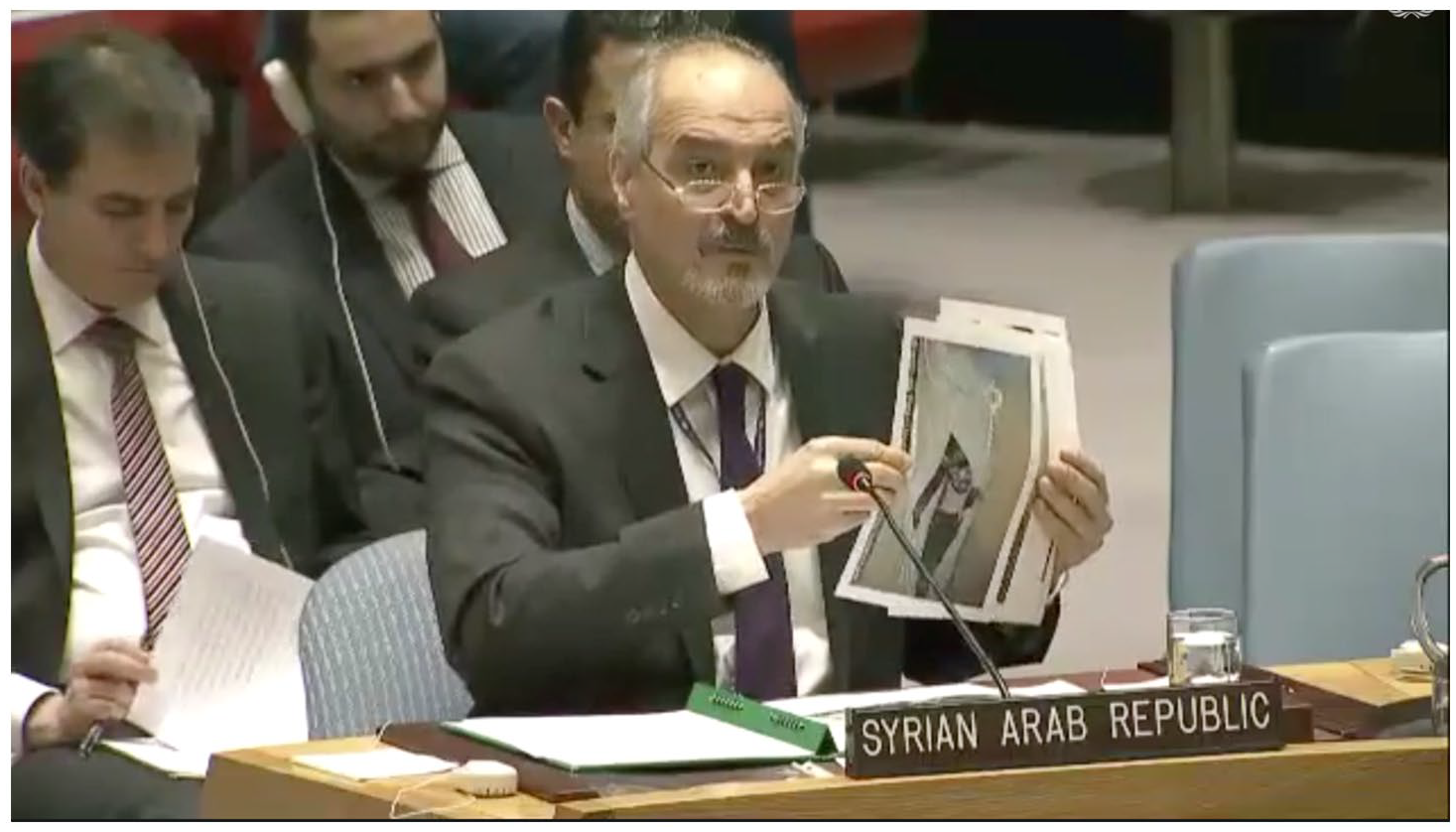
Former Permanent Representative of the Syrian Arab Republic to the United Nations Bashar Jaafari presents a photograph described as that of a victim in the bombing of a school in Aleppo, Syria, 21 November 2016. © UN DGC, AV Library. Reproduced with permission.
The visuals were meant to serve as incriminating evidence of the opposition forces’ dire violations of humanitarian law. The killing of children in a planned assault on a school that at a time of armed conflict should have been reserved as a ‘[zone] of peace’ (United Nations, 2021) is a crime ‘strongly condemn[ed]’ (United Nations Security Council, 1999: 1) by the UNSC. 3 The ambassador was determined to establish the opposition forces’ lack of respect for the rule of law and human rights, as evident in their indiscriminate attacks. This claim was staged to justify the Syrian military’s subsequent Aleppo Offensive (November to December 2016), which aimed to recapture the eastern neighbourhoods of the city – thereby enacting the state’s inherent right to self-defence under international law – and to repel widespread pleas for urgent UNSC intervention against the Syrian regime. 4 Backed by sundry pro-Government forces, the Syrian army waged an intense military campaign that led to ‘ever-worsening human suffering’ (O’Brien in United Nations Security Council, 2016a: 2) marking the culmination of five years of fighting during which an estimated 24,462 civilian fatalities were reported (Grant and Kaussler, 2020: 2).
Evidential imagery was again introduced to endorse the final stages of the military operation. Barely a few weeks later – upon the decisive victory of the Syrian army and its allies in the said battle – Ambassador Jaafari presented the UNSC forum with yet another barrage of visuals (see Figure 2), this time devised to demonstrate that the Syrian army’s objective was the ‘liberation’ (Assad in Reuters Staff, 2020) of Aleppo. Jaafari (in United Nations Security Council, 2016b: 16) described the visuals as follows:
This is what the Syrian army is doing in Aleppo. Here is a picture of a Syrian soldier turning his body into a bridge to help a woman get out of the car that took her out of eastern Aleppo. This is what the Syrian army does. Here is another soldier carrying on his shoulders a civilian woman who was trying to flee from eastern Aleppo, where the terrorists hold sway. Here are Syrian soldiers arranging the distribution of humanitarian assistance to civilians emerging from eastern Aleppo. I have many photos, but I know that time is short.
Throughout the two-month offensive in Syria, Ambassador Jaafari exercised a twofold strategy of visual lawfare at the UNSC. First, he presented damning evidence that the enemy was lawless at the beginning of the brutal operation. The second stage then involved further evidential imagery to prove that the war waged by the Syrian forces was humanitarian. Toward the end of the siege, visuals were brought in to prove the lawfulness of Syrian operations (humanitarian assistance). Jaafari used visuals to explain the unprecedented bombing by Assad’s forces, and to counter reports from the ground about carnage and horrific war crimes allegedly carried out by Assad’s troops (see Hannas et al., 2016). This tactic of advocating that one’s own side is following the law, while denouncing the other side for breaking it, is a hallmark of visual lawfare (see Cheng in Dunlap, 2017: 12). Instead of the photos ‘break[ing] out of th[e] cycle of violence’ (Carville, 2020: 67) and being able to promote impartial justice and conflict resolution, both the images of atrocity and those of humanitarian relief were recruited in support of the Syrian regime’s aggression.
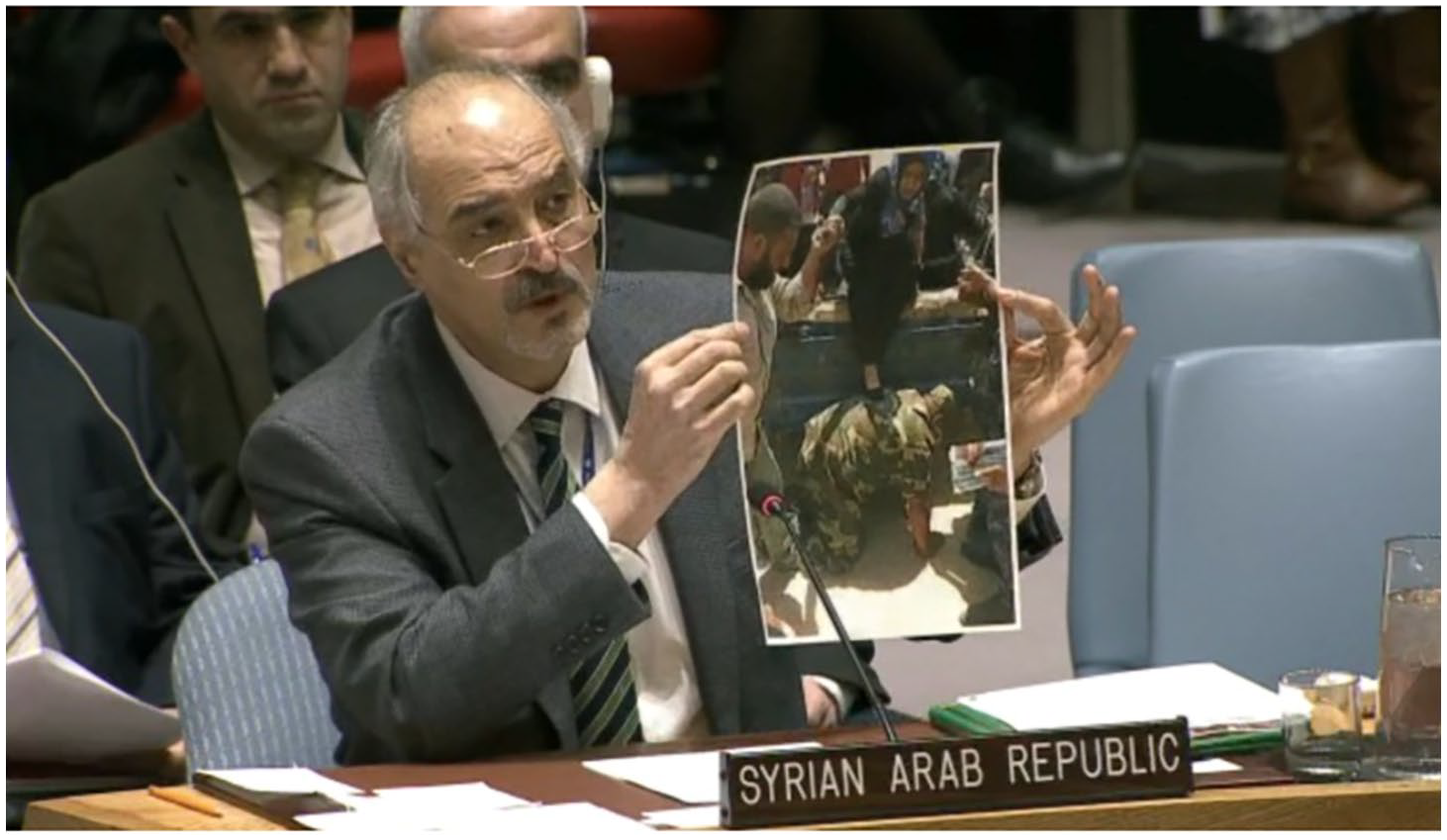
Former Permanent Representative of the Syrian Arab Republic to the United Nations Bashar Jaafari presents a photograph described as that of a Syrian soldier assisting with the evacuation of Aleppo, Syria, 13 December 2016. © UN DGC, AV Library. Reproduced with permission.
For its own part, the West (and especially the US), responded to Jaafari’s allegations by also using visual lawfare to validate the execution of lethal international force against the Assad regime, in the name of ‘peace, security and human rights’ (Haley in United Nations Security Council, 2017: 17. A day after the chemical attack on Khan Shaykhun, a town in a northwestern Syria province, on 4 April 2017 – an event that killed more than 70 civilians and was quickly blamed on the Assad regime (Krishnan, 2017: 139) – the UK and France convened an urgent meeting in which their representatives decisively protested the failure of the UNSC to act despite the mounting visual evidence. 5 Throughout his speech, as if echoing perceptions of photography as what Ariella Azoulay in another context has characterized as a ‘universal tribunal that goes beyond local interests’ (Azoulay, 2008: 121), UK representative Matthew Rycroft repeatedly referred to the evidential imagery illustrating the various reports on the attack carried out the previous morning (see Bellingcat Investigation Team, 2017). ‘History will judge all of us for how we respond to those unforgettable, unforgivable images of the innocent, who had already suffered so much even before yesterday’s attack’ (Rycroft in United Nations Security Council, 2017: 5). Bolstering his colleague’s statements, French representative François Delattre (in United Nations Security Council, 2017: 3) referenced previous visual evidence-based calls for justice that were left unanswered when atrocities had occurred, attesting that the ‘unbearable images haunt our memories’. 6
This line of argument, intent on proving international complicity based on ignored visual evidence, became that much more tangible in the statement by the American representative, Nikki Haley. Taking her European colleagues’ verbal references to the visual one step further, Haley (in United Nations Security Council, 2017: 17) rose from her seat and held up two enlarged images, which she indicated were child victims killed by the devastating chemical substance (see Figure 3). ‘Yesterday morning we awoke to pictures . . . [showing] the visible scars of a chemical-weapon attack’, she declared. ‘Look at those pictures’, she urged the members attending, displaying images that Western media would usually consider overly graphic and unpublishable.
7
‘We cannot close our eyes to those pictures’, Haley continued, calling on the council not to remain passive before the evidence:
The question that the members of the Council must ask themselves is this: if we are not able to enforce resolutions preventing the use of chemical weapons . . . what does that say about our effectiveness in this institution? . . . If we are not prepared to act . . . we will see more conflict in Syria; we will see more pictures that we can never unsee (p. 18).
8
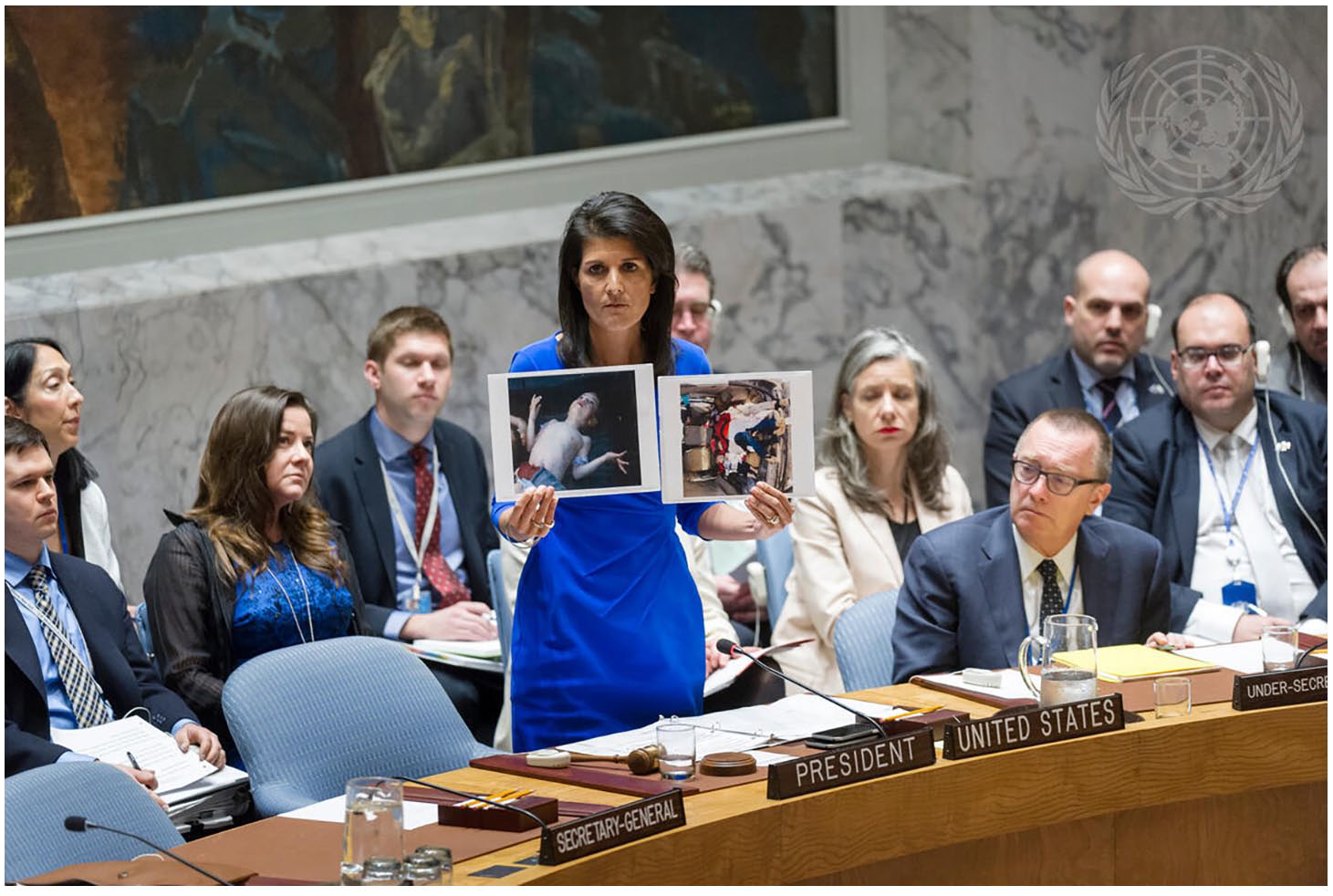
Former United States Ambassador to the United Nations Nikki Haley presents photographs described as those of child victims of the chemical attack in Douma, Syria, 5 April 2017. © UN Photo/Rick Bajornas. Reproduced with permission.
While the media branded Haley’s speech as ‘emotive’ (The Guardian, 2017), and while Jaafari’s display has been discussed in the context of propaganda (Bambury, 2016), it behoves us to regard these exhibitions as political and rhetorical tools served up for psychological effect. What concerns us here is how the evidential imagery in question was weaponized to authorize the use of force. Jaafari sought to establish an alibi to deflect allegations of war crimes committed during the Assad regime’s assault of Aleppo. Yet Haley’s intervention at the UNSC – moreover supported by an eloquent choir of allies – was equally manipulative. It aimed to justify and secure a mandate for the imminent assault by US forces, which was carried out a mere two days later. Led by the Trump administration, the attack was the first such offensive to openly target Syrian government forces since the outbreak of the devastating civil war (Sengupta and Gladstone, 2017). 9
Visual lawfare consists of proof that a threshold has been crossed, thus requiring urgent military action. 10 While the images shown by Haley lack a specific source – and were most probably created by activists on-site and distributed by diverse on-the-ground organizations – Jaafari likewise failed to identify the origin of his evidential imagery (United Nations Security Council, 2016b: 16–17). One of the pictures he showed is particularly instructive, however. It reveals much less about the situation on the ground than the fact that visual lawfare may take advantage of the so-called fog of war and rely upon misrepresentation in order to push forward a policy argument. The subject picture shows a soldier caught in the ultimate gesture of self-sacrifice as he rescues a woman, and was apparently cropped from found footage depicting Iraqi Popular Mobilization Forces in Fallujah some months earlier (O’Sullivan, 2016). The appropriation of evidence of humanitarian compliance from a foreign military force thus exemplifies how visual lawfare repurposes and instrumentalizes images to ward off legal claims that threaten to interrupt the war machine in operation. Taking Jaafari’s and Haley’s respective use of evidential imagery as case studies, we begin to see what they have in common.
Representatives of both sides co-opt unattributed evidential imagery to sanction the use of violence. The results of this co-optation may include the harming and killing of innocent civilians or acts of mass destruction, all while citing humanitarian doctrine. Moreover, Haley and Jaafari illustrate how officials employ secondhand visual evidence for the purpose of visual lawfare, while the source of the visual evidence remains obscured. Whether the visual evidence presented to the council was originally created for legal advocacy or not is a matter for further research, but the fact that such material was displayed for the purpose of validating military operations is hard to deny.
Since its invention in the mid-19th century, photography has been recognized as a viable tool for documenting international conflicts and wars, while meditating ‘the complex interconnections of humanistic and imperial perspectives’ (Kennedy and Patrick, 2020: 1). The rebranding of martial incursions as ‘humanitarian rather than counter-insurgent’ operations is observable as early as the 1940s, in the amateur photography of Dutch soldiers present on the ground during the 1945-1949 Indonesian War of Independence (Protschky, 2020: 269). The US-led coalition that invaded Iraq in 2003 deliberately applied a tactic of ‘humanitarian-related visual coverage’ that rebranded this violent conflict ‘around the rhetoric of humanitarianism, visualizing the “victims” of aggression and their “rescuers” in easily identifiable and moralistically seductive’ (Parry, 2011: 1191, 1198). Media and Communication scholar Katy Parry cites international security theorist James Der Derian to emphasize the contradictory attitude toward the role of imagery when the humanitarian approach is co-opted as a tool for persuading the public opinion of certain acts of violence and their legitimacy (p. 1186). This is the key element of visual lawfare: military actors and state representatives wield evidential imagery to advocate for the use of military force. The important shift visual lawfare offers is that images were no longer meant for private albums or public relations, but were becoming increasingly deployed specifically for use in international judicial contexts.
Fundamentally, visual lawfare emerges as the dynamic system by which imagery is weaponized to license acts of armed conflict under the auspices of international law. Even if the visual evidence is of high quality, it is clearly nevertheless prone to misappropriation and misrepresentation, and thus the integrity of an accusation may be compromised. That is, there exists a type of visual lawfare that weaponizes evidential imagery from conflict sites where the law of war has been violated (or alternatively, proof of compliance with that law) to legally justify a military objective. Next, I explore how visual lawfare also involves image production that internalizes the international codes. Instead of simply manipulating or selectively revealing visual evidence, this type of visual lawfare is not limited to recordings of past or ongoing events but may itself modify warfare and conflict situations to produce ideal visual evidence. This method has grown to become a prevailing channel of representation adopted by national militaries and armed groups, influencing even the very forms of documentation.
The visual in the conceptions and understanding of visual lawfare
Attempts to use visual materials to license military action are eerily common. As legal scholar David Kennedy famously explained, war has become a ‘legal institution’, and contemporary battles are conducted ‘in the shadow of the law’ (Kennedy, 2006: 33, 34). The modern legal terms defining armed conflict include the objective to ‘[protect] persons who are not, or are no longer, participating in hostilities’, and to ‘[restrict] the means and methods of warfare’ (International Committee of the Red Cross, 2014). Despite these declared intentions, Retired General and Professor Charles J Dunlap Jr (2001: 2, 4) calls the use of international law itself as a weapon that is ‘the newest feature of 21st century combat’, defining ‘lawfare’ to mean ‘a method of warfare where law is used as a means of realizing a military objective’. 11 While ‘Dunlap did not coin the term “lawfare”, he popularized its use as a substitute for the word “warfare” in which the conflict is with words as opposed to swords’ (Sadat and Geng, 2010: 157). 12 This shift toward exploiting law to attack or defend a military action has risen to prominence since the turn of the millennium.
Dunlap (2001: 4, 19) warns that making laws part of the arsenal of armed conflict encourages the military to search for ‘technical compliance as opposed to a more expansive philosophical commitment’. He implies that analysing the role of the visual is essential to understanding the trend of lawfare’s growing prominence, and cites the ability to selectively instrumentalize visual evidence. To explain lawfare’s affirmative potential to reduce suffering, Dunlap (2001: 21, note 17) references a US strategy during the war in Afghanistan in what Campbell (2001) called the immediate aftermath of media reports of ‘heavy civilian casualties’. Instead of exercising the ‘legal power’ of ‘“shutter control”’ over war images – an act that might have been challenged under the circumstances – the US pre-emptively bought exclusive rights to all pictures created by commercial satellites covering the area, thereby using a purchase contract as ‘a legal “weapon”’ (Dunlap, 2001: 21, note 17, 2009: 35, 2010: 123, 2017: 17; Campbell, 2001). 13
Later, Dunlap refined the definition of lawfare, suggesting it was ‘the strategy of using – or misusing – law as a substitute for traditional military means to achieve an operational objective’ (Dunlap, 2008: 146). Again, he cited evidential imagery as a case in point, looking to the military lawfare ‘“defeat”’ in the ‘exploitation’ of circulating images depicting American torture of detainees at Abu Ghraib prison in Iraq (Dunlap, 2009: 34).
14
Dunlap’s examples demonstrate that effective lawfare is manifested in the ability to master visual evidence, increasing protection and reducing suffering not necessarily by limiting violence, but rather by limiting its representation. ‘The war image in particular comes guaranteed by the full faith and credit of the sanctioning government that allows it to be seen’, Visual Culture theorist Nicholas Mirzoeff (2005: 77) suggested when reflecting on the history of state empowered visual policing. Specifically, in terms of the typology discussed here, the US military’s efforts to screen evidence of violations carried out by its own personnel is the type of visual lawfare that weaponizes the law of war to filter against self-incriminating visual documentation from conflict sites in the service of a military objective. This type of visual lawfare appears also in other various interpretations of Dunlap’s definition that continued to widen lawfare’s scope. In his work on Israeli military operations in Gaza, communications scholar Marouf Hasian Jr suggests that the lawfare should include ‘all militarized legal rhetorics’ (Hasian, 2016: 21, emphasis in original). Hasian cites the Gaza Freedom Flotilla incident among his examples of violations carried out under the auspices of lawfare. In the course of the Israeli military raid on the 2010 humanitarian flotilla that sailed to protest against the jointly enforced Israeli–Egyptian blockade of the Gaza Strip, 10 activists lost their lives, and the military indefinitely seized all documentation from the ship’s passengers upon boarding the flotilla’s vessels (Amir, 2014: 720). Hasian claims that Israel imposed a three-day detention period on the participants in order to gain enough time to be able to edit and then broadcast doctored clips of the confiscated footage in the media, for their own propaganda purposes.
15
It should be noted that regardless of whether the handpicked visuals released by the Israeli military were broadcast in an effort to sway public opinion in the media, the images were indisputably substantial visual evidence in later official national inquiries, used in a bid to shape the actual judicial outcome.
16
Taking the argument beyond media lawfare, legal scholar Gregory P Noone focuses on lawfare as a form of ‘strategic communications’, defined as
processes and efforts to understand and engage key audiences . . . to advance national interests and objectives through . . . the supporting capabilities of Public Affairs, aspects of Information Operations principally Psychological Operations, Military Diplomacy, Defense Support to Public Diplomacy, and Visual Information (Noone, 2010: 73, 79).
Like Hasian, Noone (2010: 82) refers to the flotilla case; however, according to him, it demonstrates instead the intention of the organizers to film the Israeli military violating international law, and therefore their scheme should be considered as a lawfare-designed initiative. Irrespective of the fact that the two authors disagree regarding which side is culpable, they both highlight how the Gaza Freedom Flotilla incident serves as a critical example for the way humanitarian law influenced the strategy of the parties involved in dealing with images and recordings, not only during the event itself, but likely from the planning stage. Here, we can identify another significant type of visual lawfare, not merely as a method of limiting or repurposing war documentation, but as an active generator of conflict situations. According to Noone, one of lawfare’s tactics is to set the conditions for an ambush that allows one to capture the adversary in an act of breaking international law. To illustrate his case, Noone describes an instance in which American soldiers in Iraq were shot at from a mosque’s minarets – in a clear violation of International Humanitarian Law – with the specific aim of triggering return fire for the sake of documenting the incident. Both of the examples used by Noone (the Gaza Freedom Flotilla and provoking American return fire in Iraq) epitomize the type of visual lawfare that weaponizes an initiated performative event in order to create visual documentation with a specific objective (whether that objective is military action or military inaction). These events may differ on many accounts – intent, scale, measure of transparency, level of manipulation, level of violence involved in participation, outcome, etc. – but both present an orchestrated provocation (and possible confrontation) aimed at invoking international law, while their declared goal remains to produce authentic visual evidence on-site. The emphasis is on the creation of semi-fictive spectacles of (in)justice that artificially reenact and dramatize the laws of war. In this sense, the law of war turns into a lethal medium that shapes destinies in scenes of battle. The endeavour to capture evidential imagery that illustrates an offence encapsulates how the laws of war are incorporated as a set of cinematic limitations on war conduct. Hence, the laws of war produce action movies of a sort: instead of special effects, however, live ammunition is involved. International law is adopted as a kind of script for the staging of its violation, an act that can therefore affect how the fighting unfolds.
In this case of visual lawfare, the line between law and script becomes blurred, whereby false perspectives and optical illusions are deployed to craft a specific visual record. Promotion of militarism through fiction is addressed by scholarship that confronts what is known as the ‘military-industrial complex’, and as the ‘“Military-Industrial-Media-Entertainment Network”’ (Kaempf, 2019: 542, 543). For example, the disturbing collaboration and ‘mutual exploitation’ between the US army and Hollywood (Phil Strub, Head of the Pentagon Hollywood Liaison Office, cited in Kaempf, 2019: 542; see also Der Derian, 2009) reflects these concepts. In his critical research, political scientist Sebastian Kaempf (2019: 542) unpacks the growing extent to which ‘key military actors view the conduct of war as an arena that stretches well beyond the actual battlefields and includes the production of war movies, reality TV series, film documentaries, computer simulations, and first person shooter video games’. Some expressions of this phenomenon have also become known as ‘militainment’, defined by the Princeton online dictionary as ‘entertainment with military themes in which the Department of Defense is celebrated’ (WordNet in Stahl, 2009: 6) or later as ‘state violence translated into an object of pleasurable consumption’ (Stahl, 2009: 6). While some of the manifestations of the entertainment industry probably inform the practice of visual lawfare – which also includes the acts of non-state actors – it should be noted that the primary focus of this article is not on attempts to use mass media to affect or even manipulate the narrative and public opinion, nor that of commodifying a preferred image of conflict while capitalizing profit for private producers. I contend that visual lawfare is a unique form of legal–visual belligerence. It is based within the specific mediums of the visual and that of international law, and the dynamic between them affects both content and form of each in turn. More than sending a message, visual lawfare seeks to introduce evidential imagery in an effort to tilt the scales within given legal settings. Importantly, whereas visual lawfare may be confused with media-driven propaganda – owing to their often-common political aims and desired impact, and to the fact that in many cases the overlapping use of the same images for both legal advocacy and for influencing public perception blurs their discrete spheres of representation – the two are distinct. Since visual lawfare first and foremost addresses legal bodies, these determine its primary visual principle, and hence the images cannot be read and interpreted comprehensively without acknowledging the laws of war that inform, modify, and in some cases shape it. While the practice of using visual documentation continues to appear among lawfare’s growing literature (for example, Newton, 2010; Tiefenbrun, 2010), the systematic and distinctive analysis of its visual strategies and their implications remain largely understudied. This overview of how visuals are presented within lawfare scholarship has shown us not only how visual lawfare has its share in the construction of war’s visibility, but also in the gap that lawfare opens between image and law, and between conduct and representation.
Syria’s visual archive of war crimes and its supporting fiction
The destructive and chaotic struggle over physical control that has decimated and marred Syria coincides with a constructive struggle undertaken by all involved to produce, out of the rubbles, not just visual evidence but also counter evidence that speaks the language of the law of war in a bid to legitimize their respective military operations. While civilian survival is in constant jeopardy and the state falls into ruin, the war is not simply preserved through its documentation as it unfolds. Rather, the war’s presentation is modelled on the interchange and contrast of war crimes and humanitarian assistance. This dichotomy sometimes gives rise to multiple layers of visual co-productions involving state and non-state actors which, even if intended to promote justice, may be co-opted for further military justifications.
The origins of ‘humanitarian photography’, defined by Fehrenbach and Rodogno (2015: 1) as ‘the mobilization of photography in the service of humanitarian initiatives across state boundaries’ have been traced to the late 19th century preceding even the appearance of the modern human rights legal framework in the post-WW2 period (Linfield, 2012: 48; Sliwinski, 2006b: 333–334). The process of visualizing the violent conflict in the language of international laws – whereby the impact (and significance) of imagery is frequently defined in relation to war crimes – is especially unique in the case of the Syrian Civil War. The accelerated implementation of the laws of war as a filter for the documentation of the ongoing conflict began soon after the original 2011 protests started to spread across the country. Only five months into the regime’s brutal suppression of the public demonstrations (which eventually led to the outbreak of civil war), the UN Human Rights Council set up an international commission of inquiry to keep track of the deteriorating situation. 17 The committee members were forbidden from entering the country and were restricted to monitoring functions only, and so in an effort to bypass the government’s media-control policy, the commission was compelled to rely predominantly on grass-roots reports (Rankin, 2018: 394; United Nations Human Rights Council, 2021). As a direct consequence, a new model was soon introduced, recently named ‘entrepreneurial justice’ by legal scholar Michelle Burgis-Kasthala (2019: 1167). In the entrepreneurial justice model, private organizations secure evidential imagery and material outside the scope of existing legal bodies, delivering it to outside judicial groups or entities, thus providing evidence which can potentially hold governments accountable. 18
Under this broad goal of evidence gathering, as the civil war evolved, a growing number of Syrians (some just escaped from battles) were trained in international criminal law and the evidentiary rules of international courts and tribunals with the intent of sending them back to the front lines to obtain real-time legal documentation. 19 These civilians were equipped with a background of historical lessons – from Nuremberg to Iraq – and sensitized to distinguish between types of evidence that involve criminal liability. Leading humanitarian law experts and veterans of war crimes tribunals (Rankin, 2018: 400) provided continuous mentoring and, using this ‘novel approach’, a mass of evidence of crimes against humanity began to pile up (Taub, 2016; see also Hajimatheou, 2021).
The aim of visual evidence is not simply to ‘rais[e] awareness’ of crime but to qualify the conviction of top-state actors (Taub, 2016; see also Hajimatheou, 2021). The dominant conventions of representation shifted from a ‘citizen journalist’ model that emphasizes communication, to the non-conventional training of ‘Syrian non-state actors’ as ‘international criminal investigators’ (Rankin, 2018: 396, 399) in an effort to prepare cases for future prosecution. The process was intended to ‘[change] how war crimes are documented’ (Roca, 2017). According to human rights scholar Beth van Schaack (2016: 285, 284), it facilitated a growing catalogue ‘of almost every war crime known to humankind’, turning the Syrian war into ‘one of the most well-documented international crime bases in history’. Moreover, documentation of the patterns of war crimes not only bring foresight to the recording process, but also affect its preservation. Trained Syrian refugees were positioned to sift through the vast visual archive emerging from the country, and aggregate the ‘video evidence’ deemed relevant to the cause (Borger, 2015). Concomitantly, new artificial intelligence software was deployed to comb through visual databases and detect the regime’s violations, so as to establish systematic abuse claims (Hao, 2020). 20 With this objective, evidential imagery is no longer simply accurately recording the events as they unfold, but is instead re-cast as forensic: capturing breaches of the laws of war, and turning the war zone into a crime scene where non-state actors monitor violent anomalies and pre-defined atrocities.
Undoubtedly, applying international criminal law to frame the depiction of the Syrian Civil War does not by any means entail its employment for military ends; in fact, it has already been shown to open legal avenues when used in domestic proceedings for proving individual accountability for the grave crimes committed (Hubbard, 2021). On the ground, however, evidence is often produced under fire from both sides and, despite their humanitarian mandate, those conducting this impartial documentation regularly require protection from the fighters themselves. 21 Although the Syrian government is generally considered to be responsible for the majority of the crimes committed so far during this protracted war, it is widely agreed upon that all the armed parties involved in the conflict have violated international law and committed gross war crimes (Charbonneau and Nichols, 2014). 22 Given the utterly extreme condition of aggression, sometimes it can be difficult to distinguish evidence production from warfare interests (UN Web TV, 2018). In addition, while the international legal bodies have so far failed to provide a platform for prosecution, we meanwhile witness how visual evidence is deployed at the UNSC to legitimize the adversaries’ military actions.
Thus, while the armed parties continue to exchange fire, another form of aggression seeks to target the tenability of visual evidence presented to support their interventions. This reveals another type of visual lawfare that weaponizes an initiated documented event for the production of visual evidence to contradict an existing visual documentation that has been presented as evidence for violations of the laws of war. In a striking example of this kind of visual lawfare, a filmed testimonial campaign was promoted by the Russian UN Ambassador in a bid to undermine the credibility of certain visual reports submitted by NGOs on the ground in the first accounts of the chemical attack in the city of Douma. The incident marks the pinnacle of the complexities of representation and international law in the war in Syria. On 7 April 2018, reports of a chemical weapon attack carried out by the Syrian regime in Douma were accompanied by graphic videos, specifically one showing children being frantically treated in what appeared to be a hospital or other facility containing medical devices, and packed with injured victims (The Guardian, 2018).
The video was made and distributed by the so-called White Helmets (also known as Syria Civil Defense), an organization of volunteers (funded by the UK and the US, among other Western governments) operating in rebel areas in Syria. The White Helmets’ dual mission has been described as providing rescue in areas of conflict while also documenting ‘what is taking place within the country via handheld and helmet cameras’ (Solon, 2017). 23 Only a few days after visuals from the attack began spreading, Russian UN ambassador Vasily Nebenzya declared that he was distributing a filmed testimony among UNSC members, while planning its formal screening at the council, and disseminating a document that would refute the veracity of the previous claims regarding the chemical attack (TASS, 2018; World News Today, 2020). In the filmed testimony cited by Nebenzya, the ‘[11]-year-old . . . Hassan Diab’ in the White Helmets video from the hospital was ‘made to pose as a victim’ (The Straits Times, 2018; see also TASS, 2018). Stitching together scenes from the original clip alongside the newly recorded testimony, Diab attests that in reality it was a coerced performance, and that for his staged participation, he was rewarded with ‘“dates and cookies”’ (TASS, 2018). First aired on the Russian state-backed news channel Ruptly TV, the testimony was also followed by images purportedly showing the subsequent airstrikes by Western militaries, with the reporter emphasizing that it was ‘these scenes [from the hospital video] [that] convinced three countries [France, the UK and the US] to launch cruise missiles at Syria’ (RT, 2018). 24 The broadcaster was described as one of the Kremlin’s ‘main drivers of political warfare against the west’ (Polyakova and Boyer, 2018: 4; see also Mackey, 2018), and is considered one of Russia’s tools for executing its ‘hybrid warfare’. 25
In his commentary on the different manifestations of lawfare, Dunlap recognizes the uniqueness of the Russian case, where lawfare acted as a legal element of this ‘hybrid warfare’ that combined ‘“traditional forces governed by law, military tradition, and custom with unregulated forces that act with no restrictions on violence or target selection”’ (Army Doctrine Reference Publication in Dunlap, 2017: 12). Journalist Robert Mackey alleged that Russian authorities were clandestinely and dubiously involved in the production of Diab’s testimony (similar to the Russian collaboration with the Syrian military) (Mackey, 2018). Mackey suggested that, despite a facade of a spontaneous expression claimed to be taken at the child’s hometown in Douma, Diab was in fact secretly filmed at a closed military facility in Damascus frequently visited by Russian military advisors. 26 Moreover, it was after that the video provided by the White Helmets was included as substantial evidence in the Organization for the Prohibition of Chemical Weapons (OPCW) report on the attack that the Russian–Syrian involvement in Diab’s testimonial production was brought officially out in the open. In response, on 26 April 2018, Russia flew Diab together with a group of Syrians to The Hague to publicly convey their testimony with the declared aim of proving the ‘disrespect’ (Shulgin in Ruptly, 2018) to international law, and the other subsequent violations carried out by the US and its allies regarding their intervention in the Syrian war, in particular as manifested post-Douma massive bombardment targeting the Syrian regime that again cited the online reports as its catalyst (see Figure 4).
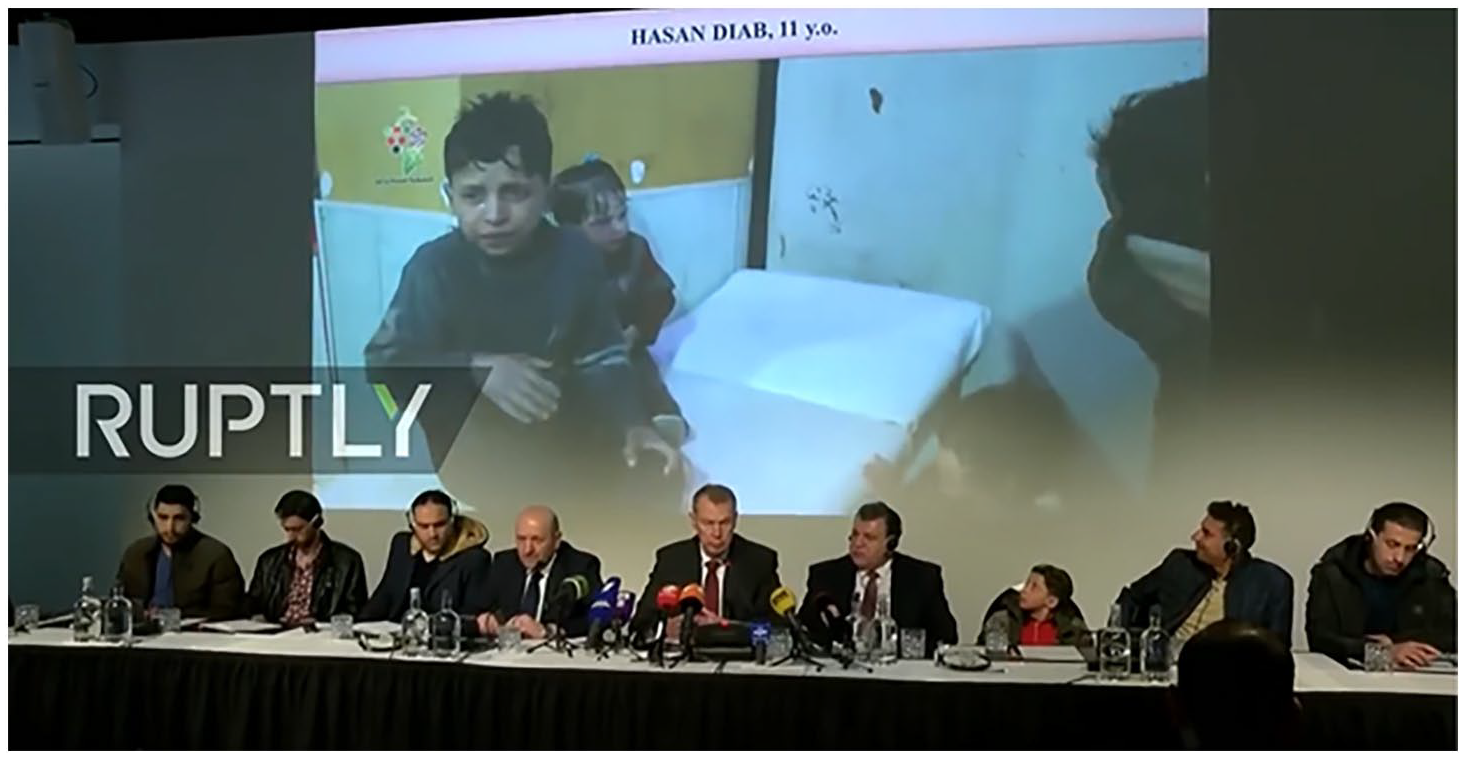
Russian Delegation to the Organization for the Prohibition of Chemical Weapons (OPCW) brings Syrian civilians to The Hague to testify against what is described as an alleged chemical attack in Douma, Syria, 26 April 2018. © Ruptly. Reproduced with permission.
Russia’s permanent representative to the OPCW, Alexander Shulgin, decisively claimed that ‘the primary argument they used to explain their desire to strike against Assad was [the hospital] video’, a ‘sloppily staged video . . . [used] as a pretense for strikes against Syria’ (Shulgin in Ruptly, 2018). Shulgin stressed that the phenomenon of the US legally qualifying its attacks while citing visuals as evidence has turned into a recurring pattern, claiming that
they followed the same operation . . . they used last year . . . as always they have shown these [documentations of] so-called victims, very young victims of chemical weapons, a year ago it was reported that these photos of suffering children have terrified Donald Trump and this is why he ordered missile strikes (Shulgin in Ruptly, 2018.)
In reference to the earlier chemical attack, and soon after Haley’s presentation of visuals at the UN council, the White House announced that Trump’s decision to launch the missile strike at the regime was prompted by the sight of ‘“disturbing and tragic”’ photos (Blake, 2017). Recorded with a marked emphasis on being broadcast ‘live’ (Ruptly, 2018) by the same Russian state-backed news agency Ruptly TV – as if to invoke high standards of documentation integrity and transparency 27 – the conference itself was yet another well-planned example of (counter)visual evidence production, and chose the ‘legal capital of the world’ (Shulgin in Ruptly, 2018) as its arena for presenting the irrefutable ‘truth . . . from the people . . . on the ground’ (Obeid in Ruptly, 2018). 28 The aforementioned Syrian survivors of the Douma attack voiced their testimony one-by-one, so as to create an eyewitness record of events, which was globally distributed via YouTube.
In reality, as with Diab’s first filmed testimony promoted by the Russian ambassador in the UN, their testimony was not so much to bear witness to one of the cruellest wars of the 21st century, as it was corroborating the fictive and inauthentic nature of the documentation of ongoing war crimes in the Syrian Civil War. Rather than convey their personal perspective of the war, they were brought in to deny its visual record. Officially presented as ‘real people . . . who were on that film’ (Shulgin in Ruptly, 2018) the Syrian witnesses were adroitly chosen to demonstrate that the influential visual evidence prompting the later US bombardment (the hospital video) was instead a set-up. As they delivered their statements with the original footage in the background, they were asked to point at the screen and re-enact the fabricated performance of a chemical attack. The result was that the human disaster itself was completely sidelined by the debate over the falsification. 29 The idea was to transmit their live memories from that fateful night in a bid to prove the fabrication of evidence, and validate a supposedly accurate re-representation.
The testimonies of these handpicked eyewitnesses are a chilling demonstration of how visual evidence is thus produced to frame the horrors of warfare, and how this can accelerate injustice as part of the strategic battle over documenting legal justifications for the use of armed force. Diab and the group of witnesses – irrespective of whether they are relating their authentic experience or defending a false narrative – are more like staged heroes performing a script to prove a violation of international law in the course of manufacturing visual evidence. The production of evidential imagery devised to discredit the White Helmets hospital video belongs to a very specific kind of image construction, one co-produced by both state and non-state actors, in a murky collusion that draws on international law in order to justify further acts of war. A report produced by the Center for European Analysis (2021) assessing Russia’s hybrid warfare tactics indicates that, within this framework, Russia made strenuous efforts to ‘whitewash its violations of international law’ (Polyakova et al., 2021: 7). Experts have claimed that Russia adopts a ‘chaos-seeding strategy’ (Jensen and Doran, 2018: 35), activated with the goal of ‘undermining’ Western alliances and ‘political systems’, adopting tactics that involve blurring the lines between fact and fiction (Polyakova et al., 2021: 2). Interestingly, at the UN council, just before presenting the visual evidence, the Syrian ambassador blamed the West (specifically France, the US and the UK) for ‘sowing moral confusion’ in an attempt to discredit his position (Jaafari in United Nations Security Council, 2016a: 21).
Looking at the battle over war crime evidence in Syria through the lens of visual lawfare offers a clearer view of how international law gains prominence as a channel for documenting grave violence. War records are produced according to legal criteria. But, as the horrific violence soared in the Syrian theatre of conflict, we witness how the law of war not only falls drastically short of constraining violence, but how in some ways the very quest for evidence of violations may increase the carnage. What comes to light is how – when laws are deployed for the sake of staging appearances instead of minimizing the violence of the armed conflict – visual lawfare can give rise to the opposite. The concerted frenzy to produce counterevidence may in some cases trigger the accentuation of violence through the spread of semi-fictional facts. In such instances, evidence and crime merge: the crime is radicalized purely for the sake of its representation. The visual representation of the Douma chemical attack spotlights the cruel potential for visual lawfare to become implicated in humanitarian strategies, fostering not only the ‘repe[tition]’ and ‘reproduc[tion]’ of atrocities (Sliwinski, 2006a: 91), but a production of evidential imagery that tends toward the ‘“revictimiz[ation]”’ of the victim (Rosler, 2006: 104), while the process of producing visual counterevidence commits additional crimes, all in the name of universal law.
Visual advocacy of armed conflicts: concluding remarks
This article aims to broaden our understanding of how international law is instrumental for organizing both conflicts and evidence-oriented documentation, and illustrates how visual records may therefore be weaponized to ‘vindicate’ lethal violence by reframing them within the bounds of international law. This research has explored the evolving use of evidential imagery as a means of outmanoeuvering the enemy on the shifting battlefront of international laws governing warfare, calling the practice visual lawfare. It focused on instances of instrumentalization of visual evidence at the UNSC as a parallel theatre of the ongoing Syrian Civil War, where diverse visual records of events may be loaded with legal claims to justify the use of force or even to order attacks that escalate the war itself. However, while the current conflict in Syria seems to push the boundaries of visual lawfare manifestations, by sifting back through earlier applications of visual evidence amongst the growing lawfare literature, I foregrounded the extent to which, even from the earliest stages, strategically marshalling visual evidence was vital for lawfare operations.
The adoption of international codes as the dominant framework for conflict documentation, should, in regard to visual lawfare, raise awareness to the way laws of war are not simply understood as guides for action, but are also internalized (in some cases solely) to guide action in relation to representation.
Despite visual lawfare’s crucial effect on both the way war is conducted and represented, notably, while visual lawfare is most certainly recorded, the seepage of international codes into visual consideration often eludes immediate detection. The war zone conditions can limit reports to those of the fighting parties, where skilled adversaries camouflage their interventions and contribute to the ambiguity of visual lawfare. The cases presented here offer a mere sliver of a far wider arsenal of cases that exemplify the practice of visual lawfare in conflicts globally and in smaller scale.
To facilitate a more nuanced understanding of this broad category, I have briefly presented four types of visual lawfare operations. The rough classification offers an overview of the impact of visual lawfare on the conduct of violent conflicts, ranging from the basic way in which existing images are submitted or screened away to certify acts of military belligerence, to more proactive interventions that stage conflict to produce evidence and even stage evidence and counterevidence to support the campaign already underway. This escalating weaponization of representation intensifies from reloading visuals created outside of lawfare efforts with verbal justification for violence to visual lawfare image production that brings violent actions and crimes into being.
In this article, I examined the use of visual lawfare in the context it is being presented in in the United Nations Security Council arena, focusing on the Syrian war as an example of a current ongoing violent conflict. International law has the power to shape a military reality but this article introduced it as the designer of visual lawfare, influencing either side of the conflict to establish learning and training facilities and tools in order to produce the acceptable evidence. Following the above, I suggest the current time in history as a marking point for the vanishing of the first type described above (deployment of visual evidence from the battle scene that was not necessarily informed by international law at the time of its production), due to the growing relevance and influence of international law on military conflicts.
A further reason for examining visual lawfare is to scrutinize the current system applied by the United Nations Security Council, where visual lawfare is brought to bear with increasing frequency. A worrisome instance is the furious visual battle in the Syrian case, in which the available visual evidence is presented in favour of international authorization of military force. Nevertheless, it becomes evident that the principle of admissibility of evidence applied by the United Nations Security Council is not explicitly cited among the council’s Rules of Procedure (United Nations, 1983). Against this backdrop, we find a chaotic ‘unchecked image environment’ in which all photographs risk assuming equal value, ‘including doctored, manipulated, or constructed photographs, and those without any meaningful – or with entirely false – contexts’ (Linfield, 2012: 61, 60). The dangers are legion, notes the art critic Andy Grundberg (2005: 109); the indiscriminate use of visuals ‘may prove to be less a blessing than a subtle form of tyranny, and the democracy of the camera a perverse kind of fascism’ (also quoted in Linfield, 2012: 61). In light of the dual capacity of the image to act as accomplice to war crime, and its unique ability to mobilize law against criminals (Elander, 2018; Shapiro, 2007; Zelizer, 1998), and the combined application of photography as ‘part of the arsenal of modern war’ but also as ‘conduits of justice’ (Sliwinski, 2006a: 92), growing scholarship at the intersection of law and image offers vital insights into further visual lawfare research. This would include, for instance, advocating against law that would ‘ignore over one century of scholarship on photography, never attempting to formulate a [much needed] jurisprudence of the visual’, as Katherine Biber (2007: 5) put it in her study of legal approaches toward visual evidence. Likewise, when we inquire about concepts of law from an artistic lens, we need a research that does not simply apply ‘visual studies “to” the problem of law, as one applies an old method to a new object’ but rather obliges ‘a constant recalibration of the dialogue between law and society, history, visual studies, and theory’, as Desmond Manderson (2018: 7) emphasizes.
Moreover, when in the first type of visual lawfare suggested here, images seem to function as mere illustrations of international law, a major concern arises when it involves forms of image-creation that co-opt an array of media devices to generate evidential scripts, whereby scenes are deliberately staged in the battle zone, that also have an afterlife as post-event evidence to prove the fair conduct of any given military. Ironically, the exact same type of evidence-gathering is adopted to build a counterargument to reveal breaches committed by the other side. To produce such exonerating material, activists or non-combatant citizens are often unwittingly lured or involuntarily hijacked into performing like extras in staged scenes of conflict that deliberately falsify the ways in which violence was exercised. If we accept the conventional understanding of the ‘Art of War’, then armed conflict is basically a form of weaponized politics, whereby the type of image-making I discuss in this article becomes an armed visual production in which images are deployed to legally justify certain acts of war. 30
Visual lawfare helps target the growing risks related to a state of affairs in which codes of international law governing war and codes of representation overlap exclusive modes of representation. The law arrests the content of the image and far less, if at all, the regulation of the violent exchange it was supposed to facilitate. By espousing visual lawfare as an investigative premise, the debate shifts also outside the arena of media and public opinion, driving a wedge into the realm of international law. The idea that images become a common weapon of war from their actual operative role in military operations to their symbolic use for terrorizing the enemy and shaping public opinion is not new (Virilio, 1989: 1; see also Farocki, 2004; Mirzoeff, 2005; Mitchell, 2011). Moreover, the idea that the evidential imagery of war is a performative event that can be found in Visual Culture and beyond is ubiquitous (Campbell, 2003; Mirzoeff, 2005; Sontag, 2003). While the scale, volume and impact of this visual warfare has yet to be explored systematically, the host of examples emerging from the battlefield, submitted often unexamined to legal institutions responsible for shaping and gatekeeping international law, which exploit the mutual knowledge gaps between the law and image to affect violent conflict, should be critically addressed before visuals presented as evidence can promote and mitigate the next lethal strike while relying on international law as their legitimating frame.
Footnotes

Notes
Address: Maayan Amir, Department of the Arts, Ben-Gurion University of the Negev, P.O. Box