



Abstract
The communicative style of right-wing populism is characterized by embodied modes of performance as much as verbal stylistic features. This article investigates the embodied performance of one right-wing populist politician, namely Donald Trump, with a focus on one specific kinesic routine: the shrug. While the body’s role in right-wing populist communication is increasingly recognized, it is rarely approached through the kind of systematic analysis afforded by gesture studies within cognitive linguistics. This article takes a multimodal discourse-analytical approach, drawing on gesture studies within cognitive linguistics, to offer a detailed description and critical interpretation of the forms and functions of Donald Trump’s shrugging gestures. The analysis shows how Trump’s shrugs contribute to the kind of ‘corporeal presence’ typically observed of right-wing populist politicians. It further shows the range of evaluative meanings that Trump expresses through shrugs and the ideological functions that such stance-taking acts perform within the context of right-wing populism. In doing so, the article further advances a programme for gestural research in multimodal critical discourse analysis.
Introduction
On 8 November 2016, in a result that came as a surprise to political observers both inside and outside America, the business mogul and television presenter turned politician Donald Trump was elected as the 45th President of the United States. Part of the surprise stems from a view of Trump as un-presidential in the way he talks and otherwise conducts himself. Subsequent research has shown, however, that it was precisely his more ‘folksy’ discursive style that enabled him to connect with his base and gain populist appeal, ultimately paving the way to victory. Donald Trump was re-elected as the 47th President of the United States on 5 November 2024 and immediately embarked on a series of policy actions designed to redefine and reposition America socially, economically and politically.
Donald Trump presents a canonical example of a right-wing populist politician and, as such, his discourse is marked by stylistic (as well as ideological) features characteristic of right-wing populism more broadly. However, it is also noted of Trump that he presents a unique idiolectal style which is to be understood as a discursive phenomenon in its own right. Much of the academic research investigating the discourse of Donald Trump has addressed his use of language on social media sites like Twitter (now X) rather than in live settings like campaign rallies. As a consequence, comparatively little attention has been paid to those multimodal features that occur as part of Trump’s spoken discourse, such as co-speech gestures (Kendon, 2004; McNeill, 1992). While it is generally acknowledged that the body is key to political performance, and popular political commentary has identified several ‘signature moves’ in Trump’s gestural repertoire, including shrugs, few studies have investigated the embodied modes of communication central to Trump’s live performances.
Situated in multimodal critical discourse analysis (Machin, 2013) but drawing on gesture studies within cognitive linguistics and cognitive science, in this article we explore the role of gesture in the spoken performance of Donald Trump taking as the focus of our investigation one specific gesture type, namely the shrug, whose forms and functions in political communication have not previously been considered.
Background
Right-wing populism
Right-wing populism (RWP) is characterized as both an ideology (Albertazzi and McDonnell, 2015; Freeden, 2017; Mudde, 2007; Müller, 2016; Stanley, 2008) and as a communicative or performative style (Bucy et al., 2020; Ekström et al., 2018; Jagers and Walgrave, 2007; Moffitt, 2016; Moffitt and Tormey, 2014; Montgomery, 2017; De Vreese et al., 2018). As an ideology, right-wing populism is organized around a horizontal axis and a vertical axis with the concept of ‘the people’ at the centre (De Cleen and Stavrakakis, 2017). On the horizontal axis, ‘the people’ are distinguished from Others who are not of ‘the people’ (e.g. foreigners) and who pose a threat to ‘the people’. On the vertical axis, ‘the people’ are distinguished from an elite and supposedly corrupt political class who fail to put the interests of ‘the people’ first and who have failed in dealing with the threat posed by the Others. RWP, by contrast, entails a claim to speak and act on behalf of ‘the people’.
The communicative or performative style of RWP is reflective of its ideology with right-wing populist politicians adopting a style that is more ‘folksy’ compared to traditional politicians (Montgomery, 2017). Right-wing populist politicians thus not only claim to speak on behalf of ‘the people’ but, through various stylistic means, position themselves as belonging to ‘the people’. Right-wing populist leaders, in other words, construct themselves as authentic (Montgomery, 2017). Somewhat paradoxically, right-wing populist leaders are also recognized for being charismatic (Kissas, 2020; Weyland, 2001, 2017). While right-wing populists in many ways speak the same way as the rest of ‘us’, their performances are at the same time marked for being especially animated, energized and galvanizing. Populist leaders must therefore strike a balance between appearing both ordinary and extraordinary (Moffitt, 2016: 52).
The communicative style of RWP is also marked for being transgressive (Aiolfi, 2022; Kissas, 2020; Moffitt, 2016; Moffit and Tormey, 2014; Ostiguy, 2009, 2017, 2020), which is to say that it breaks with the normal conventions of political discourse. The transgressive style of RWP manifests itself in several ways. Ostiguy (2009, 2017) argues that RWP is best characterized with respect to a high–low axis rather than the standard left–right axis of political ideology. In contrast with traditionally ‘high’ forms of politics, RWP involves a ‘flaunting of the low’ (Ostiguy, 2017: 78). High and low have to do with ways of relating to people which go beyond discourses as mere words to encompass ‘issues of accents, level of language, body language, gestures, ways of dressing etc.’ (Ostiguy, 2009: 5). One way the low is realized is through ‘bad manners’ (Moffitt, 2016), which includes use of slang, swearing and political incorrectness. Right-wing populists are ‘self-consciously crude’ (Lowndes, 2017: 236). Importantly, though, the transgressive style of RWP does not represent a ‘low’ form of politics for right-wing populist speakers and their audiences but rather a more ‘honest’, ‘frank’ or ‘candid’ way of communicating (Ekström et al., 2018).
The communicative style of RWP extends beyond language to encompass other semiotic modes. In spoken language, the communicative style of RWP is manifested in co-verbal as well as verbal behaviours. Several scholars have noted the corporeal aspects of performance associated with RWP. In contrast with non-populist leaders whose bodily performances appear more rigid and rehearsed, right-wing populists are shown to adopt a gestural style that is more typical of ordinary face-to-face conversation (Cienki and Giansante, 2014). Yet, at the same time, right-wing populist leaders are noted for their ‘strong corporeal presence’ (Moffitt, 2016: 52) and for being overly ‘corporeally demonstrative’ (Lowndes, 2017: 236). The mass media, including social media, has made the individual bodily performances of political leaders more recognizable (Casullo, 2020: 30). Right-wing populist leaders especially like to draw attention to their bodies using them as a symbol of the body-politic, where a strong corporeal presence symbolizes a strong and united ‘people’ (Moffitt, 2016: 63–68).
Donald Trump is a canonical example of a right-wing populist politician whose co-verbal behaviours can be considered transgressive. His communicative style, however, has many idiolectal features, including co-speech gestures, which are an essential part of the persona he has constructed. His own particular brand of RWP is therefore to be considered a discursive phenomenon in its own right.
Donald Trump
Much attention has been given to the verbal features that define the communicative style of Donald Trump and the way they transgress normal conventions for political communication (Bucey et al., 2020). A large proportion of this research has been directed at Trump’s language on social media platforms like Twitter and more recently Truth Social (e.g. Bucey et al., 2020; Clarke and Greive, 2019; Demata, 2018; Kissas, 2020; Kreis, 2017; Ott and Dickinson, 2019; Stolee and Caton, 2018; Stopfner, 2021; Zompetti, 2019). However, several distinctive features are also observed of his spoken language, including the use he makes of discourse markers (Sclafani, 2018), constructed dialogue (Sclafani 2018) and stance-taking words (McDonnell and Ondelli, 2025). The result is a spoken form which Montgomery (2020: 740) argues consists of a ‘highly contemporary, conversational, informal idiom’.
Trump’s informal style extends multimodally to the prosodic features of his speech (e.g. Ahmadian et al., 2017; Bosker, 2021). Kjeldgaard-Christiansen (2024) argues that Trump’s use of pitch, amplitude, speech rate, rhythm and other vocal measures combine to make his paralanguage counter-normatively informal and that this informal voice ‘symbolically aligns him with an aggrieved, straight-talkin’ folk and against a self-censoring, reactionary, and condescending elite’ (p. 290). One especially noteworthy form–function pairing is Trump’s use of screeching pitch accents to place stress on specific words and express the absurdity of disagreeable propositions (p. 293).
Multimodality extends beyond speech prosody to more embodied modes. Speech, in nearly all situations, is accompanied by co-speech gestures – hand or other bodily movements that are ‘co-produced with a linguistic message as part of a communicative act’ (Abner et al., 2015: 439). Co-speech gestures thus collaborate with speech in the expression of meaning. For Kendon (2004), they form the ‘visible action component’ of utterances that are inherently multimodal. Despite recent interest in the gestural performances of politicians (Cienki, 2004; Guilbeault, 2017; Lempert, 2011; Streeck 2008), including right-wing populist politicians (Hart and Winter, 2020), and despite extensive media interest in his hand movements, 1 there are relatively few scientific studies investigating co-speech gestures in the spoken performances of Donald Trump (see Hall et al., 2016; Hart, 2024; Montgomery, 2020). The result is that ‘considerably more attention has been devoted to Trump’s virtual social media presence than to his actual visible physical presence’ (Montgomery, 2020: 734).
Where Trump’s gestural performance has been analysed, he is found to make excessive use of the gesture space (Sclafani, 2018: 58), to produce exaggerated gestural forms (Hall et al., 2016) and to produce more defiance gestures such as finger wagging, forming a fist and shaking the head in disagreement or disapproval (Bucy et al., 2020). Trump’s co-speech gestures are thus a further means by which he transgresses the normal conventions of political discourse. As Hall et al. (2016: 83) state, ‘Trump violates many of the normative bodily standards of presidential propriety expected for the political stage.’ Consistent with a ‘flaunting of the low’ (Ostiguy, 2009, 2017) and politics as entertainment (Wodak, 2015), Hall et al. (2016: 83) argue that Trump has ‘inserted a level of lowbrow drama, humor and violence into the genre through exaggerated appeals to the body’. Gestures analysed as part of this performance include gestural depictions mocking physical characteristics of his opponents and framing their bodies as grotesque, as well as gestures acting out the firing of a gun. While, for many people, such transgressive gestures might be considered vulgar or offensive, for his supporters they suggest a man who is spontaneous and real instead of scripted.
Indeed, Trump’s live performances give strong indications of being only semi-structured and delivered to a large extent ad lib and extempore (Montgomery, 2020: 740). He nevertheless makes some use of teleprompters. As Montgomery shows, this gives rise to two basic bodily orientations: direct orientation in which Trump’s body and gaze face directly forward toward a fixed camera and oblique orientation in which his body and gaze are angled toward the (predominantly left) side where the teleprompter is located. Montgomery observes that, in oblique orientation, Trump’s hands are typically resting on the lectern while in direct orientation ‘Trump is gesturally more open and mobile, using a wider range of gesture – especially varieties of pointing’ (p. 742). Direct orientation is by far the dominant arrangement and it is in this orientation that ‘the real performance of working and engaging with the audience is done’ (p. 742). Trump’s pointing gestures are analysed systematically by Hart (2024). Different directional points (inward, outward, upward and downward) are found to co-occur with specific speech categories and to perform different social-indexical and rhetorical functions. Through pointing, for example, Trump is able to ‘entertain his audience, engage directly with them, steer their attention, and align himself with them as a man of the people’ (p. 20).
Besides pointing, another specific gestural form that features extensively in Trump’s spoken performances is shrugging. Trump’s use of shrug gestures is remarked upon by the media where shrugging is described as his ‘signature move’. 2 His shrug gestures, however, have not been subject to any systematic form of investigation.
Shrugs
Co-speech gestures may be classified according to form and function (Cienki, 2022). Gesture forms are usually described with respect to four main parameters: handshape, orientation of the palm, movement of the hand (including path and manner) and location of the hand (Bressem et al., 2013; Mittelberg, 2007). These parameters pertain to the stroke phase of the gesture as opposed to preparation or retraction phases. 3 A frequent classification given for gesture function distinguishes between referential and pragmatic gestures (Cienki, 2022; Kendon, 2004). Referential gestures include deictic gestures (e.g. pointing) and depictive or representational gestures (e.g. forming a pistol shape). Pragmatic gestures are divided into: (i) modal gestures, which perform an evaluative function and express stance; (ii) parsing gestures, which serve a discourse-structuring purpose similar to the intonational patterns of speech; and (iii) performative gestures, which indicate the kind of speech act taking place and carry illocutionary force (Kendon, 2004: 158–159). A third category is interactive gestures used to manage turn-taking or to identify the addressee of an utterance (p. 159).
A further distinction pertains to degree of conventionalization and fixity of form and function (McNeill, 1992). The shrug has been classified as an emblem (Kendon, 1981; Morris, 1994), i.e. a recognized or ‘quotable’ (Kendon, 2004: 335) gestural form that has a fixed meaning in a given culture and which can be used independently or in place of speech. Lay accounts typically consider the shrug to involve raised shoulders and to express ‘I don’t know’ or ‘I don’t care’. Certainly, the shrug is easily recognized by both observers and interlocuters, suggesting its ontological status as a conventionalized unit. However, the gesture is more than just an emblem. It is realized in a variety of forms across different contexts of use where it performs a richer array of semantically related but context-dependent functions (Debras, 2017). The shrug is therefore analysed as a recurrent co-speech gesture that ‘is actually a much more complex network of forms and meanings’ (pp. 23–24).
In terms of form, shrugs fall within a family of ‘Palm Up Open Hand’ (PUOH) gestures (Cooperrider et al., 2018), the core practice of which consists of ‘the rotation of the palms upwards or outwards towards the recipient’ (Clift, 2020: 204). Shrugs, however, are compound enactments that typically consist of several gestures performed simultaneously (Debras, 2017; see also Streeck, 2009: 189). Prototypically, this includes a PUOH gesture though this is not a necessary feature. Debras (2017) describes shrugs as a combination of formal features that also includes shoulder lifts, lateral head tilts (toward a raised shoulder), raised eyebrows, and various forms of facial expression including lowered mouth corners and pouts (‘mouth shrugs’, Morris, 1994: 165). Kendon (2004: 265) similarly notes that there is a tendency for PUOH (or open hand supine (OHS) in his terminology) gestures ‘to be combined with a raising of the shoulders in a “shrug” and a certain range of characteristic facial expressions’. 4 Shrugs may be performed unilaterally involving one arm and/or shoulder or bilaterally involving both arms and/or shoulders. Importantly, not all instances of shrugging need include all of these features. Rather, together they constitute an idealized ensemble (Debras, 2017). Instances of shrugging may involve different combinations of these features and in fact may realize only one component which is indexical of the whole ensemble (p. 2). Contrary to lay perceptions, it is the PUOH element rather than the raised shoulder element that is the most frequently instantiated component of the shrug complex (Jehoul et al., 2017: 3). Conversely, the elements that make up the shrugging ensemble need not always function as shrugs. For example, a PUOH gesture can also function as a presentational gesture (Cooperrider et al., 2018). Presentational gestures are a type of interactive gesture rooted in the practical actions of giving and receiving. They are fundamentally metaphoric in so far as they ‘hold up’ or ‘offer’ to the addressee for joint consideration abstract discourse objects as though they were concrete physical objects (Müller, 2004). PUOH gestures functioning as shrugs versus presentational gestures appear to exhibit formational differences relating to motion pattern. In PUOH gestures functioning as shrugs, the palms typically move outward away from one another while in PUOH presentational gestures the palms typically move toward the interlocuter (Cooperider et al., 2018). This is not always the case, however, and tokens may be compatible with both an evaluative and a presentational meaning (p. 4). In any case, a shrug is a form-meaning pairing and whether a gesture is considered a shrug or not is therefore not determinable by formational features alone but depends on an interpretation of its function within specific speech contexts.
In terms of function, shrugs are analysed as modal gestures which, like the prosodic features of speech, express the speaker’s stance toward the proposition communicated (Cooperrider et al., 2018; Debras, 2017; Debras and Cienki, 2012; Jehoul et al., 2017). Shrugging thus constitutes a stance-taking act. For example, at a general level, shrugs function as ‘displays of distancing and disengagement’ (Streeck, 2009: 189–191). More specifically, Debras and Cienki (2012) show that shrugs can function to signal disagreement or as epistemic-evidential markers relating to the gesturer’s degree of knowledge of, and commitment to, a state of affairs, as well as the origin of this knowledge. For example, they may accompany expressions of uncertainty or, alternatively, be used to convey the obviousness of a state of affairs based on facts observable to everybody or general knowledge and doxic beliefs. Shrugs may also be used in utterances where the speaker explicitly denies or avoids taking responsibility for a state of affairs. Based on a corpus containing 102 occurrences, Debras (2017) follows a bottom-up approach to identify the five main functions of shrugs as expressions of incapacity, inaction, indifference, indetermination (including ignorance) and common ground (including obviousness).
Crucially, shrugs may be co-produced with verbal stance markers or may bear sole responsibility for communicating the speaker’s stance, in which case they can be glossed by verbal expressions of stance that are not actually co-instantiated (Debras, 2017). In all cases, shrugs not only function as an expression of the speaker’s stance but act as an invitation to the addressee to intersubjectively align with the speaker in adopting the same stance.
While shrugs are a normal feature of everyday interaction, they are not a normal feature of political communication where they may be considered non-committal or even slovenly. Trump, however, is a prolific shrugger whose shrugs are morphologically varied and used for a broad range of evaluative purposes.
Data and Method
Data
While research to date has focused primarily on his use of social media, Trump’s performance in live settings like campaign rallies has received considerably less attention. Montgomery (2020: 734) points out that Trump’s rallies ‘would warrant detailed attention if only for their sheer scale and concentration’. In the 2015–2016 primary season, for example, Trump spoke at 188 rallies to an estimated total audience of nearly 800,000 people. 5 But Trump’s campaign rallies have also been essential to his electoral success as ‘large-scale public events [that] confirm the bond between [him] and his base’ (Montgomery, 2020: 733). Through such rallies, Trump is able to connect directly and engage emotionally with a self-selecting audience. Trump rallies are more than just public speeches, however. They are spectacles (Davison, 2016) which have as much in common with live entertainment events like pop concerts as they do with traditional forums for political discourse. As a communicative event, they therefore offer a special kind of experience that can only be had by ‘being there’ (Montgomery, 2020: 760). For Montgomery, Trump rallies are best described as ‘a public conversation in which a shifting set of alignments are performatively – but collectively – realised in action, gesture, and word’. The result is an unabashed, embodied performance that is entertaining, evocative, exciting and enthralling.
The data analysed in the present study consists of two rallies held in the primary season leading up to the 2016 US election. The first rally was held in Dayton, Ohio, on 12 March 2016 and was attended by an estimated 20,000 people. The second rally was held in Buffalo, New York, on 18 April 2016 and was attended by an estimated 11,400 people. Videos of both rallies are available via C-SPAN. 6 The two rallies amount to approximately 110 minutes of video data.
Method
Shrugs were identified on the basis of both form and function. Gestures were identified as shrugs if they included one or more of the three core formational features outlined by Debras (2017) – (i) a PUOH gesture; (ii) lifted shoulder(s); (iii) a mouth shrug – and if they were interpreted as functioning modally. Thus, PUOH gestures that appeared to function exclusively as presentational gestures were not included in the analysis. We took a conservative approach and included only gestures that both researchers were confident counted as shrugs. Gestures we thought were shrugs but where impeded visual access (e.g. by the lectern or through a long camera lens) made classification difficult were also not included. This resulted in a final sample of 187 shrugs across the two rallies (Buffalo, n = 87; Dayton, n = 100). Gestures were subsequently coded in an inductive way for both form and function. Speech context was also coded where relevant based on four categories that emerged as recurrent: (i) reported speech; (ii) rhetorical questions (frequently formed with turn-final ‘right’); (iii) interjections (where Trump disrupts the flow of his own discourse to make an adjacent point); and (iv) mental state predicates ‘you know’, ‘we know’ and ‘I don’t know’ (often functioning as discourse markers).
In terms of gestural form, since 94.7 percent of instances involved a PUOH element, we used this as the principal parameter along which to characterize all shrugs, which we coded according to orientation of the forearm(s) (horizontal versus vertical) and position of the hand(s) relative to shoulder width (inside versus outside). 7 The distinction between horizontal and vertical shrugs is illustrated in the ‘outside’ gestures depicted in Figure 1(a) versus 1(b). We also noted and coded as its own type a particular sub-species of ‘horizontal-outside’ shrugs in which the arm or arms align more or less directly with the lateral (transversal) axis as in Figure 1(c) where the palms are also rotated outward. This produced a five-way classification of shrug-types as below.
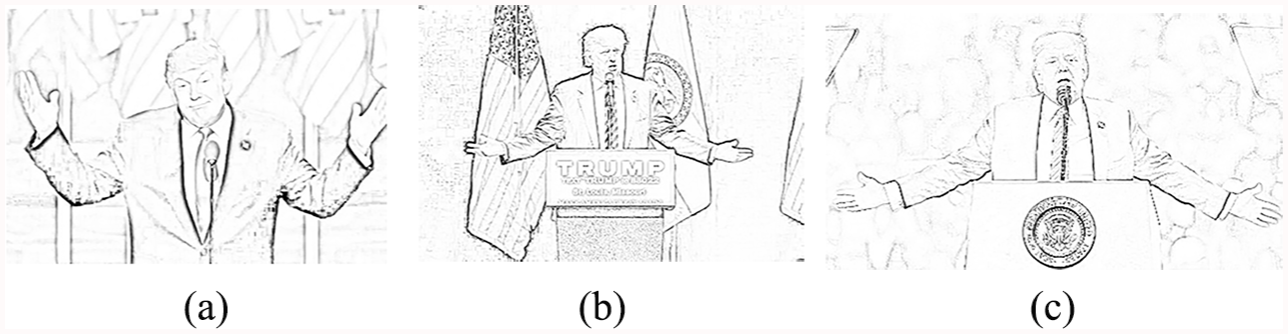
Vertical (a) versus horizontal (b) versus lateral (c) shrugs.
— Vertical–inside (VI): forearm(s) in vertical plane, hands(s) inside of shoulder width
— Vertical–outside (VO): forearm(s) in vertical plane, hand(s) outside of shoulder width
— Horizontal–inside (HI): forearm(s) in horizontal plane, hand(s) inside of shoulder width
— Horizontal–outside (HO): forearm(s) in horizontal plane, hand(s) outside of shoulder width
— Lateral (L): forearm(s) in horizontal plane, hand(s) on lateral axis
Shrugs that did not fall into one of these five categories, such as shoulder- or mouth-only shrugs, were coded as ‘other’. 8 Shrugs that oscillated between types in one continuous movement without returning to rest were treated as a single gesture and coded according to the configuration on which they ‘landed’. They were further coded as complex. 9
Each of the five main shrug-types are, in principle, capable of being performed with arms flexed (i.e. bent at the elbow) or extended in a more or less straight line, as well as bimanually or unimanually. In addition to the main formational features of forearm orientation and hand position, then, we also coded for two further variables relating to morphology: extension and number of arms/hands.
The entire dataset was coded by the second author with 27 percent of the data (25 gestures per rally) being independently coded by the first author to ensure reliability. The mean kappa score across the four variables was 0.859 indicating near perfect agreement. On individual variables, kappa scores ranged from substantial to perfect agreement: main type (0.805); extension (0.911); number of hands (1.00); complexity (0.720). Since intercoder reliability was high, analysis proceeded on the basis of the original coding.
To code gesture function, we took an alternative approach and co-coded the data, discussing each instance and resolving any disagreements along the way. To code shrug functions we used a scheme derived from Debras (2017) but adapted in a bottom-up way based on our own data. Shrugs were coded as expressing one of five types of modal meaning:
— Epistemic distance (‘I don’t know’/‘I don’t believe’)
— Common ground/obviousness (‘Everybody knows’/‘It’s obvious’)
— Indifference (‘I don’t care’)
— Affective distance (‘I don’t like’)
— Other
Results and Discussion
Forms
As shown in Figure 2, the most frequent shrug-type was Horizontal Outside, which accounted for 48.1 percent of all shrugs. By contrast, Trump makes relatively minimal use of Vertical Outside or Vertical Inside shrugs. The second most frequent form was the Lateral shrug, accounting for 32.6 percent of all shrugs.
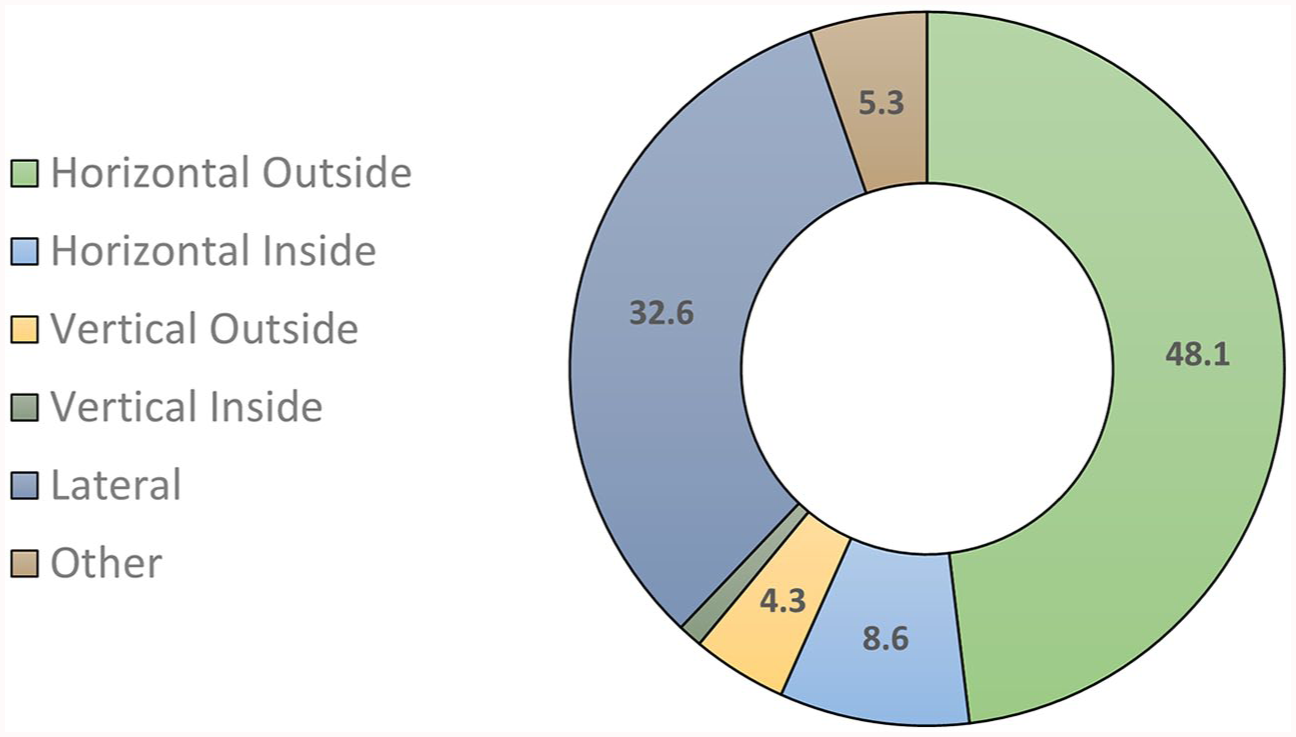
Doughnut plot showing proportion of shrug-types.
Of the shrugs involving a PUOH element, shrugs were performed bimanually more often (83.6%) than they were performed unimanually (16.4%). However, there were significant differences between shrug-types with horizontal shrugs tending to be performed bimanually (81.1%) (and lateral shrugs being performed exclusively with two hands) and vertical shrugs tending to be performed unimanually (90%) (χ2 = 52.170, p < .001).
There were some correlations between form features and speech contexts. For example, in relation to number of hands, shrugs accompanying rhetorical questions and the mental state predicate I don’t know were performed bimanually in 91.7 percent and 80 percent of instances, respectively, while shrugs accompanying interjections and mental state predicates you know/we know were performed bimanually only 50 percent of the time and unimanually the other 50 percent of the time (χ2 =13.112, p < .01). No correlations were found between the specific forms of shrugs and their semantic functions.
In terms of other formational features, 30.5 percent of shrugs were complex, involving dynamic movement between types. Horizontal Outside shrugs accounted for the majority of complex shrugs (56.1%). However, only Horizonal Inside shrugs occurred significantly more frequently as complex (81.3%) rather than simple shrugs (χ2 = 35.724, p < .001). Extension was most closely related to Lateral shrugs (χ2 = 81.047, p < .001). Indeed, Lateral shrugs were performed more often with extension (60.7%) than they were without and accounted for 94.9 percent of all instances of extension.
Right-wing populists are notable for their strong corporeal presence (Moffitt, 2016: 52). In gestural terms, Sclafani (2018: 58) observes that Trump’s gestures are marked for the gestural space they span, occupying a larger space than the gestures of other politicians. Hall et al. (2016: 84) similarly note that Trump ‘uses gestural excess to convey the impression he is a new kind of politician’. These results show that shrugs are one gestural form through which such corporeal presence is manifested. For example, Trump’s preference for Outside shrugs over Inside shrugs is one way that he makes expansive use of the gesture space. While Inside shrugs involve a contraction of the body and shrinking into the gesture space, Outside shrugs occupy more of it. The Lateral shrug in particular, when performed with extension, makes maximal use of the gesture space. As exemplified in Figure 3, the articulators in this gesture are extended to near the limits of the gesture space. Hall et al. (2016) note that Trump’s embodied performance is interdiscursively linked with the genre of entertainment. Certainly, lateral extended shrugs such as shown in Figure 3 exhibit a kind of showmanship normally associated with live entertainment rather than politics.
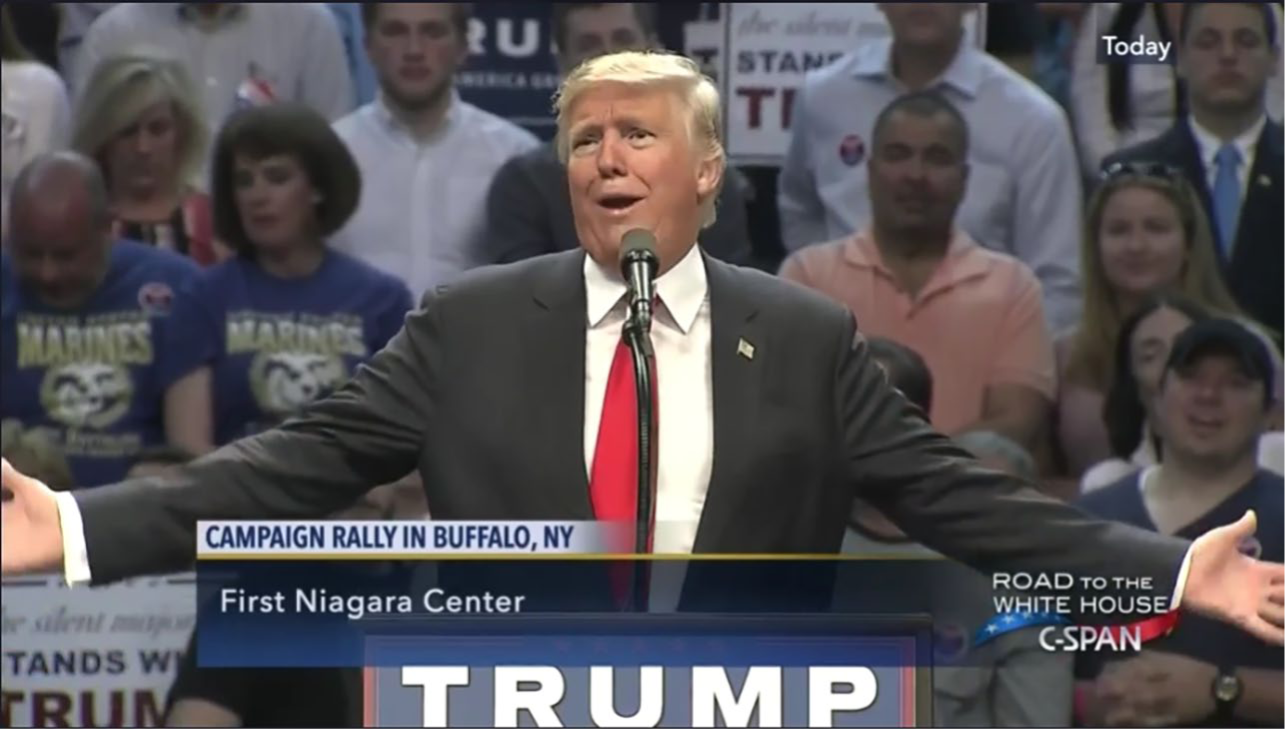
Lateral shrug performed with extension.
Complex shrugs may similarly be read as having entertainment value as they move back and forth repeatedly through different configurations to create a highly animated bodily performance that is often caricaturesque. This is evident in the example in Figure 4 where the shrug oscillates between Horizontal Inside and Horizontal Outside configurations and in the Inside phase also includes hunched shoulders and contorted facial expressions.
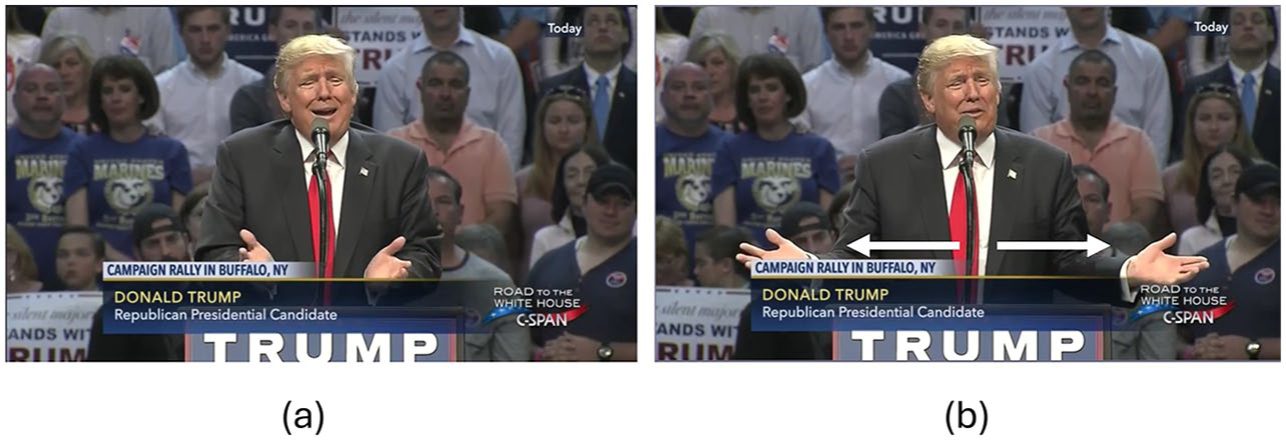
Complex horizontal shrug moving between HI and HO configurations.
While Trump’s shrugs are highly performative, and thus extraordinary, they are also indexical of an everyday informal register not normally associated with political discourse. Stylistically, Trump’s shrugs therefore serve to distance him from other politicians and to signal instead his ordinariness.
Semantically, complexity and extension do not convey any particular meaning but can be analysed instead as forms of hyperarticulation which, in speech, refers to ‘the ability of speakers to exaggerate speech sounds’ (Whalen et al., 2004: 155). Hyperarticulation is accomplished by various means including extending phonemes and expanding the vowel space. It is associated in particular with evaluation, where it is used ‘to call attention to speaker’s stances’ (Freeman, 2014: 2). Complexity and extension in shrugs may similarly serve to highlight the stance-taking act performed by the speaker. We turn to the types of stance expressed through shrugs in the proceeding section.
Functions
In lay accounts, it is epistemic distance and indifference that are typically considered the primary functions of shrugs. However, as shown in Figure 5, Trump’s shrug gestures function most frequently as expressions of common ground/obviousness (44.4%) and affective distance (24.1%) with epistemic distance and indifference accounting for 16.6 and 8 percent of shrugs, respectively. Unsurprisingly, correlations are observed between specific speech contexts and the evaluative functions of shrugs occurring within them (χ2 = 36.088, p < .001). For example, of the rhetorical questions in the data, 62.2 percent feature shrugs expressing common ground/obviousness. The shrugs accompanying mental state predicates you know/we know similarly express common ground/obviousness in 93.3 percent of cases. Conversely, the shrugs combining with the mental state predicate I don’t know, in 80 percent of cases, express epistemic distance. Each of the four main functions identified in Trump’s shrugs are discussed in further detail below.
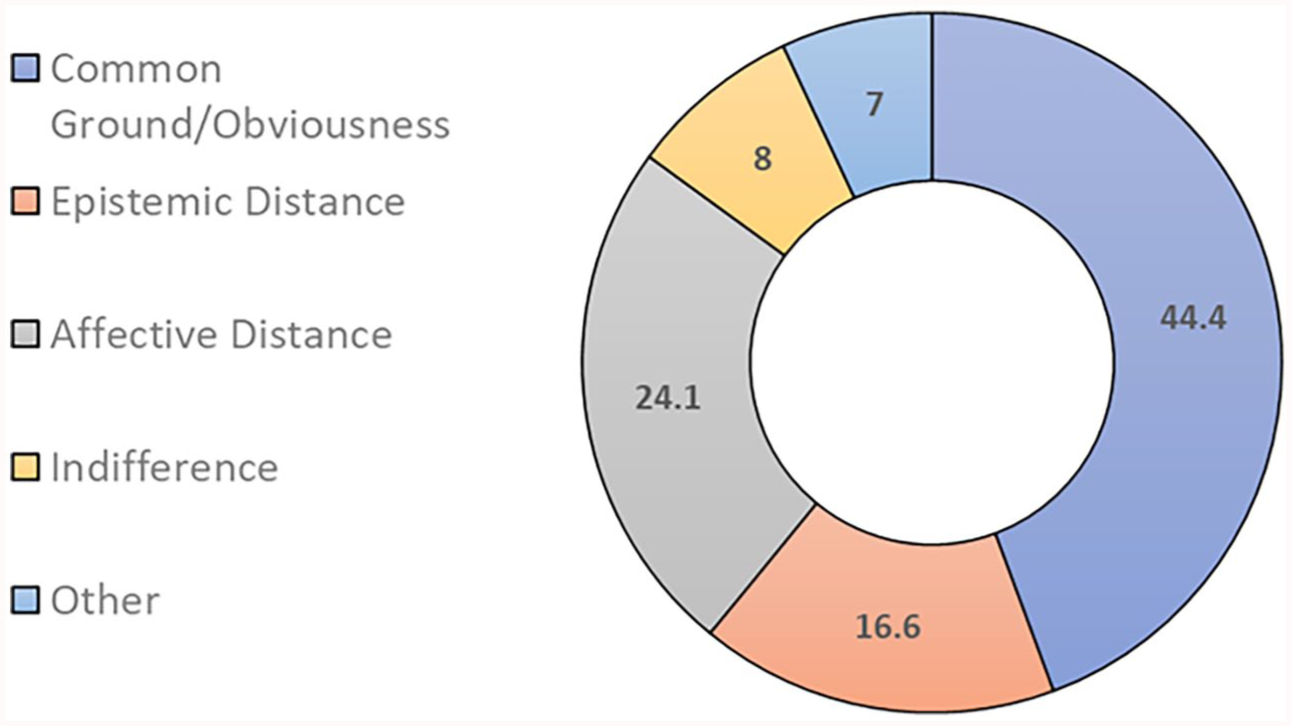
Doughnut plot showing proportion of shrug functions.
Common ground/obviousness
Shrugs expressing common ground/obviousness are used to signal intersubjective alignment between Trump and his audience, both in terms of shared knowledge and shared values. They feature in a variety of rhetorical moves associated with right-wing populism, including aligning himself with his audience through commonly held values, bragging about his own political aptitude while undermining the abilities of others, and treating conspiracy theories as established fact. In each of these contexts, shrugs signal that the proposition communicated is known or obvious.
In terms of speech contexts, PUOH gestures have previously been linked with rhetorical questions (Kendon, 2004: 278). In utterances like (1)–(4), Trump shrugs alongside a rhetorical question to signal that an affirmative response is presupposed and that he and his audience thus have the values expressed in common. As part of (1), for example, Trump performs the Lateral shrug shown in Figure 6.
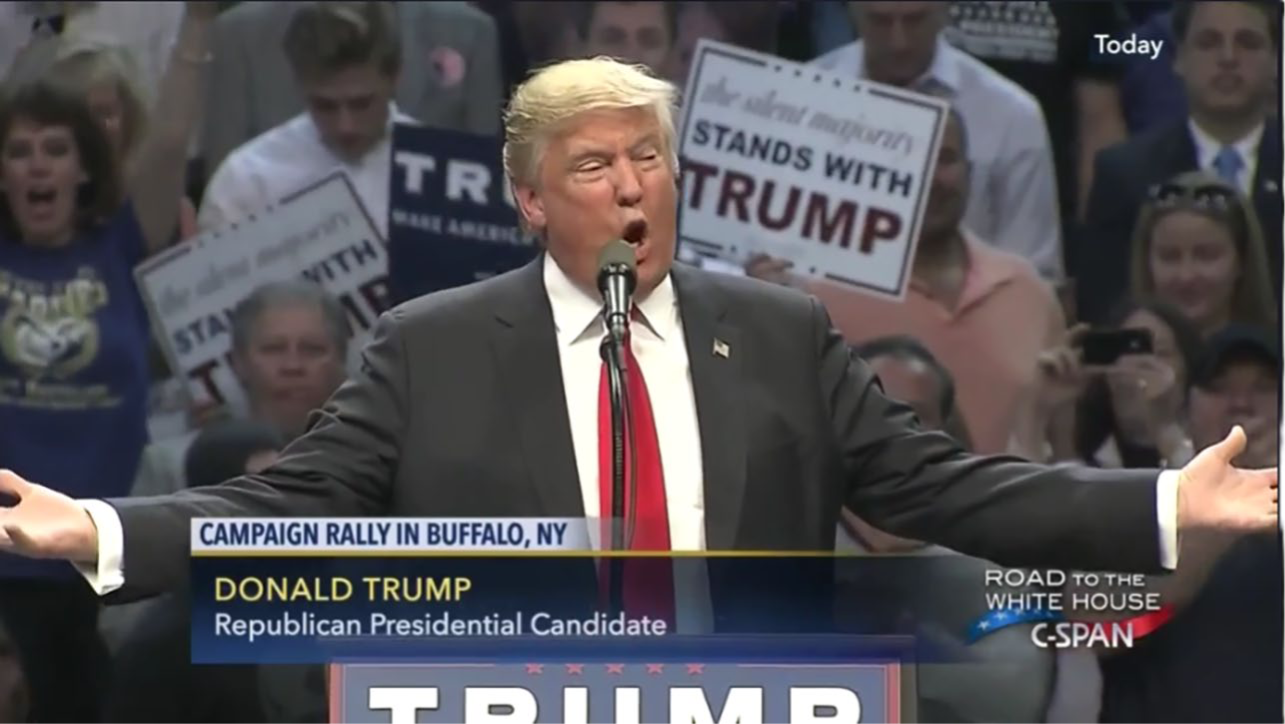
Lateral shrug expressing common ground/obviousness produced as part of (1).
(1) We love New York values, do we agree? We love New York values (Buffalo, 00:11:24)
(2) I think that’s what we like, don’t you think? (Buffalo, 00:20:30)
(3) We love our police. Do we love our police? (Dayton, 00:08:29)
(4) Do we have great military right? (Dayton, 00:16:41)
Trump also uses shrugs to present as given his prowess as a political speaker, as in utterances like (5)–(8). As part of (7) and (8), for example, Trump produces the unimanual HO shrugs shown in Figure 7. The meaning of the shrug in each of these utterances can be glossed as ‘obviously’, ‘as you know’, or ‘of course’. The shrugs produced as part of these utterances thus convey that Trump’s ability as a debater or negotiator is known to all and is not called into question.
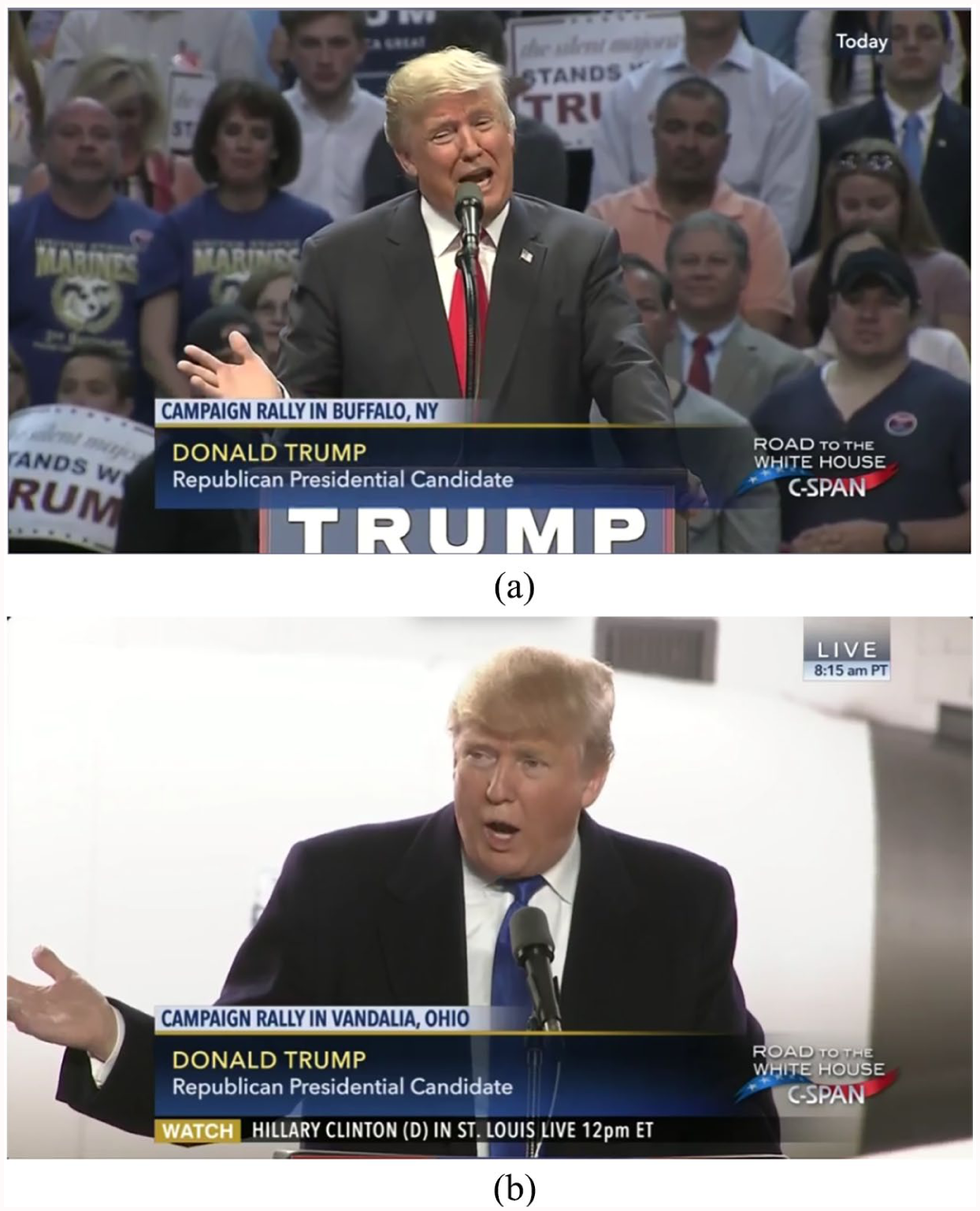
Unimanual HO shrugs expressing common ground/obviousness produced as part of (7 (a) and (8) (b).
(5) I’ve won every single debate. (Buffalo, 00:16:50)
(6) I could have done really well, because I’m very good at dealing with the bosses. (Buffalo, 00:25:38)
(7) I love this stuff, it’s like, I’m very natural at it. I’m really good at it. (Buffalo, 00:44:49)
(8) Did I do well in that debate or what? (Dayton, 00:20:42)
Conversely, Trump uses shrugs as part of utterances denouncing his opponents to imply that the shortcomings he ascribes to them are given or obvious, as in utterances like (9)–(11) where, in each case, Trump produces a Lateral shrug. The shrug featuring as part of (11), for example, is shown in Figure 8.
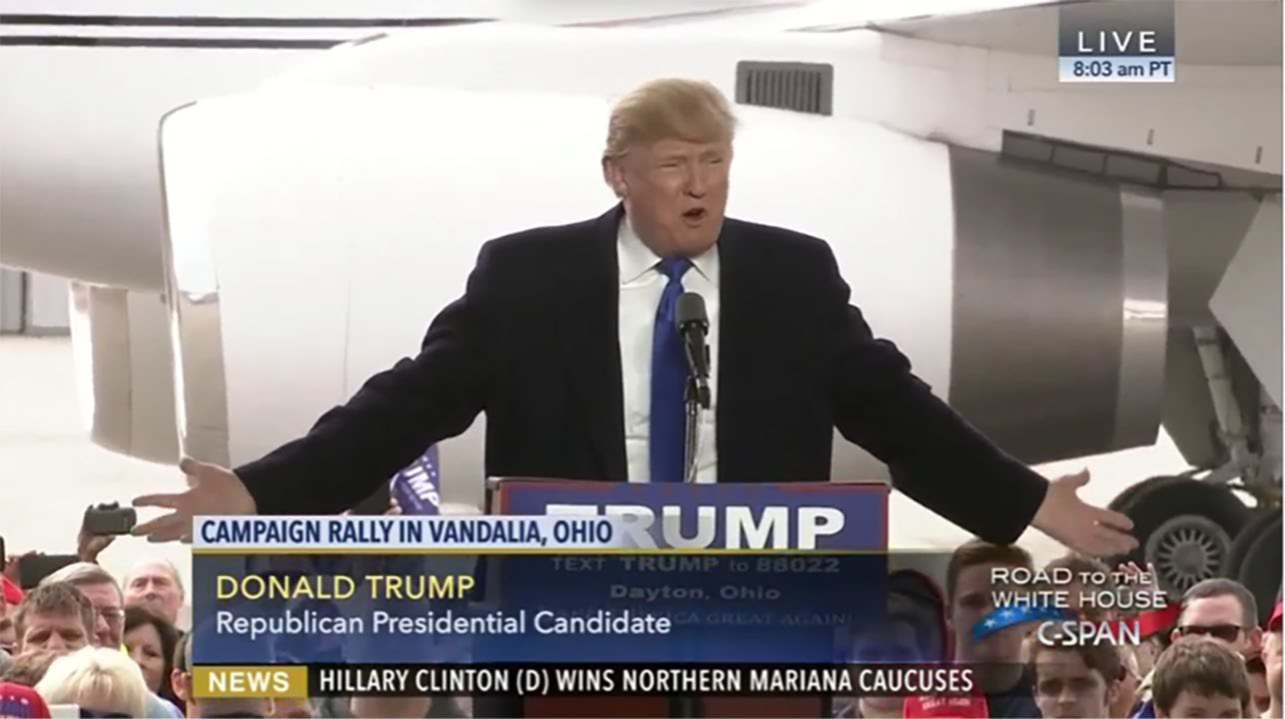
Lateral extended shrug expressing common ground/obviousness produced as part of (11).
(9) They don’t have any people at their rallies folks, there’s nobody there, nobody cares (Dayton, 00:07:43)
(10) If the pollsters were any good they’d be doing what we’re doing, right? Don’t you think? (Dayton, 00:31:01)
(11) They have no fervour, there’s no fervour. (Dayton, 00:09:27)
A further way that shrugs mark common ground/obviousness in Trump’s discourse is in relation to conspiracy theories. In (12) and (13), the shrugs that occur as part of the utterance present his claims around a corrupt electoral system and ‘fake news’ as being self-evidently true. As part of (13), coinciding with the interjection, Trump produces the unimanual VO shrug shown in Figure 9.
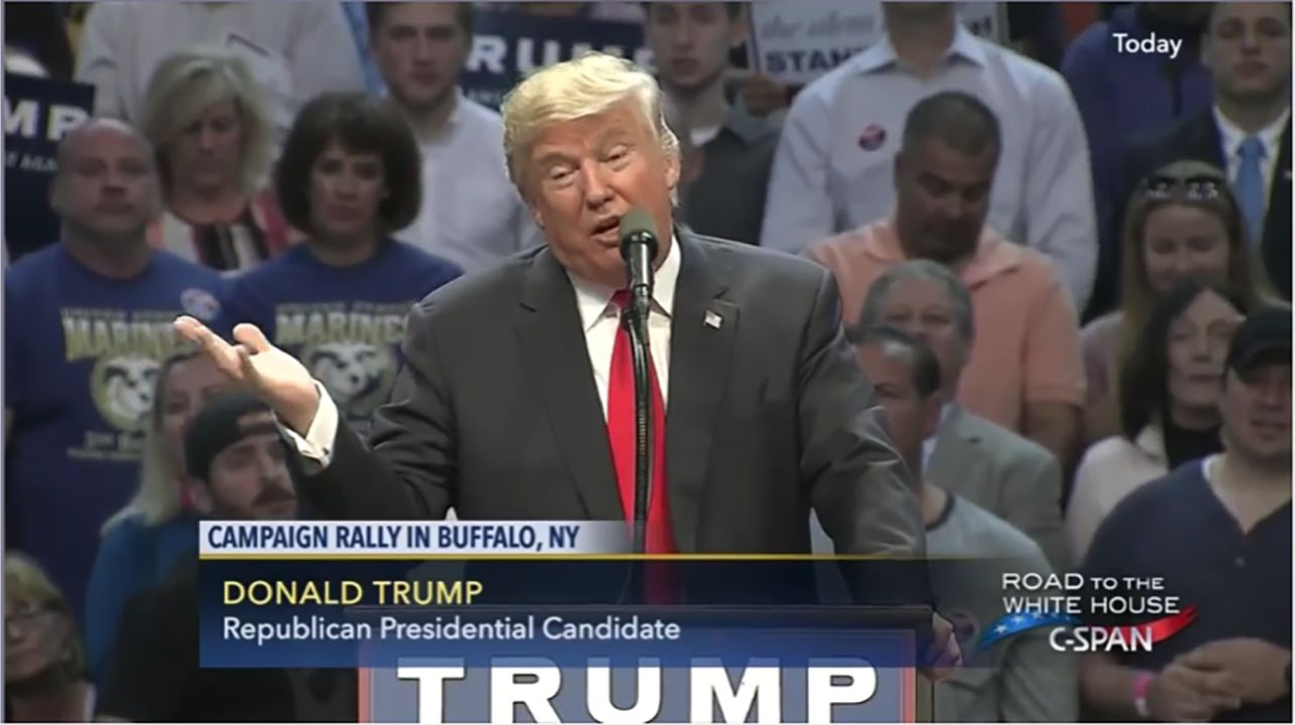
Unimanual VO shrug expressing common ground/obviousness produced as part of (13).
(12) Because the system’s rigged. (Buffalo, 00:28:44)
(13) I saw it on television, which you can never believe a hundred per cent so maybe they’re wrong. (Buffalo, 00:37:31)
Finally, the PUOH element of shrugs has been linked to argumentation where it serves to cast the proposition being advanced as obvious (Marrese et al., 2021). Trump uses shrugs in argument sequences to present proposed political changes as clear and obvious responses to current circumstances. (14) and (15), for instance, represent the conclusion to extended arguments around international trade tariffs. In both utterances, Trump produces a Lateral extended shrug. The shrug produced as part of (15) is captured in Figure 10 where the Lateral extended configuration shown is maintained over the entire course of the utterance.
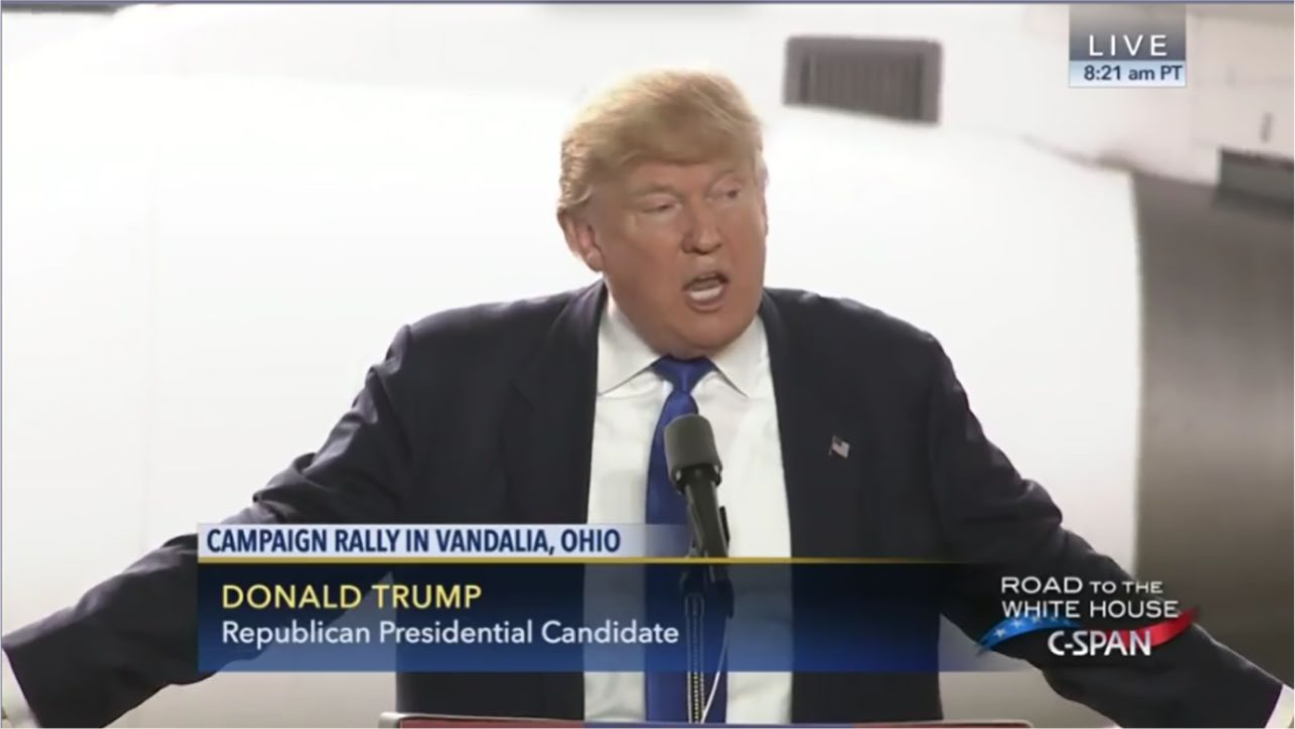
Lateral extended shrug expressing common ground/obviousness produced as part of (15).
(14) They gotta pay up folks, they gotta pay up. (Buffalo, 00:53:41)
(15) It’s gotta change folks, it’s gotta change, it’s gotta change. (Dayton, 00:26:45)
Epistemic distance
A second type of epistemic meaning expressed by shrugs is epistemic distance (Debras, 2017). Included within this category are shrugs expressing ignorance, uncertainty, surprise, doubt, disbelief and denial. Such shrugs frequently accompany the expression I don’t know or in other contexts can be glossed as conveying ‘I don’t know’ or ‘I don’t believe’. For example, shrugs feature in general expressions of uncertainty as in (16) - (19):
(16) Since then, I don’t know if he’s lost. (Buffalo, 00:28:14)
(17) That means like what fifteen people? (Dayton, 00:14:12)
(18) Who knows? (Dayton, 00:11:06)
(19) I mean, he might be bad, he might be good (Dayton, 00:32:21)
Shrugs also feature in utterances expressing surprise at a current situation or state of affairs which is construed as violating previous expectations, as in (20) - (22). In (20), Trump expresses surprise at a group previously thought unlikely to support him but now endorsing him. In (21) and (22), Trump expresses surprise at his opponents making it to the final stages of the primaries. This involves establishing a prior temporal vantage point from which doubt is expressed over their likelihood of progressing so far.
(20) I guess you probably heard, from NASCAR, they endorsed Trump . . . Trump . . . Trump! (Dayton, 00:24:19)
(21) Honestly I never thought I was gonna see him as one of the last three people, I never thought it was gonna happen, I never thought it was gonna happen. (Buffalo, 00:33:52)
(22) Honestly, I didn’t expect to see either of these two. (Buffalo, 00:34:07)
A marked feature of Trump’s rhetorical style is his use of reported speech or constructed dialogue (Sclafani, 2018). Constructed dialogue is an intertextual strategy which, in contexts of political communication, plays an important role in Self-promotion and Other-denigration (Kuo, 2001). 10 Trump uses constructed dialogue to re-enact past or imagined conversations with other people, including supporters, political opponents and business leaders. This re-enactment is a full embodied performance that includes the gestures of both Trump and his interlocutor in the interaction. One way that shrugs expressing epistemic distance feature in such instances of constructed dialogue is to represent his opponents as stupid or ignorant. Hall et al. (2016: 73) note that Trump ‘elevates his entertainment value by crafting comedic representations of his political opponents’. These performances frequently take the form of caricatured and derisive embodied impersonations. In the constructed dialogue of (23), Trump assumes the subjectivity of Caroline Kennedy (US Ambassador to Japan) when he states ‘I don’t know, I don’t know’. As part of the utterance, Trump performs a Lateral shrug which includes, as other elements of the full ensemble, a wide-eyed and open-mouthed facial expression and searching head movement. The entire gesture, captured in Figure 11, depicts Kennedy, in a mocking and comedic fashion, as an individual who lacks intelligence and awareness. The gesture succeeds in eliciting laughter from the audience. Through such routines, Trump is not only able to ridicule his adversaries but, as Hall et al. (2016: 74) note, his performance ‘accrues entertainment value as it opposes the usual habitus associated with US presidential candidates’.

Lateral shrug expressing epistemic distance produced as part of (23).
(23) I mean, we have Caroline Kennedy representing us in Japan. And she admits she got the job.
How did you get it?
I don’t know, I don’t know [audience laughter] (Dayton, 00:48:23)
A second way that shrugs expressing epistemic distance feature in constructed dialogue is in challenges to claims that Trump’s proposed policies are unrealistic. In such cases, constructed dialogue provides a context for Trump to present himself as remaining firm in the face of critics. For example, in (24), relating to his proposed border wall, Trump produces HO shrugs expressing epistemic distance when he states ‘Really? Why not?’. The multimodal utterance undermines the proposition that Trump will be unable to build a wall by inviting evidence for the claim that he can’t and implying ‘I don’t know of a reason why not’. The shrug co-timed with ‘Really’ is shown in Figure 12.
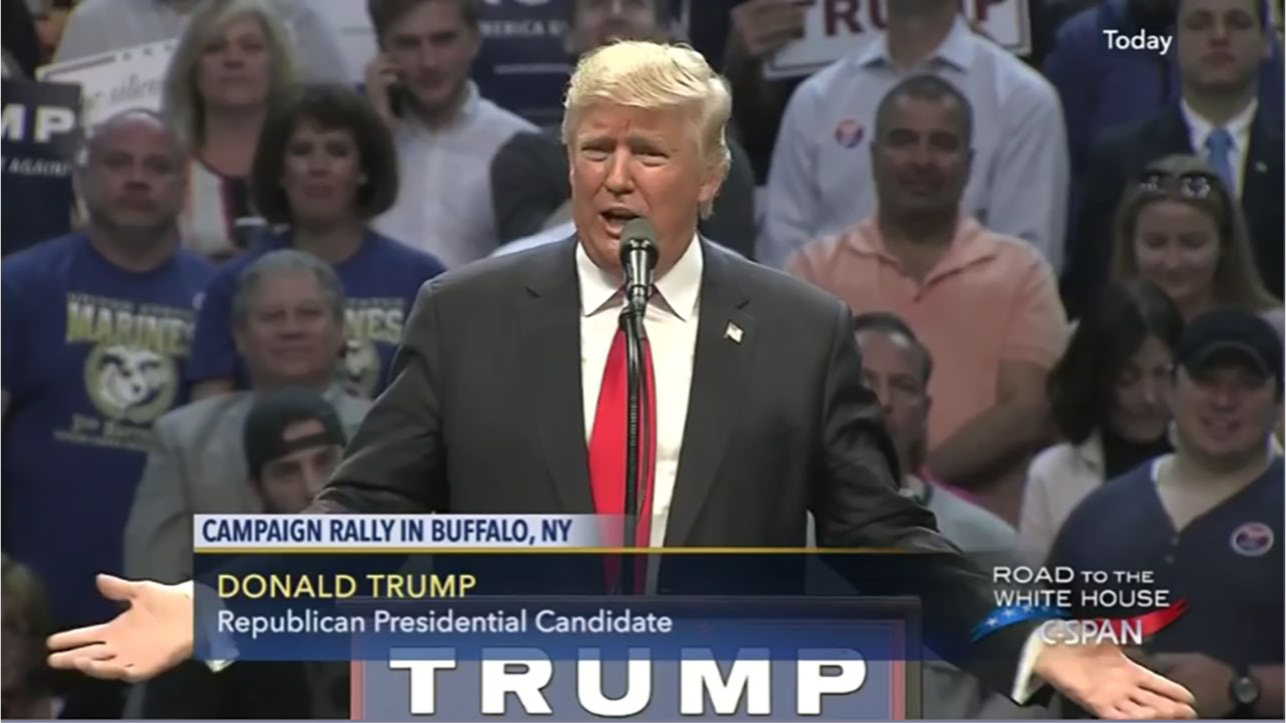
HO shrug expressing epistemic distance produced as part of (24).
(24) A couple of participants came up to me. They said Donald, you know you’re not gonna build a wall.
I said why not?
You can’t build a wall.
Really? Why not? (Buffalo, 00:34:27)
Indifference
Shrugs expressing indifference are the least represented in the data. They can be glossed by ‘I don’t care’ and in fact are observed in the data to occur alongside the rhetorical question ‘who cares?’ as in (25) and (26).
(25) I understand that it might not be presidential. Who cares? (Dayton, 00:51:48)
(26) So the conservatives they will say like Jeb Bush used to get up ‘He is not a conservative’. Who cares? (Buffalo, 00:50:10)
Expressions of indifference are not common among politicians who typically avoid the risks of appearing apathetic. Trump, however, uses shrugs to signal indifference in several rhetorical contexts. In (25) and (26), the multimodal expression of indifference dismisses the concerns of other politicians as irrelevant and demonstrates that Trump does not care about the same things that they do. Expressions of indifference thus allow Trump to position himself as a different kind of politician who operates outside the bounds of normal politics. As part of both (25) and (26), Trump produces a Lateral extended shrug with the shrug produced as part of (26) being the one previously shown in Figure 3.
Another way that Trump uses shrugs expressing indifference is to appear modest or nonchalant in connection with his own position of power and status as in (27) and (28). In (28), for example, Trump produces a Lateral shrug as part of ‘I’ll do it myself’. This multimodal expression of indifference shows that Trump is amenable to carrying out mundane tasks like typing despite his role and status and thus contributes to discursively performing or constructing his ‘ordinariness’.
(27) I used to be, I guess, one of the bosses in a certain way. (Buffalo, 00:53:58)
(28) I type out, you know, ding ding ding, I’ll do it myself. (Dayton, 00:33:00)
Affective distance
Affective distance can be seen in contrast with indifference. While shrugs expressing indifference signal lack of interest or concern, shrugs expressing affective distance indicate a level of emotional investment. Affect refers to ‘the means by which writers/speakers positively or negatively evaluate the entities, happenings and states-of-affairs with which their texts are concerned’ (Martin and White, 2005: 2). Shrugs expressing affect can thus be glossed by ‘I like’ or ‘I don’t like’ depending on valence. More specifically, shrugs expressing affective distance convey a range of negative affective meanings that include disappointment, disapproval, dissatisfaction, disdain, indignation, exasperation and dismay. Trump shrugs to express affective distance toward current political states-of-affairs and policies which he sees as being ineffective and failing to meet American interests. This includes the electoral system as in (29) and (30) and US military capabilities as in (31) and (32). As part of (32), for example, coinciding with ‘And we don’t even know where we can try ’em’, Trump produces the Lateral shrug shown in Figure 13.
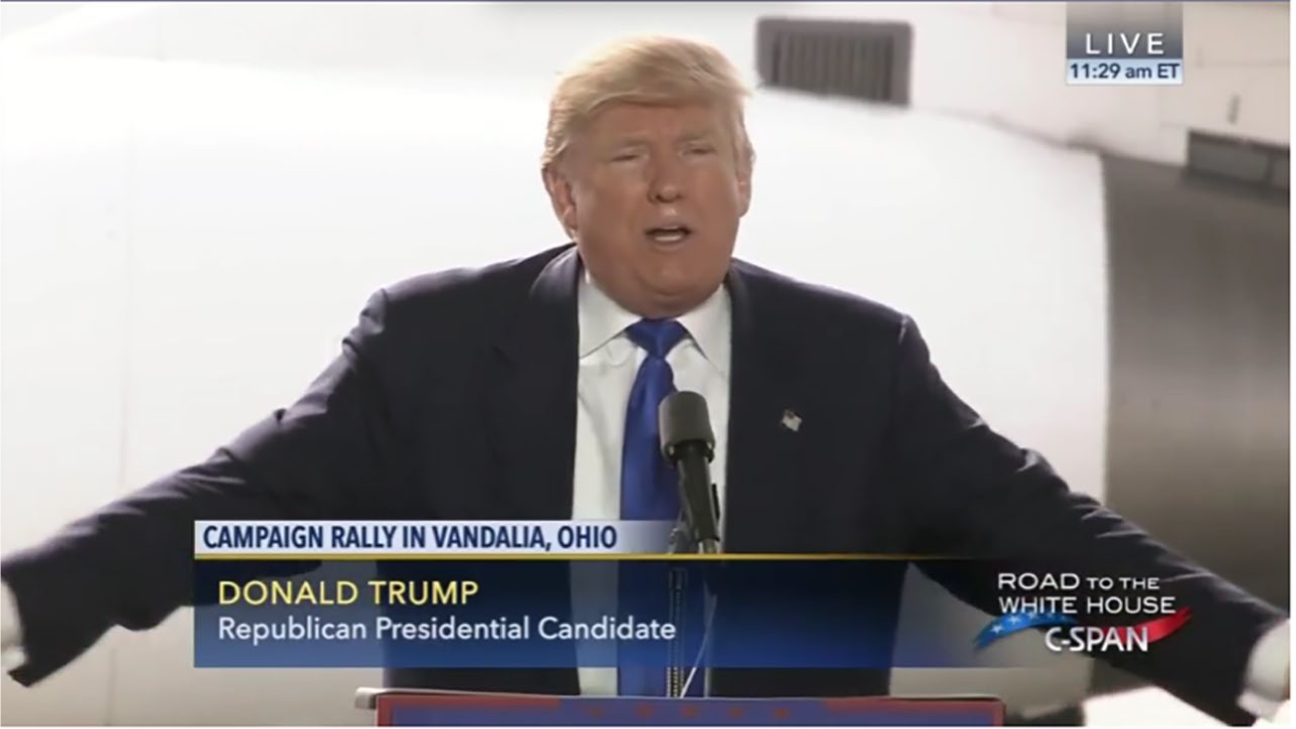
Lateral shrug expressing affective distances as part of (32).
(29) I announced in June. People saw that I was gonna do great in Colorado. And all of a sudden in August they change the system. (Buffalo, 00:25:24)
(30) They took the vote away from the people of Colorado. They didn’t give the vote to the people of Wyoming. (Buffalo, 00:25:33)
(31) We have a problem. Our military can’t beat ISIS. (Dayton, 00:16:49)
(32) So we catch one of these animals that had just chopped off ten, ten heads. And we don’t even know where we can try ’em. (Dayton, 00:34:50)
It also includes international trade arrangements as in (33) – (36). Occurring as part of (33), for example, is the complex HI-HO shrug shown previously in Figure 4.
(33) We’re dying with these deals (Buffalo, 00:52:07)
(34) These deals are terrible. (Buffalo, 00:52:09)
(35) We protect Saudia Arabia (Dayton, 00:25:12)
(36) like we’re indentured servants, they pay us peanuts (Dayton, 00:25:20)
In each of these examples (29)–(36), the shrug provides an evaluative frame in which the utterance is to be interpreted. It is through the shrug, rather than through what is actually said, that Trump takes a negative affective stance toward the proposition communicated.
Conclusion
The shrug, as has been previously acknowledged, is a complex gesture that can take many different forms involving multiple body parts. Prototypically, however, shrugs include a palm-up open-hand element which may be accompanied by other actions including a raising of the shoulders and certain facial expressions (or ‘mouth shrugs’). Functionally, shrugs are equally complex in so far as they express a range of different meanings. The range of meanings expressed by shrugs is not unconstrained, however, with shrugs functioning as bodily expressions of stance. Shrugs thus constitute, both physically and communicatively, a stance-taking act.
While shrugs feature extensively in everyday conversation, they are not generally considered a feature of political communication. Trump, however, is a frequent shrugger. In the data analysed here, Trump produces on average 1.7 shrugs per minute. Trump’s propensity to shrug is interpreted as a stylistic means by which his specific brand of right-wing populism is performed multimodally. Where the communicative style of right-wing populism is described as transgressive, shrugs are one way that Trump transgresses the normal conventions of political discourse. Right-wing populists are also described as having corporeal presence, which is manifested in Trump’s shrugs through gestures that are markedly animated, maximally expansive and often protracted in time. Shrugs are thus an important gestural means by which Trump is able to perform both ordinariness and extraordinariness at the same time.
Trump’s frequent and flagrant use of shrugs is consistent with Moffitt’s (2016: 65) observation that ‘populist leaders are often keen to draw attention to their bodies to prove or demonstrate their potency and strength through crude banter, politically incorrect statements or boasts’. Trump’s shrugs figure in multimodal stance-taking acts across two domains: the epistemic and the affective. In the epistemic domain, Trump’s shrugs function as expressions of common ground/obviousness or as expressions of epistemic distance. In the affective domain, Trump’s shrugs function as expressions of indifference or as expressions of affective distance. Through the embodied expression of stance, Trump is able to realize rhetorical strategies associated with right-wing populism. For example, Trump shrugs to align himself with ‘the people’ while distancing himself from other politicians, to present himself as a strong and competent leader, to mock his opponents, and to appraise current states-of-affairs as bad.
The study is innovative in being the first to offer a systematic analysis of Donald Trump’s shrugging behaviour. However, it is not without some obvious limitations in scope. Firstly, the observations extend only so far as Donald Trump. It is not clear, based on quantitative evidence, if or how shrugs figure in the communicative style of other populist or non-populist leaders and thus whether shrugs can be considered a feature specific to Trump’s discourse or whether they may be a feature characteristic of the communicative style of right-wing populism more generally. Further comparative research is required here. Secondly, we have considered only one gestural form among the many that Trump and other politicians employ as part of their embodied performances. Further research is required to investigate the forms and functions of other gesture-types in political communication and to build more complete gesture profiles for individual politicians. Thirdly, the analysis focused almost exclusively on spatial configurations of the arms and hands in shrug gestures. Other elements of the shrug complex, such as facial expressions, were not considered. These are obviously important for meaning and their analysis is likely to allow more fine-grained semantic distinctions to be made or form-function correlations to be established. Currently, however, facial expressions are difficult to analyse in any systematic way. Similarly, the analysis did not fully take into account temporality. Kendon (2004: 112) observes that the stroke phase in any gesture may be prolonged in a post-stroke hold. In shrugs, this is especially the case for the palm-up open-hand component (Abner et al., 2018: 13). The function of post-stroke holds is debated but one function seems to be to fix the audience’s overt visual attention on the gesture being performed (Gullberg and Kita, 2009). The effects that such attention-attracting features have in political communication also requires further investigation.
Notwithstanding any limitations, we have provided a systematic description and critical interpretation of the forms and functions of shrug gestures in the live performance of Donald Trump. In doing so, we have shed further light on the discursive means by which he achieves populist appeal. We hope also to have highlighted a wider need to consider aspects of multimodal performance when analysing political communication.
Footnotes
Declaration of Conflicting Interests
The authors declared no potential conflicts of interest with respect to the research, authorship and publication of this article.
Funding
The research was supported by a BA/Leverhulme Small Grant (no. CRFG\106703) awarded to Christopher Hart.

Data Availability Statement
Notes
Biographical Notes
CHRISTOPHER HART is Professor of Linguistics at Lancaster University. His research investigates the link between language, cognition and action in contexts of political communication. He is author of Language, Image, Gesture: The Cognitive Semiotics of Politics (2025, Cambridge University Press).
Address: School of Social Sciences, Lancaster University, Lancaster LA1 4YW, UK. [email:
STEVE STRUDWICK is a PhD student in the School of Social Sciences at Lancaster University. His interests lie with experimental and other empirical methods in Critical Discourse Studies.
Address: as Christopher Hart. [email: