




Abstract
Social media have long provided opportunities for political and civic participation and YouTube is one of those social media platforms that has been studied and analysed in this light (see Carpentier, ‘Fuck the clowns from Grease!! in Information, Communication & Society, 2014; and Way, ‘YouTube as a site of debate through populist politics’ in Journal of Multicultural Discourses, 2015). This article explores the relationship between the multimodal representation of a historical documentary, Greece, The Hidden War (dir. Gabriel, 1986) and the reception and comments amongst its viewers in order to investigate the way in which the multimodal representation influenced the ensuing discussions. The research investigates which aspects of the documentary the viewers draw on and which topics and discourses they bring into the ensuing discussion.
The reception analysis highlights three levels of engagement: a micro level that pertains to themes and events specifically related to the programme; a meso level that addresses the Greek Civil War in its entirety; and a macro level that relates to broader ideological antagonisms. The findings show how the multimodal representation influences viewers’ responses and highlight the agentive role and rhetorical strategies of the viewers in their interpretation and recontexualization of the events portrayed in the documentary.
Introduction
Recent studies on YouTube as a digital space have suggested that, notwithstanding the potential for such space to be a democratic and democratizing force, at best it ‘is a location of meeting, dialoguing and sharing, but also of fierce ideological struggles’ (Carpentier, 2014: 1008) and, at worst, it ‘generates no shared identities or values, as is witnessed by the ruthless comments around YouTube posts’ (Jenkins, in Jenkins and Carpentier, 2013: 273). This article aims to contribute to this discussion about the role of YouTube (and potentially other similar social media platforms) as a place for dialogue and dialectical argumentation. It does so by looking at a documentary and its reception, and by proposing an integrated approach that combines a multimodal critical discourse analysis of a documentary and an analysis of the comments left by users. It is argued that such an integrated methodology is not just useful but also necessary in order to fully appreciate the role YouTube (and similar social media platforms) can play in fostering civic participation in contemporary societies.
The documentary is Greece: The Hidden War and the reason for choosing it is that the subject matter, the Greek Civil War that took place soon after the end of World War II, has been a historical period that caused collective social, political and, later on, mnemonic division (Anastasiadis, 2011). 1 The programme represents a history that is still open to negotiation and the results of our reception analysis indeed provide evidence for such division. Civil wars divide memories between groups that continue to advocate and defend the narrative of the collectivity they belong to, long after the war is over. Both sides, in public speech, attempt to restore the ‘true’ historical facts and defend the righteousness of the cause of the side they align with. YouTube functions as a digital agora, a cyber space open to such public speeches, providing the potential for people to exchange ideas, discuss events at local, national or international levels and, ultimately, to contribute to the social and civic development of societies.
The methodology for the case study combines a multimodal discourse analytical framework for the study of documentaries (Castaldi, 2021, 2024, 2025) informed by a reception study element which looks at the YouTube comments on a version of the documentary. Comments reflect different levels of engagement which, for the purpose of our analysis, we identified as follows: a micro level directly related to content shown or discussed in the documentary; a meso level that relates to the Greek Civil War beyond what is shown or discussed in the documentary; and a macro level that goes beyond the Greek Civil War and engages with broader ideological constructs (sometimes loosely) connected to the perceived actors in the Greek Civil War. Descriptive statistics have also been employed to illustrate how the methodology can be applied both in a qualitative and quantitative fashion; however, we do not claim any generalizability of our results given the small dataset. Nonetheless, the quantitative element is helpful to highlight both the distribution of interpretative codes amongst the users, and the strategies they employ in their recontextualization and evaluation of the events discussed in the documentary, thus supporting the qualitative interpretation of the findings.
The focus of the article is on the reception of the documentary. However, the results of the multimodal analysis of the documentary are provided as a starting point so that the ensuing discussion can be followed and understood in light of the media representation the users interacted with. After an overview of studies on YouTube as a place for civic participation, the article provides an overview of the documentary and a detailed description of the methodology adopted, before providing examples from the multimodal and reception analyses, a discussion and a conclusion.
Youtube As A Digital Agora
Singh (2024) reports that, as of 2024, YouTube has over 2.70 billion active users. While considering the implications of such numbers, Gossett (2020: 524) notes, in a somewhat negative vein, that ‘YouTube’s exponential growth has made it an internet giant. It has been able to control the news narrative and influence culture.’ Notwithstanding the dangers of a social media platform with such a reach, another implication has been explored by researchers, which points towards a more positive role of social media giants in our contemporary societies, that is, the opportunity to function as a catalyst for democratic and critical dialogues between users of diverging ideological and political standings. This latter position is the one we also advocate in this article.
In order to establish whether YouTube (and indeed other social media platforms) offers the opportunity for democratic spaces, the nature and boundaries of these spaces need to be qualified. A common concept that has been used to assess the potentials of YouTube as a democratic space is the idea of civic and political participation. What, in theory, makes YouTube a space for such participation is ‘its double function as both a “top-down” platform for the distribution of popular culture and a “bottom-up” platform for vernacular creativity’ (Burgess and Green, 2009: 6). This bottom-up process of vernacular activity can also be expanded to include non-creative, ideology-laden content, and serves the double purpose, on the one hand, to contribute to YouTube’s function as a digital public archive (Burgess and Green, 2009: 88) and, on the other, to provide a ‘mediating mechanism for the cultural public sphere’ (p. 77).
However, the extent to which such participation is real and achievable has been questioned by some (e.g. Carpentier, 2014; Jenkins 2016; Jenkins and Carpentier, 2013). There are two main issues these scholars highlight: the first concerns the power dynamics inherent in the distribution and access to digital participatory practices (Carpentier, 2014: 1002). As Carpentier (in Jenkins and Carpentier, 2013: 267) points out, ‘full participation [requires] the equal power position of all actors in a decision-making process.’ On these premises, it is easy to see how accessing YouTube as a digital space is not available to everyone, but only to ‘those with the motivations, technological competencies, and site-specific cultural capital sufficient to participate at all levels of engagement the network affords’ (Burgess and Green, 2009: 81). Notwithstanding the issues of power in relation to access, it can be argued that those who do have access to YouTube are in a position of equality. Clearly, the owner of the channel can moderate users’ contributions or disallow them altogether, but this does not affect the balance of power amongst users.
Furthermore, the role of the YouTube algorithm has also been investigated in relation to its potential to increase ideological polarization and even radicalization. Several studies (e.g. Bessi et al., 2016; Cho et al., 2020; Sunstein, 2017) have highlighted how such a risk exists, while others have identified different outcomes depending on the topics of the videos (García-Marín and Serrano-Contreras, 2023) or on the political orientation of the content (Park and Park, 2024). Our case study is very interesting in this regard, as the users who left comments clearly belonged to different political orientations, thus suggesting that if the algorithm had a role in their watching the documentary, this might have been more on the grounds of genre and interest preferences, than on the grounds of political orientations.
Recent research also looked at factors that may enable such a potential for civic participation to fully materialize in YouTube digital practices, especially when it comes to the comments area. Thelwall et al. (2012) highlight several criteria affecting the way YouTube audiences engage in the comment area. First, the topic of the video is a good predictor of the number of comments left by the viewers: perhaps unsurprisingly, topics such as religion and politics attract more comments than topics such as music or comedy (p. 626). Negative comments, moreover, attract more replies than positive comments do, which can be attributed to the fact that a debate is occurring and users feel the urge to share contrasting views (p. 622). The fact that such debates occur led the authors to conclude that: YouTube hosts genuine audience discussions about the various topics hosted on the site . . . some of these are genuine debates on controversial issues, which raises the possibility that YouTube is a significant public space . . . for engaging in debate and exchanging opinions. (p. 627).
Given the quantitative nature of Thelwall et al.’s (2012) study, however, the nature and dynamics of such debates are not clear, nor is whether the debates lead to a truly dialectical exchange between the participants or, rather, to a shouting match between participants who are not willing to move away from their initial positions.
Way’s (2015) study on the comments to Turkish protest videos, for example, provides evidence that ‘comments do not deal with the actual events represented in the video but seek to frame these in terms of wider forms of allegiances’ (p. 180) and concludes that the comment area of YouTube does not function as a site of engagement (p. 193). This position is also shared by other scholars (Carpentier, 2014: 1008; Jenkins, in Jenkins and Carpentier, 2013: 273). When it comes to the nature of comments on political issues and on the possibility of a dialectical exchange between users, Carpentier (2014) argues that, although users invest time and efforts in posting comments with a view to contributing to a meaningful dialogue, their contributions are undermined by a dual fantasy: on the one hand, the idea that their voice matters and, on the other, that they have ‘privileged access to truth’ (p. 1012). Notwithstanding the importance of Carpentier’s assertions, what is of interest to us and discussed in this article is how those contributions come to be in relation to the content of the documentary under analysis.
Georgakopoulou (2014) investigated the connection between comments and content about a political clash, followed by a physical assault, that occurred on Greek television in 2012 between two left-wing MPs and a male one (the assailant). The analysis highlighted how 326 out of the 500 comments could be directly related to the incident itself (p. 526), which is what we are referring to as the micro level of engagement. The remaining comments addressed broader political matters beyond the incident, either commenting on other issues pertaining to the participants in the incident, which is what we are referring to as the meso level, or debating higher level political issues and controversies, which is what we are referring to as the macro level. Georgakopoulou’s study, whose results are on the whole confirmed by our own findings, suggest that YouTube users not only engage with the content they watch, but may also use it as a springboard for further discussions that attempt to enrich the content by providing further contextual evidence that ‘explains’ it (meso level), or to use the content as exemplary or symptomatic of wider ideological stances (macro level). This does not mean that the contributions are necessarily based on sound evidence and argumentative steps or even that they matter (see Carpentier’s, 2014, idea of fantasies), but it still points at least to the potential role social media can hold to foster civic and political participation. After all, we cannot dismiss the impact of the online discussions without ‘following’ the participants in their offline lives.
Boy et al. (2020) recently took on the task of exploring the extent to which science communication content on YouTube is successfully retained by those engaging with it. They combined a discursive, multimodal analysis of the videos with a reception study element combining eye-tracking technology, questionnaires, interviews, and knowledge tests (p. 2), and concluded that ‘the different types of videos have a significant impact on the recipients’ quality of knowledge acquisition’ (p. 14). When users engage with online content on YouTube which includes ‘factual’ information (the accuracy of which is irrelevant at this point), they do tend to retain such information. Although the results from Boy et al. (2020) pertain to a different genre from the one analysed in this article and may not be generalizable to all genres, their results regarding the retention of ‘factual’ information is still relevant to our discussion as documentaries also contain non-fictional content and ‘facts’ and, as a genre, they are expected to provide some ‘expert-gathered’ information. Moreover, it can be speculated that the knowledge retention also occurs when users engage with factual content in the comments area, which is an aspect supported by another recent study (Dubovi and Tabak, 2020: 11) whose findings highlight not only the importance of disagreements and counter-claims [in the comments area] as necessary conditions for higher forms of knowledge construction, but also . . . that motivated and engaged users are more likely to employ deep, reflective strategies and to reach the stage of conflict resolution.
If we combine the findings from these two studies, we cannot rule out that such knowledge may in turn affect users’ behaviour in their offline lives, thus making a platform such as YouTube a valid arena for civic and political participation.
Greece: The Hidden War and its Context
‘Greece: The Hidden War’ is a documentary series in three parts, produced by TVS for the British public broadcasting television, Channel 4, lasting a total of 158 minutes. The programme is directed and written by Jane Gabriel with the co-operation of Professor Yanis Yanoulopoulos as historical advisor. The first part of the programme deals with the time between the end of WWII and the beginning of the Greek civil war (1944–1946). The second part draws a picture of the events of the civil war between 1946 and 1949, and the third part portrays the time of exile and repatriation of the members of the Greek Communist Party and Left guerillas. Upon its first airing in the UK, the programme was considered a product of political propaganda and, despite the IBA approval of the legitimacy of the approach of the documentary producers, following a surge of negative press coverage, Channel 4 agreed that the series would not be shown again either in the UK or abroad.
The material we examine in this article is from the second part ‘Greece: The Hidden War – Part 2’, subtitled in Greek for the show of the Greek journalist and political analyst Stelios Kouloglou, Thematiki Vradia, on ERT1 (Greek public television). The documentary is in English with subtitles in Greek. The interviews with Greek-speaking people are dubbed in English. The video and related comments, which together form our dataset, was uploaded to YouTube on 9 April 2011 through the channel of @PierreYTBourdieu. The comments were retrieved from the YouTube Channel on 10 February 2023. 2
Methodology
In order to explore the relationship between the documentary text and the ensuing discussions in the comments area, we opted for an integrated approach that combines an ‘engagement’ type of reception study with a multimodal critical discourse analysis of the documentary. Pihlaja (2014) argues that, for any investigations of digital interactions, not just the comments or posts should be carefully analysed but also the video content, since ‘analysis of video talk is essential for describing and analysing responses in comments’ (p. 4). Just for matters of terminological precision, following the definition proposed in the systemic–functional tradition (Halliday and Hasan, 1976) and expanded by social semioticians (Iedema, 2001: 187), by ‘text’ we refer to any socially meaningful trace of a communicative event, regardless of the mode or combination of modes (e.g. written language, spoken language, moving images, etc.) which compose it. Therefore, the documentary analysed is a ‘text’ and so are the comments left by the users – we will therefore specify the ‘text’ we refer to when necessary to avoid confusion.
Engagement studies involve analysing a naturalistic interactional environment, in which the users have spontaneously engaged with a text (Castaldi, 2021: 57). This in turn signals a genuine (rather than experimentally created) interest with the text under analysis. However, since YouTube relies on an algorithm that recommends content to the users, some of the people who commented in response to the documentary might have been directed there by the platform. A total of 149 comments from 70 unique users were collected and analysed as of 10 February 2023: through an initial thematic analysis, we identified three levels of engagement that we labelled micro, meso and macro. For the purpose of our analysis, by micro level, we refer to comments about social actors and events directly represented in the documentary; by meso level, we refer to comments directed at events and information regarding the Greek Civil War that were not directly represented in the documentary, but found in other media discourses; and by macro level, we refer to comments pointing at higher-order ideological positions, e.g. left- and right-wing political ideologies.
The reception analysis focused on what Dynel (2014: 42ff) identifies as the ‘second level of communication on YouTube: senders and recipients’, that is the interaction of users with the video content. The main reason for focusing on this level and not on the third level Dynel identifies, i.e. ‘the level of comments: YouTube speakers and hearers’ (45ff), is that we were primarily interested in the relationship between the documentary and its reception. This does not mean that analysing the interactions between users in the comments is not valuable for the purpose of assessing YouTube as a digital agora: we concede this is a limitation of the present article and suggest this as an area for further research. The aim of the reception analysis was two-fold. On the one hand, it allowed us to identify those events and social actors that mostly attracted viewers’ attention and that functioned as the catalyst and springboard for the ensuing discussions. This, in turn, guided the multimodal analysis of those actors and events in the documentary and allowed us to code the comments depending on whether they reflected a dominant, oppositional or negotiated interpretative code in relation to the preferred readings (Hall, 2005[1980]) in the documentary. Hall calls preferred reading the interpretation the text producers hope the viewers to reach. A dominant code entails viewers recognizing the message conveyed and accepting its validity; an oppositional code sees viewers recognizing the message, but deciding to reject it for not fitting in with their worldview; a negotiated code involves viewers recognizing the message and accepting it under certain circumstances but not under others, hence negotiating its validity. On the other hand, the reception analysis allowed us to explore which topics and discourses the posters brought into the discussions that developed in the comments, and how they articulated their points in response to them. For this reason, we carried out a quantitative analysis of the comments to find out the proportion of comments supporting or rejecting the documentary narrative, the proportion of comments at each level of engagement (micro, meso and macro), and the type and distribution of rhetorical strategies used by the posters.
The multimodal critical discourse analysis (e.g. Kress and Van Leeuwen, 1996, 2001; Machin and Mayr, 2012; Van Leeuwen, 1999), recently applied to documentary films (Castaldi, 2021, 2024, 2025) explored how the combination of different semiotic modes is exploited to offer a specific discursive representation of the events, and how it maximizes the chances that the preferred reading of the text is accepted by the audience during the mediated interaction. The semiotic modes analysed include spoken and written language (dialogues, voice-over commentary and captions), visuals (shots of people and places, graphs, maps) and audio (music, sound). More specifically, our analysis focuses on matters of connotation (Leech, 1983), on the representation of social actors (Van Leeuwen, 1996) and on the representation of the processes related to those social actors (Halliday and Matthiessen, 2014). Table 1 shows a summary of the multimodal approach and analytical foci (Castaldi, 2021: 60). The multimodal transcription and analysis were carried out manually and examples are provided in the analysis and results section.
Foci of the multimodal analysis.
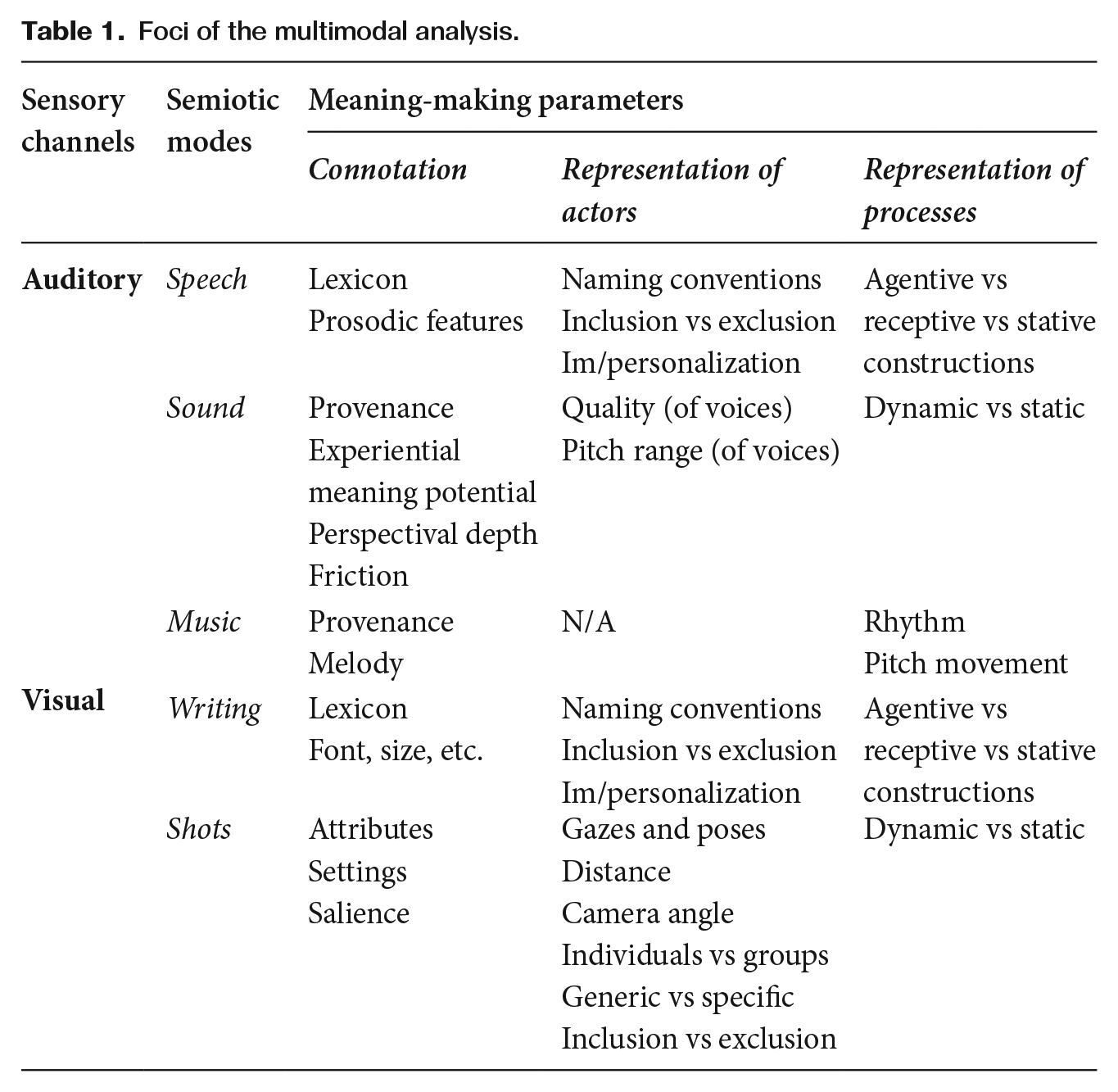
To summarize the procedure: we started by watching the documentary ourselves and by noting down the themes, social actors and events discussed. Second, we analysed the comments to identify which social actors and events attracted the most attention amongst the posters. We then carried out the multimodal analysis of the social actors and events that had attracted the most attention in order to identify the preferred readings. Finally, we went back to the comments and coded them based on the interpretative codes, the level of engagement (i.e. micro, meso and macro), the political orientation and the strategies used to express the comments. Although the analysis moved back and forth between the documentary and the comments, we present the multimodal analysis first, as this will facilitate following the discussion about the reception analysis.
Analysis And Results
Multimodal text analysis
The analysis was led by the events and social actors that the viewers referred to in the comments. The social actors are the British (A1), ELAS (A2), the Government Army (A3), the US (A4), the ELAS partisan Olga Dhedhe (A5), and the ELAS Leadership (A7). Figure 1 shows the analysis of the introduction to the programme (00:00:00 – 00:01:08) as an example of the multimodal transcription of the documentary and the coding applied for the analysis of connotation, representation of social actors and representations of processes across the modes. The British (A1) and ELAS (A2) are both represented in this introductory part.
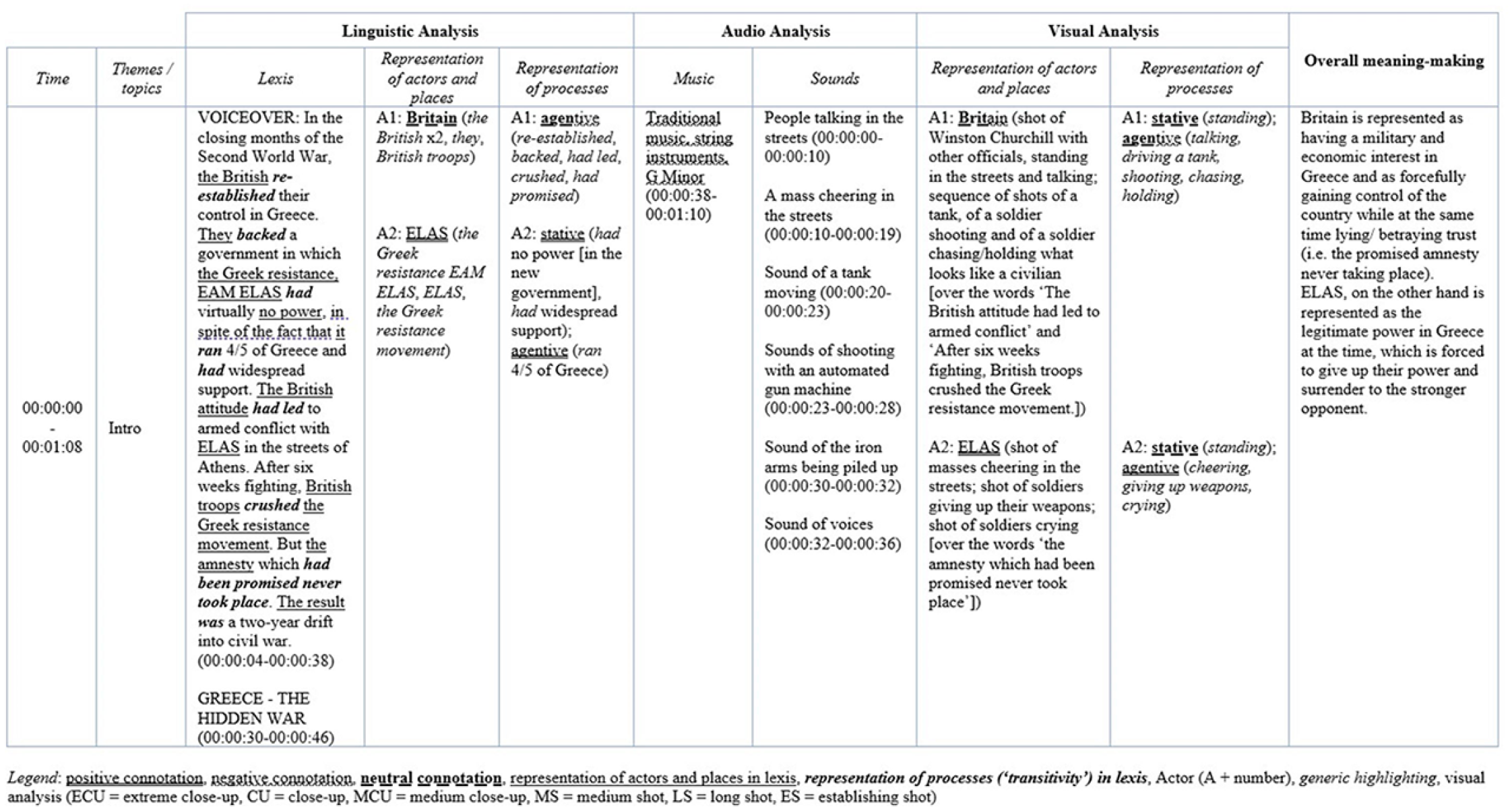
Example of the multimodal analysis.
If we look at the representation of each social actor more closely, we can analyse how the different modes contribute to the discursive construction offered by the documentary. The themes the analysis refers to are those related to the events that attracted most of the comments: the ‘British and American involvement in Greek affairs’ (00:04:05 – 00:08:17 and 00:19:22 – 00:24:24), ‘Operation Summit’ (00:37:31 – 00:40:51), the ‘Children Diaspora’ (00:40:51- 00:44:57) and ‘Operation Torch’ (00:44:57 – 00:50:48).
The social actors ‘involved’ in the first theme, i.e. the ‘British and American involvement in Greek affairs’, are the British (A1), ELAS (A2), the Government Army (A3), the US (A4) and the USSR (A10). The first part (00:04:05 – 00:08:17) constructs a contraposition between, on the one hand, the British (A1) and the Government Army (A3), and, on the other, ELAS (A2). The linguistic representation of A1 and A3, primarily based on accounts of members of the Left, underlines a co-operation between these social actors which led to discrimination towards members of ELAS as well as their incarceration and execution under ad hoc military laws. ELAS (A2), on the other hand, are predominantly represented as the victims of the situations, with numbers (‘by July 1945 49,000 former ELAS partisans were in prison’ and ‘80,000 former ELAS partisans were in prison’) provided to illustrate the scale of such discrimination. The visual modes (moving and still images) reinforce the narrative, by showing, for example, British soldiers in relaxed situations (Figure 2a) and ELAS members on trial and behind bars (Figures 2b and 2c).
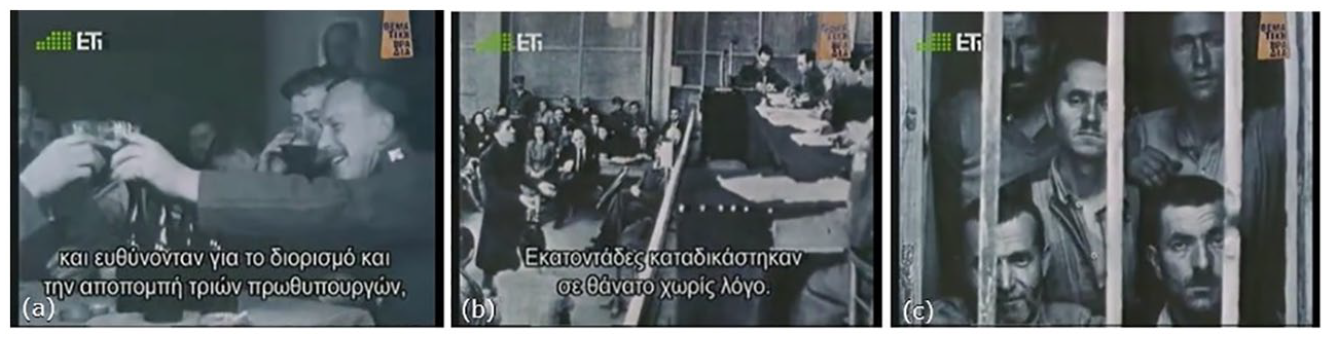
(a) British soldiers cheering (00:04:12); (b) ELAS members on trial (00:05:25); (c) ELAS members behind bars (00:06:24). Screenshots from ‘Greece: The Hidden War – Part 2’. © TVS (1986).
The second part (00:19:22 – 00:24:24) discusses the ‘handover’ of the Greek issue from the British (A1) to the US (A4) and the implementation in Greece of the ‘Truman Doctrine’ (00:21:00 – 00:22:23). The stress here is on how the Americans came to control the Greek administration, especially in the military sector, the control was very, very thorough because the Americans provided not only the equipment but also the economic support for the armed forces and therefore the Americans had a veto over anything that had to do with the Greek armed forces. (Professor John Iatrides, 00:23:19 – 00:23:32)
The effects of the takeover and of new military operations against ELAS (A2) are reported by former members, who tell stories of being moved from place to place (00:23:54 – 00:24:23). Visually, a contraposition is created by archive images of the American soldiers working with the Greek ones (Figure 3a) and close-up shots of elderly people remembering what happened at the time (Figures 3b and 3c).
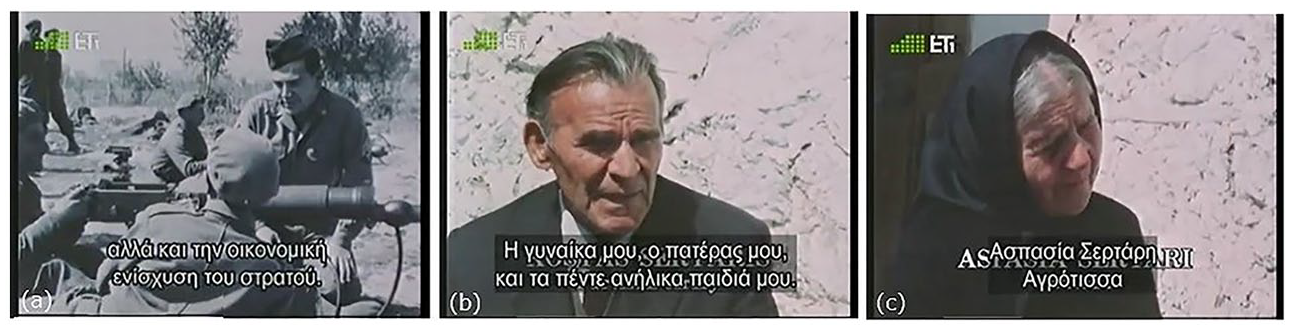
(a) American and Greek soldiers working together (00:23:25); (b) Close-up shot of a man (00:24:01); (c) Close-up shot of a woman (00:24:07). Screenshots from ‘Greece: The Hidden War – Part 2’. © TVS (1986).
The second theme, ‘Operation Summit’ (00:37:31 – 00:40:51), involves ELAS (A2), the Government Army (A3) and the US (A4). Once again, a contraposition is created between A3 and A4 on one side, and A2 on the other. A3 and A4 are linguistically represented as attacking ELAS and using unconventional weapons such as napalm, whereas A2 is represented as the victim of the attacks, ‘outnumbered’, ‘building defences’, but still keeping a ‘sense of humour’. Visually, archive footage with sound (whether diegetic or non-diegetic is difficult to tell) shows American bombers (Figure 4a), burning woods (Figure 4b) and heavy artillery on the ground (Figure 4c).
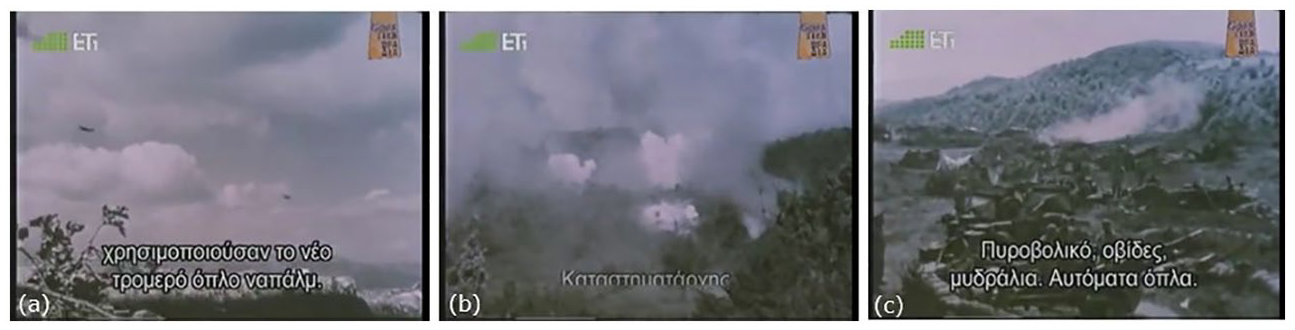
(a) American bombers (00:37:48); (b) Burning woods (00:37:52); (c) War scene (00:39:04). Screenshots from ‘Greece: The Hidden War – Part 2’. © TVS (1986).
The third theme, the ‘Children Diaspora’ (00:40:51 – 00:44:57), discusses the decision taken by the ELAS leadership, following ‘Operation Summit’, to evacuate the children of partisans and civilians to Albania. The Government Army (A3) are linguistically described as the reason behind this decision, as they ‘had emptied all the villages’, ‘people were butchered [by the Government Army]’, ‘opened fire’ and ‘children and women were killed in the bombardment from the government army planes’. ELAS and civilians, on the other hand, are represented as the victims of these attacks. Visually, archive footage highlights the desperate situation of the civilians, showing large groups on the move (Figure 5a), details of their conditions (Figure 5b) and several shots of mothers and children (Figure 5c).
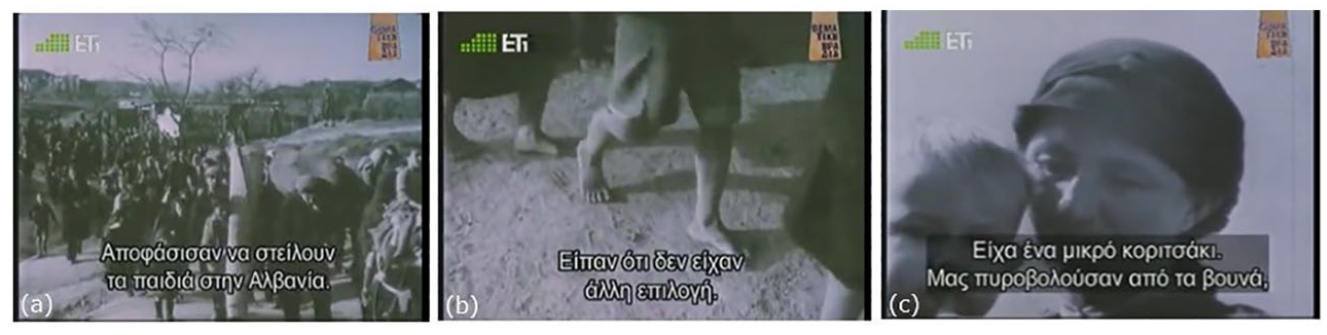
(a) Civilians fleeing (00:41:17); (b) Close-up shot of bare feet (00:41:19); (c) Close-up shot of mother and child (00:41:39). Screenshots from ‘Greece: The Hidden War – Part 2’. © TVS (1986).
Finally, the fourth theme, ‘Operation Torch’ (00:44:57 – 00:50:48), offers a snapshot of the role of guerrilla women during the civil war (Foundouka, 2024), through the testimony of one female partisan, Olga Dhedhe (A5). Linguistically, she describes her actions as a partisan as a mix between good deeds, e.g. ‘helped carry the stretchers’ or ‘go and collect an injured government army officer’, and bad ones, e.g. ‘threw stones’ or ‘killed him’ and ‘tore him to pieces’, effectively describing a war situation. Her final words, moreover, were the object of comments (both positive and negative) by some of the viewers: ‘The civil war was fought for democracy. But there are people who are greedy. Let them burst from their greed. Democracy will come one day’ (00:50:38 – 00:50:47). Visually, close-up shots during her interview reveal the unrepenting nature of this character who can smile while talking about killing an enemy and tearing his body apart (Figure 6a) and shows pride and determination for her actions (Figure 6b). Figure 6b is also the final still of the documentary, after which a strings and piano, slow tempo music in F# Minor accompanies the closing credits (00:50:48 – 00:51:41).
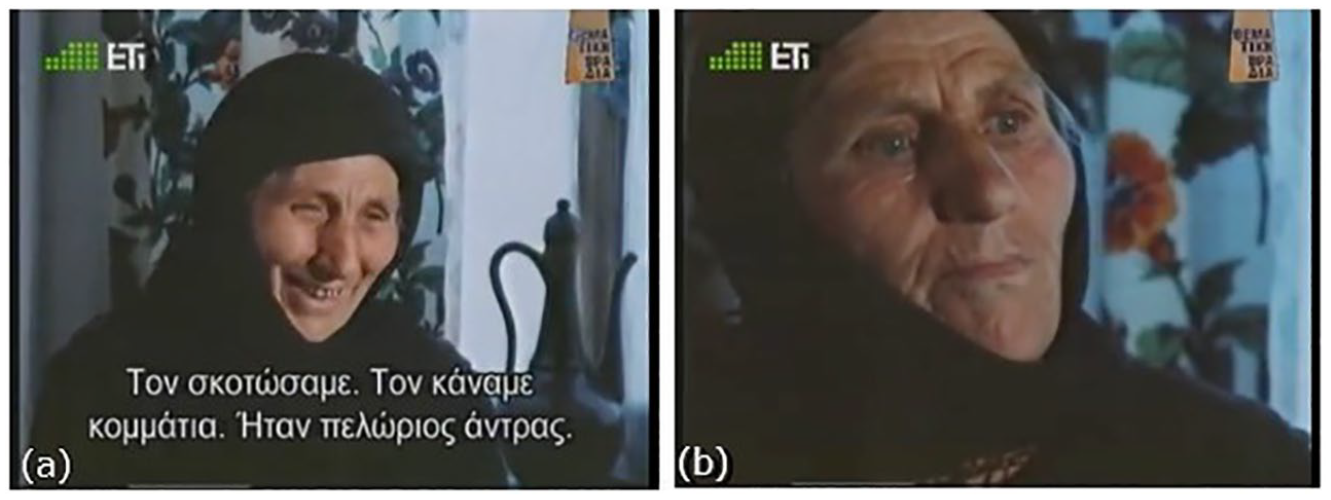
(a) Olga Dhedhe smiling (00:48:03); (b) Olga Dhedhe with a severe expression (00:50:48). Screenshots from ‘Greece: The Hidden War – Part 2’. © TVS (1986).
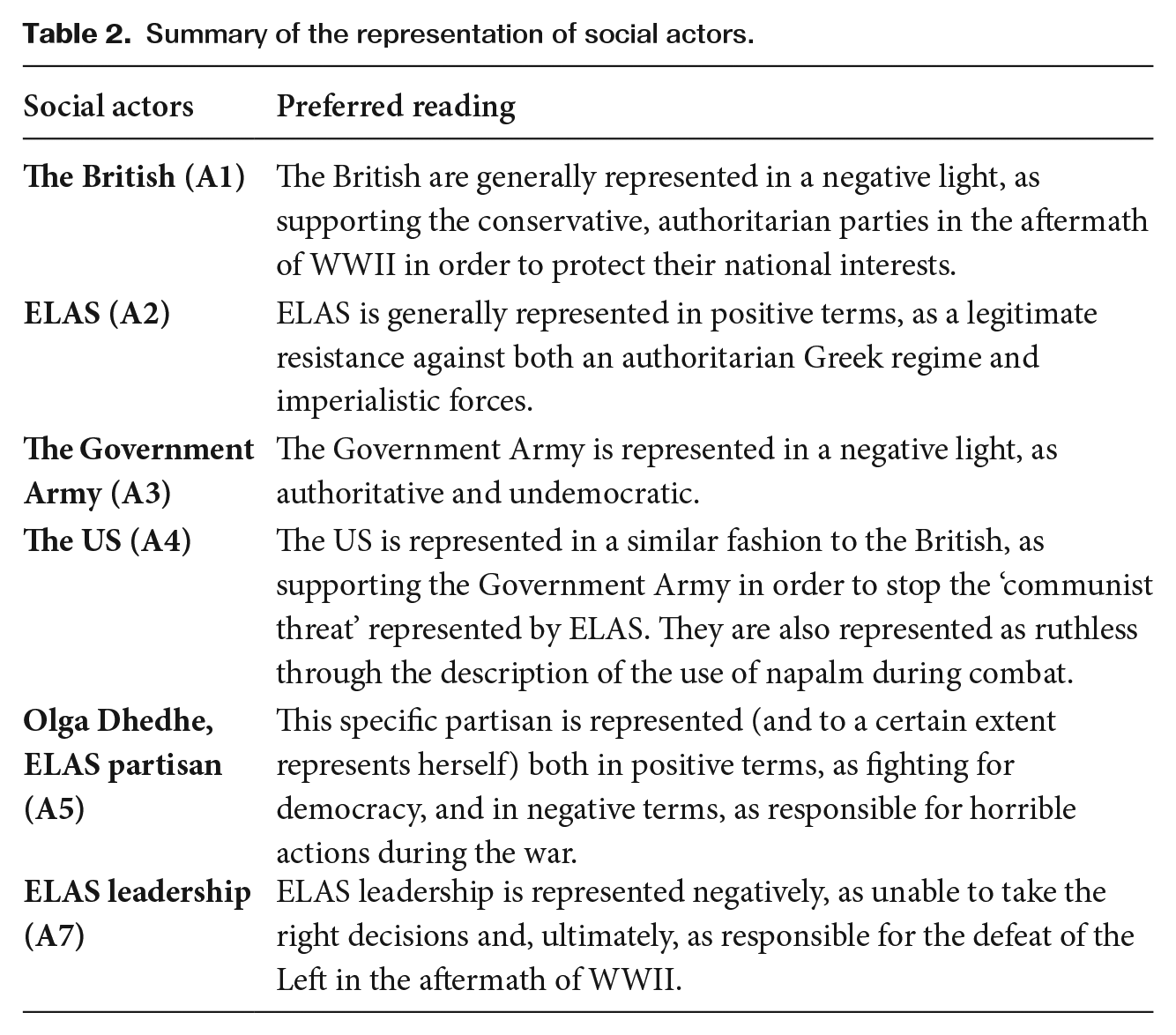
Overall, the multimodal analysis shows how the documentary provided a positive representation of the leftist resistance movement ELAS (but not their leadership) and a negative representation of the Government Army and its allies, i.e. the British and American political and military forces. Table 2 provides a summary of the representation of all actors and the preferred readings associated with them. The preferred readings identified by the multimodal analysis point toward a specific rendition of the events related to the Greek Civil War, which is, in turn, taken up and upheld or challenged by the YouTube users.
Summary of the representation of social actors.
Reception analysis
The reception study looked at all the comments left as of 10 February 2023, for a total of 149 comments left by 70 unique users. The comments were analysed qualitatively to assign an interpretative code and quantitatively to establish the distribution of interpretative code amongst both comments (Figure 7) and users (Figure 8).
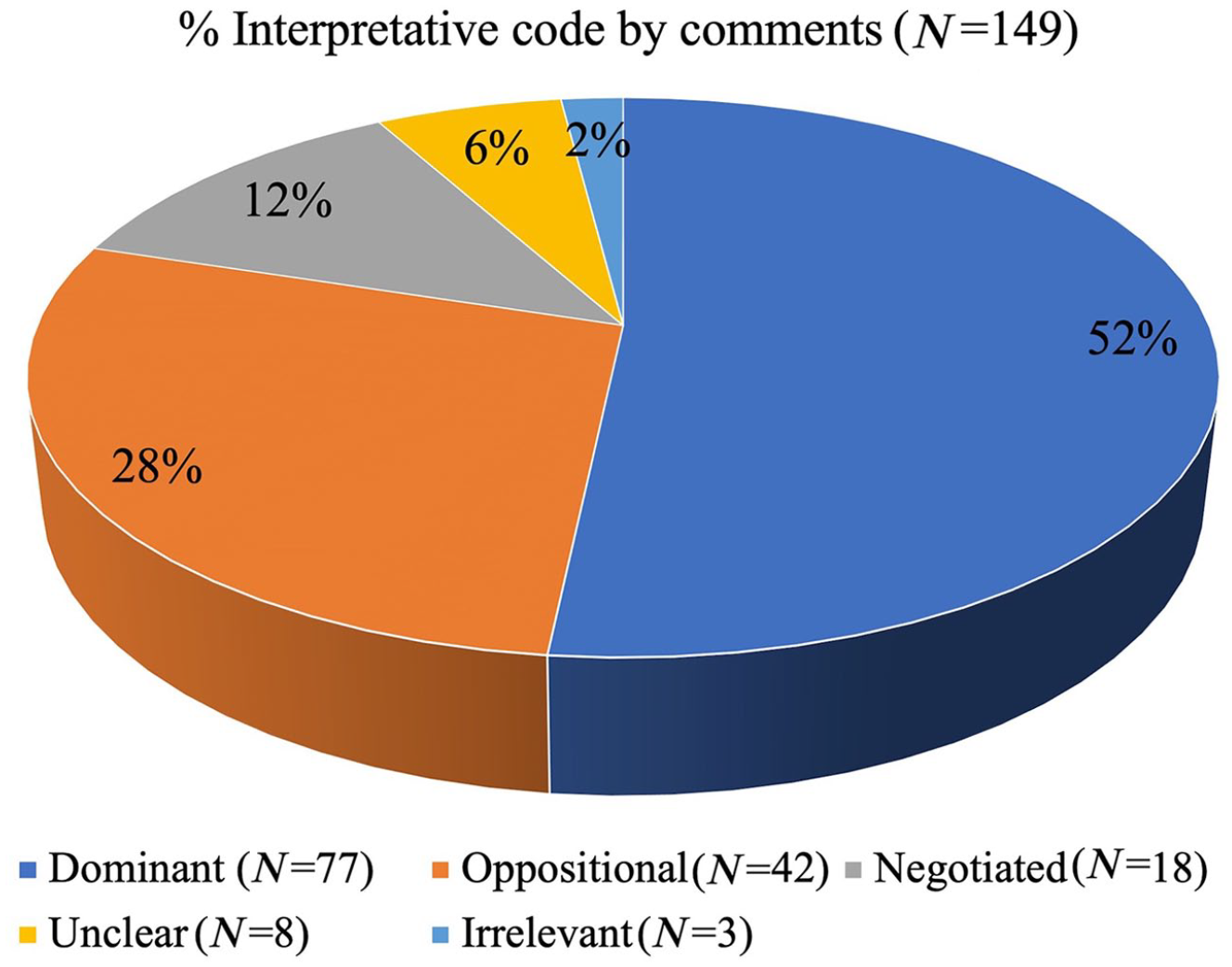
Interpretative code by comments.
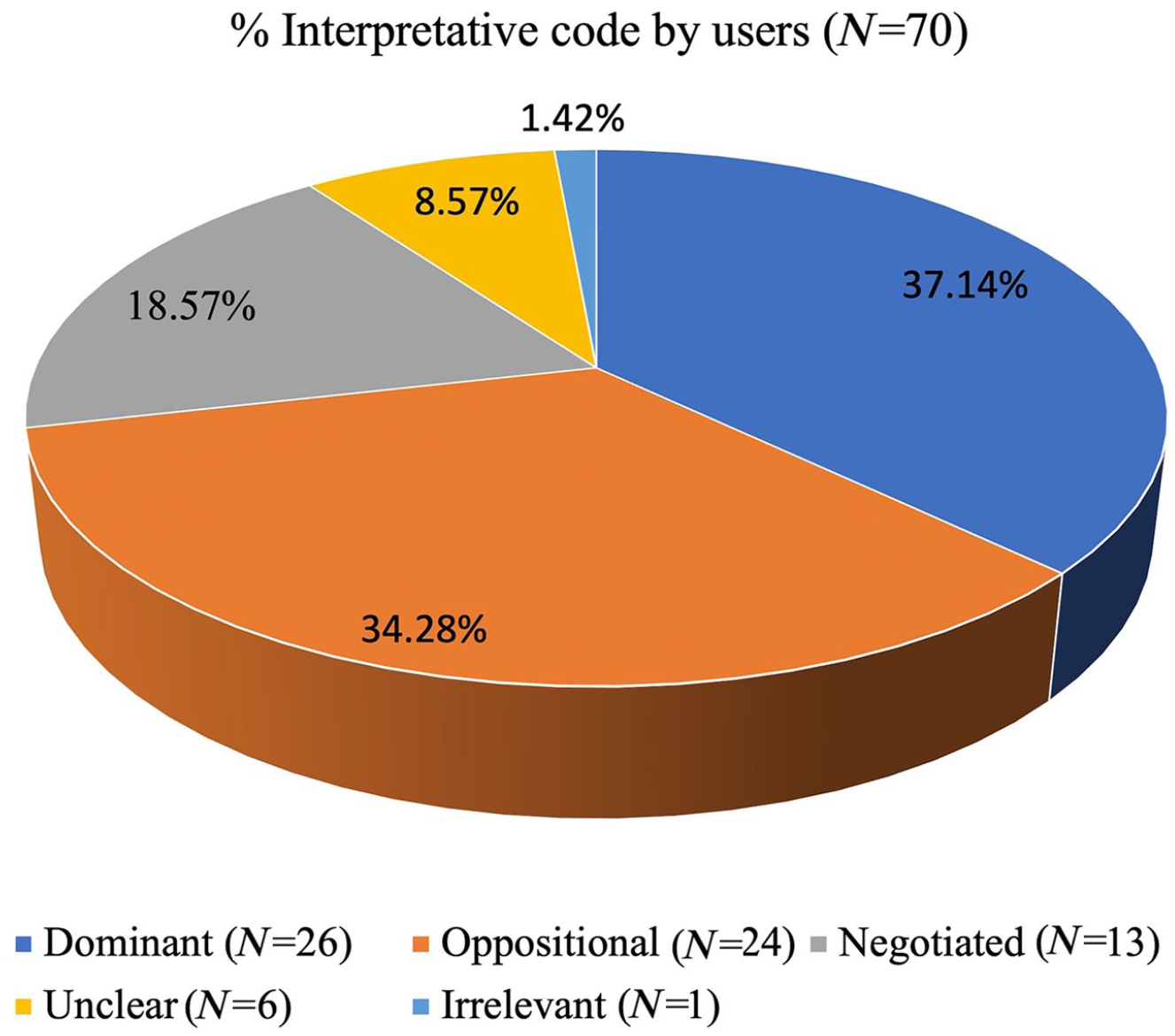
Interpretative code by users.
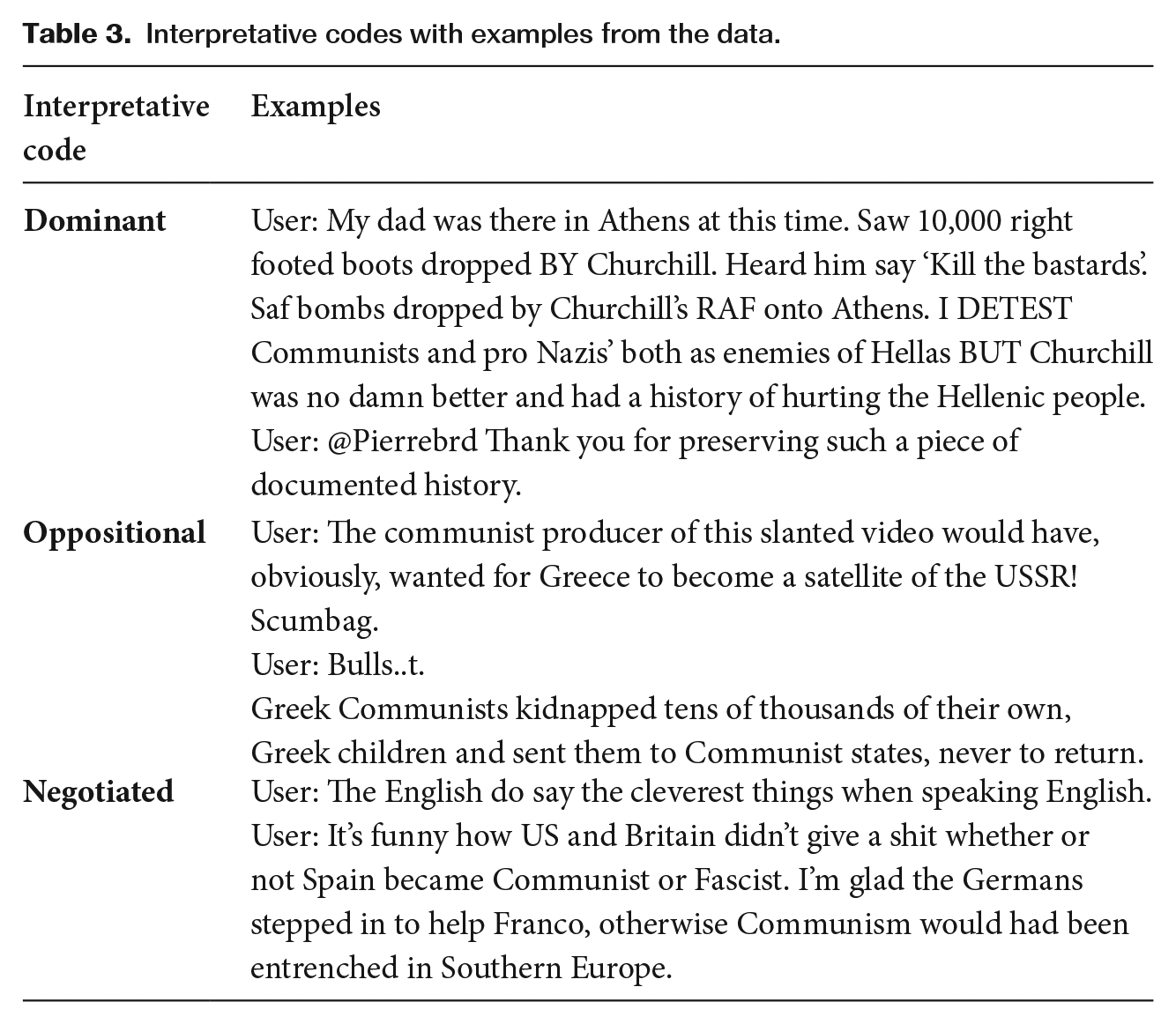
As can be seen from the graphs, the distribution of interpretative codes amongst both comments and users shows mainly dominant and oppositional codes being employed. 3 Table 3 provides examples from comments in English of the coding for the three interpretative codes, but the same was done for comments in Greek. It is interesting to note that the negotiated interpretative code was not employed as often (12% of comments and 18.57% of users) as the dominant (52% of comments and 37.14% of users) and the oppositional (28% of comments and 34.28% of users) ones. This demonstrates the polarization of the people when discussing the civil war and politics between Left and Right. It also suggests that the users come to the platform with pre-conceived ideologies and that they were not there to negotiate their views but to convince the other, the ‘opponent’. The opinions they express are not individual ones but that of specific socio-political groups they belong to, which we have identified as aligning with communism and leftist politics on the one side, and neoliberalism, the far-right, neo-Nazi and nationalistic politics on the other.
Interpretative codes with examples from the data.
While it is interesting to have an overview of the interpretative codes employed by the commentators, we were also interested in exploring the topics of discussion the documentary instigated and the way in which different users approached the debate and expressed their opinions. As Figure 9 shows, 4 there was a fairly even distribution of the comments over the three levels of engagement taken into consideration, micro, meso and macro, with the macro level (41.10%) being slightly higher than the other two (28.83% micro and 30.06% meso). This suggests that the users often used the content of the documentary as a starting point to debate broader political issues. This aspect will be discussed in more detail below.
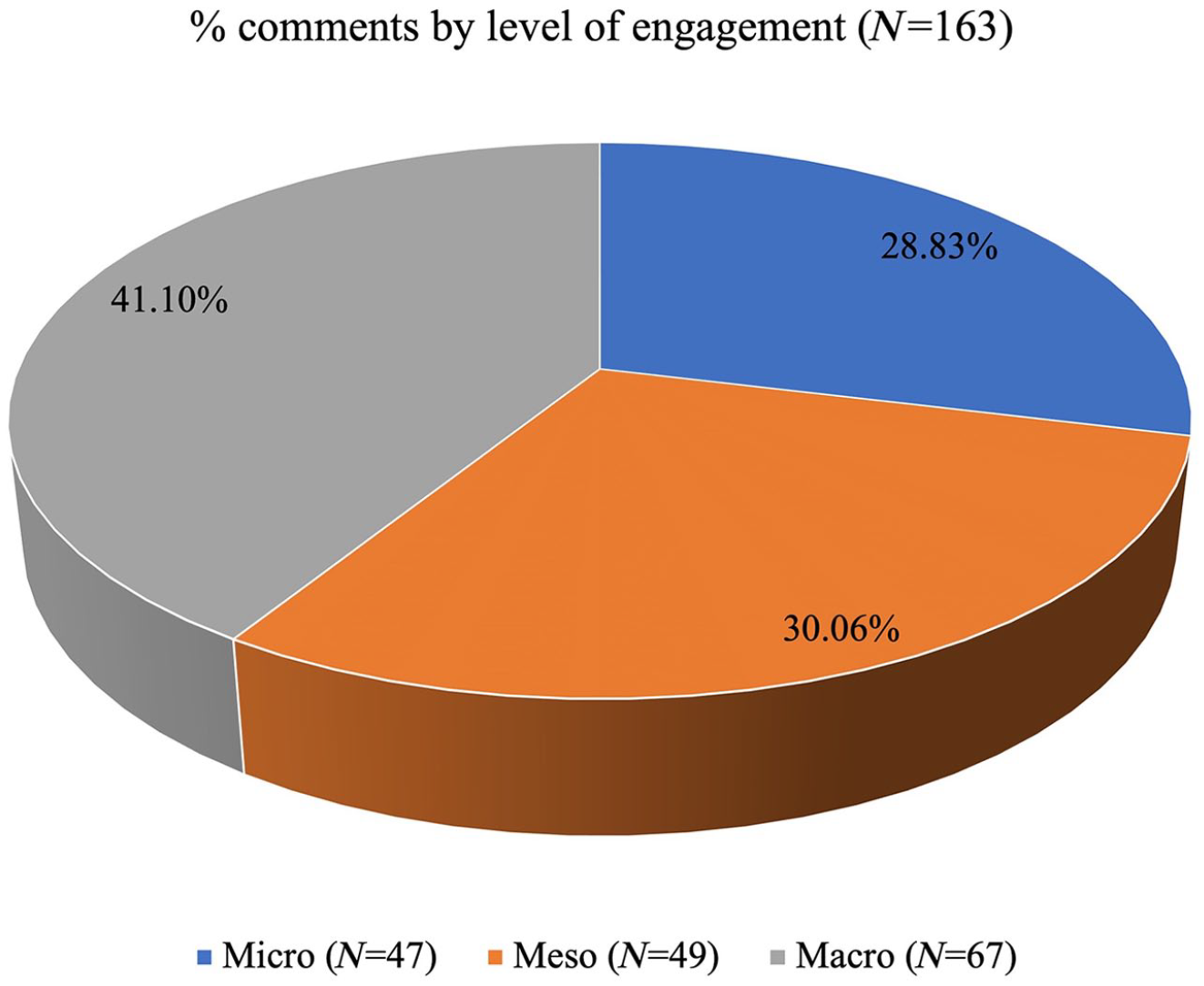
Comments by level of engagement.
Furthermore, it is interesting to explore how the users put forward their opinions in relation both to the levels of engagement and to their political orientations. Figure 10 shows the distribution of four types of rhetorical strategies employed by the users: argumentation, indirect insults, direct insults and slogans.
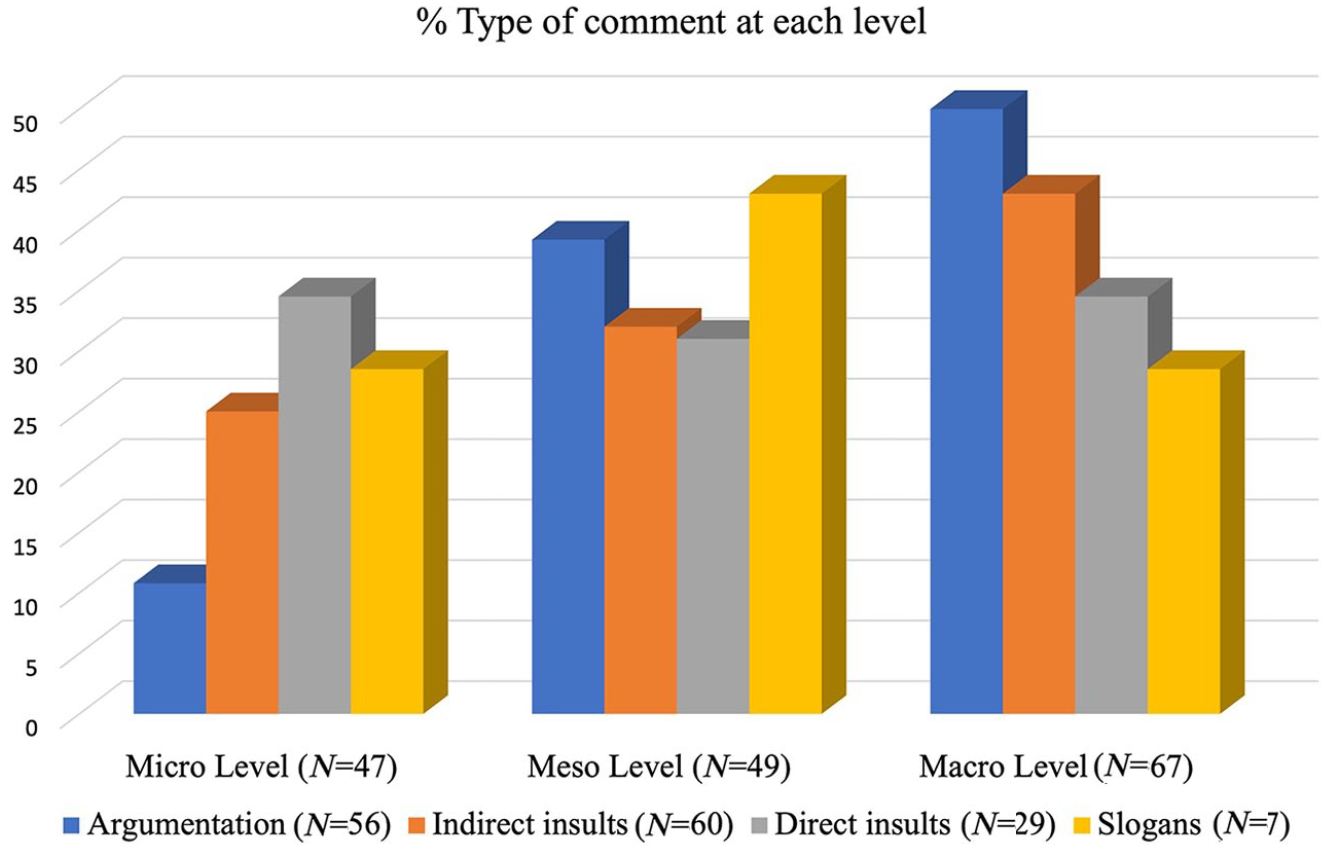
Rhetorical strategies used at each level.
The first type of rhetorical strategy is argumentation (36.84%), which we define as a systematic reasoning process in support of an idea, often with references to external sources either presented or implied (see Van Leeuwen’s (2018: 221ff) category of authority with regard to legitimation in discourse). The use of references (books, sites, articles and conference proceedings) is detected in 11 comments out of 56 (19.6%). Looking at the comments that use references, 45 percent of the references come from the left-wing commenters (their political identity is deduced from the ideology they express through the comments) and refer to sites, articles and conference proceedings of the Communist Party. It should be noted that most of the references come from the channel owner PierreYTBourdieu. The use of argumentation with references in comments written by right-wing users is detected in 28 percent of the comments using this rhetorical strategy, with quotes of historical books written by right-wing historians. The other 27 percent of the references concern foreign politics, suggesting sites with statistics of the EU politics, the history of Himarë, South Albania and Greece–Macedonia.
One interesting aspect to note is how the strategy of argumentation is employed far more often at meso (39.2%) and macro (50%) levels than at micro (10.8%) level. This could be explained in a couple of ways: first, it could be that the perceived factual nature of the documentary, as a genre, leaves less space for counter-arguments, which would require evidence to be produced in contrast with that presented in the documentary – a task that may require too much effort on the part of the users. Another reason could be that, since at meso and macro levels the choice of themes to discuss is made by the users themselves, the latter may have more knowledge around those themes, and be able to provide arguments and supporting evidence more easily than they could with regard to the specific information presented in the documentary. Finally, this also points to the possibility that, being unable to counter the specific information and evidence provided in the documentary, some users resort to bringing in other themes and arguments to the table, rather than conceding that the representation provided by the documentary is accurate. The other three strategies are more evenly distributed across the different levels of engagement, thus suggesting that some users may simply bring in their pre-conceived ideas and fail or avoid engaging in constructive discussions.
Insults, direct or indirect, represent 58.54 percent of the strategies used. Indirect insults are characterized by mild irony, belittling terms and hate speech, and they represent 39.47 percent of the total strategies and 67.41 percent of all insults. By the term ‘direct insult’ we have linguistically categorized the comments that involve the use of notionally offensive words, mainly to demonstrate disrespect and challenge the other person’s intelligence or (less frequently) mental health. Direct insults represent 19.07 percent of the total strategies and 32.58 percent of all insults, with 60 percent of them coming from right-wing posters.
The strategy employed less often is that of slogan ‘shouting’, written in capital letters accompanied by exclamation marks and emojis. There is only a small percentage of this strategy (4.6%), and most of the comments are in Greek. The comments that contain slogans are further categorized regarding the ideology they represent, 72 percent coming from users expressing right-wing (and far-right, nationalistic) ideologies, and 28 percent from left-wing users. The use of slogans in the comments is accompanied by the lack of argumentation.
Figure 11 shows the distribution of the strategies (indirect and direct insults have been put together) amongst users with different ideological positions. As the graph shows, argumentation is the preferred option amongst users belonging to left-wing ideologies (just over 40%), while insults (almost 60%) and slogans (almost 70%) are the preferred strategies amongst users belonging to right-wing ideologies. Associating better argumentative skills to left-wing users seems too simplistic an explanation, so these findings may suggest that left-wing users in the data analysed possessed more knowledge around the themes discussed than other users, and could articulate and argue their points more effectively.
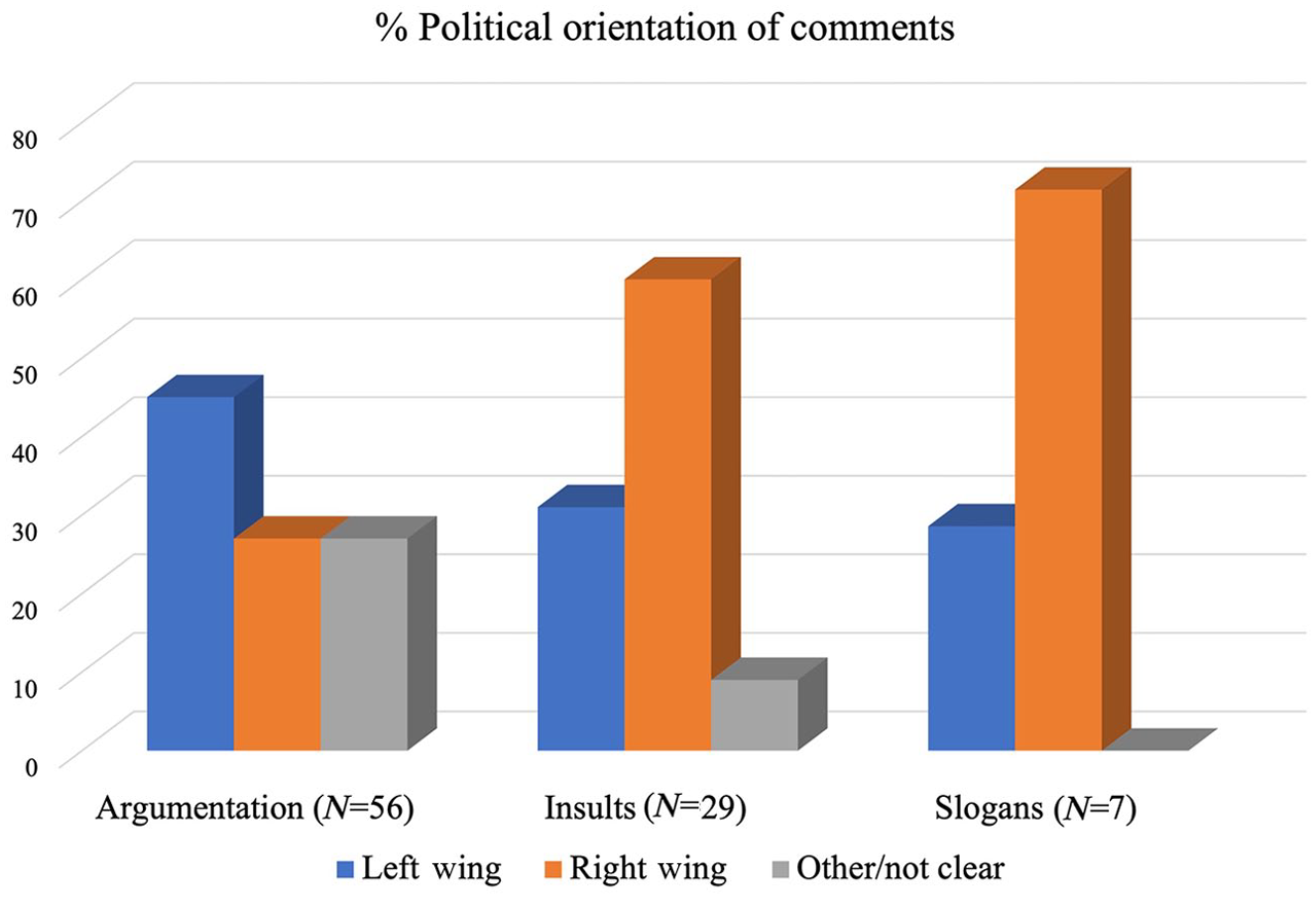
Political orientation of comments.
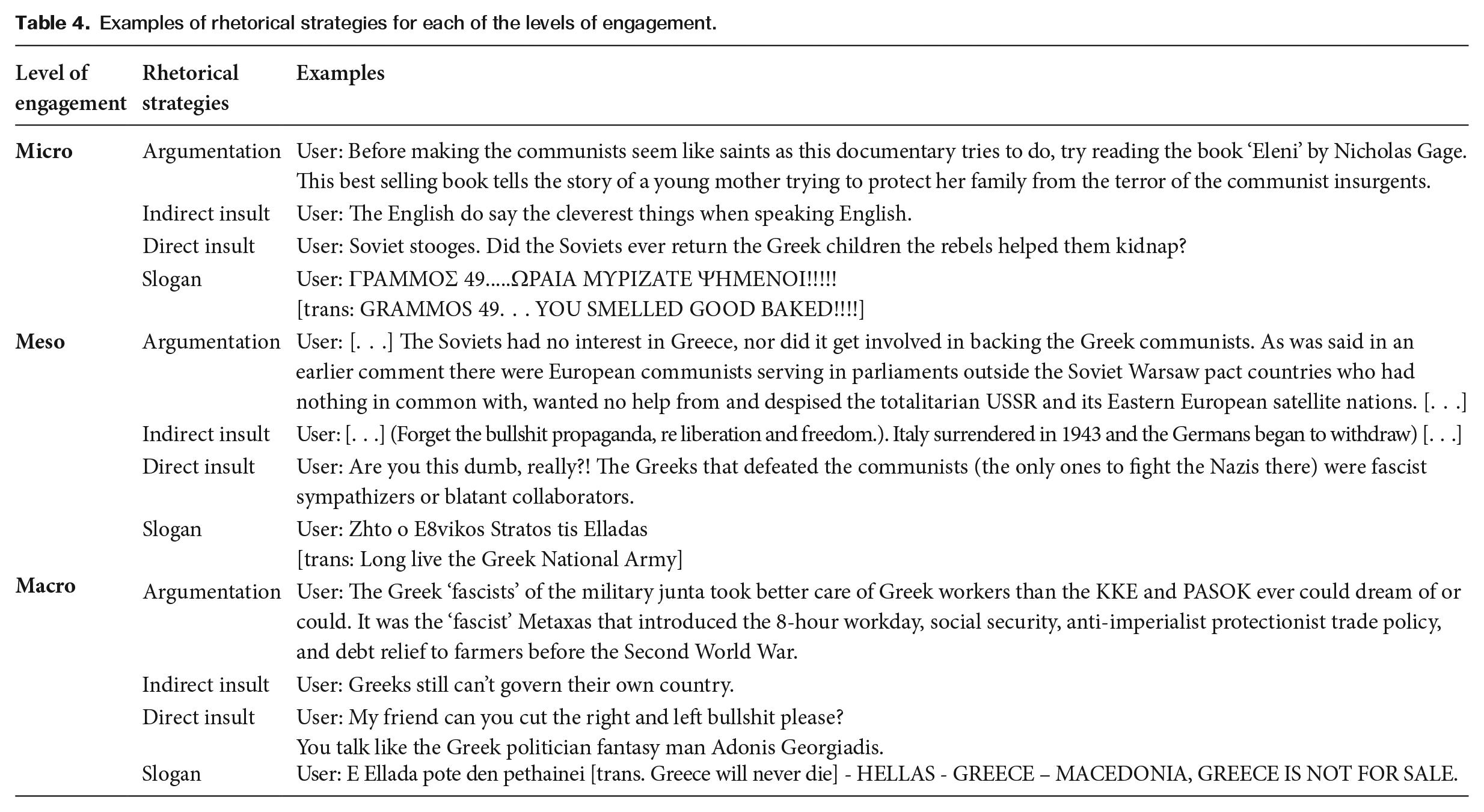
Table 4 provides examples of each of these strategies for each of the levels of engagement.
Examples of rhetorical strategies for each of the levels of engagement.
Moving on to the themes discussed at each level of engagement, Figure 12 shows all themes discussed at the micro level and their distribution amongst users. As mentioned in section 5.1, these themes were used as the basis for the multimodal analysis of the documentary, as they indicated what topics the commentators had focused on. The highest percentage of comments at this level (22%) comes from users who interpreted the documentary through an oppositional code and who accuse the documentary of being biased. Other common themes included the use of napalm and disputes over the number of casualties (16%), the role of Britain and the US (16%), comments on the final character in the documentary, Olga Dhedhe (10%), and discussions around the children diaspora (7%). All these themes were given considerable space in the documentary with some, particularly the use of napalm and the testimony of Olga Dhedhe, charged with emotive overtones that might have grabbed the viewers’ attention.
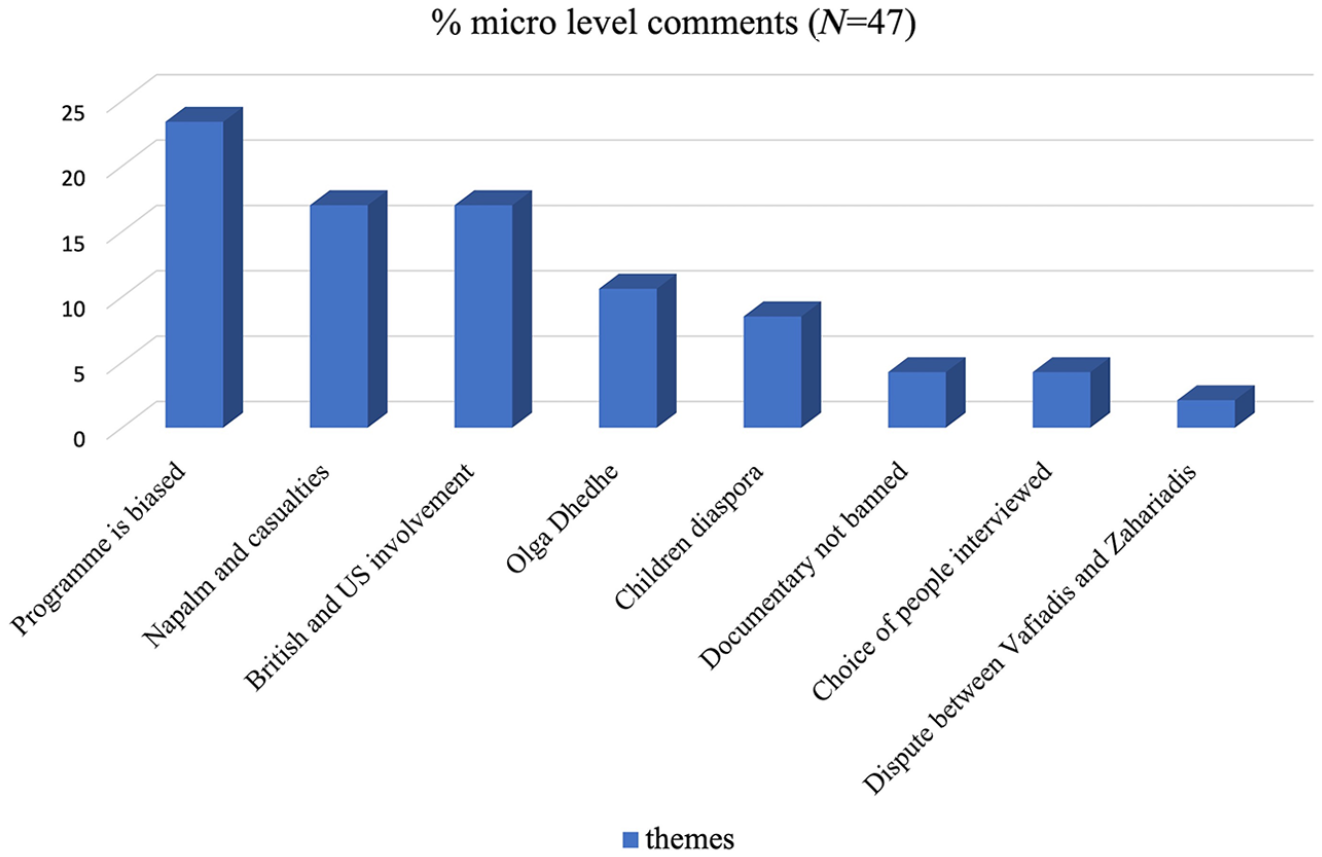
Topics at micro level.
At the meso and macro levels of engagement, we can see in Figures 13 and 14 that the topic that was discussed most frequently (over 40% of the comments at the meso level) is the role of Britain and the US as global superpowers. This is perhaps unsurprising given the fact that it is the only topic that still holds great relevance in our days and that people might have felt they could relate to and comment on. Moreover, it is interesting to note that current political affairs that still polarize the Left and Right viewers hold a significant place in the discussions. Although not as frequently discussed, the most heated discussions at the meso level were about the material ‘support’ to the partisan army by the Soviets and specifically Tito, and generally the USSR involvement in the civil war (15%). As an argument, this works in favour of the ‘anti-communist’ narrative in order to justify the civil war and the interference of Britain and the US in Greek politics.
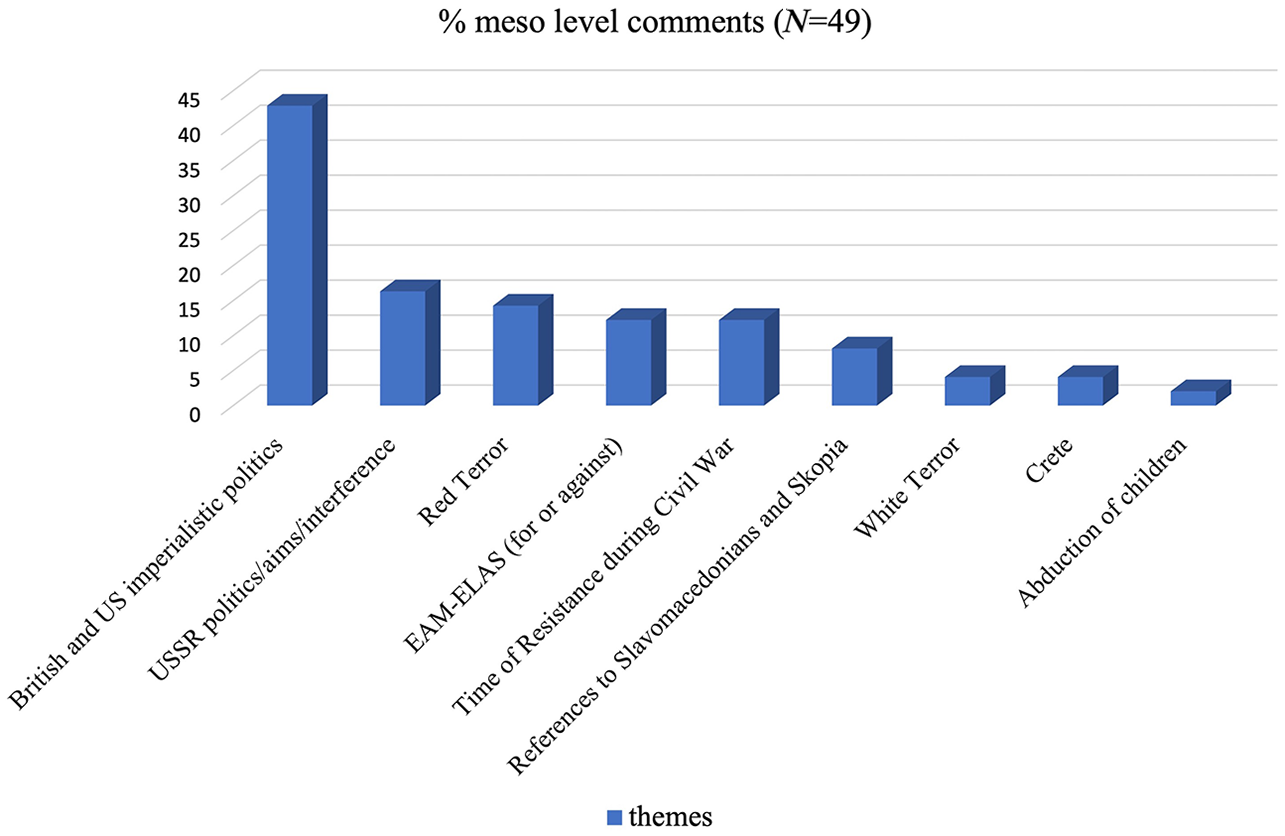
Topics at meso level.
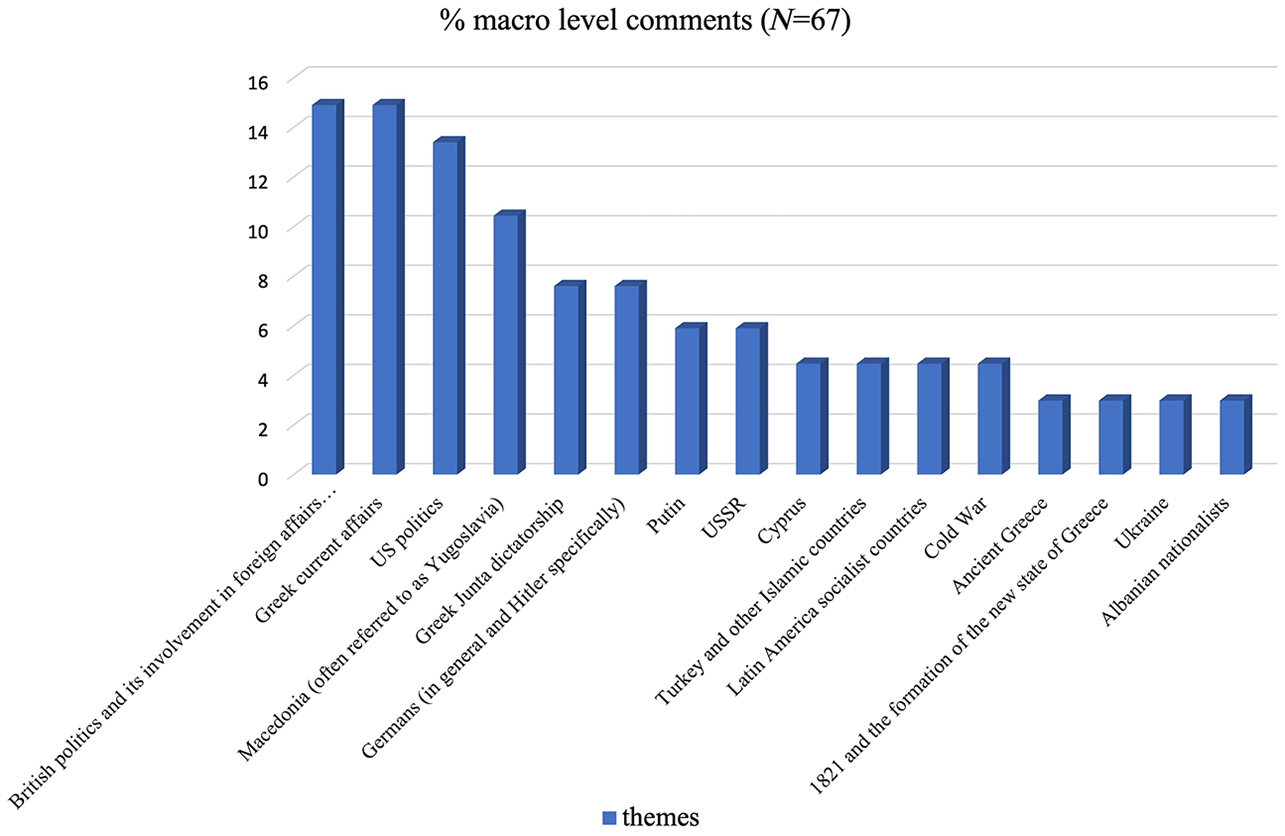
Topics at macro level.
At the macro level of engagement, one of the most extended discussions (just over 10%) was about Macedonia and Yugoslavia (now North Macedonia) and this is understandable if we consider the historical context of the time the comments were written, i.e. 2011–2022. The use of the country name ‘Macedonia’ was disputed between Greece and FYROM, the Republic of Macedonia (now North Macedonia) between 1991 and 2019. The dispute was a source of instability in the Western Balkans for 25 years. It was resolved through negotiations between Athens and Skopje, and mediated by the United Nations, resulting in the Prespa Agreement, which was signed on 17 June 2018. It was signed by the Greek prime minister Alexis Tsipras and was the cause of dispute between the Left (represented by the ruling party SYRIZA), the neo-liberal Right (Nea Dimokratia) and the nationalists (Golden Dawn). Lastly, but sufficiently significant as evidence of the fact that the Greek Civil War has caused a division beyond the Greek territories, there are comments coming from Albanian nationalists (3%), negotiating the political history and the division of territories of North Epirus after the end of WWII.
Discussion
The findings from the case study seem to agree to a large extent with Thelwall et al.’s (2012: 627) view that YouTube can function as a public space to exchange opinions. The comments we analysed show that discussions are indeed occurring and that different opinions, from different ideological standpoints, are not only in relation to the content of the documentary (the micro level), but also around broader issues that are related to it (meso and macro levels). Such exchanges, however, do seem to be polarized on existing positions and, in this respect, the findings seem to validate other studies on YouTube (e.g. Way, 2015) that noted an unwillingness on the part of the commentators to move away from pre-existing ideologies. Unlike in Way’s study, however, we noted that some of the users did engage with the content of the documentary and that this functioned as a springboard for the ensuing discussions, which is something that aligns with Georgakopoulou’s (2014) results.
Our findings, moreover, challenge the assumption that the comment area of YouTube is simply the ground for shouting matches between people with opposing views. It seems to be the case, as Pihlaja (2014: 8) notes, that ‘dominance of another user is an explicit goal of the interaction.’ This process, however, is often part of debates in many different contexts. Although insults and slogans were found in our data, so were argumentative strategies that attempted to create a dialogue based on civil, evidence-based discussions. In spite of the fact that the creation of shared identities may not be immediately visible in the comment area itself (Jenkins, in Jenkins and Carpentier, 2013: 273), we cannot assume that the discussions that occur online are not taken forward offline by the YouTube users. Even within the comment area, shared identities between users with similar views are certainly reinforced, with users forming allegiances and supporting like-minded users. The existence of different, opposing identities is indeed a sign of democratic exchange, as homogeneous shared values and identities would point towards authoritarian, rather than democratic, processes.
Finally, the integration of the multimodal analysis of the video content with the reception study showed that the multimodal discursive construction indeed influenced the interpretation of the users. This, however, and in line with Hall’s (2005[1980]) non-deterministic view of mass-media communication, does not mean that other top-down factors (i.e. viewer-driven) did not play a role in the users’ ideological positions. Bottom-up (i.e. text-driven) and top-down processes over the course of the media interaction are not mutually exclusive, but rather complementary. Pre-existing ideologies might influence the comments, but still in relation to the representation offered by the documentary and the multimodal representation of social actors and events therein. In other words, the viewers recognize the preferred readings in the documentary, which therefore influences the focus and tone of the ensuing discussions. However, at the same time, their pre-existing ideologies influence the way they react, through their comments, to those preferred readings. In fact, unlike other studies on less overt political genres (e.g. Castaldi, 2021, 2024, 2025), the present one showed the whole array of interpretative codes being employed by the users. This could be simply due to the overt political nature of the text under consideration, but also to the fact that the interactional nature of the YouTube comment area lends itself well to the formation and expression of diverse ideological standpoints. Future research could explore this further by looking at less overt political content on YouTube for comparison with the results of this study.
Conclusion
Our study aimed to shed some light on the role of YouTube as a form of digital agora, that is, a contemporary space where ideas can be exchanged, and democratic and civil participation can occur. We are in agreement with Pihlaja (2014: 4) that, if we are to meaningfully engage with discursive constructions on YouTube (or any other similar social media platform), it is not sufficient to look at the user interactions alone: a systematic (multimodal) analysis of the video content is also necessary to establish the starting point of the ensuing interactions. The multimodal analysis of the documentary highlighted a specific preferred reading in the documentary, sympathetic to the Left resistance during the Greek civil war. The reception study showed how this preferred reading was interpreted through different codes, dominant, oppositional and negotiated, and how the content of the documentary was used as a springboard for discussions around the documentary itself and beyond.
The documentary, when streamed through a YouTube channel, attracted viewers from diverse, often opposing, ideological positions: in this sense, it could be argued that it represents a form of digital agora. However, as Way (2015) argues, viewers’ comments do not seem to be influenced by the content, but rather to be based on their pre-existing ideologies. The debates seem stalled on polar oppositions and rarely some kind of agreement between users with contrasting views seems possible; our study confirmed this to a large extent. This does not mean, however, that the content did not influence the scope and tone of the discussions in the comments, which was the focus of our analysis and which is supported by the findings at the micro level of engagement in the reception study. The two sets of processes, documentary-driven (bottom-up) and viewer-driven (top-down), are not mutually exclusive in the sense that pre-existing ideologies might influence the comments, but still in relation to the representation offered by the documentary and the multimodal representation of social actors and events therein.
Moreover, the comments in our dataset displayed an array of rhetorical strategies used by the commentators: argumentation, indirect and direct insults, and slogans. The quantitative analysis showed differences in the distribution of these strategies across the three levels of engagement analysed (micro, meso and macro) with argumentation occurring more frequently at the last two levels. Moreover, the quantitative analysis highlighted how users whose ideology can be assigned to left-wing politics used argumentation more often than those whose ideology can be assigned to right-wing politics; the opposite was found to be the case for using insults and slogans. These quantitative findings, however, do not carry any claim of generalizability, given the small dataset analysed, but were only functional to provide a better understanding of the interactional dynamics.
This case study explored and highlighted some of the digital interactional dynamics around a historical documentary. Further research is necessary to corroborate our findings, but we propose that our integrated methodology and the differentiation between levels of engagement and between rhetorical strategies can provide a fruitful way to investigate civic participation in digital contexts, both in a qualitative and in a quantitative fashion.
Footnotes
Acknowledgements
We would like to thank Janina Wildfeuer, Ruth Sanz Sabido and two anonymous reviewers for their invaluable feedback and comments at various stages of drafting this paper.

Data Availability Statement
Data sharing is not applicable to this article as no datasets were generated or analysed during the current study.
Notes
Biographical Notes
JACOPO CASTALDI is a Senior Lecturer at Canterbury Christ Church University. His main research interests are Critical Discourse Studies, Multimodality, Mass-mediated Communication, and the semiotic and cognitive aspects of manipulation, with a focus on the interactive experiences of audiences and on meaning interpretation. Address: Canterbury Christ Church University, North Holmes Road, Canterbury, Kent CT1 1QU, UK. [email:
Iokasti Christina Foundouka is a PhD candidate from the Aristotle University of Thessaloniki, Department of Architecture, Sector of History of Arts and Architecture. She has an MA in Semiotics, Culture and Communication, and a BA in Architectural Design from the same institution. Her field of research is the history of the Greek civil war (1946–1949), memory studies, the social and cultural aspects of the representation of gender and gender relationships, as well as photography and its medium specifics. Address: Aristotle University of Thessaloniki, Faculty of Engineering, School of Architecture, University Campus, 541 24, Thessaloniki, Greece. [email: