




Abstract
Conceptual Metaphor Theory claims that metaphors are a key instrument for making abstract and complex phenomena comprehensible. Cancer, one of the deadliest diseases in the world, is one such complex phenomenon. Hitherto, metaphors pertaining to the nature and treatment of cancer, and to coping with it, have been analysed almost exclusively in verbal communication. Cancer metaphors, however, are also often audio-visualized in animations. In this article, the authors analyse the metaphors in 30 short medical animation films. Their purpose is twofold: (1) to assess whether these animations feature the same metaphors as those prevailing in the verbal texts analysed in earlier research; and (2) to show how animation provides medium-specific ways to present metaphors related to ‘dealing with cancer’. They end the article with reflections on challenges with respect to the identification and categorization of metaphors in animated films to help future researchers, and with some cautious recommendations for possible practical uses of understanding cancer metaphors in animations.
Keywords
1. Introduction
In 2018, cancer was responsible for an estimated 9.6 million deaths (WHO-Cancer, 2023). The way we think about cancer influences how we communicate about it, and presumably how stakeholders cope with it. As has been robustly attested, verbal discourses pertaining to cancer are full of metaphors (Gibbs, 2020; Gibbs and Franks, 2002; Gustafsson et al, 2020; Hommerberg et al, 2020; Reisfield and Wilson, 2004; Skott, 2002; Wackers et al, 2020). This work is heavily indebted to Lakoff and Johnson (1980), who propose that human beings can only conceptualize abstract and complex phenomena by systematically understanding them in terms of concrete, perceptible phenomena – an approach known as Conceptual Metaphor Theory (CMT). For a long time, CMT almost exclusively studied verbal expressions of conceptual metaphors. But, given that ‘metaphor is primarily a matter of thought and action, and only derivatively a matter of language’ (Lakoff and Johnson, 1980: 153), it is unsurprising that research gradually began to expand to metaphors that are expressed visually, or in combinations of language, visuals, sound, music and gestures, resulting in so-called ‘multimodal metaphors’ (Forceville and Urios-Aparisi, 2009).
Drawing on CMT, in this article we analyse the metaphorical conceptualizations of cancer in the medium of animation. Our purpose is twofold: (1) to assess whether the animation films analysed feature the same dominant metaphors as the verbal texts examined in earlier research; and (2) to attest how and to what extent the verbal mode and the visual mode contribute to the identification of these metaphors. The structure of the article is as follows. In section 2 we explain the bare bones of CMT, focusing on verbal metaphors pertaining to cancer. In section 3 we point out animation’s specific affordances to communicate information. Section 4 explains our corpus and method of analysis. Section 5 presents which metaphors we found in 30 medical instruction animations about cancer, followed by a discussion of the results. After reflection on the limitations of our project and suggestions for further research (section 6), we end with some concluding remarks (section 7).
2. Conceptual Metaphor Theory (CMT) And Cancer Metaphors
The central tenet of CMT is that people can only conceptualize abstract, complex phenomena by comprehending them in terms of concrete, perceptible phenomena – that is, by metaphorizing them. Conceptual metaphors are conventionally presented in target a is source b 1 form. For instance, we typically understand the target domain time in terms of the source domain space, as transpires from expressions such as ‘these events lie long behind us’, ‘our deadline is approaching’, ‘Don’t look back; always look ahead when making plans.’ That is, in Western society we conceive of the present as being here, the past as behind us and the future as in front of us. Similarly, ‘we live by’ the metaphor emotions are physical forces (Kövecses, 2010: 289), as in ‘he exploded with anger’, ‘he was livid: the steam came out of his ears’, ‘he swelled with pride’.
Conceptual metaphors have another fundamental property: they occur systematically and routinely, consisting of ‘sets of correspondences, or mappings, across the two domains in conceptual structure’ (Semino et al., 2018: 8). We thus, largely subconsciously, exploit our everyday familiarity with concrete, perceptible ‘things’ to impose a configuration on abstract, complex ‘things’, making metaphor ‘a pervasive, indispensable structure of human understanding by means of which we figuratively comprehend our world’ (Johnson, 1987: xx). Since the source domains in conceptual metaphors are accessed via sensory perception and bodily movement, CMT is a theory that emphasizes ‘putting the body back into the mind’ (p. xxxvi). It is this central notion of embodied experience that ‘shape[s] our thoughts, language, and behavior’ (El Refaie, 2019: 21).
The interpretation of a metaphor entails ‘mapping’ a set of (often: structurally related) features, including associated emotions and attitudes, from the source domain onto the target domain. By definition, such mappings are selective: only appropriate features are mapped. Lakoff and Johnson (1980: ch. 3) discuss this in terms of ‘highlighting’ and ‘hiding’. As a consequence, a specific metaphor can distract us from aspects of a target domain that are inconsistent with the source domain adopted to present that concept.
Given that metaphors are typically used to make abstract and complex phenomena more comprehensible, their ubiquity in illness narratives is unsurprising: ‘It is almost impossible to describe illness and healing without metaphor rushing in to help characterize some of the specifics of these critical life events’ (Gibbs, 2020: 2). Various source domains have been found that are used to metaphorically characterize cancer, such as imprisonment (Gustafsson et al., 2020), dance (Gibbs and Franks, 2002) and burden (Hommerberg et al., 2020). But analysts of cancer-related-metaphors in verbal discourses conclude that, at least in English texts, there are two dominant metaphorical ‘scenarios’ (Musolff, 2016) in cancer discourse: cancer as war/battle/violence and cancer as journey (El Refaie, 2019; Gustafsson et al, 2020; Harrington, 2012; Hendricks et al., 2018; Hommerberg et al., 2020; Semino et al., 2018; Williams Camus, 2009, 2016; see also Hurley, 2014; Penson et al., 2014; Wackers et al., 2020). On the basis of analysing 37 cancer-related news items from The Guardian published in 2007–2008, Williams Camus argues that the battle scenario can be identified as such when dealing with cancer is described in terms of such (italicized) terms as the following: After the cancer’s invasion of the body, the immune system launches an offensive to beat the disease. The army of killer T cells and stealth viruses fight the tumour cells. However, this is not enough to wipe out or eradicate the invader completely, especially if it has spread throughout the body becoming lethal. Thus, a bigger arsenal of weapons, consisting of magic bullets and blunt instruments, target the enemy. If the cancer is still resistant to the cancer-fighting tools, other weapons are injected to attack the disease or to boost the body’s own defences. This attack may eventually lead to defeating the disease although it also involves serious side-effects as healthy cells are also destroyed by the weapons. (Williams Camus, 2009: 475, emphases in original).
Something similar can be done for the journey scenario (which Williams Camus, 2009, describes as the movement forward scenario). In her corpus of British popularization articles on cancer research, she finds for instance that new discoveries take a major step, make an exciting move, achieve a breakthrough, find new avenues or keys to open doors, permitting movement forward and pave the way for effective treatments, A significant discovery constitutes a landmark along the route towards the ultimate destination (the italicized words are from the corpus analysed in Williams Camus, 2009).
Clearly, metaphors are never neutral descriptions, always providing specific perspectives on a target domain. Metaphorical source domains deployed to characterize cancer can both empower and disempower a patient and other stakeholders (e.g. Czechmeister, 1994; Hendricks et al, 2018; Hurley, 2014; Penson et al., 2004; Semino et al., 2018, Wackers and Plug, 2022). Ideally, a metaphor aids patients to better understand their ill selves (again), leading to a reconnection of mind and body (El Refaie, 2019: 57). Moreover, metaphors can help patients to explain their subjective experiences, and thereby help others understand what they are going through (Penson et al., 2004; see also Hendricks et al., 2018; Semino et al., 2018). They also function as bridges to fill the gap between ‘the illness experience and the world of technology and treatment’ (Penson et al., 2004: 713). But metaphors can also be harmful. Suffering from breast cancer, Susan Sontag (1978) famously rejected the widely used metaphor of cancer-as-a-merciless intruder (see also Hurley, 2014: 311) as misleading, discouraging and shameful, leading to victim blaming.
The meaning patients attribute to their illness influences how they cope with it (see Charmaz, 1994). A change in the mindset via metaphors can lead to a higher quality of life for a patient suffering from the disease (Hendricks et al., 2018: 268). In contrast, a metaphor that does not correspond with a patient’s experience can aggravate the suffering, leading to negative emotions (e.g. Czechmeister, 1994; El Refaie, 2019; Hendricks et al., 2018). If misused in this way, metaphorical language can cause ‘misunderstanding, misdiagnoses, frustration, anxiety and stigma’ (Semino et al., 2018: 4).
Almost all research into cancer-related metaphors pertains to their verbal manifestations. But cancer-related metaphors also surface in the medium of animation, which has different affordances and constraints than language. Since the medium is the message (McLuhan, 1964: 24 et passim), these differences inevitably affect how cancer metaphors surface in animation.
3. The Medium Of Animation
Wells (2012) argues that since animation routinely allows for visual transformations and does not need to respect physical laws, it is well suited to provide unusual, ‘impossible’ perspectives on complex phenomena, while the various modes it exploits (visuals, language, music and sound) interact to create new meaning. Animation can thus ‘interrogate previous representations of “reality” and reinterpret how “reality” might be viewed’ (p. 232), thereby providing novel, creative perspectives on people and events. Furthermore, animation can visualize almost anything that the mind can produce (Lazarescu-Thois, 2018: 62), thereby allowing for more freedom to represent people, things and events than live-action film (Forceville and Paling, 2021: 44–45). Music can be used in animation to reinforce emotions experienced by characters onscreen as well as help the spectator empathize with these characters (Goldmark, 2013: 231), while non-musical sound contributes to overall meaning, for instance by cueing bodily actions such as sighing, panting, gasping, sobbing, shouting, screaming, and laughing (Garwood and Greene, 2016: 105). Moreover, animations (and films in general) often provide information not just visually, but also via spoken language, whether uttered by characters or in voice-over narration, and sometimes via written language (e.g. as signs, names, explanatory texts). Another affordance of animation is that characters’ inner mental states and emotions can easily be externalized, making abstract phenomena accessible (Fahlenbrach, 2017: 108; see also Honess Roe, 2013). Furthermore, animation often uses personification, ‘a highly useful tool to visualize plot events, since “persons” undertake (self-enabled) actions . . . featuring specific attributes and typical behaviors’ (Forceville, 2017: 251–252, emphasis in original).
The visual, musical, sonic and verbal modes can be used on their own or in interaction to create metaphors in animation. Forceville (e.g. Forceville, 2016; Forceville and Jeulink, 2011) demonstrates that the journey source domain is often used in animations that, in one way or another, thematize humans’ purposes in life. Formally, this metaphor can be rendered as purposive activity is self-propelled motion toward a destination. But the target domain purposive activity allows for metaphorical couplings with other source domains besides journey, e.g. battle or creating an object/building (Forceville, 2017). In recent years, multimodal metaphor scholars have zoomed in on how the domain of depression has been presented in film and animation (Fahlenbrach, 2017; Forceville and Paling, 2021). Forceville and Paling found two dominant metaphors: depression is a black monster and depression is a dark confining space.
4. Corpus And Method Of Analysis
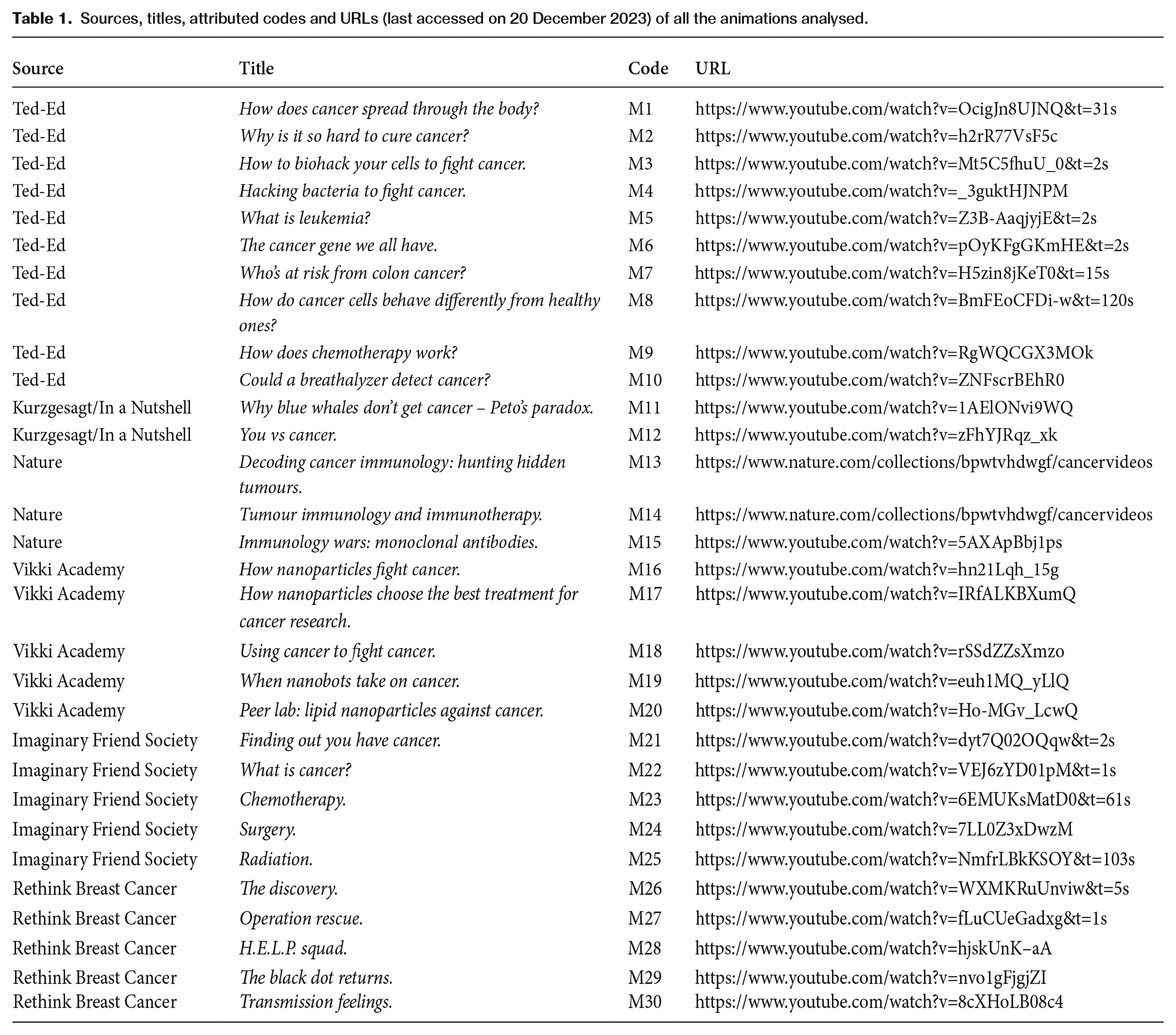
To collect data, we began by searching on YouTube using the keywords ‘animation’ and ‘cancer’. On the basis of this exploratory search, it transpired that several of the cancer-related animations we found were hosted by respectable organizations aiming to make reliable information available to patients and other stakeholders. Four of these organizations host many animated films, only some of which pertain to cancer (Ted-Ed, Kurzgesagt/In a Nutshell, Vikki Academy and Nature). Two others (Imaginary Friend Society and Rethink Breast Cancer/Talking to Kids about Cancer) specifically aim to spread information about (dealing with) cancer to children. We decided to focus on animations from these six organizations. In order to be selected, the films had to consist exclusively of animated footage and be in English. From the first four sites we selected the animations in which cancer is the exclusive or dominant topic, as suggested by the presence of the word ‘cancer’ in titles or in accompanying descriptions. Of the 20 animated films on the ‘Imaginary Friend Society’ site, we chose the five that explicitly audio-visualize cancer. The five animations on the ‘Rethink Breast Cancer’ site were all aimed at children having to deal with a mother suffering from breast cancer. The sites yielded a total of 30 animation films about cancer (see Table 1; all animations being last accessed December 2023). We manually transcribed the voice-over texts of all of them; this enabled quick and reliable keyword searches to help identify any verbal metaphors.
Sources, titles, attributed codes and URLs (last accessed on 20 December 2023) of all the animations analysed.
Identifying a metaphor in language in a methodologically sound way is no easy matter. Semino et al. (2018) base their research roughly on MIP (Pragglejazz, 2007) and MIPVU (Steen et al., 2010), but have to finetune this method manually: ‘as there does not yet exist any fully automated corpus-based method for identifying or analysing metaphor, analyses of large datasets often begin with a qualitative analysis of the data’ (Semino et al., 2018: 61). Identifying metaphor in visuals and multimodal discourse is even more challenging since visuals do not have a grammar or a vocabulary in the sense that language has (see Forceville, 1999, for discussion). Procedures for analysing metaphor in film are still being developed (e.g. Bort-Mir, 2019, critically evaluated in Forceville, 2024; Forceville, 2008; Müller and Kappelhoff, 2018, critically evaluated by Forceville, 2018). In the spirit of Max Black’s (1962: 30) warning that ‘there is . . . a sense of “metaphor” that belongs to “pragmatics” rather than to “semantics” – and this sense may be the one most deserving of attention’, we believe there is no simple, failsafe procedure for identifying and interpreting metaphors in audio-visual discourse. That said, the following is a description of how the metaphors in the 30 animations were manually identified. As discussed above, in verbal metaphors cancer (a target domain which we took to include actions such as treating cancer and dealing with cancer, cancer cells and cancer tumours) is most often expressed in terms of the battle and the journey domains, respectively. We decided to take this as a starting point for our search for cancer-related metaphors by scrutinizing the animations’ voice-over texts, any written-verbal texts and the visuals. Given CMT’s central tenet that humans think and experience in terms of metaphors irrespective of medium, we expected that, if the battle and journey domains were presented verbally and/or visually in our corpus of animations pertaining to cancer, they were not used literally but metaphorically – which was subsequently checked in context for each instance.
More specifically, the battle domain was considered to be present if concepts like those in the Williams Camus (2009) sample quoted above were verbalized in the animations’ voice-over texts, while we considered the battle domain to be visualized if there were manifestations of creatures presented as soldiers (identified on the basis of dress, helmets, weapons) or other warriors, whether or not involved in (violent) fighting. We included in the battle domain the videogame domain, since sometimes it is difficult or even impossible to decide whether the violent conflict depicted is better described as a battle-in-a-war or as a battle-in-a-videogame (which is usually animated, after all). We also included in the battle domain occurrences of the sports contest domain which, like the videogame domain, can be considered a ‘euphemistic’ subtype of the battle domain (we owe the ‘euphemistic’ phrase to a comment from rhetoric and argumentation scholar Menno Reijven).
We identified the journey metaphor when concepts such as those listed in section 1 were depicted and/or verbalized. This specifically meant: verbal references to and/or depictions of movement along a path towards a destination, vehicles for transport and any circumstances that facilitate or prevent smooth progress from one place to another. As with the battle domain, we expected that, in the context of animations about cancer, by far most references to journeys would be metaphorical rather than literal – but this, too, was checked for each instance.
Our focus of attention consisted of the battle and journey metaphors, but we were also alert to any other salient information that, because of its literal incongruity with the cancer domain, was a candidate for serving as a metaphorical source domain (for the role of incongruity in metaphor, see Forceville, 1996; Šorm and Steen, 2018: 57).
A metaphor was counted as such when it was visually or verbally cued at least once, even if only fleetingly. Since more than one metaphor pertaining to cancer could be used in a single animation, the total number of metaphors identified exceeds the total number of animations analysed.
5. Results And Discussion Of The 30 Case Studies
5.1 TED-Ed (‘Lessons worth sharing’) – 10 animations (collected by using the keyword ‘cancer’ on https://ed.ted.com/search?qs=cancer and selecting the first 10 animations that pertained to cancer)
The most often used verbal and visual metaphor in these animations is cancer treatment is a battle. The cancer antagonist in the confrontations is typically visualized as a monster (defined as such when a creature has two or more of the following features: darkness, deformity, spikiness, tentacles, big/sharp teeth, a look of anger, growling, laughing ‘evilly’) (Figures 1a, 1b, 1c, 1d, 1e, and 1f). If present, protagonists (‘good’ cells/bacteria, medicines, various therapies) look less scary and are lighter in colour than their monstrous antagonists. Sometimes the cancer cells, wielding weapons, attack healthy tissue; sometimes the ‘good’ bacteria, etc. attack the cancer cells. Most of the animations’ voice-overs draw on the battle metaphor by using words and expressions such as war, battle, kill, allies, struggle/struggling, vanquish, defeat(ing), destruction/destroy, invade/invaders, target(ing), fight(ing), strike, bombard, hit (down), fortress ripe for the plundering, shields, top guards, patrol, Trojan horses, hacking. In M7 there are, exceptionally, no words that suggest the battle domain (we did not count ‘keep cancer cells in check’ and ‘cells that grow out of control’ as such) but we considered the visualization of a stylized, verbally identified ‘suppressor’ repeatedly hitting a stylized ‘oncogene’ with a hammer as expressing the battle metaphor. M9 shows a bad cell as targeted via a hair visor (fig. 2a). In the highly stylized M10 the battle metaphor is absent, although cancer is briefly visualized as a monster.
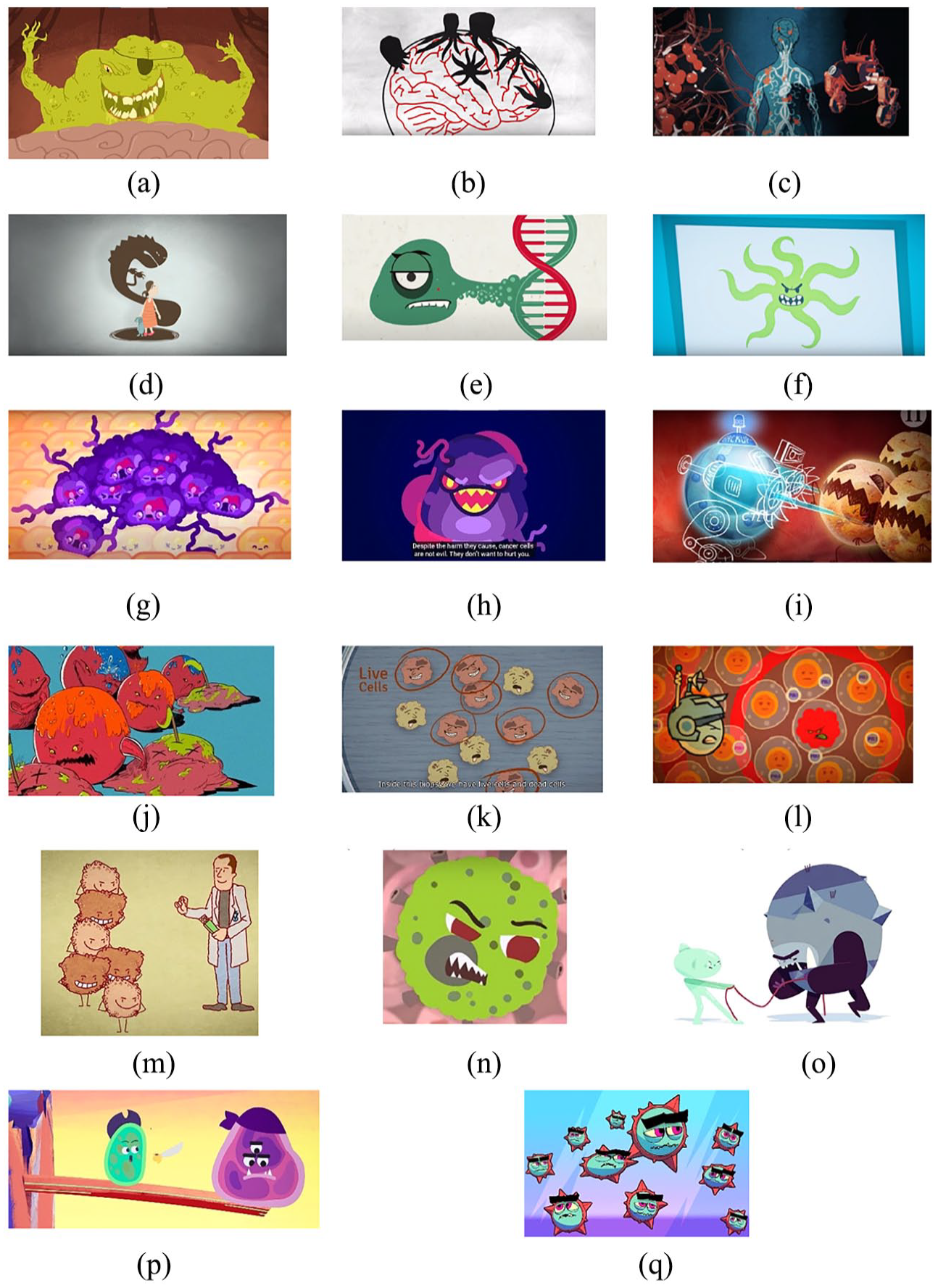
cancer cell is monster: (a) Cancer-monster above the brain (M1); (b) Octopus-monsters conquer the brain (M2); (c) Cancer is hairy monster (l)/robot (r) (M3); (d) Leukemia-monster (M5); (e) Damaged cell (M6); (f) Monster cell (M10); (g) Monster cell (M11); (h) Monster cell (M12); (i) Antibody robot attacking monstrous cells (M15); (j) Monster cells (M16); (k) Monster cells (M17); (l) Monster cells are attacked (M18); (m) Monster cells among healthy ones (M19); (n) Monster cell (M20); (o) Body in tug-of-war with monster cell (M21); (p) Healthy cell fighting monster cell (M22); (q) Monster cells (M23).
Sometimes the battle metaphor is integrated with, or complemented by, other metaphors. Several times the (cancer-afflicted) body is audio-visualized as a machine, or a computer programme. Verbal cues include meat robot, copy/glitch in/fix/rewrite/design the code, machinery, (re)wire, biohackers, (re)programming, repair, car crash, functioning gene, build new blood vessels. M3 also depicts a robotic human being, and a system of pipes in a heart, while M6 not only verbalizes but also depicts the cancer-afflicted body as a car crashing.
We found only one verbal instantiation of the journey metaphor (M3: ‘[good cells are] on a mission to find the cancerous cells’) and one verbal–visual manifestation (in the final credits of M2, there is a submarine with the text ‘Thanks for supporting this mission!’).
5.2 Kurzgesagt/In a nutshell (‘We counter existential dread with optimistic nihilism’) – on https://www.youtube.com/@kurzgesagt/videos; the two videos with ‘cancer’ in the title were selected
M11 and M12, created in the same style, repeatedly cue the battle metaphor in the voice-over text (killing, slaying, defences, antagonist, enemy, murdering, patrolling, winning the war, arms race). At its end, M11 shows a bird sticking a sword in a tumour, but this is the only visual instantiation of the battle metaphor we identified, while cancer is fleetingly monstrified visually (Figure 1g). The videogame variety of the battle metaphor is sometimes evoked by videogame iconography (via boxes with numbers and ‘energy levels’), while the voice-over also verbally personifies cancer cells as criminals, ‘stealing nutrients’ from, and ‘tricking’, the body. the body is a machine is verbally evoked (‘our cells are protein robots’; ‘tiny mistakes add up until the grandiose machinery gets corrupted’). M12 monstrifies cancer (Figure 1h), and fleetingly draws on the battle domain by showing a creature activating a bomb exploding a tumour. M12 also visualizes the human body intermittently as a machine/computer programme, supported by the voice-over text: ‘cells are protein robots that just follow their programming’ and ‘a cell becomes unable to fix the mistakes in its genetic code.’ The journey metaphor is referenced (verbally) only once, in M11 (‘open the path to new therapies and treatments’).
5.3 Nature video (affiliated to the prestigious science journal Nature) – three animations, two via https://www.nature.com/collections/bpwtvhdwgf/cancervideos. A third video endorsed by Nature we found was added
Both M13 and M14’s visuals are highly stylized and abstract, dispensing with any form of personification. Although the voice-over texts are very technical, M13 and M14 nonetheless saliently reference the battle metaphor (e.g. hostile cells, cancer cells flying under the radar, respond to the threat, combat, battle, attack, fight, help the body win more of its battles against cancer, killer cells, target the immune checkpoints). The videogame variety of the battle metaphor is visualized in M14 by showing ‘good’, light-coloured cells ‘shooting’ at bad dark-coloured cells while the voice-over mentions a battle between two opposing immune responses (Figure 2b). M15, by contrast, not only triggers the battle metaphor verbally (weapons, target, defenceless, attacking, blast away, fight), but also audio-visualizes antibodies as grim robots that attack bad cells and depicts cancer cells as monsters (Figure 1i). M13 refers to finding the right therapy in terms of ‘put[ting] together the pieces of this complex puzzle’, simultaneously showing a fruit machine.
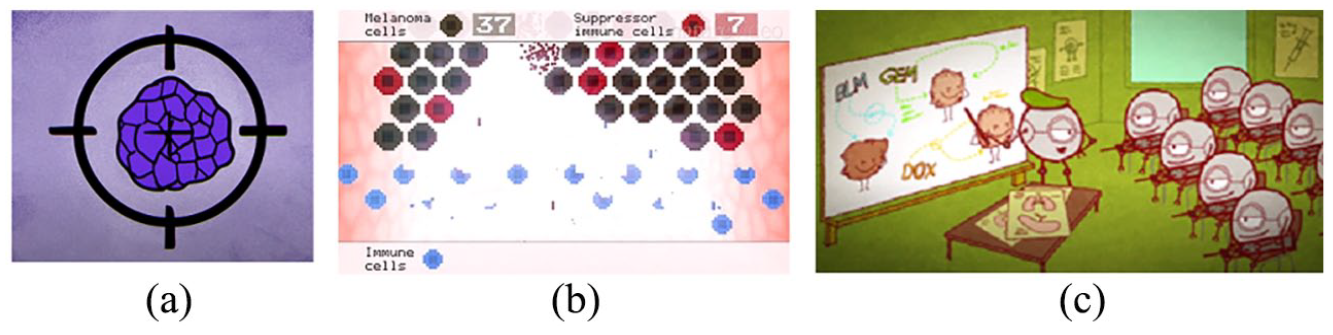
Visualizations of the battle metaphor: (a) Targeted bad cell (M9); (b) Videogame: good cells fire at bad ones (M14); (c) Army officer instructs ‘good’ bacteria soldiers (M19).
5.4 Vikki academy (‘animating great research’) – five animations, via https://www.youtube.com/@VIKKiAcademy/videos, selected because (only) these have the word ‘cancer’ in their title
M16 and M17, made in the same style, exemplify personified ‘good’ nanoparticles. In both, cancer cells appear as monsters (Figure 1j, 1k), whereas in M17 a good cell is briefly metaphorized as a ‘saint’ via the halo above it. The phrase ‘we find barcodes of effective medicines’ in M17 fleetingly suggests the computer program source domain. In M17 an oncologist says he thinks of nanoparticles as ‘small submarines [that] deliver the medicine to the organs that really need it’ – this ‘delivery’ visualized via a submarine.
M18 portrays cancer treatment visually in terms of a fight between good and bad monster cells (Figure 1l), the iconography perhaps suggesting a videogame fight. The voice-over emphatically references the battle domain (war, army, warriors defending, foreign threats, destroy, enemy, fight, battle). The sentence ‘rogue cells . . . that may slip through’ suggests cancer cell is criminal/misbehaving person). M19 depicts bad cells as monsters (Figure 1m), and its voice-over mentions fighting cancer cells, but also calls the body a ‘small and safe treatment lab’, arguably invoking a variety of the body is a machine. The ‘body-as-lab’ is also visualized and nanoparticles are equipped with syringes that look like spears, attacking bad cells. At the end we see an ‘army’ officer instructing nanopart ‘soldiers’ about impending actions (Figure 2c).
Although M20 depicts cancer cells as monsters (Figure 1n), it only sparingly uses the battle domain (in the written ‘defeat cancer from within’, and the voice-over’s destroy and target), and briefly features this domain verbal–visually via an airplane with ‘chemotherapy’ written on it that drops bombs on cancer cells. The metaphor of injecting healthy nanoparticles in terms of delivery surfaces in words such as messenger, guide, direct and may be said to be rooted in the journey metaphor.
5.5 Imaginary Friend Society/IFS (‘providing answers, smiles and support to kids facing cancer’) – five animations, via https://www.imaginaryfriendsociety.com/home
In all 20 IFS animations, an ‘imaginary friend’ – human, animal, or fantasy figure – addresses the child and functions as a guide. The animations all ‘bracket’ the contents as a stage play, with curtains opening at the beginning and closing at the end. We focus on the five animations that explicitly audio-visualize cancer. In M21, the battle metaphor is briefly alluded to (‘bravely fighting cancer’, ‘an army of doctors, nurses, and scientists fighting with you’, ‘kick cancer’s butt’). There is a brief visualization of a tug-of-war between a cancer-monster and the healthy body (Figure 1o), cueing the sports contest variety of the battle domain. Briefly a ‘hover tank’ is visible and mentioned, activating a videogame scenario. But M21 also mentions that ‘the road ahead feels long and scary to you’, while showing a jungle-like path. Moreover, the guide tells the viewer that ‘above all, know that . . . your friends, doctors, family will always be with you every step of the way.’ Clearly, the facing cancer treatment is a journey metaphor is activated here. M22, set on a pirate’s ship, invokes the battle metaphor by calling the cancer attack a ‘mutiny’, and shows the fight between good and bad cells (Figure 1p). M23 portrays chemotherapy as a superhero fighting monstrous cancer cells (Figure 1q, Figure 3a) and verbally references the battle metaphor (destroy/fight/defeat cancer). M24 metaphorically compares the brain visually and verbally to a computer and presents the brain surgeon as ‘fixing’ things and ‘do some tinkering’ (cueing an organism is a machine) eventually ‘removing any bad stuff that doesn’t belong [in the brain]’ (Figure 3b, triggering curing cancer is cleaning up). M25’s voice-over tells how radiation ‘zaps away . . . unruly little blighters’, visualizing these as laser beams destroying colourful balls in a videogame-like manner (Figure 3c), while focusing on the ‘imaginary friends’ travelling by car – arguably hinting at the journey metaphor.
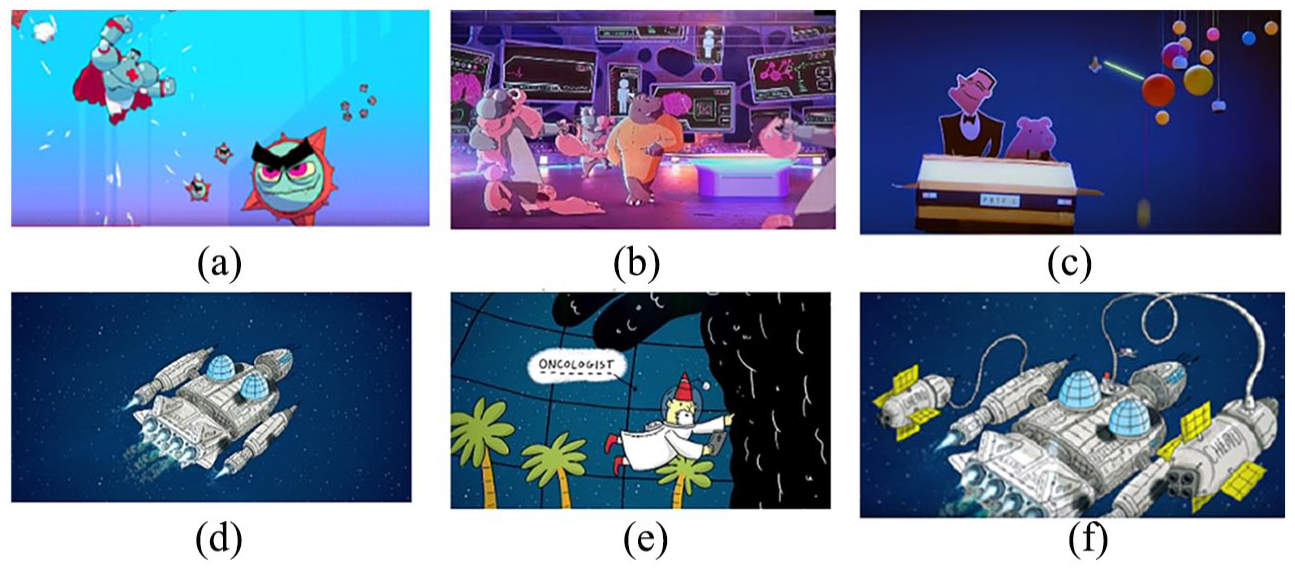
Screenshots from animations aimed at children: (a) Superhero attacks monster cells (M23); (b) Doctors remove any ‘bad stuff that doesn’t belong’ in the brain (M24); (c) ‘invisible lasers . . . to zap these bad parts away’ (M25); (d) Opening shot of M26–M30: woman is spaceship; (e) cancer is black tree; oncologist is wizard (M26, M27, M29); (f) chemotherapy is small spaceship providing fuel for woman-as-spaceship (M28).
5.6 Rethink breast cancer (‘Talking to kids about cancer’) – five animations, at https://rethinkbreastcancer.com/?page=1&per_page=10&s=mission%20recovery&search=mission%20recovery
A series of five thematically and stylistically related animations features (fantasy) animals voicing texts spoken by children about their mother having cancer. The setting is space travel, and each animation begins by showing a spaceship in the form of a woman (Figure 3d). The recurrent metaphor is cancer is a black dot, mentioned by one of the children; in M26, M27 and M29 this develops into cancer is black tree, which is treated by astronaut oncologists wearing wizard hats (oncologists are wizards) (Figure 3e). Significantly, in the five animations, there is no visual and only two verbal references to the battle domain (‘zap the tumour away’ in M27 and ‘fight metastasis with chemo and radiation’ in M29). The travelling mother-diagnosed-with-cancer-as-spaceship setting suggests the metaphor dealing with cancer is a journey, which is also captured in the series title ‘Mission recovery’; in M28, this metaphor is visually reinforced by chemotherapy is small spaceship providing fuel for woman-as-spaceship (Figure 3f), whereas in M29 radiation comes from the wizard oncologists in separate, smaller spaceships. In M30 friends of the children come to the mother-spaceship in astronauts’ suits to provide support. 2
5.7. General observations
As Table 2 shows, all animations draw on one or more metaphors to present cancer and its treatment. Metaphors are used to explain cancer and its possible treatments to lay people, but it is telling that even animations using predominantly technical language (M13, M14) do not avoid metaphors. As in the studies about cancer metaphors in verbal discourses, the battle domain is dominant in the 30 animations, appearing in more than two/three of them, Usually, but not always, the metaphor occurs both verbally and visually. The cancer-antagonist is visualized as a monster in over half of the animations. Notably, these monsters
(1) only occur visually; the word ‘monster’ is never used;
(2) may, within a specific animation, play a dominant or a marginal role;
(3) are depicted with varying degrees of scariness (and, if used, look less scary in the animations aimed at children).
In most, but not all, cases the visual metaphorization of monsters is reinforced by battle terminology in the voice-over text. The goal is to destroy the antagonist or to invade and take control over enemy territory (typically: the human body, or a tumour in it) or to isolate/imprison/chase away the cancer cells. Sometimes, the battle is presented as a videogame or a sports contest, which of course presents a more playful conflict than one that is part of a war. The medicines and therapies, or those administering them, are personified as ‘good’ creatures, typically friendly-looking and lighter-coloured than their opponents. Interestingly, the battle domain is not at all visualized and only twice referenced verbally in the ‘Rethink Breast Cancer’ series (M26–M30). We suspect this is not a coincidence since these animations are aimed at trying to help children cope with their mother’s cancer rather than to explain the technicalities of the disease; presumably the idea was not to unnecessarily frighten them by drawing on this grim source domain. Perhaps surprisingly, given that it allows for audio-visualizing less violent confrontations, we found only three instances of the sports contest variety of the battle domain in the 30 animations.
Metaphorical source domains used in the 30 medical cancer animation films. Source domains were counted if they occurred at least once; they can be cued visually, verbally, or in both modes.
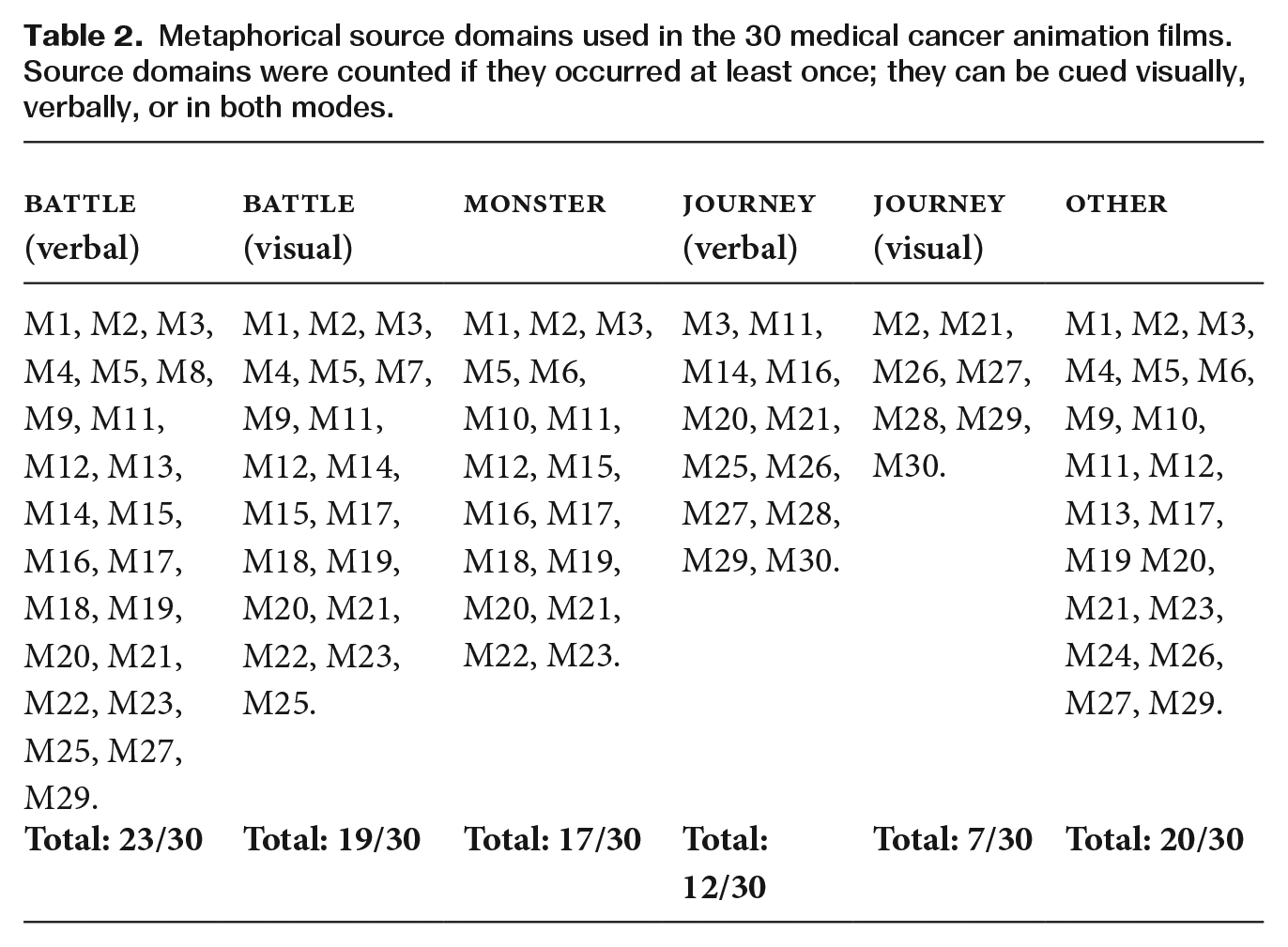
The corpus shows a sustained, subtle, but only visual use of the journey metaphor in the five related animations of the ‘Rethink Breast Cancer’ series via the mother-suffering-from-cancer is a spaceship-travelling-through-space. Inasmuch as the two protagonists of M25 travel by car toward a radiation appointment, this animation, too, could be said to suggest the journey domain visually. In the animations aimed at adults, the journey metaphor is markedly less present, both visually and verbally.
We found many ‘other’ metaphors in the animations, most of them occurring only once or twice, which is why we did not identify them systematically. That said, it is worth noting that in 13 cases the cancerous body is metaphorized as some kind of machine, or computer, that is, as an inanimate ‘thing’ that can break down and be fixed, and be (de)coded, respectively. What they have in common is that they portray bodily processes as mechanical ones. This metaphor ‘automates’ the body and its organs. It can perhaps make patients feel dissociated from their body and its affliction – which may be good or bad – but may also misleadingly suggest that the body can always be ‘repaired’ or ‘reprogrammed’. Another source domain we encountered a few times, by verbal references to ‘rogue cells’ and ‘tricking’, ‘stealing’, and ‘offending’ could be labelled misbehaving person/criminal.
The ‘other’ category includes instances of source domains that figure only locally and briefly. Some of these presumably would be found to recur if a larger corpus were analysed (e.g. controlled cancer is prisoner in a cage [M1, M2], good bacterium is mailman [M4]; finding the right cancer therapy is a puzzle [M5, M13], finding the right therapy is playing a fruit machine (M13), a good bacterium is a saint [M17]). Others verge towards what Black (1979) would call creative metaphors (e.g. cells copying themselves are copies made of copies on a copying machine [M12], healthy nanoparticles are students [M20], getting cancer is getting a bad card in a card game [M21], surgically removing a cancer tumour from the brain is cleaning up a room (M24], cancer patient is royal person [m25], oncolologist is wizard [M26, M27]).
It turns out that metaphors can be easily ‘mixed’ (Gibbs, 2016): often two or more metaphors unproblematically alternate or complement each other within a single animation. Indeed, sometimes metaphors overlap: the videogame domain, here analysed as a variety of the battle domain, also has elements of the sports contest and the computer programming domains. Indeed, mixing metaphors may actually be a good thing in the context of discussions between medical professionals and clients: ‘Therapists should encourage clients to use diverse metaphors to convey the intensity of their emotions even if the feelings they convey are negative ones’ (Charteris-Black, 2012: 199). Moreover, the battle metaphors often routinely combine with good is up/light and bad is down/dark (Forceville and Renckens, 2013) – these latter sometimes being reinforced by high/upbeat versus low/depressing sounds and music. It is to be emphasized that while many of the metaphors in the animations appear both in the visuals and in the voice-overs – they are rarely multimodal in the sense of Forceville (2006), since this requires that target and source domains are each cued exclusively or predominantly in different modes. In almost all animations, moreover, any information in the written–verbal mode is used to explain or ‘annotate’ literally depicted phenomena, and thus rarely cues metaphorical source domains.
6. Limitations Of The Research Design And Further Reflections On Our Findings
In this section, we reflect briefly on aspects of the methodology of identifying metaphors in animation, which hopefully will help future researchers avoid pitfalls and fine-tune their analyses. We formulate these in terms of claims, which we briefly discuss.
Deciding which metaphorical source domains need to be distinguished in corpus research cannot be decided in advance. Increasingly, it is acknowledged in CMT that it is sometimes difficult to attribute a verbal phrase or depiction to one domain rather than another (Reinierse and Burgers, 2023). If the specific context does not help resolve this issue, analysts may in some cases have to accept that categorization choices remain debatable. In this article, for instance, it was decided to group battle, videogame and sports contest in one category, but in larger corpora it would make sense to retain them as separate source domains. A limitation of the current project is that the identification of the metaphor was done only by one coder, the second author. Given the difficulties surrounding the decision how to (sub)categorize and label source domains, ideally such work is done by at least two coders. The coders would have to be knowledgeable about metaphor theory, and should extensively discuss a protocol for identification, categorization and labelling after jointly analysing a small sample of the corpus in advance – and will probably find they have to finetune this protocol along the way. We trust that the detailed descriptions of the qualitative approach adopted for the analyses in this article will help future collaborative work on larger corpora, leading to the kind of intercoder reliability that will enable drawing robust quantitative conclusions.
A given source domain may be repeatedly cued visually and/or verbally, thereby ‘driving home’ the metaphor; or it may be only cued fleetingly. Presumably, the more frequently and intensively a given source domain is used, the more the metaphor will be consciously interpreted by and affect the recipient of the animation. Clearly, attesting any effects of the degree of intensity requires experimental testing.
Analyses of larger corpora (irrespective of the medium in which they occur) will benefit from making more fine-grained distinctions within the target domain. The journey domain, for instance can metaphorize finding successful treatments, administering medicines to the right place, but also learning to cope with cancer. The latter can also be true for the battle domain (see Wackers and Plug, 2022).
However powerful metaphors are in persuasive communication, there are always many other ‘tools’ and meaningful elements that help appeal to envisaged audiences. We noted that the IFS animations’ guides, addressing children, all have very expressive, sometimes heavily accented voice-overs, are colourful and present small jokes and light-hearted asides (see Semino et al., 2018: ch. 10), and feature upbeat music throughout, the latter also notable in M26–M30. Another recurring stylistic strategy we found was creating emphasis by a sonic ‘beat’ or a sudden visual ‘zoom-in’. The overall effect of the animations, that is, depends on more than just the use of metaphors.
7. Concluding Remarks
The ‘illness identity’ concept introduced by Charmaz (1994) states that ‘the disruption of individuals’ lives as a result of chronic illness is paired with drastic changes in their relationships, their abilities and their self-perception’ (cited in Husson, 2023: 5). Undoubtedly, the dominant metaphorical representations of an illness are likely to have an impact on patients’ ability to cope with it. We trust to have demonstrated in this article that animation is a highly suitable medium for conveying metaphors. In this section, we consider possible implications of our findings for communication about cancer between various stakeholders.
As Williams Camus (2009: 465) emphasizes, ‘no single metaphorical system is sufficient to represent the complexity of cancer-related knowledge.’ Put differently, no cancer metaphor works for everybody and for all situations. Moreover, no cancer metaphor is intrinsically better than another. That said, our hunch is that the dominance of the battle scenario animations is not very encouraging (Semino et al., 2018, make the same point). Although they typically convey a wealth of factual information, sometimes in a very vivid way, they pay hardly any attention to how having been diagnosed with cancer may affect a patient emotionally. Conflict metaphors in which, typically, a cancer-monster is lodged in one’s own body may be intimidating or discouraging to patients and frightening to children. The battle scenario moreover leaves no room for emotions other than satisfaction or despair depending on whether cancer is ‘defeated’ or ‘wins’. But even if one of the conflict domains is chosen, oncologists and animators may carefully ponder how scary the cancer-monsters should look, and how grim the attacks. It is also worth considering opting more systematically for the less violent videogame and sports contest scenarios. Losing a game or a sports match, after all, is far less dramatic than losing a war or a battle (see also Zhang and Forceville, 2020).
It is a pity that the journey metaphor is so underused in the medical animations as it is not only more encouraging but also far richer than the battle metaphor: a traveller may be accompanied by other travellers (doctors, family, friends, care-givers); the journey (say, attempting a specific medication or therapy) has a starting point, a trajectory and a destination, but can also have detours (e.g. temporary delays in a treatment); the traveller can be aided or hindered by natural forces (e.g. treatments that do, or do not, work); experiences during journeys can evoke a variety of unpleasant and pleasant emotions (joy at positive developments in the treatment, sadness at negative ones) . . . Indeed, Hendricks et al. (2018), using both the battle and journey source domains in their stimulus material, conclude that, although each has its advantages and drawbacks, the journey metaphor appears to be less likely to induce feelings of guilt and greater chances of being able to make peace with one’s condition.
However, quite apart from which metaphor is used by professionals, there are indications that patients may benefit from communication with professionals and other helpers who understand the mechanics of metaphor and can adapt and fine-tune them according to the needs of those they try to cure or help (Charteris-Black, 2012; Keefer et al., 2014; Tay, 2016). A well-chosen metaphor thus may help to ‘bring the patient’s subjective view of illness into the forefront of the medical encounter, give meaning to the experience, and allow the doctor and patient to strengthen the therapeutic alliance around a shared vision’ (Penson et al., 2004: 715; see also Padfield et al., 2018). Alternatively, a doctor may be able to influence a patient’s way of thinking by suggesting a different, more appropriate source domain. Finally, we suspect that the genre of films in which cancer metaphors occur is also bound to make a difference: perhaps doctors may recommend uplifting artistic films 3 about dealing with cancer as a healthy antidote to the medical ones.
Footnotes
Acknowledgements
We are indebted to two anonymous reviewers for their comments on earlier drafts of this article, but of course we alone remain responsible for its contents. The first author would like to thank Michiel van Brekel, oncologist at the Antoni van Leeuwenhoek hospital in Amsterdam, for letting her attend a control polyclinic meeting between him and some patients to give her an impression of doctor–patient interactions.
Data Availability Statement
Data sharing is not applicable to this article as no datasets were generated or analysed during the current study.

Notes
Biographical Notes
NINA GEBRAAD graduated in Media Studies, University of Amsterdam, in 2020. This article is based on her MA thesis.
The key theme in the research of CHARLES FORCEVILLE (Media Studies, University of Amsterdam) is the question of how visuals convey meaning. Committed to cognitivist, socio-biological and relevance-theoretic approaches, he publishes on multimodality in various genres and media (documentary film, animation, advertising, comics and cartoons, picture books for children). In 1996, he published Pictorial Metaphor in Advertising (Routledge, 1996). He co-edited Multimodal Metaphor (Mouton de Gruyter, 2009), Creativity and the Agile Mind (Mouton de Gruyter, 2013) and Multimodal Argumentation and Rhetoric in Media Genres (Benjamins, 2017). His monograph Visual and Multimodal Communication: Applying the Relevance Principle was published by Oxford University Press in 2020.