




Abstract
This article explores the mediated spacetime of crime events to reconsider how criminalization works through visual journalism. Drawing on close analysis of 45 images from Australian newspaper reports about so-called ‘African gang crime’ events in the city of Melbourne, it develops a typology of five distinct ‘ways of looking’ at crime that news images can open for their viewers. Each extends unique imaginative demands and so conditions perceptual relationships of spatial, historical and political significance between crime events and those who watch them unfold through the news in distinct ways. Together, these ways of looking constitute an intertextual representational mechanism that the author calls kaleidoscopic visuality, holding fixed the ‘who’ and ‘what’ of crime events while endlessly shifting and destabilizing the ‘where’ and ‘when’. The concept of kaleidoscopic visuality helps clarify how and why hypermediated crime events and phenomena resist discrete and/or desecuritized interpretations of their political significance, and thus broadens existing accounts of how news images criminalize.
Introduction
Criminalization through (visual) media has been traditionally conceptualized, analysed and critiqued through the lens of identity construction – that is, primarily as a process whereby certain (usually, racialized and classed) subjectivities, spaces and places, practices and experiences are symbolically fused to the category of ‘crime’ through iterative acts of representation (for example, see Davis, 1998: 269–270; Entman, 1990; Gutsche, 2011; Hall et al, 1978; Majavu, 2020; Smiley and Fakunle, 2016). This article builds on this important line of critique by shifting analytical attention towards the visual mediation of crime events. Crime events ‘rupture’ at specific junctures of time and space yet must ‘live’ beyond these junctures to take on historical significance and so figure within cultural processes of criminalization (Wagner-Pacifici, 2017). News images, as mediated forms of such events, play a critical role in the mediated life of criminality – indeed, in making crime ‘eventful’. Here, I propose that journalistic visualizations of crime events are significant for criminalization because they help establish the temporal and spatial dimensions of the relationship between such events and the subjects who watch them unfold through the news, thus conditioning the sense of historical significance attached to such events in the banal imaginary of everyday political life. In performing this spacetime work, news images imaginatively scale crime events in ways that can inform the cultural legitimacy of coercive practices of intervention, including but not limited to policing and incarceration.
To explore the spacetime work of news images and its significance for criminalization, this article draws on Wagner-Pacifici’s (2017) theory of the event as constituted in the ‘forms’ and ‘flows’ of symbolic texts, including images. Specifically, the analysis here interrogates the ‘demonstrative’ capacities of images of crime – how the image positions and orientates its viewer (both in time and in space) vis-à-vis the crime event, and in doing so extends specific imaginative demands (Frosh, 2006). I consider these questions through a close analysis of 45 photographs and graphic illustrations collected from Australian news stories about so-called ‘African gang crime’ – incidents of crime or public disorder involving Black and/or African-born youth in the south-east Australian city of Melbourne (see Majavu, 2020; Weber et al., 2021; Windle, 2018). Using the concept of a ‘vantage point’, five different ‘ways of looking’ at crime are identified and theorized: the anticipatory, the embodied, the forensic, the vigilant and the pre-emptive. To advance an understanding of how the spacetime work of news visuality negotiates criminalization, I propose that these different ways of looking must ultimately be interpreted together as components of what I term the ‘kaleidoscopic visuality’ of crime event journalism.
Existing critiques of the mediated criminalization of Black and/or African-born people in Melbourne have overwhelmingly focused on how criminality is stereotyped, and thus on criminalization as a process of (racialized and classed) subject construction (see Majavu, 2020; Windle, 2018). While carrying these critiques forward, this article shifts the analytical lens towards the question of how criminality is contextualized – that is, how images invite viewers to relationally locate the stereotyped figure of ‘the criminal’ within the historical, spatial and political dimensions of everyday social life. In doing so, it pushes existing theories of mediated criminalization to their limits and opens new lines of critical inquiry for future studies of how visual journalism contributes to the reproduction of ‘criminality’ – not only as a constructed category of subject but, more fundamentally, as an arbitrary yet historically resilient justificatory logic that helps practices of injury, domination and exclusion reproduce themselves as something we call either ‘safety’ or ‘justice’. Ultimately, a critique of ‘kaleidoscopically visualized’ crime is concerned with the imaginative possibilities occluded in the visual ecology of crime event reporting, including the possibility of imaginative divestment from ‘crime control’ as the dominant frame through which challenges to order and security are increasingly diagnosed and acted upon in societies (like Australia) marked by endemic and racially-organized imbalances of power, resources and vulnerability to harm (Ericson, 2007; Kilroy, 2018; Simon, 2007; Vitale, 2017).
News Storytelling and the Banal Spectacle of Crime
To coherently feature in journalistic storytelling, crime events must be communicated in ways that speak to both spectacle and banality. On the one hand, crime events are newsworthy inasmuch as they are sensational, extraordinary and disruptive to the mundane reproduction of power in everyday life (Hall et al., 1978; Jewkes, 2015: 58–59; Williams and Dickinson, 1993). However, the symbolic purchase of crime stories in our media landscape also rests on their implicit claim to be able to tell us something about the political realities we live in. To function as moral and political mythology (Loader, 1997), crime events must be narrated in ways that speak to historicity as well as novelty: extraordinary distillations of ordinary power struggles, jagged tips of hidden political icebergs. And so, beyond the obvious question of salience, newsworthiness relies on the (constructed) resonance of events with what we remember of our past, experience our present and imagine our future (Ettema, 2005). This is why ‘proximity’ (both geographical and historical) is also a leading determinant of crime event reportability (Jewkes, 2015; Schmitz Weiss, 2015), as is the capacity for the event to speak to pre-existing cultural anxieties and political tensions, particularly as they relate to race (Cohen, 1972; Davis, 1998; Entman, 1990; Hall et al., 1978).
In the context of journalistic storytelling, the tension between banality and spectacle can be interpreted through the inverse relationship between reportability and credibility that beleaguers all practices of narrative communication (Labov, 2002). To coherently feature within journalism as a speech genre (Bakhtin, 1986) that attempts to make sense and order of the lived messiness of social reality through the construction of narratives (Tuchman, 1980), mediated crime events must be able to tell us something of everyday realities whilst also sitting outside the everyday. Too banal and the event ceases to be reportable; too spectacular and the event fails to be credible. In multi-modal news storytelling, this tension is managed symbolically. It is not that some crimes simply possess these characteristics while others do not, and thus feature in the news as a fait accompli. Rather, this paradoxical sense of being ‘of the everyday’ and ‘apart from the everyday’ conditions both the selection and multi-modal representation of crime events through the news. This is what Ettema (2005) describes as the ‘craft’ of narrative resonance. By appreciating the ‘banal spectacle’ of crime as a symbolic construction achieved through narrative, we move closer to theorizing how stories about events inform broader imaginaries of everyday political life (Taylor, 2002), and thus how mediated stories about ‘extraordinary’ crime events can symbolically condition how we visualize – and imaginatively locate ourselves within – ‘ordinary’ power relations.
Critical geographies of visual journalism have richly demonstrated how news images sculpt and sustain imaginaries of urban space, often symbolically bounding ‘criminality’ within certain neighbourhoods and places while scrubbing it from others, usually along spatialized lines of race and class (see, for example, Gutsche, 2011). Here, however, I approach the relationship between news photographs and the imaginaries they help build and sustain not in terms of the representational construction of criminalized space and place, but rather, as the mediated negotiation of a criminalizing eventfulness. Wagner-Pacifici (2017) proposes that eventfulness is semiotized by – and therefore, lives in and lives through – the ‘form’ and ‘flow’ of symbolic texts (p. 11) as ‘no event lives for longer than an instant without copies’ (p. 26). Though Wagner-Pacifici does not explicitly centre mediation as a productive force vis-à-vis the life of the event, her theory implicitly foregrounds mediation by emphasizing the conditions of mobility of event forms, including the affordances and constraints of specific media technologies (pp. 29–30), the conventions of different genres of speech (p. 28) and the material and semiotic specificities of different communicative modalities. The ‘restlessness’ and ‘openness’ that Wagner-Pacifici ascribes to events thus speak directly to the contingency of mediated discourse (Chouliaraki, 2006a), offering a helpful epistemological inroad to investigating the imaginative world-making potential of crime news imagery.
Eventful ‘ruptures’ and the everyday ‘ground’ from which such events take off are dialectically co-constituted in semiosis (Wagner-Pacifici, 2017). Events cannot exist without context; the ontological status of a moment of eventful rupture is reliant upon and indexed to ‘ground’ as its inverse. For the spectacle of crime, represented visually, to coherently feature within the narrativity of journalism, it must speak to and of its own context of emergence – that is, it must articulate claims about the pre-existing terrain of social and political life from which the crime event has sprung. News stories, then, need to actively (re)make ground to coherently narrate moments of rupture. In analysing the mediation of crime events through the visuality of journalism, my interest here is less in what is being claimed about the specificities of the event itself within any one visual representation, and more about how the event, as a spectacular moment of rupture, is implicated in the imaginative (re)construction of ground – or, how images of crime help sculpt and sustain criminalizing background imaginaries of everyday (in)security.
Imag(e)ination and the Spacetime Work of News Images
What kinds of imaginative work do images of crime events invite, even demand, from their viewers? While such events are temporally and spatially ‘restless’ in their mediation (Wagner-Pacifici, 2017), the news image of crime is by definition still – a singular capture in time and space that speaks to and of a world in which no such stillness ever actually exists. For a photographic image to ‘speak’ about the world it must necessarily speak of more than what it formally shows – imagination is the normative proposition of all photographs. Zelizer (2010) calls this the ‘subjunctive voice of the visual’ – the unique power of images to testify to (that is, make claims about) precisely that which they leave out, to suspend representation between the ‘as is’ of the image and the ‘as if’ invitation all images extend. Within the invariable stillness of still-capture news images there is inevitable activity: specifically, an active negotiation of the spatiotemporal parameters of the political imaginary evoked within the image and sustained by the act of photographic mediation, which must be watched rather than merely ‘viewed’ (Azoulay, 2008).
I propose that the productive potential of crime news images vis-à-vis the imaginative construction of social spacetime operates across two concentric dimensions. The first relates to photographs as representational texts that work within the narrativity of journalism to locate crime events within the terrain of everyday social life and politics. In this first dimension, news images function as testimonies of the ‘who’, ‘what’, ‘where’ and ‘when’ of the event; within the narrativity of journalistic discourse, these representational testimonies articulate claims about relative agency between different actors caught up in the event as well as its historical and geographic location and scale (and thus significance). Encapsulating this first dimension of productive potential, however, is a second which relates to photographs as mediating technologies. Here, the spatiotemporal productiveness of crime images operates through the visual negotiation of proximity and distance between the crime event and the viewing subject through the act of photographic capture and mediated circulation (Chouliaraki, 2006a; Silverstone, 2006).
To grapple with how news images of crime events build and sustain cultural imaginaries of criminality, the analysis here thus attends to both the spatiotemporal dimensions of crime events as represented in news photographs, and the spatiotemporal character of the relationship between a depicted event and the viewer as negotiated through visual mediation. Together, these form what Chouliaraki (2006a: 168) calls the ‘chronotope’ of mediated events: that ‘regime of multiple spaces (danger and safety) and temporalities (present, past or future) through which the event “moves” back and forth and, in so doing, presents the spectator not with one single reality of [criminality] but with multiple realities relevant to [criminality].’ 1 In contrast to critical geographic approaches to (visual) crime reporting, an eventfulness-based approach reframes criminalization as dependent not only on the symbolic construction of legitimate ‘targets’ (including ‘criminalized’ communities and places) but, more fundamentally, on the unstable relationship between (crime) event and (political and historical) context that representation primes and imagination elaborates.
Capturing both these concentric dimensions of mediated spacetime – the represented-in-text and the negotiated-through-mediation – is the concept of a vantage point. As a conceptual tool for the analysis of mediated visuality, a vantage point helpfully incorporates both the objects of vision (i.e. what one is looking at/what falls within the scope of vision) and also the location from which vision occurs (i.e. where one is looking from/how the scope of vision is structured and organized by the positionality of the viewing subject). Returning briefly to Wagner-Pacifici’s political semiosis of the event, we can conceptualize vantage points as emerging from what she calls the ‘demonstrative’ capacities of news images as symbolic event forms. The work of demonstration within and across symbolic forms is to establish relationships of proximity, distance and scale between events and those watching and experiencing them unfold. These relational constructs can be spatial (for example, establishing whether an event is happening ‘here’ or ‘there’, ‘close’ or ‘far away’) but also temporal (‘now’ or ‘then’, ‘finished’ or ‘ongoing’) and intersubjective (i.e. is this event happening to an ‘us’, or to a ‘them’, or simply to ‘me’?). If the work of the representational feature of political semiosis is to provide possible answers to the question ‘what is this?’ (Wagner-Pacifici, 2017: 26), then the demonstrative feature answers another set of questions: ‘where/when is this?’ and ‘where/when am I in relation to it?’ Through their demonstrative register, news images work to orientate viewing subjects within and towards the spacetime of mediated events, opening varied possibilities for imaginative engagement and helping to establish the parameters of an event’s constructed sense of historical and political significance.
Analytical Approach
This article investigates the demonstrative capacities of news images as symbolic forms of crime events. The analysis is invested in uncovering both the various vantage points vis-à-vis crime events that news images can open, as well as the varied imaginative demands those vantage points extend to their viewers. My theoretical framework understands these demands to be significant for criminalization in two ways: first, in scaling the spatiotemporal significance of spectacular crime events in the banal imaginary of political life that journalism (re)produces; and second, by helping constitute in and through that imaginary a justificatory basis for coercive practices of crime control, including but not limited to policing and incarceration.
My empirical material is a corpus of 45 news images, collected from 14 newspaper articles (both print and digital) covering crime events involving Black and/or African migrant youth in the city of Melbourne. Using the ‘vantage point’ as a grounding conceptual tool, analysis of these images was conducted using the rubrics for the analysis of mediated spacetime and agency developed in Chouliaraki’s (2006a, 2006b) analytics of mediation. For each image, the purpose of analysis was to first identify where the image places the viewer in time and space vis-à-vis the moment of criminal rupture, and then how the temporal and spatial dimensions of the event and its relationship to the viewer are negotiated through representational choices such as camera placement and angle, framing, composition and aesthetic quality. As these images appear in the context of multi-modal news texts, this visual analysis is occasionally dialogized with accompanying linguistic elements, such as headlines and captions. However, the primary objective here is not to ‘deconstruct’ these visual representations of crime in terms of their (essentially multi-modal) ideological meaning, but rather more narrowly, to explicate the precise forms of imaginative elaboration the viewer is obliged to contribute for such images to function coherently as representations of crime events, and the potential implications of these imaginative demands for criminalization. For this reason, the analysis is principally visual, rather than multi-modal.
Analysis of these images is presented in the form of a typology, which identifies and theorizes five different vantage points vis-à-vis the rupture of crime events that news images can open for their viewers. It is proposed that each image type – Immediate Before, During, Immediate After, Distant After/Distant Before and Extreme Distance – corresponds to a different ‘way of looking’ at crime, each with its own imaginative implications: the anticipatory, the embodied, the forensic, the vigilant, and the pre-emptive. While each carries its own securitizing potential vis-à-vis the crime event, the article will follow-up this typological analysis by considering what these ways of looking do together within the broader visual ecology of crime journalism, where they are mutually available, and thus symbolically interconnected.
Immediate Before: Anticipatory Looking
The Immediate Before image represents the rupture of the crime event by capturing the moment immediately preceding it – a punch about to land, a window about to shatter, a fight about to break out. These images are laden with expectation. The significance of the captured moment (and thus the narrative coherence of the image) is derived from what the viewer must imagine taking place beyond the frame – the swung fist connecting with the waiting face, or two bodies launched towards each other finally making contact. The sense of trajectory captured by these images of ‘action in progress’ allows for a feeling of certainty about the moment of violence to come, even while it remains formally absent from the frame. However, the affective impact of that moment is left to the work of imagination – the image testifies to precisely that which it leaves out, from a distance of mere (milli)seconds. The ‘way of looking’ thus invited by these images is deeply anticipatory: the viewer is called on to look towards what cannot be seen, not by adjusting the gaze but by imaginatively constructing the next moment in a trajectory of movement frozen by photography.
A suite of visual elements manifests this imaginative invitation in Figure 1. A wide expanse of negative space at the centre of the photograph focuses the viewer’s attention onto the only figures who occupy it: two teenaged boys moving towards one another. Blurring around the limbs of the figures in the central foreground of the frame communicates a sense of movement and thus action-in-progress. Meanwhile, the trajectory of this movement is implied through the orientation of their bodies towards one another, as jutting limbs compel the about-to-be fighters forwards from either side. Every other figure captured within the frame appears to be orientated towards this unfolding scene – the faces of distant onlookers gaze inward, while the bodies of those immediately proximate physically encircle the about-to-be fighters. The coming confrontation between these two boys forms a physical and meaningful centre of gravity, the bodies of onlookers angled and blurred as if they were being pulled inwards – towards one another – to an imminent violent encounter at the centre of the photograph.
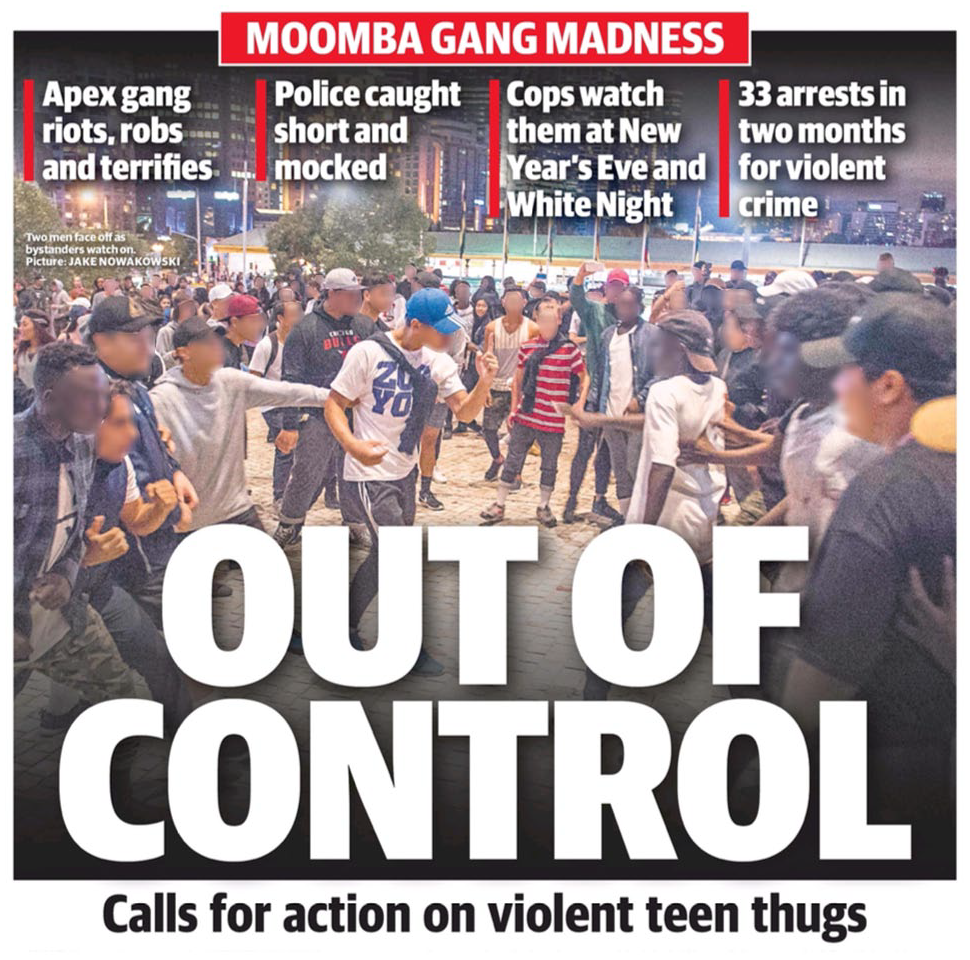
Herald Sun (14 March 2016). Photograph by Jake Nowakowski.
Visual juxtapositions work in concert with the image headline to clarify just who is ‘Out of Control’ and in what way. First, there is a clear juxtaposition of movement and stillness – a flurry of action concentrated in the central foreground of the frame set against a backdrop of static, unmoving watchfulness in the form of distant onlookers. Evoked here is a visual micro-politics of agency that divides the subjects present within the frame into active and passive positionalities: the ‘doers’ and the ‘done to’. Second, there is a compositional contrast between spaciousness and crowdedness, evoking a visual micro-politics of space. Negative space is concentrated around the would-be fighters in the central foreground of the image, while onlookers are visually crowded out to the upper extremity of the scene. Again, a clear binarism is established: between those who take up space and those from whom space is taken.
Anticipatory looking scales the crime event by calling on the viewer to place the captured frame within an imaginatively constructed, and formally limitless, sequence of activity. By positioning the viewer ambivalently between two co-constitutive positionalities – the ‘out of control’ criminalized actor who is in fact ‘in control’ of the represented scene, and the ‘under control’ bystander who is ‘out of control’ of the scene’s progression – the Immediate Before image opens a way of looking at crime that is forcefully anticipatory yet deeply disempowered. The sense of trajectory articulated by an anticipatory gaze invites a sense of certainty and inevitability about a continuation or escalation of violence, even if (and when) that violence is absent and may never arrive.
During: Embodied Looking
During images catch criminal rupture ‘in the act’. The most spatially and temporally immediate vantage point available for the spectatorship of crime, these are usually photographic representations of an event whose semiotic elements conspire to immerse viewers within the captured moment by placing them at the centre of a fraught space of action and disorder. Usually, they are examples of what artist and scholar Hito Steyerl calls the ‘poor image’: technically deficient, hard to decipher, and bearing the aesthetic scars of multiple remediations across various technological and representational mediums. The poor image, Steyerl (2009: np) writes, is one that ‘tends towards abstraction – it is a visual idea in its very becoming’. Typified by Figure 2, they testify to the event not by communicating details about ‘what’ happened, ‘where’ and ‘with whom’ but, rather, through an impressionistic, aesthetically-founded account of how the captured moment might have registered physically and emotionally for ‘the eye that is the camera’ (Mroué and Martin, 2012). The ‘representational inadequacy’ of the During image ‘encodes immediacy [and] the collapse of time-space limits with the scene of violence, allowing us to make ourselves imaginatively present at the event’ (Andén-Papadopoulos, 2013: 346). The core imaginative demand of the During image is thus a demand for embodied, affected immersion: to feel the depicted scene as if physically present within it.
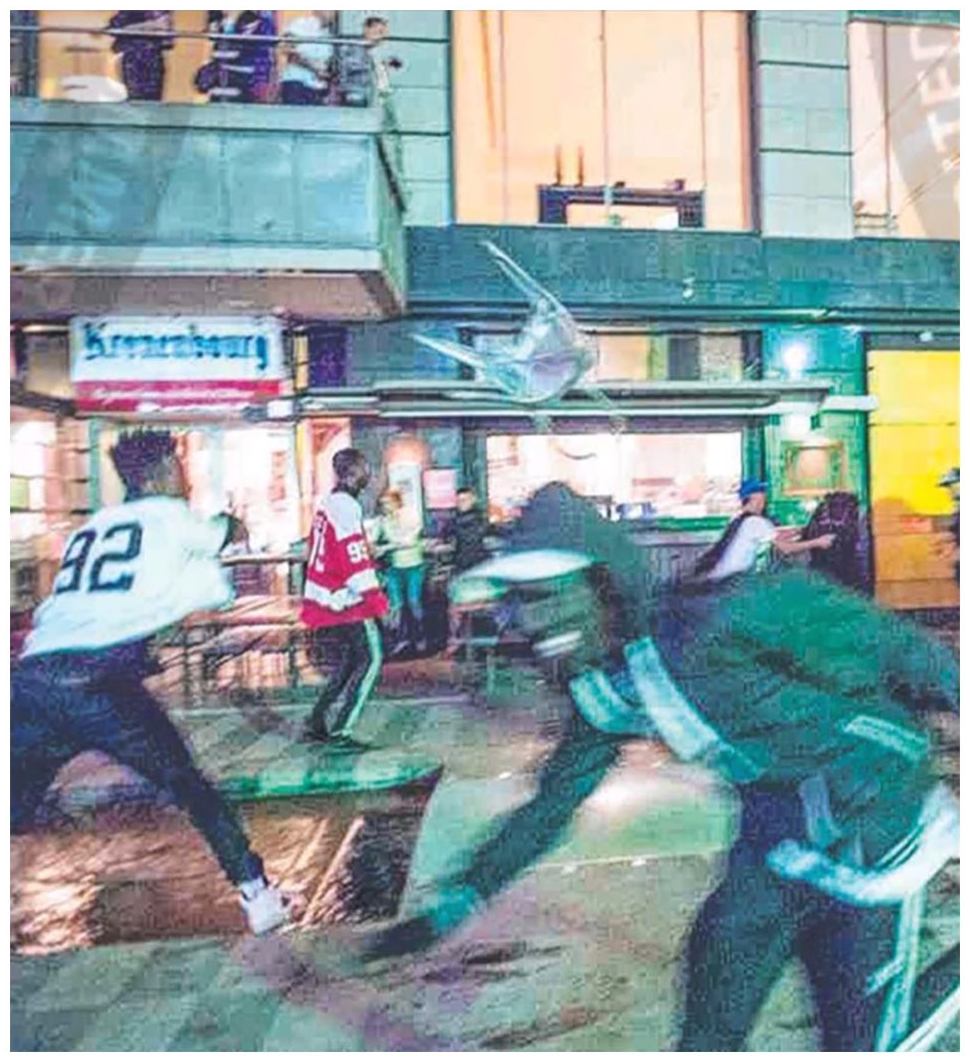
Herald Sun (14 March 2016). Photograph by Jake Nowakowski.
Figure 2 offers an illustrative example of the aesthetical hallmarks of the During image and the invitation to embodied looking it extends. Compositionally, the point-of-view of the eye/camera behind the image places the viewer at the centre of the scene, with bodies crowding the image at various depths to imply an ‘extension’ of the scene beyond the perimeter of the captured frame. Pixilation, low resolution, blurring and visual ‘fuzz’ all contrast sharply with the usual professionalism and intentionality of press photography, implying a ‘lay’ photographer and the possibility of remediation (i.e. that the image might be a still-capture from a video recorded on a mobile phone, or another amateur device). Finally, the aesthetics of hypermobility (p. 345) evoke a sense of embodied presence within the scene of action, calling the viewer into the ‘first person’ immediacy of the captured moment. Hypermobility here refers not only to the chaotic and multi-directional movement of bodies and objects within the image, but also the movement of the human eye/hand/camera behind the image, 2 implied in Figure 2 by tilted angle of the captured frame.
The subject of the During image of crime is not ‘the criminal’ but the human hand/eye/camera-subject that manifests aesthetically as a ‘haunting absence’ (Mroué and Martin, 2012: 24). Images of this type invoke the vulnerability of the body to imaginatively summon their viewer to the centre of a chaotic field of visual transitivity. In doing so, they implore imaginative identification with a particular political positionality – that of the subjugated, the overwhelmed, the disempowered, the frightened. Embodied looking ‘scales’ the crime event not through the communication of magnitude (across space and time) but rather through the visual manifestation of intensity. The testimonial force of such images within the mediated construction of crime events is thus dually derived: first, from the claims to authenticity imbedded in the visual genre of clandestine testimony (Chouliaraki, 2010; Mroué and Martin, 2012) and, second, from the claims to authority imbedded in the figure of what Harari (2009) calls the ‘flesh witness’ – she who knows the ‘truth’ of criminality not through a familiarity with verified facts, but through the affective immediacy of lived experience.
Immediate After: Forensic Looking
Immediate After images are photographic documents of damage, either to a body (in the form of bodily injury) or to an object (in the form of damaged property). As in the Immediate Before image, the spatial–temporal location of the captured frame via-à-vis the rupture of the narrated crime event is asymmetrical – spatially immediate, and yet temporally ‘afterwards’. Specifically, the Immediate After image invites the viewer to move backwards through time, using evidentiary objects to ‘read off’ imagined sequences of prior actions by an imagined subject or subjects. We can call this way of looking forensic: bodies and objects are presented as artefacts of since-passed crime events, with the viewer invited to imaginatively reconstruct the causes and conditions to which these material traces testify.
The invitation to forensic looking advanced by the Immediate After image – typified by Figure 3 – relies on a few consistent visual features. First, inviting reconstructive imagination relies on the capture of informational detail, usually implying a sharp focus and long depth of field. For zoomed-out images, like Figure 3, fine-grained visual detail emphasizes the quantity of damage. Damaged objects clutter and overwhelm the frame, calling the eye in multiple directions at once rather than offering a single focal point. For zoomed-in images, the precision and clarity of visual detail scales the event by emphasizing the quality of damage – a gaping, jagged hole in a shop window, or blood oozing from a fresh wound. In both instances, sharp denotative detail is essential to the connotative work of the image as an imaginative medium, scaling both the physical magnitude and the affective intensity of the prior criminality to which these images testify.
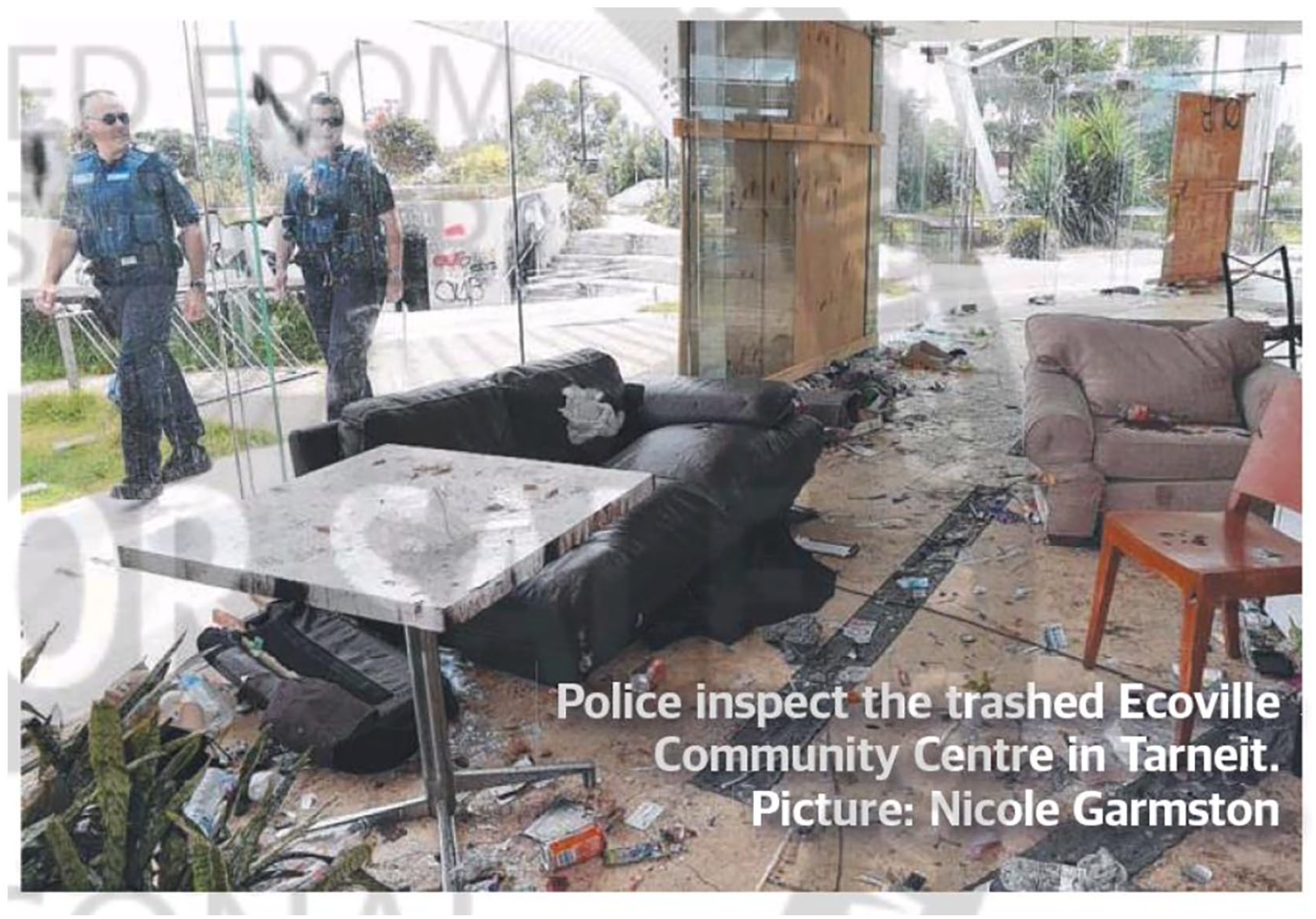
Sydney Daily Telegraph (6 January 2018). Photograph by Nicole Garmston.
Relatedly, the Immediate After image – in its semiotic reliance on stillness and clarity – tends to be absent of action-in-progress. The presence of active agents within the captured frame would be both visually distracting (in terms of the aesthetics of movement) and narratively confusing (making it less clear which sequence of action – past or present – the image is testifying to). An important exception to this, observable in Figure 3, is the figure of ‘the onlooker’. This figure serves its own demonstrative function by performing within the photograph the very same forensic way of looking that the image invites – surveying and evaluating the material damage captured by the photograph.
The Immediate After image invites the viewer to imaginatively reconstruct a past criminal rupture using material traces ‘the criminal’ leaves behind. Damaged objects stand in representationally for their own violent conditions of emergence, articulating the narrativity of journalism with a discourse of evidence from the sphere of procedural criminal justice – specifically, through the visual genre of crime scene photography. In this way, these images invite ‘reconstructive’ imaginations of the crime event and a forensic way of looking at the materiality of social space.
Distant after/distant Before: Vigilant Looking
Distant After photographs are portraits of social space which emphasize spatial proximity to a moment of criminal rupture whilst also harnessing temporal distance to perform contextualizing work. However, the degree of temporal distance that characterizes these images is so significant as to render them abstract. The scenes they capture are ‘elsewhere’ in time whilst remaining ‘precisely there’ in space, relying on captions and headlines to clarify their location vis-à-vis the rupture of crime. Temporal abstraction supports representational ambiguity: not clearly marked as either ‘before’ or ‘after’ a criminal moment, these images function narratively as both. Distant After images are thus also Distant Before images, as nothing in the visual modality distinguishes these two types from one another.
In Figure 4(a), the subjects of the image – a mother and child – are photographed from the middle distance so as to capture details of their environmental surroundings: a large house, a sweeping driveway, a manicured front garden and a peaceful suburban street receding into the distance. This is both a portrait of a mother and child and of the social space they occupy, at the interface of the public and private domains. A caption formally classifies this as a Distant After image: the woman stands in immediate spatial proximity to a site of criminal rupture, but at considerable temporal distance. However, the mood of the image is expectant. The woman’s gaze is cast out into the distance as if in watchful anticipation of something approaching her home, while an abundance of negative space in the central foreground of the image places her ‘out in the open’, emphasizing physical vulnerability. The image distils the ambivalent temporality of the Distant After/Distant Before and its imaginative significance: the literal after is the meaningful before, with vulnerability (rather than injury) the primary ‘trace’ of the criminal threat.
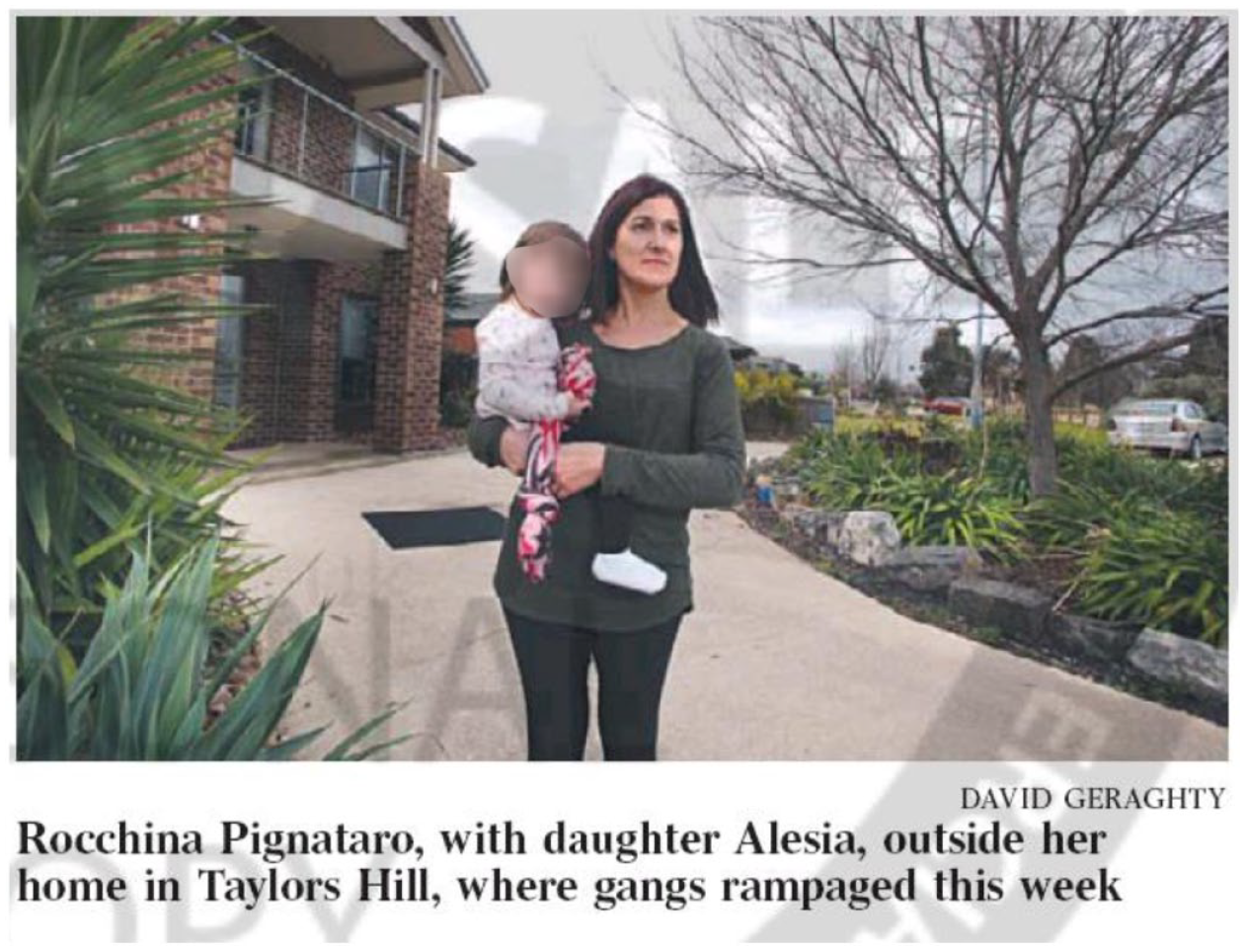
The Australian (10 August 2018). Photograph by David Geraghty.
As symbolic event forms, Distant After/Distant Before images collapse time into space to invite contrasting imaginations of the social environment: the caption accompanying Figure 4(a) reads ‘Dream suburb turns to worst nightmare’. The idealized imaginary of suburban social space is positioned as both the before and after setting of the nightmare of criminal disorder. The way of looking invited by the Distant After/Distant Before image might therefore be called vigilant – a watchful orientation towards spaces and the bodies that inhabit them that scans for dormant or emergent criminal potential in the everyday.
As Louise Amoore (2009) writes, this ‘vigilant visuality’ is characteristic of a post-9/11 security imaginary in which the local and the everyday are imaginatively reconfigured through practices of mediated communication (including journalism) as the ‘homefront’ of larger geopolitical power struggles. This vigilant watchfulness is grounded in an attentiveness to contrast – between ‘self and other, homeland and strangeland, safe and unsafe, ordinary and suspicious’ (p. 217) – and committed to the predictive power of the present, and thus a pre-emptive logic of action. As a result, vigilance often ‘plays out as profiling’ (p. 216): bodies, as well as spaces, become ‘sites’ to be scanned for signs of emergent threat. In Figure 4b, the spatial proximity of criminal past-futures is evoked not through contrasting representations of material space, but through the multi-modal articulation of the banal body and the spectacle of criminal violence. A vigilant way of looking – ever searching for the emergent criminal potential of the seemingly noncriminal – is thus attuned to gendered and racialized difference and the body not just as a container of agency, but also a site of action that can imaginatively call together events with distinct temporalities into a compressed, cyclical vision of crime. The materiality of social space is replaced with the materiality of the body as the after/before ‘trace’ of criminal events, in this case re-signifying the Black body as criminality-in-becoming (see Smiley and Fakunle, 2016).
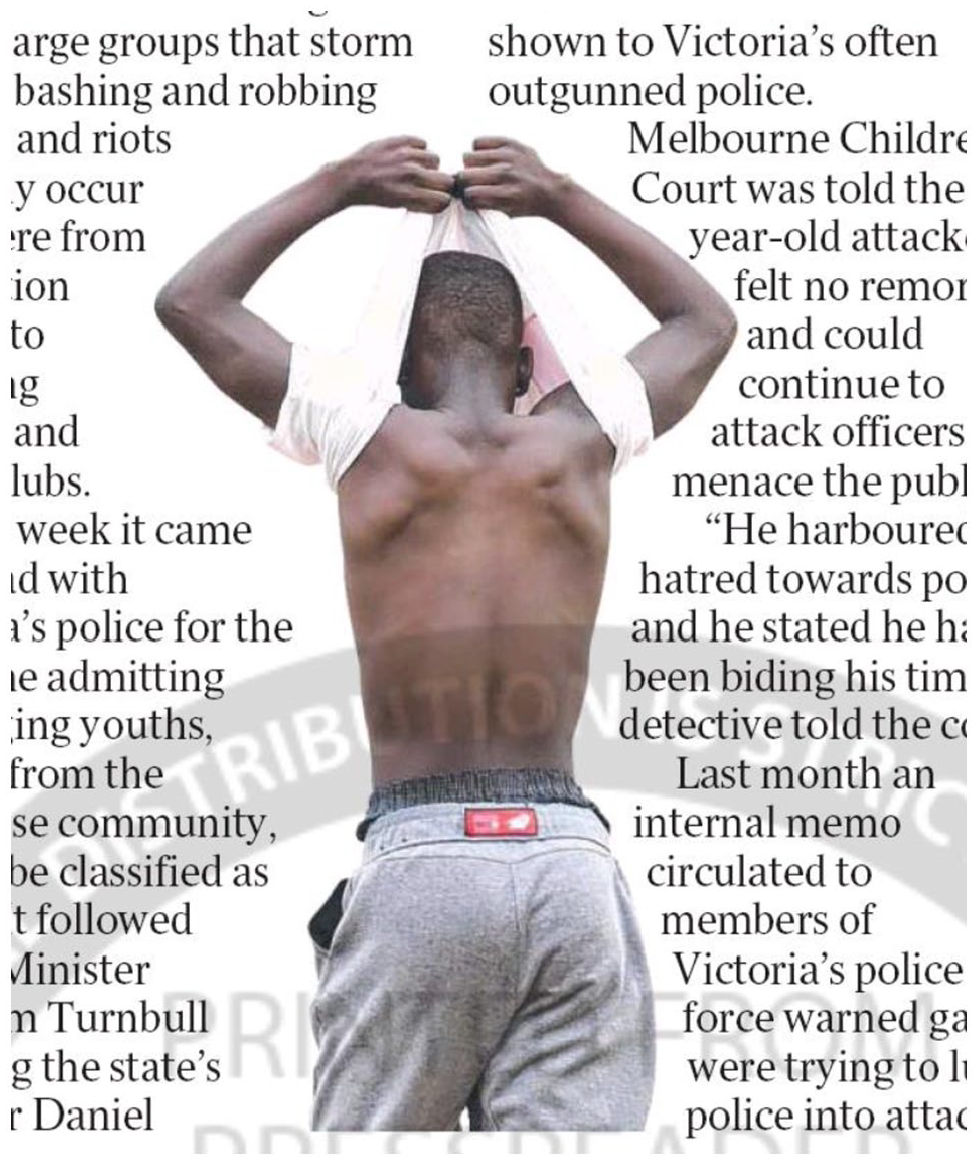
Sydney Daily Telegraph (6 January 2018).
Extreme Distance: Pre-emptive Looking
The Extreme Distance image is usually a multi-modal graphic of some kind – a map, a timeline, a graph, a collage – incorporating text, digital illustration, and sometimes photography into a single visual frame. As symbolic event forms, these images do not testify to any single event at any particular juncture of space and time. Rather, the Extreme Distance image congeals events together visually to mediate them as phenomena, connected in time and space, and co-implicated in meaning. These images testify not to an eventful rupture that has ‘happened’ (as in the ‘witness’ photograph that typifies the genre of photojournalism), but rather to something happening – active, ongoing, in-process. The Extreme Distance vantage point collates events from across the chronology of lived time so that they can appear and amass side-by-side in visual simultaneity. Spatial contexts, meanwhile, are cut and pasted together within the frame, giving the crime phenomenon a sense of trajectory, direction and scale.
In Figure 5, a map of greater Melbourne serves as a visual backdrop. This map is absent of any ‘social geographic’ markers such as roads, schools, hospitals, parks or places of worship or trade. Instead, the map highlights only borders – in this case, between local council constituencies – as the definitional feature of space, thus rendering the city of Melbourne in territorial terms. In this way, the image collapses both journalistic and cartographic modes of visual authority to function as a selective representation not only of crime but, more explicitly, of social place (Gasher, 2021; Usher, 2020). Small red circles mark locations of past crime events. The indexicality of these marks is clarified by accompanying captions, which give superficial details about the date, location and type of crime represented by each red circle. In real time, the nine events represented in Figure 5 have taken place over the course of almost eight months. However, the Extreme Distance image articulates these events within a single frame so that they can appear – and, crucially, massify – in visual simultaneity. Each red circle is numbered: tracing them with the eye in sequential order draws the gaze back and forth across the map, reinforcing a narrative claim that criminality is spreading across or ‘taking over’ the spatial terrain of the image. Moreover, the red circle sign does not discriminate between different types of crime event, establishing a sense of symbolic equivalence between, say, a trashed Airbnb property and a fatal stabbing (Wallace, 2009).
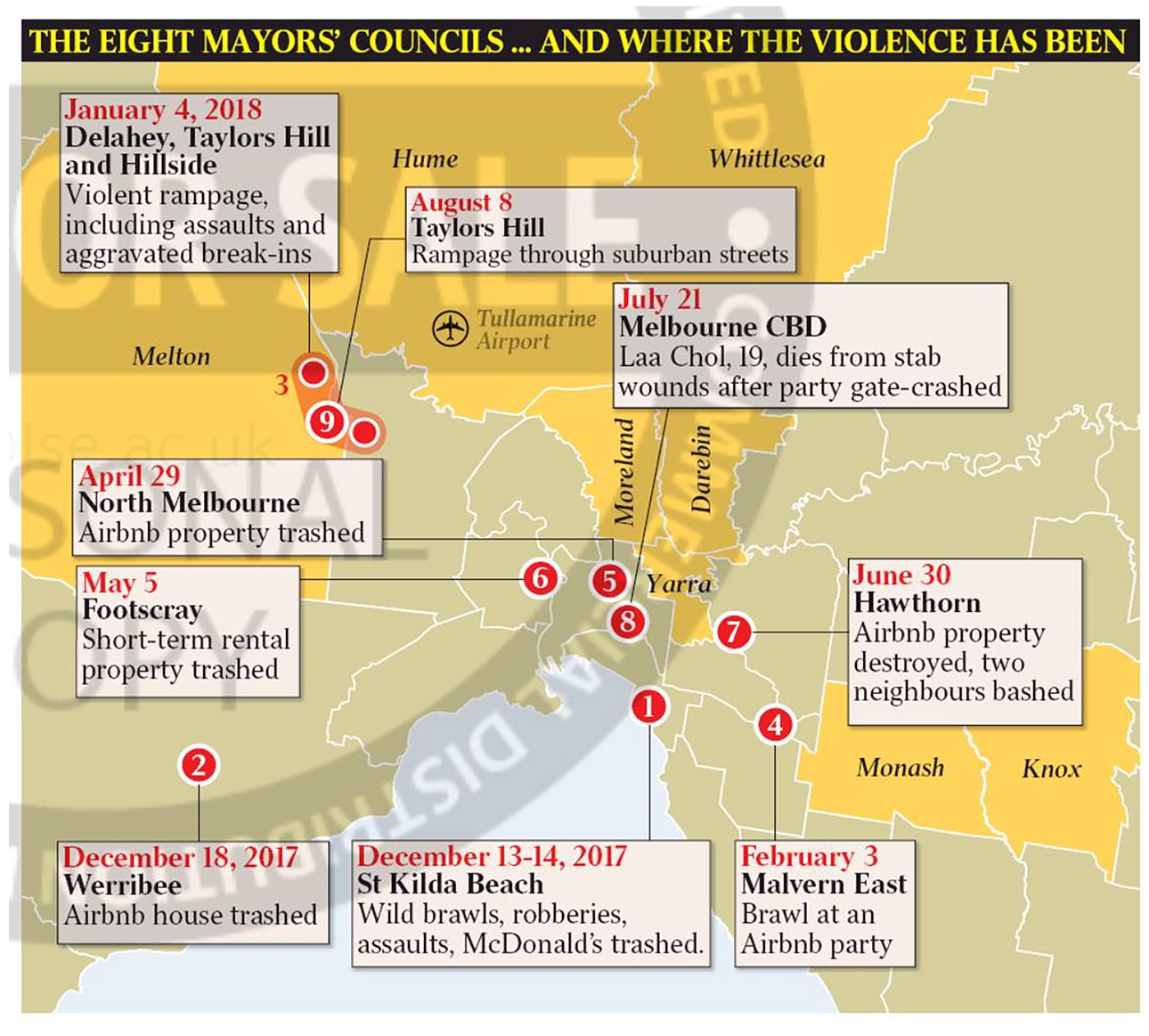
The Australian (14 August 2018).
The Extreme Distance image takes up discrete crime events and mediates them as parts of an as-yet-incomplete whole; it offers a way of looking at crime that facilitates the identification (and imaginative continuation) of patterns. We can describe the way of looking it invites as pre-emptive: a sense of ‘seeing-as-foreseeing’ that invokes the pre-emptive logic of national security within the domestic business of crime control (McCulloch and Pickering, 2009; Virilio, 1994; Wallace, 2009). The sense of event accumulation evoked by the Extreme Distance image constitutes a register of visual transitivity, animating an imagination of the crime phenomenon as something active, accelerating, and on-the-move. It also co-implicates the meaning of these events, so that the socio-political significance of each derives as much from its place within the sequence as from its own specificities. And so, when viewed from an Extreme Distance, mediated crime events resist discrete and/or limited imaginations of their spatial and historical significance. Past and future crime events are called together ‘as matter to shadow’ in the imaginative visualization of crime futures (McCulloch and Pickering, 2009: 641).
Kaleidoscopic Visuality: Rethinking How News Images Criminalize
Traditionally, both qualitative and quantitative studies of criminalization in and through visual media representations have ascribed the greatest significance to that which stays relatively fixed across iterative representations of crime and criminality: usually, the people, places and practices that are resiliently positioned within – and so, constructed by – media discourses as ‘criminal’. This approach conceptualizes mediated criminalization as symbolic articulation (Hall, 1997): the steady and repetitive association of certain subjectivities (especially racialized subjects) with the category of ‘crime’ through discourse until this symbolic association calcifies into a pernicious stereotype, lending cultural legitimacy to selective practices of state surveillance, exclusion and control (Davis, 1998). Certainly, this is a fundamental component of how criminalization works through journalism and a significant dynamic in the criminalization of African youth in Melbourne, many of whom have reported feeling stereotyped, stigmatized and exposed to retributive violence and/or discrimination as a result of the Australian media’s moral panic about so-called ‘African gangs’ (Henriques-Gomes, 2018; Weber et al., 2021).
However, to be criminalized is not simply to be stereotyped as criminal, but to be legitimately excluded from state protection and exposed to practices of state violence (Cacho, 2012). Criminalization is a harmful and deeply endemic justificatory logic of social practice that mobilizes certain practical responses to everyday vulnerability and harm by lending them meaningful coherence and justificatory support. It relies symbolically on the cultural reproduction of ‘criminal’ subjects, certainly, but on more than that alone. Specifically, it also requires the imaginative scaling of crime: the meaningful transformation of individual and isolated events into something connected, expansive and dynamic, with historical significance and implications beyond the immediate time and place of each event’s occurrence. Only when crime events ‘live’ beyond their moment of rupture as testimonies of larger political realities can they lend justificatory support to present and future practices of crime control. Therefore, critiques of mediated criminalization must also be attentive to what doesn’t stay fixed across visual representations of crime, specifically, the ‘where’ and ‘when’ of crime events both as represented in news images as testimonial texts and as experientially constructed through the hypermediacy of visual journalism. While the fragmented visual aesthetic of crime news photojournalism has been remarked upon before (Straw, 2015), the analysis here connects the question of aesthetic more explicitly to the question of representational politics by highlighting how it is spatiotemporal fragmentation specifically that helps scale crime events in terms of their historical context and scope – and so, too, in terms of their socio-political meaning and justificatory significance.
The varied ways of looking at crime uncovered through this analysis do not exist in semiotic isolation. The imaginative potential of each is conditioned by its relationships to others, both symbolic (within the genre of crime journalism) and material (within the multi-modality of news stories, in which such varied vantage points often appear side-by-side). Thus, in the last instance, they must be read dialogically, as interconnected moments of a larger strategy of visualization through which crime events are ‘made to mean’ through intertextual news storytelling (Bakhtin, 1981; Chouliaraki and Fairclough, 1999). What multiplies across the typology presented here is not simply the quantity of events involving African youth that are made visible as ‘crime’ through news reporting, but also (a) the quantity of historical contexts within which such events are positioned as being socially and politically significant; and (b) the quantity of temporal–spatial configurations from which (indeed, through which) the spectatorship of crime can occur. However, while the chronotope of the ‘African gang crime’ event is mediated as open and radically unstable, the (obviously racialized) account of relative social power and agency each event distils in representation remains narrowly repetitive across texts. This visual dialectic – between narrative repetition/stability and contextual variation/instability – is what I term kaleidoscopic visuality.
A kaleidoscope is a narrow tube, usually constructed from plastic or cardboard, containing two or more mirrors set facing towards one another at varying angles. An object viewed through a kaleidoscope is thus viewed as if from multiple positions at once; innumerable perspectives are captured through the viewfinder as if part of a singular vantage point. The multiplicity of available perspectives is temporal as well as spatial – as the kaleidoscope rotates, the angled reflections within the tube shift and the perspectives available to the viewer proliferate anew. Kaleidoscopic visions are ultimately patterned visions that emerge through a visual interplay between singularity/fixity and infinity/movement: the moment of criminal rupture set against the restlessness of the mediated event, the stillness of the photograph against the inevitable motion of social life. A patterned imaginary emerges because, while the figure of ‘the criminal’ remains narrowly stereotyped, the historical contexts within which (in representation) and from which (through mediated spectatorship) ‘crime events’ are positioned as socially and politically consequential are endlessly shifting and formally limitless.
A typological analysis of the kind conducted here is critically useful because it draws a broad map of the different visualization strategies at work within this particular representational ecology – journalistic reporting on and reconstruction of ‘African gang crime’ events – and offers a granular, qualitative account of the imaginative implications of each. Future qualitative studies of mediated criminalization may therefore draw on the five ‘ways of looking’ theorized here as conceptual resources for analyses of criminalizing representation. This may in turn help such critiques move beyond the question of criminalized subjectivity to additionally consider the significance of mediated event spacetime and how images negotiate imaginative relationship between the viewer and the viewed. Of course, however, the analysis here has been deliberately narrow in its focus: it has examined just one element of news visuality (the spatiotemporal vantage point) and its implications for just one dimension of cultural criminalization (the resonance of the crime event within background imaginaries of everyday political life). For this reason, the account of visual criminalization developed here should be understood as supplementary to, rather than substitutive of, other ways of understanding how criminalization works through news imagery, especially those which centre the construction of (usually, racialized and classed) ‘criminal’ subjects.
Moreover, the question of the prevalence of different vantage points and ways of looking has not figured in the analysis here, though it is certainly consequential to the question of criminalization and the mediated ‘life’ of crime events. Quantitative studies of how news images criminalize are usually most attuned to the repetition and accumulation of specific criminalizing semiotic constructs across representations – for example, specific narratives, news frames, stereotypes, visual motifs, or tropes (see, for example, Entman, 1990; Mortensen et al., 2020; Oliver, 1994). The image types explicated by this study can help inform the design of future quantitative work of this kind, as they offer quantitative researchers both a clearly defined empirical object (the spatiotemporal vantage point) and an elucidating qualitative account of its representational significance (its attendant ‘way of looking’ and imaginative demands). More pointedly, however, the concept of kaleidoscopic visuality highlights the limitations of a prevalence-based approach, as it suggests that it is rather an intertextual dialectic between prevalence and variance that negotiates the spatiotemporal dimensions of crime events – and so, their imagined sense of historical/conjunctural significance. Future quantitative studies of criminalizing imagery should therefore work to accommodate the representational significance of variation – especially, spatiotemporal and contextual variation – as well as of repetition in the intertextual construction of crime and criminality.
These important directions for future study notwithstanding, the concept of kaleidoscopic visuality extends our understanding of how criminalization works through news images in at least two important ways. First, if feelings of insecurity flourish at the outer extremities of knowledge and control (see, for example, Amoore, 2009; Bigo, 2002; De Goede, 2008; Ericson, 2007), then kaleidoscopic visuality is instrumental in helping mediated crime events resist desecuritized interpretations of their significance, and therefore in culturally animating practices of crime control. On the one hand, it fosters a ‘fantasy of manageability’ (De Goede, 2008: 168) as it relates to the ‘who’ and ‘what’ of social threat – in this case, ‘gangs’ of African youth. On the other, however, it nurtures a hypervigilance towards the unknown, especially as it relates to the ‘where’ and ‘when’ of possible future crime, which are mediated as limitless, fluctuating and ever-uncertain.
Second, it complements critiques of visual criminalization as subject-construction by illuminating how, through mediated eventfulness, the spectacle of crime comes to appear as being symptomatic of, rather than anomalous to, everyday power relations. This fortifies criminalization by lending essential justificatory support to crime control practices – including policing and incarceration – as ‘necessary’ responses to conditions of power and vulnerability in everyday life that are considered to be broadly ‘real’ or factual. In the background imaginary of social life that a kaleidoscopic visualization of crime events helps to (re)make, crime manifests not in the form of discrete and finite events bounded at particular junctures of space and time, but rather as moments in a dynamic and unified ‘crime phenomenon’ that is active, growing, spreading, in-process, accelerating and as yet incomplete. This expansive spacetime is a key mechanism through which crime events accrue meaning beyond their immediate contexts of emergence – and so, how the mediated spectacle of crime resonates in the banal imaginary of everyday social power and vulnerability that journalism helps cultivate. The figure of the ‘African gang criminal’ is therein imbued with a limitless sense of coercive agency, belying the actual (and profoundly racialized) conditions of political and economic subjugation that make up the culturally and politically ‘non-criminal’ backdrop for the mediated spectacle of crime in contexts like Australia.
Footnotes
Funding
The author received no financial support for the research, authorship and publication of this article, and there is no conflict of interest.

Notes
Biographical note
KATHRYN CLAIRE HIGGINS is a PhD candidate in the Department of Media and Communications at the London School of Economics and Political Science.
Address: The London School of Economics and Political Science, Houghton Street, London WC2A 2AE, UK. [email: