




Abstract
This article uses images from the visual essays produced for Plume of Feathers, an audio-visual project, to examine the notion of ‘reflective nostalgia’ as an attitude towards meaning-making within image creation, in particular illustration that can counter certain political uses of images that present a restorative–nostalgic world view. The project at the core of the article is concerned with the decline of public houses and their social function in the UK. However, the image of the pub is embroiled within the visual rhetoric related to the UK’s (2016) Brexit referendum. This article explores the ways in which the illustrated image can provide a different view of the pub that reveals the conceptual construction of the notion of ‘pub’ and offers a critical alternative. The constructed nature of the illustrated image is then explored for its potential to visualize the past differently, following Svetlana Boym’s proposal of reflective nostalgia in The Future of Nostalgia (2001) in order to address problems in the present.
The article proposes that reflective nostalgia’s utility as a critical tool lies in its consideration of the key role played by the surface of the image, through the material signifiers of age. As illustrators, embracing these nostalgic triggers when making images allows the viewer to reconnect to the past with critical distance, thereby returning politics to the surface of the image, something that Fredric Jameson saw in Postmodernism, Or the Cultural Logic of Late Capitalism (1991) as recuperated and rendered politically neutral. Illustration is therefore cast as a meaning-making practice that shapes the world it operates within, with the article suggesting that by making nostalgic images, illustrators can exercise their agency as agitators.
Introduction
In 1946, George Orwell wrote an article for The Evening Standard about the ideal pub, which he called The Moon Under Water. As such, The Moon Under Water was an urban, British hostelry fitted out in wood and ornamental mirrors in a fashion that was ‘uncompromisingly Victorian’. It was a place where conversation flowed, bar staff were hospitable, substantial snacks could be procured and families were welcome. Orwell concluded by informing the reader that his description was a fiction, that it was only a proposal of an ideal he yearned for. Despite its fiction, Orwell’s image of the pub has endured as a significant trope of the friendly British pub. Online image searches for ‘British pub’ deliver almost exactly the wood, mirrors and Victoriana of Orwell’s The Moon Under Water. Visibly traditional and an anchor in an otherwise changing world, the enduring image of the British pub is imbued with nostalgia, but it is also a fiction.
The illustrated image is similarly constructed, and this article is concerned with how the deliberate decisions made when constructing representations enable the resulting images to shape how we see the world. The article dissects an audiovisual project entitled Plume of Feathers which is concerned with the decline of the pub in the UK and its social function. According to figures from the Office for National Statistics (2018) the number of pubs dropped by 23 percent over 10 years to leave 39,000 remaining in 2018, with the decline also noted by the Campaign for Real Ale (CAMRA, 2016) as a cause for alarm, and further discussed by Rodionova (2016). The retrospective nature of a project concerned with loss and the past locates it within a discussion of nostalgia, which is underlined by the formal and thematic concerns of the images used for Plume of Feathers.
From the literature concerning nostalgia and images, the work of Svetlana Boym and Fredric Jameson are central to this discussion and will be employed in conjunction with reflections on illustration practice undertaken for Plume of Feathers to generate insights concerning the role and responsibilities of the illustrator. Illustrations produced for Plume of Feathers will be explored for their ability to formulate different representations of pubs and pub culture to those already in existence, and therefore a different approach to nostalgia that realigns it with a more leftwing political perspective. This is undertaken with direct reference to the political events providing the context for the project, for the image of the pub (as envisioned in popular culture) became a tool within the campaign for Britain leaving the European Union (henceforth referred to as ‘Brexit’). This implicates nostalgic images in the resultant social divisions observed (BBC News, 2016) and, in this regard, the political backdrop is embroiled within the exploration and evaluation of the concept of nostalgia in relation to illustration. The philosopher AC Grayling noted that British society was losing cohesion in the year following the Brexit referendum (Coughlan, 2017) but, by proposing that society is united through the shared use of local pubs, Dunbar et al. (2017) reveal the positive aspect of the pub’s entanglement with politics. The role of the image in foregrounding different perspectives is at the heart of the reflections on the Plume of Feathers illustrations.
In writing this article, I seek to capture the reflections emerging from the process of making images and to use these to open a broader discussion concerning the role of the illustrated image as an agent of change within society. 1 How images accomplish this will be explored in order to position illustration as a critical participant through both its formal and cultural construction. This aspect of the discussion will show the contribution that creative practice can make to our relationship with the past and present, offering the political capacity of the nostalgic image as a potential tool to be harnessed by illustrators to strengthen their agency as agitators.
Plume of Feathers: An Expanded Illustration Project
The project examined within this article is an audiovisual project about the decline of pubs called Plume of Feathers, which ran between 2015 and 2018. It focused on the people in pubs and how pubs are visualized through popular culture. The title refers to an historic pub in Bristol that closed and was converted into flats, chosen because it was emblematic of the threats facing pubs. Likewise, whilst Bristol informs the project, it was about pubs more generally. Plume of Feathers consisted of an album of music by a band of the same name and, when performed live in pubs, music venues and festivals across the UK, each song on the album had a ‘visual essay’ to accompany it. The visuals were comprised of drawing, collage and borrowed film clips, which were combined to create a largely non-narrative series of images that reflected the dynamics of the songs. These were projected as pre-prepared films onto a screen behind or in front of the band as they performed, making them unique to their surroundings. Figure 1 shows a photograph of a Plume of Feathers performance, with a visual essay projected behind the band. The album and visuals shared a research process, but the production of music and images was separate and I produced the images in response to songs. It is the visual essays that are discussed here, with the titles of the figures taking the name of the song they are paired with. 2
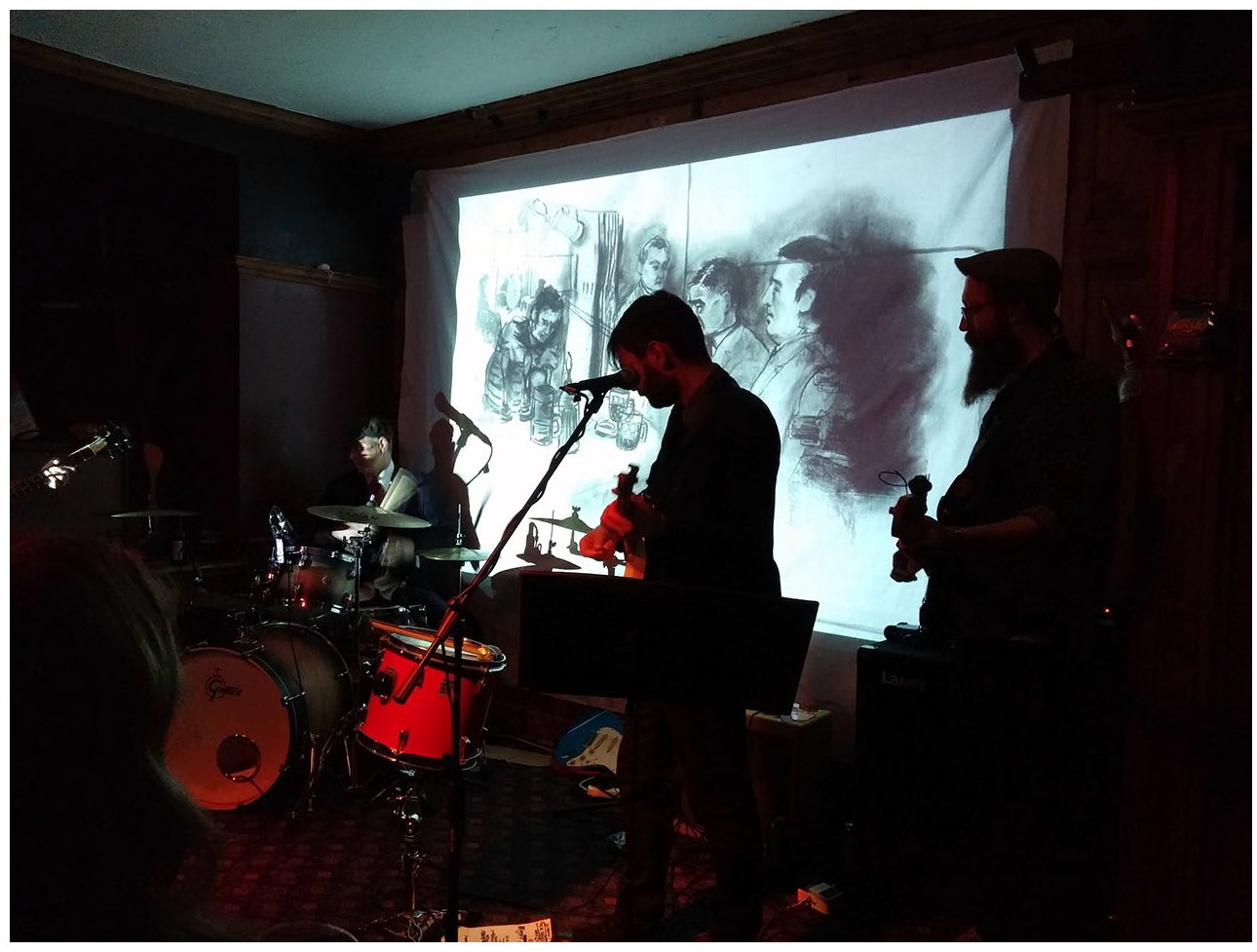
Plume of Feathers performance at the Stag and Hounds pub and music venue, Bristol, December 2016. A visual essay can be seen projected onto the screen behind the band. © Photograph by Matt Redmond. Reproduced with permission.
The visual essays within the project extend the possible modalities for illustration, in line with Susan Doyle’s reminder that illustration need not be defined by print: ‘The “what” (subject) and “how” (medium) of an image are not the defining factors; rather, the “why” (purpose) determines whether a work of art is illustration or not’ (Doyle et al., 2019: xvii). In this respect, the images discussed here are commensurate with Doyle’s definition of illustration as a visual endeavour that is ‘inherently in service of an idea and seeks to communicate something particular, usually to a specific audience’. The particular approach taken in communicating that something in Plume of Feathers is one of counterpoint is described by Joanna Carey (2003: 16) in her discussion of illustrated children’s books as the non-literal relationship between image and text that allows both to contribute to the story. Therefore the images produced to accompany songs were not necessarily of pubs and might include geometric patterns or photographs of buffets sourced from the internet. In collating the images, I created conceptual gaps between images which is possible because they are often sequences of still images rather than the more fluid transitions of film. This creates a slight disjunction as a puzzle. The images are also counterpoints to the songs they accompany, providing a different point of view. In this regard, the illustrations experienced with the music as part of a Plume of Feathers performance are one mode of a multimodal text; this creates further gaps between the parallel strands of the overall communication and asks the audience to span them, thereby creating fluidity from fragments. 3
Illustration and Nostalgia
The concept of nostalgia arose from the materials and imagery employed within the illustrated element of Plume of Feathers, as well as being reflected in the album’s concern with the loss of pubs from our urban landscape. Concerned with a retrospective look at pub history and the pub culture that is lost when pubs close, the project is inherently nostalgic. As a temporal concept, nostalgia is relevant to developments in the wider field of illustration for, as Roderick Mills (2015) notes, illustration is becoming increasingly time-based in professional practice. In a reflection of this, references to the temporal qualities of illustration are appearing within illustration research more frequently (for example, Braund, 2011; Heller, 1999; Mills, 2013). It must be acknowledged that the frequency of mentions is relative to the scale of illustration research, which is a field in development. This in itself constitutes a sound argument for further scrutiny of the illustrated image.
In Heller (1999), illustrator Sue Coe asserts that images should slow time down, which Braund (2011) pursues by examining how images can do so, for example, by holding the attention of the audience as a result of compositional decisions. Mills (2013: 149) notes the opportunities afforded by increasingly time-based media for illustrators to expand their communicative range. These sources establish a relationship between the image and its viewer’s experience of time, and to the platforms available to illustrators to publish time-based work.
A recent issue of illustration magazine Varoom further emphasizes the link between time and illustration, with a specific focus on nostalgia. The issue surveys illustration practices concerned with nostalgia to some degree, showing it to be a concept of contemporary relevance to the field. Issue 39 documents the concerns and processes of illustrators working with memory, history and archival resources, with Zoe Taylor (2019:77) noting that an entire section of illustration (fashion) is perceived as a nostalgic enterprise, as a signifier of visual languages from the past. Billie Muraben’s (2019: 32–33) contribution to the issue begins to make links between illustration practices and the literature on nostalgia, referencing Owen Hatherley (2016) and Clay Routledge (2017). Further to this, Muraben suggests that illustrators can use nostalgic styles to communicate criticism of outdated values (p. 38), as can be seen in the example of Richard Littler’s Scarfolk elsewhere in the issue. However, Olivia Ahmad (the Editor) suggests that illustration’s use of visual languages and materials from times past is ‘often ultimately empty’, describing them as ‘pastiche’ (Ahmad, 2019: 1). Ahmad’s concern is that ‘while wistfully looking back, we reduce space for new ideas to come forward and to make progress’, whereas this article argues that there is space for progress within the nostalgic image, and it works in tandem with Muraben’s suggestions to show how the nostalgic illustrated image can be constructed and put to use with greater criticality.
Nostalgia and the Image of the Pub
Nostalgia is defined by Bonnett and Alexander (2013: 392) as ‘a yearning for the past, a sense of loss in the face of change’. This anchors my own understanding of nostalgia and shifts it from a medical matter (as homesickness) to a social matter as explained by Lowenthal (1989). Definitions such as these that foreground the social and reflective aspects of nostalgia were of paramount importance at the time the project was developed and performed, when using the past to represent ‘tradition’ was used to argue for morally reprehensible divisions in society (such as those mentioned by Grayling). Bonnett (2010: 2) notes the link between nostalgia and conservatism, suggesting that it is a reactionary approach to the progress of modernity and a regressive perspective aligned with the political right wing. Making nostalgic pictures may align with these values, contributing to a right-leaning construction of the pub which is at odds with the values of Plume of Feathers. Appropriately, my suspicion regarding the use of images of the past is a common response to nostalgia as noted by Bonnett (2010: 2) and Lowenthal (1989: 19), and guides the following attempt to locate the Plume of Feathers project within the politics of nostalgia. The place of pub imagery within this discussion then informs a broader exploration of the politics of the image within the political context for Plume of Feathers. This in turn informs the creative decisions made to navigate this context, which will be examined subsequently.
To explain the relationship between right-wing politics and the image of the pub in popular culture, I will introduce the visual manifestation of both. By performing an image search for the term ‘British pub’, the results collect the most popular images that represent the concept, with many visual features in common. The pubs pictured represent an ideal pub much like Orwell’s Moon Under Water, it’s quaint, it’s brown, its fittings are made of wood. This image, with the overtones of tradition and community that Orwell outlines, has been put to use within the social and political upheaval resulting from the EU referendum by prominent figures in the campaign to leave the EU. These include Boris Johnson and Michael Gove of the Conservative Party who fronted the official ‘Vote Leave’ campaign, and Nigel Farage from the United Kingdom Independence Party (UKIP).
4
Perceptions of their parties’ relative positions are mapped by Dahlgreen (2014) using YouGov (an international research data and analytics group) research, showing both to be right-of-centre with UKIP to the far right. Farage in particular has utilized the image of the pub to establish himself as what one BBC political reporter described as someone who ‘revels in being “the man in the pub”, the political outsider . . . he states his opinions without much recourse to political correctness’ (Parkinson, 2014). To establish this position, he is frequently pictured inside and outside pubs, pint in hand. Diane Bolet (2021: 1666–1667) establishes a relationship between the decline of pubs, Farage, support for right-wing politics and nostalgia, noting that:
UKIP offers programmatic positions which appeal to a sense of Britishness, nostalgia and community that are resonating in light of the decline of community spaces such as pubs. By having Farage stressing the importance of the local pub, UKIP not only invokes a lost sense of community, but also a sense of threatened white working-class identity.
The strategy of appearing to be an everyman from outside the political elite using the visual shorthand of the pub was also adopted by Johnson and Gove to launch the official Vote Leave campaign, using a branch of the British pub chain JD Wetherspoon (whose founder and chairman is a vocal supporter of Brexit) for their launch event’s photo opportunity.
Calculated decisions by these politicians to harness the meaning of the image of the pub for political ends meant that the image of the pub became associated with a visual vocabulary that included divisive rhetoric concerning immigration. An example of this is the ‘Breaking Point’ billboard produced by the pro-Brexit Grassroots Out campaign group and launched by Farage, which promoted anti-migrant sentiment. Andrew Reid (2019: 624) describes the poster as ‘depicting a line of refugees from the Middle East with the slogan “Breaking Point” displayed in red’ and considers the role of the image within the communication, pronouncing it hate speech with the effect of othering and excluding as it ‘presents non-white migrants as a hostile or invading force and an imminent threat to British resources’ (Reid, 2019: 630). Both Reid and James Morrison focus on the role of the image in their analyses of the poster, seeing it as shouldering the burden of maliciously deceiving and manipulating the viewer – not least by conflating non-EU refugees with intra-EU movement. Morrison (2016: 66) describes it as ‘an image of invading “orientals” so laced with distortion, alarm and misrepresentation that it can only be viewed as a weapon of wilfully fomented moral panic’. The tone of the Brexit debate is commented upon by Lucy P Marcus (2016) and John Burnett (2017), who both link it with real effects in the world, such as a spike in hate crimes recorded after the referendum. Writing in The Financial Times, Henry Mance (2016) further establishes a link between post-truth politics and the official pro-Brexit campaign. The image of the Moon-Under-Water-style pub therefore sits within a troubled political context that utilizes images as its footsoldiers. As a result, the use of similar representations of pubs within Plume of Feathers needed to be questioned in light of what is lost when pubs close, what is worth keeping, and for whom.
The problematic use of the image of the pub described above overlaps with the Plume of Feathers’ use of pub imagery for a different end, encouraging further scrutiny and refinement of terminology relating to the phenomenon of interest. In this regard, this article is concerned with nostalgia rather than memory, in line with Christopher Lasch’s (1990: 18) definitions of the two terms, where nostalgia requires a dissatisfaction with the present. This is what Howard (2012: 3) defines as nostalgia’s ‘poverty of the present requirement’. Farage, Gove and Johnson’s use of the image of the traditional pub can also be located within another retrospective sense of time; the fib of heritage. As David Lowenthal (1989) defines it, heritage is ‘necessarily false’ and used to sustain group identity by excluding others: ‘to be opaque to outsiders they have to be full of invented falsehoods’, which unite the group (cited in Edwards and Wilson, 2014: 113). This can be mapped effectively onto the pro-Brexit rhetoric and post-referendum bigotry, and the xenophobia noted by the UN Committee on the Elimination of Racial Discrimination (BBC News, 2016).
To complicate matters further, the image of the ‘traditional’ pub enmeshed in the visual rhetoric outlined above is itself a falsehood. As Mark Girouard (1975) points out in Victorian Pubs, pubs have always been redesigned and reconfigured inside and out every few years. This is traditional, whereas Everitt and Bowler (1996: 102, 115) define the pub described so far (the brown wooden variety) as ‘sentimental typical’, which can be bought from catalogues. It is how we would like an old pub to look rather than what it actually looked like, the aspirational bent of which runs parallel to Orwell’s Moon Under Water. This approach chimes with Linda Hutcheon’s (1998) suggestion that, for the nostalgist, the past is not simply remembered but reconstructed in accordance with present needs. Therefore, tradition is fictional in pubs and fiction is traditional in nostalgia, adopting the ‘invented falsehood’ of heritage to unite a group of dissatisfied people. The conflation of real and imagined imagery is central to Svetlana Boym’s (2007) concerns about the uncritical adoption of nostalgia. She outlines the roots of the word as located in a combination of longing and a return home and warns that ‘The danger of nostalgia is that it tends to confuse the actual home and the imaginary one’ (pp. 9–10). The use of a fictional idea of a perfect pub in imagery associated with the Leave campaign is an example of how the confusion Boym notes becomes dangerous, with images used to construct the imaginary home promised by the ideological projects she sees as associated with nostalgia.
Boym helps to locate the project in relation to the political stances identified within the literature surveyed, by liberating nostalgia from the politically conservative approach noted by Bonnett (2010) and Lowenthal (1989). To do so, she subdivides nostalgia into ‘reflective’ and ‘restorative’ types, in a fashion similar to Fred Davis (1979: 24) who outlines three orders of nostalgia: ‘simple’, ‘reflexive’ and ‘interpretive nostalgia’. The resulting terms identify forms of nostalgia that emphasize its critical utility and potential as a tool for enacting change, in line with the critical impetus driving the image-making within Plume of Feathers. Jafari and Taheri (2014: 220) emphasize the analytical approach of interpretive nostalgia, which involves ‘an interpretive exploration of self in order to understand the reason for feeling nostalgic’. This concept’s utility lies in its positioning of nostalgia as a social activity; as Jafari and Taheri summarize in relation to literature on nostalgia, its reflexivity is what encourages us to consider the conditions of others and consider ourselves, and gives us agency in building our identity within the future. It is counter to the traditional view of nostalgia as being contrary to change and contrary to a left-leaning political position, and more in line with Alison Blunt’s (2003: 722) ‘productive nostalgia’, another durational view of nostalgia that aims for change in the future through practical acts in the present. Blunt sees productive nostalgia’s strategy as imagining a place differently; in Plume of Feathers this involved opening up future possibilities by visualizing the past differently through illustration.
Boym (2001: xviii) incorporates the critical distance of Davis’s reflexive and interpretive nostalgias within her ‘reflective nostalgia’, which she explains in The Future of Nostalgia in relation to its counterpart – ‘restorative nostalgia’:
Restorative nostalgia does not think of itself as nostalgia, but rather as truth and tradition. Reflective nostalgia dwells on the ambivalences of human longing and belonging and does not shy away from the contradictions of modernity. Restorative nostalgia protects the absolute truth, while reflective nostalgia calls it into doubt.
Reflective nostalgia is therefore critical and analytical, focused on the longing itself as a means of reflecting on the difference between past and present. This creates opportunities for change (as seen in Blunt’s, 2003, productive nostalgia), with Boym (2001: 49) stating: ‘Reflection suggests new flexibility, not the reestablishment of stasis.’ Boym also considers the visual qualities of nostalgic materials, offering the possibility of formal intervention through image-making. Reflective nostalgia embraces the material signifiers of time passing, whereas these are rejected by restorative nostalgia as unhelpful to the project of restoring the past to its eternally youthful state. Such traces of the past, Boym’s ‘signs of historical time – patina, ruins, cracks, imperfections’ (p. 45) – are central to much image-making through collage and were utilized within Plume of Feathers as a critical tool. Further to this, Boym addresses the tone of voice taken by nostalgic communications: ‘Restorative nostalgia takes itself dead seriously. Reflective nostalgia, on the other hand, can be ironic and humorous. It reveals that longing and critical thinking are not opposed to one another’ (p. 49). These visual qualities and rhetorical strategies are available to the illustrator as tools to experiment with, which in turn shape the illustrator’s use of materials, styles and imagery from the past.
The Materials of Nostalgia: How Illustration Negotiates Nostalgia within Plume of Feathers
Having located the project within the literature on nostalgia and the image of the pub (and the political perspectives these are made to serve), this section examines how the decisions made within the creation of images for Plume of Feathers respond to the political, theoretical and visual context outlined in the previous section. The practice surveyed here uses different image-making strategies to do so, with varying degrees of success. These strategies will be evaluated, ultimately leading to the suggestion that the project demonstrates that longing and critical thinking coexist within illustration practice as they do within Boym’s reflective nostalgia.
Figures 2 and 3 show how the illustration work produced for Plume of Feathers is interlaced with the concept of nostalgia. The concept hovers over an interest in time, the materials used and the focus of the project, with its critical approach aligning with reflective nostalgia. For example, Gin Palace People (Figure 2) weaves together past and present to ask questions about expectations of gender, and superficial journalism that does not bother asking questions of its subjects. It accompanies a song about the snobbery that greeted the Gin Craze of the early 1700s and offers a contemporary parallel by redrawing the ‘booze-shaming’ photographs from a British online tabloid newspaper with a vendetta against young women drinkers, where the latter are frequently pictured dishevelled and staggering in town centres late at night. The images were selected because the scenes depicted mirrored the Gin Craze, asking that their causes be compared. Peter Bailey (Smith, 1983: 368) states that the Gin Palaces of the 1830s offered ‘gaudy compensation for the meanness of everyday life’; the images encourage reflection on whether contemporary lives are similarly trying. The scenes have been recast in a softer visual language to emphasize the glamour, kindness and camaraderie within (but overlooked in) the photos published by the online newspaper. When taken as a whole with the musical counterpart, the visuals for Gin Palace People juxtapose past and present by using a contemporary phenomenon to visualize the historical examples in the music. This reflects the claim by Jafari and Taheri (2014: 216, citing Batcho et al., 2008, and Brown and Humphreys, 2002) that nostalgia is ‘a process of ‘self-exploration’ and ‘sense-making’ through juxtaposing the past, present and future’. These images do not reject the present (I did not seek to condemn the women or the practice), but use the temporal parallels to encourage reflection upon other ways of interpreting the photographs as a strategy in line with Boym’s reflective nostalgia.
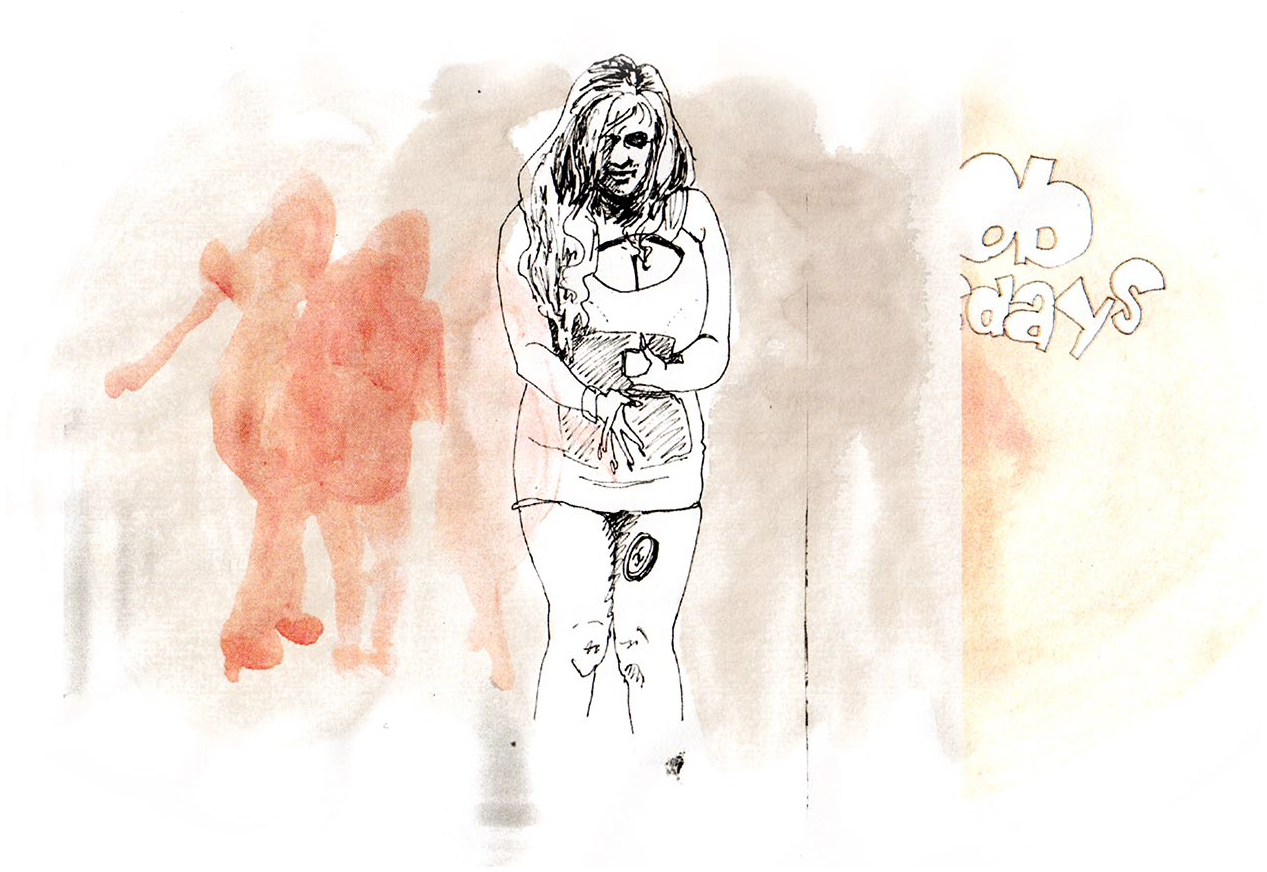
Still from the visual essay projected alongside the song ‘Gin Palace People’, showing images from the Mail Online redrawn to create a contemporary parallel to the Gin Craze of the song. © Stephanie Black.
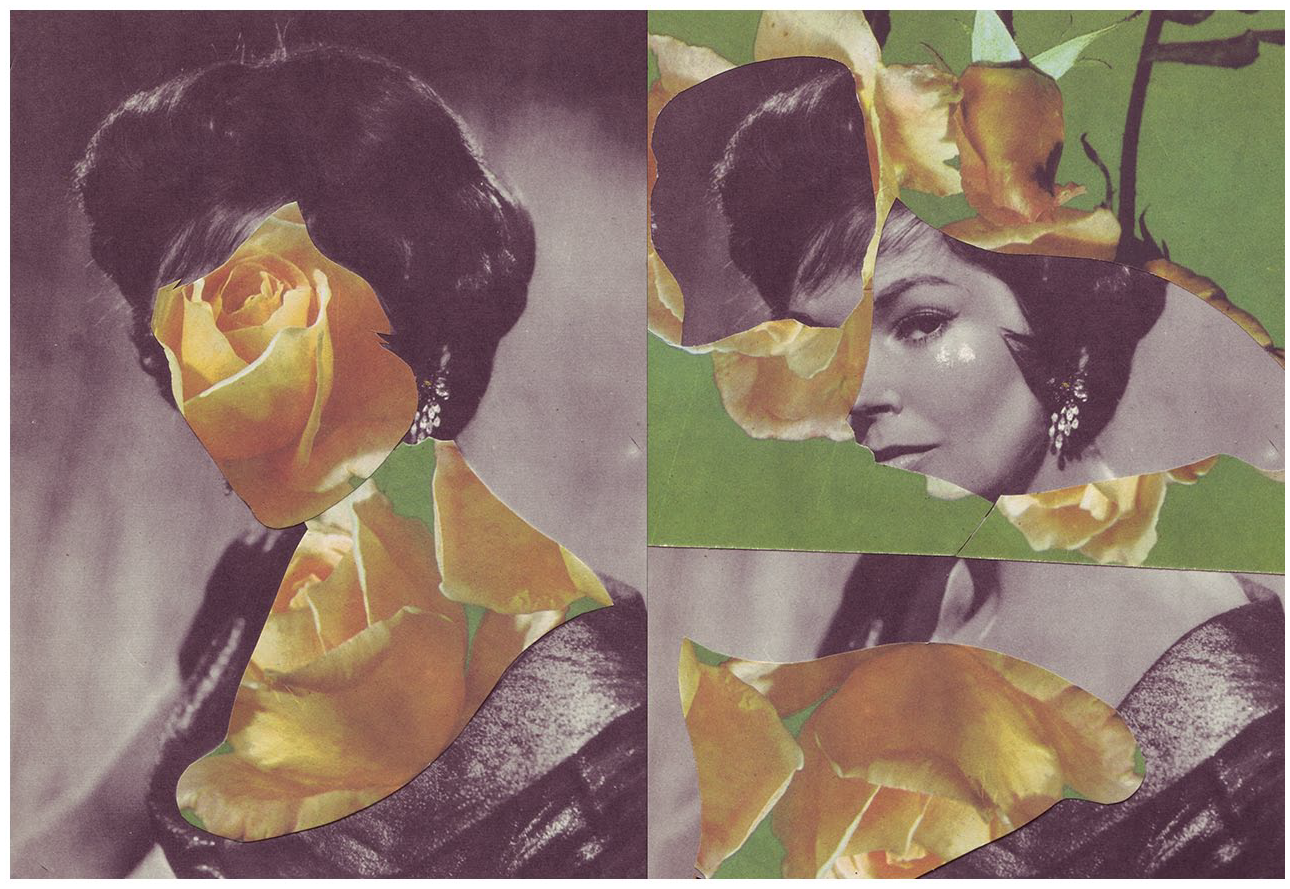
Stills from the visuals projected as an accompaniment to the song ‘First Date’, referencing and then breaking through a trope. © Stephanie Black.
Figure 3 shows stills from the projections made to accompany the song ‘First Date’ and, like Figure 2, operates as a visual counterpoint, using provocative metaphors and a slapstick moment to counter the lyrics. These are sung from a male perspective and, as a humorous counterpoint, Figure 3 uses a montage of old printed material as it adopts a tired visual trope in illustration (which is appropriate to the inferred female character’s role as a narrative prop), in order to then dismantle it literally and metaphorically. The source material was used partly for the aesthetic merits of fuzzy, slightly mis-registered printing from the 1950s and partly to explore how we might use its fetishization in illustration in a self-consciously critical way, as an extension of reflective nostalgia’s embrace of surface qualities.
However, playing with clichés raised doubts as to the appropriateness of nostalgic imagery to political ends. For example, when reinterpreting existing images self-consciously and critically (such as in Figures 2 and 3), do they become indistinguishable from the authentic-looking falsehoods discussed in the previous section? In an historical parallel, the Situationists used the critical strategy of ‘détournement’, described by David Evans (2009: 13) as ‘the hijacking of dominant words and images to create insubordinate, counter messages’. However, they recognized the potential shortcomings of using images in this way as reflected in détournement’s opposite: ‘recuperation’. Evans explains that recuperation sees messages twisted and emptied out of subversive meaning and absorbed by mainstream culture, concerns which are shared by Jameson (1985) regarding pastiche. Recuperation embodies my concerns about whether my critical use of imagery could be mistaken for uncritical recycling of the same tropes that are under scrutiny. My concern is that the confusion arising from the conflict of past and present, real and aspirationally reconstructed in nostalgic images poses a challenge to the illustrator making a critical commentary on current events – particularly within the post-truth landscape mentioned by Grayling (in Coughlan, 2017) and Mance (2016).
To rectify the problem, I tried to find a productive use in my practice for the unreliability inherent within nostalgia’s reconstruction of the past by making both reconstruction and unreliability visible. I highlighted the slippage between real and imaginary, past and present to raise questions about the ‘poverty of the present’ (Howard, 2012: 2). The practical manifestation of this aim can be found in my revealing the constructed nature of the images by unmaking them a little (seen in Figure 3’s deconstruction), to emphasize the fact that these are obviously hand-made pictures. This is similar to the strategy employed by 16th-century sculptors restoring fragments from antiquity as Boym (2001: 47) describes, noting that they were careful to make the difference between new and old visible in the same way as First Date images reveal their construction. In Boym’s account, sculptors would use different materials to mark the distinction, a formal solution paralleled by Figure 2’s shift from photographic to hand-drawn image to indicate a shift of register from uncritical reproduction to reflective interpretation.
I extended the reflective, critical approach described to the pub imagery used throughout the project. My use of Moon Under Water-style pub imagery deserved scrutiny in relation to the political circumstances outlined earlier and whose needs it serves. The image of the sentimental typical pub rests on a restorative nostalgic fiction, which I endeavoured to acknowledge and challenge in the images I produced. These could encompass the ‘community pub’ examined by Bolet (2021), which mirrors the ‘local’ pub defined by Dunbar et al. (2017: 120). The latter ‘tends to be close to where its clientele live or work, such that regulars visit with sufficient frequency to know the staff and clientele on a personal basis.’ They may lack ornate architecture (often featuring small windows with grilles covering them), while internally they may have linoleum floors and mismatched furniture (perhaps of an incongruous style). Dunbar finds that ‘local’ pubs provide their users with ‘the single most important buffer against mental and physical illness’ through their extension of social networks (Dunbar et al., 2017: 126). Despite their less alluring image and lower potential for triggering wistful longing, they embody the key quality of community as set out by Orwell and championed by Dunbar. Therefore the image of the pub needs to be broadened beyond the ‘sentimental typical’ to reflect this.
With this in mind, I questioned the restorative nostalgic representation of pubs by dismantling the falsehood of aestheticized images of sentimental typical pubs in the sequence of images collected in Figure 4. The sequence descends into undesirable images (fight scenes) with the intention of raising the question of what we are losing in some cases (the fight scenes), and whether we are nostalgic for the most useful aspect of pubs or metaphorically crying over spilt milk; whether it is the principles of community and conviviality of the Moon Under Water, or its alluring architecture and fittings. I also produced alternative images of pubs where the principles of community and conviviality could be found, although without the Victorian architecture common to restorative nostalgic representations. Figure 5 (still from ‘Long Forgotten’) closed the Plume of Feathers performance with a visual alternative to the sentimental typical pub, one with nostalgic triggers removed.
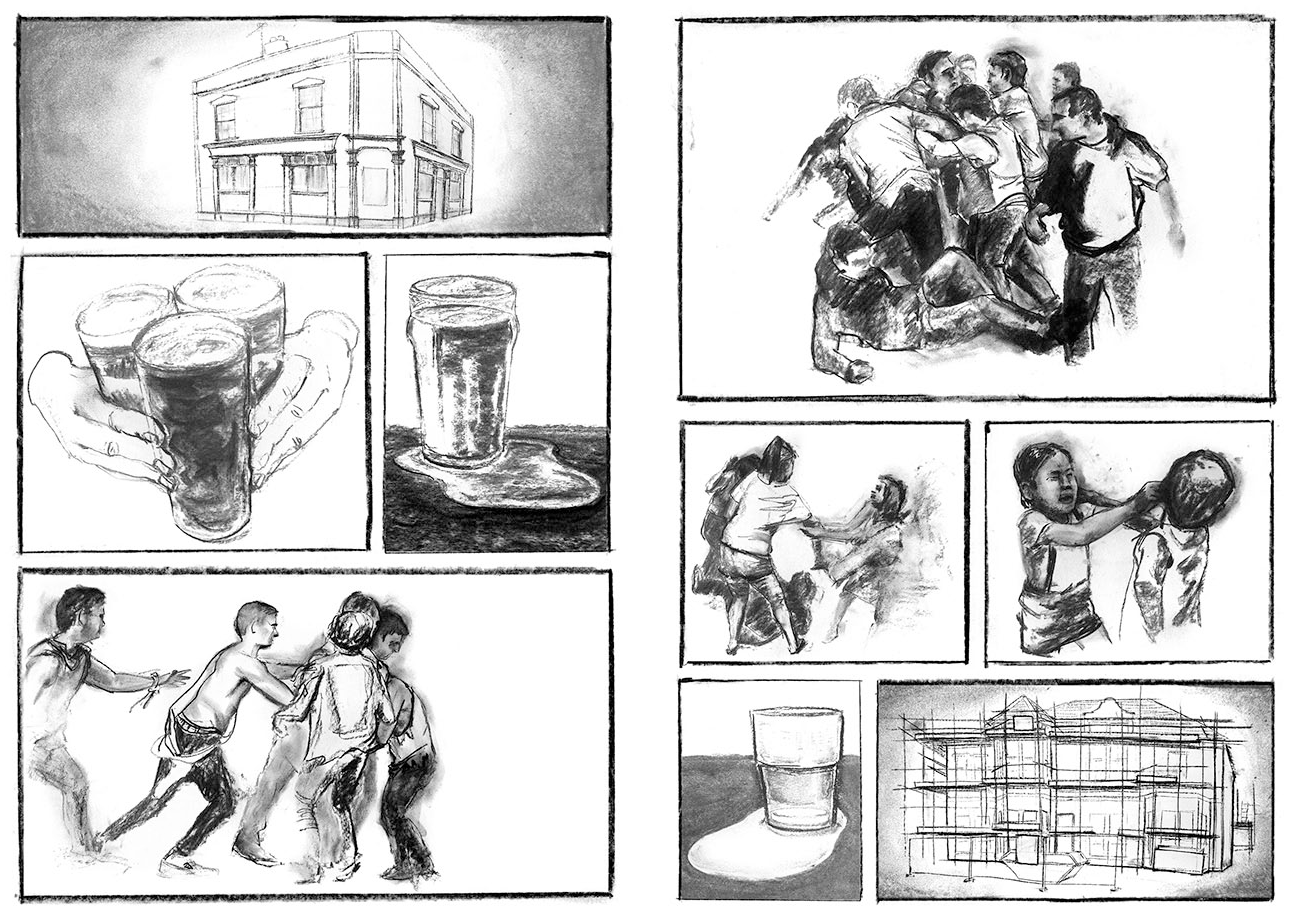
Images made to be projected during live perfomance of the song ‘Cnut in a Suit’ combined in a grid, questioning what is lost when pubs close. © Stephanie Black.
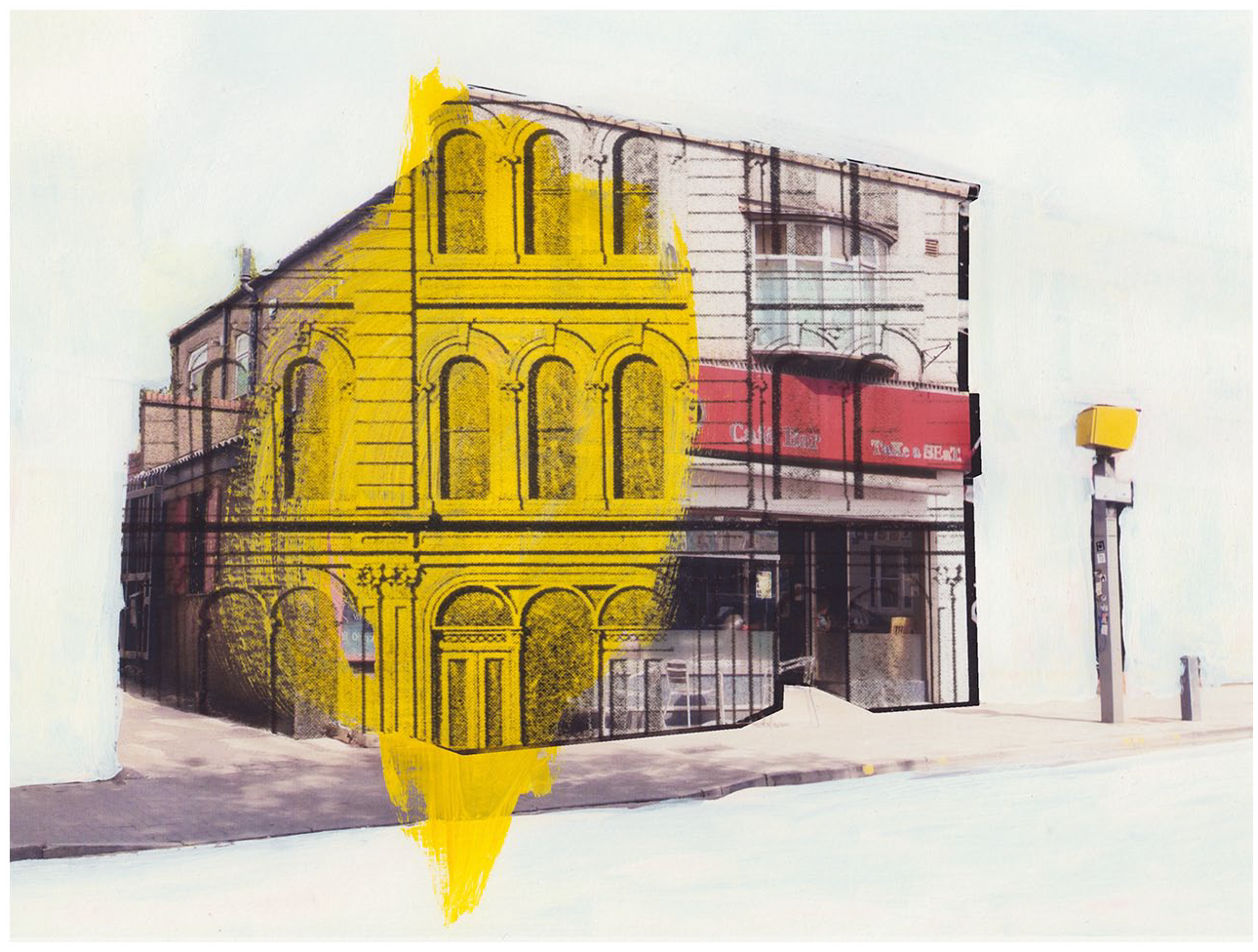
Still from the visual essay made to accompany the final song ‘Long Forgotten’ showing a ‘caffy-pub’. © Stephanie Black.
What is illustrated in Figure 5 is similar to Everitt and Bowler’s (1996: 108) ‘caffy-pub’, which they define as a food- and family-friendly establishment favoured by those familiar with such things from European holidays. The café pictured in Figure 5 overlaps with this definition, being a place where all ages meet up in a place that sells beer and food. The emphasis on food is similar to the ‘gastro pub’ identified by Bolet (2021: 1664), which is ‘frequented by the middle-class and ethnically diverse communities in gentrified areas’. The latter point reflects my selection of this example partially in response to conversations with friends about the inclusivity of Bolet’s community pub. 5 The architecture parallels the phenomenon of ‘micropubs’ opening in former shops, with both the caffy-pub and newer micropub types resulting in our urban environment losing the architecture of the Victorian pub. However, as Girouard (1975) points out, the architecture of that historical precedent was changeable, making these developments in the image of the pub part of a tradition of revisions, in keeping with Boym’s reflective nostalgia and moving away from the political reference points that the image of the pub has been tethered to.
However, upon investigating the details of the specific caffy-pub in Figure 5, its relationship with nostalgia becomes more convoluted. It transpired that I have not identified an image for the pub with all of the nostalgic triggers removed as they can be found inside the building and are instrumental in its role as a restorative nostalgic enterprise. This café was founded by an estate agent/property developer/lettings agent as a pastiche of the living room in their ‘period properties’, thus making what had previously been one of the cheapest areas in the city appear aspirational and making it profitable. It is the domestic equivalent of the sentimental typical pub, where the imagined past is presented uncritically as good.
This example could be read negatively through the lens of nostalgia, through the way it harnesses restorative nostalgia to an estate agent’s project that is tangled up in the complex mix of factors that shape the social and economic shifts discussed by both AC Grayling (Coughlan, 2017) and Bolet (2021: 1660). Both authors discuss these in relation to the rise of the divisive messaging that Figure 5 was intended to steer the image of the pub away from. Such developments in the area are already reflected in changes to the number of what Bolet would describe as community pubs, which she positions as a victim of the more middle-class and diverse gastro pub, finding the latter ‘in gentrified areas at the expense of local, deeply-rooted white working-class communities’ (p. 1664). Bolet equates the demise of the community pub with the rise of far-right causes and their use of post-truth and nostalgic messaging to garner support. Therefore Bolet’s research leads me to conclude that the image of the caffy-pub in Figure 5 is as complicated a representation as the sentimental typical pub and the community pub. The particular example I used was not exempt from nostalgic triggers and the type it represents may even be enmeshed within the production of further restorative nostalgic images. I considered it initially as an inclusive counterpoint to Bolet’s community pub, but the image of the caffy-pub is located within an extended conversation concerning restorative nostalgia that may compromise those aims.
I failed to remove nostalgic triggers from the image of the pub but, by adopting a reflective nostalgic approach, I was able to reflect critically on the different constructions of the image of the pub that I had experimented with. I resolved the conflicts they unearthed by incorporating all of these different ways of visualizing the pub (much like reflective nostalgia’s accommodation of the ‘contradictions of modernity’ according to Boym, 2001: xviii), and presented the different perspectives to the audience. For example, I have included images of the community, sentimental typical and caffy-pubs within the final visual essay, showing them layered in sequence so that they replace and reveal each other in turn. These are all valid representations of the pub, each type having a different role to play within the overall aim of the Plume of Feathers project to draw attention to what is lost when pubs close.
Theoretical Implications: The Political Potential in the Surface of the Reflective Nostalgic Image
The final visual essay for discussion brings together the various image-making strategies examined in relation to reflective and restorative nostalgic depictions of pubs and enables a deeper discussion of the political agency that these practical processes allow the illustrator. The following discussion examines the challenges posed to theoretical perspectives on nostalgia and postmodernism.
Figure 6 exploits the critical approach to image construction adopted by Figure 2, the surface qualities of the image discussed in relation to Figure 3 (the ‘patina of time’ that Boym, 2001: 41 writes of), and takes a different approach to the nostalgic triggers examined through Figures 4 and 5 by embracing the wistful longing rejected by the latter. Although the subject matter is divorced from the image of the pub, Figure 6 created an opportunity to explore a political role for the nostalgic image that contrasted with the way that the pro-Brexit images discussed engaged with themes of identity and exclusion. In this regard, Figure 6 plays with the overlap Boym notes between the visual triggers for both restorative and reflective nostalgia. She states:
the two might overlap in their frames of reference, but they do not coincide in their narratives and plots of identity. In other words, they can use the same triggers of memory and symbols . . . but tell different stories about it. (p. 49)
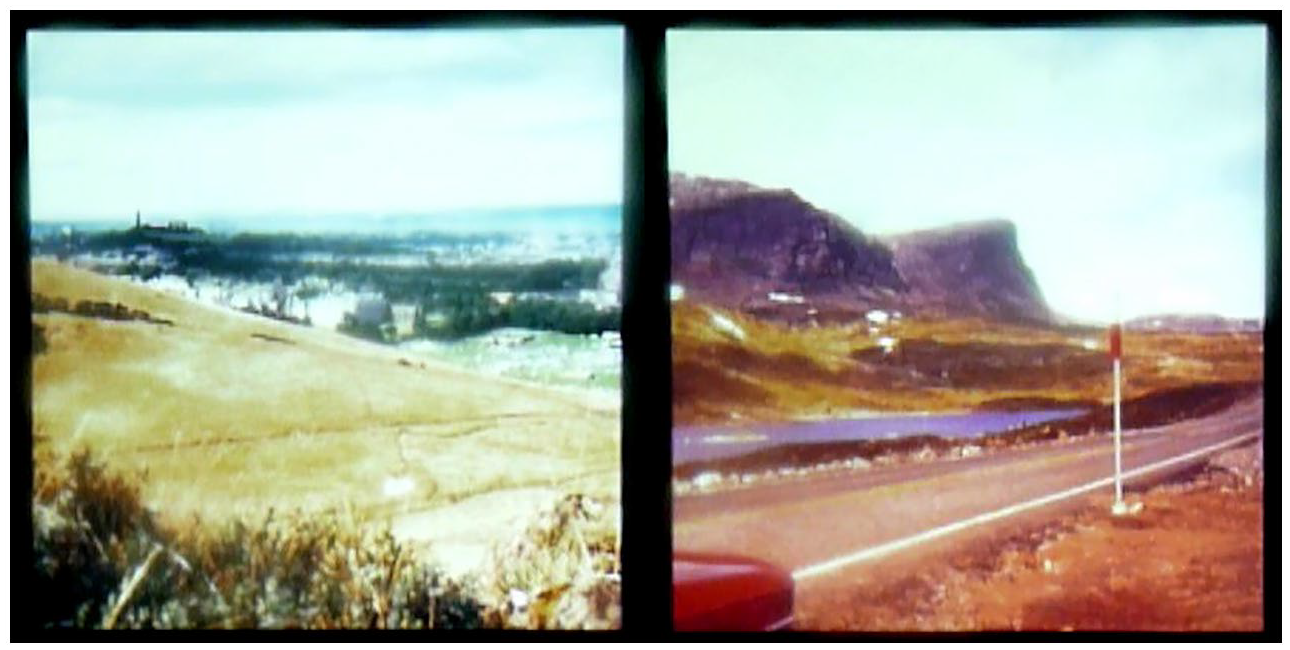
Stills from ‘Anders from Iceland’ released as a music video showing images of different countries united through shared ‘pastness’. © Stephanie Black.
A deliberate focus on the surface of the past was used strategically in the visuals for ‘Anders from Iceland’ (Figure 6). This was undertaken in order to explore the role of nostalgic stylings, in keeping with the song’s focus on nostalgia for a different time and place. ‘Anders from Iceland’ is a song about a character in a pub who has moved countries during his life so that his sense of national identity does not reflect where he was born. His maudlin regret is exacerbated by alcohol, making him an example of Howard’s (2012: 3) ‘poverty of the present’ condition. To reproduce this visually, I have combined two different family photograph albums from different times, one Danish, one Scottish. I have reorganized their contents according to subject matter; bridges, trees, people, coastlines. These are old photos with a stylistic veneer of ‘pastness’. This surface quality unifies the two albums as a new sequence, rendering them indistinguishable. The result suggests that being nostalgic for and defining yourself by one place seems arbitrary. As, by extension, does defining others against this, as we saw occur with Lowenthal’s ‘heritage’. 6
However, by prioritizing how the past looks to make this suggestion, what I have claimed to have achieved in relation to ‘Anders from Iceland’ becomes complicated, theoretically. My focus on ‘pastness’ is reminiscent of Fredric Jameson’s retro pastiche (as invoked by Ahmad, 2019: 1), where surface overwhelms political purpose in the service of making money from the dislocated image of the past (Jameson, 1985). Chase and Shaw (1989: 10) address this aspect of nostalgia in their writing on the supporting role of images. They, too, reference Jameson’s postmodernism and its reduction of the past to a ‘collection of competing voices and pictures’ reminding us that ‘there is the obvious danger that we become indifferent to the significance of the past and hypersensitive to its look.’
The problem for Chase and Shaw, as well as Jameson, is that these are easy-to-consume, inauthentic images of ‘pastness’ and both the surface and surfeit of images foster indifference so we do not learn from the past. But I have redeemed the surface of the image, through practice. Their discussion hinges upon the role of images and, for picture makers, there is the possibility of making these differently to exploit reflective nostalgia’s flexibility to imagine. To respond to Chase and Shaw, and Jameson, ‘Anders from Iceland’ is not indifferent in its use of ‘pastness’. It uses the visual triggers of ‘homeland’ affiliated with restorative nostalgia and its nationalistic inclinations as described by Boym (2001: 41), but harnesses them to a reflective nostalgic purpose that questions such messaging. As a consequence, the use of old materials in illustration has been shown to respond to Ahmad’s (2019: 1) concerns by challenging the divisive politics of restorative nostalgia.
The strategic use of wistfulness through a retro aesthetic in the visuals for ‘Anders from Iceland’ allows for a deeper reflection on the relationship between the surface qualities of the image, our experience of time through cultural forms and the implications this holds for the agency of the illustrator. This last visual essay is a postmodern cultural form as Jameson (1991: 25–31) describes it, being a ‘heap of fragments’ arranged in sequence with conceptual gaps between them. However, Jameson discusses these fragmented forms in largely negative terms, relating it to the disruption of the subject’s identity through the breakdown of temporal unity (our sense of our past, present and future) provided by language. Andrew Higson (2014: 126) further expands upon the relationship between postmodern cultural forms and time, stating that the postmodern nostalgic experience collapses time, is atemporal, and non-durational. He explains that the past is made present as we can buy and surround ourselves with souvenirs of it, so that wistfulness evaporates because the object of our longing has been returned to us. This is the ‘souvenirisation of the past’ that Boym (2001: 38) writes about, mirroring both the retro pastiche Jameson bemoaned and the nostalgic design decisions governing the interior of Figure 5’s caffy-pub. Boym, Jameson and Higson all note that the business of nostalgia puts profit before criticality. However, ‘Anders from Iceland’ collapses time in a slightly different way to postmodern nostalgia and uses wistfulness as the basis of its criticality. This visual essay collapses two different pasts together, unified by the patina of time. But, here, the use of ‘pastness’ triggers wistfulness to keep the distance between past and present intact, as well as unifying the series into a smoother temporal composite that sits alongside its durational counterpart – music.
The complex and durational approach to time described above aligns this example with the ‘off-modern’ cultural forms that Boym (2001: 30–31) describes, reflecting the latter’s ‘superimposition and coexistence of heterogenous times’ more than the cultural forms and nostalgic experiences that are defined by Higson and Jameson as postmodern. ‘Anders from Iceland’ has reconciled Jameson’s postmodern cultural form with the criticality of the off-modern, liberating the former from the quotation marks that Boym saw limiting nostalgia’s utility to that of an historical style. Instead, the off-modernist artists she describes produce work that plays ‘an important social role’, although she notes that, in such cases, the work may not be marketable. This is a provocative point, worthy of further scrutiny in relation to the evolution of illustration’s identity as a discipline. 7 The example represented by Figure 6 may not be the ‘radically new form’ that Jameson (1991: 54) hoped for, but I argue that ‘Anders from Iceland’ (and the other visual essays discussed here) use their formal properties to allay Jameson’s concern that critical distance was lost from the fragmented postmodern cultural form and suggest that, by engaging with nostalgic stylings, illustration has the ability to engage with and intervene within socio-political discourse (p. 48).
Through this example and the previous ones from the Plume of Feathers project, I hope to turn Jameson’s formula inside out. I hope that by being hypersensitive to the surface of the image, we draw attention to the referent, the past, in order to explore the imperfections of the present, so that we can look to the future with the aim of effecting change. The image has therefore avoided recuperation, suggesting that adopting a self-conscious reflective–nostalgic approach to image making may prove a productive route through the traps and tropes of fragmentation and retro styling that concerned Jameson. Instead, by making nostalgic images, the patina of time central to Boym’s reflective nostalgia can be harnessed to facilitate greater scrutiny of the past and present, and of why there is a discrepancy (the poverty of the present) that produces nostalgic longing.
Conclusion
The image has been shown to play a significant role as an ideological tool employed within recent political debate in the UK, with the discussion confirming the use of restorative nostalgic images within the visual rhetoric adopted by ideological projects (as suggested by Boym, 2001) and the resulting social divisions. Specifically, the image of the pub was implicated within pro-Brexit communications which drove my exploration of how to picture the pub differently, from a reflective nostalgic position. By doing so, I attempted to manoeuvre the image of the pub from such socially divisive rhetoric based on restorative nostalgia and establish it within a more compassionate social context, and also situate it within a critical discussion of the role of the nostalgic illustrated image. The aim and outcome of these practical experiments and subsequent reflections thereon was to use illustration to effect change and to establish the political agency of the illustrator, in response to imagery circulating at the time the project was undertaken.
By dissecting the illustrations produced for Plume of Feathers, I have established that the longing and critical thinking Boym ascribes to reflective nostalgia can be united within the illustrated image (p. 49). The examples examined show how this can be achieved, by using my insights into the production of images. Exploration of this process focused on the role played by the image’s surface, in particular the material signifiers of age within reflective nostalgic images. The surface of the image was shown to play a pivotal role in relation to the political message within the illustrated image, by using pastness and wistfulness. The resulting images reconcile longing and critical thinking through a self-consciously critical approach to their subject matter and surface. In this respect, the illustration work presented here is offered as an example of how Boym’s reflective nostalgia can be enacted as a strategy for making critical images, showing that reflective nostalgia is productive for image-makers due to its embrace and use of surface qualities. By using its surface to give a more complex experience of time, I have suggested that it is possible to return politics to the surface of Jameson’s fragmented postmodern cultural forms and draw a parallel with Boym’s off-modern practices and their critical perspectives.
For the development of the field of illustration, this article establishes the concept of reflective nostalgia as commensurate with outward-looking socially-engaged illustration. It is the image maker’s ability to make things up in order to imagine the past differently that unites illustration with reflective nostalgia and makes it a powerful tool for proposing future alternatives. As Boym states: ‘reflective nostalgia has a utopian dimension that consists in the exploration of other potentialities and unfulfilled promises of modern happiness’ (p. 342). I have argued that illustration can operate as an agent of change by employing reflective nostalgia as an attitude and image-making strategy, and can therefore change the conditions that give rise to nostalgia.
Footnotes
Acknowledgements
I would like to thank Anya Lewin and Joanna Griffin at the University of Plymouth for their assistance with editing this article, and the peer reviewers and Editor for their support and recommendations.
Funding
The author received financial support for the research, authorship and publication of this article from the University of Plymouth.

Notes
Biographical note
STEPHANIE BLACK puts pictures and words together as a practitioner–researcher in illustration. Her research interests include the negotiation of time within illustration, methodology in relation to practice-led research in illustration, and illustration as counterpoint. She completed a practice-led PhD at the University of the West of England (Bristol) and currently lectures at Plymouth and Kingston Universities. Recent publications include articles for the Journal of Illustration and a book chapter for the Wiley Blackwell Companion to Illustration.
Address: Department of Illustration and Animation, Kingston School of Art, Grange Road, Kingston upon Thames KT1 2QJ, UK. [email: