




Abstract
Within academia, as in other corporatized environments, there are irreconcilable tensions embedded in the managerial data imaginary, in contrast to the messy reality of lived experience and increasingly precarious working conditions for those at the coalface of Higher Education. Combined with student debt and escalating surveillance via so-called ‘artificially intelligent’ transactional data analysis, fantasies of control and domination converge on platitudes about Big Data and computational information, often presented as unambiguously neutral via idealized visualizations and ‘dashboards’ such as those commonly provided by Tableau and Google. As a structure, the digital archive is no different, open to fantasies of secure representation but, in fact, always unstable, subject to the materiality and flux of electronic, symbolic and social processes. As academics exposed to intensified metricization within increasingly data driven institutions, how can we counter the reduction of our qualitative research and experience to dashboards and scores? Drawing upon the work of Fleming’s Dark Academia: How Universities Die (2021), Poster’s The Mode of Information (1990), Cascella’s En Abime: Listening, Reading, Writing: An Archival Fiction (2012) and Bayne et al.’s The Manifesto for Teaching Online (2020) among others, and focusing on work developed by the authors from 2008 onwards, they discuss their contingent, often nauseating virtual reality information repository, the Riverine Archive, developed to hold and withhold information about their writing and art within the ugly hulk of what they define as a ‘neoliberal ship of fools’. The work seeks to offer a counter to prevailing platitudes and fantasies about the neutrality and realism of data to directly represent a stable, singular reality. The authors concur that information is not beautiful, but rather a fallacy of stability, servicing a rapacious, anti-academic neoliberal ideology that needs to be brought to the surface and subjected to honest discourse, away from hype and managerial wishful thinking. Truth and beauty cannot be framed as stable, monolithic or universal; to do so is to replicate a colonial projection of knowledge, a mono-logic, centring all truth upon the Global North.
Introduction: Academia in the Age of the Data Dashboard
The river is a key theme within our work, an agent and collaborator. We have used the tides of the Thames to define the patterns of our collaboration and to carry away (biodegradable) work we no longer wanted to own. We have used the river as a metaphor and walked within the Thames and the Ravensbourne river while recording narratives. The colour of the Thames captured on CCTV has also been used in our live performances and workshops, hence our framing of the river as a kind of agent, one that always has the potential to capsize our truths and destabilize what counts as knowledge. What follows is an attempt to explain and analyse our work and riverine relations, which may at times only confuse further. Clarity may emerge, but it may also be lost – our work is not traditional, neat or bounded by off the shelf methods. Our work is contingent, messy, posthuman, not always human, not always digital, it is provocative and not concerned with professionalism or academic metrics of success or failure. We apologize insincerely, in advance, for the confusion which will, we hope, ensue.
As academics subject to the intensified metricization of increasingly data-driven institutions, how can we counter the reduction of our qualitative research and experience to dashboards and scores? The neoliberal imaginary is arguably colonial, represented by an array of technologically determined fantasies, such as omniscient control via datafication, metric measurement, surveillance of staff and students, AI fantasies of automated marking and feedback, predictive analysis and even ‘mindreading’ (somehow for both ‘enhancement’ and regulation of transgressive behaviours). Many of these fantasies are represented by the absurd trajectory of so-called mind reading technologies and billionaire space missions, as well as notions of pervasive automated transport and AI driven futures, in this context:
Educational neurotechnologies are surrounded by transhumanist “enhancement” imaginaries that are too easy to dismiss as sci-fi. They are real, promising to render individual, personal learning data more intrusive and potentially problematic than anything currently discussed in the mainstream literature on learning analytics and educational data. This is an issue for teaching practice that we need to surface and discuss. (Bayne et al., 2020: 202–203)
Amidst such fixations upon data, the Riverine Archive (Dare and Antonopoulou, 2019) arose, a project that seeks to bring to the surface and submerge the complexity of neoliberal datafication and, indeed, all forms of reductionism. The archive takes the form of an unstable VR experience, one that generates nausea in the pursuit of information which can never be stable and often sinks without trace. It adopts a riverine methodology, or anti-methodology, developed through this work, and a riverine narrative structure that we evaluate over the next few pages, also explaining how we re-mediated the corpus of our digital and analogue stories, the result of a collaboration that started in 2008. At all times, the Riverine Archive risks information loss, as manuscripts and paper disintegrate and information retrieval mechanisms are replaced with newer, less compatible devices, in the quest for the disingenuous capital of neoliberal ‘innovation’. We will explain how and why we accept, and indeed, deploy, the contingency and situatedness of our own information archive, and how the loss it engenders is as agential as retrieval. Ultimately, we report upon our deep tiredness with information, which fades in and out of view, which escapes our grasp and transmutes into noise. We acknowledge and even encourage what Byung-Chul Han (2015: 33) describes as the way ‘Things flicker, twinkle, and vibrate at the edges and lose some of their resolution’. Our work seeks to destabilize, to refuse, to challenge the constructs of knowledge and research paradigms we have inherited from the humanist traditions of academia. Rob Shields (2020: np) writes:
More more more needs to be done to decentre the researcher who remains a sort of modern hero albeit recast in the role of woke, attuned, wonderer. I am sure, however, that collaborating, co-creating, attending and listening to the world of humans, animals and active objects that these methods advise is a start that will lead in a decolonial direction.
We concur and pursue forms of inquiry that attend to such a decentring, this can be loosely described as post-qualitative inquiry, but it does not come with a handbook or a set of guidelines. Post-qualitative inquiry eschews humanist constructs of knowledge and learning as unsituated, disembodied, stable, singular or universal (Bayley, 2018).
In Dark Academia (2021: 167), Peter Fleming observes ‘the unhappiness sweeping higher education in the US, UK, Australasia, Canada and many European countries has rarely resulted in effective counter-planning and resistance. Some even talk about academic zombies on this score, which is a bit harsh.’ Without a unified voice, Fleming writes ‘the despair has been pushed underground instead, a problem for individuals to deal with alone as they bear heavier teaching loads, more emails, deteriorating pay and conditions and the unstoppable march of managerialism.’ It is in these conditions that we began work on the Riverine Archive in 2019, which seeks to destabilize the idea of a reliable repository for our collaborative work, the Phi Books project, developed from 2008 onwards. Over the next few pages, we evaluate how we have remediated the corpus of our own digital and analogue stories, and how this has been entangled with critical strategies, undermining the orthodoxies of neoliberal essentialism and universal knowledge. We outline and research paradigms that replicate humanist essentialism and universality. We explain why we accept the contingency situatedness of our own information archive and how loss is as agential as retrieval. At the possibly false sunset of the pandemic, we write with deep tiredness in relation to digital information but, more importantly, we are alert to the dangers of algorithmic reduction, to the way systems of categorization replicate racism, sexism, ableism. In the case of computer vision, such procedures ‘must first reduce the hall of possibilities to a set of pre-existing conditions. This is inherent in the function of machine perception’ (Amaro, 2019), the implications for Higher Education (HE) are irreconcilable with social justice, as colleges seek to position students as ‘cheats’ and pathogens, deploying computer vision and proctoring to detect transgressive acts (which discriminates on an array of factors), as well as marking systems that make predictions based on regression algorithms, modelling linear learning processes. At the same time, HE also (confusingly) frames students as customers, in which they are frequently invited to measure their ‘satisfaction’ with colleges. In such a context, the computational instability of the Riverine Archive becomes a political act, a refusal of both these narratives. Writers such as Harney and Moten (2013), Fleming (2021), Williamson (2015), Selwyn and Gasevic (2020), Bayne et al. (2020) and Bayley (2018) have all critiqued the impact of neoliberalism on both students and staff, and the wider infrastructure and trajectory of HE. Bayley’s posthuman pedagogies (2018), the work of Braidotti (2013) as well as that of Barad (2007) on post-human agency all point to the urgency of reframing knowledge(s) away from humanist paradigms, in which human beings are either stable as a construct, or the sole bearers of knowledge and agency.
The Riverine Archive
The Riverine Archive is an unstable repository for the Phi Books collaboration that started in 2008. The Phi Books is a speculative writing collaboration (Dare and Antonopoulou, 2008–ongoing), in which we have developed new approaches to speculative and collective writing across an array of practices, including model making, walking, non-immersive VR and AR (which will be explained later in this article) and performance. While first developing the Phi Books, we were PhD students, with precarious economic and housing situations (moving homes regularly and working as casual lecturers, not knowing if our contracts would be renewed), often having to move from halls and flats at short notice. This meant that, at all times, we risked information loss, at some points not having homes, losing our possessions, finding that our manuscripts and papers had disintegrated or just could not be found, memory sticks stopped working or college server space disappeared, some devices, such as mini disc players were incompatible with newer systems, in the quest for the disingenuous capital of neo liberal innovation. Our work now exists, of course, within the context of growing interest in digital art, via the phenomena of NFTs (non-fungible tokens) which are commodities represented only by data that might represent art or music with their value created by attribution of ownership. Tina Rivers Ryan (2021) describes NFTs as replicating or even intensifying the art market’s worst aspects. They reify ownership and platform capitalism at precisely the moment when digital art could be facilitating a conversation about alternatives such as decentralization and self-sovereignty. We feel this is relevant to the Phi Books collaboration and the Riverine Archive, in the context of reactionary markets, reifying a construct of realism, focused on technique, in which
the history of communication is representable, from this point of view, as a totalizing, continuous, progressive evolution. This history supports the enlightenment view of man [sic] as a rational ghost in the machine to gradually master his environment and submit to it his own ends. The history of human language is one of thoughts and actions, where Odyssean man invents and struggles his way into a communications Elysian field of ‘all information in all places at all times’. (Poster, 1990: 83)
Poster is highlighting the tendency of Global North intellectual traditions to assume a totality of knowledge and a linearity of ‘progress’, in which humans triumph over nature, subject to inevitable market forces and myths of man-made mastery and technologically determined control of the environment. The harshness of our current situation is exacerbated by a rapacious right-wing state, enamoured with data as the solution to all its problems, providing both an apparent form of omniscience and the supposed ‘business intelligence’ to outwit opponents and gain control of the very markets they have withdrawn from or to form alternatives in countries that are paradoxically disparaged. China, in particular, has been framed by American and UK governments as an opponent in a type of technological cold war. The America Competes Act of 2007 (see law.cornell.edu, 2011) explicitly frames STEM (Science, Technology, Engineering and Mathematics) and AI as a patriotic weapon against China’s economic transformation. Further, in HE, such is the neoliberal faith in data and positivism that the Arts and Humanities are being sacrificed in the name of STEM with 50 percent cuts in funding re-routed to STEM subjects. Fleming (2021: 187) makes the resonant observation that:
While we have a decent understanding of what’s objectively gone wrong in higher education, less attention has been paid to the psychological and emotional toll that years of funding cuts and creeping technocracy have had on staff and students.
What is not clear is how we might recover from the damage done to academia and to Arts and Humanities disciplines which do not align with a reductionist vision of life as a commodifiable stream of data. Fleming (2021) suggests a range of over-arching responses, such as building stronger unions or a university ‘without condition (or limits imposed by the marketplace, money, government enmity, etc.)’, combined with Harney and Moten’s (2013) fugitivity or states of resistance in the ‘undercommons’ of HE, in which collegiality and refusal might challenge a neutralizing ‘hyper-professionality’ (Fleming, 2021). Fleming states:
Managers, scholars and students still have agency, of course. But the institutional field is overdetermined and formidably delimited by the state first, the market and economic matrix second and the corporate industrial-complex third, which increasingly define the macro-rules of the game we must play.
But this agency is vaguely alluded to, leaving the details of such a refusal down to us, academics and wider HE staff and students. We hope our work offers one part of a counter to that data-driven reductionism, one strand of critical practice that will proliferate amidst multiple sites of resistance to the destruction of the Arts and Humanities as we value them: complex, critical, political, messily troubling of the status quo, questioning and threatening colonial power structures and rigid regimes of what counts as knowledge. Recent cuts of 50 percent to the funding of Arts and Humanities courses in the UK mean that they are particularly vulnerable, divisively set against STEM subjects which have (apparently) had money from Arts education channelled back to them.
How Our Collaboration Began: The Phi Books
The Phi Books collaboration uses the notion of a house as a metaphor for interdisciplinary collaboration and a way for collaborating as writers, artists and designers. Figure 1 was the plan we used as a writing structure for our collaboration, in which each room represented a locale for our writing themes and a number of words. Using that plan of a terraced house, we wrote stories stemming from imaginary rooms, sharing analogue books and moving from room to room, writing in response to each other’s work and the idea of these rooms. We have produced two books and, over the years, metaphorically invited many different participants into these terraced houses, to write about their own experiences of rooms and studios. We have also made a number of films, sculptures, performances, critical VR and AR works. We were led into more performative and interactive forms using real-time interactive programs, such as an interactive film that captured the audience even though we had offered the illusion of privacy and choice (as explained later).
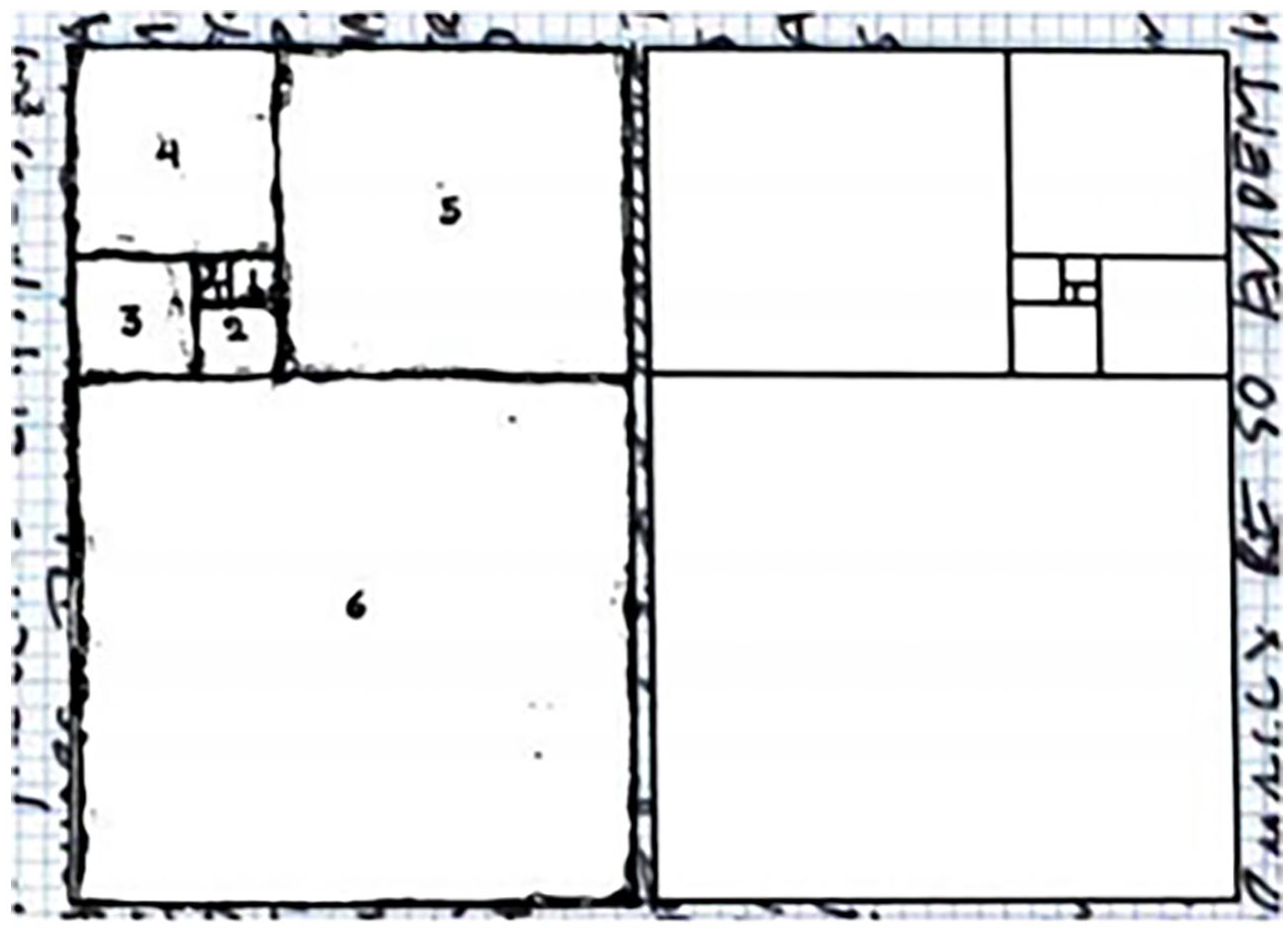
The Phi Books floor plan.
Throughout our collaboration we use narrative, performance, exploration and contingency to discover for ourselves how borders, doors and rules might facilitate, as well as close down collaboration. This has led us to produce books and interactive material, and to develop work with other participants which is both fictional and imaginative, academic and methodologically reflexive. We have had many different stages in the development of this project from the initial formulation of our algorithmic fictions in the tradition of OULIPO (a French movement of writers and mathematicians who developed new ways of writing from the 1960s onwards – foremost among these writers were Georges Perec, Italo Calvino and Raymond Queneau), to technologically mediate and embed systems of collaboration, including the use of Machine Learning and Natural Language Processing, to create a ‘coagulagent’ chat bot collaborator called Hilly Fields (Dare and Antonpoulou, 2022, 2021). But, at the same time, we are highly cautious about technological determinism and the backdrop of STEM and STEAM colonialism, relating back to the Cold War framing of technology mentioned earlier, in which China is seen as overtaking American manufacturing power. Technological determinism projects agency onto specific technologies and markets, but it does not address systemic, structural reasons for the problems we face of, for example, inequality and climate crises.
The Thames has been a mutable interface for our collaboration, participation and information streams, including its virtual versions such as the Riverine Archive, a VR river in which we have placed recordings of our work attached to objects which bob up and down with the tides, at times sinking. A live transmission of what we called the Phi Film (see Figure 2) started in 2010 with a screen showing the colour of the Thames, captured from CCTV (the BBC ‘Jam Cam’), it then faded to show the workshop participants confined inside our Phi houses (writing spaces and models on screen) – even for the viewers who had not consented to participate.
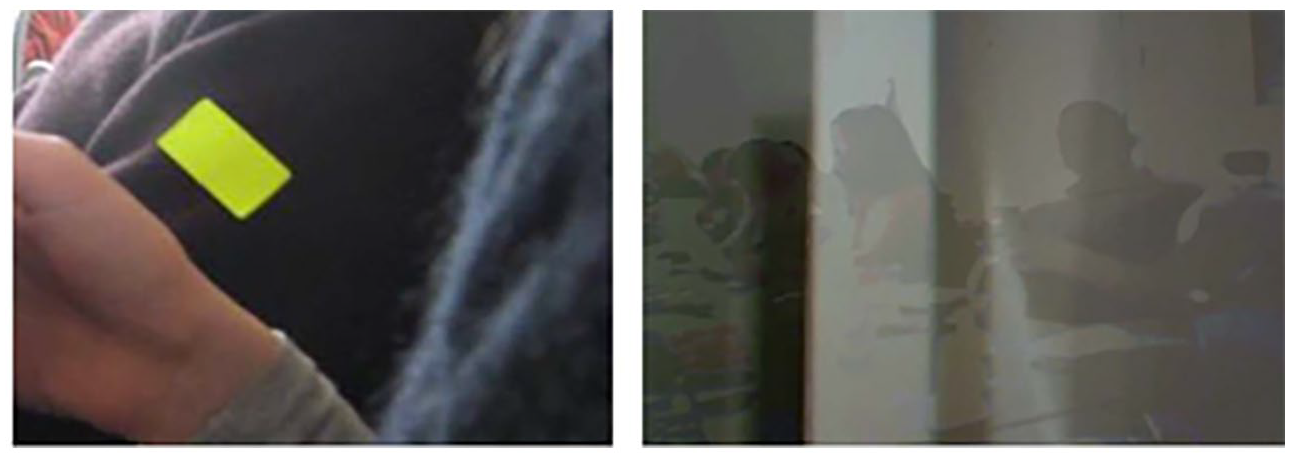
The Phi Film.
Our deployment of fake choices (allowing our audience to select a yellow badge for participation and a red one for non-participation), surveillance and contingency is related to our experience of academic precarity, which has often surfaced in our work. We have both worked on zero hours contracts and lived in unreliable housing. Further, we do not have faith in the safety of data or the reliability of its retrieval; this precarity is a kind of material in our practice and informs our creation of the Riverine Archive, a VR work from 2019, shown in Figure 3.
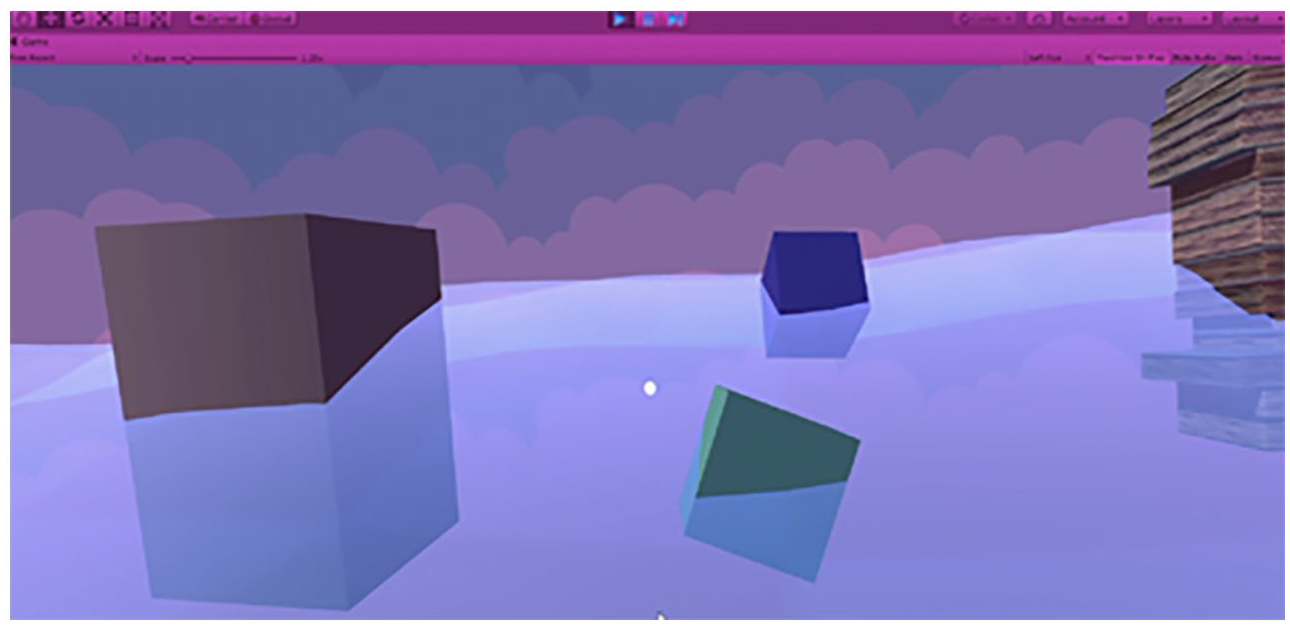
The Riverine Archive (Dare and Antonopoulou, 2019).
The Riverine Archive Bobs Up Again
The Riverine Archive VR ‘experience’ is an attempt to catalogue the various activities of the Phi Books, captured as soundtracks triggered when viewers look at floating objects. The work has been described by curator Gabriel Menotti as a memory project in which loss of agency and tension is deployed:
to make use of informational spaces as a meeting point between their practices, playing with the loss of control and the friction with the environment in order to generate performances, graphics, stories, and simulations. In this memory project, it could not have been any different. The Riverine Archive uses the changing shape of the river to produce a dysfunctional collection, in which the records float with the waves and can only be accessed in a fragmented way. This Brechtian gesture invites us to take critical distance and creates suspicion about the forms of immersion and automation of empathy promised by virtual reality. Perhaps technology will not be able to free us completely from the threat – or the promise of liberation – symbolized by oblivion. (Museo sem parades, 2021)
Our work with spatial technologies started at Goldsmiths University where we used a multi-camera motion capture studio (see Figure 4). We asked our participants (colleagues and students at Goldsmiths) to wear motion capture suits to generate gestural information. We then recorded their gestures as they recounted narratives of their homes and workspaces and also did this ourselves. In this way, we collected narratives of the rooms and spaces where we worked, rested, struggled and created, where we and our participants began our formal academic journeys. The camera translated these movements into structures at points detached from the self, as second-order subjects. These secondary participants became strange agents, their movements at times still revealing who they are, despite a high degree of abstraction.
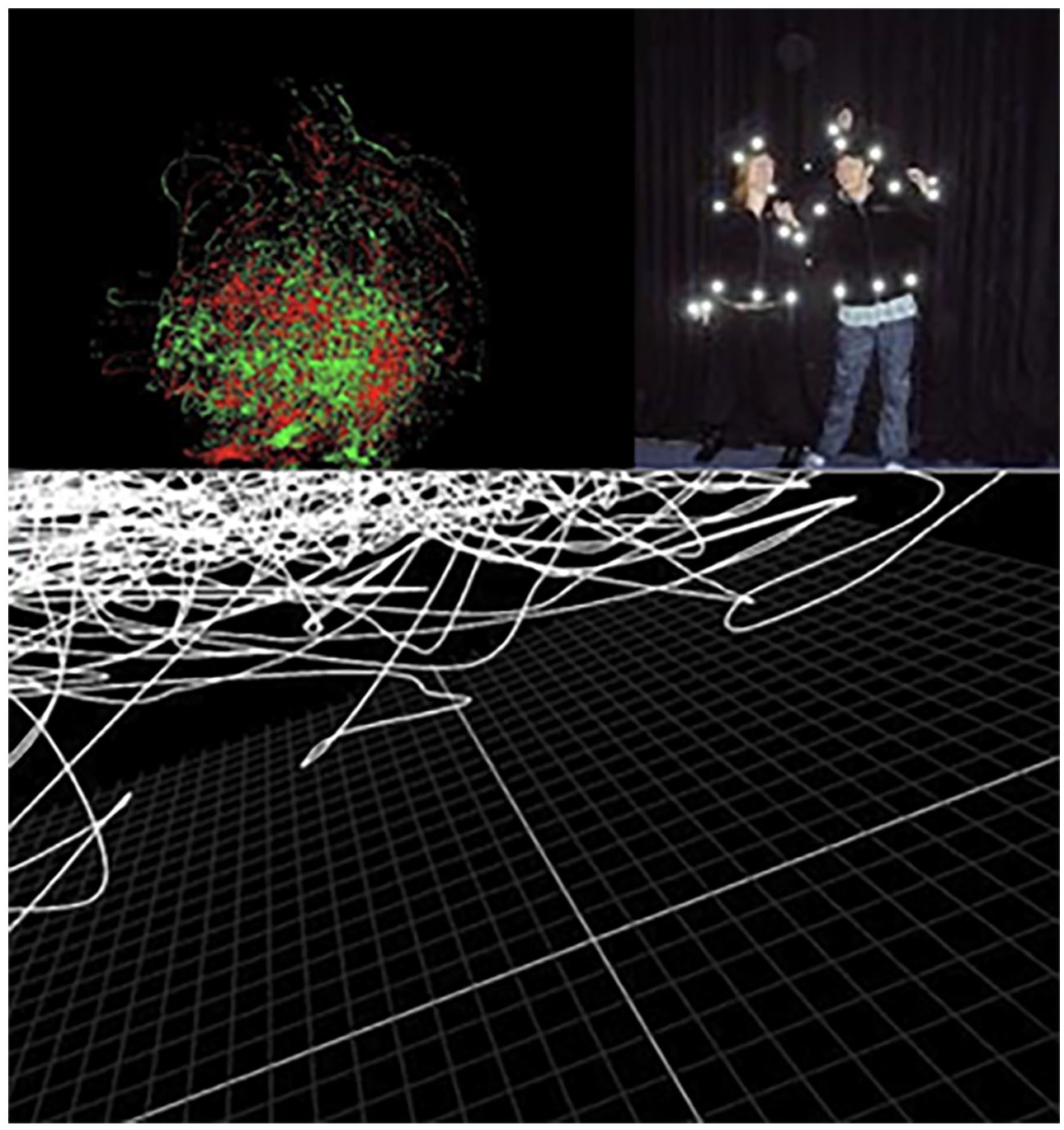
Phi Books motion capture.
The gesture recognition system mediated the participants’ physical performance while narrating their spatial narratives, eradicating their physical presence, leaving just a representation of the way they move. It became more difficult to define identities and relationships during the collaboration. It was the abstracting agency of this technology that deconstructed and re-represented individuals, adding noise, glitching the idea that data is indexical to subjects. This detached abstraction, or dualism, is reminiscent of the second-order subjects generated in HE by metrics and datafication. We do not present these processes as desirable or informative but frame this work as largely critical of such disembodiment. Its value for us is within a critical arts practice. The sense that technologies have an ambiguous kind of agency has been evident throughout the Phi Books project. The files from the motion capture and film are now lost to us – if they are on a server somewhere it is not accessible to us. Colleges cut staff and students off from servers very soon after they leave and we have lost a lot of work over the years in this and other ways. Lost like so much that we have tried to embody in the Riverine Archive, an archive of that which is non representable, of loss itself. We have lost so many formats, so many words, so many notebooks, so many conversations. We are interested in this lost and found material, forgotten, or hidden in layers of language and code over time. We challenge the idea of an archive as a fixed account of our project. A fixed, stable archive cannot represent our interest in process and dynamic intentions, body-to-body performance energies and multiple perspectives (no single ideas – even in our heads).
Our projects often arise dynamically when we meet and chat, when we are next to each other. Creating a riverine, unstable archive of our work and events is a provocation, it is refusal of information as a beautiful, stable presence, a provider of universal, immutable truths. One day we met at Alexandra Antonopoulou’s house by the river and were thinking of the idea of the archive. We performed what we discussed, throwing one of our books into the river Thames (see Figure 5) and then uploaded the footage to social media, awaiting the response, which was interesting – shocked and credulous. The object bobbing up and down the river appeared and reappeared, as once again the body of the opaque river resembled a mutable archive of our work, a refusal of stability. This event was later realized in VR form. Whatever we can recollect from our collaboration resembles what is appearing above the surface of the water and what has been forgotten seemed to resemble what was underwater. When we find lost USB sticks, pieces of paper, code, files and photos that bring forgotten memories of our research past, they remind us of the fragments of information that momentarily re-emerge from the river as variables come together, then dip beneath the surface (of the river and our memories) and freeze time until they appear again.
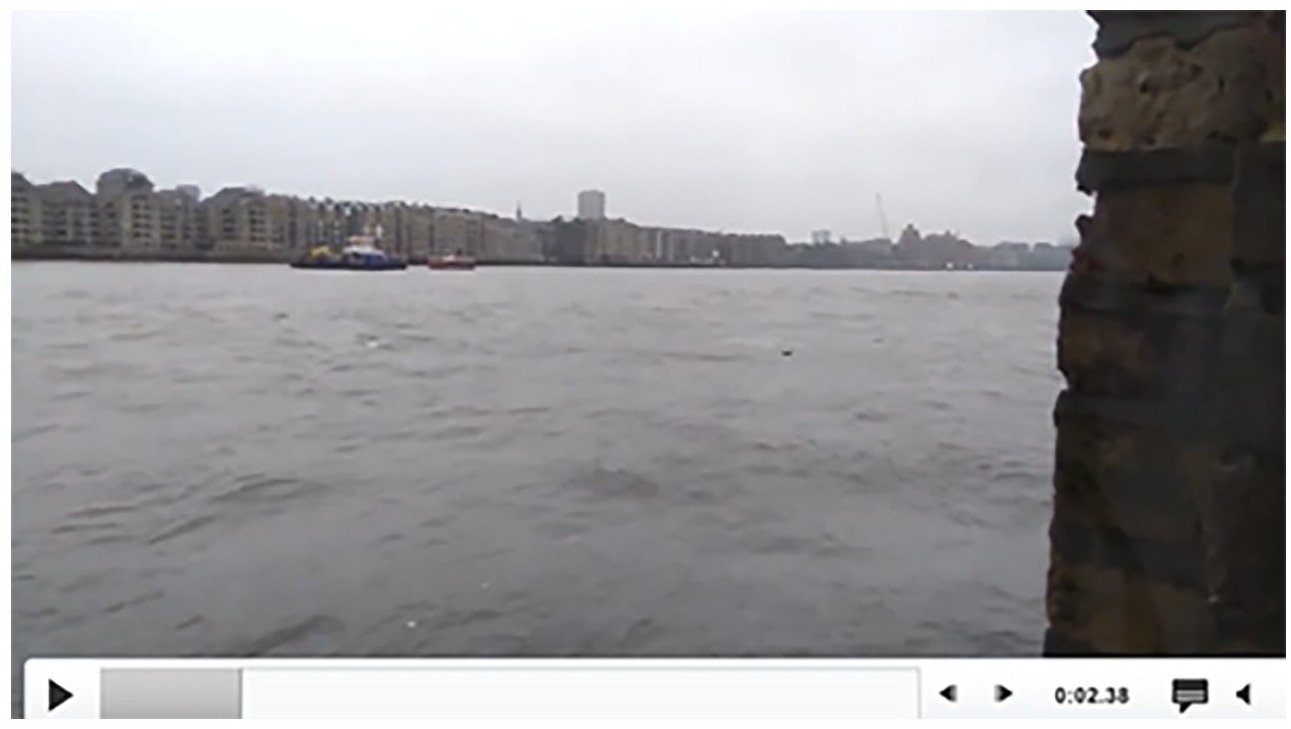
The Phi Books return to the Thames, a video performance in which we symbolically let go of our work.
In response to this, the Riverine Archive (Dare and Antonopoulou, 2019, 2021), as mentioned previously, was constructed as an alternative methodological approach, one that interrogates and reframes what an archive can and cannot represent. Our work introduces the idea of an archive that is in constant flux, a mutable structure, one that celebrates the idea of occlusion and the value of intersubjective emergence. We are interested in an idea of a mutable archive that resists fixed documentation and leaves space for the non-recordable energy of togetherness, collaboration and performance. It allows for data to dip beneath the surface and re-emerge, if and when variables come together.
We have chosen to work with a flow of data that is essentially positioned between chaos and order; in this way, we define the Riverine Archive as a system having, what, in Deleuzian (1981) terms, might be described as diagrammatic qualities. Such qualities are contingent, nascent or diagrammatic. These are the conditions that Gilles Deleuze describes as being necessary for generating the new. His description is highly resonant of a river, ‘The diagram is indeed a chaos, a catastrophe, but it is also a germ of rhythm. It is a violent chaos in relation to the figurative givens’ (p. 72).
In 2019, based on our idea of the Riverine Archive, we developed a VR application – one that destabilizes orthodox VR interaction modes, which generally avoid nausea or deliberate discomfort. During this experience, users wear the headset and find themselves on a boat in the middle of a river. They then have to point the VR reticle (a kind of cursor in VR) at floating objects representing our research (such as books, sounds, phone apps, geometries) (see Figure 6) to listen to the soundtrack of our narratives and academic papers. However, they can only listen to stories and academic works when the objects are on the surface. It is difficult to point at the objects as they bob up and down with the boat, on digital waters that are never still. This experience results in disjointed narratives, floating and submerging fragments of information, generating a feeling of nausea during the attempt to access memories and information. The idea of nausea is important to us; we see it as another agent that disorientates the floating player, making the information in the archive unfixable. The Riverine Archive goes against linear archives, institutional models, academic structures and research repositories that put academics under pressure to record everything in a linear way and for purposes of extraction. The nausea and the information fragmentation are seen as an escape from this reductionist approach; they are an attempt to make meaning by loose associations that resemble the flow of collaborative conversations, including repetition, silence, ellipses and mumbling.
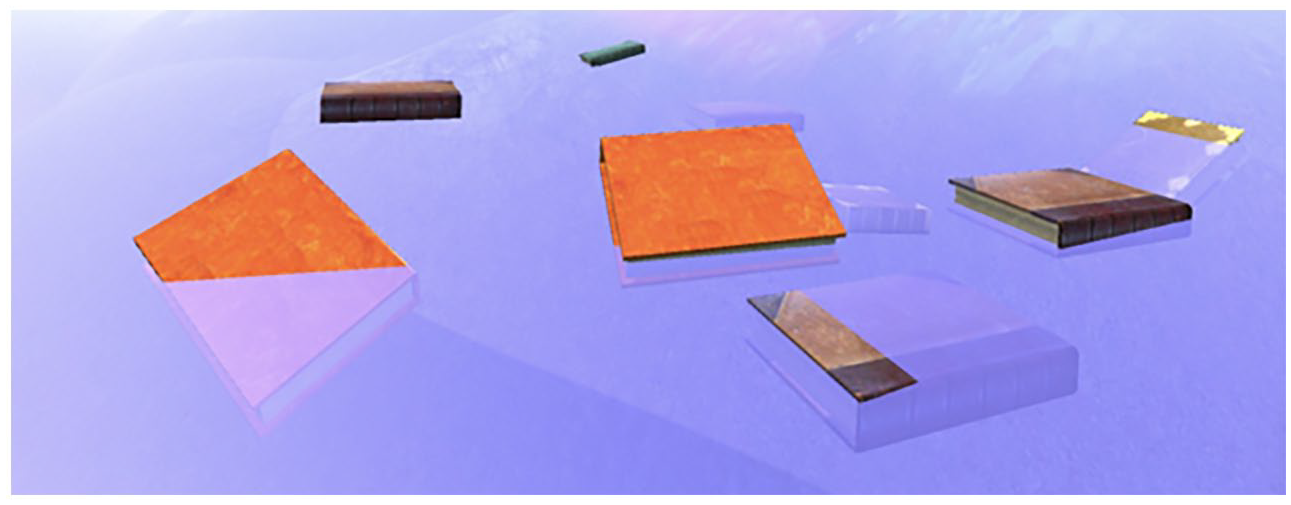
The Riverine Archive (Dare and Antonopoulou, 2019).
People who experienced the VR Riverine Archive online thought the disrupted sounds were due to their internet connection. We find this significant as, in this way, it becomes a masquerade of online glitches: it surfaces the delusion of stable information. The idea of the Riverine Archive also goes against the institutional drive to collect information that can represent the volume, complexity and dynamism of what was lived as an experience in the past. It cannot represent touch, it cannot represent hunger, smell, body nuances and the subtleties of gesture and movement as phenomenological events. The nausea this experience generates is closer to the embodied discomfort, precarity and dissonance that we, as workers, have experienced within the academy. It is a state of fugitive refusal, of flux and multiple perspectives.
A Different Form of Logic
In our work, the physical and the virtual are entangled. In our first performance in an academic setting at the Freie Universität Berlin in 2010, we presented the Phi Books, performing them in an attempt to convey the logic of our practice and its so-called ‘outcomes’. The books were placed in a physical map of the Phi Books’ neighbourhood, representing houses, with a plan of buildings and terraced rooms in which we placed documents and drawings. Around the books there were piles of photocopied extracts of the authors’ stories, representing other houses. The participants used these random bits of the authors’ house stories to write their own house stories. The Phi neighbourhood scenery was constantly changing while the participants added or extracted papers from the pile. The participants continued to send us new stories online, adding layers of information. As Daniela Cascella puts it in En Abime (2012: 57), we were listening, reading, writing, ‘discovering darker threads infiltrated by the writer in the plot’ in which
both writer and reader are woven into the fabric of the story. The infinite entanglements of all social things, which forbid that one thread should fly the general fabric, on some lines of duty, without tearing itself and tearing others, make it impossible for a writer to produce a text disentangled.
The logic of the Phi ratios was maintained in our performance as well as writing; for example, sound was used to reflect the mathematical Phi ratios, to punctuate the performance, connecting the linguistic to the sonic and to the spatial constraints of our collaboration. Each sound was progressively expanded to reflect the increase in size of each room in the Phi house, according to the ancient ratios, with each term beyond the second, the sum of the previous two. We modelled the room sizes computationally to get a reverberation that fitted the geometry of each room. Our models of sound are events, not fixable data, as sound is something we are oddly distant from. The impulse response (reverberation file) was created in advance, but we have no control over the dynamic experience of sound, for each listener their physiology and spatial configuration will transform that sound, making it an event, we assert, not a fixed object (see Figure 7). As Cascella (2012: 72) states:
As I listen to sounds and then set out to write, I become more and more aware of my distance from them. My words cannot capture them: they let them go astray, dissolve. Instead, my words inscribe sounds with their own presence; they answer the enigma of sounds with yet another enigma.
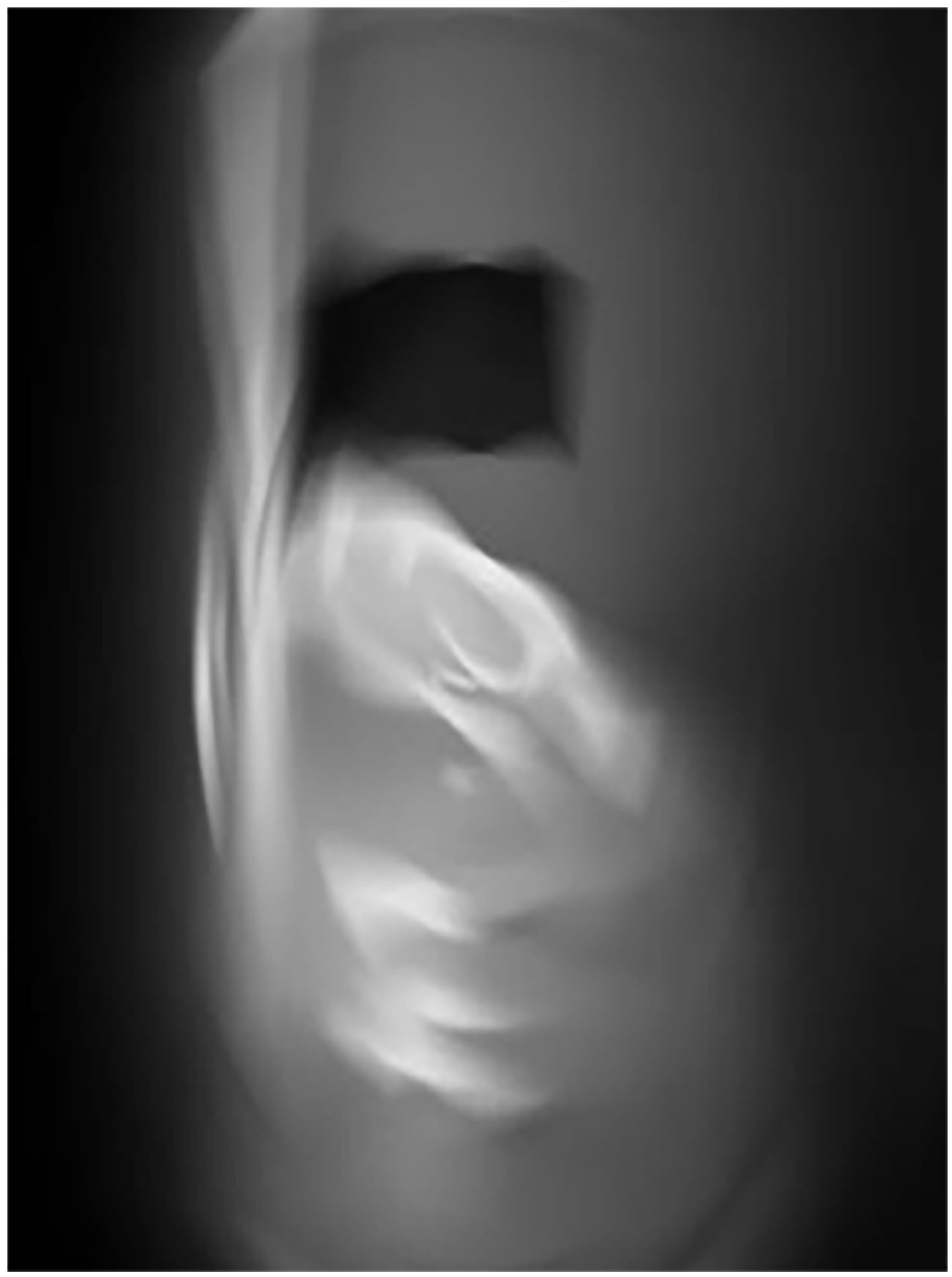
Sounds of books falling in the Phi rooms.
While we invited the audience to join us in the society of Phi co-writer agents or ‘coagulagents’, we were hesitant to impose a misleading degree of coherence upon the project. We took full responsibility/un-responsibility for the work by defining it as a ‘research experimentation’ and acknowledge there are many more rooms and chambers that we have not entered yet. And, although we followed an algorithmic process, we were very weary of framing our practice as adhering to some form of logic. As we stated, and as Bourdieu (1990: 80) entreats us, we must acknowledge that the logic of practice is ‘not that of the logician’.
Like many academics who do not aspire to the logic of metrics, we challenge a solely quantitative evaluation of our work, seeking different ways to value and represent it; especially when we need to represent the significant nuances of collaborative work, lived experience and embodied interactions. As researchers in different domains, we still encounter similar preoccupations and face the frequent reductionist evaluation of all aspects of our work, including our research, being constantly asked: How much of it did we do? Did we do too little or too much? How many research bids have we put in? How many students have we recruited? How many events have we taken part in? How much business revenue did we raise? How many industries are we in touch with? Have we contributed to the well-being drive? Have we completed the forms and spreadsheets, the training on GDPR (General Data Protection Regulation), terrorism, ladder safety, copyright? Did we complete our fellowships, join enough committees, mentor others? The list goes on, but as Fleming (2021) reminds us, such performance metrics are not new:
In higher education today, a veritable ‘tyranny of metrics’, to borrow Jerry Muller’s phrase, tracks almost everything we do. Student satisfaction scores, sometimes surveyed two or three times per semester; journal quality rankings like Scimago and ISI, in addition to discipline-level tables that typically carry a 1–4 (including 4*) or A–D scale to convey prestige; impact factors for leading journals; research grant application submissions and successful external income; Google citation ratings and the notorious H-Index designed to capture both productivity (or quantity) and impact (or quality). This barrage of data is then recalibrated to university-specific templates and used during annual appraisals, helping to allocate workloads (including teaching relief for ‘star’ academics, etc.), assess promotion and tenure eligibility or guide the much-feared ‘Performance Improvement Plan’ for staff who won’t knuckle under.
How did we write under these conditions? In which this:
obsession with metrics and big data originates from a number of sources. Clearly there’s an attempt to mimic private enterprises that have always closely measured productivity, outputs and earnings. In the UK, for example, this gained traction with the 1985 Jarratt Report which recommended universities be managed with strict accounting controls, budgetary constraints and performance targets.
Our work has never been driven by metrics or because someone else asked us to do it. Our work cannot be quantified in this way – for example, the dynamic way in which it began, in 2008. Our work together was always driven by an ambivalent urge to collaborate, to learn from each other, to do things that we and others found important and urgent, to challenge how we do things in the everyday, both in our lives and jobs.
This drive was the start of the Phi Books project. Neither of us were comfortable about collaboration, it was painful and conflicted, but we were driven to expand our own practices, knowing it would take us somewhere unexpected. At first, we started by modelling two empty drawing books as English terraced houses that seem identical in structure. The similarity is superficial as each house is different because unique people inhabit them. We used these identical blank books as a metaphor for our own homes, we wrote stories for each room in the houses that we drew, following the logic of the Phi ratios. The writing plan followed a spatial footprint. After we had each written a story, we swapped our books and wrote in a response to each other’s words, almost like an Extreme Programming methodology, with our frazzled agility and time-poor rapidity and our attempts to break each other’s stories and rules. We used a precise number of words for each room or story, the numbers of the words in each room followed the logic of the Phi ratios. We wrote:
Room one is one hundred words to his room of 200 words and three is a room of 300, what is room for is a room of five words. Room five is a room of eight hundred words. Six is a room of thirteen hundred words. Ignoring the initial seed values, each remaining number is the sum of the previous two. Room one is a tiny room, just one hundred words. What could it fit in a tiny space of 10 by 10 words? (Phi Books, 2008–ongoing)
Our work with each other involved a great deal of fighting against the loss of control of our authorship and ideas. We had to negotiate and agree how we would start swapping our books, how we would write each other’s stories. At first we felt comfortable residing in only two small rooms, exchanging stories and also mediated by email and Twitter, and our many walks together around Hilly Fields, a leafily undulating park in South East London. Again, these walks cannot be usefully represented as data, including the struggles that have unfolded between us as we played ping pong, climbed the undulating hills, walked and talked our way back to the Goldsmiths campus. In the complexity of interacting with each other, we resorted to visual, non-verbal models as a heuristic for gaining insight into our own anxieties about collaboration. These models have represented a significant break-through in the context of our research, in which spatializing the book form has opened new areas of investigation. The models may be seen as an epistemic shift but not a fixed opposition to other modes of generating knowledge; they have also engendered deeper thinking about the relationships of geography to language and of the possibilities for performing the book form.
Conclusion
The archive of our work is in constant flux, a mutable structure, one that celebrates the idea of occlusion and the value of intersubjective emergence. We are interested in the idea of a mutable archive that resists fixed documentation and leaves space for the non-recordable energy of togetherness, collaboration and performance. It allows for data to dip beneath the surface and re-emerge when variables come together.
In the context of all online work and collaboration, we are always at risk of being observed by our employers, observed by platforms, observed by Amazon, observed by Google, commodified. Our own documentation of work with each other and participants is conflicted; to place work online is always to risk its subsumption into corporate neoliberality and surveillance We seem to be in the midst of a situation where academics do not know which way to turn, whether to turn towards the neoliberal, the platitudes of digital transformation innovation, or to try and resist what is happening to us and our disciplines.
The ideology of merit is also closely linked to market rationality. Academics are encouraged to act like independent business owners, constantly polishing their CVs and leveraging their position for better income. Having a quantified representation of one’s market value fits into this vision of academic capitalism hand in glove. (Fleming, 2021)
It is also hard to know what to do with our work, whether we should try and continue with our practices, or indeed, what agency they have, but we heed Fleming’s warning that:
progressive and emancipatory re-evaluation of higher education must carefully sidestep the reactionary right-wing pessimism that’s helped lay waste to tertiary education over the past several decades.
We cite from Fleming to convey the state of pessimism so many of us are experiencing in the future of an academia that values STEM and STEAM over Arts and Humanities, which prioritizes metrics over critical imagination and qualitative experience. In the context of our work with immerticality (which is our term for critical immersion), we have surfaced what happens in moments of fragmentation and nausea. Our work may be seen as a manifesto for a representational shift within contemporary academic and technological practices, in particular VR and virtuality. We urge academics, students, artists, developers, directors, viewers and audiences to turn away from mirrors of realist correspondence, metricization, Big Datafication and immersion and, instead, to engage with critically dynamic practices and actions. This is an assault on the Cartesian split between subjects and objects, it is intended as a provocation and a spur for new forms of pedagogy, critical virtuality and subversion. For us, the issue is also this: How do we stop everything being subsumed into a neoliberal model of all life as business, all things as data? We concur that information is not beautiful, but rather a fallacy of stability, servicing a rapacious, anti-academic neoliberal ideology. The value of Big Data is premised on a delusion of fixed categorizations and separations, generative of information that we have no reason to trust and every reason to refuse.
Footnotes
Funding
The authors received no financial support for the research, authorship and publication of this article, and there is no conflict of interest.

Biographical Notes
Address: University of the Arts London London College of Communication, Elephant & Castle, London SE1 6SB, UK. [email:
Address: Cambridge University, Homerton College, Cambridge CB2 1TN, UK. [email: