




Abstract
This article examines a novel approach to visual methods that artist Ben Davis has developed based on sociologist Kevin Walby’s research into decommissioned industrial sites, which is referred to here as tracing. Disrupting the over-reliance on photographic representation in visual methods in the social sciences, the authors integrate audio recordings of interviews, as well as photos, maps, and building plans for pop-up mining communities into visual art works to provide a counter-visual analysis of the landscapes depicted in Kevin Walby’s photographs of Uranium City. After reviewing literature on environmental degradation and on visual methods, the article elaborates on Ben Davis’s practice of tracing as a technique representing the feeling of decomposition and decay generated by the harms of industrial resource extraction. The authors argue that the technique of tracing excavates layered histories of place, providing a way of creating new interpretations of social and environmental issues. They then discuss how this counter-visual analysis and approach to tracing enables a trans-disciplinary and dialogical space for engagement with academics, artists, and activists to explore issues centered on land, contamination, and justice.
Introduction
There is no shortage of artistic and scholarly work examining representations of environmental damage and ecological destruction (Bossen and Freedman, 2015; Burtynsky et al., 2018; Lippard, 2014; Ray, 2016). This literature has explored the ways that photography and visual representation can raise awareness about contamination and pollution. Explicit visualization of the past can play an important role in reviving or maintaining awareness of historical violence or destruction (Chouliaraki, 2013). Analyzing decommissioned industrial sites such as abandoned mining towns using visual methods can reveal how these places have been created but also devastated by capitalism. Photographs can challenge historical amnesia (Mokhtar, 2020) and support public education. However, photography and visual representation may also obscure phenomena, sanitizing or glamorizing the toxic. It follows that the photographic route is not a simple pathway to knowing about social relations or places, and may create occlusions that require excavation. There can be invisibilities created in art, scholarship, and activism that undermine efforts to know about ecological destruction (Barnett, 2015). Visual studies scholars have noted it is necessary to go beyond qualitative realism in the taking and interpretation of photographs (Hinthorne and Simpson Reeves, 2015; Pauwels, 2010).
This article examines a trans-disciplinary collaboration approach to visual methods and artistic exposition that Ben Davis has developed based on Kevin Walby’s research into decommissioned industrial sites and abandoned mining towns (variously referred to as industrial brownfields, superfund sites, or wastelands in other contexts) and the contamination they entail. By reporting on our collaboration, we hope to convey the methodological insights we have arrived at from working together. Walby’s research on decommissioned industrial sites (specifically, one site named Uranium City) begins from the assumption that there is something about place that eludes photography, an approach consistent with what has been referred to as counter-visual analysis (Schept, 2014, see later). Instead of focusing on photographs alone, counter-visual analysis also uses interviews and archival research to investigate what meaning can be generated by engagement with the obfuscated or the occluded. Walby’s data includes audio recordings of interviews, maps, and building plans for pop-up mining communities, which Davis integrates into a series of pieces that bring to light the contradictions behind the seemingly benign landscapes depicted in Walby’s landscape photographs. Examining the process by which Davis has developed new work from Walby’s research into Uranium City is a way of exploring the tension between appearance and reality, troubling over-reliance on photographic representation in visual methods.
Adding to discussions about representation in visual methods and the role of photographs, we describe Davis’s tracing as not only a technique of representing decomposition and decay, and unearthing that is so resonant with the Uranium City example. Rather, such collective re-drawing of photographs on tracing paper to expose layers of meaning is a technique for investigation, evocation, and communication. Working on tracing alludes to the layered and partially occluded histories of post-industrial sites of contamination and pollution associated with cyclonic development. By incorporating tracings of photos as a technique of interpreting them and the places they represent, we contribute to the objective of extending visual methods. We understand tracing as a trans-disciplinary approach for addressing the occlusion and invisibilities that can emerge with over-reliance on and realist interpretations of photographs. Trans-disciplinary work incorporating art and social science is necessary to untangle the haunting meaning of sites of contamination and pollution, and the visualization of them (Bloom, 2018). Reflecting on our use of visual methods and the technique of tracing, we also contribute to literature on the politics of the visualization of contaminated spaces (Balayannis, 2019, 2020; Barnett, 2015; Lippard, 2014; Peeples, 2011; Schwartz, 1989).
We begin by providing context about Uranium City itself, elaborating on the research site. We then describe our collaboration, and we situate our work in relation to visual methods as well as counter-visual analysis as we understand it. We then explain what we mean by the technique and process of tracing. These tracings become forms of knowledge mobilization that have their own evocative status during the collective drawing but also afterwards, wherever they are exhibited. Advocating for the collaborative approach of tracing, our work has implications for literature on visual methods in social science and the status of photographic representations (Harper, 2002; Pink, 2003; Prosser, 2007; Schwartz, 1989). We believe the implications of this argument and technique are important especially for social science as a means of challenging the realist approach to incorporating photographs in sociological and criminological research. We conclude by discussing the politics of visuality and how tracing generates a trans-disciplinary and dialogical space for engagement with audiences beyond the academy to explore issues of land, environment, contamination, and justice.
Picturing Uranium City: Where ‘The Streets are Paved with Better than Gold . . .’
In August 1954, a New York Times story touted a frontier industry settlement where ‘the Frontier and the Atom Meet’ and ‘the streets are paved with better than gold. . .’ (Hillaby, 1954). What could be better than gold? Uranium, it was thought. Located on Lake Athabasca in Saskatchewan near the border with the Northwest Territories, today Uranium City is virtually a ghost town. Though the population reached over 5,000 during the fervour of the atomic age, only a few dozen residents remain today. When mining companies withdrew in the 1980s, people began to flee the city on ice roads across the great northern lakes, leaving behind an urban infrastructure jettisoned in the bush (Keeling and Sandlos, 2009). The area is still home to many radioactive uranium mines, tailings ponds, and sludge pits (Keeling, 2010; Keeling and Sandlos, 2017). As Walby (2017: 200) has noted: The region is the traditional territory of the Chipewyan Dene people. The town was formed when gold was discovered in 1934. Uranium mining began near Beaverlodge Lake in the area in 1946, although awareness of radioactive minerals dates to the 1930s. Uranium mining occurred between 1953 and 1980. Erecting the town took massive public expenditures from federal and provincial governments. Over the course of thirty-five years, hundreds of thousands of tonnes of uranium were mined . . . Mine closure in 1981 led to a sudden reduction of economic opportunity, and threatened Uranium City with ‘the imminent danger of becoming a ghost town.’ (Dougall, 1982: 63)
Plant life is now overtaking the infrastructure and buildings left behind. A photograph may make it seem like a pristine wilderness. Many of the photographs by Walby were taken precisely at junctures that appear through the camera to be wild, wooded places (see Figure 1). What cannot be seen in photographs is the contamination that seeps into every molecule near old mines and mills.
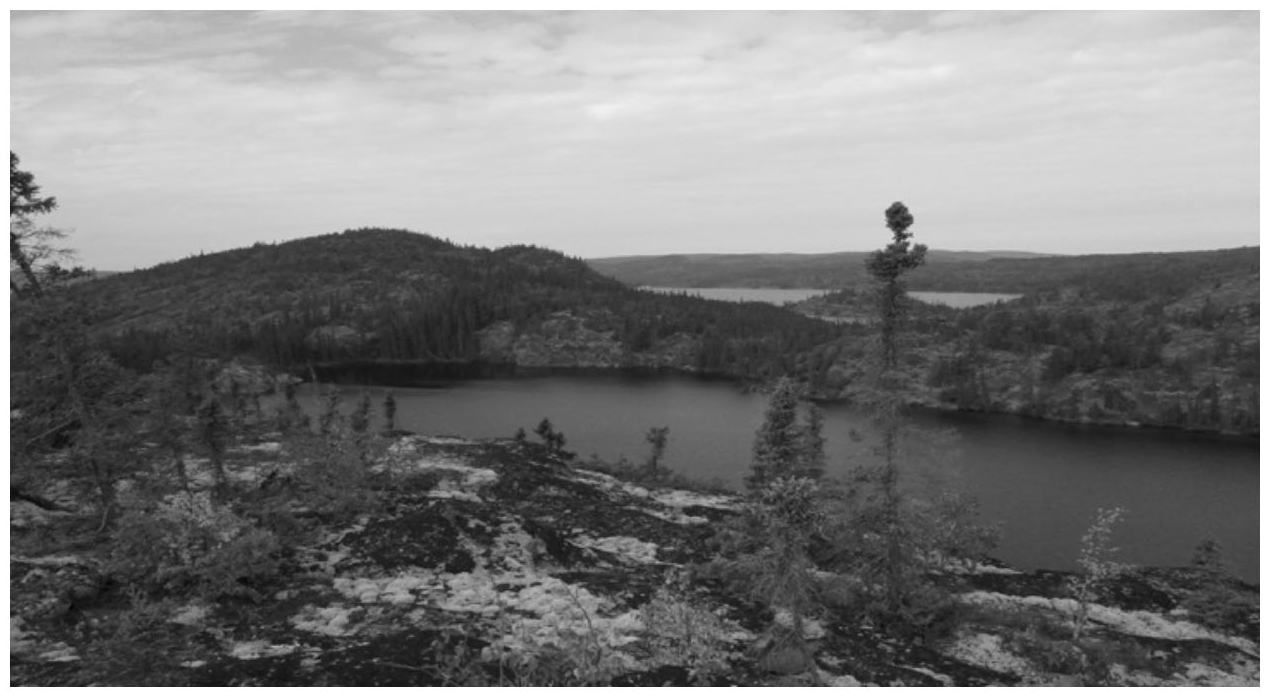
View from hill at Goldfields Gold Mine. © 2017, Kevin Walby.
Since it was established in a cyclone of development during the 1950s and through its decline in the 80s and beyond, Uranium City (with its toxic legacy, natural beauty, and remoteness) has remained a topic of research and been reported on in the media by travel journalists. In this latter respect, it has become somewhat mythologized in photo and travel essays, including one in Outside Magazine entitled ‘Radioactive and here to stay: Say it loud and say it proud: Uranium City, Saskatchewan, boomtown, ghost town, antimecca of the atomic age, is still a great place to glow in’ (Lee, 1994). As news media is reporting headlines such as ‘Toxic leftovers from Giant Mine found in snowshoe hares and new advisories are being released regarding arsenic levels in northern lakes, and contaminant levels in people’ (Morin, 2013), our project takes on relevance beyond Uranium City, and reflects trends with other decommissioned mining and post-industrial sites further afield.
Fascinated with destruction and the macabre, people across the world clamour to view contaminated sites. Pollution tourism and virtual toxic tourism are gaining popularity as people seek knowledge of and exposure to contaminated pockets of our world (Bowers, 2013; Pezzullo, 2009; Rosenfeld et al., 2018). Virtual tourism is one option to raise awareness about pollution, while landscape photography is another. Yet, tourism and photography are not a straightforward way of learning about contamination or the environment. These practices may create a distance between the viewer and the object or issue. Distorted memories can emerge in tourism that visualizes industrial ruins (Edensor, 2005a, 2005b). Interpretation of such images is difficult, even in the best of conditions when context and prior knowledge can be obtained (Lobinger and Brantner, 2015; Wells, 2007). There is an occlusion that can occur with tourism and photography, a blockage in knowledge and in action. This possibility of social distance or blockage is in part why Ben Davis has developed the technique of tracing as an artistic–social–political intervention into this field of study, as a foray into knowing about such places that goes beyond reliance on photos alone.
Bringing Visual Arts and Social Science Together
Although we investigate land and place through different disciplinary lenses using different conceptual and methodological tools (Walby working in social science, and Davis in the visual arts), after meeting at a conference we sensed our research intersected in terms of investigating issues of justice and land, and shared ideas of layering. By layering, we refer to stratums of meaning and land created by power structures and colonialism that shape people’s lives. Through our collaboration, we advance a trans-disciplinary visual/textual/auditory exploration of land, environment, and contamination, specifically around Uranium City. Our writing and visual art is not a form of ‘smokestack nostalgia’ (High, 2013: 142) or yearning for a productive industrial past, as we are aware of the politics of remembering and representing such sites in visual studies and social science (Abu Hatoum, 2017). Similar to the discussion of using visual inquiry to muddle through post-atomic landscapes (De Vos and Mavrokordopoulou, 2018), we draw attention to the ambiguities and tensions of living in and learning about contaminated living spaces. It is in this context of the politics of representation and how to excavate and add meaning to photographs that the idea of tracing emerged.
Ben Davis has a history of working in multiple visual mediums and exhibiting visual and mixed-media artworks in several countries. He situates his practice within postcolonial discourse and a commitment to reconciliation. This approach stems not only from his politics but his experience of landing as an immigrant in multiple countries across the globe and encountering similar scenes of striated settler space layered atop unceded and contested lands. At the core of his practice is an understanding of land as text, using the idea of a palimpsest, an overwritten paper document with partially occluded layers of older text, which then gradually show through beneath the newer writing. As Lebeninskaia (2012) noted about the works and approach of Ben Davis: The land that is constructed by representation as imaginary – but also physically and through economic activity – is a palimpsest: it carries and shows layers of past uses and histories, even as they are erased. Based on the ancient practice of reusing sheets of parchment and vellum by continuously erasing and rewriting on them, palimpsest has grown to mean any surface that carries visible accumulation of meaning and history.
Davis uses layering, sequencing, and repetition to suggest the possibility of multiple readings of both land and place, something that has tangible relevance to Uranium City.
Prior to our collaboration, Kevin Walby went to Uranium City and photographed sites of loss, decomposition and decay, writing about the destructive cyclonic development of extractive industries, arguing one must generate some knowledge beyond the photograph to understand the history of meaning and loss in the site. Exploring the meaning-making practices of people living in these contaminated spaces through interviews and observations as well as photography, Walby is drawing from interpretative approaches to qualitative research and ethnography. The photographs provided documentary evidence of the abandoned buildings and landscapes and, before departing, Walby was inspired by Edward Burtynsky’s landscape photographs of stunning and tainted places. Examining decommissioned industrial sites and abandoned mining towns through the lenses of social and environmental justice, the research explores the methodological implications of visual methods (also see Balayannis, 2019, 2020; Anaïs and Walby, 2016). To this end, Walby contends there is something about place that eludes visual methods, especially photography, which is consistent with a counter-visual analysis: examining what is communicated through the invisible, as opposed to focusing on (readily) apparent narratives, cues, and significations. This area of Walby’s research had resonance with Ben Davis’s practice. Walby also conducted interviews (excerpts of which have been integrated into the collaborative tracing) about how remaining residents in Uranium City understand this place and history today.
Bringing together visual arts and social science, our work together is multi-textual, multi-modal, dialogical, and trans-disciplinary. With photography, even the photography of Walby, the meaning and history of a site can be obscured or covered over. With tracing, inspired by Davis’s prior use of palimpsest, the main objective is to recover some of that meaning by layering images, sound, interaction and discussion, and contemplation with participants. To go beyond qualitative realism in the taking and interpretation of photographs in visual methods, we reflexively incorporate the image, group listening to audio of interview excerpts, and dialogue in ways we describe below.
Engaging with Visual Methods and Counter-Visual Analysis
Before elaborating on the technique and process of tracing, we situate our work in conceptual context. There is literature on the geography and visualization of development and ruin, such as Matt Dyce’s (2013) work on aerial photography and state vision, and writing on nuclear geography (Alexis-Martin and Davies, 2017). There is also literature on photography and post-industrial spaces and ruin. Carolyn Kane (2018) refers to photography of environmental degradation as the toxic sublime. The juxtaposition captures the sense of harm and beauty that is intermingled in decommissioned industrial and nuclear sites (also see Kuletz, 1998; Peeples, 2011). Photographs of the toxic sublime can raise awareness about contamination but are also easily glossed over (Barnett, 2015), which creates new invisibilities and silences. Viewers can become stuck in a mode where they feel distant from the toxic site and powerless to remediate it (Peeples, 2011). Environmental photography (Bossen and Freedman, 2015) raises ethical and political questions about the nature and future of industry and resource extraction. There is a critical politics and an ethics to imaging contaminated landscapes (Balayannis, 2019; Davies, 2019; Kuchinskaya, 2014) that informs our approach.
Pink (2014) suggests photographs used in visual ethnography are marked by a temporal disjuncture. Photographs are a flash of the immediate or distant past that the viewer can no longer access. The disjuncture is not only temporal. There are material elements of place that do not appear in photographs (Liboiron et al., 2018), which cannot be understood from such visual texts without exegesis of some kind. Schembri and Boyle (2013) add that researchers should not fetishize the visual in performing visual methods. This is not least because neither place nor space can be fully represented using photos. Such claims suggest a methodological shift is required in visual methods, away from realist accounts toward a more interpretive, modest framework. Boschman and Bunn (2018), also writing about Uranium City, concur regarding ‘the limits of the photograph in documenting traumatized landscapes.’ This refers to the notion of occlusion of perception noted earlier. Photographs can even be conceived of as dangerous forms of evidence that, at their worst, represent a colonial way of knowing and seeing (Pinney, 2008). This tension is an undercurrent not only in literature on landscape and pollution photography but also tourism literature that addresses the same phenomena (Edensor, 2005a, 2005b). Because of this duality in the photograph and in the material scenes depicted, Christopher Pinney (2008) calls the photograph both a cure and a poison. This is a position held in environmental photography more broadly (Bossen and Freedman, 2015). The idea of picturing things that are both alluring and poisonous also appears in Julia Peck’s (2016) notion of vibrant photography, which draws attention to petro-chemical runoff and leaking as actants having capacities to undo or reverse life, and the ethics of introducing such elements into the world.
Our approach to research and exposition is likewise about what is missing from the scene, and not captured in the frame. Judah Schept (2014: 211), writing about prisons, suggests that: Perhaps what is most important in a counter-visual study . . . is providing what is otherwise ‘cropped out’ . . . we must examine [a place’s] spatial and historical contexts. What is next to it? What came before it? What is it built on top of?
Schept argues that pictures should be used to look for structures of power that shape place, ghosts of past regimes, and murderous forms of pollution that elude the visual. Neudörfl (2010) similarly argues that Urban Studies scholars should adopt a counter-visual approach that goes beyond a realist-documentary approach to visual methods and instead uses archival and sensual methods to study invisible elements of city living. Joshua Barnett (2015) has likewise written about the multiple visibilities and invisibilities of struggles for environmental and ecological justice and how to intervene in the scenes captured in toxic portraits. As Walby (2017: 206) notes: ‘The central claim . . . is that there is something about place that eludes the visual, especially photography, which should be of concern to social scientists using visual methods.’ Building on this claim, we are interested in the relationship between the ocular and occlusion, and how a trans-disciplinary collaboration between social science and visual arts can attempt to unearth vestiges of modernity buried beneath our feet. We situate our work in this paradoxical space, and offer the process of tracing as a means of meandering through these relations and issues.
Schept’s (2014) practice of counter-visual analysis calls for researchers to examine what is communicated through the invisible, as opposed to focusing on the photograph in a purely or merely realist manner. Bowers’s (2013) related notion of counter-mapping is similarly oriented toward rewriting and recovering knowledge of sites that become occluded or obscured. Archival and historical work as well as interviews are needed to generate stories about what is not apparent in visual data and to elucidate why it is not there. Counter-visual analysis requires a process of investigating and reflecting on the site including visual representations of it to excavate buried meanings or other relevant interpretations. González-Stephan and Good (2016) likewise refer to the counter-visual potential of the archival and of historicization. Discussing her documentary, The Prison in 12 Landscapes, Brett Story (2017) explains why and how the film responds to and adopts a counter-visual approach, asking ‘What might it mean to seek not sight, but a different kind of eyes, when it comes to visual representations?’ How can such work span academic disciplines and resonate with the communities that such pollution and contamination directly affect? One way is the technique and process of tracing.
Exploring the Technique of Tracing
In this section, we describe the technique of tracing as a response to these limits of visual methods and photography. One way to describe tracing is to differentiate it from drawing. The practice of drawing or sketching can be an important means of knowledge creation and mobilization (Mutonyi and Kendrick, 2011). Drawing is increasingly used in social science as a creative and visual method to uncover the views and experiences of respondents who may otherwise have a difficult time articulating their views (Boden et al., 2019; Tracy and Redden, 2015). For example, Campbell et al. (2010), as well as Mutonyo and Kendrick (2011), ask children to draw cartoon accounts of various facets of the HIV/AIDS pandemic. The children draw cartoon accounts of death, suffering, fear, and shame. Cartoons were selected by the visual researchers as a medium over a more realist approach to drawing to make the process more creative. The cartoons offered by these children provide insights into their thoughts and experiences, going beyond what could be articulated in an interview. These authors thus demonstrate the power of cartoon drawing as a creative, visual approach to research.
We realize that cartoon drawing is not as realist as many forms of photography (see also Boden et al., 2019) and that capitalist contamination of land is different from disease transmission and immediate human suffering. Our point is that creative, participatory visual methods such as drawing and tracing serve as a point of departure from photography as a visual method. As Kearney and Hyle (2004) argue, drawing is one way to communicate emotions and memory, yet drawings always require some further interpretation and elaboration. In cartoon drawing, respondents are free to draw their own image. In tracing, the difference is that participants are all involved in interrogating the same photograph with the aid of audio clips from interviews and through their own dialogue. The recorded interview clips bring voices from the research site into the tracing space, and lived experiences from Uranium City become the contextual backdrop for the tracing practice. In drawing, the cartoon as a means of data collection replaces the interview, and data analysis follows a traditional pathway of grounded theory or thematic analysis. In tracing, the difference is that multiple visual mediums and mixed-media are used in ways that feed back into one another to assess and unearth the compound and leaching meanings of our contaminated world. As we note below, with tracing, the end product does not need to turn back into an academic article but instead can remain as a series of artistic outcomes, as a series of spiralling audio sessions and/or simply as a generative and memorable encounter with ideas and people in dialogue that shapes a participant’s approach to being in the world.
In developing our approach and collaboration, one of our goals was to find a way to bring Walby’s Uranium City research into a wider public domain and create space(s) beyond the academy for people to learn about and engage with issues related to Uranium City, to move from learning then knowing about a specific instance to practical experience on a wider scale. We also weave in an explicit counter-visual understanding of these photos and their meanings.
As a way of doing art in the anthropocene (Davis and Turpin, 2015) to confront the harms of industry and to raise questions about the existential crises of our times, the technique of tracing revisits and to a degree reveals what is occluded by the ocular or the visual. In a co-operative setting, tracing becomes a way of participating and learning. If done collaboratively and in conjunction with local struggles, tracing is a way of reconnecting with land and people. Tracing involves pointing to occluded or hidden contaminants that drift through material space but, by incorporating interviews in textual and auditory form, it is also a technique of bringing local social and cultural history into consciousness. Tracing is at the same time a way of breaking from deceiving representations and developing different sensual understandings of these scenes, thus unsettling authoritative views. A 2021 exhibition by Tahltan First Nation artist Tsēmā Igharas entitled ‘Tailings Pool’ brings out some of the same unsettling qualities. From the ground level, a large mound resembling a tailings pond is all that is visible in a parking lot. When one goes up the steps, one sees the pond full of neon blue liquid in the shape of a swimming pool. The pool invites the viewers, but the neon liquid clearly looks noxious. The exhibit plays with some of the same tensions of visibility/invisibility and clean/contaminated as our approach to tracing. Similar work that unsettles our relationship with industrial contamination are Carpenter’s (2016) examination of nuclear art and Green’s (2019) reflections on oil and aesthetics.
Two interdisciplinary residencies, one at Hospitalfield in Arbroath, Scotland, and the other at the Banff Centre in Alberta, Canada, proved significant for Ben Davis to develop the technique of tracing and take it to a wider audience. Those involved were able to experience the feeling of loss, decomposition, and decay that is so resonant with the Uranium City example and with other decommissioned industrial sites and abandoned purpose-built towns. At each residency, Davis worked with particularly evocative photographs that Walby had taken during a research trip to Uranium City and its surrounds, including one showing a south-facing view of Beaverlodge Lake (see Figure 2). This photograph, which seems to show a pristine wilderness lake, was a site of large-scale uranium mining and milling. The lake is a massive blue gem in the middle of a rocky, pine covered wilderness. It appears untouched to the eye and to the camera. However, signs are posted warning of radioactivity and cesium in the soil as well as cesium-laced fish.
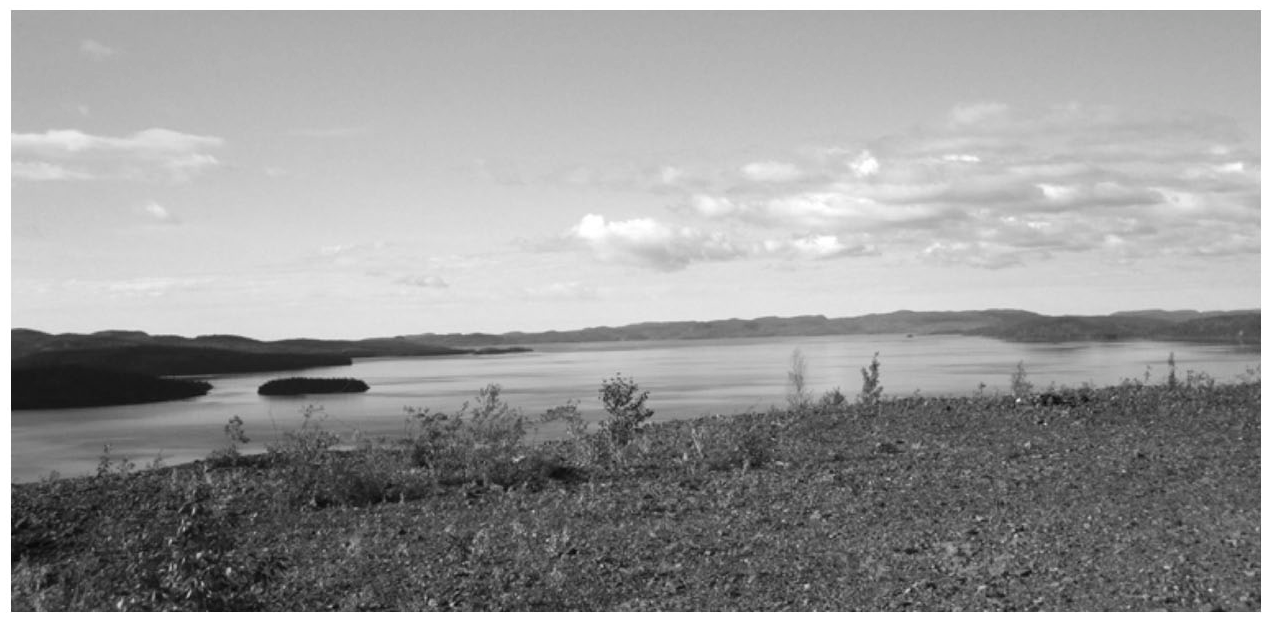
South-facing view of Beaverlodge Lake. © 2017, Kevin Walby.
As with other photographs, Ben Davis began by projecting and then copying the image onto a large sheet of tracing paper before re-tracing the lines of the drawing in graphite on the reverse. This original sheet became the source for a series of communal collaborative tracings sheet onto a roll of tracing paper undertaken with residency members and the wider community. The space becomes an informal lab of visuality and sound, a collaboratory of sense making, learning, and sharing. With each tracing, the graphite of the original gradually diminished, and the transferred image became fainter and fainter, decaying until, by the final iterations it was all but gone, with the faint imprint of pressure the only reminder of the repetitive, rhythmic process. In Eco-Aesthetics (2014: 3), Malcolm Miles warns of a point when ‘the planet will be processed into profit until nothing but dust and ash remain’, and this idea of endless resource extraction leading to decay is central to our piece. The work reveals a material fact and metaphorical current in extractive, purpose-built towns: the fetish and fervor for resources culminates in decay and unravelling of the social realm and living spaces. By tracing pictures and images of these corroding scenes in Uranium City, this work tries to connect those present to the site but also to the sense of loss and abandonment. It is meant to be a somewhat unsettling activity, dislodging some assumptions about what the original depicts and what the place represented is all about.
Tracing is a sensing for ghostly figures, hidden under tainted and corrupted soil, overgrown emitting trees, and in sky-blue radioactive pools. The figures are remnants that must be traced to remember and to know them, yet tracing only brings to the surface a figment of the original, a hallucination of an unbelievable reality of resource extraction and remote lives. This work brings into sensory experience the decay and erosion that resource extraction inevitably leads to, in ways that the merely visual (the photographic) cannot (see Figure 3). Layering in the voices of interviewees during the tracing session brings their stories to the listeners as they trace, and brings the scene of contaminated land and water to life more vividly in the mind as the photograph is built on and made sense of but, at the same time, decentered through the process of analysis. It may also offer an invitation to join the conversation or to share a story, a point of response as opposed to more closed/intimidating silent viewing. The interviews are not presented in any particular order or in a linear manner, but instead are loosely curated to allow the participants to form their own relationship with the audio while they continue to trace.
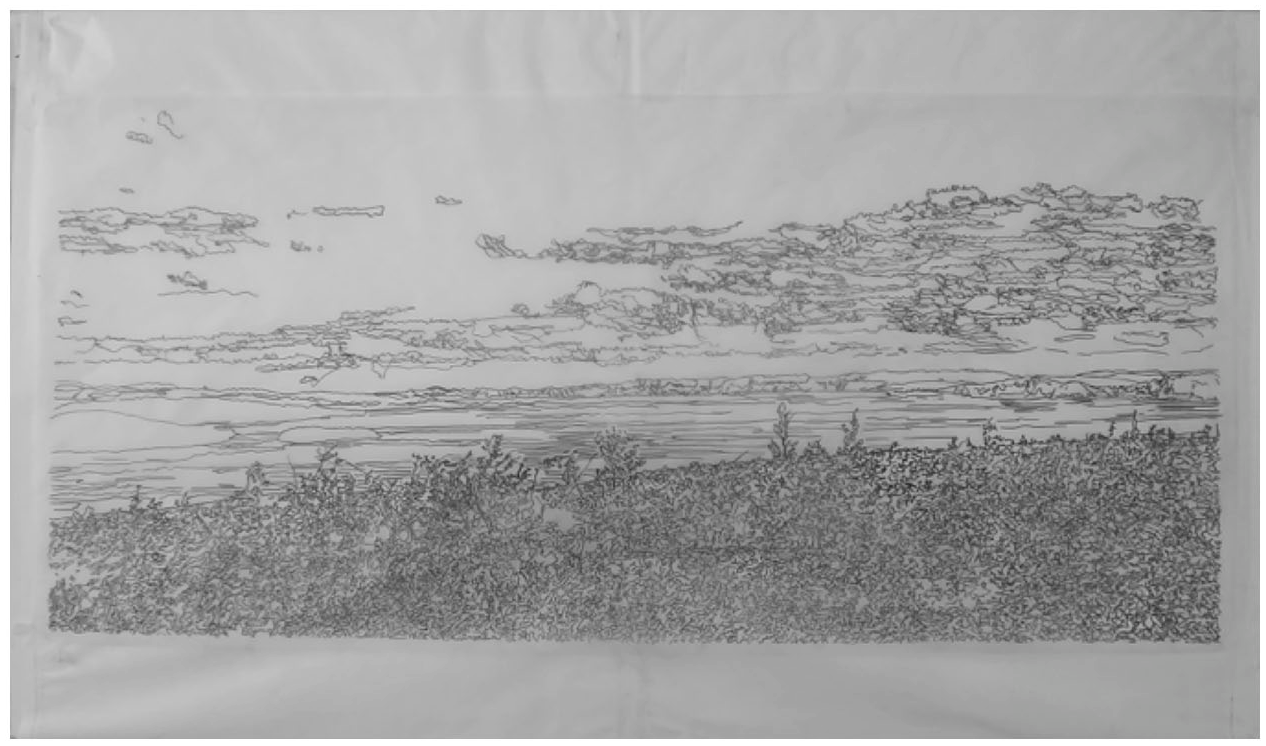
Master tracing of south-facing view of Beaverlodge Lake. © 2017, Ben Davis.
Building understanding and encouraging conversation, debate, and storytelling through community is central to this approach. At both Hospitalfield and Banff, tracings were undertaken around a large, solid table (see Figure 4). Inviting the diversity of residency participants and people from the area to informally and collectively trace – ‘tracing assemblies’ – encouraged both an interrogation of the photograph and reframed it as a physical place. In this format, tracing is a shared undertaking and practice of meaning-making (see Figure 5). Wandering lines are traced and mapped (as though across the land) until the image disintegrates and what remains is an ongoing discussion about Uranium City and associated issues, and the possibility of ‘doing’ or action in the form of continuing dialogue. These discussions were recorded to become another layer in the story, to be used later in exhibitions, or repeated with other groups to elicit further interpretations but also mobilize the stories and images to a greater degree. There is thus an iterative, looping dimension to the process. Although the Centre for Land Use Interpretation (CLUI) and Critical Art Ensemble (CAE) have different approaches to exposition (Holte, 2006; Kanouse, 2005; McKenzie and Schneider, 2000; Schneider, 2000), perhaps the technique of tracing could be seen as akin to the work of the CLUI and CAE as, with tracing, there is an attempt to aestheticize and confront something hidden, something tense, and creatively make it known and public.
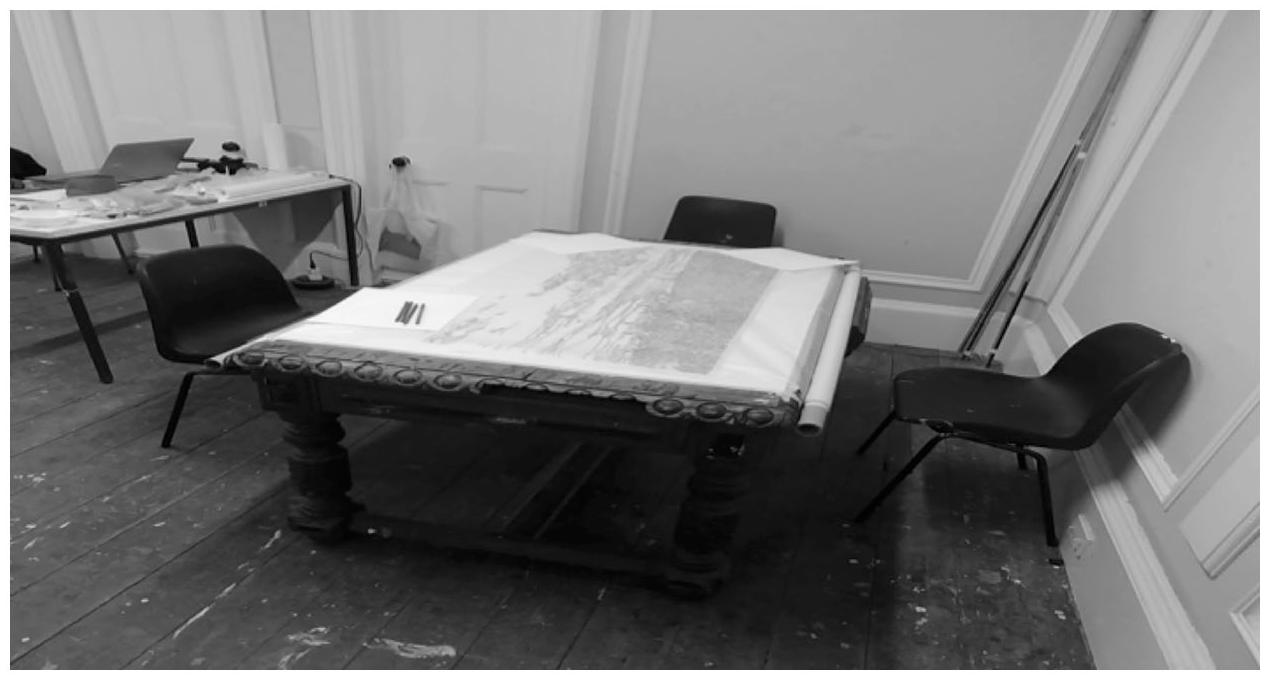
Communal tracing table, Hospitalfield Interdisciplinary Residency, Arbroath, Scotland, May 2018. © Photograph, Ben Davis.
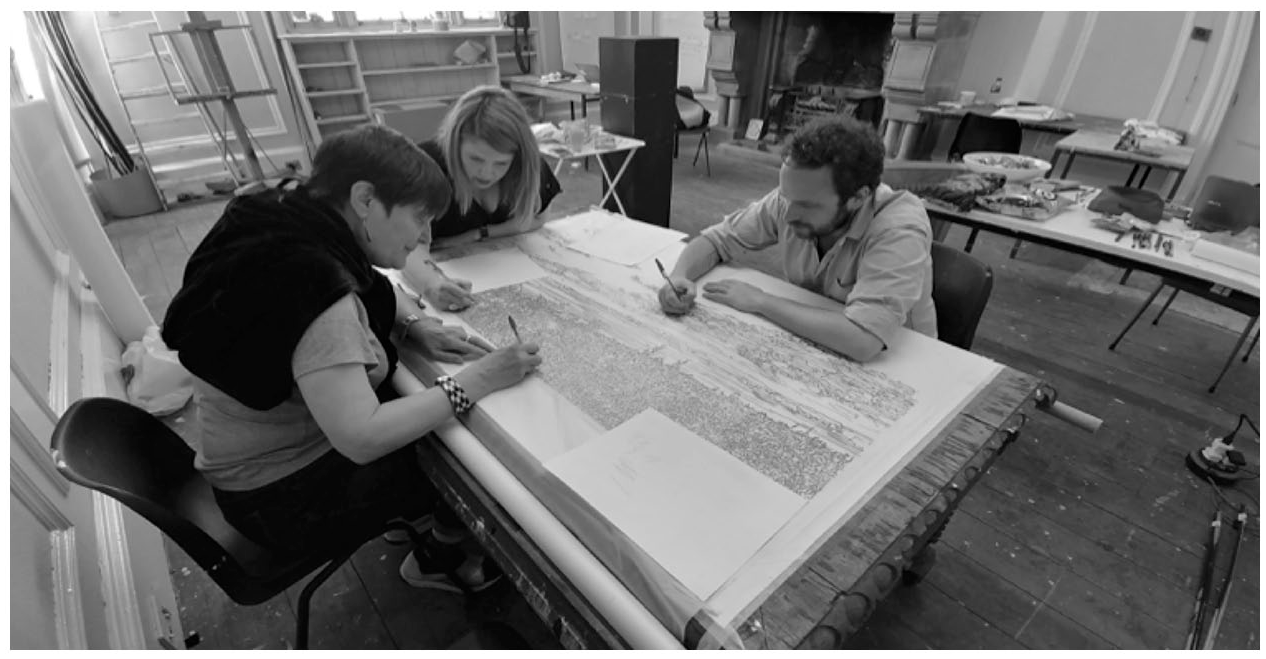
Participants tracing, Hospitalfield Interdisciplinary Residency, Arbroath, Scotland, May 2018. © Photograph, Ben Davis.
The Earthed visual arts residency at the Banff Centre for Arts and Creativity (2019) was an invaluable opportunity for Ben Davis to develop collaborative tracing further over a more extended period of time. Earthed was led by British artists Heather Ackroyd and Dan Harvey, vanguards of environmental and ecological activism, and involved working alongside a diversity of artists sharing a common focus, namely to explore: visual art practices that shed light on planetary processes and concerns . . . artistic practices [which] may operate on the margins of the typical systems of art production and exchange . . . [and which] may employ art as a conduit to engage with environmental issues including regenerative living, habitat loss and degradation, climate breakdown, biodiversity, adaptation, and more. This program investigates the confluence of ethics and aesthetics in search of alternative structures to raise cultural and political awareness of urgent environmental issues.
The residency included workshops with fellow participants and facilitators, an eclectic mix of guest speakers and traditional knowledge keepers reflecting on environmentalism, wildlife conservation, social activism, and visual arts, as well as dedicated studio time and space to think, research, and create.
Over the course of five weeks, Davis invited fellow residents, facilitators, and residency visitors to work on tracing together, working both in larger and in smaller more intimate groups. During the concluding open studio for Earthed, invited guests from the town’s community and further afield, along with the Banff Centre staff, and other interested folk also participated in the tracing (see Figure 6). As people collectively traced, recorded interviews with current residents of Uranium City played, honoring their cultural expressions and knowledge while offering a layered understanding of this remote community and its contested, troubled history. Concurrently, those people tracing were also consensually recorded, commenting on and responding to the audio provocations while adding their own diverse opinions to discussions around impacts of industry and pollution on peoples, place, culture, and climate. The intention was to centre Indigenous and non-Indigenous voices from Uranium City and to introduce new ones into the discussion, building a layered audio-scape as a key facet of tracing assemblies.
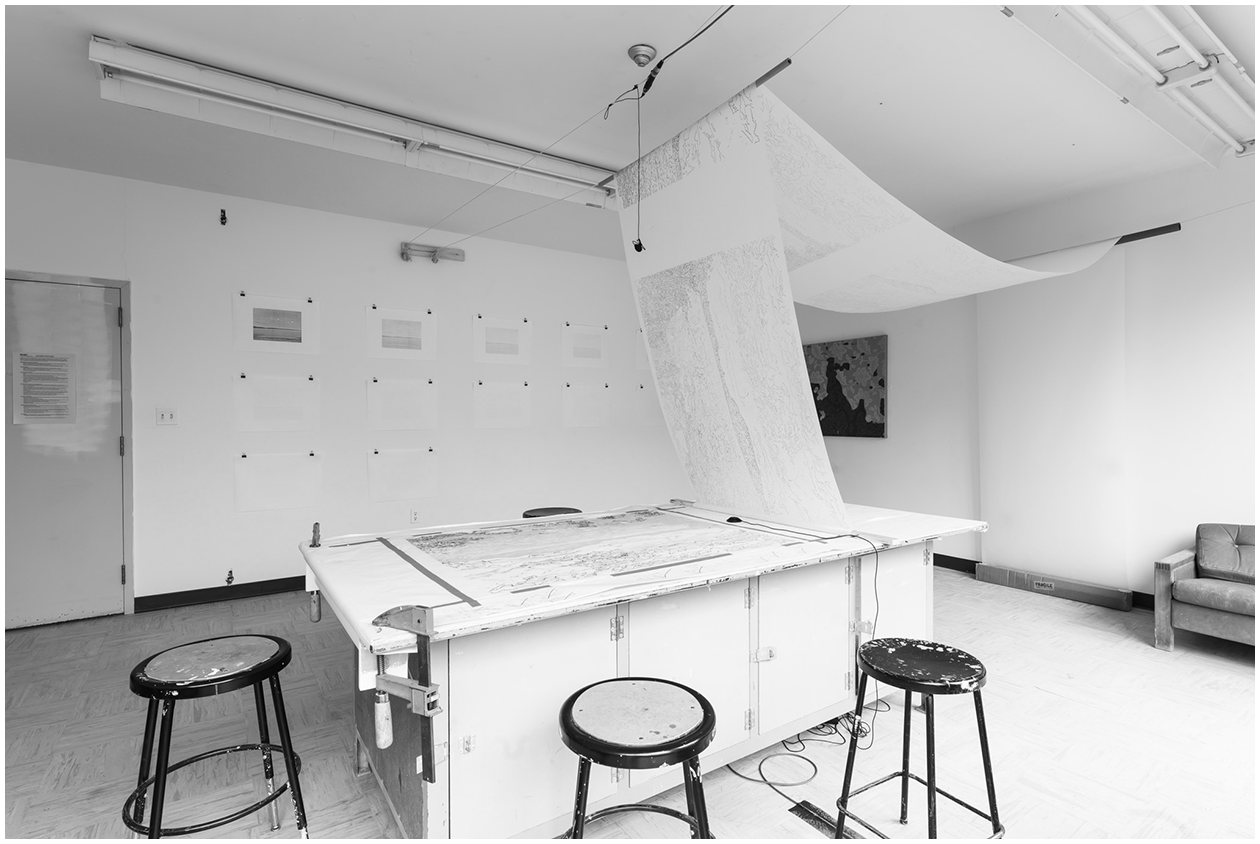
Banff Centre for Arts and Creativity Residency, Banff, Canada, May 2019. © Photograph, Ben Davis.
These recorded conversations encompassed local and global perspectives on many issues, including loss of lands and identity, relocation of Indigenous communities, employment as mine laborers, along with the many other damaging consequences of colonization and abandonment. The eclectic international make-up of the residency was key in this respect, with fellow Earthed participants offering both varying and more closely aligned/similar perspectives on the climate crisis, Indigeneity, environmentalism, and conservation informed by their backgrounds and positionality. This experience of Earthed will be vital as our project moves forward to other marginalized communities located at remote sites of large-scale resource extraction, connecting with residents toward collaboratively centering their voices, experiences, and understandings.
In one sense, tracing is a form of elicitation using photographs and artistic imagery (Alexander, 2013; Bagnoli, 2009; Clark-Ibáñez, 2004); however, it is an approach that involves creative engagement with the image rather than talking about the image. In tracing, the researcher and artist are asking participants to engage with a photograph and generate a composite of it while hearing stories about the place the image represents. The researcher and artist provide some contextual information in the form of audio clips in the background or descriptions of the site. This is a kind of elicitation that asks the tracing participants to interpret this information and to reflexively engage with the visual. The audio from interviews as well as the responses and stories of participants are used to elicit further engagement and contributions from those around the table. We note this technique of tracing could be applied to other visual data such as maps.
To contextualize and excavate the photograph, during the Earthed visual arts residency, recordings of Walby’s interviews with two long-time residents of Uranium City – one Indigenous and one settler – were played to participants as they traced: a layered visual and sonic palimpsest. The shared experience of hearing and learning from first-hand accounts of place generated a great deal of discussion, expanding conversation to wider related issues, frequently to do with environment, while also creating an opportunity for good-spirited community building. Around themes of Indigenous displacement and death, poison and contamination, as well as struggle and survival, many were surprised by how attached to these contaminated (but wild, beautiful) places the interviewed residents were and are, and by their shared nostalgia for the community of Uranium City’s short-lived but thriving past. With the Earthed residents, it was notable how some respondents made connections to other such spaces on our planet that they have witnessed or that are meaningful to them. Tracing creates a creative zone in which people are receptive to each other’s views and willing to cross-examine those same ideas and positions from across the table while continuing to trace. Tracing itself is a meditative activity, one which can generate a communal setting. It is also non-coercive as participants can respond to the dialogue and the voices of the interviewees or can trace silently, introspectively.
There is a shared intimacy in tracing and listening together. Working toward a ‘completed’ tracing unites participants within a common goal, and the tactile quality of the tracing process itself brings Uranium City closer, reducing temporal and physical distance, and creating a greater sense of immediacy. Malcolm Miles (2014: 18) writes how: curator Heike Strelow regards environmental damage as a result of nature’s estrangement. Human subjects gaze on nature as either object or resource while the ‘reality we live in’ is continuously shaped and re-shaped by representations which are complicit in that estrangement.
Rather than running the risk of becoming further mythologized (through the media) or being kept at a more remote (scientific/economic) distance through being only represented in maps and satellite imagery simply in terms of resource deposits and toxicity, our work brings Uranium City and the issues surrounding it into a more accessible present, and repopulates it both with its residents and with participants of tracing itself.
When there was no space remaining on the rolls of tracing paper, they were unfurled and installed hanging suspended in both studio spaces, evocative perhaps of walking into an old derelict home with peeling wallpaper (see Figure 7). In the years ahead, we are extending the project to include numerous rolls of gradually disappearing tracings taken from Walby’s other photographs, accumulating and suspended in one space as they are completed. Each tracing assembly creates new visual communications and layers that can in part be assembled into exhibitions. The exhibitions can include the audio components as well, at once haunting but also illuminating reminders of the lives consecrated in some of the most defiled and damaged landscapes imaginable. Contributing to methodological literature in visual studies (Mannay, 2010; Pauwels, 2010), we contend that describing tracing as we have here can provide innovative methodological and creative tools for researchers and artists using visual and creative methods and who are interested in land, contamination, pollution, and environment. There is also no reason why this approach could not be used in conjunction with other methodological approaches in visual studies and qualitative inquiry. We encourage fellow researchers and artists to adapt the technique of tracing in creative and participatory ways.
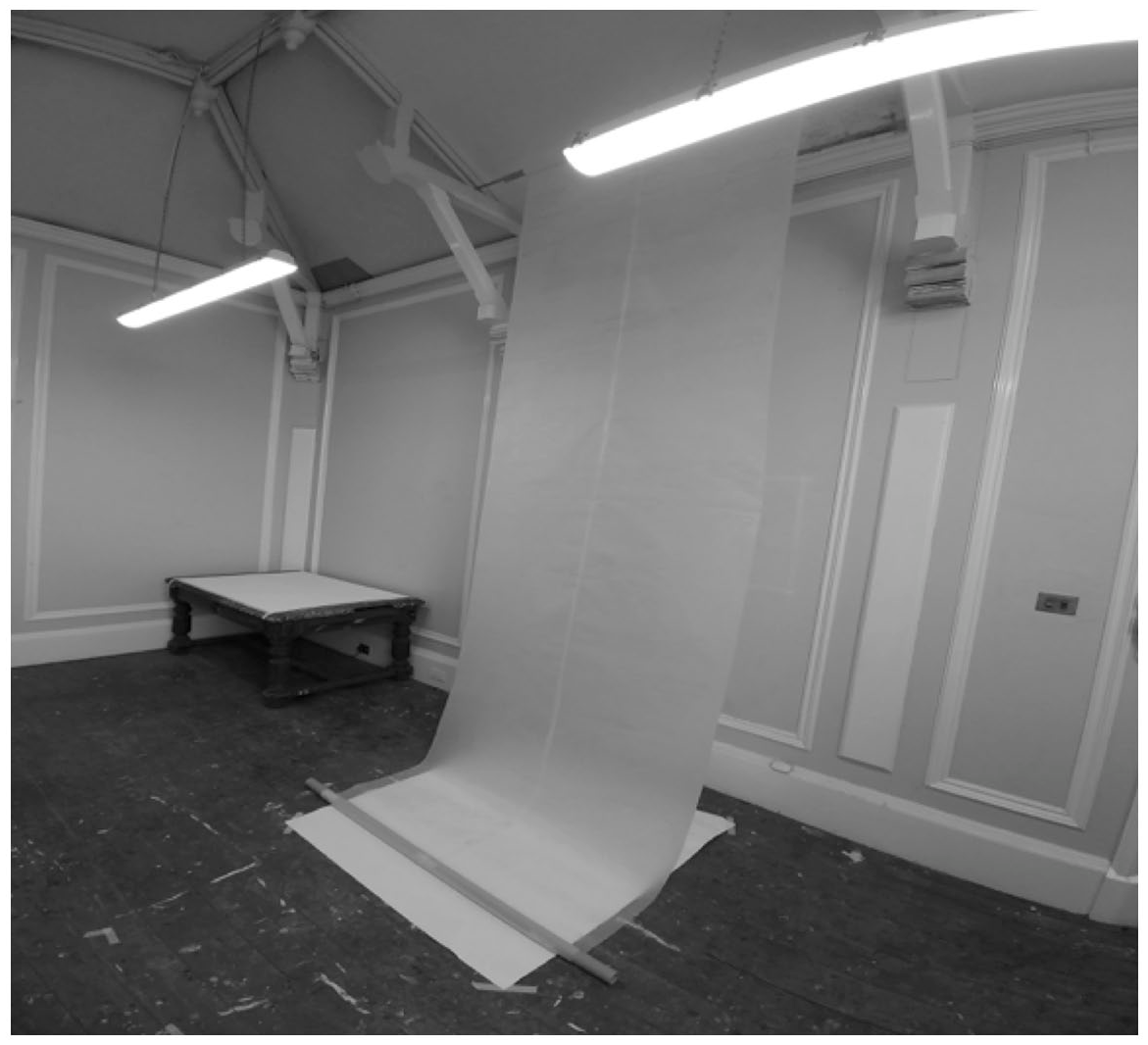
Roll of completed communal tracings installed, Hospitalfield Interdisciplinary Residency, Arbroath, Scotland, May 2018. © Photograph, Ben Davis.
Discussion: Tracing Toxic Politics
Tracing is a participatory and productive way of excavating meanings and knowledge lost in the photograph alone, building new interpretations and moments of contemplation that can be generative of future art and inquiry. There is a politics and an ethics to picturing contaminated landscapes (Davies, 2019; Kuchinskaya, 2014). Perhaps acts of tracing are a form of what Max Liboiron et al. (2018) refer to as toxic politics, a performative (rather than purely normative) approach that attempts to undo, unfurl, and unravel some ways of living while proposing other ways of subsisting at different scales or through more attentive senses. Such an intervention might be one way to alert people to the damage we are doing to the world and the molecular level of change (that enters our bodies) that we are imposing on the earth through such industrial and extractive efforts. Perhaps tracing itself can infiltrate these industrial–chemical-polluted assemblages (Peck, 2016) and transform or allure others to act differently or uncover other facets of these processes. Contributing to the project of doing art in the anthropocene (Davis and Turpin, 2015) and contesting destructive resource extraction, tracing has an aesthetic merit (Kane, 2018) very different from that of realist photography, and we hope it may resonate in more affective and sensual ways with participants and viewers. Expanding this project beyond social sciences and environmental research is intended to introduce diverse and inclusive kinds of eyes and sight to the act of interpretation, to collectively think about what is not shown and what might be omitted, and to unsettle reliance on photographic images as objective reality, thereby troubling notions of photographic positivism relying on realist readings.
As Liboiron et al. (2018: 338) put it, ‘leaks, leachates, chronic exposures, decaying infrastructure, ocean acidification, and climate change are slow disasters . . . Their scales are too large or too small to observe directly.’ As a novel technique in visual methods, we conceive of tracing as a way of comprehending these slow disasters in ways that simple visual representations sometimes prevent or disallow. With this focus on the counter-visual and tracing, we contribute to discussions of visual methods in social science and the status of photographic representations (Pink, 2003; Prosser, 2007; Margolis, 1998; Schwartz, 1989). Beyond our claims about Uranium City, we suggest that such trans-disciplinary, multi-method work straddling arts and the social sciences is not only possible but necessary to draw out the many layers of meaning generated by the practices we investigate. Trans-disciplinary work is necessary to theorize and investigate the compound dimensions of these realities.
As literature on nuclear geography (e.g. Alexis-Martin and Davies, 2017) reveals, people continue to live in sites of environmental damage and ecological destruction. They make sense of the sites in many ways and do not simply negate it (Walby, 2017; Walby and Piché, 2016). We hope to engage in tracing not only with scholars or artists but with residents from Uranium City and other sites of resource extraction, a move from researching/talking/making ‘about’ to ‘with.’ In the future, we will reconnect with past and present Uranium City residents to work with them in a collaborative way on further photographic work as well as tracings. Tracing can be a meaningfully collaborative approach to art and inquiry in ways that parallel community-based research and participatory action research, in fact it is a technique that could be incorporated into such frameworks for qualitative inquiry. It follows that tracing involves an attempt to make things happen through art that entails community intervention and participation. Beyond advocating for the technique of tracing in artistic practice and in conjunction with visual methods, we are advocating for a politics in arts and social science that is attuned to these ideas of the counter-visual and occlusion that tracing attempts to unearth. We feel this technique of tracing can be applied in many contexts and community/research partnerships.
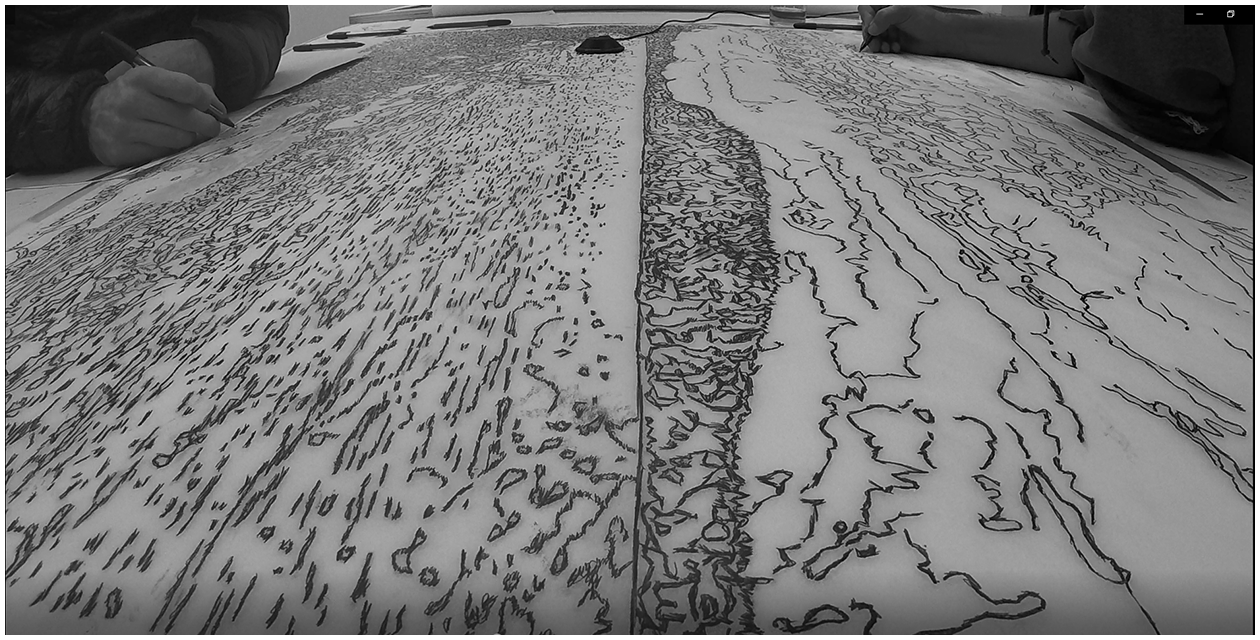
We conclude by sharing stills of a video (see Figures 8 and 9) that give a sense of the experience of communal tracing. As this occurred, we played the sound recordings of the interviews with respondents from Uranium City, adding another sensual layer to the process. Our work will continue to incorporate sound while evoking contrary notions of being undone and dissolution. The words of Uranium City residents, their stories of life and loss, are the beginning of sound, but their words then interact with the murmurs and whispers, gasps, laughter, and general noise and conversation of participants as they trace. The narrative changes in response to these new impulses and inputs as the interviews are gradually layered beneath accumulating recordings of those people reflecting and tracing together. Sound becomes unintelligible like the place that is overturned by extractive capitalism and like the lives that are pulled away from community by cyclonic capitalism. Like the discourse of extraction (gold, uranium, oil) itself, the narrative becomes just noise as more people (including ourselves) try to make sense of it and offer tinny utterances, echoing the continued senseless obliteration of the natural world.
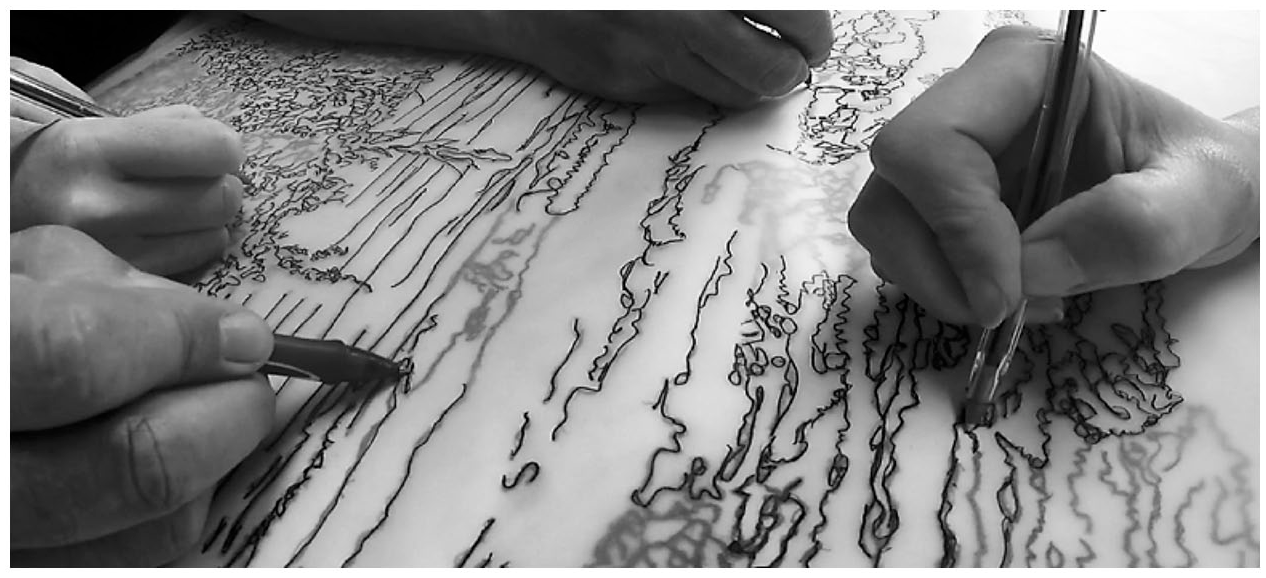
Residency participants tracing, Hospitalfield Interdisciplinary Residency, Arbroath, Scotland, May 2018. © Photograph, Ben Davis.
Residency participants tracing, Banff Centre for Arts and Creativity Residency, Banff, Canada, May 2019. © Photograph, Ben Davis.
Footnotes
Funding
The authors received no financial support for the research, authorship and publication of this article, and there is no conflict of interest.

Biographical Notes
KEVIN WALBY is Associate Professor of Criminal Justice at the University of Winnipeg. He is author of Touching Encounters: Sex, Work, and Male-for-Male Internet Escorting (University of Chicago Press, 2012). He is co-author with R Lippert of Municipal Corporate Security in International Context (Routledge, 2015). He has co-edited with R Lippert Policing Cities: Urban Securitization and Regulation in the 21st Century (Routledge, 2013) and Corporate Security in the 21st Century: Theory and Practice in International Perspective (Palgrave Macmillan, 2014). He is co-editor of Access to Information and Social Justice: Critical Research Strategies for Journalists, Scholars and Activists with J Brownlee (ARP Books, 2015), National Security, Surveillance, and Terror: Canada and Australia in Comparative Perspective with RK Lippert, I Warren and D Palmer (Palgrave, 2017), as well as The Handbook of Prison Tourism with J Wilson, S Hodgkinson and J Piche (Palgrave, 2017). He is co-editor of the Journal of Prisoners on Prisons.
Address: Department of Criminal Justice, University of Winnipeg, Centennial Hall, 3rd Floor, 515 Portage Avenue, Winnipeg, MB R3B 2E9, Canada. [ email:
BEN DAVIS is currently living and working in Manitoba. He is an Adjunct Professor at Brandon University, where he has taught in the Department of Visual & Aboriginal Art since 2008.
Address: Visual & Aboriginal Art, Brandon University, 270 18th St, Brandon, MB R7A 6A9, Canada. [ email: