This study aims to explore how political leaders used Instagram to execute self-presentation strategies in mayoral elections, including the dominant use of personalized tactics. The article reports findings of a visual framing analysis of 2,776 images featuring 2019 Istanbul mayoral election candidates Ekrem İmamoğlu (the Republican People’s Party, CHP) and Binali Yıldırım (the Justice and Development Party, AKP). The case is unusual because the initial election, which had resulted in İmamoğlu’s victory, was cancelled and a re-run was subsequently held. After many events, İmamoğlu succeeded again, becoming the first opposition politician to take control of Istanbul from the ruling AKP. In this study, we adapt Grabe and Bucy’s (2009) quantitative visual framing analysis to examine Instagram posts, from candidacy announcements until the election re-run. The results show that both candidates used the Ideal Candidate frame, with occasional increases in the frequency of the application of the Populist Campaigner frame. Self-frames in different time periods during this election are discussed, as well the frames that voters engaged with most frequently.
The rise of social media campaigns in political communication has attracted a great deal of interest since the 2008 Obama presidential campaign, which altered the dynamics of political campaigning by pioneering new strategies (Lalancette and Raynauld, 2019). Later, the use of social media in political marketing transformed into new forms thanks to data-mining technologies, mobile devices and additional applications. Early social media communication campaigns focused mostly on texts; therefore, the literature was dominated by the use and effects of textual content. Visual communication platforms, such as Instagram, YouTube, Snapchat and Pinterest have also become popular, resulting in increased scholarly interest in visual meaning-making (Muñoz and Towner, 2017). However, the importance of visual symbols and visual communication is not a new issue in the field of political communication. Recent studies have argued that visual messaging has a strong impact on the cognitive processing systems of receivers. Once an image attracts the attention of viewers, it encourages them to think about the content and to draw rational conclusions, which may result in an intended attitude formation in the receiver (Coleman and Banning, 2006). In addition, visual content provides witnessing by giving a view of what is happening and thus increasing emotional participation (Brantner et al., 2011). In this respect, images have a powerful effect on emotions (Gordillo-Rodriguez and Bellido-Perez, 2021).
As the most popular image-centric platform, Instagram has become a strategic tool for enhancing leaders’ self-images and directly addressing target groups (Turnbull-Dugarte, 2019). Likewise, leaders’ self-framing tactics on Instagram influence voters’ impressions of them. In addition, how the leaders utilize frames may increase or decrease voter engagement and influence leaders’ personal images (Muñoz and Towner, 2017). Thus, exploring the role of images in political communication campaigns has gained great importance. Previous research on politicians’ social media activities have been largely limited to Facebook and Twitter, and they mostly examine textual instead of visual content (Peng, 2021). Although leaders are increasingly using Instagram for self-presentation and expression, there are relatively few studies on their self-framing and self-presentation behaviours on the platform (Lalancette and Raynauld, 2019; Muñoz and Towner, 2017; Peng, 2021).
Recent studies have built on multimodal research to explore image-centric practices (see Stöckl et al., 2020) and explore the relations between the visual and verbal components of the Instagram posts (e.g. Caple, 2020). On the other hand, the effects of visual attributes are less understood (see Peng, 2021) and analysis of visual social media constitutes challenges on a large scale (Peng, 2021; Rodriguez and Dimitrova, 2011). Russmann (2020) categorizes the methodological challenges of studying political actors on Instagram in three parts: temporal context of the visual materials, multidimensionality of the visuals and ethical considerations. She states that, due to the fast-changing visual possibilities on Instagram, measuring instruments quickly become outdated. Russmann also mentions that carousel posts and video sharing options in one post raise methodological questions as to whether one image or one minute of a video is sufficient for a unit of analysis. Lastly, she questions to what extent the researcher can display others’ visuals to discuss findings. Political leaders, for instance, deliberately display citizens and the public in their posts. It is concluded that research on Instagram in the field of political communication is only just beginning and that it is open to new research opportunities (Russmann, 2020; Russmann and Svensson, 2016). Thus, we propose to focus on political candidates’ self-presentation and self-framing activities on Instagram during mayoral elections using Grabe and Bucy’s (2009) visual framing codebook which is specifically designed for election campaigns. Current visual framing studies tend to focus on Western democracies with relatively level playing fields for political campaigning (e.g. Grabe and Bucy, 2009; Muñoz and Towner, 2017; Steffan, 2020). The Turkish political landscape is substantially under-studied and provides an exemplary case of ‘competitive authoritarianism’, a concept that refers to regimes that are neither ‘democratic’ nor ‘authoritarian’ (Bogaards, 2009). Turkey currently has a polarized media system with a high degree of press–party parallelism (see Melek and İşeri, 2021). Turkey’s competitive authoritarian regime and highly polarized media build an uneven playing field for opposition parties in which social media’s role becomes crucial for political campaigning (see Melek and Müyesseroğlu, 2021).
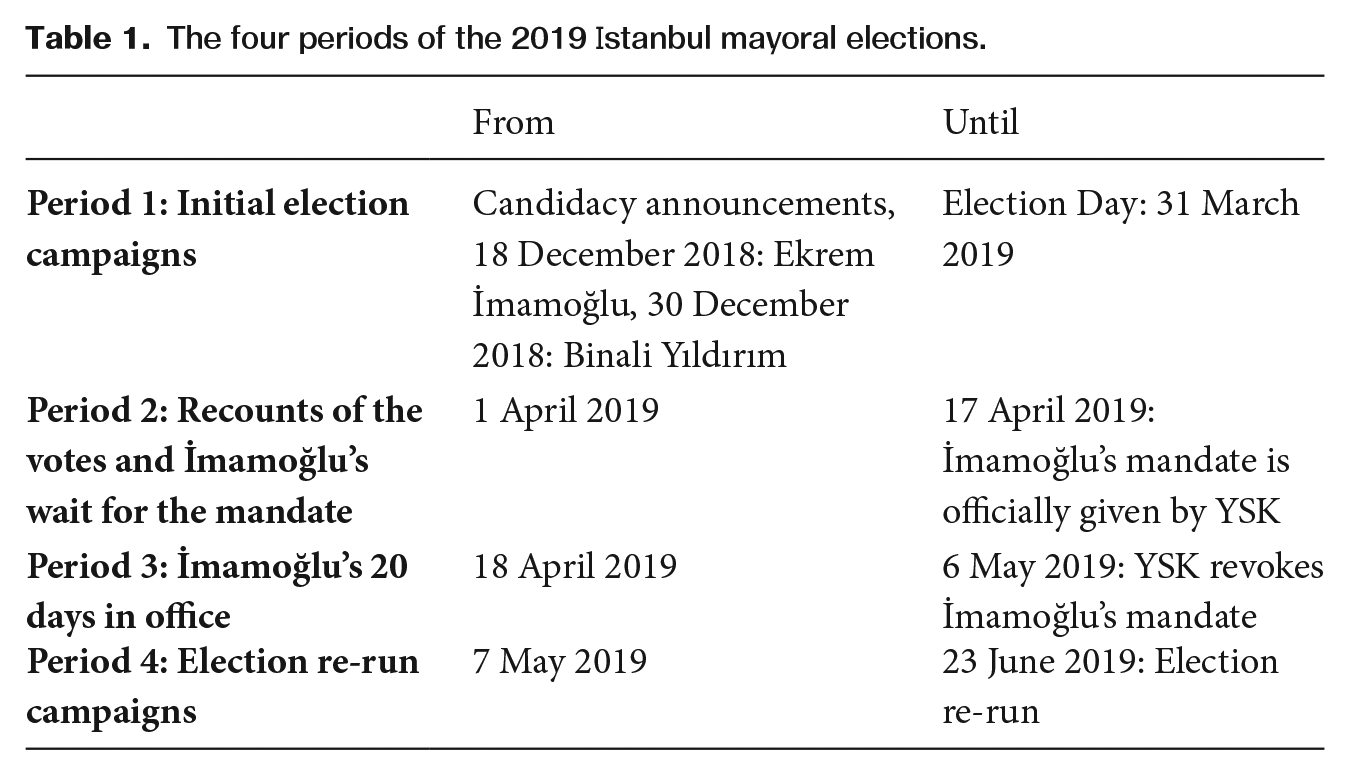
This study addresses the significance of Instagram use for self-presentation and explores how political leaders use Instagram photographs for image building through self-framing strategies beyond the context of Western democracies. We focus on the historic 2019 Istanbul mayoral elections by examining the Instagram posts of the opposition candidate, Ekrem İmamoğlu, the secular social democrat Republican People’s Party (CHP), and Binali Yıldırım, of the incumbent pro-Islamist Justice and Development Party (AKP). The study also contributes to the literature with this case, which is unusual and highly symbolic because the political Islamist parties’ 25 years of municipal dominance ended and secular social democrats were elected in Istanbul within the previously mentioned political context. Due to fraud allegations by the ruling party, the Supreme Election Council (Yüksek Seçim Kurulu [YSK]) annulled the initial election on 31 March 2019, which had ended in Ekrem İmamoğlu’s victory, and a re-run was held on 23 June 2019, which again resulted in İmamoğlu’s success. Therefore, we propose exploring how each candidate presents himself through self-framing strategies via images on Instagram (RQ1) and whether the candidates’ visual frames change between time periods (RQ2; see Table 1).
The four periods of the 2019 Istanbul mayoral elections.
From
Until
Period 1: Initial election campaigns
Candidacy announcements, 18 December 2018: Ekrem İmamoğlu, 30 December 2018: Binali Yıldırım
Election Day: 31 March 2019
Period 2: Recounts of the votes and İmamoğlu’s wait for the mandate
1 April 2019
17 April 2019: İmamoğlu’s mandate is officially given by YSK
Period 3: İmamoğlu’s 20 days in office
18 April 2019
6 May 2019: YSK revokes İmamoğlu’s mandate
Period 4: Election re-run campaigns
7 May 2019
23 June 2019: Election re-run
/table>
Theoretical Background
Visual framing
Despite the fact that images play an important role in media and political communication, research on framing has traditionally focused on textual content. The purpose of framing is ‘to select some aspects of a perceived reality and make them more salient in a communicating text, in such a way as to promote a particular problem definition, causal interpretation, moral evaluation, and/or treatment recommendation for the item described’ (Entman, 1993: 52). Thus, visual framing can be defined as a process of making certain aspects of a perceived reality more salient in a visual content to facilitate a specific understanding of a particular problem, event, or individual (Coleman, 2010; Entman, 1993; Steffan, 2020).
A substantial body of literature in recent years has applied the method of visual framing in political communication (Brantner et al., 2011; Farkas and Bene, 2021; Gordillo-Rodriguez and Bellido-Perez, 2021; Grabe and Bucy, 2009; Russmann and Svensson, 2016; Steffan, 2020). Gordillo-Rodriguez and Bellido-Perez (2021) explored the self-presentation of the five main Spanish political candidates on Instagram in order to reveal whether the candidate shows himself on Instagram in a predominantly personal and private context or in a more professional and political way. The researchers followed Goffman’s (1959) principles to explain candidates’ self-representation tactics on Instagram, which assert that candidates represent the best version of themselves or, at least, an image corresponding to what citizens may consider an ideal candidate. Farkas and Bene (2021) identified and compared the patterns and effects of Hungarian politicians’ visual-centred communication on Facebook and Instagram during the Hungarian parliamentary election campaign in 2018. The researchers explained how individualization and privatization are important dimensions of personalization. They conducted a combination of deductive and inductive visual content analysis and revealed that visuals are used mostly for personalization.
Rodriguez and Dimitrova (2011: 48) ‘propose a four-tiered model of identifying and analyzing visual frames: (1) visuals as denotative systems, (2) visuals as stylistic–semiotic systems, (3) visuals as connotative systems and (4) visuals as ideological representations.’ The denotative system is concerned with the individuals, objects and discrete elements represented in the visual. The stylistic–semiotic system in visual communication refers to stylistic choices, such as camera angle, camera distance and colour, as well as pictorial conventions, such as social distance. The ideological representations consider the hidden meanings of the visual frames, while the connotative system explores figurative symbols and visual metaphors. Recent studies have applied a multimodal approach to study visual framing analysis of various topics such as climate change and migration (Hellmueller and Zhang, 2019; Wozniak et al., 2015). For instance, in their visual framing analysis of CNN and Spiegel Online’s coverage of refugees, Hellmueller and Zhang (2019) utilized the four-tiered model and combined the denotative system, the stylistic–semiotic system, the connotative system and ideological representations. Some scholars also suggest integrating structural features into the stylistic–semiotic perspective in visual framing analyses (e.g. Coleman, 2010; Dan, 2018). In the present study, we use a denotative deductive system because the study deduces two visual frames (i.e. the Ideal Candidate and the Populist Campaigner) from Grabe and Bucy’s (2009) visual framing analysis and explores the extent to which these visual character frames occur in the sample; we further explore the visually manifest content of candidates’ Instagram posts. To study election campaigns on television news, Grabe and Bucy (2009) developed a coding sheet and analysed presidential election campaigns in the US between 1992 and 2004. Several researchers have extended Grabe and Bucy’s methodology to explore candidates’ visual self-presentation on social media sites (e.g. Muñoz and Towner, 2017; Steffan, 2020). Muñoz and Towner (2017) analysed the US presidential primary candidates’ Instagram profiles and they revealed that the Ideal Candidate frame was preferred to the Populist frame and received the most likes and comments from users. Likewise, Steffan (2020) examined the visual self-presentation of political candidates on different social media platforms (Facebook, Instagram and Twitter) in seven Western democracies (Austria, Canada, France, Germany, Norway, the UK and the US). He demonstrated that candidates are more likely to use the Ideal Candidate frame than that of the Populist Campaigner. Because of the extent to which we rely on this coding sheet and approach, the details of the codebook are presented in the methodology section.
Social media in political campaigning
The expanding role of social media in political communication has meant that leaders can disseminate information and interact with citizens without intermediaries such as the mass media. Although there is no evidence that social media has taken the place of traditional media in political communication, traditional media coverage is extensively documented and debated on social media (Enli, 2017). It is also known that image-driven social media platforms provide materials for the traditional media outlets as political leaders generate easily diffusible contents (Turnbull-Dugarte, 2019). In a way, this content may have the potential of shaping and driving the televised media outlets. As a consequence, there is a growing interest in examining social media platforms in political campaigns in different contexts. Several scholars have analysed how social media is used in election campaigns (Enli, 2017; Filimonov et al., 2016; Liebhart and Bernhardt, 2017; Melek and Müyesseroğlu, 2021; Muñoz and Towner, 2017; Turnbull-Dugarte, 2019). Research has revealed that social media platforms are mainly used as a strategic communication tool in four different ways: to broadcast election messages, mobilize supporters, manage images of a leader/party and to enhance or complement other campaign components (Filimonov et al., 2016). Some researchers have explored the effects of different social media platforms on citizens’ perception of political leaders and their agenda-setting effect (Eldin, 2016; Melek, 2017; Metz et al., 2019; Towner, 2013). These studies have illustrated that the use of social media platforms during election campaigns attracts higher levels of audience attention and interest. It was also revealed that when political leaders share more emotional and private content, they create positive impressions on citizens (Gordillo-Rodriguez and Bellido-Perez, 2021).
Personalization and self-presentation on social media are noteworthy in recent political communication research (Farkas and Bene, 2021; Goodnow, 2013; Gordillo-Rodriguez and Bellido-Perez, 2021; Jackson and Lilleker, 2011; Metz et al., 2019; Muñoz and Towner, 2017). Political personalization is explained as ‘a process in which the political weight of the individual actor in the political process increases over time, while the centrality of the political group (i.e., political party) declines’ (Rahat and Sheafer, 2007: 65). Social media analysis in political communication has illustrated that personalized posts on social media get more audience feedback in the form of likes and comments than depersonalized posts. Moreover, personalized content has more potential to be viral since it is mostly more emotional (Peng, 2021). Recent research has also highlighted that the personalization strategy in digital political campaigns triggers the audience’s positive perception. Content about leaders instead of political parties ‘decrease[s] the complexity of the message and increase[s] the credibility of the message’ (Filimonov et al., 2016: 3). Additionally, recent digital political campaigns have favoured not only textual but also visual content. Some studies have shown that using multimodal presentations – texts and visual elements – has different effects on user reactions (Casas and Williams, 2019; Lee and Xu, 2018), yet the visual attributes’ impacts are less understood (see Peng, 2021). Visuals have also been shown to influence viewers’ perceptions of politicians (e.g. Grabe and Bucy, 2009; Joo et al., 2014; Peng, 2018; Shah et al., 2016). However, there is a divide between the amount of visuals in politicians’ social media posts and our understanding of how diverse political messages promote audience engagement. The way that candidates personalize their campaigns on social media, for instance, is a typical technique on political social media, and empirical research supports the assumption that self-personalization helps politicians to gain good impressions (Lee and Oh, 2012; McGregor, 2018; Meeks, 2017). However, there is little research on the visual side of personalization (e.g. Peng, 2021). Thus, we explore the concepts of personalization and self-presentation and how they are mirrored in the visual representations of candidates and office holders in a competitive authoritarian regime.
Instagram
Political parties and leaders have noticed the attitudinal and behavioural impacts of visual social media platforms such as YouTube, Instagram, Snapchat and Pinterest on citizens, and they have adopted these platforms to reach wider groups to increase their credibility and utilize self-framing tactics (Muñoz and Towner, 2017). As the most popular visual-centred platform, Instagram has become a great opportunity for image enhancement and for directly addressing the public (Turnbull-Dugarte, 2019).
Instagram is a photo and video sharing social media platform that enables users to post, share, comment and like images. As of June 2018, it was reported that Instagram had more than 1 billion active users a month (Clement, 2020). In Turkey, there were 36,040,000 Instagram users as of May 2019, making it one of the top five countries with the most Instagram users (Johnson, 2020). Furthermore, Instagram achieves significantly higher user engagement rates compared to Facebook and Twitter (Muñoz and Towner, 2017).
This study investigates Instagram posts during the eventful 2019 Istanbul mayoral election by the candidates Ekrem İmamoğlu and Binali Yıldırım. In Istanbul, 52 percent of the population uses Instagram (Konda, 2019). According to Konda’s Ballot Box Analysis of the June 23rd Istanbul Election and Voter Profiles report (2019), 49 percent of Istanbul’s Instagram users were supporters of İmamoğlu as of March 2019 (at the end of the initial election). This ratio increased to 57 percent by the end of the election re-run in June 2019. As for Yıldırım, 36 percent of the Instagram users were his supporters as of March 2019. However, for him, the ratio decreased to 34 percent by the end of the election re-run. It is clear that İmamoğlu used Instagram images as a political communication strategy (Melek and Müyesseroğlu, 2021), whereas Yıldırım was not a frequent user of the platform despite its popularity in Turkey (Johnson, 2020). Since the winning leader, İmamoğlu, is the most frequent user of Instagram as a political leader, the study reveals exceptional data for Instagram use as a self-framing tactic in Turkey. Moreover, the 2019 Istanbul mayoral election is a very extraordinary case as explained in detail in the following section. Hence, the political communication used during the different periods of the election are worth studying in order to gain insights about the results of the election. Lastly, this study is based on quantitative content analysis to examine Instagram images by modelling previous literature, so we believe the study illustrates more objective and reliable findings.
The eventful 2019 Istanbul mayoral elections: an extraordinary case
In the 2019 Istanbul mayoral elections, Ekrem İmamoğlu became the first opposition politician to take control of the city in a quarter of a century of the political Islamist parties’ rule in Turkey’s polarized context under its competitive authoritarian regime. Levitsky and Way (2010) have explained the distinctive feature of this type of regime as an unequally built democratic playing field in conducting electoral campaigns and winning elections (e.g. the misuse of state power, and the capture and discipline of opposition media). Therefore, it is worth explaining the achievement of the opposition block despite the country’s context and how Istanbul’s election was annulled as part of Turkey’s municipal elections on 31 March 2019. According to preliminary results, the opposition secular social democrat CHP’s Ekrem İmamoğlu won Istanbul by nearly 22,000 votes (48.8% vs 48.55% for the incumbent AKP candidate). Following AKP complaints, the Supreme Election Council (YSK) ruled in favour of a partial recount of votes, in response to opposition criticism. After 17 days of recounts, Ekrem İmamoğlu was declared the winner by a margin of 13,729 votes and YSK issued his mandate. However, due to complaints from AKP members that some electoral officials were not civil servants, some result papers were unsigned and some votes were stolen, the election was annulled and he was stripped of his duties 20 days after he took office (Lowen, 2019). CHP representatives claimed that the annulment was not legally justified and that the ruling AKP had influenced the YSK to make this decision. During the election re-run (23 June 2019), İmamoğlu gained a massive 54.22 percent, which stands as the highest portion of votes achieved in the Istanbul mayoral elections in the last 35 years (Yıldırım earned 45%). Therefore, the margin increased to 806,014 votes in the end (YSK, 2019).
Methodology
In this study, we conducted a visual framing analysis to determine how the candidates presented themselves on Instagram. The candidates’ personal Instagram account posts were collected from the day immediately following their candidacy announcements in December 2018 until the election re-run (23 June 2019). Two assistants manually archived Instagram data with the help of smartphones for the defined period. All textual digital content (e.g. captions, emoji, etc.), videos and stories were excluded; only still images, including those from photo galleries, were analysed.
For the analysis, we applied the initial coding sheet from Grabe and Bucy’s (2009) systemic coding for the visual framing of presidential candidates in news coverage and adopted it for our research. Grabe and Bucy’s original coding sheet includes three main visual framing themes: (1) the Ideal Candidate, (2) the Populist Campaigner, and (3) the Sure Loser. The Sure Loser master frame depicts the candidate in a negative way and reveals campaign errors. As our research focused on self-framing, we assumed that the campaign strategies for self-presentation did not demonstrate the candidates’ negative traits. Therefore, we excluded the Sure Loser master frame from our codebook in line with previous studies (Cmeciu, 2014; Goodnow, 2013; Muñoz and Towner, 2017). The final coding sheet includes two master frames with their 4 dimensions and 23 subdimensions. The following paragraph briefly summarizes the Ideal Candidate and Populist Campaigner master frames and their related dimensions and subdimensions.
The first master frame, the Ideal Candidate, presents two broad dimensions: statesmanship and compassion. Statesmanship includes seven visual subdimensions, which mostly depict power, control and active leadership (Grabe and Bucy, 2009). These subdimensions are: elected officials and other influentials, patriotic symbols; symbols of progress (e.g. manufacturing plants); identifiable entourage (e.g. reporters and aides); campaign paraphernalia; political hoopla (e.g. streamers); and candidates in formal attire. The second broad dimension, compassion, includes images that represent affection, sympathy and goodwill. The subdimensions of compassion are: children; family associations; admiring women; religious symbols; affinity gestures (e.g. thumbs up); interaction with individuals; and physical embraces.
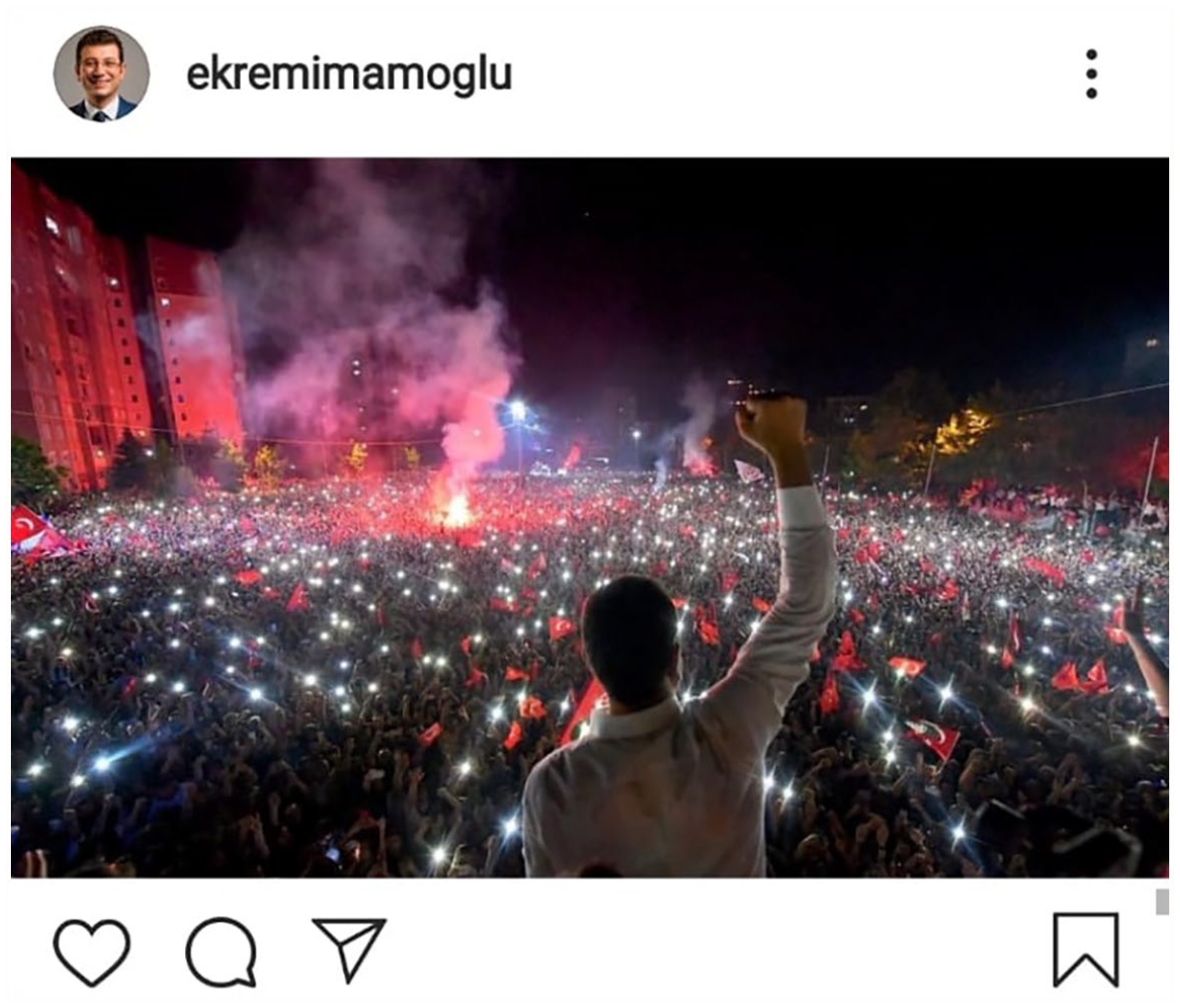
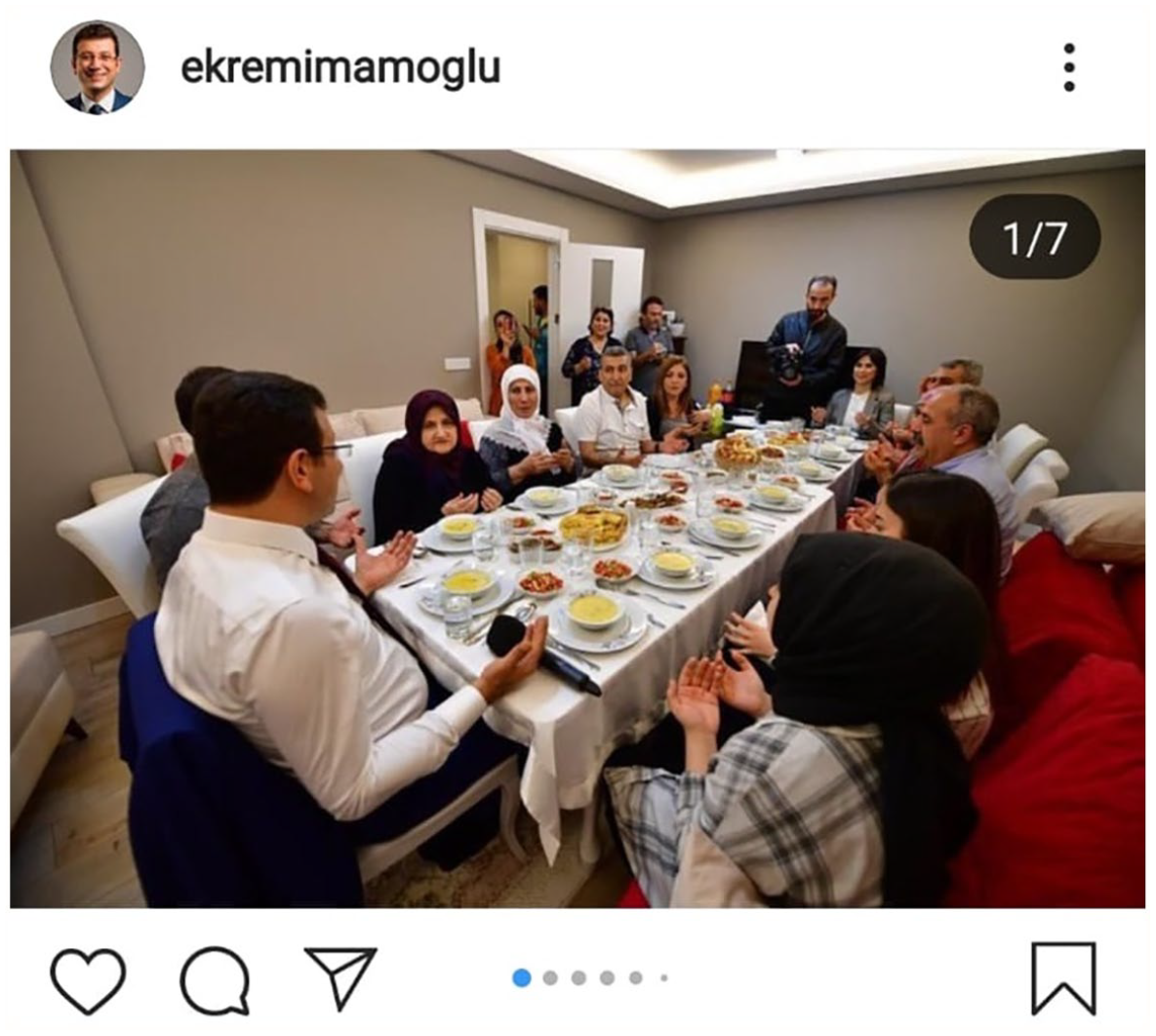
The second master frame, the Populist Campaigner, depicts two broad dimensions: mass appeal and ordinariness. Mass appeal (see Figure 1) builds upon the idea that the candidate has gained popularity and acceptance. Images that portray celebrities, large audiences, approving audiences and interaction with crowds that reflect diverse formulations of popularity constitute the subdimensions. Ordinariness has the following subdimensions: candidates wearing informal attire, casual dress, or athletic clothing; interacting with ordinary people; and participating in physical activities.
Screenshot of a post by İmamoğlu depicting Populist Campaigner framing (mass appeal dimension).
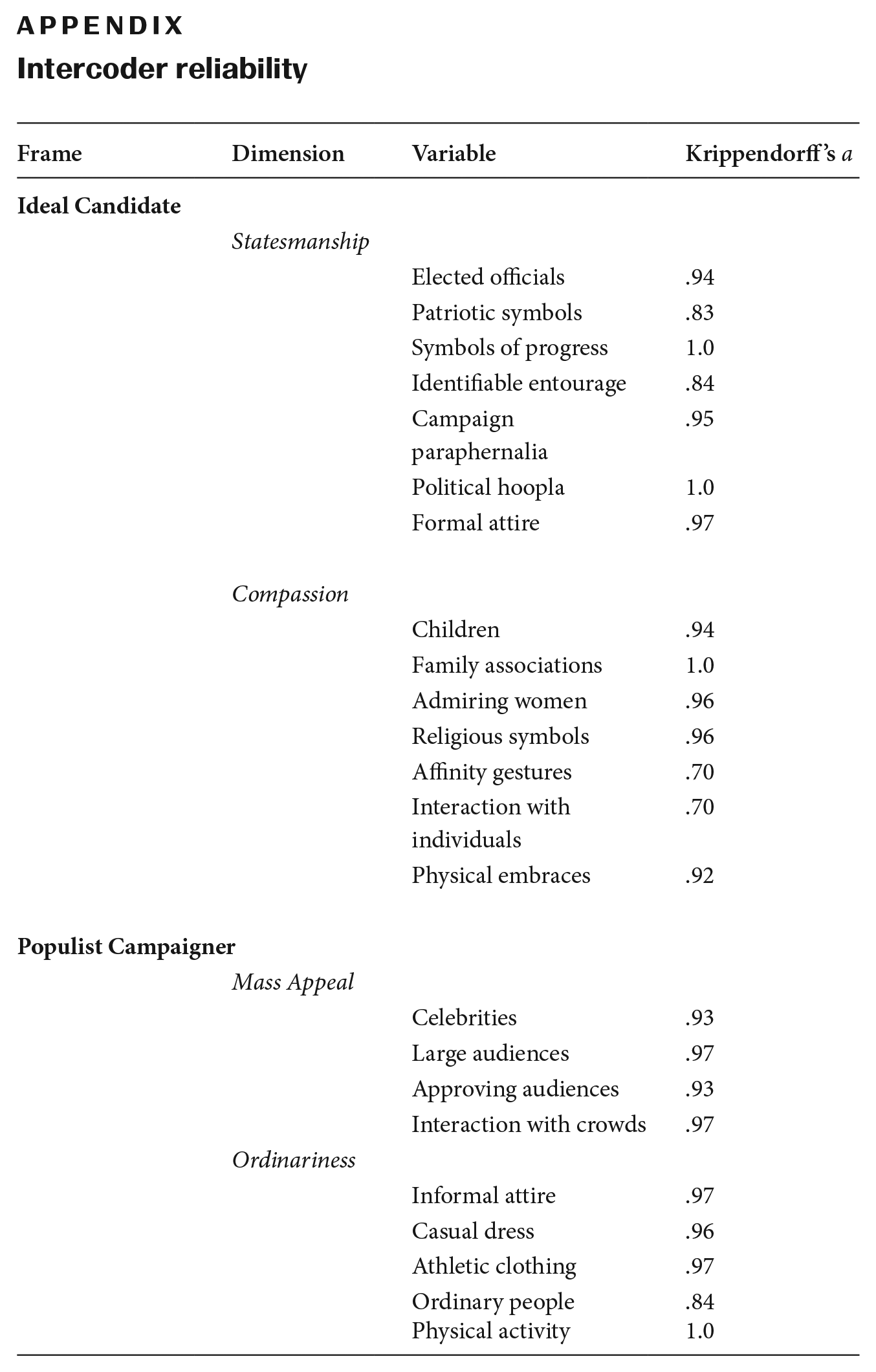
The presence (value = 1) or absence (value = 0) of a primary visual dimension was coded per image to produce scores for each candidate. Each image could be coded into more than one frame. A pre-test was conducted to calculate intercoder reliability between coders using Krippendorff’s Alpha analysis. The results showed that the average intercoder reliability was high (Kalpha = .93; see the Appendix for detailed intercoder reliability for each variable). The coders completed the coding process over the course of eight weeks in November and December 2019, and January 2020.
Results
Results showed that Ekrem İmamoğlu (n = 2,561) was a more frequent Instagram user than Binali Yıldırım (n = 215) during the 2019 Istanbul mayoral elections. The variance in the frequency of Instagram posts was also stark between the different time periods: (1) initial election campaigns; (2) recounts of the votes and İmamoğlu’s wait for the mandate; (3) İmamoğlu 20 days in office; and (4) election re-run campaigns.
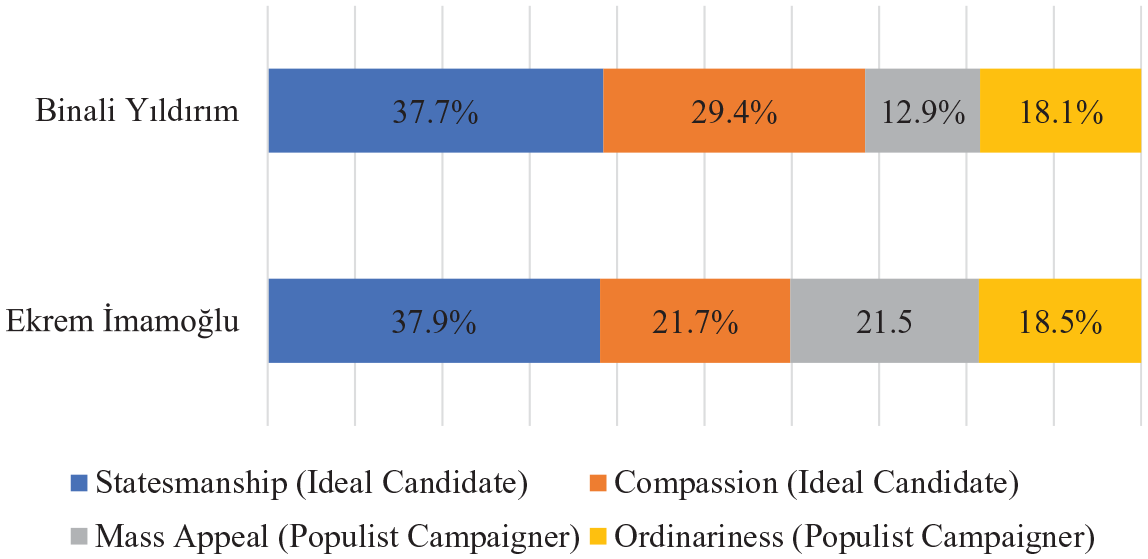
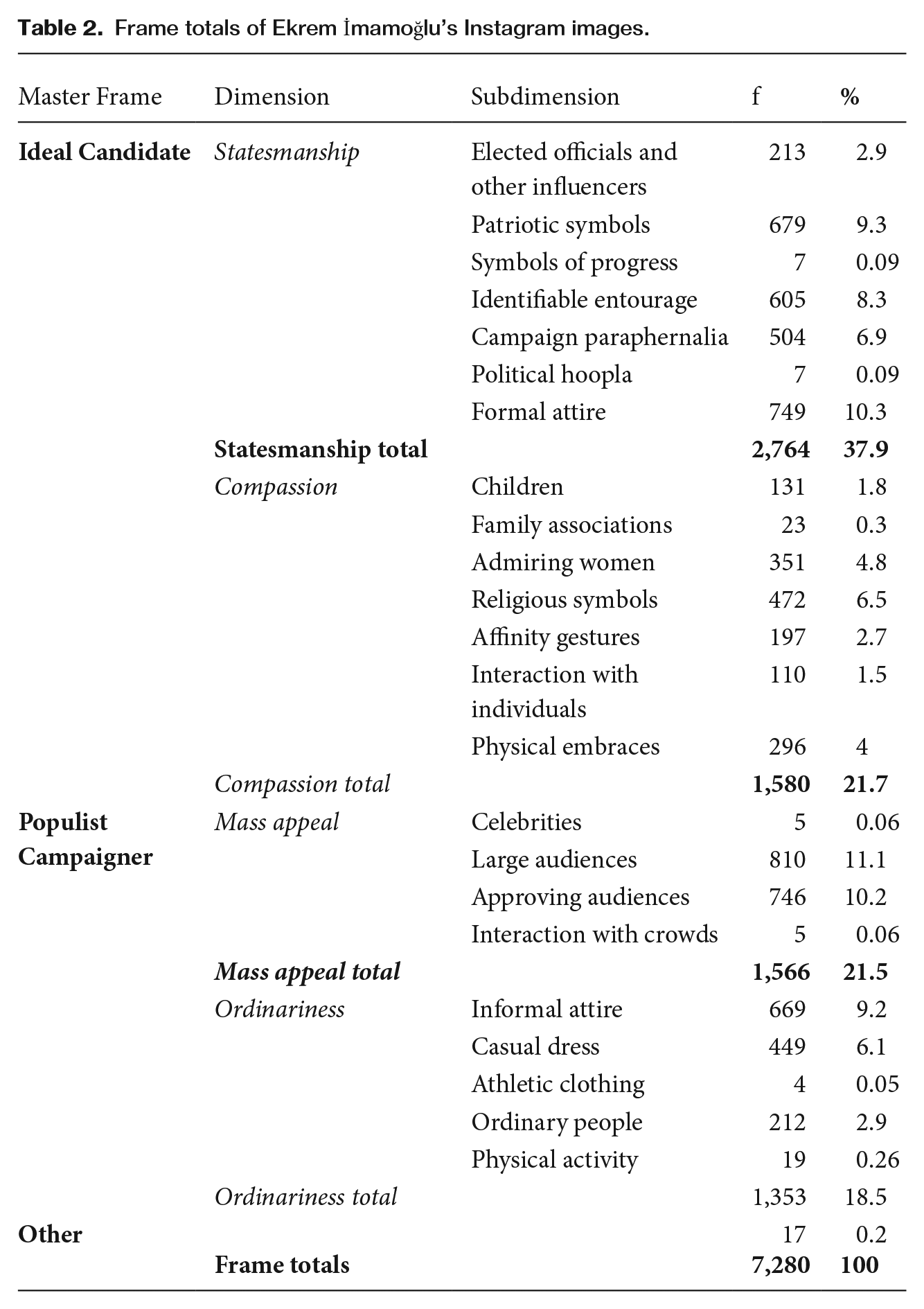
In order to calculate the self-framing patterns, we identified total frame usage by candidate. For İmamoğlu’s sample, a total of 7,280 frames were identified in 2,561 images. For Yıldırım’s sample, a total of 580 frames were identified in 215 images. Overall frame usage by candidate can be seen in Figure 2.
The candidates’ overall frame usage.
It is clear that both candidates preferred to utilize the Ideal Candidate (see Tables 2 and 3). Although several contextual characteristics, such as media and political systems, are different in Turkey, the result is consistent with the previous literature findings focusing on visual framing. Muñoz and Towner (2017) revealed that the US presidential election candidates preferred Ideal Candidate frames to Populist Campaigner on Instagram. Similarly, Steffan (2020) demonstrated that candidates from seven different Western democracies are more likely to use the Ideal Candidate frame than that of the Populist Campaigner on social media platforms.
Frame totals of Ekrem İmamoğlu’s Instagram images.
Master Frame
Dimension
Subdimension
f
%
Ideal Candidate
Statesmanship
Elected officials and other influencers
213
2.9
Patriotic symbols
679
9.3
Symbols of progress
7
0.09
Identifiable entourage
605
8.3
Campaign paraphernalia
504
6.9
Political hoopla
7
0.09
Formal attire
749
10.3
Statesmanship total
2,764
37.9
Compassion
Children
131
1.8
Family associations
23
0.3
Admiring women
351
4.8
Religious symbols
472
6.5
Affinity gestures
197
2.7
Interaction with individuals
110
1.5
Physical embraces
296
4
Compassion total
1,580
21.7
Populist Campaigner
Mass appeal
Celebrities
5
6
Large audiences
810
11.1
Approving audiences
746
10.2
Interaction with crowds
5
0.06
Mass appeal total
1,566
21.5
Ordinariness
Informal attire
669
9.2
Casual dress
449
6.1
Athletic clothing
4
0.05
Ordinary people
212
2.9
Physical activity
19
0.26
Ordinariness total
1,353
18.5
Other
17
0.2
Frame totals
7,280
100
Frame totals of Binali Yıldırım’s Instagram images.
Master Frame
Dimension
Subdimension
f
%
Ideal Candidate
Statesmanship
Elected officials and other influencers
12
2
Patriotic symbols
22
3.8
Symbols of progress
–
–
Identifiable entourage
45
7.7
Campaign paraphernalia
26
4.4
Political hoopla
–
–
Formal attire
114
19.6
Statesmanship total
219
37.7
Compassion
Children
33
5.7
Family associations
4
0.7
Admiring women
25
4.3
Religious symbols
58
10
Affinity gestures
18
3.1
Interaction with individuals
9
1.5
Physical embraces
24
4.1
Compassion total
171
29.4
Populist Campaigner
Mass appeal
Celebrities
1
Large audiences
20
3.4
Approving audiences
54
9.3
Interaction with crowds
–
–
Mass appeal total
75
12.9
Ordinariness
Informal attire
84
14.5
Casual dress
4
0.7
Athletic clothing
–
–
Ordinary people
16
2.8
Physical activity
1
0.1
Ordinariness total
105
18.1
Other
10
1.7
Frame totals
580
100
İmamoğlu shared images that reflected the statesmanship dimension 2,764 times (37.9%) in total, whereas he shared images that reflected the compassion dimension 1,580 times (21.7%) in total. The subdimensions formal attire (n = 749, 10.3%) and patriotic symbols (n = 679, 9.3%) were the most preferred ones for statesmanship among İmamoğlu’s images. Furthermore, the subdimension religious symbols (n = 472, 6.5%) was the dominant item in the compassion category (e.g., Figure 3). Through in-depth analysis, we concluded that his self-framing strategies were consistent with his election campaign. As a relatively young political figure, Ekrem İmamoğlu started his political career when he joined the main opposition party, the CHP, in 2009 (İBB Istanbul, nd). After serving as a member and then the head of CHP’s Beylikdüzü District Organization, he was elected as the mayor of the district of Beylikdüzü in western Istanbul in the 2014 local elections (France 24, 2019). Therefore, his main goal during the 2019 Istanbul mayoral elections campaign was to gain public trust and become a more recognizable leader (Özkan, 2019). We think that using statesmanship and compassion dimensions and formal attire, patriotic symbols and religious symbols sub-dimensions in his Instagram photos served to build his reputation as a relatively young candidate. He also utilized the Populist Campaigner via Instagram images. The results showed that n = 1,566 (21.5%) photos fell into the mass appeal dimension and n = 1,353 (18.5%) photos fell into the ordinariness dimension. Most posts reflecting the mass appeal dimension included large audiences images (n = 810, 11.1%). An example of large audiences sub-dimension can be seen in Figure 1. Moreover, İmamoğlu preferred sharing images that framed him in informal attire (n = 669, 9.2%), which fell into the ordinariness subdimension. The above-mentioned Populist Campaigner frames were often supported with his other campaign practices. During his campaign, İmamoğlu and his team adopted positive rhetoric in contrast to the often negative discourse and vicious attack style of Turkish politicians (see Melek and Müyesseroğlu, 2021). In addition, he was regularly seen in public places taking selfies and interacting with voters. His friendly manner toward voters, his campaign message of love, hope and unity on the premise of embracing everyone despite their ideological opinions, as well as his optimism appealed to both religious conservatives and the Kurdish minority as well as Turkish nationalists (Gall, 2019; Melek and Müyesseroğlu, 2021).
Screenshot of a post by İmamoğlu depicting Ideal Candidate framing (compassion dimension– religious symbols sub-dimension).
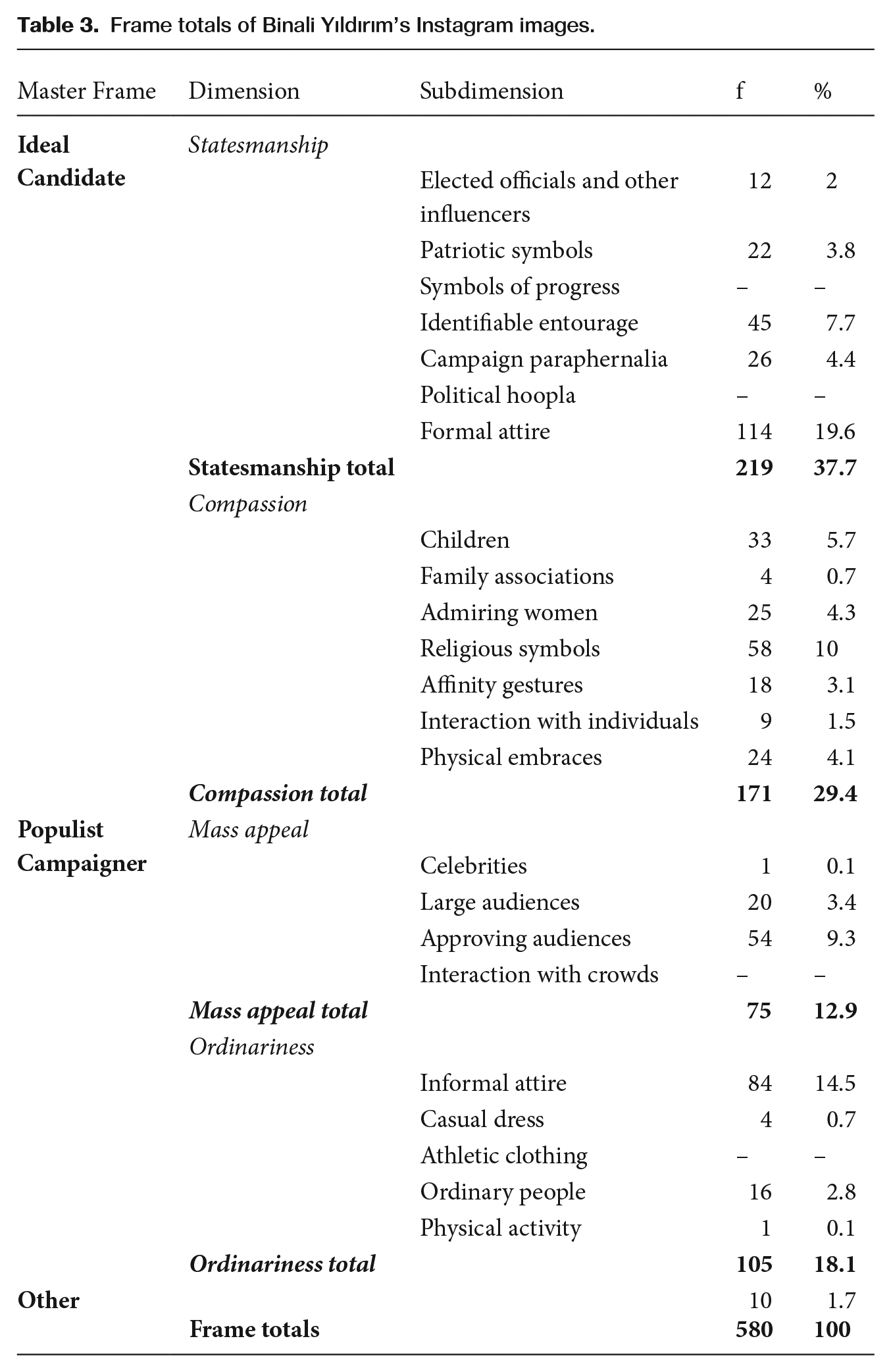
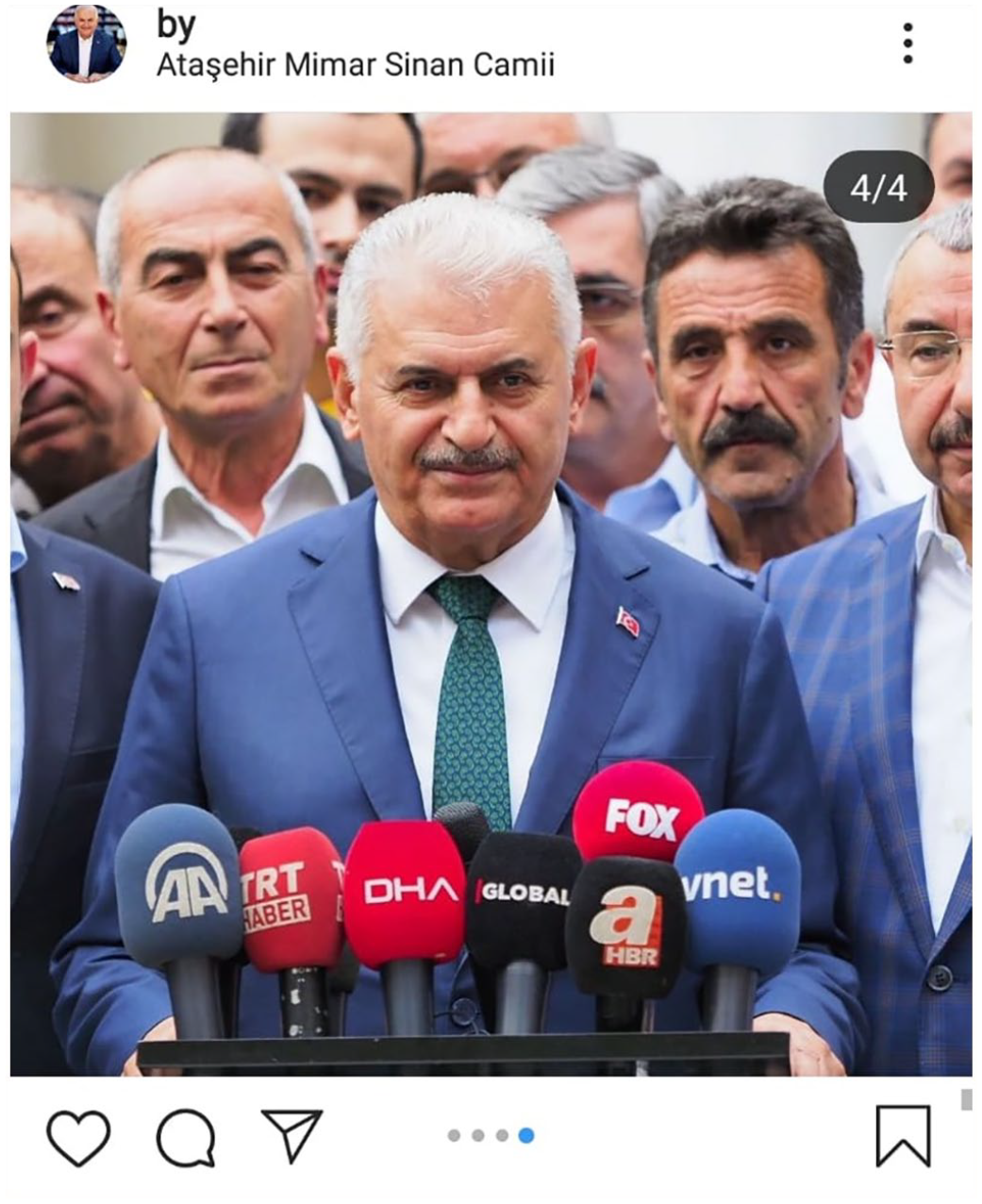
When Yıldırım’s Instagram images were analysed, we found that he mostly used the statesmanship dimension (n = 219, 37.7%), which fell into the Ideal Candidate master frame (e.g., Figure 5). Most posts for this dimension included identifiable entourage images (n = 45, 7.7). He also preferred self-frames in line with the compassion dimension (n = 171, 29.4%), for which he mostly used religious symbols (n = 58, 10%). We think that the way Yıldırım used self-frames is consistent with his extensive political background. As an experienced candidate who was referred to as AKP’s ‘permanent’ minister of transport, Yıldırım was a less frequent user of Instagram during the 2019 Istanbul mayoral election. He was already a well-known figure, who held the ministerial position on and off for nearly 12 years (2002–2013/2015–2016). Yıldırım is also known as Turkey’s last prime minister because after the referendum in April 2017, the parliamentary system was abolished and an executive presidency system was introduced; hence, Yıldırım was effectively the last prime minister of the Republic of Turkey.
In addition, he utilized the Populist Campaigner 180 times. In his Instagram images, he used approving audiences (n = 54, 9.3%) under the mass appeal dimension and informal attire (n = 84, 14.5%) under the ordinariness dimension. Approving audiences under the mass appeal dimension portray his supporters at public meetings; he used the photos evoking this dimension as one of his main campaign strategies. The informal attire subdimension usually includes photos depicting him in suits without a tie which is a style preferred by pro-Islamists, because a tie is considered to be a part of Western and secular culture.
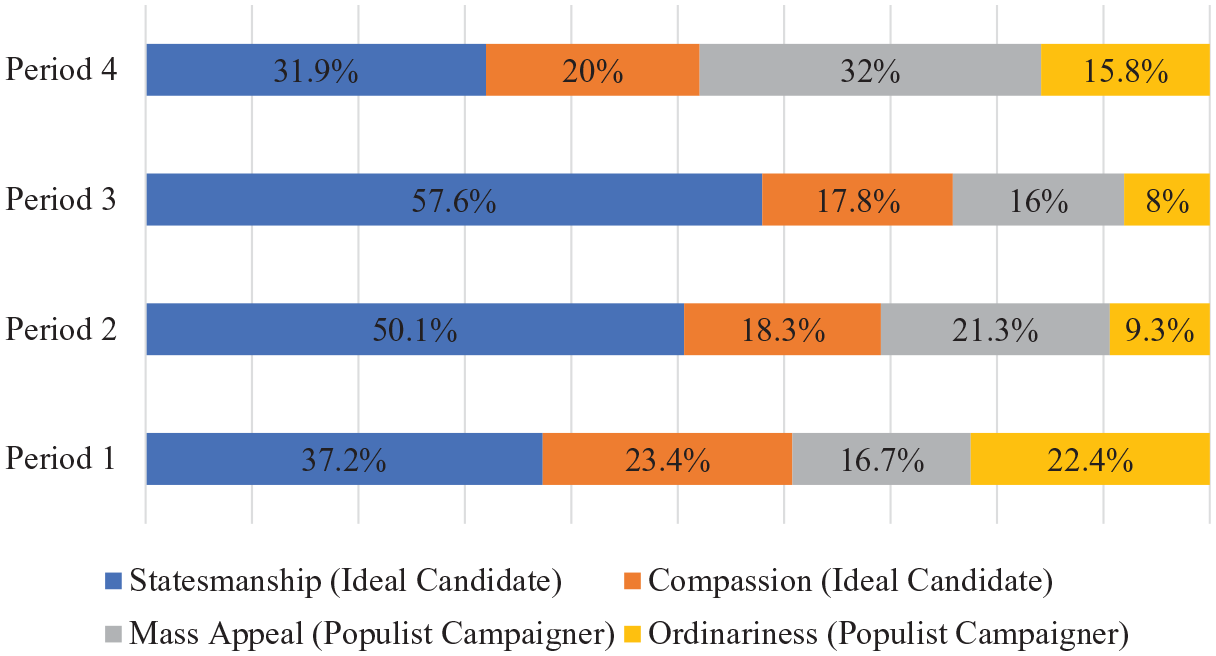
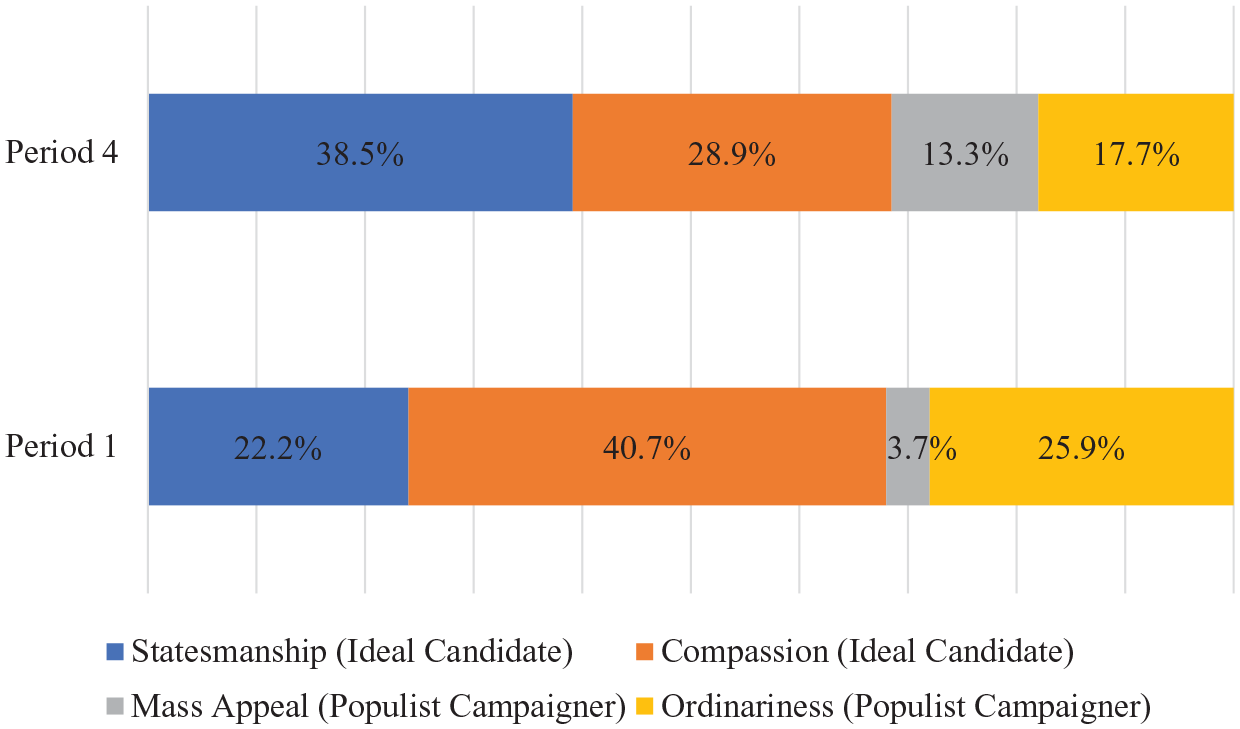
To answer RQ2, we analysed visual frames according to the time periods stated in Table 1 in order to determine whether visual framing changed during the relevant timeframes (Figures 4 and 6).
Ekrem İmamoğlu’s frame usage over the defined time periods.
Screenshot of a post by Yıldırım depicting Ideal Candidate (Statesmanship dimension–Formal Attire and Identifiable Entourage sub-dimensions).
Binali Yıldırım’s frame usage over the defined time periods.
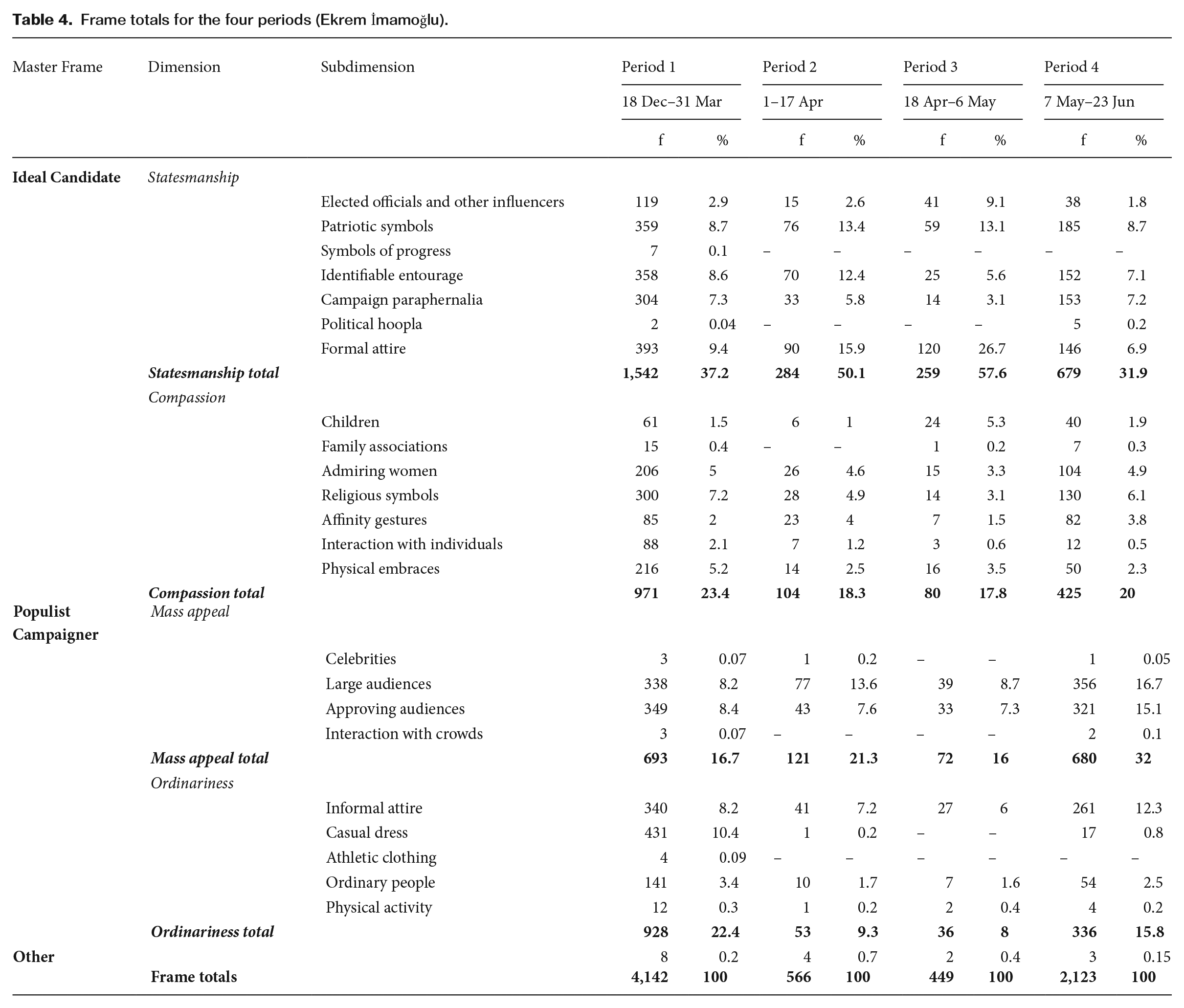
In Ekrem İmamoğlu’s case, during Period 1 (initial election campaigns), the Ideal Candidate master frame was dominant (n = 2,513, 60.6%; see Table 4 and Figure 4) with the lion’s share of statesmanship (n = 1,542, 37.2%) and compassion (n = 971, 23.4%) broad dimensions as was the case with previous studies. Against this backdrop, we observed that İmamoğlu also utilized large audiences, approving audiences, casual dress and informal attire frames under the Populist Campaigner master frame in a notable frequencies (see Table 4).
Frame totals for the four periods (Ekrem İmamoğlu).
Master Frame
Dimension
Subdimension
Period 1
18 Dec–31 Mar
Period 2
1–17 Apr
Period 3
18 Apr–6 May
Period 4
7 May–23 Jun
f
%
f
%
f
%
f
%
Ideal Candidate
Statesmanship
Elected officials and other influencers
119
2.9
15
2.6
41
9.1
38
1.8
Patriotic symbols
359
8.7
76
13.4
59
13.1
185
8.7
Symbols of progress
7
0.1
–
–
–
–
–
–
Identifiable entourage
358
8.6td>70
12.4
25
5.6
152
7.1
Campaign paraphernalia
304
7.3td>33
5.8
14
3.1
153
7.2
Political hoopla
2
0.04
–
–
–
–
5
0.2
Formal attire
393
9.4
90
15.9
120
26.7
146
6.9
Statesmanship total
1,542
37.2
284
50.1
259
57.6
679
31.9
Compassion
Children
61
1.5
d>6
1
24
5.3
40
1.9
Family associations
15
0.4
–
–
1
0.2
7
0.3
Admiring women
206
5
26
4.6
15
3.3
104
4.9
Religious symbols
300
7.2
28
4.9
14
3.1
130
6.1
Affinity gestures
85
2
23
4
7
1.5
82
3.8
Interaction with individuals
88
2.1
7
1.2
3
0.6
12
0.5
Physical embraces
216
5.2
14
2.5
16
3.5
50
2.3
Compassion total
971
23.4
104
18.3
80
17.8
425
20
Populist Campaigner
Mass appeal
Celebrities
3
0.07
1
0.2
–
–
1
0.05
Large audiences
338
8.2
77
13.6
39
8.7
356
16.7
Approving audiences
349
8.4
43
7.6
33
7.3
321
15.1
Interaction with crowds
3
0.07
–
–
–
–
2
0.1
Mass appeal total
693
16.7
121
21.3
72
16
680
32
Ordinariness
Informal attire
340
8.2
41
7.2
27
6
261
12.3
Casual dress
431
10.4
1
0.2
–
–
17
0.8
Athletic clothing
4
0.09
–
–
–
–
–
–
Ordinary people
141
3.4
10
1.7
7
1.6
54
2.5
Physical activity
12
0.3
1
0.2
2
0.4
4
0.2
Ordinariness total
928
22.4
53
9.3
36
8
336
d>
15.8
Other
8
0.2
4
0.7
2
0.4
3
0.15
Frame totals
4,142
100
566
100
449
100
2,123
100
In Period 2 (recounts of the votes and İmamoğlu’s wait for the mandate), again the dominance of the Ideal Candidate master frame can be seen (n = 388, 68.4%). However, the determinant broad dimension of this master frame was statesmanship (n = 284, 50.1%), which mainly consisted of the subdimensions formal attire (n = 90, 15.9%), patriotic symbols (n = 76, 13.4%) and identifiable entourage (n = 70, 12.4%). The second most found broad dimension during this period was mass appeal (n = 121, 21.3%) within the Populist Campaigner master frame, which consisted of the subdimensions large audiences (n = 77, 13.6%) and approving audiences (n = 43, 7.6%). We think the changes in the choice of Populist Campaigner frames are the strong signs of İmamoğlu’s message for Period 2. While he was waiting for the recount of the votes and the mandate, he used large and approving audiences to reveal the public support for him.
During Period 3 (İmamoğlu’s 20 days in office), an increase in usage of the Ideal Candidate master frame continued, with 75.4 percent and 339 total frames. The determinant broad dimension of this master frame was statesmanship (n = 259, 57.6%), which mainly consisted of the subdimensions formal attire (n = 120, 26.7%), patriotic symbols (n = 59, 13.1%) and elected officials and other influencers (n = 41, 9.1%). The second most found broad dimension was compassion (n = 80, 17.8%). The dominant subdimensions were children (n = 24, 5.3%), physical embraces (n = 16, 3.5%), admiring women (n = 15, 3.3%) and religious symbols (n = 14, 3.1%). The frames of the Ideal Candidate reflect the environment in period 3 in which İmamoğlu is officially in office. Since he was given the mandate after the recount of the votes, we believe that with the chosen frames İmamoğlu’s campaign implied that he was a strong representative of the Turkish nation. His image on his profile was of a happily married man with children and a loving husband and father, as evidenced by photographs of him with his family. Furthermore, he portrayed himself as a practising Muslim who embraced a modern lifestyle. As a Muslim-Sunni and a happily married man with children, İmamoğlu’s overall image created an impression of ‘normality’ on Instagram, in keeping with Turkish heteronormative norms. Therefore, it is distinctive that his Instagram photos, including those reflecting family associations within the Ideal Candidate master frame, were among the top 10 photos of him that sparked high levels of comments and likes.
Lastly, slight changes were observed in Period 4 (election re-run campaigns) in terms of sequencing the broad dimensions, even though the Ideal Candidate (n = 1,104, 51.9%) was still the most dominant master frame overall (e.g., Figure 7). However, the broad dimension mass appeal (n = 680, 32%) within the Populist Campaigner master frame was the most dominant dimension in this period with the subdimensions large audiences (n = 356, 16.7%) and approving audiences (n = 321, 15.1%) similar to Period 2. Because Period 4 was the hot phase of the re-run election, increased usage of these self-frames could be due to seeking more support from the voters. Here we must note that the annulment of the initial election, in which he succeeded in March 2019, had an enormous impact on his profile, with his Instagram supporters increasing from 49 percent to 57 percent by the end of the election re-run (Konda, 2019). In particular, the photos from his ‘never give up’ speech on the night his mandate was revoked were among the top 10 photos that attained high levels of user engagement; notably, these images fall into the Ideal Candidate master frame.
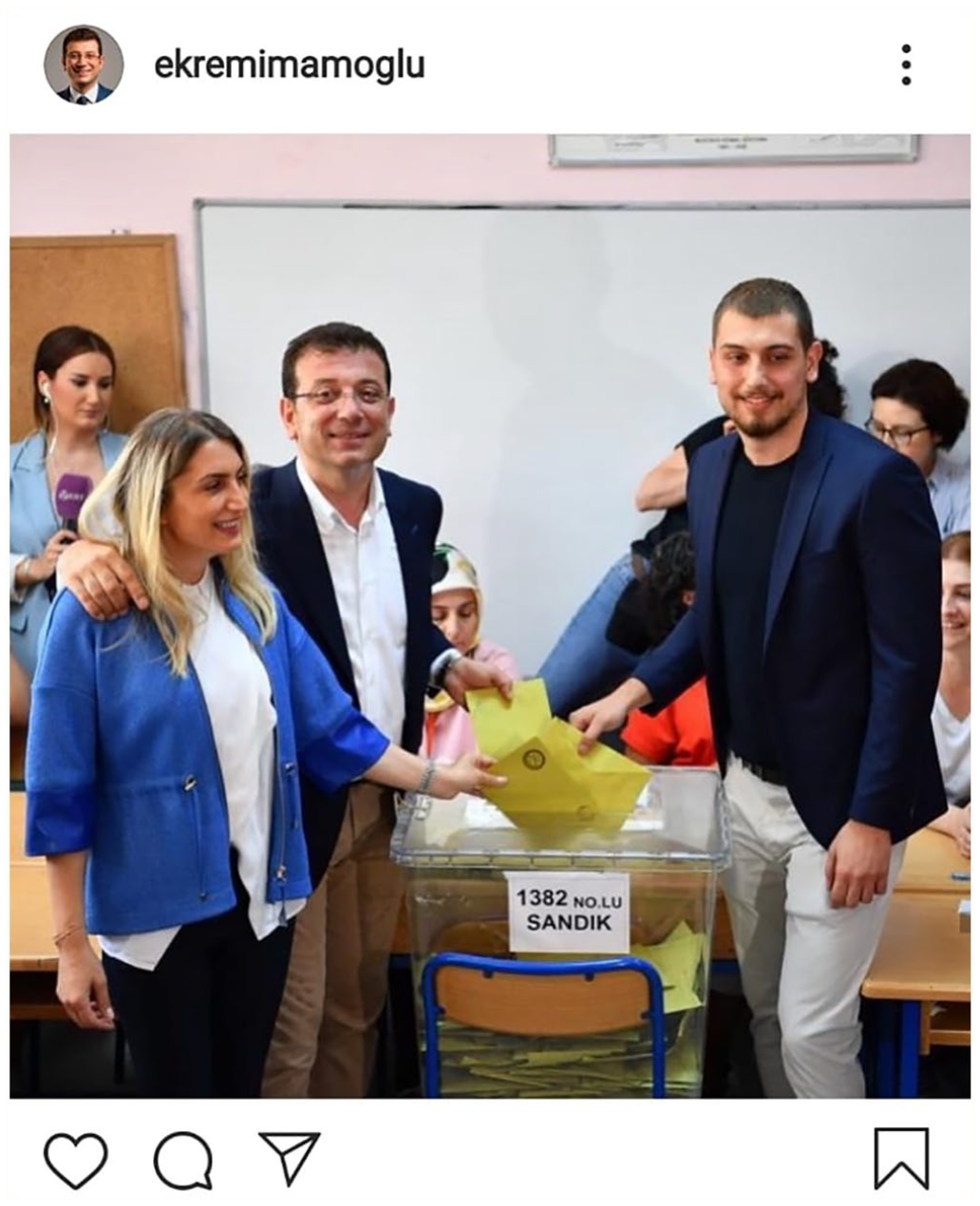
Screenshot of a post by İmamoğlu depicting Ideal Candidate framing (compassion dimension–family associations sub-dimension).
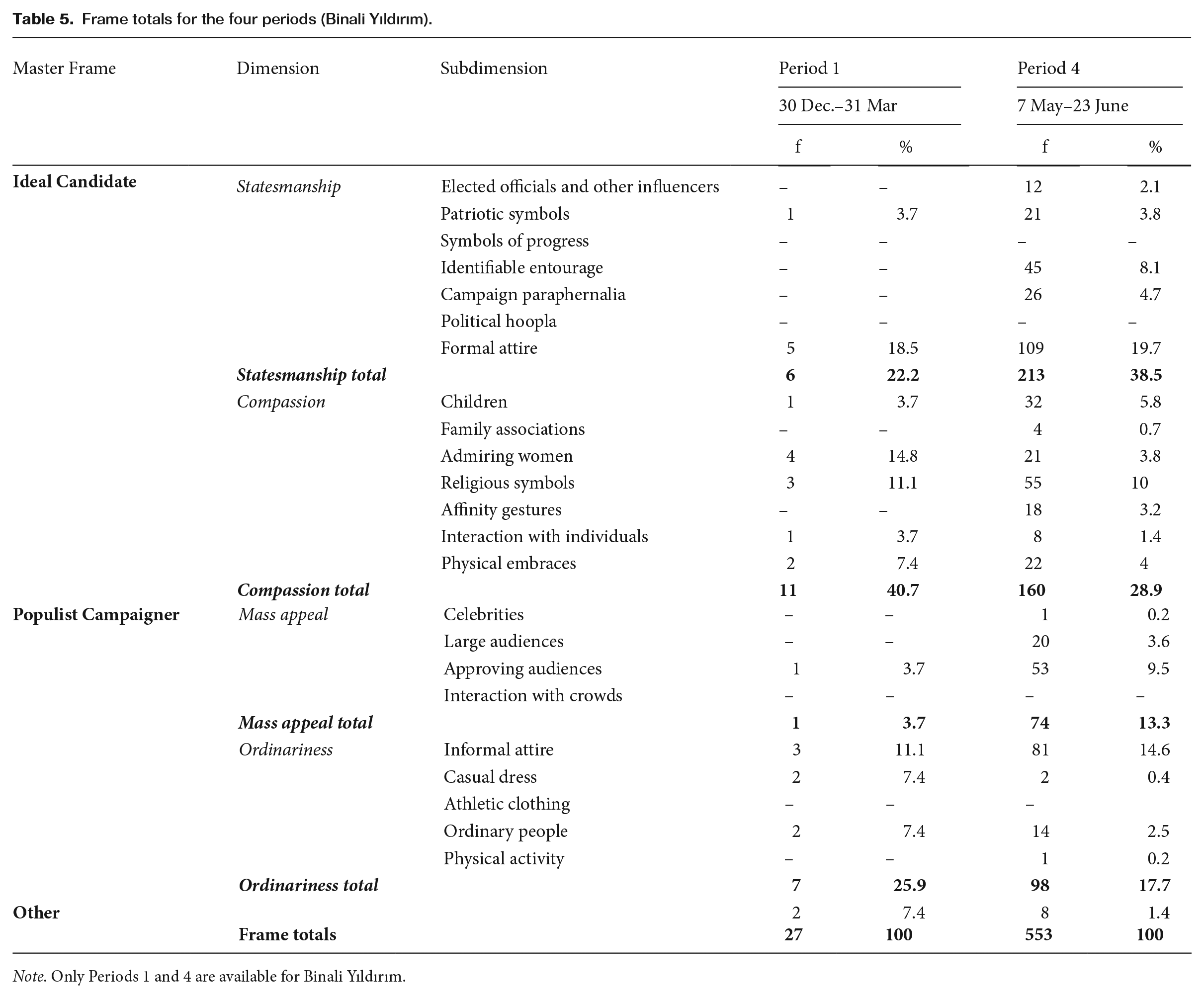
Binali Yıldırım shared images in Periods 1 (initial election campaigns) and 4 (election re-run) only (Figure 6 and Table 5). He mainly utilized the Ideal Candidate (n = 17), with the lion’s share of statesmanship (n = 6, 22.2%) and compassion (n = 11, 40.7%) during Period 1 similar to İmamoğlu, but reversed in terms of the proportions in the broad dimensions (see Tables 4 and 5).
Frame totals for the four periods (Binali Yıldırım).
Master Frame
Dimension
Subdimension
Period 130 Dec.–31 Mar
Period 47 May–23 June
f
%
f
%
Ideal Candidate
Statesmanship
Elected officials and other influencers
–
–
12
2.1
Patriotic symbols
1
3.7
21
3
d>
Symbols of progress
–
–
–
–
Identifiable entourage
–
–
45
8.1
Campaign paraphernalia
–
–
26
4.7
Political hoopla
–
–
–
–
Formal attire
5
18.5
109
19.7
Statesmanship total
6
22.2
213
38.5
Compassion
Children
1
3.7
32
5.8
Family associations
–
–
4
0.7
Admiring women
4
14.8
21
3.8
Religious symbols
3
11.1
55
10
Affinity gestures
–
–
18
3.2
Interaction with individuals
1
3.7
8
1.4
Physical embraces
2
7.4
22
4
Compassion total
11
40.7
160
28.9
Populist Campaigner
Mass appeal
Celebrities
–
–
1
0.2
Large audiences
–
–
20
3.6
Approving audiences
1
3.7
53
9.5
Interaction with crowds
–
–
–
–
Mass appeal total
1
3.7
74
13.3
Ordinariness
Informal attire
3
11.1
81
14.6
Casual dress
2
7.4
2
0.4
Athletic clothing
–
–
–
Ordinary people
2
7.4
14
2.5
Physical activity
–
–
1
0.2
Ordinariness total
7
25.9
98
17.7
Other
2
7.4
8
1.4
Frame totals
27
100
553
100
Note. Only Periods 1 and 4 are available for Binali Yıldırım.
We observed a sharp rise in the frequency of Instagram posts by Yıldırım in Period 4 although the dominant master frame was the same as that in Period 1: the Ideal Candidate (n = 373, 67.4%). He also shared images that fitted the Populist Campaigner master frame (n = 172, 31%). However, unlike İmamoğlu, Yıldırım’s self-frame adoption during the hot phase of the re-run election was mainly dominated by the broad dimensions under the Ideal Candidate master frame.
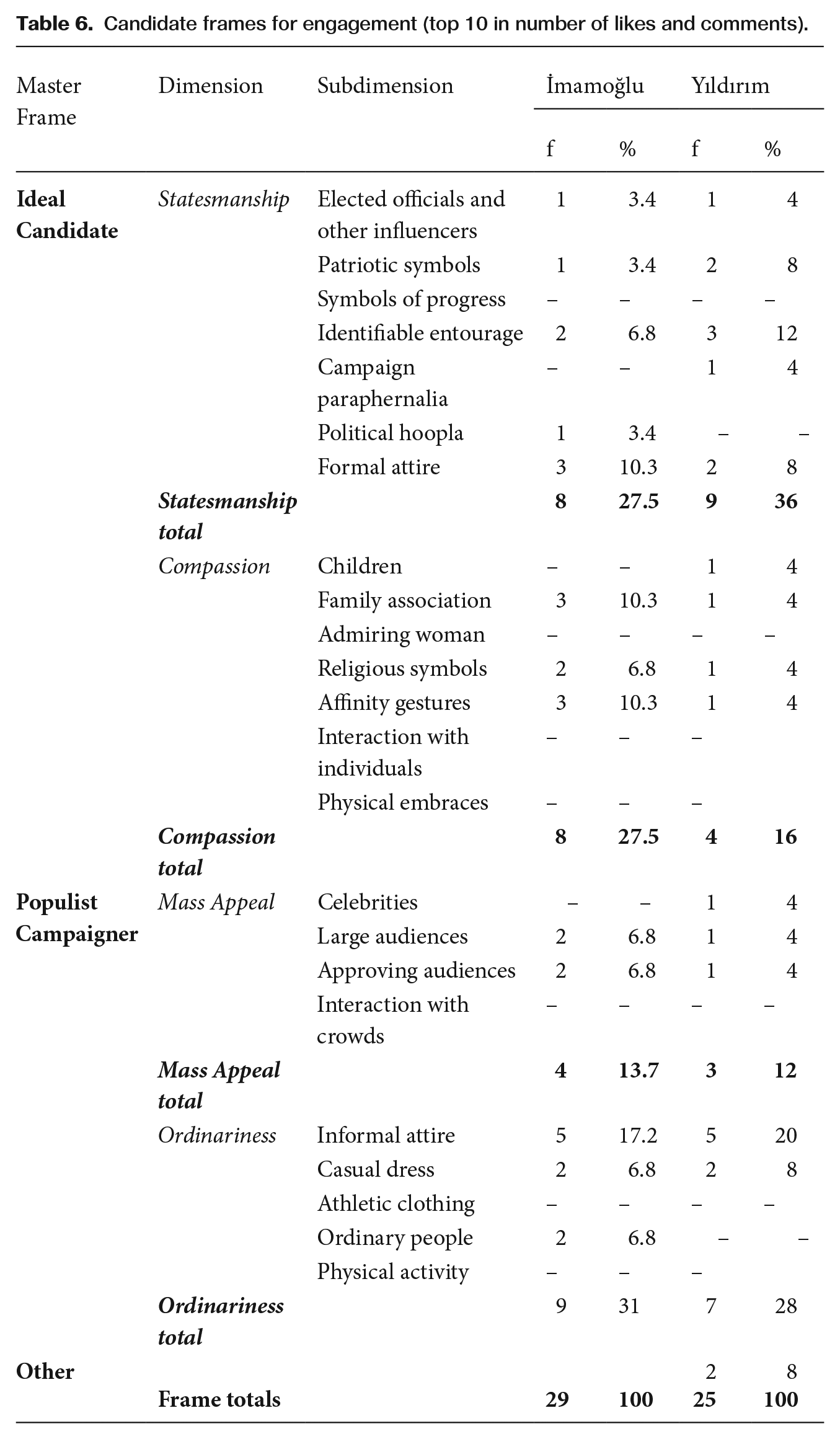
We analysed each candidate’s top 10 Instagram images based on the number of likes and comments (Table 6). We observed that, for both candidates, the same image posts received the highest likes and comments.
Candidate frames for engagement (top 10 in number of likes and comments).
Master Frame
Dimension
Subdimension
İmamoğlu
Yıldırım
f
%
f
%
Ideal Candidate
Statesmanship
Elected officials and other influencers
1
3.4
1
4
Patriotic symbols
1
3.4
2
8
Symbols of progress
–
–
–
–
Identifiable entourage
2
6.8
3
12
Campaign paraphernalia
–
–
1
4
Political hoopla
1
3.4
–
–
Formal attire
3
10.3
2
8
Statesmanship total
8
27.5
9
36
Compassion
Children
–
–
1
4
Family association
3
10.3
1
4
Admiring woman
–
–
–
–
Religious symbols
2
6.8
1
4
Affinity gestures
3
10.3
1
4
Interaction with individuals
–
–
–
Physical embraces
–
–
–
Compassion total
8
27.5
4
16
Populist Campaigner
Mass Appeal
Celebrities
–
–
1
4
Large audiences
2
6.8
1
4
Approving audiences
2
6.8
1
4
Interaction with crowds
–
–
–
–
Mass Appeal total
4
13.7
3
12
Ordinariness
Informal attire
5
17.2
5
20
Casual dress
2
6.8
2
8
Athletic clothing
–
–
–
–
Ordinary people
2
6.8
–
–
Physical activity
–
–
–
Ordinariness total
9
31
7
28
Other
2
8
Frame totals
29
100
25
100
As illustrated in Table 6, most images that had a high engagement were part of the Ideal Candidate master frame. For İmamoğlu, Instagram users liked/commented equally on images reflecting the statesmanship (n = 8, 27.5%) and compassion (n = 8, 27.5%) dimensions. The most popular subdimensions in this category were formal attire (n = 3, 10.3%) and identifiable entourage (n = 2, 6.8%). Nevertheless, the photo with the highest engagement, i.e. an image depicting Ekrem İmamoğlu and his wife and son voting on the final election date, fitted in the family associations subdimension. However, the Populist Campaigner dimension with the highest engagement was ordinariness (n = 9, 31%), with the subdimension informal attire (n = 5, 17.2%).
When analysing Yıldırım’s most engaged-with images, we observed that there was a slight difference between the frequency of usage of the Ideal Candidate (n = 13, 52%) and the Populist Campaigner (n = 10, 40%) master frames. Among Yıldırım’s most engaged photos, informal attire was the most frequently occurring subdimension (n =5, 20%). In the photos that reflected this dimension, he was mostly depicted without a tie in different scenarios. However, his most engaged-with photo portrayed him surrounded by children in bayram; this image is considered to be reflective of the Ideal Candidate master frame in the compassion dimension.
Conclusion
Despite the increase in political leaders’ use of Instagram to manage their political images, there are few studies investigating politicians’ self-framing and self-presentation and they only focus on Western democracies where there is a relatively level playing field for political campaigning (Lalancette and Raynauld, 2019; Muñoz and Towner, 2017; Steffan, 2020). Therefore, this study focuses on Turkey, a substantially under-studied competitive authoritarian context with a polarized media system (see Melek and İşeri, 2021) to explore political leaders’ visual image construction through self-framing strategies beyond the context of Western democracies. The study uses the eventful 2019 Istanbul mayoral election as a case study and examines the Instagram posts of the candidates of the opposition, secular social democrat CHP’s Ekrem İmamoğlu and incumbent pro-Islamist AKP’s Binali Yıldırım (c.f. Melek and Müyesseroğlu, 2021). The study is particularly interested in exploring whether the unfair playing field caused by the structural agent (i.e. the competitive authoritarian regime and polarized media system) would determine the self-framing adoptions of the Turkish candidates compared to their Western counterparts.
The study reveals that the candidates mainly presented themselves as the Ideal Candidate, as previous research has already noted (Muñoz and Towner, 2017; Steffan 2020). However, the candidates also shared photos conveying the Populist Campaigner at notable frequencies. Similar to previous research results, patriotic symbols and formal attire for the Ideal Candidate master frame and large audiences and approving audiences for the Populist Campaigner master frame had high mean scores (Muñoz and Towner, 2017; Steffan, 2020). On the other hand, unlike prior studies (Muñoz and Towner, 2017; Steffan, 2020) the religious symbols sub-dimension did not have the lowest mean score; instead it had recognizable mean scores for both candidates (see Tables 2 and 3).
İmamoğlu utilized patriotic symbols, formal attire and religious symbols more frequently as part of the Ideal Candidate master frame in his Instagram images. In addition, he frequently used large audiences, approving audiences and informal attire, which fall into the Populist Campaigner master frame. İmamoğlu’s Instagram photos appear to be a particularly good fit to strengthen his political persona. As a young and less known candidate, he managed to reach large audiences and gain a reputation via social media.
Consistent with his political background, Yıldırım frequently conveyed the subdimensions of identifiable entourage, formal attire and religious symbols as part of the Ideal Candidate master frame. The subdimension children was also notable in this master frame, and his most engaged-with photo included children, serving the compassion dimension within the Ideal Candidate master frame. As for the Populist Campaigner master frame, some of his Instagram photos reflected the approving audiences dimension as they portrayed his supporters at public meetings; he used the photos evoking this dimension as one of his main campaign strategies. However, the informal attire subdimension was also visible in this master frame, as some photos depicted him in suits without a tie. When compared with İmamoğlu, we observed that Yıldırım used traditional media as the main channel for managing his political campaign. Moreover, there was a huge difference between İmamoğlu’s and Yıldırım’s Instagram posting frequency. It is open to discussion whether more frequent Instagram use might have a direct effect on engagement and the way a leader is perceived.
This is also one of the first studies to adapt Grabe and Bucy’s (2009) coding sheet, which was developed for television election coverage to Instagram. In addition, the study is one of the few to report from a large sample size of 2,776 Instagram images and investigate framing strategies in mayoral elections, which is a context where self-framing strategies are more distinguishable.
This research is limited to still images. We did not analyse videos or image captions/texts, which may enrich the study’s results. Nevertheless, we have provided a general idea about how political leaders frame themselves during a highly personalized political communication campaign – the mayoral election – by analysing 2,776 Instagram images, which overcome the sample size limitation highlighted by Muñoz and Towner (2017). Moreover, since our case is peculiar because of the reasons explained above, the research also sheds light on different strategies that were applied in four different time periods. In future research, the visual self-framing strategies of politicians during election times in similar and different regime types could be investigated to comparatively analyse the role of Instagram in political communication. Also, the relationship between political participation and exposure to Instagram photos may be questioned. Furthermore, future studies should investigate whether exposure to Instagram posts has a direct effect on how leaders are perceived. In conclusion, it would be worthwhile investigating receivers’ perceptions in addition to self-frames.
Footnotes
Appendix
Intercoder reliability
Frame
Dimension
Variable
Krippendorff’s a
Ideal Candidate
Statesmanship
Elected officials
.94
Patriotic symbols
.83
Symbols of progress
1.0
Identifiable entourage
.84
Campaign paraphernalia
.95
Political hoopla
1.0
Formal attire
.97
Compassion
Children
.94
Family associations
1.0
Admiring women
.96
Religious symbols
.96
Affinity gestures
.70
Interaction with individuals
.70
Physical embraces
.92
Populist Campaigner
Mass Appeal
Celebrities
.93
Large audiences
.97
Approving audiences
.93
Interaction with crowds
.97
Ordinariness
Informal attire
.97
Casual dress
.96
Athletic clothing
.97
Ordinary people
.84
Physical activity
1.0
Funding
This work was supported by the Project Evaluation Commission of Yaşar University under the project (BAP077) “Self-Presenting Strategies and Visual Frames of Political Leaders on Instagram: Evidence from the Eventful Istanbul Mayoral Elections 2019.”
ORCID iD
Dilek Melike Uluçay
Gizem Melek
Biographical Notes
DILEK MELIKE ULUÇAY is an assistant professor in the Faculty of Communication, at Yaşar University, İzmir, Turkey. Her research interests span the areas of visual communication, personal branding, perception studies. Her current study particularly focuses on the impact of social media influencers on pro-environmental behavior.
Address: Department of Public Relations and Advertising, Faculty of Communication, Yaşar University, Universite Cad. No: 37–39, Ağaçlı Yol, Bornova, Izmir 35100, Turkey. [email: melike.taner@yasar.edu.tr]
GIZEM MELEK is currently an affiliate of the Faculty of Communication, Yaşar University. Her main academic research areas focus on the interplay between media and politics, mainly in the areas of journalism, political communication and climate change communication. She has published numerous articles and chapters in books at publishers such as Routledge and peer-reviewed journals, including Visual Studies and Communications. In addition to her academic work, she is an experienced journalist who worked both in Turkey and in the UK for six years.
BogaardsM (2009) How to classify hybrid regimes? Defective democracy and electoral authoritarianism. Democratization16(2): 399–423. DOI: 10.1080/13510340902777800.
2.
BrantnerCLobingerKWetzsteinI (2011) Effects of visual framing and evaluations of news stories on emotional responses about the Gaza conflict 2009. Journalism & Mass Communication Quarterly88(3): 523–540. DOI: 10.1177/107769901108800304.
3.
CapleH (2020) Image-centric practices on Instagram: Subtle shifts in ‘footing’. In: StöcklH, et al. (eds) Shifts toward Image-Centricity in Contemporary Multimodal Practices. Abingdon: Routledge, 153–176.
4.
CasasAWilliamsNW (2019) Images that matter: Online protests and the mobilizing role of pictures. Political Research Quarterly72(2): 360–375. DOI:10.1177/1065912918786805.
CmeciuC (2014) Beyond the Online Faces of Romanian candidates for the 2014 European Parliament Elections: A Visual Framing Analysis of Facebook Photographic Images (Conference session). Third International Conference on Argumentation and Rhetoric, Oradea/Nagyvárad, Romania.
7.
ColemanRBanningS (2006) Network TV news’ affective framing of the presidential candidates: evidence for a second-level agenda-setting effect through visual framing. Journalism & Mass Communication Quarterly83(2): 313–328. DOI: 10.1177/107769900608300206.
8.
ColemanR (2010) Framing the pictures in our heads. In: D’AngeloPKumpersJA (eds) Doing News Framing Analysis: Empirical and Theoretical Perspectives. Abingdon: Routledge, 233–261.
9.
DanV (2018) Integrative Framing Analysis: Framing Health through Words and Visuals. New York, NY: Routledge.
10.
EldinAK (2016) Instagram role in influencing youth opinion in 2015 election campaign in Bahrain. European Scientific Journal12(2): 245–257. DOI: 10.19044/esj.2016.v12n2p245.
11.
EnliG (2017) Twitter as arena for the authentic outsider: Exploring the social media campaigns of Trump and Clinton in the 2016 US presidential election. European Journal of Communication32(1): 50–61. DOI: 10.1177/0267323116682802.
12.
EntmanRM (1993) Framing: Towards clarification of a fractured paradigm. Journal of Communication43(4): 51–58.
13.
FarkasXBeneM (2021) Images, politicians, and social media: Patterns and effects of politicians’ image-based political communication strategies on social media. International Journal of Press/Politics26(1): 119–142. DOI: 10.1177/1940161220959553.
14.
FilimonovKRussmannUSvenssonJ (2016) Picturing the party: Instagram and party campaigning in the 2014 Swedish Elections. Social Media + Society2(3): 1–11. DOI: 10.1177/2056305116662179.
GallC (2019) How a message of unity and mistakes by Erdogan tipped the Istanbul election. The New York Times. Available at: https://nyti.ms/2ZJhvrU (accessed 15 February 2020).
17.
GoffmanE (1959) The Presentation of Self in Everyday Life. New York, NY: Doubleday.
18.
GoodnowT (2013) Facing off: A comparative analysis of Obama and Romney Facebook timeline photographs. American Behavioral Scientist57(11): 1584–1595. DOI: 10.1177/0002764213489013.
19.
Gordillo-RodriguezMTBellido-PerezE (2021) Politicians’ self-representation on Instagram: The professional and the humanized candidate during 2019 Spanish elections. Observatorio (OBS)15(1): 109–136.
20.
GrabeMEBucyEP (2009) Image Bite Politics: News and the Visual Framing of Elections. Oxford: Oxford University Press.
21.
HellmuellerLZhangX (2019) Shifting toward a humanized perspective? Visual framing analysis of the coverage of refugees on CNN and Spiegel Online before and after the iconic photo publication of Alan Kurdi. Visual Communication. DOI:10.1177/1470357219832790.
JacksonNLillekerD (2011) Microblogging, constituency service and impression management: UK MPs and the use of Twitter. Journal of Legislative Studies17(1): 86–105. DOI: 10.1080/13572334.2011.545181.
LalancetteMRaynauldV (2019) The power of political image: Justin Trudeau, Instagram, and celebrity politics. American Behavioral Scientist63(7): 888–924. DOI: 10.1177/0002764217744838.
28.
LeeEJOhSY (2012) To personalize or depersonalize? When and how politicians’ personalized tweets affect the public’s reactions. Journal of Communication62(6): 932–949. DOI: 10.1111/j.1460-2466.2012.01681.x.
29.
LeeJXuW (2018) The more attacks, the more retweets: Trump’s and Clinton’s agenda setting on Twitter. Public Relations Review44(2): 201–213. DOI: 10.1016/j.pubrev.2017.10.002.
30.
LevitskySWayLA (2010) Competitive Authoritarianism: Hybrid Regimes after the Cold War. New York, NY: Cambridge University Press.
31.
LiebhartKBernhardtP (2017) Political storytelling on Instagram: Key aspects of Alexander Van der Bellen’s successful 2016 presidential election campaign. Media and Communication5(4): 15–25. DOI: 10.17645/mac.v5i4.1062.
McGregorSC (2018) Personalization, social media, and voting: Effects of candidate self-personalization on vote intention. New Media & Society20(3): 1139–1160. DOI: 10.1177/1461444816.
34.
MeeksL (2017) Getting personal: Effects of Twitter personalization on candidate evaluations. Politics & Gender13(1): 1–25. DOI: 10.1017/S1743923X16000696.
35.
MelekG (2017) A study on Hürriyet and Twitter within the framework of intermedia agenda-setting. İletişim Kuram ve Araştırma Dergisi44: 17–41.
36.
MelekGİşeriE (2021) When a polarized media system meets a pandemic: Framing the political discord over COVID-19 aid campaigns in Turkey. In: Van AelstPBlumlerJ (eds) Political Communication in the Time of Coronavirus. New York, NY: Routledge, 136–154.
37.
MelekGMüyesseroğluE (2021) Political storytelling of Ekrem İmamoğlu on Instagram during 2019 Istanbul mayoral elections in Turkey. Visual Studies. DOI: 10.1080/1472586X.2021.1975501.
38.
MetzMKruikemeierSLechelerS (2019) Personalization of politics on Facebook: Examining the content and effects of professional, emotional and private self-personalization. Information, Communication and Society23(10): 1481–1498. DOI: 10.1080/1369118X.2019.1581244.
39.
MuñozCLTownerTL (2017) The image is the message: Instagram marketing and the 2016 presidential primary season. Journal of Political Marketing16(3/4): 290–318. DOI: 10.1080/15377857.2017.1334254.
40.
ÖzkanN (2019) Kahramanın Yolculuğu (The Hero’s Journey). MediaCat.
41.
PengY (2018) Same candidates, different faces: Uncovering media bias in visual portrayals of presidential candidates with computer vision. Journal of Communication68(5): 920–941. DOI: 10.1093/joc/jqy041.
42.
PengY (2021) What makes politicians’ Instagram posts popular? Analyzing social media strategies of candidates and office holders with computer vision. International Journal of Press/Politics26(1): 143–166. DOI: 10.1177/1940161220964769.
43.
RahatGSheaferT (2007) The personalization(s) of politics: Israel, 1949–2003. Political Communication24(1): 65–80. DOI: 10.1080/10584600601128739.
44.
RodriguezLDimitrovaDV (2011) The levels of visual framing. Journal of Visual Literacy30(1): 48–65. DOI: 10.1080/23796529.2011.11674684.
RussmannUSvenssonJ (2016) How to study Instagram? Reflections on coding visual communication online (Conference session). Conference for E-Democracy and Open Government, Krems, Austria.
47.
ShahDV, et al. (2016) Dual screening during presidential debates: Political nonverbals and the volume and valence of online expression. American Behavioral Scientist60(14): 1816–1843. DOI: 10.1177/0002764216676245.
48.
SteffanD (2020) Visual self-presentation strategies of political candidates on social media platforms: A comparative study. International Journal of Communication14: 3096–3118.
49.
StöckHCapleHPflaegingJ (eds) (2020) Shifts towards Image-Centricity in Contemporary Multimodal Practices. Abingdon: Routledge.
50.
TownerTL (2013) All political participation is socially networked? New media and the 2012 election. Social Science Computer Review31(5): 527–541. DOI: 10.1177/0894439313489656.
51.
Turnbull-DugarteSJ (2019) Selfies, policies, or votes? Political party use of Instagram in the 2015 and 2016 Spanish general elections. Social Media + Society5(2): 1–15. DOI: 10.1177/2056305119826129.
52.
WozniakALückJWesslerH (2015) Frames, stories, and images: The advantages of a multimodal approach in comparative media content research on climate change. Environmental Communication9(4): 469–490. DOI: 10.1080/17524032.2014.981559.