




Abstract
Drawing on ethnographic research with children in Athens, the authors examine sensual, performative and embodied aspects of children’s photographic representations of a monument that is central in the Greek national, cultural and historical discourse, the Acropolis. Moving away from the hermeneutics of cultural domination, the focus of this article is on how the pictures depicted the monument and how they were used by the children. Assuming an analytical framework which incorporates aspects of sensual experience in the analysis of the photography, the authors discuss how the children’s pictures of the Acropolis not only make visual records of the monument, and thus are not simply visual evidence of the centrality of the mainstream Greek national and historical discourse, but also how they entail the children’s embodied relation to it, and what this relation might tell us about childhood expressions of heritage and belonging, and by extension about politics in childhood. The analytical focus on embodied aspects of children’s photography illuminates complexities of cultural representation and their gestural, discursive and political significance.
Keywords
1. Introduction: Ways of Looking at the Acropolis
In this article, we explore the ways in which children who took part in a study on the relationship between childhood and public life relate to the monument of the Acropolis, and what that might tell us about childhood expressions of heritage and belonging (Varvantakis, 2021; Varvantakis et al., 2019a), and by extension politics in childhood. We are interested in the photographic practices that some children in the study employed to reproduce the monument, something we had neither planned for nor anticipated. Key to our understanding of such practices is their location at the intersection of representation and of gesture, in particular of touch, and the possibility of images to make contact with and acquire a subject through its likeness (Taussig, 1993). We argue that the product of such practices, photographs in this case, convey significant cultural information about the photographer’s relationship to the subject at the same time as they remake both photographer and subject. Specifically, while we agree ontologically that multimodality includes ‘images, gazes, gesture, movement, music, speech and sound effects (Jewitt and Kress 2008), at an epistemological level, we resist the well-trodden discursive/semiotic (Kress and Van Leeuwen, 2006) paths of reading such images of the Acropolis as examples of ‘banal nationalism’ (Billig, 1995), or irony (Yalouri, 2001). Instead, drawing on a sensory tradition in anthropology and sociology (Pink, 2005, 2011; Pinney, 2016) that releases ‘the visual from linguistic models that treat it as a form of language’ and invites us ‘to grasp imagery’s efficacy at the level of materiality and the body’ (Kalantzis, 2015: 509), we are prompted to ask what sort of worlds of heritage have the children’s pictures invented in taking the Acropolis as their central subject?
We make the case for these images to be regarded as gestures of acquisition and/or of dismantlement (Varvantakis, 2009) of the distance – material and symbolic, that separated their makers, the children in our study, from the monument and everything the monument represents for an ‘imagined community’ (Anderson, 1983) of ‘Greekness’ (in this case). Approached from this sensory perspective, the processes of producing, reproducing, or remixing images of the Acropolis over time can be read as politically, emotionally and sensually laden gestures (cf. Bhabha, 2004; Sahlins, 1999), as idioms of political expressions of belonging. This is particularly the case when such gestures touch on issues of cultural and social self-determination which, in our study, was the meaning that children themselves assigned to such pictures, as we will go on to demonstrate. Such a reading also enables an understanding of children as politically knowing subjects.
We develop our argument ethnographically by firstly engaging with our own initial bemusement with these photographs the children in the study took of the Acropolis – when the first author asked these children interlocutors in Athens to take pictures of things that mattered to them, a significant number of the children turned in pictures of the Acropolis – before turning our attention to the images and the dynamics of their production and circulation through the project spaces. In exploring the Acropolis as a subject and the children’s photographs of it, we shift our focus away from the question of why they took pictures of the Acropolis, and look instead at what these pictures are for them and what these pictures do (cf. Azoulay, 2012; Campt, 2017; Mitchell, 2005). In so doing, our aim is to take into consideration the material and political agency of the pictures and their makers, the act of making pictures and the act of showing pictures to others. Within such an endeavour, we also address issues of children’s relationship to public space – with regard to its symbolic and material accessibility – as this is expressed by children themselves, and by extension their own ways of writing their own multimodal heritage stories.
In the next section, we provide details of the study, the sample, the multimodal ethnography and the study context before describing the sensory visual studies tradition that supported our analysis of the children’s photographic practices. Following these two sections, we turn our attention to the ethnographic material before concluding with a discussion on how our approach further contributes to understanding children’s embodied politics.
2. Contextualizing the Research
Data for this article have been drawn from a sub-sample of cases from the Connectors Study, 1 an international ethnographic study that explored the relationship between childhood and public life, and in particular looked at the ways in which younger children encountered, experienced and engaged with public life, its civic and political dimensions. The study followed a total of 45 children and their families, aged 6–8 years at the time of recruitment, in three cities (Athens, Hyderabad and London). The sample was diverse in terms of the families’ socio-economic situations and compositions, political orientations of parents, local/migration status and other salient differences to each context. A multimodal ethnographic approach to both data collection and analysis was taken (cf. Varvantakis et al., 2019b, Nolas and Varvantakis, 2018 and Varvantakis and Nolas, 2019, for more details). Our fieldwork took place over a 3-year period during which we visited children at home, in playgrounds near their homes, walked with them around their neighbourhoods and different parts of each city, as well as spent time with them and their families (Nolas et al., 2016, 2017a, 2017b). Our visits and activities with the children were documented in fieldnotes, and we collected and catalogued children’s photographs, drawings and maps with the help of NVivo. We analysed the materials collected through drawing lines of enquiry that jumped across modes and media (Varvantakis and Nolas, 2019); one such line of enquiry, which we present here, developed in response to the children’s photographs of the Acropolis. This article is based on 4 children drawn from a larger sample of 14 children in Athens. The 4 children are emblematic of different aspects of local childhoods (local/migrant, gender, levels of affluence), as well as being children who produced narratives of the Acropolis.
Our understanding of childhood is aligned with emerging post-humanist approaches that emphasize the materialities of children’s embodiment and experiences, and the ways in which childhoods emerge through networks of both human and non-human actors (cf. Coleman and Ringrose, 2013; Hickey-Moody, 2013; Lee, 1998). Given this focus, we also found conceptual and methodological inspiration in phenomenological anthropology which emphasizes the role of the senses, of affect and of multimodality in everyday lives (Seremetakis, 1994; Sutton, 2001; Taussig, 1993). Our definition of public life, the civic and the political, took inspiration from feminism, early sociological writing (Mills, 1959) and a recent interdisciplinary turn that approaches the political as an issue of care and concern, of ‘what moves and matters’ to people (Lutz, 2017; Puig de la Bellacasa, 2017). As such, we worked with a conceptualization of public life as an entanglement of the personal and the political, the private and the public, the human and the non-human.
In line with the theoretical grounding of the study, many of the activities that we undertook with the children in the study pivoted around the subject of ‘things that mattered to them’ and resulted in artefacts of several different media – as exemplified by the data we will turn to next. The study also involved cultural work in the form of a public exhibition. During the ethnographic research, each child was given a digital camera and was asked to take pictures of things that mattered to them. In the second year of the study, and in preparation for a public exhibition that we co-curated with the children, children were asked to choose 10 pictures of the ones they had taken of things that mattered to them the most. Consequently, a workshop was organized in each city, in which the study children met each other for the first time and discussed their 10-picture selection among themselves, finally choosing one picture with which to write a photo-story. 2
The study took place at a time when Athens, like the rest of Greece, was in the midst of an economic recession, having been under austerity measures for almost a decade. In particular, and from 2010 onwards, the climate of economic austerity was palpable in the city and in Athenians’ everyday lives, following the austerity measures introduced by the European Central Bank, the International Monetary Fund and the European Union that were designed to keep Greece in the Eurozone. These economic realities and the exclusions they create are navigated by the children through their photography and accompanying stories.
3. From Semiotics to the Senses: Acropolis, From A Distance
The Connectors Study, from which these photographs of the Acropolis were taken, did not set off to research heritage or belonging. We were interested in the relationship between childhood and public life, always broadly defined and how that emerged and presented itself to children and us in their everyday lives, between school and home, between family and friendship groups, in their cities and neighbourhoods and through play, talk and images. In this sense, these photographs of the Acropolis we were presented with offered an interesting case through which to explore that relationship.
The monument is perennially situated as a central element in the construction of Greek national heritage and, by extension, identity, in ways analogous to its material centrality in the city of Athens. Because of these centralities, in material as well as metaphoric terms, the monument has become the subject of countless pictures (souvenirs, propaganda posters, tourist advertisements) (see Hamilakis, 2007, Plantzos, 2012; Yalouri, 2001). It has also been employed as a visual metaphor for things more abstract such as, democracy, Europe, freedom and the entire classical antiquity. Plantzos (2012), has remarked how the Acropolis – either the very monument or its endless reproductions – has functioned as an element, often pivotal, for the construction of cultural and ethnic identities and national imagination (Hamilakis, 2007), functioning as a metonym for Greece, or Greekness itself, over the years. In many ways, the ‘heavy’ symbolic lifting that the Acropolis performs has become ordinary, banal even.
As such, the status of the monument could have lent itself well to a semiotic analysis of the children’s photographs. Semiotics provides an established approach for analysing children’s image-making practices (Hopperstad, 2008; Kress and Van Leeuwen, 2006), including their drawings of antiquity (Diamantopoulou and Christidou, 2018). But, as we will show in the next section, the ways in which the children related affectively to their images over time, both with the first author and then in conversation with one another in the workshop we ran, suggested to us that a different approach was necessary. We needed an approach that would enable us to move away from dominant ways of understanding the monument and children’s images as text emerging from domestic (Pahl, 2006) and educational (Hopperstad, 2008) spaces, to one that would allow us to locate children’s image production practices in the messy and quotidien interstices of everyday life (see also Dicks et al., 2006; Jewitt and Leder Mackley, 2019; Jewitt et al., 2021; Varvantakis and Nolas, 2019).
A sensory understanding of image making (Marks, 2002; Taussig, 1993) hones our attention on everyday life and forces us to hover analytically on the indeterminate spaces between culture, history and biography in search of that ever illusive ‘third meaning’ (Barthes, 1977). Barthes talks about this ‘third meaning’ as the ‘obtuse meaning’ of the image; images as a series of contradictions: persistent and fleeting, smooth and elusive, emphatic and elliptic. ‘Obtuse’ is indeed how these images of the Acropolis first presented themselves to the first author. As we alluded to in the introduction, we initially found the children’s photographs of the monument a strange choice of subject. Having asked the children in the study to take photographs of things that mattered to them, we had expected these photographs to depict people, places, situations and objects proximal to children’s everyday, lived experiences. For most of the children (except Lina, see below), the Acropolis would not fit this description and many of the children had not even visited the monument. Monuments – as a photographic subject – did not feature in the children’s photography in general, and where they did appear they did not make it into the children’s selection of 10 photographs of ‘the most important things to them’ for the workshop, except for the 4 out of 14 children whom we turn to next. On the other hand, given the centrality of the monument to imagined communities of ‘Greekness’, it also made sense. It was this interplay between strangeness and sense that prompted us to look more closely. Indeed, it is in these interplays, according to Barthes (1977), that third meanings might be found: where something both is and is not at the same time, it is in plain sight and in disguise; it is a reading of images that happens in between. Or rather, it is through the interplay of meaning and the emotional resonance created in the in-between of binary oppositions (e.g. ordinary and extraordinary, such is the Acropolis) that the third meaning emerges.
Conversations in both visual and sensory anthropology that attend to this ‘third meaning’ remind us that knowledge beyond the linguistic demands a different means of approach (Edwards, 2011; Kalantzis, 2015; MacDougall, 2006; Morphy and Banks, 1997; Pink, 2005; Banks (2001); Pinney, 2005; Varvantakis, 2016, 2021). Affect plays a key role in giving linguistic form to the ‘third meaning’, it requires, as Tina Campt (2017: 3) persuasively argues, a broad repertoire of ‘modalities of perception, encounter and engagement’, including the beautifully counterintuitive idea of ‘listening’ to images (Campt, 2017). Campt is concerned with what she describes as ‘quiet photography’ in the form of identification photographs of members of the Black diasporic community. Identification photographs (such as passport photos) are ‘some of the least celebrated, often most disposable archives of photography. They are images that we are compelled or required to take’ (pp. 17–18). Photographs of the Acropolis are a form of national–cultural identification photography: tourists and locals alike feel obliged to photograph the monument and, while the monument itself is celebrated, the plethora of its photographic reproductions makes its likeness disposable and mundane. Our initial bemusement and very near dismissal of these images attests to their quietness. As such, prompted by Campt’s ‘modality of quiet’, we began listening out for the images’ ‘frequencies’ and attending to their affective qualities. These attempts to listen to the images were greatly aided by the first author’s conversations with the children, attending to how and why they produced the images in the first place, and then by listening in to the discussions that these images prompted for children during the creative workshop. We focus in particular on the ways that distance – material and symbolic – was acquired and dismantled by the children both in their taking of the various photographs and in their discussion of these images.
4. Making Pictures and Showing Pictures to Others: Navigating Proximity and Distance
The ethnographic biographies we work with are of two boys and two girls. One boy and one girl are local, and one boy and one girl share a migration history. Each of the four children experience material and symbolic proximity and distance to the Acropolis differently and develop (or fail to develop) strategies for dealing with the gap between themselves and the monument. We analyse each ethnographic biography – child, photograph, context – in turn before turning our attention to the four children’s encounters with each other at the workshop, and their discussions on the photographs taken with other children in the study. All ages (in parentheses) of the children are correct for the times we were working with them.
Michalis
Michalis (8 years) lives with his mother in Petralona, a central, middle-class Athens neighbourhood close to Thiseion, south of the Acropolis (see his photo, Figure 1). They are a single-parent middle-class household. Michalis attends the local state school which serves a local, Greek population reflective of the area. Michalis loves watching films and aspires to become a screenwriter. When Christos met him, he was writing stories and attending dance classes in his spare time.
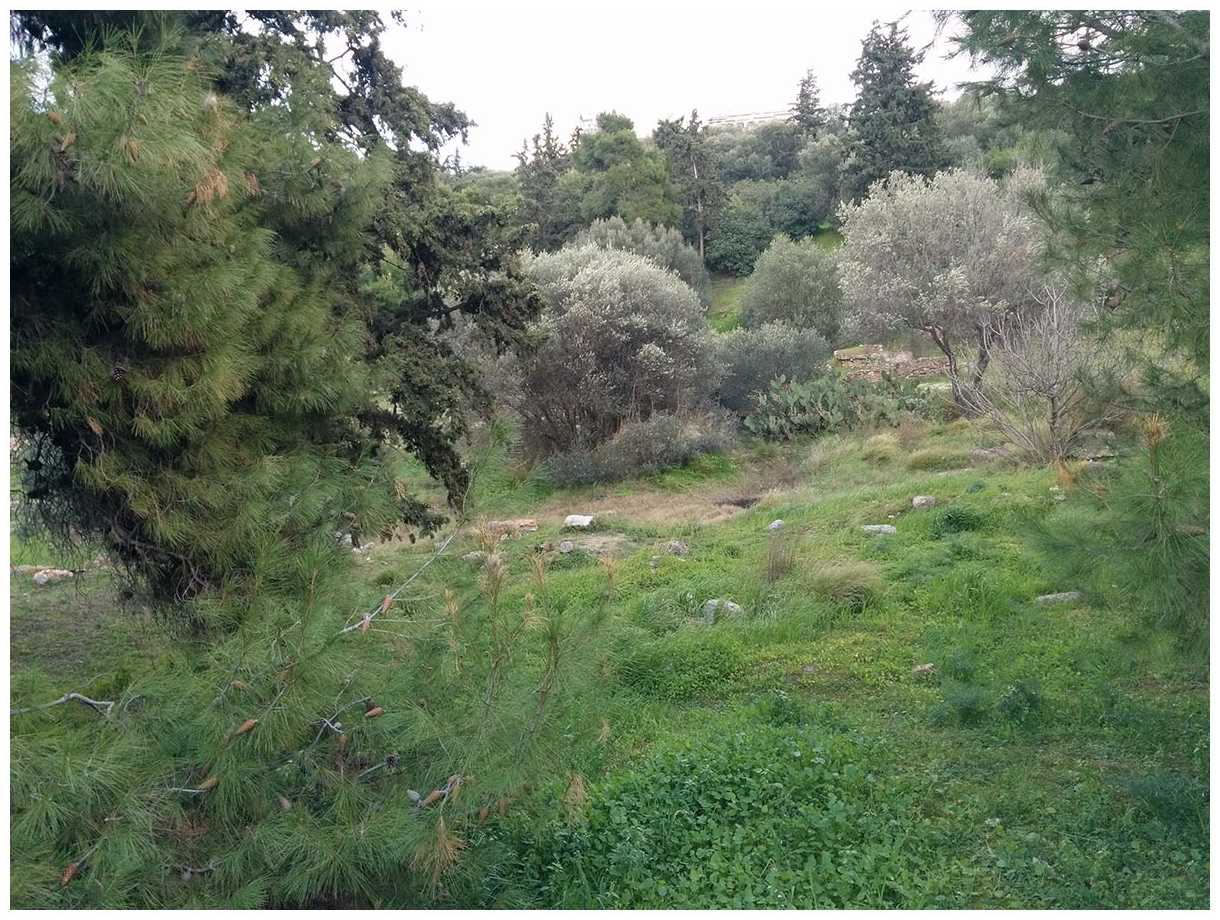
Michalis’s picture of the Acropolis.
During one of Christos’s visits, the pair head out for a walk on Filopappou Hill that surrounds the south side of the Acropolis. On the way, Michalis expresses his anticipation of reaching a park at the top of Filopappou, and makes Christos pick up his pace. At one point he stops abruptly, taking out his camera, and says, ‘Okay, at least, let’s take a picture of the Acropolis’ – which he did hastily. His gesture conveyed necessity, even obligation, and was somewhat at odds with what Christos had come to expect of him as a photographer. Previous photos Michalis had taken revealed a technical fluency that included using the camera zoom and focus. This time he did not stop to frame or zoom. Instead, having taken his photograph, he looked at the LCD display, satisfied because the Acropolis was in shot. The pair looked at the picture together and Michalis told Christos that it was ‘like a postcard’; Christos asked him why and he responded ‘because it has the Acropolis in it’. That it is a satisfying or even beautiful picture rests on the fact that the Acropolis is captured within the picture’s frame, never mind that the monument is barely visible. The tiny, faraway spot on the top of the hill is almost a quiet, magical presence, enough to turn an ordinary picture into a postcard.
Michalis’s likening of his photograph of the Acropolis to a postcard suggests distance. Distance, in the case of Michalis is expressed through a combination of a symbolic and material height. A postcard is often understood in opposition to a normal snapshot and, in this context, it is indeed used to signify that it stands out. A postcard might imply a beautiful image – but does not convey the casual intimacy that a snapshot, in all its ‘banality’, might. Later, at the top of the hill, Michalis takes another photograph in which the Acropolis is placed higher than the rest of the ‘things’ in the frame, suggesting Michalis’s understanding of its cultural importance. The Acropolis is far away because it is above, higher up; it is also imposing and powerful because it towers over the landscape, out of reach.
Ardian
Ardian (8 years) was born in Greece to Albanian parents and his family have been living in the central Athens area of Aghios Panteleimonas, a working-class neighbourhood with a high concentration of migrants. 3 His parents struggled to find work; during the time of the research they were trying to secure Greek citizenship for themselves, in the hope that this would afford more work security. Ardian attends the local state school which is considerably mixed in terms of ethnicity and race, something that Ardian considers entirely normal. Ardian is fascinated with Ancient Greek history, mythology and culture, and enjoys talking about these subjects with Christos. His interest for Greek culture extends to language as well, and he hopes that one day he will learn ancient Greek. His interest in ancient Greek culture and history is embodied, as he told Christos, in his love of the monument of the Acropolis (see Figure 2).
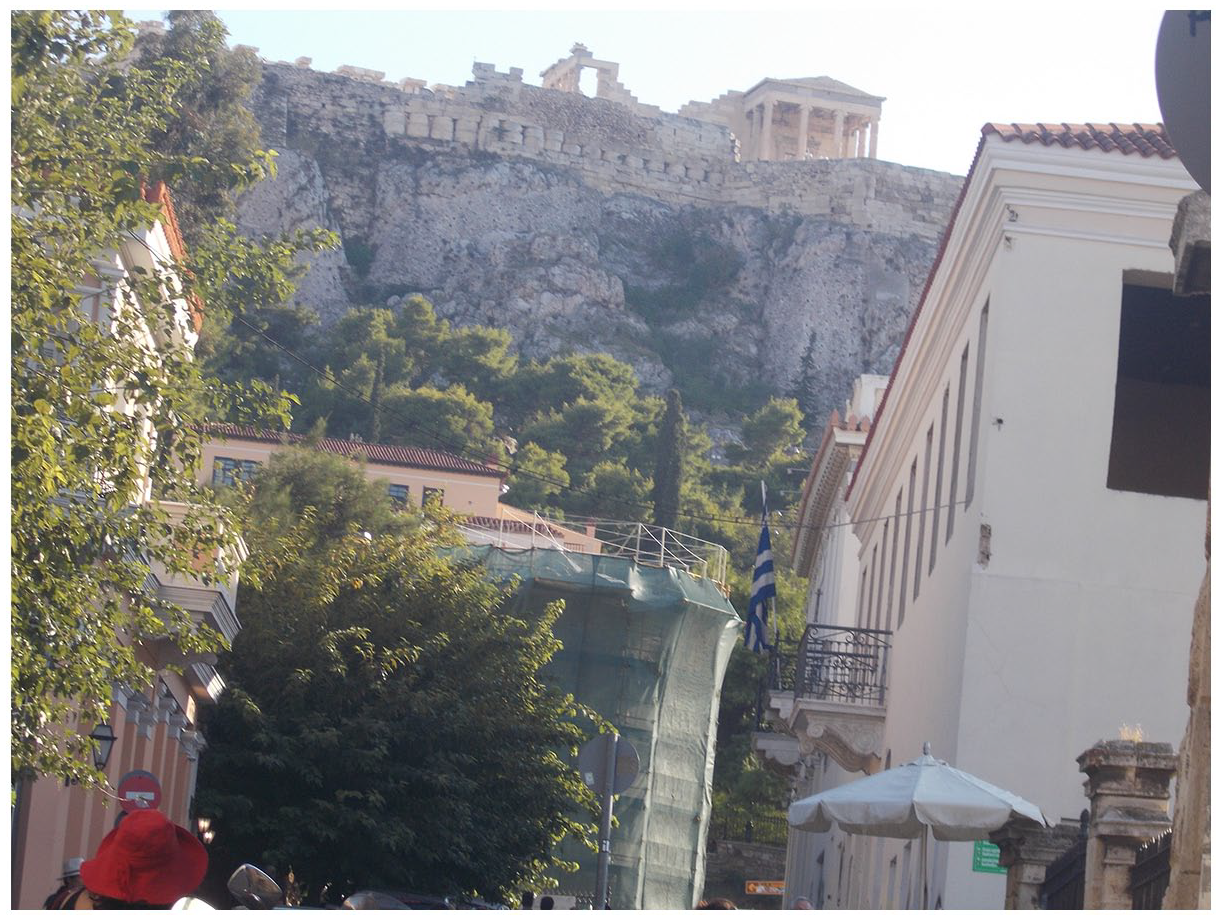
Ardian’s picture of the Acropolis.
For Ardian, the distance that separates him from the Acropolis draws on a different metric: money. Ardian has walked around Plaka many times, but never actually visited the Acropolis. He likes the surrounding area too, where you can ‘see many ancient things’, but he thinks that the Acropolis is the masterpiece of ‘all these things’. Ardian tells Christos about his strolls around Plaka with his mother and older brother, and shows him photographs of ruins from the area, as well as of pictures of replicas of pots and statuettes found in the various souvenir shops. He also shows Christos a picture of the Acropolis, taken from below – indeed, this became one of the 10 pictures he chose to later bring with him to the workshop.
In his picture, the Acropolis is portrayed from below, from the foothills in the area of Plaka. The Acropolis appears distant, on the top of the frame, with several other elements, such as buildings, trees and the hill separating the viewer from the monument, the former positioned at a lower level looking upwards at it. The upward perspective in this low-angle shot makes the monument appear imposing as well as distant. However, actually visiting the monument is out of the question for Ardian. He tells Christos that he really likes the Acropolis, ‘but it costs too much money, so they cannot go there to see it.’ It costs 20 euros per person he told Christos, so only tourists who have ‘a loooot of money’ can go. He thinks it should be much cheaper – as it is, ‘only tourists can visit now.’
Lina
Lina (7 years), lives in Plaka, a neighbourhood at the foot of the Acropolis, in an apartment with stunning views over the monument. Lina comes from a wealthy family, both her parents are professionals running their own business. Lina attends a private school in the same neighbourhood which attracts middle and upper middle-class families from across Athens. She takes piano and tennis lessons. When she talks about the Acropolis, she talks about it as a feature of her neighbourhood, as something that is proximate and familiar, while in more abstract discussions she highlights the significance and universal recognizability of the monument.
When Christos asked Lina to draw her map of places that mattered to her (see contextualization section), she sat quietly and thoughtfully, contemplating what should be included. After lengthy consideration, she yelled ‘I know! The obvious one of course, Acropolis!’ She made several attempts at drawing the monument, and when she finished with the Acropolis she drew the Greek flag next to it, which was the only bit of colour in her drawing, as well as a staircase to indicate her home (see Figure 3). She drew some people on the Acropolis too (she said ‘the people’). When she was done with the map, Lina asked Christos if he could write down the names of the places for her. He agreed and asked her what he should write? House, garage, a sign reading ‘to the school’. Christos asked her ‘what about the Acropolis, should I write something there?’ ‘No,’ she responds, ‘everybody knows it’s the Acropolis’.
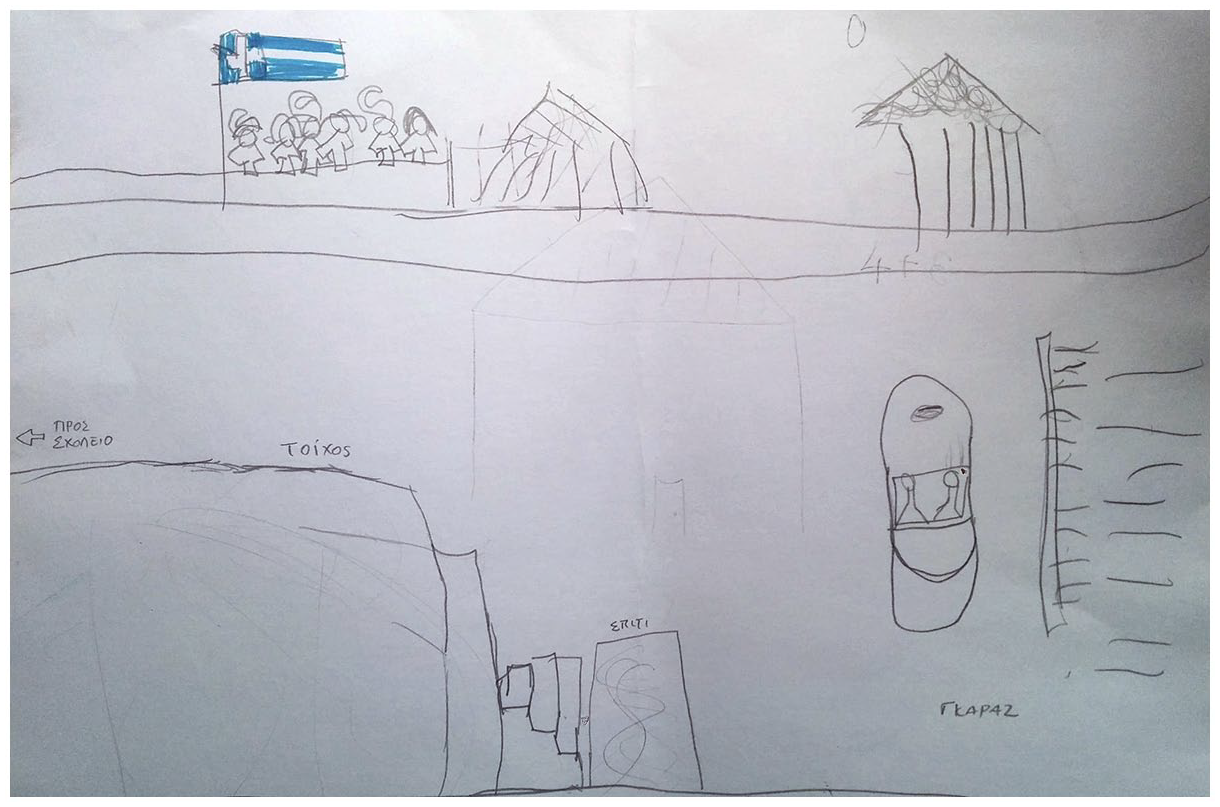
Lina’s map of her neighbourhood, and of things that matter to her there.
Lina’s use of the word ‘obvious’, to denote the self-evident landmark of her neighbourhood reveals the significance and centrality that the monument has in the cultural imagination – of children and perhaps, even more in this case, of Lina herself who lives at the foot of the hill. Accordingly, she thinks it is unnecessary to signpost the Acropolis, she assumes that everybody knows what it is – an assumption that speaks to an imagined universal recognizability of the monument.
Lina chose two pictures of the Acropolis amongst her selection of 10 pictures of things that mattered to her to bring to the workshop. The photograph in Figure 4, one of Lina’s two pictures of the Acropolis taken from Lina’s balcony, she describes as ‘the classic view’ of the monument. The inclusion of the balcony was a conscious framing decision. In reviewing these photographs alongside other pictures Lina took of the monument, she told Christos that she prefers those (Figures 4 and 5), precisely because one can see the balcony too. By including her balcony in the frame, she brings the monument closer to the house thus blurring the boundaries between the public and the private spheres. The combination of the two elements (balcony and monument), result in an undisputed proximity.
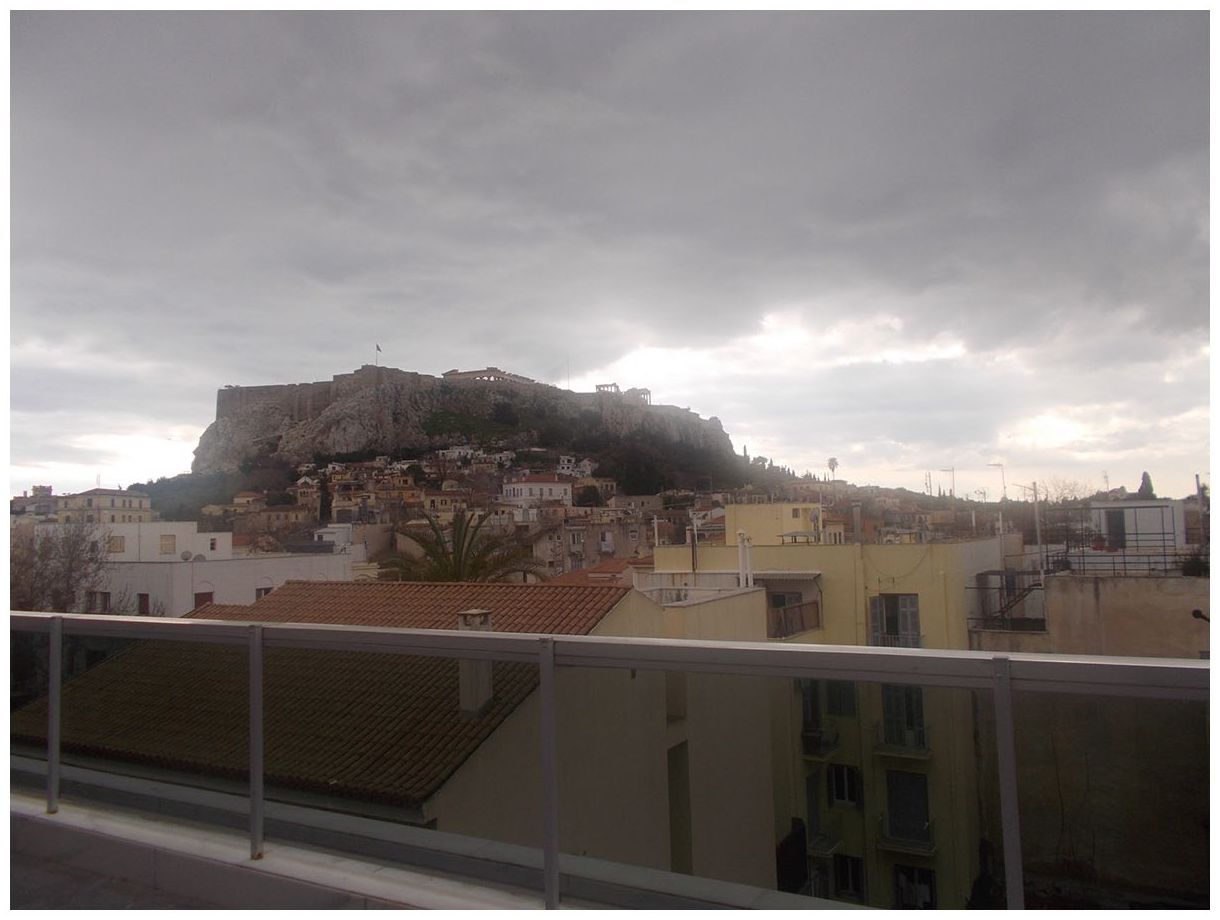
The Acropolis, as seen from Lina’s balcony during daytime.
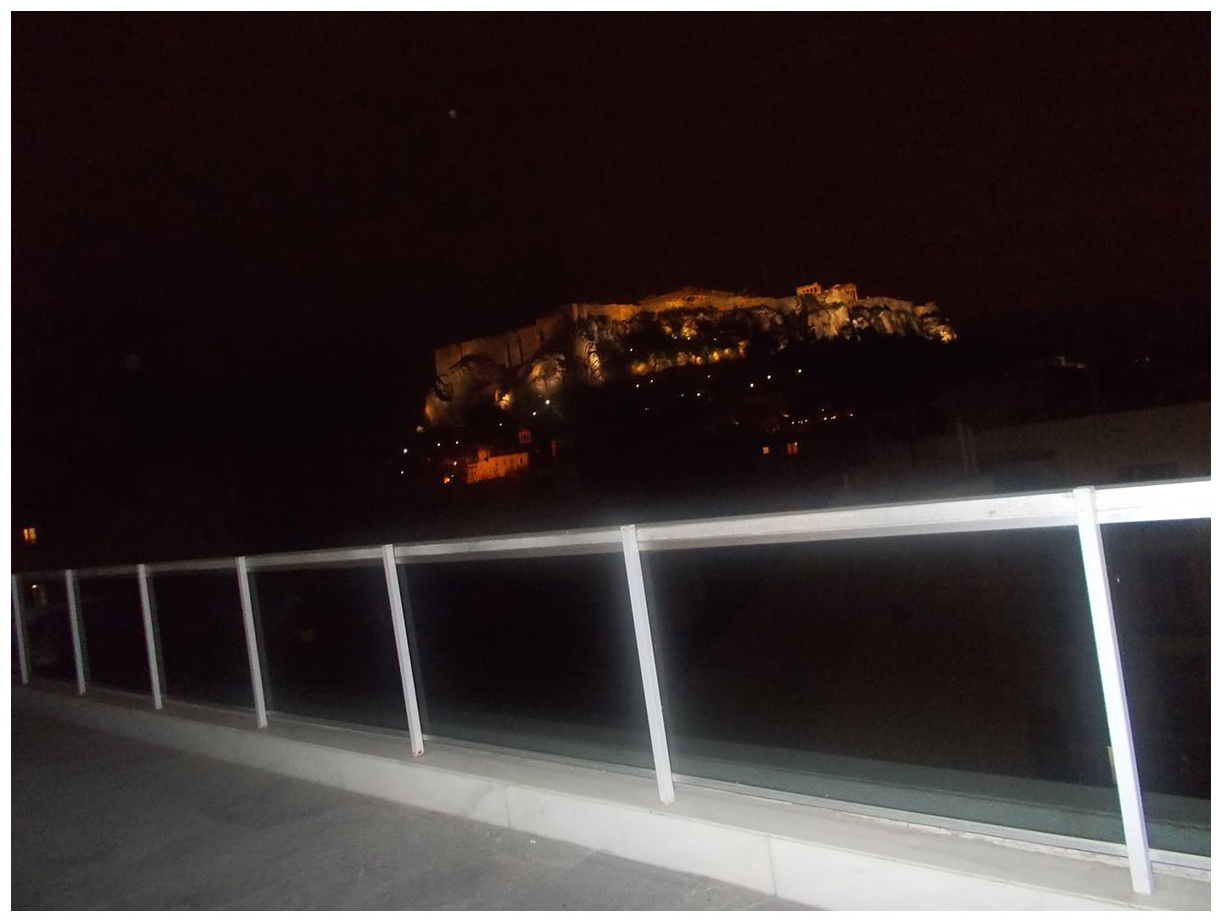
The Acropolis from Lina’s balcony in the night.
Her second image is a night shot of the monument from approximately the same angle. This shot feels even more intimate than the daytime one. Viewed together, the photographs prescribe a profound proximity to the monument, as an element of Lina’s everyday life. Lina considered the Acropolis to be a very significant ‘thing’ in her life, something she repeatedly talks about in discussions with Christos, often referring to the monument as the best thing in her home. Just as her photography brings the exterior, the public monument, into her home, her private space, so too her remark, serves to reinforce this gesture of appropriation.
Georgina
Georgina (8 years) lives in Nea Ionia, a working-class suburb, north of central Athens. Her family are from Albania. Her parents are both manual workers, her father works long and irregular hours, often away from Athens. Georgina was born in Athens and has Greek citizenship but is not always at ease with her dual heritage. She sometimes tries to disguise her Albanian side in public encounters with strangers, something Christos also witnessed while strolling around the city centre with her. Like Ardian, Georgina is also attracted to Greek antiquity, and history classes are her favourite school subject. She likes the history class because they tell stories – ‘and that’s why it’s called history’ (in Greek the word for story and history are the same (ιστορία), see also Herzfeld, 1991).
For Georgina, the Acropolis is also a very significant thing, a thing that matters to her. She also turned in several pictures of the Acropolis in the course of the research and many of the discussions Christos and Georgina had revolved around the monument. Georgina is the only child interlocutor who chose the subject of the Acropolis for her photo-story – the final product of the workshop.
On one occasion, Christos took a very long stroll through Plaka with Georgina. She really liked the area, which is quite far from where she lives, and somewhere she has only visited once before. During their walk they ended up talking a lot about ancient history. Amongst many other of Georgina’s impressions of ancient history, they discussed the Acropolis a good deal which, she told Christos, ‘is the best of all places here’. Christos asked her whether she had been there, and she told him no, she hadn’t: it’s at the end of a long and exhausting uphill walk and besides it is too expensive to visit. But, she added while making pictures of the Acropolis, she doesn’t really have to as she can instead look at it through the camera. She zoomed in fully and started making pictures of the monument: ‘you see, it’s like you are there!’ She took a few pictures of the temple and of the Acropolis, always struggling to frame the things she wanted to make pictures of – because of the extreme zoom she was using (i.e. Figures 6 and 7).
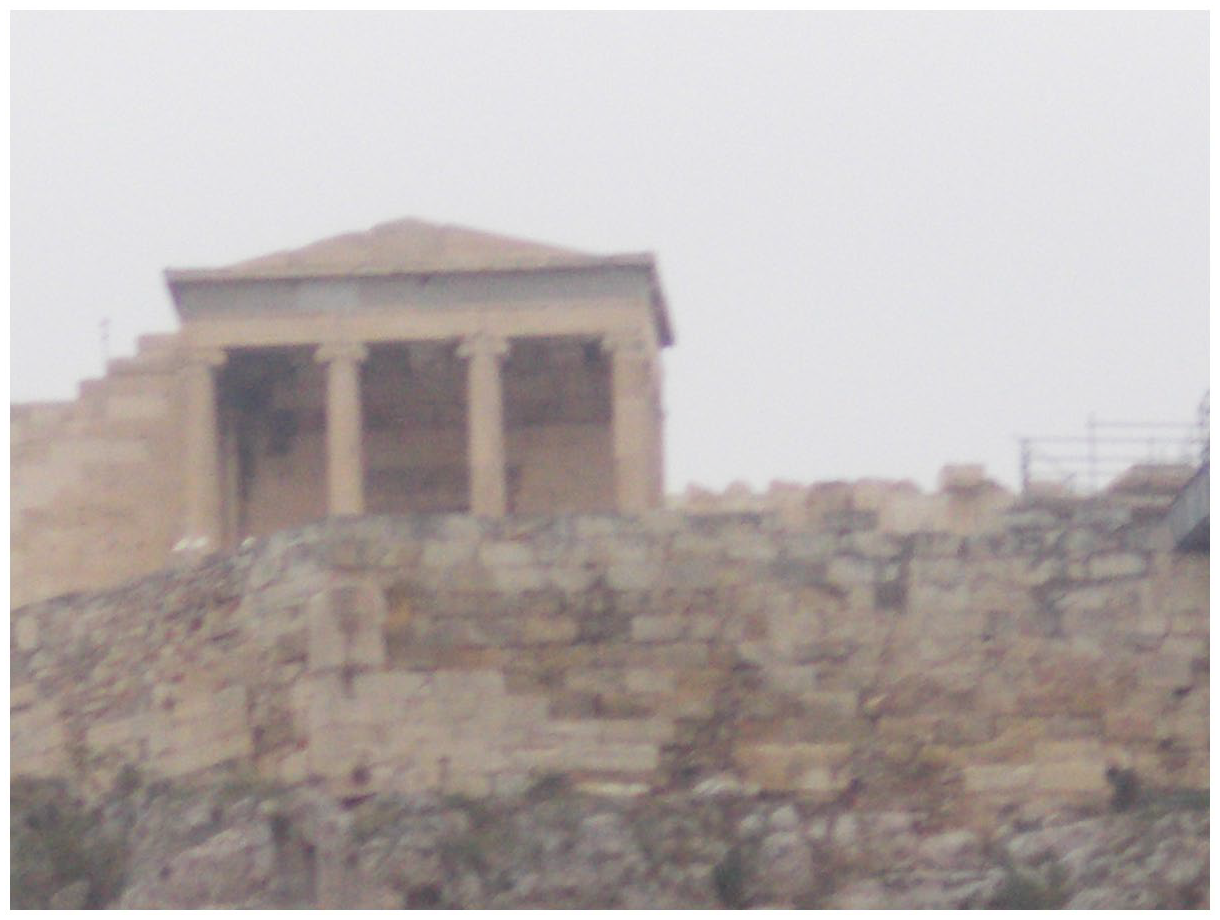
Georgina’s picture of the Acropolis.
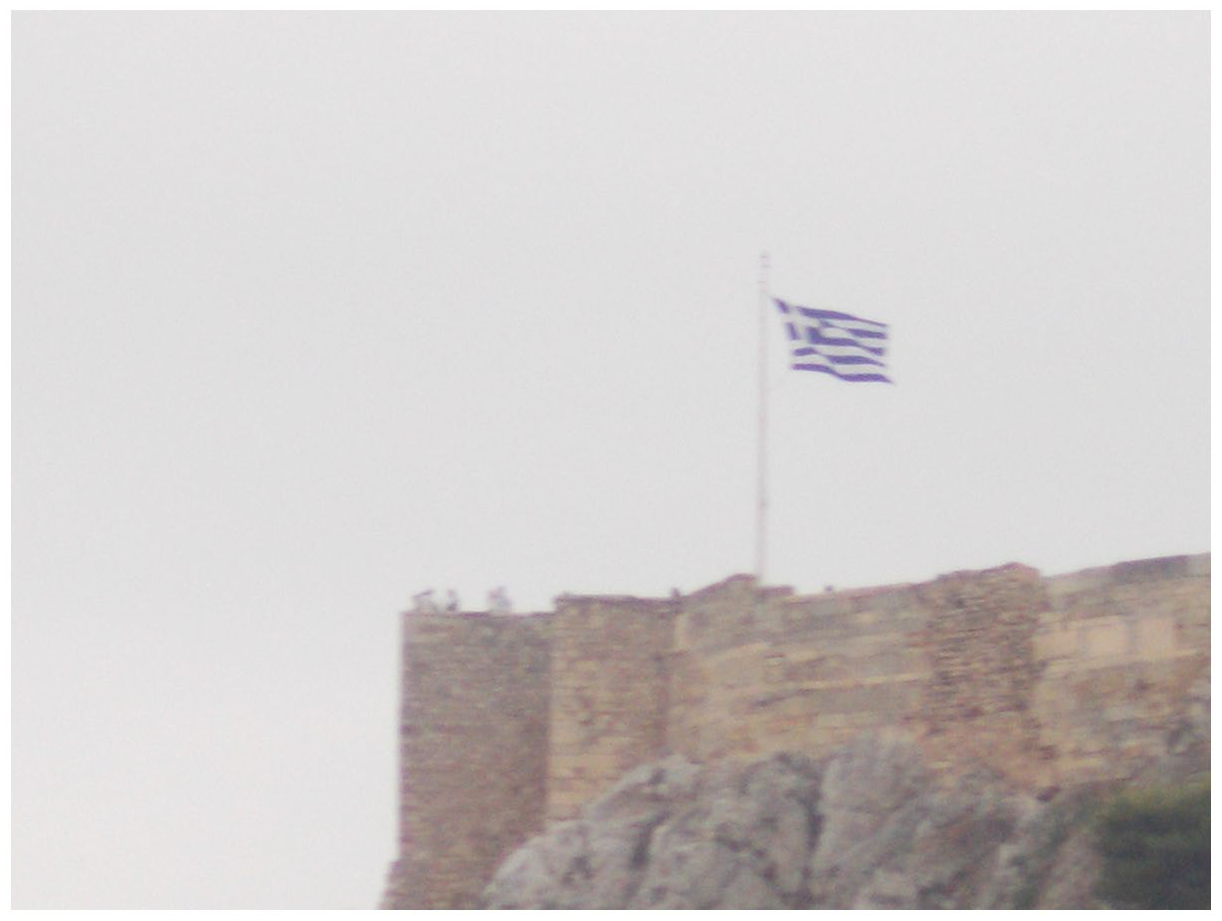
Georgina’s picture of the Greek flag, by the Acropolis.
At one point during Christos and Georgina’s walk through Plaka, while she was making pictures, she zoomed in on the Greek flag on the top of the hill (see Figure 7), and said she was going to make a picture of that too. It was quite difficult to get the flag in the frame at this zoom level, but she eventually managed. Christos asked her why she took a picture of it, and she told him that it is ‘the real thing, the official flag of course’, and that, ‘who knows since when this flag stands there, it is very important’. Georgina’s commentary, like Lina’s, symbolically couples the Acropolis and the Greek national flag. The understanding of the two in the same framework reflects the nationalist state discourse and official history – in which discourses the two often go together (Hamilakis, 2007; Herzfeld, 1991; Varvantakis et al., 2019a; Varvantakis, 2021; Yalouri, 2001).
Images in conversation
In each of the above ethnographic moments, we see that children use photography and argumentation to different effect to manage their proximity and distance from a monument that they know signifies national heritage and belonging. Michalis does not feel the need to resolve the distance and makes the monument even more distant through ‘postcarding’ it. Arguably, this strategy fits in the dominant discourses of the Acropolis where the monument is seen as a dominant cultural symbol in the construction of Greek national heritage. Lina, another local girl, who lives the nearest to the monument also draws on the dominant discourses of the Acropolis but, instead of distancing it, she brings it even further into her life through photographs of the monument framed by her balcony during the day and at night. We could well imagine that the next iteration of her strategy might be a figurine or photograph of the acropolis in the actual home.
Ardian and Georgina, who also recognize the dominance of the symbol, also respond to the monument in different ways. Ardian would like to dissolve the distance but does not manage to do so because he identifies the key impediment as being a material barrier, money, which is hard to overcome given his socio-economic position. Georgina, on the other hand, whose family is in a similar precarious socio-economic situation, ignores the material barriers to proximity and, using her creativity and imagination, she finds ways to overcome the distance symbolically. In this final analytical section, we continue to follow Georgina’s creative and imaginative strategies to reduce distance and to write her own multimodal heritage story.
During the workshop, among her 10 pictures of things that mattered to her, Georgina turned in several pictures of the Acropolis. Children in the workshop were seated at three different tables. Georgina sat at the same table with Lina, the two of them chatting and playing from the start. Lina brought with her the two pictures of the Acropolis she took from her balcony (Figures 4 and 5). Throughout the day both girls talked extensively and excitedly about how much each of them liked the Acropolis, a playful rivalry emerging between them. Lina spoke about the Acropolis, as something that is very close to her, something she sees every day, without having to leave her home. This proximity was discussed at the table, with another child, Mary, asking whether the banister was from her home’s balcony – to which Lina proudly answered that it was. Georgina, on the other hand, having turned in several pictures of the Acropolis (5) was talking extensively about how important the monument was for her but also how much she is enjoying strolling around the Plaka neighbourhood.
Later in the workshop, while children chose a single picture each to work with, Georgina decided to make a collage of two pictures: one of the Acropolis and one of a popsicle she had eaten on one of her walks around Plaka (Figure 8). In the text she produced for her photo-story she mentions that she went to the Acropolis, but she explained to Christos that she did not visit the actual monument, instead she went up to the rock next to the Acropolis (from where she also took the picture that she used in her collage). Similarly to how in her previous images of the Acropolis she used the zoom function in order to overcome material distance and create proximity to this off-limits monument, in her collage she collapses this distance by merging her own sensual experience with the image of the Acropolis. She puts her hand on the monument and, in so doing, merges her personal, sensual experience of ice-cream eating with the pleasure of viewing the Acropolis, an otherwise far-away, unapproachable and untouchable monument.
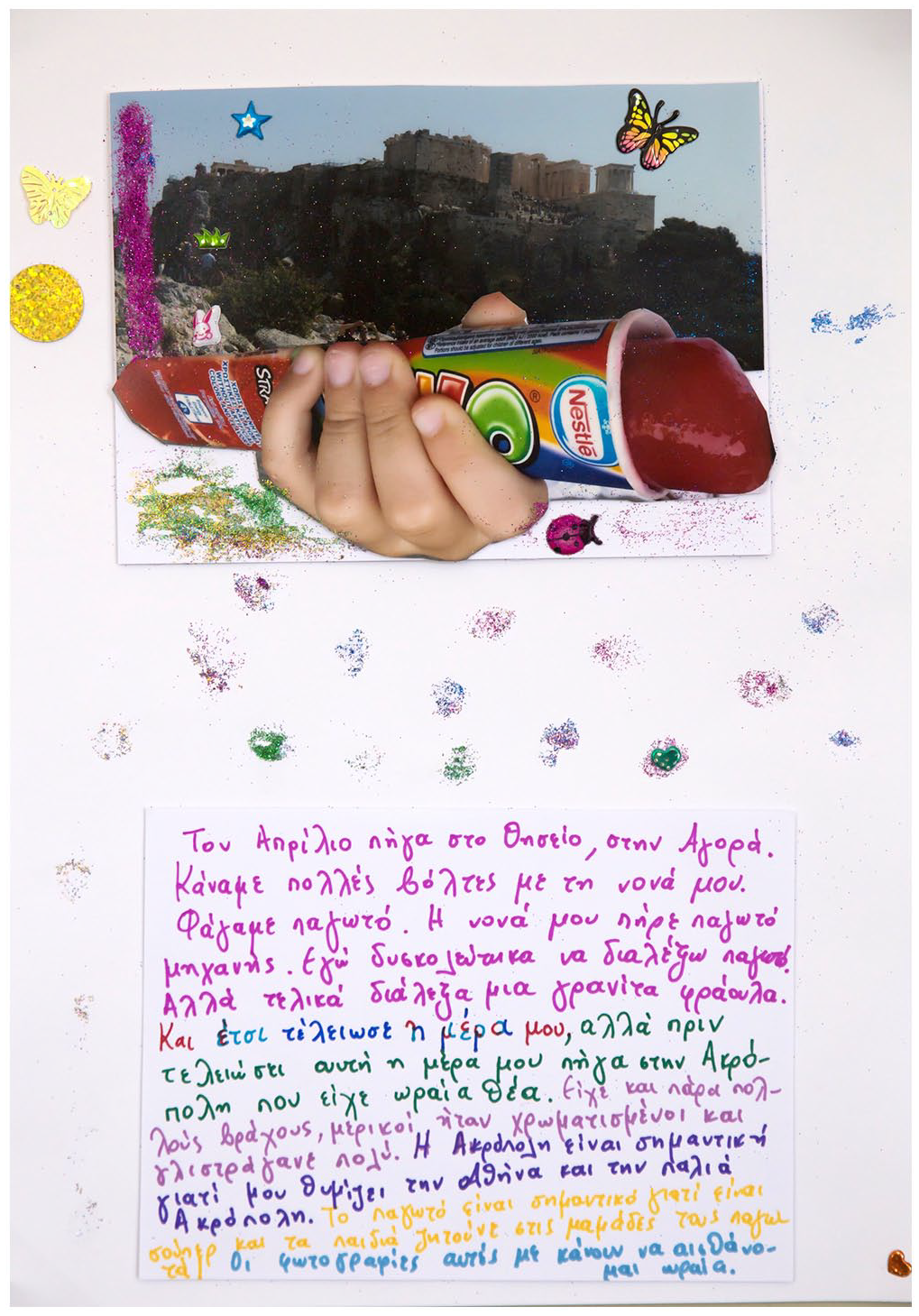
Georgina’s photo-story, created at the Connectors Study children’s workshop. The caption reads: ‘In April I went to Thisseion, in Agora. We walked around a lot with my godmother. We ate ice-cream. My godmother had an ice cream in a cone. I couldn’t decide what ice cream to choose. But in the end I chose a Strawberry popsicle. And so my day ended, but before it did I went to Acropolis which had a great view. It had many rocks too, some of which were coloured and very slippery. Acropolis is important because it reminds me of Athens and of the old Acropolis. Ice cream is important because it’s super and children ask their mothers for ice-creams. These pictures make me feel nice.’
We interpret Georgina’s gesture as being politically laden, a gesture of touch, of making contact and of entangling things that matter (Seremetakis, 1994; Sutton, 2001; Taussig, 1993). It is a gesture that appropriates a significant but unobtainable, for her, public space and by extension allows her to touch history. Multimodality (the photograph, the walk), the conversations with Christos during the fieldwork and those with the other children at the workshop, together with the remixing of her photographs (with glitter, glue and stickers) (Coleman, 2020), makes this gesture possible, highlighting, at the same time, the embodied use of photography to which children also have access. Georgina’s gesture of appropriation is an act of ‘multisensoriality’ (Pink, 2011), an embodied act of being in and connecting with the world (Taussig, 1993). But the same can be said for all of the children’s pictures of the Acropolis, albeit in different ways: as an expression of perceived distance from the monument (i.e. Figures 1 and 2), as expressions of proximity to it (i.e. Figures 3 and 4), and/or as attempts to overcome the distance that separates the photographer from the monument (Figures 5, 6 and 7).
The children’s pictures presented and discussed in this article do not only document the monument in question, but also talk of the photographer’s positioning and relation to/with it. In all cases too, the images and the accompanying stories that children told about them, moved their audiences – the other children, the authors, other researchers who have heard this paper presented, and later the exhibition audiences in Athens and in London 4 (Nolas et al., 2017c), through the conversations and thinking they have generated. In Van de Port’s (2018) words we, as researchers, as well as many who attended the final exhibition of the children’s photo-stories, fell ‘in love’ with the images and were recruited into their idiomatic political worlds (Nolas, 2021; Varvantakis and Nolas, 2019), an upending that challenges dominant representations of apolitical children as well as serious historical narratives.
5. Children’s multimodal heritage stories and expressions of the political in childhood
Photographs matter to people and photography plays an important role in communicating cultural identity, heritage and national belonging (Campt, 2012: 5–6). In this article, we focused our analysis on what children did when they put their hands on elements of the dominant culture, when they produced ‘quiet photography’. Through the analysis presented in this article, we demonstrate how photography as a practice, and children’s photographs as artefacts, afforded our interlocutors the opportunity to craft their own multimodal heritage stories. Children’s pictures are material entities (see also Ormerod and Ivanic, 2002), produced within social worlds, their meanings ascribed, adjusted and readjusted within social and material entanglements.
Our analysis took its cue from the initial ‘obtuse meaning’ the children’s photographs presented us with and focused on those parts of the images that held our attention beyond the subject’s obvious meanings. In this sense, we have allowed the photographs and the children to speak to us by paying attention to both the idioms of childhood (Nolas et al., 2018) and the idioms of children’s photography; we have attended to the sonority of the images (Campt, 2017). In other words, ‘quiet’ images and potentially inert objects (a banal image of an over-photographed monument) became animated beings with desires of their own (Mitchell, 2005). Photographs, argues Mitchell, are our way of gaining access to events and practices (p. xiv); pictures are ‘ways of worldmaking’ not just world mirroring (Nelson, 1978, cited in Mitchell, 2005) including, for children, a way of communicating their cares and concerns.
Attending to the sensuous properties of the medium and taking our analytical queues from the image itself (Pinney, 2005) and the children’s relationship to it, we have endeavoured to illustrate children’s cultural identity and national belonging, which we have envisaged as a spatial dynamic of proximity and distance from a monument that plays a central role in the cultural imaginary of ‘Greekness’, and how they engage with this affectively. The analysis developed here goes beyond the assumption that the presence of the national monument in children’s pictures manifests the prevalence of the dominant cultural, historical national discourse among children. In so doing, it challenges the assumption of children’s passive assimilation of these curricula and discourses. Aiming to move beyond a diagnosis of cultural domination, we looked instead on what children did when they placed their hands on elements of the dominant culture, and explored other histories (Pinney, 2005) which were nuanced, created and negotiated in these (photographic) encounters with the monument and with other children.
The analysis showed a range of multimodal heritage stories, some of which conform to the dominant narratives of the monument (postcards and classic views), some that challenge the distance and assumed membership of the classic view (the hand and ice-cream on the monument), and others that keep their photographer at a distance (the foothills). In particular, Georgina’s powerful image is one where many layers of meaning and desires collide and coalesce. In the mixing and remixing of her original images, she not only ‘speaks’ to a national historical narrative but also imposes the playful pleasures of childhood experience on the serious subject of history; this brimming over of playfulness and pleasure moves her audience.
Engaging in children’s images in this affective and sensory way challenges the sovereign notion of citizenship and national belonging associated with the nation state (Azoulay, 2012: 166). Instead, it enables us to think of children and childhood, through their images, as part of the ‘interface that enables people who inhabit different spheres of existence to share a common world despite marked differences in the conditions of their existence’ (p. 165). Thus, such an analysis of the children’s pictures is additionally significant in that it enables us to look at childhood processes and gestures which can be read as political. The fact that several children in Athens took pictures of the Acropolis can be understood as a significant element in the process of negotiating and constructing a national identity (Varvantakis 2021). In order to understand the complex politics of the relationship between childhood and public life, we followed an analytical approach that allowed us to hover between their verbal and non-verbal sensual landscapes, where idiomatic expression might be located (Nolas et al., 2018). In this way, the children’s photographs of the Acropolis can be understood as politically, emotionally, and sensually laden gestures that have the potential to move their audiences (as Georgina’s image has done).
From the perspective of furthering our understanding of childhood and children as political figures, our analysis suggests that political processes in childhood are often informal, everyday occurrences that more formal or adult frames and definitions of politics are likely to obscure (see also Kallio and Hakli, 2003); they require idiomatic readings. At the same time, the analysis demonstrates that aspects of the political in childhood lie in places beyond spoken language. Multimodal modes for data collection and production in the ethnographic research are particularly well suited to achieving these ends, allowing for more idiomatic expressions to surface. Similarly too, the decentralization of the focus of enquiry from the hermeneutics of cultural domination to the creative processes of the interlocutors’ engagement with elements of this dominant culture, also serves to locate the analysis beyond language. We have attempted to show how photography, and its storying, might be employed as a tool to investigate children’s relations with the social worlds they inhabit. We have indicated that, for such enquiries, a sensuous and embodied understanding of the act of photography proves to be most fruitful. Similarly, an approach to photography not as merely a means to generate verbal commentary but also with respect to the particular expressive forms of the medium is essential.
Footnotes
Funding and Acknowledgements
The Connectors Study was funded by the European Research Council Starting Grant, ERC-StG-335514, to Sevasti-Melissa Nolas. We would like to thank Penelope Petsini, Nikos Panayotopoulos, Konstantinos Kalantzis and Rupert Cox for their feedback and commentaries on previous drafts of this paper, as well as the three anonymous reviewers for their comments and suggestions. An initial version of the analysis that appears in this article was presented in the Photographic Encounters conference in Kithira in 2016 and included in the conference proceedings in Greek (see Varvantakis, 2021). There is no conflict of interest.

Notes
Biographical Notes
Christos Varvantakis has a background in social anthropology and sociology, and is currently working at Goldsmiths, University of London. His research areas include: childhood, politics, activism and contested urban spaces, as well as qualitative, visual and multimodal research methodologies. He co-directs the Childhood Publics research programme and is the Co-editor of entanglements: experiments in multimodal ethnography, and the Head of Programming of Ethnofest, the Athens Ethnographic Film Festival.
Address: Department of Sociology (WT1108), Goldsmiths University of London, New Cross, London, SE14 6NW, UK. [email:
Sevasti-Melissa Nolas is Senior Lecturer in the Department of Sociology at Goldsmiths, University of London. Her research focuses on: childhood, youth and family lives; civic and political practices across the life course; human agency and lived experience; multimodal ethnography; and publics creating methodologies. She co-directs the Childhood Publics research programme and is the Co-editor of entanglements: experiments in multimodal ethnography. She was the PI for the European Research Council-funded Connectors Study (2014–2019).
Address: as Christos Varvantakis. [email: