




Abstract
Musical numbers, as viral modes of entertainment, influential forms of visual culture and catalysts of popular discourse are dense with multivariate aesthetic performers, and are interlaced to punctuate the melodramatic narrative texture in advancement of the plot and characterization in musical films. Performing identity through dancing bodies has been the subject of several film, music, culture, performance and communication research endeavours yet has rarely been explored from multimodal discourse analysis perspectives. To examine the ‘resilient identities’ underlying performances, the article adopts an eclectic approach informed by the Bakhtinian chronotope with regard to two numbers drawn from a recent American musical film in order to pinpoint: (a) the full repertoire of multimodal resources of narrative agency and identity performance; (b) the emotional experiences evoked by the musical numbers; and (c) the social practices that constitute, maintain and resist social realities and identities. The unconventional approach to the analysis of the musical numbers is what makes the current research project stand out among interdisciplinary studies of musical discourse.
Keywords
1. Introduction
As viral modes of entertainment, influential forms of visual culture and catalysts of popular discourse, musical numbers are dense with multivariate aesthetic performers and are ‘interlaced’ to punctuate the melodramatic narrative texture in advancement of the plot and characterization (Weintraub, 2012). Characteristically, they are incorporated into musical films in mobilization of the spatio-temporal features and characterological motifs of the narrative texts. This is achieved in order for the performers to assert their persona and thus unique narrative trajectories are generated. Musical numbers have been the subject of several film, music, culture, performance and communication research endeavours (see, for example, Gehlawata and Dudrahb, 2017; Iyer, 2014; Rehman, 2016) drawing on interdisciplinary work in close relation to gender, performance and dance studies (Acet, 2019). Nevertheless, they have rarely been explored from multimodal, musical and discursive vantage points.
Several multimodal scholars approached ‘performances’ in a diversity of multimodal artifacts (i.e. live, mediated and recorded performing arts) from different perspectives in light of social semiotics, systemic functional theory, cognition, pragmatics and cultural theory, illuminating in the process key ‘semiotic practices’ and ‘identity formation’ processes (see Sindoni et al., 2017, for a comprehensive review of recent studies on performing arts). Extending scholarship on the theories and methods developed for multimodal artifacts to an under-researched genre, this article fills the gap, unpacking the semiotic patterns of musical numbers whose significant socio-semiotic power is downplayed and has not been fully theorized in multimodal discourse studies. Arguably, calling specific attention to the song-and-dance sequences in musical numbers, placing emphasis on the spectacular movement vocabulary, excellent scores, cinematographic and editing techniques, intelligent lyrics, glamorous costumes, star bodies and creative mise-en-scène (Bordwell and Thompson, 2008) is critical to understanding musical numbers.
On another note, musical numbers, as socially determined sets of practices, construct places according to multiple, relative chronotopes. They are ‘multimodally’ structured and ‘ideologically’ interpreted in conjunction with agentive selves (i.e. the dancing bodies) whereby identity is chronotopically organized in captivating time–space configurations that are never random. Identity is not a given category; rather, it is ‘the situated outcome of a rhetorical and interpretive process in which interactants make situationally motivated selections from socially constituted repertoires of identificational and affiliational resources and craft these semiotic resources into identity claims for presentation to others’ (Bauman, 2000: 1). This fact aligns with the Bakhtinian notion of the ‘chronotope’ (1981, 1986) – the ‘time–space’ continuum articulated in literature – and its recent sociolinguistic uptakes (see, for example, Agha, 2005, 2007; Blommaert and De Fina, 2017; Lempert and Perrino, 2007; Woolard, 2013, 2016). Although Bahktin’s notion of the chronotope has extensively been the subject of several literary studies, its inherent features, types and functions have hardly been systematically put to the test in the study of film genres, or further theorized from multimodal vantage points at the level of musical numbers.
Cognisant of the range of meanings attributed to the performing body, this study argues for the positive contribution a multimodal discourse analysis can make toward a fuller contemporary understanding of the complex chronotopic configuration of ‘resilient identities’ in musical numbers and the significant ‘ideological space’ (Lefebvre et al., 2009) they are embedded in. To this end, this article takes two musical numbers drawn from The Greatest Showman (2017) as a case study and a point of departure, namely ‘Rewrite the Stars’ and ‘This Is Me’. Peculiarly, in a series of mesmerizing spectacles and whimsical narrative song-and-dance sequences, the female performers call for key inter-class and inter-racial universal values of self-love, dignity, tolerance, fidelity, diversity, equality and perseverance. Loaded with socially transformative messages, these numbers tap into several themes that resonate in the American culture by virtue of their social, political and cultural relevance. They are structured around a display of dancing bodies that rework senses of time, space and agency in a re-situation of the embodied subject to thicken the present to the participating viewer’s experience of being. More specifically, in their capacities of ideological expression through song-and-dance sequences, the female protagonists therein naturalize extraordinary performances that advance the storyline yet their spontaneous improvisation of exquisitely choreographed song-and-dance numbers strains plausibility and removing them would disrupt the narrative logic.
2. The Bakhtinian Chronotope
The incorporation of the key Bakhtinian concepts of ‘dialogism’, ‘intertextuality’, ‘heteroglossia’, ‘carnivalesque’ and, more recently, ‘chronotope’ into cultural and media studies has invigorated the full understanding of not only Bakhtin but also a diversity of film genres as well. Fundamentally, the literary chronotope, or ‘the intrinsic connectedness of temporal and spatial relationships artistically expressed in literature’, was created and used by the 20th-century Russian philosopher and literary critic Mikhail Bakhtin (1981) to analyse ‘temporal’ and ‘spatial’ dimensions in classic genres of literature from ancient epic poems to modern Russian and European novels. In The Forms of Time and of the Chronotope in the Novel, Bakhtin explicates how people inhabit different concrete chronotopes in the course of history in two millennia of literary production and how this, in turn, is socio-historically reflected in social realities and practices. To Bakhtin, in these literary texts, time ‘thickens, takes on flesh, becomes artistically viable’ and space becomes ‘charged and responsive to the movements of time, plot and history’ (p. 84). Indeed, the representational capacity of the literary chronotope lies in the inseparability of time and space in constructing narratives, characters and ‘responsible actions’ (Steinby, 2013). These time–space connections are indexical. Every invocation is symptomatic of ‘agentive’ selves and identities, and signifies locally enacted sets of meaningful signs – i.e. sets of historically established, socialized and thus recognizable linguistic, semiotic and discursive features, in other words, orders of indexicality (Blommaert, 2010).
The chronotope has featured prominently in recent work for the last two decades, with several interpretations, in serious attempts to unravel the inherent complex ‘spatio-temporal’ configurations and relations in semiotic representations and discursive practices of different types in relation to ideologies. A substantial body of research on the Bakhtinian chronotope and a variety of text patterns and genres from cultural, anthropological, sociolinguistic and discoursal standpoints is discernible in the literature to date (see, for example, Blommaert, 2015, 2018; Blommaert and De Fina, 2017; Blommaert and Rampton, 2011; Blommaert and Varis, 2013; Dickinson et al., 2019; Karimzad and Catedral, 2018; Lempert and Perrino, 2007; Woolard, 2013, 2016) and further studies extended from literature to performance and identity work not excluding films (Blommaert, 2015; Garcia, 2014; Wirtz, 2011). Whereas literature is linear, the cinematic chronotope fleshes out on screen with specific dimensions unfolding in literal time and space (Flanagan, 2009; Lafontaine, 2014; Sammartino, 2017; Zitzelsberger, 2019). In Bakhtin and the Movies, Flanagan (2009: 57) avers that ‘Time and space, then, are the main constituents of film form, elevating the chronotope to an essential factor in any study of how cinematic texts create narrative effects.’
Arguably, the chronotope seems more appropriate to film than literature and promises a more compelling avenue to the theorization of song-and-dance sequences in musical numbers. In proposing a more nuanced analytical model for the analysis of song-and-dance sequences in musical numbers, with a focus on the display and mobilization of the ‘dancing body’, the study aims to attend to the pertinent choreo-musical and discursive features therein. Analysing media texts multimodally divulges how semiotic resources and their division of labour, ‘articulate ideologies’ (Machin, 2013) and is, therefore, likely to pinpoint: (a) the full repertoire of multimodal resources of narrative agency and identity performance; (b) the multiple spatio-temporal configuration of the musical numbers; and (c) the social practices that constitute, maintain and resist social realities and identities. To examine the ‘resilient identities’ underlying performances in musical numbers, the article adopts an eclectic approach informed by the Bakhtinian ‘road’ chronotope to lay bare the mediated workings of ideology through the cross-fertilization of multidisciplinary analytical tools (Wodak and Meyer, 2001). Bakhtin (1981: 244) identifies the ‘road’ chronotope as one of the most enduring in Western literature and, in the narratives of the ‘road’ chronotope, the protagonist’s journey is a metaphorical one whereby the ‘choice of a real itinerary equals the choice of “the path of life”’ (p. 120). The insights and findings of the research endeavour are discussed in light of the ‘road’ chronotope in order to: first, illuminate the socio-historical gendered appropriation of the musical numbers; second, shed new light on the ways in which the numbers react to the wider artistic, political and historical frames within which performers operate; and third, create new modalities of time–space configurations, rendering the ‘here-and-now’ in a new light, and hence reflecting on the gendered power structures that shaped realities in novel ways.
3. Case Study
In the context of this research endeavour, only two musical numbers are analysed as a case study, namely ‘Rewrite the Stars’ and the Best Song Golden Globe-winning ‘This Is Me’ drawn from the American musical film The Greatest Showman (2017) that characteristically foreground the storyline by weaving narratives around song-and-dance sequences in outstanding musical numbers. The film tells the story of the visionary Phineas Taylor Barnum who revolutionized popular culture and managed to change the view of the so-called ‘socially unacceptable’ misfits of society to a ‘circus of human marvels’. In essence, the musical numbers represent a step in the journey from heartache to one of self-love and cultural awareness. In their entirety, the represented world views they advocate and the diversities they celebrate, namely those of the marginalized and disenfranchised in American literature, are noteworthy.
The rationale for selecting these two numbers for analysis is twofold. First, not only do the body movements and dance sequences therein advance the narrative but they provide aesthetically pleasing moments to appreciate the marriage of music and movement as well, rendering the female performers as coherent musical subjects. As empowering mechanisms, the song-and-dance sequences function as extended metaphors and allegories of ‘resistance’ in transgressive spaces, which is of special interest in this research endeavour. Second, in the fabric of the narrative numbers, time and space are discursively negotiated and bodily enacted by the female performers. The songs emerge in similar historical contexts and develop their distinctive chronotopes by placing emphasis upon unusual song-and-dance sequences through which the body occupies a space separating past, present and future moments in time.
4. Methodology
Approaching song-and-dance performances in musical films as ‘situated behaviours’ rendered meaningful in relevant contexts (or relevant ‘time–space’ configurations) implies that identity is not ‘static’ or ‘predetermined’; rather, identity is dynamically ‘performed’, ‘constructed’, ‘authenticated’, ‘negotiated’ and/or ‘challenged’ (Brubaker and Cooper, 2000). To Feuer (1992) and Knapp (2009), musical films adopt a multiplicity of narrative strategies that afford audiences authentic and multivalent experiences in the viewing process. To unravel the strategies of identity performance in musical numbers, the analytical model advanced in this article comprises two intertwined taxonomic categories that lend themselves to scrutiny in the genre under study, namely: Choreography and Musicality (see Figure 1 for the Choreo-Musical Analytical Model [C-MAM] adopted).
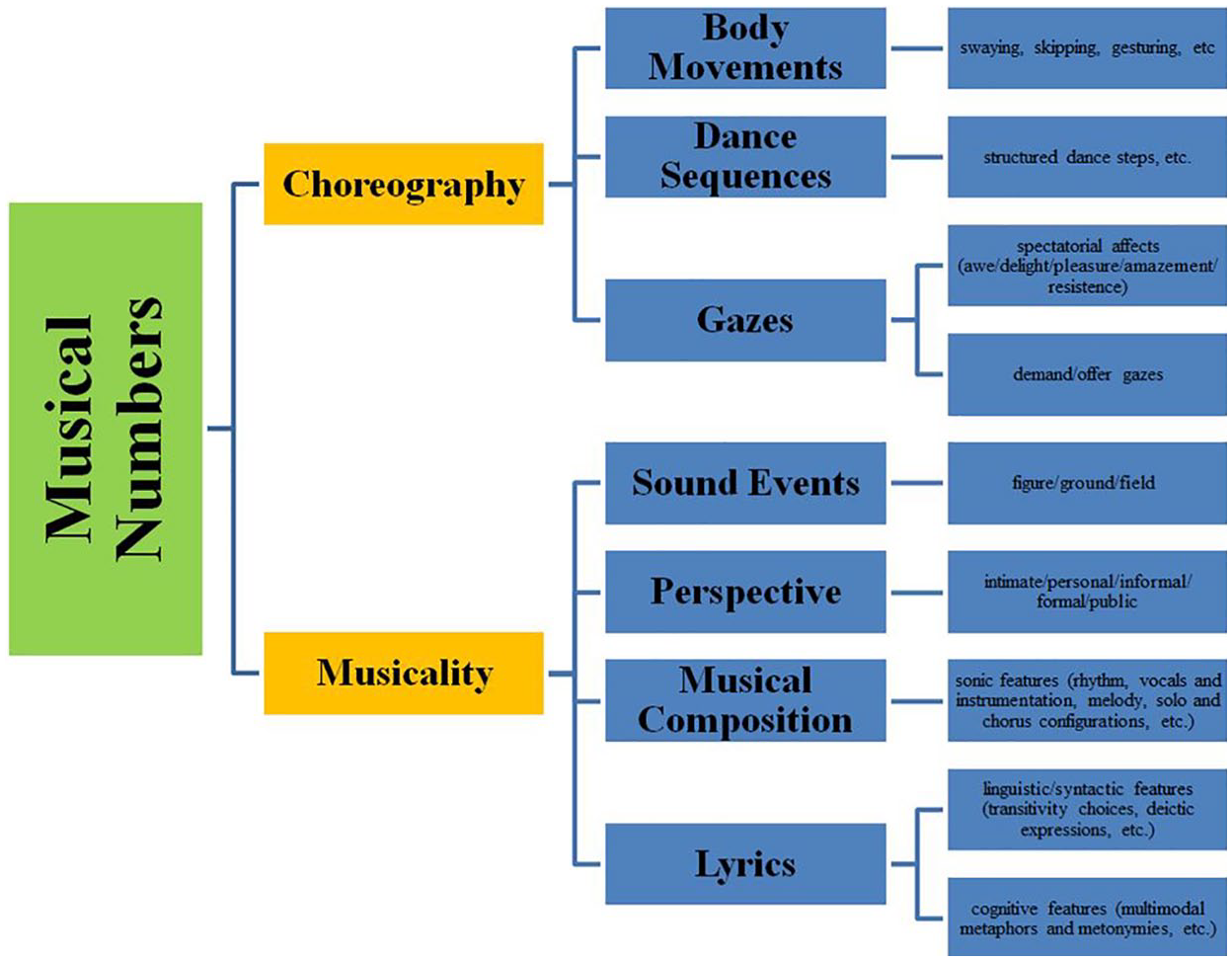
Choreo-Musical Analytical Model (C-MAM) for musical numbers.
The first category of Choreography is understood in the context of this study as an emerging autonomous aesthetics of change, a world perceived in patterns, proportionalities, relations, ecologies and energies in a ‘representational space’ (Stenglin, 2009, 2011, 2016) that incorporates ‘complex actions’ (Van Leuween, 2008) purposefully carried out by performers for a specific audience (Christensen and Calvo-Merino, 2013; Maiorani, 2017). Interpreted as the design of movement in time and space (Klein and Noeth, 2011), choreography alludes to Bakhtin’s chronotope in terms of the ‘intrinsic connectedness of temporal and spatial relationships’ (Bakhtin, 1981: 84). As a representation of ‘narrative processes’ (Kress and Van Leuween, 2006), it is constitutive of not only language but also an array of mobilized semiotic resources (kinesthetic, spatial and material arrangements) as argued by Streeck et al. (2011). To Foster (1998: 5–6), choreography ‘serves as a useful intervention into discussions of materiality and body by focusing on the unspoken, on bodily gestures and movements that, along with speech, construct [hybrid identities]’. Drawing on Lefebvre’s (2009) contention that ‘the space of a (social) order is hidden in the order of space’, the study takes choreography as a primary indicator of how ideology comes to be embodied in spatial aesthetics.
Typically, choreography encompasses a myriad of ‘representational’ and ‘interactive’ meanings (Kress and Van Leuween, 2006) at the full disposal of artists to call upon, particularly body movements, dance sequences and, arguably, gazes (see Figure 1). With the use of specific camera-related ‘choreographic’ techniques, viewers can visually appreciate what is physically taking space, getting a clear idea of the exact shapes that the dancing body creates when moving around the social space. Whereas body movements are ‘free-flowing’ and ‘unsynchronized’ (Luck and Sloboda, 2009), ranging from relaxed movements of swaying in coordination with the melody and rhythm to a plethora of facial expressions that express inner emotions, dance sequences are patterned and rhythmic forms of expression.
Relatedly, the dexterous camera editing techniques employed in song-and-dance sequences project the illusion of a direct authentic self-expression, conspire to position the viewer’s gaze in relation to multiple coherent and expressive gazes in the narrative numbers, and keep the viewing eye moving fluently through space (Bordwell, 1985). It is particularly interesting to evaluate such moments in musical numbers where it is necessary to showcase the physicality of the performer (i.e. dance skills, creativity and triggered spectatorial affects). Following Kress and Van Leeuwen’s (2006) classification of gazes, the two types of demand and offer are of special interest in the current study. To Kress and Van Leeuwen, images make demands when an animate represented participant looks directly at the viewer because vectors, or lines of direction, connect the viewer and the represented participant. There may be a smile (suggesting social affinity), a stare (suggesting cold disdain), or a pout (suggesting a sexual offer or demand). Alternatively, if the represented participant is depicted as the object of the invisible onlooker’s contemplation and/or inspection with no socio-relational call on the part of the viewer, it is an offer.
The second category in the model pertains to Musicality. The ability to recognize the way sound design calibrates the on-screen bodies to the music score, generates affective propensity and positions the intended viewers is fundamental to the critical analysis of audio-visual representations. The grammar of sound concerns not only music as a deliberate production of a sound act made up of melody, harmony, tempo, meter and timbre but also the full repertoire of choices adeptly made to communicate attitudes, create coherence across soundscapes and fulfill the three language meta-functions. Fittingly alluding to landscape, ‘soundscape’ subsumes the idea of relative and variable distances, of space and of perspective within that space. To closely examine the manifold role of sound and music in the narrative numbers, the study is informed by Van Leeuwen’s (1999, 2007, 2012) work on sound design. To Van Leuween (1999), perspective is a continuum rather than a strict division ranging from intimate, personal, informal, formal to public. Central to the notion of ‘perspective’ is ‘social distance’.
Sound events are further described in terms of ‘figure’, ‘ground’ and ‘field’. While figure is the most prominent sound event that requires immediate attention and is consciously listened to, ground is background ambient, passively heard instead of actively listened. Field (or soundscape) is the physical world in which figure and ground are identified. The functions of these sound events are examined with special regard to social distance. Additionally, musical composition in terms of sonic features is considered as one element of larger multimodal texts, examining the interacting meaning potential of semiotic resources such as rhythm, vocals and instrumentation, pitch, melody, solo and chorus configurations and their interrelationships with lyrics, moving images, colour and other modes of communication, drawing upon and extending the conceptual territory of social semiotics.
The semantics and syntax of the lyrics, as Belton (2013: 143) asserts, allow the musical to ‘transform the setting or space from one that grounds the action from the more or less realistic world of the story (its fictional reality) into a different register’, and the ‘conventions of classic realist narration, in which characters do not normally break into song and dance, suddenly yield to the conventions of the musical number, in which they do’. Lyrics are examined with special regard to two sets of ideologized, normalized and enregistered features in the genre under scrutiny. The first comprises the linguistic/syntactic features therein with regard to transitivity choices (see Halliday and Matthiessen, 2014, for a detailed account) as well as the personal and chronotopic deictic expressions as philosophical, socio-linguistic and psychological phenomena examined from discoursal and cognitive perspectives (see Griffiths, 2006, for a detailed account). The second embraces the inherent cognitive features in terms of multimodal metaphor and metonymy (see Forceville, 2009a, 2009b, 2013, and Lakoff and Johnson, 2003, for a detailed account). The latter features are of special interest in this article by virtue of their predominance in the narrative texts. Within cognitive metaphor theory (CMT), a metaphor is a cross-domain mapping between the source (abstract concept) and target (physical experience) domains. A major clue in the identification of metaphors and metonymies in the current study is Black’s (1993) resonance. A metaphor is resonant if it allows for a rich array of mappings from source to target. Conceptual metaphors and metonymies are typically written in capital letters whereas their linguistic/visual realizations are written in small letters.
In alignment with cinema studies, the article uses the term ‘musical number’, often referred to interchangeably as ‘narrative number’, in the course of analysis. In the section that follows, choreography and musicality are discussed as the principal aesthetic processes and interpreted in light of the emergent multiple chronotopes that unfold in the narrative of the numbers.
5. Analysis
Choreography
In ‘Rewrite the Stars’ and ‘This Is Me’, each body movement and dance sequence is overtly choreographed, strictly coordinating with the accompanying melody and complex musical rhythm with rigour and excellence. Fashioned in this manner, the aesthetic expression guised in ‘the dynamic actions of the face, voice, and body’ (Matsumoto et al., 2013: 34) are best viewed as performatives showing coherence and fidelity relating to the viewer’s beliefs and experiences.
The potential of choreography in ‘Rewrite the Stars’ lies in the suspensions, levitations and pauses discernible on screen (see Figure 2). To elaborate, the musical number is depicted in a ‘self-enclosed’ realm, existing parallel to the world outside the stage, where more enduring bodily movements express inner emotions in deep engagement with a spatial aesthetics. The duet is entangled in an intimate, aerial cat-and-mouse chase on weighted ropes, engaged in constant gazes at each other (see Figure 3), which, in turn, elevate the scene’s emotional weight and capture the intimacy of two star-crossed lovers at a crossroads, representing the obstacles that they face. More specifically, the female performing body defies gravity, integrating powerful athleticism into the acrobatic movements. The choreographic aesthetics – attuned to alternations in pitch, timbre, melody, rhythms and lyrics – seem to trigger a ‘binary opposition’ whereby the song-and-dance sequences both separate and unite the lovers in their social milieu. How each physical movement of the trained dancing bodies triggers or initiates that of another is intriguing to the unerring eye.
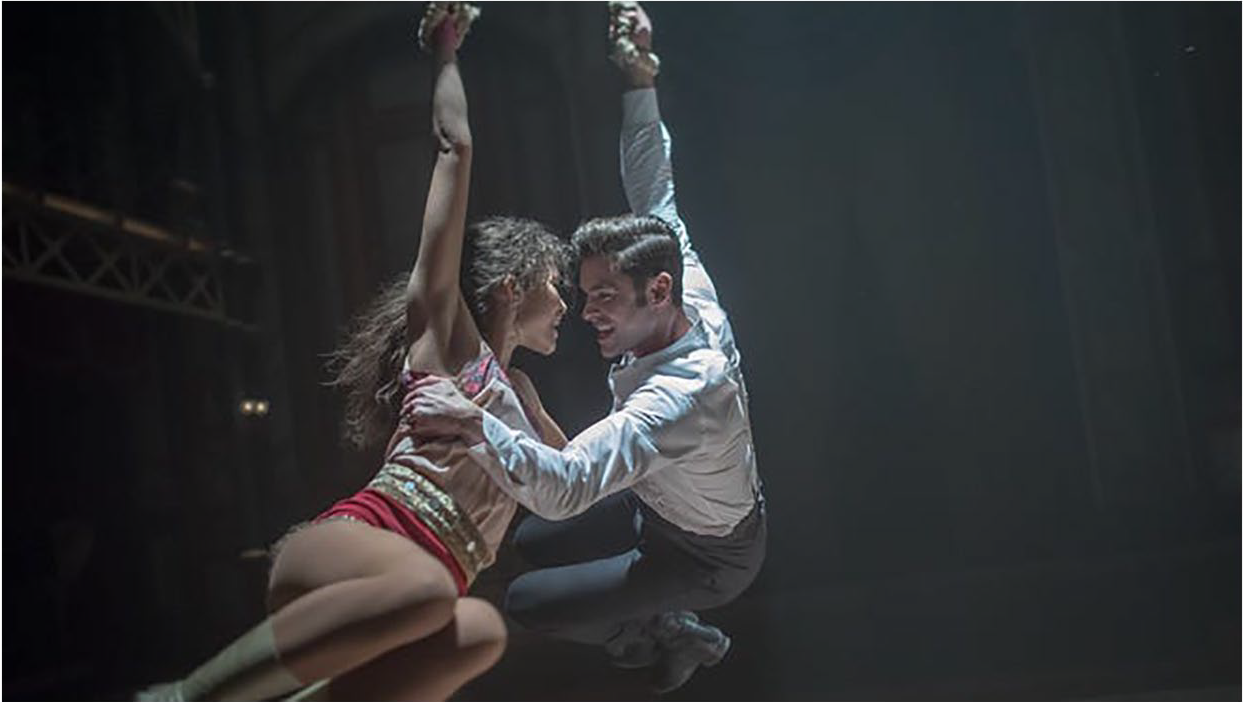
Choreographed body movements and dance sequences in ‘Rewrite the Stars’.
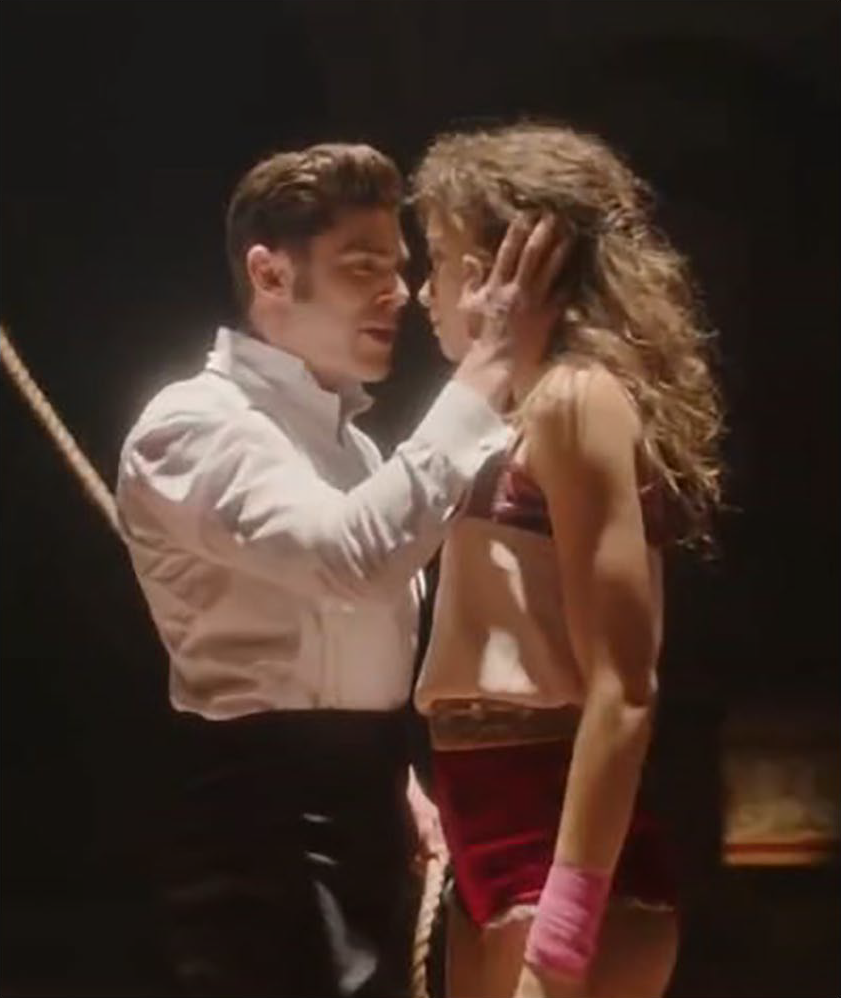
Intimate demand gazes between Anne and Phillip in ‘Rewrite the Stars’.
The duet is represented at times inches away, at other times as though they were to keep their distance, tied both by the ropes of trapezing and of social conventions. They display well-crafted body movements and dance sequences while gracefully gliding through the air on an acrobat rope, layering original movement vocabulary onto the narrative number, and affording the space and the repertoire that fulfills different numerous functions both dramaturgically and aesthetically. These choreographies synthesize not only distinctive temporal flows and mark bodies struck by temporal pressure but also resilient identities in the process of healing a temporal disjunction as their bodies slip and slide between ‘dialectical times’ as physical embodiments of tension and resistance. As a consequence, viewers bear witness to the exuberant choreography and daring agility that feed the nascent passion of the interactive duet, creating a grand spectacle of ‘embodied minds’ (Snowber, 2012). As the song progresses, the visual construction of female subjectivity is leveraged. As the background music accelerates, song-and-dance sequences (paired with music and lyrics) reach a dizzying climax, emblematic of the emotions aroused in the lovers, and by extension the multimodal ‘aesthetic’ pleasure viewers feel as a consequence (Reason and Reynolds, 2010). Approaching an aesthetics of escapism and allegorical realism, ‘Rewrite the Stars’ blossoms into more refined emotional expressions and the duet fades away to emptiness, albeit a beautiful and intriguing one, towards the end of the musical number.
In a similar vein, choreography in ‘This Is Me’, as a form of responsive ‘spatial practice’, is noteworthy. Noticeably, the musical number exhibits characteristics of a performed gendered discourse of ‘resilience’ motivating the chorus and verses to excite the audiences therein, on the one hand, and constituting a significant development in the plot, on the other. The Bearded Lady and each member of the Ensemble perform their movements in perfect unison to different parts of the score – melody, harmony or base rhythm in the artistically circumscribed space (see Figure 4). The Ensemble performs in different patterns in a ‘space of flows’ with no real formations, yet with seamless harmony and cohesion, scattered on the stage to reinforce diversity and grant the audience an immediate sense of the world they are part of, that is, a community that inhabits different characters but with unique movement signatures. The performers walk through fancy halls of upper-class men and women who disapprovingly gaze at them (see the reaction shots of the audiences in Figure 5). In return, The Bearded Lady and the Ensemble challenge the very gazes of the elite through the aesthetic expressions of anger heightened onscreen in their song-and-dance performances. As they all sing ‘This Is Me’ to the angry onlookers who believe they should not be allowed to show their faces, audience reception changes (see Figure 6).
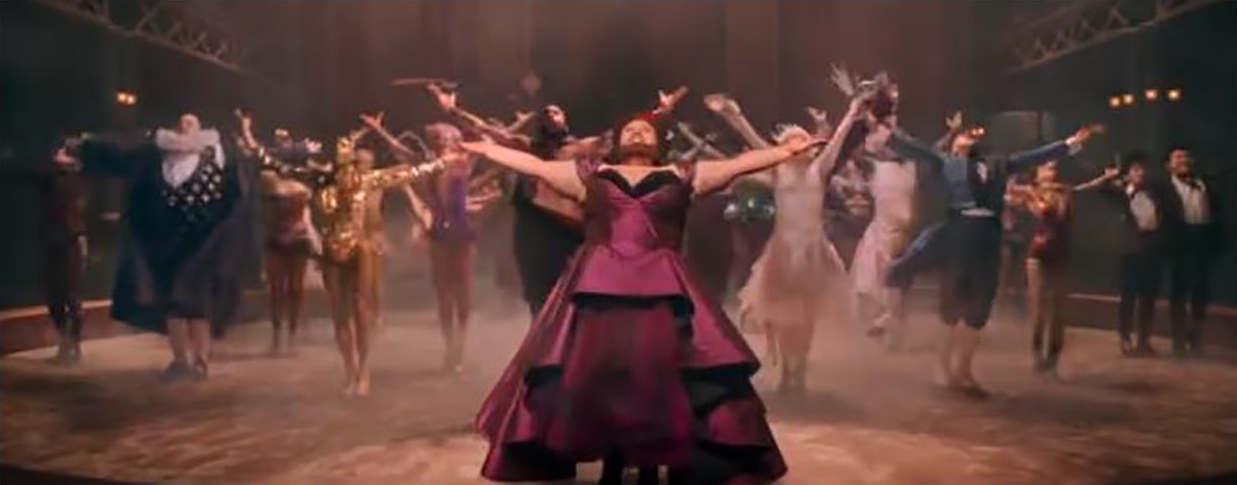
Choreographed body movements and dance sequences in ‘This Is Me’.
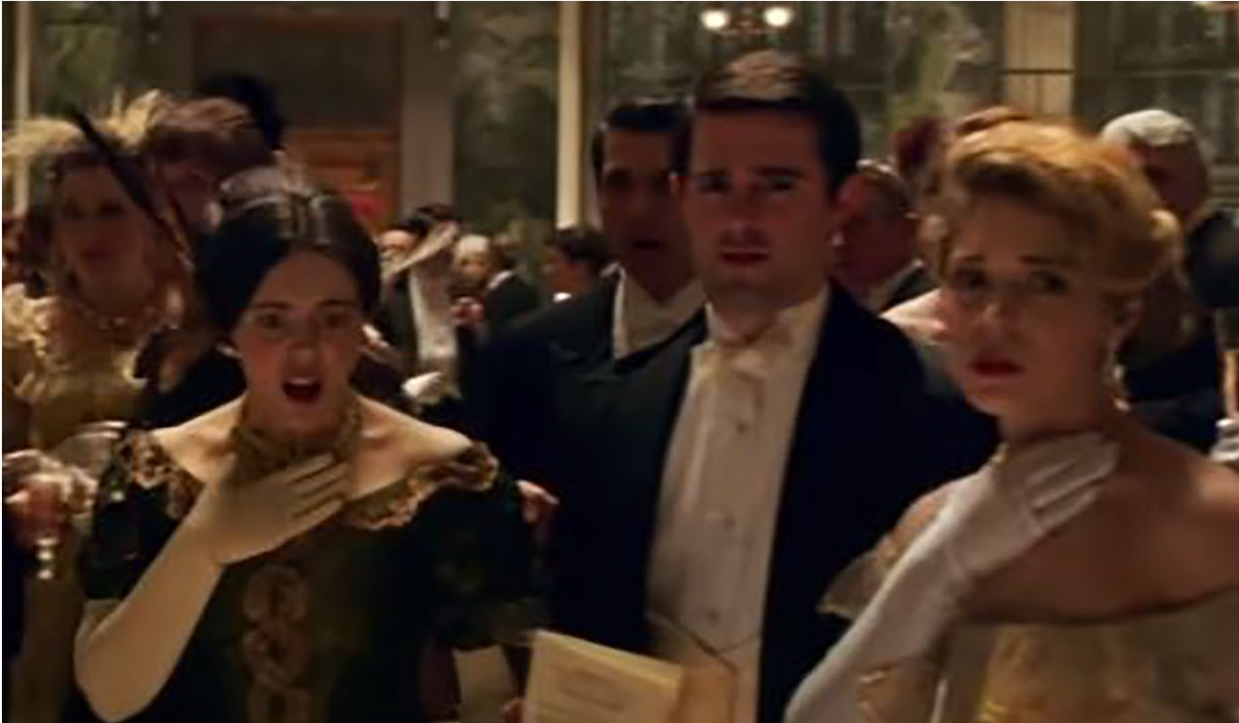
Disapproving offer gazes at the Bearded Lady and the ensemble early on in ‘This is Me’.
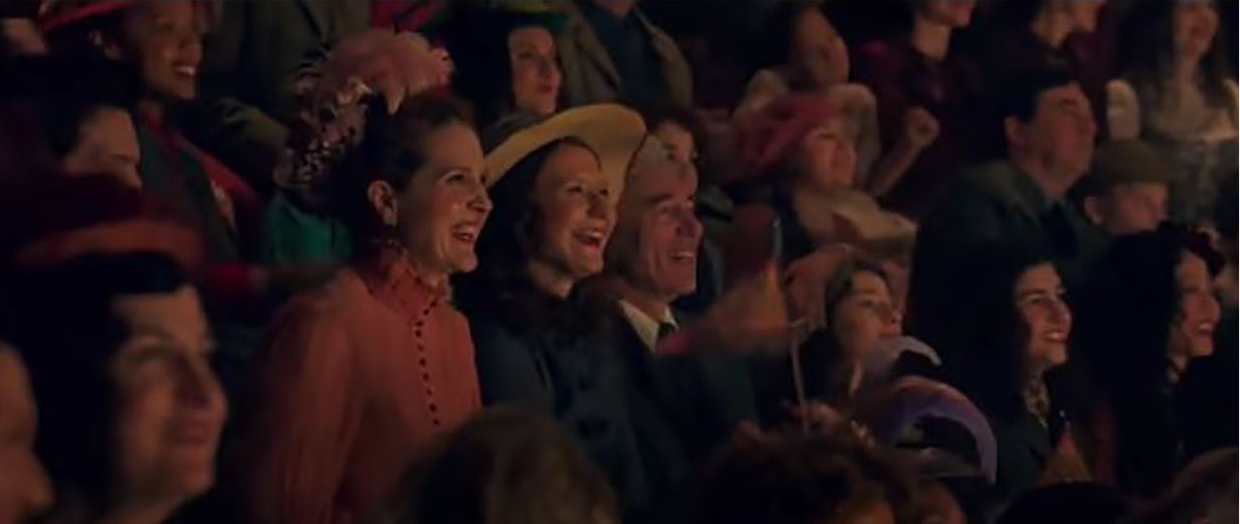
Encouraging offer gazes at the Bearded Lady and the ensemble toward the end of ‘This is Me’.
This overlay of signifying practices lays bare naturalistic representations to the multilayered emotions performed. The movements become sites of ‘transgressive delight’ where viewers can experiment with and explore new ways to move and construct different patterns of movement and existence. As the music builds up, the performers patrol the streets in clusters with strong and open movements, lengthened limbs and outstretched arms with an entirely distinct ‘expressive mode’ (Wolf, 2011). The performing bodies seem to waver between a temporal prejudice that emasculates their very existence and eccentric vigour that dispatches the arrow of time down a different course. In this way, the song-and-dance sequence inhabits a new space, signifying in the process a new causal relationship within the film – moments where a social change is imminent.
As shown in the two numbers above, ‘space’ plays a significant role in the performance of resilient identities. Fundamentally, the stage functions as the physical manifestation of ‘social space’ as experienced, negotiated, resisted and reproduced by the female performers. In this space, the socio-historical context is intensified in response to a wide array of filmmaking multimodal aspects (e.g. editing, camera work, lighting, gazes, sound and image juxtapositions, and framing, to name a few). A spatial effect of the chronotopic configurations prevalent in the numbers, as a consequence, is a ‘snowball’ effect. Actions of identity performance start to gain momentum as the protagonists summon a differentiating force that recovers history in dialectically timed poses and move across a space that is anything but empty. A tension between the mimetic power of the camera and their own inventively constructed temporalities is further ignited. The performing bodies as representational chronotopes (constructed in temporal settings) co-evolve with embodied chronotopes (the real concrete historical times, places and events) and, as avatars of time, offer a unique viewpoint onto the fashioned chronotopes inviting viewers to re-think their own present condition and who, when confronted by non-linear temporalities, shuttle back and forth in time in the course of the narrative numbers.
Musicality
A fundamental feature of the sound design of ‘Rewrite the Stars’ and ‘This Is Me’ is ‘mickey-mousing’, that is, the placement of the full spectrum of sound events, perspective and sonic features in relation to the overall narrative structure imitating aspects of the spatio-temporal and visual movements on screen with an uncanny consistency to keep the story in the foreground of the viewer’s perception. In the two numbers, perspective is representationally manipulated to a good effect. The typical aural perspective relies on music as background, composed and performed to leave room for the lyrics as foreground through technological manipulations of volume. Relative loudness is used to position the viewers close to specific parts of the complex musical events and distance them from others. Background music frames the narratives in a socio-historical context, marking clear shifts in the storyline as the numbers progress and the lyrics unfold.
Characteristically, the two numbers start at the Ground level and progressively shift to Figure as the images parallel the narratives of tension (of the duet and the ensemble) enriching the storytelling. In so doing, this creates emotive allegiance to and solidarity with the represented social groups and expresses the values these diversities stand for. At the Figure level, the audience senses what is coming and feels a poignant response. Tension and resistance are represented by the accented downbeats, dynamics and increased tempo, hence adding direction and momentum. The performers’ voice lends a sense of veracity, enhances the number’s emotional content and provides rhythm and pace in the display of images. The fading out of music and the return of the ambient sound mark the end of each multimodal text.
In interplay with the moving images, these sound events are reminiscent narrative instruments that simultaneously articulate, arouse and evoke the quality of experience, through their unique sonic property as well as their embodied meaning. It is perhaps the rhythmic details where the whimsy and innovation of the musical numbers shine. The social spaces that host the female protagonists while they are busy performing their resilient identities and expressing their inner emotions are inherently rhythmic ‘temporal milieus’ (Langford, 2005: 84–90). In fact, the multiple rhythmic strata of the numbers either echo or parallel spatial relationships (i.e. the momentum and the athletic movements of the performers).
Against the rhythmic patterns, the musical composition features afford salience to the internal journey of the performers that starts with desperation and bewilderment (manifested in the visual and verbal ‘cry’) to eventually end with acceptance. Additionally, the complex ‘polyphonic’ texture and different dynamic melodies, simultaneously played by different instruments and performed by the female protagonists, are noteworthy. The accentuation and contrast of melodies pull viewers back and forth so as not to drift along with the flowing imagery. Each melody stands on its own yet all fit harmoniously together. It is, therefore, a form of interaction in which the performing duet/group are ‘equal but different’, and hence serve ‘social pluralism’.
In ‘Rewrite the Stars’ and ‘This Is Me’, music and lyrics conspire to articulate what is not visual: the inner thoughts and internal struggle of the female performers. Essentially, lyrics work in an almost operatic dialogue with the action. Every refrain becomes a subject of evaluation and appraisal on the part of viewers, while ‘resilient’ performances are responsive to the lyrics vis-à-vis expected constellations of linguistic, semiotic and discursive resources. Arguably, ‘multimodal metaphor’ in the texture of the numbers is commensurable with the chronotope; both metaphor and chronotope are tools of drawing relationships between two notions of conceptual similarity. If chronotope is ‘almost but not entirely’ a metaphor of time/space, then the ‘road’ chronotope synonymous with the multimodal metaphor LIBERATION IS A JOURNEY holds true in the lyrics of the two songs. Just as the road represents an escape from society in many road narratives, the multimodal metaphor LIBERATION IS A JOURNEY seems to free the female performers from the very social conventions that bind them. For the discursive realization of the multimodal metaphor, the source and target domains are not manifested in the same mode. While the target LIBERATION is cued visually (in the guise of the performing bodies), the source JOURNEY is cued textually (in the lyrics of the musical numbers).
A tight mapping exists between the target and source domains whereby entities in target domain correspond systematically to entities in the source domain. The set of correspondences becomes apparent in the metaphorical expressions (i.e. linguistic realizations or textual cues) discernible in the lyrics through which the female performers ‘voice’ their identities. Examples to cite from ‘Rewrite the Stars’ include ‘Fate is pulling you miles away’, ‘What if we rewrite the stars?’, ‘But there are mountains and there are doors that we can’t walk through’, and ‘We’re bound to break and my hands are tied’. On the other hand, examples to note from ‘This Is Me’ are: ‘I won’t let the shame sink in’, ‘We are bursting through the barricades’, ‘I won't let them break me down to dust’, ‘When the sharpest words wanna cut me down’, and ‘I’m gonna send a flood, gonna drown them out’. Through these instantiations, the female protagonists undertake an inner journey of spiritual immanence. Metaphorically trapped in a ‘temporal bubble’, they are unable to properly assimilate into their literary space. Such a ‘bubble’ bursts out as the metaphorical time gets in conflict with their metonymical space. To Bakhtin (1981: 252), chronotopes are ‘mutually inclusive’ and ‘they co-exist, they may be interwoven with, replace or oppose one another, contradict one another or find themselves in ever more complex interrelationships.’ In this view, a literary text may contain multiple chronotopes, which stand in various relations to one another. Since specific chronotopes define what is achievable, accessible and proximal, discursively performing identity is noteworthy. It is as though only through song-and-dance performances do the protagonists construct their own space, granting other travellers the opportunity to refashion new spatio-temporal configurations paving the way to their ‘liberation’.
As indicated above, the diverse manifestations of musicality seem to have the power of transforming the rather bleak reality of the performers, empowering them in unprecedented ways and endowing them with the ‘voice’ that blurs difference and challenges upper-class privilege. The subtleties within the sound design that are not foregrounded are likely to contribute at a subliminal level to the overall filmic materials. The result is a reverent, glittering epic production with lots of spectacle and (to the viewer’s eye) much emotional depth and credibility. In the two numbers under scrutiny, the female performers perceive both time and space as contracting as the narrative progresses. They are unable to adapt to the norms set by the chronotopic matrix in the musical film and therefore race against the clock to receive recognition. It is through these different musical configurations that the identities of performers have been transformed across spatio-temporal scales.
6. Conclusion
The current research endeavour sheds light on: first, an interdisciplinary approach to the analysis of musical numbers presenting novel perspectives relating to multimodal chronotopes (the space–time interplay among the visual, aural and discursive elements therein); second, the multiple chronotopic configurations of female agency (of the performing bodies, as signifiers of resilient identities) that reveal imaginaries of spatio-temporal resistance and imminent social transformation in two musical numbers drawn from The Greatest Showman. The article set out to examine how ‘Rewrite the Stars’ and ‘This Is Me’ fabricate their respective chronotopes from the standpoint of multimodal discourse analysis.
The Bakhtinian chronotope proved to be a useful theoretical framework for the exploration of spatiotemporal configurations of identity performance. It helped elucidate the proposed model, capturing the moments that highlight distinct representations of resonant and shifting feminist agency through the bodily dispositions of performers. The two musical numbers entail a process of becoming, in which bodily states and temporal moments are about to be, but are not yet. Neither character surrenders to the dominance of their corresponding chronotopes. Arguably, the emergence and circulations of recognizable chronotopes within the musical narratives of these numbers is likely to afford audiences genuine opportunities to experience ‘chunks of history’ that are emblematic of social values and realities bound to specific time–space configurations. Seeing identity work as organized, regimented and ordered by specific time–space configurations affords full understanding of the complex social and cultural processes.
The study suggests that time–space configurations are major forces in the performance of resilient identities and the transformation of the female performers. By showing how chronotopic stances are enacted, this article bridges the gap in recent studies pertaining to the Bakhtinian chronotope (Agha, 2007; Blommaert and De Fina, 2017). Future research projects can examine Bollywood movies that are rich with song-and-dance sequences and draw cross-cultural comparisons with Hollywood musical films over an extended period of time.
Footnotes
Funding
The author received no financial support for the research, authorship and publication of this article, and there is no conflict of interest.

Biographical Note
NASHWA ELYAMANY is an Assistant Professor of Linguistics at the College of Language and Communication (CLC), Arab Academy for Science, Technology and Maritime Transport (AASTMT), Smart Village, Cairo, Egypt. Her research interests include Stylistics, Pragmatics, Critical Discourse Analysis, Cognitive Linguistics, Multimodal Discourse Analysis, Social Semiotics and cultural studies. Her scholarly work has so far centred around the critical study of motivational speeches, digital narratives, music videos, political memes, TED talks and the aesthetics of forensic crime drama series. She is actively engaged in several interdisciplinary research projects on a diversity of media outlets. Recent publications include articles in The Social Science Journal (2020), Arab Media & Society (2020) and Learning-Electronic Journal (CALL-EJ) (2019).
Address: College of Language and Communication (CLC), Arab Academy for Science, Technology and Maritime Transport (AASTMT), Smart Village, Elmoshier Ahmed Ismail Street, Heliopolis, Cairo 2033, Egypt. [email: