




Abstract
Research in fields such as multimodality and semiotics has focused on creation of value in different forms: aesthetic, economic and symbolic. However, the destruction of value has attracted much less attention. The aim of this article is to identify social, semiotic and ideological functions of acts of destruction based on an analysis of the traces these acts leave on the urban environment. Five overarching acts of destruction are discussed, but the authors’ main focus is on what they call transformation-driven and social presence-driven destruction, with two examples from Sweden and South Africa. The article discusses sanctioned destructive acts that are largely in compliance with dominating semiotic regimes at a certain time and place, as well as disruptive actions that challenge or even disobey those regimes. The analysis shows how a distinction between sanctioned and disruptive is in no way clear and often depends on complex power distributions between semiotic regimes at a given time and place. In fact, traces in the physical environment that may point to or index highly destructive acts can, in relation to other semiotic regimes, be regarded as creative and constructive. The authors argue that the semiotic processes of destruction and the traces they leave deserve more attention from research in the fields of multimodality and semiotics.
Introduction
Every act of creation is first an act of destruction. (Pablo Picasso)
Multimodal approaches often look at the ‘making’ of something: a text representing an idea; a building as an invitation to specific social actions; or an artefact that can be viewed or sold. At the core of such processes is a creative element which results in a type of value adding. In the production of a text, there is the possibility of spreading ideas and adding value. Or, in the case of an artefact, there may be increased economic value when materials are designed in specific ways. Much less research interest has been directed towards the ‘unmaking’ or destruction of value. In this study, our main focus is on material traces (Mosbæek Johannessen and Van Leeuwen, 2017) that, indexically, point to acts of destruction (see Karlander, 2019). Traces of destruction are related to semiotic regimes, namely the norms that enable and restrict different types of meaning-making at a given time and place, albeit in sometimes complex and contradictory ways. Employing the notion of semiotic regimes enables a critical discussion of the social, semiotic and ideological functions of destruction.
Our approach is motivated at different levels. It is primarily theoretical and explorative in that we wish to explore concepts for thinking about destruction in terms of social semiotics. From a social semiotic perspective, actions are judged as meaningful according to the impact they have on unfolding interactions between people (Kress, 2010; Van Leeuwen, 2005). According to this approach, destruction can be seen to be ‘as meaningful as an act that would typically be seen as creative or productive’ (Sakr, 2017: 228). As such, we argue that semiotic acts of destruction deserve more attention from research in multimodality and semiotics. That, however, is not to say that destruction as a sociological phenomenon has not been studied before. There is, for instance, rigorous research on iconoclasm (Hardy, 2019; Tsongas, 2018) and vandalism (Bhati and Pearce, 2016; Richardson, 2019), but generally destruction is not framed as a type of meaning-making, which is the case in this article.
The focus on the traces of destruction rather than the acts themselves also distinguishes the analysis from related approaches to destruction. From a methodological perspective, acts of destruction are typically ‘here-and-now’ types of events that are transitory in that they often take place quite rapidly and then they are over. Thus, this article offers ways of thinking about traces as indexical signs of acts of destruction in another time, but usually in the same place as where the trace is found. Destructive practices are both common and important, and we offer concepts and tools for thinking about destruction as meaning-making. The main data for our analysis consists of 81 photographs, a short film, along with on-site observations of the student protests and the removal of the Cecil Rhodes statue at the University of Cape Town campus (2015–2017) and Hammarby football fans’ season opening march in Södermalm, Stockholm (April 2019).
Theoretical Framework: Indexical ‘Traces’ and Semiotic Regimes
Sakr (2017: 228) explores children’s destruction of their own artwork in order to develop an understanding of ‘the work that destruction can do, and the impact of different semiotic resources on destruction’. She looks at the materialities of destruction, ‘the physical actions that constitute destruction and the “stuff” that gets destroyed’. We look at destruction slightly differently to this, rather focusing on the traces of the acts of destruction: ‘Nothing just vanishes; of everything that disappears there remain traces’ (Baudrillard, 2007: 25). A trace is, broadly speaking, an ‘enduring mark left in or on a surface. It can be produced through addition or removal, with something either being applied to the surface or taken away from it’ (Karlander, 2019: 9).
Our theoretical approach to exploring traces of destruction is multimodal social semiotics (Björkvall and Karlsson, 2011; Kress, 2010; Van Leeuwen, 2005; Van Leeuwen and Jewitt, 2001). The assumption underpinning this approach is that meaning-making is a realization and materialization of social practice. The materialization of those practices is often referred to as texts. As social semioticians, we interrogate the material world, what we can touch and see, the material traces that we can find in the environment. We argue that traces of destruction are text-like in the sense that they are (partial and fragmental) representations of previous semiotic acts. Acts of destruction often leave traces: composite remnants of the destroyed object, as well as remnants of the act of destruction in the place in which the act took place.
We employ the concept of indexicality to think about traces on the urban environment in relation to acts of destruction. A concept originally introduced by Peirce (1984) in the 19th century, indexical signs can be described as ‘intrinsically related to the context of their occurrence (however capacious that context might be’ (Nakassis, 2018). A classic example is that of smoke as an indexical sign of fire. However, in the field of linguistic anthropology – primarily through the influential works of Silverstein (e.g. 2003) – the concept has been radically extended to include connections between linguistic acts and broad, cultural contexts. The concept of indexicality has also played a key role in the field of linguistic and semiotic landscape studies (Blackwood et al., 2016; Shohamy and Gorter, 2009; Thurlow and Jaworski, 2010), and in the geosemiotics of Scollon and Scollon (2003). For our purposes, we follow Scollon and Scollon’s application of the concept: ‘the [indexical] sign only has meaning because of where it is placed in the world’ (p. 29, emphasis in original). In other words, the concept of indexicality helps us to construe connections between material traces on the environment and the acts of destruction that caused them.
In order to interrogate traces of destruction, we need to think about ‘value’ and how that is semiotically regulated. The attribution of value to something is related to what Appadurai (1986: 14–15) called regimes of value. Such regimes function like normative discourses in that they control what is appreciated in certain social groups or societies at a certain time and place. That is, regimes of value regulate what is valuable and, thus, can be destroyed (or de-valued). That type of destruction of value is also a key feature of Baudrillard’s (e.g. 2012) understanding of potlatch as ‘the destruction – by fire or other means – of the material signifiers of the signifieds of wealth’ (Genosko, 1994: 162).
Value can be of different types which include economic, symbolic, aesthetic and functional value. An object has economic value if it can be exchanged for money. In a market economy, this is one of the more fundamental types of value that is also relevant for other value categories. For instance, if destroyed, a building with high symbolic value, say a library at an academic institution, can only be fully replaced by something with similar symbolic value, but that replacement will also cost money. Even objects with a high aesthetic value, such as works of art, can usually be exchanged for money. Functional value has to do with an object’s ability to perform certain specified tasks: a door’s main function is to enclose and open up a space; if the hinges are destroyed, the door will neither open nor close and that particular functional value of the object is removed. In our analysis, we relate the acts of destruction to the dominating value of the objects being destroyed, whilst acknowledging that few objects possess only one type of value.
Building on the notion of ‘regimes of value’, we employ a more specifically semiotically oriented concept in the analysis, namely that of semiotic regimes (Van Leeuwen, 2005). Inspired by Deleuze and Guttari’s (2013[1988]) ‘regime of signs’ which ‘effectuates the condition of possibility of language’ (p. 162) or any semiotic system, ‘semiotic regimes are ways in which the uses of semiotic resources are governed in specific contexts’ (Van Leeuwen, 2005: 285). Differently put, semiotic regimes sanction the type of meaning-making that is permissible at a specific time and place. Importantly, there is rarely one semiotic regime present; there are often many, partially conflicting or contradictory regimes. However, what is perceived as destruction to a large extent depends on the dominating semiotic regimes at a given time and place. Graffiti is an obvious example. According to some semiotic regimes, graffiti is an accepted, artistic semiotic practice whereas, according to others, it is highly disruptive and, thus, an unsanctioned practice (Karlander, 2019).
Basic Acts of Destruction
We discuss five types of acts of destruction, namely expressionistic, consumption-driven, ritualized, transformation-driven and social presence-driven destruction. All acts of destruction can be more or less sanctioned according to complex configurations of semiotic regimes. Below follows a short description of the identified acts of destruction, before we go on to present two examples of transformation-driven and social presence-driven destruction.
Expressionistic destruction
The first form of destruction is what we call ‘expressionistic’ destruction. This type of destruction could be a result of individual emotions such as frustration or anger. It can be sanctioned or unsanctioned in relation to semiotic regimes. An example of an unsanctioned expressionistic act would be somebody getting upset about bad treatment at a restaurant and smashing a glass on the floor as an expression of their frustration. A perhaps more sanctioned version of this would be performing the same act of destruction with a glass in one’s own house due to frustration over something that had just occurred. Expressionistic acts of destruction are often performed by individuals, triggered by interactions with others or objects, and are to be regarded as driven by individual impulses rather than group expectations (whilst acknowledging that the distinction between these two is not clear cut).
Acts of destruction as part of art practices can also be described as expressionistic destruction, albeit in a much more complex way. Under the condition that artists use their artistic practice as a way of connecting their feelings and emotions with the outer world – and this article does not in any way have the ambition to identify intentions or the like of artists or anyone else – works like Ai Weiwei’s Dropping a Han Dynasty Urn and Christian Houge’s Residence of Impermanence can be viewed as expressionistic destruction. Whereas Weiwei drops an invaluable urn, Houge burns taxidermy trophy-animals. Both are processes of destruction which are documented photographically, with a particular focus on the traces and burn marks, in the case of Houge. On a rather abstract plane, these are examples of how artists can express feelings, or something else, by means of destruction and how the traces of destruction become an integral part of the artwork. Interestingly, that type of destruction is at the same time the prerequisite for the type of value adding that becomes the result of the artistic practice.
Consumption-driven destruction
Destruction is built into systems of modernist consumption at a societal or cultural level: something is bought, consumed and leftovers are destroyed (or reused/recycled). There are obvious cause and effect properties of these types of destruction and they are usually so formalized and sanctioned by dominating semiotic regimes that the indexical traces are not very visible. An example of destruction through consumption could be throwing a takeaway coffee cup in the garbage bin after finishing its content. This is a fully sanctioned act of destruction linked to the modernist consumer economy, namely ‘use and destroy’. In this, destruction is an inextricable part of consumption. Interestingly, the trace that this semiotic act of destruction (in its sanctioned version) leaves on the environment is not located in the place of disposal, but in another location, the landfill where the cup has no value. The act of destruction is so integrated in the discourse of consumption that it has become naturalized and thus many do not think about it. On the other hand, the unsanctioned version of consumption-driven destruction leaves traces exactly where the act of destruction through consumption takes place: shattered glass bottles in a park, open ice-cream packages on the streets or crushed plastic containers along the highway.
Industrialization depends on this type of destructive behaviour. Obviously, destruction here encompasses social practices around devaluing – the process of going from something that has value to something that minimizes value. However, as pointed out in relation to expressionistic destruction above, destruction can also be about value adding. The consumption–destruction–production circle can be fertile ground for more sustainable solutions. From a materially oriented semiotic approach to disposal, Hetherington (2004: 159) claims that when we dispose of something ‘we do not necessarily get rid of its semiotic presence and the effects that are generated around that’. This could be similar to processes of ‘upcycling’, where upcycling is a kind of creation or reconstruction of (new) value after an object’s destruction. In Archer and Björkvall (2018, 2019) we argue that many upcycled products tend to gain not only economic value in the process of being transformed from used, old things, but also an ethical value through being created out of a responsibility for the environment and, in some cases, a resistance toward mass consumerism. Thus, the ‘semiotic regimes’ in an environment that values re-use can transform the theoretical semiotic potentials of resources, combining them with other semiotic potentials, perhaps aesthetic ones or those tied to sustainability.
Ritualized destruction
Ritualized destruction often comprises part of religious acts. Through history, people have destroyed both objects and living creatures as offerings to gods, spirits or other powers. A contemporary but secular example of ritualized destruction of value can be seen in some of the practices of the Izikhothane in South Africa which involve the ritualized destruction of high-priced commercial goods (Mnisi, 2015). The word ‘Izikhothane’ is taken from the isiZulu word ‘ukukhothana’, loosely translated as ‘those who lick’ (p. 341). Some believe that it refers to ‘the provocative action of licking one’s fingers to peel through bundles of money. Others state that it refers to being soaked in Ultramel – a popular South African brand of custard’ (Ngcobo, 2016: 2). The Izikhothane perform social ritualized processes which involve dancing and chanting, and destruction of objects, such as burning money, destroying expensive clothes and pouring expensive alcohol or custard on the ground. Here, value adding is achieved through destruction. Performance usually involves the repetition of stylized acts including ritualized gestures and sounds. The Izikhothane are usually young people who come from poor backgrounds in the townships of South Africa. In a similar vein as that of ‘upcycling’, the destruction of valuable goods becomes the prerequisite for adding social value to the persons that perform these ritualized acts. Here, destruction is seen as the ultimate act of consumption or, what some have called ‘conspicuous consumption’ (Veblen, 2007).
Linked to ‘ritualized’ destruction is what Bakhtin (1968) has called the ‘carnivalesque’, where destruction is sanctioned in a specific demarcated time and space. The carnivalesque is a mocking or satirical challenge to authority and the traditional social hierarchy where the routines of daily life are suspended. The ritualized practices of the Izikhotane are very sub-cultural and delimited to particular groups of people. In contrast to this, the ‘carnival’ is widespread across large sections of the population. During the ‘carnival’ there is destabilization and reversal of power structures, although this is often a temporary situation. An example of this is Guy Fawkes night, which commemorates the foiling of the gunpowder plot in England on 5 November 1605. Guy Fawkes night has now mostly lost its connections to its political and religious origins, but some commonwealth countries like South Africa still ‘celebrate’ with elaborate fireworks displays and bonfires. Guy Fawkes night in South Africa provides an opportunity to light fires, burn effigies, make a loud noise and generally behave badly by, for example, pelting passing cars with stockings filled with paint, or used condoms filled with paint and faeces. 1 The carnivalesque mobilizes humour, satire, excessiveness and grotesquery, especially with regard to the human body (Bakhtin, 1968). It is a ritualized mocking or satirical challenge to authority and the traditional social hierarchy where the routines of daily life are suspended. The indexical traces of destruction in this particular event include faeces, burn marks on the environment, various defacings of property and public spaces. In many ways, the destruction during these types of events is to some degree ‘sanctioned’ in the sense that it is expected and, most importantly, contained within a certain space and time, and often these traces are removed in a short space of time.
Transformation-driven destruction
We now turn to ‘transformation-driven’ destruction which we will examine in more depth through a particular example. Transformation-driven destruction aims at social, political or ideological change, including revolutionary acts of removing symbols from a landscape. This can include destruction for disruption through preventing other people from performing their social actions in the system, disrupting or thwarting other people’s possibilities through, for example, blocking roads or burning trains. It could also involve destruction for the purpose of rebuilding something. Wars involve destruction on a whole different scale, but perhaps also have the hope of ‘building something’, ‘saving something’, or allowing a new order to emerge. The creative potential in terms of destruction is social change, critical commentary and voice-through-action. These destructive acts often produce salient indexical markers on the environment in which they take place, and it is to these markers that we turn our analytical gaze.
During the years 2015–2017, movements in South African higher education called for free, decolonized education. These movements became known as ‘#Rhodesmustfall’ and ‘#Feesmustfall’. Disparities in access to Higher Education as a residual effect of the apartheid system and a slow and disproportionate throughput of students of colour were part of the reasons for these movements and the call to decolonize Higher Education. The protests manifested in different ways across the campuses in South Africa. Here, we focus on two instances at the University of Cape Town campus (namely the removal of the statue of Cecil John Rhodes and the ‘fees must fall’ protests) and look at the traces left on the upper part of the campus area.
Figure 1 shows the statue of Rhodes that presided over the university’s rugby fields for many years. The statue sits in proprietorial contemplation of the city below from a high vantage point, hand on knee, gaze upwards and outwards. However, the graffiti painted on the plinth is in stark contrast to the colonial monument. Scollon and Scollon (2003: 146) use the term ‘transgressive emplacement’ to describe ‘any sign that is in the “wrong” place’, for example graffiti, trash or discarded items. According to Blommaert and Huang (2009), transgressive signs require additional interpretations because they are at odds with the space in which they are located and thus destabilize that space to some extent. The transgressive sign with the proposition ‘Fuck your dream of empire’ is not only a local disruption but is ‘part of the socio-political meaning of these particular spaces’ (Olofsson, 2014: 77). The graffiti in this specific place (below the Rhodes statue) at this particular time is clearly indexical of the larger movements circulating at that particular historical moment.
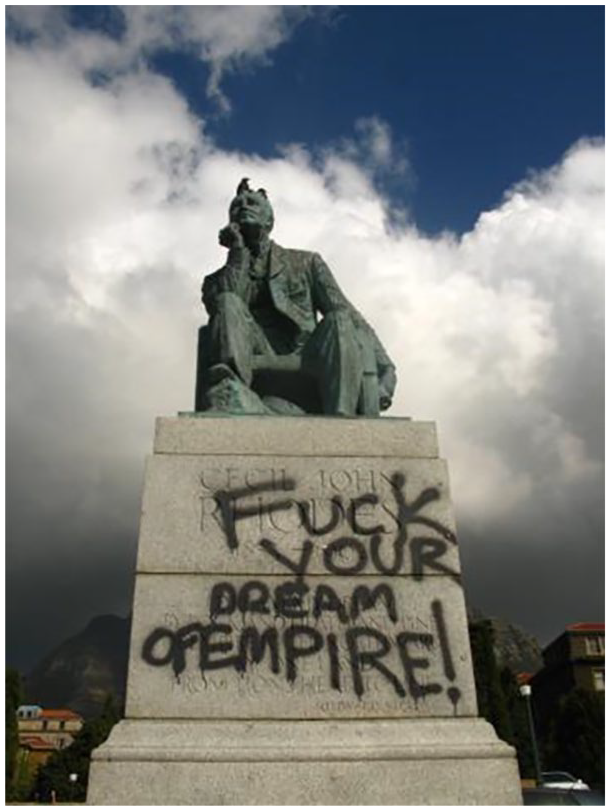
Rhodes statue with graffiti. Available at: https://anarkismo.net/article/28433.
The growing dissatisfaction with everything the Rhodes statue indexes eventually led to its removal in April 2015. It is now stored in an unknown place, off campus, and is no longer visible to the public. However, traces of the removed object remain and continue to define the landscape where Rhodes used to gaze out at the university’s playing fields and the city from a high vantage point. Now, only the plinth remains (Figure 2). The empty plinth speaks to ‘presence in absence’ and forces questions as to ‘what was there, and why was it removed?’ Emptiness presides over the space, but it does not necessarily neutralize it. Karlander (2019) writes about erasure and the ‘semiotics of nonexistence’. He argues that the act of erasure is often deeply embedded in the semiotic regimentation of space. Erasure is different to ‘destruction’. Destruction may result in erasure. However, erasure could lead to the subverting of a space even when the aim was to quench and regiment subversion, as in the erasure of graffiti or the removal of anti-government posters. Despite attempts at erasure (like the removal of the Rhodes statue), the object may continue to exist as ‘a semi-absence or a shadowlike trace’ (p. 203). The shadow effect in Figure 2 was created by paint (faded by the sun); it emerges from the bottom of the plinth and spills down the stairs at an angle suggesting a late afternoon light. The shape of the shadow is indistinct; it is a shadow of something no longer physically present, but it suggests that the ‘shadow’ of Rhodes and his colonial legacy still hangs over the university and Higher Education in South Africa.
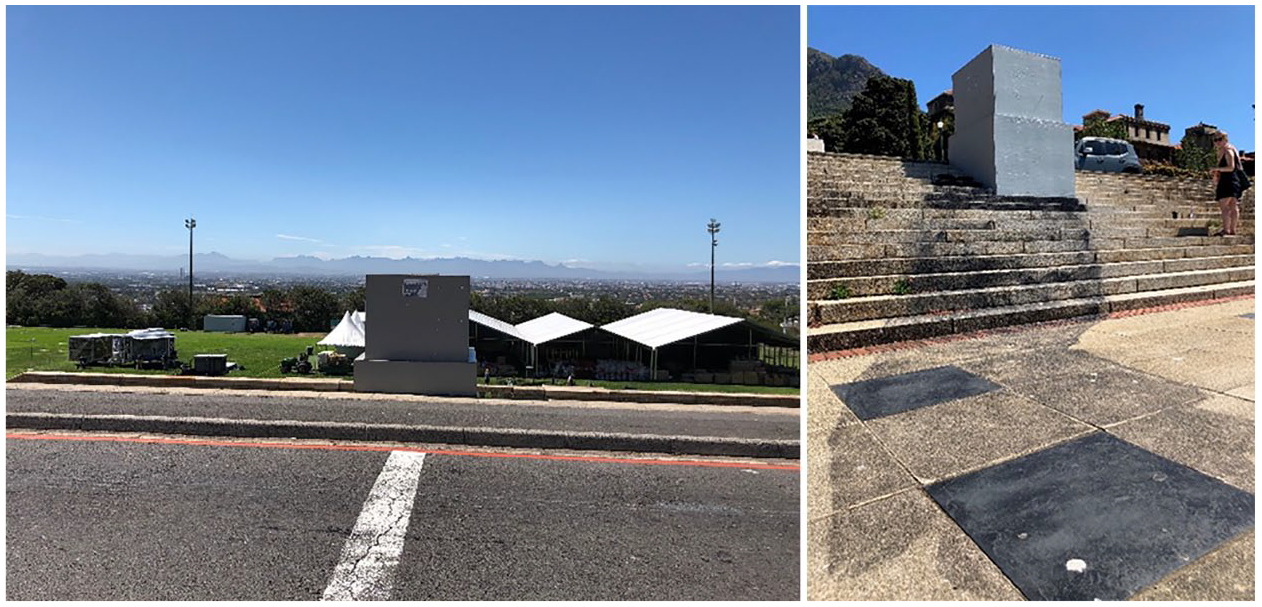
The empty plinth and painted shadow of the Rhodes statue. © Photographs: Anders Björkvall.
In the next example, burning is the means for destruction. Fire is an element which often leaves material traces on the physical environment. It is visually striking in events that are often more about the photographic and social media record than the moment itself. Fire thus adds to the carnivalesque and the visual spectacle. Figure 3 shows the traces of destruction by fire on the main plaza at the University of Cape Town. The trace includes a black, burnt, bubbled textured mass. The mark is large and misshapen and, in many ways, redefines the space of the plaza. People walk through and over it to traverse the campus and look over it whilst sitting on the steps between lectures, or eating their lunch. This mark or stain could be erased and ‘cleaned up’ but it has not been, and it remains a part of the social and political history of the space.
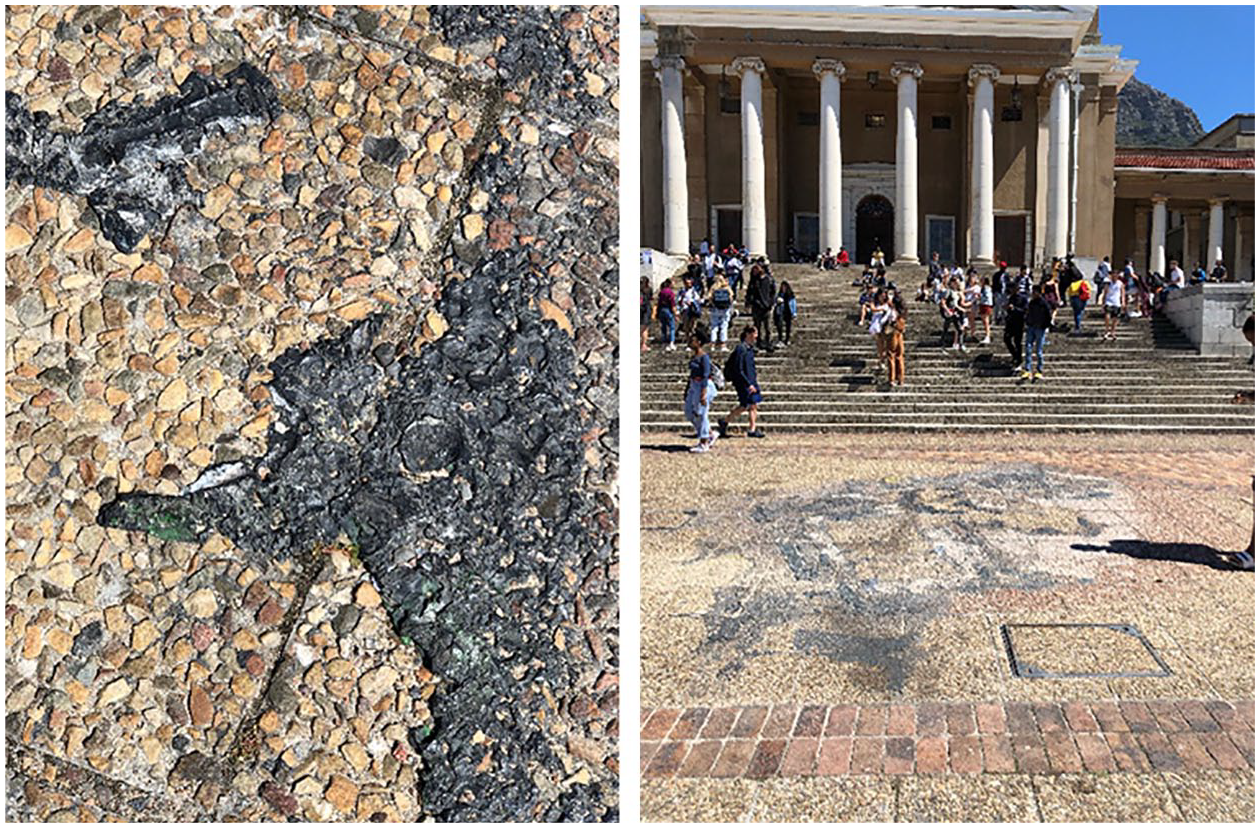
Traces of fire on campus. © Photographs: Anders Björkvall.
In the two examples mentioned above, there are clearly blurred boundaries between destruction and creativity due to shifting power between semiotic regimes. In many ways, the University of Cape Town is an environment in transition and thus some semiotic regimes still resonate with the old world of a traditional, ivory tower academic environment. In this context, the traces in the environment (the burn marks, the boxed plinth of the statue) could connote ‘agency’, ‘equality’ and ‘transformation’. The results of certain acts of destruction are that some ended up being highly transformative (at least on the surface of the campus environment). The environment remains deeply marked until the indexical markers are removed; the traces continue to point to the highly symbolic objects that were destroyed. However, these markers can function as a catalyst for further discussions and as a reminder of what took place and why. Although many of these acts were unsanctioned as they were disruptive and against campus policies, in another sense, they were also partially sanctioned due to a broad understanding for calls for decolonization and transformation of universities in South Africa. This points to dialogic semiotic regimes that to some extent allow for transformative destruction.
Social presence-driven destruction
The final act of destruction that we concentrate on is what we have called social presence-driven destruction because ‘making a mark in the environment’ that points to the presence of a group is often a significant part of the act of destruction. Thus, there are usually salient indexical traces left on the environment, with variations in terms of their longevity. This kind of destruction is mostly collective and occurs in groups. The function could be to gain social status, to produce a show of masculinity and a sense of belonging to a group (‘we destroy to show and leave a mark of our presence’). Social presence-driven destruction involves an obvious breach of what is often a legally sanctioned semiotic regime through its breaking of public or private property in the urban environment.
The traces that football fans leave on the urban environment are a good example of social presence-driven destruction. Hammarby IF is a football team in the Swedish top division (Allsvenskan). It is one of three dominant teams in the capital of Stockholm, and its fan base comes primarily from the southern part of the inner-city area (Södermalm) and the southern suburbs. Before the first home game of every season, a march is arranged which attracts thousands of participants. It traverses the area from Södermalm to the suburban stadium (see Figure 4).
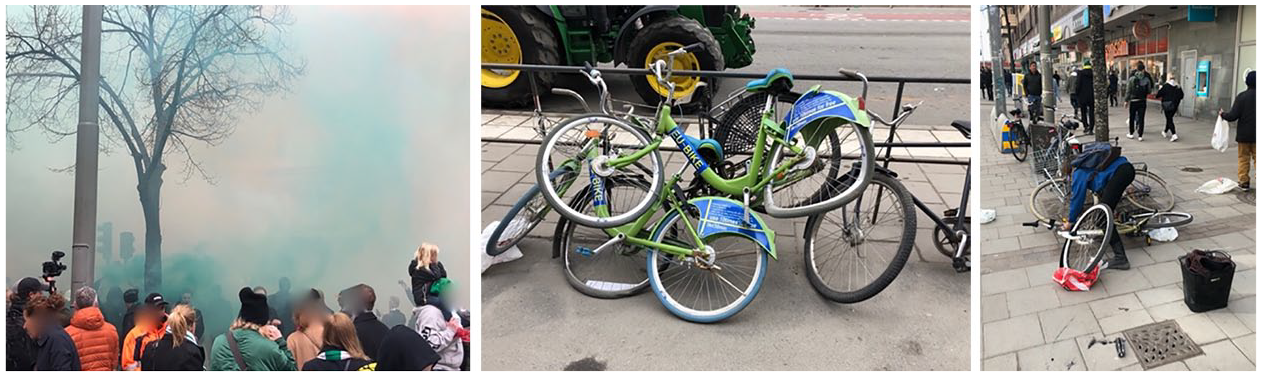
Football fans making a mark. © Photographs: Anders Björkvall.
During the course of the march a number of breaches of laws and regulations take place. The official semiotic regimes during the time of the march are exactly the same as at any other time: citizens cannot, for instance, throw fire bombs and torches on the ground or jump on and crush parked bicycles (see Figure 4). However, in hooligan and fan cultures, other highly disruptive, semiotic regimes have developed that allow for representing group identity through ‘making a mark’ – by any means available – on the environments that the fans pass through or on other urban spaces and places that they consider to belong to their group (see Winands et al., 2019). One aspect of the semiotic regimes construed by many supporter groups is the encouragement to make its presence visible and audible – also by means that are not sanctioned by other semiotic regimes. Acts of destruction sometimes play an important role in such practices.
Of the indexical traces on the environment that point to social presence-driven acts of destruction, some have the potential to function as long-lived traces of the acts of the Hammarby fans, whereas others are more transient. However, guided by a rather strong, resourceful and formally legitimate semiotic regime, the city of Stockholm mobilizes cleaning trucks and staff to try to remove these traces of destruction (as well as other rubbish left after the march). From a methodological perspective, this means that we, as researchers, had to walk no more than 50 metres behind the last fan in the march in order to document the multitude of indexical traces of destruction before some of them were removed. Right after us came the cleaning trucks along with people collecting beer bottles and cans for refund (see Figure 5). This is very different to the traces of transformation-driven destruction discussed before, where the trace has a much longer longevity.
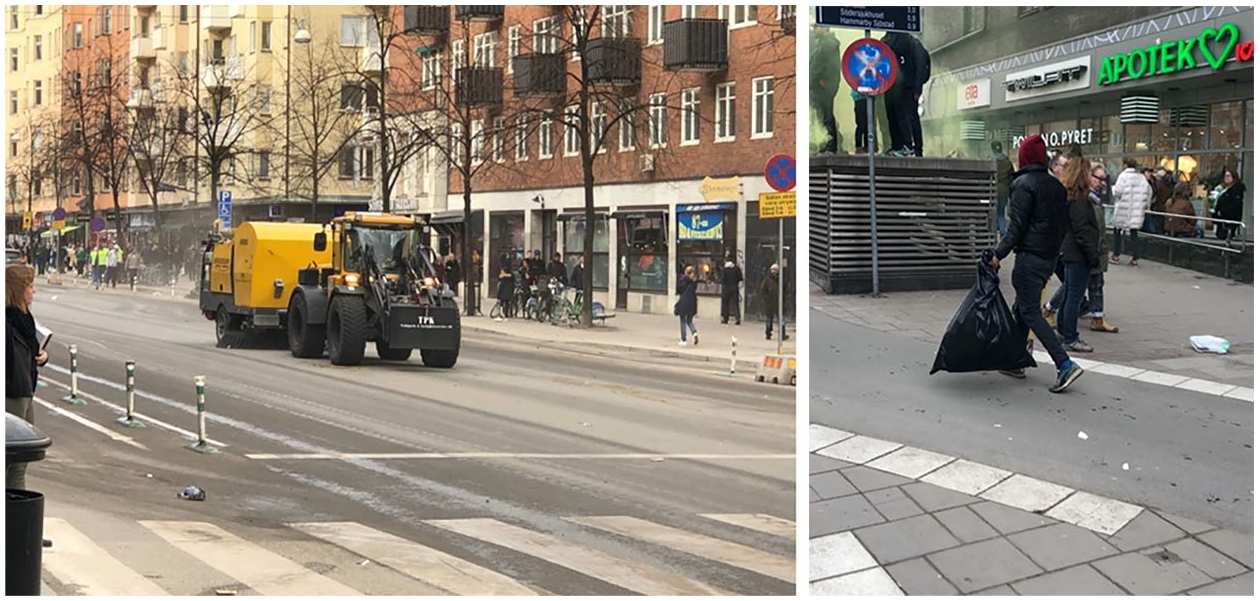
Cleaning up after the march. © Photographs: Anders Björkvall.
Typical traces of these acts of destruction are the displaced (and banged-up) shields of the traffic lights in Figure 6. As part of the march, supporters climbed up the posts of the traffic light, hit the shields and threw them to the ground where they were left as traces of this act of destruction. Of course, leaving a mark of social presence on the environment is not the only part of this act of destruction; at the time of the action, making oneself heard or creating an atmosphere of aggression or unity may have been even more important. But what remains are traces in the street indexically pointing to the previous presence of the Hammarby fans in this particular place.
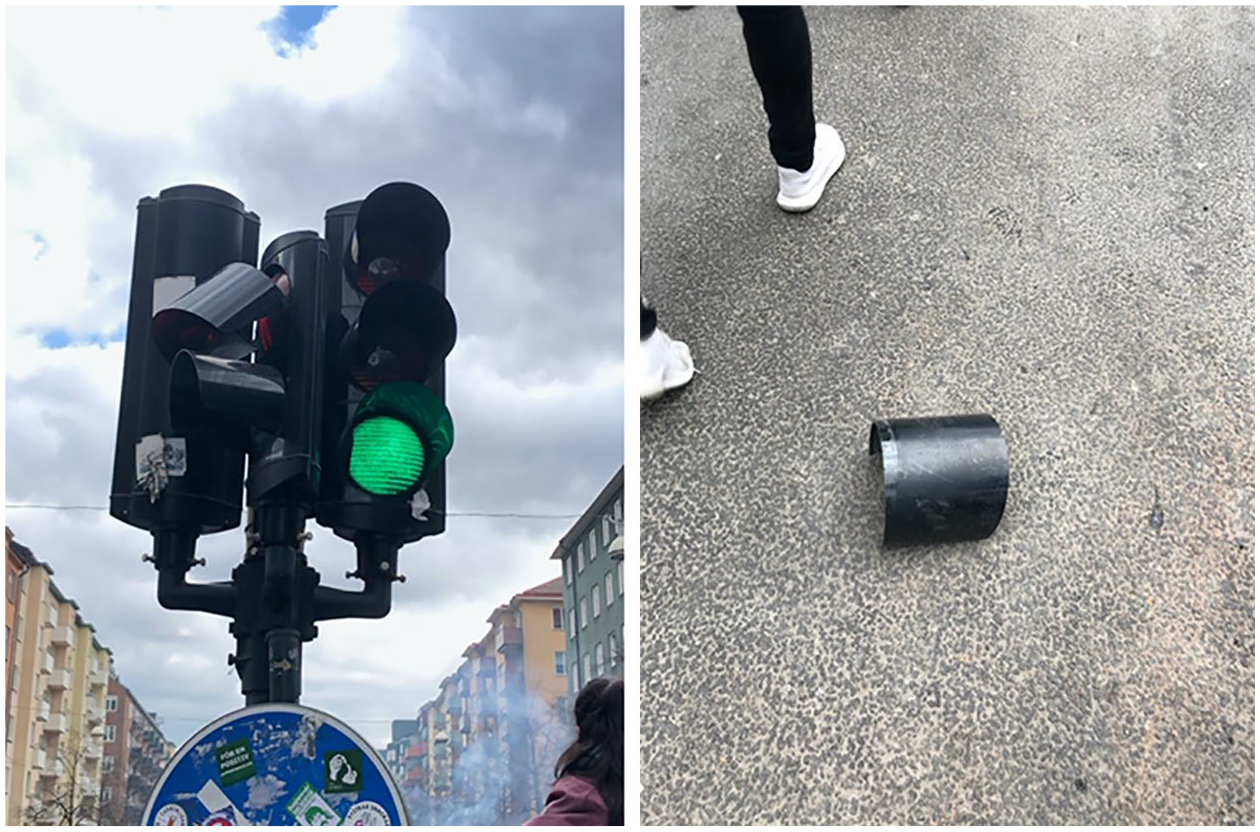
Damaged traffic lights. © Photographs: Anders Björkvall.
A significant difference with the transformation-driven acts of destruction connected to the Rhodes statue in Cape Town is that, whereas the statue has significant (but contested) symbolic value, the traffic lights do not. In other words, the object of destruction is of less importance in the social presence-driven act (represented in Figure 6) than in the transformation-driven destruction of the Rhodes statue. More precisely, in the case with the traffic lights, functional value is destroyed, but it could probably have been any other type of value for the fans, as long as a mark was left. Also, the means of destruction (graffiti and faeces) used in the case of the Rhodes statue were more elaborated and, arguably, more intrinsically loaded with symbolic value than was the case in Figure 6. In fact, there are no traces of the means with which the shields where removed. Thus, the traces of destruction are not as semiotically dense and have a rather more straightforward semiotic potential: ‘we were here and we made a mark’.
The Hammarby fans also mark their presence through other destructive acts, according to the legally based semiotic regimes. They attach a large number of stickers on suitable surfaces along the path of the march, including traffic signs (see Figure 7). The traces of this type of destruction are quite permanent (but less so than, for instance, graffiti) and, again, affect the functional value of the traffic sign itself: the arrow is less visible than it would have been without the stickers.

Stickers on traffic sign. © Photograph: Anders Björkvall.
These traces explicitly mark the previous presence of the fans in this particular street. Vigsø (2010: 42) claims that the aim of supporter stickers is to mark the presence of the fans in an obvious way: ‘By sticking these signs to lampposts or street signs, the supporters make a clear manifestation of their presence in the area – a moral boost to other supporters, and a thorn in the eye of opposing supporters.’ In fact, the stickers, even more specifically than the broken traffic lights, point out not just any supporter group, but the Hammarby supporters. Vigsø, again, says that ‘the fact that the person who has put up a sticker is a member of a certain subcultural group is the very point of putting it up.’ The colours, wording and depicted players on the stickers explicitly represent Hammarby and its supporters. The connection between this type of destruction and graffiti is obvious: the stickers are elaborately and to some extent artistically designed but, according to the semiotic regimes of the city of Stockholm, they are disruptive and must be removed. Some traces of previously removed stickers are still visible in Figure 7.
Discussion
In this article, we have identified some of the social, semiotic and ideological functions of acts of destruction, based on an analysis of the traces these acts leave on the environment. Materialities and resources of destruction need more of our attention, because in destruction there is always creation, or at least a seed thereof. Destroying the Rhodes statue is certainly perceived as an act of creation, of starting something new for many of the protesters at the university campus. The traces can then be seen as those of creation, not necessarily destruction, and they are still there, although attempts could have been made to erase them. Equally, acts of destruction can signify the claiming of territory and creation of group identity for many Hammarby fans. However, here the semiotic regimes of ‘clean’ nonmarked urban spaces hit back much faster. We have shown that whether a semiotic act is to be regarded as an act of destruction depends on the dominating semiotic regimes in that time and place, which may also be complex and contested. Traces such as graffiti and football stickers in the urban environment are obvious examples, but one could also think more abstractedly. For example, every act of analysis (for instance, in higher education) could also be regarded as an act of destruction or ‘deconstruction’ (of an idea, a text, a piece of art) or creation (of new ideas and interpretations).
Through our analysis, we can identify four types of scales in looking at the semiotics of destruction, namely scales of value, effort, salience and durability. The first is the scale of value: economic, symbolic, aesthetic, functional and so on. For example, the disposed coffee cup (as part of consumption-driven destruction) would primarily have its economic value destroyed, whereas the Rhodes statue had its (previous) high symbolic value destroyed. In ritualized destruction, above all symbolic value is destroyed. The Izikhothane’s destructive acts are primarily about destroying the symbolic value of luxury goods, rather than the obvious economic value. The actions of the Hammarby fans destroyed functional value, but we argued that it could have been any type of value as long as the traces left on the environment were salient (see below). If, for instance, symbols of other local teams were to be found along the path of the march they would most certainly also have been destroyed, and vehemently so.
The second scale in the semiotics of destruction is that of effort, which could be both physical or mental. For instance, low effort is required in throwing away the coffee cup whereas high effort is required in defacing or removing the Rhodes statue. This is related to the efficiency of the systems that societies create for facilitating or hindering acts of destruction. In accordance with this, destroying a statue or climbing up a traffic light in order to tear off its protective shields requires more effort than performing the highly sanctioned act of disposing of consumer products. The third scale is that of the salience of the traces of the act of destruction in the environment in which it took place. Some acts of destruction stand out here: in especially social presence-driven destruction, but also transformation-driven destruction, the salience of the traces left on the environment seems to be just as important as the destructive act itself. That way, the destructive acts can potentially keep on producing (at least parts of) their meanings even after the conclusion of the acts. This is related to the fourth scale: the durability of the trace. Throughout our analysis this durability has been discussed as a struggle between semiotic regimes. Someone creates more or less durable traces through destroying something; and representatives of competing semiotic regimes try to remove the traces. Their success partially depends on the durability of the traces.
By viewing traces as indexical signs of destruction and the specific time and place that the traces index, we have discussed five types of semiotic acts of destruction, namely expressionistic, consumption-driven, ritualized, transformation-driven and social presence-driven destruction. All of these types of destruction can be both sanctioned and disruptive in a specific time and place. We have argued that traces in the physical environment that index highly disruptive and destructive acts can, in relation to other semiotic regimes, be regarded as creative and constructive. Some acts of destruction violate the norms of semiotic regimes (e.g. Rhodes must fall and the semiotic regimes surrounding monuments) whereas other acts of destruction comply with dominating regimes (such as placing your paper cup in a bin). In other words, the same action could be both sanctioned and unsanctioned depending on the specific time and place. For instance, consumption-driven destruction could be a sanctioned act by the dominant semiotic regime, as in the throwing away of the paper cup. However, the same action would not be sanctioned in a more eco-friendly regime or discourse. And, as mentioned, both types of destruction are always tied to a specific time and place. For instance, the actions around Guy Fawkes would not be sanctioned on any day other than the 5th of November, that is, on that day the semiotic regimes allow for the connected acts of destruction to take place without sanction. On any other day, they do not.
‘Every act of creation is first an act of destruction’, said Picasso, and this seems to be true not only for the few artistic examples of destruction that we have discussed, but for all types of destruction analysed here. Value as a result of destruction is always added for the person(s) that perform the act. In expressionistic destruction, emotions are allowed to be released through the destruction; ritualized destruction has the potential to bring luck or status to the people that perform the act; consumption-driven destruction removes the burden of caring for a used product; transformation-driven destruction can give the actors a sense of true agency that can bring about change; and social presence-driven destruction often brings a sense of group identity and self-esteem to the destroyers. However, at the other side of the spectrum, there are groups of people that simply lose value through other people’s destructive acts. For instance, some people may uphold the symbolic value being contested in transformation-driven destruction, and the citizens of Stockholm have to pay for the restored functionality of the destroyed traffic lights and signs. Thinking about traces of destruction as indexing scales of value within specific semiotic regimes has proved to be a generative approach for beginning to think about the semiotics of destruction.
Footnotes
Declaration of conflicting interests
The author(s) declared no potential conflicts of interest with respect to the research, authorship, and/or publication of this article.
Funding
The author(s) disclosed receipt of the following financial support for the research, authorship, and/or publication of this article: This work is part of the research project Multimodal texts and pedagogies in Higher Education, funded by the Swedish Foundation for International Cooperation in Research and Higher Education (STINT, SA2015-6206) and the National Research Foundation in South Africa (STINT150903141397).

Notes
Biographical Notes
ANDERS BJÖRKVALL is a Chaired Professor of Swedish at Örebro University, Sweden. He is currently interested in organizational discourse and critical genre analysis, but also in the materiality of artefacts and texts. Recent publications include ‘Legitimation of value practices, value texts, and core values at public authorities’ in Discourse & Communication (together with Catharina Nyström Höög) and the book chapter ‘Multimodal Discourse Analysis’ in Analyzing Text and Discourse: Eight Approaches for the Social Sciences (Sage, 2017).
Address: Örebro University, Orebro 701 82, Sweden. [email:
ARLENE ARCHER is an Associate Professor in Applied Linguistics and the Director of the Writing Centre, University of Cape Town. Her research employs a multimodal social semiotic perspective to re-look at key concepts of an ‘academic literacies’ approach to teaching and researching writing in Higher Education. She has co-edited four books on multimodality and writing, and is currently investigating the changing forms of writing in a digital age with a British Academy Fellowship.
Address: University of Cape Town, Cape Town, South Africa. [email: