




Abstract
Objective:
The angiotensinogen (AGT) gene has been shown to be involved in the development of coronary heart disease (CHD). However, the results have been inconsistent. In this study, the authors performed a meta-analysis to clarify the associations between AGT polymorphisms and CHD risk among the Chinese population.
Methods:
Published literature from PubMed, the China National Knowledge Infrastructure and Wanfang Data were searched. Pooled odds ratio (OR) and 95% confidence interval (CI) were calculated using a fixed- or random-effects model.
Results:
Fourteen studies (2540 cases and 2173 controls) for M235T polymorphism and five studies (655 cases and 815 controls) for T174M polymorphism were included in the meta-analyses. The results showed that M235T polymorphism was significantly associated with CHD risk under a recessive model (OR=1.65, 95% CI 1.22–2.25). There was also significant association between T174M polymorphism and CHD risk under a homogeneous co-dominant model (OR= 4.20, 95% CI 1.90–9.29) and a recessive model (OR=4.15, 95% CI 1.88–9.15). Further sensitivity analyses confirmed the significant association.
Conclusions:
The meta-analyses indicated the significant associations of two AGT polymorphisms (M235T, T174M) with CHD risk in the Chinese population.
Introduction
Coronary heart disease (CHD) is a main cause of morbidity and mortality in developed and developing countries. Epidemiological studies have shown that smoking, a diet high in fat, lack of physical activity, hypertension and cholesterol are the major risk factors of CHD. 1 However, emerging evidence has indicated the great contribution of genetic factors.
The rennin-angiotensin system (RAS) plays an important role in the regulation of blood pressure, vascular remodeling and sodium homeostasis. 2 Several genes that belong to RAS have been suggested to be associated with risk of CHD. However, inconsistent results have been reported. The most studied genetic polymorphisms include the insertion/deletion (I/D) polymorphism in the angiotensin I-converting enzyme (ACE) gene and two polymorphisms (M235T, T174M) in the angiotensinogen (AGT) gene. Two meta-analyses confirmed the significant association between I/D polymorphism in the ACE gene and CHD in Europeans 3 as well as among the Chinese population. 4 In addition, another two meta-analyses investigated the associations of two polymorphisms (M235T, T174M) in the AGT gene with CHD risk.5,6 However, these two meta-analyses included only limited studies related to the Chinese population, and most studies published in Chinese local journals were not included. Therefore, we performed a meta-analysis to clarify the associations between two polymorphisms (M235T, T174M) in the AGT gene and CHD risk among the Chinese population.
Materials and methods
Literature and search strategy
We searched the literature databases including PubMed, the China National Knowledge Infrastructure and Wanfang Data. The search strategy to identify all possible studies involved the use of the following keywords: (angiotensinogen or AGT) and (variant or variation or polymorphism) and (coronary disease or coronary heart disease or myocardial infarction or coronary artery disease or ischemic heart disease or CAD or MI or CHD or IHD) and (China or Chinese). All relevant studies were limited to ones published in the English and Chinese languages. The reference lists of retrieved articles were hand-searched. If more than one article was published using the same case series, only the study with the largest sample size was included. The literature search was updated on 20 March 2012.
Inclusion criteria and data extraction
The studies included in the meta-analysis must meet all the following inclusion criteria: (1) evaluating the association of M235T or T174M polymorphism in the AGT gene with CHD risk; (2) using case-control or cohort design; and (3) providing sufficient data for calculation of odds ratio (OR) with 95% confidence interval (CI). The following information was extracted from each study: (1) name of the first author; (2) year of publication; (3) region; (4) sample size of cases and controls; (5) genotype distribution in cases and controls; and (6) P value for Hardy-Weinberg equilibrium (HWE) test in controls. Two authors independently assessed the articles for compliance with the inclusion/exclusion criteria, resolved disagreements and reached a consistent decision.
Statistical analysis
The association of M235T or T174M polymorphism in the AGT gene with CHD risk was estimated by calculating pooled OR and 95% CI under co-dominant, dominant and recessive genetic models, respectively. The significance of pooled OR was determined by Z test (p<0.05 was considered statistically significant). A Q test was performed to evaluate whether the variation was due to heterogeneity or by chance. A random- (DerSimonian-Laird method 7 ) or fixed- (Mantel-Haenszel method 8 ) effects model was used to calculate pooled OR in the presence (p<=0.10) or absence (p>0.10) of heterogeneity, respectively. Meta-regression analysis was used to explore the source of heterogeneity. Sensitivity analysis, after removing one study at a time, was performed to evaluate the stability of the results. Publication bias was assessed by Egger’s test 9 (p<0.05 was considered statistically significant). Data analysis was performed using STATA version 11 (StataCorp LP, College Station, TX, USA).
Results
Characteristics of the studies
The literature search identified a total of 81 potentially relevant papers. Forty-two papers were excluded because of obvious irrelevance to our study aim. In addition, 16 papers were excluded because they were duplicate publications, reviews, investigated associations with other polymorphisms of the AGT gene or did not provide sufficient data for calculation OR with 95% CI. Therefore, 23 papers met the primary inclusion criteria.10 –31 However, the genotypes of M235T polymorphism in controls were not in HWE for five papers; they were then excluded.24,28 –31 Ultimately, 14 studies for M235T polymorphism10 –23 and five studies for T174M polymorphism24 –27 were included in the meta-analyses. A flowchart describing the process of study inclusion/exclusion is displayed as Figure 1. The characteristics of the included studies are listed in Table 1.

Flowchart of meta-analysis for exclusion/inclusion of studies.
Characteristics of the studies included in the meta-analysis.

PHWE: P value for Hardy-Weinberg equilibrium test in controls. For M235T variant, 11,12 and 22 represent MM, MT and TT, respectively; for T174 M variant, 11,12 and 22 represent TT, MT and MM, respectively.
Meta-analysis results
A total of 2540 cases and 2173 controls were identified for M235T polymorphism. The results showed that M235T polymorphism was significantly associated with CHD risk under a homogeneous co-dominant model (OR=1.61, 95% CI 1.03–2.51) and recessive model (OR=1.65, 95% CI 1.22–2.25, Table 2 and Figure 2). A total of 655 cases and 815 controls were identified for T174M polymorphism. There was also significant association between T174M polymorphism and CHD risk under a homogeneous co-dominant model (OR= 4.20, 95% CI 1.90–9.29) and recessive model (OR= 4.15, 95% CI 1.88–9.15, Table 2 and Figure 3).
Meta-analysis of associations of M235T and T174 M variants in the AGT gene with coronary heart disease risk.
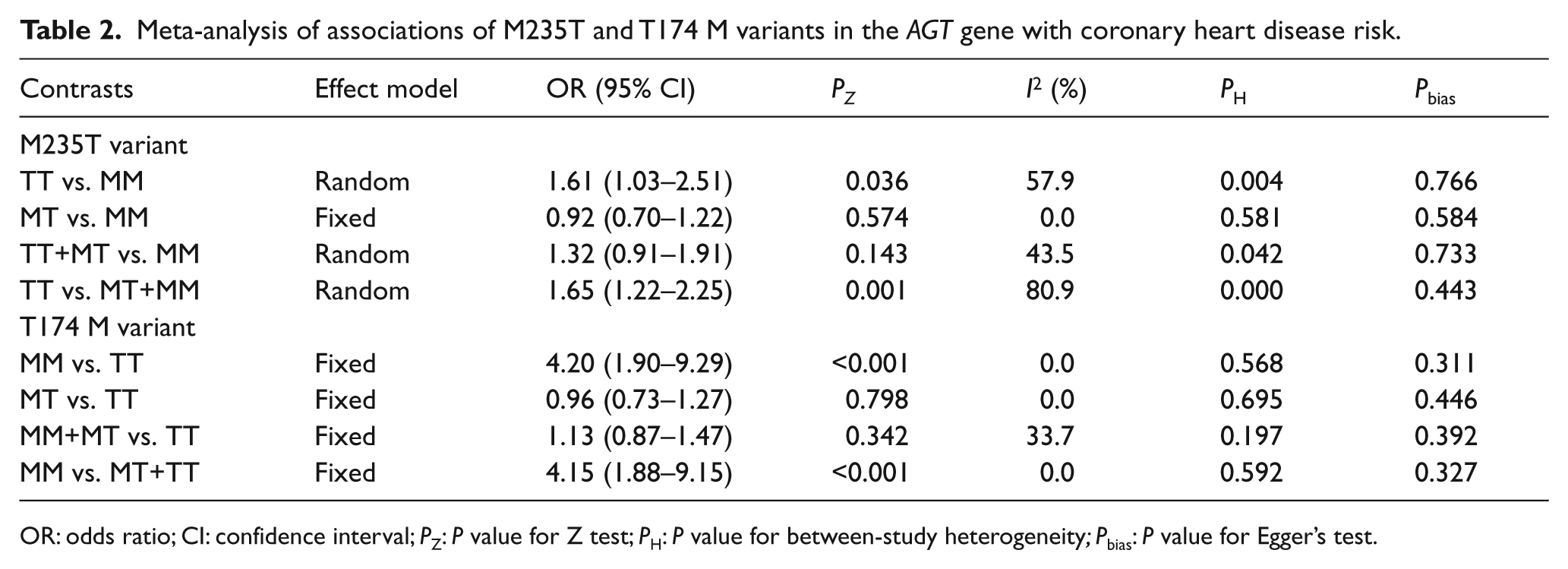
OR: odds ratio; CI: confidence interval; PZ: P value for Z test; PH: P value for between-study heterogeneity; Pbias: P value for Egger’s test.

Forest plot of the association of the AGT M235T polymorphism with coronary heart disease risk under recessive model (TT vs. MT+MM).
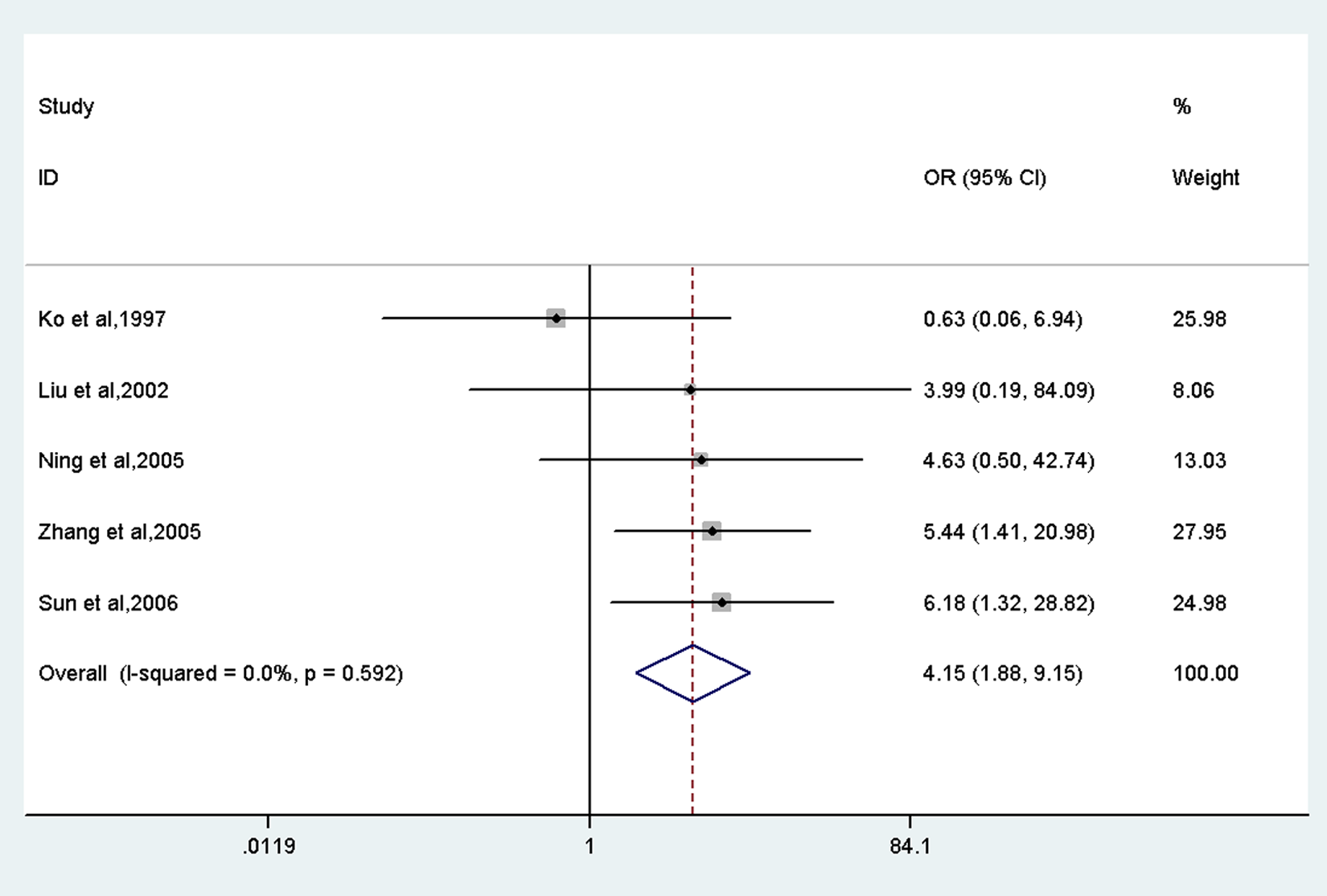
Forest plot of the association of the AGT T174 M polymorphism with coronary heart disease risk under recessive model (MM vs. MT+TT).
Sensitivity analysis
Sensitivity analysis was performed by excluding each study, one at a time. The results confirmed the significant association between M235T polymorphism and CHD risk under a recessive model (OR with 95% CI ranges from 1.53 (1.15–2.04) to 1.78 (1.37–2.30)), between T174M polymorphism and CHD risk under a co-dominant model (OR with 95% CI ranges from 3.56 (1.24–10.22) to 5.53 (2.28–13.41)) and a recessive model (OR with 95% CI ranges from 3.55 (1.24–10.26) to 5.39 (2.23–13.04)).
Publication bias
There was no evidence of publication bias for M235T and T174M polymorphisms under all genetic models (Table 2).
Discussion
To our knowledge, this is the first meta-analysis that comprehensively assessed the associations between AGT gene polymorphisms and risk of CHD in the Chinese population. The results indicated that both M235T and T174M polymorphisms were associated with CHD risk in the Chinese population. Our findings were different from those based on the two previous meta-analyses that suggested a marginally significant association among Europeans while significant publication bias existed.5,6
The AGT gene is located on chromosome 1q42–43 and comprises five exons and four introns spanning 12 kb. Several molecular variants of this gene have been detected, and two polymorphisms (M235T, T174M) in exon 2 were the most studied. The M235T polymorphism was in strong linkage disequilibrium with the T174M polymorphism. 32 The mechanisms by which M235T variant influences risk of CHD are still unclear. It has been suggested that M235T homozygotes were associated with increased AGT synthesis and angiotensin II production. The pleiotropic actions of angiotensin II and artery wall injury should be considered. 33 Further experimental studies are required to explore the mechanisms of the AGT polymorphisms in the implication of CHD.
Several limitations should be considered. First, the present meta-analysis was based primarily on unadjusted effect estimates and the confounding factors were not controlled for. Second, the effect of gene-gene and gene-environment interactions was not addressed in this meta-analysis because most studies did not provide related data. Third, the results of T174M polymorphism should be interpreted with caution because of limited statistical power. Fourth, there was significant between-study heterogeneity for M235T variant. The variables including sex frequency, mean age, study design, region and sample size were introduced into meta-regression analysis. However, non-significant confounders were found, suggesting that other unknown factors might confound the association between M235T variant and CHD risk.
In conclusion, the result indicated the significant associations of two AGT polymorphisms (M235T, T174M) with CHD risk in the Chinese population. However, further studies considering gene-gene and gene-environment interactions should be conducted to investigate the associations.
Footnotes
Conflict of interest
None declared.
Funding
This research received no specific grant from any funding agency in the public, commercial, or not-for-profit sectors.