



Abstract
Project-based learning is a student-centered problem-driven approach that can motivate students in higher education to learn and collaborate, and strengthen their learning outcomes. This study examined how students’ motivation and collaborative learning were related to their self-reported outcomes of online collaborative project-based learning. An 8-week online project-based mental health course at a Chinese university was implemented. In addition to lectures and workshops during the course, students collaboratively created a final product (i.e., a film analysis report) with group members using WeChat as the communication tool. Survey data were collected from 81 students from 25 groups. Results from a partial least squares analysis showed that students’ motivation was positively related to students’ perceived outcomes. With respect to students’ collaborative learning, four strategies were distinguished. The more students considered others’ opinions and challenged others, the more positively they evaluated the outcomes of their collaboration. For the other two strategies, no significant relationships with perceived outcomes were found. Practical implications for teachers and suggestions for further research are provided.
Keywords
Introduction
Teacher-led instruction and exam-oriented teaching still dominate compulsory courses in Chinese universities (Lu, 2024). With this instructional style, teachers, rather than students, perform activities such as generating ideas, deciding the way of learning, and controlling the learning pace, whereas students passively receive knowledge (Serin, 2018). As a result, learners might be deprived of the opportunity to actively participate in educational activities, which might lead to low learning motivation and dissatisfaction with the learning process (Yin et al., 2016; H. Zhang et al., 2011). One way to improve this situation is to introduce the student-centered problem-driven learning approaches, such as Problem-based learning (PBL), project-based learning (PjBL), and Case-based learning (CBL). Given that the implementation of student-centered problem-driven learning approaches is still rare in Chinese university education, we have implemented PjBL and examined students’ motivation, collaborative learning strategies, and perceived outcomes of PjBL in a university compulsory course in order to better understand this methodology in this educational context.
Literature Review
Student-Centered Problem-Driven Learning Approaches
Three problem-driven learning approaches in higher education can be distinguished (Wijnia et al., 2024): Problem-based learning (PBL), Case-based learning (CBL), and project-based learning (PjBL). In all three approaches, students work on an authentic task, which can be a case, a problem, a challenge, or a particular project. It is authentic in the sense that it relates to either the real-life experiences of students or to their future profession (Herrington, 2005). In PBL, small student groups work on real-life problems, guided by a teacher to boost intrinsic motivation and learning outcomes such as knowledge retention and professional skills (Wijnia & Servant-Miklos, 2019). The key features of PBL are (1) starting with a problem that activates students’ prior knowledge and interest in learning. This problem can be a case, story, visual prompt, or phenomenon that needs explaining; (2) student-centered, activating learning activities; (3) small-group collaboration; (4) teacher guidance; and (5) self-study time (Schmidt et al., 2009). Student collaboration in the initial phase and reporting phase can lead to enjoyment of the social interaction as well as pressure to perform well.
In CBL, students are presented with a specific case that requires them to apply their acquired knowledge (Dikilitaş et al., 2025; Leijon et al., 2022; Loyens & Rikers, 2017). Key features of CBL are (1) students apply their knowledge to solve or explain the provided authentic case; (2) teachers facilitate the process; and (3) students collaboratively discuss the case. Unlike PBL, students in CBL are often provided with predefined questions about the case, which are answered in small groups guided by a teacher. This means that compared to PBL and PjBL, CBL offers students less autonomy. Both collaboration and the application of knowledge can be understood as factors that motivate students to learn (Loyens et al., 2022).
PjBL indicates an active, student-centered teaching and learning process in which learners are engaged in the creation of artifacts in real-world projects. Through the development of final products, students are expected to acquire and apply existing knowledge and eventually construct new knowledge. Previous studies have shown that PjBL is positively related to students’ motivation to learn (Stolk & Harari, 2014), interpersonal and conflict management skills (Johnsen et al., 2024), critical thinking (Balleisen et al., 2024), self-directed learning skills (S. Lee et al., 2024), content knowledge (Swanson et al., 2017), and academic achievement (Chen & Yang, 2019). These outcomes are confirmed in a review study on project-based learning outcomes in higher education by Guo et al. (2020). Students’ collaborative learning with peers is often integrated with PjBL (Chen & Yang, 2019). Raes et al. (2016) claim that projects conducted through student collaboration have great educational potential for both teaching and learning processes. However, other studies have found that in PjBL some students experience difficulties with collaboration with their peers (Dauletova, 2014; Raycheva et al, 2017; K. Zhang et al., 2009). These difficulties can be even more visible when students work together via computer-supported collaborative learning (CSCL) tools, such as instant messaging apps. Students might misunderstand each other’s intentions due to insufficient non-verbal cues (Robinson, 2013). Also, their communication and interaction could decrease due to schedule conflicts (Heo et al., 2010). Furthermore, due to the openness and ill-structured features of PjBL, students need to conduct a series of collaborative activities to develop final products, such as defining problems, discussing ideas, and collecting and analyzing data. This process of knowledge construction is not easy and requires certain strategies. For example, students might have to exchange and confirm a lot of information before they can move to the next step and negotiate over different opinions to reach an agreement.
The findings about the effects of these three student-centered problem-driven learning approaches are ambiguous. A systematic literature review by Leijon et al. (2022) shows that only a limited number of research publications on CBL are available, which are mostly descriptive and about potential learning effects that can be expected. In their literature review of PBL and its effects on student learning, Yew and Goh (2016) concluded that most studies demonstrated effects on students’ longer-term knowledge retention and in the application of knowledge. Studies on the process of PBL, however, were still inconclusive as to which component(s) of PBL most significantly impacted students’ learning. A literature review of PjBL by Authors (2020) summarized four different outcomes of PjBL: affective (e.g., perceptions of learning), cognitive (e.g., knowledge retention), behavioral (e.g., skills), and artefact outcomes (e.g., products). Although the meta-analysis of Wijnia et al. (2024) did not show a significant difference in the positive effects of these three learning approaches concerning students’ motivation to learn, Stefanou et al. (2013) found that students in the project-based environments reported higher levels of elaboration, critical thinking, and metacognition, compared to students in problem-based learning. In the current study, PjBL was implemented as a pedagogical approach in a university compulsory course.
Self-Determination Theory and Motivation
Motivation is a core element in active learning that keeps students involved in authentic projects (Urquiza-Fuentes & Paredes-Velasco, 2017). Various definitions of motivation can be found in the literature to understand its role in learning (Rienties et al., 2012). This study has adopted the Self-Determination Theory (SDT; Ryan & Deci, 2020) as the theoretical framework. Based on SDT, motivation can exist in specific activities at a specific time and therefore is referred to as “situational motivation” (Guay et al., 2000). Thus, SDT is suitable for exploring student motivation in this study as they participated in a specific project for a few weeks to collaboratively develop the final artifact.
Based on SDT, motivation can be structured in three aspects: autonomous motivation, controlled motivation, and amotivation (Ryan & Deci, 2020). Autonomously motivated students experience psychological freedom and carry out an activity based on their personal importance, inherent interests, and enjoyment rather than external rewards. Controlled motivation refers to learners’ conduction of activity because of potential external outcomes or feelings of pressure from within, such as shame or guilt. In addition, amotivation describes the state in which students are not motivated by either autonomous or controlled motivation and lack an intention or willingness to engage in learning activities (Säfvenbom et al., 2015).
Autonomous motivation is associated with more favorable student outcomes than controlled motivation (Howard et al., 2021). Many recent studies have reported that autonomous motivation can lead to positive student cognitive learning outcomes, measured as either performance (Calderón et al., 2020; Kusurkar et al., 2013; H. Wu et al., 2020) or perceived learning outcomes (Ferreira et al., 2011; Jeno et al., 2017; Waheed et al., 2016). For example, Jeno et al. (2019) investigated the effect of autonomous motivation within three different learning conditions on students’ academic achievement. The results showed that autonomous motivation triggered by a mobile learning tool was positively related to students’ knowledge test achievement. Buil et al. (2019) revealed that students’ intrinsic motivation for playing business simulation games directly and indirectly through the effects of engagement, predicted their business-skill development and perceived course learning. However, Schulte-Uentrop (2020) found that autonomous motivation of medical students did not significantly explain differences in students’ performance of non-technical skills.
Studies have also found that controlled motivation can undermine students’ performance (Waheed et al., 2016). For example, Areepattamannil et al. (2011) reported that the effect of controlled motivation on academic achievement can be either negative or non-significant, depending on different groups of students. Liu et al. (2020) found that controlled motivation undermined the academic performance of learners with high autonomous motivation but improved the performance of learners with low autonomous motivation. In addition, controlled motivation can also promote cognitive achievement (e.g., Konheim-Kalkstein & van den Broek, 2008). Based on a national survey, H. Wu et al. (2020) reported that medical students’ controlled motivation predicted their academic performance through learning engagement. Furthermore, Cheo (2017) found that different types of controlled motivation, such as rewards and encouragement, improve student performance in different stages.
Similar to controlled motivation, studies about amotivation have reported that learners who lack motivation usually have poor academic performance (Cokley, 2003; Turner et al., 2009). Moreover, Próspero and Vohra-Gupta (2007) found that the negative effects of amotivation on student performance were significant for first-generation college students and non-significant for the other students. The authors conclude that the motivational and integrative dimensions are more salient factors among first-generation students compared to non-first-generation students. Also Komarraju et al. (2009) reported that amotivation did not explain any significant variation in student academic achievement.
Only a few studies have explored the relationship between students’ motivation and satisfaction with the course processes and outcomes. For example, Bailey et al. (2020) investigated the effects of EFL learners’ intrinsic motivation for both synchronous and asynchronous communication on course satisfaction. The results showed that students’ motivation for asynchronous online collaborative writing was positively related to satisfaction with online learning in general, while students’ motivation for synchronous videoconference activities had no impact on satisfaction. The authors do not provide a clear explanation for this finding. Ferriz et al. (2013) reported how student motivation in Physical Education classes influenced their course satisfaction. The findings revealed that for males, course satisfaction was related to autonomous motivation in a positive way. For females, satisfaction was positively related to both autonomous and controlled motivation and negatively related to amotivation.
Collaborative Learning Strategies in PjBL
Some studies have explored students’ individual use of strategies in PjBL and the strategies adopted during collaboration with peers. Regarding the individual level, Barak and Dori (2005) investigated chemical students’ strategies used in the construction of digital molecular models during computer-assisted PjBL. The analysis of student interviews and teacher observations revealed that learners go through five learning stages, ranging from a low to a high level of students’ understanding of molecular structures. Stefanou et al. (2013) compared the learning strategy used by students during both problem-based learning (PBL) and PjBL. Different from PjBL, in PBL students usually focus on acquiring existing knowledge by solving well-structured problems. Survey results showed that the level of PjBL group students’ use of some strategies, such as elaboration and critical thinking, was significantly higher than that of their PBL counterparts. Hou et al. (2007) investigated students’ learning activities and peer assessment in online PjBL. During the course, each student first completed a project and wrote a report, and then gave feedback on each other’s reports in an online forum. The coding results of students’ comments revealed that the most frequently used learning activity was information sharing. Moreover, the sequence analysis showed that learners repeated the learning activities of information sharing and off-topic discussions, but there were no sequences found in other learning activities, such as disagreement detection and negotiation of meaning.
As for the learning activities in groups, Heo et al. (2010) explored how students constructed knowledge in online collaborative PjBL. Content analyses of student online discourse showed that both groups with low and high project performance used the learning activity of information sharing. The high-performance groups, however, also adopted other learning activities, such as disagreement detection, goal clarification, and negotiation of meaning. S.-Y. Wu et al. (2013) compared students’ knowledge construction with team members between online PjBL and PBL. The coding results of students’ discussions revealed that in both learning environments, learners adopted learning activities of information sharing, disagreement detection, and negotiation of meaning. Students also adopted the learning activities of testing and modification of new ideas. Furthermore, the sequence analysis showed that when disagreement occurred, learners in PjBL tried to negotiate over it and reached an agreement but in PBL they did not. The authors explained this difference based on the difference in aim of PjBL and PBL: students in PBL had to solve a problem, while students in PjBL had to agree on a collective project.
This Study
As argued above, PjBL can have benefits for students as well as pose them with a number of challenges. Because of these challenges in combination with the Chinese educational context, the question arises whether students who are not used to collaborating are motivated for online collaborative PjBL and how their motivation might affect learning outcomes, which only a few previous studies have investigated (see Urquiza-Fuentes & Paredes-Velasco, 2017; T.-T. Wu et al., 2018). In addition, while some studies have reported students’ collaborative learning strategies adopted in online collaborative PjBL, little empirical data are available about how these strategies are related to learning outcomes. In the current study, we aim to investigate students’ motivation for and collaborative learning strategies adopted in online collaborative PjBL and their potential influence on students’ perceived outcomes of this learning approach. The findings might develop a deeper understanding of students’ motives and learning process in an online collaborative learning environment and contribute to the improvement of future PjBL curriculum, especially for students who are not familiar with collaboration. This research aim has been worked out in two research questions:
How is students’ motivation related to their perceived outcomes of online collaborative PjBL?
How are students’ collaboration strategies related to their perceived outcomes of online collaborative PjBL?
Method
Research Context
An 8-week online Introductory Course on Mental Health for freshmen in a Chinese university was implemented. In the first 3 weeks of the second semester, students watched 26 recorded instruction videos on the university’s MOOC platform. These videos contained the basic content knowledge that students needed to learn and they were free to choose the watching sequence. In weeks 4 to 7, learners attended online lectures where the teacher further explained important topics and theories. In week 8, students took a final paper-pencil exam about the content that was covered in the video and lectures.
During the first 3 weeks, students also participated in a project-based group activity and created a final product (i.e., a film analysis report) in small groups of three to four via an instant messaging app (i.e., WeChat). This group activity aimed to help students learn and understand the basic content knowledge through the creation of artifacts together. Students were first asked to watch four films provided that were closely related to this course and choose one of them for further analysis. Since the aim of this course was not about professional film analysis, students did not analyze the entire film. They only needed to select certain film fragments and analyze them based on the topics and theories they learned from the recorded instruction videos. Instructions on how to analyze the film and how to share their findings with group members in WeChat were provided in the instruction videos as well. Students were asked to watch these videos before they started working. The teacher provided students with some suggestions to complete the film report and the grading criteria for the report. During the whole process, students were asked to discuss everything about the group activity in their WeChat discussion groups, of which a copy was provided for the researchers.
Participants, Procedures, and Data Source
Before the first week, teachers suggested how to divide into 25 small groups of 3 to 4 students, but students decided and were able to switch places if they wanted. Each group built their own WeChat discussion groups. One of the researchers introduced the research design via video conferencing with explanatory documents. At the end of the second week, all 95 students (Mage = 18.96, Male = 20) completed the motivation questionnaire. After submitting the film report at the end of the third week, 85 students (Mage = 19.00, Male = 17) reported their strategies used in a survey and provided their evaluations of the group activity. In total, 81 students (Mage = 18.94; Male = 15) finished both surveys. All participants provided consent. Research clearance was provided by the ethics committee of the researchers’ university.
Measures
An overview of the measures is presented in Appendix. Motivation for online collaborative PjBL (see Appendix) was measured by 16 items via the Situational Motivation Scale of Guay et al. (2000). After Principal Component Analysis (PCA) with Oblimin rotation on these 16 items, item 10 was excluded due to low factor loading. Three factors of the rest 15 items with a cumulative explained variance of 73.49% were extracted: autonomous motivation (items 1, 2, 5, 6, 9, 13, 14, Cronbach’s α = 0.938), controlled motivation (items 3, 7, 11, 15, Cronbach’s α = 0.701), and amotivation (items 4, 8, 12, 16, Cronbach’s α = 0.815). The measure for motivation adopted a 7-point Likert-type rating scale, as used in the original scale of Guay et al. (2000), from 1 = corresponds not all to 7 = corresponds exactly.
Strategies for online collaborative PjBL (see Appendix) were measured by 13 items based on the work of Junus et al (2019). After PCA with Oblimin rotation on these 13 items, item 13 was excluded due to low factor loading. Item 12 was left out because its latent meaning is different from other items. Thus, four factors with 11 items with a cumulative explained variance of 77.74% were extracted: consider others’ opinions (items 1–4, Cronbach’s α = 0.865), challenge others (items 10 and 11, Cronbach’s α = 0.784), observe others (items 5 and 6, Cronbach’s α = 0.810), and confirm information (items 7 to 9, Cronbach’s α = 0.732). The answer options ranged from 1 = very much disagree to 6 = very much agree.
Students’ perceived outcomes of online collaborative PjBL (see Appendix) were measured by 11 items based on the work of Parmelee (2009) and So and Brush (2008). Two factors with a cumulative explained variance of 77.46% were extracted after PCA with Oblimin rotation: perceived benefits (items 1–5, Cronbach’s α = 0.923) and satisfaction (items 6–11, Cronbach’s α = 0.930). The answer options ranged from 1 = very much disagree to 6 = very much agree.
Data Analysis
To answer the two research questions, a partial least squares (PLS) analysis was performed using the SmartPLS 3.0 developed by Ringle et al. (2015) with the three motivation variables and the four strategies variables as independent variables and the two evaluation variables as dependent variables. The PLS analysis was adopted in this study because the sample size is relatively low (i.e., 81 students; cf. Hair et al., 2011).
Results
Measurement Model
To evaluate the reliability and validity of the measurement model using PLS, several indicators should be reported (Hair et al., 2011; Urbach & Ahlemann, 2010). Regarding reliability, in exploratory research, indicator loadings of each item can be accepted between 0.6 and 0.7. This can be supported if items of each variable load higher on this variable than on any other variable (i.e., cross-loadings). To meet the internal consistency reliability, Cronbach’s alpha (CA) of each variable should not be lower than 0.60 and the composite reliability (CR) should be greater than 0.70. As for the validity, the average variance extracted (AVE) should be greater than 0.50 to meet the standard of convergent validity. To test the discriminant validity, the square root of each variable’s AVE should be greater than the correlation of the variable to other variables.
Two items of controlled motivation (items 3 and 7) were deleted due to low factor loadings. Results show adequate CA, CR, and AVE and satisfying indicator loadings and cross-loadings of the measurement model (see Table 1). Hence, the reliability and validity of the measurement model are supported.
Means, Standard Deviations, Reliabilities and Correlation of Variables (N = 81).
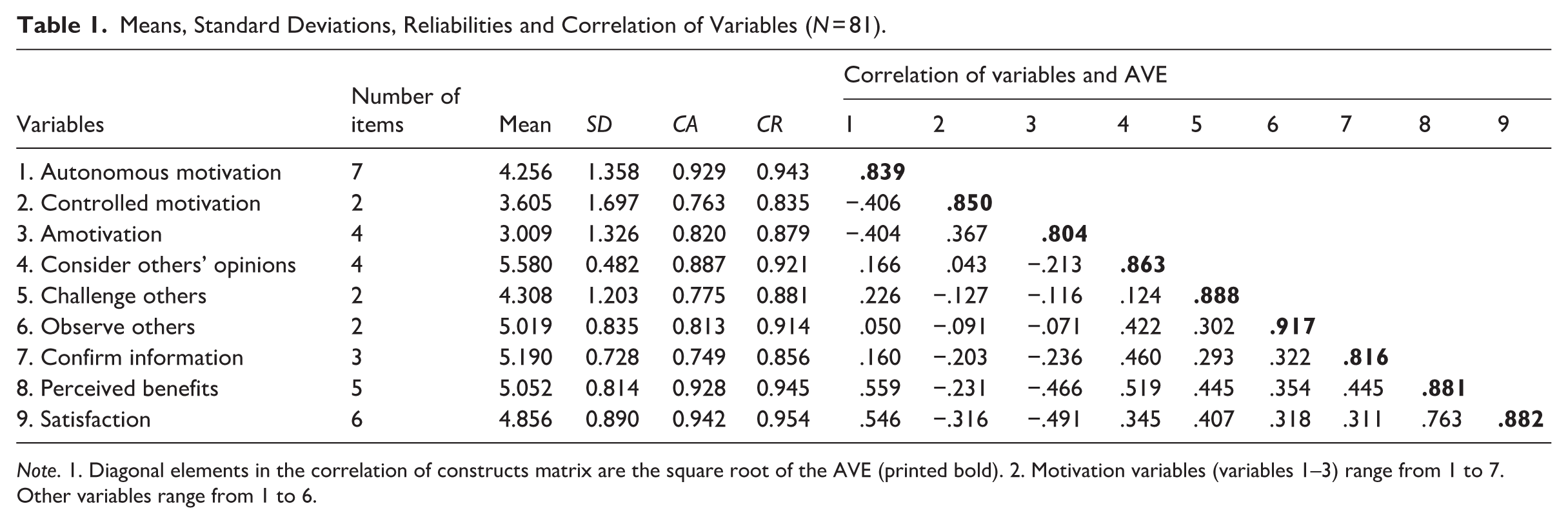
Note. 1. Diagonal elements in the correlation of constructs matrix are the square root of the AVE (printed bold). 2. Motivation variables (variables 1–3) range from 1 to 7. Other variables range from 1 to 6.
Structural Model
To test the structural model, Bootstrapping with 5,000 subsamples was conducted. The results showed that the R2 for perceived benefits was 0.64, suggesting that the model explained 64% of the variance in students’ perceived benefits of PjBL. The R2 for satisfaction was 0.52, indicating the model explained 52% of the variance of students’ satisfaction with PjBL. Table 2 presents the results of the path coefficients for the model.
Results of Path Coefficients (N = 81).
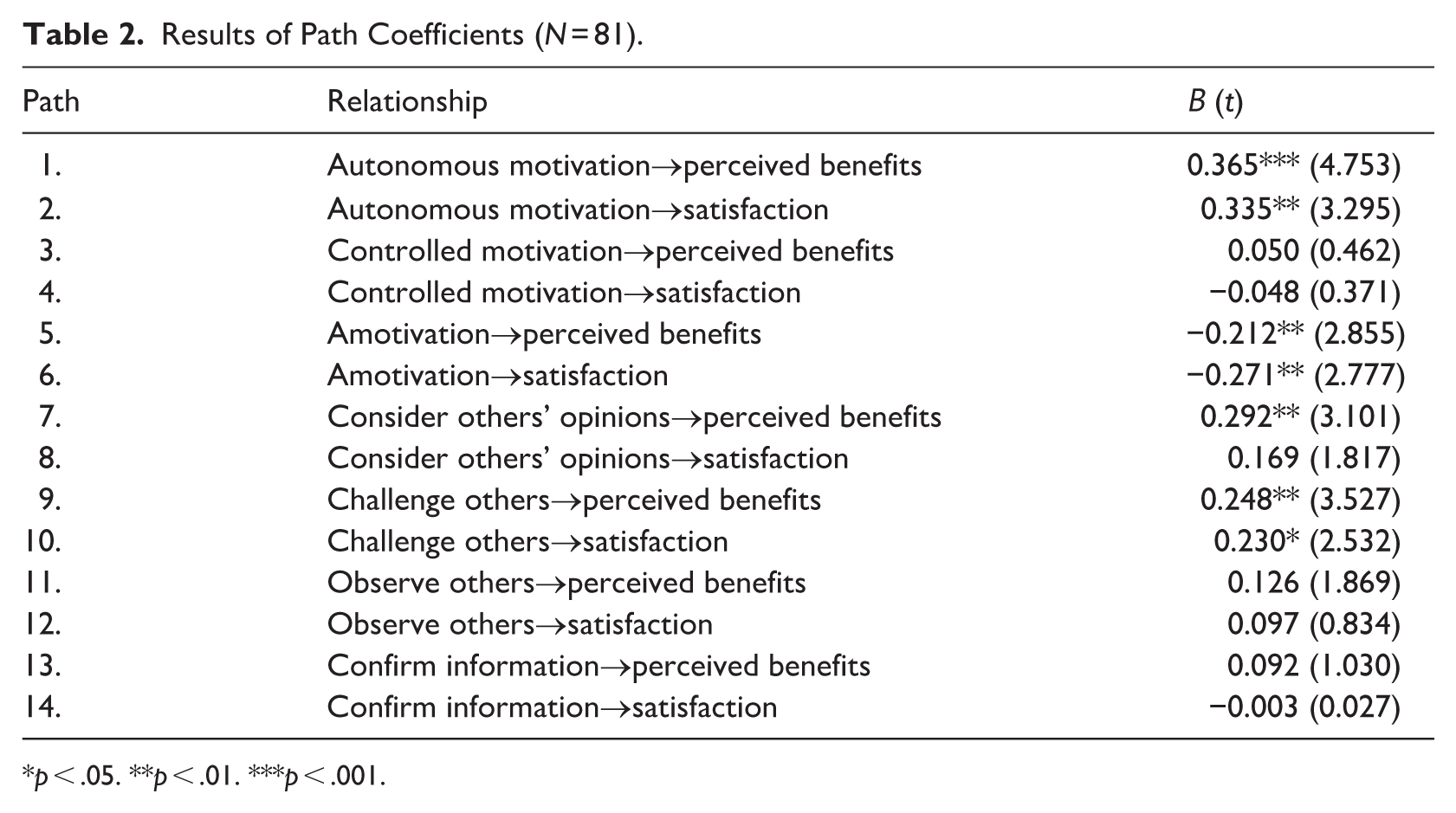
p < .05. **p < .01. ***p < .001.
Regarding motivation variables, Autonomous motivation was positively related to both Perceived benefits (Path 1: β = 0.365, p < .001) and Satisfaction (Path 2: β = 0.335, p < .01), while Amotivation had a negative impact on both Perceived benefits (Path 5: β = −0.212, p < .01) and Satisfaction (Path 6: β = −0.271, p < .01). No significant relationships were observed of Controlled motivation with either Perceived benefits or Satisfaction (Paths 3 and 4).
Concerning collaboration strategies, Consider others’ opinions was positively related with Perceived benefits (Path 7: β = 0.292, p < .01) but not with Satisfaction (Path 8). Challenge others was positively related to both Perceived benefits (Path 9: β = 0.248, p < .01) and Satisfaction (Path 10: β = 0.230, p < .05). Both Observe others and Confirm information did not show a significant relationship with either Perceived benefits or Satisfaction (Paths 11–14).
Discussion
Motivation, Perceived Benefits, and Satisfaction
Regarding the first research question, the results showed that autonomous motivation was positively related to both students’ perceived benefits and their satisfaction, consistent with the findings from previous studies (e.g., Buil et al., 2019; Ferriz et al., 2013), although not all studies on project-based learning found significant relationships between motivation and satisfaction (e.g., S. J. Lee et al., 2016). Yet in the current study, students reported a greater sense of learning and satisfaction because of feelings of inherent interest and enjoyment from conducting this project and the benefits for their personal development. Three features of this project might explain this result.
First, the project of the film analysis was an authentic task and related to the daily lives of the students and their future professional career. The topics students learned and discussed in this course, including happiness, self, relation, and life, are closely related to students’ daily lives and can be found in the film provided. Certain film fragments are actually the epitome of real life. Therefore, during this process students have many opportunities to connect their life experiences with course materials, which is highly motivating (cf., Herrington, 2005)
Second, WeChat was used for students’ knowledge construction in this project. While WeChat is one of the most frequently used instant messaging tools, it is barely used for learning purposes. Using WeChat to collaboratively develop the final product might be novel and interesting for students, and therefore, they might put more effort in this process. Moreover, WeChat has some advantages in comparison to other digital technologies (e.g., online discussion forums and videoconferencing). The most important aspect is that there are diverse forms of communication on WeChat, including text messages, emojis and stickers, uploaded pictures and documents, audio messages, and audio calls. Students can adopt multiple ways to efficiently interact with each other, both synchronously and asynchronously. In particular, students usually use positive humor in communication, which makes the learning atmosphere vivid and satisfying. Besides, learners can easily access WeChat as they can use it seamlessly on multiple devices.
Third, students not only acquired content knowledge but also improved their soft skills during the development of the film report. Students were engaged in a series of collaborative activities, such as selecting film fragments, deciding analysis topics and methods, and revising manuscripts. In each activity, learners needed to complete a learning loop of “propose ideas–receive feedback–negotiate–reach agreements.” In so doing, students might have acknowledged that their teamwork, problem-solving, and critical thinking skills were enhanced.
In addition, the results revealed that amotivation negatively predicted students’ evaluations (both perceived benefits and satisfaction): The more students felt unmotivated to complete the project, the less benefits and satisfaction they perceived. This is in line with findings from previous studies (Ferriz et al., 2013). This might be because the lack of intention to invest effort in this project might increase students’ negative emotions and undermine positive emotions in learning. This, in turn, could lead to less performance and lower satisfaction (Legault et al., 2006).
Collaboration Strategies, Perceived Benefits, and Satisfaction
Regarding the second research question, two of the four collaboration strategies were found to be related to students’ perceived benefits, and one to students’ satisfaction with the course. The latter result implied that the more students considered peers’ opinions when they wrote the film report, the greater sense of learning they felt. This was in line with previous studies on students’ engagement and perceptions of learning in online discourse (e.g., Bain, 2011). Reflecting on others’ opinions can be beneficial to students’ deeper understanding of the course material. Moreover, the process of thinking of and accepting others’ ideas might trigger students to think outside the box and change their inherent thinking model, which can improve their critical thinking skills.
Furthermore, challenging peers’ opinions was positively related to students’ perceived benefits from the creation of the film report. This might support the claim of Nguyen-Phuong-Mai (2019) that constructive discussions and valuable outcomes can stem from differences of opinion. When students question the ideas of their peers, it usually means that they can put forward their own opinions after thoughtful reflection. That is to say, only when the challengers have carefully thought about the issues discussed, their opinions will be seen as meaningful and might be accepted by other team members. As a result, challengers will be encouraged to think deeply and extensively, which might not only deepen their understanding of the content knowledge but also improve their thinking ability.
The results further showed that learners felt satisfied with the collaborative activity even if they challenged each other. This is different from previous studies (e.g., Wei et al., 2013; Zhu, 2012) that have found students who grow up with an East-Asian education background normally tend to pursue harmony and avoid direct confrontation and conflict with others in collaboration. The personal emotions of students who engaged in the film report writing were probably not harmed by expressing differences, perhaps because they perceived safety during the collaboration and therefore expressed their feelings and opinions openly. Three settings of the project might have contributed to this. First, students’ collaboration was part of a formative assessment procedure aimed at giving each other feedback and preparing each other for the final exam later on. This could mean that collaboration, whether it is challenging each other or other forms of collaboration, was understood as a way to help each other to become better prepared. Second, when using asynchronous discussions in WeChat, information can be presented after careful wording. Students could also use emoticons and stickers to express their emotions and attitudes. These could have avoided potential conflict, embarrassment, and shame that may sometimes occur in synchronous communication. Second, all learners were grouped by themselves rather than by the teacher. In other words, students in the same team were familiar with each other. Previous studies have reported that Chinese students prefer to work with familiar peers (M. Wang, 2007; K. Zhang et al., 2009). Forming teams through friendship may help learners to directly express their true opinions without being too concerned about the feelings of others, which might contribute to group cohesiveness (e.g., Q. Wang, 2009).
Implications for Practice
The first implication for the practice of this study is related to project design. To help students be motivated to learn, the selection and design of the project and the educational activities should be authentic. In particular, the final product’s design should be closely connected to students’ real lives and their future professional career (cf., Herrington, 2005). Second, teachers should encourage learners to listen to each other during collaboration and try to question their peers’ ideas and put forward their own opinions. One way to do so is to ask students to write a reflection diary in which they summarize peers’ different opinions daily. Besides, students can anonymously comment on everyone’s work and propose their improvement suggestions. Third, teachers should create a safe and comfortable atmosphere for students’ collaboration, so as to encourage them to openly express their feelings, attitudes, and opinions without worry. Encouraging students to form their own teams and use multi-functional educational technology to collaborate are two possible ways. Moreover, the fact that, in the current study, the task students worked on was only used for formative assessment, may have helped to create a safe learning environment. Grading the artefact (i.e., a film analysis) and the group work could have had negative consequences for student motivation.
Limitations and Future Directions for Research
The first limitation of this study is related to the collected data, which is only quantitative. Future studies could adopt an explanatory sequential design (Creswell, 2012; Leavy, 2017) that helps with the explanation of quantitative results via follow-up data collected from qualitative methods, such as interviews and diaries. This combination of data provides insights into not only the relationship between motivation, collaboration strategies, and perceived learning outcomes but also the reasons why students are motivated as they are, why their particular collaboration strategies, and what specific learning outcomes they see from PjBL. A second limitation is the limited generalizability of the results of this study, as it is about one course with a relatively small sample of students. It does generate potential hypotheses about PjBL and learning outcomes, which can be studied in future research. One way to increase the sample size could be to integrate online PjBL with MOOCs that provide large samples from various disciplines.
Conclusion
This study has contributed to our understanding of college students’ motivation and strategies used during online collaborative PjBL. It can be concluded from the results that autonomous motivation and amotivation are positively and negatively related to students’ perceived benefits and satisfaction, respectively. Both strategies considering others’ opinions and challenging others are positively associated with students’ perceived benefits. In addition, challenging others is also related to students’ satisfaction with PjBL. These findings can serve as guidelines for a better design of future project-based curricula and educational activities.
Supplemental Material
sj-docx-1-alh-10.1177_14697874261419448 – Supplemental material for Online Collaborative Project-Based Learning in Higher Education: Students’ Motivation, Collaborative Learning, and Perceived Outcomes
Supplemental material, sj-docx-1-alh-10.1177_14697874261419448 for Online Collaborative Project-Based Learning in Higher Education: Students’ Motivation, Collaborative Learning, and Perceived Outcomes by Wilfried Admiraal, Nadira Saab and Pengyue Guo in Active Learning in Higher Education
Footnotes

Author Contributions
Author 1 wrote the paper. Author 2 provided feedback on drafts of the manuscript. Author 3 conceived and designed the study, and performed the analysis
Funding
The authors received no financial support for the research, authorship, and/or publication of this article.
Declaration of Conflicting Interests
The authors declared no potential conflicts of interest with respect to the research, authorship, and/or publication of this article.
Supplemental Material
Supplemental material for this article is available online.
Author Biographies
References
Supplementary Material
Please find the following supplemental material available below.
For Open Access articles published under a Creative Commons License, all supplemental material carries the same license as the article it is associated with.
For non-Open Access articles published, all supplemental material carries a non-exclusive license, and permission requests for re-use of supplemental material or any part of supplemental material shall be sent directly to the copyright owner as specified in the copyright notice associated with the article.
