



Abstract
This study examined how students conceptualise their emotions when engaging in online asynchronous forums within a university course. With the move online in work and educational practices and the reduction in physical contact, the need to understand emotional influences on social learning behaviour in digital spaces is important. There is little research about how students conceive of their emotions when engaging in online asynchronous course forums. Using case study method student engagement across a 6-week fully online module was examined using a theoretical framework bringing together social, emotional and online learning dimensions. Three types of behaviours were found represented as self-protective, self-oriented and community-oriented. Perceived social and emotional behaviours are conceptualised regarding content, peer interaction and within the asynchronous forum. This study contributes understanding about how students understand their emotional engagement in a social space and how this influences their learning behaviours in an asynchronous forum. Implications for future research directions are discussed.
Contextualising the Move Online
Understanding emotional influences on social learning behaviour in digital spaces is important in a world where earning and learning is rapidly moving online. Although working remotely is not new and existed pre-covid (Chung & van der Lippe, 2020), it was boosted by the pandemic period worldwide, creating a shift in social perceptions. As a result, social acceptance of the advantages of working from home have increased with the move to more hybrid (work/home) approaches (Tarigan et al., 2023); as well as greater access to data and global collaboration tools with less restriction to specific work sites (Homberg et al., 2023). This has built a work ecology for companies’ transition to supporting work-home life balance (Tsang et al., 2023).
The move online in academic course work in higher education also existed pre-covid but the approaches could be considered as a more isolated independent practices, where courses were considered to be delivered online or not. Now, universities consider an online mode of delivery as standard practice (Kortemeyer et al., 2023). An academic course is more likely to be offered both on campus as well as using an online delivery mode. This online mode may include lectures that are pre-recorded and made accessible in a digital repository, with smaller sized tutorials offered synchronous, delivered like an on-campus tutorial. This rapid shift to providing an increased opportunity for students to access a course online provides a wider reach and “presence” for a given university. Now a student does not have to geographically relocate to be an alumnus of a university.
Underpinning this digital earn and learn shift, is the fact that heightened importance is placed on facilitating affective engagement such as psychological engagement (enthusiasm) as a key link to student’s behavioural engagement (perseverance) and cognitive engagement (reconciliation) when learning online (see Teo et al., 2023). Coupled with this, more specifically, is the transition for secondary school students from a classroom model of learning to an online mode at university. Even if students take an on-campus mode there is an increased inclusion of online tools within undergraduate coursework, reduced lecture delivery and new digital platforms and communication pathways to cope with (Ensmann et al., 2021). Campus life is changing with less time in the physical realm and more time in the digital space (Eman, 2021).
These changes are culminating in reduced physical contact with learning and earning moving online. This study seeks to step into this problem using an emotional lens. There is more discussion about the relationships between emotions and achievement (Egan et al., 2022; Kukkar et al., 2023; Valiente et al., 2012) with little research into the role of emotional engagement in the learning process especially in social online forums, as well as little about how students represented and conceptualised their emotions (Simion, 2023). This study responds to this call and the call from researchers requesting further examination of reducing students’ stress when learning online through digital wellbeing (Greener, 2020; Khawaja & Stallman, 2011; Slykerman et al., 2022) and social learning (Brundidge & McArthur, 2025; Ensmann et al., 2021; Sujarwanto et al., 2021). Through an exploratory approach this study seeks to understand students’ emotional engagement when learning online and provide a complex representation of their emotional behaviours and approaches. The question directing this study is: How do students conceptualise their emotional engagement when learning in an asynchronous forum? The findings will inform wider understanding on emotional engagement in online social platforms.
Emotional Engagement in Social Online Spaces
It has long been established that students need both cognitive, social and emotional skills to function effectively inside of education boundaries and for life in general (OECD, 2015, p. 3). Learning itself has become a complex system of interactions and connections across formal, non-formal and informal contexts (Erstad & Silseth, 2023; Prestridge et al., 2024). The rise of a digital ecosystem has advocated for the importance of social and emotional engagement (Erstad et al., 2024). Engagement has been defined as the level of participation and personal interest that a student shows in their behaviours and attitudes towards their learning (Newmann, 1992). Fredricks et al. (2016) suggest that the construct of engagement is appealing, holding potential for intervention and thus, improvement in learning. Fredricks’ and colleagues seminal work on engagement (Fredricks et al., 2004) identified three dimensions: behavioural, emotional and cognitive. Linnenbrink-Garcia et al.’s (2011) extended on these dimensions to include social behaviours as emerging from social learning activities (see also Wang et al., 2016). Drawing these works together, engagement is examined in this study through the lens of social and emotional engagement within a digital platform such as an asynchronous discussion forum.
Research in higher education identifies the pedagogical approaches to support student’s psychological wellbeing as foundational to cognitive and behavioural engagement when studying online (Teo et al., 2023; Tualaulelei et al., 2022). Online learning can sometimes provoke feelings of isolation which may lead to feelings of loneliness and disconnection (Martin, 2019). Educators need to consider the mitigating role that emotional engagement can play in fostering a sense of belonging and connection among learners, which has been found to be essential for promoting overall well-being and mental health (Greenan, 2021; Lu et al., 2024). Research suggests that social interactions and emotional connections with instructors and peers enhance motivation and engagement in learning, encouraging students to participate actively in online courses in dialogue and co-construction of tasks which can be achieved asynchronously (Sulé et al., 2023; Tualaulelei et al., 2022). Social and emotional interactions provide opportunities for students to seek help, share ideas and collaborate on projects, thus enhancing learning outcomes and promoting a sense of shared responsibility for academic success (Dietz-Uhler & Hurn, 2013; Kim et al., 2015). Such sharing and collaboration help students to develop and practice essential interpersonal skills such as communication, empathy, collaboration and conflict resolution in online environments (Molka-Danielsen & Brask, 2014). When learners feel connected to their instructors and peers, they are more likely to actively participate in discussions, seek help when needed and persist in their studies, leading to improved academic performance (Richardson et al., 2017). Much of this research examines the role of the instructor as the active connector to support social and emotional engagement. However, in social digital spaces such as asynchronous forums, peer-to-peer engagement is a significant form of the interaction.
More specifically then, research into emotional engagement in asynchronous forums explores the effect on social relationships, instruction and performance. In the study by Lim et al. (2020) who examined emotional engagement and wishful identification (that is wanting to be like their favourite character) in a massive live-streamed game channel, found strong links to parasocial relationships (that is one-sided intimate relationships). These researchers considered emotional connectedness and expression within comments and reactions in chats through a survey. Prayogo et al. (2024) conceptual study integrated emotional engagement with online learning proposing a set of instructional strategies to build students’ socio-emotional engagement, which they believe is valuable in online digital spaces. This focus on instruction and learning design is also found by Tu et al.’s (2025) systematic review of emotional engagement in synchronous learning. Pilotti et al. (2017) examined student academic outcomes as a result of behavioural, cognitive and emotional engagement in an asynchronous discussion forum. They found that grades improved with students’ emotional engagement but declined when instructor’s demonstrated cognitive engagement. These results were found using a word count of comments/posts.
Digging more deeply into the effect of the asynchronous forums on emotional engagement, Han et al. (2023) found that the lack of immediacy as well as asynchronicity challenge students’ time management, specifically affecting procrastination and motivation which are central tenets of self-regulated learning processes. Interestingly, this study considered emotional engagement associated with students’ self-efficacy for their self-regulated behaviours. Self-efficacy in the study of achievement emotions in online learning by Bakır-Yalçın and Usluel (2024) links to students’ perception of their control and value of an activity. Put simply, greater feelings of control of learning and the value of a task evidenced more enjoyment which in turn supports higher levels of cognitive and behavioural engagement. In this study the mediating factor was task value which was found to have an important effect on student engagement. Moving one step deeper again, S. Liu et al. (2025) MOOCs study adds the dimension of task complexity, such that an increase in higher-order thinking requirements reduces positive emotions and increases confusion and negative emotions while Z. Liu et al. (2024) MOOCs study explores discussion patterns associated to emotions. This study finds that students with active and meaningful contributions had more positive emotions. These studies highlight the inter-relational aspects of emotions associated with cognitive and behavioural activity in online learning with the additional importance of considering the nature of the digital forum.
In summary, from the research examined here on social and emotional engagement, a surface level understanding is represented of (mainly) students’ positive emotional responses underpinning their engagement that increase learning in online coursework. More research exists about digital tools and instruction than a deep understanding of emotion enabling social engagement in digital spaces. Research also represents programs and or practices to integrate or increase social and emotional skills into higher education coursework rather than examining the relationship between emotional and social behaviours, with no research examining students’ emotional perspective as part of the learning process rather than its inter-relationship to student achievement or outcomes of courses in higher education. The current literature does provide some insights into the social behaviours of students help seeking, sharing ideas and collaborating on projects but does little for understanding emotions and social perceptions of these behaviours in interactive social digital spaces. A deeper examination is needed to understand students’ emotional perceptions and how this influences how they behave socially in an online forum.
Research Method
The research question guiding this study was How do students conceptualise their emotional engagement when learning in an asynchronous forum? From the student perspective this study examines how emotional engagement, both perceptions and behaviours, affected their social engagement within a course forum that was wholly asynchronous. Using both interviews with students and screenshot evidence of their engagement in posts and comments, this study sought to provide insight into how students’ emotional conceptions direct how they engage with the content, other students and the interface itself.
This is a qualitative case study using an interpretivist paradigm to consider the social realities of higher education students bounded within an undergraduate course (Creswell, 2013). Qualitative methodology enables the researchers to look at representations from the perspective of the participants exploring how they see and feel emotional interactions (Creswell & Poth, 2018). To provide the researcher with a framework to examine perceptions of students’ online emotional engagement, the Collaboration for Academic, Social and Emotional Learning (CASEL) dimensions was adopted in association with the three types of online engagement defined by Moore (1989) and Hillman et al. (1994). This framework draws together social and emotional learning with online learning engagement.
The CASEL framework has been used in the higher education context for examining social-emotional learning behaviours (Simion, 2023) but was originally designed for the K-12 schooling context. It is composed of five dimensions: (a) Self-awareness; (b) Self-management; (c) Responsible decision-making; (d) Relationship skills; and (e) Social awareness. The use of the CASEL framework has been applied to examine attitudes and assessment perspectives (Simion, 2023); prevention and promotion programs fostering social-emotional learning (see Conley, 2015 for a review); integration of social and emotional learning practices into coursework not specifically using online environments (Elmi, 2020); as well as identifying social and emotional skills, standards and evidence in the K-12 context (Cipriano et al., 2023; Frye et al., 2024). However, there is no research currently that uses the CASEL framework as part of understanding online learning engagement in asynchronous forums.
With regard to online engagement, Moore (1989) defined three dimensions of interaction in distance education, these being, student to content, student to instructor and student to student. While Hillman et al. (1994) defined a focus on student to interface dimension. For this study, the three types: student to content; student to student and student to interface in combination with the social emotional dimensions were applied (see Table 1). The omission of the online engagement type – student to instructor is validated for this study as the context for the asynchronous forum did not require instruction specifically by the educators in the course forum. Rather interaction with the instructor occurred in other online spaces in this course such as the Q & A forum; check-ins. Further background details of the course design are provided below.
Code Framework for Online Social-emotional Engagement Dimensions.
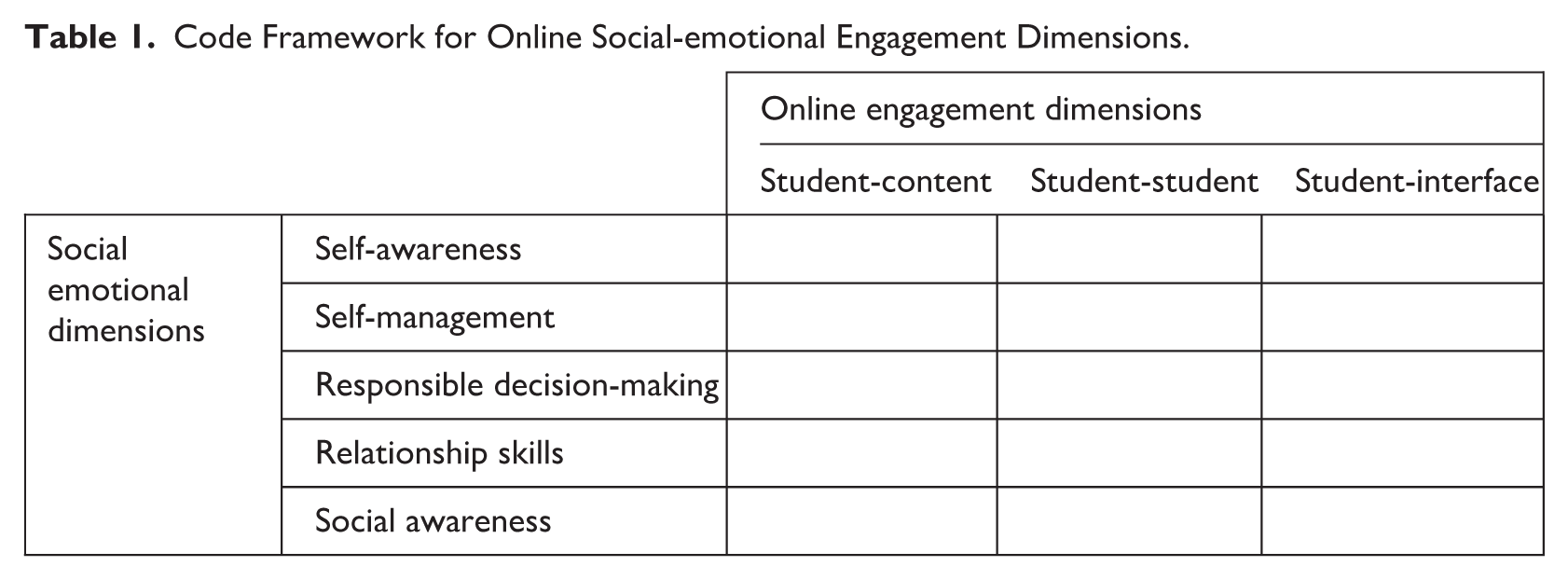
In higher education, other theories have been applied to examine students’ emotional engagement in online asynchronous forum, such as Pekrun’s (2006, see also Pekrun & Perry, 2014) Control-Value Theory of achievement emotions (CVT) and self-efficacy for self-regulation (see Bakır-Yalçın & Usluel, 2024; Han et al., 2023). These studies examine students’ emotions associated mainly with performance outcomes rather than purely associated within the process of learning. While these theories are used to identify the relationships between concepts such as control and value appraisal of a task, achievement emotions, emotion regulation of reappraisal and suppression, the CASEL framework positions social emotions as capabilities for learning within an educational domain. Moving towards capabilities widens the possibility for examining emotions beyond students’ levels of control and value of a task to a position of learning within action, that is, emotional engagement associated within dialogic activity for and with content, other students and the interface building a framework that can examine integrally student reasoning for affective action within online forums (see Table 1) for meaningful learning experiences.
Course Details
The undergraduate third year bachelor course was delivered in two modules. The first module involved face to face tutorial delivery and online synchronous tutorials over 6 weeks. Students chose either the on-campus or the online tutorial. This was delivered in-person in a tutorial room on a campus or using synchronous technologies (Microsoft Teams video chat) if the class was online. The second module was delivered fully asynchronously (no scheduled tutorials) that consisted of digital content in the form of short videos (e.g. YouTube), academic readings combined with a series of weekly tasks (e.g. make an infographic or explain a concept) that requested student to post in a Microsoft Teams course forum. The course asynchronous forum had weekly channels – Topic 1, Topic 2 to Topic 5 and was set up with all students in the course in the one asynchronous forum (260+ students). There was also a separate Q & A forum to help students where the instructors actively answered questions. This forum ran parallel to the asynchronous course forum. There were two optional online sessions separate to the course forum to discuss the assessment. The students were not assessed on their participation in the course forum or completion of the topics/tasks. They were encouraged to be active and post in the course forum but were not given explicit instructions on how to formulate a post. The students had 6 weeks to complete the five topics and were given freedom to choose when and if to engage. The design of the asynchronous activities across the five topics was associate to course learning outcomes. This study focuses on Module two Microsoft Teams asynchronous course forum which will be called the “course forum.”
Data Collection
All students in the course were invited to participate. Three students volunteered ensuring a random sample (Cohen et al., 2018). Each student was considered a single case as it was their perspectives on their emotional engagement in an online social forum that affected their behaviours in the course forum (Simons, 2009). Data collected for this study included interview data and forum posts throughout the 6-week module. Students were asked to participate in an online interview using Microsoft Teams after the completion of the course after all assessment was marked and grades given. The semi-structured interviews ranged from 30 min to 1 hr. A screen shot was taken of forum posts associated to the given student and copied into a word document in chronological order of postings. Peer responses to the posts such as comments, emojis and likes were also recorded. Informed consent included permission for materials in the Microsoft Teams forum to be screen captured, pseudonym allocated to names of students, ensuring that all students were de-identified in any publication or reporting process. Date changes have been made for further de-identification. All ethical protocols have been adhered to (Griffith University Ethic Committee: 2023/394).
In-depth semi-structured interviews were used with a pre-formed set of 16 questions that were process oriented, such that students were asked to describe actions and behaviours in the course forum as well as how they felt and the reasons for their actions or behaviours. To begin the interview the researcher started with a discussion of the posts and comments in the course forum that the student had made to help prompt how and why they engaged in certain ways. To examine online interactions in more depth as associated to online social and emotional engagement, questions using words such as “feel,” “encourage others,” “empathy,” “emotionally engage,” with such questions as “If you posted and someone liked it did you like theirs? Which came first?” and “How did you frame a post. . .did you actively soften it. . . .” Interview questions were sent prior to the interview taking place to give students a sense of what the interview was going to include so they felt comfortable. The researcher completed all three interviews and used a conversational discursive approach to support the ebb and flow of the dialogue (see Kvale & Brinkmann, 2015).
Data Analysis
Each of the three cases (semi-structured interview and course forum posts) was analysed using a deductive coding approach (Cohen et al., 2018) that involved examining, comparing, conceptualising and categorising the data (Strauss & Corbin, 1990). Firstly, the theoretical framework described in Table 1 provided the categories for deductively framing the data from theory driven codes. As there were two theories used in this study providing social, emotional and online engagement dimensions, a codebook was established with cross-theory definitions (see Table 2). For example, the social and emotional dimension of self-awareness in association to the online engagement dimension of student to content became the category of “self-awareness-content” and was defined as the student being aware of their emotions and how these affect their interactions with content. All social and emotional dimensions were combined with online engagement dimensions creating 15 categories in the codebook. The 15 categories with abbreviated titles “self-awareness-content” have been bolded in Table 2 and are used to label social emotional online engagement practices in the presentation of findings.
Social Emotional Online Engagement Dimensions Definitions.
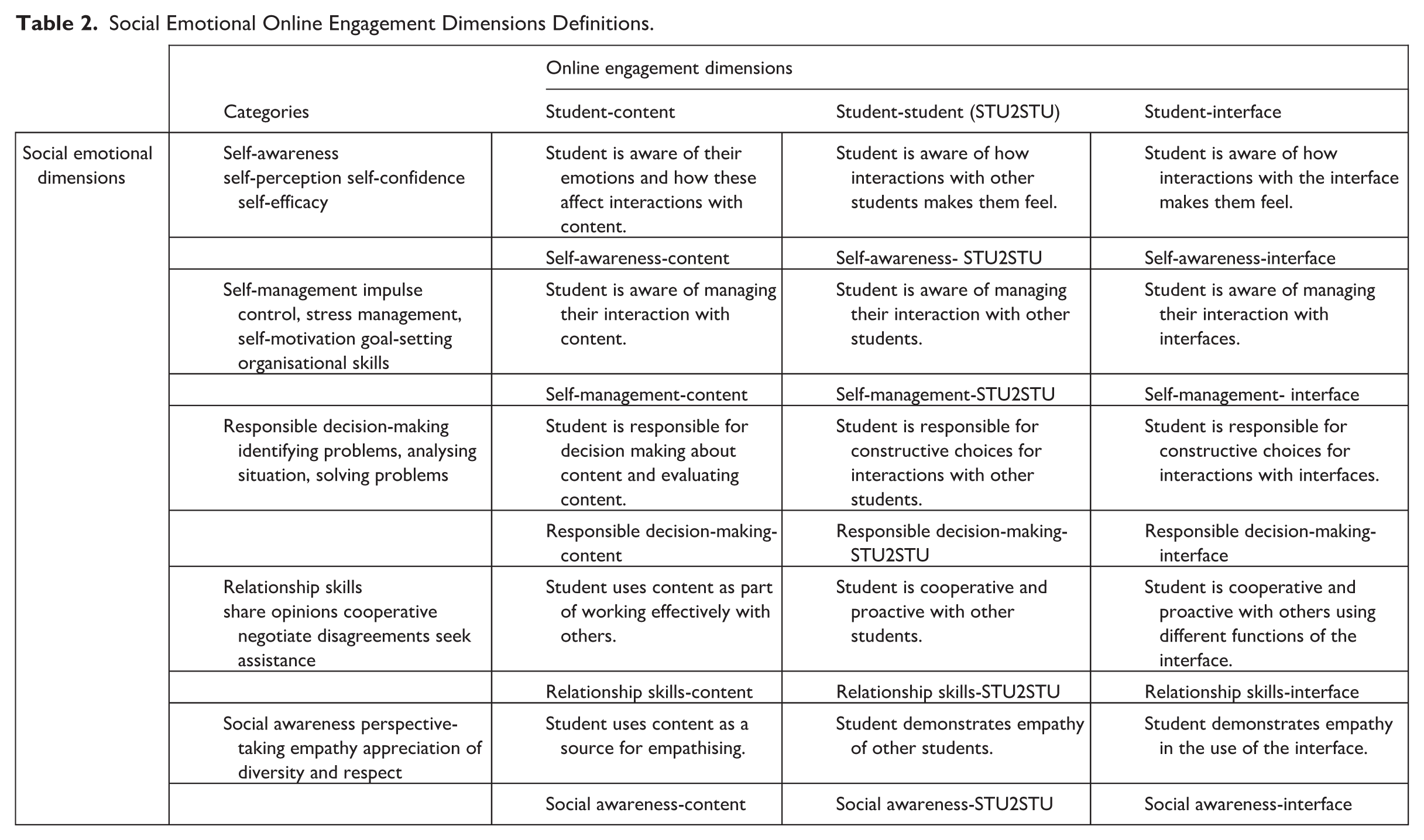
The three student cases were coded individually. The course forum posts were analysed first for each case to establish an engagement pathway ready for the interview. As described above, the interview started with a reflection on how the student engaged in the course forum (see above). The engagement pathway was descriptive and included screen shots of posts in chronological order – such as Topic 1 the student posted (date/time) and this was commented on by three peers. All screen shots were in order. The case interview transcript excerpts were coded using the 15 categories (Table 2). Interview sentence-excerpt were coded in sections such that one sentence could be allocated to more than one category as such in interview sentence: I only like to comment if it made me feel something (coded to self-awareness-STU2STU), if I like it it actually encouraged me to think further and to think deeper (coded to self-awareness-content). If the student repeated the same idea and or elaborated on the same idea at different times during the interview, this was coded to the given category.
From here two representations were created for each case, one being a case narrative and the other a visual graph representing the number of coded segments in each category. The case narrative was a rich description of the online social emotional engagement behaviours incorporating the student’s engagement pathway and interview excerpts. The visual graphs were created using Microsoft Excel based on “references” referring to the number of interview segments coded in each category. To establish a thick description (Geertz, 1973), the three case analytical items (codebook, case narrative and visual graph) were applied and or constructed through a continual iterative process, in that, the researcher coded the semi-structured interview alongside the course forum posts, going back and forth through the data using the codebook building the case narrative. The process of re-coding and re-comparing were repeated until the representation was well-established. Consistency of analysis was achieved as the researcher continually examined the codebook and compared case analysis. Additionally, codebook categories were presented in each case narrative to support validity. The visual graph was then created and examined in comparison to the case narrative as a final comparison and evaluation of each case.
In the findings section, each case will be presented using the case narrative and visual graph. The case description starts with an overall look at the online social emotional dimensions across categories through the visual graph. This is followed with the case summary that starts with the student’s engagement pathway flowing into the narrative of the case.
Findings
The Case of Susan
Figure 1 represents Susan’s perceptions of her online social engagement practices. She was self-aware of how she was engaging with content, peers and the interface. She talked about this the most. Her own awareness of her needs was driving her social emotional engagement. Complementing this was social awareness, that is, how she was representing herself to others through content, and the ways she thought about interacting with her peers, for example by softening her language, saying thank you and checking to see if peers liked what she said. There was analysis of peer comments and likes that informed decision making of what to post herself so that it would be valuable for her peers. The interface, that is, the course forum, influenced her as it was a large course group “hundreds of people” but considered by her as a learning space and a professional space. Of least importance was being connected with others or developing relationships but more so it was important to be polite and be constructive in what was posted, things like, building on ideas rather than just liking what was posted.
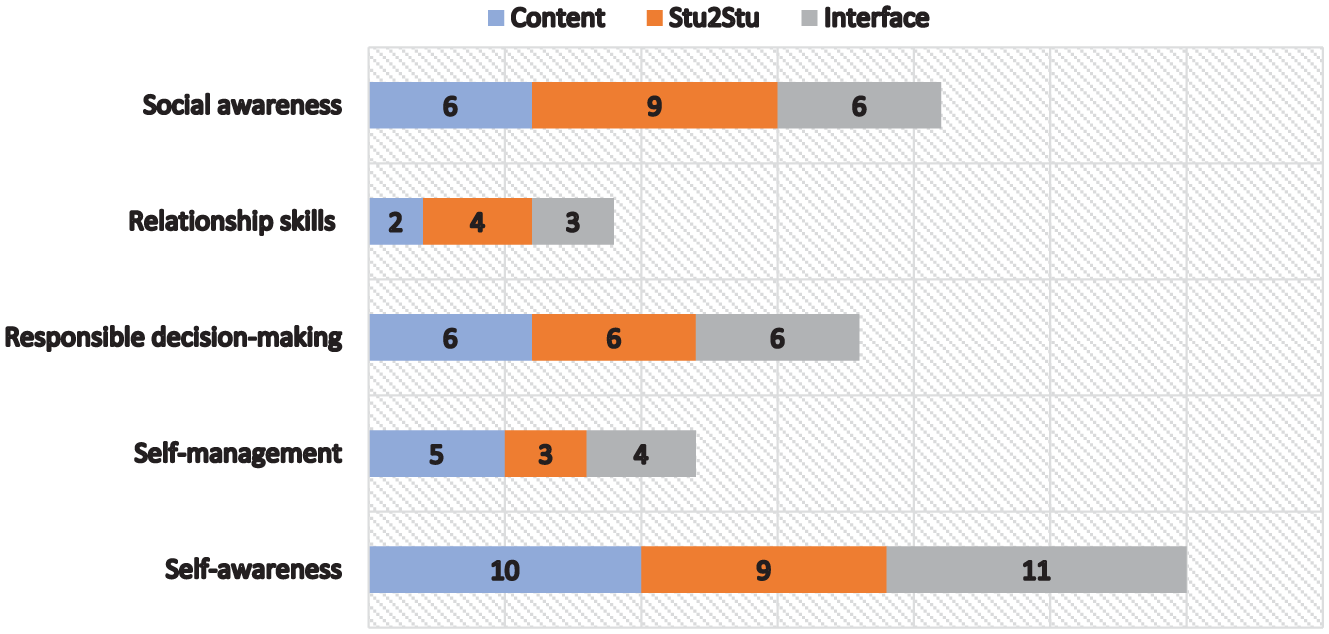
Susan’s online social emotional engagements across categories.
At the beginning of the module, Susan waited till other students had posted before she posted for the first time in the course forum. She posted after 4 weeks, near the end of the module. She wanted to see what other students were posting and the style of the activity post explaining that “I very much need to read the room before I say anything, even if it’s online” (responsible decision-making Interface). In reviewing other students’ activity posts she commented first before she posted her own task. She said she commented on posts that “made me feel something, encouraged me to think further and to think deeper” (self-awareness-content). Figure 2 is the first post she made in the course, in the form of a comment.

Susan’s first post to course forum.
On the same night (@21:14) she posted her activity -a task to create a mindmap. She did this because she found the space overwhelming with so many students she did not know. This affected her by making her show less emotions. She said “I don’t know a lot of those names. . . . [So] I think I would have actually drew it back” (self-management-STU2STU). Due to the “being shared to hundreds of people” (self-management-interface) she did not feel as comfortable showing her emotions saying “I found that quite difficult for me” (relationship skills-STU2STU).
Driven by self-awareness and social-awareness she engaged with the content and other students within the Teams forum: “I care about what other people think of me and what other people see of me, so for this I had to read others to see what they were doing first” (self-awareness-STU2STU). She stated that she is “neurodivergent, so I need to assess the situation” (self-awareness-STU2STU) then respond to peers in a way that is acceptable. In explaining this she described that “this is showing who I am to people rather than just content. Like revealing but that’s why I think I respected when I saw other people doing it, I felt more connected to the work” (social-awareness-content). This indicates that Susan was crafting her responses as representations of herself and seeing other students who did the same in the course forum.
Susan also illustrated the dimensions of responsible decision making in two ways. Firstly, with regard to student posts she evaluated the value of the content-posts, as she talked about “fake comments” and creating “information that’s engaging” (responsible decision making-content). Secondly, in association to the design of the course and the forum interface she mentioned it’s flexibility to “smashed it all out. . .all in one chunk.” She stated she “loved it,” explaining that the flexible design “my mind can’t handle . . . doing four different subjects a week. It’s too much.” Being able to complete all the tasks topics in one go, resulted in better learning outcomes: “This was my best subject was the one I understood the most out of all of them” (responsible decision making-interface). This suggests that doing the module in one go helped Susan focus on the content and her learning.
Susan was interested in cooperating and sharing opinions but to do this a peer’s comment or post had to be real and “make me feel something” (self-awareness-content). When Susan posted her task, she would only reply to comments on these posts if she was being asked a question. She wasn’t restricting herself to interacting with only “friends” or known colleagues, rather it was the quality of the post or comment that led her to further peer interaction, she stated: “But I didn’t just look at their name and go, oh, that’s my friend. I’ll comment on this” (social-awareness-STU2STU). Developing relationships to any depth was not a priority for Susan who was more interested in the content of the conversation: “the whole point of getting online and outside of your immediate circle is to find those different views and values and things like that” (social-awareness-interface).
Circling back to Susan’s first post of her activity that she cultivated after seeing her peer’s post (Figure 3). Her first post got eight separate peer comments, two are provided here as examples.
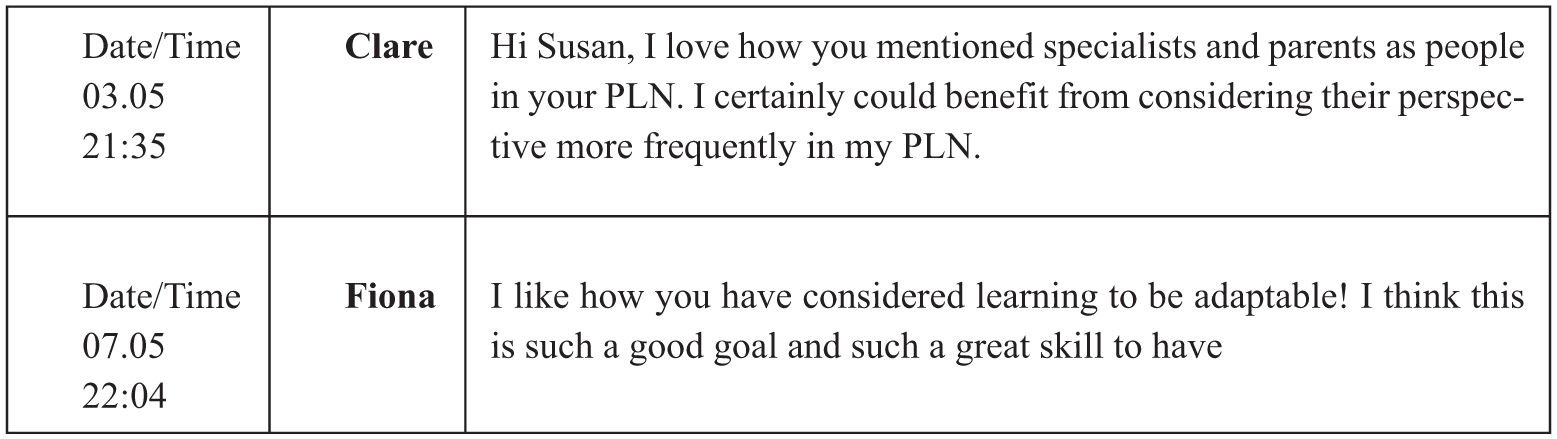
Comments on Susan’s first task post.
Susan indicated that she was “very invested in what people had to respond to me just the first few. Just to reassure that what I posted was OK, because that’s just personally, that’s who I am. I need that reassurance” (self-awareness-STU2STU). She didn’t respond to any of these as she wanted more than an |“I like. . .” comments, she wanted to be asked to expand on her ideas, “to spark thinking for me” (responsible-decision-making-content). This pattern of engagement continued across the five topics – Susan would post her task, receive comments, but not reply. Her engagement was limited to projecting her thoughts and receiving peer endorsement. She found the course forum a “protective barrier of being online” (self-awareness-interface). The peer comments made her feel accepted: “I’ve just gone back to on campus classes, and I really don’t like it because of that emotional aspect of needing to be accepted in person. And if I don’t feel accepted then I can’t keep learning, whereas on here it didn’t” (social-awareness-interface).
The Case of Andrea
Figure 4 illustrates that Andrea was focused on responsible decision making. She was analytical of the content, of how peers were interacting and was making decisions based on how the course forum worked. There was a heavy emphasis on the interface and how it shaped her social emotional engagement. Not being tool savvy meant she spent too long making things look good to post. The forum itself also shaped her engagement as there were so many posts which became overwhelming. The space was not considered safe or friendly which meant it was way too risky to post because of the social expectation she felt.
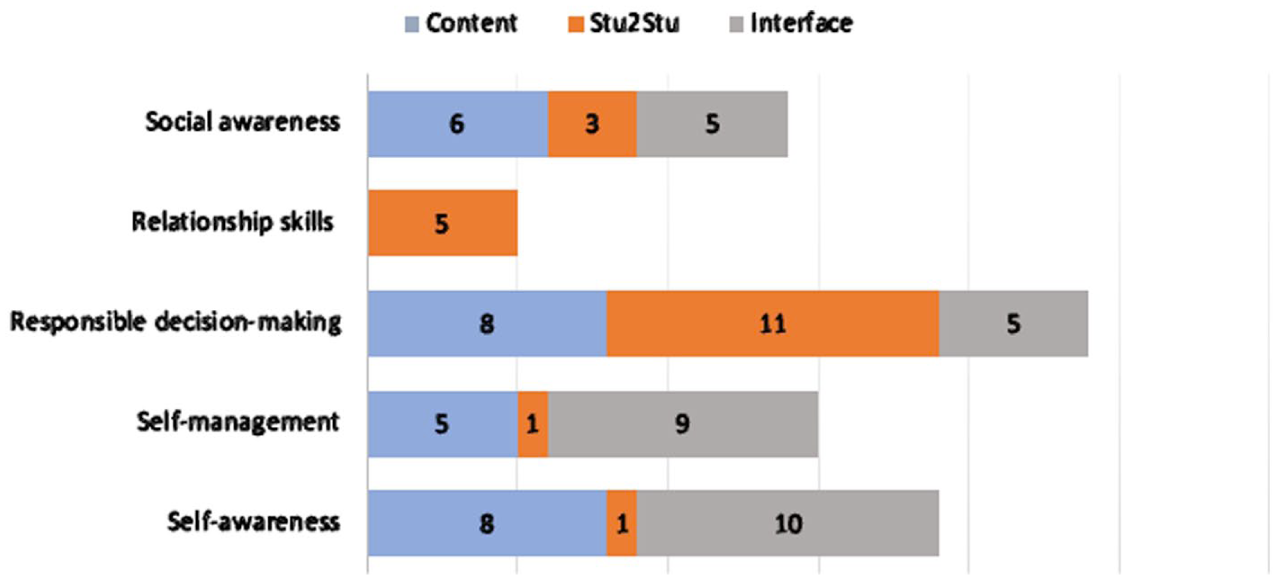
Andrea’s online social emotional engagements across categories.
Andrea’s first post to the course forum was within the first week 06.04 @ 19:56 pm which was the task activity of a mindmap. She had four peer comments on her post spanning the next week (see Figure 5): [09.04 12:06pm]; [11.04 11:10am]; [11.04 15:27pm]; [14.04 20:55pm]. One example comment was (see Figure 5).

A peer comment based on Andrea’s post.
Andrea did not engage again by responding to any of these peer comments nor posting any other of the four Topics. She said “Yeah, it did feel good” (self-awareness – STU2STU) to get those peer comments but then “I felt bad because I just couldn't bring myself to go through the other posts and read everyone else's and try and comment on others (self-awareness – STU2STU). When asked to explain further she gave two social emotional indicators: It took too long and was difficult to create an image (self-management-interface) and she was overwhelmed by the social aspect of the synchronous space (self-management – STU2STU). Further evidence of the impact of the social dynamic of the forum was explained in the way she waited for peer feedback: You know, like 'cause, it's not like you're talking to someone like this. Like it's you post something. It could be a week before you get anything back, you know. And then there's that anxiety, like, oh, my God. Oh my God. That's so long. And in reality, it probably wouldn't have been that long. But you just never know. That's just how the Internet is. So, there's no immediate feedback, really (self-management interface). Andrea waited 3 days to receive feedback from Mary (see Figure 5).
Her emphasis on the interface which influenced her social-emotional engagement was evident when she explained a different tool such as a Miro board. I haven't had the same problem before. When we've done it on. . . a little website. . . and it's all the little posts, sticky notes (social-awareness-interface). The reason why the Miro board was less overwhelming than the course forum was associate to the Miro board interface requiring small post-it note like responses rather than what was required in this course – the creation of an image, or table or reflection. She also explains that both interfaces directed her social-emotional engagement as “I have to get in really quick because otherwise same thing too many response” (responsible decision making-interface, getting in quick meant that she didn’t have to read all the other posts. Plus “I get a bit overwhelmed, especially if there's a requirement to then like, read through others work and like comment and give them feedback and things because I find it really hard” (social-awareness-STU2STU). For Andrea there are a number of considerations which influence her engagement from a social-emotional perspective. These could be considered as the technical complexity of the task-response; the number of people-responses; and latency but requirement for peer-feedback. These combine to influence her actions within online asynchronous tools, that is, to get in early, as a social-emotional strategy.
In addition to these strategies, the actual tasks peers would post on the course forum would require time for Andrea to critically assess: The thing that was hard was like then looking at other people’s responses in terms of like their actual submission. And I just would be so confused. I was like, is that actually on track or is that off track? Does it matter? Is it just a representation of what they’re thinking? (responsible decision making-content). Thus, in addition to creating her own task response, she assessed peer responses to see if she is on track. She found she was not able to assess the validity of these posts which contributed to her lack of peer engagement but also confusion as often they would be “completely different” to what she was thinking, further restricting her participation. She acknowledges that there were no right answers by stating “I don’t work well with grey” (responsible decision making-content) and that these online forums itself don’t have “any rules, adding, “there was nothing for me to align myself with and follow” (self-management-interface). Additionally in the online forum she indicated that there were new social norms “having to relearn from scratch on the fly” (responsible decision making-STU2STU) which added further pressure.
Due to the social nature of the course forum she decided to only comment on her friends post because they knew what she would mean and therefore understand it (responsible decision- making-STU2STU). This meant that she looked at the posts of other students but did not comment. She indicated that really she found other students’ comments were not genuine describing peer comments as “It was sort of like empty words (self-management-content). She also indicated it was too hard to find the people who commented on her’s and then comment on theirs – I can't bring myself to then go and try and search for their posts (responsible decision making-interface) and then comment on them as well, so I just didn't (responsible decision making – STU2STU). Later in the interview Andrea re-confirmed this further indicating “I felt like a social obligation to do it, but not enough that I actually went and did it” (responsible decision making-STU2STU).
Her engagement was dependent on her perspective of forums being considered un-friendly spaces, being exposed and thus it was way too risky to post. Even though she indicted that this was a more professional space as it was associated to course work her experiences with social media still made it riskier to participate: It just felt very social media-ish which I I try to kind of avoid personally 'cause I don't do overly well with that sort of pressure (self-management-interface). Because of this pressure she only uses Facebook and “like a scrapbook for my own memories” (self-management-interface). She continued to emphasise that social engagement with others in social spaces was difficult for her. Also, she was aware that the forum did not use algorithms like Facebook does and “shows you the people that you could talk to the most” (self-management-interface) which again limited her interactions with other students. In acknowledging Andrea’s lack of posts or peer comments she emphasises that “For me, the content itself wasn't crazy difficult and that was all fine, but just adding that whole new expectation socially sort of in there, it was too much for me in that setting” (social-awareness-interface).
The Case of Sasha
In examining Figure 6 Sasha was utilising self-awareness of content to moderate her behaviour in the course forum. Once she found someone who aligned to her thinking, she would actively search them out to read their posts. If negative (rather than constructive comments) then Sasha would lose confidence and change her approach from posting first to posting last. Her confidence with the content enabled her to post early. She also did not mention difficulties or influence of the interface on social emotional behaviours, rather she used the interface functions to enable her to post and view comments at any time, more focused on the content of peers’ post with some interaction.
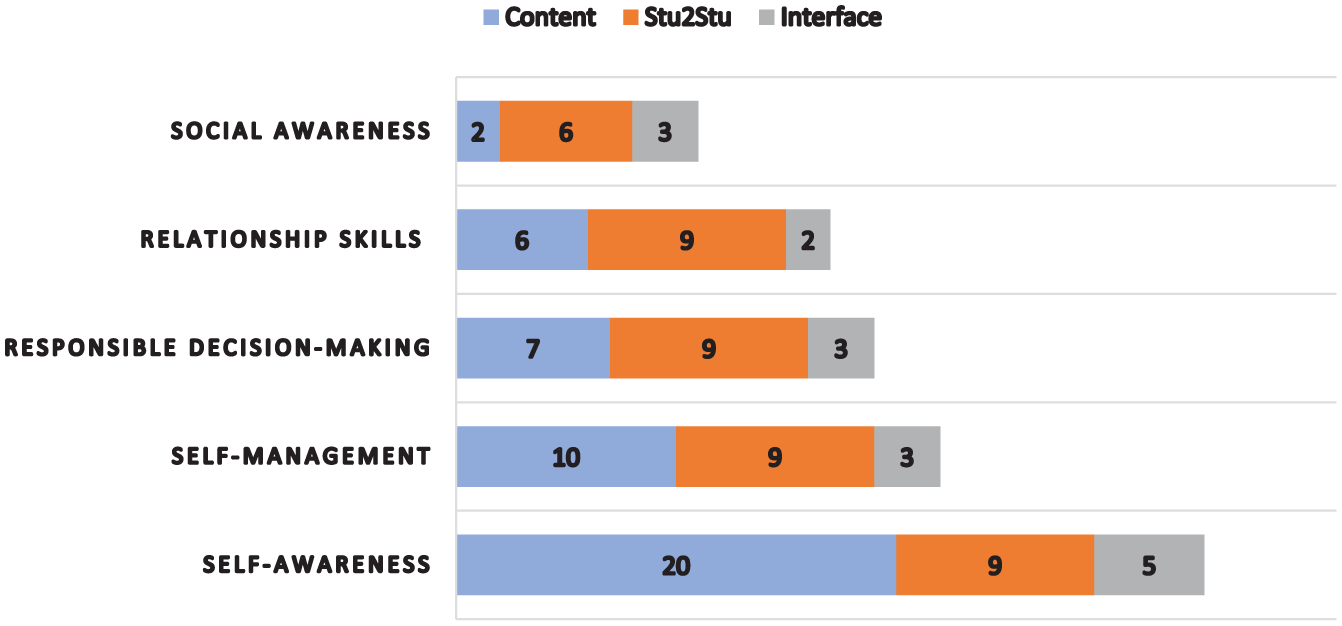
Sasha’s online social emotional engagements across categories.
A week before Module 2 started, Sasha posted three tasks – 2 for Topic 2 then 1 for Topic 1 (all on Monday at time of day (am) 10:43; 10:47; 11:07. She said “everything was still fresh in my mind. I was quite eager” (self-management-content). On the following Sunday at 13:43 Maggie a peer commented, then 2 weeks later John commented. Sasha “liked” each comment responding also with a written comment such as: “thank you so much for the feedback I really appreciate it”. When asked about her posting approach to post first she indicated that it was because she was really confident with the content (self-aware-content) and she would do the coursework up to a week prior to posting (self-managing-content). She also liked working in this way as she felt her peers could use it as an “inspiration or you know, use it to sort of guide their own understanding” (self-awareness-STU2STU) helping those who struggle with online content. She said she wouldn’t be posting first if she got negative comments and would “be looking back at other people’s work to check that I'm sort of doing the same as them, so I sort of blend in and not stand out so yeah” (self-management STU2STU).
Topic 3 was posted on 04.04 and then Topic 4 and 5 on 11.04 indicating that all 5 Topics were completed within 2 weeks of the 6-week module. Sasha expressed that this concise approach of getting the topics completed was supported by a self-awareness of her confidence with the content. Sasha posted her task and continued with the same pattern of engagement. She also liked every comment made on her posts, even returning to the Topic channel to check if her post was liked or commented on indicated it as important as “it's like having a conversation with someone. If you were giving someone feedback, you wouldn't just ignore them and walk away” (social awareness – STU2STU).
Specifically in regard to peers’ comments on her posts, Sasha was clear in her decision-making with interactions. She shared things that were important to her and when she got a peer response which indicated they benefited from her post she indicated that “it helped frame her understanding. I felt like, oh, I’ve, you know, I’ve done it. I’ve made a difference” (responsible decision-making-STU2STU). Sasha put notifications on the interface because she felt it was important to respond if peers made a comment (Responsible decision-making-Interface). She would scroll through the posts and check if she got a comment saying that “it would feel good” (self-awareness – STU2STU). If not, she would continue reading peer posts. She did mention that “if I would see someone's work that I liked or I connected with, then in the following week, I would sort of look out for that person and see what they've done in the following week” (relationship skills – STU2STU).
In Topic 3 Sasha posted a humorous Meme about being called upon in a seminar to represent her thinking. She got three laughs from three peers plus three comments from 3 different peers. Sasha also posted a thank you reply. “So it made me feel good that other people understood where I was coming from” (self-awareness-content) she explained this mattered because she was seen in the asynchronous space: “when everyone’s got their cameras turned off and there's no one's really talking much in tutorials” (self-awareness-interface). It seemed Sasha considered the online space to have more ambiguity. She also indicated that the peer responses “it gives you that boost of confidence to sort of keep moving forward” (social-awareness – STU2STU).
It was so important to her that she would check and reply to the notifications instantly. She stated that “when the notification would come up, I would be in my car like laughing. And you know I would reply back and yeah, it was quite good” (relationship skills-interface). The forum itself Sasha indicated encouraged “people on the same playing field definitely helped with sort of sharing and sort of, yeah, how I interacted and engaged” (relationship skills – interface). When asked about responding to a constructive comment Sasha indicated that she would look at it, consider it and “I probably would have even gone further to sort of look at that aspect of it and then replied” (responsible decision-making-STU2STU). The reasoning here was explained that we are “working together” (relationship skills-STU2STU).
Interestingly, when asked if she would give a constructive comment to a peer, her response was “if I'm being completely honest, no”(self-awareness-STU2STU) because of the nature of the interface – “I think with the online space, something that I'm aware of is that you have to be really careful with how you write your messages” (self-awareness-interface). Additionally, Sasha was proactive with commenting and liking her uni-friends posts saying “So I would always sort of make sure that I would bump her up a little bit” (relationship skills-STU2STU). However, if Sasha liked what anyone was saying she would follow them up “I would follow that through each week” (relationship skills-content). In explaining this a peer, unknown to Sasha commented on her work indicating that it had built her understanding of cultural perspectives. Sasha then followed this peer watching her comments through later Topic forum posts “So that was something that I followed, and especially that aspect of it to sort of see where her understanding developed as each week passed” (responsible decision-making
Discussion
In answering the research question: How do students conceptualise their emotional engagement when learning in an asynchronous forum? This study finds that students are very aware of how the online asynchronous forum makes them feel, with each student perceiving the online environment differently influencing their learning behaviours. The three students who volunteered for this study, where not specifically selected to represent different ways of thinking. However, what has emerged from the analysis are different ways that their emotions influenced their engagement in the same online asynchronous forum. Three findings will be discussed that have emerged from this study. These provide deeper understanding of the behaviours that student knowingly choose to enact in this learning context. As a final contribution this study brings together these three student conceptualisations into relational understandings of social-emotional online engagement behaviours.
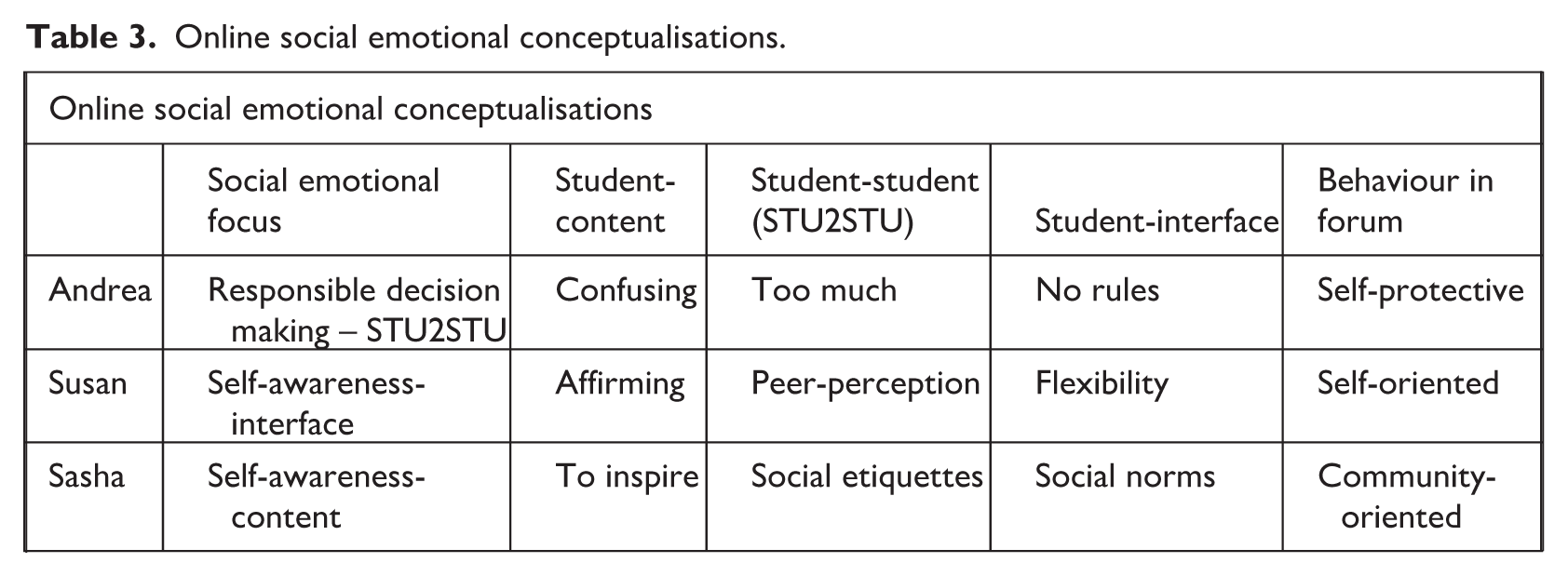
The first finding focuses on the student’s social and emotional behaviours in response to the content posted on the course forum. For Andrea the content was confusing; for Susan the content was affirming and for Sasha the content was to inspire others. In understanding these varying perceptions, it is not unusual, in an educational context, to check for understanding by looking at peer responses, however, the nature of the online asynchronous course forum amplified this process as there were many students (200+) posting content at varying times across the 6-week module as well as the fact that the given post remained recorded in the channel enabling continuous visualisation of a students’ task response. This study confirms Bakır-Yalçın and Usluel (2024) finding that once a student feels socially and emotionally connected and value the task, as in the case of Susan and Sasha, they are more likely to actively participate. The inverse is also true as in the case of Andrea, who did not feel this connection because the content confused her. This study provides further insight into the variations of what we are calling “engagement,” in that, for example Susan, who was feeling affirmed still “drew it back” that is, cautioned the content in her responses based on emotions because of the large numbers in the course forum indicating there is a need to look beyond students’ self-efficacy (Han et al., 2023) and value of task (Bakır-Yalçın & Usluel, 2024) to include implications associated to course design.
This leads to the second finding focused on the influence of the asynchronous interface. From Andreas’s perspective learning in a course forum meant no rules on how to engage; for Susan it meant flexibility with when and how she chose to engage; and for Sasha it meant that she must maintain social norms by thanking those who commented on her posts. These three perspectives were very different and emerged as emotional positions. There is evidence that flexibility within online course design especially using asynchronous tools supports greater student engagement (Stone et al., 2019; Sugden et al., 2021) but what this study adds to this concept of flexibility are the insights into the emotional link. Emotions associated with the opportunity to chunk learning can be empowering in the case of Susan but also dis-empowering and confusing as in the case of Andrea. The lack of structure in an asynchronous forum has been found in other studies to result in a lack of discussion (see Kimbrel, 2020) and in procastination (Han et al., 2023). The need to behave in a socially responsive manner as in the case of Sasha increased emotions resulting in no engagement or liking/thanking behaviours which have been found to be considered a less complex forms of cognitive engagement in asynchronous forums (Prestridge et al., 2023). This study provides a different perception of engagement that aligns to asynchronicity as a choice – to engage or not to engage – rather than considering a lack of engagement or delayed engagement as needing to be regulated (e.g. fixing procrastination see Han et al., 2023).
The third finding focuses on the students’ interactions within the forum as a social peer interaction space. For Andrea it was too much, as she needed immediate feedback that does not occur in these spaces, causing her to disengage; for Susan it was important to her that she received thoughtful comments from peers as her posts were representations of herself; and for Sasha it was about maintaining social etiquettes, such as liking others who liked you. Interestingly, not getting immediate feedback on your post by your peers created heightened emotions causing disengagement which was also found by Han et al. (2023) but in this study the reason for the disengagement can be attributed to an increase in feedback anxiety not time-management nor self-efficacy as found by Han et al. (2023). Immediacy, wait-time and validation by peer interaction within an anytime space is a complex dichotomy needing further examination for emotional engagement. In the case of Susan and Sasha, both students were considering peer interaction on the basis of the content of the post, for Sasha it was minimal likes but for Susan it needed to be constructive. The link to the complexity of the feedback-comment has been examined in online forums by both Burke et al. (2025) and Moni (2024). Burke et al. findings affirm that peer engagement can be shallow such as liking; while Moni’s (2024) research also evidenced the need for constructive feedback termed “feed-forward.” This study provides insights into the different emotional reasons for the types of peer interactions and feedback forms, that being, for personal representation and validation. However, both Burke and Moni’s research focuses on instructor prompts and feedback not directly student to student.
Table 3 provides as overview of the online social-emotional conceptualisations with resulting behaviours in the forum. These are presented as descriptive representations using interpreted labels based on the three cases. In examining how students conceptualise their social-emotional engagement when learning in an asynchronous forum, it seems that their behaviour to engage in particular ways is influenced by both their own social and emotional focus bounded within the digital learning space. The three students behaved differently, in that they were self-protective; self-oriented; or community-oriented. For Andrea her focus on making responsible decisions with peers, that is, making constructive choices for interactions was influenced by the asynchronous interface, that is, having no rules with the content to post confused her, resulting in self-protective behaviours of watching others posts more than posting or commenting herself. Susan was self-aware of the interactivity within the interface, examined peer contributions to ensure she was on the right track before posting when she wanted to (self-oriented behaviour). Finally, Sasha was also self-aware but focused on content and due to her conceptualisation of the forum as a social learning activity she needed to thank peers and was socially oriented (community-oriented). These three different conceptualisations of how students engage online through a social and emotional lens begins to explain the different behaviours that are enacted in this context.
Online social emotional conceptualisations.
Conclusions with Future Directions
This study sought to examine how students consider their emotional engagement in an online asynchronous course forum. As there is little research in this field it was important to develop a theoretical framework that combined emotional engagement with social online engagement theory. This new framework is a contribution to the field, but more importantly, it provided a device to examine how students consider their emotions in a social space, providing opportunity to understand the emotional reasoning for social learning behaviours. What has been uncovered is more about understanding the process of learning asynchronously than understanding how to get better results, or the effect of positive or negative emotions. This study was not oriented to the impact of online emotional engagement on assessment or cognitive outcomes. This study rather focused on the core process of learning online, that is, on student online engagement with content and peers within an online interface.
There are limitations to this study that need to be considered. Firstly, as this study used the interface as an element associated to the analytical framework, the use of Microsoft Teams, as the main platform limits generalisability. Secondly, the three students who self-selected for this study may consider their emotions as important aspects of asynchronous engagement. Even though three different ways of engagement were found based on emotions within a social forum, the three new conceptualisations cannot be considered the only representations of emotional engagement. These findings are representations of emotional engagements within this study’s course and cannot be tracked longitudinally.
There are implications for practice that can be considered. In course design, as the students did not choose to complete forum tasks weekly, consideration needs to be given to designing asynchronous activities within blocks or periods, enabling flexibility and choice for students to complete social learning interactions. In considering task completion or forum posts, perceptions that the more frequent a person posts means they are learning more. As indicated in this study, the social context and the interface impacted on how students were choosing to engage. This suggests reframing notions of number of posts as indicators of student learning to considering broader views on non-engagement. In considering temporal functions of asynchronous forums, students need for feedback as validation of their acceptance within the forum is evident for continued participation. Supporting students to give constructive feedback to each other rather than the instructor being the main responder aligns to networked learning.
What can be said of the findings signifies the individual nature of the learner and the amplification of action that occurs as a response to posting in social public spaces. Even though the students knew that it was a professional space, a learning space, that notion of being exposed and having yourself represented by a post resulted in three different types of behaviours – discontinuation, only post and socially responsive actions. More research is needed in this field of online learning from the student perspective. Understanding the emotional reasoning for learning behaviours that result in no-action (Andrea) for example, do not mean that learning is not occurring. Measures of action, such as counts of likes or posts, do not provide the full picture for online social learning. This study calls for more qualitative insights in understanding the reasons behind approaches to posts and comments, in understanding the strategic decision-making to engage in particular ways. Also, there is a need for examining more deeply the empowerment of flexibility in course design for students such as Susan and Sasha who chose when and how often to post across the 6 weeks. Insights such as these springboards off the conceptualisation that learning engagement does matter, especially dialogue in asynchronous forums, as a process of unpacking new concepts through many contributions. Considering that students disengage, choose to learn anytime and consider social etiquettes as important, students’ emotional engagement provides the key in helping us to understand social learning asynchronously.
Footnotes

Funding
The author received no financial support for the research, authorship/or publication of this article.
Declaration of Conflicting Interests
The author declared no potential conflicts of interest with respect to the research, authorship and/or publication of this article.