




Abstract
Despite the growing emphasis on peer feedback, its effectiveness and students’ perceptions remain uncertain. Therefore, it is essential to evaluate different feedback techniques to understand the strengths and limitations of each. This study aims to assess students’ perceptions and attitudes toward peer feedback, its impact on motivation and engagement, and their preferred feedback channels—text, video, or face-to-face interactions. The findings reveal that most students view peer feedback as beneficial to their learning process, with a strong preference for face-to-face feedback over text and video. This preference stems from the ability to seek immediate clarification, which enhances the feedback’s effectiveness and promotes a deeper understanding among students. Additionally, the survey results indicate that peer feedback fosters closer interactions among peers and boosts motivation and engagement in the learning process. A majority of students expressed a desire to continue receiving peer feedback in future courses.
Introduction
Feedback is a process where learners use information from various sources to enhance their work or learning strategies (Carless & Boud, 2018; Henderson et al., 2021; Ion et al., 2019; D. J. Nicol, 2021). For feedback to be effective, it must be informative, actionable, and encourage student reflection on strengths and areas for improvement. Effective feedback should be practical, engaging, and foster dialog between students and lecturers, with trust being crucial for meaningful interaction (Armengol-Asparó et al., 2022; Nicol & Macfarlane-Dick, 2006; N. E. Winstone & Boud, 2019). High-quality, timely formative feedback is essential for improving student learning, helping them identify strengths and weaknesses while enabling teachers to address learning difficulties promptly (Boud & Molloy, 2013; Henderson et al., 2019a; N. Winstone & Carless, 2020). Recent studies emphasize a shift from teacher-centered to learner-centered feedback, promoting learner autonomy and enhancing educational outcomes (Gould & Day, 2013; Henderson et al., 2019b; D. J. Nicol & McCallum, 2022).
Students have been repositioned as active learners dedicated to finding and using information regarding the quality of their work in the context of their studies, rather than passive consumers of instructors’ remarks about the quality of their previous work. Peer feedback helps students learn by allowing them to compare their performance with the work of their peers. Peer feedback can provide many benefits for student learning, including increased subject knowledge, feedback from various sources, constructive reflection, attention to detail, critical analysis, critical thinking, and improved work quality (D. J. Nicol & McCallum, 2022; Yu & Schunn, 2023). Peer feedback is a vital supplement to teacher feedback since it can improve students’ learning without adding to the instructor’s burden (D. Nicol et al., 2014). Despite the increasing focus on peer feedback strategy, the students’ perception of the effectiveness of the strategy is still not clearly understood (Huisman et al., 2019; McCarthy, 2017; Mishra et al., 2020). Hence, there is a need to evaluate different feedback channels utilised for formative assessment tasks to establish the affordances and limitations of each feedback type (Espasa et al., 2022; Li et al., 2020; Morris & Chikwa, 2016).
The objectives of this study are (1) To determine the students’ perceptions and attitudes toward peer feedback; (2) To determine how peer feedback influences the student’s motivation and engagement in the learning process; and (3) To determine the preferred type of peer feedback channel among text, video, and face-2-face interactions.
Methodology
Two cohorts of undergraduate students from two courses, namely CIV2263-Water Systems (43 students-Year 2) and CIV4288-Water Treatment (60 students-Year 4) in semester 1 and 2 in 2022 were asked to participate in this study. The students were asked to participate in the formative assessment task on their lab report assignment in CIV2263 unit and design project in CIV4288 unit, respectively. The students were asked to submit their assignment works to the shared folder, and each student was assigned to provide peer feedback on another peer’s assignment/report. The peers remained the same throughout the semester, and the educator randomly allocated them. They must provide all types of feedback (written, video, and face-to-face). The feedback contents are the same for each feedback channel. The students provided video feedback in a recording. The duration of video feedback varies from 3 to 10 min, depending on the number of feedbacks provided by the students for their peers. Explicit assessment criteria for the assignment/project were provided to students in classes CIV2263 and CIV4288, and they needed to provide constructive feedback to their peers for improvement. Some guidelines are provided to the students on how to give constructive feedback. A group discussion was also set up in class so that the students could verbally provide comments and suggestions to their peers. The students were not required to grade their peers during these peer feedback tasks. After the final submission of assignments/projects, the students were asked to evaluate this peer feedback approach (online and in-class) through an online survey. The survey questions used in this study are adopted from the Beliefs about Peer-feedback Questionnaire (BPFQ) developed by Huisman et al. (2019). The BPFQ covered four themes derived from the existing empirical research literature and expectancy-value theory. The survey questionnaire included demographic info (gender, local or international student, and grades) and questions such as perceived usefulness of peer feedback methods, willingness to participate in this peer feedback task, evaluating the quality and frequency of feedback and interaction between peers. The students provided their responses in the survey through the Likert-type scale statements. Two open-ended questions were asked to the students to collect qualitative responses on their perception and attitude toward peer feedback as an instructional strategy. The sample of survey questions is included as a Supplemental Material to the article. This study was approved by the Monash University Human Research Ethics Committee (project ID: 32485).
The survey results were analyzed using SPSS statistical software. The Student t-tests were performed to determine any significant differences between Sem 1 and Sem 2 of the survey data. Two-way ANOVA tests were executed to examine the effects of three peer feedback channels (text, video, and face-2-face) on student’s motivation and engagement in the learning process.
Results and discussion
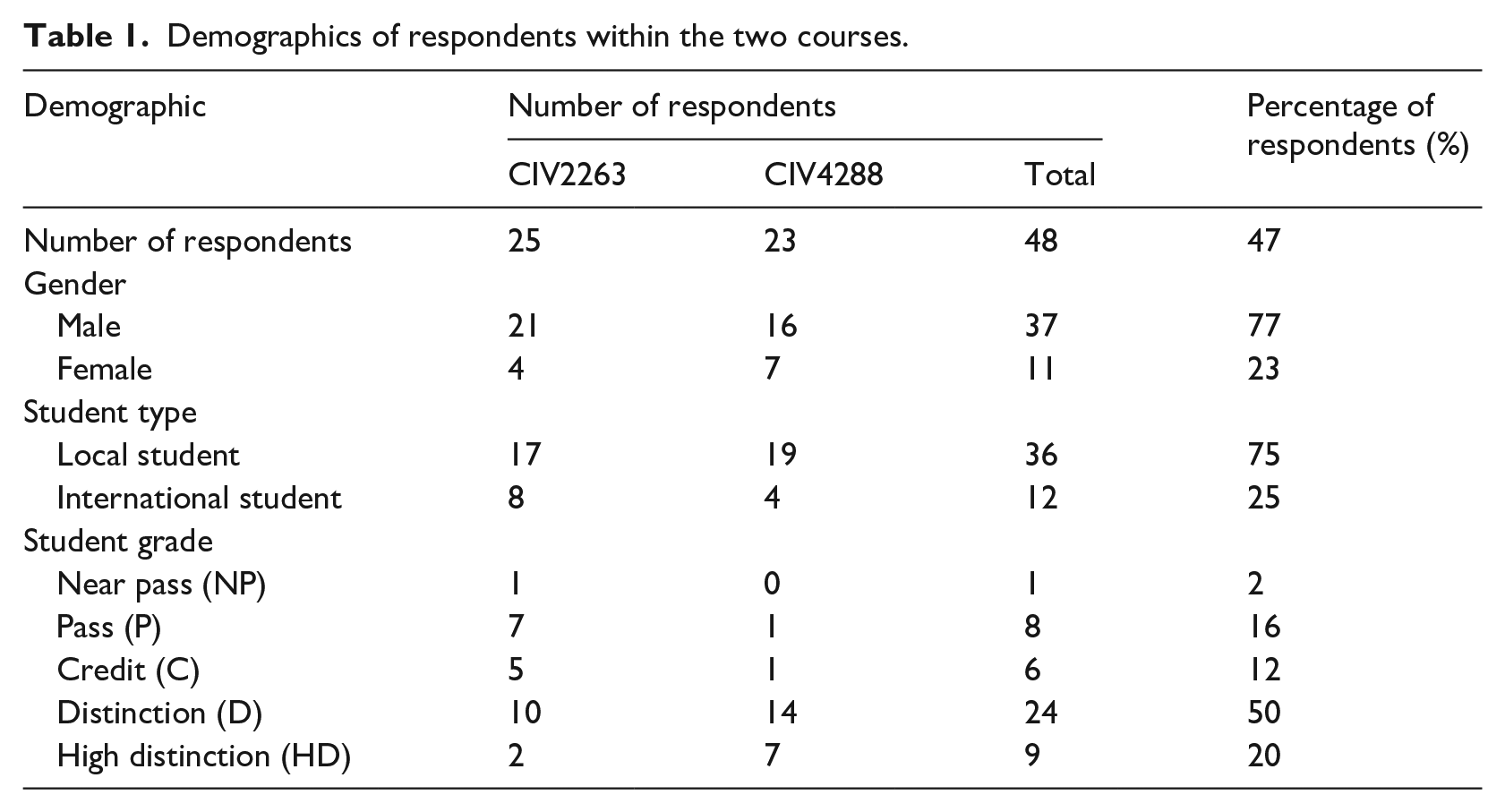
In this study, surveys were distributed to 103 students, and 48 of them completed the surveys, resulting in a response rate of 47%. Among the 48 survey participants, 84% identified as male, while the remaining 16% identified as female. Within the group of respondents, 75% were local students and 25% were international students. The respondent’s cumulative grade point average (CGPA) ranges from 2% of NP (1.16–1.70), 16% of P (1.71–2.15), 12% of C (2.16–2.85), 50% of D (2.86–3.67), and 20% of HD (3.68–4.00). The demographic statistics of the survey respondents are presented in Table 1.
Demographics of respondents within the two courses.
The student t-test results indicated no statistically significant difference between the means of the two cohorts. Therefore, the survey results from both cohorts can be analyzed together. The students’ perspective and attitudes toward peer feedback practices is presented in Table 2. The research findings reveal that most students believe peer feedback is beneficial to their learning process. In all, 76% of total respondents agreed that involving students in feedback through the use of peer feedback activity is meaningful. A similar finding was reported by Mishra et al. (2020) that the students benefit from participating in peer feedback. In the study by Andersson and Weurlander (2019), students expressed that peer feedback provided a positive learning experience and gained new insights from the opportunity to review others’ reports. The results also indicated that the peer feedback practice influenced the students’ motivation and engagement in the learning process. When asked whether feedback should only be provided by the teaching staff, only 36% of respondents agreed with this statement. The survey results also revealed that 80% of respondents found this peer feedback activity promoted closer interaction with their peers. About 64% of respondents would like to receive feedback from their peers again, and 76% would like to receive feedback from multiple peers in future courses. In general, the students expressed a positive attitude toward peer feedback practice in their learning process.
Mean response and agreement rate related to student’s perception and attitude toward peer feedback.
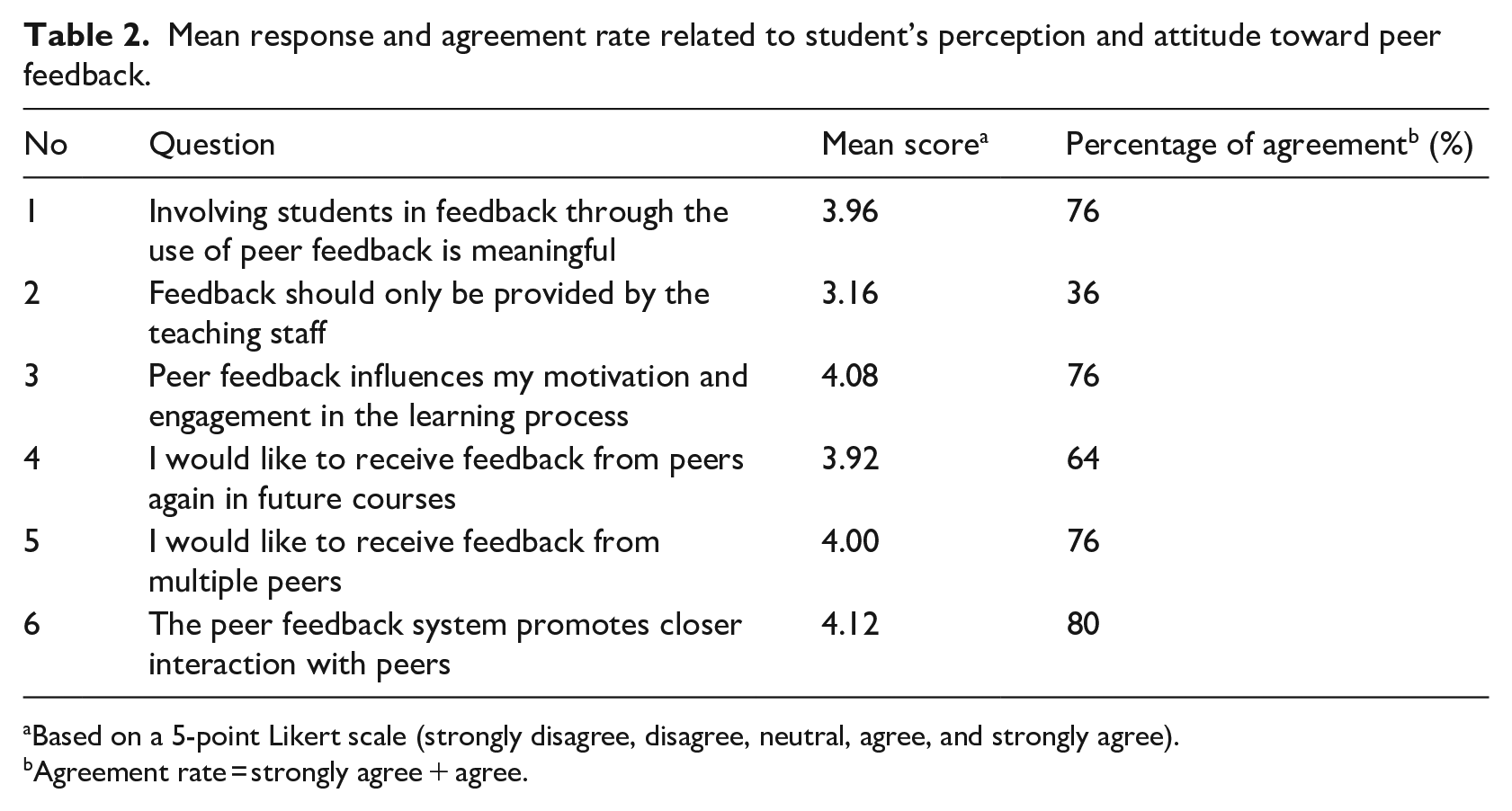
Based on a 5-point Likert scale (strongly disagree, disagree, neutral, agree, and strongly agree).
Agreement rate = strongly agree + agree.
The students were also asked to express their confidence in their own ability to provide feedback and their peers’ competence in offering useful feedback. Based on the findings presented in Table 3, it appears that 72% of respondents expressed confidence in the quality of the feedback they provided to their peers, with 68% agreeing that this feedback would aid their peers in improving their work. However, only 56% of respondents expressed confidence in the quality of the feedback they received from their peers. Nevertheless, 68% of respondents agreed that the feedback received would contribute to enhancing their work. Regarding the skills necessary for peer feedback, a significant majority (92% and 88%) agreed that providing constructive feedback and handling critical feedback is important. Moreover, over 90% of respondents indicated that learning from peer feedback to enhance their work is crucial. In terms of timing, 72% of respondents emphasized the importance of providing and receiving feedback as promptly as possible. An assessment rubric is also necessary for completing the peer feedback task, as indicated by 4.00 of mean score and 80% of agreement rate.
Results on competency and confident on providing and receiving good quality peer feedbacks.
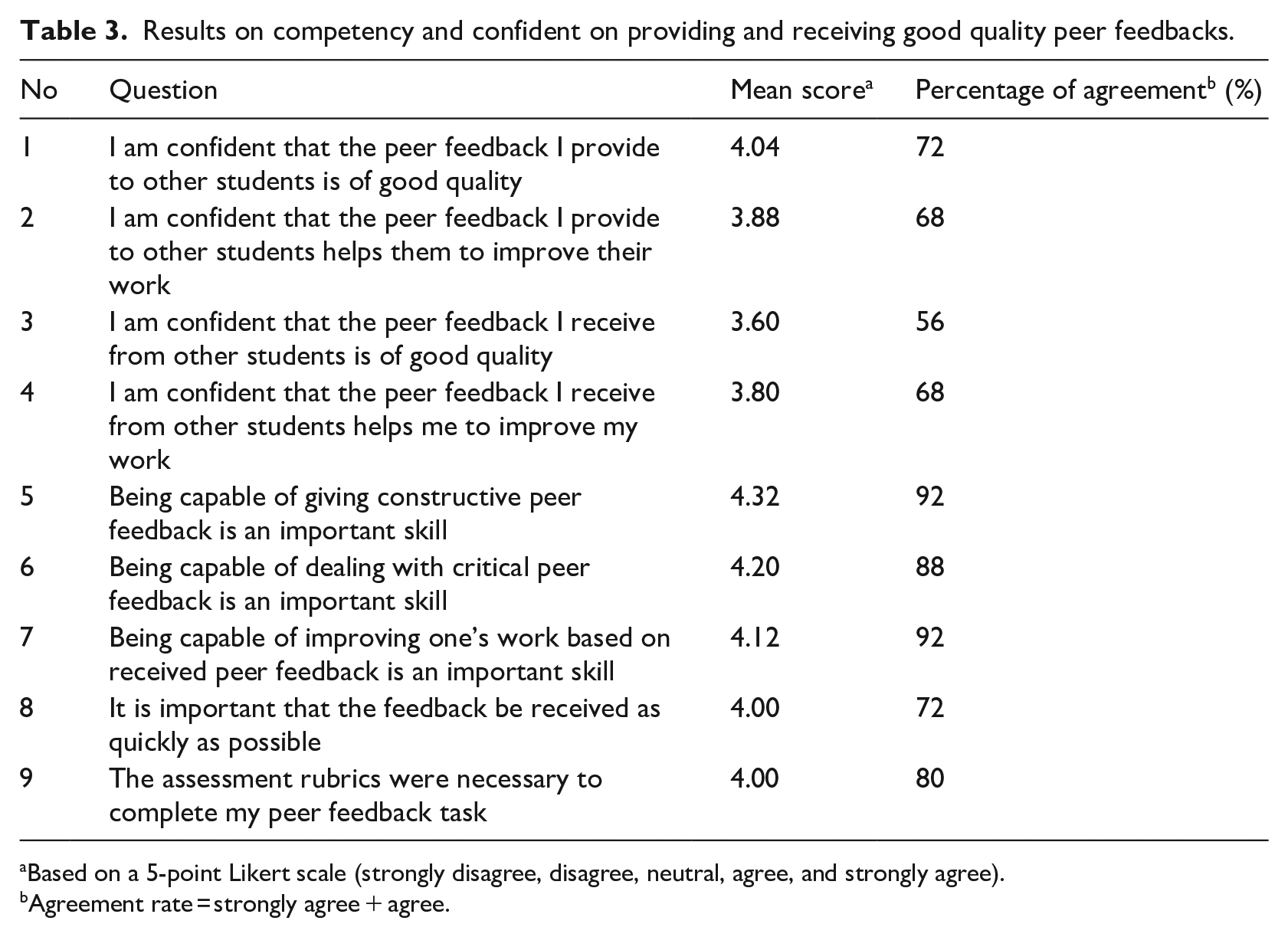
Based on a 5-point Likert scale (strongly disagree, disagree, neutral, agree, and strongly agree).
Agreement rate = strongly agree + agree.
In this study, the students were asked about the preferred format of peer feedback that is beneficial to improve their work. According to the results presented in Figure 1, 87% of students preferred to receive peer feedback through face-to-face communication in the class session. This preference stems from the fact that students can immediately seek additional clarification from their peers following feedback. This real-time interaction improves the feedback process’s effectiveness and fosters a deeper understanding of the feedback among students. This preference is also evident through the survey result that 74% of respondents were comfortable providing face-to-face feedback to their peers. On the other hand, 74% indicated that they received beneficial feedback from peers through written text. Peer feedback in video format is the least preferred format as shown in Figure 1. The ANOVA analysis results indicated that there were significant differences in preferred feedback format and significant differences between the means of the groups (on a scale of 1–5, a mean score of 3.30 ± 0.97 for video feedback, 3.782 ± 0.80 for written text feedback, and 4.26 ± 0.92 for face-2-face feedback; F = 6.525, p = 0.003).
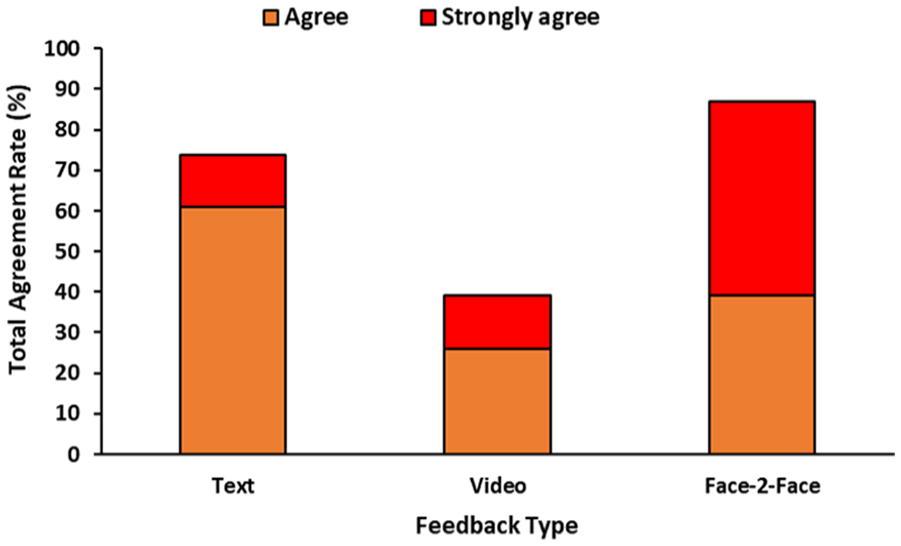
Total agreement rate of each received feedback type.
A sample of typical comments made by students for the opened question on which feedback channel (text, video, or face-to-face) makes feedback more useful and facilitates its implementation is presented below:
Text makes feedback useful. This is because the feedback was listed down clear and nice, easier for students to understand. Meanwhile, due to the accent from different students and the low quality of the video, the face to face and video made the feedback process hard to communicate and understand.
Face to face is useful in my opinion. This is because it is less time consuming without the issue of Video lagging, or going back and forth during text. Also, peers are able to draw, make notes, etc, freely whatever is required to answer any question that might arise on the spot. The one who is receiving the feedback too can also ask any questions on the spot without any delay of communication.
Text is more efficient, you can say what you want easily. Face-to-face may be awkward for shy students. Video might have internet connection problems.
Face to face gives additional closure between participants, additional sense of responsibility to give accurate response
Text is fine, but face to face will definitely be better as any questions can be asked instantly without any confusion.
Face-to-face as it allows us to directly convey our message in a clear manner. Peer feedback through texts and videos can be interpreted wrongly by the person on the other end.
A sample of typical comments made by students for the opened question on what they liked or disliked, about this peer feedback system is presented below:
Like: know which part of the report that can be improved; Dislike: need both parties to be active in this system.
Sometimes the feedback is not correct, need to confirm all the comments before make the correction
It allows us to review other group works and we have learnt a lot from the peer. It enhances the learning experience.
Liked: This feedback helps me to check on my work so that it meets all the requirement in the rubric.; Unliked: Reviewing others’ work may be time consuming if the work is not done properly
Peer feedback could also demotivate others when the feedback is negative or not necessarily what the students expect from their peers.
I liked the engagement. Regardless of whether the feedback is helpful or not, it make one think and be more clearer on one’s concept.
Students expressed the least preference for video peer feedback, which does not align with the findings of Espasa et al. (2022). They found that video feedback from instructors was well-received by students, as it fostered a stronger sense of connection with their lecturers. This preference may stem from students’ comfort with face-to-face interactions. Conversely, our study revealed that students were least receptive to video peer feedback, possibly because of challenges in their communication abilities when offering effective feedback to their peers. Technical issues associated with video feedback may outweigh its advantages, potentially reducing its effectiveness, as indicated in the study by Li et al. (2020). McCarthy (2017) found that while some students favored in-class interaction for its directness, others preferred online interaction due to social inhibitions and language barriers. Hence, this study suggests that creating flexible learning environments will facilitate more vital interaction among students in large classes, as it accommodates a wide range of student attitudes.
Conclusion
This study provides critical insights into the role of peer feedback in enhancing student learning, motivation, and engagement, as well as their preferred feedback channels—text, video, or face-to-face interactions. Our comprehensive evaluation of student perceptions highlights the significant value of peer feedback, with a clear preference for face-to-face interactions. This feedback mode not only allows for immediate clarification but also strengthens peer connections, leading to increased motivation and deeper engagement in the learning process. The strong preference for face-to-face feedback underscores the need for educational strategies that prioritize direct communication, especially in fostering collaborative learning environments. Furthermore, the widespread student interest in continuing peer feedback in future courses reaffirms its effectiveness and relevance in contemporary education. These findings have important implications for curriculum design, suggesting that integrating structured peer feedback, particularly through face-to-face channels, can greatly enhance educational outcomes.
Supplemental Material
sj-docx-1-alh-10.1177_14697874241301263 – Supplemental material for Understanding student perspectives on peer feedback: Written versus video versus face-to-face dialog
Supplemental material, sj-docx-1-alh-10.1177_14697874241301263 for Understanding student perspectives on peer feedback: Written versus video versus face-to-face dialog by Ming Fai Chow in Active Learning in Higher Education
Footnotes
Declaration of conflicting interests
The author declared no potential conflicts of interest with respect to the research, authorship, and/or publication of this article.
Funding
The author disclosed receipt of the following financial support for the research, authorship, and/or publication of this article: This work was supported by the Monash University Malaysia (MUM) Learning & Teaching Grant Scheme 2022 (STG-000102).

Supplemental material
Supplemental material for this article is available online.
Author biography
References
Supplementary Material
Please find the following supplemental material available below.
For Open Access articles published under a Creative Commons License, all supplemental material carries the same license as the article it is associated with.
For non-Open Access articles published, all supplemental material carries a non-exclusive license, and permission requests for re-use of supplemental material or any part of supplemental material shall be sent directly to the copyright owner as specified in the copyright notice associated with the article.
