




Abstract
I investigate the material characteristics and spatial contexts of saltpans in two of antiquity’s most successful empires—Rome and Han China. Production strategies made salt widely available but were distinct in their form and appearance, as well as process. Rome’s infrastructure was less visually imposing and environmentally disruptive compared to the Han installations, which were made to stand out and overtake natural contexts. Born from its sites of production, salt had a different social role and political value in these empires.
Framing the material comparison
The efforts empires have made to control and market salt have stretched from ancient times to the modern day (Braudel, 1995; Hocquet, 2012; Kurlansky, 2002). As a commodity, salt was indispensable in both ancient Rome and Han China, with profound infrastructural investment made across each empire to augment production, a commonality worth probing deeper. While no history is precisely the same, a comparative approach can help amplify our knowledge of each case by destabilizing assumptions and bolstering interpretations (Scheidel, 2018: 42; Sivin, 2018). Archaeological studies have explored cross-cultural comparisons to theorize the human relationship to the material world (Meskell and Joyce, 2003). The material markers of salt production can reveal how Romans and Han Chinese related to and manipulated their environments to achieve this prized resource as part of a continuum from origin point to table.
Scholars have investigated the social role of salt (Chen, 2018; Traina, 1994), with discussion of this commodity central to political and social debates. In Han China, the Confucians lamented that the salt monopoly, in enabling broad accessibility to salt across social classes, detached it from its previous elite networks of distribution and status-making (Discourses, chapter I, l and II, b, Gale (trans.), 1931). In Rome, “salt and bean” friends were those so close and longstanding that they would not refuse such an unpretentious meal (Plutarch, Quaest. conv. 5.10.1 [684]). Pliny the Elder marked salt as central to civilized life, with sal used metaphorically for wit (HN XXXI.41.88). In other words, salt was a topic through which the elite in both empires made sense of social interactions and hierarchies.
Archaeological research has detailed salt-producing infrastructure, even relying on comparative approaches to decipher similarities in technology. Such work has been interested in predominantly economic questions (Carusi, 2008; Hoët-van Cauwenberghe et al., 2020; Li and von Falkenhausen, 2010; Marzano, 2013). However, the social impact of salt-making on ancient societies is little explored (Beltran, 2014). Salt undergoing production was limitedly observed and recorded in ancient texts, providing a starting point for discussion. Rutilius Claudius Namatianus, in his fifth c. CE de Reditu Suo (485-486), described the appearance of salt in evaporation pans at Vada Volterrana, in Tuscany, as “no different than when the bristling Danube bears large carts on its frozen course,” i.e., like ice. In China’s fifth c. CE Qi dynasty, Zhang Rong, assigned to a new post in Jiaozhu, composed Rhapsody of the Sea and described the sight of salt as “Heaped up snow in midst of spring/Flying frost on summer roads” (translation by Vogel, 2010). In the context of production, salt was like ice and snow, appearing season-bending. Commonalities might have arisen across contexts, born of the product’s characteristics or the desire, in an imperial context, to produce salt at scale. However, none of the material traces were pre-determined, required, or obvious; they were choices enacted for a desired outcome. How might salt production infrastructure have initiated the conversation around salt’s role in these imperial societies as an everyday commodity and symbol?
Through closely reading salt installations in their environmental contexts, I situate salt production into broader discourses of meaning that brought salt into circulation, communicating relevant values and meanings in these empires. A picture emerges in which salt production in Rome appears more integrated, environmentally and temporally, in its landscape, calling into question attitudes linking environmental dominance and imperialism. In the Han Chinese case, it appears as an extraneous force, following its own timelines, contributing to the complexity of the monopoly as an institution. Salt was widely available in both empires, but its infrastructure had divergent discursive influence.
Salt and empire: theorizing an infrastructure of production
To extract salt from its naturally occurring contexts and make it edible required the adaptation of salt-rich sites into distinct and specialized loci of production. In the empires discussed here, a considerable investment of both labor and resources transformed environments with intricate material culture to amplify the output. Infrastructure is a tool, intentionally constructed, materially complex, and often at scale, to enable, manipulate, and augment human activity. In this intricacy, infrastructure opens itself up to additional meanings and interpretations beyond its function. While examples exist of overt political, symbolic, or social motivations imbuing infrastructural projects (Larkin, 2013), all infrastructures can communicate multiple intentions, however simple or banal they might seem. Wilkinson (2018: 1222) notes infrastructure’s role in managing “things, resources, and waste,” while Larkin (2013: 327) focuses on infrastructure’s networking properties “that facilitate the flow of goods, people, or ideas and allow for their exchange over space.” Therefore, infrastructure is a material mediator between people and between people and their environments.
Within these empires, salt infrastructure was not sui generis, but built on a long history and material patrimony to produce a resource valuable politically, economically, and socially. Scholarship for each empire has independently underscored the significant role access to salt played in state formation: in the Bronze and Iron Ages in Latium and along the Tiber River, where the potent city-state of Rome emerged (Coarelli, 1988; Giovannini, 1978), and in China, in the Sichuan region, where merchant networks linked nascent polities, providing the underpinnings of trading and economic networks for the subsequent Qin and Han (Flad, 2011: 220-230). These emergent states, it is important to note, shared early technologies of salt-making. Briquetage has been attested archaeologically in both coastal and inland locations by its characteristic “trash”: conical or rectangular terracotta molds in which brine was boiled, leaving behind salt (Alessandri et al., 2024; Chen, 2013; Li et al., 2003; Sun and Zeng, 2006: 299-301). The single-use containers employed were made beforehand, creating extra steps to production and calling on more resources for the desired salt.
My chronological focus spans the first c. BCE-first c. CE, when archaeological data has registered new modes of salt production engendered by the political and economic circumstances created by each empire, making its development and dissemination possible. For instance, the abandonment of briquetage technology often marks the separation between the Qin and Han empires (Chen, 2013, 2018; Flad, 2011: 168), even if both were invested in controlling salt distribution. The chronology of Rome’s installations also runs parallel with economic expansion of the Late Republic and early empire (Hopkins, 1980). However, each case presented its own bureaucratic complexity for control and revenue generation.
In Rome, coordination had local interests parallel to imperial bureaucracy (Carusi, 2008: 199-201). Inscription evidence has refined this picture, supporting that most salt infrastructure in Rome’s empire was largely privately or civically/municipally owned (Marzano, 2024: 6; Lowe, 2018: 475). Few are the exceptions that have contributed to a picture of a state-run industry: the pans at Ostia, the capital’s port, were deemed public goods, run by conductores, managers who held contracts with the state and whose product was taxed (Cébeillac-Gervaisoni and Morelli, 2014). A hyper-connected empire provided favorable marketing conditions for many goods beyond salt (olive oil, wine, etc.), fostering private production (Jongman, 2007).
In Han China, instead, the narrative is dominated by accounts of the state-run monopoly, which by 186 BCE was already taxing private salt producers on one-sixth of their revenue to enrich the emperor’s personal coffers (shaofu) (bamboo slips from Zhangjiashan, Chen, 2018: 108). Only after 119 BCE, having faced a revolt and needing revenue (Chen, 2018; Luo and Luo, 1995), was the monopoly established along with local administrative (commandery) offices, coordinating the extraction, quantification, and distribution of salt. Lewis notes that at this time, income from the salt and iron monopolies went to the Ministry of Agriculture, whose funds were considered public and financed the army (Lewis, 2015: 288). Former merchants were still responsible for salt production, served as administrators within the monopoly, and were required to sell salt to the state for its resale (Yü, 1967: 16-19; Sadao, 1986; Lewis, 2015). However, the monopoly was not a static institution. Historical sources demonstrate moments of more stringent state controls and moments of slackening (Barbieri-Low, 2001: 78; Yü, 1967: 20-21). By the late first c. CE, under the Eastern Han, the monopoly was formally abolished, leaving local commanderies to manage the collection and circulation of salt (Lewis, 2015: 288).
Therefore, production was not solely in the hands of the state, and resultingly, not every infrastructure was purely public. This is noted with other imperial infrastructures. In Rome, baths employed a similar technology, whether built by the state or private investors, facilitating a similar ambiance. For instance, the urban estate of Julia Felix at Pompeii had baths materially similar in layout and technology to the public baths, while affording public access (Kolowski-Ostrow, 2007: 237-238). While the iron monopoly in Han China manufactured and sold the majority of iron tools, in some peripheral places, private sector production continued, often resulting in higher-quality products (Lewis, 2015: 288; Lam, 2023: 119-120). Privately run infrastructure did not discourage construction at scale or the deployment of specific formal properties or visual cues, which would have linked them to broader imperial material discourses. Modern case studies also remind us that infrastructures could be coordinated from below through political and social connections (Anand, 2011; Elyachar, 2010). Rather, the networks of production and dissemination of salt meant that public and private interests were inextricably linked.
Contexts for salt production
When designed to modify, exploit, control, or transcend spaces or resources considered “natural,” infrastructure plays a critical role in mediating the relationship between people and their environments (Cosgrove, 1998 [1984]; Tilley, 1994; Rogers, 2013). Salt, as a prized and necessary resource, insisted that myriad natural contexts be exploited for its production and incorporated into imperial networks.
At its greatest extent, the Roman empire spanned numerous micro-ecologies from western Asia to the Atlantic, from the edges of the Sahara to the northern reaches of temperate Europe, encompassing many and diverse sites for salt production (Figure 1). Pliny the Elder (HN XXXI.29.73-83) distinguishes between naturally occurring and artificial salt. His narrative gravitates to natural wonders and “exceptional” features in the empire to provide an image of heterogeneity and uniqueness, to amplify Rome’s greatness (Murphy, 2004). The encrustation of salty lake water, especially as found at Tarentum in Southern Italy and Cocanicus in Sicily, both described as mirabile (“wondrous”), underline its spontaneous occurrence and the seeming uniqueness of these sites. Pliny details the specific practice in Germania and Gallia of pouring brine on burning logs, and the boiling of well-brine, requiring fuel. The latter has been archaeologically attested, its floruit and technological advancement linked to the economic infusion caused by the Roman military on the frontier (Dekoninck and De Clercq, 2022). Map of the Western Roman empire with relevant places and regions.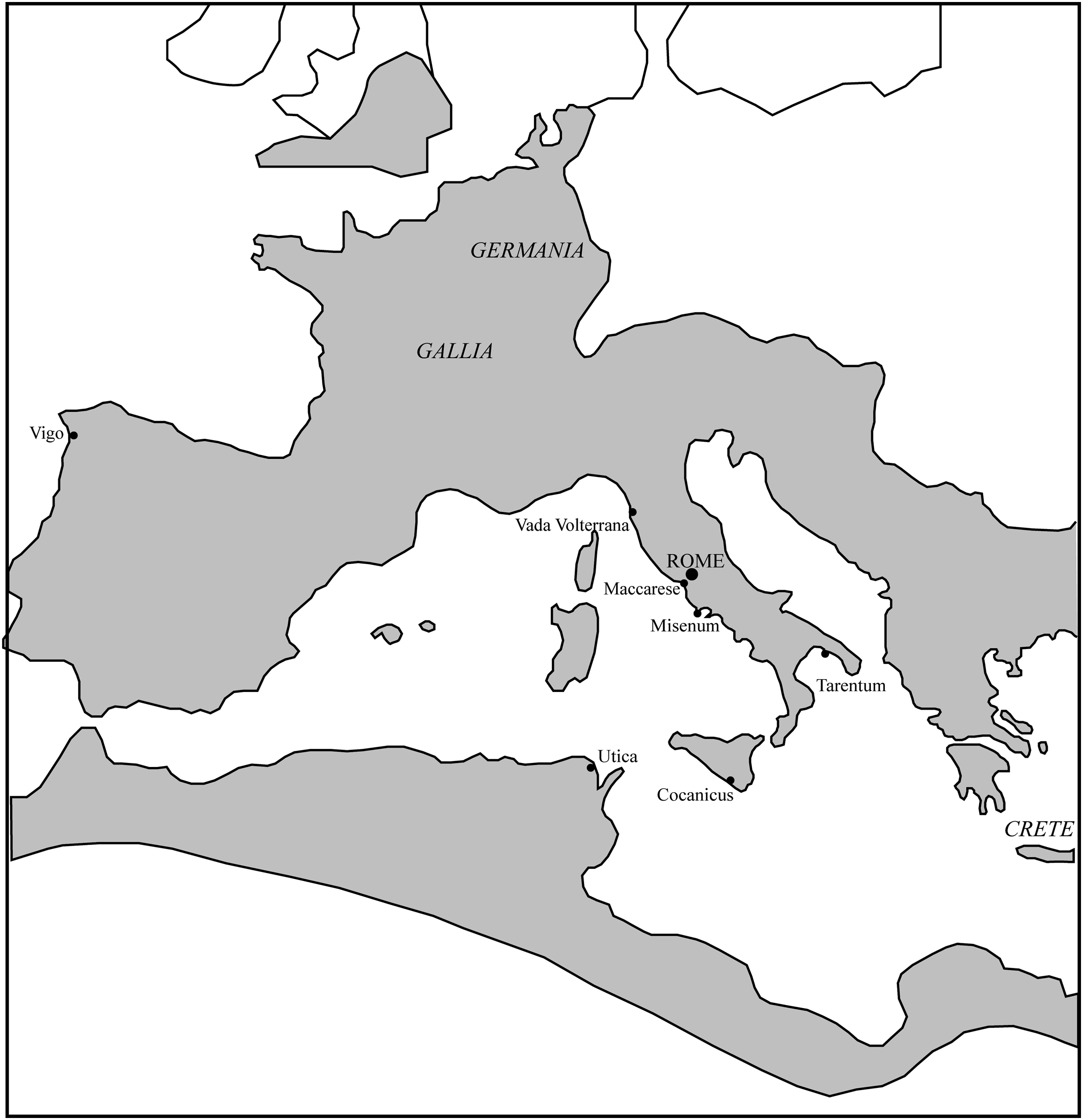
However, one strategy was most prevalent in the empire as a whole: managed solar evaporation of seawater. Pliny only cites two examples, on Crete and at Utica, where a mountain of salt attesting its remarkable output was visible from the sea. Although references to Italian production sites are absent in his narrative (Morère Molinaro, 2008: 370), Pliny would have been aware of this technology’s role and extensiveness, especially given his military post at Misenum, not far from Pompeii’s saltpans (Columella Rust. 10.135).
Opportunities to develop salt-making infrastructure along the extensive coastlines of the Mediterranean were numerous, with its inlets and lagoons concentrating salt water (Grisonic, 2022; Guarnieri, 2021). Coupled with the hot and sun-drenched summers of the Mediterranean, the preference for evaporative technology is not surprising, and archaeological evidence for its prevalence has been growing. It seems even to have spread with Roman contact to the Atlantic Ocean (Currás, 2017: 326, Figure 1), the Black (Carusi, 2008: 70-79) and Red Seas (Breton, 2021), and even the English Fens (Crowson, 2001). Salt probably found further customers inland from these coastal and marsh-bound installations (Carusi, 2008: 248-253). Civic management would have likely encompassed salt production, fish-salting (Lowe, 2018; Marzano, 2013), and port infrastructure in Roman coastal towns, interconnected material and infrastructural modifications.
Conversely, the Han empire operated within different geographical and ecological circumstances, largely land-bound. Once consolidated, it stretched from the Mongolian steppe to the Pacific Ocean and the South China Sea (Figure 2). The best evidence for the extent of salt-making comes from the Book of Han, completed in 111 CE, which recorded the 43 salt commanderies throughout the empire, each associated with at least one site of production (Luo and Luo, 1995; Barbieri-Low, 2001: 80, Figure 5). Nineteen were situated on the coast, where salt water was the source of brine, concentrated in Shandong province, near the Bay of Laizhou. Other sites were in the interior, in the north-northwest at Shanxi, Shaanxi, Gansu, near to the capital Chang’an, known for naturally evaporating lake salt. The Sichuan region, though on the periphery, has consistent and ample material evidence of salt-making, from the prehistoric period to the present. The Han monopoly registered five commanderies and its capital at Chengdu, marking its central role. Map of the Han empire with relevant places and regions.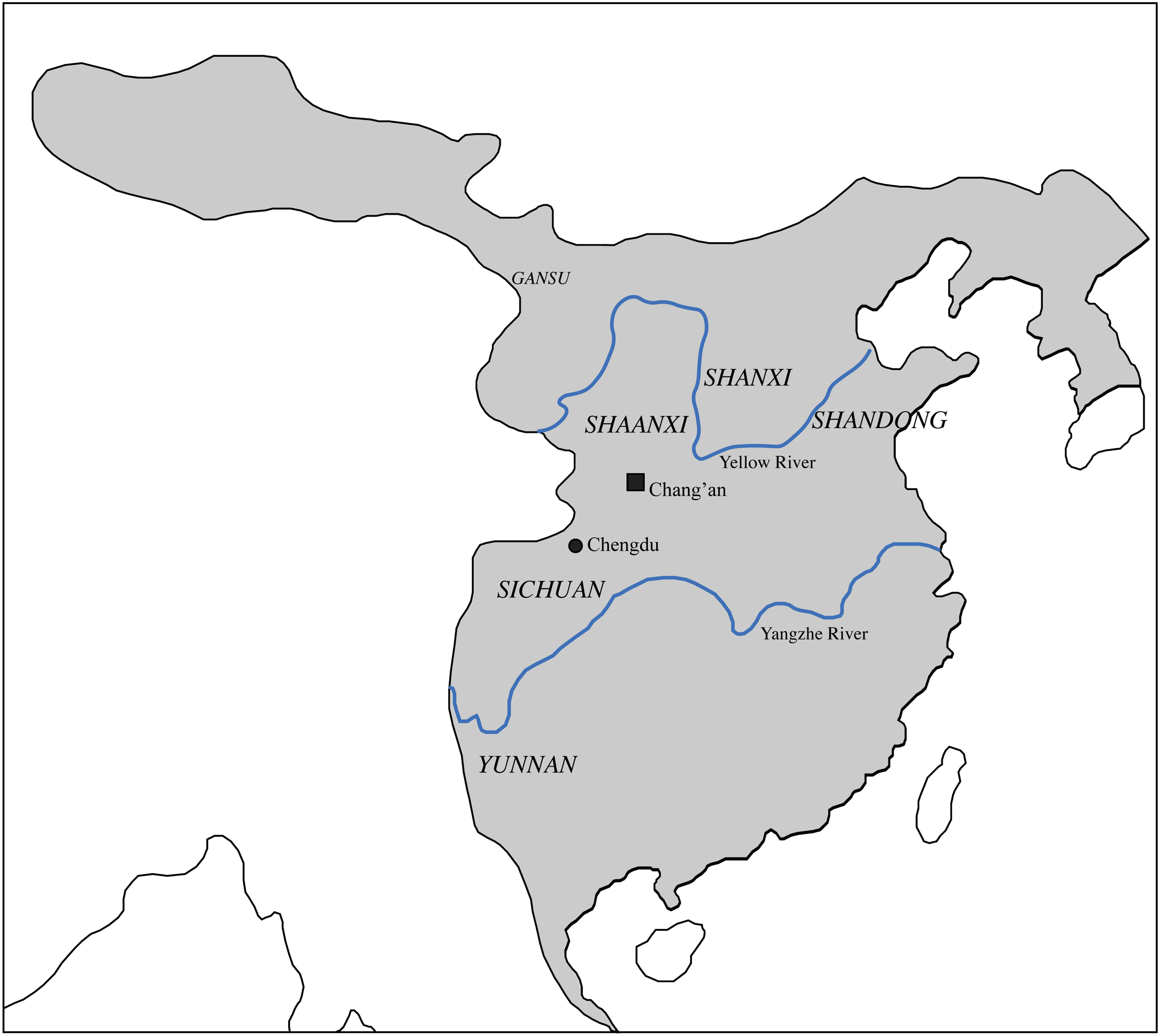
Juxtaposing these circumscribed zones for production to the vast regions in the central and southern empire with little evidence of the salt bureaucracy, the state’s close involvement in its production is understandable and was pursued by each subsequent pre-modern imperial dynasty (Lewis, 2015: 288). It made a coordinated program and a repository of local manufacturers immediately available and recognizable. Conversely, the extent of Rome’s coastlines was immense. To manage their full extent, and each singular site of salt production, from small pools to coastal villas to small towns, made a broader bureaucracy limitedly feasible, if not potentially undesirable.
Materials for making landscapes
Infrastructures call for the confluence of myriad material ingredients to operate as intended, amplifying their complexity (Wilkinson, 2018: 1223). For instance, a port must unite diverse structures to block sea swells, dock ships, disembark goods, and link sea to land. Even in infrastructures that appear uniform materially, like roads, dams, or storage sheds, interconnecting materials and forms (usually unseen) create the desired outcomes. The intricacy of salt infrastructure in Rome and Han China is apparent in a close reading of the materials involved and coordinated across space, opening it up to meanings and interpretations beyond its function. These materials, situated in the environmental contexts described above, inform how infrastructure was not only of places, but was also active in creating them (Knapp, 1999). As the origin sites for salt, they were linked to certain visual cues and effects.
Rome’s evaporative infrastructure
Two excavated salt production sites, one from the center of the empire and one from its periphery, have provided rich material evidence of evaporative saltpans: the Stagno Maccarese, a coastal zone at the mouth of the Tiber, near Portus and Ostia (Grossi et al., 2015), and O Areal, located at the western limit of empire at Vigo, in the northwestern Iberian Peninsula (Currás, 2017). First appearing around the first c. CE, these saltpans were used for at least two centuries, providing chronological consistency (Grossi et al., 2015: 97; Currás, 2017: 333).
These installations were close to the coast, to enable saltwater to be delivered into the system. Maccarese’s coastline faced the Tyrrhenian Sea, bounded by the Tiber estuary at its south. At Vigo, paleoenvironmental reconstructions have detailed its siting on a salt lagoon that moderated the ocean’s stronger currents (Currás, 2017: 327). Touching the shore, these saltworks trapped and held water so that over the cycle of production evaporation might occur, leaving salt behind.
Breaker walls were the bulwark of these systems, enabling water management. At Maccarese, hundreds of re-used transport amphorae stretched at least 1000 m to form a barrier: their necks and shoulders lopped off, their pointed feet twisted into the sandy soil (Grossi et al., 2015: 92). In spots, they were doubled up to create a stronger stop for water. Although amphorae had long been recycled for building projects in Ostia and Rome, to lighten vaults, make drains, and pave floors (Peña, 2007: 170-192; Lancaster, 2005), in this coastal context, they were the first line of approach. They dually encapsulated Ostia’s contributions to the coastal economy. Once arriving by sea, they were repurposed and positioned to meet the sea for salt-making. O Areal also worked with the gradient of the coast to bring water into the system. The first row of largest basins, situated quite close to the coastline, relied on the shifting tides of the Atlantic Ocean to fill them with water (Currás, 2017: 343). The building of this installation required significant effort to shape the landscape, from the movement of earth to the laying of stone to form the basins. In both cases, knowledge of the natural coastline and its cyclical relationship with water was mediated by precisely positioned material culture that was low-lying but could take control of this unruly resource.
Channels and basins moved and contained water, respectively. At Maccarese, walled channels, excavated perpendicular to the amphora dam, were reinforced by tufa stone and tile bound with concrete (Grossi et al., 2015: 94). In certain instances, the incorporation of sluices made of concrete and travertine blocks would have controlled water flow into the system. The materials used here were the same as those employed in monumental building in Rome and its hinterland. A cumulative total of about 600 meters of channels have been uncovered to produce large rectangular basins both to contain and facilitate the movement of water (Figure 3). Only a fraction of this installation was exposed. Still, the size of these channels, coupled with the length of the amphora dam, leaves open the possibility of a structure more than three times the length. The authors record a downward slope in this area, perhaps naturally conditioned, from west (the coastline) to east (inland), that allowed gravity to move water from the larger, deeper pans to the smaller, shallower ones, increasingly salty through evaporation as it moved through this process. Vertically planted wooden poles probably reinforced the edges of the ground channels to help contain the water so that it might be stationary to absorb the sun’s heat (Grossi et al., 2015: 95-96). Basin floors were lined with soil/clay deposits. Taken together, the cutting and building produced an interconnected and interwoven system that modified and regimented the marsh’s appearance, underlying its extent with regularized and predictable channels. Plans of the saltpans from Maccarese and Vigo, adapted from Grossi et al., 2015: Figure 5 and Currás, 2017: Figures 4 and 5.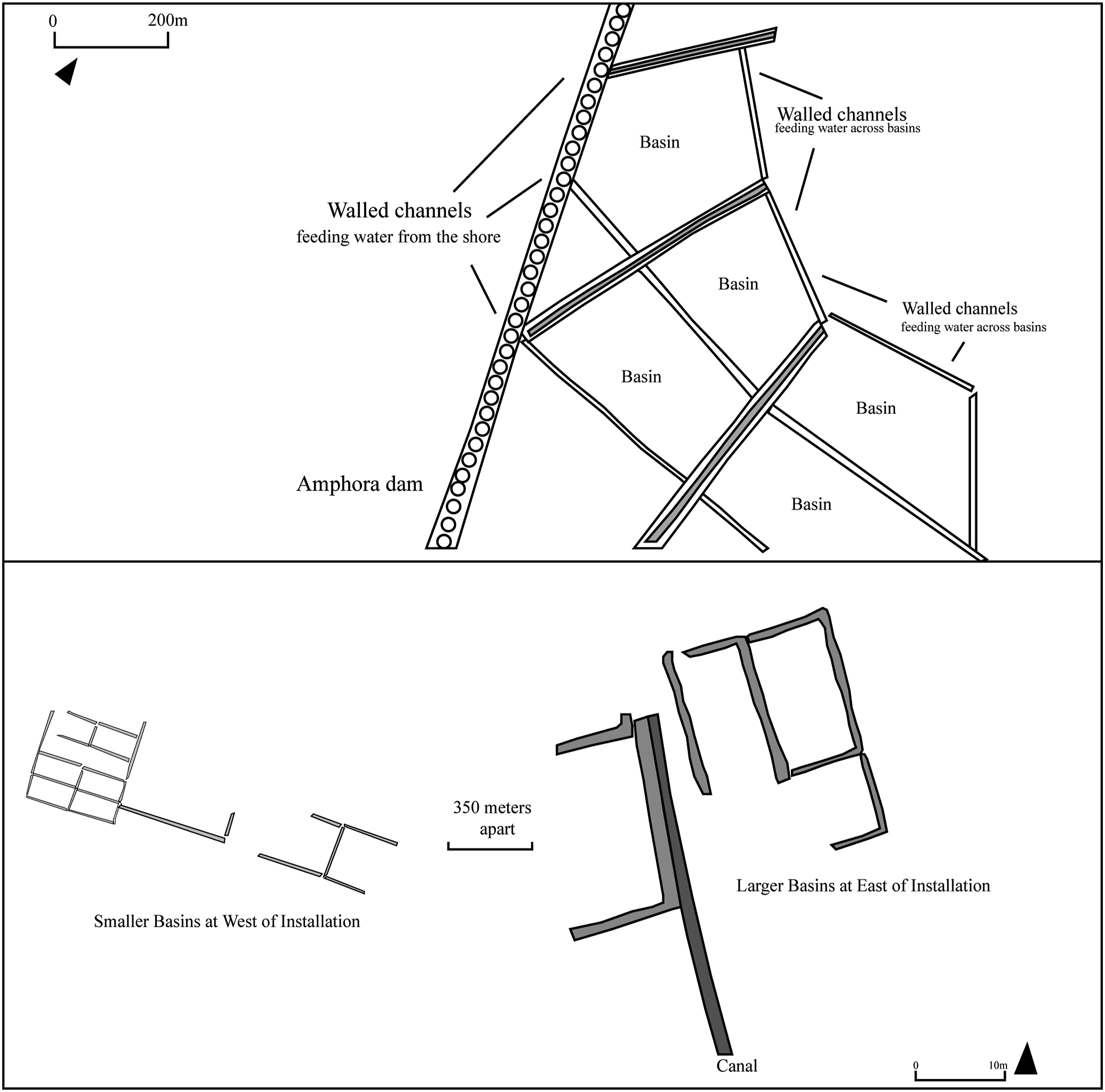
At Vigo, regimented basins were also registered. Outlined with schist or granite slabs oriented vertically to make them contain water, their floor surfaces were paved with large stones or compacted gravel reinforced with impermeable clay, or just clay alone (Curràs, 2017: 331). All materials were quarried or recovered locally, reforming natural geology into a human-made structure. The author notes that as the pans became smaller and shallower, progressing through an installation recorded at 700 m long so far, the gradient of the terrain was raised by orders of 20-35 cm, creating a stepped appearance that mimicked the incline upward from the sea (Curràs, 2017: 328, Figures 2–4). The smaller basins were found further up this incline. Therefore, water was moved through the system manually, not through channels. The differences between Vigo and Maccarese demonstrate how each installation adapted to the landscape and resources available for their construction and operation, similarly to other types of Roman water technology like baths and aqueducts. O Areal was smaller and water could be moved by hand. Maccarese’s solution of poles and sluicegates simplified the challenges posed by greater size and scale. The formal similarities of the basins point to a standard that produced the best outcomes for evaporation and made this infrastructure recognizable, as well, across contexts.
Once in operation, the material components of this infrastructure were invisible as they were filled and covered by water. The efforts of earth removal and material construction would have been imperceptible. These installations descended approximately a meter into the soil and barely extended above surface level. While the outlines of individual basins were visible, regimenting water into geometrically defined compartments, the overall effect was one of flatness. They were unlike the well-known Roman monuments that managed water: bath complexes that stretched stories into the air or aqueduct arches bounding across terrestrial landscapes. Evaporative salt infrastructure was more like the non-descript aqueduct channels that weaved beneath the earth or through mountains, adapting to the topography and remaining largely buried like underground rivers (Hodge, 2012). Yet, while the pans were in operation, the regularized patchwork would have presented a rather manicured effect compared to the natural, and potentially uneven, lines and textures of the marsh or sea that had been there before. The contrast with parts of the coastline not englobed by the installation signaled control of aquatic resources not apparent otherwise. However, we cannot completely interpret this infrastructure without considering its production cycle, which is undertaken below.
Han China’s salt installations
Contrasting Rome’s material modifications with the Han case foregrounds not only the distinct environmental transformations, but also the diverse manipulation of material culture. In Sichuan, the challenge was to extract brine from wells dug deeply into the ground and boil it. Due to the long-lived character of salt-rich sites in China, it is difficult to distinguish Han material from that of later ancient and early modern periods (Zhang and Zhang, 2013: 127-129). The transition from briquetage to furnaces for boiling, hypothesized to have occurred under Emperor Wu with the institution of the monopoly, set the course for this industry, in type and scale, across the Middle Ages and into the 20th century (von Falkenhausen et al., 2006: 310). The material traces on the ground do match scenes of salt production stamped on funerary tiles from the tombs of officials in Chengdu and Qionglai (Zhang and Zhang, 2013: 127; Vogel, 2008: 254; Chen, 2018: 110). Dated to the 1st c. CE (Eastern Han), they bolster the hypothesized dating for archaeological remains to the Han, bringing us closer to what salt-making infrastucture was like (Chen, 2018; Flad, 2011).
Wells were dug manually adjacent to or just above the riverbeds to intercept the brine deposits. The wells were circular in form, descending perpendicularly, with their apertures often shored up by bricks or stones. With greater extraction over time, most wells were sunk progressively deeper. The Han Dynasty had not yet developed cement-shoring technology to reinforce the walls of these wells, augmenting the possibility that their sides would cave in intermittently, creating both logistical difficulties and safety issues for workers (Zhang and Zhang, 2013: 131). Digging a well transferred human-environment interactions below ground. It restructured the visual perspective of those involved in digging and managing these wells directly, but these features would have been seemingly invisible to those viewing from a distance.
Rather, they were visible by proxy, featuring tall derricks of multiple floors made of wood, rising from the opening and facilitating the transport of brine-filled buckets to the surface. If such structures were already in place in the Qin period, we lack evidence. However, institution under the Han would have reflected an increased scale of production. The eye is drawn to this structure for its height and distinctness from the trees (Figure 4). Human figures pulled ropes to retrieve buckets full of brine. Labor was on display. We see the technological demands required to hoist brine to the surface with equipment that encouraged visual focus. They marked these places as both salt-producing and central to labor investment. Salt-making, Eastern Han funerary tile.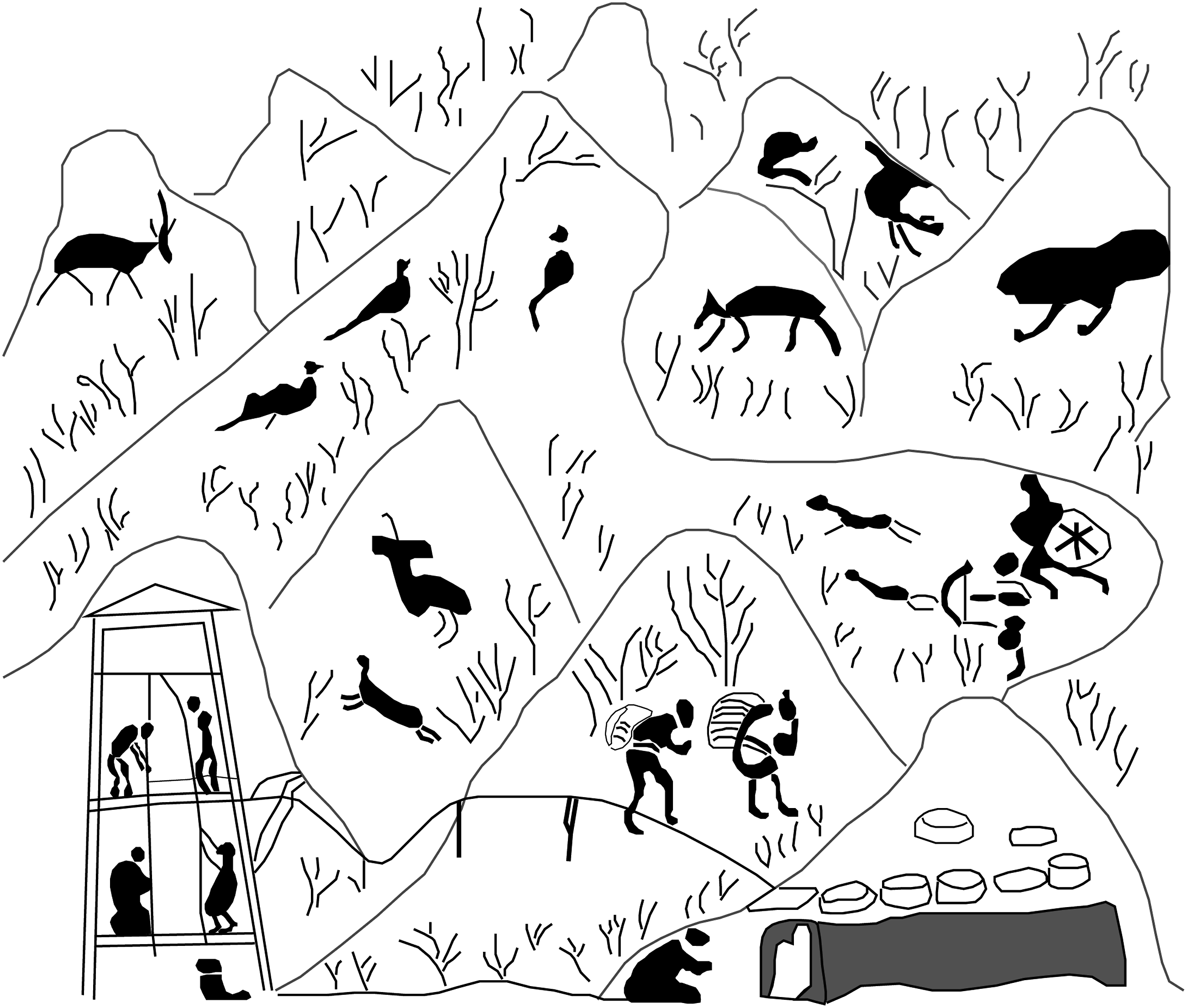
Moving from the derricks, in dendritic fashion, were networks of piping, conveying the brine to the next stage of production and commanding attention. Han evidence comes from the tiles, but as later contexts attest, these pipes were probably made of widely available and lightweight bamboo (Zhang and Zhang, 2013: 133); postholes around the well apertures likely represent the scaffolding that supported these pipes (von Falkenhausen et al., 2006: 320, Figure 1). Gravity conveyed the brine from the top of the well derricks, crisscrossing and filling the open spaces of these landscapes, linking the varied activity zones (Kurlansky, 2002: 28). Their objective was to arrive at the furnaces, a feature depicted in the bottom right of the tile and amply attested archaeologically.
The piping delivered brine ready to be boiled. Scale could be augmented by boiling in reusable iron pans, rather than requiring briquetage vessel manufacture. Depictions of furnaces (the “dragon kilns”) on the funerary tiles and in terracotta miniatures of salt-making from funerary contexts bolster this hypothesis (Li, 2013: 171 and plate 18.1). At Zhongba, the published remains of three different furnaces provide details, with 13 total found in the same area (Chen, 2013: 227-229), each 13-16 m in length and 50 cm wide. Trenches were dug in the earth, sloping up and away from the riverbed. Round stones lined the floors and the walls, with the upper covering molded in clay. Each opening had a work area, large enough to accommodate a human being, who could enter to add fuel, clean debris from one firing to the next, and build the mud and stone closure for firing. A vent admitted oxygen to stoke the fire. Distinct compartments concentrated heat, especially at the center, where the pans were balanced. A flue, which allowed smoke and air to emerge, pulled heat from the firing chamber through the furnace. Firing chambers often faced the river at the southwest, taking advantage of the movement of wind to fan the flames (Sun, 2013: 35). Funerary clay models render as many as 10 iron pans resting on these furnaces. They required considerable space, not only for structure, but also for those operating it. Most installations had more than one furnace, leaving a significant material mark as they sprawled across these landscapes. While made of earth, they might have approximated the appearance of the foothills but for two reasons. First, the iron pans created a manicured appearance. Provided by the state, they were made of iron—a fusion of the two monopolies (Sadao, 1986: 603; von Falkenhausen et al., 2006: 329). Second, like the derricks and the piping, human-made material was on display, further emphasizing its manufactured appearance.
Taken together, the main components of the installation reveal a rather complex and integrated system of production (von Falkenhausen, 2006: 15). Each set excavated existed on different elevations that reflect the diverse terrain of Sichuan, with the furnaces placed at a higher, protective elevation should the Yangzi or its tributaries have flooded (Sun, 2013: 51-53). While minor variations across production sites speak to context-dependent “localization” of production (von Falkenhausen et al., 2006: 331-333), employing similar material culture across the region speaks to the transformative effects of these installations in aggregate. As human-made constructions modifying the topography, these Han installations were almost industrial, contrasting to Rome’s flat, water-borne evaporative pans that seemed more like agricultural fields. Once in operation, the furnaces billowed smoke, a visual cue that set them apart from the “natural” topography. Rome’s infrastructure only required the heat of the sun and wind.
The demand for fuel to heat the Han furnaces would have been far-reaching: firewood, rushes, and straw, as confirmed by the ashen deposits found inside (Vogel, 2008: 453-454). On the tiles, men carry bundles of wood on their backs toward the furnaces. For the Neolithic period, Bennett argues that the prevalence of stone axes and adzes in settlement assemblages at Zhongba might point to an over-exploitation of forest resources, to fire the briquetage vessels and boil brine (Bennett, 2013: 387-393). The demands of an empire would have been ever greater. Although we cannot calculate how much wood fuel would have been consumed to boil brine—since the total number of installations is unknown—the need for fuel would have potentially extended into other zones, influencing the everyday lives of more distant communities (Lander, 2023). The agglomerative effects should not be understated.
Indeed, the tiles evince a particular way of seeing the world, with salt production as part of a more ample tableau. The installations occupy the bottom register, organized and linear. The upper registers are more sweeping and more “natural,” with mountainous terrain, wildlife—plants, large birds, antelope, and even a lion!—along with a scene of hunting (Zhang and Zhang, 2013: Figure 3; Chen, 2018: Figure 4.4). The depicted landscape was busy, accommodating silvan and industrial activities, and prompting reflection on how this human activity more invasively and commandingly than hunting took control of the landscape. Hunting was a more unpredictable and ad hoc pursuit, while salt-making was more organized, regimented, and technologically advanced. The tiles encourage consideration of how certain activities were integrated into these landscapes and the weight of their interventions. Via its spatially imposing and extensive infrastructure, salt-making was more invasive and potent, materially and humanly, than other activities.
Were similar visual cues signaled in the infrastructure of salt-making along the northeastern coastal sites? Zhang Rong, quoted above, references leaching of salty sand to create brine, a different process from evaporation. The coast had saltwater readily available, negating the need for derricks and piping to transport brine. However, leaching required digging pits in the earth, construction of their structure in wood, gathering sands, and filtration to separate out the brine (Sebillaud et al., 2017: 390, Figure 12). Either the coast was flooded or water moved to these pits in buckets, as seen in later 13th-century artistic renderings (Vogel, 2010: 22, Figure 1). Close to the coast and potentially victim to its vicissitudes, leaching pits would have needed to be re-excavated intermittently, focusing labor in these areas. Once the brine had excess water and muck removed, it was boiled to produce salt. Han texts tell us that iron pans were distributed there, too, for brine boiling (Luo and Luo, 1995). Therefore, further demands to construct furnaces and procure fuel for boiling transformed these coastal landscapes significantly, as in Sichuan. Furnaces and billowing smoke also marked these coastal installations, drawing one’s eye to these spaces of production, an “industrial” imprint that again distinguished this infrastructure from the “natural” appearance of the coastline.
Timing as tool
In order to understand these infrastructures in operation, we must consider the variable of time. Time was captured in their initial construction, which was a process. Larkin recounts the startling transformations brought to landscapes by bridges and highways in their becoming in colonial Nigeria, and he insists that they remained a point of conversation and intrigue for viewers, with continual impact (Larkin, 2008: 19-20, Larkin, 2013: 336). Salt infrastructure was always in process in varied ways. The steps of its use cycle projected malleability and changeability based on the time of day and the seasons. Its appearance was transformed by the emergence of the very product it created. There were also requirements for repairs, reworkings, or even repurposing over the long-term, as with all infrastructures, to keep them operational (Wilkinson, 2019). Salt-making infrastructure had its own specific requirements with clear impacts.
In Rome’s evaporative pans, the ingenuity was reinforced by the very progression of salt-making itself. Makers needed to carefully observe the color of the water and its density, to know when to move the water to the next stage. As water’s saline content increases, it changes colors, from shades of blue to grey to pink to deep reddish (Figure 5). While certain variations in colors emerge intermittently in the untouched marsh, especially in the shallower zones, the pans augmented and intensified this natural process. Coupled with the regularized patterning of the pans, the infrastructure made plain visually the salt water transformed and its distinction from the surrounding marsh (Strang, 2005). The brilliant colors augmented the aesthetic impacts of this infrastructure, mimicking the beauty of a warm-hued sunset along Italy’s coastlines. By late summer, the appearance changed again, with the accumulation of white crusty salt on the edges of the smallest pans, ready for harvesting—a final flourish. Rutilius (de reditu, 480-485) recounts this progression: When Sirius drives forward his blazing fires, the grasses yellow, and every field sits dried out, then the sea is closed out by the sluicegates, so that the parched earth hardens the trapped waters. The natural incrustations seize biting Apollo, and the heavy crust comes together with summer heat. Color change in the saltpans (Margherita di Savoia, Italy,–Google Satellite).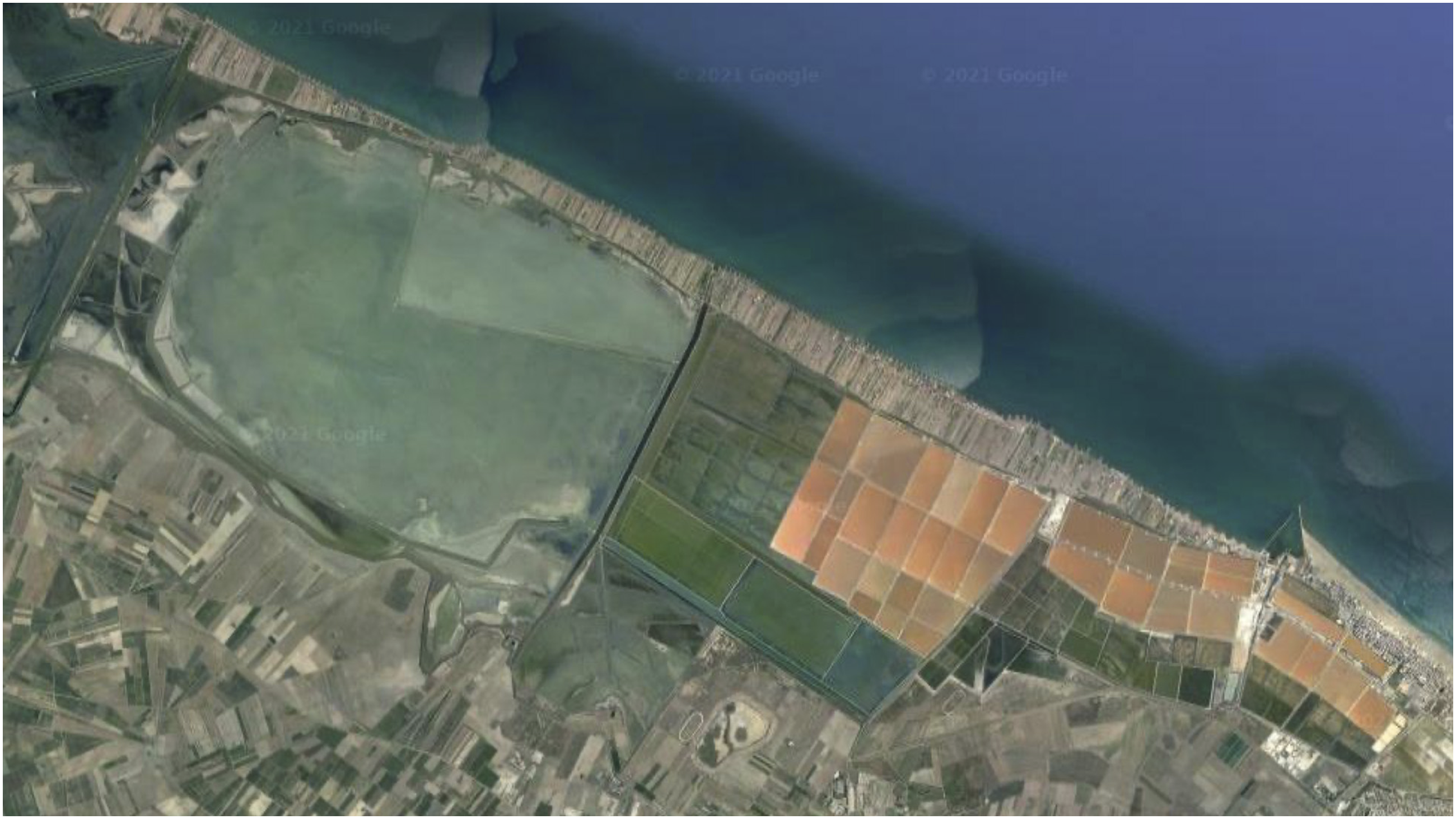
He goes on to compare the salt’s accumulation to the frozen Danube River. To see summer “captured” in this way—only to produce a wintery vision—might have added to the wonder this infrastructure created (Knappett, 2021). It was the most visible and distinct from the marsh and coastline in late summer and early fall.
However, even during the months of greatest activity and productivity, irregularity and unpredictability might have been introduced into the system. This started from the initial introduction of water: funneling and curating the water into these pans was a great effort. Manilius rendered the process in verse: “[they] next conduct therein waters channelled from the nearby sea and then deny them exit by closing sluice-gates: so the floor holds in the waves” (Astronomica V.684-6, Manilius and Goold (trans.), 2006). Such action required careful observation of water’s movement and the tides. Unwanted rainwater would have caused undesired effects on the system that could destabilize its regularity. Sedimentation from upriver or erosion seaside, possible given the agricultural boom of the centuries these pans were in operation, needed constant attention and intermittent upkeep (Salomon et al., 2023).
In the evaporative process, there was also an off-season. Modern practices are informative. Labor contracts for the saltpans at Barletta in the 18th and 19th centuries record work beginning on April 23. For more than two months, the pans underwent “spring cleaning”: the structure was shored up, the detritus of the winter months, like mud and aquatic plants, was removed, and the channels to the sea were flushed (Russo, 2001: 57-64). It is in this particular season we envision energetic activity to prepare the pans. As Currás does (2017: 339-340), it is here that I would read Cassiodorus’ sixth-c. CE praise of the hard-working Altinians: “Instead of plows and pruning hooks, you roll grinding stones” (Variae 12.24.6, Cassiodorus and Bjornlie (trans.), 2019). The simile has grinding stones equated with tools that prepare the fields for cultivation. Usually lined with clay, the pans needed rolling to smooth and seal, to prevent seepage and mud incursions. These reworkings reinforced the infrastructure that would have then been resubmerged under water with the summer seeding.
Over the winter season, when not in use, the pans were no longer the center of activity. Overtaken by plants and fauna, they appeared almost indistinguishable from the surrounding marsh, approximating the changeability of marsh environments from season to season. With springtime, the potential of this infrastructure re-emerged. Taming the marsh was not a single event, concluded with the inauguration of the infrastructural project, but one that required consistent attention (Huijbens and Palsson, 2015: 50; Giblett, 1996: 3), in seasonal and annual cycles.
The Chinese case instead provides an opposing picture: one of infrastructure potentially and seemingly in constant use. Leaching and boiling in coastal zones was not dependent on a hot and dry season to produce salt, and so, as in Sichuan, salt would have probably been made over many months of the year due to fuel use. In fact, such extra-seasonal production contributed to the Han’s ability to produce salt at scale for broad and economical distribution. The material set of this infrastructure, operating over long stretches of the year, would have promoted its potent and consistent presence, communicating an expanded scale and reach of this resource extraction. Notably, the Confucians argued that the monopoly required that tasks be done beyond their rightful season, signaling that Han practices did not conform to the expectations of the agricultural calendar (Discourses, Chapter III.f, Gale (trans.), 1931; Chin, 2014: 34). This is a telling rebuke of salt production, one which reminds of the strong effects of this infrastructure—and the practices it enabled—not only where it was located, but in the distant imperial capital.
Salt, infrastructure, and society: perception and the value of comparison
What do we gain from comparing salt infrastructure from the Roman and Han empires? In each case, profound material investment ensured the production of a necessary and prized resource, with each infrastructure augmenting the potential of its environmental context. In effect, Han practices infringed on sight lines, landscapes, and natural resources even beyond the initial outlay of construction in producing salt, while Rome’s infrastructure did so comparatively less.
Han salt infrastructure did this by extending up, down, and outward across the landscapes where installed, modifying natural components and creating sensory experiences not possible otherwise: furnaces billowing smoke, workers elevated above the ground, and circular iron pans, all among the forest’s trees and foothills. Already built on the spatial legacy of previous centuries of production, as time advanced, these installations were expanded in scale and by new technology, all while further denuding the forest’s trees for fuel. As a result, it became an increasingly dominant player visually and materially as the forest was consumed, likely continuing year-round. Such an image counters the idea that long-lived infrastructure becomes invisible (Peters, 2016). Instead, its role shifted with time’s advance and was shaped by it.
When juxtaposed to the complex communication around the extraction of forest resources, at times part of the imperial holdings and therefore tightly controlled (von Glahn, 2016: 106), salt infrastructure belonged to a continuum leading to the commanderies that amassed, apportioned, and distributed, at a fixed price, the salt produced; the private merchants managing these saltworks were stuck in the middle. In the Discourses on Salt and Iron, the monopolies were seen by imperial administrators as the pillars of economic stability, generating considerable revenue (Chapter I.i, Gale (trans.), 1931). Not even grain saw its price, and availability, so closely regulated (von Glahn, 2016: 121-123). This infrastructure also conditioned a specific relationship to human labor, drawn from the surrounding region, where likely a mix of skilled artisans directed local peasants, a similar labor structure to the iron monopoly directly operated by the state (Sadao, 1986: 583; von Glahn, 2016: 104; Lam, 2023). The Confucians emphasized salt production’s lack of synchronization with the agricultural calendar to which peasants were intimately linked. As long as the state taxed this resource, the private merchants could never be truly independent, and peasants would be forced to furnish labor, even if given freely, beyond their regular agricultural demands. Taxation of their agricultural produce meant that they needed added income.
Imperial will and coordination made such infrastructure possible, insisting on its extractive relationship to the surrounding environment, just as it constrained private producers to sell directly to the state. Perhaps the visibility of this infrastructure—displaying its consumption of and command over both labor and natural resources—reflected this tension between state and private interests, ensuring the intersection among them remained ever-present. Salt installations, therefore, provided a strong statement of origin for salt that emphasized its expanded access at the table for all social classes in the empire, but not free from debate, complexity, and power struggles.
The contrast with Rome’s salt infrastructure makes the potency of China’s material manipulation ever more apparent. Constructed at the boundary between land and water, the infrastructure rather served to augment and regiment natural processes. While the Roman state did have a hand in coordinating the production and distribution of salt, mainly through the extraction of tax revenues in certain locales, it did not aim—nor seemingly could it—to control all loci of production. Rather, the infrastructure inspired reflection on the complexity of the human-environment relationship. For instance, Manilius versified how this infrastructure could harness a natural process, underscoring human-environment collaboration. People build the pans, create an entry for the water, and prevent its exit, but it is the sun that evaporates the water, as the pans hold it, only for the salt to be collected newly by human labor once again (Ocean’s “locks shorn”) (Astronomica V. 682-690, Manilius and Goold, 2006). Cassiodorus describes the Altinians, as well, aiming to find a balance with the sea for their coastal community. By his estimation, they find their wealth and stability by extracting salt, “possessing what they do not make,” i.e. the sea, “with every wave favorable to their craft” (Variae, 12.24.6, Cassiodorus and Bjornlie (trans.), 2019). Pliny the Elder’s treatise, intriguingly, places salt within a larger discussion of water that provides people myriad resources, among which is salt (HN XXXI.39). The description of its infrastructure is one of a long list of material modifications to landscape amplifying access to water, so long as people are attentive to its natural changes and tendencies.
Rome’s production occurred when natural conditions were most conducive to prolific outcomes. While constructed to produce at scale, these installations needed to achieve symbiosis with natural systems. Therefore, the reliance on time and patience was crucial. Added to what we know of this infrastructure’s material signature, the visual effect created a consistency with the surrounding landscape: flat, watery, glistening. Yet, by relinquishing this infrastructure each winter to overgrowth, the changeability and unpredictability of the marsh, this infrastructure complicates the idea that Rome saw its engagement with nature as one of complete subjugation (Hughes, 1994; Usher, 2020). In fact, Traina notes the somewhat antithetical ideals of economic progress and reclamation works to local management of marshes: the flashy projects were reserved for imperial posturing by important political figures like Caesar and the emperors in intractable landscapes (Traina, 1988: 115-117). Local marshes, rather, were subjected to the more collaborative approaches described above. As infrastructure, the salt pans seemed to reflect a local, more intimate agenda for engagement. Local marshes, local coordination, local control, and salt distribution were sustained and contributed to an interconnected and integrated imperial Mediterranean economic system.
Where does this leave Roman salt? The Romans did not record deep political debates on the control of salt and its administration. Rather, as cited above, Plutarch saw salt as a means of testing social bonds, and Pliny saw it as the spice of life. There is also a fixation on divine images of salt and its making. Manilius affords this process a quasi-divine image, while Rutilius underscores the role of Sirius (heat) and Apollo (the sun) in bringing salt about. It is not a great leap to link the hardened salt of the pans, season-crossing in its appearance, to salt’s timelessness, nor the wonder of its arising seemingly from nothing, to bolster its generative image. Plutarch’s interlocutors repeatedly emphasize salt’s divinity, affirmed by Homer as one of the earth’s primary and godlike resources (Plutarch, Quaest. conv. 5.10.1-4, [684-685]; Pliny, HN XXXI.39.89). They note its role in preserving dead bodies from decay. Just as Venus emerged from the sea, so did salt. The saltpans and their operation, then pervasive on the coasts of the Mediterranean, contributed to such images and mindsets, amplifying the social symbolism of this resource so widely available because of this technology.
Footnotes
Acknowledgements
I thank Andrew Donnelly, Carl Knappett, and Griet Vankeerberghen for providing critical, helpful comments on this project at various stages, as well as the feedback of the anonymous reviewers. They made the text better. All errors and mistakes remain my own.
Declaration of conflicting interests
The author(s) declared no potential conflicts of interest with respect to the research, authorship, and/or publication of this article.
Funding
The author(s) received no financial support for the research, authorship, and/or publication of this article.
