



Abstract
At the national scale, Lydd is one of the “mixed cities” in Israel; however, to the Lydd municipality, the city is an “ancient historical city.” Through a discourse analysis of how the Lydd Municipality uses heritage as a tool to construct the city’s image as an “ancient historical city,” this article highlights how the two disparate urban identities align in producing and maintaining histories of colonial erasure. To the Lydd Municipality, the image of Lydd as an “ancient historical city” begins with the Shelby White and Leon Levy Lod Mosaic Archaeological Center, a pristine modern structure standing only a few blocks away from several abandoned and haphazardly cordoned-off ruins from the Ottoman era. Looking to municipal rhetorics and urban development plans for several of the heritage sites in the northeastern portion of the city, heritage is understood as a tool through which national priorities, municipal entrepreneurialism, and colonial erasure coalesce.
Introduction
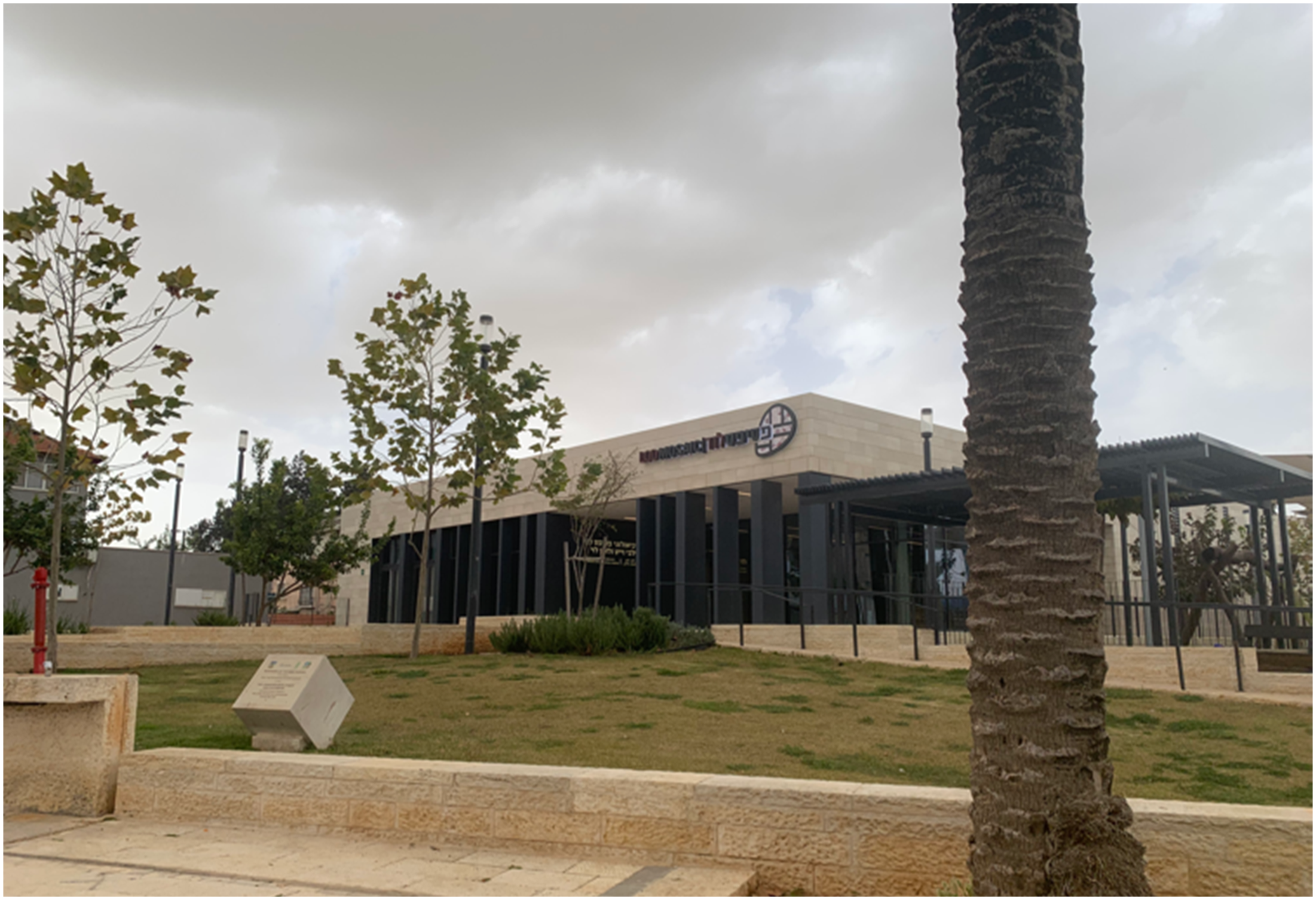
In the Ramat Eshkol neighborhood of Lydd, Israel, hidden behind unkempt and overgrown grasses, is a small entry point into a building of the Hassouneh family olive press (Figure 1). Constructed during the late Ottoman period, operating through the British Mandate era, and abandoned since the Nakba, the Hassouneh olive press and other structures such as a soap factory by the Old City have been haphazardly cordoned off and left to exist without any caretaking by the state or Lydd municipality (Da’adli, 2022). These sites and their ruination stand in stark contrast to the recently opened Shelby White and Leon Levy Lod Mosaic Archaeological Center, located two blocks away, which displays a late third-century Roman mosaic (Figure 2). Twenty-five years after the mosaic was discovered, and following a world tour that brought this piece of heritage to premier museums such as the Metropolitan Museum in New York City and the Louvre in Paris, the mosaic has returned to Lydd and is viewable to the public in this new museum. It is against the backdrop of the museum opening that this discussion of the malleable and intertwined nature of heritage and urban identity sits. With the establishment of the Shelby White and Leon Levy Lod Mosaic Archaeological Center, municipal planning’s role in defining and constructing an identity for Lydd through heritage comes to the fore. Hassouneh olive press in 2014 (photo by author). Shelby White and Leon Levy Lod Mosaic Archaeological Center in 2023 (photo by author).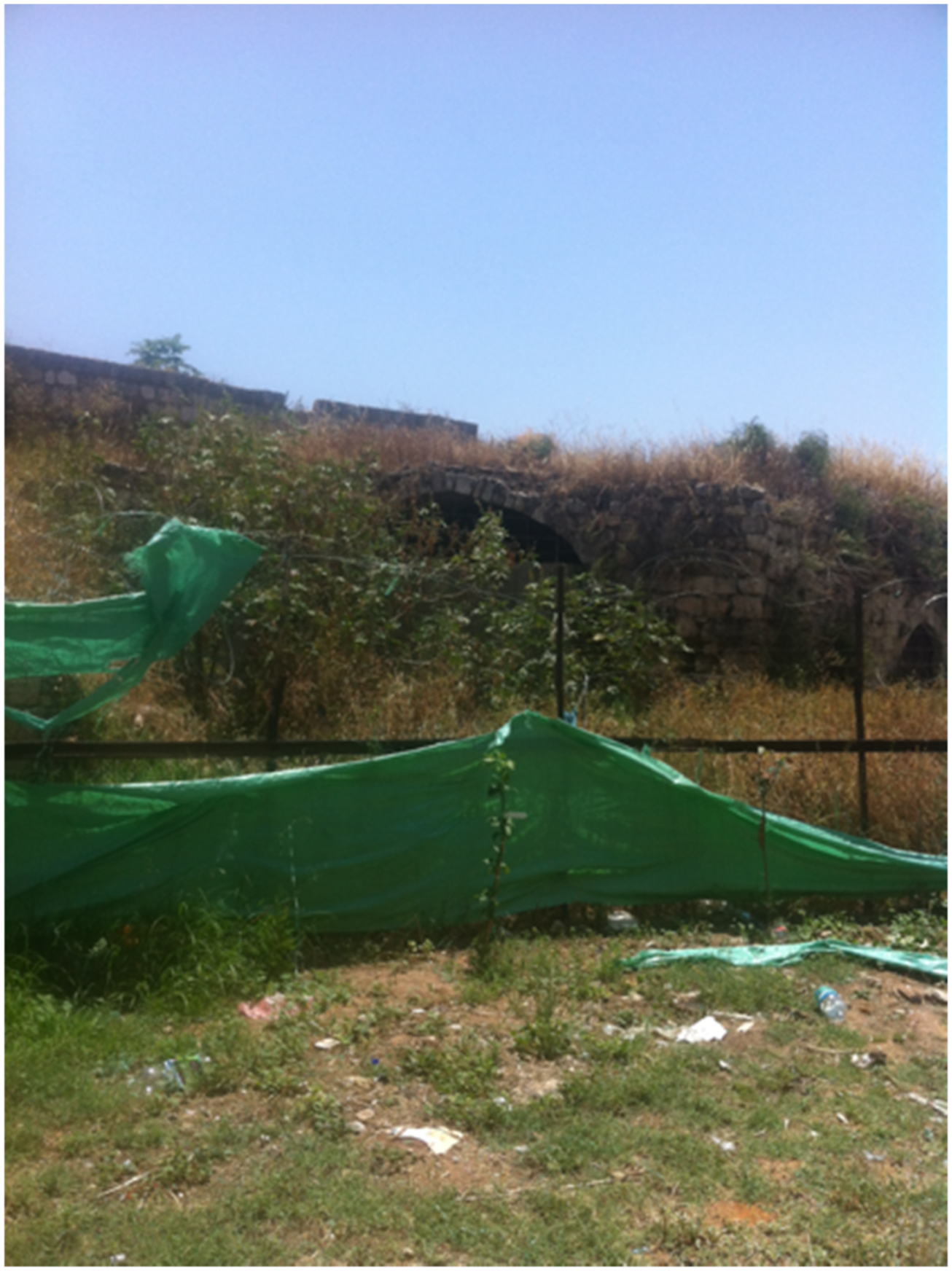
Through heritage management, there is a targeted attempt to elevate Lydd’s “ancient historical city” identity. Heritage’s incorporation into constructing a new urban identity for Lydd sits within the context of its nationally given “mixed city” identity, which—at face value—is a demographic designation denoting cities with a “significant” Arab population within a majority Jewish population (Central Bureau of Statistics, 2017). Attention to the identities carefully constructed for cities highlights questions of scaled power and authority, each competing with the others for dominance and prominence in the public understanding of a place (Gotham, 2007; Greenberg, 2008). As Kevin Gotham (2007: 828) aptly asserts, “Urban imaginaries are not uniform or coherent but are plural, conflicting, and power-laden”; whose urban image ultimately rises to the fore revolves around questions of power. Urban branding is the mobilization of such power, constructing a particular representation of a space that supersedes all others in defining the space for the broader public (Greenberg, 2000). The local municipality and the nation-state, as well as local grassroots organizations, all partake in working toward this definition. In heritage management we see scales of power intersect with competing spatial narratives via the identities ascribed to the city. Municipal urban branding campaigns may seek to supersede a nationally constructed urban identity; meanwhile, both work to eclipse the local grassroots urban identities. On Lydd’s heritage scene, this emerges through the Roman mosaic museum’s catalyzing force in rebranding Lydd as an “ancient historical city” while the histories of heritage sites like Khan el-Hilo and the Hassouneh olive press remain shrouded and ignored.
This paper, rather than centering the particular histories represented by the individual heritage sites, turns its attention to how the sites are leveraged and reimagined by official planning bodies. With this focus, questions of scale—namely, the national-municipal government divide—and purpose—economics versus narratives—in urban branding and heritage management take center stage. By looking at heritage practices of the Lydd municipality, we see how urban branding and heritage coalesce to perpetuate colonial violence in the form of both erasure and liminal inclusion. There is a different scalar and authority relationship at play when attending to Israeli governmental engagement with and use of heritage within the Green Line as opposed to in the Occupied Palestinian Territories. For this paper, the most significant difference comes through in who or what institutions are molding and shaping heritage sites and narratives. Whereas heritage management in the Occupied Palestinian Territories is a knot of world heritage organizations (De Cesari, 2010), Palestinian governmental authorities and grassroots organizations (De Cesari, 2019), and Israeli antiquities departments attempting to affirm their narrative and physical control over heritage (Bshara, 2013; Kersel, 2014), within the Green Line, the local municipalities have fewer administrative and legal challengers vying for control over heritage practices and management. It is here that we see the municipality as an extension of the state, still contributing towards a colonial mission but doing so in a way that creates and maintains its own authority. To articulate this argument, I begin with first establishing the relationship between municipal planning, heritage, and urban branding, highlighting how municipal planning brings heritage to the city scale through urban branding and identity construction. This then flows into a discussion of the national-municipal power dynamics involved in defining urban identities, which, for the case of Lydd, looks at how the nationally given “mixed city” identity becomes sidelined by the municipally established “ancient city” identity while both still maintain colonial priorities of erasure. Following this theoretical conversation around how planning uses its institutionalized powers to define cities, I turn to the particularities of how this has occurred within Lydd through a discourse analysis of the municipal announcements around heritage production and management, particularly the Shelby White and Leon Levy Lod Mosaic Archeological Center, and urban development projects around other heritage sites in town.
Urban branding, heritage, and municipal planning
When considering the relationship between urban branding, heritage, and municipal planning there are two key intersecting conversations. The first is that of scale, particularly scales of governments involved in planning, branding, and heritage campaigns, and how these actors move between the local, national, and international spheres. The second discussion of central importance attends to the purpose of urban branding campaigns, heritage practices, and planning initiatives. As this section continues, several purposes, ranging from political relations to economic development, come to the fore depending on the scale at which heritage is discussed. These purposes are not mutually exclusive to each other nor to the scale at which they operate, and as will become apparent, planning’s use of heritage as part of urban branding shifts between and balances the different purposes behind the initiatives.
Often discussions of heritage as power fall within the realm of international politics, focusing on how international entities develop programming devoted to protecting and safeguarding heritage sites for the future. Tim Winter’s (2015) discussion of heritage as democracy highlights how heritage functions as a negotiation tool for aid and transnational agreements. Heritage and its management serve as spaces to stoke conflict and procure advantages in agreements that would abate conflict. Within such discussions, the relationships being negotiated are at an international scale, often between nation-states and organizations claiming to represent broad geographic territories. This, though, misses a key discussion of heritage management and construction as central tools for entities functioning at a smaller scale. While individual cities are less central to defining international relations, they have frequently inserted themselves into the international scale as a way to address internal challenges, particularly those brought about during the rise and expansion of neoliberalism, which severely restricted the financial support from centralized national and regional government institutions to cities (Brenner and Theodore, 2002). As David Harvey (1989) explains, this shift gave rise to the entrepreneurial city, wherein urban governments needed to find innovative ways to gather the necessary revenue for the city’s functioning. Part and parcel of this change was a turn to public-private partnerships to transform the built environment and elevate existing urban features, a strategy which will resurface in significance once we shift to the specifics of heritage management in Lydd (AlSayyad, 2001; Harvey, 1989). Municipalities have taken advantage of the perception of heritage sites as spaces for economic gains, and have used these sites to offset budget reductions through increased entrance fees (Su, 2015) and using the sites themselves as advertisement spaces (Starr, 2010).
Cities’ participation in urban development and tourism initiatives supported by the World Bank, UNESCO, UN-Habitat, and the European Union exemplify how the municipal and international scales intersect around the purpose of using heritage and urban branding to ameliorate economic challenges. Using urban branding, cities, and particularly their municipal planning departments, signal latent economic value to entice investment (Broudehoux, 2001). For many urban studies and municipal planning scholars, the way urban planning departments leverage heritage sites aligns with the field’s long relationship to and origins within capitalism, ordering space and society in a manner that opens space and people for capital accumulation (Foglesong, 1986; Sevilla-Buitrago, 2022). While urban planning’s relationship to and service towards expanding capital is undeniable, scholars such as Paul Rabinow (1989) and Libby Porter (2010) argue for reading planning within its relationship to and as part of colonialism. To ignore the field’s relationship to colonialism in favor of its role in advancing capital accumulation is to sidestep the erasure that the field has been complicit in and neglect how planning retains a tendency to continue colonial erasures. This erasure is a second purpose of branding that must be kept at the front of our minds as we move towards the particularities of Lydd, its heritage, and urban identity formation. Miriam Greenberg (2008: 31) pointedly reminds us of the erasure that is near-inherent to urban branding, writing, “‘branding’ simultaneously connotes the corporate labeling of a thing, and the physical, even violent transformation and commodification of both inanimate things and living beings.” In their enfolding of heritage into this discussion of urban branding, both Nezar AlSayyed (2001) and Andrea Lucarelli (2018) entangle the two purposes or goals of urban branding. Heritage consumption must be read through both its economic purposes but also its narrative purpose—whether it be erasure via replacement or liminal inclusion as seen through multicultural or cosmopolitan narratives. One must see how these purposes function and work together rather than seeing them as distinct and mutually exclusive.
Urban planning, like urban branding, is not the sole purview of official government institutions. As scholars of grassroots and insurgent planning have shown, individuals and non-state actors make claims to space and services through conventional routes and spaces (Bou Akar, 2018; Miraftab, 2009), as well as through loopholes, taking advantage of their invisibility (Bayat, 2000; Bhan, 2009), and disruptive organizing (Garcia, 2017); however, the power of governmental urban planning departments and their contracted partners cannot be understated. Across history, government planning institutions—at both the national and municipal scales—have used their power and authority to (re)define, destroy, protect, elevate, or ignore heritage in ways that enfold the two purposes of economic development and narrative formation. Prioritizing efficiency, modernist planners often destroyed and recreated the built environment, erasing the existing histories inscribed into space in favor of constructing ahistoric and efficient sites (Holston, 1989: 31–58). Erasure in colonial planning comes through both destroying existing built environments representing native histories and by constructing heritage anew through physical development and rhetoric. Heritage as a tool for erasure in colonial planning becomes more subtle in the instances where the administration maintains physical sites, opting to preserve structures for their touristic appeal (Abu-Lughod, 1980; Cooper, 2000; King, 2015; Porter, 2010). Heritage, though, is more than merely the physical space; rather, heritage includes the histories and narratives represented in the tangible sites (De Cesari and Herzfeld, 2015; Smith, 2006). The fetishization of native structures, as seen in Le Corbusier and Louis Hubert Lyautey’s respective desires to preserve the Casbahs of Algeria and Morocco, erases the native histories within them, reducing the sites to being of significance only for the tourists’ gaze (Abu-Lughod, 1980; Celik, 1992, 1997: 11–57). The malleability of narratives through heritage continues to be gleaned through contemporary discussions of heritage construction and reconstruction by governments. In Syria, the regime prioritizes reconstructing heritage sites decimated by the civil war based on their utility to the regime’s image, profitability to the elites, and capacity to reward loyalists (Munawar, 2022). As Nadia Abu el-Haj articulates through her detailed analysis of archeology as a field and its use within Israel, the field’s association with scientific rationality lends credibility to particular historical narratives constructed around the collection of artifacts and what they are said to represent, enabling the use of archaeology as a tool in service of Israeli nationalism and colonialism (Abu el-Haj, 2001). What becomes ever more clear, though, is how planning, as a governmental institution, uses its power over heritage space and rhetoric to construct a particular urban image that is structured around an intent of erasure. These examples of Algeria, Morocco, Syria, and Palestine are of national planning bodies using heritage to construct an urban image approved and defined at that same national level. In the case of Lydd, there is the question of alignment between the municipally established urban image centering the city’s heritage sites and the nationally established identity that depends on sheer demographics.
As will be shown, what emerges in this discourse analysis is how while the municipality seeks to have the “ancient city” identity subsume the “mixed city” identity, the identities function together to align with the continued settler colonial goal of erasure. This exploration into the urban identities constructed for Lydd by the municipal and national governments does not uphold nor advocate for such identities and imaginations of Lydd; rather, instead of blanketly and swiftly dismissing these classifications and identities as fictitious constructions of the Israeli state, this inquiry probes further to ask how such identities are continued forms of colonial violence.
Power and authority in constructing heritage and city identities
Space and urban identities must be understood through the many components that combine and interact to produce them, including their materialities, relationalities, and the rhetorics used to define them, as well as the competing powers seeking to shape space (Janz, 2005; Jessop et al., 2008; Lefebvre, 1991: 68–168). As Chiara De Cesari and Michael Herzfeld describe, there is a somewhat recursive relationship between heritage and power and sovereignty (De Cesari and Herzfeld, 2015: 175). Power and authority are enacted to define, construct, and destroy heritage; and the definition, construction, and destruction of heritage then affirms said power and authority. With different scales and sources of power and authority converging over heritage sites, there is a seeming weight lent to the purpose and image that these sites are transformed into. Through looking at heritage management at a municipal scale—rather than a national scale as scholars like Abu el-Haj, De Cesari, and Herzfeld have done—I challenge the ease with which literature blurs the priorities and activities of municipal and national actors on the heritage scene; the motives and initiatives of these actors must be read concurrently, noting how, why, and when they converge or diverge. For the case of Lydd, what becomes apparent in reviewing discourses of heritage since the opening of the Shelby White and Leon Levy Lod Mosaic Archaeological Center is how, for the Lydd Municipality, heritage functions as a vehicle to construct and deploy Lydd’s urban identity as an “ancient historical city,” relegating its official classification as a “mixed city” to secondary importance.
Lydd is not unique when it comes to having various groups along the political and social hierarchies of power competing to define and redefine the city’s identity. Private corporations have noted the opportunity posed by being involved in shaping Lydd (Lod Municipality, 2015). Their interest and involvement in developing Lydd, though, must also be situated within the work and priorities of the Lydd Municipality. As will be shown, currently, Lydd’s municipality—headed by a member of the right-wing Likud party with six Arab city council members that sit in opposition to the rest of the right-wing-majority city council—maneuvers and engineers both the rhetoric around and material realities of heritage to, in seeming contradiction, oscillate between upholding the nationally designated classification of Lydd as a “mixed city” and subjugating this identity in favor of an alternate branding for the city (Lod Municipality, n. d.b). It is in this oscillation, the negotiations between simultaneously holding urban identities produced at two different scales, that we see the significance of heritage as a vehicle to define lines of inclusion as its mobilization balances and unites the ultimate purposes of and narratives espoused by these urban identities.
Attention to grassroots engagement with heritage in Lydd has the potential to further highlight the relationship between urban branding and colonial erasures; however, such an approach falls beyond the scope of this paper. This research’s interest in how urban identities and narrative production intersect with scales of government warrants an institutional approach. As such, there are two primary urban identities constructed for Lydd at the two relevant scales of government: the national image of Lydd as a “mixed city” and the municipal branding of Lydd as an “ancient historical city.” The Israeli state has classified Lydd as one of the official “mixed cities” in the country, a label denoting a municipality with a “significant” Palestinian minority population amongst a “decisive” Jewish majority (Avgar et al., 2021). However, there are wildly varying demographics across the cities that hold this classification, ranging from a 30% Palestinian population in Lydd to only a 4.8% Palestinian population in Tel Aviv-Jaffa, which brings into question the precise benchmarks and purposes of this categorization (Central Bureau of Statistics, 2021a, 2021b). Urban studies scholars have reiterated the falsity of this identity, noting how these cities are far from mixed, but rather are deeply segregated spaces (Hart, 2022; Hawari, 2019; Kolodney and Kallus, 2008; Monterescu, 2015; Pasquetti, 2019; Yiftachel and Yacobi, 2003). The lack of parity between mixed cities and the disjuncture between reality and the classification points to the need to understand this “mixed city” identity not as a neutral demographic label but as a political classification, one which can be molded to fit various narrative agendas. The nature of that political classification and the intentions behind it are never static, with politics being an ever-evolving process of relations. This, though, makes heritage a convenient tool for such types of classifications and labels, as heritage itself is dynamic and malleable (Harvey, 2001: 325).
Malleability further comes to the fore when looking at how the state-given “mixed city” identity is paired with municipally generated urban identities. Distinct identities coming from the different scales of governments twist and maneuver to function around and with each other; neither challenges or rejects the other; instead, they are both used in an intricate dance of constructing compatible narratives. For Tel Aviv-Jaffa, the city is represented as a cosmopolitan haven that can please all; in contrast, Haifa is understood as an urban oasis of tolerance with calming panoramic views, and Jerusalem is the city of religions. Each of these branded identities draws on the mixed city classification’s obscuring of settler colonialism via multicultural and cosmopolitan narratives, and to various extents, enfolding the national urban brand within the municipally constructed urban image for the city (Israeli Ministry of Tourism, n. d.). As will be shown for Lydd, though, rather than intertwining the national classification and municipal urban identity, the Municipality’s construction of Lydd as an “ancient historical city” only loosely draws on Lydd’s “mixed city” identity. In the case of Lydd, there is a greater distance between state and municipal urban identities. Urban branding and descriptions of Lydd coming from municipal offices did not always center the city’s heritage sites; rather, at varying points greater emphasis has been placed on generic economic, industry, and geographic significance (Lod Municipality, 2014a, 2015). Thus, the decision to mobilize and deploy heritage sites in a particular manner must be situated within the present political and social context (Harvey, 2001), and this exploration into Lydd’s heritage mobilization for the sake of constructing an urban identity that subjugates and erases Lydd’s larger history in order to foreground the city’s ancient history cannot be disconnected from the continued violence of a settler colony seeking to affirm its control. To do so requires striking a balance of erasure and domination through inclusion and exclusion, liminally incorporating the mixed identity through heritage management and discourse just enough so that its presence is noted but not prominent enough to define the city.
The juxtaposing physical realities of cultural heritage sites in Lydd, some in ruins and others with vast finances poured into their preservation, can, on the one hand, be read with easy alignment with the overarching discourse of mixed cities, namely as spatial management practices that uphold Jewish ethnonational supremacy (Yiftachel and Yacobi, 2003). Such an understanding aligns with the vast scholarship that has linked heritage management to affirming, constructing, and realizing the nation, submerging or resurfacing particular memories through spatial materialities in service of curating and crafting national narratives (Abu el-Haj, 2001; Said, 2000: 179). However, while understanding the uneven conservation and preservation of heritage sites as related to materializing ethnonational identity and supremacy may not be inaccurate, such a reading foregoes attention to the details of this narrower municipal scale, a scale that highlights the malleability of heritage in a way that affirms the larger currents of ethnonational supremacy but does so while also attending to the particularities of the local.
Dissecting representations and rhetorics of heritage and the mixed city
Planning and heritage management involves a variety of actors including municipal departments, private companies, non-profit organizations, and grassroots organizations. This paper focuses on the municipal offices and the private entities they have aligned and entangled themselves with in the process of rebranding Lydd through heritage. The variety of participants in urban branding is mirrored in the many formats and materials through which to glean and see Lydd’s urban identity, from mayoral speeches and interviews to official municipal communications and tourism materials. While previous observations and walk-throughs of these heritage sites from recent years serve as the basis for understanding the physical state of the heritage sites to be discussed, this inquiry is primarily a discourse analysis. When considering the work done to define a city’s urban brand and identity, visibility and accessibility are vital components. As such, official and digitally published materials comprise the base source material for this inquiry rather than turning to individualized materials, such as interviews. Urban branding—while not solely undertaken by public entities—is a public-facing project; it shapes the access to, appearance of, and narratives behind historical sites. As was noted earlier, these narratives are plural, conflicting, and competing. The urban branding process to construct such narratives is in many ways a performance—a performance with varying perceptions of believability. While not a central point of discussion in this paper, this idea of performance and credibility of urban image is important to remember when thinking about the “mixed city” identity. With the national contexts of state officials blatantly espousing the prioritization of Jewish Israelis and the local context of the violence enacted by the national and municipal governments in Lydd during the May 2021 uprising, the weak performative façade of Israeli multiculturalism offered by the “mixed city” identity continues to crumble. Regardless of its believability, though, its persistent presence, the nation and municipality’s continued performance of it, how the state, both municipal and national, sees its power as intertwined with this identity’s consistent presence, and that understanding of power’s relationship to urban identity construction are more significant that the plausibility of the identity itself (Wedeen, 2015). Through a discourse analysis of the Lydd municipal website’s mentions of heritage sites—most notably the Roman mosaic and its new museum—municipal urban renewal documents, and the Shelby White and Leon Levy Lod Mosaic Archaeological Center’s website, due to the mosaic’s centrality in promulgating the “ancient city” urban brand, I trace the contours of Lydd’s urban brand and how it maintains settler colonial power dynamics through erasure.
Eliding the mixed city for the ancient city
Abu el-Haj is adamant that understanding archaeology’s place in Israel requires seeing it in relationship to both collective—in her case national—identity construction and colonialism (Abu el-Haj, 2001: 2). The representation of Lydd’s heritage sites, from both the municipality and the mosaic museum, resurfaces those ties through their public-facing materials and discussions. Both the municipality and the museum construct Lydd’s urban identity as a historic city with a history that extends exceedingly far back into time, a history well beyond the contemporary politics of the city such that these modern conflicts are rendered irrelevant. To highlight this construction of Lydd’s urban identity and this process of erasure, I begin with noting the colonial tones of replacement and separation that permeate through materials around the museum’s establishment and philosophy. I then segue into an interrogation of the logistics and logics behind the heritage preservation activities and their relationship to prioritized urban identities and the implied undertones of (de)valued and (un)threatening histories and heritage. This then turns to circle back towards the question of purpose, specifically a particular narrative construction as a goal of heritage management, looking to the instances in which “mixed city” and “ancient city” urban identities were brought together. Continuing with the thread of heritage’s malleability to conform to specific purposes, I lastly return to a discussion of how economic opportunities become enfolded into heritage management across the city and how the municipality brings together the “ancient” urban identity to serve economic priorities.
The presence of rhetorics around emptiness, terra nullius, and tabula rasa that consume colonial discussions of space is difficult to ignore as the museum and municipality rebrand Lydd and shepherd its new identity into the public eye. In designing the museum, architects were explicit about the logics that guided the museum’s construction and the mosaic’s display, focusing on conveying realities of archaeological work and preserving the in situ conditions of the mosaic to the extent that is possible (Gorzalczany and Shoeff, 2022; Matthews, n. d.). However, the same care and consideration is not granted in how the museum and mosaic are situated within the local urban fabric. The museum website presents the heritage site as sitting within a “sparse” urban fabric (Matthews, n. d.). The geographic description of the museum represents the area as loosely populated and empty; however, this area contains both densely populated apartment buildings as well as single-family homes within a few meters of the museum’s doorstep. Furthermore, there is an underlying implication of the “sparse urban fabric” description in that there is implied to be nothing of note within the area; it is empty of activities and people that would enliven the space. Thus, the museum’s location serves a dual purpose of both keeping the mosaic in situ but also of opening up the city and reinvigorating the area. The museum, and the history it contains, welcomes people to Lydd; it becomes the monument that marks Lydd’s entrance and defines Lydd as a significant locale. Making such implications more explicit, the planning principles guiding the museum’s construction state, “The site will become a landmark close to the Ginnaton Junction entrance to the city and will serve as a departure point from which to tour the historic ancient city,” both affirming its significance to the city as a whole and explicitly naming a particular identity for Lydd (Matthews, n. d.). The museum, though, is set to be more than a metaphorical gateway to Lydd, as it is also slated to become the tourism and cultural center for Lydd writ large (Lod Municipality, 2018a). In addition to the language used in reference to the museum, the disparate visual aesthetics of the site underscore a new and different representation of Lydd, especially when taken together with its positioning as a “welcome” to the city. Its modern glass façade and black stone pillars sit in stark contrast to the light stone and concrete of the surrounding built environment, and the open grassy plaza is juxtaposed with the dry and dusty enclosed spaces underneath the adjacent housing complexes. Together, the language and visual elements presenting this heritage site set the museum and its mosaic apart from rest of the city. This piece of heritage is not part of the existing city of Lydd; rather, it is used as a building block from which to construct a new identity for Lydd. Khan el-Hilo in 2017 (photo by author). House of Arches in 2014 (photo by author).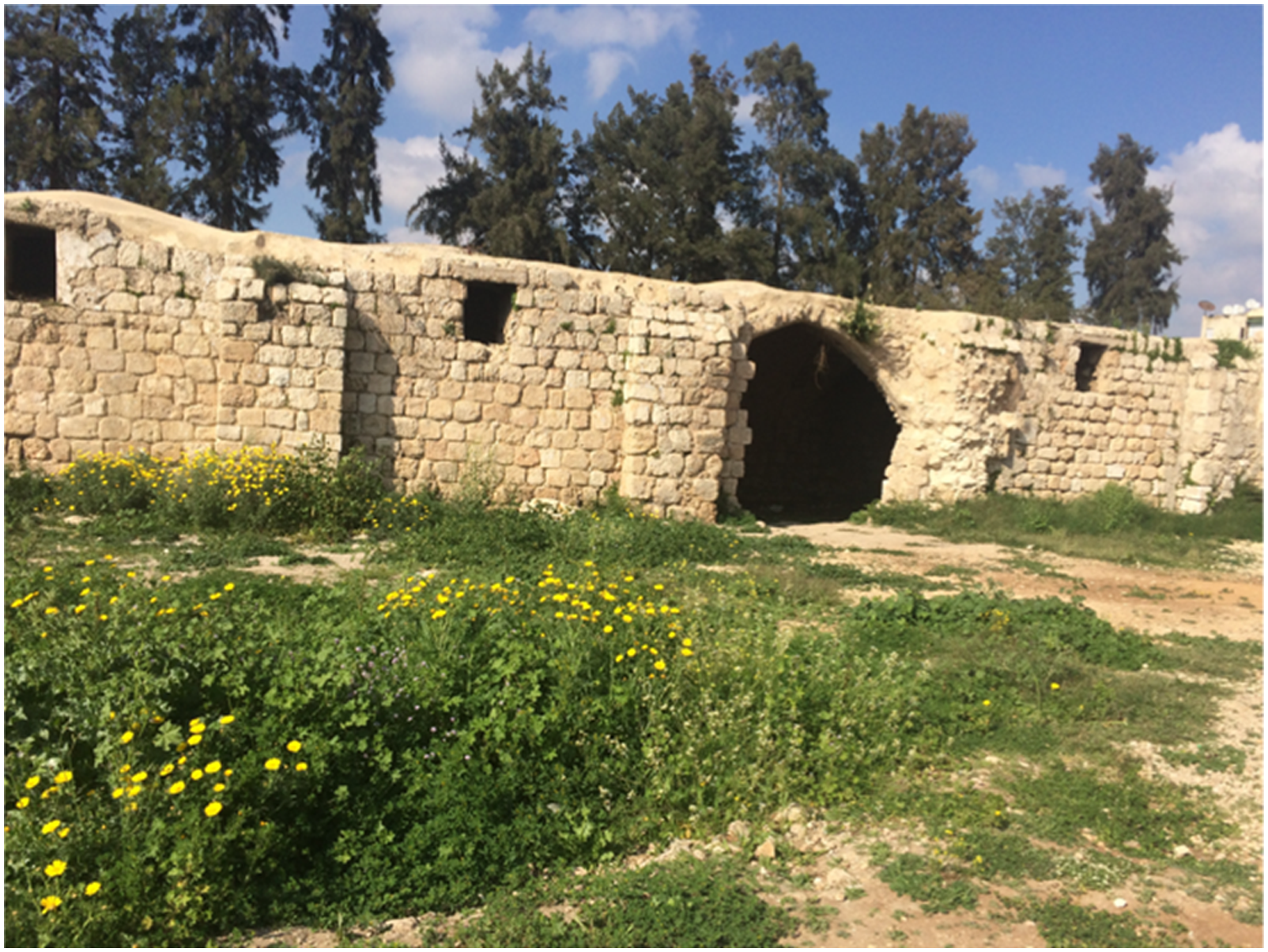
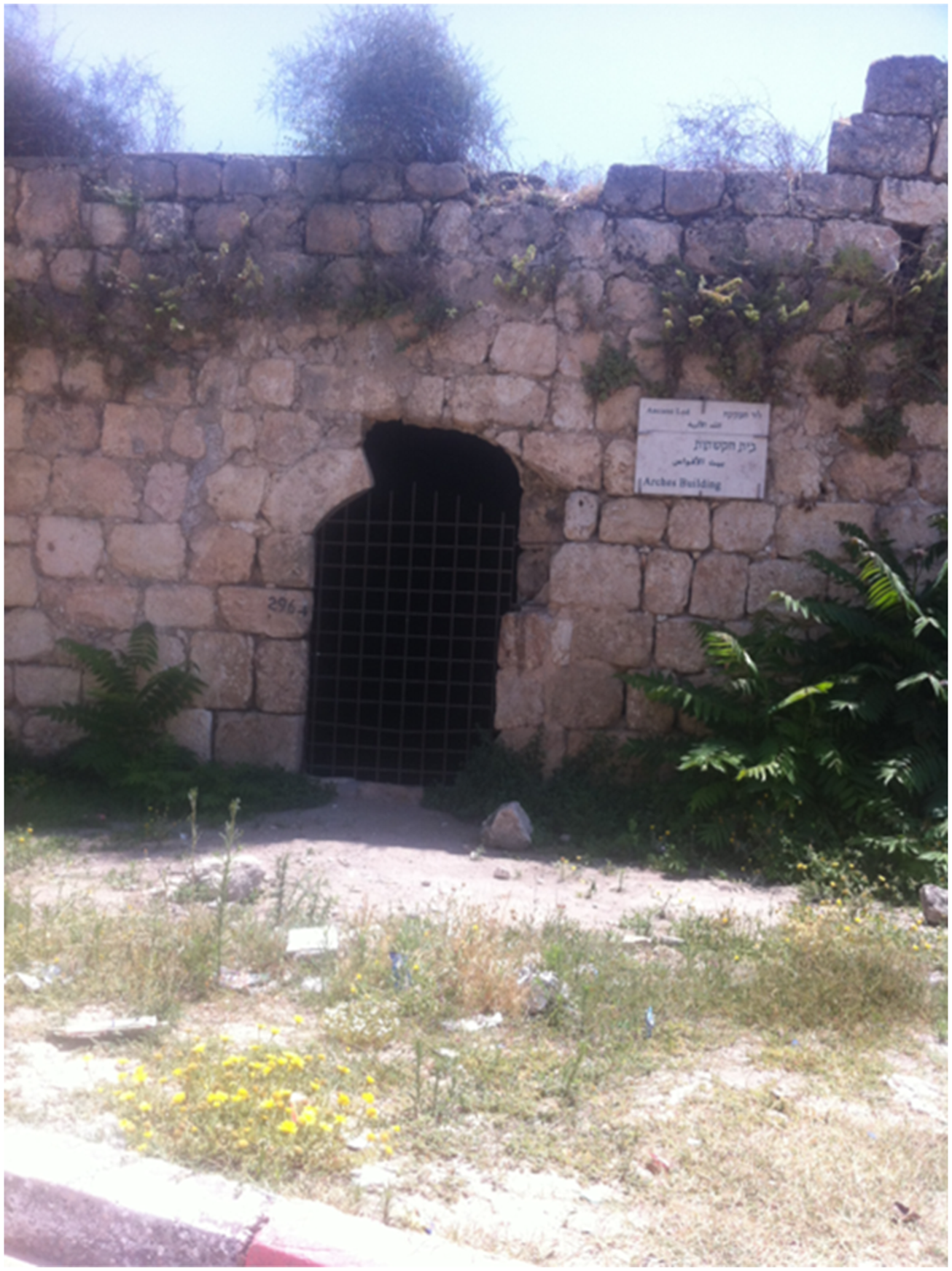
Despite the implied intercommunal interactions and mixing—between Muslim, Christian, and Jewish residents and merchants, as well as British and Ottoman officials due to the city’s prominent role in trade and transportation (Da’adli, 2019; Yacobi, 2009)—that have occurred in Lydd across history, the invocation of Lydd’s classification as a “mixed city” comes only in one form throughout the official recorded announcements around the museum’s opening, and the reference comes merely as a passing comment. At a committee meeting regarding the ribbon-cutting ceremony for the Shelby White and Leon Levy Lod Mosaic Archeological Center, Revivo stated, “Very soon our dream for the city—which itself is a mosaic of cultures—will come true when we inaugurate in Lod one of the most important museums in the country which will place Lod on the national map of cultures” (Lod Municipality, 2022). Reading the “mosaic of cultures” as analogous to the official mixed city classification of Lydd, Revivo attempts to give a nod to the other heritage sites that he positions as representing the diverse demographics of Lydd. Since at least 2014, this phrase and branding of Lydd has been a heavily used cliché referring to the city’s demographic diversity (Lod Municipality, 2014b, 2023). However, with the opening of the museum there is a shift away from Lydd’s branding as merely a mosaic of cultures. The pinnacle of Lydd’s identity as a historic site, in the way that Revivo discusses it, remains the unearthed Roman mosaic, and the mosaic’s presence is sufficient to solidify the “ancient historical city” identity. The museum may situate the mosaic as one heritage site amongst many in its urban connection map, motioning towards cohesion and unity amongst all these sites, each needing to be understood as an individual unit in the whole that is the “ancient historical city,” and the Municipality’s featured tourist attractions lists the mosaic alongside the House of Arches, the Ottoman soap factory, Khan el-Hilo—a caravansary (Figure 3)—and the adjoined Omari Mosque and Saint George Orthodox Church; however, these other heritage sites—even collectively—were not sufficient to embark on intense heritage preservation and urban branding efforts, and restoration activities for the Old City of Lydd, Khan el-Hilo, and the House of Arches (Figure 4) remain promises yet to be underway (Lod Municipality, 2022).
What Revivo’s comments bring to the fore is a question of why Lydd’s branding as a historical city, worthy of being a key tourism destination, comes only with the inauguration of this new museum when these other sites have been both known about for far longer than the Lydd mosaic and have been far more accessible given that they do not require the same scale of archaeological excavation as the buried mosaic did (Figure 5). Part of the answer to this question around prioritizing the mosaic over other more readily accessible heritage sites naturally contends with issues of financial feasibility and options available to the municipal authorities for heritage management. The Shelby White and Leon Levy Foundation’s funding and support of the museum construction eased the financial burden on the city for preserving and incorporating the mosaic into the city’s urban fabric and imagination; however, heritage management comes in many forms. An externally funded museum is just one approach, but each method and management style is imbued with varying connotations and agendas. The decision to wait for a private, third-party donor to facilitate the excavation of the mosaic and construction of the museum—as opposed to pressuring the Israeli Antiquities Authority to provide greater support or seeking international heritage conservation financing—forces a questioning of how the municipality weighed its options to pursue an “ancient history” identity for the city. Rather than expend its own financial and political capital to spearhead the campaign of rebranding Lydd—again, which would have been cheaper to do with other heritage sites as was mentioned above—the city waited for an option that would maximize its own financial benefit. Ultimately, though, this garners the question of whether Lydd would have fully embarked on a rebranding of the city as an ancient city had the Shelby White and Leon Levy Fund not financed the conservation efforts and museum. Old City soap factory in 2014 (photo by author).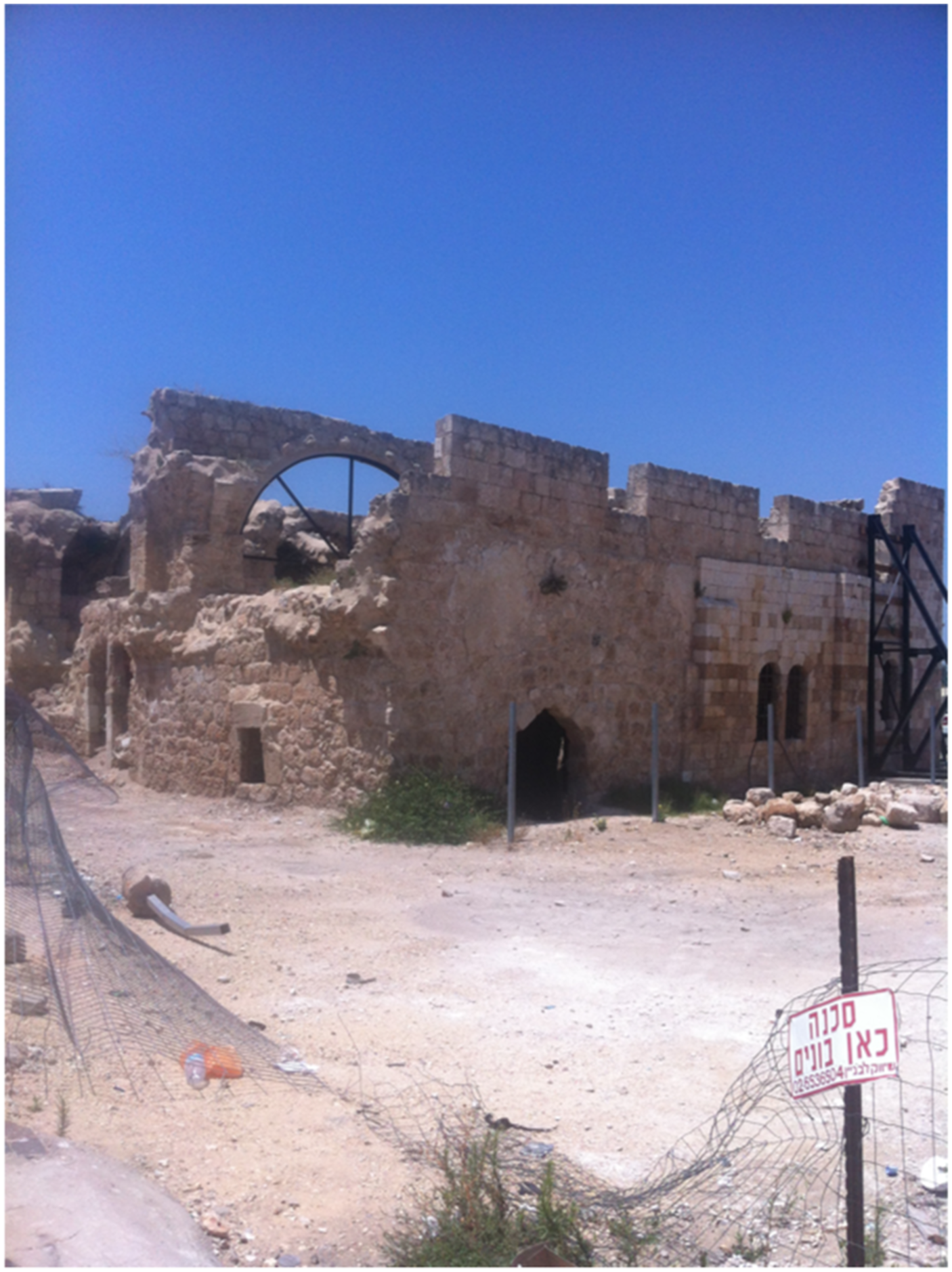
The Shelby White and Leon Levy Lod Mosaic Center’s heritage management philosophy was two-fold: to prioritize preservation and to use this heritage as an opportunity and source of education and community development (Gorzalczany and Shoeff, 2022; Matthews, n. d.). This question of community development and its relationship with the museum warrants further exploration as it is unclear what compromises or community work occurred to allow the project to move forward despite community disagreement and frustration with the museum’s establishment and plan (Gorzalczany and Shoeff, 2022). Heritage sites have no inherent capacity to resolve social strife and division, and the abstracted elevation of heritage as an opportunity for social change without clearly defining what community development looks like endows heritage with imaginative powers and obfuscates the responsibilities of heritage managers to truly engage the community. The programming, or lack thereof, by the municipality and museum to engage the local community—including elementary students at Al-Rushidiyya school down the street—emphasizes the divergence of narratives between the “mixed city” urban identity and the “ancient city” identity. While Revivo calls the city a “mosaic of cultures,” the mosaic that sits at the heart of the “ancient city” identity has little to do with presenting a multicultural narrative for the city. Turning to the second component of the museum’s philosophy—preservation—we see a clear contrast with the other heritage sites that are ostensibly also vital to constructing the “ancient city” identity. Heritage management for sites like the soap factory, Khan el-Hilo, and the House of Arches did not place preservation at the forefront. Heritage management instead manifests as urban renewal—a categorization of projects already laden with histories of destruction (Berman, 1982; Goldstein, 2022; Herscher, 2020; Jacobs, 1992; Lipsitz, 2007; Sa’di-Ibraheem, 2022; Smith, 2008; Stein, 2019). In contrast to the architectural plans for the Lydd mosaic, which revolved around the particularities of viewing the mosaic from multiple angles and future research, the development plans for the House of Arches heritage site center repurposing the building and its surrounding area for mixed uses (Lod Municipality n. d.a: 4). The historical narrative behind the House of Arches, which the mayor reiterates each time he invokes this site as part of Lydd’s identity as an “ancient historical city,” becomes obscured in the urban renewal plans for the area as the project leaders—comprised of municipal and national urban renewal authorities as well as the municipal economic department—emphasize the new housing constructions and employment opportunities offered by the development plans (Lod Municipality, n. d.a: 5). All of the presentation slides for this urban renewal project, as well as those for the core Old City urban renewal plan, focus on, and draw attention to, the new construction coming out of this project—standing in distinct juxtaposition to the ways that the mayor highlights these areas when he draws attention to the historic element of these sites in other references to them and their surroundings (Lod Municipality, n. d.a: 3, Lod Municipality, n. d.b: 3). Even the digital rendering of the renewal project obscures the historic House of Arches, as eyes are drawn not to the heritage sites that ostensibly sit at the heart of these projects—given that the renewal projects are named after the site—but instead attention is drawn to the tall buildings surrounding the heritage site, flattening these historic structures and uplifting the modern new buildings (Lod Municipality, n.d.a: 7). Important to note, though, there is a disjuncture between the presentation of these urban renewal plans in public-facing materials, such as the aforementioned slides, and the more technical urban renewal documents. Within the land-use maps for the urban renewal plans of House of Arches and the Old City, the structures of Khan el-Hilo, the soap factory, and the House of Arches are denoted for preservation (Lod Municipality, 2018b). So, while the public materials envelop these historical structures within the economic purpose their transformation might serve, preservation is not fully absent from the projects but its incorporation is still vaguely defined within the physical plans.
All of this representation and discourse around Lydd as a historic ancient city seems to largely sideline the official classification of the city as a “mixed city”—an identity that the municipality still upholds and values, at least at a performative level, given how its public-facing online presence defines the urban image of Lydd to be that which is “open” and pluralistic (Lod Municipality, n.d.a). The malleability of the “mixed city” identity for Lydd manifests in how and when the municipality offices choose to prioritize it as the premier identity for the city to espouse, recalling it as a cliché “mosaic” when talking about the Roman mosaic, but then not incorporating or developing this identity further. Through the lens of heritage management, the municipality fades the “mixed city” classification into the background, invoking it only as part of brief soundbites.
Conclusion
This close analysis of the discourse around Lydd’s heritage sites in light of the grand opening of the Shelby White and Leon Levy Lod Mosaic Archeological Center sought to explore how Lydd’s official classification as a “mixed city” emerges vis-à-vis heritage. The various heritage sites point to Lydd’s long past of intercommunal interactions within the city, offering the space to mobilize such pasts for political ends such as working to represent and hinting towards an atmosphere of multiculturalism and tolerance that would maintain the façade of mixed cities—and Israel more generally—as a pluralistic and equitable society (De Cesari, 2010). Ultimately, though, what the discourses and rhetoric around heritage highlight is not a narrative of multiculturalism that the nationally given “mixed city” identity attempts to perform. Rather, the municipality and private heritage entities construct Lydd’s identity in a manner that foregrounds an ancient history, incorporating a narrative of multicultural and intercommunal mix in an abstracted manner.
As it currently stands, heritage management has been a process molded to shape an urban identity for Lydd that focuses on the city’s long temporal past. The human texture that comprised such a history—the intercommunal mixing of the past, be they positive or negative interactions—is left undiscussed. Lydd’s identity as an “ancient city,” predicated on and heavily promoted through only the Roman mosaic, erases the rest of Lydd’s history—from its economic significance, as can be gleaned through Khan el-Hilo, and the trauma and violence of the Nakba, a history to be told through the Dahmash Mosque, to its experiences in the 2021 Unity Uprising, giving new meaning to the Old City as a public space. This reality of heritage and the associated identity for Lydd is not set in perpetuity. As Harvey (2001) reminds us, heritage is a dynamic, contextualized process constantly made and remade by power, politics, and people (Lefebvre, 1991: 68–168). Several local grassroots organizations, such as Tatheer Lydd and Halaqat Istiqbal, have led workshops and tours for the Palestinian community through these heritage sites left out of the “ancient city” identity to ensure that the histories of these heritage sites are remembered despite the urban development projects that work to sanitize and erase such histories. These organizations are claiming the space—whether they are invited to contribute or not (Miraftab, 2009)—to tell the history of Lydd being erased through both its nationally-given “mixed city” identity and the municipal “ancient city” identity, quietly and forcefully reminding us of the grassroots urban identities and the capacity for the grassroots to shape urban identities (Bayat, 2000). With the urban renewal processes in the Old City under deliberation, the state of heritage and its relationship to Lydd’s official mixed city classification may converge more prominently as urban actors—from the municipality and private companies to individuals and local organizations—seek to use heritage as a vehicle and tool to shape and reshape Lydd’s identity as a city.
Footnotes
Acknowledgments
I would like to thank Nour Munawar for convening the Post-Conflict Reconstruction of Cultural Heritage in MENA conference at the Doha Institute for Graduate Studies and Issam Nassar for his feedback on this article during the conference. Further thanks are extended to Hiba Bou Akar, Kylie Broderick, participants in the Columbia Urban Planning PhD Research Workshop, and three anonymous reviewers for their constructive feedback on various iterations and presentations of this article.
Declaration of conflicting interests
The author(s) declared no potential conflicts of interest with respect to the research, authorship, and/or publication of this article.
Funding
The author(s) received no financial support for the research, authorship, and/or publication of this article.